If $$a$$, $$b$$ and $$c$$ are real numbers such that the polynomial $$x^3 + 6x^2 + ax + b$$ is the cube of $$x + c$$, then
NMTC Bhaskara ( junior level) 9th and 10th oct 7 2023
For the following questions answer them individually
Solution
Expanding gives $$(x+c)^3 = x^3 + 3cx^2 + 3c^2x + c^3$$. Comparing coefficients gives $$3c = 6$$, so $$c = 2$$, $$a = 3c^2 = 12$$ and $$b = c^3 = 8$$. Hence $$a+b+c = 22$$, which is divisible by $$11$$.
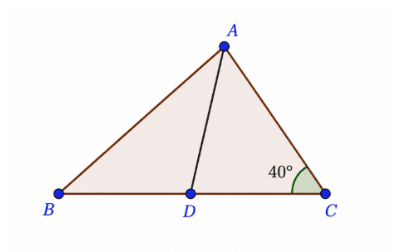
In the adjoining figure, $$AB = 9\text{ cm}$$, $$AC = 7\text{ cm}$$, $$BC = 8\text{ cm}$$, $$AD$$ is the median and $$\angle C = 40^\circ$$. Then the measure of $$\angle ADB$$ in degrees is
Solution
The three side lengths give $$\cos C = \frac{AC^2+BC^2-AB^2}{2\cdot AC\cdot BC} = \frac{2}{7}$$, so $$\angle C$$ is approximately $$73.4^\circ$$ and not $$40^\circ$$. Therefore no triangle satisfies all the stated conditions and none of the printed options is valid. The source treats this as a bonus problem, so the answer letter is only a required placeholder.
If $$x^2 + 6x + 1 = 0$$ and $$\frac{x^4+kx^2+1}{3x^3+kx^2+3x} = 2$$, then the value of $$k$$ is
Solution
Dividing $$x^2+6x+1=0$$ by $$x$$ gives $$x+\frac{1}{x}=-6$$, and hence $$x^2+\frac{1}{x^2}=34$$. Dividing the given fraction by $$x^2$$ changes it to $$\frac{k+34}{k-18}=2$$. Therefore $$k+34=2k-36$$, which gives $$k=70$$.
.webp)
If $$x = \sqrt[3]{49}+\sqrt[3]{42}+\sqrt[]{36}$$, then the value of $$x-\frac{1}{x^2}$$ is
Solution
Let $$p=\sqrt[3]{7}$$ and $$q=\sqrt[3]{6}$$. Then $$x=p^2+pq+q^2=\frac{p^3-q^3}{p-q}=\frac{1}{p-q}$$, so $$\frac{1}{x}=p-q$$. Thus $$x-\frac{1}{x^2}=p^2+pq+q^2-(p-q)^2=3pq=3\sqrt[3]{42}$$.
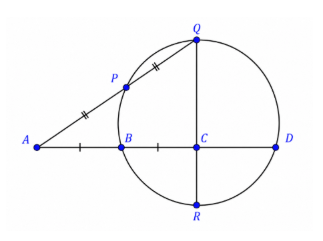
In the adjoining figure, $$AB = BC = CD$$. Point $$P$$ is the midpoint of $$AQ$$. If $$CR = 4$$ and $$QC = 12$$, then $$PQ$$ is equal to
Solution
Intersecting chords at $$C$$ give $$QC\cdot CR = BC\cdot CD$$, so the common length satisfies $$x^2=12\cdot4=48$$. Since $$P$$ is the midpoint of $$AQ$$, write $$AP=PQ=y$$ and $$AQ=2y$$. Using the two secants from $$A$$ gives $$AP\cdot AQ=AB\cdot AD$$, so $$2y^2=3x^2=144$$ and $$PQ=y=6\sqrt{2}$$. This value is not among the printed options, so the source treats the problem as a bonus and the answer letter is only a required placeholder.
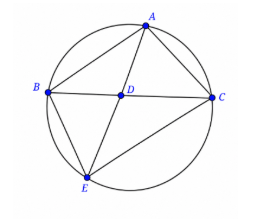
In the adjoining figure, $$A$$ is the midpoint of the arc $$BAC$$. Given that $$AB = 15$$ and $$AD = 10$$, the value of $$AB$$ is
Solution
The uploaded paper prints $$AB$$ in the final sentence, but $$AB=15$$ is already given and the diagram and options correspond to $$AE$$. Let $$M$$ be the midpoint of $$BC$$. Since $$AB=AC$$, $$AM$$ is perpendicular to $$BC$$, and $$DB\cdot DC = AB^2-AD^2 = 225-100=125$$. By the intersecting chords theorem, $$AD\cdot DE=DB\cdot DC$$, so $$DE=12.5$$ and $$AE=AD+DE=22.5$$.
.webp)
The number of real numbers $$x$$ which satisfy $$\frac{8^x+27^x}{12^x+18^x}=\frac{7}{6}$$ is
Solution
Put $$a=2^x$$ and $$b=3^x$$. The equation becomes $$\frac{a^3+b^3}{a^2b+ab^2}=\frac{7}{6}$$, which simplifies to $$6a^2-13ab+6b^2=0$$. Hence $$(3a-2b)(2a-3b)=0$$, giving $$\left(\frac{2}{3}\right)^x=\frac{2}{3}$$ or $$\left(\frac{2}{3}\right)^x=\frac{3}{2}$$. Therefore $$x=1$$ or $$x=-1$$, so there are $$2$$ real solutions.
$$a$$ , $$b$$ are real numbers such that $$2a^2+5b^2=20$$, then the maximum value of $$a^4b^6$$ is
Solution
Let $$u=a^2$$ and $$v=b^2$$, so $$2u+5v=20$$ and the expression is $$u^2v^3$$. The maximum occurs when the two resource terms are divided in the ratio of the exponents, so $$2u=8$$ and $$5v=12$$. Hence $$u=4$$, $$v=\frac{12}{5}$$ and the maximum is $$16\left(\frac{12}{5}\right)^3=\frac{27648}{125}=221.184$$. This value is not among the printed options, so the source treats the problem as a bonus and the answer letter is only a required placeholder.
The number of ordered pairs $$(x,y)$$ of integers such that $$x-y^2=4$$ and $$x^2+y^4=26$$ is
Solution
From $$x-y^2=4$$, we get $$x=4+y^2$$. Substitution into the second equation gives $$(4+y^2)^2+y^4=26$$, or $$y^4+4y^2-5=0$$. This factors as $$(y^2+5)(y^2-1)=0$$, so the integer values are $$y=1$$ and $$y=-1$$, with $$x=5$$ in both cases. Thus there are $$2$$ ordered pairs.
.webp)
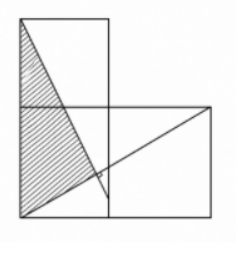
In the adjoining figure, three equal squares are placed. The squares are unit squares The area of the shaded region in $$(incm^2)$$ is
Solution
Place the lower left square on coordinates from $$(0,0)$$ to $$(1,1)$$. The two slanted boundaries of the shaded triangle have equations $$y=2-2x$$ and $$y=\frac{x}{2}$$, so they intersect at $$\left(\frac{4}{5},\frac{2}{5}\right)$$. The shaded triangle has a vertical base of length $$2$$ and horizontal height $$\frac{4}{5}$$. Its area is $$\frac{1}{2}\cdot2\cdot\frac{4}{5}=\frac{4}{5}$$.
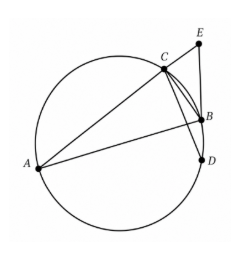
In the adjoining figure, $$AB$$ is a diameter of the circle. Given $$\angle BAC=20^\circ$$ and $$\angle AEB=56^\circ$$, the measure of $$\angle BCD$$ in degrees is
Solution
Since $$AB$$ is a diameter, $$\angle ACB=90^\circ$$. Points $$A$$, $$C$$ and $$E$$ are collinear, so triangle $$AEB$$ gives $$\angle ABE=180^\circ-20^\circ-56^\circ=104^\circ$$, and because $$E$$, $$B$$ and $$D$$ are collinear, $$\angle ABD=76^\circ$$. Also $$\angle ADB=\angle ACB=90^\circ$$ because both subtend chord $$AB$$. Hence $$\angle BAD=180^\circ-76^\circ-90^\circ=14^\circ$$, and $$\angle BCD=\angle BAD=14^\circ$$ because both subtend chord $$BD$$.
The number of ordered pairs $$(m,n)$$ of integers such that $$1\le m,n\le100$$ and $$m^n\cdot n^m$$ leaves a remainder of $$1$$ when divided by $$4$$ is
Solution
Both numbers must be odd. For odd exponents, the product is congruent to $$mn$$ modulo $$4$$, so the remainder is $$1$$ exactly when both numbers are congruent to $$1$$ modulo $$4$$ or both are congruent to $$3$$ modulo $$4$$. There are $$25$$ numbers of each type from $$1$$ to $$100$$. Hence the number of ordered pairs is $$25^2+25^2=1250$$.
The number of ordered pairs of positive integers $$(x,y)$$ satisfying the equation $$x^2+4y=3x+16$$ is
Solution
Rearranging gives $$x^2-3x+4y-16=0$$. Treating this as a quadratic in $$x$$, the discriminant is $$73-16y$$ and must be a nonnegative perfect square. The possible positive values are $$y=3$$ and $$y=4$$, producing the positive solutions $$(4,3)$$ and $$(3,4)$$. Therefore there are $$2$$ ordered pairs.
The algebraic expression $$(a+b+ab+2)^2+(a-ab+2-b)^2-2b^2(1+a^2)$$ reduces to
Solution
Write the first two squares as $$((a+2)+(b+ab))^2$$ and $$((a+2)-(b+ab))^2$$. Their sum is $$2(a+2)^2+2(b+ab)^2$$. Since $$(b+ab)^2=b^2(1+a)^2$$, subtracting $$2b^2(1+a^2)$$ leaves $$2(a+2)^2+4ab^2$$.
The sum of $$(1\times4)+(2\times7)+(3\times10)+(4\times13)+\cdots$$ for $$49$$ terms is equal to
Solution
The $$n$$th term is $$n(3n+1)=3n^2+n$$. Therefore the sum is $$3\sum_{n=1}^{49}n^2+\sum_{n=1}^{49}n$$. Using the standard sums gives $$3\cdot\frac{49\cdot50\cdot99}{6}+\frac{49\cdot50}{2}=122500$$.
If the equations $$x^3+ax+1=0$$ and $$x^4-ax^2+1=0$$ have a common root, then the value of $$a^2$$ is
Backspace
789
456
123
0.-
Clear All
789
456
123
0.-
Clear All
Solution
Eliminating the common root gives the condition $$4a^4-4a^3+4a^2+7a+2=0$$, which does not determine one unique value of $$a^2$$. Therefore the problem has no single numerical answer and the source treats it as a bonus. The value $$0$$ is only a required placeholder.
If $$a$$, $$b$$, $$c$$ and $$d$$ are positive reals such that $$abcd=1$$, then the maximum value of $$a^2+b^2+c^2+d^2+ab+ac+ad+bc+bd+cd$$ is
Backspace
789
456
123
0.-
Clear All
789
456
123
0.-
Clear All
Solution
Take $$a=b=t$$ and $$c=d=\frac{1}{t}$$, which keeps $$abcd=1$$. The expression then contains the term $$2t^2$$ and grows without bound as $$t$$ increases. Hence no finite maximum exists, so the source treats this as a bonus and $$0$$ is only a required placeholder.
The sum of all natural numbers $$n$$ for which $$n(n+1)$$ is a perfect square is
Backspace
789
456
123
0.-
Clear All
789
456
123
0.-
Clear All
Solution
Since $$n$$ and $$n+1$$ are coprime, their product can be a square only when both are perfect squares. The only consecutive perfect squares are $$0$$ and $$1$$, which would give $$n=0$$. As the paper uses natural numbers beginning with $$1$$, there is no valid value of $$n$$, so the required sum is $$0$$.
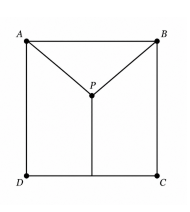
Point $$P$$ is inside the square $$ABCD$$ such that $$PA=PB$$ = Distance of $$P$$ from $$CD$$. The ratio of the area of triangle $$PAB$$ to the area of square $$ABCD$$ is $$\frac{m}{n}$$, where $$m$$ and $$n$$ are relatively prime integers. Then the value of $$m+n$$ is
Backspace
789
456
123
0.-
Clear All
789
456
123
0.-
Clear All
Solution
Let the side of the square be $$s$$ and the distance from $$P$$ to $$CD$$ be $$y$$. Since $$PA=PB$$, point $$P$$ lies on the perpendicular bisector of $$AB$$, and $$PA^2=(s-y)^2+\left(\frac{s}{2}\right)^2=y^2$$. This gives $$5s=8y$$. Therefore the area ratio is $$\frac{\frac{1}{2}s(s-y)}{s^2}=\frac{s-y}{2s}=\frac{3}{16}$$, so $$m+n=3+16=19$$.
The sum of the roots of the simultaneous equations $$\sqrt[y]{4^x}=32\sqrt[x]{8^y}$$ and $$\sqrt[y]{3^x}=3\sqrt[y]{9^{1-y}}$$ is
Backspace
789
456
123
0.-
Clear All
789
456
123
0.-
Clear All
Solution
Rewriting the equations with exponents gives $$\frac{2x}{y}=5+\frac{3y}{x}$$ and $$\frac{x}{y}=\frac{2}{y}-1$$. Put $$p=\frac{x}{y}$$. The first equation gives $$2p^2-5p-3=0$$, so $$p=3$$ or $$p=-\frac{1}{2}$$, and the second gives the pairs $$\left(\frac{3}{2},\frac{1}{2}\right)$$ and $$(-2,4)$$. In both pairs, $$x+y=2$$.
If $$2\sqrt{3+\sqrt{5-\sqrt{13+\sqrt{48}}}}=\sqrt{a}+\sqrt{b}$$, where $$a$$ and $$b$$ are natural numbers, then the value of $$a+b$$ is
Backspace
789
456
123
0.-
Clear All
789
456
123
0.-
Clear All
Solution
Since $$\sqrt{13+\sqrt{48}}=\sqrt{13+4\sqrt{3}}=2\sqrt{3}+1$$, the next radical is $$\sqrt{4-2\sqrt{3}}=\sqrt{3}-1$$. Thus the outer expression becomes $$2\sqrt{2+\sqrt{3}}$$. Since $$\sqrt{2+\sqrt{3}}=\frac{\sqrt{6}+\sqrt{2}}{2}$$, the expression equals $$\sqrt{6}+\sqrt{2}$$. Hence $$a+b=6+2=8$$.
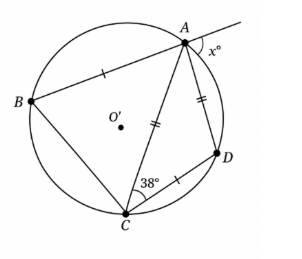
In the adjoining figure, $$\angle ACD=38^\circ$$. Then the measure of angle $$x$$ in degrees is
Backspace
789
456
123
0.-
Clear All
789
456
123
0.-
Clear All
Solution
The equal side marks give $$AD=CD$$, so $$\angle CAD=\angle ACD=38^\circ$$ and $$\angle ADC=104^\circ$$. Since $$ABCD$$ is cyclic, $$\angle ABC=180^\circ-104^\circ=76^\circ$$. The other equal side marks give $$AB=AC$$, so $$\angle BCA=76^\circ$$. The exterior angle at $$A$$ equals the opposite interior angle $$\angle BCD=76^\circ+38^\circ=114^\circ$$.
If $$\frac{a}{b+c}+\frac{c}{a+b}=\frac{2b}{c+a}$$, where $$a+b$$, $$b+c$$, $$c+a$$ and $$a+b+c$$ are all nonzero, then the numerical value of $$\frac{a^2+c^2}{b^2}$$ is
Backspace
789
456
123
0.-
Clear All
789
456
123
0.-
Clear All
Solution
Multiplying the given equation by $$(a+b)(b+c)(c+a)$$ and simplifying gives $$(a+b+c)(a^2-2b^2+c^2)=0$$. Since $$a+b+c$$ is nonzero, we must have $$a^2+c^2=2b^2$$. Therefore $$\frac{a^2+c^2}{b^2}=2$$.
The geometric and arithmetic means of two positive numbers are respectively $$8$$ and $$17$$. The larger of the two numbers is
Backspace
789
456
123
0.-
Clear All
789
456
123
0.-
Clear All
Solution
Let the numbers be $$u$$ and $$v$$. Then $$u+v=34$$ and $$uv=64$$, so they are the roots of $$t^2-34t+64=0$$. The roots are $$17\pm\sqrt{17^2-8^2}=17\pm15$$, giving $$32$$ and $$2$$. Hence the larger number is $$32$$.
The number of two-digit numbers in which the tens digit and the units digit are different and both odd is
Backspace
789
456
123
0.-
Clear All
789
456
123
0.-
Clear All
Solution
The units digit can be any of the $$5$$ odd digits $$1,3,5,7,9$$. After choosing it, the tens digit can be any of the remaining $$4$$ odd digits. Hence the total number is $$5\times4=20$$.
The value of $$(5\sqrt[3]{4}-3\sqrt[3]{\frac{1}{2}})(12\sqrt[3]{2}+\sqrt[3]{16}-2\sqrt[3]{2})$$ is
Backspace
789
456
123
0.-
Clear All
789
456
123
0.-
Clear All
Solution
Let $$t=\sqrt[3]{2}$$, so $$t^3=2$$, $$\sqrt[3]{4}=t^2$$, $$\sqrt[3]{\frac{1}{2}}=\frac{1}{t}$$ and $$\sqrt[3]{16}=2t$$. The expression becomes $$\left(5t^2-\frac{3}{t}\right)(12t)$$. This equals $$12(5t^3-3)=12(10-3)=84$$.
If $$\frac{xy}{x+y}=1$$, $$\frac{yz}{y+z}=2$$ and $$\frac{zx}{z+x}=3$$, then the numerical value of $$15x-7y-z$$ is
Backspace
789
456
123
0.-
Clear All
789
456
123
0.-
Clear All
Solution
Taking reciprocals gives $$\frac{1}{x}+\frac{1}{y}=1$$, $$\frac{1}{y}+\frac{1}{z}=\frac{1}{2}$$ and $$\frac{1}{z}+\frac{1}{x}=\frac{1}{3}$$. Solving these linear equations gives $$x=\frac{12}{5}$$, $$y=\frac{12}{7}$$ and $$z=-12$$. Therefore $$15x-7y-z=36-12+12=36$$.
The sum of all natural numbers which satisfy the simultaneous inequations $$x+3<4+2x$$ and $$5x-3<4x-1$$ is
Backspace
789
456
123
0.-
Clear All
789
456
123
0.-
Clear All
Solution
The first inequality gives $$x>-1$$, while the second gives $$x<2$$. Thus $$-1<x<2$$. The only natural number in this interval is $$x=1$$, so the required sum is $$1$$.
In an increasing geometric progression with $$1st$$ term $$a$$ and $$n$$th term $$t_n$$, the difference between the fourth and first terms is $$52$$ and the sum of the first three terms is $$26$$. Then the numerical value of $$\frac{t_{2024}}{t_{2023}}+\frac{a^{2024}}{a^{2023}}$$ is
Backspace
789
456
123
0.-
Clear All
789
456
123
0.-
Clear All
Solution
If the common ratio is $$r$$, then $$a(r^3-1)=52$$ and $$a(1+r+r^2)=26$$. Since $$r^3-1=(r-1)(1+r+r^2)$$, division gives $$r-1=2$$, so $$r=3$$. Substitution gives $$a=2$$. Therefore $$\frac{t_{2024}}{t_{2023}}+\frac{a^{2024}}{a^{2023}}=r+a=3+2=5$$.
The base of a triangle is $$4$$ units less than the altitude drawn to it. The area of the triangle is $$96\text{ units}^2$$. The ratio of the base to the height is $$\frac{p}{q}$$, where $$p$$ and $$q$$ are relatively prime. Then the value of $$p+q$$ is
Backspace
789
456
123
0.-
Clear All
789
456
123
0.-
Clear All
Solution
Let the height be $$h$$, so the base is $$h-4$$. The area condition gives $$\frac{1}{2}h(h-4)=96$$, or $$h^2-4h-192=0$$. The positive root is $$h=16$$, so the base is $$12$$. Therefore the ratio is $$\frac{12}{16}=\frac{3}{4}$$ and $$p+q=3+4=7$$.