
 Group
Group
 Group
Group


 Preferred Source

 Google Discover
New IITs vs Old IITs
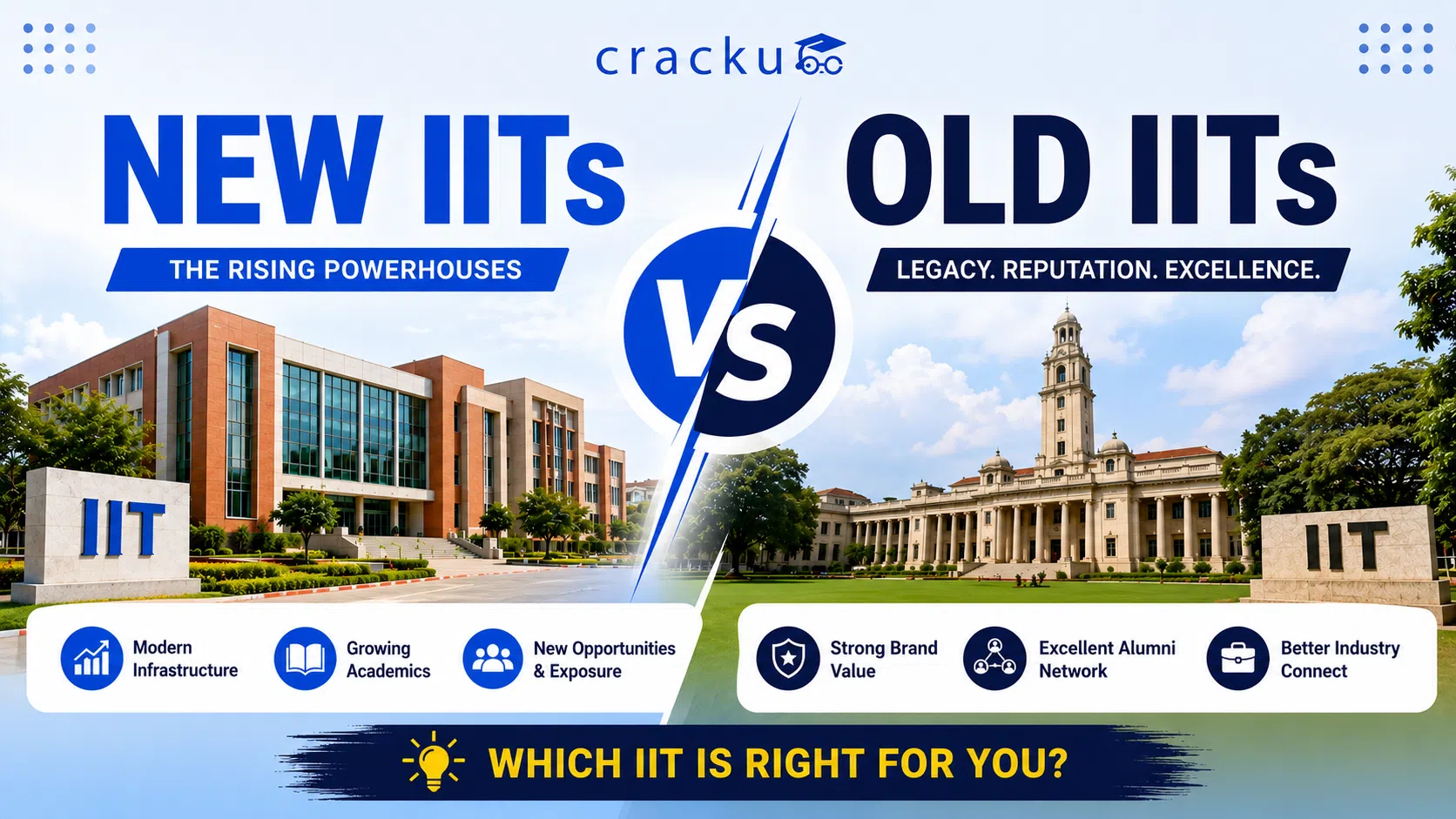
Old IITs are the 1st Generation IITs, established between 1951 and 1961. New IITs fall into two distinct groups: 2nd Generation IITs, established around 2008 to 2009 (including IIT Hyderabad, IIT Indore, and IIT Gandhinagar), and 3rd Generation IITs, established around 2015 to 2016 (including IIT Bhilai, IIT Jammu, and IIT Goa). Newer IITs are developing rapidly in terms of recognition, academics, education quality, and facilities, but old IITs continue to hold a stronger reputation and industry connection that new IITs are still working to achieve. Old IITs remain the first choice of JEE top rankers even today.
With 23 IITs now functioning across India, choosing between an old IIT and a new IIT is more complicated than it was a few years back. A popular discussion among IIT aspirants is that the brand value of IITs is slowly diluting as the number of institutes grows. New IITs are still developing; placements are growing at new IITs, but they still lag in infrastructure, faculty expertise, and alumni network. Old IITs, on the other hand, offer strong placements but often at a higher academic cost in terms of competition.
Key Differences Between Old IITs and New IITs
While new IITs have been steadily picking up pace with old IITs, several key challenges, from inadequate infrastructure to faculty shortages, continue to affect their brand name and value. Experts have characterised the difference between old IITs and new IITs as one of maturity versus velocity: old IITs have decades of established systems, while new IITs are growing faster but from a much smaller base. Before comparing the advantages and disadvantages of old IITs versus new IITs, if you are targeting one of the top IITs, check Cracku's JEE Study Material for learning the concepts and theories tested in the exam. In the engineering field, old IITs are still generally preferred over new IITs, though developments at newer campuses are narrowing the gap. The table below compares the key differences between old IITs and new IITs across the parameters that matter most to prospective students.
Parameter | Old IITs (1st Generation) | New IITs (2nd and 3rd Generation) |
|---|---|---|
Locations | Kharagpur, Bombay, Madras, Kanpur, Delhi, Guwahati, and Roorkee | Bhubaneswar, Gandhinagar, Hyderabad, Jodhpur, Patna, Ropar, Indore, Mandi, Palakkad, Tirupati, Bhilai, Goa, Jammu, Dharwad, and the Indian School of Mines, Dhanbad |
Infrastructure | Well developed but old | New but still developing |
Faculty | Experienced and sufficient | Shortage with lesser experience |
Placements | Consistently higher median packages | Improving since establishment |
Student Reviews | Always preferred first over regional institutions and reputed private colleges | Enriching experience with multiple opportunities to learn and grow in a dynamic culture |
Top Ranked IITs | IIT Madras, IIT Delhi, IIT Bombay, IIT Kanpur, IIT Kharagpur, and IIT Roorkee | IIT Hyderabad |
Campus Culture | Academic and research oriented | Entrepreneurial, based on student opinions |
Also Read: Best Engineering Colleges In India 2026, IIT, NIT & IIIT Details
Placement Comparison of Old IITs and New IITs
Before comparing placements at old versus new IITs, it is worth noting that the All IITs Placement Committee (AIPC) updated its placement rules, directing students at all 23 IITs to remove JEE Advanced ranks and GATE scores from their resumes to ensure fairness in the recruitment and selection process. This policy remains active for the current placement cycle. The table below lists the generation of each IIT alongside its NIRF Engineering 2025 rank and median placement package. While most of the highest packages are offered at old IITs, IIT Hyderabad, a 2nd Generation IIT, has recorded a median package on par with several old IITs.
IIT | Generation | NIRF Engineering 2025 | Median Package |
|---|---|---|---|
IIT Madras | 1st Generation (Old) | 1 | Rs. 19 to 19.6 LPA |
IIT Delhi | 1st Generation (Old) | 2 | Rs. 20 LPA |
IIT Bombay | 1st Generation (Old) | 3 | Rs. 20 LPA |
IIT Kanpur | 1st Generation (Old) | 4 | Rs. 21.7 LPA |
IIT Kharagpur | 1st Generation (Old) | 5 | Rs. 13 to 13.5 LPA |
IIT Roorkee | 1st Generation (Old) | 6 | Rs. 16 to 18 LPA |
IIT Guwahati | 1st Generation (Old) | 7 | Rs. 21.6 LPA |
IIT Hyderabad | 2nd Generation (New) | 8 | Rs. 18 to 19 LPA |
IIT BHU | Older (Converted IIT) | 10 | ~Rs. 14 LPA |
IIT Indore | 2nd Generation (New) | 14 | Rs. 15.2 LPA |
IIT (ISM) Dhanbad | Older (Converted IIT) | 15 | ~Rs. 12 LPA |
IIT Gandhinagar | 2nd Generation (New) | 16 | ~Rs. 13 LPA |
Also Read: Best ROI Engineering Colleges in India, Fees, Placements
Campus Life and Infrastructure at Different IITs
Campus life at newer IITs is shaped largely by the energy of the student body and the batch culture, while at older IITs, campus life is more academic and research oriented, reflecting decades of established institutional culture. As per an official release, by 2028-29, all five IITs established after 2014 are expected to have world-class infrastructure comprising academic buildings, research parks, and hostels.
The table below summarises infrastructure delays recorded at select new IITs since 2012.
IIT | Infrastructure Delay (Since 2012) |
|---|---|
IIT Hyderabad | 56 months |
IIT Mandi | 41 months |
IIT Ropar | 39 months |
IIT Gandhinagar | 37 months |
IIT Indore | 37 months |
Also Read: Top 10 Engineering Colleges in India 2026, Placements & ROI
Branch vs College: What Should You Prioritize?
Earlier, the branch versus college debate was shaped mostly by numbers such as placement package and ranking. Over the last decade, however, student priorities have shifted. Long-term stability and market opportunity now play a more critical role in deciding between branch and college than they once did.
CSE has always been the top choice among JEE aspirants, but with the rapid growth of AI and automation, priorities, including renewed interest in core branches, are beginning to shift.
JoSAA 2026 Round 1 data tells a clear story. CSE at IIT Bombay closed around AIR 65, while Civil closed past 4,300. Nearly every top-100 ranker still picks Computer Science. What this suggests is not a mass migration from silicon to cement; rather, students beyond the top 100 ranks appear to be making more deliberate and less herd-driven choices when weighing branch against college.
So what should you prioritise: branch or college? The answer depends on more than one factor. Compare placement trends, but also stay updated on the evolving scope of core sectors, alongside fast-growing fields like Data Science and Automation. Choose your branch based on meaningful long-term work rather than short-term popularity or salary alone.
With JoSAA counselling ongoing, prospective JEE aspirants may benefit from Cracku's JEE Question Bank for focused practice.
How to Prioritise the Right College
Here is how to evaluate your IIT options, from new to old, and choose the best fit for your future.
A recent performance audit by the CAG flagged noticeable delays in the construction of academic buildings, hostels, and labs, which continue to affect campus life and infrastructure at new IITs
While new IITs still need to work on campus life and infrastructure, old IITs have built and sustained quality infrastructure over decades
New IITs also face a drawback in the sheer quantity of their infrastructure, but this gap has given rise to institution-building roles for faculty and students that foster a pioneering spirit not always present at more established campuses
If you value the ecosystem, alumni network, research opportunities, and peer group, choose a core branch at an old IIT like IIT Bombay, IIT Delhi, or IIT Madras.
If your JEE Advanced AIR sits just outside the cutoff for CSE at older IITs, roughly in the top 1,000 to 3,000 range, consider a core branch at a top-3 IIT over CSE at a 2nd or 3rd generation IIT if you value the alumni network and research ecosystem more
Give more weight to institute reputation and peer network than to branch choice alone, particularly in the middle rank bands
Shift your thinking from short-term opportunity to long-term conviction when making your final decision
New IITs vs Old IITs: Conclusion
New IITs vs Old IITs is an important comparison for JEE aspirants during JoSAA counselling because the decision affects academics, placements, peer group, campus life, and long-term career growth. Old IITs still hold a clear advantage in brand value, alumni network, recruiter trust, research ecosystem, and overall campus maturity. They remain the preferred choice for many top JEE rankers, especially for students who want strong exposure, established academic systems, and long-term institutional reputation.
At the same time, New IITs are improving rapidly in placements, infrastructure, academics, and industry connections. Institutes like IIT Hyderabad, IIT Indore, and IIT Gandhinagar have already built strong reputations among newer IITs. Students should not choose only by the IIT tag or branch popularity. Instead, compare median package, placement percentage, faculty strength, infrastructure, alumni network, branch interest, and future career goals before making the final choice