MAH MBA CET Sample Paper 2026
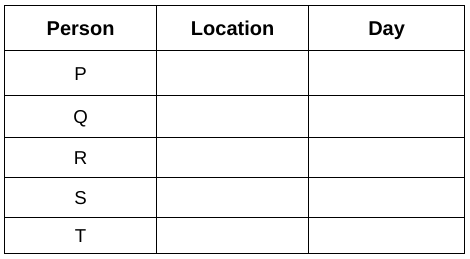
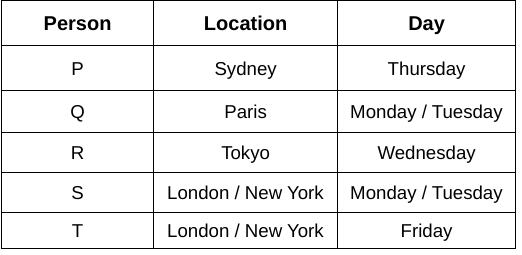
Five friends, P, Q, R, S, and T, attended a series of five conferences in different cities: New York, London, Tokyo, Paris, and Sydney. Each friend attended a conference in a different city, and they attended the conferences on different days of the week: Monday, Tuesday, Wednesday, Thursday, and Friday. We have the following information about which person attended which conference and on which day:
1. P attended the conference in Sydney
2. T attended the conference on Friday and Q attended the conference in Paris.
3. The person who attended the Tokyo conference did so on Wednesday.
4. S and Q attended the conference on consecutive days and none went to Tokyo.
MAH MBA CET Sample Paper 2026 - Question 111
If S went to London on Tuesday, Q went to _____________ ?
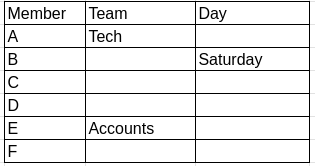
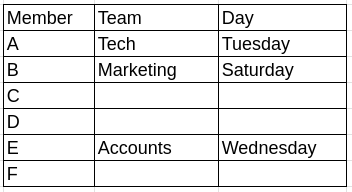
In XYZ company, six employees—A, B, C, D, E, and F—belong to different teams: Tech, Marketing, Design, Networking, Accounts, and Sales, not necessarily in the same order. Each employee visits the office on a different day from Monday to Saturday. The following details are known about the six employees.
1) A who belongs to Tech team doesn't visit on Thursday and C is not from marketing and did not visit on Friday.
2) E is from Accounts team and B visits on Saturday. While employee from Design did not visit on Saturday.
3) The employee from sales team visits on Monday and the employee from Network team visits on Friday.
4) Employee from Tech and sales visited on consecutive days while the employees from Tech and Design did not.
MAH MBA CET Sample Paper 2026 - Question 112
On which day did E visit the office?
MAH MBA CET Sample Paper 2026 - Question 113
How many different combinations of team and visiting day are possible for the six employees?
MAH MBA CET Sample Paper 2026 - Question 114
If F is from sales team which team does D belong to?
The following table represents data about the number of families residing in buildings A and B of the pink apartment for different years. The table also represents the the number of families with less than 4 members and the number of families with more than 6 members as a percentage of a total number of families in both buildings combined.

Use the data provided in the table above to answer the FOUR questions that follow:
MAH MBA CET Sample Paper 2026 - Question 115
In which of the following years did the number of families with less than 4 members in pink apartments decrease compared to last year?
MAH MBA CET Sample Paper 2026 - Question 116
If no family in a pink apartment had more than eight and less than two members, what is the lowest number of people that could have been living Pink apartment for the year 2021?
(Assume that only the families mentioned in the table are present in the apartment).
MAH MBA CET Sample Paper 2026 - Question 117
If no family in a pink apartment had more than eight and less than two members, what is the highest number of people that could have been living Pink apartment for the year 2018?
(Assume that only the families mentioned in the table are present in the apartment).
MAH MBA CET Sample Paper 2026 - Question 118
What is the difference (approximate) between the average number of families that stayed in buildings A and B over the given 7 years?
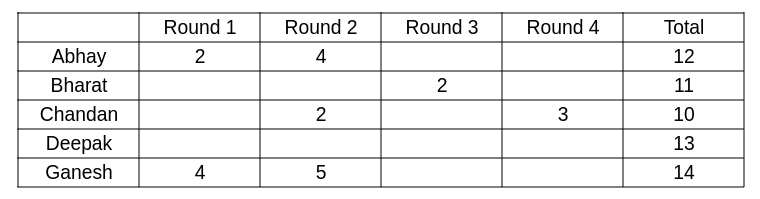
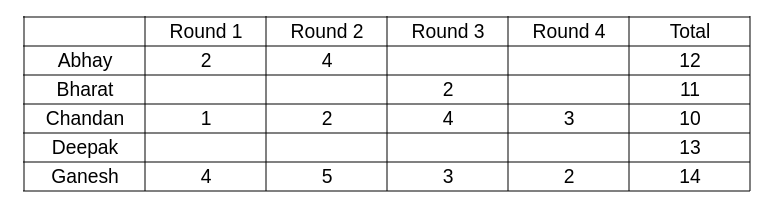
Five friends are playing a game consisting of several rounds. In each round, every friend is assigned a unique score ranging from 1 to 5, ensuring no two friends receive the same score in that round. It is also known that each friend obtained a different score in each round. The provided table presents partial details about the scores earned by each friend in different rounds, along with their total scores across all rounds. Using this information, answer the following questions.