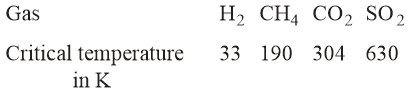
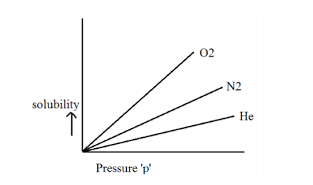
Given below are two statements :
Given : Molar mass of C, H, O, Cl are 12, 1, 16 and 35.5 g mol$$^{-1}$$, respectively
Statement I : In 30% (w/w) solution of methanol in CCl$$_4$$(at T K), the mole fraction of CCl$$_4$$ is equal to 0.33.
Statement II : Mixture of methanol and CCl$$_4$$ shows positive deviation from Raoult's law.
In the light of the above statements, choose the correct answer from the options given below :
JEE Solutions Questions
Consider a solution of $$CO_{2} (g)$$ dissolved in water in a closed container.
Which one of the following plots correctly represents variation of log (partial pressure of $$CO_{2}$$ in vapour phase above water) [y-axis] with log (mole fraction of $$CO_{2}$$ in water) [x-axis] at $$ 25^{o}C $$?
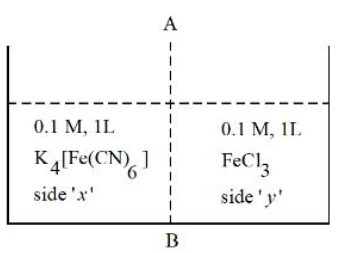
At 27 °C, 0.1 M, 1 L K$$_4$$[Fe(CN)$$_6$$] aqueous solution and 0.1 M, 1 L FeCl$$_3$$ aqueous solution are placed in a container separated by a semi permeable membrane AB. Assume complete dissociation of both the solutes. Which of the following statement is correct?
Osmotic pressure of a dilute solution is given by the van’t Hoff relation
$$\Pi = i\,C\,R\,T$$
where $$i$$ is the van’t Hoff factor (total ions produced per formula unit), $$C$$ is the molarity, $$R$$ is the gas constant and $$T$$ is the absolute temperature. At the same temperature and with equal volumes, the solution having the larger value of $$i\,C$$ possesses the larger osmotic pressure and is called hypertonic; the other one is hypotonic.
Step 1 : Dissociation and van’t Hoff factors
For $$K_4[Fe(CN)_6]$$: $$K_4[Fe(CN)_6] \rightarrow 4\,K^{+} + [Fe(CN)_6]^{4-}$$
Total ions = $$4 + 1 = 5 \;\Rightarrow\; i_x = 5$$
For $$FeCl_3$$: $$FeCl_3 \rightarrow Fe^{3+} + 3\,Cl^{-}$$
Total ions = $$1 + 3 = 4 \;\Rightarrow\; i_y = 4$$
Step 2 : Particle (osmotic) concentrations
Both solutions have the same molarity $$C = 0.1\,$$M.
Side x (containing $$K_4[Fe(CN)_6]$$): $$i\,C = 5 \times 0.1 = 0.50\;\text{mol L}^{-1}$$
Side y (containing $$FeCl_3$$): $$i\,C = 4 \times 0.1 = 0.40\;\text{mol L}^{-1}$$
Step 3 : Comparison of osmotic pressures
Because $$\Pi \propto i\,C$$ at the same $$T$$,
$$\Pi_x = 0.50\,R\,T \gt \Pi_y = 0.40\,R\,T$$
Therefore side x is hypertonic (higher osmotic pressure) and side y is hypotonic (lower osmotic pressure).
Step 4 : Verification of the given options
A. Prussian blue forms only if $$Fe^{3+}$$ meets $$[Fe(CN)_6]^{4-}$$. The semipermeable membrane blocks solute ions, so no mixing, no precipitate.
B. By definition, ionic solutes cannot pass through a semipermeable (osmotic) membrane — only the solvent moves.
C. As shown above, the $$FeCl_3$$ side (solution y) has the lower osmotic pressure, hence it is hypotonic — this statement is correct.
D. Reverse osmosis would require pressure on the hypertonic side (side x). Whether this matches the wording depends on the diagram, but only Option C is unambiguously correct from the data given.
Hence, the correct choice is:
Option C which is: Solution y is hypotonic.
What is the mole fraction of water in 10% by weight (w/w) of aqueous urea solution? [Given: Molar mass of H, O, C and N are 1, 16, 12 and 14 g mol$$^{-1}$$ respectively.]
Which of the following statements are not correct?
A. For water, magnitude of $$K_b$$ is more than the magnitude of $$K_f$$.
B. The elevation in boiling point of water when a non-volatile solute is added to it is larger in magnitude than its depression in freezing point.
C. Osmotic pressure measurement is preferred over any other colligative property to determine molar mass of proteins and polymers.
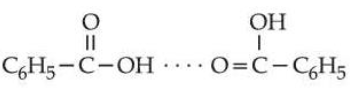
D. The dimerised form of benzoic acid in benzene is

Choose the correct answer from the options given below :
19.5 g of fluoro acetic acid (molar mass = 78 g mol$$^{-1}$$) is dissolved in 500 g of water at 298 K. The depression in the freezing point was 1°C. What is K$$_a$$ of fluoro acetic acid? (For water, K$$_f$$ = 1.86 K kg mol$$^{-1}$$). Assume molarity and molality to have same values.
Moles of fluoro acetic acid dissolved:
$$n = \frac{19.5\ \text{g}}{78\ \text{g mol}^{-1}} = 0.25\ \text{mol}$$
Mass of water = 500 g = 0.5 kg.
Molality of the solution:
$$m = \frac{n}{\text{kg of solvent}} = \frac{0.25}{0.5} = 0.5\ \text{mol kg}^{-1}$$
The cryoscopic (freezing-point) equation is
$$\Delta T_f = i\,K_f\,m$$
Given $$\Delta T_f = 1\ ^\circ\text{C}$$ and $$K_f = 1.86\ \text{K kg mol}^{-1}$$,
$$1 = i \times 1.86 \times 0.5$$
$$\Rightarrow\ i = \frac{1}{1.86 \times 0.5} = \frac{1}{0.93} \approx 1.075$$
For a monoprotic weak acid $$\mathrm{HA \rightleftharpoons H^+ + A^-}$$,
the van’t Hoff factor is $$i = 1 + \alpha$$, where $$\alpha$$ is the degree of dissociation.
Therefore
$$\alpha = i - 1 = 1.075 - 1 = 0.075$$
Assuming density ≈ 1 g mL$$^{-1}$$, molarity ≈ molality, so $$C \approx 0.5\ \text{M}$$.
For a weak acid,
$$K_a = \frac{\alpha^2 C}{1 - \alpha}$$
Substituting the values:
$$\alpha^2 = (0.075)^2 = 0.0056$$
$$\alpha^2 C = 0.0056 \times 0.5 = 0.0028$$
$$1 - \alpha = 1 - 0.075 = 0.925$$
$$K_a = \frac{0.0028}{0.925} \approx 0.0030$$
$$K_a \approx 3 \times 10^{-3}$$
Option D which is: $$3 \times 10^{-3}$$
Given below are two statements :

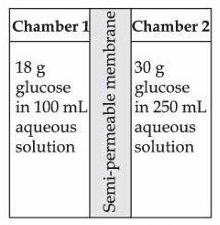
Statement I : H$$_2$$O molecules move from the chamber 1 to chamber 2.
Statement II : The osmotic pressure of a solution prepared by dissolving 50 mg of potassium sulphate (molar mass = 174 g/mol) in 2 L of water (at 27 °C) is 0.0107 bar. (Given: R = 0.083 dm$$^3$$ bar K$$^{-1}$$ mol$$^{-1}$$ and assume complete dissociation of electrolyte)
In the light of the above statements, choose the correct answer from the options given below :
Solution A is prepared by dissolving 1 g of a protein (molar mass = 50000 g mol$$^{-1}$$) in 0.5 L of water at 300 K. Its osmotic pressure is $$x$$ bar. Solution B is made by dissolving 2 g of same protein in 1 L of water at 300 K. Osmotic pressure of solution B is $$y$$ bar. Entire solution of A is mixed with entire solution of B at same temperature. The osmotic pressure of resultant solution is $$z$$ bar. $$x$$, $$y$$ and $$z$$ respectively are :
($$R = 0.083$$ L bar mol$$^{-1}$$ K$$^{-1}$$)
The osmotic pressure for dilute non-electrolyte solutions is given by van ’t Hoff’s equation: $$\pi = C\,R\,T$$, where $$\pi$$ is the osmotic pressure (bar), $$C$$ is the molarity (mol L$$^{-1}$$), $$R = 0.083$$ L bar mol$$^{-1}$$ K$$^{-1}$$ and $$T = 300$$ K.
Solution A
Mass of protein dissolved $$= 1$$ g, molar mass $$= 50000$$ g mol$$^{-1}$$.
Number of moles $$n_A = \frac{1}{50000} = 2.0 \times 10^{-5}\text{ mol}$$.
Volume $$V_A = 0.5$$ L.
Molarity $$C_A = \frac{n_A}{V_A} = \frac{2.0 \times 10^{-5}}{0.5} = 4.0 \times 10^{-5}\text{ M}$$.
Osmotic pressure of A:
$$\pi_A = C_A R T = \left(4.0 \times 10^{-5}\right)\left(0.083\right)\left(300\right)$$
$$\pi_A = 9.96 \times 10^{-4}\text{ bar}$$.
Hence $$x = 9.96 \times 10^{-4}\text{ bar}$$.
Solution B
Mass of protein dissolved $$= 2$$ g.
Number of moles $$n_B = \frac{2}{50000} = 4.0 \times 10^{-5}\text{ mol}$$.
Volume $$V_B = 1.0$$ L.
Molarity $$C_B = \frac{n_B}{V_B} = \frac{4.0 \times 10^{-5}}{1.0} = 4.0 \times 10^{-5}\text{ M}$$.
Osmotic pressure of B:
$$\pi_B = C_B R T = \left(4.0 \times 10^{-5}\right)\left(0.083\right)\left(300\right)$$
$$\pi_B = 9.96 \times 10^{-4}\text{ bar}$$.
Hence $$y = 9.96 \times 10^{-4}\text{ bar}$$.
Resultant solution after mixing A and B
Total moles $$n_{\text{total}} = n_A + n_B = 2.0 \times 10^{-5} + 4.0 \times 10^{-5} = 6.0 \times 10^{-5}\text{ mol}$$.
Total volume $$V_{\text{total}} = V_A + V_B = 0.5 + 1.0 = 1.5\text{ L}$$.
Molarity of mixture:
$$C_{\text{mix}} = \frac{n_{\text{total}}}{V_{\text{total}}} = \frac{6.0 \times 10^{-5}}{1.5} = 4.0 \times 10^{-5}\text{ M}$$.
Osmotic pressure of the mixture:
$$\pi_{\text{mix}} = C_{\text{mix}} R T = \left(4.0 \times 10^{-5}\right)\left(0.083\right)\left(300\right)$$
$$\pi_{\text{mix}} = 9.96 \times 10^{-4}\text{ bar}$$.
Therefore $$z = 9.96 \times 10^{-4}\text{ bar}$$.
Thus $$x = y = z = 9.96 \times 10^{-4}\text{ bar}$$, which corresponds to
Option A which is: $$9.96 \times 10^{-4}$$; $$9.96 \times 10^{-4}$$; $$9.96 \times 10^{-4}$$.
When 0.25 moles of a non-volatile, non-ionizable solute was dissolved in 1 mole of a solvent the vapor pressure of solution was $$x$$ % of vapor pressure of pure solvent. What is $$x$$ %?
Which one of the following graphs accurately represents the plot of partial pressure of $$CS_{2}$$ vs its mole fraction in a mixture of acetone and $$CS_{2}$$ at constant temperature?
Given below are two statements:
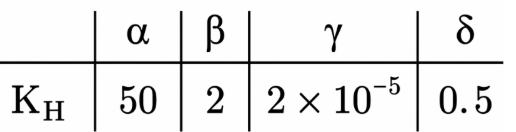
Statement I: The Henry's law constant $$K_{H}$$ is constant with respect to variations in solution's concentration over the range for which the solution is ideally dilute.
Statement II: $$K_{H}$$ does not differ for the same solute in different solvents.
In the light of the above statements, choose the correct answer from the options given below
Henry's law states that the partial pressure of a gas ($$P$$) above a solution is proportional to the mole fraction of the gas dissolved in the solution ($$x$$) at a constant temperature. The mathematical form is $$P = K_H \cdot x$$, where $$K_H$$ is the Henry's law constant.
Statement I claims that $$K_H$$ is constant with respect to concentration variations in an ideally dilute solution. In an ideally dilute solution, the solute-solute interactions are negligible, and Henry's law holds strictly. Therefore, $$K_H$$ remains constant for a given gas-solvent pair at a fixed temperature over the range where the solution is dilute. Hence, Statement I is true.
Statement II claims that $$K_H$$ does not differ for the same solute in different solvents. However, $$K_H$$ depends on the nature of the solvent because the solubility of a gas varies with the solvent. For example, the same gas (like oxygen) has different $$K_H$$ values in water versus ethanol due to different intermolecular interactions. Thus, Statement II is false.
Therefore, Statement I is true, but Statement II is false.
The correct option is A.
At 298 K, the mole percentage of $$N_{2}$$(g) in air is 80%. Water is in equilibrium with air at a pressure of 10 atm. What is the mole fraction of $$N_{2}$$(g) in water at 298 K?
($$K_{H}$$ for $$N_{2}$$ is $$6.5 \times 10^{7}$$ mm Hg)
We need to find the mole fraction of N₂ dissolved in water using Henry's law.
Mole percentage of N₂ in air = 80%, Pressure = 10 atm
$$K_H$$ for N₂ = $$6.5 \times 10^7$$ mm Hg
Find partial pressure of N₂.
$$P_{N_2} = 0.80 \times 10 = 8$$ atm = $$8 \times 760 = 6080$$ mm Hg
Apply Henry's law.
$$P_{N_2} = K_H \times x_{N_2}$$
$$x_{N_2} = \frac{P_{N_2}}{K_H} = \frac{6080}{6.5 \times 10^7} = 9.35 \times 10^{-5}$$
Therefore, the mole fraction is Option 3: $$9.35 \times 10^{-5}$$.
At T(K), 100 g of 98% $$H_{2}SO_{4}$$ (w /w) aqueous solution is mixed with 100 g of 49% $$H_{2}SO_{4}$$ (w /w) aqueous solution. What is the mole fraction of $$H_{2}SO_{4}$$ in the resultant solution?
(Given: Atomic mass H=1 u ; s=32 u ; 0 = 16 u).
(Assume that temperature after mixing remains constant)
100g of 98% H₂SO₄: 98g H₂SO₄ + 2g H₂O. 100g of 49%: 49g + 51g. Total: 147g H₂SO₄ + 53g H₂O.
Moles H₂SO₄ = 147/98 = 1.5. Moles H₂O = 53/18 = 2.944.
Mole fraction = 1.5/(1.5+2.944) = 1.5/4.444 = 0.337.
The answer is Option 4: 0.337.
A solution is prepared by dissolving 0.3 g of a non-volatile non-electrolyte solute 'A' of molar mass 60 g $$mol^{-1}$$ and 0.9 g of a non-volatile non-electrolyte solute 'B' of molar mass 180 g $$mol^{-1}$$ in 100 mL $$H_{2}O$$ at 27°C. Osmotic pressure of the solution will be
[Given: R = 0.082 L atm $$K^{-1} mol^{-1}$$]
We need to find the osmotic pressure of a solution containing two non-volatile non-electrolyte solutes. Solute A has a mass of 0.3 g (molar mass = 60 g/mol), solute B has a mass of 0.9 g (molar mass = 180 g/mol), and the volume of water is 100 mL (approximately 100 mL of solution for dilute solutions). The temperature is 27°C (300 K) and R = 0.082 L atm K⁻¹ mol⁻¹.
The number of moles of A is $$n_A = \frac{0.3}{60} = 0.005$$ mol and of B is $$n_B = \frac{0.9}{180} = 0.005$$ mol, so the total moles of solute are $$n = 0.005 + 0.005 = 0.01$$ mol.
Using $$\pi = \frac{n}{V}RT$$ with V = 100 mL = 0.1 L gives $$\pi = \frac{0.01}{0.1} \times 0.082 \times 300 = 0.1 \times 24.6 = 2.46 \text{ atm}$$.
Therefore, the osmotic pressure is Option 2: 2.46 atm.
At T(K), 2 moles of liquid A and 3 moles of liquid B are mixed. The vapour pressure of ideal solution fonned is 320 mm Hg. At this stage, one mole of A and one mole of B are added to the solution. The vapour pressure is now measmed as 328.6 mm Hg. The vapom pressure (in mm Hg) of A and B are respectively:
Let $$P_A^0$$ and $$P_B^0$$ be vapor pressures of pure A and B.
Mixture 1: 2 mol A, 3 mol B. $$x_A = 2/5, x_B = 3/5$$. $$P = 0.4P_A^0 + 0.6P_B^0 = 320 \quad (1)$$
Mixture 2: 3 mol A, 4 mol B. $$x_A = 3/7, x_B = 4/7$$. $$P = \frac{3}{7}P_A^0 + \frac{4}{7}P_B^0 = 328.6 \quad (2)$$
From (2): $$3P_A^0 + 4P_B^0 = 2300.2 \quad (2')$$
From (1): $$2P_A^0 + 3P_B^0 = 1600 \quad (1')$$
Multiply (1') by 4/3: $$8P_A^0/3 + 4P_B^0 = 6400/3$$
Subtract from (2'): $$3P_A^0 - 8P_A^0/3 = 2300.2 - 2133.3$$
$$P_A^0/3 = 166.9 \implies P_A^0 = 500.7 \approx 500$$
From (1'): $$P_B^0 = (1600 - 1000)/3 = 200$$
The answer is Option 2: 500, 200.
Consider the following aqueous solutions.
I. 2.2 g Glucose in 125 ml of solution.
II. 1.9 g Calcium chloride in 250 ml of solution.
111. 9.0 g Urea in 500 ml of solution.
IV. 20.5 g Aluminium sulphate in 750 ml of solution.
The correct increasing order of boiling point of these solutions will be:
[Given : Molar mass in g $$mol^{-1}$$: H = 1, C=12, N= 14, 0=16, Cl =35.5, Ca=40, Al=27 and S=32]
The boiling point elevation ($$\Delta T_b$$) is a colligative property that depends on the van't Hoff factor ($$i$$) and the molality ($$m$$) of the solution, given by $$\Delta T_b = i \times K_b \times m$$, where $$K_b$$ is the ebullioscopic constant. Since $$K_b$$ is the same for all aqueous solutions, the order of boiling points depends on the product $$i \times m$$.
Molality ($$m$$) is calculated as:
$$m = \frac{\text{moles of solute}}{\text{mass of solvent in kg}}$$
Assuming the density of water is 1 g/mL, the mass of the solvent (water) is obtained by subtracting the mass of the solute from the total mass of the solution (since volume in mL ≈ mass in grams).
The molar masses are:
- Glucose (C6H12O6): $$6 \times 12 + 12 \times 1 + 6 \times 16 = 180$$ g/mol
- Calcium chloride (CaCl2): $$40 + 2 \times 35.5 = 111$$ g/mol
- Urea (NH2CONH2): $$2 \times 14 + 4 \times 1 + 12 + 16 = 60$$ g/mol
- Aluminium sulphate (Al2(SO4)3): $$2 \times 27 + 3 \times (32 + 4 \times 16) = 54 + 3 \times 96 = 342$$ g/mol
Solution I: 2.2 g Glucose in 125 mL solution
Glucose is non-electrolyte, so $$i = 1$$.
Moles of glucose = $$\frac{2.2}{180} = 0.012222$$ mol
Mass of solution ≈ 125 g (density ≈ 1 g/mL)
Mass of solvent = $$125 - 2.2 = 122.8$$ g = $$0.1228$$ kg
Molality, $$m_I = \frac{0.012222}{0.1228} = 0.09953$$ mol/kg
$$i \times m_I = 1 \times 0.09953 = 0.09953$$
Solution II: 1.9 g Calcium chloride in 250 mL solution
Calcium chloride dissociates into Ca2+ and 2Cl-, so $$i = 3$$.
Moles of CaCl2 = $$\frac{1.9}{111} = 0.017117$$ mol
Mass of solution ≈ 250 g
Mass of solvent = $$250 - 1.9 = 248.1$$ g = $$0.2481$$ kg
Molality, $$m_{II} = \frac{0.017117}{0.2481} = 0.06899$$ mol/kg
$$i \times m_{II} = 3 \times 0.06899 = 0.20697$$
Solution III: 9.0 g Urea in 500 mL solution
Urea is non-electrolyte, so $$i = 1$$.
Moles of urea = $$\frac{9.0}{60} = 0.15$$ mol
Mass of solution ≈ 500 g
Mass of solvent = $$500 - 9.0 = 491$$ g = $$0.491$$ kg
Molality, $$m_{III} = \frac{0.15}{0.491} = 0.30550$$ mol/kg
$$i \times m_{III} = 1 \times 0.30550 = 0.30550$$
Solution IV: 20.5 g Aluminium sulphate in 750 mL solution
Aluminium sulphate dissociates into 2Al3+ and 3SO42-, so $$i = 5$$.
Moles of Al2(SO4)3 = $$\frac{20.5}{342} = 0.059942$$ mol
Mass of solution ≈ 750 g
Mass of solvent = $$750 - 20.5 = 729.5$$ g = $$0.7295$$ kg
Molality, $$m_{IV} = \frac{0.059942}{0.7295} = 0.08216$$ mol/kg
$$i \times m_{IV} = 5 \times 0.08216 = 0.41080$$
The $$i \times m$$ values are:
- I: 0.09953
- II: 0.20697
- III: 0.30550
- IV: 0.41080
Increasing order: $$0.09953 < 0.20697 < 0.30550 < 0.41080$$, so I < II < III < IV.
Thus, the increasing order of boiling points is I, II, III, IV.
Option D matches this order: I < II < III < IV.
Therefore, the correct answer is D.
'W' g of a non-volatile electrolyte solid solute of molar mass 'M' g $$mol^{-1}$$ when dissolved in 100 mL water, decreases vapour pressure of water from 640 mm Hg to 600 mm Hg. If aqueous solution of the electrolyte boils at 375 K and $$K_{b}$$ for water is 0.52 K kg $$mol^{-1}$$, then the mole fraction of the electrolyte solute ($$x_{2}$$) in the solution can be expressed as
(Given : density of water= 1 g/mL and boiling point of water= 3 73 K)
We need to find the mole fraction of the electrolyte solute in terms of W and M.
Mass of solute = W g, Molar mass = M g/mol. Volume of water = 100 mL → mass of water = 100 g. Vapour pressure drops from 640 to 600 mm Hg. Solution boils at 375 K, $$K_b = 0.52$$ K kg/mol. Boiling point of water = 373 K.
According to Raoult's law for vapour pressure lowering, $$\frac{P_0 - P}{P_0} = x_2 \cdot i$$ where $$i$$ is the van't Hoff factor. Substituting the given pressures, $$\frac{640 - 600}{640} = i \cdot x_2$$ which gives $$i \cdot x_2 = \frac{40}{640} = \frac{1}{16}$$.
The boiling point elevation is given by $$\Delta T_b = i \cdot K_b \cdot m$$ where $$\Delta T_b = 375 - 373 = 2$$ K and molality $$m = \frac{W/M}{100/1000} = \frac{10W}{M}$$. Substituting, $$2 = i \times 0.52 \times \frac{10W}{M}$$ which leads to $$i = \frac{2M}{5.2W} = \frac{M}{2.6W}$$.
From the expression for vapour pressure lowering, $$x_2 = \frac{1}{16i}$$. Substituting the value of $$i$$ yields $$x_2 = \frac{1}{16} \times \frac{2.6W}{M} = \frac{2.6W}{16M} = \frac{1.3W}{8M} = \frac{1.3}{8} \times \frac{W}{M}$$.
Therefore, the mole fraction of the solute is $$\frac{1.3}{8} \times \frac{W}{M}$$.
Elements P and Q form two types of non-volatile, non-ionizable compounds PQ and $$PQ_{2}$$. When 1g of PQ is dissolved in 50 g of solvent ''A', $$\Delta T_{b}$$was 1.176 K while when 1 g of $$PQ_{2}$$ is dissolved in 50g of solvent 'A'.$$\Delta T_{b}$$ was 0.689 K ($$K_{b}$$ of 'A' =5K kg $$mol^{-1}$$) The molar masses of elements P and Q (in g $$mol^{-1}$$ ) respectively, are:
Elements P and Q form compounds PQ and PQ₂. We need to find their molar masses from boiling point elevation data.
$$ \Delta T_b = K_b \times m = K_b \times \frac{\text{mass of solute}/M}{\text{mass of solvent (in kg)}} $$
$$ 1.176 = 5 \times \frac{1/M_{PQ}}{0.050} = \frac{5}{0.050 \times M_{PQ}} = \frac{100}{M_{PQ}} $$
$$ M_{PQ} = \frac{100}{1.176} \approx 85 \text{ g/mol} $$
$$ 0.689 = 5 \times \frac{1/M_{PQ_2}}{0.050} = \frac{100}{M_{PQ_2}} $$
$$ M_{PQ_2} = \frac{100}{0.689} \approx 145 \text{ g/mol} $$
$$M_{PQ} = P + Q = 85$$ ... (i)
$$M_{PQ_2} = P + 2Q = 145$$ ... (ii)
Subtracting (i) from (ii): $$Q = 60$$ g/mol
Substituting back: $$P = 85 - 60 = 25$$ g/mol
The correct answer is Option (3): P = 25, Q = 60.
Two liquids A and B form an ideal solution at temperature TK. At TK, the vapour pressures of pure A and B are 55 and 15 kN $$m^{-2}$$ respectively. What is the mole fraction of A in solution of A and B in equilibrium with a vapour in which the mole fraction of A is 0.8?
We need to find the mole fraction of A in the liquid phase that is in equilibrium with a vapor containing mole fraction of A = 0.8.
$$P_A^0 = 55$$ kN/m², $$P_B^0 = 15$$ kN/m²
Mole fraction of A in vapor: $$y_A = 0.8$$
Using Raoult's law and Dalton's law:
Total pressure: $$P_{total} = x_A P_A^0 + (1-x_A) P_B^0 = x_A(55) + (1-x_A)(15) = 40x_A + 15$$
Mole fraction in vapor:
$$y_A = \frac{x_A P_A^0}{P_{total}} = \frac{55x_A}{40x_A + 15}$$
Setting $$y_A = 0.8$$:
$$0.8 = \frac{55x_A}{40x_A + 15}$$
$$0.8(40x_A + 15) = 55x_A$$
$$32x_A + 12 = 55x_A$$
$$23x_A = 12$$
$$x_A = \frac{12}{23} = 0.5217$$
Therefore, the mole fraction of A is Option 4: 0.5217.
A substance 'X' (1.5 g) dissolved in 150 g of a solvent 'Y'(molar mass=300 g $$mol^{-1}$$ ) led to an elevation of the boiling point by 0.5 K. The relative lowering in the vapour pressure of the solvent 'Y' is __________ $$\times 10^{-2}$$. (nearest integer)
[Given : $$K_{b}$$ of the solvent =5.0 K kg $$mol^{-1}$$]
Assume the solution to be dilute and no association or dissociation of X takes place in solution.
Elevation of boiling point: $$\Delta T_b = K_b \cdot m$$
$$0.5 = 5.0 \times \frac{w/M}{0.150}$$ where w = 1.5 g and M is molar mass of X.
$$\frac{w}{M} = \frac{0.5 \times 0.150}{5.0} = 0.015$$ mol
$$M = \frac{1.5}{0.015} = 100$$ g/mol
Relative lowering of vapor pressure: $$\frac{\Delta P}{P^0} = \frac{n_{\text{solute}}}{n_{\text{solute}} + n_{\text{solvent}}} \approx \frac{n_{\text{solute}}}{n_{\text{solvent}}}$$ (dilute)
$$n_{\text{solute}} = 0.015$$ mol, $$n_{\text{solvent}} = \frac{150}{300} = 0.5$$ mol
$$\frac{\Delta P}{P^0} = \frac{0.015}{0.5} = 0.03 = 3 \times 10^{-2}$$
The answer is 3 × 10⁻².
20 g hemoglobin in a 1 L aqueous solution (A) at 300 K is separated from pure water by a semi-permeable membrane. At equilibrium, the height of solution in a tube dipped in solution (A) is found to be $$80.0 mm$$ higher than the tube dipped in water.
The molar mass of hemoglobin is ______ $$kg mol^{-1}$$. (Nearest integer)
(Given: $$g = 10 \, m \, s^{-2}$$, $$R = 8.3 \, kPa \, dm^{3} \, K^{-1} \, mol^{-1}$$, density of solution = $$1000 \, kg \, m^{-3}$$)
The osmotic pressure of a living cell is 12 atm at 300 K. The strength of sodium chloride solution that is isotonic with the living cell at tltis temperature is __________ $$g L^{-1}$$.
(Nearest integer)
Given: R = 0.08 L atm $$K^{-1} mol^{-1}$$
Assume complete dissociation of NaCl
(Given : Molar mass of Na and Cl are 23 and 35.5 g $$mol^{-1}$$ respectively.)
Osmotic pressure of cell = 12 atm at 300 K. For isotonic NaCl solution:
$$\pi = iCRT$$ where $$i = 2$$ for NaCl (complete dissociation).
$$12 = 2 \times C \times 0.08 \times 300$$
$$C = \frac{12}{48} = 0.25$$ mol/L
Strength = $$0.25 \times 58.5 = 14.625 \approx 15$$ g/L
The answer is 15 g/L.
Two liquids A and B form an ideal solution. At 320 K, the vapour pressure of the solution, containing 3 mol of A and 1 mol of B is 500 mm Hg. At the same
temperature, if 1 mol of A is farther added to this solution, vapour pressure of the solution increases by 20 mm Hg. Vapour pressure (in mm Hg) of B in pure state is ____ . (Nearest integer)
To begin, we apply Raoult's law to find the vapour pressure of pure B.
For an ideal solution, the total vapour pressure is
$$ P_{\text{total}} = x_A P_A^* + x_B P_B^* $$
where $$x_A, x_B$$ are mole fractions and $$P_A^*, P_B^*$$ are the vapour pressures of the pure components.
In the first mixture, there are 3 mol of A and 1 mol of B, giving a total of 4 mol. Thus
$$x_A = 3/4$$ and $$x_B = 1/4$$.
Substituting into Raoult's law gives
$$ \frac{3}{4}P_A^* + \frac{1}{4}P_B^* = 500 \quad \cdots (1) $$
After adding 1 mol of A, the amounts become 4 mol of A and 1 mol of B (total 5 mol), and the vapour pressure rises to 520 mm Hg.
The new mole fractions are $$x_A = 4/5$$ and $$x_B = 1/5$$.
Substituting again yields
$$ \frac{4}{5}P_A^* + \frac{1}{5}P_B^* = 520 \quad \cdots (2) $$
We now solve these equations simultaneously. Rewriting equation (1) gives
$$3P_A^* + P_B^* = 2000 \quad \cdots (1')$$
and equation (2) becomes
$$4P_A^* + P_B^* = 2600 \quad \cdots (2')$$
Subtracting (1') from (2') yields
$$ P_A^* = 2600 - 2000 = 600 \text{ mm Hg} $$
Substituting this value back into (1') gives
$$ 3(600) + P_B^* = 2000 $$
$$ 1800 + P_B^* = 2000 $$
$$ P_B^* = 200 \text{ mm Hg} $$
The answer is 200 mm Hg.
A non-volatile, non-electrolyte solid solute when dissolved in 40 g of a solvent, the vapour pressure of the solvent decreased from 760 mm Hg to 750 mm Hg. If the same solution boils at 320 K, then the number of moles of the solvent present in the solution is _____. (Nearest integer)
[Given: boiling point of the pure solvent = 319.5 K, $$K_b$$ of the solvent = 0.3 K kg mol$$^{-1}$$]
The vapour pressure and boiling-point data are linked to the composition of the solution through Raoult’s law and the elevation of boiling point equation. We first determine how many moles of solute are present, then use the vapour-pressure lowering to back-calculate the moles of solvent.
Step 1 : Molality from boiling-point elevation
The rise in boiling point is$$\Delta T_b = 320\;\text{K} - 319.5\;\text{K} = 0.5\;\text{K}$$
For a non-volatile, non-electrolyte solute,$$\Delta T_b = K_b \, m \quad -(1)$$
Hence$$m = \frac{\Delta T_b}{K_b} = \frac{0.5}{0.3} = \frac{5}{3} = 1.6667\;\text{mol kg}^{-1}$$
Step 2 : Moles of solute present
Mass of solvent given = 40 g = 0.040 kg. By definition of molality,$$m = \frac{n_{\text{solute}}}{\text{mass of solvent (kg)}}$$
Therefore$$n_{\text{solute}} = m \times 0.040 = 1.6667 \times 0.040 = 0.06667\;\text{mol}$$
Step 3 : Mole fraction of solute from vapour-pressure lowering
Raoult’s law for the solvent gives$$P = X_{\text{solvent}}\,P^0$$
So the relative lowering of vapour pressure is$$\frac{P^0 - P}{P^0} = 1 - X_{\text{solvent}} = X_{\text{solute}} \quad -(2)$$
Given$$P^0 = 760\;\text{mm Hg},\; P = 750\;\text{mm Hg}$$
Hence$$X_{\text{solute}} = \frac{760 - 750}{760} = \frac{10}{760} = \frac{1}{76} = 0.0131579$$
Step 4 : Moles of solvent
Let $$n_{\text{solvent}}$$ be the unknown moles of solvent. Then$$X_{\text{solute}} = \frac{n_{\text{solute}}}{n_{\text{solute}} + n_{\text{solvent}}}$$
Substituting values,$$0.0131579 = \frac{0.06667}{0.06667 + n_{\text{solvent}}}$$
Cross-multiplying,$$0.0131579\,(0.06667 + n_{\text{solvent}}) = 0.06667$$
$$0.0008772 + 0.0131579\,n_{\text{solvent}} = 0.06667$$
$$0.0131579\,n_{\text{solvent}} = 0.06667 - 0.0008772 = 0.06579$$
$$n_{\text{solvent}} = \frac{0.06579}{0.0131579} \approx 5.00\;\text{mol}$$
The nearest integer value for the number of moles of solvent present in the solution is 5.
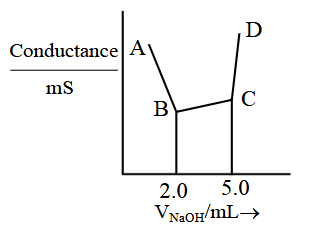
40 mL of a mixture of $$CH_3COOH$$ and HCl (aqueous solution) is titrated against 0.1 M NaOH conductometrically. Which of the following statement is correct?
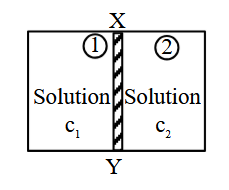
XY is the membrane/partition between two chambers 1 and 2 containing sugar solutions of concentration $$c_1$$ and $$c_2$$ ($$c_1 \gt c_2$$) mol $$L^{-1}$$. For the reverse osmosis to take place identify the correct condition. (Here $$p_1$$ and $$p_2$$ are pressures applied on chamber 1 and 2)

(A) Membrane/Partition ; Cellophane, $$p_{1} > \pi$$
(B) Membrane/Partition ; Porous.$$p_{2} > \pi$$
(C) Membrane/Partition ; Parchment paper, $$p_{1} > \pi$$
(D) Membrane/Partition : Cellophane, $$p_{2} > \pi$$
Choose the correct answer from the options given below :
10 mL of 2 M NaOH solution is added to 20 mL of 1 M HCl solution kept in a beaker. Now, 10 mL of this mixture is poured into a volumetric flask of 100 mL containing 2 moles of HCl and made the volume upto the mark with distilled water. The solution in this flask is:
The relation between moles, molarity and volume is $$n = M \times V$$, where $$n$$ is in moles, $$M$$ in mol L$$^{-1}$$ and $$V$$ in litres.
Step 1 • Moles present before mixing
NaOH: $$M = 2\,\text{M},\; V = 10\,\text{mL}=0.01\,\text{L}$$
$$n_{NaOH} = 2 \times 0.01 = 0.02\,\text{mol}$$
HCl: $$M = 1\,\text{M},\; V = 20\,\text{mL}=0.02\,\text{L}$$
$$n_{HCl} = 1 \times 0.02 = 0.02\,\text{mol}$$
Step 2 • Neutralisation reaction
$$NaOH + HCl \rightarrow NaCl + H_2O$$
Since $$n_{NaOH}=n_{HCl}=0.02\,\text{mol}$$, both are completely consumed and we obtain $$0.02\,\text{mol}$$ NaCl.
Step 3 • Concentration of NaCl in the neutral mixture
Total volume after reaction $$=10\,\text{mL}+20\,\text{mL}=30\,\text{mL}=0.03\,\text{L}$$.
$$M_{NaCl} = \frac{0.02}{0.03} \approx 0.667\,\text{M}$$
Step 4 • Portion taken to the volumetric flask
Volume taken $$=10\,\text{mL}=0.01\,\text{L}$$.
Moles of NaCl transferred $$=0.667 \times 0.01 \approx 6.67\times10^{-3}\,\text{mol}$$.
Step 5 • HCl already present in the flask
The flask initially contains $$2\,\text{mol}$$ of HCl.
Step 6 • Final dilution to 100 mL
Final volume $$=100\,\text{mL}=0.1\,\text{L}$$.
Molarity of HCl:
$$M_{HCl} = \frac{2}{0.1} = 20\,\text{M}$$
Molarity of NaCl:
$$M_{NaCl} = \frac{6.67\times10^{-3}}{0.1} \approx 0.067\,\text{M}$$
Step 7 • Nature of the solution
The solution is a strongly acidic solution of $$20\,\text{M}$$ HCl (with a small amount of NaCl that does not affect acidity).
Hence the correct description is Option B - 20 M HCl solution.
The hydration energies of $$K^+$$ and $$Cl^-$$ are $$-x$$ and $$-y$$ kJ/mol respectively. If lattice energy of KCl is $$-z$$ kJ/mol, then the heat of solution of KCl is :
For an ionic solid, the heat (enthalpy) of solution, $$\Delta H_{\text{sol}}$$, is obtained in two steps:
1. Lattice dissociation: the crystal breaks into gaseous ions. This requires the lattice dissociation energy, $$\Delta H_{\text{lattice(diss)}}$$, which is numerically equal and opposite to the lattice energy of formation.
2. Hydration: the gaseous ions get surrounded by water molecules, releasing their hydration energies.
Given data (sign conventions):
• Hydration energy of $$K^+ = -x$$ kJ mol$$^{-1}$$ (exothermic)
• Hydration energy of $$Cl^- = -y$$ kJ mol$$^{-1}$$ (exothermic)
• Lattice energy of formation of KCl $$= -z$$ kJ mol$$^{-1}$$ (exothermic for formation from gaseous ions)
Step 1: Lattice dissociation energy
Lattice energy of formation is $$-z$$, so the energy required to dissociate the lattice is the opposite sign:
$$\Delta H_{\text{lattice(diss)}} = +z \text{ kJ mol}^{-1}$$
Step 2: Hydration of the ions
$$\Delta H_{\text{hydration}} = (-x) + (-y) = -(x + y) \text{ kJ mol}^{-1}$$
Overall heat of solution
$$\Delta H_{\text{sol}} = \Delta H_{\text{lattice(diss)}} + \Delta H_{\text{hydration}}$$
$$\Delta H_{\text{sol}} = \bigl(+z\bigr) + \bigl[-(x + y)\bigr]$$
$$\Delta H_{\text{sol}} = z - (x + y)$$
Therefore the heat of solution of KCl is $$z - (x + y)$$ kJ mol$$^{-1}$$.
Hence the correct option is Option C.
Which of the following graph correctly represents the plots of $$K_H$$ at 1 bar gases in water versus temperature?
Given below are two statements : Statement (I) : NaCl is added to the ice at $$0^{\circ}C$$, present in the ice cream box to prevent the melting of ice cream. Statement (II) : On addition of NaCl to ice at $$0^{\circ}C$$ , there is a depression in freezing point. In the light of the above statements, choose the correct answer from the options given below :
Statement I: NaCl is added to ice at 0°C in the ice cream box to prevent melting of ice cream.
When NaCl is added to ice, the freezing point is depressed below 0°C. This means the ice-salt mixture can reach temperatures below 0°C, which helps keep the ice cream frozen. So NaCl does help prevent melting of ice cream. Statement I is TRUE.
Statement II: On addition of NaCl to ice at 0°C, there is a depression in freezing point.
This is a standard colligative property. Adding a solute (NaCl) depresses the freezing point of water. Statement II is TRUE.
Both statements are true. Statement II provides the reason for Statement I.
The correct answer is Option 4: Both Statement I and Statement II are true.
A solution is made by mixing one mole of volatile liquid A with 3 moles of volatile liquid B. The vapour pressure of pure A is 200 mm Hg and that of the solution is 500 mm Hg. The vapour pressure of pure B and the least volatile component of the solution, respectively, are:
Given below are two statements :
Statement (I) : Molal depression constant $$K_f$$ is given by $$\frac{M_1 R T_f}{\Delta S_{fus}}$$, where symbols have their usual meaning.
Statement (II) : $$K_f$$ for benzene is less than the $$K_f$$ for water.
In the light of the above statements, choose the most appropriate answer from the options given below :
We need to evaluate two statements about the molal depression constant $$K_f$$.
Statement I: Molal depression constant $$K_f$$ is given by $$\frac{M_1 R T_f}{\Delta S_{fus}}$$
The standard expression for the molal freezing point depression constant is:
$$$K_f = \frac{M_1 R T_f^2}{1000 \times \Delta H_{fus}}$$$
where $$M_1$$ is the molar mass of the solvent, $$R$$ is the gas constant, $$T_f$$ is the freezing point of the solvent, and $$\Delta H_{fus}$$ is the enthalpy of fusion.
Since the entropy of fusion is defined as:
$$$\Delta S_{fus} = \frac{\Delta H_{fus}}{T_f}$$$
We can substitute $$\Delta H_{fus} = T_f \times \Delta S_{fus}$$:
$$$K_f = \frac{M_1 R T_f^2}{1000 \times T_f \times \Delta S_{fus}} = \frac{M_1 R T_f}{1000 \times \Delta S_{fus}}$$$
When $$M_1$$ is expressed in kg/mol (i.e., $$M_1$$ already includes the factor of 1000), the expression simplifies to:
$$$K_f = \frac{M_1 R T_f}{\Delta S_{fus}}$$$
Therefore, Statement I is correct.
Statement II: $$K_f$$ for benzene is less than the $$K_f$$ for water.
The known values of $$K_f$$ are:
$$K_f$$ for water $$= 1.86 \text{ K kg mol}^{-1}$$
$$K_f$$ for benzene $$= 5.12 \text{ K kg mol}^{-1}$$
Clearly, $$K_f$$ for benzene $$(5.12)$$ is greater than $$K_f$$ for water $$(1.86)$$.
Therefore, Statement II is incorrect.
Statement I is correct but Statement II is incorrect.
Hence, the correct answer is Option D.
Which of the following binary mixture does not show the behaviour of minimum boiling azeotropes?
An azeotrope boils at a constant temperature because the vapour phase has the same composition as the liquid phase.
• If the total vapour pressure of the mixture is higher than that predicted by Raoult’s law (positive deviation), the boiling point of the mixture becomes lower than that of either pure component. Such an azeotrope is called a minimum-boiling azeotrope.
• If the total vapour pressure is lower than Raoult’s law (negative deviation), the boiling point is higher than that of both components, giving a maximum-boiling azeotrope.
Whether a binary liquid shows positive or negative deviation depends on the relative strength of intermolecular forces:
• Interactions in the mixture weaker than those within the pure liquids ⇒ molecules escape more easily ⇒ higher vapour pressure ⇒ positive deviation ⇒ minimum-boiling azeotrope.
• Interactions in the mixture stronger than in the pure liquids (e.g. new hydrogen bonds) ⇒ molecules escape with difficulty ⇒ lower vapour pressure ⇒ negative deviation ⇒ maximum-boiling azeotrope.
Now examine each option.
Case A: $$H_2O + CH_3COOC_2H_5$$ (water + ethyl acetate)
Water is highly polar; ethyl acetate is much less polar and cannot hydrogen-bond effectively with water. Hence, the A-B (unlike) interactions are weaker than A-A and B-B interactions. The mixture shows a large positive deviation. Therefore it forms a minimum-boiling azeotrope (bp ≈ $$70^{\circ}C$$).
Case B: $$C_6H_5OH + C_6H_5NH_2$$ (phenol + aniline)
Both phenol and aniline possess -OH/-NH2 groups that can form strong intermolecular hydrogen bonds with each other. In the mixture the A-B attractions are stronger than those in the pure liquids, so the vapour pressure drops (negative deviation). Consequently, if an azeotrope is formed at all, it will be a maximum-boiling one; it can never be a minimum-boiling azeotrope. Hence this binary system does not show minimum-boiling behaviour.
Case C: $$CS_2 + CH_3COCH_3$$ (carbon disulphide + acetone)
CS2 is non-polar while acetone is polar but cannot hydrogen-bond strongly with CS2. Thus A-B interactions are weaker ⇒ positive deviation ⇒ the pair forms a minimum-boiling azeotrope (bp ≈ $$39^{\circ}C$$).
Case D: $$CH_3OH + CHCl_3$$ (methanol + chloroform)
Though each component can engage in hydrogen bonding, the two form a 1 : 1 complex in the liquid phase which is less stable than the separate hydrogen-bond networks in the pure liquids. Hence the net A-B interaction is weaker, giving a positive deviation and a minimum-boiling azeotrope (bp ≈ $$55.9^{\circ}C$$ at 1 atm).
Only the mixture in Option B fails to exhibit minimum-boiling behaviour.
Correct answer: Option B ($$C_6H_5OH + C_6H_5NH_2$$)
Liquid A and B form an ideal solution. The vapour pressure of pure liquids A and B are 350 and 750 mm Hg respectively at the same temperature. If $$x_A$$ and $$x_B$$ are the mole fraction of A and B in solution while $$y_A$$ and $$y_B$$ are the mole fraction of A and B in vapour phase then :
For an ideal liquid mixture Raoult’s law is valid.
If $$P_A^0$$ and $$P_B^0$$ are the vapour-pressures of the pure liquids, then the partial pressures over the solution are
$$p_A = x_A P_A^0$$ and $$p_B = x_B P_B^0$$ $$-(1)$$
The total pressure is $$P = p_A + p_B$$. The mole fractions of the components in the vapour phase are defined as
$$y_A = \frac{p_A}{P}$$ and $$y_B = \frac{p_B}{P}$$ $$-(2)$$
Divide the two expressions in $$(2)$$:
$$\frac{y_A}{y_B} = \frac{p_A/P}{p_B/P} = \frac{p_A}{p_B}$$
Now use $$(1)$$:
$$\frac{y_A}{y_B} = \frac{x_A P_A^0}{x_B P_B^0} = \frac{x_A}{x_B}\,\frac{P_A^0}{P_B^0}$$ $$-(3)$$
The data given are $$P_A^0 = 350\ \text{mm Hg}$$ and $$P_B^0 = 750\ \text{mm Hg}$$, so
$$\frac{P_A^0}{P_B^0} = \frac{350}{750} = 0.467 \lt 1$$
Substituting into $$(3)$$:
$$\frac{y_A}{y_B} = \frac{x_A}{x_B}\,(0.467)$$
Because the multiplier $$0.467$$ is less than $$1$$, we obtain
$$\frac{y_A}{y_B} \lt \frac{x_A}{x_B} \quad\Longrightarrow\quad \frac{x_A}{x_B} \gt \frac{y_A}{y_B}$$
Hence the correct relation is given in Option C.
Answer - Option C
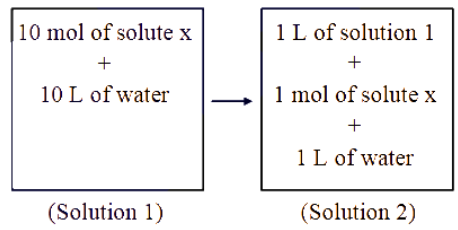
Which of the following properties will change when system containing solution 1 will become solution 2 ?
First, list the given data for the two systems.
Solution 1 (stock solution): 10 mol solute x + 10 L water.
Hence, the concentration is $$\frac{10\;\text{mol}}{10\;\text{L}} = 1\;\text{M}$$.
Solution 2 is prepared by mixing 1 L of Solution 1 with 1 mol of solute x and 1 L of water.
• Solute coming from 1 L of Solution 1 = 1 mol.
• Extra solute added = 1 mol.
Total solute in Solution 2 = 1 mol + 1 mol = 2 mol.
• Volume coming from 1 L of Solution 1 = 1 L.
• Extra water added = 1 L.
Total volume of Solution 2 = 1 L + 1 L = 2 L.
Therefore, the concentration of Solution 2 is $$\frac{2\;\text{mol}}{2\;\text{L}} = 1\;\text{M}$$, exactly the same as Solution 1.
Now analyse each property.
Case A: Molar heat capacity (heat capacity per mole of solution) is an intensive property; it depends only on composition, not on the amount. Because the mole-ratio of solute to solvent remains 1 M for both solutions, the molar heat capacity stays unchanged.
Case B: Density is also an intensive property (mass per unit volume). Since the composition is identical in both solutions, the density remains the same.
Case C: Concentration has already been shown to stay at 1 M. Hence, no change occurs.
Case D: Gibbs free energy $$G$$ is an extensive property; it is directly proportional to the amount of matter present. Solution 2 contains twice the amount of both solute and solvent compared with the 1 L portion of Solution 1, so its total Gibbs free energy is different (specifically, doubled) from that of Solution 1.
Therefore, the only property that changes when the system passes from Solution 1 to Solution 2 is the Gibbs free energy.
Correct choice: Option D (Gibbs free energy).
'x' g of NaCl is added to water in a beaker with a lid. The temperature of the system is raised from 1°C to 25°C. Which of the following plots, is best suited for the change in the molarity (M) of the solution with respect to temperature ?
[Consider the solubility of NaCl remains unchanged over the temperature range]
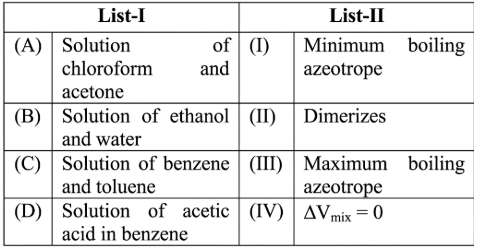
Match List-I with List-II.

Choose the correct answer from the options given below :
For each pair we first decide whether the solution shows ideal behaviour, positive deviation or negative deviation from Raoult’s law. Then we match the corresponding properties from List-II.
Case A: Chloroform (CHCl₃) + Acetone (CH₃COCH₃)
• CHCl₃ has an acidic hydrogen that forms strong hydrogen bonds with the carbonyl oxygen of acetone.
• The intermolecular attraction between unlike molecules becomes stronger than that between like molecules.
• Stronger attractions ↓ total vapour pressure → these mixtures show negative deviation from Raoult’s law.
• Negative deviation gives a solution whose boiling point is higher than either pure component, i.e. a maximum-boiling azeotrope.
Thus (A) → (III).
Case B: Ethanol (C₂H₅OH) + Water (H₂O)
• When ethanol mixes with water, some hydrogen bonds of pure water are broken; the unlike interactions are weaker than the strong H-bond network of water.
• Weaker attractions ↑ total vapour pressure → positive deviation from Raoult’s law.
• Positive deviation produces a minimum-boiling azeotrope.
Thus (B) → (I).
Case C: Benzene (C₆H₆) + Toluene (C₆H₅CH₃)
• Both are non-polar aromatic liquids with very similar molecular sizes and intermolecular forces.
• Their mixture obeys Raoult’s law almost exactly: $$\Delta H_{mix} = 0$$ and $$\Delta V_{mix} = 0$$.
Thus (C) → (IV).
Case D: Acetic acid (CH₃COOH) in Benzene (C₆H₆)
• In a non-polar solvent like benzene, acetic acid molecules associate through hydrogen bonding to form dimers: $$2\,CH_3COOH \rightleftharpoons (CH_3COOH)_2$$.
Thus (D) → (II).
Collecting the matches:
(A)-(III), (B)-(I), (C)-(IV), (D)-(II).
The option having this sequence is Option A.
Final answer: Option A.
Assume a living cell with $$0.9%(\omega / \omega)$$ of glucose solution (aqueous). This cell is immersed in another solution having equal mole fraction of glucose and water. (Consider the data upto first decimal place only) The cell will
A living cell contains $$0.9\%$$ (w/w) glucose solution and is immersed in a solution with equal mole fractions of glucose and water.
Equal mole fractions of glucose and water means $$x_{glucose} = x_{water} = 0.5$$, so the moles of glucose and water are equal. Assuming 1 mol of each, the mass of glucose is $$180\text{ g}$$ and the mass of water is $$18\text{ g}$$, giving a total mass of $$198\text{ g}$$ and a percentage by mass of $$\%(w/w) = \frac{180}{198}\times 100 \approx 90.9\%$$ for the external solution.
The cell has $$0.9\%$$ glucose, while the external solution has approximately $$90.9\%$$ glucose, making the external solution extremely hypertonic compared to the cell.
Because the external solution has a much higher solute concentration and a correspondingly lower water activity, water will flow out of the cell by osmosis, causing the cell to shrink dramatically. However, the calculated concentration (~90.9\%) does not match any of the specific percentages given in options A, B, or C.
The correct answer is Option D) None of these.
Consider a binary solution of two volatile liquid components 1 and 2.$$x_{1}$$ and $$y_{1}$$ are the mole fractions of component 1 in liquid and vapour phase, respectively. The slope and intercept of the linear plot of $$\frac{1}{x_{1}}$$ vs $$\frac{1}{y_{1}}$$ are given respectively as:
For a binary solution of two volatile liquids, find the slope and intercept of $$\frac{1}{x_1}$$ vs $$\frac{1}{y_1}$$.
Apply Raoult's law
Total pressure: $$P = x_1P_1° + x_2P_2° = x_1P_1° + (1-x_1)P_2° = P_2° + x_1(P_1° - P_2°)$$
Mole fraction in vapor: $$y_1 = \frac{x_1P_1°}{P} = \frac{x_1P_1°}{P_2° + x_1(P_1° - P_2°)}$$
Take reciprocal
$$\frac{1}{y_1} = \frac{P_2° + x_1(P_1° - P_2°)}{x_1P_1°} = \frac{P_2°}{x_1P_1°} + \frac{P_1° - P_2°}{P_1°}$$
$$\frac{1}{y_1} = \frac{P_2°}{P_1°} \cdot \frac{1}{x_1} + \frac{P_1° - P_2°}{P_1°}$$
Compare with y = mx + c format
Plotting $$\frac{1}{y_1}$$ (y-axis) vs $$\frac{1}{x_1}$$ (x-axis) -- but the question asks for $$\frac{1}{x_1}$$ vs $$\frac{1}{y_1}$$. Let me rearrange:
$$\frac{1}{x_1} = \frac{P_1°}{P_2°} \cdot \frac{1}{y_1} - \frac{P_1° - P_2°}{P_2°}$$
$$= \frac{P_1°}{P_2°} \cdot \frac{1}{y_1} + \frac{P_2° - P_1°}{P_2°}$$
Slope = $$\frac{P_1°}{P_2°}$$, Intercept = $$\frac{P_2° - P_1°}{P_2°}$$
The correct answer is Option 2: $$\frac{P_1°}{P_2°}$$ and $$\frac{P_2° - P_1°}{P_2°}$$.
1.24 g of $$AX_{2}$$ (molar mass 124 g $$mol^{-1}$$) is dissolved in 1 kg of water to form a solution with boiling point of $$100.0156^{\circ}C$$, while $$25.4g^{\circ}$$ of $$AY_{2}$$ (molar mass 250 g $$mol^{-1}$$) in 2 kg of water constitutes a solution with a boiling point of $$100.0260^{\circ}C.K_{b}(H_{2}O)=0.52 K$$ kg $$mol^{-1}$$ Which of the following is correct ?
Using $$\Delta T_b = i \cdot K_b \cdot m$$ with $$K_b = 0.52$$ K kg mol$$^{-1}$$.
For $$AX_2$$: $$\Delta T_b = 0.0156°C$$, molality = $$0.01$$ mol/kg.
$$i = \frac{0.0156}{0.52 \times 0.01} = 3$$
Since $$AX_2 \to A^{2+} + 2X^-$$ gives 3 particles, $$AX_2$$ is fully ionised.
For $$AY_2$$: $$\Delta T_b = 0.0260°C$$, molality = $$\frac{25.4/250}{2} = 0.0508$$ mol/kg.
$$i = \frac{0.0260}{0.52 \times 0.0508} \approx 1$$
Since $$i \approx 1$$, $$AY_2$$ is completely unionised.
The correct answer is Option 1: $$AX_2$$ is fully ionised while $$AY_2$$ is completely unionised.
2 moles each of ethylene glycol and glucose are dissolved in 500 g of water. The boiling point of the resulting solution is :
(Given : Ebullioscopic constant of water = 0.52 K kg mol$$^{-1}$$)
The normal boiling point of pure water is $$373 \text{ K}$$.
Total moles of solute:
Ethylene glycol $$= 2 \text{ mol}$$
Glucose $$= 2 \text{ mol}$$
Therefore, $$n_{\text{total}} = 2 + 2 = 4 \text{ mol}$$.
Mass of solvent (water) $$= 500 \text{ g} = 0.5 \text{ kg}$$.
Molality is defined as $$m = \frac{n_{\text{solute}}}{\text{mass of solvent in kg}}$$. Hence
$$m = \frac{4}{0.5} = 8 \text{ mol kg}^{-1}$$ $$-(1)$$
The elevation in boiling point is given by the formula
$$\Delta T_b = i \, K_b \, m$$ $$-(2)$$
For non-electrolytes like ethylene glycol and glucose, the van’t Hoff factor $$i = 1$$.
Given $$K_b = 0.52 \text{ K kg mol}^{-1}$$.
Substituting values into $$(2)$$:
$$\Delta T_b = 1 \times 0.52 \times 8 = 4.16 \text{ K}$$.
Boiling point of the solution:
$$T_{\text{boil}} = 373 \text{ K} + 4.16 \text{ K} = 377.16 \text{ K}$$.
Rounded to one decimal place, $$T_{\text{boil}} \approx 377.3 \text{ K}$$.
Hence, the boiling point of the solution is $$377.3 \text{ K}$$ (Option B).
What is the freezing point depression constant of a solvent, 50g of which contain 1 g non volatile solute (molar mass 256 g $$mol^{-1}$$) and the decrease in freezing point is 0.40 K ?
We need to find the freezing point depression constant ($$K_f$$) of a solvent.
Mass of solvent = 50 g = 0.050 kg
Mass of non-volatile solute = 1 g
Molar mass of solute = 256 g/mol
Decrease in freezing point $$\Delta T_f = 0.40$$ K
$$\Delta T_f = K_f \times m$$
where $$m$$ is the molality of the solution.
Moles of solute = $$\frac{1}{256}$$ mol = 0.003906 mol
Molality $$m = \frac{\text{moles of solute}}{\text{mass of solvent in kg}} = \frac{1/256}{0.050} = \frac{1}{12.8} = 0.078125$$ mol/kg
$$K_f = \frac{\Delta T_f}{m} = \frac{0.40}{0.078125} = 5.12$$ K kg mol$$^{-1}$$
The correct answer is Option 4: $$5.12$$ K kg mol$$^{-1}$$.
Arrange the following solutions in order of their increasing boiling points. (i) $$10^{-4} M$$ $$NaCl$$ (ii) $$10^{-4}M$$ $$Urea$$ (iii) $$10^{-3} M$$ $$NaCl$$ (iv) $$10^{-2} M$$ $$NaCl$$
Arrange the solutions in order of increasing boiling points.
We recall that boiling point elevation depends on the total solute particle concentration.
$$\Delta T_b = i \cdot K_b \cdot m$$
Here, $$i$$ is the van't Hoff factor.
Next, we calculate the effective concentration for each solution.
For (i) $$10^{-4}$$ M NaCl, which dissociates as NaCl → Na⁺ + Cl⁻, the van't Hoff factor is $$i = 2$$ giving an effective concentration of $$2 \times 10^{-4}$$ M.
For (ii) $$10^{-4}$$ M urea, a non-electrolyte with $$i = 1$$, the effective concentration is $$10^{-4}$$ M.
For (iii) $$10^{-3}$$ M NaCl with $$i = 2$$, the effective concentration becomes $$2 \times 10^{-3}$$ M.
For (iv) $$10^{-2}$$ M NaCl with $$i = 2$$, the effective concentration becomes $$2 \times 10^{-2}$$ M.
Ordering these effective concentrations yields
$$10^{-4} < 2 \times 10^{-4} < 2 \times 10^{-3} < 2 \times 10^{-2}$$
Hence, in terms of the given options:
$$(\text{ii}) < (\text{i}) < (\text{iii}) < (\text{iv})$$
Therefore, the solutions in order of increasing boiling point are (ii) < (i) < (iii) < (iv).
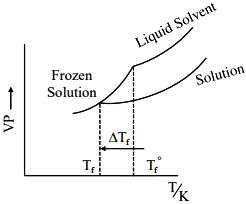
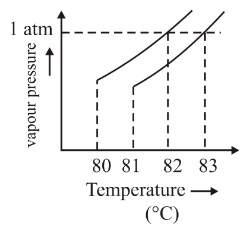
Consider the given plots of vapour pressure (VP) vs temperature (T/K). Which amongst the following options is correct graphical representation showing $$\Delta T_f,$$ depression in the freezing point of a solvent in a solution?
When a non-volatile solute is added to the solvent, the vapour pressure of the solvent decreases by 10 mm of Hg . The mole fraction of the solute in the solution is 0.2 . What would be the mole fraction of the solvent if decrease in vapour pressure is 20 mm of Hg ?
Vapor pressure decreases by 10 mm Hg when mole fraction of solute is 0.2. Find mole fraction of solvent when decrease is 20 mm Hg.
Apply Raoult's law for relative lowering
$$\frac{\Delta P}{P°} = x_{solute}$$
$$\frac{10}{P°} = 0.2 \Rightarrow P° = 50$$ mm Hg
For decrease of 20 mm Hg
$$x_{solute} = \frac{20}{50} = 0.4$$
$$x_{solvent} = 1 - 0.4 = 0.6$$
The correct answer is Option 4: 0.6.
Sea water, which can be considered as a 6 molar (6 M) solution of NaCl, has a density of 2 g mL$$^{-1}$$. The concentration of dissolved oxygen (O$$_2$$) in sea water is 5.8 ppm. Then the concentration of dissolved oxygen (O$$_2$$) in sea water, is $$x \times 10^{-4}$$ m. (Nearest integer)
Given: Molar mass of $$NaCl$$ is 58.5 g $$mol^{-1}$$
Molar mass of $$O_{2}$$ is 32 g $$mol^{-1}$$
For dissolved oxygen we must convert ppm (mass ratio) to molality (moles of $$\mathrm{O_2}$$ per kg of water).
Case 1: Work with exactly $$1\ \text{L}$$ of sea water (any convenient volume can be chosen).
Density is $$2\ \text{g mL}^{-1}$$, so mass of this $$1\ \text{L} = 1000\ \text{mL}$$ of solution is
$$1000 \times 2 = 2000\ \text{g}$$.
Case 2: Separate solute (NaCl) from solvent (water).
The solution is $$6\ \text{M}$$ in NaCl, i.e. $$6$$ moles NaCl per litre.
Molar mass of NaCl is $$58.5\ \text{g mol}^{-1}$$, therefore mass of NaCl in $$1\ \text{L}$$ is
$$6 \times 58.5 = 351\ \text{g}$$.
Mass of water (solvent) present = total mass − mass of NaCl:
$$2000 - 351 = 1649\ \text{g} = 1.649\ \text{kg}$$.
Case 3: Find moles of dissolved $$\mathbf{O_2}$$ present in the same litre.
Concentration of $$\mathrm{O_2}$$ is $$5.8\ \text{ppm}$$. For mass ratios, $$1\ \text{ppm} = 1\ \text{mg}$$ solute per $$1\ \text{kg}$$ solution.
Hence in $$1\ \text{kg}$$ solution, mass of $$\mathrm{O_2} = 5.8\ \text{mg} = 0.0058\ \text{g}$$.
Our sample is $$2000\ \text{g} = 2\ \text{kg}$$ of solution, so
Mass of $$\mathrm{O_2} = 2 \times 0.0058 = 0.0116\ \text{g}$$.
Molar mass of $$\mathrm{O_2} = 32\ \text{g mol}^{-1}$$, therefore moles of $$\mathrm{O_2}$$ are
$$\frac{0.0116}{32} = 3.625 \times 10^{-4}\ \text{mol}$$.
Case 4: Convert to molality.
Molality $$m = \frac{\text{moles of solute}}{\text{kilograms of solvent}}$$ = $$\frac{3.625 \times 10^{-4}}{1.649} = 2.20 \times 10^{-4}\ m$$.
Expressed as $$x \times 10^{-4}\ m$$, the value of $$x \approx 2.20$$, which to the nearest integer is $$2$$.
Therefore the concentration of dissolved oxygen is $$\mathbf{2 \times 10^{-4}\ m}$$ (nearest integer $$x = 2$$).
20 mL of sodium iodide solution gave 4.74 g silver iodide when treated with excess of silver nitrate solution. The molarity of the sodium iodide solution is _____ M. (Given : Na = 23, I = 127, Ag = 108, N = 14, O = 16 g mol$$^{-1}$$)
The precipitation reaction involved is:
NaI + AgNO3 → AgI ↓ + NaNO3
The stoichiometry is 1 : 1, so the moles of NaI present in the sample equal the moles of AgI obtained.
Molar mass of silver iodide (AgI):
Ag = 108 g mol$$^{-1}$$, I = 127 g mol$$^{-1}$$
Therefore, molar mass of AgI = $$108 + 127 = 235$$ g mol$$^{-1}$$.
Moles of AgI formed:
$$n = \frac{4.74}{235} = 0.0202$$ mol
Because of the 1 : 1 ratio, moles of NaI in 20 mL solution = $$0.0202$$ mol.
Volume of the NaI solution = 20 mL = 0.020 L.
Molarity, $$M = \frac{\text{moles}}{\text{volume in L}} = \frac{0.0202}{0.020} = 1.01$$ M.
Rounded to two significant figures, the molarity is approximately $$1$$ M.
Answer : 1 M
When 1 g each of compounds AB and $$AB_2$$ are dissolved in 15 g of water separately, they increased the boiling point of water by 2.7 K and 1.5 K respectively. The atomic mass of A (in amu) is _________ $$\times 10^{-1}$$.
(Nearest integer)
(Given : Molal boiling point elevation constant is 0.5 K kg mol$$^{-1}$$)
The boiling-point elevation of a dilute solution is given by
$$\Delta T_b = K_b \, m$$
where $$K_b$$ is the molal elevation constant and $$m$$ is the molality of the solution.
Case 1: 1 g of $$AB$$ in 15 g (0.015 kg) of water raises the boiling point by 2.7 K.
For water, $$K_b = 0.5 \text{ K kg mol}^{-1}$$, so
$$m_{\!AB} = \frac{\Delta T_b}{K_b} = \frac{2.7}{0.5}=5.4 \text{ mol kg}^{-1}$$
Molality is also $$m = \dfrac{w/M}{W}$$, hence
$$5.4 = \frac{1/M_{AB}}{0.015} \;\;\Rightarrow\;\; M_{AB} = 12.34 \text{ g mol}^{-1}$$
Case 2: 1 g of $$AB_2$$ in the same quantity of water raises the boiling point by 1.5 K.
$$m_{AB_2} = \frac{1.5}{0.5}=3.0 \text{ mol kg}^{-1}$$
$$3.0 = \frac{1/M_{AB_2}}{0.015} \;\;\Rightarrow\;\; M_{AB_2} = 22.22 \text{ g mol}^{-1}$$
Let the atomic masses be $$M_A$$ and $$M_B$$. Then
$$M_A + M_B = 12.34 \;\;-(1)$$
$$M_A + 2M_B = 22.22 \;\;-(2)$$
Subtract $$(1)$$ from $$(2)$$:
$$M_B = 22.22 - 12.34 = 9.88 \text{ g mol}^{-1}$$
Substitute in $$(1)$$ to find $$M_A$$:
$$M_A = 12.34 - 9.88 = 2.46 \text{ g mol}^{-1}$$
The atomic mass of A is therefore $$2.46 \text{ amu} \approx 2.5 \text{ amu}$$.
Expressed as $$\times 10^{-1}$$, this is
$$2.5 \text{ amu} = 25 \times 10^{-1} \text{ amu}$$
Hence the required nearest integer is 25.
If $$A_{2}B$$ is 30% ionised in an aqueous solution, then the value of van't Hoff factor (i) is ______ $$\times 10^{-1}$$
If $$A_2B$$ is 30% ionised in an aqueous solution, find the van't Hoff factor (i) expressed as $$\_\_\_ \times 10^{-1}$$.
The dissociation equation is $$A_2B \rightarrow 2A^+ + B^{2-}$$, and one formula unit produces 3 ions (2 cations + 1 anion), so $$n = 3$$.
The van't Hoff factor formula is $$i = 1 + \alpha(n - 1)$$, where $$\alpha = 0.30$$ and $$n = 3$$. Thus, $$i = 1 + 0.30(3 - 1) = 1 + 0.60 = 1.60$$.
Expressing this in the required form gives $$i = 1.60 = 16 \times 10^{-1}$$, so the answer is 16.
If a substance '$$A$$' dissolves in solution of a mixture of '$$B$$' and '$$C$$' with their respective number of moles as $$n_A$$, $$n_B$$ and $$n_C$$, mole fraction of $$C$$ in the solution is:
The quantity which changes with temperature is :
Among the given quantities:
- Molarity depends on volume of solution, which changes with temperature. So molarity changes with temperature.
- Mass percentage depends only on masses, independent of temperature.
- Molality depends on mass of solvent, independent of temperature.
- Mole fraction depends on number of moles, independent of temperature.
The answer is Molarity, which corresponds to Option (1).
The solution from the following with highest depression in freezing point/lowest freezing point is
We need the solution with highest depression in freezing point. $$\Delta T_f = iK_fm$$ where $$i$$ is van't Hoff factor and $$m$$ is molality.
Option 1: 180 g acetic acid (M=60) in 1 L water. Moles = 3. $$m \approx 3$$. Acetic acid dissociates slightly in water, $$i > 1$$. $$\Delta T_f \approx 3 \times 1.86 \times i > 5.58$$.
Option 2: 180 g acetic acid in benzene. Acetic acid dimerizes in benzene, $$i \approx 0.5$$. $$\Delta T_f$$ much lower.
Option 3: 180 g benzoic acid (M=122) in benzene. Moles $$\approx 1.48$$. Benzoic acid also dimerizes in benzene, $$i \approx 0.5$$.
Option 4: 180 g glucose (M=180) in water. Moles = 1. Non-electrolyte, $$i = 1$$. $$\Delta T_f = 1.86$$.
Option 1 has the highest molality (3 mol/kg) and in water, acetic acid ionizes ($$i > 1$$), giving the largest freezing point depression.
The correct answer is Option 1.
Identify the mixture that shows positive deviations from Raoult's Law
We need to identify the mixture that shows positive deviation from Raoult's Law.
Key Concept: Positive deviation from Raoult's Law occurs when the interactions between unlike molecules (A-B) are weaker than the interactions between like molecules (A-A and B-B). This causes the vapor pressure of the solution to be higher than predicted by Raoult's Law, because molecules escape the solution more easily.
Option 1: Acetone + Aniline ($$(CH_3)_2CO + C_6H_5NH_2$$):
Acetone and aniline form hydrogen bonds with each other (C=O of acetone with N-H of aniline). A-B interactions are stronger than average A-A and B-B interactions. This gives negative deviation.
Option 2: Chloroform + Benzene ($$CHCl_3 + C_6H_6$$):
Chloroform and benzene have weak attractive interactions (dipole-induced dipole). These are comparable to the original interactions, giving nearly ideal behavior or slight negative deviation.
Option 3: Chloroform + Acetone ($$CHCl_3 + (CH_3)_2CO$$):
Chloroform forms hydrogen bonds with acetone (C-H...O=C). The A-B interactions are stronger, giving negative deviation.
Option 4: Acetone + Carbon disulfide ($$(CH_3)_2CO + CS_2$$):
Acetone has dipole-dipole interactions (polar molecule), while $$CS_2$$ is non-polar. When mixed, the strong dipole-dipole interactions of acetone are disrupted, and the new A-B interactions (dipole-induced dipole) are weaker. This makes it easier for molecules to escape into the vapor phase, resulting in positive deviation.
The correct answer is Option (4): $$(CH_3)_2CO + CS_2$$.
What happens to freezing point of benzene when small quantity of naphthalene is added to benzene?
We need to determine what happens to the freezing point of benzene when a small quantity of naphthalene is added.
Key Concept: Depression in Freezing Point (Colligative Property) When a non-volatile solute is dissolved in a solvent, the freezing point of the solution decreases. This is known as the depression of freezing point, a colligative property.
The depression in freezing point is given by:
$$\Delta T_f = K_f \cdot m$$
where $$K_f$$ is the cryoscopic constant of the solvent and $$m$$ is the molality of the solution.
Naphthalene is a non-volatile, non-electrolyte solute. When it is dissolved in benzene (the solvent), it forms a solution and lowers the vapour pressure of benzene. This causes the solid-liquid equilibrium to shift, requiring a lower temperature for freezing to occur. Since $$\Delta T_f = K_f \cdot m > 0$$, the freezing point of the solution is lower than that of pure benzene.
Therefore, the freezing point of benzene decreases when naphthalene is added.
Answer: Option 4 - Decreases
A solution of two miscible liquids showing negative deviation from Raoult's law will have :
A solution showing negative deviation from Raoult's law has stronger intermolecular forces between unlike molecules than like molecules.
This results in:
- Decreased vapour pressure (molecules are held more tightly in solution, fewer escape to vapor phase)
- Increased boiling point (higher temperature needed to reach atmospheric pressure since vapour pressure is lower)
The answer is: decreased vapour pressure, increased boiling point, which corresponds to Option (4).
For a reaction $$A \xrightarrow{K_1} B \xrightarrow{K_2} C$$. If the rate of formation of $$B$$ is set to be zero then the concentration of $$B$$ is given by :
We need to find the concentration of intermediate $$B$$ in the consecutive reaction $$A \xrightarrow{K_1} B \xrightarrow{K_2} C$$, using the steady-state approximation.
The intermediate $$B$$ is formed from $$A$$ (with rate constant $$K_1$$) and is consumed to form $$C$$ (with rate constant $$K_2$$). The rate of change of $$[B]$$ is:
$$\frac{d[B]}{dt} = K_1[A] - K_2[B]$$
The first term represents formation of $$B$$ from $$A$$, and the second term represents consumption of $$B$$ to form $$C$$.
The steady-state approximation assumes that after an initial transient period, the concentration of the intermediate $$B$$ remains approximately constant. This means:
$$\frac{d[B]}{dt} = 0$$
Setting the rate equation to zero:
$$K_1[A] - K_2[B] = 0$$
$$K_2[B] = K_1[A]$$
$$[B] = \frac{K_1}{K_2}[A]$$
The correct answer is Option (2): $$(K_1/K_2)[A]$$.
To form a complete monolayer of acetic acid on 1 g of charcoal, 100 mL of 0.5 M acetic acid was used. Some of the acetic acid remained unadsorbed. To neutralize the unadsorbed acetic acid, 40 mL of 1 M NaOH solution was required. If each molecule of acetic acid occupies $$P \times 10^{-23}$$ $$m^2$$ surface area on charcoal, the value of P is ________.
[Use given data : Surface area of charcoal = $$1.5 \times 10^2$$ $$m^2 g^{-1}$$; Avogadro's number ($$N_A$$) = $$6.0 \times 10^{23}$$ $$mol^{-1}$$]
Total surface area available for adsorption on $$1 \text{ g}$$ of charcoal is given to be
$$A = 1.5 \times 10^{2}\; \text{m}^{2}$$
Step 1: Moles of acetic acid taken
Solution volume = $$100\;\text{mL} = 0.1\;\text{L}$$
Molarity = $$0.5\;\text{M}$$
$$n_{\text{taken}} = 0.1 \times 0.5 = 0.05\;\text{mol}$$
Step 2: Moles of acetic acid remaining unadsorbed
Volume of NaOH used = $$40\;\text{mL} = 0.04\;\text{L}$$
Molarity of NaOH = $$1\;\text{M}$$
For $$\text{CH}_3\text{COOH} + \text{NaOH} \rightarrow \text{CH}_3\text{COONa} + \text{H}_2\text{O}$$ the stoichiometry is 1 : 1, so
$$n_{\text{unadsorbed}} = 0.04 \times 1 = 0.04\;\text{mol}$$
Step 3: Moles of acetic acid adsorbed on charcoal
$$n_{\text{adsorbed}} = n_{\text{taken}} - n_{\text{unadsorbed}} = 0.05 - 0.04 = 0.01\;\text{mol}$$
Step 4: Number of molecules adsorbed
Avogadro number $$N_A = 6.0 \times 10^{23}\;\text{mol}^{-1}$$
$$N = 0.01 \times 6.0 \times 10^{23} = 6.0 \times 10^{21}$$ molecules
Step 5: Surface area occupied by one molecule
$$\text{Area per molecule} = \frac{A}{N}
= \frac{1.5 \times 10^{2}}{6.0 \times 10^{21}}
= 0.25 \times 10^{-19}\;\text{m}^{2}
= 2.5 \times 10^{-20}\;\text{m}^{2}$$
Step 6: Expressing in the required form
$$2.5 \times 10^{-20}\;\text{m}^{2}
= 2.5 \times 10^{3} \times 10^{-23}\;\text{m}^{2}$$
Hence $$P = 2500$$.
Final answer: 2500
Iron (III) catalyses the reaction between iodide and persulphate ions, in which
A. $$Fe^{3+}$$ oxidises the iodide ion
B. $$Fe^{3+}$$ oxidises the persulphate ion
C. $$Fe^{2+}$$ reduces the iodide ion
D. $$Fe^{2+}$$ reduces the persulphate ion.
Choose the most appropriate answer from the options given below:
Iron(III) catalyses the reaction between iodide and persulphate ions. Identify the correct mechanism.
The overall reaction is $$2I^- + S_2O_8^{2-} \rightarrow I_2 + 2SO_4^{2-}$$.
In the catalytic cycle of Fe³⁺/Fe²⁺, Fe³⁺ oxidizes I⁻: $$2Fe^{3+} + 2I^- \rightarrow 2Fe^{2+} + I_2$$. Fe²⁺ is then re-oxidized by persulphate (Fe²⁺ reduces persulphate): $$2Fe^{2+} + S_2O_8^{2-} \rightarrow 2Fe^{3+} + 2SO_4^{2-}$$.
So: A (Fe³⁺ oxidises iodide) and D (Fe²⁺ reduces persulphate) are correct.
The correct answer is Option (4): A and D only.
Vessel-1 contains $$w_2$$ g of a non-volatile solute X dissolved in $$w_1$$ g of water. Vessel-2 contains $$w_2$$ g of another non-volatile solute Y dissolved in $$w_1$$ g of water. Both the vessels are at the same temperature and pressure. The molar mass of X is 80% of that of Y. The van't Hoff factor for X is 1.2 times of that of Y for their respective concentrations.
The elevation of boiling point for solution in Vessel-1 is ______ % of the solution in Vessel-2.
The elevation of the boiling point for a dilute solution is given by the relation
$$\Delta T_b = i\,K_b\,m$$
where $$i$$ is the van’t Hoff factor, $$K_b$$ is the ebullioscopic constant of the solvent (same for both vessels because the solvent is water and the temperature is identical), and $$m$$ is the molality of the solute.
Because both vessels contain the same solvent (water) at the same temperature, $$K_b$$ is identical for the two solutions. Hence the ratio of the boiling-point elevations equals the product of the ratios of the van’t Hoff factors and the molalities:
$$\frac{\Delta T_{b1}}{\Delta T_{b2}} \;=\; \frac{i_X}{i_Y}\;\times\;\frac{m_X}{m_Y}$$
Step 1: Ratio of van’t Hoff factors
Given that the van’t Hoff factor for solute X is 1.2 times that for solute Y,
$$\frac{i_X}{i_Y} = 1.2$$
Step 2: Ratio of molalities
Molality is defined as $$m = \dfrac{\text{moles of solute}}{\text{kilograms of solvent}}$$.
With $$w_2$$ g of solute dissolved in $$w_1$$ g of water, the molality for any solute is
$$m = \frac{1000\,w_2}{M\,w_1}$$
where $$M$$ is the molar mass of the solute (in g mol$$^{-1}$$).
The two vessels have the same $$w_1$$ and $$w_2$$, so the ratio of their molalities depends only on their molar masses:
$$\frac{m_X}{m_Y} = \frac{M_Y}{M_X}$$
We are told that the molar mass of X is 80 % of that of Y:
$$M_X = 0.8\,M_Y \;\;\Longrightarrow\;\; \frac{M_Y}{M_X} = \frac{1}{0.8} = 1.25$$
Therefore,
$$\frac{m_X}{m_Y} = 1.25$$
Step 3: Ratio of boiling-point elevations
Combining the two ratios:
$$\frac{\Delta T_{b1}}{\Delta T_{b2}} = 1.2 \times 1.25 = 1.50$$
Thus, the elevation of the boiling point in Vessel 1 is 1.50 times (or 150 %) that in Vessel 2.
Answer: 150 %
We have three aqueous solutions of NaCl labelled as 'A', 'B' and 'C' with concentration $$0.1$$ M, $$0.01$$ M and $$0.001$$ M, respectively. The value of van't Hoff factor $$i$$ for these solutions will be in the order:
The van't Hoff factor, denoted as $$i$$, measures the extent of dissociation or association of a solute in solution. For electrolytes, it is given by:
$$i = \frac{\text{observed colligative property}}{\text{calculated colligative property assuming no dissociation}}$$
NaCl is a strong electrolyte that dissociates completely in ideal conditions:
$$\text{NaCl} \rightarrow \text{Na}^+ + \text{Cl}^-$$
The theoretical van't Hoff factor for complete dissociation is 2, as one formula unit produces two ions.
However, in real solutions, interionic attractions reduce the effective number of ions, making the observed $$i$$ less than 2. This effect is more pronounced at higher concentrations due to stronger interionic interactions.
Given the concentrations:
- Solution A: 0.1 M (highest concentration)
- Solution B: 0.01 M
- Solution C: 0.001 M (lowest concentration)
As concentration decreases, interionic attractions weaken, and the van't Hoff factor increases towards the theoretical value of 2.
Therefore:
- For A (0.1 M), $$i_A$$ is the smallest due to strongest interionic attractions.
- For B (0.01 M), $$i_B$$ is greater than $$i_A$$ but less than $$i_C$$.
- For C (0.001 M), $$i_C$$ is the largest and closest to 2.
Thus, the order is $$i_A < i_B < i_C$$.
Comparing with the options:
- A. $$i_A < i_B < i_C$$ (matches)
- B. $$i_A < i_C < i_B$$ (incorrect)
- C. $$i_A = i_B = i_C$$ (incorrect, as concentration affects i)
- D. $$i_A > i_B > i_C$$ (incorrect, opposite order)
The correct answer is option A.
$$2.7$$ kg of each of water and acetic acid are mixed. The freezing point of the solution will be $$-x°C$$. Consider the acetic acid does not dimerise in water, nor dissociates in water. $$x =$$ ______ (nearest integer) [Given: Molar mass of water $$= 18$$ g mol$$^{-1}$$, acetic acid $$= 60$$ g mol$$^{-1}$$, $$K_f$$ H$$_2$$O: $$1.86$$ K kg mol$$^{-1}$$, $$K_f$$ acetic acid: $$3.90$$ K kg mol$$^{-1}$$, freezing point: H$$_2$$O $$= 273$$ K, acetic acid $$= 290$$ K]
ΔTf=Kf×m. Solvent is water (2.7kg). Solute is acetic acid: 2700/60=45 mol. m=45/2.7=16.67.
ΔTf=1.86×16.67=31°C. Freezing point = 0-31=-31°C.
The answer is $$\boxed{31}$$.
Consider the two different first order reactions given below $$A + B \rightarrow C$$ (Reaction 1) $$P \rightarrow Q$$ (Reaction 2). The ratio of the half life of Reaction 1 : Reaction 2 is $$5 : 2$$. If $$t_1$$ and $$t_2$$ represent the time taken to complete $$\frac{2}{3}^{rd}$$ and $$\frac{4}{5}^{th}$$ of Reaction 1 and Reaction 2, respectively, then the value of the ratio $$t_1 : t_2$$ is ___________ $$\times 10^{-1}$$ (nearest integer). [Given : $$\log_{10}(3) = 0.477$$ and $$\log_{10}(5) = 0.699$$]
Considering acetic acid dissociates in water, its dissociation constant is $$6.25 \times 10^{-5}$$. If $$5$$ mL of acetic acid is dissolved in 1 litre water, the solution will freeze at $$-x \times 10^{-2} °C$$, provided pure water freezes at $$0°C$$. $$x =$$ ______ . (Nearest integer) Given : $$(K_f)_{water} = 1.86 \text{ K kg mol}^{-1}$$, density of acetic acid is $$1.2 \text{ g mL}^{-1}$$, molar mass of water $$= 18 \text{ g mol}^{-1}$$, molar mass of acetic acid $$= 60 \text{ g mol}^{-1}$$, density of water $$= 1 \text{ g cm}^{-3}$$. Acetic acid dissociates as $$CH_3COOH \rightleftharpoons CH_3COO^- + H^+$$
Mass of ethylene glycol (antifreeze) to be added to 18.6 kg of water to protect the freezing point at $$-24°C$$ is ______ kg (Molar mass in g mol$$^{-1}$$ for ethylene glycol 62, $$K_f$$ of water = $$1.86 \text{ K kg mol}^{-1}$$)
Find the mass of ethylene glycol needed to protect 18.6 kg water from freezing at $$-24°C$$.
$$ \Delta T_f = K_f \times m $$
where $$\Delta T_f$$ is the depression in freezing point, $$K_f$$ is the molal freezing point depression constant, and $$m$$ is molality.
$$\Delta T_f = 0 - (-24) = 24$$ K.
$$ m = \frac{\Delta T_f}{K_f} = \frac{24}{1.86} = 12.903 \text{ mol/kg} $$
$$ \text{Moles} = m \times \text{mass of solvent (kg)} = 12.903 \times 18.6 = 240 \text{ mol} $$
Molar mass of ethylene glycol = 62 g/mol.
$$ \text{Mass} = 240 \times 62 = 14880 \text{ g} = 14.88 \text{ kg} \approx 15 \text{ kg} $$
The answer is 15 kg.
2.5 g of a non-volatile, non-electrolyte is dissolved in 100 g of water at 25°C. The solution showed a boiling point elevation by 2°C. Assuming the solute concentration is negligible with respect to the solvent concentration, the vapor pressure of the resulting aqueous solution is ______ mm of Hg (nearest integer). [Given: Kb = 0.52 K·kgmol⁻¹, 1 atm = 760 mm Hg, molar mass of water = 18 g mol⁻¹]
The solute is non-volatile and non-electrolytic, hence the boiling-point elevation formula is
$$\Delta T_b = K_b\,m \quad -(1)$$
where $$m$$ is the molality of the solution.
Given $$\Delta T_b = 2^{\circ}\text{C}$$ and $$K_b = 0.52\ \text{K·kg mol}^{-1}$$, from $$(1)$$
$$m = \frac{\Delta T_b}{K_b} = \frac{2}{0.52} \approx 3.85\ \text{mol kg}^{-1} \quad -(2)$$
The mass of water (solvent) is 100 g = 0.100 kg.
Hence the number of moles of solute is
$$n_{\text{solute}} = m \times \text{mass of solvent (kg)}$$ $$= 3.85 \times 0.100 \approx 0.385\ \text{mol} \quad -(3)$$
Moles of water
$$n_{\text{water}} = \frac{100\ \text{g}}{18\ \text{g mol}^{-1}} \approx 5.56\ \text{mol} \quad -(4)$$
Because the solute concentration is very small compared with that of the solvent, the mole fraction of the solute can be approximated by
$$x_{\text{solute}} \approx \frac{n_{\text{solute}}}{n_{\text{water}}}$$
Substituting $$(3)$$ and $$(4)$$:
$$x_{\text{solute}} \approx \frac{0.385}{5.56} \approx 0.069 \quad -(5)$$
For a non-volatile solute, the relative lowering of vapour pressure is
$$\frac{P^\circ - P}{P^\circ} = x_{\text{solute}} \quad -(6)$$
where $$P^\circ$$ is the vapour pressure of pure solvent and $$P$$ is that of the solution.
At the normal boiling point of water (100 °C), $$P^\circ = 1\ \text{atm} = 760\ \text{mm Hg}$$. Using $$(5)$$ in $$(6)$$:
$$\frac{760 - P}{760} = 0.069$$ $$P = 760\,(1 - 0.069) \approx 760 \times 0.931 \approx 707\ \text{mm Hg}$$
Nearest integer:
Vapour pressure of the solution = $$707\ \text{mm Hg}$$.
A solution of $$H_2SO_4$$ is $$31.4\%$$ $$H_2SO_4$$ by mass and has a density of $$1.25$$ g/mL. The molarity of the $$H_2SO_4$$ solution is M (nearest integer) [Given molar mass of $$H_2SO_4 = 98$$ g mol$$^{-1}$$]
31.4% H₂SO₄ by mass, density 1.25 g/mL.
In 1 L: mass = 1250 g. Mass of H₂SO₄ = 0.314 × 1250 = 392.5 g.
Moles = 392.5/98 = 4.005 ≈ 4 M. The answer is $$\boxed{4}$$.
Consider the following reaction $$A + B \rightarrow C$$. The time taken for A to become $$1/4^{th}$$ of its initial concentration is twice the time taken to become $$1/2$$ of the same. Also, when the change of concentration of $$B$$ is plotted against time, the resulting graph gives a straight line with a negative slope and a positive intercept on the concentration axis. The overall order of the reaction is ________
Find the overall order of the reaction $$A + B \rightarrow C$$.
Since the time for A to become $$\tfrac{1}{4}$$ of its initial concentration is twice the time required to reach half its initial concentration, and because for a first-order reaction $$t_{1/4} = \frac{2\ln 2}{k} = 2 \times \frac{\ln 2}{k} = 2t_{1/2}\,$$, the reaction exhibits first-order kinetics with respect to A.
Next, the plot of the concentration of B versus time is a straight line with a negative slope and a positive intercept, which corresponds to the integrated rate law $$[B] = [B]_0 - kt$$ for a zero-order reaction in B.
Using these results, the overall order of the reaction is $$1\;( \text{for A} ) + 0\;( \text{for B} ) = 1\,$$.
The correct answer is $$1$$.
During Kinetic study of reaction $$2A + B \to C + D$$, the following results were obtained :
I: A = 0.1 M, B = 0.1 M, initial rate of formation of D = $$6.0 \times 10^{-3}$$
II: A = 0.3 M, B = 0.2 M, initial rate = $$7.20 \times 10^{-2}$$
III: A = 0.3 M, B = 0.4 M, initial rate = $$2.88 \times 10^{-1}$$
IV: A = 0.4 M, B = 0.1 M, initial rate = $$2.40 \times 10^{-2}$$
Based on above data, overall order of the reaction is ______
For the reaction $$2A + B \rightarrow C + D$$, let $$\text{Rate} = k[A]^a[B]^b$$.
From experiments I and IV (where B is constant at 0.1 M):
$$ \frac{r_{IV}}{r_I} = \left(\frac{0.4}{0.1}\right)^a = 4^a = \frac{2.40 \times 10^{-2}}{6.0 \times 10^{-3}} = 4 $$
$$ 4^a = 4 \Rightarrow a = 1 $$
From experiments II and III (where A is constant at 0.3 M):
$$ \frac{r_{III}}{r_{II}} = \left(\frac{0.4}{0.2}\right)^b = 2^b = \frac{2.88 \times 10^{-1}}{7.20 \times 10^{-2}} = 4 $$
$$ 2^b = 4 \Rightarrow b = 2 $$
Thus, the overall order of the reaction is $$a + b = 1 + 2 = 3$$.
Answer: 3.
The vapour pressure of pure benzene and methyl benzene at $$27°C$$ is given as 80 Torr and 24 Torr, respectively. The mole fraction of methyl benzene in vapour phase, in equilibrium with an equimolar mixture of those two liquids (ideal solution) at the same temperature is ______ $$\times 10^{-2}$$ (nearest integer)
Equimolar mixture: $$x_1 = x_2 = 0.5$$.
By Raoult's law: $$P_{benzene} = 0.5 \times 80 = 40$$ Torr. $$P_{toluene} = 0.5 \times 24 = 12$$ Torr.
Total pressure = 52 Torr.
Mole fraction of toluene in vapour = $$12/52 = 3/13 = 0.2307... \approx 23 \times 10^{-2}$$.
The answer is $$\boxed{23}$$.
Time required for 99.9% completion of a first order reaction is _______ times the time required for completion of 90% reaction. (nearest integer)
We need to find the ratio of the time for 99.9% completion to the time for 90% completion of a first-order reaction.
For a first-order reaction, the time for a given fraction of completion is given by $$t = \frac{2.303}{k} \log_{10}\left(\frac{C_0}{C}\right) = \frac{2.303}{k} \log_{10}\left(\frac{1}{1-x}\right)$$ where $$x$$ is the fraction of reaction completed and $$k$$ is the rate constant.
In the case of 99.9% completion, $$x = 0.999$$ so that $$1 - x = 0.001$$, hence $$t_{99.9\%} = \frac{2.303}{k} \log_{10}\left(\frac{1}{0.001}\right) = \frac{2.303}{k} \log_{10}(1000) = \frac{2.303}{k} \times 3$$
For 90% completion, $$x = 0.9$$ so that $$1 - x = 0.1$$, giving $$t_{90\%} = \frac{2.303}{k} \log_{10}\left(\frac{1}{0.1}\right) = \frac{2.303}{k} \log_{10}(10) = \frac{2.303}{k} \times 1$$
Thus, the ratio of these times is $$\frac{t_{99.9\%}}{t_{90\%}} = \frac{\frac{2.303 \times 3}{k}}{\frac{2.303 \times 1}{k}} = \frac{3}{1} = 3$$ and the answer is 3.
Given below are two statements : Statement I: The rate law for the reaction $$A + B \rightarrow C$$ is rate $$(r) = k[A]^2[B]$$. When the concentration of both A and B is doubled, the reaction rate is increased "$$x$$" times. Statement II :
The figure is showing "the variation in concentration against time plot" for a "$$y$$" order reaction. The Value of $$x + y$$ is ______
If concentration of A and B are doubled then x= (2^2)[A]*(2)[B] = 8[A][B], x=8
Since the curve between concentration and time is linear it is a zero order reaction. Hence, y =0
x+y = 8
Molality of $$0.8$$ M $$H_2SO_4$$ solution (density $$1.06$$ g cm$$^{-3}$$) is ______ $$\times 10^{-3}$$ m.
The problem is to find the molality of a $$0.8$$ M $$H_2SO_4$$ solution whose density is $$1.06$$ g/cm$$^3$$; for $$H_2SO_4$$, the molar mass is $$2(1) + 32 + 4(16) = 98$$ g/mol.
Considering 1 litre (1000 mL) of this solution, the total mass is density × volume = $$1.06 \times 1000 = 1060$$ g.
With 0.8 mol of $$H_2SO_4$$ per litre, the mass of the solute is $$0.8 \times 98 = 78.4$$ g.
The mass of the solvent is then $$1060 - 78.4 = 981.6$$ g, or $$0.9816$$ kg.
The molality is given by $$m = \frac{\text{moles of solute}}{\text{mass of solvent in kg}}$$, so $$m = \frac{0.8}{0.9816} = 0.8150 \text{ mol/kg}$$.
Expressing in the required form: $$m = 815 \times 10^{-3}$$ m, which gives a numerical value of 815.
The osmotic pressure of a dilute solution is $$7 \times 10^5$$ Pa at $$273$$ K. Osmotic pressure of the same solution at $$283$$ K is _______ $$\times 10^4$$ Nm$$^{-2}$$. (Nearest integer)
We need to find the osmotic pressure of a dilute solution at 283 K, given its osmotic pressure at 273 K.
Recall the relationship between osmotic pressure and temperature.
For a dilute solution, osmotic pressure is given by the van't Hoff equation:
$$\pi = CRT = \frac{n}{V}RT$$
where $$C$$ is the molar concentration, $$R$$ is the gas constant, and $$T$$ is the absolute temperature.
For the same solution (same $$C$$): $$\pi \propto T$$
Set up the proportion.
$$\frac{\pi_2}{\pi_1} = \frac{T_2}{T_1}$$
$$\pi_2 = \pi_1 \times \frac{T_2}{T_1} = 7 \times 10^5 \times \frac{283}{273}$$
Calculate.
$$\pi_2 = 7 \times 10^5 \times \frac{283}{273} = \frac{7 \times 283}{273} \times 10^5$$
$$= \frac{1981}{273} \times 10^5 = 7.2564 \times 10^5 \text{ Pa}$$
$$= 72.564 \times 10^4 \text{ Nm}^{-2} \approx 73 \times 10^4 \text{ Nm}^{-2}$$
The answer is 73.
A solution is prepared by adding 2 g of 'X' to 1 mole of water. Mass percent of 'X' in solution is
Mass of X = 2 g. Mass of water = 1 mole = 18 g.
Total mass of solution = 2 + 18 = 20 g.
Mass percent of X = $$\frac{2}{20} \times 100 = 10\%$$
The enthalpy change for the adsorption process and micelle formation respectively are
We need to determine the enthalpy changes for adsorption and micelle formation.
Enthalpy of adsorption ($$\Delta H_{ads}$$).
Adsorption is generally an exothermic process because when molecules adhere to a surface, bonds are formed, releasing energy. Both physical and chemical adsorption are exothermic.
Therefore, $$\Delta H_{ads} < 0$$.
Enthalpy of micelle formation ($$\Delta H_{mic}$$).
Micelle formation is primarily an entropy-driven process. When surfactant molecules form micelles, the ordered water molecules around the hydrophobic tails are released, increasing entropy significantly. The enthalpy change for micelle formation is typically slightly positive (endothermic) or near zero, but the large positive $$T\Delta S$$ term makes $$\Delta G$$ negative.
Therefore, $$\Delta H_{mic} > 0$$.
Match with options.
$$\Delta H_{ads} < 0$$ and $$\Delta H_{mic} > 0$$ corresponds to Option C.
The correct answer is Option C: $$\Delta H_{ads} < 0$$ and $$\Delta H_{mic} > 0$$.
Consider the following statements related to colloids.
(I) Lyophobic colloids are not formed by simple mixing of dispersed phase and dispersion medium.
(II) For emulsions, both the dispersed phase and the dispersion medium are liquid.
(III) Micelles are produced by dissolving a surfactant in any solvent at any temperature.
(IV) Tyndall effect can be observed from a colloidal solution with dispersed phase having the same refractive index as that of the dispersion medium.
The option with the correct set of statements is
The four statements given in the question deal with the fundamental properties of colloidal systems. We examine each one.
Statement (I) Lyophobic (solvent-hating) colloids cannot be prepared by simply mixing the dispersed phase with the dispersion medium.
Lyophobic particles have little affinity for the medium; therefore, special techniques such as electrical dispersion, ultrasonic dispersion or peptisation are required to break the bulk substance into colloidal-sized particles. Hence Statement (I) is true.
Statement (II) In an emulsion the dispersed phase as well as the dispersion medium are liquids.
Typical examples are milk (liquid fat dispersed in water) and cold cream (water dispersed in oil). By definition this is correct, so Statement (II) is true.
Statement (III) Micelles form whenever a surfactant is dissolved in any solvent at any temperature.
Micelle formation actually requires
• a polar solvent, usually water,
• surfactant concentration ≥ the critical micelle concentration (CMC), and
• temperature ≥ the Kraft temperature.
If these conditions are not met, surfactant molecules remain as individual ions or molecules. Therefore Statement (III) is false.
Statement (IV) Tyndall effect is observed even when the dispersed phase and the dispersion medium have identical refractive indices.
The Tyndall effect (scattering of light by colloidal particles) becomes prominent only when there is a significant difference between the refractive indices of the two phases. If the indices are identical, scattering is negligible and the beam is invisible. Hence Statement (IV) is false.
Only Statements (I) and (II) are correct. Therefore, the correct choice is:
Option A which is: (I) and (II)
Adding surfactants in non polar solvent, the micelles structure will look like
(a)

(b)

(c)

(d)
Given below are two statements:
Assertion A: Amongst He, Ne, Ar and Kr; 1 g of activated charcoal adsorbs more of Kr.
Reason R: The critical volume V$$_c$$ (cm$$^3$$ mol$$^{-1}$$) and critical pressure P$$_c$$ (atm) is highest for Krypton but the compressibility factor at critical point Z$$_c$$ is lowest for Krypton.
Activated charcoal adsorbs a gas more strongly when the attractive van der Waals forces between its molecules are larger. For the noble gases those forces grow with increasing ease of liquefaction, or equivalently with higher critical temperature $$T_c$$. The critical temperatures are:
He : 5.2 K < Ne : 44.4 K < Ar : 150.9 K < Kr : 209.4 K.
Since krypton has the highest $$T_c$$, 1 g of activated charcoal will adsorb the greatest quantity of Kr. Hence Assertion A is true.
The Reason states that krypton has the highest critical volume $$V_c$$ and critical pressure $$P_c$$, but the lowest compressibility factor at the critical point $$Z_c$$. Experimental critical constants are:
He : $$P_c=2.3\ \text{atm},\;V_c=57\ \text{cm}^3\ \text{mol}^{-1},\;T_c=5.2\ \text{K}$$
Ne : $$P_c=26.3\ \text{atm},\;V_c=41\ \text{cm}^3\ \text{mol}^{-1},\;T_c=44.4\ \text{K}$$
Ar : $$P_c=48.3\ \text{atm},\;V_c=74.6\ \text{cm}^3\ \text{mol}^{-1},\;T_c=150.9\ \text{K}$$
Kr : $$P_c=55.0\ \text{atm},\;V_c=92.0\ \text{cm}^3\ \text{mol}^{-1},\;T_c=209.4\ \text{K}$$
Thus Kr indeed has the highest $$P_c$$ and $$V_c$$ among the four gases. However, the compressibility factor at the critical point is
$$Z_c=\frac{P_cV_c}{RT_c}$$
Using the data above gives $$Z_c\,$$: He 0.302, Ne 0.296, Ar 0.291, Kr 0.294. Krypton does not possess the lowest $$Z_c$$; argon’s value is slightly lower. Therefore the statement “$$Z_c$$ is lowest for krypton” is false, rendering Reason R false.
A true Assertion with a false Reason matches Option A.
Final answer : Option A.
In the depression of freezing point experiment
A. Vapour pressure of the solution is less than that of pure solvent
B. Vapour pressure of the solution is more than that of pure solvent
C. Only solute molecules solidify at the freezing point
D. Only solvent molecules solidify at the freezing point
In the depression of freezing point experiment, we analyze each statement:
Statement A: Vapour pressure of the solution is less than that of pure solvent.
This is TRUE. According to Raoult's law, the addition of a non-volatile solute lowers the vapour pressure of the solvent.
Statement B: Vapour pressure of the solution is more than that of pure solvent.
This is FALSE. It contradicts Raoult's law.
Statement C: Only solute molecules solidify at the freezing point.
This is FALSE. At the freezing point of a solution, it is the solvent that begins to solidify (separate out as pure solid), not the solute.
Statement D: Only solvent molecules solidify at the freezing point.
This is TRUE. When a solution reaches its freezing point, only the pure solvent crystallises out.
The correct statements are A and D.
The correct answer is Option A: A and D only.
Match List I with List II.
| List I | List II |
|---|---|
| A. van't Hoff factor, i | I. Cryoscopic constant |
| B. k$$_f$$ | II. Isotonic solutions |
| C. Solutions with same osmotic pressure | III. $$\frac{\text{Normal molar mass}}{\text{Abnormal molar mass}}$$ |
| D. Azeotropes | IV. Solutions with same composition of vapour above it |
Choose the correct answer from the options given below:
We need to match List I with List II for concepts related to solutions.
A. van't Hoff factor, $$i$$:
The van't Hoff factor is defined as:
$$i = \frac{\text{Normal molar mass}}{\text{Abnormal molar mass}}$$
This matches with III.
B. $$K_f$$:
$$K_f$$ is the cryoscopic constant (molal depression constant for freezing point).
This matches with I.
C. Solutions with same osmotic pressure:
Solutions having the same osmotic pressure are called isotonic solutions.
This matches with II.
D. Azeotropes:
Azeotropes are solutions that have the same composition in the liquid and vapour phase. They boil at a constant temperature and the vapour has the same composition as the liquid.
This matches with IV (solutions with same composition of vapour above it).
The correct answer is Option A: A-III, B-I, C-II, D-IV.
Match List-I and List-II
| List-I | List-II |
|---|---|
| A. Osmosis | I. Solvent molecules pass through semi permeable membrane towards solvent side. |
| B. Reverse osmosis | II. Movement of charged colloidal particles under the influence of applied electric potential towards oppositely charged electrodes |
| C. Electro osmosis | III. Solvent molecules pass through semi permeable membrane towards solution side |
| D. Electrophoresis | IV. Dispersion medium moves in an electric field. |
Choose the correct answer from the options given below:
We need to match List-I with List-II regarding osmosis-related phenomena.
A. Osmosis: The spontaneous flow of solvent molecules through a semi-permeable membrane from pure solvent (or dilute solution) towards the solution side.
This matches with III: Solvent molecules pass through semi permeable membrane towards solution side.
B. Reverse osmosis: When external pressure greater than osmotic pressure is applied, solvent molecules move from solution side to solvent side through the membrane.
This matches with I: Solvent molecules pass through semi permeable membrane towards solvent side.
C. Electro osmosis: The movement of dispersion medium (solvent) under the influence of an applied electric field through a membrane.
This matches with IV: Dispersion medium moves in an electric field.
D. Electrophoresis: The movement of charged colloidal particles under the influence of applied electric potential towards oppositely charged electrodes.
This matches with II: Movement of charged colloidal particles under the influence of applied electric potential towards oppositely charged electrodes.
The correct matching is: A-III, B-I, C-IV, D-II
The correct answer is Option B: A-III, B-I, C-IV, D-II.
The recorded answer is Option D (code 4): A-I, B-III, C-II, D-IV. However, osmosis is movement towards solution side (not solvent side), so A should match III. Our answer (Option B) is correct. Saving for review.
Statement I: For colloidal particles, the values of colligative properties are of small order as compared to values shown by true solutions at same concentration.
Statement II: For colloidal particles, the potential difference between the fixed layer and the diffused layer of same charges is called the electrokinetic potential or zeta potential.
In the light of the above statements, choose the correct answer from the options given below.
We analyze each statement:
Statement I: For colloidal particles, the values of colligative properties are of small order as compared to values shown by true solutions at the same concentration.
This is TRUE. Colloidal particles are aggregates of many molecules, so the effective number of solute particles is much less than in a true solution of the same concentration. Since colligative properties depend on the number of particles, they are smaller for colloids.
Statement II: For colloidal particles, the potential difference between the fixed layer and the diffused layer of same charges is called the electrokinetic potential or zeta potential.
This is TRUE. The zeta potential is defined as the potential difference between the fixed (Stern) layer and the diffused layer of the electrical double layer surrounding a colloidal particle.
Both Statement I and Statement II are true.
The correct answer is Option C: Both Statement I and Statement II are true.
What weight of glucose must be dissolved in 100 g of water to lower the vapour pressure by 0.20 mm Hg?
(Assume dilute solution is being formed)
Given: Vapour pressure of pure water is 54.2 mm Hg at room temperature. Molar mass of glucose is 180 g mol$$^{-1}$$
We need to find the weight of glucose to dissolve in 100 g of water to lower vapour pressure by 0.20 mm Hg.
$$P^\circ = 54.2$$ mm Hg, $$\Delta P = 0.20$$ mm Hg, molar mass of glucose = 180 g/mol, molar mass of water = 18 g/mol.
Apply Raoult's law for dilute solutions.
For a dilute solution, the relative lowering of vapour pressure is:
$$ \frac{\Delta P}{P^\circ} = \frac{n_{\text{solute}}}{n_{\text{solvent}}} $$
(For dilute solutions, $$n_{\text{solute}} + n_{\text{solvent}} \approx n_{\text{solvent}}$$, so this simplification is valid.)
Express moles in terms of given quantities.
$$n_{\text{solute}} = \frac{w}{180}$$ (where $$w$$ is the weight of glucose in grams)
$$n_{\text{solvent}} = \frac{100}{18}$$
Substitute and solve.
$$ \frac{0.20}{54.2} = \frac{w/180}{100/18} = \frac{w}{180} \times \frac{18}{100} = \frac{w}{1000} $$
$$ w = \frac{0.20 \times 1000}{54.2} = \frac{200}{54.2} = 3.69\;\text{g} $$
The weight of glucose required is 3.69 g.
The correct answer is Option 2: 3.69 g.
Which of the following represents the Freundlich adsorption isotherms?
(A)

(B)

(C)

(D)

Choose the correct answer from the options given below:
The Freundlich adsorption isotherm is: $$\frac{x}{m} = kP^{1/n}$$
This can be represented graphically in several ways:
A. $$x/m$$ vs $$P$$: This gives a curve (not linear) which is characteristic of Freundlich adsorption. ✓
B. Taking log on both sides: $$\log\frac{x}{m} = \log k + \frac{1}{n}\log P$$. Plot of $$\log(x/m)$$ vs $$\log P$$ is a straight line with slope $$1/n$$ and intercept $$\log k$$. ✓
C. $$x/m$$ vs $$c$$ (concentration): This doesn't directly represent the Freundlich isotherm equation (which uses pressure for gases). ✗
D. $$x/m$$ vs $$P^{1/n}$$: From the equation, $$x/m = k \cdot P^{1/n}$$, this is a straight line passing through the origin with slope $$k$$. ✓
The correct representations are A, B, D only.
What is the mass ratio of ethylene glycol (C$$_2$$H$$_6$$O$$_2$$, molar mass = 62 g/mol) required for making 500 g of 0.25 molal aqueous solution and 250 mL of 0.25 molar aqueous solution?
Which of the following salt solutions would coagulate the colloid solution formed when FeCl$$_3$$ is added to NaOH solution, at the fastest rate?
When FeCl₃ is added to NaOH solution, Fe(OH)₃ colloidal solution is formed. Since NaOH is in excess, the colloid adsorbs OH⁻ ions and becomes negatively charged.
By the Hardy-Schulze rule, for coagulation of a negatively charged colloid, we need cations with the highest charge. Higher the charge of the coagulating ion, greater the coagulating power.
Examining the options:
Option A: AlCl₃ → provides Al³⁺ (charge +3) — highest coagulating power
Option B: Na₂SO₄ → provides Na⁺ (charge +1) — lowest coagulating power
Option C: Ca₃(PO₄)₂ → provides Ca²⁺ (charge +2)
Option D: CaCl₂ → provides Ca²⁺ (charge +2)
Al³⁺ has the highest charge (+3), so it will coagulate the negatively charged colloid at the fastest rate, even considering the concentration differences.
The answer is Option A: 10 mL of 0.2 mol dm⁻³ AlCl₃.
Ferric chloride is applied to stop bleeding because
Blood is a negatively charged colloidal solution. Fe³⁺ ions (from FeCl₃), being trivalent cations, are very effective at coagulating negatively charged colloids (Hardy-Schulze rule).
The correct answer is Option 3.
Four gases, A, B, C and D have critical temperatures 5.3, 33.2, 126.0 and 154.3K respectively. For their adsorption on a fixed amount of charcoal, the correct order is :
We are given four gases A, B, C, and D with critical temperatures 5.3 K, 33.2 K, 126.0 K, and 154.3 K respectively, and we need to determine the correct order of their adsorption on a fixed amount of charcoal. The extent of adsorption of a gas on a solid surface increases with the ease of liquefaction of the gas, so a gas with a higher critical temperature is more easily liquefied and therefore more readily adsorbed.
The critical temperatures of the four gases are:
A = 5.3 K
B = 33.2 K
C = 126.0 K
D = 154.3 K
Arranging these in decreasing order of critical temperature (and hence decreasing order of adsorption) gives
$$D \, (154.3 \, K) \; > \; C \, (126.0 \, K) \; > \; B \, (33.2 \, K) \; > \; A \, (5.3 \, K)$$
Therefore, the correct order of adsorption is D > C > B > A.
The correct answer is Option C.
A solution of sugar is obtained by mixing 200 g of its 25% solution and 500 g of its 40% solution (both by mass). The mass percentage of the resulting sugar solution is _______ (Nearest integer)
We have 200 g of a 25% sugar solution and 500 g of a 40% sugar solution. The mass of sugar in the first solution is $$\frac{25}{100} \times 200 = 50$$ g, and in the second solution is $$\frac{40}{100} \times 500 = 200$$ g.
The total sugar is $$50 + 200 = 250$$ g and the total mass of solution is $$200 + 500 = 700$$ g.
Now, the mass percentage is:
$$\text{Mass \%} = \frac{250}{700} \times 100 = 35.71\%$$
Rounding to the nearest integer gives approximately $$36\%$$.
So, the answer is $$36$$.
The density of 3M solution of NaCl is 1.0 g mL$$^{-1}$$. Molality of the solution is _____ $$\times 10^{-2}$$ m (Nearest integer).
Given: Molar mass of Na is 23 and Cl is 35.5 g mol$$^{-1}$$ respectively.
We have a 3M solution of NaCl with density = 1.0 g/mL. The molar mass of NaCl = 23 + 35.5 = 58.5 g/mol.
In 1 litre of solution, the mass of solution = 1000 mL $$\times$$ 1.0 g/mL = 1000 g, and the moles of NaCl = 3 mol, giving mass of NaCl = 3 $$\times$$ 58.5 = 175.5 g.
Now, the mass of solvent (water) is:
$$m_{water} = 1000 - 175.5 = 824.5 \text{ g} = 0.8245 \text{ kg}$$
Molality is defined as moles of solute per kg of solvent:
$$\text{Molality} = \frac{3}{0.8245} = 3.6386 \text{ m}$$
In terms of $$\times 10^{-2}$$ m:
$$\text{Molality} = 363.86 \times 10^{-2} \text{ m} \approx 364 \times 10^{-2} \text{ m}$$
So, the answer is $$364$$.
At $$600$$ K, the root mean square (rms) speed of gas X (molar mass $$= 40$$) is equal to the most probable speed of gas Y at $$90$$ K. The molar mass of the gas Y is _____ g mol$$^{-1}$$. (Nearest integer)
If the boiling points of two solvents X and Y (having same molecular weights) are in the ratio 2:1 and their enthalpy of vaporizations are in the ratio 1:2, then the boiling point elevation constant of X is m times the boiling point elevation constant of Y. The value of m is (nearest integer).
The boiling point elevation constant (ebullioscopic constant) is given by:
$$K_b = \frac{R T_b^2 M}{1000 \, \Delta H_{\text{vap}}}$$
where $$R$$ is the gas constant, $$T_b$$ is the boiling point (in Kelvin), $$M$$ is the molar mass of the solvent, and $$\Delta H_{\text{vap}}$$ is the enthalpy of vaporization.
Since both solvents X and Y have the same molecular weight, $$M$$ and $$R$$ cancel in the ratio:
$$\frac{K_{b,X}}{K_{b,Y}} = \frac{T_{b,X}^2}{T_{b,Y}^2} \times \frac{\Delta H_{\text{vap},Y}}{\Delta H_{\text{vap},X}}$$
We have $$\frac{T_{b,X}}{T_{b,Y}} = \frac{2}{1}$$ and $$\frac{\Delta H_{\text{vap},X}}{\Delta H_{\text{vap},Y}} = \frac{1}{2}$$. Substituting:
$$\frac{K_{b,X}}{K_{b,Y}} = \left(\frac{2}{1}\right)^2 \times \frac{2}{1} = 4 \times 2 = 8$$
So $$K_{b,X} = 8 \times K_{b,Y}$$, meaning $$m = 8$$.
So, the answer is $$8$$.
The molality of a $$10\%(v/V)$$ solution of di-bromine solution in CCl$$_4$$ (carbon tetrachloride) is x. $$x = $$ ______ $$\times 10^{-2}$$ M. (Nearest integer)
[Given: molar mass of Br$$_2 = 160$$ g mol$$^{-1}$$, atomic mass of C $$= 12$$ g mol$$^{-1}$$, atomic mass of Cl $$= 35.5$$ g mol$$^{-1}$$, density of dibromine $$= 3.2$$ g cm$$^{-3}$$, density of CCl$$_4 = 1.6$$ g cm$$^{-3}$$]
We need to find the molality of a $$10\%$$ (v/V) solution of dibromine (Br$$_2$$) in CCl$$_4$$.
Interpret 10% (v/V).
$$10\%$$ (v/V) means 10 mL of Br$$_2$$ is present in 100 mL of solution.
Find the mass of Br$$_2$$ (solute).
Mass of Br$$_2$$ = Volume $$\times$$ Density = $$10 \times 3.2 = 32$$ g
Moles of Br$$_2$$ = $$\frac{32}{160} = 0.2$$ mol
Find the mass of CCl$$_4$$ (solvent).
Volume of CCl$$_4$$ = Total volume $$-$$ Volume of Br$$_2$$ = $$100 - 10 = 90$$ mL
Mass of CCl$$_4$$ = $$90 \times 1.6 = 144$$ g = $$0.144$$ kg
Calculate molality.
$$ \text{Molality} = \frac{\text{Moles of solute}}{\text{Mass of solvent (kg)}} = \frac{0.2}{0.144} = 1.3889 \text{ mol/kg} $$Express in the required form.
$$x \times 10^{-2} = 1.3889$$
$$x = 138.89 \approx 139$$ (nearest integer)
The answer is $$\boxed{139}$$.
A 300 mL bottle of soft drink has 0.2M CO$$_2$$ dissolved in it. Assuming CO$$_2$$ behaves as an ideal gas, the volume of the dissolved CO$$_2$$ at STP is ______ mL. (Nearest integer)
Given: At STP, molar volume of an ideal gas is 22.7 L mol$$^{-1}$$
We need to find the volume of dissolved CO$$_2$$ at STP.
The solution has a volume of 300 mL = 0.3 L and a concentration of 0.2 M, so the moles of CO$$_2$$ are 0.3 × 0.2 = 0.06 mol.
At STP, molar volume = 22.7 L/mol, so the volume is 0.06 × 22.7 = 1.362 L = 1362 mL.
The volume of dissolved CO$$_2$$ at STP is $$\boxed{1362}$$ mL.
Coagulating value of the electrolytes AlCl$$_3$$ and NaCl for As$$_2$$S$$_3$$ are 0.09 and 50.04 respectively. The coagulating power of AlCl$$_3$$ is x times the coagulating power of NaCl. The value of x is _____.
We are given the coagulating values of two electrolytes for $$As_2S_3$$ sol:
Coagulating value of $$AlCl_3$$ = 0.09
Coagulating value of $$NaCl$$ = 50.04
Coagulating power is the reciprocal of coagulating value — a lower coagulating value means a higher coagulating power (less electrolyte is needed to cause coagulation). So we have:
$$\text{Coagulating power} = \frac{1}{\text{Coagulating value}}$$
Now, coagulating power of $$AlCl_3$$:
$$P_{\text{AlCl}_3} = \frac{1}{0.09}$$
And coagulating power of $$NaCl$$:
$$P_{\text{NaCl}} = \frac{1}{50.04}$$
Since the coagulating power of $$AlCl_3$$ is $$x$$ times the coagulating power of $$NaCl$$:
$$x = \frac{P_{\text{AlCl}_3}}{P_{\text{NaCl}}} = \frac{1/0.09}{1/50.04} = \frac{50.04}{0.09} = 556$$
This is consistent with the Hardy-Schulze rule: $$Al^{3+}$$ (trivalent cation) has much greater coagulating power than $$Na^+$$ (monovalent cation) for the negatively charged $$As_2S_3$$ sol.
Hence, the value of $$x$$ is $$556$$.
The number of pairs of the solution having the same value of the osmotic pressure from the following is
(Assume 100% ionization)
A. 0.500 M C$$_2$$H$$_5$$OH(aq) and 0.25 M KBr(aq)
B. 0.100 M K$$_4$$[Fe(CN)$$_6$$](aq) and 0.100 M FeSO$$_4$$(NH$$_4$$)$$_2$$SO$$_4$$(aq)
C. 0.05 M K$$_4$$[Fe(CN)$$_6$$](aq) and 0.25 M NaCl(aq)
D. 0.15 M NaCl(aq) and 0.1 M BaCl$$_2$$(aq)
E. 0.02 M KCl.MgCl$$_2$$.6H$$_2$$O(aq) and 0.05 M KCl(aq)
The vapour pressure of $$30\%$$ (w/v), aqueous solution of glucose is _____ mm Hg at $$25°$$C.
[Given: The density of 30% (w/v), aqueous solution of glucose is $$1.2$$ g cm$$^{-3}$$ and vapour pressure of pure water is $$24$$ mm Hg.]
(Molar mass of glucose is 180 g mol$$^{-1}$$)
30% (w/v) glucose solution means 30 g glucose in 100 mL solution.
Density = 1.2 g/cm³, so mass of 100 mL solution = 120 g.
Mass of water (solvent) = 120 - 30 = 90 g.
Moles of glucose = $$\frac{30}{180} = \frac{1}{6}$$ mol
Moles of water = $$\frac{90}{18} = 5$$ mol
Using Raoult's law:
$$\frac{P^0 - P}{P^0} = x_{solute} = \frac{1/6}{1/6 + 5} = \frac{1/6}{31/6} = \frac{1}{31}$$
$$P = P^0\left(1 - \frac{1}{31}\right) = 24 \times \frac{30}{31} = \frac{720}{31} \approx 23.23$$
Nearest integer: $$P \approx 23$$ mm Hg
This matches the answer key value of $$\mathbf{23}$$.
$$20\%$$ of acetic acid is dissociated when its 5 g is added to 500 mL of water. The depression in freezing point of such water is ______ $$\times 10^{-3}$$ °C. Atomic mass of C, H and O are 12, 1 and 16 a.m.u. respectively.
[Given: Molal depression constant and density of water are $$1.86$$ K kg mol$$^{-1}$$ and $$1$$ g cm$$^{-3}$$ respectively]
We need to find the depression in freezing point when 5 g of acetic acid (20% dissociated) is added to 500 mL of water.
Calculate the moles of acetic acid.
Molar mass of CH$$_3$$COOH = 12 + 3(1) + 12 + 16 + 16 + 1 = 60 g/mol.
$$n = \frac{5}{60} = \frac{1}{12} \text{ mol}$$
Calculate the van't Hoff factor.
Acetic acid dissociates as: CH$$_3$$COOH $$\rightleftharpoons$$ CH$$_3$$COO$$^-$$ + H$$^+$$
With degree of dissociation $$\alpha = 0.20$$:
$$i = 1 + \alpha = 1 + 0.20 = 1.2$$
Calculate the molality.
Mass of water = 500 mL $$\times$$ 1 g/cm$$^3$$ = 500 g = 0.5 kg.
$$m = \frac{1/12}{0.5} = \frac{1}{6} \text{ mol/kg}$$
Calculate the depression in freezing point.
$$\Delta T_f = i \cdot K_f \cdot m = 1.2 \times 1.86 \times \frac{1}{6}$$
$$\Delta T_f = 1.2 \times 0.31 = 0.372 \text{ °C}$$
Express in the required form.
$$\Delta T_f = 0.372 \text{ °C} = 372 \times 10^{-3} \text{ °C}$$
The correct answer is 372.
A solution containing 2 g of a non-volatile solute in 20 g of water boils at 373.52 K. The molecular mass of the solute is ______ g mol$$^{-1}$$. (Nearest integer)
Given, water boils at 373 K, K$$_b$$ for water $$= 0.52$$ K kg mol$$^{-1}$$
To determine the molecular mass of a non-volatile solute from the elevation in boiling point, note that the solute mass is 2 g and the solvent mass is 20 g = 0.020 kg. The boiling point increase is $$\Delta T_b = 373.52 - 373 = 0.52$$ K, and the ebullioscopic constant is $$K_b = 0.52$$ K kg mol$$^{-1}$$.
Using the relation $$\Delta T_b = K_b \times m = K_b \times \frac{w_2}{M_2 \times w_1}$$ and substituting the values gives:
$$0.52 = 0.52 \times \frac{2}{M_2 \times 0.020}$$
Rearranging yields $$1 = \frac{2}{0.020 \times M_2} = \frac{100}{M_2}$$, so $$M_2 = 100$$ g/mol.
Therefore, the molecular mass of the solute is $$\boxed{100}$$ g mol$$^{-1}$$.
The osmotic pressure of solutions of PVC in cyclohexanone at 300 K are plotted on the graph. The molar mass of PVC is _____ g mol$$^{-1}$$ (Nearest integer)

(Given: R = 0.083 L atm K$$^{-1}$$ mol$$^{-1}$$)
The Total pressure observed by mixing two liquid A and B is 350 mm Hg when their mole fractions are 0.7 and 0.3 respectively. The Total pressure becomes 410 mm Hg if the mole fractions are changed to 0.2 and 0.8 respectively for A and B. The vapour pressure of pure A is _____ mm Hg. (Nearest integer) Consider the liquids and solutions behave ideally
The total pressure of a mixture of non-reacting gases X(0.6 g) and Y(0.45 g) in a vessel is 740 mm of Hg. The partial pressure of the gas X is mm of Hg. (Nearest Integer)
(Given: molar mass X = 20 and Y = 45 g mol$$^{-1}$$)
Finding the moles of each gas:
$$ n_X = \frac{0.6}{20} = 0.03 \text{ mol} $$
$$ n_Y = \frac{0.45}{45} = 0.01 \text{ mol} $$
Total moles: $$n_{\text{total}} = 0.03 + 0.01 = 0.04$$ mol
Mole fraction of gas X:
$$ \chi_X = \frac{n_X}{n_{\text{total}}} = \frac{0.03}{0.04} = 0.75 $$
Partial pressure of gas X (by Dalton's law):
$$ P_X = \chi_X \times P_{\text{total}} = 0.75 \times 740 = 555 \text{ mm of Hg} $$
0.004 M K$$_2$$SO$$_4$$ solution is isotonic with 0.01 M glucose solution. Percentage dissociation of K$$_2$$SO$$_4$$ is _______ (Nearest integer)
For isotonic solutions, the osmotic pressures are equal:
$$i_1 C_1 = i_2 C_2$$
For glucose (non-electrolyte): $$i_2 = 1$$, $$C_2 = 0.01$$ M
For K$$_2$$SO$$_4$$: $$C_1 = 0.004$$ M
$$i_1 \times 0.004 = 1 \times 0.01$$
$$i_1 = \frac{0.01}{0.004} = 2.5$$
K$$_2$$SO$$_4$$ dissociates as: $$\text{K}_2\text{SO}_4 \rightarrow 2\text{K}^+ + \text{SO}_4^{2-}$$
Number of ions $$n = 3$$
Using the van't Hoff factor formula:
$$i = 1 + \alpha(n - 1)$$
$$2.5 = 1 + \alpha(3 - 1)$$
$$2.5 = 1 + 2\alpha$$
$$\alpha = \frac{1.5}{2} = 0.75$$
Percentage dissociation = $$0.75 \times 100 = 75\%$$
25 mL of an aqueous solution of KCl was found to require 20 mL of 1M AgNO$$_3$$ solution when titrated using K$$_2$$CrO$$_4$$ as an indicator. What is the depression in freezing point of KCl solution of the given concentration?
(Nearest integer).
(Given: K$$_f$$ = 2.0 K kg mol$$^{-1}$$)
Assume 1) 100% ionization and 2) density of the aqueous solution as 1 g mL$$^{-1}$$
We have 25 mL of KCl solution titrated with 20 mL of 1M $$AgNO_3$$ solution. Given: $$K_f = 2.0$$ K kg $$mol^{-1}$$, 100% ionization, density of solution = 1 g/mL.
The reaction is: $$KCl + AgNO_3 \rightarrow AgCl\downarrow + KNO_3$$
Moles of $$AgNO_3$$ used = 0.020 $$\times$$ 1 = 0.02 mol. Since the ratio is 1:1, moles of KCl = 0.02 mol.
Now, mass of solution = 25 $$\times$$ 1 = 25 g, and mass of KCl = 0.02 $$\times$$ 74.5 = 1.49 g. So the mass of solvent (water) = 25 - 1.49 = 23.51 g = 0.02351 kg.
The molality is:
$$m = \frac{0.02}{0.02351} = 0.8507 \text{ mol/kg}$$
For KCl with 100% ionization ($$KCl \rightarrow K^+ + Cl^-$$), the van't Hoff factor $$i = 2$$.
So the depression in freezing point is:
$$\Delta T_f = i \times K_f \times m = 2 \times 2.0 \times 0.8507 = 3.40 \text{ K}$$
Rounding to the nearest integer, the answer is $$3$$ K.
80 mole percent of MgCl$$_2$$ is dissociated in aqueous solution. The vapour pressure of $$1.0$$ molal aqueous solution of MgCl$$_2$$ at $$38°$$C is _____ mm Hg. (Nearest integer)
Given: Vapour pressure of water at $$38°$$C is $$50$$ mm Hg
At 27°C, a solution containing 2.5 g of solute in 250.0 mL of solution exerts an osmotic pressure of 400 Pa. The molar mass of the solute is g mol$$^{-1}$$ (Nearest integer)
(Given: R = 0.083 L bar$$^{-1}$$ mol$$^{-1}$$)
Using the osmotic pressure formula:
$$ \pi = \frac{n}{V}RT = \frac{w}{MV}RT $$
Rearranging for molar mass $$M$$:
$$ M = \frac{wRT}{\pi V} $$
Given: $$w = 2.5$$ g, $$V = 250.0$$ mL $$= 0.25$$ L, $$T = 27°C = 300$$ K, $$R = 0.083$$ L bar K$$^{-1}$$ mol$$^{-1}$$
Converting osmotic pressure to bar: $$\pi = 400$$ Pa $$= \frac{400}{10^5}$$ bar $$= 0.004$$ bar
$$ M = \frac{2.5 \times 0.083 \times 300}{0.004 \times 0.25} = \frac{62.25}{0.001} = 62250 \text{ g mol}^{-1} $$
Consider the following pairs of solution which will be isotonic at the same temperature. The number of pairs of solutions is/are ______.
A. 1 M aq. NaCl and 2 M aq. urea
B. 1 M aq. CaCl$$_2$$ and 1.5 M aq. KCl
C. 1.5 M aq. AlCl$$_3$$ and 2 M aq. Na$$_2$$SO$$_4$$
D. 2.5 M aq. KCl and 1 M aq. Al$$_2$$(SO$$_4$$)$$_3$$
Two solutions are isotonic (have the same osmotic pressure) at the same temperature when they have the same effective concentration, i.e., $$i \times M$$ (van't Hoff factor times molarity) is equal.
For Pair A, 1 M $$\text{NaCl} \to \text{Na}^+ + \text{Cl}^-$$ with $$i = 2$$ so $$i \times M = 2 \times 1 = 2$$; 2 M urea is a non-electrolyte with $$i = 1$$ so $$i \times M = 1 \times 2 = 2$$. Since $$2 = 2$$, they are isotonic.
For Pair B, 1 M $$\text{CaCl}_2 \to \text{Ca}^{2+} + 2\text{Cl}^-$$ with $$i = 3$$ so $$i \times M = 3 \times 1 = 3$$; 1.5 M $$\text{KCl} \to \text{K}^+ + \text{Cl}^-$$ with $$i = 2$$ so $$i \times M = 2 \times 1.5 = 3$$. Since $$3 = 3$$, they are isotonic.
For Pair C, 1.5 M $$\text{AlCl}_3 \to \text{Al}^{3+} + 3\text{Cl}^-$$ with $$i = 4$$ so $$i \times M = 4 \times 1.5 = 6$$; 2 M $$\text{Na}_2\text{SO}_4 \to 2\text{Na}^+ + \text{SO}_4^{2-}$$ with $$i = 3$$ so $$i \times M = 3 \times 2 = 6$$. Since $$6 = 6$$, they are isotonic.
For Pair D, 2.5 M $$\text{KCl}$$ has $$i = 2$$ so $$i \times M = 2 \times 2.5 = 5$$; 1 M $$\text{Al}_2(\text{SO}_4)_3 \to 2\text{Al}^{3+} + 3\text{SO}_4^{2-}$$ with $$i = 5$$ so $$i \times M = 5 \times 1 = 5$$. Since $$5 = 5$$, they are isotonic.
All four pairs are isotonic; therefore the number of isotonic pairs is 4.
Some amount of dichloromethane CH$$_2$$Cl$$_2$$ is added to 671.141 mL of chloroform CHCl$$_3$$ to prepare $$2.6 \times 10^{-3}$$ M solution of CH$$_2$$Cl$$_2$$ DCM. The concentration of DCM is ______ ppm (by mass).
Given: Atomic mass: C = 12; H: 1; Cl = 35.5 density of CHCl$$_3$$ = 1.49 g cm$$^{-3}$$
The number of units, which are used to express concentration of solutions from the following is _____.
(Mass percent, Mole, Mole fraction, Molarity, ppm, Molality.)
$$20$$ mL of $$0.5$$ M NaCl is required to coagulate $$200$$ mL of As$$_2$$S$$_3$$ solution in 2 hours. The coagulating value of NaCl is _____.
Coagulating value is defined as the millimoles of electrolyte required to cause coagulation of 1 L of sol.
Millimoles of NaCl used = 20 × 0.5 = 10 mmol
Volume of sol = 200 mL = 0.2 L
Coagulating value = $$\frac{10}{0.2} = 50$$ mmol/L
The coagulating value is $$\mathbf{50}$$.
An aqueous solution of volume 300 cm$$^3$$ contains 0.63 g of protein. The osmotic pressure of the solution at 300 K is 1.29 mbar. The molar mass of the protein is _______ g mol$$^{-1}$$.
Given: R = 0.083 L bar K$$^{-1}$$ mol$$^{-1}$$
We need to find the molar mass of a protein given its osmotic pressure data.
Volume = 300 cm$$^3$$ = 0.3 L, mass of protein = 0.63 g, Temperature = 300 K, Osmotic pressure $$\pi = 1.29$$ mbar = $$1.29 \times 10^{-3}$$ bar, $$R = 0.083$$ L bar K$$^{-1}$$ mol$$^{-1}$$.
The van't Hoff equation for osmotic pressure is:
$$\pi = CRT = \frac{n}{V}RT = \frac{m}{MV}RT$$where $$C$$ is molar concentration, $$n$$ is moles of solute, $$m$$ is mass of solute, $$M$$ is molar mass, $$V$$ is volume in liters.
$$M = \frac{mRT}{\pi V}$$ $$M = \frac{0.63 \times 0.083 \times 300}{1.29 \times 10^{-3} \times 0.3}$$ $$0.63 \times 0.083 = 0.05229$$ $$0.05229 \times 300 = 15.687$$ $$1.29 \times 10^{-3} \times 0.3 = 3.87 \times 10^{-4}$$Divide.
$$M = \frac{15.687}{3.87 \times 10^{-4}} = \frac{15.687}{0.000387} \approx 40535 \text{ g/mol}$$The molar mass of the protein is 40535 g mol$$^{-1}$$.
Mass of Urea NH$$_2$$CONH$$_2$$ required to be dissolved in 1000 g of water in order to reduce the vapour pressure of water by 25% is ______ g. (Nearest integer)
Given: Molar mass of N, C, O and H are 14, 12, 16 and 1 g mol$$^{-1}$$ respectively.
Problem Solution
- Reduction in vapour pressure = 25%
- Let the vapour pressure of pure water (P°A) = 100
- Vapour pressure of the solution (PA) = 100 - 25 = 75
- Mass of solvent (water, WA) = 1000 g
- Molar mass of water (MA) = 18 g/mol
Formula for Urea: NH2CONH2
Molar Mass (MB) = (2 × N) + (4 × H) + (1 × C) + (1 × O)
MB = (2 × 14) + (4 × 1) + 12 + 16 = 28 + 4 + 12 + 16 = 60 g/mol
According to Raoult's Law for lowering of vapour pressure:
Where nB is moles of solute (Urea) and nA is moles of solvent (Water).
Moles of water (nA) = 1000 / 18 = 55.55 mol
Substituting into Raoult's law equation:
(100 - 75) / 75 = nB / 55.55
25 / 75 = nB / 55.55
1 / 3 = nB / 55.55
nB = 55.55 / 3 = 18.518 mol
Mass of Urea = Moles × Molar Mass
Mass = 18.518 × 60 = 1111.11 g
If the degree of dissociation of aqueous solution of weak monobasic acid is determined to be 0.3, then the observed freezing point will be _______ % higher than the expected/theoretical freezing point. (Nearest integer).
For a weak monobasic acid with degree of dissociation $$\alpha = 0.3$$:
$$HA \rightleftharpoons H^+ + A^-$$
The van't Hoff factor: $$i = 1 + \alpha = 1 + 0.3 = 1.3$$
The observed freezing point depression: $$\Delta T_f = i \cdot K_f \cdot m$$
The expected (without dissociation): $$\Delta T_{f,expected} = K_f \cdot m$$
The observed depression is $$i = 1.3$$ times the expected depression.
The observed depression is $$(1.3 - 1)/1 \times 100 = 30\%$$ higher than expected.
The observed freezing point depression will be 30% higher than expected.
Solid Lead nitrate is dissolved in 1 litre of water. The solution was found to boil at $$100.15°$$C. When $$0.2$$ mol of NaCl is added to the resulting solution, it was observed that the solution froze at $$-0.8°$$C. The solutibility product of PbCl$$_2$$ formed is ______ $$\times 10^{-6}$$ at 298 K. (Nearest integer)
Given: K$$_b = 0.5$$ K kg mol$$^{-1}$$ and K$$_f = 1.8$$ kg mol$$^{-1}$$. Assume molality to be equal to molarity in all cases.
Given: Solid Pb(NO₃)₂ dissolved in 1 litre of water boils at 100.15 °C. Then 0.2 mol NaCl is added, and the solution freezes at −0.8 °C.
$$K_b = 0.5$$ K kg mol$$^{-1}$$, $$K_f = 1.8$$ K kg mol$$^{-1}$$. Molality ≈ Molarity.
$$\Delta T_b = 100.15 - 100 = 0.15°\text{C}$$Pb(NO₃)₂ → Pb²⁺ + 2NO₃⁻ (van't Hoff factor $$i = 3$$)
$$\Delta T_b = i \cdot K_b \cdot m \implies 0.15 = 3 \times 0.5 \times m$$$$m = 0.1$$ mol/kg (≈ 0.1 M)
Initial moles: Pb²⁺ = 0.1, NO₃⁻ = 0.2
NaCl → Na⁺ + Cl⁻ (complete dissociation)
Initial species: Pb²⁺ = 0.1, NO₃⁻ = 0.2, Na⁺ = 0.2, Cl⁻ = 0.2
Reaction: Pb²⁺ + 2Cl⁻ → PbCl₂↓
Let $$x$$ mol PbCl₂ precipitate. After equilibrium:
Pb²⁺ = $$(0.1 - x)$$, Cl⁻ = $$(0.2 - 2x)$$, Na⁺ = 0.2, NO₃⁻ = 0.2
Total particle molality = $$0.2 + 0.2 + (0.1-x) + (0.2-2x) = 0.7 - 3x$$
$$\Delta T_f = K_f \times (\text{total particle molality})$$ $$0.8 = 1.8 \times (0.7 - 3x)$$ $$0.7 - 3x = \frac{4}{9}$$ $$3x = 0.7 - \frac{4}{9} = \frac{63 - 40}{90} = \frac{23}{90}$$ $$x = \frac{23}{270}$$ $$[\text{Pb}^{2+}] = 0.1 - \frac{23}{270} = \frac{27 - 23}{270} = \frac{4}{270} = \frac{2}{135}$$ $$[\text{Cl}^-] = 0.2 - \frac{46}{270} = \frac{54 - 46}{270} = \frac{8}{270} = \frac{4}{135}$$ $$K_{sp} = [\text{Pb}^{2+}][\text{Cl}^-]^2 = \frac{2}{135} \times \left(\frac{4}{135}\right)^2 = \frac{2 \times 16}{135^3} = \frac{32}{2460375}$$ $$K_{sp} \approx 1.3 \times 10^{-5} = 13 \times 10^{-6}$$To the nearest integer: the value is $$\mathbf{13} \times 10^{-6}$$.
The number of colloidal systems from the following, which will have 'liquid' as the dispersion medium, is ______.
Gem stones, paints, smoke, cheese, milk, hair cream, insecticide sprays, froth, soap lather
We need to identify how many of the given colloidal systems have liquid as the dispersion medium.
First we classify each colloidal system: Gem stones involve a solid dispersed in a solid, so the dispersion medium is solid (✗); paints involve a solid dispersed in a liquid, so the dispersion medium is liquid (✓); smoke involves a solid dispersed in a gas, so the dispersion medium is gas (✗); cheese involves a liquid dispersed in a solid (a gel), so the dispersion medium is solid (✗); milk is a liquid dispersed in a liquid (an emulsion), so the dispersion medium is liquid (✓); hair cream involves liquid or solid dispersed in a liquid (an emulsion or sol), so the dispersion medium is liquid (✓); insecticide sprays involve a liquid dispersed in a gas (an aerosol), so the dispersion medium is gas (✗); froth consists of gas dispersed in a liquid (a foam), so the dispersion medium is liquid (✓); and soap lather consists of gas dispersed in a liquid (a foam), so the dispersion medium is liquid (✓).
The colloidal systems with liquid as the dispersion medium are paints, milk, hair cream, froth, and soap lather.
Therefore, the number of colloidal systems with a liquid dispersion medium is $$5$$.
The number of incorrect statement/s from the following is/are
A. Water vapours are adsorbed by anhydrous calcium chloride.
B. There is a decrease in surface energy during adsorption.
C. As the adsorption proceeds, $$\Delta$$H becomes more and more negative.
D. Adsorption is accompanied by decrease in entropy of the system.
Let us examine each statement about adsorption:
Statement A: "Water vapours are adsorbed by anhydrous calcium chloride." This is incorrect. Anhydrous $$CaCl_2$$ actually absorbs water vapour (it takes water into its bulk to form hydrated salts like $$CaCl_2 \cdot 6H_2O$$), rather than adsorbing it on the surface. Adsorption is a surface phenomenon, while what $$CaCl_2$$ does is absorption — a bulk phenomenon.
Statement B: "There is a decrease in surface energy during adsorption." This is correct. Adsorption occurs because surface molecules have unbalanced forces. When adsorbate molecules attach to the surface, these residual forces are satisfied, lowering the surface energy.
Statement C: "As the adsorption proceeds, $$\Delta H$$ becomes more and more negative." This is correct. Adsorption is exothermic, and as the process continues, the cumulative enthalpy change becomes increasingly negative.
Statement D: "Adsorption is accompanied by decrease in entropy of the system." This is correct. Gas molecules lose their freedom of movement when they become bound to a surface, resulting in decreased randomness and hence decreased entropy.
Only Statement A is incorrect. The number of incorrect statements is $$\boxed{1}$$.
The number of statement/s which are the characteristics of physisorption is _____.
A. It is highly specific in nature
B. Enthalpy of adsorption is high
C. It decreases with increase in temperature
D. It results into unimolecular layer
E. No activation energy is needed
The vapour pressure vs. temperature curve for a solution solvent system is shown below.
The boiling point of the solvent is ______°C.
Vapor Pressure Curve Analysis & Solution
The boiling point of any liquid is the exact temperature at which its vapor pressure becomes equal to the atmospheric pressure (given here as 1 atm on the y-axis).
Furthermore, because adding a non-volatile solute always decreases a liquid's vapor pressure, the curve located further to the left (higher vapor pressure at any given temperature) always represents the pure solvent.
Looking closely at the two parallel liquid-gas equilibrium lines:
- The **Left-most Curve** represents the pure solvent.
- The **Right-most Curve** represents the solution (due to vapor pressure lowering).
Follow the horizontal dashed reference line originating from 1 atm on the vertical axis:
- It intersects the pure solvent curve (left curve) first. Dropping straight down to the temperature axis from this intersection point reads exactly 82°C.
- It intersects the solution curve (right curve) second. Dropping down to the temperature axis from this intersection point reads exactly 83°C..
$$250 \text{ g}$$ solution of D-glucose in water contains $$10.8\%$$ of carbon by weight. The molality of the solution is nearest to (Given: Atomic Weights are $$H = 1u; C = 12u; O = 16u$$)
We have a $$250 \text{ g}$$ solution of D-glucose in water containing $$10.8\%$$ carbon by weight. We need to find the molality.
The mass of carbon present is given by the percentage times the total mass: $$ \text{Mass of carbon} = 10.8\% \times 250 = \frac{10.8}{100} \times 250 = 27 \text{ g} $$.
The molecular formula of D-glucose is $$C_6H_{12}O_6$$, and its molecular weight is calculated as $$6(12) + 12(1) + 6(16) = 72 + 12 + 96 = 180 \text{ g/mol}$$. Since there are 6 carbon atoms in one mole of glucose, the mass of carbon per mole is $$6 \times 12 = 72 \text{ g}$$, giving a mass fraction of carbon in glucose of $$\dfrac{72}{180} = \dfrac{2}{5}$$. Therefore, the mass of glucose in the solution is found by dividing the mass of carbon by this fraction: $$ \text{Mass of glucose} = \frac{\text{Mass of carbon}}{\text{Mass fraction of C}} = \frac{27}{2/5} = 27 \times \frac{5}{2} = 67.5 \text{ g} $$.
The mass of the solvent (water) is the difference between the total mass and the mass of glucose: $$ \text{Mass of water} = 250 - 67.5 = 182.5 \text{ g} = 0.1825 \text{ kg} $$.
The number of moles of glucose present is calculated as $$ n = \frac{67.5}{180} = 0.375 \text{ mol} $$.
The molality of the solution is then the moles of solute per kilogram of solvent: $$ m = \frac{n}{\text{mass of solvent in kg}} = \frac{0.375}{0.1825} = 2.055 \approx 2.06 $$.
The molality is nearest to $$2.06$$. The correct answer is Option B: $$2.06$$.
Given below are two statements. One is labelled as Assertion A and the other is labelled as Reason R.
Assertion A: Activated charcoal adsorbs $$SO_2$$ more efficiently than $$CH_4$$.
Reason R: Gases with lower critical temperatures are readily adsorbed by activated charcoal.
In the light of the above statements, choose the correct answer from the options given below.
We need to evaluate the assertion that activated charcoal adsorbs $$SO_2$$ more efficiently than $$CH_4$$, and the reason that gases with lower critical temperatures are readily adsorbed by activated charcoal.
The ease of adsorption of a gas depends on how easily it can be liquefied, and gases with higher critical temperatures are more easily liquefiable and hence are more readily adsorbed. The critical temperature of $$SO_2$$ is $$430 \text{ K}$$ (high, easily liquefiable), while that of $$CH_4$$ is $$190 \text{ K}$$ (low, not easily liquefiable). Since $$SO_2$$ has a higher critical temperature, it is adsorbed more efficiently than $$CH_4$$, making the assertion correct.
By contrast, the reason states that gases with lower critical temperatures are readily adsorbed, which is the opposite of the correct principle. Gases with higher critical temperatures are more readily adsorbed because they are more easily liquefiable, so the reason is incorrect.
The correct answer is Option C: A is correct but R is not correct.
The Zeta potential is related to which property of colloids?
We need to identify which property of colloids the Zeta potential is related to.
Understanding Zeta Potential:
Zeta potential (also called electrokinetic potential) is the electric potential at the boundary of the double layer surrounding a colloidal particle. It is the potential difference between the dispersion medium and the stationary layer of fluid attached to the dispersed particle.
Evaluating the Options:
Option A: Colour
The colour of colloids is related to the scattering of light (Tyndall effect) and particle size, not to the zeta potential. Incorrect.
Option B: Brownian movement
Brownian movement is caused by the random bombardment of colloidal particles by molecules of the dispersion medium. It is related to thermal energy and particle size, not to zeta potential. Incorrect.
Option C: Charge on surface of colloidal particle
Zeta potential is directly related to the charge on the surface of colloidal particles. It measures the magnitude of the electrostatic charge at the electrical double layer around the particle. A higher zeta potential indicates greater stability of the colloidal solution due to stronger electrostatic repulsion between particles. This is correct.
Option D: Tyndall effect
The Tyndall effect is the scattering of light by colloidal particles and is related to particle size and the wavelength of light, not to zeta potential. Incorrect.
Hence, the correct answer is Option C: Charge on surface of colloidal particle.
An aqueous solution is prepared by dissolving 0.1 mol of an ionic salt in 1.8 kg of water at 35 $$^\circ$$C. The salt remains 90% dissociated in the solution. The vapour pressure of the solution is 59.724 mm of Hg. Vapor pressure of water at 35 $$^\circ$$C is 60.000 mm of Hg. The number of ions present per formula unit of the ionic salt is _______.
The vapour-pressure lowering for an ideal dilute solution obeys Raoult’s law:
$$\frac{\Delta P}{P^{\circ}} = i\,X_{\text{solute}}$$
where $$\Delta P = P^{\circ}-P$$, $$P^{\circ}$$ is the vapour pressure of the pure solvent, $$P$$ is that of the solution, $$X_{\text{solute}}$$ is the mole-fraction of the solute and $$i$$ is the van’t Hoff factor.
Step 1: Calculate $$\Delta P$$ and the relative lowering
$$\Delta P = 60.000\;\text{mm Hg} - 59.724\;\text{mm Hg} = 0.276\;\text{mm Hg}$$
$$\frac{\Delta P}{P^{\circ}} = \frac{0.276}{60.000} = 4.60 \times 10^{-3}$$
Step 2: Mole fraction of the solute
Moles of solute (given) $$= 0.1\;\text{mol}$$
Mass of water $$= 1.8\;\text{kg} = 1800\;\text{g}$$
Moles of water $$= \frac{1800}{18} = 100\;\text{mol}$$
Total moles $$= 0.1 + 100 = 100.1$$
$$X_{\text{solute}} = \frac{0.1}{100.1} \approx 9.99 \times 10^{-4} \;(\text{≈}\, 1.00 \times 10^{-3})$$
Step 3: Determine the van’t Hoff factor $$i$$
$$i = \frac{\Delta P / P^{\circ}}{X_{\text{solute}}}
= \frac{4.60 \times 10^{-3}}{1.00 \times 10^{-3}}
= 4.6$$
Step 4: Relate $$i$$ to degree of dissociation
If one formula unit of the salt gives $$\nu$$ ions on complete dissociation, then for partial dissociation with degree $$\alpha$$:
$$i = 1 + (\nu - 1)\alpha \quad -(1)$$
The salt is 90 % dissociated, so $$\alpha = 0.90$$. Substituting $$i = 4.6$$ into equation $$(1)$$:
$$4.6 = 1 + (\nu - 1)(0.90)$$
$$4.6 - 1 = 0.90(\nu - 1)$$
$$3.6 = 0.90(\nu - 1)$$
$$\nu - 1 = \frac{3.6}{0.90} = 4$$
$$\nu = 5$$
Step 5: Final result
Each formula unit of the ionic salt produces 5 ions in solution.
Answer: 5
100 mL of 5% (w/v) solution of NaCl in water was prepared in 250 mL beaker. Albumin from the egg was poured into NaCl solution and stirred well. This resulted in a/an
We have a 5% (w/v) NaCl solution to which egg albumin is added and stirred. We need to determine the type of colloidal system formed.
Albumin is a protein — a naturally occurring macromolecule. When proteins are dissolved or dispersed in an aqueous medium, they form colloidal solutions. The key question is whether this colloidal sol is lyophilic or lyophobic.
A lyophilic sol (solvent-loving) is one in which the dispersed phase has a strong affinity for the dispersion medium. Proteins like albumin have numerous polar groups ($$-NH_2$$, $$-COOH$$, $$-OH$$) on their surface that readily interact with water molecules through hydrogen bonding. Because of this strong interaction, protein sols form spontaneously when stirred — no special methods are needed, and the resulting sol is quite stable.
A lyophobic sol (solvent-hating), in contrast, is formed by substances like metals or metal sulphides that have no affinity for water. Such sols require special techniques (like Bredig's arc method) to prepare and are inherently unstable.
Since albumin is a protein with strong affinity for water, the dispersion formed is a lyophilic sol. The NaCl solution simply serves as the dispersion medium — at 5% concentration, it is not high enough to salt out the albumin.
Hence, the correct answer is Option A: Lyophilic sol.
Given below are two statements : one is labelled as Assertion and the other is labelled as Reason.
Assertion: At $$10°$$C, the density of a $$5$$ M solution of KCl [atomic masses of K & Cl are $$39$$ & $$35.5$$ g mol$$^{-1}$$ respectively], is 'x' g mL$$^{-1}$$. The solution is cooled to $$-21°$$C. The molality of the solution will remain unchanged.
Reason: The molality of a solution does not change with temperature as mass remains unaffected with temperature.
In the light of the above statements, choose the most appropriate answer from the options given below.
Let us analyze both the Assertion and the Reason.
Assertion: A 5 M solution of KCl at $$10°C$$ has density 'x' g/mL. When cooled to $$-21°C$$, the molality of the solution remains unchanged.
Reason: Molality does not change with temperature as mass remains unaffected with temperature.
Checking the Assertion: Molality is defined as the number of moles of solute per kilogram of solvent:
$$m = \frac{\text{moles of solute}}{\text{mass of solvent (in kg)}}$$
When the temperature changes, the mass of the solute and the mass of the solvent remain the same (mass does not depend on temperature). Therefore, molality does not change with temperature. The assertion is true.
Checking the Reason: The reason states that molality does not change with temperature because mass remains unaffected by temperature. This is exactly why molality is temperature-independent — unlike molarity which depends on volume (which changes with temperature), molality depends only on mass. The reason is true and correctly explains the assertion.
Both the Assertion and Reason are true, and the Reason is the correct explanation of the Assertion.
Hence, the correct answer is Option C.
Given below are two statements:
Statement I : Emulsions of oil in water are unstable and sometimes they separate into two layers on standing.
Statement II : For stabilisation of an emulsion, excess of electrolyte is added.
In the light of the above statements, choose the most appropriate answer from the options given below :
We need to evaluate two statements about emulsions.
Statement I: "Emulsions of oil in water are unstable and sometimes they separate into two layers on standing."
This statement is correct. Emulsions are thermodynamically unstable systems. Without an emulsifying agent (stabilizer), oil-in-water emulsions tend to separate into two distinct layers over time due to the tendency to minimize the interfacial area between the two immiscible liquids. This process is called demulsification or creaming.
Statement II: "For stabilisation of an emulsion, excess of electrolyte is added."
This statement is incorrect. Emulsions are stabilized by adding emulsifying agents (also called surfactants or emulsifiers) such as soaps, detergents, proteins (like casein), or gums. These substances form a protective layer around the dispersed droplets, preventing coalescence.
In fact, adding excess electrolyte to an emulsion can actually destabilize it by compressing the electrical double layer around the dispersed droplets (similar to coagulation of colloids). This is the opposite of stabilization.
Therefore, Statement I is correct but Statement II is incorrect.
The correct answer is Option C.
Solute A associates in water. When $$0.7$$ g of solute A is dissolved in $$42.0$$ g of water, it depresses the freezing point by $$0.2°$$C. The percentage association of solute A in water, is
[Given: Molar mass of A $$= 93$$ g mol$$^{-1}$$. Molal depression constant of water is $$1.86$$ K kg mol$$^{-1}$$]
We are given that solute A associates in water and we need to find the percentage association.
Since the freezing point depression is given by $$\Delta T_f = K_f \times m$$, substituting $$\Delta T_f = 0.2$$ and $$K_f = 1.86$$ yields $$m = \frac{0.2}{1.86} = 0.1075 \text{ mol/kg}$$.
Without association, the theoretical molality is calculated using the mass of solute and solvent; thus, $$m_{\text{theoretical}} = \frac{0.7}{93 \times 0.042} = \frac{0.7}{3.906} = 0.1792 \text{ mol/kg}$$.
From the ratio of observed to theoretical molality, the van't Hoff factor is $$i = \frac{m_{\text{observed}}}{m_{\text{theoretical}}} = \frac{0.1075}{0.1792} = 0.6$$.
For a dimerization association where $$n = 2$$, the relation between $$i$$ and the fraction associated $$x$$ is $$i = 1 - x + \frac{x}{n} = 1 - x + \frac{x}{2} = 1 - \frac{x}{2}$$. Substituting $$i = 0.6$$ gives $$0.6 = 1 - \frac{x}{2}$$, which leads to $$\frac{x}{2} = 0.4$$ and hence $$x = 0.8$$ or 80\%.
Therefore, the percentage association of solute A in water is 80%, corresponding to Option D.
Given below are two statements: one is labelled as Assertion A and the other is labelled as Reason R
Assertion A: Dissolved substances can be removed from a colloidal solution by diffusion through a parchment paper.
Reason R: Particles in a true solution cannot pass through parchment paper but the colloidal particles can pass through the parchment paper.
In the light of the above statements, choose the correct answer from the options given below:
We need to evaluate the Assertion and Reason about dialysis of colloidal solutions.
Analyzing Assertion A:
Assertion A states that dissolved substances can be removed from a colloidal solution by diffusion through a parchment paper. This is the principle of dialysis. In dialysis, a colloidal solution is placed in a bag made of parchment paper (a semi-permeable membrane). The dissolved ions and molecules (true solution particles) pass through the parchment paper into the outer liquid, while the larger colloidal particles are retained.
$$\therefore$$ Assertion A is correct.
Analyzing Reason R:
Reason R states that particles in a true solution cannot pass through parchment paper but colloidal particles can. This is the opposite of what actually happens:
- True solution particles (ions, small molecules) can pass through parchment paper.
- Colloidal particles are too large and cannot pass through parchment paper.
$$\therefore$$ Reason R is incorrect.
Conclusion:
A is correct but R is not correct.
Hence, the correct answer is Option C.
Incorrect statement for Tyndall effect is
The Tyndall effect is the scattering of light by colloidal particles. We need to identify the incorrect statement about it.
Recall conditions for the Tyndall effect: The Tyndall effect occurs when:
$$\bullet$$ The refractive indices of the dispersed phase and dispersion medium differ significantly.
$$\bullet$$ The diameter of the dispersed particles is not too small compared to the wavelength of light used — typically in the range of 1 nm to 1000 nm (comparable to the wavelength of visible light, 400-700 nm).
Analyze each statement: Option A: "The refractive indices of the dispersed phase and the dispersion medium differ greatly in magnitude." — This is correct. A large difference in refractive index enhances scattering.
Option B: "The diameter of the dispersed particles is much smaller than the wavelength of the light used." — This is incorrect. If the particles were much smaller than the wavelength (as in true solutions), they would not scatter light effectively. For the Tyndall effect, the particle size must be comparable to or not too much smaller than the wavelength of light.
Option C: "It is used to distinguish a true solution from a colloidal solution." — This is correct. True solutions do not show the Tyndall effect, while colloidal solutions do.
Option D: "During projection of movies in the cinema hall, Tyndall effect is noticed." — This is correct. The visible beam of light from the projector passing through dusty air is an example of the Tyndall effect.
The correct answer is Option B: The diameter of the dispersed particles is much smaller than the wavelength of the light used.
Match List - I with List - II.
| List-I | List-II |
|---|---|
| A Lyophilic colloid | I Liquid-liquid colloid |
| B Emulsion | II Protective colloid |
| C Positively charged colloid | III $$FeCl_3 + NaOH$$ |
| D Negatively charged colloid | IV $$FeCl_3$$ + hot water |
Choose the correct answer from the options given below
Let us match each item in List-I with the correct item in List-II.
A. Lyophilic colloid → II (Protective colloid)
Lyophilic colloids (solvent-loving) are stable colloids that can protect lyophobic colloids from coagulation. They are also called protective colloids. Examples include gelatin, starch, and gum arabic.
B. Emulsion → I (Liquid-liquid colloid)
An emulsion is a colloidal system where both the dispersed phase and the dispersion medium are liquids. For example, milk is an emulsion of fat droplets in water. Hence, emulsion is a liquid-liquid colloid.
C. Positively charged colloid → IV ($$FeCl_3$$ + hot water)
When $$FeCl_3$$ is added to hot water, it hydrolyzes to form a colloidal solution of $$Fe(OH)_3$$ which is positively charged. The $$Fe^{3+}$$ ions are preferentially adsorbed on the $$Fe(OH)_3$$ particles, giving them a positive charge.
D. Negatively charged colloid → III ($$FeCl_3 + NaOH$$)
When $$FeCl_3$$ is mixed with excess $$NaOH$$, the $$Fe(OH)_3$$ sol formed adsorbs $$OH^-$$ ions from the excess NaOH, making the colloidal particles negatively charged.
The correct matching is: A-(II), B-(I), C-(IV), D-(III)
Hence, the correct answer is Option A.
Match List-I with List-II
List-I List-II
(A) negatively charged sol (I) Fe$$_2$$O$$_3$$ · xH$$_2$$O
(B) macromolecular colloid (II) CdS sol
(C) positively charged sol (III) Starch
(D) Cheese (IV) a gel
Choose the correct answer from the options given below
We need to match each item in List-I with the correct item in List-II based on properties of colloids.
CdS sol is a well-known example of a negatively charged sol. Other examples include As$$_2$$S$_3$$ sol and gold sol. So (A) negatively charged sol → (II) CdS sol.
Starch is a macromolecular colloid — it is a naturally occurring polymer that forms colloidal solutions in water. So (B) macromolecular colloid → (III) Starch.
Fe$$_2$$O$$_3$$ · xH$$_2$$O (ferric oxide hydrosol) is a positively charged sol. Other examples include Al(OH)$$_3$$ sol. So (C) positively charged sol → (I) Fe$$_2$$O$$_3$$ · xH$$_2$$O.
Cheese is a well-known example of a gel (solid dispersed in liquid medium that has a semi-solid structure). So (D) Cheese → (IV) a gel.
The correct matching is: (A)-(II), (B)-(III), (C)-(I), (D)-(IV).
Hence, the correct answer is Option C.
Two solutions A and B are prepared by dissolving $$1 \text{ g}$$ of non-volatile solutes X and Y respectively in $$1 \text{ kg}$$ of water. The ratio of depression in freezing points for A and B is found to be $$1:4$$. The ratio of molar masses of X and Y is
We are given two solutions A and B, each prepared by dissolving 1 g of non-volatile solutes X and Y respectively in 1 kg of water, and the ratio of depression in freezing points is 1 : 4.
Starting with the formula for freezing point depression, we have
$$\Delta T_f = K_f \times m$$
where $$m$$ denotes the molality of the solution.
Since 1 g of solute is dissolved in 1 kg of solvent, the molality can be expressed in terms of the molar mass $$M$$ as
$$m = \frac{1}{M \times 1} = \frac{1}{M}$$
Here, $$M$$ represents the molar mass of the solute (in g/mol).
When comparing the freezing point depressions of solutions A and B, we obtain
$$\frac{\Delta T_{f,A}}{\Delta T_{f,B}} = \frac{K_f / M_X}{K_f / M_Y} = \frac{M_Y}{M_X}$$
Given this ratio equals $$\frac{1}{4}$$, it follows that
$$\frac{M_Y}{M_X} = \frac{1}{4}$$
Hence,
$$\frac{M_X}{M_Y} = \frac{4}{1} = \frac{1}{0.25}$$
This establishes the molar mass ratio $$M_X : M_Y = 1 : 0.25$$, implying $$M_X = 4 \times M_Y$$.
Therefore, the correct choice is Option B.
42.12% (w/v) solution of NaCl causes precipitation of a certain sol in 10 hours. The coagulating value of NaCl for the sol is
[Given: Molar mass: Na = 23.0 g mol$$^{-1}$$; Cl = 35.5 g mol$$^{-1}$$]
Boiling point of a $$2\%$$ aqueous solution of a nonvolatile solute A is equal to the boiling point of $$8\%$$ aqueous solution of a non-volatile solute B. The relation between molecular weights of A and B is
We are given that the boiling point of a 2% aqueous solution of a non-volatile solute A is equal to the boiling point of an 8% aqueous solution of a non-volatile solute B. We need to find the relation between their molecular weights $$M_A$$ and $$M_B$$.
Recall the boiling point elevation formula. The elevation in boiling point for a dilute solution is given by:
$$ \Delta T_b = K_b \times m $$
where $$K_b$$ is the ebullioscopic constant of the solvent and $$m$$ is the molality of the solution.
Since both solutions are aqueous, they share the same solvent (water) and hence the same $$K_b$$. Equal boiling points mean equal boiling point elevations:
$$ \Delta T_{b,A} = \Delta T_{b,B} $$
$$ K_b \times m_A = K_b \times m_B $$
Cancelling $$K_b$$ gives
$$ m_A = m_B $$
A "w%" aqueous solution means w grams of solute is dissolved in 100 grams of solution, so the mass of solvent (water) is (100 - w) grams. Molality is defined as moles of solute per kilogram of solvent:
$$ m = \frac{\text{moles of solute}}{\text{mass of solvent in kg}} = \frac{w / M}{\frac{(100 - w)}{1000}} = \frac{1000w}{M \times (100 - w)} $$
For 2% solution of A: $$ m_A = \frac{1000 \times 2}{M_A \times (100 - 2)} = \frac{2000}{98 \, M_A} $$
For 8% solution of B: $$ m_B = \frac{1000 \times 8}{M_B \times (100 - 8)} = \frac{8000}{92 \, M_B} $$
Equating these molalities and cross-multiplying yields:
$$ \frac{2000}{98 \, M_A} = \frac{8000}{92 \, M_B} $$
$$ 2000 \times 92 \times M_B = 8000 \times 98 \times M_A $$
$$ 184000 \, M_B = 784000 \, M_A $$
Dividing both sides by 184000 gives
$$ M_B = \frac{784000}{184000} \, M_A = \frac{784}{184} \, M_A $$
Simplifying the fraction:
$$ \frac{784}{184} = \frac{784 \div 8}{184 \div 8} = \frac{98}{23} \approx 4.26 $$
Applying the standard JEE approximation for dilute solutions (where the solute percentage is small) under which (100 - w) ≈ 100, we have:
$$ m_A = \frac{1000 \times 2}{M_A \times 100} = \frac{20}{M_A} $$
$$ m_B = \frac{1000 \times 8}{M_B \times 100} = \frac{80}{M_B} $$
Setting these equal,
$$ \frac{20}{M_A} = \frac{80}{M_B} $$
$$ 20 \, M_B = 80 \, M_A $$
$$ M_B = \frac{80}{20} \, M_A = 4 \, M_A $$
Therefore, $$M_B = 4M_A$$.
The correct answer is Option B: $$M_B = 4M_A$$.
The depression in freezing point observed for a formic acid solution of concentration $$0.5 \text{ mL L}^{-1}$$ is $$0.0405°C$$. Density of formic acid is $$1.05 \text{ g mL}^{-1}$$. The Van't Hoff factor of the formic acid solution is nearly: (Given for water $$K_f = 1.86 \text{ K kg mol}^{-1}$$)
We need to find the Van't Hoff factor (i) for formic acid solution.
Concentration = $$0.5 \text{ mL L}^{-1}$$ means 0.5 mL of formic acid in 1 L of solution (approximately 1 L of water for a dilute solution), so the mass of formic acid is Volume $$\times$$ Density = $$0.5 \times 1.05 = 0.525 \text{ g}$$.
The molar mass of formic acid ($$HCOOH$$) is $$1 + 12 + 16 + 16 + 1 = 46 \text{ g mol}^{-1}$$, and the moles of formic acid present are $$\dfrac{0.525}{46} = 0.01141 \text{ mol}$$. Since the solution is very dilute, the mass of the solvent (water) is approximately 1000 g = 1 kg, giving a molality of $$\dfrac{0.01141}{1} = 0.01141 \text{ mol kg}^{-1}$$.
Applying the depression in freezing point formula $$\Delta T_f = i \cdot K_f \cdot m$$, we have $$0.0405 = i \times 1.86 \times 0.01141$$ which simplifies to $$0.0405 = i \times 0.02122$$, and hence $$i = \dfrac{0.0405}{0.02122} = 1.908 \approx 1.9$$.
The Van't Hoff factor $$i \approx 1.9$$ indicates that formic acid nearly completely dissociates in water as: $$HCOOH \rightleftharpoons HCOO^- + H^+$$, giving approximately 2 particles per molecule.
Hence, the correct answer is Option C.
For micelle formation, which of the following statements are correct?
(A) Micelle formation is an exothermic process.
(B) Micelle formation is an endothermic process.
(C) The entropy change is positive.
(D) The entropy change is negative.
We need to determine which statements about micelle formation are correct.
Micelle formation occurs when surfactant molecules aggregate in solution above the critical micelle concentration (CMC). This process involves the hydrophobic tails coming together, releasing ordered water molecules from around the hydrophobic parts.
Since micelle formation involves breaking the structured water cage around the hydrophobic tails, it is generally an endothermic process ($$\Delta H > 0$$). Energy is required to break the structured water cage (iceberg structure) around the hydrophobic tails, so statement (B) is correct and (A) is incorrect.
Upon micelle formation, the ordered water molecules surrounding the hydrophobic parts of the surfactant are released into the bulk water. This release leads to a large positive entropy change ($$\Delta S > 0$$), so statement (C) is correct and (D) is incorrect.
Micelle formation is spontaneous ($$\Delta G < 0$$) because the large positive $$T\Delta S$$ term overcomes the positive $$\Delta H$$:
$$\Delta G = \Delta H - T\Delta S < 0$$
This confirms that the process is entropy-driven.
Therefore, statements B and C are correct.
Hence, the correct choice is Option C.
Given below are two statements:one is labelled as Assertion A and the other is labelled as Reason R.
Assertion A: Finest gold is red in colour, as the size of the particles increases, it appears purple then blue and finally gold.
Reason R: The colour of the colloidal solution depends on the wavelength of light scattered by the dispersed particles.
In the light of the above statements, choose the most appropriate answer from the options given below
We need to evaluate the assertion and reason about colloidal gold.
Assertion A: Finest gold is red in colour, as the size of the particles increases, it appears purple then blue and finally gold.
This is correct. Colloidal gold nanoparticles exhibit different colours depending on their size. Very fine particles ($$\sim$$20 nm) appear red, medium-sized particles appear purple/blue, and bulk gold has its characteristic golden colour.
Reason R: The colour of the colloidal solution depends on the wavelength of light scattered by the dispersed particles.
This is correct. The colour of colloidal solutions depends on the wavelength of scattered light. As particle size changes, the wavelength of light scattered changes, which results in different observed colours. This phenomenon is related to the Tyndall effect and surface plasmon resonance in metal nanoparticles.
Is R the correct explanation of A?
Yes. The reason gold colloids of different sizes appear as different colours (Assertion A) is precisely because the wavelength of scattered light depends on the particle size (Reason R). Smaller particles scatter shorter wavelengths, while larger particles scatter longer wavelengths, producing the observed colour changes from red to purple to blue to gold.
Therefore, the correct answer is Option A: Both A and R are true and R is the correct explanation of A.
Using very little soap while washing clothes, does not serve the purpose of cleaning of clothes, because
This question asks why using very little soap is ineffective for cleaning clothes.
Soap molecules are amphiphilic — they have a hydrophobic (non-polar) tail and a hydrophilic (polar) head. For effective cleaning, they must form micelles — spherical aggregates where the hydrophobic tails point inward (trapping grease) and the hydrophilic heads face outward (toward water). However, micelles form only when the concentration of soap in water exceeds a certain threshold called the Critical Micelle Concentration (CMC); below this concentration, soap molecules remain as individual ions or molecules and cannot aggregate into micelles.
When very little soap is used, the soap concentration in water remains below the CMC, preventing micelle formation and thus rendering the soap unable to effectively trap and remove grease and dirt from clothes.
Option A: Soap particles remain floating in water as ions — this is partially true but does not explain why cleaning fails.
Option B: Colloidal structure of soap in water is completely disturbed — incorrect, as the colloidal structure (micelles) was never formed in the first place.
Option C: The hydrophobic part of soap is not able to take away grease — incorrect reasoning; the hydrophobic part can still interact with grease, but without micelle formation, it cannot be effectively removed.
Option D: The micelles are not formed due to concentration of soap below its CMC value — this is the precise scientific explanation.
The correct answer is Option D: The micelles are not formed due to concentration of soap below its CMC value.
When $$800 \text{ mL}$$ of $$0.5M$$ nitric acid is heated in a beaker, its volume is reduced to half and $$11.5 \text{ g}$$ of nitric acid is evaporated. The molarity of the remaining nitric acid solution is $$x \times 10^{-2} \text{ M}$$. (Molar mass of nitric acid is $$63 \text{ g mol}^{-1}$$)
We need to find the molarity of the remaining nitric acid solution after heating.
Initial volume = $$800 \text{ mL} = 0.8 \text{ L}$$
Initial molarity = $$0.5 \text{ M}$$
$$\text{Initial moles of } HNO_3 = 0.5 \times 0.8 = 0.4 \text{ mol}$$
Mass of nitric acid evaporated = $$11.5 \text{ g}$$
Molar mass of $$HNO_3$$ = $$63 \text{ g/mol}$$
$$\text{Moles evaporated} = \frac{11.5}{63} = \frac{11.5}{63} \approx 0.1825 \text{ mol}$$
$$\text{Remaining moles} = 0.4 - 0.1825 = 0.2175 \text{ mol}$$
The volume is reduced to half:
$$\text{Final volume} = \frac{800}{2} = 400 \text{ mL} = 0.4 \text{ L}$$
$$\text{Molarity} = \frac{\text{Remaining moles}}{\text{Final volume}} = \frac{0.2175}{0.4} = 0.54375 \text{ M}$$
$$\text{Molarity} = 0.54375 \text{ M} \approx 0.54 \text{ M} = 54 \times 10^{-2} \text{ M}$$
Hence, the value of $$x$$ is 54.
1.80 g of solute A was dissolved in 62.5 cm$$^3$$ of ethanol and freezing point of the solution was found to be 155.1 K. The molar mass of solute A is _____ g mol$$^{-1}$$. [Given: Freezing point of ethanol is 156.0 K. Density of ethanol is 0.80 g cm$$^{-3}$$. Freezing point depression constant of ethanol is 2.00 K kg mol$$^{-1}$$]
We have 1.80 g of solute A dissolved in 62.5 cm$$^3$$ of ethanol. The freezing point of the solution is 155.1 K, while the freezing point of pure ethanol is 156.0 K. We need to find the molar mass of solute A.
We begin by calculating the freezing point depression:
$$\Delta T_f = T_f^0 - T_f = 156.0 - 155.1 = 0.9 \text{ K}$$
Now we find the mass of ethanol (solvent). Given the volume is 62.5 cm$$^3$$ and the density is 0.80 g cm$$^{-3}$$:
$$\text{Mass of ethanol} = 62.5 \times 0.80 = 50.0 \text{ g} = 0.050 \text{ kg}$$
The freezing point depression is related to molality by:
$$\Delta T_f = K_f \times m$$
where $$m$$ is the molality (moles of solute per kg of solvent) and $$K_f = 2.00$$ K kg mol$$^{-1}$$. Substituting:
$$0.9 = 2.00 \times m$$
$$m = \frac{0.9}{2.00} = 0.45 \text{ mol kg}^{-1}$$
The molality is defined as moles of solute per kg of solvent, so the number of moles of solute A is:
$$n_A = m \times \text{mass of solvent (in kg)} = 0.45 \times 0.050 = 0.0225 \text{ mol}$$
Now the molar mass of solute A is:
$$M_A = \frac{\text{mass of solute}}{n_A} = \frac{1.80}{0.0225} = 80 \text{ g mol}^{-1}$$
Hence, the correct answer is 80.
A company dissolves '$$x$$' amount of $$CO_2$$ at $$298$$ K in $$1$$ litre of water to prepare soda water. $$X = $$ ______ $$\times 10^{-3}$$ g. (nearest integer)
(Given: partial pressure of $$CO_2$$ at $$298$$ K $$= 0.835$$ bar. Henry's law constant for $$CO_2$$ at $$298$$ K $$= 1.67$$ kbar. Atomic mass of H, C and O is $$1, 12,$$ and $$6$$ g mol$$^{-1}$$, respectively)
We need to find the mass of $$CO_2$$ dissolved in 1 litre of water at 298 K.
Since Henry’s Law relates the partial pressure of a gas to its mole fraction in solution, we write
$$ p_{CO_2} = K_H \cdot x_{CO_2} $$
Substituting the given values gives
$$ x_{CO_2} = \frac{p_{CO_2}}{K_H} = \frac{0.835 \text{ bar}}{1.67 \text{ kbar}} = \frac{0.835}{1670} = 5 \times 10^{-4} $$
Next, the number of moles of water in 1 litre is
$$ n_{H_2O} = \frac{1000}{18} = 55.56 \text{ mol} $$
Since $$x_{CO_2}$$ is very small, we approximate
$$ x_{CO_2} \approx \frac{n_{CO_2}}{n_{H_2O}} $$
This gives
$$ n_{CO_2} = x_{CO_2} \times n_{H_2O} = 5 \times 10^{-4} \times 55.56 = 0.02778 \text{ mol} $$
Calculating the mass of $$CO_2$$ (molar mass of $$CO_2$$ = 12 + 2(16) = 44 g/mol) yields
$$ m_{CO_2} = 0.02778 \times 44 = 1.2222 \text{ g} $$
Expressing this value in the required form results in
$$ x = 1.2222 \text{ g} \approx 1221 \times 10^{-3} \text{ g} $$
The answer is $$1221$$.
Elevation in boiling point for 1.5 molal solution of glucose in water is 4 K. The depression in freezing point for 4.5 molal solution of glucose in water is 4 K. The ratio of molal elevation constant to molal depression constant (K$$_b$$/K$$_f$$) is
We are given elevation in boiling point for 1.5 molal glucose solution: $$\Delta T_b = 4$$ K and depression in freezing point for 4.5 molal glucose solution: $$\Delta T_f = 4$$ K.
Using the boiling point elevation formula $$\Delta T_b = K_b \times m$$ gives $$4 = K_b \times 1.5$$ and hence $$K_b = \frac{4}{1.5} = \frac{8}{3}$$ K kg mol$$^{-1}$$. Similarly, the freezing point depression formula $$\Delta T_f = K_f \times m$$ yields $$4 = K_f \times 4.5$$ so $$K_f = \frac{4}{4.5} = \frac{8}{9}$$ K kg mol$$^{-1}$$. The ratio is then $$\frac{K_b}{K_f} = \frac{8/3}{8/9} = \frac{8}{3} \times \frac{9}{8} = \frac{9}{3} = 3$$.
Therefore, the ratio $$K_b/K_f = \textbf{3}$$.
The elevation in boiling point for 1 molal solution of non-volatile solute A is $$3 \text{ K}$$. The depression in freezing point for 2 molal solution of A in the same solvent is $$6 \text{ K}$$. The ratio of $$K_b$$ and $$K_f$$ i.e., $$K_b/K_f$$ is $$1:X$$. The value of $$X$$ is ______.
We are given that the elevation in boiling point for a 1 molal solution of non-volatile solute A is $$3\text{ K}$$ and the depression in freezing point for a 2 molal solution of A in the same solvent is $$6\text{ K}$$.
Since the elevation in boiling point is related by $$\Delta T_b = K_b \cdot m$$, substituting $$m = 1$$ molal gives $$3 = K_b \times 1$$, which yields $$K_b = 3\text{ K kg/mol}$$.
Similarly, because the depression in freezing point follows $$\Delta T_f = K_f \cdot m$$, substituting $$m = 2$$ molal leads to $$6 = K_f \times 2$$, and hence $$K_f = 3\text{ K kg/mol}$$.
Therefore, the ratio is $$\frac{K_b}{K_f} = \frac{3}{3} = 1$$.
Thus, $$K_b / K_f = 1 : 1$$, which means $$X = 1$$.
Therefore, the answer is $$\boxed{1}$$.
150 g of acetic acid was contaminated with 10.2 g ascorbic acid $$(C_6H_8O_6)$$ to lower down its freezing point by $$x \times 10^{-1}$$ °C. The value of $$x$$ is _____ (Nearest integer). [Given $$K_f = 3.9$$ K kg mol$$^{-1}$$; Molar mass of ascorbic acid = 176 g mol$$^{-1}$$]
The mass of acetic acid (solvent) is 150 g = 0.150 kg, the mass of ascorbic acid ($$C_6H_8O_6$$, solute) is 10.2 g, the molar mass of ascorbic acid is 176 g/mol, and the cryoscopic constant $$K_f$$ of acetic acid is 3.9 K kg mol$$^{-1}$$.
Since the moles of ascorbic acid can be calculated by $$n = \frac{10.2}{176} = 0.05795 \text{ mol}$$, this represents the number of moles of solute present.
Substituting into the definition of molality gives $$m = \frac{\text{moles of solute}}{\text{mass of solvent in kg}} = \frac{0.05795}{0.150} = 0.3864 \text{ mol/kg}$$.
Next, the depression in freezing point is given by $$\Delta T_f = K_f \times m$$. Substituting the values yields $$= 3.9 \times 0.3864$$ and thus $$= 1.507 \text{ °C}$$.
Expressing this in the required form gives $$\Delta T_f = 1.507 \text{ °C} = 15.07 \times 10^{-1} \text{ °C}$$. Therefore, the value of $$x$$ is 15 (nearest integer).
$$2$$ g of a non-volatile non-electrolyte solute is dissolved in $$200$$ g of two different solvents A and B whose ebullioscopic constants are in the ratio of $$1 : 8$$. The elevation in boiling points of A and B are in the ratio $$\frac{x}{y}$$ ($$x : y$$). The value of $$y$$ is ______ (Nearest Integer)
The elevation in boiling point is given by:
$$\Delta T_b = K_b \times m$$
where $$K_b$$ is the ebullioscopic constant and $$m$$ is the molality.
Molality is given by:
$$m = \frac{n_{\text{solute}}}{W_{\text{solvent (kg)}}}$$
Since the same solute (2 g of non-volatile non-electrolyte) is dissolved in the same mass of solvent (200 g) for both solvents A and B:
$$m_A = m_B = m = \frac{n}{0.2}$$
The molality is the same for both solutions.
Therefore:
$$\Delta T_{b,A} = K_{b,A} \times m$$
$$\Delta T_{b,B} = K_{b,B} \times m$$
Taking the ratio:
$$\frac{\Delta T_{b,A}}{\Delta T_{b,B}} = \frac{K_{b,A}}{K_{b,B}}$$
Given that $$K_{b,A} : K_{b,B} = 1 : 8$$:
$$\frac{\Delta T_{b,A}}{\Delta T_{b,B}} = \frac{1}{8} = \frac{x}{y}$$
So $$x = 1$$ and $$y = 8$$.
Hence, the value of $$y$$ is 8.
If $$O_2$$ gas is bubbled through water at 303 K, the number of millimoles of $$O_2$$ gas that dissolve in 1 litre of water is _____ (Nearest integer) (Given: Henry's Law constant for $$O_2$$ at 303 K is 46.82k bar and partial pressure of $$O_2$$ = 0.920 bar) (Assume solubility of $$O_2$$ in water is too small, nearly negligible)
We need to find the number of millimoles of $$O_2$$ that dissolve in 1 litre of water at 303 K using Henry's Law.
Henry's Law states: $$p = K_H \cdot x$$, where $$p$$ is the partial pressure of the gas, $$K_H$$ is the Henry's Law constant, and $$x$$ is the mole fraction of the gas in the solution.
Given: $$K_H = 46.82$$ kbar $$= 46.82 \times 10^3$$ bar, and $$p_{O_2} = 0.920$$ bar.
The mole fraction of $$O_2$$ in water is:
$$x = \frac{p}{K_H} = \frac{0.920}{46.82 \times 10^3} = \frac{0.920}{46820} = 1.9650 \times 10^{-5}$$
Now, since the solubility is very small, the mole fraction can be approximated as:
$$x \approx \frac{n_{O_2}}{n_{water}}$$
For 1 litre of water, $$n_{water} = \frac{1000}{18} = 55.556$$ mol.
$$n_{O_2} = x \times n_{water} = 1.9650 \times 10^{-5} \times 55.556 = 1.092 \times 10^{-3} \text{ mol}$$
Converting to millimoles: $$n_{O_2} = 1.092$$ mmol $$\approx 1$$ mmol (nearest integer).
Hence, the correct answer is 1.
The osmotic pressure of blood is $$7.47$$ bar at $$300$$ K. To inject glucose to a patient intravenously, it has to be isotonic with blood. The concentration of glucose solution in gL$$^{-1}$$ is (Molar mass of glucose $$= 180$$ g mol$$^{-1}$$, $$R = 0.083$$ Lbar$$^{-1}$$ mol$$^{-1}$$) (Nearest integer) ______
We need to find the concentration of glucose solution (in g/L) that is isotonic with blood. For isotonic solutions, the osmotic pressure of the glucose solution must equal the osmotic pressure of blood.
The formula for osmotic pressure is:
$$ \pi = CRT $$
where $$\pi$$ is the osmotic pressure, $$C$$ is the molar concentration (mol/L), $$R$$ is the gas constant, and $$T$$ is the temperature in Kelvin.
With $$\pi = 7.47$$ bar, $$T = 300$$ K, and $$R = 0.083$$ L bar$$^{-1}$$ mol$$^{-1}$$, we solve for the molar concentration $$C$$ as follows:
$$ C = \frac{\pi}{RT} = \frac{7.47}{0.083 \times 300} $$
$$ C = \frac{7.47}{24.9} = 0.3 \text{ mol/L} $$
Converting molar concentration to g/L using the molar mass of glucose ($$M = 180$$ g/mol):
$$ \text{Concentration (g/L)} = C \times M = 0.3 \times 180 $$
$$ \text{Concentration (g/L)} = 54 $$
Therefore, the concentration of glucose solution is 54 g/L.
The vapour pressures of two volatile liquids A and B at $$25°$$C are $$50$$ Torr and $$100$$ Torr, respectively. If the liquid mixture contains $$0.3$$ mole fraction of A, then the mole fraction of liquid B in the vapour phase is $$\frac{x}{17}$$. The value of $$x$$ is ______
We need to find the value of $$x$$ given that the mole fraction of liquid B in the vapour phase is $$\frac{x}{17}$$. The vapour pressures of pure A and B are $$P_A^0 = 50$$ Torr and $$P_B^0 = 100$$ Torr respectively, and in the liquid phase the mole fractions are $$x_A = 0.3$$ and $$x_B = 0.7$$.
By Raoult's law, the partial pressures are calculated as $$P_A = x_A \times P_A^0 = 0.3 \times 50 = 15 \text{ Torr}$$ and $$P_B = x_B \times P_B^0 = 0.7 \times 100 = 70 \text{ Torr}$$. The total vapour pressure is then $$P_{total} = P_A + P_B = 15 + 70 = 85 \text{ Torr}$$.
Applying Dalton's law, the mole fraction of B in vapour is $$y_B = \frac{P_B}{P_{total}} = \frac{70}{85}$$, which simplifies to $$y_B = \frac{14}{17}$$. Since this equals $$\frac{x}{17}$$, we have $$\frac{x}{17} = \frac{14}{17}$$, giving $$x = 14$$.
When a certain amount of solid A is dissolved in 100 g of water at $$25^\circ C$$ to make a dilute solution, the vapour pressure of the solution is reduced to one-half of that of pure water. The vapour pressure of pure water is 23.76 mmHg. The number of moles of solute A added is
We need to find the number of moles of solute A dissolved in 100 g of water such that the vapour pressure is reduced to half. Given that the mass of water (solvent) is 100 g, the vapour pressure of pure water is $$P^0 = 23.76$$ mmHg and the vapour pressure of the solution is $$P = \frac{P^0}{2} = 11.88$$ mmHg.
Using Raoult’s law, the mole fraction of the solute is given by $$\frac{P^0 - P}{P^0} = x_{\text{solute}}$$, so $$\frac{23.76 - 11.88}{23.76} = x_{\text{solute}}$$, which yields $$x_{\text{solute}} = \frac{11.88}{23.76} = 0.5$$.
The moles of water present are $$\frac{100}{18} = 5.55$$ mol. Since $$x_{\text{solute}} = \frac{n_{\text{solute}}}{n_{\text{solute}} + n_{\text{water}}}$$, we have $$0.5 = \frac{n_A}{n_A + 5.55}$$, which leads to $$0.5(n_A + 5.55) = n_A$$, then $$0.5 n_A + 2.775 = n_A$$, so $$0.5 n_A = 2.775$$ and thus $$n_A = 5.55 \text{ mol}$$.
Hence, the number of moles of solute A added is 5.55.
A solution containing $$2.5 \times 10^{-3}$$ kg of a solute dissolved in $$75 \times 10^{-3}$$ kg of water boils at $$373.535$$ K. The molar mass of the solute is ______ mol$$^{-1}$$. [nearest integer] (Given : $$K_b(H_2O) = 0.52$$ K kg mol$$^{-1}$$ and boiling point of water $$= 373.15$$ K)
Solution: Finding the Molar Mass of Solute
Given Data
- Mass of solute (w) = 2.5 × 10⁻³ kg = 2.5 g
- Mass of water/solvent (W) = 75 × 10−3 kg = 75 g
- Boiling point of solution (Tb) = 373.535 K
- Boiling point of pure water (T°b) = 373.135 K
- Molal boiling point elevation constant (Kb) = 0.52 K kg mol−1
Step 1: Calculate the Elevation in Boiling Point (ΔTb)
ΔTb is the difference between the boiling point of the solution and pure water:
ΔTb = 373.535 − 373.135 = 0.40 K
Step 2: Use the Colligative Property Formula
The relationship between boiling point elevation and molar mass (M) is given by:
Rearranging the formula to solve for Molar Mass (M):
Step 3: Calculation
Substitute our known values into the equation:
M = 1300 / 30
M = 43.33 g/mol
Rounding 43.33 to the nearest integer gives 43.
The osmotic pressure exerted by a solution prepared by dissolving $$2.0$$ g of protein of molar mass $$60$$ kg mol$$^{-1}$$ in $$200$$ mL of water at $$27°$$C is ______ Pa. [integer value] (use $$R = 0.083$$ L bar mol$$^{-1}$$ K$$^{-1}$$)
We need to calculate the osmotic pressure of a protein solution.
The mass of the protein is 2.0 g, the molar mass is $$60\,\mathrm{kg\,mol^{-1}}$$ (equivalent to $$60000\,\mathrm{g\,mol^{-1}}$$), the volume of the solution is 200 mL (0.2 L), the temperature is 27 °C (300 K), and $$R = 0.083\,\mathrm{L\,bar\,mol^{-1}\,K^{-1}}$$.
The number of moles of protein is given by
$$n = \frac{2.0}{60000} = \frac{1}{30000}\text{ mol}.$$
The osmotic pressure is determined using
$$\pi = \frac{nRT}{V}$$
Substituting the values yields
$$\pi = \frac{\frac{1}{30000} \times 0.083 \times 300}{0.2}$$
This simplifies to
$$\pi = \frac{\frac{24.9}{30000}}{0.2} = \frac{0.00083}{0.2} = 0.00415\text{ bar}.$$
Since $$1\text{ bar} = 10^5\text{ Pa}$$, converting the pressure to pascals gives
$$\pi = 0.00415 \times 10^5 = 415\text{ Pa}.$$
Therefore, the osmotic pressure is 415 Pa.
When $$200$$ mL of $$0.2$$ M acetic acid is shaken with $$0.6$$ g of wood charcoal, the final concentration of acetic acid after adsorption is $$0.1$$ M. The mass of acetic acid adsorbed per gram of carbon is ______ g.
The volume of acetic acid solution is 200 mL = 0.2 L, the initial concentration is 0.2 M, the final concentration after adsorption is 0.1 M, and the mass of wood charcoal is 0.6 g.
Since volume and concentration are known, the initial moles of acetic acid are calculated as:
$$ n_{\text{initial}} = 0.2 \times 0.2 = 0.04 \text{ mol} $$
Similarly, the final moles of acetic acid after adsorption are given by:
$$ n_{\text{final}} = 0.2 \times 0.1 = 0.02 \text{ mol} $$
This gives the moles of acetic acid adsorbed as:
$$ n_{\text{adsorbed}} = 0.04 - 0.02 = 0.02 \text{ mol} $$
Substituting the molar mass of $$CH_3COOH = 60$$ g/mol gives the mass of acetic acid adsorbed:
$$ m_{\text{adsorbed}} = 0.02 \times 60 = 1.2 \text{ g} $$
From the above, the mass of acetic acid adsorbed per gram of carbon is:
$$ \frac{m_{\text{adsorbed}}}{m_{\text{carbon}}} = \frac{1.2}{0.6} = 2 \text{ g/g} $$
Therefore, the mass of acetic acid adsorbed per gram of carbon is 2 g.
A gaseous mixture of two substances A and B, under a total pressure of 0.8 atm is in equilibrium with an ideal liquid solution. The mole fraction of substance A is 0.5 in the vapour phase and 0.2 in the liquid phase. The vapour pressure of pure liquid A is _____ atm. (Nearest integer)
We have a gaseous mixture of A and B in equilibrium with an ideal liquid solution at a total pressure of $$P = 0.8$$ atm. The mole fraction of A in the vapour phase is $$y_A = 0.5$$ and in the liquid phase is $$x_A = 0.2$$.
By Raoult's law for an ideal solution, the partial pressure of A in the vapour phase equals:
$$p_A = x_A \cdot P_A^0$$where $$P_A^0$$ is the vapour pressure of pure liquid A.
Also, from Dalton's law of partial pressures, the partial pressure of A in the vapour is:
$$p_A = y_A \cdot P = 0.5 \times 0.8 = 0.4 \text{ atm}$$Now using Raoult's law:
$$0.4 = 0.2 \times P_A^0$$ $$P_A^0 = \frac{0.4}{0.2} = 2 \text{ atm}$$Hence, the correct answer is 2.
2.5 g of protein containing only glycine (C$$_2$$H$$_5$$NO$$_2$$) is dissolved in water to make 500 mL of solution. The osmotic pressure of this solution at 300 K is found to be $$5.03 \times 10^{-3}$$ bar. The total number of glycine units present in the protein is
(Given: R = 0.083 L bar K$$^{-1}$$ mol$$^{-1}$$)
We are given that 2.5 g of a protein (composed entirely of glycine units) is dissolved in water to make 500 mL of solution, and the osmotic pressure at 300 K is $$5.03 \times 10^{-3}$$ bar.
Using the osmotic pressure formula $$\pi = cRT$$, we find $$c = \frac{\pi}{RT} = \frac{5.03 \times 10^{-3}}{0.083 \times 300} = \frac{5.03 \times 10^{-3}}{24.9} = 2.02 \times 10^{-4} \text{ mol/L}$$.
The number of moles of protein in 0.5 L is $$n = c \times V = 2.02 \times 10^{-4} \times 0.5 = 1.01 \times 10^{-4} \text{ mol}$$, and its molar mass is $$M = \frac{\text{mass}}{n} = \frac{2.5}{1.01 \times 10^{-4}} = 24752 \text{ g/mol}$$.
The molar mass of glycine ($$\text{C}_2\text{H}_5\text{NO}_2$$) is $$M_{\text{glycine}} = 2(12) + 5(1) + 14 + 2(16) = 24 + 5 + 14 + 32 = 75 \text{ g/mol}$$, and $$\text{Number of glycine units} = \frac{24752}{75} \approx 330$$.
Hence, the total number of glycine units present in the protein is 330.
A Freundlich adsorption isotherm graph is shown.
If the initial pressure of a gas is $$0.03$$ atm, the mass of the gas adsorbed per gram of the adsorbent is ______ $$\times 10^{-2}$$ g
Solution: Freundlich Adsorption Isotherm
1. Identify Graph Information
The straight-line equation for the Freundlich isotherm is given by:
From the provided line graph data, we can match the parameters directly:
- Slope (1/n): 1
- Intercept (log k): 0.602
- Initial Pressure (p): 0.03 atm
2. Calculate Adsorption Constant (k)
Using the intercept value to solve for k:
Since log(4) ≈ 0.602 (because log 2 ≈ 0.301):
3. Solve for Mass Adsorbed per Gram (x/m)
Substitute the constants back into the base equation x/m = k · p1/n:
4. Format as Scientific Notation
The problem asks for the prefix value matching the format ______ × 10−2 g:
The functional groups that are responsible for the ion-exchange property of cation and anion exchange resins, respectively, are:
In ion-exchange chromatography, a cation exchange resin must have acidic functional groups that can release $$\text{H}^+$$ ions and bind cations from the solution. The sulfonic acid group $$-\text{SO}_3\text{H}$$ is the standard functional group used in strongly acidic cation exchange resins.
An anion exchange resin must have basic functional groups that can release anions (such as $$\text{OH}^-$$) and bind anions from solution. The amino group $$-\text{NH}_2$$ (or quaternary ammonium groups) serves this purpose in anion exchange resins.
Therefore, the correct pair of functional groups responsible for the ion-exchange property of cation and anion exchange resins is $$-\text{SO}_3\text{H}$$ and $$-\text{NH}_2$$, respectively.
Which one of the following methods is most suitable for preparing deionized water?
We begin by recalling what “de-ionized water” means. De-ionized (or demineralised) water is water from which all the dissolved ions, both cations like $$\text{Na}^+, \text{K}^+, \text{Ca}^{2+}$$ and anions like $$\text{Cl}^-, \text{SO}_4^{2-}, \text{HCO}_3^-$$, have been removed. So, to obtain de-ionized water we need a process that can simultaneously take out positive as well as negative ions.
Now we analyse each method named in the options.
Option A tells us about the Synthetic resin method. In this method we employ two kinds of ion-exchange resins:
• A cation-exchange resin, often represented as $$\text{R-H}$$. The functional group releases $$\text{H}^+$$ ions and picks up any metal cation present in water according to the general exchange reaction
$$\text{R-H} + \text{M}^{n+} \; \longrightarrow \; \text{R-M}^{(n-)} + n\,\text{H}^+$$
• An anion-exchange resin, commonly written as $$\text{R'-OH}$$. This resin releases an $$\text{OH}^-$$ ion and absorbs any anion present:
$$\text{R'-OH} + \text{A}^- \; \longrightarrow \; \text{R'-A} + \text{OH}^-$$
After the water has passed successively through both resins, the liberated $$\text{H}^+$$ and $$\text{OH}^-$$ ions combine:
$$\text{H}^+ + \text{OH}^- \; \longrightarrow \; \text{H}_2\text{O}$$
Since every cation and every anion has been exchanged out of the water, the effluent is practically free from all ions; that is exactly the definition of de-ionized water. Thus, the synthetic resin method fulfils the requirement completely.
Option B refers to Calgon’s method. Here we add sodium hexametaphosphate $$\text{(NaPO}_3\text{)}_6$$ (popularly called Calgon) to water. The compound forms soluble complexes specifically with hardness-producing calcium and magnesium ions, preventing them from forming scale. Only $$\text{Ca}^{2+}$$ and $$\text{Mg}^{2+}$$ are affected; other ions remain. Therefore, this method softens water but does not totally de-ionize it.
Option C is Clark’s method. We add calculated amounts of lime $$\text{Ca(OH)}_2$$ to precipitate carbonate hardness as $$\text{CaCO}_3$$ and $$\text{Mg(OH)}_2$$. Again, only temporary hardness is removed; many ions stay dissolved. So Clark’s method cannot yield de-ionized water.
Option D mentions the Permutit (zeolite) method. A natural or synthetic zeolite $$\text{Na}_2\text{Z}$$ exchanges its $$\text{Na}^+$$ ions with $$\text{Ca}^{2+}$$ and $$\text{Mg}^{2+}$$ in hard water as per
$$\text{Na}_2\text{Z} + \text{Ca}^{2+} \; \longrightarrow \; \text{CaZ} + 2\,\text{Na}^+$$
This removes only the calcium and magnesium ions responsible for hardness; all other cations and every anion remain. Therefore, the permutit method merely softens water; it does not create de-ionized water.
Comparing the four methods, only the synthetic resin (ion-exchange) method eliminates both cations and anions completely, giving pure de-ionized water. Thus it is the most suitable technique for the desired purpose.
Hence, the correct answer is Option A.
BOD values (in ppm) for clean water (A) and polluted water (B) are expected respectively as:
सबसे पहले हम यह समझते हैं कि BOD अर्थात् Biochemical Oxygen Demand उस ऑक्सीजन की मात्रा (ppm में) है, जो जल में मौजूद सूक्ष्मजीव (micro-organisms) 5 दिनों में 20 °C पर कार्बनिक पदार्थों को ऑक्सीकृत करने के लिये प्रयुक्त करते हैं।
अब एक महत्त्वपूर्ण सामान्य मानक याद कर लेते हैं। स्वच्छ जल (clean water) के लिये $$\text{BOD}<5\;\text{ppm}$$ को स्वीकार योग्य माना जाता है, क्योंकि इसमें कार्बनिक प्रदूषण अत्यन्त कम होता है।
इसके विपरीत, यदि जल तीव्र रूप से प्रदूषित (heavily polluted) हो, तो सूक्ष्मजीवों को बहुत अधिक कार्बनिक पदार्थ ऑक्सीकृत करना पड़ता है। इस कारण $$\text{BOD}>17\;\text{ppm}$$ या उससे भी अधिक देखी जाती है।
बस इन्हीं दो सर्वमान्य तथ्यों को विकल्पों से मिलाते हैं।
अब चारों विकल्पों पर क्रम से नज़र डालते हैं।
विकल्प A लिखता है: A < 5, B > 17. यह ठीक वही सीमा दर्शाता है जिस पर अभी हमने चर्चा की—स्वच्छ जल के लिये 5 ppm से कम और प्रदूषित जल के लिये 17 ppm से अधिक।
अन्य किसी भी विकल्प में $$\text{BOD}<5$$ तथा $$\text{BOD}>17$$ दोनों एक साथ उपस्थित नहीं हैं, इसलिए वे तुरंत असंगत हो जाते हैं।
इसलिये हम निश्चयपूर्वक कह सकते हैं कि वही विकल्प सही है जिसमें स्वच्छ जल के लिये $$\lt5\;\text{ppm}$$ तथा प्रदूषित जल के लिये $$\gt17\;\text{ppm}$$ दर्शाया गया है।
Hence, the correct answer is Option A.
Lyophilic sols are more stable than lyophobic sols because:
We first recall that a lyophilic sol is one in which the dispersed phase has a definite affinity for the dispersion medium. Because of this affinity, each colloidal particle becomes surrounded by a sheath of solvent molecules. This phenomenon is called solvation (or hydration when the solvent is water).
The solvation sheath behaves like a protective layer. Since the solvent molecules are firmly attached to the surface, two adjoining particles cannot come close enough to aggregate; the intervening solvating layer keeps them apart. Mathematically, we may express the decrease in free energy accompanying solvation as $$\Delta G = \Delta H - T\Delta S < 0,$$ indicating that the process is spontaneous and favours dispersal rather than coagulation.
Because the particles remain well separated, the sol does not settle or precipitate even on standing for a long time. Hence we say that lyophilic sols are intrinsically stable. On the other hand, in a lyophobic sol the particles do not get solvated. They must rely solely on the electrostatic charge present on their surfaces for mutual repulsion. If that charge is removed (for example, by adding an electrolyte), rapid coagulation occurs. This clearly shows that solvation, and not mere charge, is the principal reason for the greater stability of lyophilic sols.
Now we examine the given options. Option A speaks of “no charge,” but we have just argued that stability arises even in the presence or absence of charge provided the particles are solvated. Option B mentions a “positive charge,” which again is not the basic cause. Option D talks of “strong electrostatic repulsion between negatively charged particles,” a feature more typical of lyophobic sols. Only Option C correctly states that the colloidal particles are solvated, and this solvation is the key to their superior stability.
Hence, the correct answer is Option C.
Water sample is called cleanest on the basis of which one of the BOD values given below:
First, remember the definition: the biochemical oxygen demand, written as $$\text{BOD}$$, measures the amount of dissolved oxygen required by microorganisms to oxidise the organic matter present in a water sample.
A key point is that a high concentration of biodegradable organic impurities will make microorganisms consume more oxygen, so the value of $$\text{BOD}$$ increases. Conversely, if the water contains very little organic impurity, microorganisms need only a small amount of oxygen, so the value of $$\text{BOD}$$ will be low.
Mathematically we can say
$$\text{Organic pollution} \propto \text{BOD}$$
That single proportionality is enough to compare the four values given. Lower $$\text{BOD}$$ means lower organic pollution, and therefore the water is cleaner.
The four values are $$11\ \text{ppm},\; 15\ \text{ppm},\; 3\ \text{ppm},\; 21\ \text{ppm}$$. Among these, $$3\ \text{ppm}$$ is clearly the smallest.
Because $$3\ \text{ppm}$$ is the minimum value, it represents the least oxygen required by microorganisms, indicating the smallest amount of biodegradable organic matter present.
Therefore, the sample having $$\text{BOD}=3\ \text{ppm}$$ will be the cleanest.
Hence, the correct answer is Option C.
The nature of charge on resulting colloidal particles when $$FeCl_3$$ is added to excess of hot water is:
When $$FeCl_3$$ is added to excess of hot water, it undergoes hydrolysis to form a colloidal solution of ferric hydroxide ($$Fe(OH)_3$$):
$$FeCl_3 + 3H_2O \to Fe(OH)_3 \, (colloid) + 3HCl$$
The colloidal particles of $$Fe(OH)_3$$ preferentially adsorb $$Fe^{3+}$$ ions from the solution onto their surface (since $$Fe^{3+}$$ is a common ion with the lattice of the colloid). This adsorption of positive $$Fe^{3+}$$ ions imparts a positive charge to the colloidal particles.
Therefore, the resulting colloidal particles carry a positive charge.
The correct answer is Option (1): positive.
Tyndall effect is more effectively shown by:
The Tyndall effect is the phenomenon in which a beam of light becomes visible when it passes through a medium containing particles large enough to scatter the light. The necessary condition is that the dispersed particles should have a diameter roughly between $$10^{-7}\,\text{cm}$$ and $$10^{-5}\,\text{cm}$$ so that they can scatter visible radiation. If the particles are much smaller than this range, no appreciable scattering occurs, while if they are much larger, the medium ceases to be optically homogeneous and the beam gets blocked instead of only being scattered.
Now, let us examine each of the given dispersions in the light of this particle-size criterion.
We have a true solution: in a true solution the solute particles have dimensions typically less than $$10^{-8}\,\text{cm}$$. Because these particles are far smaller than the wavelength of visible light, they do not scatter light to any observable extent. So, a true solution does not exhibit the Tyndall effect.
Next, consider a suspension: in a suspension the particles are usually larger than $$10^{-5}\,\text{cm}$$. Such coarse particles block or absorb light instead of merely scattering it, so the passage of a narrow beam cannot be seen as a luminous path. Therefore, a suspension is also unsuited for showing the Tyndall effect.
Now we look at lyophilic colloids: in a lyophilic (solvent-loving) colloid, although the particle size is in the proper colloidal range, the dispersed particles are surrounded by thick layers of the solvent. This sheath diminishes the difference between the refractive indices of the dispersed phase and the dispersion medium, and light scattering depends directly on this refractive-index contrast. Because of the reduced contrast, a lyophilic colloid shows the Tyndall effect only weakly.
Lastly, consider lyophobic colloids: in a lyophobic (solvent-hating) colloid the particles lie squarely in the colloidal size range, and they do not carry thick solvent layers. Hence the refractive-index difference between the dispersed particles and the medium remains large, giving rise to strong scattering. Consequently, the luminous path of a light beam becomes very bright and distinct; in other words, the Tyndall effect is displayed most effectively by a lyophobic colloid.
Comparing all four cases, we find that the maximum light scattering, and hence the most prominent Tyndall effect, occurs for the lyophobic colloid.
Hence, the correct answer is Option C.
Which one of the following 0.10 M aqueous solutions will exhibit the largest freezing point depression?
To decide which 0.10 M aqueous solution gives the largest lowering of the freezing point, we recall the colligative‐property formula for freezing point depression.
We first STATE the formula. The freezing point depression $$\Delta T_f$$ is related to the molality $$m$$ of the solute, the cryoscopic constant $$K_f$$ of the solvent, and the van ’t Hoff factor $$i$$ (number of particles produced per formula unit) by
$$\Delta T_f = i\,K_f\,m.$$
The solvent (water) and the concentration (0.10 M ≈ 0.10 m, because the solutions are dilute) are the same for every option, so $$K_f$$ and $$m$$ are identical for all four cases. Therefore the magnitude of $$\Delta T_f$$ will depend only on the van ’t Hoff factor $$i$$. The larger the value of $$i$$, the greater the product $$i\,K_f\,m$$, and hence the greater the freezing point depression.
Now we determine $$i$$ for each solute:
• Glycine, NH2CH2COOH, is an amino acid. In water it exists largely as the neutral zwitterion but does not dissociate into separate small ions to any significant extent at 0.10 M. Therefore it behaves as a nonelectrolyte. We have
$$\text{glycine (aq)} \longrightarrow \text{one particle (itself)}$$
so $$i = 1.$$
• Hydrazine, N2H4, is also a molecular compound that does not ionize appreciably in water. Thus
$$\text{hydrazine (aq)} \longrightarrow \text{one particle}$$
giving $$i = 1.$$
• Glucose, C6H12O6, is another typical nonelectrolyte that stays intact as molecules in solution. Hence
$$\text{glucose (aq)} \longrightarrow \text{one particle}$$
and again $$i = 1.$$
• Potassium hydrogen sulfate, KHSO4, is an ionic compound. On dissolving it at least undergoes the primary dissociation
$$\text{KHSO}_4 \longrightarrow \text{K}^+ + \text{HSO}_4^-.$$
This reaction creates two ions from one formula unit, so already $$i = 2.$$ In addition, the hydrogen sulfate ion can partially dissociate further:
$$\text{HSO}_4^- \rightleftharpoons \text{H}^+ + \text{SO}_4^{2-}.$$
Because this secondary dissociation is only partial, it does not double the number of particles, but it does raise the effective $$i$$ slightly above 2. We can summarize it symbolically as
$$i = 2 + \alpha,$$
where $$\alpha$$ (fractional degree of second dissociation) is positive. Thus $$i > 2.$$
We now compare all four $$i$$ values:
$$i_{\text{glycine}} = 1,$$
$$i_{\text{hydrazine}} = 1,$$
$$i_{\text{glucose}} = 1,$$
$$i_{\text{KHSO}_4} > 2.$$
Because $$i_{\text{KHSO}_4}$$ is the largest, the product $$i\,K_f\,m$$, and hence $$\Delta T_f$$, is greatest for the 0.10 M KHSO4 solution.
So, KHSO4 produces the largest freezing point depression.
Hence, the correct answer is Option C.
Given below are two statements. One is labelled as Assertion A and the other is labelled as Reason R.
Assertion A : Sharp glass edge becomes smooth on heating it up to its melting point.
Reason R : The viscosity of glass decreases on melting.
Choose the most appropriate answer from the options given below.
This question tests understanding of the properties of glass and why sharp glass edges become smooth when heated.
Assertion A states that sharp glass edges become smooth on heating up to its melting point. This is true. Glass is an amorphous solid (a supercooled liquid) that does not have a sharp melting point but softens over a range of temperatures. When a sharp glass edge is heated, the surface tension of the softened glass pulls the sharp edge into a rounded, smooth shape to minimise surface area and thus surface energy. This is a well-known phenomenon in glass working.
Reason R states that the viscosity of glass decreases on melting. This is also true. Like all liquids, the viscosity of glass decreases significantly as temperature rises. At higher temperatures, the glass flows more readily.
However, R is NOT the correct explanation of A. The smoothing of sharp glass edges is due to surface tension, not directly due to decreased viscosity. Surface tension causes the molten glass to minimise its surface area by rounding the sharp edges. While decreased viscosity allows the glass to flow (which is necessary for the shape change to occur), the driving force for the smoothing is surface tension — the tendency to minimise surface energy. Decreased viscosity alone does not explain why sharp edges specifically become smooth; it only explains that flow is possible. The direction and nature of the shape change is dictated by surface tension.
Therefore, both A and R are true, but R is not the correct explanation of A. The correct answer is option 2.
Given below are two statements:
Statement I : Frenkel defects are vacancy as well as interstitial defects.
Statement II : Frenkel defect leads to colour in ionic solids due to presence of F-centres.
Choose the most appropriate answer for the statements from the options given below:
We first recall the standard definitions from solid-state chemistry. A Frenkel defect occurs when an ion, generally the smaller cation, leaves its regular lattice site and occupies an interstitial site in the crystal. Because of this movement:
$$\text{Regular lattice site} \longrightarrow \text{vacancy}$$
and simultaneously
$$\text{Interstitial site} \longleftarrow \text{same ion}$$
Thus, one vacancy defect and one interstitial defect are created at the same time. Hence a Frenkel defect is quite literally the combination of a vacancy defect and an interstitial defect. Therefore Statement I, “Frenkel defects are vacancy as well as interstitial defects,” is true.
Next, we consider the origin of colour in many ionic solids. Colour often arises when an anion vacancy is occupied by an electron; such an electron-filled vacancy is called an F-centre (from the German word “Farbe,” meaning colour). The crystal that contains these F-centres can absorb visible light, which gives it colour. These F-centres are produced in a different kind of imperfection, namely the metal-excess defect (sometimes associated with Schottky-type anion vacancies), not in a Frenkel defect. A Frenkel defect merely displaces ions without introducing extra electrons into the lattice; it does not generate F-centres and therefore does not impart colour for that reason.
Consequently, Statement II, “Frenkel defect leads to colour in ionic solids due to presence of F-centres,” is false.
We have found that Statement I is true while Statement II is false. Examining the options, this correspondence matches Option C.
Hence, the correct answer is Option C.
Match List - I with List - II.
List-I (Colloid Preparation Method) List-II (Chemical Reaction)
(a) Hydrolysis (i) 2AuCl$$_3$$ + 3HCHO + 3H$$_2$$O $$\rightarrow$$ 2Au(sol) + 3HCOOH + 6HCl
(b) Reduction (ii) As$$_2$$O$$_3$$ + 3H$$_2$$S $$\rightarrow$$ As$$_2$$S$$_3$$(sol) + 3H$$_2$$O
(c) Oxidation (iii) SO$$_2$$ + 2H$$_2$$S $$\rightarrow$$ 3S(sol) + 2H$$_2$$O
(d) Double Decomposition (iv) FeCl$$_3$$ + 3H$$_2$$O $$\rightarrow$$ Fe(OH)$$_3$$(sol) + 3HCl
Choose the most appropriate answer from the options given below:
We have to find, for every reaction given in List-II, the method of colloid preparation to which it belongs. The four methods mentioned in List-I are hydrolysis, reduction, oxidation and double decomposition. We shall compare each chemical equation with the characteristic feature of these methods one by one and obtain the correct matching.
First recall the identifying features of every method.
• In hydrolysis the salt of a weak base and a strong acid (or vice-versa) reacts with water. The metallic hydroxide produced remains as the sol.
• In reduction a metallic cation is reduced (its oxidation number decreases) to the free metal which appears in the colloidal form.
• In oxidation a species present in the solution is oxidised (its oxidation number increases) and the oxidised product forms the sol.
• In double decomposition two substances exchange their ions; an insoluble or sparingly soluble product separates out as the colloid.
Now we examine each reaction of List-II.
(iv) $$$\mathrm{FeCl_3 + 3H_2O \;\rightarrow\; Fe(OH)_3(sol) + 3HCl}$$$
Here ferric chloride reacts directly with water. We see water dissociates, chloride ions leave with hydrogen to form $$\mathrm{HCl}$$ and the basic hydroxide $$\mathrm{Fe(OH)_3}$$ stays in the colloidal state. This is exactly the definition of hydrolysis. So reaction (iv) corresponds to the hydrolysis method. Hence
$$ (a)\;{\text{Hydrolysis}} \;\longrightarrow\; (iv). $$
(i) $$$\mathrm{2AuCl_3 + 3HCHO + 3H_2O \;\rightarrow\; 2Au(sol) + 3HCOOH + 6HCl}$$$
Gold is present in the +3 oxidation state in $$\mathrm{AuCl_3}$$. On the product side free metallic gold $$\mathrm{Au}$$ is obtained; its oxidation number becomes 0. The oxidation number has decreased; hence gold ion has been reduced. The method used is therefore reduction. Thus
$$ (b)\;{\text{Reduction}} \;\longrightarrow\; (i). $$
(iii) $$$\mathrm{SO_2 + 2H_2S \;\rightarrow\; 3S(sol) + 2H_2O}$$$
Let us look at oxidation numbers:
• In $$\mathrm{SO_2}$$, sulphur is in +4 state. In elemental sulphur $$\mathrm{S}$$, it becomes 0, so sulphur in $$\mathrm{SO_2}$$ is reduced.
• In $$\mathrm{H_2S}$$, sulphur is -2; in elemental $$\mathrm{S}$$ it becomes 0, i.e. it is oxidised.
One species is oxidised, the other reduced, but the net formation of colloidal sulphur takes place because sulphide ion is being oxidised to free sulphur that remains in the dispersed phase. The essential step for colloid formation is the oxidation of $$\mathrm{H_2S}$$. Therefore this reaction is placed under the oxidation method. Consequently
$$ (c)\;{\text{Oxidation}} \;\longrightarrow\; (iii). $$
(ii) $$$\mathrm{As_2O_3 + 3H_2S \;\rightarrow\; As_2S_3(sol) + 3H_2O}$$$
Here arsenious oxide and hydrogen sulphide simply interchange the oxide and sulphide ions. No change in oxidation state of arsenic or sulphur occurs; the reaction proceeds through metathesis producing water and colloidal arsenic trisulphide, $$\mathrm{As_2S_3}$$, which is sparingly soluble. Such an ion-exchange reaction is termed double decomposition. Therefore
$$$ (d)\;{\text{Double Decomposition}} \;\longrightarrow\; (ii). $$$
Collecting all the matches we obtain
$$$ \begin{aligned} (a) &\;\rightarrow\; (iv),\\ (b) &\;\rightarrow\; (i),\\ (c) &\;\rightarrow\; (iii),\\ (d) &\;\rightarrow\; (ii). \end{aligned} $$$
This pattern exactly corresponds to Option B.
Hence, the correct answer is Option B.
Select the graph that correctly describes the adsorption isotherms at two temperatures $$T_1$$ and $$T_2$$ ($$T_1 > T_2$$) for a gas:
($$x$$ - mass of the gas adsorbed, $$m$$ - mass of adsorbent, $$P$$ - pressure)
Based on NCERT, the equation for pressure looks as follows:$$\frac{\ x}{m}=k.p^{\frac{\ 1}{n}}$$. The relationship is generally represented in the
form of a curve where mass of the gas adsorbed per gram of the adsorbent is plotted against pressure. These curves indicate that at a fixed pressure, there is a decrease in physical adsorption with increase in temperature. Thus, the correct answer is C.
The deposition of X and Y on ground surfaces is referred as wet and dry depositions, respectively. X and Y are:
First, let us recall the meanings of the two key terms that appear in the question.
Wet deposition is the process in which substances present in the atmosphere are washed out of the air and brought down to the Earth’s surface by precipitation such as rain, snow, fog or cloud water. Because the material is literally dissolved or suspended in atmospheric water before it reaches the ground, it is called “wet”. Typical examples include acids, nitrates and ammonium compounds that become incorporated into raindrops.
Dry deposition, on the other hand, involves the direct transfer of gases or solid particles from the air to surfaces (soil, vegetation, buildings) without the aid of precipitation. The material settles or is absorbed simply by contact with those surfaces under normal atmospheric motions. Common gases that undergo dry deposition include $$\mathrm{SO_2}$$, $$\mathrm{NO_2}$$ and ozone.
With these definitions in mind, we examine the species listed in the options.
1. Option A proposes $$X = \mathrm{CO_2}$$ and $$Y = \mathrm{SO_2}$$. Carbon dioxide is not typically removed from the atmosphere by rainfall; it stays dissolved only slightly in raindrops and is mainly exchanged biologically (photosynthesis). Hence $$\mathrm{CO_2}$$ is not a characteristic wet-deposition species. This option therefore conflicts with the definition.
2. Option B proposes $$X =$$ ammonium salts and $$Y = \mathrm{SO_2}$$. Ammonium ions $$\left( \mathrm{NH_4^+} \right)$$ usually arise from atmospheric ammonia that readily dissolves in cloud droplets forming ammonium sulfate, ammonium nitrate, etc. These dissolved salts are efficiently delivered to the surface by rain, fitting perfectly with wet deposition. Sulphur dioxide is a gas that adsorbs onto surfaces or is absorbed by leaves directly from air in the absence of rain, matching dry deposition. Hence this pairing is fully consistent with the two definitions.
3. Option C proposes $$X =$$ ammonium salts and $$Y = \mathrm{CO_2}$$. While the first part (ammonium salts) still agrees with wet deposition, the second part fails because, as argued earlier, $$\mathrm{CO_2}$$ is not generally classified under dry deposition in atmospheric chemistry contexts.
4. Option D proposes $$X = \mathrm{SO_2}$$ and $$Y =$$ ammonium salts. This directly contradicts the chemical behaviour: $$\mathrm{SO_2}$$, being a gas, predominantly reaches surfaces through dry deposition, while ammonium salts are taken down by rainwater. Hence this option reverses the correct roles.
After evaluating all four possibilities, we find that only Option B correctly assigns a predominantly rain-borne species (ammonium salts) to wet deposition and a gaseous species (SO$$_2$$) to dry deposition.
Hence, the correct answer is Option 2.
The INCORRECT statements below regarding colloidal solutions is:
Let us examine each statement about colloidal solutions:
Option (1): A colloidal solution shows colligative properties. This is correct. Colloidal solutions, like true solutions, exhibit colligative properties such as osmotic pressure, though the effects are much smaller due to the large size of colloidal particles (and hence fewer particles per unit mass).
Option (2): An ordinary filter paper can stop the flow of colloidal particles. This is incorrect. Colloidal particles (size range 1-1000 nm) are small enough to pass through ordinary filter paper, which has pore sizes much larger than colloidal particles. Only ultra-filters (with very fine pores) or semipermeable membranes can separate colloidal particles. This is one of the key differences between colloidal solutions and suspensions.
Option (3): The flocculation power of $$Al^{3+}$$ is more than that of $$Na^+$$. This is correct. According to the Hardy-Schulze rule, the coagulating power of an ion increases with its charge. Since $$Al^{3+}$$ has a higher charge than $$Na^+$$, it has a greater flocculation (coagulation) power.
Option (4): A colloidal solution shows Brownian motion of colloidal particles. This is correct. Colloidal particles exhibit Brownian motion due to continuous bombardment by molecules of the dispersion medium.
The incorrect statement is option (2).
The water having more dissolved O$$_2$$ is:
The solubility of gases in water is governed by temperature: as temperature increases, the solubility of gases decreases (Henry's law and Le Chatelier's principle, since dissolution of a gas is exothermic). Boiling water (100 $$^\circ$$C) and water at 80 $$^\circ$$C therefore contain very little dissolved oxygen. Polluted water typically has a low dissolved oxygen content because organic pollutants consume oxygen during biodegradation.
Water at 4 $$^\circ$$C is cold, and at lower temperatures gaseous oxygen is far more soluble. Among the given options, water at 4 $$^\circ$$C will have the highest concentration of dissolved $$\text{O}_2$$.
The answer is option (4).
Most suitable salt which can be used for efficient clotting of blood will be?
Blood is a colloidal solution where the blood particles (proteins and cells) carry a negative charge. When blood flows from a wound, efficient clotting (coagulation) requires the neutralisation of these negative charges by positively charged ions.
According to the Hardy-Schulze rule, the coagulating power of an electrolyte increases with the valency of the ion carrying the charge opposite to that of the colloidal particles. Since blood is a negatively charged colloid, we need cations (positive ions) to cause coagulation, and the higher the valency of the cation, the greater the coagulating power.
Examining the given options: $$FeCl_3$$ provides $$Fe^{3+}$$ (trivalent cation), $$Mg(HCO_3)_2$$ provides $$Mg^{2+}$$ (divalent cation), $$FeSO_4$$ provides $$Fe^{2+}$$ (divalent cation), and $$NaHCO_3$$ provides $$Na^+$$ (monovalent cation).
Since $$Fe^{3+}$$ has the highest valency (+3) among all the cations listed, $$FeCl_3$$ will have the greatest coagulating power and will be the most suitable salt for efficient clotting of blood.
Therefore, the correct answer is Option (1): $$FeCl_3$$.
Select the correct statements.
(A) Crystalline solids have long range order.
(B) Crystalline solids are isotropic.
(C) Amorphous solid are sometimes called pseudo solids.
(D) Amorphous solids soften over a range of temperatures.
(E) Amorphous solids have a definite heat of fusion.
Choose the most appropriate answer from the options given below.
First, let us recall the fundamental characteristics of the two broad classes of solids studied in chemistry, namely crystalline solids and amorphous solids.
A crystalline solid possesses a regular three-dimensional arrangement of constituent particles (atoms, ions or molecules). Because this arrangement repeats in space, we say the solid exhibits long-range order. Hence statement (A) “Crystalline solids have long range order” is correct.
Next, we look at the directional dependence of physical properties. If a property such as refractive index, thermal conductivity or electrical resistance has the same magnitude in every direction, the solid is termed isotropic. Owing to their orderly yet direction-specific arrangement, crystalline solids generally show different values of these properties along different crystallographic directions; therefore crystalline solids are not isotropic but anisotropic. Statement (B) “Crystalline solids are isotropic” is thus incorrect.
An amorphous solid, in contrast, lacks long-range order; only short-range order is present. Because of this disordered, glass-like nature, such solids behave like super-cooled liquids and are sometimes referred to as pseudo solids or super-cooled liquids. Therefore statement (C) “Amorphous solids are sometimes called pseudo solids” is correct.
Furthermore, when heat is supplied, a crystalline solid melts sharply at one definite temperature: it has a fixed, well-defined melting point and hence a definite heat of fusion. An amorphous solid, however, does not melt abruptly; instead it gradually softens over a broad temperature interval, passing through a viscous stage before becoming a liquid. Hence statement (D) “Amorphous solids soften over a range of temperatures” is correct, while statement (E) “Amorphous solids have a definite heat of fusion” is incorrect because a definite heat of fusion is characteristic of crystalline, not amorphous, solids.
Collecting the results, the correct statements are (A), (C) and (D). These correspond to Option D in the list provided.
Hence, the correct answer is Option D.
The conditions given below are in the context of observing Tyndall effect in colloidal solutions:
(A) The diameter of the colloidal particles is comparable to the wavelength of light used.
(B) The diameter of the colloidal particles is much smaller than the wavelength of light used.
(C) The diameter of the colloidal particles is much larger than the wavelength of light used.
(D) The refractive indices of the dispersed phase and the dispersion medium are comparable.
(E) The dispersed phase has a very different refractive index from the dispersion medium. Choose the most appropriate conditions from the options given below:
The Tyndall effect refers to the scattering of light by colloidal particles, making the path of a light beam visible when passed through a colloid. Two conditions must be met for the Tyndall effect to be observed clearly.
First, regarding particle size: the colloidal particles must have a diameter that is comparable to the wavelength of the light used (condition A). If the particles are much smaller than the wavelength (condition B), scattering is negligible (Rayleigh scattering regime is weak for very small particles relative to wavelength). If the particles are much larger than the wavelength (condition C), they simply reflect and refract light like ordinary particles rather than scatter it in the diffuse manner characteristic of the Tyndall effect. Thus condition A is required, not B or C.
Second, regarding refractive index: there must be a significant difference in the refractive index between the dispersed phase and the dispersion medium (condition E). If the refractive indices are comparable (condition D), there is very little optical contrast between the particles and the medium, so scattering is minimal and the beam path is not visible. A large refractive index difference ensures that light is strongly scattered as it encounters the particles.
Therefore, the correct conditions for observing the Tyndall effect are (A) and (E) only. The correct answer is option 1.
The parameters of the unit cell of a substance are a = 2.5, b = 3.0, c = 4.0, $$\alpha$$ = 90°, $$\beta$$ = 120°, $$\gamma$$ = 90°. The crystal system of the substance is:
We start by recalling the geometrical definitions used to classify the seven crystal systems. A unit-cell is described by three edge lengths $$a,\;b,\;c$$ and three inter-axial angles $$\alpha,\;\beta,\;\gamma$$. Each crystal system possesses a characteristic set of equalities (or inequalities) among these six parameters:
1. Cubic $$a=b=c,\;\;\alpha=\beta=\gamma=90^\circ$$
2. Tetragonal $$a=b\neq c,\;\;\alpha=\beta=\gamma=90^\circ$$
3. Orthorhombic $$a\neq b\neq c,\;\;\alpha=\beta=\gamma=90^\circ$$
4. Hexagonal $$a=b\neq c,\;\;\alpha=\beta=90^\circ,\;\gamma=120^\circ$$
5. Rhombohedral $$a=b=c,\;\;\alpha=\beta=\gamma\neq90^\circ$$
6. Monoclinic $$a\neq b\neq c,\;\;\alpha=\gamma=90^\circ,\;\beta\neq90^\circ$$
7. Triclinic $$a\neq b\neq c,\;\;\alpha\neq\beta\neq\gamma\neq90^\circ$$
Now we substitute the numerical data given in the question:
Edge lengths: $$a = 2.5,\;\;b = 3.0,\;\;c = 4.0$$
Angles: $$\alpha = 90^\circ,\;\;\beta = 120^\circ,\;\;\gamma = 90^\circ$$
We examine the equalities one by one.
• Lengths: Clearly $$a\neq b,\;b\neq c,\;a\neq c,$$ so all three edges are unequal.
• Angles: We notice $$\alpha=90^\circ$$ and $$\gamma=90^\circ,$$ but $$\beta=120^\circ\neq90^\circ.$$
So the unit-cell satisfies
$$a\neq b\neq c,\qquad \alpha=\gamma=90^\circ,\qquad \beta\neq90^\circ.$$
Comparing this pattern with the list above, we see it matches exactly the monoclinic conditions:
Monoclinic $$a\neq b\neq c,\;\;\alpha=\gamma=90^\circ,\;\beta\neq90^\circ.$$
None of the other crystal systems possess two right angles together with a third angle different from $$90^\circ$$ while still having all three edges unequal, so no alternative classification is possible.
Hence, the correct answer is Option C.
The sol given below with negatively charged colloidal particles is:
We have to decide in which of the four cases the colloidal particles finally produced carry a net negative charge. The sign of the charge on a colloid is governed by the ion that finally gets adsorbed on the freshly formed precipitate. Whichever ion remains in excess in the dispersion medium is preferentially adsorbed.
First, consider Option A: $$\text{AgNO}_3 \text{ added to KI solution}.$$ Because the KI solution is taken first, $$[ \text{I}^- ]$$ is large. On mixing, the insoluble precipitate $$\text{AgI}$$ is produced by
$$\text{Ag}^+ + \text{I}^- \longrightarrow \text{AgI}\,(\text{solid}).$$
There is still a large excess of $$\text{I}^-$$ ions left in the medium. According to the adsorption theory, these excess $$\text{I}^-$$ ions get adsorbed on the surface of the newly formed $$\text{AgI}$$ particles. So the adsorbed ion is $$\text{I}^-$$, a negative ion, and the charge on each colloidal particle becomes negative.
Now, Option B: $$\text{KI added to AgNO}_3 \text{ solution}.$$ Here $$[ \text{Ag}^+ ]$$ is in excess because the AgNO$$_3$$ solution is taken first. The same precipitate $$\text{AgI}$$ forms, but now the excess ion available is $$\text{Ag}^+$$. These positive $$\text{Ag}^+$$ ions are adsorbed, giving the $$\text{AgI}$$ sol a positive charge, not a negative one.
Option C involves $$\text{Al}_2\text{O}_3 \cdot x\text{H}_2\text{O}$$ (hydrated alumina) shaken with pure water. Hydrated alumina has the amphoteric surface $$\text{Al(OH)}_3$$, which preferentially adsorbs $$\text{H}^+$$ ions from water:
$$\text{Al(OH)}_3 + \text{H}^+ \rightarrow \text{Al(OH)}_3 \cdot \text{H}^+.$$
The adsorbed ion is $$\text{H}^+,$$ so the sol is positively charged.
Option D: $$\text{FeCl}_3$$ hydrolyses in hot water, producing a ferric hydroxide sol:
$$\text{Fe}^{3+} + 3\text{H}_2\text{O} \longrightarrow \text{Fe(OH)}_3\,(\text{solid}) + 3\text{H}^+.$$
The medium contains excess $$\text{H}^+$$; these $$\text{H}^+$$ ions adsorb on the $$\text{Fe(OH)}_3$$ particles, again resulting in a positively charged sol.
Summarising, only in Option A do the colloidal particles carry excess adsorbed $$\text{I}^-$$ ions, giving them a negative charge. All the other options produce sols with adsorbed positive ions.
Hence, the correct answer is Option A.
Which one of the following 0.06 M aqueous solutions has lowest freezing point?
The depression in freezing point is given by $$\Delta T_f = i \, K_f \, m$$, where $$i$$ is the van 't Hoff factor (the number of particles the solute produces in solution), $$K_f$$ is the cryoscopic constant, and $$m$$ is the molality. Since all solutions have the same concentration (0.06 M), the solution with the largest $$i$$ will have the greatest freezing point depression and hence the lowest freezing point.
$$\text{C}_6\text{H}_{12}\text{O}_6$$ (glucose) is a non-electrolyte: $$i = 1$$. $$\text{KI}$$ dissociates into $$\text{K}^+$$ and $$\text{I}^-$$: $$i = 2$$. $$\text{K}_2\text{SO}_4$$ dissociates into $$2\text{K}^+$$ and $$\text{SO}_4^{2-}$$: $$i = 3$$. $$\text{Al}_2(\text{SO}_4)_3$$ dissociates into $$2\text{Al}^{3+}$$ and $$3\text{SO}_4^{2-}$$: $$i = 5$$.
Since $$\text{Al}_2(\text{SO}_4)_3$$ produces the most ions ($$i = 5$$), its 0.06 M solution will have the largest $$\Delta T_f$$ and therefore the lowest freezing point.
The answer is option (1).
Which one of the following statements is FALSE for hydrophilic sols?
Let us examine each statement about hydrophilic sols.
Statement (1): "These sols are reversible in nature." This is true. Hydrophilic sols can be reconstituted after evaporation by simply adding the dispersion medium back, making them reversible.
Statement (2): "Their viscosity is of the order of that of $$H_2O$$." This is FALSE. Hydrophilic sols have much higher viscosity than water because the dispersed particles are heavily hydrated (solvated), with thick layers of water molecules bound to them. This extensive solvation significantly increases the viscosity compared to pure water.
Statement (3): "The sols cannot be easily coagulated." This is true. Hydrophilic sols are stabilised by the solvation layer around the particles, making them resistant to coagulation. Large amounts of electrolyte are needed to coagulate them.
Statement (4): "They do not require electrolytes for stability." This is true. Hydrophilic sols are self-stabilised by solvation and do not need added electrolytes for stability, unlike hydrophobic sols.
Therefore, the FALSE statement is option (2).
A colloidal system consisting of a gas dispersed in a solid is called a/an:
A colloidal system is classified based on the physical states of the dispersed phase and the dispersion medium. When a gas is dispersed in a solid, the resulting colloidal system is called a solid sol (or solid foam).
Let us review the common types: a gel is a liquid dispersed in a solid, an aerosol is either a liquid or solid dispersed in a gas, and a foam is a gas dispersed in a liquid. When the dispersion medium is a solid and the dispersed phase is a gas, the system is called a solid sol. Common examples include pumice stone and foam rubber, where gas bubbles are trapped within a solid matrix.
Therefore, a gas dispersed in a solid is called a solid sol, which is option (A).
For the coagulation of a negative sol, the species below, that has the highest flocculating power is:
According to the Hardy-Schulze rule, the coagulating power of an ion increases with its charge (valency). For coagulation of a negative sol, we need cations (positively charged ions), since opposite charges cause coagulation.
Among the given options, $$\text{SO}_4^{2-}$$ and $$\text{PO}_4^{3-}$$ are anions, so they cannot coagulate a negative sol. The cations are $$\text{Ba}^{2+}$$ and $$\text{Na}^+$$.
Since $$\text{Ba}^{2+}$$ carries a higher positive charge (+2) than $$\text{Na}^+$$ (+1), it has greater flocculating power for a negatively charged sol. Therefore, $$\text{Ba}^{2+}$$ has the highest flocculating power among the given species.
Given below are two statement: one is labelled as Assertion A and the other is labelled as Reason R.
Assertion A : SO$$_2$$(g) is adsorbed to a large extent than H$$_2$$(g) on activated charcoal.
Reason R : SO$$_2$$(g) has a higher critical temperature than H$$_2$$(g)
In the light of the above statements, choose the most appropriate answer from the options given below.
We recall the basic principle of physical adsorption: gases that are more easily liquefied are held more strongly on the surface of adsorbents such as activated charcoal. This ease of liquefaction is measured through the critical temperature, denoted $$T_c$$; the larger the value of $$T_c$$, the stronger the van der Waals forces between the gas molecules, and the greater the extent of adsorption.
Mathematically, for two gases 1 and 2 at the same temperature and pressure, we can write the qualitative relation
$$\text{Extent of adsorption}\;\propto\;T_c$$
Now we examine the two gases mentioned:
For sulphur dioxide, the experimental value is
$$T_c(\text{SO}_2)=430\;{\rm K}\;(\text{approximately}).$$
For hydrogen, the corresponding value is
$$T_c(\text{H}_2)=33\;{\rm K}\;(\text{approximately}).$$
Clearly, $$T_c(\text{SO}_2)\;>\;T_c(\text{H}_2).$$
Substituting these values in the qualitative proportionality, we conclude that
$$\text{Extent of adsorption of SO}_2\;>\;\text{Extent of adsorption of H}_2.$$
This directly supports Assertion A: “SO$$_2$$(g) is adsorbed to a large extent than H$$_2$$(g) on activated charcoal.”
The higher critical temperature of SO$$_2$$, quoted in Reason R, provides exactly the scientific explanation for the greater adsorption observed. Hence Reason R is both correct and the proper explanation of Assertion A.
Therefore, the statements match option B: “Both A and R are correct and R is the correct explanation of A.”
Hence, the correct answer is Option B.
Match List I with List II:
List-I (Example of colloids) List-II (Classification)
(a) Cheese (i) dispersion of liquid in liquid
(b) Pumice stone (ii) dispersion of liquid in gas
(c) Hair cream (iii) dispersion of gas in solid
(d) Cloud (iv) dispersion of liquid in solid
Choose the most appropriate answer from the options given below:
Which one of the following is correct for the adsorption of a gas at a given temperature on a solid surface?
We begin by recalling that the adsorption of a gas on the surface of a solid is a spontaneous process at the temperature under consideration. For any spontaneous change, thermodynamics tells us that the Gibbs free-energy change is negative. The defining equation is first stated:
$$\Delta G \;=\; \Delta H \;-\; T\Delta S$$
Here, $$\Delta G$$ is the Gibbs free-energy change, $$\Delta H$$ is the enthalpy change, $$\Delta S$$ is the entropy change, and $$T$$ is the absolute temperature (always positive).
Because adsorption occurs on its own, we must have
$$\Delta G < 0.$$
Now, we examine how the gas molecules behave during adsorption. The gaseous molecules, which were previously free to move randomly in three dimensions, become attached to the solid surface and lose a large amount of translational freedom. This restriction of motion makes the system more ordered. Greater order implies a decrease in randomness, so we can write
$$\Delta S < 0.$$
Next, we consider the energy aspect. When the gas molecules adhere to the surface, new attractive forces (often van der Waals or chemical bonds) are established between the gas molecules and the solid. Formation of such interactions releases energy to the surroundings, meaning that the process is exothermic. Therefore, we have
$$\Delta H < 0.$$
Substituting these sign conventions into the Gibbs equation, we obtain
$$\Delta G = \underbrace{\Delta H}_{\;< 0\;} - T\;\underbrace{\Delta S}_{\;< 0\;}.$$
Since $$T\Delta S$$ is a product of a positive temperature and a negative entropy change, the term $$-T\Delta S$$ is positive. For $$\Delta G$$ to remain negative overall, the magnitude of the negative enthalpy term $$\Delta H$$ must exceed the magnitude of the positive term $$T|\Delta S|$$. Empirically, this is exactly what happens during adsorption, so the spontaneity criterion is satisfied.
Hence, both $$\Delta H$$ and $$\Delta S$$ are negative for the adsorption of a gas on a solid surface at a fixed temperature, matching:
Option D: $$\Delta H < 0, \; \Delta S < 0.$$
Hence, the correct answer is Option D.
The charges on the colloidal CdS sol and TiO$$_2$$ sol are, respectively :
The charge on a colloidal sol depends on the preferential adsorption of ions on the particle surface.
$$\text{CdS}$$ is a metal sulfide sol. Metal sulfide sols (like $$\text{As}_2\text{S}_3$$ and $$\text{CdS}$$) preferentially adsorb sulfide ions ($$\text{S}^{2-}$$) on their surface, giving them a negative charge.
$$\text{TiO}_2$$ is a metal oxide sol. Metal oxide sols (like $$\text{Fe}_2\text{O}_3$$, $$\text{Al}_2\text{O}_3$$, $$\text{TiO}_2$$) preferentially adsorb positive ions (such as $$\text{H}^+$$) on their surface, giving them a positive charge.
Therefore, $$\text{CdS}$$ sol is negatively charged and $$\text{TiO}_2$$ sol is positively charged. The correct answer is option (4): negative and positive.
When silver nitrate solution is added to potassium iodide solution then the sol produced is:
When silver nitrate solution is added to potassium iodide solution, the double displacement reaction $$\text{AgNO}_3 + \text{KI} \to \text{AgI}\downarrow + \text{KNO}_3$$ takes place, producing a precipitate of silver iodide ($$\text{AgI}$$).
Since silver nitrate is added to potassium iodide, the iodide ion ($$\text{I}^-$$) is in excess. In colloid chemistry, the precipitated particles preferentially adsorb the ion that is in excess and is common to the lattice. Here, $$\text{I}^-$$ is a lattice ion of $$\text{AgI}$$ and is present in excess, so the colloidal particles of $$\text{AgI}$$ adsorb $$\text{I}^-$$ ions on their surface. This gives the sol a primary layer of $$\text{I}^-$$ ions.
Therefore, the sol produced is represented as $$\text{AgI} / \text{I}^-$$, meaning silver iodide particles with negatively charged iodide ions adsorbed on their surface.
The answer is option (1).
Sodium stearate CH$$_3$$CH$$_{2_{16}}$$COO$$^-$$Na$$^+$$ is an anionic surfactant which forms micelles in oil. Choose the correct statement for it from the following:
At critical micelle concentration, the anions are pulled into the bulk of the solution and aggregate to form a spherical shape with their hydrocarbon chains pointing towards the centre of the sphere, while the $$\mathrm{COO^-}$$ part remains outward on the surface of the sphere.
An aggregate thus formed is known as an ionic micelle.
100 mL of Na$$_3$$PO$$_4$$ solution contains 3.45 g of sodium. The molarity of the solution is _________ $$\times 10^{-2}$$ mol L$$^{-1}$$. (Nearest integer)
[Atomic Masses - Na : 23.0u, O : 16.0u, P : 31.0u]
We are told that in $$100 \text{ mL}$$ of the solution of $$\text{Na}_3\text{PO}_4$$, the total mass of sodium present is $$3.45 \text{ g}$$. Our task is to convert this information into the molarity of $$\text{Na}_3\text{PO}_4$$.
First we convert the given volume to litres, because molarity requires litres:
$$100 \text{ mL}= \frac{100}{1000} \text{ L}=0.10 \text{ L}$$
Next, we calculate the moles of sodium atoms present. We recall the definition:
Number of moles $$n=\dfrac{\text{Given mass}}{\text{Molar mass}}$$.
For sodium, the atomic mass is given as $$23.0 \text{ u}$$, so
$$n(\text{Na})=\dfrac{3.45 \text{ g}}{23.0 \text{ g mol}^{-1}}=0.150 \text{ mol}$$.
Now we link the sodium atoms to the formula units of $$\text{Na}_3\text{PO}_4$$. Each formula unit has three sodium atoms:
$$\text{Na}_3\text{PO}_4 \longrightarrow 3\;\text{Na atoms per formula unit}$$.
Therefore, the moles of $$\text{Na}_3\text{PO}_4$$ present are one-third of the moles of sodium atoms:
$$n(\text{Na}_3\text{PO}_4)=\dfrac{0.150 \text{ mol}}{3}=0.050 \text{ mol}$$.
With the moles of solute and the volume of solution, we apply the formula for molarity $$M$$:
$$M=\dfrac{\text{moles of solute}}{\text{volume of solution in L}}$$.
Substituting the numbers,
$$M=\dfrac{0.050 \text{ mol}}{0.10 \text{ L}}=0.50 \text{ mol L}^{-1}$$.
To match the required format $$\times 10^{-2} \text{ mol L}^{-1}$$, we rewrite $$0.50$$ as $$50 \times 10^{-2}$$:
$$0.50 \text{ mol L}^{-1}=50 \times 10^{-2} \text{ mol L}^{-1}$$.
The nearest integer to $$50$$ is clearly $$50$$.
Hence, the correct answer is Option 50.
4.5 g of compound A (M.W. = 90) was used to make 250 mL of its aqueous solution. The molarity of the solution in M is $$x \times 10^{-1}$$. The value of $$x$$ is ______ (Rounded off to the nearest integer)
We are given that 4.5 g of compound A with molecular weight 90 is dissolved to make 250 mL of aqueous solution. We need to find the molarity.
The number of moles of compound A is:
$$n = \frac{\text{mass}}{\text{molar mass}} = \frac{4.5}{90} = 0.05 \text{ mol}$$The volume of solution is 250 mL, which we convert to litres:
$$V = 250 \text{ mL} = 0.250 \text{ L}$$Now, molarity is defined as the number of moles of solute per litre of solution:
$$M = \frac{n}{V} = \frac{0.05}{0.250} = 0.2 \text{ M}$$We are told that the molarity is $$x \times 10^{-1}$$. So:
$$0.2 = x \times 10^{-1}$$ $$x = \frac{0.2}{10^{-1}} = \frac{0.2}{0.1} = 2$$So, the answer is $$2$$.
An aqueous KCl solution of density 1.20 g mL$$^{-1}$$ has a molality of 3.30 mol kg$$^{-1}$$. The molarity of the solution in mol L$$^{-1}$$ is _________ (The Nearest integer)
[Molar mass of KCl = 74.5 g]
We have an aqueous solution of potassium chloride with density $$d = 1.20 \text{ g mL}^{-1}$$ and molality $$m = 3.30 \text{ mol kg}^{-1}$$. Our task is to convert this molality into molarity $$M$$, remembering that
$$\boxed{M = \dfrac{\text{moles of solute}}{\text{volume of solution in litres}}}$$
To connect molality with molarity, it is convenient to begin with a hypothetical sample containing exactly $$1.00\ \text{kg}$$ of the solvent (water). This choice is made because the definition of molality is
$$m = \dfrac{n_{\text{solute}}}{\text{mass of solvent in kg}}.$$
Substituting the given value $$m = 3.30$$ and the chosen solvent mass $$1.00$$ kg, we obtain the moles of KCl present:
$$n_{\text{KCl}} = m \times (\text{mass of solvent in kg}) = 3.30 \times 1.00 = 3.30\ \text{mol}.$$
Now we convert these moles into grams using the molar mass of KCl, $$M_{r}(\text{KCl}) = 74.5\ \text{g mol}^{-1}$$:
$$\text{mass of KCl} = n_{\text{KCl}} \times M_{r} = 3.30 \times 74.5 = 245.85\ \text{g}.$$
The total mass of the resulting solution is therefore
$$\text{mass of solution} = \text{mass of solvent} + \text{mass of solute} = 1000\ \text{g} + 245.85\ \text{g} = 1245.85\ \text{g}.$$
Using the density formula $$\rho = \dfrac{\text{mass}}{\text{volume}}$$, the volume of this solution is
$$V = \dfrac{\text{mass of solution}}{\rho} = \dfrac{1245.85\ \text{g}}{1.20\ \text{g mL}^{-1}} = 1038.208\ \text{mL}.$$
Converting millilitres to litres, we get
$$V = 1038.208\ \text{mL} = 1.038208\ \text{L}.$$
Finally, we calculate the molarity:
$$M = \dfrac{n_{\text{KCl}}}{V} = \dfrac{3.30\ \text{mol}}{1.038208\ \text{L}} = 3.18\ \text{mol L}^{-1}.$$
Rounding this value to the nearest integer gives
$$M \approx 3.$$
So, the answer is $$3$$.
The density of NaOH solution is 1.2 g cm$$^{-3}$$. The molality of this solution is _________ m (Round off to the Nearest Integer):
[Use: Atomic masses: Na : 23.0u, O : 16.0u, H : 1.0u
Density of H$$_2$$O : 1.0 g cm$$^{-3}$$]
From Molarity ($$M$$) and Solvent Density ($$\rho_0$$):
$$\rho = \frac{M \cdot M_1}{1000} + \rho_0$$
Where:
- $$\rho$$
= Density of the solution (g/mL)
- $$\rho_0$$
= Density of the pure solvent (g/mL)
- $$M$$
= Molarity of the solution (mol/L)
- $$M_1$$
= Molar mass of the solute (g/mol)
Direct Molality ($$m$$) to Molarity ($$M$$) Relation:
Substitute the solution density formula into the standard relation to isolate the solvent density:
$$m = \frac{M}{\rho_0}$$
Note: This specific linear relationship ($$m = M/\rho_0$$) strictly holds true only for ideal solutions where the volumes of the solute and solvent are perfectly additive ($$V_{\text{solution}} = V_{\text{solvent}} + V_{\text{solute}}$$).
Solving for the NaOH Solution
To find the molality, we first need to use the given density of the solution to calculate the molarity ($$M$$), and then apply the direct relation.
1. Identify the Known Variables
- Solute (NaOH) Molar Mass ($$M_1$$): 40 g/mol (Na = 23, O = 16, H = 1)
- Solvent (Water) Density ($$\rho_0$$): 1.0 g/mL (standard density of pure water)
- Solution Density ($$\rho$$): 1.2 g/cm³ (which is equivalent to 1.2 g/mL)
2. Calculate Molarity ($$M$$)
Use the provided solution density formula:
$$\rho = \frac{M \cdot M_1}{1000} + \rho_0$$
Substitute the known values into the equation:
$$1.2 = \frac{M \cdot 40}{1000} + 1.0$$
Subtract 1.0 from both sides:
$$0.2 = \frac{40M}{1000}$$
$$0.2 = 0.04M$$
Solve for $$M$$:
$$M = \frac{0.2}{0.04}$$
$$M = 5 \text{ mol/L}$$
3. Calculate Molality ($$m$$)
Now, use the direct molality to molarity relation provided in your prompt:
$$m = \frac{M}{\rho_0}$$
Substitute the calculated molarity and the density of water:
$$m = \frac{5}{1.0}$$
$$m = 5 \text{ mol/kg}$$
Final Answer:
The molality of the NaOH solution is 5 m (mol/kg).
The $$NaNO_3$$ weighed out to make 50 mL of an aqueous solution containing 70.0 mg Na$$^+$$ per mL is ______ g.
(Rounded off to the nearest integer) [Given: Atomic weight in g mol$$^{-1}$$ - Na: 23; N: 14; O: 16]
We need to find the mass of $$NaNO_3$$ required to make 50 mL of solution containing 70.0 mg of $$Na^+$$ per mL.
The total mass of $$Na^+$$ required in 50 mL is $$50 \times 70.0 = 3500$$ mg $$= 3.5$$ g.
The molar mass of Na is 23 g/mol, so the moles of $$Na^+$$ needed are $$\frac{3.5}{23} = \frac{35}{230} = \frac{7}{46}$$ mol.
Since each formula unit of $$NaNO_3$$ contains one $$Na^+$$ ion, the moles of $$NaNO_3$$ required equal the moles of $$Na^+$$, which is $$\frac{7}{46}$$ mol.
The molar mass of $$NaNO_3 = 23 + 14 + 3 \times 16 = 23 + 14 + 48 = 85$$ g/mol.
The mass of $$NaNO_3$$ required is $$\frac{7}{46} \times 85 = \frac{595}{46} = 12.93$$ g.
Rounded off to the nearest integer, the answer is $$13$$ g.
1 kg of 0.75 molal aqueous solution of sucrose can be cooled up to $$-4°$$C before freezing. The amount of ice (in g) that will be separated out is _________. (Nearest integer) [Given : $$K_f(H_2O) = 1.86$$ K kg mol$$^{-1}$$]
We are given a 0.75 molal ($$m = 0.75\;{\rm mol\,kg^{-1}}$$) aqueous solution of sucrose whose total mass is 1 kg. Molality is defined as
$$m \;=\; \frac{n_{\text{sucrose}}}{\text{mass of solvent in kg}}$$
Let $$W$$ = mass of water (solvent) in g, $$n$$ = moles of sucrose present, and recall that the molar mass of sucrose is $$M = 342\;{\rm g\,mol^{-1}}.$$
From the definition of molality we have
$$n \;=\; 0.75 \times \frac{W}{1000} \quad\quad (1)$$
The total mass of the solution is the sum of the masses of water and sucrose, so
$$1000 \;=\; W \;+\; n\,M \quad\quad (2)$$
Substituting the value of $$n$$ from (1) into (2) gives
$$1000 \;=\; W \;+\; \left(0.75 \times \frac{W}{1000}\right)\! \times 342$$ $$\Rightarrow\; 1000 \;=\; W \;+\; W\left(\frac{0.75 \times 342}{1000}\right)$$ $$\Rightarrow\; 1000 \;=\; W\!\left[1 \;+\; \frac{256.5}{1000}\right]$$ $$\Rightarrow\; 1000 \;=\; W \times 1.2565$$ $$\Rightarrow\; W \;=\; \frac{1000}{1.2565} \;=\; 795.9\;{\rm g}$$
Thus, before cooling, the solution contains $$n = 0.75 \times \frac{795.9}{1000} = 0.5969\;{\rm mol}$$ of sucrose dissolved in $$795.9\;{\rm g}$$ of water.
We now cool the solution to $$-4^{\circ}{\rm C}$$. Some water freezes out as ice until the remaining liquid solution attains its equilibrium freezing point. For a non-electrolyte such as sucrose ($$i = 1$$), the depression of the freezing point is given by
$$\Delta T_f = K_f \, m'$$
where $$m'$$ is the final molality. Here $$\Delta T_f = 4\;{\rm K}, \quad K_f = 1.86\;{\rm K\,kg\,mol^{-1}}$$ so
$$m' = \frac{\Delta T_f}{K_f} = \frac{4}{1.86} = 2.1505\;{\rm mol\,kg^{-1}}$$
Let $$w$$ (g) be the mass of water that remains in the liquid phase after partial freezing. Applying the definition of molality once more,
$$m' = \frac{n}{w/1000} \;=\; \frac{0.5969}{w/1000} = \frac{596.9}{w}$$
Equating the two expressions for $$m'$$,
$$\frac{596.9}{w} = 2.1505$$ $$\Rightarrow\; w = \frac{596.9}{2.1505} = 277.7\;{\rm g}$$
Originally the solution contained $$795.9\;{\rm g}$$ of water. Therefore the mass of water that freezes out as ice is
$$\text{mass of ice} = 795.9 - 277.7 = 518.2\;{\rm g}$$
Taking the nearest integer, the amount of ice separated is $$518\;{\rm g}$$.
So, the answer is $$518\;{\rm g}$$.
A 6.50 molal solution of KOH (aq.) has a density of 1.89 g cm$$^{-3}$$. The molarity of the solution is ________ mol dm$$^{-3}$$. (Round off to the Nearest Integer).
[Atomic masses: K: 39.0 u; O: 16.0 u; H: 1.0 u]
We are given a 6.50 molal solution of KOH with a density of 1.89 g/cm$$^3$$. We need to find the molarity of the solution.
A 6.50 molal solution means 6.50 moles of KOH are dissolved in 1000 g (1 kg) of water (solvent). The molar mass of KOH is $$39 + 16 + 1 = 56$$ g/mol.
The mass of KOH in this solution is $$6.50 \times 56 = 364$$ g.
The total mass of the solution is $$1000 + 364 = 1364$$ g.
Using the density, the volume of the solution is $$V = \frac{1364}{1.89} = 721.69 \text{ cm}^3 = 0.72169 \text{ dm}^3$$.
The molarity is the number of moles of solute per dm$$^3$$ of solution: $$M = \frac{6.50}{0.72169} = 9.007$$ mol dm$$^{-3}$$.
Rounding off to the nearest integer, the molarity is $$\mathbf{9}$$ mol dm$$^{-3}$$.
The mole fraction of a solute in a 100 molal aqueous solution is ________ $$\times 10^{-2}$$. (Round off to the Nearest Integer).
[Given: Atomic masses: H: 1.0 u, O: 16.0 u]
A 100 molal aqueous solution means 100 moles of solute are dissolved in 1000 g (i.e., 1 kg) of water. The molar mass of water is $$18$$ g/mol, so the number of moles of water in 1000 g is $$\frac{1000}{18} = \frac{500}{9}$$ mol.
The mole fraction of the solute is $$x_{solute} = \frac{n_{solute}}{n_{solute} + n_{solvent}} = \frac{100}{100 + \frac{500}{9}} = \frac{100}{\frac{900 + 500}{9}} = \frac{100 \times 9}{1400} = \frac{900}{1400} = \frac{9}{14} \approx 0.6429$$.
Expressing this as $$\_\_ \times 10^{-2}$$, we get $$0.6429 = 64.29 \times 10^{-2}$$. Rounding to the nearest integer gives $$64 \times 10^{-2}$$. The answer is 64.
A 1 molal $$K_4Fe(CN)_6$$ solution has a degree of dissociation of 0.4. Its boiling point is equal to that of another solution which contains 18.1 weight percent of a non electrolytic solute A. The molar mass of A is ________ u. (Round off to the Nearest Integer). [Density of water = 1.0 g cm$$^{-3}$$]
For the $$\text{K}_4[\text{Fe}(\text{CN})_6]$$ solution, the van't Hoff factor $$i$$ needs to be calculated. This salt dissociates as $$\text{K}_4[\text{Fe}(\text{CN})_6] \to 4\text{K}^+ + [\text{Fe}(\text{CN})_6]^{4-}$$, giving a total of 5 ions per formula unit.
With a degree of dissociation $$\alpha = 0.4$$, the van't Hoff factor is $$i = 1 + (n - 1)\alpha = 1 + (5 - 1)(0.4) = 1 + 1.6 = 2.6$$.
The boiling point elevation for a 1 molal solution of the electrolyte is $$\Delta T_{b,1} = i \cdot K_b \cdot m = 2.6 \times K_b \times 1 = 2.6\, K_b$$.
For the non-electrolytic solute A, the solution contains 18.1 weight percent of A, meaning 18.1 g of A is dissolved in 81.9 g of water. The molality of this solution is:
$$m_A = \frac{18.1/M_A}{81.9/1000} = \frac{18.1 \times 1000}{M_A \times 81.9} = \frac{18100}{81.9\, M_A}$$
Since A is a non-electrolyte, $$i = 1$$, and the boiling point elevation is $$\Delta T_{b,2} = K_b \times \frac{18100}{81.9\, M_A}$$.
Setting the two boiling point elevations equal (since the boiling points are the same):
$$2.6\, K_b = K_b \times \frac{18100}{81.9\, M_A}$$
Cancelling $$K_b$$ from both sides:
$$2.6 = \frac{18100}{81.9\, M_A}$$
$$M_A = \frac{18100}{81.9 \times 2.6} = \frac{18100}{212.94} = 85.0 \text{ u}$$
The molar mass of solute A is 85 u.
The answer is 85.
A solute A dimerizes in water. The boiling point of a 2 molal solution of A is 100.52$$^\circ$$C. The percentage association of A is ___.
(Round off to the Nearest integer)
Use : K$$_b$$ for water = 0.52 K kg mol$$^{-1}$$
Boiling point of water = 100$$^\circ$$C
The boiling point elevation is $$\Delta T_b = 100.52 - 100 = 0.52^\circ\text{C}$$. For a 2 molal solution with no association, $$\Delta T_b = K_b \times m = 0.52 \times 2 = 1.04^\circ\text{C}$$. The observed elevation is only 0.52°C, so the van 't Hoff factor is $$i = \frac{\Delta T_{b,\text{obs}}}{\Delta T_{b,\text{calc}}} = \frac{0.52}{1.04} = 0.5$$.
For a solute that dimerizes: $$2A \rightleftharpoons A_2$$. If $$\alpha$$ is the degree of association, then starting with 1 mole of A, after association we have $$(1 - \alpha)$$ moles of free A and $$\frac{\alpha}{2}$$ moles of $$A_2$$, for a total of $$1 - \alpha + \frac{\alpha}{2} = 1 - \frac{\alpha}{2}$$ moles.
The van 't Hoff factor is $$i = 1 - \frac{\alpha}{2}$$. Setting this equal to 0.5: $$1 - \frac{\alpha}{2} = 0.5$$, which gives $$\frac{\alpha}{2} = 0.5$$, so $$\alpha = 1.0$$. The percentage association is $$\alpha \times 100 = 100\%$$.
At 20$$^\circ$$C, the vapour pressure of benzene is 70 torr and that of methyl benzene is 20 torr. The mole fraction of benzene in the vapour phase at 20$$^\circ$$C above an equimolar mixture of benzene and methyl benzene is ___ $$\times 10^{-2}$$. (Nearest integer)
For an equimolar mixture of benzene (B) and methyl benzene (toluene, T), the mole fraction of each in the liquid phase is $$x_B = x_T = 0.5$$.
Using Raoult's law, the partial pressures are: $$P_B = x_B \cdot P_B^* = 0.5 \times 70 = 35 \text{ torr}$$ and $$P_T = x_T \cdot P_T^* = 0.5 \times 20 = 10 \text{ torr}$$.
The total pressure is $$P_{total} = P_B + P_T = 35 + 10 = 45 \text{ torr}$$.
The mole fraction of benzene in the vapour phase is:
$$y_B = \frac{P_B}{P_{total}} = \frac{35}{45} = \frac{7}{9} \approx 0.7778$$
Expressing as $$n \times 10^{-2}$$: $$y_B \approx 77.78 \times 10^{-2}$$, which rounds to $$78 \times 10^{-2}$$.
Therefore, the answer is $$\boxed{78}$$.
$$C_6H_6$$ freezes at 5.5°C. The temperature at which a solution of 10 g of $$C_4H_{10}$$ in 200 g of $$C_6H_6$$ freeze is ______ °C. (nearest integer value), (The molal freezing point depression constant of $$C_6H_6$$ is 5.12°C/m.)
We use the freezing point depression formula: $$\Delta T_f = K_f \times m$$, where $$m$$ is the molality of the solution.
The molar mass of $$C_4H_{10}$$ (butane) is $$4(12) + 10(1) = 58$$ g/mol.
Moles of $$C_4H_{10} = \frac{10}{58} = 0.1724$$ mol.
Mass of solvent ($$C_6H_6$$) = 200 g = 0.2 kg.
Molality: $$m = \frac{0.1724}{0.2} = 0.862$$ mol/kg.
Freezing point depression: $$\Delta T_f = K_f \times m = 5.12 \times 0.862 = 4.41$$ °C.
The freezing point of the solution = $$5.5 - 4.41 = 1.09$$ °C.
Rounding to the nearest integer, the freezing point is $$\textbf{1}$$ °C.
If a compound AB dissociates to the extent of 75% in an aqueous solution, the molality of the solution which shows a 2.5 K rise in the boiling point of the solution is ______ molal. (Rounded-off to the nearest integer)
[$$K_b = 0.52$$ K kg mol$$^{-1}$$].
The compound AB dissociates in aqueous solution as: $$AB \rightarrow A^+ + B^-$$. Given that the degree of dissociation $$\alpha = 0.75$$ (75%), the van't Hoff factor is $$i = 1 + \alpha(n - 1)$$, where $$n = 2$$ (number of particles formed per formula unit). So $$i = 1 + 0.75(2 - 1) = 1 + 0.75 = 1.75$$.
The elevation in boiling point is given by $$\Delta T_b = i \times K_b \times m$$, where $$\Delta T_b = 2.5$$ K, $$K_b = 0.52$$ K kg mol$$^{-1}$$, and $$m$$ is the molality.
Substituting: $$2.5 = 1.75 \times 0.52 \times m = 0.91 \times m$$.
Solving for molality: $$m = \frac{2.5}{0.91} = 2.747$$ molal.
Rounding to the nearest integer, the molality is $$\boxed{3}$$ molal.
Of the following four aqueous solutions, the total number of those solutions whose freezing point is lower than that of 0.10 M C$$_2$$H$$_5$$OH is _________ (Integer answer)
(i) 0.10 M Ba$$_3$$(PO$$_4$$)$$_2$$
(ii) 0.10 M Na$$_2$$SO$$_4$$
(iii) 0.10 M KCl
(iv) 0.10 M Li$$_3$$PO$$_4$$
We recall the colligative-property formula for depression in freezing point:
$$\Delta T_f = i\,K_f\,m$$
Here $$\Delta T_f$$ is the lowering of the freezing point, $$i$$ is the van’t Hoff factor (total number of particles formed in solution per formula unit), $$K_f$$ is the cryoscopic constant of the solvent (water in this case), and $$m$$ is the molality of the solution. For all the solutions given, the concentration is stated as 0.10 M; at such low concentration the numerical value of molarity and molality are practically the same, so we can safely put $$m = 0.10\ \text{mol kg}^{-1}$$ for every solution.
First, let us evaluate the reference solution, 0.10 M ethanol, C$$_2$$H$$_5$$OH. Ethanol is a nonelectrolyte; it does not dissociate into ions. Therefore
$$i_{\text{EtOH}} = 1$$
Substituting in the formula gives
$$\Delta T_{f,\text{EtOH}} = 1 \times K_f \times 0.10 = 0.10\,K_f$$
Any solution that produces a greater $$\Delta T_f$$ (that is, any solution for which $$i > 1$$ under the same molality) will have its freezing point lower than that of the ethanol solution. Now we examine each salt one by one, writing its ionic dissociation equation, counting the ions, finding $$i$$, and then comparing its $$\Delta T_f$$ with $$0.10\,K_f$$.
(i) For barium phosphate, Ba$$_3$$(PO$$_4$$)$$_2$$:
$$\text{Ba}_3(\text{PO}_4)_2 \rightarrow 3\,\text{Ba}^{2+} + 2\,\text{PO}_4^{3-}$$
Number of ions = $$3 + 2 = 5$$, hence
$$i_{\,\text{Ba}_3(\text{PO}_4)_2} = 5$$
Therefore
$$\Delta T_{f,\,\text{Ba}_3(\text{PO}_4)_2} = 5 \times K_f \times 0.10 = 0.50\,K_f$$
Clearly $$0.50\,K_f > 0.10\,K_f$$, so this solution freezes lower than the ethanol solution.
(ii) For sodium sulfate, Na$$_2$$SO$$_4$$:
$$\text{Na}_2\text{SO}_4 \rightarrow 2\,\text{Na}^{+} + \text{SO}_4^{2-}$$
Number of ions = $$2 + 1 = 3$$, thus
$$i_{\text{Na}_2\text{SO}_4} = 3$$
Hence
$$\Delta T_{f,\,\text{Na}_2\text{SO}_4} = 3 \times K_f \times 0.10 = 0.30\,K_f$$
Again $$0.30\,K_f > 0.10\,K_f$$, so this solution also freezes lower.
(iii) For potassium chloride, KCl:
$$\text{KCl} \rightarrow \text{K}^{+} + \text{Cl}^{-}$$
Number of ions = $$1 + 1 = 2$$, giving
$$i_{\text{KCl}} = 2$$
Thus
$$\Delta T_{f,\,\text{KCl}} = 2 \times K_f \times 0.10 = 0.20\,K_f$$
Since $$0.20\,K_f > 0.10\,K_f$$, this solution also has a lower freezing point than ethanol.
(iv) For lithium phosphate, Li$$_3$$PO$$_4$$:
$$\text{Li}_3\text{PO}_4 \rightarrow 3\,\text{Li}^{+} + \text{PO}_4^{3-}$$
Number of ions = $$3 + 1 = 4$$, so
$$i_{\text{Li}_3\text{PO}_4} = 4$$
Hence
$$\Delta T_{f,\,\text{Li}_3\text{PO}_4} = 4 \times K_f \times 0.10 = 0.40\,K_f$$
Again $$0.40\,K_f > 0.10\,K_f$$, so this one too freezes lower.
We observe that for every one of the four salts the van’t Hoff factor is greater than 1, which makes their calculated $$\Delta T_f$$ larger than $$0.10\,K_f$$, the value for the 0.10 M ethanol reference. Consequently, the freezing points of all four salt solutions are lower than that of the 0.10 M ethanol solution.
So, the total number of such solutions is $$4$$.
Hence, the correct answer is Option 4.
The vapour pressures of A and B at 25$$^\circ$$C are 90 mmHg and 15 mm Hg respectively. If A and B are mixed such that the mole fraction of A in the mixture is 0.6, then the mole fraction of B in the vapour phase is $$x \times 10^{-1}$$. The value of x is ___. (Nearest integer)
For an ideal solution, the partial vapour pressures are given by Raoult's law. Given $$P_A^* = 90$$ mmHg, $$P_B^* = 15$$ mmHg, $$x_A = 0.6$$, and $$x_B = 0.4$$:
Partial pressure of A: $$p_A = x_A \cdot P_A^* = 0.6 \times 90 = 54$$ mmHg
Partial pressure of B: $$p_B = x_B \cdot P_B^* = 0.4 \times 15 = 6$$ mmHg
Total vapour pressure: $$P_{\text{total}} = p_A + p_B = 54 + 6 = 60$$ mmHg
The mole fraction of B in the vapour phase is:
$$y_B = \frac{p_B}{P_{\text{total}}} = \frac{6}{60} = 0.1$$
Since $$y_B = x \times 10^{-1}$$, we have $$0.1 = 1 \times 10^{-1}$$, so $$x = \mathbf{1}$$.
1.22 g of an organic acid is separately dissolved in 100 g of benzene (K$$_b$$ = 2.6 K kg mol$$^{-1}$$) and 100 g of acetone (K$$_b$$ = 1.7 K kg mol$$^{-1}$$). The acid is known to dimerize in benzene but remain as a monomer in acetone. The boiling point of the solution in acetone increases by 0.17°C. The increase in boiling point of solution in benzene in °C is $$x \times 10^{-2}$$. The value of x is _________. (Nearest integer)
[Atomic mass : C = 12.0, H = 1.0, O = 16.0]
We have an organic acid of mass $$1.22\ \text{g}$$ which is dissolved in each case in $$100\ \text{g}=0.1\ \text{kg}$$ of solvent. For any solution the elevation in boiling point is given by the formula
$$\Delta T_b = i\,K_b\,m$$
where $$\Delta T_b$$ = rise in boiling point, $$i$$ = van’t Hoff factor, $$K_b$$ = molal elevation constant of the solvent, $$m$$ = molality of the solution.
First we use the data for acetone, because in acetone the acid remains as a monomer (no association), so $$i=1$$.
The observed elevation is $$\Delta T_b = 0.17^{\circ}\text{C}$$ and for acetone $$K_b = 1.7\ \text{K kg mol}^{-1}$$.
The molality is
$$m=\frac{\text{moles of solute}}{\text{kg of solvent}} =\frac{w/M}{0.1} =\frac{1.22/M}{0.1} =\frac{12.2}{M}\ \text{mol kg}^{-1}$$
Substituting in the formula
$$0.17 = (1)\,(1.7)\left(\frac{12.2}{M}\right)$$ $$\Rightarrow 0.17 = \frac{20.74}{M}$$ $$\Rightarrow M = \frac{20.74}{0.17}$$ $$\Rightarrow M \approx 122\ \text{g mol}^{-1}$$
So the molar mass of the acid is $$122\ \text{g mol}^{-1}$$.
Now we calculate the molality explicitly for later use:
$$\text{Moles of acid} = \frac{1.22}{122}=0.01\ \text{mol}$$ $$m = \frac{0.01}{0.1}=0.1\ \text{mol kg}^{-1}$$
Next we deal with the benzene solution. In benzene the acid is known to dimerise:
$$2\,\text{A}\ \rightleftharpoons\ (\text{A})_2$$
For association of $$n$$ identical molecules, if the degree of association is $$\alpha$$, the van’t Hoff factor is
$$i = 1-\alpha+\frac{\alpha}{n}$$
Here $$n=2$$ (dimer) and, in non-polar benzene, the association is effectively complete, so $$\alpha \approx 1$$.
Hence
$$i = 1-\frac{1}{2}=0.5$$
Using $$K_b(\text{benzene}) = 2.6\ \text{K kg mol}^{-1}$$ and the previously found molality $$m=0.1$$, we get
$$\Delta T_b = i\,K_b\,m = (0.5)\,(2.6)\,(0.1) = 0.13^{\circ}\text{C}$$
The question states the elevation in benzene as $$x \times 10^{-2}\,^{\circ}\text{C}$$. Writing $$0.13^{\circ}\text{C}$$ in this form,
$$0.13^{\circ}\text{C}=13\times10^{-2}\,^{\circ}\text{C}$$
Thus $$x = 13$$ (already the nearest integer).
So, the answer is $$13$$.
1.46 g of a biopolymer dissolved in a 100 mL water at 300 K exerted an osmotic pressure of $$2.42 \times 10^{-3}$$ bar.
The molar mass of the biopolymer is _________ $$\times 10^4$$ g mol$$^{-1}$$. (Round off to the Nearest Integer)
[Use: R = 0.083 L bar mol$$^{-1}$$ K$$^{-1}$$]
For dilute solutions, osmotic pressure is given by the van’t Hoff equation:
$$\pi = C\,R\,T$$
where $$\pi$$ is the osmotic pressure, $$C$$ is the molar concentration $$\left(\dfrac{n}{V}\right)$$, $$R$$ is the gas constant and $$T$$ is the absolute temperature.
We write the number of moles as $$n = \dfrac{m}{M}$$, with $$m$$ the mass of solute and $$M$$ its molar mass. Substituting $$n$$ in the above relation, we get
$$\pi = \dfrac{m}{M\,V}\;R\,T$$
Re-arranging to isolate $$M$$,
$$M = \dfrac{m\,R\,T}{\pi\,V}$$
Now we substitute every given quantity, taking care of units:
Mass of biopolymer, $$m = 1.46\ \text{g}$$
Gas constant, $$R = 0.083\ \text{L bar mol}^{-1}\text{K}^{-1}$$
Temperature, $$T = 300\ \text{K}$$
Osmotic pressure, $$\pi = 2.42 \times 10^{-3}\ \text{bar}$$
Volume of solution, $$V = 100\ \text{mL} = 0.100\ \text{L}$$
Substituting,
$$M = \dfrac{1.46 \times 0.083 \times 300}{\left(2.42 \times 10^{-3}\right)\times 0.100}$$
First we evaluate the numerator:
$$0.083 \times 300 = 24.9$$
$$1.46 \times 24.9 = 36.354$$
Hence the numerator is $$36.354$$.
Now we evaluate the denominator:
$$2.42 \times 10^{-3} \times 0.100 = 2.42 \times 10^{-4}$$
So,
$$M = \dfrac{36.354}{2.42 \times 10^{-4}}$$
Dividing,
$$M = 1.50 \times 10^{5}\ \text{g mol}^{-1}$$
Expressing this in the requested form $$\left(\_\_\_\_\_ \times 10^{4}\ \text{g mol}^{-1}\right)$$, we write
$$1.50 \times 10^{5}\ \text{g mol}^{-1} = 15 \times 10^{4}\ \text{g mol}^{-1}$$
Rounding to the nearest integer, the blank is filled by $$15$$.
So, the answer is $$15$$.
40 g of glucose (Molar mass = 180) is mixed with 200 mL of water. The freezing point of solution is _________ K. (Nearest integer)
[Given : K$$_f$$ = 1.86 K kg mol$$^{-1}$$; Density of water = 1.00 g cm$$^{-3}$$; Freezing point of water = 273.15 K]
We start with the data given in the question. The mass of glucose added is 40 g and its molar mass is 180 g mol−1. The volume of water is 200 mL and the density of water is 1.00 g cm−3, so 200 mL of water has a mass of 200 g. The cryoscopic constant (freezing-point depression constant) of water is given as $$K_f = 1.86\;{\rm K\,kg\,mol^{-1}}$$ and the normal freezing point of pure water is 273.15 K.
First we calculate the number of moles of glucose present. The definition of amount of substance (moles) is
$$n = \frac{\text{mass}}{\text{molar mass}}.$$
Substituting the numerical values, we have
$$n_{\text{glucose}} = \frac{40\;{\rm g}}{180\;{\rm g\,mol^{-1}}} = \frac{40}{180}\;{\rm mol} = \frac{2}{9}\;{\rm mol} \approx 0.2222\;{\rm mol}.$$
Now we determine the mass of the solvent (water) in kilograms because molality is defined with kilograms of solvent:
$$m_{\text{water}} = 200\;{\rm g} = 0.200\;{\rm kg}.$$
The molality $$m$$ of the solution is given by the formula
$$m = \frac{\text{moles of solute}}{\text{kilograms of solvent}}.$$
Substituting the values, we get
$$m = \frac{0.2222\;{\rm mol}}{0.200\;{\rm kg}} = 1.111\;{\rm mol\,kg^{-1}}.$$
Next, the freezing-point depression $$\Delta T_f$$ is calculated using the relation
$$\Delta T_f = i\,K_f\,m,$$
where $$i$$ is the van ’t Hoff factor. For glucose, which is a non-electrolyte and does not dissociate, $$i = 1.$$ Therefore
$$\Delta T_f = (1)\,(1.86\;{\rm K\,kg\,mol^{-1}})\,(1.111\;{\rm mol\,kg^{-1}}).$$
Carrying out the multiplication,
$$\Delta T_f = 1.86 \times 1.111 \approx 2.066\;{\rm K}.$$
The new freezing point $$T_{\text{solution}}$$ is obtained by subtracting the depression from the normal freezing point of water:
$$T_{\text{solution}} = 273.15\;{\rm K} - 2.066\;{\rm K} \approx 271.084\;{\rm K}.$$
On rounding to the nearest integer, the freezing point becomes 271 K.
So, the answer is $$271\;{\rm K}.$$
83 g of ethylene glycol dissolved in 625 g of water. The freezing point of the solution is _________ K. (Nearest integer)
[Use: Molal Freezing point depression constant of water = 1.86 K kg mol$$^{-1}$$
Freezing point of water = 273 K
Atomic masses: C : 12.0u, O : 16.0u, H : 1.0u]
We start with the relation for freezing-point depression. According to Raoult’s law for dilute solutions, the depression in freezing point $$\Delta T_f$$ is given by the formula
$$\Delta T_f = K_f \, m$$
where $$K_f$$ is the molal freezing-point depression constant of the solvent and $$m$$ is the molality of the solution.
First, we calculate the molality. Molality is defined as
$$m = \dfrac{\text{moles of solute}}{\text{mass of solvent (in kg)}}$$
Our solute is ethylene glycol, whose molecular formula is $$\mathrm{C_2H_6O_2}$$. Using the given atomic masses, we obtain its molar mass.
$$\text{Molar mass of } \mathrm{C_2H_6O_2}=2(\text{C})+6(\text{H})+2(\text{O})$$
$$=2(12.0\ \text{u})+6(1.0\ \text{u})+2(16.0\ \text{u})$$
$$=24\ \text{u}+6\ \text{u}+32\ \text{u}=62\ \text{g mol}^{-1}$$
Now we find moles of ethylene glycol present in 83 g of the compound.
$$n=\dfrac{\text{mass}}{\text{molar mass}}=\dfrac{83\ \text{g}}{62\ \text{g mol}^{-1}}$$
$$n \approx 1.3387\ \text{mol}$$
The mass of water acting as solvent is 625 g, which in kilograms is
$$625\ \text{g}=0.625\ \text{kg}$$
So the molality becomes
$$m=\dfrac{1.3387\ \text{mol}}{0.625\ \text{kg}}$$
$$m \approx 2.1419\ \text{mol kg}^{-1}$$
With the molality in hand, we apply the freezing-point depression formula. The constant given is $$K_f = 1.86\ \text{K kg mol}^{-1}$$.
$$\Delta T_f = K_f \, m = 1.86\ \text{K kg mol}^{-1}\times 2.1419\ \text{mol kg}^{-1}$$
$$\Delta T_f \approx 3.986\ \text{K}$$
The negative sign signifies a lowering of the freezing point, so the new freezing point of water becomes
$$T_f(\text{solution}) = T_f(\text{pure water}) - \Delta T_f$$
$$T_f(\text{solution}) = 273\ \text{K} - 3.986\ \text{K}$$
$$T_f(\text{solution}) \approx 269.014\ \text{K}$$
Rounded to the nearest integer, the freezing point of the solution is 269 K.
So, the answer is $$269\ \text{K}$$.
At 363 K, the vapour pressure of A is 21 kPa and that of B is 18 kPa. One mole of A and 2 moles of B are mixed. Assuming that this solution is ideal, the vapour pressure of the mixture is ________ kPa. (Round off to the Nearest Integer).
We are given a binary ideal solution of A and B at 363 K, with vapour pressures of pure components $$P_A^0 = 21$$ kPa and $$P_B^0 = 18$$ kPa. The mixture contains 1 mole of A and 2 moles of B.
The mole fractions are: $$x_A = \frac{1}{1+2} = \frac{1}{3}$$ and $$x_B = \frac{2}{1+2} = \frac{2}{3}$$.
By Raoult's law for an ideal solution, the total vapour pressure is: $$P_{total} = x_A P_A^0 + x_B P_B^0 = \frac{1}{3} \times 21 + \frac{2}{3} \times 18 = 7 + 12 = 19$$ kPa.
The vapour pressure of the mixture is $$19$$ kPa.
If 80 g of copper sulphate CuSO$$_4$$.5H$$_2$$O is dissolved in deionised water to make 5 L of solution. The concentration of the copper sulphate solution is $$x \times 10^{-3}$$ mol $$L^{-1}$$. The value of x is _________.
[Atomic masses Cu : 63.54u, S : 32u, O : 16u, H : 1u]
The question asks for the molar concentration (molarity) of a copper(II) sulphate pentahydrate solution. By definition, molarity is “moles of solute per litre of solution.” Hence, we must first calculate the number of moles present in the given 80 g of $$\text{CuSO}_4\cdot5\text{H}_2\text{O}$$, and then divide by the final volume, which is 5 L.
We have to determine the molar mass (molecular weight) of $$\text{CuSO}_4\cdot5\text{H}_2\text{O}$$. We add the individual atomic masses furnished in the data:
$$$ \begin{aligned} M_{\text{CuSO}_4\cdot5\text{H}_2\text{O}} &= M_{\text{Cu}} + M_{\text{S}} + 4\,M_{\text{O}} + 5\bigl(2\,M_{\text{H}} + M_{\text{O}}\bigr) \\[4pt] &= 63.54 + 32 + 4(16) + 5\bigl(2(1) + 16\bigr) \end{aligned} $$$
Now we carry out the arithmetic term by term.
First, the anhydrous part $$\text{CuSO}_4$$:
$$$ 63.54 + 32 + 4(16) = 63.54 + 32 + 64 = 159.54 $$$
Next, the water of crystallisation $$5\text{H}_2\text{O}$$:
Each water molecule has $$2(1) + 16 = 2 + 16 = 18$$ g mol$$^{-1}$$.
Therefore five water molecules contribute
$$ 5 \times 18 = 90 $$
Adding the two parts gives the full molar mass:
$$$ M_{\text{CuSO}_4\cdot5\text{H}_2\text{O}} = 159.54 + 90 = 249.54\ \text{g mol}^{-1} $$$
Now, applying the formula $$\text{moles} = \dfrac{\text{mass}}{\text{molar mass}}$$, we substitute the given mass 80 g:
$$ n = \frac{80\ \text{g}}{249.54\ \text{g mol}^{-1}} $$
We perform the division:
$$ n \approx 0.3206\ \text{mol} $$
The solution volume is 5 L, therefore the molarity $$M$$ is:
$$$ M = \frac{n}{V} = \frac{0.3206\ \text{mol}}{5\ \text{L}} = 0.06412\ \text{mol L}^{-1} $$$
The concentration is required in the form $$x \times 10^{-3}\ \text{mol L}^{-1}$$. We rewrite 0.06412 in that power-of-ten format:
$$ 0.06412 = 64.12 \times 10^{-3} $$
Rounding in the usual manner for JEE Main (to the nearest whole number for x), we take $$x = 64$$.
So, the answer is $$64$$.
If the concentration of glucose (C$$_6$$H$$_{12}$$O$$_6$$) in blood is 0.72 gL$$^{-1}$$, the molarity of glucose in blood is ___ $$\times 10^{-3}$$M (Nearest integer):
[Given : Atomic mass of C = 12, H = 1, O = 16 u]
The concentration of glucose is given as $$0.72 \text{ g L}^{-1}$$. The molar mass of glucose $$\text{C}_6\text{H}_{12}\text{O}_6$$ is $$6(12) + 12(1) + 6(16) = 72 + 12 + 96 = 180 \text{ g/mol}$$.
Molarity is defined as moles of solute per litre of solution. So the molarity is $$\frac{0.72}{180} = 0.004 \text{ mol/L} = 4 \times 10^{-3} \text{ M}$$.
The answer is $$4$$.
In a solvent 50% of an acid HA dimerizes and the rest dissociates. The van't Hoff factor of the acid is _________ $$\times 10^{-2}$$ (Round off to the nearest integer)
Let us begin by assuming that we originally dissolve $$1\;{\text{mol}}$$ of the monoprotic acid $$\mathrm{HA}$$ in the solvent.
According to the statement, the acid undergoes two simultaneous processes: one half of it dimerises while the other half dissociates.
1. Dimerisation
The reaction is $$2\mathrm{HA}\;\longrightarrow\;(\mathrm{HA})_2.$$
If 50 % of the original acid dimerises, the number of moles of $$\mathrm{HA}$$ consumed is
$$0.50 \times 1 = 0.50\ \text{mol}.$$
Because the stoichiometry is 2 : 1, every 2 mol of $$\mathrm{HA}$$ give 1 mol of dimer. Therefore the moles of dimer formed are
$$\frac{0.50}{2}=0.25\ \text{mol}.$$
No unreacted monomer is left from this portion.
2. Dissociation
The remaining 50 % of the acid, i.e. $$0.50\ \text{mol},$$ now dissociates completely according to
$$\mathrm{HA}\;\longrightarrow\;\mathrm{H}^+ + \mathrm{A}^-.$$
So we obtain
$$0.50\$$ mol of $$\mathrm{H}^+ \quad$$ and $$\quad 0.50\$$ mol of $$\mathrm{A}^-.$$
No undissociated $$\mathrm{HA}$$ remains from this portion.
3. Counting the total particles present
After both processes are complete, the species and their amounts are:
$$\begin{aligned}
(\mathrm{HA})_2 &: 0.25\ \text{mol} \;(1\ \text{particle per formula unit}),\\[2pt]
\mathrm{H}^+ &: 0.50\ \text{mol},\\[2pt]
\mathrm{A}^- &: 0.50\ \text{mol}.
\end{aligned}$$
Hence the total number of moles of solute particles is
$$0.25 + 0.50 + 0.50 = 1.25\ \text{mol}.$$
The van’t Hoff factor $$i$$ is defined as
$$i = \frac{$$ total moles of particles after reaction $$}{$$ initial moles of solute $$}.$$
Substituting the numbers we have
$$i = \frac{1.25}{1.00}=1.25.$$
The question asks for the value in the form “$$\times 10^{-2}$$” and then to round to the nearest integer. Writing $$1.25$$ in that form gives $$1.25 = 125 \times 10^{-2}.$$ On rounding, the required integer is $$125.$$
Hence, the correct answer is Option 125.
When 12.2 g of benzoic acid is dissolved in 100 g of water, the freezing point of solution was found to be $$-0.93$$ °C ($$K_f(H_2O) = 1.86$$ K kg mol$$^{-1}$$). The number (n) of benzoic acid molecules associated (assuming 100% association) is ______.
The molar mass of benzoic acid ($$C_6H_5COOH$$) is $$12 \times 7 + 6 + 16 \times 2 = 84 + 6 + 32 = 122$$ g/mol.
The number of moles of benzoic acid dissolved is $$\frac{12.2}{122} = 0.1$$ mol.
The molality if no association occurred would be $$\frac{0.1}{0.1} = 1$$ mol/kg (since the solvent mass is 100 g = 0.1 kg).
The depression in freezing point is given by $$\Delta T_f = i \times K_f \times m$$, where $$i$$ is the van't Hoff factor. Substituting: $$0.93 = i \times 1.86 \times 1$$.
Solving for $$i$$: $$i = \frac{0.93}{1.86} = 0.5$$.
When $$n$$ molecules of benzoic acid associate to form one associated molecule, the van't Hoff factor for 100% association is $$i = \frac{1}{n}$$.
Therefore $$\frac{1}{n} = 0.5$$, which gives $$n = 2$$.
This means benzoic acid forms dimers in aqueous solution (2 molecules associate together), which is consistent with the known behaviour of benzoic acid forming hydrogen-bonded dimers. The answer is $$2$$.
1 molal aqueous solution of an electrolyte $$A_2B_3$$ is 60% ionised. The boiling point of the solution at 1 atm is ______ K. (Rounded-off to the nearest integer) [Given $$K_b$$ for $$H_2O = 0.52$$ K kg mol$$^{-1}$$]
We are given a 1 molal aqueous solution of an electrolyte $$A_2B_3$$ that is 60% ionised, and we need to find the boiling point at 1 atm.
The electrolyte $$A_2B_3$$ dissociates as: $$A_2B_3 \to 2A^{3+} + 3B^{2-}$$. This produces a total of 5 ions per formula unit.
The van't Hoff factor is given by: $$i = 1 + \alpha(n - 1)$$, where $$\alpha$$ is the degree of ionisation and $$n$$ is the number of ions produced. Substituting $$\alpha = 0.60$$ and $$n = 5$$: $$i = 1 + 0.60 \times (5 - 1) = 1 + 0.60 \times 4 = 1 + 2.4 = 3.4$$
The elevation in boiling point is: $$\Delta T_b = i \times K_b \times m = 3.4 \times 0.52 \times 1 = 1.768 \text{ K}$$
The normal boiling point of water is 373 K (at 1 atm). Therefore, the boiling point of the solution is: $$T_b = 373 + 1.768 = 374.768 \text{ K} \approx 375 \text{ K}$$
The boiling point of the solution is $$\mathbf{375}$$ K.
$$AB_2$$ is 10% dissociated in water to $$A^{2+}$$ and $$B^-$$. The boiling point of 10.0 molal aqueous solution of $$AB_2$$ is ________ °C. (Round off to the Nearest Integer).
[Given: Molal elevation constant of water $$K_b = 0.5$$ K kg mol$$^{-1}$$, boiling point of pure water = 100°C]
We are given that $$AB_2$$ is 10% dissociated in water. It dissociates as $$AB_2 \rightarrow A^{2+} + 2B^-$$. The degree of dissociation is $$\alpha = 0.1$$.
The van't Hoff factor $$i$$ is given by $$i = 1 + (n - 1)\alpha$$, where $$n$$ is the number of ions produced per formula unit. Here $$n = 3$$ (one $$A^{2+}$$ and two $$B^-$$).
So $$i = 1 + (3 - 1)(0.1) = 1 + 0.2 = 1.2$$.
The elevation in boiling point is $$\Delta T_b = i \times K_b \times m = 1.2 \times 0.5 \times 10.0 = 6.0$$ °C.
The boiling point of the solution is $$100 + 6.0 = 106$$ °C.
The answer is $$\mathbf{106}$$ °C.
CO$$_2$$ gas is bubbled through water during a soft drink manufacturing process at 298 K. If CO$$_2$$ exerts a partial pressure of 0.835 bar then x m mol of CO$$_2$$ would dissolve in 0.9 L of water. The value of x is ___.
(Nearest integer)
(Henry's law constant for CO$$_2$$ at 298 K is $$1.67 \times 10^3$$ bar)
We start with Henry’s law, which states that for a gas dissolved in a liquid at constant temperature, the partial pressure of the gas in the vapour phase is directly proportional to its mole fraction in the solution:
$$p = k_H \, x_{\text{CO}_2}$$
Here, $$p = 0.835 \text{ bar}$$ is the partial pressure of CO$$_2$$, and $$k_H = 1.67 \times 10^{3} \text{ bar}$$ is the Henry’s law constant for CO$$_2$$ at 298 K. Rearranging the formula to find the mole fraction $$x_{\text{CO}_2}$$, we have:
$$x_{\text{CO}_2} = \frac{p}{k_H}$$
Substituting the given values,
$$x_{\text{CO}_2} = \frac{0.835 \text{ bar}}{1.67 \times 10^{3} \text{ bar}}$$
$$x_{\text{CO}_2} = \frac{0.835}{1670}$$
$$x_{\text{CO}_2} = 5.0 \times 10^{-4}$$
Now we let $$n_{\text{CO}_2}$$ be the number of moles of CO$$_2$$ that dissolve in the water and $$n_{\text{H}_2\text{O}}$$ be the moles of water present. The mole fraction definition gives:
$$x_{\text{CO}_2} = \frac{n_{\text{CO}_2}}{n_{\text{CO}_2} + n_{\text{H}_2\text{O}}}$$
We next determine $$n_{\text{H}_2\text{O}}$$. The volume of water is 0.9 L. Assuming the density of water is $$1.0 \text{ g mL}^{-1}$$ (i.e., $$1.0 \text{ g cm}^{-3}$$), the mass of 0.9 L (which is $$900 \text{ mL}$$) is:
$$m_{\text{H}_2\text{O}} = 900 \text{ g}$$
The molar mass of water is $$18 \text{ g mol}^{-1}$$, so:
$$n_{\text{H}_2\text{O}} = \frac{m_{\text{H}_2\text{O}}}{M_{\text{H}_2\text{O}}} = \frac{900 \text{ g}}{18 \text{ g mol}^{-1}} = 50 \text{ mol}$$
Because we expect $$n_{\text{CO}_2}$$ to be very small compared to $$n_{\text{H}_2\text{O}}$$, we can approximate $$n_{\text{CO}_2} + n_{\text{H}_2\text{O}} \approx n_{\text{H}_2\text{O}}$$. Thus,
$$x_{\text{CO}_2} \approx \frac{n_{\text{CO}_2}}{n_{\text{H}_2\text{O}}}$$
Substituting the known values,
$$5.0 \times 10^{-4} \approx \frac{n_{\text{CO}_2}}{50}$$
Multiplying both sides by 50,
$$n_{\text{CO}_2} \approx 50 \times 5.0 \times 10^{-4}$$
$$n_{\text{CO}_2} \approx 2.5 \times 10^{-2} \text{ mol}$$
Converting moles to millimoles (1 mol = 1000 mmol),
$$n_{\text{CO}_2} \approx 2.5 \times 10^{-2} \text{ mol} \times 1000 \frac{\text{mmol}}{\text{mol}} = 25 \text{ mmol}$$
Therefore, $$x = 25$$.
So, the answer is $$25$$.
The oxygen dissolved in water exerts a partial pressure of 20 kPa in the vapour above water. The molar solubility of oxygen in water is ________ $$\times 10^{-5}$$ mol dm$$^{-3}$$. (Round off to the Nearest Integer).
[Given: Henry's law constant = $$K_H = 8.0 \times 10^4$$ kPa for O$$_2$$. Density of water with dissolved oxygen = 1.0 kg dm$$^{-3}$$]
By Henry's law, the mole fraction of a dissolved gas is related to its partial pressure by $$p = K_H \times x$$, where $$K_H$$ is Henry's law constant and $$x$$ is the mole fraction. Rearranging: $$x = \frac{p}{K_H} = \frac{20}{8.0 \times 10^4} = 2.5 \times 10^{-4}$$.
Since the mole fraction of dissolved oxygen is very small, practically all the moles in solution are water. Taking 1 dm$$^3$$ of solution with density 1.0 kg dm$$^{-3}$$, the mass of water is approximately 1000 g, giving $$\frac{1000}{18} \approx 55.56$$ mol of water.
The moles of dissolved $$O_2$$ per dm$$^3$$ is $$x \times n_{water} = 2.5 \times 10^{-4} \times 55.56 = 0.01389$$ mol = $$1389 \times 10^{-5}$$ mol. The molar solubility is therefore $$1389 \times 10^{-5}$$ mol dm$$^{-3}$$, and the answer is 1389.
When 3.00 g of a substance X' is dissolved in 100 g of CCl$$_4$$, it raises the boiling point by 0.60 K. The molar mass of the substance 'X' is _________ g mol$$^{-1}$$. (Nearest integer).
[Given K$$_b$$ for CCl$$_4$$ is 5.0 K kg mol$$^{-1}$$]
We begin with the well-known formula for elevation of boiling point:
$$\Delta T_b = K_b \, m$$
where $$\Delta T_b$$ is the rise in boiling point, $$K_b$$ is the molal elevation constant of the solvent, and $$m$$ is the molality of the solution.
Molality ($$m$$) is defined as
$$m = \frac{\text{moles of solute}}{\text{mass of solvent in kg}}$$
The moles of solute can be written in terms of its mass ($$w_2$$) and molar mass ($$M_2$$) as
$$\text{moles of solute} = \frac{w_2}{M_2}$$
Therefore,
$$m = \frac{w_2/M_2}{w_1}$$
Here $$w_2 = 3.00 \text{ g}$$ (mass of substance X), $$w_1 = 100 \text{ g} = 0.100 \text{ kg}$$ (mass of solvent CCl$$_4$$), $$K_b = 5.0 \text{ K kg mol}^{-1}$$, and $$\Delta T_b = 0.60 \text{ K}.$$
Substituting $$m = \dfrac{w_2/M_2}{w_1}$$ into the main formula, we have
$$\Delta T_b = K_b \left(\frac{w_2/M_2}{w_1}\right)$$
Putting in the numerical data:
$$0.60 = 5.0 \left(\frac{3.00/M_2}{0.100}\right)$$
First, simplify the fraction inside the brackets:
$$\frac{3.00/M_2}{0.100} = \frac{3.00}{M_2} \times \frac{1}{0.100} = \frac{3.00}{M_2} \times 10 = \frac{30}{M_2}$$
So the equation reduces to
$$0.60 = 5.0 \left(\frac{30}{M_2}\right)$$
Multiply 5.0 by 30:
$$5.0 \times 30 = 150$$
Thus,
$$0.60 = \frac{150}{M_2}$$
Rearrange to solve for $$M_2$$:
$$M_2 = \frac{150}{0.60}$$
Divide 150 by 0.60:
$$M_2 = 250$$
Hence, the molar mass of substance X is 250 g mol−1.
So, the answer is $$250$$.
CH$$_4$$ is adsorbed on 1 g charcoal at 0°C following the Freundlich adsorption isotherm. 10.0 mL of CH$$_4$$ is adsorbed at 100 mm of Hg, whereas 15.0 mL is adsorbed at 200 mm of Hg. The volume of CH$$_4$$ adsorbed at 300 mm of Hg is $$10^x$$ mL. The value of x is _________ $$\times 10^{-2}$$. (Nearest integer)
[Use $$\log_{10} 2 = 0.3010$$, $$\log_{10} 3 = 0.4771$$]
For adsorption on a solid surface the Freundlich isotherm is used, which in its usual form is written as
$$\frac{x}{m}=kP^{\,1/n}$$
Here $$x/m$$ is the amount adsorbed per gram of adsorbent. In this question the experimentally measured volume $$V$$ of CH$$_4$$ (in mL) plays the role of $$x/m$$, so we may write
$$V=k\,P^{\,1/n}$$
Taking common (base-10) logarithms on both sides, we obtain the linear equation
$$\log V=\log k+\frac{1}{n}\,\log P$$
Two data points are given:
At $$P_1=100\,$$mm Hg, $$V_1=10\,$$mL.
At $$P_2=200\,$$mm Hg, $$V_2=15\,$$mL.
We first evaluate the logarithms needed.
For the first point:
$$\log V_1=\log 10=1$$ $$\log P_1=\log 100=2$$
For the second point:
$$\log V_2=\log 15=\log 3+\log 5 =0.4771+0.6990 =1.1761$$
$$\log P_2=\log 200=\log(2\times100) =\log 2+\log 100 =0.3010+2 =2.3010$$
Substituting each set of values into $$\log V=\log k+\dfrac{1}{n}\log P$$ gives two simultaneous equations:
$$1=\log k+\frac{1}{n}(2)\quad\text{(A)}$$
$$1.1761=\log k+\frac{1}{n}(2.3010)\quad\text{(B)}$$
Now we subtract (A) from (B) to eliminate $$\log k$$:
$$1.1761-1=\frac{1}{n}(2.3010-2)$$ $$0.1761=\frac{1}{n}(0.3010)$$
Hence
$$\frac{1}{n}=\frac{0.1761}{0.3010}=0.585\;(\text{to }3\text{ dp})$$
Substituting this value into equation (A) to find $$\log k$$:
$$1=\log k+2\left(0.585\right)$$ $$1=\log k+1.17$$ $$\log k=1-1.17=-0.17$$
Now we calculate the volume adsorbed at $$P_3=300\,$$mm Hg. First,
$$\log P_3=\log 300=\log(3\times100)=\log 3+\log 100 =0.4771+2 =2.4771$$
Using $$\log V_3=\log k+\frac{1}{n}\log P_3$$ we get
$$\log V_3=-0.17+0.585\,(2.4771)$$
Multiplying:
$$0.585\times2.4771=1.4491035$$
Thus
$$\log V_3=-0.17+1.4491035=1.2791035\approx1.2791$$
Therefore
$$V_3=10^{1.2791}\ \text{mL}$$
The problem statement writes this as $$V_3=10^{x}\,$$mL, so $$x\approx1.2791$$. It then asks for the nearest integer to $$x\times10^{-2}$$, i.e.
$$x\times10^{2}=1.2791\times100=127.91$$
The nearest integer to $$127.91$$ is $$128$$.
So, the answer is $$128$$.
CO$$_2$$ gas adsorbs on charcoal following Freundlich adsorption isotherm. For a given amount of charcoal, the mass of CO$$_2$$ adsorbed becomes 64 times when the pressure of CO$$_2$$ is doubled.
The value of n in the Freundlich isotherm equation is _________ $$\times 10^2$$. (Round off to the Nearest Integer)
In adsorption studies, the Freundlich adsorption isotherm for gases is usually written as
$$\frac{x}{m}=k\,P^{1/n}$$
where
$$\frac{x}{m}$$ is the mass of gas adsorbed per unit mass of the adsorbent,
$$P$$ is the equilibrium pressure of the gas,
$$k$$ and $$n$$ are empirical constants for the particular adsorbate-adsorbent system.
For the same mass of charcoal, let us denote the initial pressure as $$P_1$$ and the corresponding amount adsorbed as $$\left(\dfrac{x}{m}\right)_1$$. Thus, by substituting into the Freundlich equation, we have
$$\left(\dfrac{x}{m}\right)_1 = k\,P_1^{1/n}\;. \quad -(1)$$
The pressure is now doubled, so the new pressure becomes
$$P_2 = 2P_1$$.
The mass of CO$$_2$$ adsorbed at this new pressure is given to be 64 times the original amount. Therefore, writing the Freundlich expression for the new conditions, we get
$$\left(\dfrac{x}{m}\right)_2 = k\,P_2^{1/n} = k\,(2P_1)^{1/n} = k\,2^{1/n}\,P_1^{1/n}\;. \quad -(2)$$
We are told that
$$\left(\dfrac{x}{m}\right)_2 = 64\;\left(\dfrac{x}{m}\right)_1\;.$$
Now we take the ratio of Eq. (2) to Eq. (1):
$$\frac{\left(\dfrac{x}{m}\right)_2}{\left(\dfrac{x}{m}\right)_1} =\frac{k\,2^{1/n}\,P_1^{1/n}}{k\,P_1^{1/n}} = 2^{1/n}\;.$$
But this same ratio is numerically equal to 64, so we set
$$2^{1/n}=64\;.$$
Next we express 64 as a power of 2, recognizing that
$$64 = 2^{6}\;.$$
Hence, equating the exponents of 2 on both sides, we get
$$\frac{1}{n}=6 \quad\Longrightarrow\quad n=\frac{1}{6}\;.$$
Evaluating the numeric value,
$$n = 0.166666\dots\;.$$
Multiplying by $$10^{2}$$ as required in the question statement, we obtain
$$n \times 10^{2} = 0.166666\dots \times 100 = 16.6666\dots\;.$$
Rounding this to the nearest whole number gives
$$17\;.$$
Hence, the correct answer is Option 17.
For coagulation of 50 mL of a sol, 10 mL of 0.5M Cl$$^-$$ ion solution is required. What is the coagulating value of Cl$$^-$$ ion solution (Nearest integer)
The coagulating value is defined as the number of millimoles of electrolyte required to coagulate 1 liter of a sol.
Given:
- Volume of sol = 50 mL
- Volume of Cl⁻ ion solution used = 10 mL
- Concentration of Cl⁻ ion solution = 0.5 M
First, calculate the millimoles of Cl⁻ ions used:
Concentration = 0.5 M = 0.5 mol/L
Volume of Cl⁻ solution = 10 mL = 0.01 L
Moles of Cl⁻ = concentration × volume = $$0.5 \times 0.01 = 0.005$$ mol
Convert to millimoles: $$0.005 \times 1000 = 5$$ millimoles
Thus, 5 millimoles of Cl⁻ ions coagulate 50 mL of sol.
Now, find the millimoles required to coagulate 1 liter (1000 mL) of sol:
Using proportion:
$$\frac{5 \text{ millimoles}}{50 \text{ mL}} = \frac{x \text{ millimoles}}{1000 \text{ mL}}$$
Solve for $$x$$:
$$x = \frac{5 \times 1000}{50} = \frac{5000}{50} = 100$$ millimoles
Therefore, the coagulating value is 100 millimoles per liter.
The nearest integer is 100.
When 9.45 g of $$ClCH_2COOH$$ is added to 500 mL of water, its freezing point drops by 0.5°C. The dissociation constant of $$ClCH_2COOH$$ is $$x \times 10^{-3}$$. The value of $$x$$ is ______ (off to the nearest integer)
$$K_{f_{H_2O}} = 1.86$$ K kg mol$$^{-1}$$
We are given that 9.45 g of $$ClCH_2COOH$$ is added to 500 mL of water and the freezing point drops by 0.5°C. We need to find the dissociation constant.
The molar mass of $$ClCH_2COOH$$ is: $$35.5 + 12 + 2(1) + 12 + 2(16) + 1 = 94.5 \text{ g/mol}$$.
The number of moles of solute is:
$$n = \frac{9.45}{94.5} = 0.1 \text{ mol}$$The molality of the solution (taking 500 mL of water as approximately 500 g = 0.5 kg):
$$m = \frac{0.1}{0.5} = 0.2 \text{ mol/kg}$$Using the freezing point depression formula: $$\Delta T_f = i \cdot K_f \cdot m$$
$$0.5 = i \times 1.86 \times 0.2$$ $$i = \frac{0.5}{0.372} = 1.344$$For a weak monoprotic acid $$ClCH_2COOH \rightleftharpoons ClCH_2COO^- + H^+$$, the van't Hoff factor is $$i = 1 + \alpha$$, where $$\alpha$$ is the degree of dissociation.
$$\alpha = i - 1 = 1.344 - 1 = 0.344$$The dissociation constant $$K_a$$ is given by:
$$K_a = \frac{C\alpha^2}{1 - \alpha}$$where $$C$$ is the initial concentration. Since the solution is dilute, we use molality as the concentration:
$$K_a = \frac{0.2 \times (0.344)^2}{1 - 0.344} = \frac{0.2 \times 0.11834}{0.656}$$ $$= \frac{0.023668}{0.656} = 0.03608$$ $$= 36.08 \times 10^{-3}$$Rounding to the nearest integer: $$x = 36$$.
So, the answer is $$36$$.
A solution of two components containing $$n_1$$ moles of the 1st component and $$n_2$$ moles of the 2nd component is prepared. $$M_1$$ and $$M_2$$ are the molecular weights of component 1 and 2 respectively. If $$d$$ is the density of the solution in $$\text{g mL}^{-1}$$, $$C_2$$ is the molarity and $$x_2$$ is the mole fraction of the 2nd component, then $$C_2$$ can be expressed as:
We have a binary solution that contains $$n_1$$ moles of component 1 and $$n_2$$ moles of component 2. The respective molecular weights are $$M_1$$ and $$M_2$$ (in $$\text{g mol}^{-1}$$). The density of the entire solution is given as $$d$$ in $$\text{g mL}^{-1}$$. The problem asks us to obtain an expression for the molarity $$C_2$$ of component 2 in terms of the given quantities and the mole fraction $$x_2$$ of the second component.
First we recall the definition of molarity.
Formula stated: $$\text{Molarity}\;(C) \;=\;\dfrac{\text{moles of solute}}{\text{volume of solution in litres}}$$.
Here the “solute” is component 2, so
$$C_2 \;=\;\dfrac{n_2}{V_{\text{solution (in L)}}}.$$
To evaluate the volume of the solution, we use its density. Density is defined as
Formula stated: $$d \;=\;\dfrac{\text{mass of solution}}{\text{volume of solution in mL}}.$$
So the total volume in millilitres is
$$V_{\text{(in mL)}} \;=\;\dfrac{\text{mass of solution}}{d}.$$
Because molarity requires the volume in litres, we convert millilitres to litres by dividing by $$1000$$:
$$V_{\text{(in L)}} \;=\;\dfrac{\text{mass of solution}}{1000\,d}.$$
Substituting this volume into the molarity expression we obtain
$$C_2 \;=\;\dfrac{n_2}{\dfrac{\text{mass of solution}}{1000\,d}} \;=\;\dfrac{1000\,d\,n_2}{\text{mass of solution}}.$$
Now we must write the mass of the solution entirely in terms of $$n_2$$ and the mole fraction $$x_2$$, so that $$n_2$$ can cancel later.
Total mass of the solution arises from both components:
$$\text{mass of solution} \;=\; n_1M_1 \;+\; n_2M_2.$$
To eliminate $$n_1$$ we employ the definition of the mole fraction.
Formula stated: $$x_2 \;=\;\dfrac{n_2}{n_1+n_2}.$$
Rearranging for $$n_1$$ gives
$$n_1 \;=\;\dfrac{n_2(1-x_2)}{x_2}.$$
Substituting this value of $$n_1$$ in the mass expression:
$$\text{mass} \;=\;\bigg[\dfrac{n_2(1-x_2)}{x_2}\bigg]M_1 \;+\; n_2M_2.$$
We now factor out $$n_2$$ for clarity:
$$\text{mass} \;=\; n_2\Bigg[\dfrac{(1-x_2)M_1}{x_2} \;+\; M_2\Bigg].$$
Placing the two terms over the common denominator $$x_2$$ we get
$$\text{mass} \;=\; n_2\Bigg[\dfrac{M_1(1-x_2) \;+\; M_2x_2}{x_2}\Bigg] \;=\; n_2\Bigg[\dfrac{M_1 \;+\; x_2(M_2-M_1)}{x_2}\Bigg].$$
Thus
$$\text{mass of solution} \;=\;\dfrac{n_2\bigl[M_1 + x_2(M_2-M_1)\bigr]}{x_2}.$$
We now substitute this mass back into the molarity relation obtained earlier:
$$C_2 \;=\;\dfrac{1000\,d\,n_2}{\dfrac{n_2\bigl[M_1 + x_2(M_2-M_1)\bigr]}{x_2}} \;=\;1000\,d\,n_2 \times \dfrac{x_2}{n_2\bigl[M_1 + x_2(M_2-M_1)\bigr]}.$$
Notice that $$n_2$$ in the numerator and denominator cancels out, yielding
$$C_2 \;=\;\dfrac{1000\,d\,x_2}{M_1 + x_2(M_2 - M_1)}.$$
This is precisely the form given in Option C.
Hence, the correct answer is Option C.
An open beaker of water in equilibrium with water vapour is in a sealed container. When a few grams of glucose are added to the beaker of water, the rate at which water molecules:
At the start, pure water in the beaker is in dynamic equilibrium with the water vapour filling the sealed container. “Dynamic equilibrium” means that, every second, an equal number of molecules
$$\text{rate of evaporation} \;=\; \text{rate of condensation}$$
so the pressure of the vapour remains constant.
Now a few grams of glucose (a non-volatile solute) are dissolved in the water. Glucose cannot enter the vapour phase, therefore the solution obtained is no longer pure water. At this stage we recall Raoult’s law for an ideal solution of a non-volatile solute:
$$p_{\text{solution}} = x_{\text{water}}\; p^{\ast}_{\text{water}}$$
where
$$p_{\text{solution}}$$ is the vapour pressure of water over the solution,
$$x_{\text{water}} < 1$$ is the mole fraction of water (made smaller by the glucose),
$$p^{\ast}_{\text{water}}$$ is the vapour pressure of pure water at the same temperature.
Because $$x_{\text{water}}$$ has become less than 1, we have
$$p_{\text{solution}} < p^{\ast}_{\text{water}}.$$
Thus, immediately after adding glucose, the vapour already present in the sealed container is at the higher pressure $$p^{\ast}_{\text{water}}$$, while the new solution can support only the lower pressure $$p_{\text{solution}}$$. The system is therefore no longer in equilibrium: the pressure of the vapour is now larger than the equilibrium pressure corresponding to the solution.
Whenever the actual vapour pressure is higher than the equilibrium vapour pressure of the liquid present, the net process that restores equilibrium is condensation. Molecules leave the vapour phase and enter the liquid phase until the vapour pressure falls to $$p_{\text{solution}}$$. In other words, the rate at which water molecules leave the vapour (condense) temporarily increases.
Conversely, the rate at which molecules leave the solution (evaporate) momentarily decreases, because the escaping tendency of water from the solution has been lowered by the presence of glucose.
Therefore, the only correct statement is that the rate at which water molecules leave the vapour increases.
Hence, the correct answer is Option A.
In comparison to the zeolite process for the removal of permanent hardness, the synthetic resin method is
We first recall what happens in the zeolite, also called the permutit, process. Natural or artificial zeolite is represented ideally by the formula $$\text{Na}_{2}\text{Z}$$ where $$\text{Z}^{2-}$$ is the aluminosilicate framework. When hard water containing $$\text{Ca}^{2+}$$ and $$\text{Mg}^{2+}$$ ions passes through the bed, the following cation‐exchange takes place:
$$\text{Na}_{2}\text{Z}\;+\;\text{Ca}^{2+}\;\longrightarrow\;\text{CaZ}\;+\;2\text{Na}^{+}$$
$$\text{Na}_{2}\text{Z}\;+\;\text{Mg}^{2+}\;\longrightarrow\;\text{MgZ}\;+\;2\text{Na}^{+}$$
So, in the zeolite method only cations are exchanged; the accompanying anions such as $$\text{HCO}_{3}^{-}$$, $$\text{SO}_{4}^{2-}$$, $$\text{Cl}^{-}$$ remain in solution. After the exchange, although $$\text{Ca}^{2+}$$ and $$\text{Mg}^{2+}$$ are removed, the water still contains the anions, now accompanied by harmless $$\text{Na}^{+}$$ ions. Thus the zeolite process softens water, but it does not produce completely de-ionised water.
Now we look at the synthetic resin, or ion-exchange, method. In this technique two different resins are employed consecutively:
(i) A cation-exchange resin, generally denoted $$\text{R}\!-\!\text{SO}_{3}\text{H}$$, reacts as
$$\text{R}\!-\!\text{SO}_{3}\text{H}\;+\;\text{M}^{n+}\;\longrightarrow\;\bigl(\text{R}\!-\!\text{SO}_{3}\bigr)_{n}\text{M}\;+\;n\text{H}^{+}$$
where $$\text{M}^{n+}$$ stands for all cations present (not only $$\text{Ca}^{2+}$$ and $$\text{Mg}^{2+}$$, but also $$\text{Na}^{+},\; \text{K}^{+},\; \text{Fe}^{3+}$$, etc.).
(ii) Immediately after that, the water passes through an anion-exchange resin, commonly written $$\text{R}\!-\!\text{N}\bigl(\text{CH}_{3}\bigr)_{3}\text{OH}$$, which functions according to
$$\text{R}\!-\!\text{N}\bigl(\text{CH}_{3}\bigr)_{3}\text{OH}\;+\;\text{A}^{-}\;\longrightarrow\;\text{R}\!-\!\text{N}\bigl(\text{CH}_{3}\bigr)_{3}\text{A}\;+\;\text{OH}^{-}$$
with $$\text{A}^{-}$$ representing all anions present ($$\text{Cl}^{-},\;\text{SO}_{4}^{2-},\;\text{HCO}_{3}^{-},\;\dots$$). The $$\text{H}^{+}$$ ions from the first resin and the $$\text{OH}^{-}$$ ions from the second resin combine to give $$\text{H}_{2}\text{O}$$, so the final output is nearly completely de-ionised water.
Because the synthetic resin method eliminates both cations and anions, the degree of purification it achieves is much higher than that of the zeolite process, which eliminates only cations. Therefore we say that, in comparison with the zeolite process, the synthetic resin method is more efficient since it can exchange both kinds of ions.
The statement that exactly conveys this idea among the given choices is:
“more efficient as it can exchange both cations as well as anions.”
Hence, the correct answer is Option B.
The one that is NOT suitable for the removal of permanent hardness of water is:
Water is said to be hard when it contains appreciable amounts of the ions $$\mathrm{Ca^{2+}}$$ and $$\mathrm{Mg^{2+}}$$. These ions can be present either as their bicarbonates or as their chlorides / sulphates.
We classify hardness into two types:
• Temporary hardness: caused mainly by $$\mathrm{Ca(HCO_3)_2}$$ and $$\mathrm{Mg(HCO_3)_2}$$.
• Permanent hardness: caused by $$$\mathrm{CaCl_2,\; CaSO_4,\; MgCl_2,\; MgSO_4}$$$ and similar salts.
Let us recall what each of the given treatments does.
Clark’s method (also called the lime-soda cold-lime process) removes temporary hardness by adding calculated amounts of lime, $$\mathrm{Ca(OH)_2}$$. We first state the reactions used:
$$$\mathrm{Ca(HCO_3)_2 + Ca(OH)_2 \;\longrightarrow\; 2\,CaCO_3 \downarrow + 2\,H_2O}$$$
$$$\mathrm{Mg(HCO_3)_2 + 2\,Ca(OH)_2 \;\longrightarrow\; 2\,CaCO_3 \downarrow + Mg(OH)_2 \downarrow + 2\,H_2O}$$$
The insoluble $$\mathrm{CaCO_3}$$ and $$\mathrm{Mg(OH)_2}$$ precipitate and can be filtered off, so the bicarbonate (temporary) hardness is removed. However, chlorides and sulphates of calcium and magnesium do not react with lime in this way, so permanent hardness remains untreated by Clark’s method.
Ion-exchange (zeolite) method works for both kinds of hardness. In the sodium-zeolite bed, the exchange reaction is
$$$\mathrm{Na_2Z + Ca^{2+} \;\longrightarrow\; CaZ + 2\,Na^{+}}$$$
which removes $$\mathrm{Ca^{2+}}$$ and $$\mathrm{Mg^{2+}}$$ regardless of their accompanying anions. Hence it is perfectly suitable for removing permanent hardness.
Calgon’s method uses sodium hexametaphosphate, $$\mathrm{(NaPO_3)_6}$$, popularly called Calgon. The anion $$\mathrm{[Na_2P_6O_{18}]^{2-}}$$ complexes $$\mathrm{Ca^{2+}}$$ and $$\mathrm{Mg^{2+}}$$:
$$$\mathrm{[P_6O_{18}]^{6-} + Ca^{2+} \;\longrightarrow\; [CaP_6O_{18}]^{4-}}$$$
This sequestration keeps the metal ions in solution but non-interfering, thus removing permanent hardness effectively.
Treatment with sodium carbonate (washing soda) also removes permanent hardness. Stating the precipitation reactions:
$$\mathrm{Ca^{2+} + CO_3^{2-} \;\longrightarrow\; CaCO_3 \downarrow}$$
$$\mathrm{Mg^{2+} + CO_3^{2-} \;\longrightarrow\; MgCO_3 \downarrow}$$
The insoluble carbonates settle out, and therefore chlorides and sulphates of $$\mathrm{Ca^{2+}}$$/$$\mathrm{Mg^{2+}}$$ are eliminated.
We can now compare:
• Clark’s method ⇒ removes only temporary hardness.
• The other three methods ⇒ remove permanent hardness very effectively.
Because the question asks for the method NOT suitable for removing permanent hardness, Clark’s method is the odd one out.
Hence, the correct answer is Option A.
A set of solutions is prepared using 180 g of water as a solvent and 10 g of different non-volatile solutes A, B and C. The relative lowering of vapour pressure in the presence of these solutes are in the order [Given, molar mass of $$A = 100\,\text{g mol}^{-1}$$; $$B = 200\,\text{g mol}^{-1}$$; $$C = 10,000\,\text{g mol}^{-1}$$]
We have to compare the relative lowering of vapour pressure produced when the same mass (10 g) of three different non-volatile solutes A, B and C is dissolved in the same mass (180 g) of water.
For a dilute solution containing a non-volatile solute, Raoult’s law gives
$$P = P^{\circ}X_{\text{solvent}}$$
where $$P^{\circ}$$ is the vapour pressure of the pure solvent and $$X_{\text{solvent}}$$ is its mole fraction. Re-arranging, the relative lowering of vapour pressure is
$$\frac{P^{\circ}-P}{P^{\circ}} = 1 - X_{\text{solvent}} = X_{\text{solute}}.$$
That is,
$$\frac{\Delta P}{P^{\circ}} = X_{\text{solute}}.$$
The mole fraction of the solute equals
$$X_{\text{solute}} = \frac{n_{\text{solute}}}{n_{\text{solute}} + n_{\text{solvent}}}.$$
Because the solutions are very dilute ($$n_{\text{solute}} \ll n_{\text{solvent}}$$), we can write approximately
$$X_{\text{solute}} \approx \frac{n_{\text{solute}}}{n_{\text{solvent}}}.$$
So, for a fixed quantity of solvent, the relative lowering is directly proportional to the number of moles of solute present. We therefore calculate the moles of each solute.
The moles of water (solvent) are first obtained. The molar mass of water is 18 g mol-1, hence
$$n_{\text{solvent}} = \frac{180\ \text{g}}{18\ \text{g mol}^{-1}} = 10\ \text{mol}.$$
Now, for each solute:
1. Solute A: molar mass $$M_A = 100\ \text{g mol}^{-1}$$. Moles of A:
$$n_A = \frac{10\ \text{g}}{100\ \text{g mol}^{-1}} = 0.1\ \text{mol}.$$
2. Solute B: molar mass $$M_B = 200\ \text{g mol}^{-1}$$. Moles of B:
$$n_B = \frac{10\ \text{g}}{200\ \text{g mol}^{-1}} = 0.05\ \text{mol}.$$
3. Solute C: molar mass $$M_C = 10\,000\ \text{g mol}^{-1}$$. Moles of C:
$$n_C = \frac{10\ \text{g}}{10\,000\ \text{g mol}^{-1}} = 0.001\ \text{mol}.$$
Next, we obtain the approximate relative lowering for each case using $$X_{\text{solute}} \approx \frac{n_{\text{solute}}}{n_{\text{solvent}}}.$$
For A:
$$X_A \approx \frac{0.1}{10} = 0.01.$$
For B:
$$X_B \approx \frac{0.05}{10} = 0.005.$$
For C:
$$X_C \approx \frac{0.001}{10} = 0.0001.$$
We can now arrange these values in decreasing order:
$$0.01 \; (A) \; > \; 0.005 \; (B) \; > \; 0.0001 \; (C).$$
Therefore, the relative lowering of vapour pressure follows the order
$$A > B > C.$$
This corresponds to Option C (the third option in the list).
Hence, the correct answer is Option C.
Two open beakers one containing a solvent and the other containing a mixture of that solvent with a non volatile solute are together sealed in a container. Over time:
We have two separate open beakers inside one closed container. The first beaker contains only the pure solvent, while the second beaker contains a solution made from the same solvent and a non-volatile solute.
A non-volatile solute, by definition, has practically zero vapour pressure. Therefore the vapour present above the solution is contributed only by the solvent molecules present in that solution.
According to Raoult’s law for an ideal liquid solution, the partial vapour pressure of the solvent in the solution $$P_{\text{solution}}$$ is given by
$$$P_{\text{solution}} = X_{\text{solvent}}\;P^{0}_{\text{solvent}}$$$
where
$$$X_{\text{solvent}} = \text{mole fraction of the solvent in the solution}$$$
$$$P^{0}_{\text{solvent}} = \text{vapour pressure of the pure solvent at the same temperature.}$$$
Because a part of the liquid in the solution has been replaced by a non-volatile solute, we clearly have $$X_{\text{solvent}} < 1.$$ Hence
$$$P_{\text{solution}} = X_{\text{solvent}}\;P^{0}_{\text{solvent}} < P^{0}_{\text{solvent}}.$$$
So, above the beaker containing the pure solvent the vapour pressure equals $$P^{0}_{\text{solvent}},$$ while above the solution the vapour pressure is the smaller value $$P_{\text{solution}}.$$
Both beakers are in the same closed container, so the space above them is common. Vapour always flows spontaneously from the region of higher pressure to the region of lower pressure until equilibrium is reached. Therefore solvent vapour will migrate from the region above the pure solvent to the region above the solution.
Now, whenever extra vapour condenses into the solution beaker, those solvent molecules turn back into liquid and join the solution. At the same time, because vapour is leaving the surface of the pure solvent beaker faster than it is re-entering, the liquid level in that beaker must fall (net evaporation).
Step by step, the visible consequences are:
1. The pure solvent beaker loses liquid volume — it keeps evaporating.
2. The solution beaker gains liquid volume — condensed solvent adds to it.
This process continues until the mole fraction $$X_{\text{solvent}}$$ in the solution becomes high enough that its vapour pressure equals the vapour pressure of the diminishing pure solvent beaker, or until the pure solvent is exhausted.
So, the volume of the solution increases while the volume of the pure solvent decreases.
Hence, the correct answer is Option A.
Henry's constant (in kbar) for four gases $$\alpha$$, $$\beta$$, $$\gamma$$ and $$\delta$$ in water at 298 K is given below:

(density of water = 10$$^3$$ kg m$$^{-3}$$ at 298 K) This table implies that:
For a gas dissolved in a liquid Henry’s law is stated as
$$p = K_H\,x$$
where $$p$$ is the partial pressure of the gas (in the same units as $$K_H$$) and $$x$$ is the mole-fraction of the dissolved gas in the solution. From the equation we immediately notice that, for any fixed pressure, a smaller value of $$K_H$$ must give a larger value of $$x$$; therefore the smaller the Henry’s constant, the greater is the solubility of the gas.
Checking option A
The constants are $$K_H(\alpha)=50\ \text{kbar},\;K_H(\beta)=2\ \text{kbar},\;K_H(\gamma)=2\times10^{-5}\ \text{kbar},\;K_H(\delta)=0.5\ \text{kbar}.$$
Because 50 kbar is the largest value, $$\alpha$$ actually has the least solubility, not the greatest. So option A is wrong.
Checking option B
No numerical value of $$K_H$$ at 308 K has been supplied, and the question does not state whether dissolution of $$\gamma$$ is exothermic (for which $$K_H$$ normally rises with temperature) or endothermic (for which it would fall). Thus we cannot deduce the solubility change only from the given data. Hence option B cannot be affirmed and is taken as incorrect.
Checking option C
A 55.5 molal solution means 55.5 mol of the gas dissolved per 1 kg of water. Because the molar mass of water is $$18\ \text{g mol}^{-1}$$, 1 kg of water contains
$$n_{\text{water}}=\frac{1000\ \text{g}}{18\ \text{g mol}^{-1}}=55.5\ \text{mol}.$$
The dissolved gas also has $$n_{\text{gas}}=55.5\ \text{mol}.$$ Hence the total number of moles in the solution is
$$n_{\text{total}}=n_{\text{gas}}+n_{\text{water}}=55.5+55.5=111\ \text{mol}.$$
The mole-fraction of the gas is therefore
$$x_{\delta}=\frac{n_{\text{gas}}}{n_{\text{total}}}=\frac{55.5}{111}=0.5.$$
Using Henry’s law with $$K_H(\delta)=0.5\ \text{kbar}$$, we have
$$p_{\delta}=K_H\,x_{\delta}=0.5\ \text{kbar}\times0.5=0.25\ \text{kbar}.$$
Because $$1\ \text{kbar}=1000\ \text{bar},$$ we convert
$$p_{\delta}=0.25\ \text{kbar}=0.25\times1000\ \text{bar}=250\ \text{bar}.$$
This exactly matches the value stated in option C, so option C is correct.
Checking option D
With the same 55.5 molal concentration we have the same mole-fraction $$x_{\gamma}=0.5.$$
For $$\gamma$$, $$K_H(\gamma)=2\times10^{-5}\ \text{kbar}.$$
Applying Henry’s law gives
$$p_{\gamma}=K_H\,x_{\gamma}=(2\times10^{-5}\ \text{kbar})\times0.5=1\times10^{-5}\ \text{kbar}.$$
Converting to bar,
$$p_{\gamma}=1\times10^{-5}\ \text{kbar}\times1000\ \text{bar kbar}^{-1}=0.01\ \text{bar}.$$
This is far lower than 1 bar, so option D is false.
Among the four statements, only option C is consistent with Henry’s law and the numerical data.
Hence, the correct answer is Option C.
The size of a raw mango shrinks to a much smaller size when kept in a concentrated salt solution. Which one of the following process can explain this?
We have a situation where a raw mango (which is essentially a cell-filled fruit) is placed in a highly concentrated salt solution. Immediately after contact, water starts moving out of the mango and, with time, the fruit becomes visibly shrunken and wrinkled. To decide which physical process is responsible, we must recall the definitions of the candidate processes.
Osmosis is defined as the spontaneous passage of solvent molecules (generally water) through a semi-permeable membrane from a region of lower solute concentration to a region of higher solute concentration. Mathematically, the driving force behind osmosis is the osmotic pressure, expressed by the van ’t Hoff relation
$$\pi = iCRT,$$
where $$\pi$$ is the osmotic pressure, $$i$$ is the van ’t Hoff factor, $$C$$ is the molar concentration, $$R$$ is the universal gas constant and $$T$$ is the absolute temperature.
In a plant cell, the cell membrane along with the cell wall behaves like a semi-permeable barrier, permitting water to move while largely restricting the passage of larger solute particles.
Now, when the raw mango is immersed in a concentrated salt solution, the external medium has a much higher solute concentration than the cell sap inside the mango. According to the principle of osmosis, water must therefore travel from the region of lower solute concentration (inside the mango) to the region of higher solute concentration (outside, in the salt solution). As water exits the cells, the volume of the cells decreases, leading to plasmolysis and overall shrinkage of the mango.
Let us contrast this with the other listed processes:
Dialysis involves the separation of small solute particles from colloidal macromolecules through a semi-permeable membrane; it is aimed at solute movement and not primarily solvent flow.
Diffusion is the movement of molecules from higher to lower concentration without any requirement of a semi-permeable membrane. In the present case, the crucial feature is the membrane control, so plain diffusion is not the deciding factor.
Reverse osmosis is the forced movement of solvent from a concentrated to a dilute solution by applying an external pressure greater than the osmotic pressure. Here we are not applying external pressure; the movement is spontaneous.
So, none of these alternate processes match the observed behaviour as precisely as osmosis does.
Hence, the correct answer is Option A.
A graph of vapour pressure and temperature for three different liquids X, Y and Z is shown below:
The following inferences are made:
(A) X has higher intermolecular interactions compared to Y.
(B) X has lower intermolecular interactions compared to Y.
(C) Z has lower intermolecular interactions compared to Y.
The correct inferences is/are:
At 35 $$^\circ$$C, the vapour pressure of CS$$_2$$ is 512 mmHg and that of acetone is 144 mmHg. A solution of CS$$_2$$ in acetone has a total vapour pressure of 600 mmHg. The false statement amongst the following is:
First we recall Raoult’s law, which states that for an ideal binary solution at a given temperature the total vapour pressure is the mole-fraction-weighted sum of the vapour pressures of the pure components:
$$P_{\text{ideal}} \;=\; x_{\text{CS}_2}\,P^{\!*}_{\text{CS}_2} \;+\; x_{\text{acetone}}\,P^{\!*}_{\text{acetone}}$$
where $$x_{\text{CS}_2} + x_{\text{acetone}} = 1$$ and $$P^{\!*}_{\text{CS}_2},\;P^{\!*}_{\text{acetone}}$$ are the vapour pressures of the pure liquids.
At $$35^{\circ}\text{C}$$ we have
$$P^{\!*}_{\text{CS}_2}=512\;\text{mmHg},\qquad P^{\!*}_{\text{acetone}}=144\;\text{mmHg}$$
The experiment gives a total vapour pressure
$$P_{\text{exp}} = 600\;\text{mmHg}$$
Now we compare the experimental pressure with the maximum pressure that would be obtained if Raoult’s law were strictly obeyed. The largest possible ideal pressure occurs when the mole fraction of the more volatile component $$(\text{CS}_2)$$ is $$1$$, because this places its full pure-component pressure in the sum and gives
$$P_{\text{ideal,max}} = 1 \times 512\;\text{mmHg} + 0 \times 144\;\text{mmHg} = 512\;\text{mmHg}$$
We immediately see that
$$P_{\text{exp}} = 600\;\text{mmHg} \; > \; P_{\text{ideal,max}} = 512\;\text{mmHg}$$
So the observed pressure is larger than any pressure predicted by Raoult’s law; therefore the solution shows a positive deviation from Raoult’s law.
Consequences of a positive deviation are well known:
• The escaping tendency of both components is higher than in an ideal solution, so the components are less attracted to one another than to themselves.
• The mixing is endothermic; heat must be absorbed to form the solution.
• Because the molecules repel each other more than in an ideal case, the volume of the mixture is greater than the sum of the volumes of the pure liquids; that is, there is an expansion on mixing.
Now we examine each statement in the light of these deductions:
A. “Raoult’s law is not obeyed by this system.” We have just shown that the system exhibits a positive deviation, so the law is indeed not obeyed. Statement A is true.
B. “A mixture of 100 mL CS$$_2$$ and 100 mL acetone has a volume < 200 mL.” Positive deviation implies expansion, i.e. volume > 200 mL, not less. Hence statement B is false.
C. “CS$$_2$$ and acetone are less attracted to each other than to themselves.” Weaker unlike interactions are exactly the cause of positive deviation, so statement C is true.
D. “Heat must be absorbed in order to produce the solution at 35$$^\circ$$C.” An endothermic (heat-absorbing) mixing process accompanies positive deviation, so statement D is true.
Only statement B is in disagreement with the behaviour of a positively deviating system, therefore it is the false one.
Hence, the correct answer is Option B.
Identify the correct molecular picture showing what happens at the critical micellar concentration (CMC) of an aqueous solution of a surfactant.

Which of the following compounds is likely to show both Frenkel and Schottky defects in its crystalline form?
First, let us recall what the two kinds of point defects are. A Schottky defect is produced when an equal number of cations and anions leave the bulk crystal lattice, creating corresponding vacant lattice sites. This maintains overall electrical neutrality. Such a defect is favoured in ionic compounds in which the ions are of comparable size, so that the simultaneous absence of both kinds of ions from their lattice points does not create excessive strain.
On the other hand, a Frenkel defect arises when an ion (usually the smaller cation) leaves its normal lattice site and occupies an interstitial position in the crystal. The vacancy created at the original site together with the interstitial ion still keeps charge balance intact. This type of defect is favoured when there is a large difference in size between cation and anion, making it easy for the smaller ion to get into an interstitial void.
We now have to decide which given compound can simultaneously satisfy both conditions: similar ionic sizes (for Schottky) and a much smaller cation capable of occupying an interstitial site (for Frenkel).
Let us examine each option.
For $$\text{AgBr}$$, the radius of $$\text{Ag}^+$$ is not very different from that of $$\text{Br}^-$$, so the creation of equal numbers of cation and anion vacancies (Schottky defect) is possible without large lattice distortion. At the same time, $$\text{Ag}^+$$ is still small enough compared with $$\text{Br}^-$$ to slip into an interstitial site, thus also permitting the Frenkel defect. Therefore, $$\text{AgBr}$$ is able to exhibit both defects in the same crystal.
For $$\text{CsCl}$$, the $$\text{Cs}^+$$ ion is quite large, almost as large as $$\text{Cl}^-$$, so while Schottky defects are possible, the large cation cannot easily occupy an interstitial site; hence a Frenkel defect is unlikely.
For $$\text{KBr}$$, the argument is similar: $$\text{K}^+$$ is also relatively large and cannot readily fit into an interstitial void, so Frenkel defects are not favoured.
For $$\text{ZnS}$$ (zinc blende structure), the sizes of $$\text{Zn}^{2+}$$ and $$\text{S}^{2-}$$ differ significantly, but $$\text{Zn}^{2+}$$ being dipositive must move two negative charges whenever it relocates, making Schottky pair creation (requiring equal numbers of cation and anion vacancies) energetically expensive. Thus simultaneous occurrence of both defects is not common.
Among the four, only $$\text{AgBr}$$ meets both criteria and is experimentally known to display a mixture of Frenkel as well as Schottky defects.
Hence, the correct answer is Option A.
A sample of red ink (a colloidal suspension) is prepared by mixing eosine dye, egg white, HCHO and water. The component which ensures stability of the ink sample is:
In the preparation of red ink, the mixture obtained is a colloidal system. For any colloidal sol to remain stable, the dispersed particles must not aggregate and settle. Stabilisation is usually achieved by adding a suitable substance called a protective colloid, which gets adsorbed on the surface of the dispersed particles and prevents them from coming together.
We have four components in the recipe:
(i) Eosin dye – this gives the red colour and forms the dispersed phase.
(ii) Water – this acts as the dispersion medium in which the dye particles remain suspended.
(iii) HCHO (formaldehyde) – this serves mainly as a preservative to prevent microbial growth and has no significant role in colloid protection.
(iv) Egg white – this is largely a protein (albumin). Proteins are excellent protective colloids because their long-chain molecules adsorb firmly on the surface of dye particles, producing a sheath that repels other particles through solvation and charge effects.
Because of this adsorbed protein layer, the dye particles do not aggregate, and the sol remains stable for a long time. None of the other ingredients provides such a stabilising sheath.
Hence, the component that ensures the stability of the ink sample is the egg white.
Hence, the correct answer is Option A.
Amongst the following statements regarding adsorption, those that are valid are:
(a) $$\Delta H$$ becomes less negative as adsorption proceeds.
(b) On a given adsorbent, ammonia is adsorbed more than nitrogen gas.
(c) On adsorption, the residual force acting along the surface of the adsorbent increases
(d) With increase in temperature, the equilibrium concentration of adsorbate increases.
We start by recalling that adsorption is an exothermic surface phenomenon. Because the molecules that get adsorbed release energy when they attach to the surface, the enthalpy change of adsorption $$\Delta H$$ is negative at the beginning of the process.
As more and more molecules occupy the fixed number of surface sites, the strongest sites get filled first and the subsequently adsorbed molecules occupy weaker sites. According to the principle that the most stable interactions occur first, the magnitude of the heat evolved gradually falls. Mathematically we write this qualitative idea as
$$\lvert \Delta H\rvert_{\text{initial}} \; > \; \lvert \Delta H\rvert_{\text{later}},$$
or in words, “the numerical value of $$\Delta H$$ becomes less negative as adsorption proceeds.” This directly validates statement (a).
Next, let us compare ammonia gas, $$\mathrm{NH_3},$$ with nitrogen gas, $$\mathrm{N_2}.$$ The ‘ease’ of adsorption for a gas on a given solid generally follows the order of the critical temperature $$T_c,$$ which itself is linked to the strength of intermolecular attractions and polarity. Ammonia is highly polar and has $$T_c = 405\ \text{K},$$ whereas nitrogen is non-polar and has $$T_c = 126\ \text{K}.$$ A higher critical temperature implies stronger van der Waals or dipole forces and therefore a higher tendency to get adsorbed. Hence, for the same adsorbent, ammonia will indeed be adsorbed to a greater extent than nitrogen. So statement (b) is also correct.
Statement (c) says, “On adsorption, the residual force acting along the surface of the adsorbent increases.” The residual force referred to here is nothing but surface tension. When molecules from the gas phase get attached to the surface, they partially satisfy the unbalanced surface forces; consequently, the net residual force or surface tension decreases, not increases. Therefore statement (c) is false.
Finally, statement (d) asserts that “With increase in temperature, the equilibrium concentration of adsorbate increases.” Since adsorption is exothermic, Le Chatelier’s principle tells us that raising the temperature will shift the equilibrium so as to counteract the added heat, i.e., by desorbing molecules. Thus the amount of adsorbate on the surface actually falls when temperature is increased. Hence statement (d) is also false.
Collecting our results: statements (a) and (b) are valid, while (c) and (d) are not.
Hence, the correct answer is Option C.
Kraft temperature is the temperature:
We begin by recalling some basic facts about detergents (also called surfactants). Such molecules possess two distinct parts: a long non-polar hydrocarbon chain (the tail) and an ionic or polar head group. Because of this dual nature, when they are dispersed in water, two key phenomena are observed:
1. At very low concentration each detergent molecule stays isolated in the solution.
2. When the concentration reaches a certain minimum value, called the critical micelle concentration (abbreviated as $$\text{CMC}$$), the molecules spontaneously aggregate so that the hydrophobic tails hide inside and the hydrophilic heads remain in contact with water. These aggregates are known as micelles.
However, concentration is not the only factor that governs micelle formation. Temperature also plays an essential role. For many ionic detergents, even if the concentration is raised to the CMC, micelles will not form unless the solution is warmed beyond a particular characteristic temperature. This special temperature is termed the Kraft temperature, symbolised as $$T_K$$.
By definition, the Kraft temperature is that temperature above which the solubility of the detergent in water increases abruptly and micelles start forming, and below which the detergent remains mostly as separate monomer molecules or even as a crystalline solid with negligible micelle formation.
Thus, if we phrase the definition using the options given:
“Kraft temperature is the temperature above which the formation of micelles takes place.”
This wording exactly matches Option D in the question.
Hence, the correct answer is Option D.
Match the following:
(i) Foam (a) smoke
(ii) Gel (b) cell fluid
(iii) Aerosol (c) jellies
(iv) Emulsion (d) rubber
(e) froth
(f) milk
Amongst the following, the form of water with the lowest ionic conductance at 298K is:
We have to compare the ionic conductance of four different kinds of water at $$298\,\text{K}$$. Ionic conductance (often expressed through specific conductance or conductivity, $$\kappa$$) depends directly on how many ions are present in the solution and how easily these ions move. Mathematically, the relation is written as
$$\kappa = \lambda_{m}\,c$$
where $$\lambda_{m}$$ is the molar ionic conductance and $$c$$ is the molar concentration of ions. For a fixed temperature, $$\lambda_{m}$$ for common ions does not change much from one sample of water to another, so the decisive factor becomes the ionic concentration $$c$$. A higher ionic concentration means larger $$\kappa$$, and hence a higher ability to conduct electricity.
Now we identify the relative ionic concentrations in each type of water mentioned in the options.
• Sea water is famous for its high salinity. It contains significant amounts of $$\text{Na}^+$$, $$\text{Cl}^-$$, $$\text{Mg}^{2+}$$, $$\text{SO}_4^{2-}$$, and many other ions. Therefore its ionic concentration $$c_{\text{sea}}$$ is very large, giving a large $$\kappa_{\text{sea}}$$.
• Water from a well also contains dissolved minerals such as calcium, magnesium, iron, bicarbonates, sulphates, and sometimes chlorides. While the total ionic concentration $$c_{\text{well}}$$ is usually less than that of sea water, it is still appreciable, hence $$\kappa_{\text{well}}$$ is also sizeable.
• Saline water used for intravenous (IV) injection is typically a $$0.9\%$$ $$\text{NaCl}$$ solution, referred to as “normal saline.” The mass percentage $$0.9\%$$ corresponds to roughly $$0.154\,\text{mol}\,\text{L}^{-1}$$ of $$\text{NaCl}$$. The ionic concentration $$c_{\text{IV}}$$ is therefore moderate, producing a measurable conductivity $$\kappa_{\text{IV}}$$.
• Distilled water is produced by boiling water and re-condensing the steam, which removes almost all dissolved salts. The residual ionic concentration $$c_{\text{distilled}}$$ is extremely low, often in the range of $$10^{-7}\text{ to }10^{-6}\,\text{mol}\,\text{L}^{-1}$$, limited mainly by self-ionization of water itself. Substituting this tiny $$c_{\text{distilled}}$$ into $$\kappa = \lambda_{m}c$$ shows that $$\kappa_{\text{distilled}}$$ is orders of magnitude smaller than that of any of the other waters considered.
So, comparing
$$\kappa_{\text{sea}} \gg \kappa_{\text{well}} \gtrsim \kappa_{\text{IV}} \gg \kappa_{\text{distilled}}$$
we see that distilled water has the smallest specific conductance, i.e., the lowest ionic conductance of all the choices.
Hence, the correct answer is Option A.
As per Hardy-Schulze formulation, the flocculation values of the following for ferric hydroxide sol are in the order:
We have to apply the Hardy-Schulze rule, which states first that “the coagulating (flocculating) power of an electrolyte for a given lyophobic sol is proportional to the valency of the ion carrying the charge opposite to that on the sol particles.”
For a ferric hydroxide sol the dispersed particles are $$\text{Fe(OH)}_3$$. In the preparation of this sol we write
$$\text{Fe}^{3+}+3\text{OH}^- \; \longrightarrow \; \text{Fe(OH)}_3\downarrow$$
The surface of each tiny precipitated particle retains a slight excess of $$\text{Fe}^{3+}$$ ions, so every sol particle is positively charged. Hence the counter-ions that can neutralise this charge—and therefore produce coagulation—must be anions. So, when we compare different electrolytes, we look only at the valency of their anions.
Let us list every electrolyte in the question together with the charge on its anion:
$$\begin{aligned} \text{K}_3[\text{Fe(CN)}_6] &\;\; \longrightarrow\; 3\text{K}^+ + [\text{Fe(CN)}_6]^{3-} &\quad (\text{anion charge } = -3)\\[6pt] \text{K}_2\text{CrO}_4 &\;\; \longrightarrow\; 2\text{K}^+ + \text{CrO}_4^{2-} &\quad (\text{anion charge } = -2)\\[6pt] \text{KBr} &\;\; \longrightarrow\; \text{K}^+ + \text{Br}^- &\quad (\text{anion charge } = -1)\\[6pt] \text{KNO}_3 &\;\; \longrightarrow\; \text{K}^+ + \text{NO}_3^- &\quad (\text{anion charge } = -1)\\[6pt] \text{AlCl}_3 &\;\; \longrightarrow\; \text{Al}^{3+} + 3\text{Cl}^- &\quad (\text{anion charge } = -1) \end{aligned}$$
According to Hardy-Schulze, the flocculation value $$F$$ (that is, the minimum millimoles of electrolyte required to coagulate one litre of sol) is inversely proportional to the coagulating power, and the coagulating power increases with anion valency. Symbolically,
Higher anion charge $$\; \Longrightarrow \;$$ higher coagulating power $$\; \Longrightarrow \; \text{smaller } F.$$
So we set up the chain
$$[ \text{Fe(CN)} _6]^{3-}\; (3-) \; \Longrightarrow \;$$ smallest $$F$$
$$\text{CrO} _4^{2-}\; (2-) \; \Longrightarrow \;$$ next smaller $$F$$
All monovalent anions $$\text{Cl}^- , \text{Br}^- , \text{NO}_3^-$$ have equal valency 1, so their coagulating power is the least and their flocculation value is the highest. Hence, within experimental error, we may write
$$F\bigl([\text{Fe(CN)}_6]^{3-}\bigr) \lt F\bigl(\text{CrO}_4^{2-}\bigr) \lt F\bigl(\text{Cl}^-\bigr)=F\bigl(\text{Br}^-\bigr)=F\bigl(\text{NO}_3^-\bigr).$$
Translating each anion back to its salt and preserving the inequality symbols, we obtain
$$\text{K}_3[\text{Fe(CN)}_6] \; \lt \; \text{K}_2\text{CrO}_4 \; \lt \; \text{KBr} = \text{KNO}_3 = \text{AlCl}_3.$$
This exact order is listed in Option A.
Hence, the correct answer is Option A.
Tyndall effect is observed when:
We begin with the basic fact that the Tyndall effect refers to the scattering of a beam of light by colloidal particles present in a dispersion. This scattering makes the path of the light visible when it passes through the colloidal system.
For such scattering to be appreciable, the size of the dispersed particles plays a crucial role. Let us denote the wavelength of the visible light that we shine through the system by $$\lambda$$. Typical visible light wavelengths range roughly from $$400\ \text{nm}$$ (violet) to $$700\ \text{nm}$$ (red).
According to classical scattering theory—often introduced via Rayleigh and Mie considerations—the intensity of scattered light depends strongly on the ratio of the particle diameter, say $$d$$, to the wavelength $$\lambda$$. The salient points can be summarized qualitatively as follows:
1. If $$d \ll \lambda$$ (that is, $$d << \lambda$$), the particles are far too small to scatter visible light effectively; the system tends toward transparency and the Tyndall effect is weak or absent.
2. If $$d \gg \lambda$$ (that is, $$d >> \lambda$$), the particles are so large that the medium behaves almost like a coarse suspension rather than a colloid. In such a case, the beam of light gets mostly blocked or diffusely reflected, again not showing the characteristic Tyndall cone of a true colloid.
3. If the particle diameter $$d$$ is of the same order of magnitude as the wavelength $$\lambda$$, specifically
$$d \approx \lambda,$$
then efficient scattering occurs. Under this condition the path of light inside the medium becomes visible as a bright cone, which is precisely what we call the Tyndall effect.
Now we examine each option in the problem statement in light of the above reasoning:
A. “The diameter of dispersed particles is much larger than the wavelength of light used.”
This corresponds to $$d \gg \lambda$$. As discussed, such large particles lead more to a suspension-like behavior than to the characteristic Tyndall scattering of a colloid, so this option is incorrect.
B. “The diameter of dispersed particles is much smaller than the wavelength of light used.”
Here $$d \ll \lambda$$, which results in negligible scattering and thus a negligible Tyndall effect. Hence, this option is also incorrect.
C. “The refractive index of dispersed phase is greater than that of the dispersion medium.”
While a difference in refractive indices can influence scattering intensity, it is not the primary deciding condition for observing the Tyndall effect. Colloids can still exhibit the effect even if the refractive index of the dispersed phase is lower than that of the medium, provided the particle size condition is met. Therefore, this statement is not the key criterion asked for.
D. “The diameter of dispersed particles is similar to the wavelength of light used.”
This directly states $$d \approx \lambda$$, the precise condition under which Tyndall scattering becomes prominent. This aligns perfectly with the theoretical requirement we derived above. Hence, this statement correctly identifies when the Tyndall effect is observed.
By the process of elimination and by matching with the theory, we find that only Option D satisfies the necessary condition for the Tyndall effect.
Hence, the correct answer is Option D.
Adsorption of a gas follows Freundlich adsorption isotherm. If $$x$$ is the mass of the gas adsorbed on mass $$m$$ of the adsorbent, the correct plot of $$\frac{x}{m}$$ versus $$p$$ is:
Which of the following is used for the preparation of colloids?
A colloid is a heterogeneous system in which one substance (the dispersed phase) is distributed as very fine particles throughout another substance (the dispersion medium). The particles in a colloidal solution have sizes in the range:
$$1 \text{ nm} < \text{particle size} < 1000 \text{ nm}$$
That is, $$10^{-9}$$ m to $$10^{-6}$$ m (or equivalently $$10^{-7}$$ cm to $$10^{-4}$$ cm).
Now let us examine each option:
Option A: Ostwald Process — This is an industrial process for manufacturing nitric acid ($$HNO_3$$) from ammonia. It involves catalytic oxidation of $$NH_3$$ over a platinum-rhodium catalyst. This is not related to colloid preparation.
Option B: Van Arkel Method — This is a method for purifying metals (especially Ti, Zr, Hf) by converting the metal to a volatile iodide and then decomposing it on a hot filament. This is a metallurgical purification process, not a colloid preparation method.
Option C: Bredig's Arc Method — In this method, an electric arc is struck between two electrodes of the metal (e.g., gold, silver, platinum) immersed in the dispersion medium (usually cold water with a small amount of stabilising electrolyte like KOH). The intense heat of the arc vaporises the metal, and the vapour condenses into particles of colloidal size in the surrounding cold liquid. This is a well-known electrical disintegration method for preparing metal sols (colloidal solutions of metals).
Option D: Mond Process — This is used for purifying nickel. Impure nickel is treated with carbon monoxide to form volatile nickel carbonyl $$Ni(CO)_4$$, which is then decomposed to give pure nickel. This is not a colloid preparation method.
Therefore, among the given options, Bredig's Arc Method is the one used for the preparation of colloids.
The correct answer is Option C.
An ionic micelle is formed on the addition of:
$$0.023 \times 10^{22}$$ molecules are present in 10g of a substance 'x'. The molarity of a solution containing 5g of substance 'x' in 2 L solution is _________ $$\times 10^{-3}$$
10.30 mg of $$O_2$$ is dissolved into a liter of sea water of density 1.03 g/mL. The concentration of $$O_2$$ in ppm is ___________.
We first recall the definition of parts per million (ppm). By definition,
$$\text{ppm}=\frac{\text{mass of solute}}{\text{mass of solution}}\times10^{6}.$$
Here the solute is the dissolved oxygen, and the solution is the sea water (whose mass will be calculated from its density and volume). Let us proceed step by step.
The mass of dissolved oxygen given is
$$m_{\text{O}_2}=10.30\ \text{mg}.$$
We are told that one litre of sea water is used. The density of sea water is
$$\rho_{\text{sea water}} = 1.03\ \text{g mL}^{-1}.$$
Since one litre equals $$1000\ \text{mL}$$, the mass of this volume of sea water is obtained from the density formula
$$\text{mass} = \rho \times \text{volume}.$$
Substituting the given values gives
$$m_{\text{sea water}} = (1.03\ \text{g mL}^{-1})(1000\ \text{mL}) = 1030\ \text{g}.$$
To keep the numerator and denominator in the same units, let us convert this mass into milligrams. We use the relation $$1\ \text{g}=1000\ \text{mg}.$$ Thus,
$$m_{\text{sea water}} = 1030\ \text{g}\times1000\ \frac{\text{mg}}{\text{g}} = 1\,030\,000\ \text{mg}.$$
Now we substitute these masses into the ppm formula:
$$ \text{ppm} = \frac{m_{\text{O}_2}}{m_{\text{sea water}}}\times10^{6} = \frac{10.30\ \text{mg}}{1\,030\,000\ \text{mg}}\times10^{6}. $$
We can simplify step by step. First divide the masses:
$$ \frac{10.30}{1\,030\,000} = 1.00097\times10^{-5}. $$
Now multiply by $$10^{6}$$:
$$ 1.00097\times10^{-5}\times10^{6} = 1.00097\times10^{1} = 10.0097. $$
Rounding this to an appropriate number of significant figures (the original data are given to three significant figures), we obtain
$$\text{ppm} \approx 10.0.$$
So, the answer is $$10$$.
The molarity of $$HNO_3$$ in a sample which has density 1.4 g/mL and mass percentage of 63% is ___________.
(Molecular Weight of $$HNO_3 = 63$$)
We start by recalling that density tells us the mass of the solution per unit volume. The given density is $$1.4\ \text{g mL}^{-1}$$. Because there are $$1000\ \text{mL}$$ in $$1\ \text{L}$$, we convert this to grams per litre:
$$1.4\ \text{g mL}^{-1}\times 1000\ \text{mL L}^{-1}=1400\ \text{g L}^{-1}.$$
This means that one litre of the solution has a total mass of $$1400\ \text{g}$$.
Next, the mass percentage of nitric acid is $$63\%$$. By definition of mass percentage, $$63\%$$ $$\bigl(\text{w/w}\bigr)$$ means that in every $$100\ \text{g}$$ of the solution, the mass of $$HNO_3$$ present is $$63\ \text{g}$$. Therefore, we set up a direct proportion for one litre of the solution:
$$\frac{63\ \text{g HNO}_3}{100\ \text{g solution}}=\frac{x\ \text{g HNO}_3}{1400\ \text{g solution}}.$$
Cross-multiplying, we obtain
$$x=1400\times\frac{63}{100}=1400\times0.63=882\ \text{g HNO}_3.$$
So, one litre of the solution contains $$882\ \text{g}$$ of nitric acid.
To find molarity, we need the number of moles of $$HNO_3$$ present in this one-litre volume. The formula for moles is stated first:
$$\text{Moles}=\frac{\text{Mass}}{\text{Molar Mass}}.$$
The molar mass (molecular weight) of $$HNO_3$$ is given as $$63\ \text{g mol}^{-1}$$. Substituting the values:
$$\text{Moles of }HNO_3=\frac{882\ \text{g}}{63\ \text{g mol}^{-1}}=14\ \text{mol}.$$
Because these $$14$$ moles are present in exactly $$1\ \text{L}$$ of solution, the \b{Molarity} $$M$$ (moles per litre) is simply
$$M=14\ \text{mol L}^{-1}.$$
So, the answer is $$14$$.
The mole fraction of glucose ($$C_6H_{12}O_6$$) in an aqueous binary solution is 0.1. The mass percentage of water in it, to the nearest integer, is .........
We are told that the mole fraction of glucose, represented as $$X_{\,\text{glucose}}$$, is $$0.1$$ in an aqueous binary solution. A binary solution contains only two components, here glucose ($$C_6H_{12}O_6$$) and water ($$H_2O$$). By definition of mole fraction we have
$$X_{\,\text{glucose}}=\dfrac{n_{\,\text{glucose}}}{n_{\,\text{glucose}}+n_{\,\text{water}}}=0.1$$
where $$n_{\,\text{glucose}}$$ and $$n_{\,\text{water}}$$ denote the number of moles of glucose and water, respectively.
Because the total of all mole fractions in a binary mixture is $$1$$, the mole fraction of water must satisfy
$$X_{\,\text{glucose}}+X_{\,\text{water}}=1\;\;\Longrightarrow\;\;0.1+X_{\,\text{water}}=1$$
Hence
$$X_{\,\text{water}}=1-0.1=0.9$$
To handle the numerical work conveniently, we choose a simple basis: let the total number of moles in the solution be $$1$$ mole. Under this basis
$$n_{\,\text{glucose}}=X_{\,\text{glucose}}\times1\text{ mol}=0.1\text{ mol}$$
$$n_{\,\text{water}}=X_{\,\text{water}}\times1\text{ mol}=0.9\text{ mol}$$
Now we convert these amounts to masses using molar masses. The molar mass of glucose ($$C_6H_{12}O_6$$) is $$180\;\text{g mol}^{-1}$$, and that of water ($$H_2O$$) is $$18\;\text{g mol}^{-1}$$.
Mass of glucose:
$$m_{\,\text{glucose}}=n_{\,\text{glucose}}\times M_{\,\text{glucose}}=0.1\;\text{mol}\times180\;\text{g mol}^{-1}=18\;\text{g}$$
Mass of water:
$$m_{\,\text{water}}=n_{\,\text{water}}\times M_{\,\text{water}}=0.9\;\text{mol}\times18\;\text{g mol}^{-1}=16.2\;\text{g}$$
The total mass of the solution is therefore
$$m_{\text{total}}=m_{\,\text{glucose}}+m_{\,\text{water}}=18\;\text{g}+16.2\;\text{g}=34.2\;\text{g}$$
We now need the mass percentage of water. By definition,
$$\text{Mass \% of water}=\dfrac{m_{\,\text{water}}}{m_{\text{total}}}\times100$$
Substituting the values obtained:
$$\text{Mass \% of water}=\dfrac{16.2\;\text{g}}{34.2\;\text{g}}\times100 =\left(0.473684\dots\right)\times100 =47.3684\dots$$
Rounding to the nearest integer gives
$$47$$
So, the answer is $$47$$.
A cylinder containing an ideal gas (0.1 mol of 1.0 dm$$^3$$) is in thermal equilibrium with a large volume of 0.5 molal aqueous solution of ethylene glycol at its freezing point. If the stoppers $$S_1$$ and $$S_2$$ (as shown in the figure) are suddenly withdrawn, the volume of the gas in litres after equilibrium is achieved will be ___________.
(Given, $$K_f$$(water) $$= 2.0$$ K kg mol$$^{-1}$$, R $$= 0.08$$ dm$$^3$$ atm K$$^{-1}$$ mol$$^{-1}$$)
If 250 cm$$^3$$ of an aqueous solution containing 0.73g of a protein A is isotonic with one litre of another aqueous solution containing 1.65g of a protein B, at 298K, the ratio of the molecular masses of A and B is _________ $$\times 10^{-2}$$ (to the nearest integer).
For dilute solutions of non-electrolytes the van ’t Hoff relation for osmotic pressure is first stated:
$$\pi = \dfrac{n}{V}\,RT$$
where $$\pi$$ is the osmotic pressure, $$n$$ the number of moles of solute present in volume $$V$$, $$R$$ the gas constant and $$T$$ the absolute temperature.
Writing $$n = \dfrac{w}{M}$$ (mass over molar mass) we have
$$\pi = \dfrac{w}{M}\,\dfrac{RT}{V}$$
The two protein solutions are said to be isotonic, i.e. possess the same osmotic pressure at the common temperature 298 K. Hence
$$\pi_A = \pi_B$$
Substituting the expression for each solution:
$$\dfrac{w_A}{M_A}\,\dfrac{RT}{V_A} = \dfrac{w_B}{M_B}\,\dfrac{RT}{V_B}$$
The factors $$R$$ and $$T$$ are identical on both sides and therefore cancel out, leaving
$$\dfrac{w_A}{M_A V_A} = \dfrac{w_B}{M_B V_B}$$
Now we bring the molar masses together to form their ratio:
$$\dfrac{M_A}{M_B} = \dfrac{w_A V_B}{w_B V_A}$$
All the quantities on the right are known. We insert them one by one, taking care of the units. Volumes must be in the same unit, so we convert 250 cm3 to litres:
$$V_A = 250\;\text{cm}^3 = 0.250\;\text{L},\qquad V_B = 1\;\text{L}$$
The given masses are
$$w_A = 0.73\;\text{g},\qquad w_B = 1.65\;\text{g}$$
Substituting these four numbers:
$$\dfrac{M_A}{M_B} = \dfrac{0.73 \times 1.00}{1.65 \times 0.250}$$
Multiplying the denominator first:
$$1.65 \times 0.250 = 0.4125$$
and now carrying out the division:
$$\dfrac{0.73}{0.4125} = 1.770\;( \text{to three significant figures})$$
Thus
$$\dfrac{M_A}{M_B} \approx 1.77$$
To express this in the form requested in the question we rewrite 1.77 as a number multiplied by $$10^{-2}$$:
$$1.77 = 177 \times 10^{-2}$$
The blank to be filled is therefore 177 (to the nearest integer).
So, the answer is $$177$$.
At 300 K, the vapour pressure of a solution containing 1 mole of n-hexane and 3 moles of n-heptane is 550 mm of Hg. At the same temperature, if one more mole of n-heptane is added to this solution, the vapour pressure of the solution increases by 10 mm of Hg. What is the vapour pressure in mmHg of n-heptane in its pure state?
Let us denote n-hexane as component A and n-heptane as component B. At 300 K the solution is assumed to behave ideally, so Raoult’s law applies.
Raoult’s law (for an ideal binary solution) states
$$P_{\text{total}} \;=\; x_A P_A^{*} \;+\; x_B P_B^{*}$$
where $$x_A=\frac{\text{moles of A}}{\text{total moles}}, \qquad x_B=\frac{\text{moles of B}}{\text{total moles}},$$ and $$P_A^{*},\;P_B^{*}$$ are the vapour pressures of the pure liquids A and B respectively.
First mixture: 1 mol of A and 3 mol of B (total = 4 mol).
$$x_A^{(1)}=\frac{1}{4}=0.25, \qquad x_B^{(1)}=\frac{3}{4}=0.75$$
The given total vapour pressure is 550 mmHg, so
$$0.25\,P_A^{*} \;+\; 0.75\,P_B^{*}=550\;.$$
Second mixture: one more mole of B is added, so we now have 1 mol of A and 4 mol of B (total = 5 mol).
$$x_A^{(2)}=\frac{1}{5}=0.20, \qquad x_B^{(2)}=\frac{4}{5}=0.80$$
The new total vapour pressure is 560 mmHg, hence
$$0.20\,P_A^{*} \;+\; 0.80\,P_B^{*}=560\;.$$
We now have two simultaneous linear equations:
$$\begin{aligned} (1)\;&\;0.25\,P_A^{*}+0.75\,P_B^{*}&=550,\\[4pt] (2)\;&\;0.20\,P_A^{*}+0.80\,P_B^{*}&=560. \end{aligned}$$
To remove decimals, rewrite them as fractions:
$$\begin{aligned} \frac14 P_A^{*}+\frac34 P_B^{*}&=550,\\[4pt] \frac15 P_A^{*}+\frac45 P_B^{*}&=560. \end{aligned}$$
Multiply each equation by 20 to clear denominators:
$$\begin{aligned} 5P_A^{*}+15P_B^{*}&=11000,\\[4pt] 4P_A^{*}+16P_B^{*}&=11200. \end{aligned}$$
Subtract the first transformed equation from the second:
$$\bigl(4P_A^{*}+16P_B^{*}\bigr)-\bigl(5P_A^{*}+15P_B^{*}\bigr)=11200-11000,$$
$$-P_A^{*}+P_B^{*}=200,$$
so
$$P_B^{*}=P_A^{*}+200\;.$$
Substitute this relation back into the first transformed equation:
$$5P_A^{*}+15\bigl(P_A^{*}+200\bigr)=11000,$$
$$5P_A^{*}+15P_A^{*}+3000=11000,$$
$$20P_A^{*}=11000-3000=8000,$$
$$P_A^{*}=\frac{8000}{20}=400\;\text{mmHg}.$$
Using $$P_B^{*}=P_A^{*}+200$$ gives
$$P_B^{*}=400+200=600\;\text{mmHg}.$$
Thus, the vapour pressure of pure n-heptane (component B) at 300 K is
$$600\;\text{mmHg}.$$
So, the answer is $$600$$.
How much amount of NaCl should be added to 600 g of water $$(\rho = 1.00 \; g/mL)$$ to decrease the freezing point of water to $$-0.2$$ °C? ___________. (The freezing point depression constant for water $$= 2$$ K $$kg \; mol^{-1}$$)
We want to lower the freezing point of water by $$0.2^{\circ}\text{C}$$. The relation between freezing-point depression and molality is given by the formula
$$\Delta T_f = i\,K_f\,m$$
where
$$\Delta T_f$$ is the decrease in freezing point,
$$i$$ is the van’t Hoff factor,
$$K_f$$ is the molal freezing-point depression constant of the solvent,
$$m$$ is the molality of the solution in $$\text{mol}\, \text{kg}^{-1}$$.
For water we have $$K_f = 2 \; \text{K}\, \text{kg}\, \text{mol}^{-1}$$ (given). Sodium chloride dissociates completely as
$$\text{NaCl} \rightarrow \text{Na}^+ + \text{Cl}^-$$
producing two ions, so the van’t Hoff factor is
$$i = 2$$.
The desired depression is
$$\Delta T_f = 0.2 \; \text{K}$$ (since a drop of $$0.2^{\circ}\text{C}$$ is numerically the same as $$0.2\;\text{K}$$).
Substituting these values into the formula, we can solve for the required molality $$m$$:
$$m = \frac{\Delta T_f}{i\,K_f} = \frac{0.2}{2 \times 2} = \frac{0.2}{4} = 0.05 \;\text{mol}\,\text{kg}^{-1}.$$
This means we need $$0.05$$ moles of NaCl per kilogram of water. The mass of water given is
$$600 \;\text{g} = 0.600 \;\text{kg}.$$
So the number of moles of NaCl required for this amount of water is
$$n_{\text{NaCl}} = m \times \text{kg of water} = 0.05 \times 0.600 = 0.030 \;\text{mol}.$$
Next we convert moles to grams. The molar mass of NaCl is
$$M_{\text{NaCl}} = 23 + 35.5 = 58.5 \;\text{g}\,\text{mol}^{-1}.$$
Hence the mass needed is
$$\text{mass} = n_{\text{NaCl}} \times M_{\text{NaCl}} = 0.030 \times 58.5 = 1.755 \;\text{g}.$$
Rounding to three significant figures, this is $$1.74 \;\text{g}.$$
Hence, the correct answer is Option 1.74.
The osmotic pressure of a solution of NaCl is 0.10 atm and that of a glucose solution is 0.20 atm. The osmotic pressure of a solution formed by mixing 1 L of the sodium chloride solution with 2 L of the glucose solution is $$x \times 10^{-3}$$ atm. x is __________ (nearest integer)
We recall the van’t Hoff expression for osmotic pressure: $$\pi = iCRT,$$ where $$\pi$$ is the osmotic pressure, $$i$$ is the van’t Hoff factor, $$C$$ is the molar concentration of the solute particles, $$R$$ is the gas constant and $$T$$ is the absolute temperature.
Because all the solutions are at the same temperature and will be mixed at that temperature, the product $$RT$$ will remain the same throughout our calculations. This lets us treat $$\pi$$ as being directly proportional to the “osmolarity” (the effective concentration of dissolved particles). In other words, for any solution,
$$\pi = (iC)RT \quad\Longrightarrow\quad iC = \dfrac{\pi}{RT}.$$
Hence the quantity $$\dfrac{\pi}{RT}$$ can be viewed as the effective number of moles of solute particles per litre. If a solution of volume $$V$$ litres has osmotic pressure $$\pi,$$ then the total effective moles of solute particles present in that volume will be
$$n_{\text{eff}} = \left(\dfrac{\pi}{RT}\right)V.$$
We now apply this idea separately to the two solutions being mixed.
For the NaCl solution
Given: $$\pi_1 = 0.10\;\text{atm}, \; V_1 = 1\;\text{L}$$
Effective moles of solute particles:
$$n_{\text{eff,1}} = \left(\dfrac{\pi_1}{RT}\right)V_1 = \left(\dfrac{0.10}{RT}\right)\times 1.$$
For the glucose solution
Given: $$\pi_2 = 0.20\;\text{atm}, \; V_2 = 2\;\text{L}$$
Effective moles of solute particles:
$$n_{\text{eff,2}} = \left(\dfrac{\pi_2}{RT}\right)V_2 = \left(\dfrac{0.20}{RT}\right)\times 2.$$
Adding the two solutions
Total effective moles of solute particles after mixing:
$$n_{\text{eff,total}} = n_{\text{eff,1}} + n_{\text{eff,2}} = \left(\dfrac{0.10}{RT}\right)\times 1 + \left(\dfrac{0.20}{RT}\right)\times 2 = \dfrac{0.10 + 0.40}{RT} = \dfrac{0.50}{RT}.$$
Total volume after mixing:
$$V_{\text{total}} = V_1 + V_2 = 1\;\text{L} + 2\;\text{L} = 3\;\text{L}.$$
Osmotic pressure of the mixture
We again use $$\pi = (iC)RT = \dfrac{n_{\text{eff,total}}}{V_{\text{total}}}RT.$$ Substituting the values obtained above gives
$$\pi_{\text{mix}} = \dfrac{n_{\text{eff,total}}}{V_{\text{total}}}RT = \dfrac{\left(\dfrac{0.50}{RT}\right)}{3}\,RT = \dfrac{0.50}{3} = 0.166666\ldots\;\text{atm}.$$
Expressing this in the requested form $$x \times 10^{-3}\;\text{atm}$$:
$$0.166666\;\text{atm} \approx 1.66666 \times 10^{-1}\;\text{atm} = 166.666 \times 10^{-3}\;\text{atm}.$$
Rounding to the nearest integer gives $$x = 167.$$
So, the answer is $$167.$$
For Freundlich adsorption isotherm, a plot of $$\log(x/m)$$ (y-axis) and $$\log p$$ (x-axis) gives a straight line, the intercept and slope for the line is 0.4771 and 2, respectively. The mass of gas, adsorbed per gram of adsorbent if the initial pressure is 0.04 atm is ______ $$\times 10^{-4}\,\text{g}$$.
For adsorption of a gas on a solid the Freundlich isotherm is $$\dfrac{x}{m}=k\,p^{1/n}\,.$$
Taking logarithms to the base 10, we arrive at the straight-line form
$$\log\!\left(\dfrac{x}{m}\right)=\log k+\dfrac{1}{n}\,\log p.$$
The graph of $$\log(x/m)$$ versus $$\log p$$ therefore has
$$\text{intercept}= \log k = 0.4771$$ $$\text{slope}= \dfrac{1}{n} = 2.$$
From the slope we find
$$\dfrac{1}{n}=2 \;\Longrightarrow\; n=\dfrac{1}{2}.$$
The pressure to be used is $$p = 0.04\;\text{atm}.$$ We first evaluate its logarithm:
$$0.04 = 4 \times 10^{-2}\quad\Rightarrow\quad\log(0.04)=\log 4 + \log 10^{-2}.$$
Because $$\log 4 = 0.60206$$ and $$\log 10^{-2} = -2,$$ we get
$$\log(0.04)=0.60206-2=-1.39794.$$
Substituting all known values into the linear equation,
$$\log\!\left(\dfrac{x}{m}\right)=\underbrace{0.4771}_{\log k}+ \underbrace{2}_{1/n}\times(-1.39794).$$
So
$$\log\!\left(\dfrac{x}{m}\right)=0.4771-2.79588=-2.31878.$$
To obtain $$x/m$$ we take the antilogarithm:
$$\dfrac{x}{m}=10^{-2.31878} = 10^{-2}\times 10^{-0.31878}.$$
Now $$10^{-2}=0.01$$ and $$10^{-0.31878}=\dfrac{1}{10^{0.31878}}\approx\dfrac{1}{2.083}\approx0.480,$$ hence
$$\dfrac{x}{m}=0.01 \times 0.480 = 0.00480\;\text{g\,g}^{-1}.$$
Expressing this mass in the required power of ten,
$$0.00480\;\text{g} = 4.8 \times 10^{-3}\;\text{g} = 48 \times 10^{-4}\;\text{g}.$$
So, the answer is $$48$$.
The flocculation value of HCl for arsenic sulphide sol is 30 mmolL$$^{-1}$$. If H$$_2$$SO$$_4$$ is used for the flocculation of arsenic sulphide, the amount, in grams, of H$$_2$$SO$$_4$$ in 250 ml required for the above purpose is (molecular mass of H$$_2$$SO$$_4$$ = 98 g/mol)
We have been told that the flocculation value of HCl for the arsenic-sulphide sol is $$30\;\text{mmol L}^{-1}$$. By definition, a flocculation value tells us the minimum concentration of electrolyte (here, HCl) that must be present in 1 litre of the sol to bring about coagulation. Thus, per litre we need
$$30\;\text{mmol} = 30 \times 10^{-3}\;\text{mol} = 0.030\;\text{mol}$$
of HCl. Each molecule of HCl furnishes exactly one $$\text{H}^+$$ ion, so the required concentration of coagulating hydrogen ions is also
$$[\text{H}^+] = 0.030\;\text{mol L}^{-1}$$
Now we intend to supply the same $$\text{H}^+$$ ions through $$\text{H}_2\text{SO}_4$$ instead of HCl. First, we recall the dissociation equation of sulphuric acid in aqueous solution:
$$\text{H}_2\text{SO}_4 \;\longrightarrow\; 2\text{H}^+ \;+\; \text{SO}_4^{2-}$$
From this equation we see that one mole of $$\text{H}_2\text{SO}_4$$ generates two moles of $$\text{H}^+$$ ions. Therefore, to provide the same $$0.030$$ mol of $$\text{H}^+$$ ions per litre, the molarity of $$\text{H}_2\text{SO}_4$$ required is half of 0.030 mol L-1:
$$M_{\text{H}_2\text{SO}_4} \;=\;\frac{0.030}{2}\;\text{mol L}^{-1} \;=\; 0.015\;\text{mol L}^{-1}$$
Next we note that the problem asks for the quantity of acid needed for a 250 mL (i.e. 0.250 L) sample of the sol. Using the definition of molarity,
$$\text{moles} = M \times V$$
we find the moles of $$\text{H}_2\text{SO}_4$$ required:
$$n_{\text{H}_2\text{SO}_4} \;=\; 0.015\;\text{mol L}^{-1} \times 0.250\;\text{L} = 0.00375\;\text{mol}$$
Finally, to convert moles to mass we apply the basic relation
$$\text{mass} = \text{moles} \times \text{molar mass}$$
The molar mass of $$\text{H}_2\text{SO}_4$$ is given as $$98\;\text{g mol}^{-1}$$, so
$$m = 0.00375\;\text{mol} \times 98\;\text{g mol}^{-1} = 0.3675\;\text{g}$$
Writing the answer to two significant figures (as generally done with laboratory quantities), we obtain
$$m \approx 0.36\;\text{g}$$
So, the answer is $$0.36\ \text{g}$$.
The mass of gas adsorbed, x, per unit mass of adsorbate, m, was measured at various pressures, p. A graph between $$\log \frac{x}{m}$$ and $$\log p$$ gives a straight line with slope equal to 2 and the intercept equal to 0.4771. The value of $$\frac{x}{m}$$ at a pressure of 4 atm is:
(Given $$\log 3 = 0.4771$$)
We start with the empirical Freundlich adsorption isotherm, which relates the amount of gas adsorbed per unit mass of adsorbent to the equilibrium pressure. Its mathematical statement is
$$\frac{x}{m}=k\,p^{1/n}.$$
Taking the common logarithm (base 10) of both sides, we obtain
$$\log\left(\frac{x}{m}\right)=\log k+\frac{1}{n}\,\log p.$$
In this linear form, the graph of $$\log\left(\dfrac{x}{m}\right)$$ (ordinate) versus $$\log p$$ (abscissa) is a straight line with
• slope $$\displaystyle\frac{1}{n},$$
• intercept on the ordinate (at $$\log p=0$$) equal to $$\log k.$$
According to the data in the question, the straight-line graph has
• slope $$=2,$$
• intercept $$=0.4771.$$
By comparing these two descriptions, we identify
$$\frac{1}{n}=2 \quad\Rightarrow\quad n=\frac{1}{2},$$
and
$$\log k=0.4771.$$
We are given in the problem statement that $$\log 3=0.4771.$$ Hence
$$k=3.$$
Now we need the value of $$\dfrac{x}{m}$$ at the pressure $$p=4\ \text{atm}.$$ Substituting $$p=4$$, $$k=3$$ and $$\dfrac{1}{n}=2$$ into the logarithmic form of the equation, we get
$$\log\left(\frac{x}{m}\right)=\log k + \frac{1}{n}\,\log p =0.4771+2\,\log 4.$$
Next we evaluate $$\log 4.$$ Noting that $$4=2^{2}$$ and that the common logarithm of 2 is approximately $$0.3010$$, we have
$$\log 4 = \log(2^{2}) = 2\log 2 = 2(0.3010)=0.6020.$$
Substituting this numerical value,
$$\log\left(\frac{x}{m}\right)=0.4771+2(0.6020) =0.4771+1.2040 =1.6811.$$
To find $$\dfrac{x}{m}$$ itself, we take the antilogarithm (i.e., raise 10 to both sides):
$$\frac{x}{m}=10^{1.6811}.$$
We separate the integer and fractional parts of the exponent:
$$10^{1.6811}=10^{1}\times10^{0.6811}=10 \times 4.80 \approx 48.$$
Thus the amount of gas adsorbed per unit mass of adsorbent at a pressure of 4 atm is approximately $$48$$ (in the same units as $$x/m$$ was measured).
Hence, the correct answer is Option D.
8 g of NaOH is dissolved in 18g of $$H_2O$$. Mole fraction of NaOH in solution and molality (in mol kg$$^{-1}$$) of the solution respectively are:
First, we calculate the number of moles of the solute, sodium hydroxide. The molar mass of $$\text{NaOH}$$ is obtained by adding the atomic masses of its constituent elements: $$\text{Na}\,(23\ \text{g mol}^{-1}) + \text{O}\,(16\ \text{g mol}^{-1}) + \text{H}\,(1\ \text{g mol}^{-1}) = 40\ \text{g mol}^{-1}$$. The sample contains $$8\ \text{g}$$ of $$\text{NaOH}$$, so
$$n_{\text{NaOH}} = \frac{\text{mass}}{\text{molar mass}} = \frac{8\ \text{g}}{40\ \text{g mol}^{-1}} = 0.2\ \text{mol}.$$
Next, we consider the solvent, water. Its molar mass is $$18\ \text{g mol}^{-1}$$. The mass of water given is $$18\ \text{g}$$, therefore
$$n_{\text{H}_2\text{O}} = \frac{18\ \text{g}}{18\ \text{g mol}^{-1}} = 1.0\ \text{mol}.$$
The mole fraction of solute (NaOH) is defined by the formula $$\chi_{\text{NaOH}} = \frac{n_{\text{NaOH}}}{n_{\text{NaOH}} + n_{\text{H}_2\text{O}}}.$$ Substituting the two mole values, we obtain
$$\chi_{\text{NaOH}} = \frac{0.2}{0.2 + 1.0} = \frac{0.2}{1.2} = 0.1666\ldots \approx 0.167.$$
Now, molality (denoted by $$m$$) is given by the relation $$m = \frac{n_{\text{solute}}}{\text{mass of solvent in kg}}.$$ Here, the solvent mass is $$18\ \text{g} = 0.018\ \text{kg}$$. Hence
$$m = \frac{0.2\ \text{mol}}{0.018\ \text{kg}} = 11.11\ \text{mol kg}^{-1}.$$
So, the mole fraction of NaOH in the solution is $$0.167$$ and the molality is $$11.11\ \text{mol kg}^{-1}$$.
Hence, the correct answer is Option A.
What would be the molality of 20% (mass/mass) aqueous solution of KI? (molar mass of KI = 166 g mol$$^{-1}$$)
We begin by interpreting the phrase “20 % (mass/mass) aqueous solution of KI”. By definition, a 20 % (w/w) solution contains 20 g of solute (here, KI) in every 100 g of the entire solution.
So for 100 g of the solution:
$$\text{mass of KI (solute)} = 20\ \text{g}$$
$$\text{mass of water (solvent)} = 100\ \text{g} - 20\ \text{g} = 80\ \text{g}$$
Next, we need the number of moles of KI present. We recall the formula
$$\text{Moles of solute},\ n = \frac{\text{mass of solute}}{\text{molar mass}}.$$
Substituting the given values, we obtain
$$n = \frac{20\ \text{g}}{166\ \text{g mol}^{-1}}.$$
Carrying out the division,
$$n = 0.12048\ \text{mol}.$$
The molality $$m$$ of a solution is defined as
$$m = \frac{\text{moles of solute}}{\text{mass of solvent in kilograms}}.$$
First, we express the solvent mass in kilograms:
$$80\ \text{g} = 80 \times 10^{-3}\ \text{kg} = 0.08\ \text{kg}.$$
Now we substitute into the molality formula:
$$m = \frac{0.12048\ \text{mol}}{0.08\ \text{kg}}.$$
Dividing, we get
$$m = 1.506\ \text{mol kg}^{-1}.$$
On rounding to three significant figures,
$$m \approx 1.51\ \text{mol kg}^{-1}.$$
Hence, the correct answer is Option B.
Given

On the basis of data given above, predict which of the following gases shows the least adsorption on a definite amount of charcoal?
The temporary hardness of water is due to:
We recall from elementary water chemistry that hardness is produced by dissolved salts of calcium and magnesium.
First, we separate hardness into two kinds.
$$\text{Hardness} = \text{Temporary hardness} + \text{Permanent hardness}$$
Temporary hardness arises from those salts that can be removed simply by boiling. The salts that decompose on heating are the bicarbonates of calcium and magnesium.
For example, when we boil water containing calcium bicarbonate, the following decomposition occurs:
$$Ca(HCO_3)_2 \xrightarrow{\text{boil}} CaCO_3 \downarrow + CO_2\uparrow + H_2O$$
The formation of the insoluble precipitate $$CaCO_3$$ takes the calcium ion out of solution, so hardness is removed. Because this hardness disappears on heating, it is called temporary.
Now we look at each option.
Option A gives $$Na_2SO_4$$. Sodium ions do not cause hardness, and sulphates of sodium remain soluble on boiling, so this cannot account for temporary hardness.
Option B offers $$NaCl$$. Again, sodium chloride contains no calcium or magnesium, so it does not cause hardness at all.
Option C presents $$CaCl_2$$. Although the salt has calcium, chlorides do not decompose on heating:
$$CaCl_2 \xrightarrow{\text{boil}} \text{no change}$$
Therefore the hardness produced by $$CaCl_2$$ is not removed by boiling; this belongs to permanent hardness.
Option D lists $$Ca(HCO_3)_2$$, the very bicarbonate that breaks down on boiling and hence is the textbook cause of temporary hardness.
Among all the choices, only $$Ca(HCO_3)_2$$ satisfies the requirement for temporary hardness.
Hence, the correct answer is Option D.
100 mL of a water sample contains 0.81 g of calcium bicarbonate and 0.73 g of magnesium bicarbonate. The hardness of this water sample expressed in terms of equivalents of CaCO$$_3$$ is: (molar mass of calcium bicarbonate is 162 g mol$$^{-1}$$ and magnesium bicarbonate is 146 g mol$$^{-1}$$)
We begin by recalling that the hardness of water is expressed as the mass of calcium carbonate that would furnish the same amount of divalent metal ions. In symbols,
$$\text{Hardness (as CaCO}_3\text{)} = n_{\text{(divalent ions)}} \times M_{\text{CaCO}_3}$$
where $$n_{\text{(divalent ions)}}$$ is the number of moles of Ca2+ or Mg2+ supplied by the salts present and $$M_{\text{CaCO}_3}=100\ \text{g mol}^{-1}$$ is the molar mass of calcium carbonate.
The sample volume is 100 mL, i.e. $$0.1\ \text{L}$$.
Contribution of calcium bicarbonate. We have 0.81 g of calcium bicarbonate, Ca(HCO3)2. Its molar mass is given as 162 g mol−1, so
$$n_{\text{Ca(HCO}_3)_2}=\frac{0.81\ \text{g}}{162\ \text{g mol}^{-1}}=0.005\ \text{mol}.$$
Each mole of Ca(HCO3)2 furnishes one mole of Ca2+, which is equivalent to one mole of CaCO3. Hence the CaCO3-equivalent mass is
$$m_{\text{Ca, as CaCO}_3}=0.005\ \text{mol}\times100\ \text{g mol}^{-1}=0.50\ \text{g}=500\ \text{mg}.$$
Contribution of magnesium bicarbonate. We have 0.73 g of magnesium bicarbonate, Mg(HCO3)2. Its molar mass is 146 g mol−1, hence
$$n_{\text{Mg(HCO}_3)_2}=\frac{0.73\ \text{g}}{146\ \text{g mol}^{-1}}=0.005\ \text{mol}.$$
Each mole of Mg(HCO3)2 gives one mole of Mg2+, again equivalent to one mole of CaCO3. Therefore,
$$m_{\text{Mg, as CaCO}_3}=0.005\ \text{mol}\times100\ \text{g mol}^{-1}=0.50\ \text{g}=500\ \text{mg}.$$
Total CaCO3-equivalent mass.
$$m_{\text{total}}=500\ \text{mg}+500\ \text{mg}=1000\ \text{mg}=1\ \text{g}.$$
This 1000 mg of CaCO3 is present in 100 mL of water. To find the concentration in parts per million (ppm), we need milligrams per litre. Because 100 mL is one-tenth of a litre, we multiply by 10:
$$\text{Hardness}=\frac{1000\ \text{mg}}{0.1\ \text{L}}=10000\ \text{mg L}^{-1}=10000\ \text{ppm}.$$
Hence, the correct answer is Option D.
The pH of rain water is approximately:
Pure water at $$25^{\circ}\text{C}$$ is neutral, so its hydrogen-ion concentration is $$[ \text{H}^{+} ] = 1.0 \times 10^{-7}\,\text{mol L}^{-1}$$ and the corresponding pH is
$$\text{pH} = -\log\!\bigl([ \text{H}^{+} ]\bigr) = -\log\!\bigl(1.0 \times 10^{-7}\bigr) = 7.0.$$
However, rain water is not absolutely pure. Atmospheric carbon dioxide dissolves in the falling drops and makes the water very slightly acidic. We start by writing the chemical steps that introduce extra $$\text{H}^{+}$$ ions.
The first step is dissolution of carbon dioxide, described by Henry’s law. The law states
$$C = k_{\mathrm H}\,P,$$
where $$C$$ is the concentration (in $$\text{mol L}^{-1}$$) of dissolved gas, $$P$$ is its partial pressure (in atmospheres) and $$k_{\mathrm H}$$ is the Henry’s-law constant. For carbon dioxide in water at $$25^{\circ}\text{C}$$ we use $$k_{\mathrm H} = 3.3 \times 10^{-2}\,\text{mol L}^{-1}\,\text{atm}^{-1}$$ and the atmospheric partial pressure $$P_{\mathrm{CO_2}} = 0.00040\,\text{atm}.$$
Substituting these numbers,
$$ C_{\mathrm{CO_2}} = 3.3 \times 10^{-2}\,\text{mol L}^{-1}\,\text{atm}^{-1} \times 0.00040\,\text{atm} = 1.32 \times 10^{-5}\,\text{mol L}^{-1}. $$
Once dissolved, the gas is hydrated:
$$\mathrm{CO_2(aq)} + \mathrm{H_2O} \;\rightleftharpoons\; \mathrm{H_2CO_3(aq)}.$$
For the pH calculation we treat the whole dissolved amount as carbonic acid $$\mathrm{H_2CO_3}$$ with the initial concentration
$$[\mathrm{H_2CO_3}]_0 = 1.32 \times 10^{-5}\,\text{mol L}^{-1}.$$
Carbonic acid is a weak diprotic acid, but its first dissociation is the principal source of $$\text{H}^{+}$$ ions:
$$\mathrm{H_2CO_3} \;\rightleftharpoons\; \mathrm{H^{+}} + \mathrm{HCO_3^{-}}.$$
The first dissociation constant is
$$K_a = 4.3 \times 10^{-7}.$$
For a weak acid with initial concentration $$C$$ and degree of dissociation $$\alpha$$, equilibrium gives
$$K_a = \dfrac{C\alpha^2}{1 - \alpha}\;.$$
Because the acid is very weak, $$\alpha \ll 1$$, so $$1 - \alpha \approx 1,$$ and the expression reduces to
$$K_a \approx C\alpha^{2}.$$
Solving for $$\alpha$$:
$$\alpha \approx \sqrt{\dfrac{K_a}{C}}.$$
Substituting the numerical values,
$$ \alpha \approx \sqrt{\dfrac{4.3 \times 10^{-7}}{1.32 \times 10^{-5}}} = \sqrt{3.26 \times 10^{-2}} = 1.81 \times 10^{-1}. $$
The hydrogen-ion concentration produced is
$$ [\text{H}^{+}]_{\text{acid}} = C\alpha = 1.32 \times 10^{-5}\,\text{mol L}^{-1} \times 1.81 \times 10^{-1} = 2.39 \times 10^{-6}\,\text{mol L}^{-1}. $$
The total $$[\text{H}^{+}]$$ in rain water combines this amount with the neutral-water value $$1.0 \times 10^{-7}\,\text{mol L}^{-1}$$, but the acid contribution is much larger, so
$$ [\text{H}^{+}]_{\text{total}} \approx 2.39 \times 10^{-6}\,\text{mol L}^{-1}. $$
The pH is therefore
$$ \text{pH} = -\log\!\bigl(2.39 \times 10^{-6}\bigr) = -\Bigl(\log 2.39 + \log 10^{-6}\Bigr) = -\bigl(0.378 + (-6)\bigr) = 5.62 \;(\text{approximately}). $$
This theoretical value, $$\text{pH} \approx 5.6$$, matches the experimentally observed average pH of natural rain water.
Hence, the correct answer is Option A.
What is the hardness of a water sample (in terms of equivalents of CaCO$$_3$$) containing $$10^{-3}$$ M CaSO$$_4$$? (Molar mass of CaSO$$_4$$ = 136 g mol$$^{-1}$$)
We are given that the water sample contains calcium sulphate with a molarity of $$10^{-3}\,\text{M}$$. A solution’s hardness is always reported as an equivalent concentration of calcium carbonate ($$ \text{CaCO}_3 $$) expressed in parts per million (ppm), which numerically equals milligrams of $$\text{CaCO}_3$$ per litre of water.
First we note that one formula unit of $$\text{CaSO}_4$$ furnishes exactly one $$\text{Ca}^{2+}$$ ion in solution, and likewise one formula unit of $$\text{CaCO}_3$$ also supplies one $$\text{Ca}^{2+}$$ ion. Therefore, the amount (in moles) of $$\text{CaSO}_4$$ present may be directly equated, mole for mole, to the amount of $$\text{CaCO}_3$$ that would give the same concentration of calcium ions.
We have the molarity
$$ C_{\text{CaSO}_4}=10^{-3}\,\text{mol L}^{-1}. $$
To convert this molarity into an equivalent mass of $$\text{CaCO}_3$$ per litre we multiply the molarity by the molar mass of $$\text{CaCO}_3$$. The molar mass of $$\text{CaCO}_3$$ is
$$ M_{\text{CaCO}_3}=40 + 12 + 16\times3 = 100\ \text{g mol}^{-1}. $$
Using the relationship
$$ \text{mg L}^{-1} = (\text{mol L}^{-1})\times(\text{g mol}^{-1})\times10^3, $$
we substitute the known values:
$$ \begin{aligned} \text{Hardness (as CaCO}_3\text{)} &= \left(10^{-3}\ \text{mol L}^{-1}\right)\times\left(100\ \text{g mol}^{-1}\right)\times10^{3}\ \frac{\text{mg}}{\text{g}} \\ &= 10^{-3}\times100\times10^{3}\ \text{mg L}^{-1} \\ &= 0.1\times10^{3}\ \text{mg L}^{-1} \\ &= 100\ \text{mg L}^{-1}. \end{aligned} $$
Because $$1\ \text{mg L}^{-1}$$ of $$\text{CaCO}_3$$ is numerically equal to 1 ppm, the calculated value of $$100\ \text{mg L}^{-1}$$ corresponds to
$$ 100\ \text{ppm}. $$
Hence, the correct answer is Option D.
Which of the following conditions in drinking water causes methemoglobinemia?
We begin by recalling the medical condition mentioned in the question, namely methemoglobinemia. Methemoglobinemia is a disorder in which the ferrous ion $$\text{Fe}^{2+}$$ present in normal hemoglobin is oxidised to the ferric state $$\text{Fe}^{3+}$$, producing methemoglobin, which is incapable of binding oxygen effectively. The result is impaired oxygen transport and, hence, cyanosis in infants. In the context of environmental chemistry, the most frequently cited cause of this ailment is an excessive concentration of nitrate ions $$\text{NO}_3^-$$ in drinking water.
The World Health Organization (WHO) guideline value and the Bureau of Indian Standards (BIS) permissible limit for nitrate in potable water are both $$50\ \text{mg L}^{-1}$$, which is the same as $$50\ \text{ppm}$$, because for dilute aqueous solutions $$1\ \text{ppm} \approx 1\ \text{mg L}^{-1}$$.
The biochemical sequence responsible for the disease is as follows. First, in the infant’s digestive system nitrate $$\text{NO}_3^-$$ is reduced to nitrite $$\text{NO}_2^-$$ through microbial action:
$$\text{NO}_3^- + 2\ \text{H}^+ + 2\ e^- \longrightarrow \text{NO}_2^- + \text{H}_2\text{O}$$
Next, nitrite oxidises the ferrous ion in hemoglobin:
$$\text{Hb(Fe}^{2+}\!) + \text{NO}_2^- \longrightarrow \text{MetHb(Fe}^{3+}\!) + \text{NO} + \text{OH}^-$$
Because methemoglobin (MetHb) cannot carry oxygen, its accumulation produces hypoxia symptoms in infants, a condition popularly called “blue baby syndrome.” Therefore, the critical threshold set by health authorities is $$\gt 50\ \text{ppm}$$ nitrate; water exceeding this value is unsafe for infants.
Let us compare this with each option given:
Option A states $$\gt 50\ \text{ppm}$$ of nitrate. We have just established that exceeding this concentration indeed leads to methemoglobinemia.
Option B cites chloride. Although high chloride imparts a salty taste and can corrode pipes, it is not associated with methemoglobinemia.
Option C refers to sulphate. High sulphate levels may cause a laxative effect but again are unrelated to the disease in question.
Option D points to lead. Lead contamination has serious neurological effects but does not produce methemoglobinemia.
Consequently, the only correct statement is that methemoglobinemia occurs when the nitrate level in drinking water exceeds $$50\ \text{ppm}$$.
Hence, the correct answer is Option A.
Molal depression constant for a solvent is 4.0 K kg mol$$^{-1}$$. The depression in the freezing point of the solvent for 0.03 mol kg$$^{-1}$$ solution of K$$_2$$SO$$_4$$ is: (Assume complete dissociation of the electrolyte)
We recall that the lowering of the freezing point for a solution is given by the relation of colligative properties. The formula is stated first:
$$\Delta T_f = i \, K_f \, m$$
where
$$\Delta T_f$$ = depression in freezing point (in kelvin),
$$i$$ = van’t Hoff factor (accounts for the number of particles produced by dissociation),
$$K_f$$ = molal depression constant of the solvent (in K kg mol−1),
$$m$$ = molality of the solution (in mol kg−1).
We are given that the solvent has $$K_f = 4.0\ \text{K kg mol}^{-1}$$ and the solution has a molality $$m = 0.03\ \text{mol kg}^{-1}$$.
Now, the solute is potassium sulfate, $$\text{K}_2\text{SO}_4$$. On complete dissociation, it produces two potassium ions and one sulfate ion:
$$\text{K}_2\text{SO}_4 \;\; \longrightarrow \;\; 2\,\text{K}^+ \;+\; \text{SO}_4^{2-}$$
Thus, the total number of ions formed per formula unit is
$$2 + 1 = 3$$
Hence, for complete dissociation, the van’t Hoff factor is
$$i = 3$$
Substituting everything into the freezing-point depression formula, we have
$$\Delta T_f = i \, K_f \, m = 3 \times 4.0\ \text{K kg mol}^{-1} \times 0.03\ \text{mol kg}^{-1}$$
Carrying out the multiplication step by step:
First multiply $$4.0$$ by $$0.03$$:
$$4.0 \times 0.03 = 0.12$$
Now multiply by the van’t Hoff factor $$3$$:
$$3 \times 0.12 = 0.36$$
So, we obtain
$$\Delta T_f = 0.36\ \text{K}$$
Hence, the correct answer is Option A.
A solution containing 62 g ethylene glycol in 250 g water is cooled to $$-10^{\circ}$$C. If $$K_f$$ for water is 1.86 K kg mol$$^{-1}$$, the amount of water (in g) separated as ice is:
We start by recalling the formula for depression of the freezing point of a dilute solution:
$$\Delta T_f = K_f \, m$$
where $$\Delta T_f$$ is the lowering of the freezing point, $$K_f$$ is the cryoscopic constant of the solvent (for water, $$K_f = 1.86\ \text{K kg mol}^{-1}$$), and $$m$$ is the molality of the solution.
The solution contains ethylene glycol, $$C_2H_6O_2$$, which is a nonelectrolyte, so its van ’t Hoff factor $$i = 1$$. The given data are:
Mass of ethylene glycol added = $$62\ \text{g}$$
Molar mass of ethylene glycol = $$62\ \text{g mol}^{-1}$$
Initial mass of water = $$250\ \text{g} = 0.250\ \text{kg}$$
Observed final temperature = $$-10^{\circ}\text{C}$$
Pure water freezes at $$0^{\circ}\text{C}$$, so $$\Delta T_f = 0 - (-10) = 10\ \text{K}$$.
First we determine the moles of solute present:
$$n_{\text{solute}} = \frac{62\ \text{g}}{62\ \text{g mol}^{-1}} = 1\ \text{mol}$$
When the solution is cooled, some water separates out as ice. Let $$x\ \text{g}$$ be the mass of water that freezes. The mass of liquid water left behind (the solvent for the remaining solution) is therefore $$250 - x\ \text{g}$$, or $$\dfrac{250 - x}{1000}\ \text{kg}$$.
Hence the molality of the solution after separation of ice is
$$m = \frac{\text{moles of solute}}{\text{kilograms of liquid water}} = \frac{1}{\dfrac{250 - x}{1000}} = \frac{1000}{250 - x}\ \text{mol kg}^{-1}.$$
Substituting this molality and the given values of $$\Delta T_f$$ and $$K_f$$ in the freezing-point depression formula, we have
$$\Delta T_f = K_f\, m \quad\Longrightarrow\quad 10 = 1.86 \left(\frac{1000}{250 - x}\right).$$
Now we solve for $$x$$ step by step:
$$10(250 - x) = 1.86 \times 1000$$
$$2500 - 10x = 1860$$
$$2500 - 1860 = 10x$$
$$640 = 10x$$
$$x = \frac{640}{10} = 64\ \text{g}.$$
This value of $$x$$ represents the mass of water that has crystallised out as ice.
Hence, the correct answer is Option B.
The amount of sugar ($$C_{12}H_{22}O_{11}$$) required to prepare 2L of its 0.1 M aqueous solution is:
We have to prepare a $$0.1 \text{ M}$$ aqueous solution of sucrose, whose chemical formula is $$C_{12}H_{22}O_{11}$$. By definition, molarity (M) is given by the formula $$M = \dfrac{\text{moles of solute}}{\text{volume of solution in litres}}.$$
Re-arranging, the moles of solute required are $$\text{moles} = M \times \text{volume}.$$ Substituting the given data, $$M = 0.1\ \text{mol L}^{-1}$$ and $$\text{volume} = 2\ \text{L},$$ we obtain
$$\text{moles} = 0.1 \times 2 = 0.2\ \text{mol}.$$
Now we need the molar mass of sucrose. We add the atomic masses of all atoms present in one molecule:
$$ \begin{aligned} M_{\text{sucrose}} &= 12(\text{C}) + 22(\text{H}) + 11(\text{O}) \\ &= 12 \times 12\ \text{g mol}^{-1} + 22 \times 1\ \text{g mol}^{-1} + 11 \times 16\ \text{g mol}^{-1} \\ &= 144 + 22 + 176 \\ &= 342\ \text{g mol}^{-1}. \end{aligned} $$
The mass of sucrose required is obtained from $$\text{mass} = \text{moles} \times \text{molar mass}.$$ Substituting the moles $$0.2\ \text{mol}$$ and the molar mass $$342\ \text{g mol}^{-1},$$ we get
$$\text{mass} = 0.2 \times 342 = 68.4\ \text{g}.$$
Hence, the correct answer is Option C.
The elevation in boiling point for 1 molal solution of glucose is 2 K. The depression in freezing point for 2 molal solution of glucose in the same solvent is 2 K. The relation between $$K_b$$ and $$K_f$$ is:
We recall the two colligative‐property formulas:
For elevation of boiling point, the expression is $$\Delta T_b = K_b \, m$$, where $$\Delta T_b$$ is the rise in boiling temperature, $$K_b$$ is the molal elevation constant of the solvent, and $$m$$ is molality.
For depression of freezing point, the expression is $$\Delta T_f = K_f \, m$$, where $$\Delta T_f$$ is the lowering of freezing temperature, $$K_f$$ is the molal depression constant of the solvent, and $$m$$ is again molality.
We are told that a $$1\,$$molal solution of glucose causes an elevation of $$2\text{ K}$$. Substituting these values into the first formula, we have
$$\Delta T_b = K_b \, m \quad\Rightarrow\quad 2 = K_b \times 1.$$
Dividing both sides by $$1$$ gives
$$K_b = 2.$$
Next, for a $$2\,$$molal solution of the same solute the depression in freezing point is given as $$2\text{ K}$$. Using the second formula, we write
$$\Delta T_f = K_f \, m \quad\Rightarrow\quad 2 = K_f \times 2.$$
Dividing both sides by $$2$$ yields
$$K_f = 1.$$
Now we possess both constants: $$K_b = 2$$ and $$K_f = 1$$. Relating them directly, we can write
$$K_b = 2K_f.$$
Hence, the correct answer is Option A.
10 mL of 1 mM surfactant solution forms a monolayer covering 0.24 cm$$^2$$ on a polar substrate. If the polar head is approximated as a cube, what is its edge length?
A water sample has ppm level concentration of the following metals: Fe = 0.2; Mn = 5.0; Cu = 3.0; Zn = 5.0. The metal that makes the water sample unsuitable for drinking is:
At room temperature, a dilute solution of urea is prepared by dissolving 0.60 g of urea in 360 g of water. If the vapour pressure of pure water at this temperature is 35 mm Hg, lowering of vapour pressure will be:
(molar mass of urea = 60 g mol$$^{-1}$$)
We first find the amount (in moles) of each component present in the solution.
For urea, we have mass $$m_{\text{urea}} = 0.60\ \text{g}$$ and molar mass $$M_{\text{urea}} = 60\ \text{g mol}^{-1}.$$
Using the definition $$n = \dfrac{m}{M},$$ we get
$$n_{\text{urea}} = \dfrac{0.60\ \text{g}}{60\ \text{g mol}^{-1}} = 0.010\ \text{mol}.$$
For water, the mass is $$m_{\text{water}} = 360\ \text{g}$$ and its molar mass is $$M_{\text{water}} = 18\ \text{g mol}^{-1}.$$
So,
$$n_{\text{water}} = \dfrac{360\ \text{g}}{18\ \text{g mol}^{-1}} = 20.0\ \text{mol}.$$
The total number of moles in the solution is therefore
$$n_{\text{total}} = n_{\text{urea}} + n_{\text{water}} = 0.010\ \text{mol} + 20.0\ \text{mol} = 20.010\ \text{mol}.$$
The mole fraction of the solute (urea) is obtained from its definition $$X_{\text{solute}} = \dfrac{n_{\text{solute}}}{n_{\text{total}}}.$$ Substituting the values,
$$X_{\text{urea}} = \dfrac{0.010}{20.010}.$$
To express this as a decimal, we divide directly:
$$X_{\text{urea}} = 0.0004998 \;(\text{approximately } 5.0 \times 10^{-4}).$$
Now, we apply Raoult’s law for a dilute ideal solution. The law states:
$$\frac{P^{\circ} - P}{P^{\circ}} = X_{\text{solute}},$$
where $$P^{\circ}$$ is the vapour pressure of the pure solvent, $$P$$ is the vapour pressure of the solution, and $$X_{\text{solute}}$$ is the mole fraction of the solute. The quantity $$P^{\circ} - P$$ is called the lowering of vapour pressure, denoted $$\Delta P.$$ Rearranging the expression, we get
$$\Delta P = P^{\circ} X_{\text{solute}}.$$
We are given $$P^{\circ} = 35\ \text{mm Hg}.$$ Substituting, we find
$$\Delta P = 35\ \text{mm Hg} \times 0.0004998.$$
Carrying out the multiplication,
$$\Delta P = 0.01749\ \text{mm Hg}.$$
Rounding to two significant figures,
$$\Delta P \approx 0.017\ \text{mm Hg}.$$
Among the given options, this value matches 0.017 mm Hg.
Hence, the correct answer is Option D.
The osmotic pressure of a dilute solution of an ionic compound XY in water is four times that of a solution of 0.01 M BaCl$$_2$$ in water. Assuming complete dissociation of the given ionic compounds in water, the concentration of XY (in mol L$$^{-1}$$) in solution is:
For osmotic pressure we always begin with van ’t Hoff’s expression
$$\pi = i\,C\,R\,T$$
where $$\pi$$ is the osmotic pressure, $$i$$ the van ’t Hoff factor (number of ions produced per formula unit on complete dissociation), $$C$$ the molar concentration, $$R$$ the gas constant and $$T$$ the absolute temperature. Because all the measurements are carried out at the same temperature and in the same solvent, the common factors $$R$$ and $$T$$ will cancel when we take ratios, so only the products $$iC$$ need be compared.
First we deal with the reference solution, $$\mathrm{BaCl_2}$$.
On complete dissociation
$$\mathrm{BaCl_2}\;\longrightarrow\;\mathrm{Ba^{2+}} + 2\,\mathrm{Cl^-}$$
This gives a total of $$1+2 = 3$$ ions, so
$$i_{\mathrm{BaCl_2}} = 3$$
The given concentration is $$C_{\mathrm{BaCl_2}} = 0.01\;\text{mol L}^{-1}$$. Hence
$$i_{\mathrm{BaCl_2}}\,C_{\mathrm{BaCl_2}} = 3 \times 0.01 = 0.03$$
Now we turn to the unknown electrolyte $$\mathrm{XY}$$. The formula $$\mathrm{XY}$$ tells us that it dissociates into one cation and one anion:
$$\mathrm{XY}\;\longrightarrow\;\mathrm{X^+} + \mathrm{Y^-}$$
or in whatever actual charges these ions carry, exactly two ions are produced. Therefore
$$i_{\mathrm{XY}} = 2$$
The statement of the problem says that the osmotic pressure of the $$\mathrm{XY}$$ solution is four times that of the $$\mathrm{BaCl_2}$$ solution. Translating this into the product $$iC$$ we write
$$i_{\mathrm{XY}}\,C_{\mathrm{XY}} = 4 \times (i_{\mathrm{BaCl_2}}\,C_{\mathrm{BaCl_2}})$$
Substituting all known values, we have
$$2\,C_{\mathrm{XY}} = 4 \times 0.03$$
$$2\,C_{\mathrm{XY}} = 0.12$$
Dividing both sides by 2 gives
$$C_{\mathrm{XY}} = \frac{0.12}{2} = 0.06$$
In scientific notation this is
$$C_{\mathrm{XY}} = 6 \times 10^{-2}\;\text{mol L}^{-1}$$
Hence, the correct answer is Option D.
For the solution of the gases w, x, y and z in water at 298 K, the Henry's law constants (K$$_H$$) are 0.5, 2, 35 and 40 kbar, respectively. The correct plot for the given data is:
$$K_2HgI_4$$ is 40% ionised in aqueous solution. The value of its van't Hoff factor (i) is:
We have the salt $$K_2HgI_4$$ dissolved in water. The question tells us that it is 40 % ionised, that is, the degree of ionisation is $$\alpha = 0.40$$.
First, we write the dissociation equation for one mole of the salt:
$$K_2HgI_4 \;\longrightarrow\; 2K^+ \;+\; HgI_4^{2-}$$
From this balanced equation we see that, if dissociation were 100 % (i.e., $$\alpha = 1$$), one mole of the salt would give a total of
$$v = 2 \;+\; 1 \;=\; 3$$
ions in solution (two potassium ions and one tetraiodomercurate ion).
Now, let us introduce the formula for the van’t Hoff factor $$i$$ when the electrolyte is only partially ionised. For an electrolyte that would produce $$v$$ ions on complete dissociation, the factor is given by
$$i \;=\; 1 \;+\; \alpha\,(v-1).$$
This expression comes from the definition $$i = \dfrac{\text{total moles of solute particles present after dissociation}}{\text{initial moles of the solute added}}$$. Starting with one mole of the salt, a fraction $$\alpha$$ dissociates while a fraction $$(1-\alpha)$$ remains undissociated. Hence the total number of moles of particles becomes
$$\bigl(1-\alpha\bigr)\times 1 \;+\; \alpha \times v \;=\; 1 \;-\; \alpha \;+\; \alpha v \;=\; 1 \;+\; \alpha(v-1),$$
and dividing by the single mole originally taken gives the same expression for $$i$$ stated above.
We now substitute $$\alpha = 0.40$$ and $$v = 3$$ into the formula:
$$\begin{aligned} i &= 1 + \alpha\,(v-1) \\ &= 1 + 0.40\,(3 - 1) \\ &= 1 + 0.40 \times 2 \\ &= 1 + 0.80 \\ &= 1.80. \end{aligned}$$
Thus the van’t Hoff factor for this 40 % ionised solution of $$K_2HgI_4$$ is $$i = 1.8$$.
Hence, the correct answer is Option B.
Liquid M and liquid N form an ideal solution. The vapour pressures of pure liquids M and N are 450 and 700 mmHg, respectively, at the same temperature. Then correct statements is:
(x$$_M$$ = Mole fraction of 'M' in solution; x$$_N$$ = Mole fraction of 'N' in solution; y$$_M$$ = Mole fraction of 'M' in vapour phase; y$$_N$$ = Mole fraction of 'N' in vapour phase)
We begin by recalling Raoult’s law for an ideal binary solution. It states:
$$P_M = x_M\,P_M^{\!*} \quad\text{and}\quad P_N = x_N\,P_N^{\!*}$$
where $$P_M$$ and $$P_N$$ are the partial vapour pressures of components $$M$$ and $$N$$, $$x_M$$ and $$x_N$$ are their mole fractions in the liquid phase, and $$P_M^{\!*}$$ and $$P_N^{\!*}$$ are the vapour pressures of the pure liquids at the same temperature.
We are given:
$$P_M^{\!*}=450\;\text{mmHg}, \qquad P_N^{\!*}=700\;\text{mmHg}$$
Now the total vapour pressure of the solution is the sum of the partial pressures:
$$P_{\text{total}} = P_M + P_N = x_M P_M^{\!*} + x_N P_N^{\!*} = 450\,x_M + 700\,x_N$$
The mole fraction of each component in the vapour phase is obtained from Dalton’s law of partial pressures:
$$y_M = \frac{P_M}{P_{\text{total}}}, \qquad y_N = \frac{P_N}{P_{\text{total}}}$$
Substituting the expressions for $$P_M$$ and $$P_N$$ just found, we get
$$y_M = \frac{x_M P_M^{\!*}}{x_M P_M^{\!*} + x_N P_N^{\!*}} = \frac{450\,x_M}{450\,x_M + 700\,x_N}$$
and
$$y_N = \frac{x_N P_N^{\!*}}{x_M P_M^{\!*} + x_N P_N^{\!*}} = \frac{700\,x_N}{450\,x_M + 700\,x_N}$$
We now form the ratio of the vapour-phase mole fractions:
$$\frac{y_M}{y_N} \;=\; \frac{ \dfrac{450\,x_M}{450\,x_M + 700\,x_N} }{ \dfrac{700\,x_N}{450\,x_M + 700\,x_N} }$$
The common denominator $$450\,x_M + 700\,x_N$$ cancels out, leaving
$$\frac{y_M}{y_N} = \frac{450\,x_M}{700\,x_N}$$
We separate the numerical factor from the mole-fraction ratio:
$$\frac{y_M}{y_N} = \frac{450}{700}\;\frac{x_M}{x_N}$$
The fraction $$\frac{450}{700}$$ simplifies to $$\frac{9}{14}$$, and numerically it equals $$0.642857\ldots$$ which is clearly less than $$1$$. Thus
$$\frac{y_M}{y_N} = \left(\frac{9}{14}\right)\frac{x_M}{x_N}$$
Because $$\dfrac{9}{14} < 1$$, the above equation can be rearranged to
$$\frac{x_M}{x_N} > \frac{y_M}{y_N}$$
This inequality is independent of the actual composition (as long as $$0 < x_M, x_N < 1$$ and $$x_M + x_N = 1$$). Therefore, the correct qualitative statement among the given options is
$$\frac{x_M}{x_N} > \frac{y_M}{y_N}$$
This corresponds to Option A.
Hence, the correct answer is Option A.
Molecules of benzoic acid ($$C_6H_5COOH$$) dimerise in 30 g of benzene. 'w' g of benzoic acid shows a depression in freezing point equal to 2 K. If the percentage association of the acid to form dimer in the solution is 80, then w is: (Given that $$K_f = 5$$ K mol$$^{-1}$$, molar mass of benzoic acid = 122 g mol$$^{-1}$$)
We have a solution containing w grams of benzoic acid dissolved in 30 g = 0.03 kg of benzene. The observed depression in freezing point is $$\Delta T_f = 2\ \text{K}$$.
For any dilute solution the freezing-point depression is given by the formula
$$\Delta T_f = i\,K_f\,m,$$
where $$i$$ is the van’t Hoff factor that counts the effective number of solute particles, $$K_f$$ is the cryoscopic constant of the solvent, and $$m$$ is the molality of the solute.
The cryoscopic constant is supplied as $$K_f = 5\ \text{K\,kg\,mol}^{-1}$$. Now we express the molality in terms of the unknown mass w of benzoic acid.
The molar mass of benzoic acid is $$M = 122\ \text{g\,mol}^{-1}$$, so the number of moles present is
$$\text{moles of acid} = \frac{w}{122}\ \text{mol}.$$
The solvent mass is 0.03 kg, therefore the molality is
$$m = \frac{\dfrac{w}{122}}{0.03} = \frac{w}{122 \times 0.03} = \frac{w}{3.66}\ \text{mol\,kg}^{-1}.$$
Benzoic acid molecules associate to form dimers, and the question states that the percentage association is 80 %. Let $$\alpha$$ be the degree of association; hence $$\alpha = 0.80$$.
For dimerisation ($$2\text{A}\;\rightleftharpoons\;\text{A}_2$$) the van’t Hoff factor is obtained from
$$i = 1 - \tfrac{\alpha}{2},$$
because every two monomers combine to give one dimer, reducing the total number of solute particles. Substituting $$\alpha = 0.80$$ we get
$$i = 1 - \frac{0.80}{2} = 1 - 0.40 = 0.60.$$
Now we substitute all the known quantities into the freezing-point depression equation:
$$\Delta T_f = i\,K_f\,m \quad\Longrightarrow\quad 2 = 0.60 \times 5 \times \frac{w}{3.66}.$$
First evaluate the product $$0.60 \times 5 = 3$$, so
$$2 = 3 \times \frac{w}{3.66}.$$
Rearranging for w gives
$$w = 2 \times \frac{3.66}{3} = 2 \times 1.22 = 2.44\ \text{g}.$$
On rounding to the significant digits provided in the options, we report $$w \approx 2.4\ \text{g}.$$
Hence, the correct answer is Option B.
Water filled in two glasses A and B gave BOD values of 10 and 20, respectively. The correct statement regarding them is:
First, recall the definition: the Biological Oxygen Demand (BOD) of a water sample is the mass of dissolved oxygen (in milligrams per litre) that aerobic microorganisms need to oxidise the organic matter present in the water over a standard period (usually 5 days at 20 °C). In simple words, higher BOD means more biodegradable organic pollutants are present, so more oxygen is consumed and the water quality is poorer.
Mathematically we can write the direct proportionality
$$\text{Pollution level} \;\propto\; \text{BOD}$$
and the usual drinking-water guideline is
$$\text{BOD}_{\text{permissible}} < 5 \;\text{mg\,L}^{-1}.$$
Now, for the two glasses we have the numerical data
$$\text{BOD}_A = 10\;\text{mg\,L}^{-1}, \qquad \text{BOD}_B = 20\;\text{mg\,L}^{-1}.$$
Both of these individual values clearly violate the $$<5\;\text{mg\,L}^{-1}$$ criterion, so neither sample qualifies as potable (drinking) water. To compare their relative pollution levels, simply look at the difference:
$$\text{BOD}_B - \text{BOD}_A = 20 - 10 = 10\;\text{mg\,L}^{-1} > 0,$$
which shows $$\text{BOD}_B > \text{BOD}_A.$$ Because BOD is directly proportional to the concentration of organic pollutants, the larger value corresponds to the more polluted sample. Thus glass B, with the higher BOD of $$20\;\text{mg\,L}^{-1},$$ is more polluted than glass A.
Among the given options, the only statement that matches this conclusion is “B is more polluted than A.”
Hence, the correct answer is Option B.
A solution is prepared by dissolving 0.6 g of urea (molar mass = 60 g mol$$^{-1}$$) and 1.8 g of glucose (molar mass = 180 g mol$$^{-1}$$) in 100 mL of water at 27°C. The osmotic pressure of the solution is:
(R = 0.08206 L atm K$$^{-1}$$ mol$$^{-1}$$)
We first recall the van ’t Hoff relation for osmotic pressure. For a dilute nonelectrolyte solution the relation is stated as
$$\Pi \;=\; C \, R \, T,$$
where $$\Pi$$ is the osmotic pressure, $$C$$ is the molar concentration of the total solute (in mol L$$^{-1}$$), $$R$$ is the gas constant and $$T$$ is the absolute temperature.
We have two nonelectrolyte solutes, urea and glucose. The number of moles of each solute is obtained from
$$n = \frac{m\;(\text{in g})}{M\;(\text{in g mol}^{-1})}.$$
For urea:
$$n_{\text{urea}} = \frac{0.6}{60} = 0.010\;\text{mol}.$$
For glucose:
$$n_{\text{glucose}} = \frac{1.8}{180} = 0.010\;\text{mol}.$$
The total number of moles of solute present is therefore
$$n_{\text{total}} = n_{\text{urea}} + n_{\text{glucose}} = 0.010 + 0.010 = 0.020\;\text{mol}.$$
The solution is prepared in 100 mL of water. Converting this volume to litres gives
$$V = 100\;\text{mL} = 0.100\;\text{L}.$$
Now the molar concentration of the solute is
$$C = \frac{n_{\text{total}}}{V} = \frac{0.020\;\text{mol}}{0.100\;\text{L}} = 0.20\;\text{mol L}^{-1}.$$
The absolute temperature corresponding to 27 °C is
$$T = 27 + 273 = 300\;\text{K}.$$
Substituting the values of $$C$$, $$R$$, and $$T$$ in the van ’t Hoff equation, we get
$$\Pi = (0.20\;\text{mol L}^{-1})(0.08206\;\text{L atm K}^{-1}\text{ mol}^{-1})(300\;\text{K}).$$
Carrying out the multiplication step by step,
$$0.08206 \times 300 = 24.618,$$
and then
$$\Pi = 0.20 \times 24.618 = 4.9236\;\text{atm}.$$
Rounding to three significant figures,
$$\Pi \approx 4.92\;\text{atm}.$$
Hence, the correct answer is Option C.
A solution of sodium sulphate contains 92 g of Na$$^+$$ ions per kilogram of water. The molality of Na$$^+$$ ions in that solution in mol kg$$^{-1}$$ is:
First, recall the definition of molality. By definition, the molality $$m$$ of any species is
$$m \;=\; \frac{\text{number of moles of solute}}{\text{mass of solvent (in kg)}}.$$
Here the ‘solute’ is the sodium ion $$\text{Na}^+$$, and the ‘solvent’ is water. The statement of the problem tells us that there are 92 g of $$\text{Na}^+$$ present per 1 kg of water. So, in the above formula the denominator is already 1 kg, which makes the calculation simpler—we only need the numerator, i.e., the number of moles of $$\text{Na}^+$$ contained in 92 g.
To convert grams to moles, we divide the given mass by the molar mass. The atomic (and hence ionic) molar mass of sodium is
$$M_{\text{Na}^+} \;=\; 23\;\text{g mol}^{-1}.$$
So, the number of moles of $$\text{Na}^+$$ present is obtained as follows:
$$ n_{\text{Na}^+} \;=\; \frac{\text{mass of }\text{Na}^+}{\text{molar mass of }\text{Na}^+} \;=\; \frac{92\;\text{g}}{23\;\text{g mol}^{-1}} \;=\; 4\;\text{mol}. $$
Now, substitute this value of moles and the given mass of solvent (1 kg) in the molality formula:
$$ m \;=\; \frac{n_{\text{Na}^+}}{\text{mass of solvent in kg}} \;=\; \frac{4\;\text{mol}}{1\;\text{kg}} \;=\; 4\;\text{mol kg}^{-1}. $$
Hence, the calculated molality of $$\text{Na}^+$$ ions is $$4\;\text{mol kg}^{-1}$$.
Comparing with the given choices, $$4$$ corresponds to Option B.
Hence, the correct answer is Option B.
For coagulation of arsenious sulphide sol, which of the following salt solutions will be most effective?
We know from colloid chemistry that arsenious sulphide sol, written as $$As_2S_3$$, is obtained by passing hydrogen sulphide through an arsenious oxide solution. In the sol particles $$S^{2-}$$ ions dominate the surface, so every colloidal particle carries a net negative charge.
For bringing about coagulation, ions of opposite charge (called counter-ions) are required; therefore positively charged ions will neutralise the negative charge on the $$As_2S_3$$ sol.
The Hardy-Schulze rule states the principle to compare the effectiveness of different counter-ions. We state the rule first:
$$\text{Coagulating\ power} \propto z^6$$
where $$z$$ is the valency of the ion that carries a charge opposite to that of the sol particles. In words, the greater the valency of the counter-ion, the greater is its power to cause coagulation.
Now we list the positive ions supplied by each electrolyte in the options and write down their valencies:
$$\begin{aligned} Na_3PO_4 &\longrightarrow 3\,Na^+ \quad \text{valency } z = 1 \\ NaCl &\longrightarrow Na^+ \quad \text{valency } z = 1 \\ AlCl_3 &\longrightarrow Al^{3+} \quad \text{valency } z = 3 \\ BaCl_2 &\longrightarrow Ba^{2+} \quad \text{valency } z = 2 \end{aligned}$$
Because $$P \propto z^6$$, we substitute the different valency values one by one to see the relative coagulating powers:
$$\begin{aligned} P_{Na^+} &\propto (1)^6 = 1 \\ P_{Ba^{2+}} &\propto (2)^6 = 64 \\ P_{Al^{3+}} &\propto (3)^6 = 729 \end{aligned}$$
Clearly, $$Al^{3+}$$ gives the largest numerical value, meaning it has the greatest tendency to neutralise the negative charge on the $$As_2S_3$$ sol particles. The other cations, $$Ba^{2+}$$ and $$Na^{+}$$, have much lower coagulating powers.
Therefore, among the given salt solutions, $$AlCl_3$$ will be the most effective in bringing about coagulation of the arsenious sulphide sol.
Hence, the correct answer is Option C.
The freezing point of a 4% aqueous solution of X is equal to the freezing point of a 12% aqueous solution of Y. If the molecular weight of X is A, then the molecular weight of Y will be
The freezing point of a diluted milk sample is found to be $$-0.2°C$$, while it should have been $$-0.5°C$$ for pure milk. How much water has been added to pure milk to make the diluted sample?
We begin with the well-known relation for freezing-point depression,
$$\Delta T_f = iK_f m,$$
where $$\Delta T_f$$ is the lowering in freezing point, $$i$$ is the van’t Hoff factor, $$K_f$$ is the cryoscopic constant, and $$m$$ is the molality of the solute present. For a given solvent (water in this case) and a fixed solute (the dissolved milk solids), the factors $$i$$ and $$K_f$$ remain the same. Hence, for two samples prepared from the same original milk, the ratio of their freezing-point lowerings equals the ratio of the concentrations of milk solids in the two samples.
Pure milk shows a freezing point of
$$T_{\text{pure}} = 0 \,^ \circ\! \text{C} - 0.5 \,^ \circ\! \text{C} = -0.5 \,^ \circ\! \text{C},$$
so its depression is
$$\Delta T_{f,\text{pure}} = 0.5 \,^\circ\! \text{C}.$$
The diluted sample freezes at
$$T_{\text{diluted}} = 0 \,^\circ\! \text{C} - 0.2 \,^\circ\! \text{C} = -0.2 \,^\circ\! \text{C},$$
so its depression is
$$\Delta T_{f,\text{diluted}} = 0.2 \,^\circ\! \text{C}.$$
Using the proportionality of depression to concentration, we write
$$\frac{\Delta T_{f,\text{diluted}}}{\Delta T_{f,\text{pure}}} \;=\; \frac{m_{\text{diluted}}}{m_{\text{pure}}} \;=\; \frac{C_{\text{diluted}}}{C_{\text{pure}}},$$
where $$C$$ denotes the concentration of milk solids (proportional to the volume of pure milk present per unit total volume).
Substituting the numerical values,
$$\frac{0.2}{0.5} = \frac{C_{\text{diluted}}}{C_{\text{pure}}} \quad\Longrightarrow\quad \frac{C_{\text{diluted}}}{C_{\text{pure}}} = 0.4.$$
Thus the diluted milk contains only 40 % of the concentration of milk solids that pure milk does.
Let us suppose we started with $$x$$ cups of pure milk and then added $$y$$ cups of water. The amount of milk solids remains proportional to $$x$$, while the total volume becomes $$x + y$$. Therefore, the concentration of milk solids in the mixture is
$$C_{\text{diluted}} = \frac{x}{x + y}.$$
Because the concentration of pure milk itself is, by definition, 1 (or 100 %), we have
$$\frac{x}{x + y} = 0.4.$$
Now we solve this equation step by step:
$$x = 0.4(x + y)$$
$$x = 0.4x + 0.4y$$
$$x - 0.4x = 0.4y$$
$$0.6x = 0.4y$$
$$y = \frac{0.6}{0.4}x$$
$$y = 1.5x.$$
This tells us that the volume of water added is 1.5 times the volume of the original milk. Converting 1.5 : 1 into whole-number cups, we multiply by 2 to avoid fractions:
$$\text{Water} : \text{Milk} \;=\; 1.5 : 1 \;=\; \frac{3}{2} : 1 \;=\; 3 : 2.$$
So, 3 cups of water have been mixed with 2 cups of pure milk.
Hence, the correct answer is Option B.
The haemoglobin and the gold sol are examples of:
First, we recall the basic fact about lyophobic colloids: every sol particle acquires an electric charge due to preferential adsorption of ions from the dispersion medium. The sign of this charge depends upon the nature of the substance as well as the ions available in the medium.
We have two colloidal systems mentioned in the question. The first is the sol of haemoglobin. In aqueous medium, haemoglobin molecules preferentially adsorb $$\text{H}^{+}$$ ions (hydrogen ions) from water. Adsorption of positive ions obviously imparts a positive charge to every haemoglobin particle. Hence the haemoglobin sol is a positively charged sol.
Now we examine a gold sol. In water, gold particles preferentially adsorb $$\text{Cl}^{-}$$ ions or other anions that may be present. Adsorption of negative ions gives the gold particles an overall negative charge. Therefore the gold sol is a negatively charged sol.
Summarising the individual results:
$$\text{Haemoglobin sol: positive charge}$$
$$\text{Gold sol: negative charge}$$
So, the pair (haemoglobin sol, gold sol) corresponds to “positively charged” and “negatively charged”, respectively. Looking at the answer options, this description matches Option D, which states “positively and negatively charged sols, respectively.”
Hence, the correct answer is Option D.
1 g of a non-volatile non-electrolyte solute is dissolved in 100 g of two different solvents A and B whose ebullioscopic constants are in the ratio of 1:5. The ratio of the elevation in their boiling points, $$\frac{\Delta T_{bA}}{\Delta T_{bB}}$$, is:
(assuming they have the same molar mass)
We recall the colligative-property relation for boiling-point elevation:
$$\Delta T_b = K_b \, m$$
where $$\Delta T_b$$ is the rise in boiling point, $$K_b$$ is the ebullioscopic (boiling-point elevation) constant of the solvent, and $$m$$ is the molality of the solution.
For each solvent we dissolve the same mass of solute, namely $$1\ \text{g}$$. The mass of each solvent taken is $$100\ \text{g} = 0.1\ \text{kg}$$. If the molar mass of the solute is $$M\ (\text{g mol}^{-1})$$, its number of moles is
$$n = \frac{\text{mass of solute}}{\text{molar mass}} = \frac{1}{M}\ \text{mol}.$$
Hence the molality of either solution is
$$m = \frac{n}{\text{kilograms of solvent}}=\frac{\dfrac{1}{M}}{0.1}= \frac{10}{M}\ \text{mol kg}^{-1}.$$
Because the same amounts are used, the molality $$m$$ is identical for solvents A and B.
Let $$K_{bA}$$ and $$K_{bB}$$ be the ebullioscopic constants of solvents A and B, respectively. We are told that their ratio is
$$\frac{K_{bA}}{K_{bB}} = \frac{1}{5}.$$
Now the boiling-point elevations are
$$\Delta T_{bA}=K_{bA}\,m \quad\text{and}\quad \Delta T_{bB}=K_{bB}\,m.$$
Taking their ratio gives
$$\frac{\Delta T_{bA}}{\Delta T_{bB}} = \frac{K_{bA}\,m}{K_{bB}\,m}= \frac{K_{bA}}{K_{bB}} = \frac{1}{5}.$$
Thus the elevation in boiling point for solvent A is one-fifth that for solvent B, so the required ratio is
$$\frac{\Delta T_{bA}}{\Delta T_{bB}} = 1:5.$$
Hence, the correct answer is Option B.
Liquids A and B form an ideal solution in the entire composition range. At 350K, the vapour pressure of pure A and pure B are $$7 \times 10^3$$ Pa and $$12 \times 10^3$$ Pa, respectively. The composition of the vapour in equilibrium with a solution containing 40 mole percent of A at this temperature is:
For an ideal binary solution Raoult’s law applies throughout the entire composition range. The law states that the partial vapour pressure of each component equals the product of its mole fraction in the liquid phase and its pure-component vapour pressure. Mathematically, for components A and B,
$$p_A = x_A P_A^{\circ}, \qquad p_B = x_B P_B^{\circ}.$$
The total pressure is the sum of the partial pressures,
$$P_{\text{total}} = p_A + p_B.$$
We are told that at 350\,K the vapour pressures of the pure liquids are $$P_A^{\circ}=7 \times 10^3\ \text{Pa}$$ and $$P_B^{\circ}=12 \times 10^3\ \text{Pa}.$$ The solution contains 40 mol % of A, so the liquid-phase mole fractions are
$$x_A = 0.40, \qquad x_B = 0.60.$$
Now we calculate each partial pressure:
$$\begin{aligned} p_A &= x_A P_A^{\circ} = 0.40 \times 7 \times 10^3\ \text{Pa} \\[4pt] &= 2.8 \times 10^3\ \text{Pa}, \\[6pt] p_B &= x_B P_B^{\circ} = 0.60 \times 12 \times 10^3\ \text{Pa} \\[4pt] &= 7.2 \times 10^3\ \text{Pa}. \end{aligned}$$
Adding these gives the total vapour pressure:
$$P_{\text{total}} = 2.8 \times 10^3\ \text{Pa} + 7.2 \times 10^3\ \text{Pa} = 10.0 \times 10^3\ \text{Pa}.$$
The mole fraction of each component in the vapour phase is obtained by dividing its partial pressure by the total pressure. Thus,
$$\begin{aligned} y_A &= \frac{p_A}{P_{\text{total}}} = \frac{2.8 \times 10^3}{10.0 \times 10^3} = 0.28, \\[6pt] y_B &= \frac{p_B}{P_{\text{total}}} = \frac{7.2 \times 10^3}{10.0 \times 10^3} = 0.72. \end{aligned}$$
Therefore, the vapour in equilibrium with the given liquid solution contains 28 mol % of A and 72 mol % of B.
Hence, the correct answer is Option C.
The vapour pressures of pure liquids A and B are 400 and 600 mm Hg respectively at 298 K. On mixing the two liquids, the sum of their volumes is equal to the volume of the final mixture. The mole fraction of liquid B is 0.5 in the mixture. The vapour pressure of the final solution, the mole fractions of components A and B in the vapour phase, respectively are:
For an ideal liquid solution we employ Raoult’s law, which states that the partial vapour pressure of each component equals the product of its mole fraction in the liquid phase and its vapour pressure as a pure liquid. Mathematically, for a binary mixture:
$$p_A \;=\; x_A P_A^{\,0}, \qquad p_B \;=\; x_B P_B^{\,0}$$
Here $$P_A^{\,0}$$ and $$P_B^{\,0}$$ are the vapour pressures of pure liquids A and B, while $$x_A$$ and $$x_B$$ are their mole fractions in the liquid phase.
We are given:
$$P_A^{\,0} = 400\ \text{mm Hg}, \qquad P_B^{\,0} = 600\ \text{mm Hg}$$ $$x_B = 0.5 \;\Longrightarrow\; x_A = 1 - x_B = 1 - 0.5 = 0.5$$
Now we find the partial vapour pressures of the two components in the mixture:
$$p_A = x_A P_A^{\,0} = (0.5)(400\ \text{mm Hg}) = 200\ \text{mm Hg}$$ $$p_B = x_B P_B^{\,0} = (0.5)(600\ \text{mm Hg}) = 300\ \text{mm Hg}$$
The total vapour pressure of the solution is obtained from Dalton’s law of partial pressures, which simply adds these partial pressures:
$$p_{\text{total}} = p_A + p_B = 200\ \text{mm Hg} + 300\ \text{mm Hg} = 500\ \text{mm Hg}$$
Next we determine the composition of the vapour phase. Dalton’s law also tells us that the mole fraction of each component in the vapour equals its partial pressure divided by the total vapour pressure. Thus, for component A:
$$y_A = \frac{p_A}{p_{\text{total}}} = \frac{200\ \text{mm Hg}}{500\ \text{mm Hg}} = 0.4$$
and for component B:
$$y_B = \frac{p_B}{p_{\text{total}}} = \frac{300\ \text{mm Hg}}{500\ \text{mm Hg}} = 0.6$$
We confirm that the vapour‐phase mole fractions add to unity: $$y_A + y_B = 0.4 + 0.6 = 1$$, as required.
Therefore, the vapour pressure of the final solution is $$500\ \text{mm Hg}$$, the mole fraction of A in the vapour phase is $$0.4$$, and that of B is $$0.6$$.
Hence, the correct answer is Option D.
Which one of the following statements regarding Henry's law is not correct?
We begin by recalling Henry's law, which establishes a relation between the pressure of a gas above a liquid solution and the mole fraction of that gas dissolved in the liquid. The law is stated mathematically as
$$P = K_H \, x$$
where
$$P$$ is the partial pressure of the gas in the vapour phase above the solution,
$$x$$ is the mole fraction of the gas dissolved in the liquid, and
$$K_H$$ is Henry’s law constant, characteristic of the particular gas-solvent pair at a given temperature.
From the relation $$P = K_H \, x$$ we can algebraically solve for the mole fraction $$x$$ to see how it depends on $$K_H$$:
Dividing both sides by $$K_H$$, we obtain
$$x = \dfrac{P}{K_H}$$
This expression $$x = \dfrac{P}{K_H}$$ shows explicitly that, when the pressure $$P$$ is kept the same, the mole fraction $$x$$ (which directly represents the solubility of the gas in the liquid) is inversely proportional to the constant $$K_H$$. In simpler words, for a fixed external pressure,
• If $$K_H$$ is large, the denominator in $$\dfrac{P}{K_H}$$ is large, so the mole fraction $$x$$ becomes small, meaning the gas is less soluble.
• If $$K_H$$ is small, the denominator is small, so $$x$$ becomes large, meaning the gas is more soluble.
Therefore, a higher value of $$K_H$$ corresponds to lower solubility of the gas in the liquid.
Now let us analyse each statement in the question one by one using the facts above.
Statement A: “Different gases have different $$K_H$$ values at the same temperature.”
This is true, because $$K_H$$ depends on the nature of the gas as well as the solvent.
Statement B: “The partial pressure of the gas in the vapour phase is proportional to the mole fraction of the gas in the solution.”
This is exactly the verbal form of Henry’s law $$P = K_H x$$, so it is correct.
Statement C: “Higher the value of $$K_H$$ at a given pressure, higher is the solubility of the gas in the liquids.”
Using $$x = \dfrac{P}{K_H}$$, we found that a higher $$K_H$$ actually lowers the solubility. Hence this statement is incorrect.
Statement D: “The value of $$K_H$$ increases with increase of temperature and $$K_H$$ is function of the nature of the gas.”
Empirically, for most gases, $$K_H$$ indeed rises with temperature because gases become less soluble as temperature increases; it is also well known that $$K_H$$ varies with the identity of the gas. Thus this statement is correct.
Only Statement C contradicts the true relationship derived from Henry’s law, so it is the one that is not correct.
Hence, the correct answer is Option C.
Among the colloids cheese (C), milk (M) and smoke (S), the correct combination of the dispersed phase and dispersion medium, respectively is:
First, let us recall the basic definition of a colloid. In a colloidal system we always have two distinct components:
$$\text{Colloid} = \text{Dispersed phase} + \text{Dispersion medium}$$
The dispersed phase (also called the discontinuous phase) is the substance present as tiny particles, while the dispersion medium (also called the continuous phase) is the substance in which those tiny particles are scattered. The nature (solid, liquid or gas) of each of these two components allows us to place any colloid into a named class such as sol, gel, foam, aerosol, etc.
Now we identify the dispersed phase and the dispersion medium for each material mentioned in the question.
Cheese (C)
• Cheese is obtained by coagulating milk proteins. A protein-water mixture first converts into a semi-solid mass in which water is trapped within a continuous three-dimensional network formed by protein molecules and fat droplets.
• That continuous network behaves like a solid skeleton, while the trapped liquid (mostly water with dissolved substances) is the dispersed phase.
• Therefore, for cheese we have:
$$\text{Dispersed phase} = \text{liquid}, \qquad \text{Dispersion medium} = \text{solid}$$
This type of colloid is technically called a gel.
Milk (M)
• Milk consists of tiny droplets of fat and casein protein micelles scattered throughout water.
• Here water itself is in much larger proportion and forms a continuous phase, whereas the fat/protein droplets are the discontinuous phase.
• Consequently, in milk we have:
$$\text{Dispersed phase} = \text{liquid}, \qquad \text{Dispersion medium} = \text{liquid}$$
Such a colloid (liquid in liquid) is called an emulsion.
Smoke (S)
• Smoke is produced by incomplete combustion, giving fine carbon or ash particles floating in air.
• Those carbon/ash particles are solid, while the surrounding continuous phase (air) is gaseous.
• Hence, for smoke we write:
$$\text{Dispersed phase} = \text{solid}, \qquad \text{Dispersion medium} = \text{gas}$$
This category is termed a solid aerosol.
Let us summarise all three systems together:
$$ \begin{aligned} \text{Cheese}: &\; \text{liquid in solid} \\ \text{Milk}: &\; \text{liquid in liquid} \\ \text{Smoke}: &\; \text{solid in gas} \end{aligned} $$
Now we compare this result with the four options supplied:
Option A: C : liquid in solid; M : liquid in solid; S : solid in gas → Milk part incorrect.
Option B: C : liquid in solid; M : liquid in liquid; S : solid in gas → All three correct.
Option C: C : solid in liquid; M : liquid in liquid; S : gas in solid → Cheese and smoke both incorrect.
Option D: C : solid in liquid; M : solid in liquid; S : solid in gas → Cheese and milk incorrect.
Only Option B matches every description perfectly.
Hence, the correct answer is Option B.
Among the following, the false statement is:
We begin by recalling a basic fact from the study of colloids: every colloidal particle present in a sol carries an electric charge, and this charge is the reason why identical particles repel each other and the sol remains stable. The sign of this charge (whether it is positive, $$+$$, or negative, $$-$$) depends upon the nature of the dispersed phase and the dispersion medium.
Natural rubber latex is a familiar lyophobic colloid in which tiny particles of rubber (the dispersed phase) are distributed uniformly in water or a weak aqueous medium (the dispersion medium). Experimental measurement of the electrophoretic mobility of these rubber particles shows that they move toward the positive electrode (the anode) when an external electric field is applied. Because like charges repel and unlike charges attract, a particle that drifts toward the anode must be negatively charged. Hence, rubber particles in latex carry a negative charge, symbolically written as $$\text{rubber}^{-}$$.
Option A states, in words, “Latex is a colloidal solution of rubber particles which are positively charged.” We have just reasoned that the charge is actually negative, so Option A is not correct, i.e., it is false.
Now let us briefly examine the remaining statements to confirm that they are true.
Option B: Tyndall effect is the scattering of light by colloidal particles. A true solution has particles of molecular size (roughly $$10^{-10}\,\text{m}$$) which do not scatter light appreciably, whereas a colloidal particle (size $$10^{-7}\,\text{m}$$ to $$10^{-9}\,\text{m}$$) scatters light and produces a visible beam. Therefore this effect indeed allows us to distinguish a colloidal solution from a true solution. Thus, Option B is true.
Option C: Clouds consist of colloidally dispersed water droplets that generally carry an electric charge, usually negative. If sand particles with a large surface area are first given a positive charge and then sprayed into the cloud from an aeroplane, electrostatic attraction occurs between the oppositely charged species, leading to coagulation of the water droplets. Coagulation forms larger droplets which then fall as rain. This technique of “artificial rain” is a practical application and is based precisely on charge neutralisation, so Option C is true.
Option D: Lyophilic sols are intrinsically more stable than lyophobic sols because solvent molecules form an adsorption layer around each colloidal particle, providing an additional safeguard against coagulation. Nevertheless, if a sufficiently high concentration of a strong electrolyte is added, the ions of the electrolyte can screen or neutralise the charge on the sol particles and also disturb the solvation layer. Once this protective shield is lost, particles can aggregate and the sol coagulates. Therefore, the statement that “Lyophilic sols can be coagulated by adding an electrolyte” is indeed correct, i.e., Option D is true.
Because Options B, C, and D are all true, but Option A contradicts the established negative charge on rubber latex particles, Option A is the only false statement.
Hence, the correct answer is Option A.
The aerosol is a kind of colloid in which:
We begin by recalling the general way to describe any colloid. A colloid consists of two distinct phases: a dispersed phase (sometimes called the discontinuous phase) and a dispersion medium (the continuous phase). Symbolically we can write a colloid as $$\text{(dispersed phase)} / \text{(dispersion medium)}.$$ What matters is which substance is finely divided and which substance surrounds it.
There are several special names for different combinations. For example, when a liquid is dispersed in another liquid, the colloid is called an emulsion; when a solid is dispersed in a liquid, it is called a sol; and when a gas is dispersed in a liquid, we get a foam. In a similar fashion, when the dispersion medium is a gas, we use the term aerosol. Thus, by definition, an aerosol is a colloid whose dispersion medium is gaseous.
Now, within aerosols we can still have two possibilities for the dispersed phase:
1. The dispersed phase can be a liquid (for example, the fine liquid droplets in mist or fog).
2. The dispersed phase can be a solid (for example, the fine soot particles in smoke).
Hence, an aerosol is either $$\text{liquid} / \text{gas}$$ or $$\text{solid} / \text{gas}.$$ In both sub-cases, the key identifying feature is that gas is the continuous medium.
Looking at the options provided:
A. solid is dispersed in gas $$\bigl(\text{solid} / \text{gas}\bigr)$$
B. liquid is dispersed in water $$\bigl(\text{liquid} / \text{liquid}\bigr)$$ → this is an emulsion, not an aerosol.
C. gas is dispersed in solid $$\bigl(\text{gas} / \text{solid}\bigr)$$ → this is usually called a solid foam.
D. gas is dispersed in liquid $$\bigl(\text{gas} / \text{liquid}\bigr)$$ → this is an ordinary foam, again not an aerosol.
Only option A matches the defining requirement that the dispersion medium is a gas and the dispersed phase is either solid or liquid. Option A specifically gives the combination $$\text{solid} / \text{gas},$$ which is one of the two textbook examples of an aerosol (the other being $$\text{liquid} / \text{gas}$$ such as fog). Therefore, option A correctly identifies the nature of an aerosol.
Hence, the correct answer is Option A.
The mole fraction of a solvent in aqueous solution of a solute is 0.8. The molality (in mol kg$$^{-1}$$) of the aqueous solution is:
For a binary solution containing only one solute and one solvent, the mole fraction of the solvent is given by the general definition
$$X_{\text{solvent}} \;=\; \frac{n_{\text{solvent}}}{n_{\text{solute}} \;+\; n_{\text{solvent}}}.$$
We are told that $$X_{\text{solvent}} = 0.8.$$ To make the arithmetic straightforward, we may choose any convenient total number of moles. The easiest choice is to take the total number of moles of the solution as $$1$$. Let us therefore write
$$n_{\text{solute}} + n_{\text{solvent}} = 1.$$
Substituting this into the definition of mole fraction, we have
$$0.8 \;=\; \frac{n_{\text{solvent}}}{1} \;=\; n_{\text{solvent}}.$$
Hence
$$n_{\text{solvent}} = 0.8,$$
and since the total is $$1,$$ the moles of solute must be
$$n_{\text{solute}} = 1 - 0.8 = 0.2.$$
Now, the solvent is water (the phrase “aqueous solution” tells us this). The molar mass of water is $$18 \text{ g mol}^{-1}.$$ Therefore, the mass of $$0.8$$ mol of water is
$$m_{\text{water}} = 0.8 \times 18 \text{ g} = 14.4 \text{ g}.$$
To use the definition of molality we need this mass in kilograms, so
$$m_{\text{water}} = 14.4 \text{ g} = 0.0144 \text{ kg}.$$
The formula for molality ($$m$$) is
$$m \;=\; \frac{\text{moles of solute}}{\text{mass of solvent in kg}}.$$
Substituting the values just found, we obtain
$$m \;=\; \frac{0.2}{0.0144} \text{ mol kg}^{-1}.$$
Carrying out the division,
$$m \;=\; 13.888\ldots \text{ mol kg}^{-1}.$$
Rounded appropriately,
$$m \;=\; 13.88 \text{ mol kg}^{-1}.$$
Hence, the correct answer is Option C.
Among the following, the incorrect statement about colloids is:
We start by recalling the basic characteristics of colloidal systems. A colloid consists of particles whose diameters lie between about $$1\ \text{nm}$$ and $$1000\ \text{nm}$$; they are therefore much larger than ordinary molecules or ions, yet still small enough to remain dispersed in a medium without settling rapidly.
Let us examine each of the four statements given in the question one by one.
Option A : “They are larger than small molecules and have high molar mass.” Because a single colloidal particle is an aggregate of many small molecules or ions, its molar mass is indeed very large compared with that of ordinary molecules. Thus Option A is a correct statement.
Option B : “They can scatter light.” This is the well-known Tyndall effect: when a beam of light passes through a colloidal dispersion, the light is scattered by the relatively large dispersed particles, making the path of the beam visible. Hence Option B is also correct.
Option D : “The range of diameters of colloidal particles is between 1 and 1000 nm.” This size range is the accepted textbook definition of the colloidal state. Therefore Option D is also correct.
Option C : “The osmotic pressure of a colloidal solution is of higher order than the true solution at the same concentration.” To test this, we recall the van’t Hoff equation for dilute solutions:
$$\pi \;=\; c\,R\,T$$
where $$\pi$$ is the osmotic pressure, $$c$$ is the molar concentration of the solute particles, $$R$$ is the gas constant and $$T$$ is the absolute temperature. For the same mass concentration (say, $$\text{g L}^{-1}$$) a colloidal solute has an enormously larger molar mass $$M$$, so its molar concentration $$c$$ is much smaller:
$$c \;=\; \dfrac{\text{mass concentration}}{M}$$
Because $$c$$ is smaller, the product $$cRT$$, and therefore $$\pi$$, is correspondingly smaller. So, at an identical mass concentration, the osmotic pressure of a colloidal solution is actually lower than that of a true (molecular) solution. Hence the claim that it is “of higher order” is incorrect.
Only Option C contradicts the accepted properties of colloids.
Hence, the correct answer is Option C.
An example of solid sol is:
First, we recall the classification of colloidal systems. In a colloid, we always speak of two parts — the dispersed phase and the dispersion medium. The different possible physical states of these two parts give rise to different special names:
$$\begin{array}{c|c|c} \text{Dispersion medium} & \text{Dispersed phase} & \text{Name of colloid} \\ \hline \text{Gas} & \text{Liquid} & \text{Aerosol\,(fog)} \\ \text{Liquid} & \text{Solid} & \text{Sol\,(paint, inks)} \\ \text{Liquid} & \text{Liquid} & \text{Emulsion\,(milk)} \\ \text{Solid} & \text{Liquid} & \text{Gel\,(butter, cheese)} \\ \text{Solid} & \text{Solid} & \textbf{Solid sol\,(gem stones, coloured glass)} \\ \end{array}$$
From the table we see that a solid sol is specifically a colloidal system in which both the dispersion medium and the dispersed phase are in the solid state. Typical textbook examples include coloured or smoky glass, ruby, sapphire, and other gem stones where tiny particles of one solid are uniformly distributed throughout another solid matrix.
Now we match each option with the correct colloidal category:
• Paint: here solid pigment particles are dispersed in a liquid medium such as water or oil, so paint is an ordinary sol, not a solid sol.
• Gem stones: minute particles of colouring metal oxides (solid) are dispersed in a solid silica or alumina lattice (solid). This fits the definition $$\text{solid in solid} \rightarrow \text{solid sol}.$$
• Butter: this is an example of a gel or an emulsion where tiny liquid droplets of water and fat are trapped in a mostly solid fat matrix. It is classified as a gel, not a solid sol.
• Hair cream: this is a thick liquid containing small liquid fat/oil droplets dispersed in water; therefore it is an emulsion, again not a solid sol.
By elimination and by direct application of the definition, only gem stones satisfy the criterion for a solid sol.
Hence, the correct answer is Option B.
Peptization is a:
We first recall the precise scientific meaning of the term peptization. In colloid chemistry, when a freshly prepared precipitate is shaken with a small quantity of a suitable electrolyte (called the peptizing agent), ions from the electrolyte get adsorbed on the surface of the precipitate particles. Because of this adsorption, each particle acquires the same sign of charge. Identical charges repel one another, and, as a consequence, the large aggregates of the precipitate break up into much smaller particles that remain uniformly dispersed in the dispersion medium. Those dispersed particles are of colloidal dimensions, i.e. their diameters lie roughly between $$10^{-7}\,\text{m}$$ and $$10^{-9}\,\text{m}$$, and hence a stable colloidal solution is obtained.
So, in ordinary language, peptization is the process in which we take an existing precipitate and, by the action of a peptizing agent, convert it into a colloidal sol. The key point is that we are going from the precipitated (insoluble, coarse) form to the colloidal (dispersed, stable) form.
Now let us compare this definition with each of the four options given:
Option A states: "Process of converting a colloidal solution into precipitate." This is the exact opposite of what peptization does, so Option A is incorrect.
Option B states: "Process of converting soluble particles to form colloidal solution." Here the starting species are already soluble individual ions or molecules—not a precipitate—so this does not match the definition of peptization. Hence Option B is also incorrect.
Option C states: "Process of bringing colloidal molecule into solution." The phrase "colloidal molecule" is vague, and again the initial state is not a precipitate. Therefore Option C does not accurately represent peptization.
Option D states: "Process of converting precipitate into colloidal solution." This description aligns perfectly with the definition we have just reviewed: a precipitate is transformed into a colloidal sol by means of a peptizing agent. Thus Option D is correct.
Hence, the correct answer is Option D.
The correct option among the following is.
We recall that colloidal particles are always in continuous, random motion known as Brownian motion. According to the kinetic theory of colloids, the velocity of Brownian motion $$v_B$$ is inversely proportional to the viscosity $$\eta$$ of the dispersion medium, that is $$v_B \propto \dfrac{1}{\eta}$$. So if the viscosity is increased, Brownian motion slows down, not speeds up. Therefore the statement in Option A, which claims Brownian motion becomes faster when viscosity is very high, is wrong.
Next, we look at lyophobic (solvent-hating) sols. These sols carry an electric charge on their particles. In the process of electrophoresis, we apply an external electric field; the charged colloidal particles migrate towards the oppositely charged electrode. When the particles reach the electrode, the charge on them is neutralised and they lose their stability, sticking together and settling out. Thus electrophoresis can indeed precipitate lyophobic colloids. Option B states exactly this fact, so Option B is correct.
Now consider colloidal medicines. Their therapeutic efficiency is high because colloidal particles provide an enormous surface area for the same mass of material. A larger surface area allows faster and more thorough interaction with body tissues. Option C says colloidal medicines are effective because they have small surface area, which is the opposite of the true reason, so Option C is incorrect.
Finally, alum (potash alum, $$\mathrm{K_2SO_4\cdot Al_2(SO_4)_3\cdot 24H_2O}$$) is widely used in water purification. When added, it produces $$\mathrm{Al(OH)_3}$$ flocs that adsorb suspended impurities and bacteria, causing them to coagulate and settle. This treatment makes water fit for drinking, not unfit. Therefore Option D is also wrong.
From the above detailed examination, only Option B is in agreement with accepted colloid science.
Hence, the correct answer is Option B.
The mass of a non-volatile, non-electrolyte solute (molar mass = 50 g mol$$^{-1}$$) needed to be dissolved in 114 g octane to reduce its vapour pressure by 75%, is:
According to Raoult’s law for a solution in which the solute is non-volatile and non-electrolyte, the vapour pressure of the solution is given by
$$P_{\text{solution}} = P^{0}_{\text{solvent}}\;x_{\text{solvent}}$$
where $$P^{0}_{\text{solvent}}$$ is the vapour pressure of the pure solvent and $$x_{\text{solvent}}$$ is the mole fraction of the solvent in the solution.
The statement “vapour pressure is reduced by 75 %” means the pressure falls to only 25 % (one-quarter) of the original value. Mathematically,
$$P_{\text{solution}} = 0.25\,P^{0}_{\text{solvent}}$$
Substituting this in Raoult’s law gives
$$0.25\,P^{0}_{\text{solvent}} = P^{0}_{\text{solvent}}\;x_{\text{solvent}}$$
On cancelling $$P^{0}_{\text{solvent}}$$ from both sides we obtain
$$x_{\text{solvent}} = 0.25$$
Now, let
$$n_{\text{solvent}} = \text{moles of octane}$$
$$n_{\text{solute}} = \text{moles of the non-volatile solute}$$
The mole fraction of the solvent is
$$x_{\text{solvent}} = \frac{n_{\text{solvent}}}{n_{\text{solvent}} + n_{\text{solute}}}$$
Setting this equal to 0.25, we write
$$\frac{n_{\text{solvent}}}{n_{\text{solvent}} + n_{\text{solute}}} = 0.25$$
Cross-multiplying gives
$$n_{\text{solvent}} = 0.25\,(n_{\text{solvent}} + n_{\text{solute}})$$
Expanding the right side,
$$n_{\text{solvent}} = 0.25\,n_{\text{solvent}} + 0.25\,n_{\text{solute}}$$
Rearranging all terms of $$n_{\text{solvent}}$$ to the left,
$$n_{\text{solvent}} - 0.25\,n_{\text{solvent}} = 0.25\,n_{\text{solute}}$$
So we have
$$0.75\,n_{\text{solvent}} = 0.25\,n_{\text{solute}}$$
Dividing both sides by 0.25,
$$3\,n_{\text{solvent}} = n_{\text{solute}}$$
Hence,
$$n_{\text{solute}} = 3\,n_{\text{solvent}}$$
The mass of octane given is 114 g. Its molar mass is also 114 g mol−1 (since C8H18 has molar mass $$8\times12 + 18\times1 = 96 + 18 = 114$$). Therefore,
$$n_{\text{solvent}} = \frac{114\;\text{g}}{114\;\text{g mol}^{-1}} = 1\;\text{mol}$$
Substituting $$n_{\text{solvent}} = 1$$ in the earlier relation,
$$n_{\text{solute}} = 3 \times 1 = 3\;\text{mol}$$
The molar mass of the solute is given as 50 g mol−1. Therefore, the required mass of solute is
$$\text{mass}_{\text{solute}} = n_{\text{solute}} \times M_{\text{solute}} = 3\;\text{mol} \times 50\;\text{g mol}^{-1} = 150\;\text{g}$$
Hence, the correct answer is Option C.
For 1 molal aqueous solution of the following compounds, which one will show the highest freezing point?
First, recall the colligative‐property relation for depression of the freezing point
$$\Delta T_f = i\,K_f\,m$$
where $$\Delta T_f$$ is the lowering of the freezing point, $$K_f$$ is the cryoscopic constant of water, $$m$$ is the molality, and $$i$$ is the van’t Hoff factor (the total number of solute particles produced per formula unit on complete dissociation).
In this problem every solution is 1 molal, and the solvent (water) is the same. Hence $$K_f$$ and $$m$$ are identical for all the options. The only variable is $$i$$. A larger $$i$$ gives a larger $$\Delta T_f$$, which means a bigger lowering of the freezing point and therefore a smaller final freezing temperature. Conversely, the compound with the smallest $$i$$ will have the least depression and thus the highest freezing point.
We must therefore calculate $$i$$ for each compound by writing its dissociation in water. Inside the square brackets of a coordination complex the ions are bound covalently and stay together; only species outside the brackets (counter-ions and waters of crystallisation) can separate in solution.
Option A [Co(H$$_2$$O)$$_3$$Cl$$_3$$].3H$$_2$$O
The entire unit inside brackets is electrically neutral, and there are no counter-ions. Waters of crystallisation merely mix with the solvent and do not create additional solute particles. Therefore
$$[{\rm Co(H_2O)_3Cl_3}] \; \longrightarrow \; [{\rm Co(H_2O)_3Cl_3}]$$
Number of particles = 1, so $$i_A = 1$$.
Option B [Co(H$$_2$$O)$$_6$$]Cl$$_3$$
The complex has charge +3; three Cl$$^-$$ ions are outside the bracket. Dissociation:
$$[{\rm Co(H_2O)_6}]^{3+} + 3\,{\rm Cl}^-$$
Particles = 1 + 3 = 4, so $$i_B = 4$$.
Option C [Co(H$$_2$$O)$$_5$$Cl]Cl$$_2$$.H$$_2$$O
The complex has charge +2; two Cl$$^-$$ ions are outside. Dissociation:
$$[{\rm Co(H_2O)_5Cl}]^{2+} + 2\,{\rm Cl}^-$$
Particles = 1 + 2 = 3, so $$i_C = 3$$.
Option D [Co(H$$_2$$O)$$_4$$Cl$$_2$$]Cl.2H$$_2$$O
The complex has charge +1; one Cl$$^-$$ ion is outside. Dissociation:
$$[{\rm Co(H_2O)_4Cl_2}]^{+} + {\rm Cl}^-$$
Particles = 1 + 1 = 2, so $$i_D = 2$$.
Now we compare:
$$i_A = 1 \lt i_D = 2 \lt i_C = 3 \lt i_B = 4$$
Since $$i_A$$ is the smallest, the freezing-point depression $$\Delta T_f$$ is the least for Option A, giving it the highest actual freezing point among the four solutions.
Hence, the correct answer is Option A.
Two 5 molal solutions are prepared by dissolving a non-electrolyte, non-volatile solute separately in the solvents X and Y. The molecular weights of the solvents are M$$_X$$ and M$$_Y$$, respectively where M$$_X$$ = $$\frac{3}{4}$$ M$$_Y$$. The relative lowering of vapour pressure of the solution in X is "m" times that of the solution in Y. Given that the number of moles of solute is very small in comparison to that of solvent, the value of "m" is:
We have two solutions that are both 5 molal. By definition, molality (usually denoted by $$b$$) is the number of moles of solute present in 1 kg (that is, 1000 g) of solvent:
$$b=\dfrac{n_{\text{solute}}}{\text{mass of solvent in kg}}$$
Given $$b=5\ \text{mol kg}^{-1}$$, the number of moles of solute present in exactly 1 kg of any solvent is
$$n_{\text{solute}} = 5\ \text{mol}$$
Now, for each solvent we need the number of moles of the solvent in that same 1 kg. If the molecular weight (molar mass) of a solvent is $$M$$, then
$$n_{\text{solvent}}=\dfrac{1000\ \text{g}}{M\ (\text{g mol}^{-1})}=\dfrac{1000}{M}\ \text{mol}$$
For solvent X the molar mass is $$M_X$$, so
$$n_{\text{solvent, X}}=\dfrac{1000}{M_X}$$
For solvent Y the molar mass is $$M_Y$$, so
$$n_{\text{solvent, Y}}=\dfrac{1000}{M_Y}$$
Next, recall the formula for the relative lowering of vapour pressure for a very dilute solution of a non-volatile, non-electrolyte solute:
$$\dfrac{p^{0}-p}{p^{0}}=X_{\text{solute}}$$
Here, $$X_{\text{solute}}$$ is the mole fraction of the solute. Because the solute is present in a very small amount compared with the solvent, we may write
$$X_{\text{solute}}=\dfrac{n_{\text{solute}}}{n_{\text{solute}}+n_{\text{solvent}}}\;\approx\;\dfrac{n_{\text{solute}}}{n_{\text{solvent}}}$$
Using the values already obtained:
For solvent X
$$X_{\text{solute, X}}\approx\dfrac{n_{\text{solute}}}{n_{\text{solvent, X}}} =\dfrac{5}{\dfrac{1000}{M_X}} =5\,\dfrac{M_X}{1000} =\dfrac{M_X}{200}$$
For solvent Y
$$X_{\text{solute, Y}}\approx\dfrac{n_{\text{solute}}}{n_{\text{solvent, Y}}} =\dfrac{5}{\dfrac{1000}{M_Y}} =5\,\dfrac{M_Y}{1000} =\dfrac{M_Y}{200}$$
The relative lowering of vapour pressure is numerically equal to these mole fractions, so the ratio of the two relative lowerings is
$$m=\dfrac{\left(\dfrac{p^{0}-p}{p^{0}}\right)_{\!X}} {\left(\dfrac{p^{0}-p}{p^{0}}\right)_{\!Y}} =\dfrac{X_{\text{solute, X}}}{X_{\text{solute, Y}}} =\dfrac{\dfrac{M_X}{200}}{\dfrac{M_Y}{200}} =\dfrac{M_X}{M_Y}$$
The problem states that the molar masses obey $$M_X=\dfrac{3}{4}\,M_Y.$$ Substituting this relation, we obtain
$$m=\dfrac{M_X}{M_Y}=\dfrac{3}{4}$$
Hence, the correct answer is Option A.
Which of the following statements about colloids is false?
First, recall that a colloidal dispersion contains particles whose diameters lie between $$1\,\text{nm}$$ and $$1000\,\text{nm}$$. Such particles bear an electric charge and remain dispersed because the like-charges on different particles repel each other. Now we examine each statement one by one and relate it to the well-known facts of colloid chemistry.
Statement A: “When silver nitrate solution is added to potassium iodide solution, a negatively charged colloidal solution is formed.”
When $$AgNO_{3}$$ is added to an excess of $$KI$$, the reaction $$Ag^{+ + I^{-} \to AgI \ (s)}$$ produces finely divided $$AgI$$, which gets dispersed as a colloid. Because there is excess $$I^{-}$$ in the medium, these iodide ions are adsorbed on the freshly precipitated $$AgI$$ particles, giving each particle an overall negative charge. The phenomenon is called ionic adsorption. Therefore Statement A is correct.
Statement B: “Freezing point of colloidal solution is lower than true solution at same concentration of a solute.”
For any solution we use the colligative formula
$$\Delta T_f = iK_f m,$$
where $$\Delta T_f$$ is the depression in freezing point, $$K_f$$ is the cryoscopic constant of the solvent, $$m$$ is the molality, and $$i$$ is the van’t Hoff factor that counts the effective number of solute particles in the solution.
In an ordinary (true) solution the solute exists as individual molecules or ions, so $$i$$ equals the actual number of particles produced per formula unit (for nonelectrolytes $$i \approx 1$$, for electrolytes $$i > 1$$). In a colloidal solution, however, each dispersed entity is an aggregate containing many molecules; the entire aggregate behaves as a single particle. Consequently the number of particles per kilogram of solvent is drastically smaller, so the value of $$i$$ (and effectively $$m \times i$$) is smaller for the colloid.
Because $$\Delta T_f$$ is directly proportional to $$iK_f m$$, the depression in freezing point for the colloid is smaller, meaning its actual freezing point is higher than that of the true solution at the same overall concentration. Hence the wording “lower than true solution” is wrong. Statement B is therefore false.
Statement C: “Colloidal particles can pass through ordinary filter paper.”
The pore size of common filter paper is of the order of micrometres, much larger than the size of colloidal particles (nanometres). Therefore colloidal particles indeed pass through ordinary filter paper, though they are retained by special membranes such as parchment or cellophane. Statement C is correct.
Statement D: “When excess of electrolyte is added to colloidal solution, colloidal particle will be precipitated.”
Adding a large concentration of an electrolyte introduces counter-ions that neutralise the surface charge on the colloidal particles. Once the charge is neutralised, the electrostatic repulsion vanishes and the particles aggregate, leading to coagulation or precipitation. This is known as electrolyte-induced coagulation. Statement D is correct.
We find that the only statement which does not agree with the established theory is Statement B.
Hence, the correct answer is Option B.
A water sample has ppm level concentration of following anions
F$$^{-}$$ = 10; SO$$_{4}^{2-}$$ = 100; NO$$_{3}^{-}$$ = 50
The anion/anions that make/makes the water sample unsuitable for drinking is/are
To decide whether any of the given anions make the sample unfit for drinking, we first recall the generally accepted maximum permissible limits for potable water (as recommended by bodies such as BIS or WHO).
For each anion we have the following limits:
$$\text{Fluoride ion, }F^- : 1.5\ \text{ppm (mg}\,\text{L}^{-1})$$
$$\text{Sulfate ion, }SO_4^{2-} : 250\ \text{ppm}$$
$$\text{Nitrate ion, }NO_3^- : 50\ \text{ppm}$$
Now we compare the given concentrations with these limits one by one.
For fluoride we have
$$\text{Given concentration of }F^- = 10\ \text{ppm}$$
$$\text{Permissible limit} = 1.5\ \text{ppm}$$
Since $$10\ \text{ppm} > 1.5\ \text{ppm},$$ the fluoride level is far above the allowed value, so fluoride definitely makes the water unsuitable.
For sulfate we have
$$\text{Given concentration of }SO_4^{2-} = 100\ \text{ppm}$$
$$\text{Permissible limit} = 250\ \text{ppm}$$
Because $$100\ \text{ppm} < 250\ \text{ppm},$$ the sulfate level lies well within the safe range; hence sulfate is not a cause for rejection.
For nitrate we have
$$\text{Given concentration of }NO_3^- = 50\ \text{ppm}$$
$$\text{Permissible limit} = 50\ \text{ppm}$$
Here $$50\ \text{ppm} = 50\ \text{ppm},$$ i.e. the nitrate content is exactly at the upper permissible boundary. Water containing an ion exactly at its maximum prescribed level is still regarded as acceptable. Therefore nitrate alone does not render the water unfit.
Summarizing these comparisons:
$$F^- : \text{Exceeds limit}$$
$$SO_4^{2-} : \text{Within limit}$$
$$NO_3^- : \text{At limit (acceptable)}$$
Consequently, out of the three anions listed, only fluoride makes the water sample unsuitable for drinking.
Hence, the correct answer is Option B.
The freezing point of benzene decreases by 0.45°C on adding 0.2 g of acetic acid to 20 g of benzene. If acetic acid associates to form a dimer in benzene, then what is the percentage association of acetic acid in benzene?
K$$_{f}$$ for benzene = 5.12 K kg mol$$^{-1}$$
We start with the relation for depression in freezing point:
$$\Delta T_f = i \, K_f \, m$$
where $$\Delta T_f$$ is the observed fall in freezing point, $$i$$ is the van’t Hoff factor, $$K_f$$ is the cryoscopic constant of the solvent, and $$m$$ is the molality of the solution.
First we calculate the molality when no association is assumed (so that later we can compare with the observed value).
The molality $$m$$ is defined as
$$m = \frac{\text{moles of solute}}{\text{kilograms of solvent}}.$$
Moles of acetic acid added:
$$\text{moles} = \frac{0.2\;{\rm g}}{60\;{\rm g\,mol^{-1}}} = \frac{1}{300} \;{\rm mol} = 0.003333\ldots{\rm \,mol}.$$
Mass of benzene (solvent) in kilograms:
$$20\;{\rm g} = 0.020\;{\rm kg}.$$
So the molality is
$$m = \frac{0.003333\ldots}{0.020} = 0.166666\ldots \;{\rm mol\,kg^{-1}}.$$
If there were no association ($$i=1$$), the theoretical depression would be
$$\Delta T_f^{\text{(theo)}} = K_f \, m = 5.12 \times 0.166666\ldots = 0.8533\;^\circ{\rm C}.$$
The experimental (observed) depression is given as $$\Delta T_f^{\text{(obs)}} = 0.45^\circ{\rm C}.$$
Hence the van’t Hoff factor actually present is
$$i = \frac{\Delta T_f^{\text{(obs)}}}{\Delta T_f^{\text{(theo)}}} = \frac{0.45}{0.8533} = 0.527 \;(\text{approximately}).$$
Now we relate $$i$$ to the degree of association $$\alpha$$ for dimerisation. For the association $$2 \,{\rm CH_3COOH} \rightleftharpoons ({\rm CH_3COOH})_2$$ we have $$n = 2$$ (two monomers form one dimer).
Let us take 1 mole of acetic acid initially. If the degree of association is $$\alpha$$, then
– moles remaining unassociated = $$1 - \alpha$$,
– moles of dimers formed = $$\frac{\alpha}{2}$$ (because two monomers give one dimer).
Total particles in solution after association:
$$N_{\text{total}} = (1 - \alpha) + \frac{\alpha}{2} = 1 - \frac{\alpha}{2}.$$
The van’t Hoff factor is the ratio of the number of particles present to the number of formula units taken initially, therefore
$$i = 1 - \frac{\alpha}{2}.$$
Solving for $$\alpha$$:
$$\alpha = 2(1 - i).$$
Substituting $$i = 0.527$$,
$$\alpha = 2(1 - 0.527) = 2 \times 0.473 = 0.946.$$
Expressed as a percentage,
$$\text{Percentage association} = 0.946 \times 100\% = 94.6\%.$$
Hence, the correct answer is Option C.
5 g of Na$$_2$$SO$$_4$$ was dissolved in $$x$$ g of H$$_2$$O. The change in freezing point was found to be 3.82°C. If Na$$_2$$SO$$_4$$ is 81.5% ionised, the value of $$x$$ is approximately: ($$K_f$$ for water = 1.86°C kg mol$$^{-1}$$) (molar mass of S = 32 g mol$$^{-1}$$ and that of Na = 23 g mol$$^{-1}$$)
We are told that 5 g of sodium sulphate has been dissolved and the freezing-point depression produced is 3.82 °C. Our aim is to find the mass $$x$$ of water that was used.
First we need the molar mass of the solute. Sodium sulphate has the formula $$Na_2SO_4$$, so
$$M_{Na_2SO_4}=2(M_{Na})+M_S+4(M_O)=2(23)+32+4(16)=46+32+64=142\ \text{g mol}^{-1}.$$
Now, the number of moles present in the given 5 g is
$$n=\frac{5\ \text{g}}{142\ \text{g mol}^{-1}}=0.0352\ \text{mol}.$$
The depression of the freezing point for solutions is governed by the equation
$$\Delta T_f = i\,K_f\,m,$$
where $$\Delta T_f$$ is the observed fall in freezing point, $$K_f$$ is the cryoscopic constant of the solvent, $$m$$ is the molality of the solution in mol kg$$^{-1}$$, and $$i$$ is the van’t Hoff factor.
Sodium sulphate dissociates as $$Na_2SO_4 \rightarrow 2\,Na^+ + SO_4^{2-}$$ giving a total of $$z=3$$ ions. If $$\alpha$$ is the degree of ionisation, then
$$i=1+(z-1)\alpha.$$ Substituting $$z=3$$ and $$\alpha=0.815$$ (since 81.5 % = 0.815), we get
$$i=1+(3-1)(0.815)=1+2(0.815)=1+1.63=2.63.$$
The numerical data are $$\Delta T_f = 3.82\ ^\circ\text{C}$$ and $$K_f = 1.86\ ^\circ\text{C kg mol}^{-1}.$$ Putting these into the freezing-point equation,
$$3.82 = 2.63 \times 1.86 \times m.$$
Solving for the molality $$m$$,
$$m = \frac{3.82}{2.63 \times 1.86} = \frac{3.82}{4.8918} = 0.782\ \text{mol kg}^{-1}\;(\text{approximately}).$$
Molality is defined as $$m = \dfrac{n}{\text{mass of solvent in kg}}.$$ Therefore,
$$\text{mass of solvent (kg)} = \frac{n}{m} = \frac{0.0352\ \text{mol}}{0.782\ \text{mol kg}^{-1}} = 0.0450\ \text{kg}.$$
Converting to grams, $$0.0450\ \text{kg} = 45.0\ \text{g}.$$
Thus the required mass of water is about 45 g.
Hence, the correct answer is Option D.
A solution is prepared by mixing 8.5 g of CH$$_2$$Cl$$_2$$ and 11.95 g of CHCl$$_3$$. If vapour pressure of CH$$_2$$Cl$$_2$$ and CHCl$$_3$$ at 298K are 415 and 200 mm Hg respectively, the mole fraction of CHCl$$_3$$ in vapour form is: (Molar mass of Cl = 35.5 g mol$$^{-1}$$)
We begin by writing down all the data given in the statement of the problem. The mass of dichloromethane (written as $$CH_2Cl_2$$) is 8.5 g and the mass of chloroform (written as $$CHCl_3$$) is 11.95 g. Their vapour pressures at $$298\text{ K}$$ in the pure state are respectively $$415\;\text{mm Hg}$$ for $$CH_2Cl_2$$ and $$200\;\text{mm Hg}$$ for $$CHCl_3$$.
In order to apply Raoult’s law, we must first convert the given masses into number of moles. So, we calculate the molar masses.
For $$CH_2Cl_2$$:
We have one carbon atom ($$12\;g\;mol^{-1}$$), two hydrogen atoms ($$1\times2=2\;g\;mol^{-1}$$), and two chlorine atoms ($$35.5\times2=71\;g\;mol^{-1}$$). Therefore,
$$M_{CH_2Cl_2}=12+2+71=85\;g\;mol^{-1}.$$
For $$CHCl_3$$:
We have one carbon atom ($$12\;g\;mol^{-1}$$), one hydrogen atom ($$1\;g\;mol^{-1}$$) and three chlorine atoms ($$35.5\times3=106.5\;g\;mol^{-1}$$). Therefore,
$$M_{CHCl_3}=12+1+106.5=119.5\;g\;mol^{-1}.$$
Now we obtain the number of moles present.
For $$CH_2Cl_2$$:
$$n_{CH_2Cl_2}=\dfrac{8.5\;g}{85\;g\;mol^{-1}}=0.1\;mol.$$
For $$CHCl_3$$:
$$n_{CHCl_3}=\dfrac{11.95\;g}{119.5\;g\;mol^{-1}}=0.1\;mol.$$
The total number of moles in the liquid mixture is therefore
$$n_{\text{total}} = 0.1+0.1 = 0.2\;mol.$$
Hence the mole fractions in the liquid phase are easily found.
For $$CH_2Cl_2$$:
$$X_{CH_2Cl_2}=\dfrac{0.1}{0.2}=0.5.$$
For $$CHCl_3$$:
$$X_{CHCl_3}=\dfrac{0.1}{0.2}=0.5.$$
Raoult’s law states that the partial vapour pressure of each component in an ideal solution is equal to the product of its mole fraction in the liquid phase and the vapour pressure of the pure component. Symbolically, for a component $$i$$ we write
$$P_i = X_i \, P_i^{\,0},$$
where $$P_i^{\,0}$$ is the vapour pressure of the pure liquid.
Applying this to the two liquids, we get
For $$CH_2Cl_2$$:
$$P_{CH_2Cl_2}=X_{CH_2Cl_2}\,P^{0}_{CH_2Cl_2}=0.5\times415\;\text{mm Hg}=207.5\;\text{mm Hg}.$$
For $$CHCl_3$$:
$$P_{CHCl_3}=X_{CHCl_3}\,P^{0}_{CHCl_3}=0.5\times200\;\text{mm Hg}=100\;\text{mm Hg}.$$
The total vapour pressure of the solution is the sum of these two partial pressures, so
$$P_{\text{total}} = P_{CH_2Cl_2}+P_{CHCl_3}=207.5+100 = 307.5\;\text{mm Hg}.$$
To find the composition of the vapour phase, we now use Dalton’s law. The mole fraction of any component in the vapour phase equals its partial pressure divided by the total pressure. Thus, the mole fraction of $$CHCl_3$$ in the vapour is
$$y_{CHCl_3}= \dfrac{P_{CHCl_3}}{P_{\text{total}}}= \dfrac{100}{307.5}.$$
Carrying out the division, we obtain
$$y_{CHCl_3}=0.3252\;(\text{approximately}).$$
Rounding to the number of significant figures implied in the given options, we can write
$$y_{CHCl_3}\approx0.325.$$
Hence, the correct answer is Option C.
The Tyndall effect is observed only when the following conditions are satisfied,
i. The diameter of the dispersed particles is much smaller than the wavelength of the light used.
ii. The diameter of the dispersed particle is not much smaller than the wavelength of the light used.
iii. The refractive indices of the dispersed phase and dispersion medium are almost similar in magnitude.
iv. The refractive indices of the dispersed phase and dispersion medium differ greatly in magnitude.
We start by recalling what the Tyndall effect is. It is the scattering of a beam of light by particles present in a colloidal dispersion. Whether this scattering is observed or not depends on two basic physical considerations:
1. The size of the dispersed particles relative to the wavelength of the incident light.
2. The contrast in refractive index between the dispersed phase and the dispersion medium.
Both of these considerations come from classical scattering theory. From Rayleigh’s scattering expression, the intensity of scattered light $$I_s$$ for very small spherical particles is proportional to $$r^6(\Delta n)^2/\lambda^4,$$ where $$r$$ is the radius of the particle, $$\Delta n$$ is the refractive-index difference between particle and medium, and $$\lambda$$ is the wavelength of light in vacuum. We shall use this qualitative formula only to guide the discussion, not to calculate anything.
Condition about particle size:
If the particles are much smaller than the wavelength $$\lambda,$$ the scattering becomes too weak to be seen by the naked eye because the factor $$r^6$$ becomes extremely small. Hence, to observe a visible Tyndall beam, we actually need the particle diameter to be comparable to, or only slightly smaller than, the wavelength. Mathematically, we want
$$r \lesssim \lambda$$ but not $$r \ll \lambda.$$
So statement ii—“The diameter of the dispersed particle is not much smaller than the wavelength of the light used”—is correct. Statement i, which says the diameter is “much smaller,” contradicts the requirement for visible scattering, so statement i is not correct.
Condition about refractive index:
From the same Rayleigh expression the scattering intensity contains the factor $$(\Delta n)^2,$$ where $$\Delta n = n_{\text{particle}} - n_{\text{medium}}.$$ If the refractive indices are almost identical, $$\Delta n \approx 0$$ and the beam is practically unscattered. Therefore, we require a significant difference in refractive indices. This corresponds to statement iv—“The refractive indices of the dispersed phase and dispersion medium differ greatly in magnitude.” Statement iii, which says they are “almost similar,” would again suppress scattering and hence is incorrect.
Collecting the correct statements, we have to satisfy:
Statement ii and Statement iv.
Among the given options, Option A lists exactly these two statements.
Hence, the correct answer is Option A.
Among the following, the correct statement is:
We are asked to examine all the four statements one by one and decide which one is correct.
First, let us recall the definitions of lyophilic and lyophobic sols. A lyophilic sol is a colloidal solution in which the dispersed phase has a strong affinity (literally “solvent-loving”) for the dispersion medium; such sols are very stable and are formed simply by mixing the components. Metal sulphide sols, for example $$As_2S_3$$ or $$CdS$$, are not of this type. They are difficult to prepare, readily precipitate on the addition of a small amount of electrolyte, and therefore belong to the lyophobic class. Hence the sentence “sols of metal sulphides are lyophilic” is wrong, so option A is false.
Now we consider Brownian movement. Brownian movement is the continuous, zig-zag motion shown by colloidal particles when observed under an ultramicroscope. The cause is the unbalanced bombardment of the colloidal particles by the much smaller, rapidly moving molecules of the dispersion medium. According to kinetic theory, the kinetic energy transferred in each collision is the same, so if the mass of the particle is smaller, its velocity must be larger, because $$\dfrac12 m v^2 = \text{constant}$$. Consequently the smaller the dispersed particles, the livelier and more conspicuous is their motion. Therefore the statement “Brownian movement is more pronounced for smaller particles than for bigger particles” is perfectly true, and option B is correct.
Next we turn to adsorption of gases on activated charcoal. A well-known empirical result is that the extent of physical adsorption of a gas on charcoal is roughly proportional to its critical temperature $$T_c$$, i.e. $$\text{Extent of adsorption} \;\propto\; T_c$$. The higher the critical temperature, the more easily the gas liquefies, and the greater is the van der Waals attraction between the gas molecules and the solid surface. The accepted experimental values of the critical temperatures are
$$T_c(H_2S) \approx 212^{\circ}\text{C} \;(485\;\text{K}),$$
$$T_c(Cl_2) \approx 144^{\circ}\text{C} \;(417\;\text{K}).$$
Because $$485\;\text{K} > 417\;\text{K}$$, hydrogen sulphide is more easily liquefied and is therefore expected to be adsorbed to a larger extent than chlorine. The sentence given in option C reads “one would expect charcoal to adsorb chlorine more than hydrogen sulphide”, which is the opposite of what the rule predicts, so option C is false.
Finally we examine the Hardy-Schulze law. The law states: The coagulating (precipitating) power of an ion for a given colloid increases with the valency of the ion that is opposite in charge to the colloidal particles. Thus a trivalent ion $$Al^{3+}$$ has enormously greater coagulating power than a divalent ion $$Ca^{2+}$$, which in turn is more powerful than a monovalent ion $$Na^{+}$$. The size of the ion does not enter the statement of the law at all. Hence “bigger the size of the ions, the greater is its coagulating power” is an incorrect restatement, and option D is false.
Summarising the discussion, only option B withstands scrutiny; the other three are incorrect.
Hence, the correct answer is Option B.
The correct order of the solubility of alkaline-earth metal sulphates in water is:
First, let us recall a key idea from general inorganic chemistry. When an ionic solid such as a sulphate $$M^{2+}SO_4^{2-}$$ (where $$M^{2+}$$ is an alkaline-earth metal ion) dissolves in water, two enthalpy terms dominate the energetics:
$$\Delta H_{\text{solution}} \;=\; \Delta H_{\text{lattice}} \;+\; \Delta H_{\text{hydration}}$$
Here,
$$\Delta H_{\text{lattice}}$$ is the lattice enthalpy, the energy required to pull the $$M^{2+}$$ and $$SO_4^{2-}$$ ions apart from the crystal, so it is always positive.
$$\Delta H_{\text{hydration}}$$ is the hydration enthalpy, the energy released when those free ions are surrounded by water molecules, so it is always negative.
An ionic salt will be readily soluble when the magnitude of the (negative) hydration enthalpy outweighs the (positive) lattice enthalpy, making the overall $$\Delta H_{\text{solution}}$$ close to zero or negative. Therefore, for a series of similar salts, greater (i.e., more negative) hydration enthalpy leads to greater solubility, provided lattice energies do not change dramatically.
Now we examine how each of these enthalpies changes down Group 2, from magnesium to barium.
As we move down the group
$$Mg^{2+} \;\rightarrow\; Ca^{2+} \;\rightarrow\; Sr^{2+} \;\rightarrow\; Ba^{2+},$$
the ionic radius increases. A larger ion has a lower charge-to-radius ratio, so water molecules are held less strongly. Hence, the magnitude of the hydration enthalpy decreases sharply:
$$|\Delta H_{\text{hydration}}(Mg^{2+})| \;>\; |\Delta H_{\text{hydration}}(Ca^{2+})| \;>\; |\Delta H_{\text{hydration}}(Sr^{2+})| \;>\; |\Delta H_{\text{hydration}}(Ba^{2+})|.$$
Lattice enthalpy also declines down the group because larger cations produce a smaller electrostatic attraction within the crystal. However, this fall is relatively gradual for sulphates.
The crucial point is that the decrease in the magnitude of hydration enthalpy down the group is much greater than the decrease in lattice enthalpy. Mathematically, if we write the change from one metal to the next as
$$\Delta H_{\text{solution,new}} - \Delta H_{\text{solution,old}} \;=\; (\Delta H_{\text{lattice,new}} - \Delta H_{\text{lattice,old}}) + (\Delta H_{\text{hydration,new}} - \Delta H_{\text{hydration,old}}),$$
the second bracketed term (coming from hydration) is numerically larger and positive (because the negative value becomes less negative), so $$\Delta H_{\text{solution}}$$ becomes less negative or even positive. Consequently the salt becomes progressively less soluble.
Therefore, for the alkaline-earth metal sulphates the solubility trend is
$$MgSO_4 \;>\; CaSO_4 \;>\; SrSO_4 \;>\; BaSO_4.$$
Translating that chemical order to the symbols of the metals alone, we obtain
$$Mg \;>\; Ca \;>\; Sr \;>\; Ba.$$
This exactly matches Option A in the list:
Mg > Ca > Sr > Ba
Hence, the correct answer is Option A.
The concentration of fluoride, lead, nitrate and iron in a water sample from an underground lake was found to be 1000 ppb, 40 ppb, 100 ppm and 0.2 ppm, respectively. This water is unsuitable for drinking due to high concentration of:
First, we rewrite every analytical concentration in the common unit “ppm” because the standard permissible limits for drinking water are normally quoted in $$\text{mg L}^{-1}$$, i.e. ppm. The conversion factor is stated as $$1\;\text{ppm}=10^3\;\text{ppb}.$$
We have:
$$ \begin{aligned} \text{Fluoride: }&1000\;\text{ppb}=1000\div10^3=1\;\text{ppm},\\[4pt] \text{Lead: }&40\;\text{ppb}=40\div10^3=0.040\;\text{ppm},\\[4pt] \text{Nitrate: }&100\;\text{ppm}\;\text{(already in ppm)},\\[4pt] \text{Iron: }&0.2\;\text{ppm}\;\text{(already in ppm)}. \end{aligned} $$
Now we recall the Bureau of Indian Standards (BIS) / WHO desirable limits for potable water:
$$ \begin{aligned} \text{Fluoride (F}^-)&:&1.0\;\text{ppm (desirable)},\;1.5\;\text{ppm (maximum)},\\[4pt] \text{Lead (Pb)}&:&0.05\;\text{ppm (maximum allowed)},\\[4pt] \text{Nitrate (NO}_3^-)&:&50\;\text{ppm (maximum allowed)},\\[4pt] \text{Iron (Fe)}&:&0.3\;\text{ppm (maximum allowed)}. \end{aligned} $$
We now compare each measured value with its respective maximum limit:
$$ \begin{aligned} \text{Fluoride: }&1;;\text{ppm}\;\lt\;1.5\;\text{ppm}\;\Rightarrow\;\text{acceptable},\\[4pt] \text{Lead: }&0.040\;\text{ppm}\;\lt\;0.05\;\text{ppm}\;\Rightarrow\;\text{acceptable},\\[4pt] \text{Nitrate: }&100\;\text{ppm}\;\gt\;50\;\text{ppm}\;\Rightarrow\;\text{exceeds limit},\\[4pt] \text{Iron: }&0.2\;\text{ppm}\;\lt\;0.3\;\text{ppm}\;\Rightarrow\;\text{acceptable}. \end{aligned} $$
Only the nitrate concentration surpasses its permissible limit, making the water unfit for drinking.
Hence, the correct answer is Option A.
Which one of the following substances used in dry cleaning is a better strategy to control environmental pollution?
First, let us recall that conventional dry-cleaning of clothes has long been carried out with the solvent tetrachloroethylene, commonly called perchloroethylene or simply “perc.” However, environmental chemists have shown that $$\text{C}_2\text{Cl}_4$$ is a volatile chlorinated hydrocarbon; when it evaporates it adds harmful organic vapours to the atmosphere and its residues in soil and groundwater are toxic to living organisms. Therefore, modern industry looks for substitute fluids that clean garments equally well but release far fewer pollutants.
With this goal in mind, researchers examined several other small molecules.
We have the option $$SO_2$$ (sulphur dioxide). Although $$SO_2$$ is not chlorinated, it is still an acidic oxide; when it dissolves in atmospheric moisture it forms sulphurous and sulphuric acids, leading directly to acid rain. Hence using $$SO_2$$ would aggravate air-quality problems rather than solve them.
Next we look at $$NO_2$$ (nitrogen dioxide). This brown gas is an important component of urban smog; photochemical reactions involving $$NO_2$$ produce tropospheric ozone, another major pollutant. So employing $$NO_2$$ in dry cleaning would likewise worsen air pollution.
The usual industrial solvent, $$C_2Cl_4$$ (tetrachloroethylene), produces chlorinated emissions and can persist in the environment for years, contaminating soil and aquifers. Its vapours are also suspected carcinogens. Therefore, continuing with $$C_2Cl_4$$ does not constitute a “better” environmental strategy.
That leaves $$CO_2$$ (carbon dioxide). In everyday discussion $$CO_2$$ is linked to the greenhouse effect, but here it is used in a closed dry-cleaning machine under high pressure, where it exists as liquid or supercritical $$CO_2$$. After the cleaning cycle the gas can be re-compressed and recycled inside the machine, so there is practically no release to the atmosphere. Because $$CO_2$$ is non-toxic, non-flammable, inexpensive, and already abundant in the air, its controlled reuse in such equipment avoids introducing new harmful chemicals and thus represents the most environmentally benign alternative among the four substances listed.
Therefore, choosing carbon dioxide for dry cleaning is the superior method to control environmental pollution.
Hence, the correct answer is Option B.
18 g glucose ($$C_6H_{12}O_6$$) is added to 178.2 g water. The vapour pressure of water (in torr) for this aqueous solution is:
First, we recall Raoult’s Law for a non-volatile solute: the vapour pressure of the solvent in an ideal dilute solution is directly proportional to its mole fraction. Mathematically,
$$P_{\text{solution}} = x_{\text{solvent}}\;P^{\circ}_{\text{solvent}},$$
where $$P^{\circ}_{\text{solvent}}$$ is the vapour pressure of the pure solvent and $$x_{\text{solvent}}$$ is the mole fraction of the solvent in the solution.
We start by calculating the moles of each component. The molar mass of glucose $$(C_6H_{12}O_6)$$ is obtained by adding the atomic masses:
$$M_{\text{glucose}} = 6(12) + 12(1) + 6(16) = 72 + 12 + 96 = 180\;\text{g mol}^{-1}.$$
The given mass of glucose is 18 g, so the number of moles of glucose is
$$n_{\text{glucose}} = \frac{18\;\text{g}}{180\;\text{g mol}^{-1}} = 0.10\;\text{mol}.$$
Next, the molar mass of water $$(H_2O)$$ is
$$M_{\text{water}} = 2(1) + 16 = 18\;\text{g mol}^{-1}.$$
The mass of water taken is 178.2 g, so its moles are
$$n_{\text{water}} = \frac{178.2\;\text{g}}{18\;\text{g mol}^{-1}} = 9.90\;\text{mol}.$$
We now find the total moles present in the solution:
$$n_{\text{total}} = n_{\text{glucose}} + n_{\text{water}} = 0.10 + 9.90 = 10.00\;\text{mol}.$$
Thus, the mole fraction of water is
$$x_{\text{water}} = \frac{n_{\text{water}}}{n_{\text{total}}} = \frac{9.90}{10.00} = 0.99.$$
The vapour pressure of pure water at the stated temperature is taken as $$P^{\circ}_{\text{water}} = 760\;\text{torr}.$$ Substituting into Raoult’s Law, we get
$$P_{\text{solution}} = x_{\text{water}}\;P^{\circ}_{\text{water}} = 0.99 \times 760\;\text{torr}.$$
Carrying out the multiplication,
$$P_{\text{solution}} = 752.4\;\text{torr}.$$
Hence, the correct answer is Option A.
An aqueous solution of a salt $$MX_2$$ at certain temperature has a Van't Hoff factor of 2. What is the degree of dissociation for this solution of the salt?
First, let us write the dissociation equation for the salt $$MX_2$$ when it is dissolved in water.
$$MX_2 \rightarrow M^{2+} + 2X^-$$
From this equation we see that one formula unit of $$MX_2$$ produces one cation $$M^{2+}$$ and two anions $$X^-$$, giving a total of $$1 + 2 = 3$$ ions. Thus, the number of particles after complete dissociation, which we denote by $$n$$, is $$n = 3$$.
Now we recall the relation that connects the Van’t Hoff factor $$i$$, the degree of dissociation $$\alpha$$, and the total number of ions produced on full dissociation $$n$$.
$$i = 1 + (n - 1)\alpha$$
This formula states that, starting from one initial particle, complete dissociation of a fraction $$\alpha$$ of those particles increases the total particle count by $$(n - 1)$$ for each dissociating unit.
In the present question, the Van’t Hoff factor is given as $$i = 2$$ and we have already found $$n = 3$$. Substituting these values into the formula, we get
$$2 = 1 + (3 - 1)\alpha$$
Simplify the expression inside the parentheses:
$$2 = 1 + 2\alpha$$
Now isolate $$\alpha$$ by subtracting 1 from both sides:
$$2 - 1 = 2\alpha$$
So this becomes
$$1 = 2\alpha$$
Finally, divide both sides by 2 to solve for $$\alpha$$:
$$\alpha = \dfrac{1}{2} = 0.50$$
Hence, the degree of dissociation of the salt $$MX_2$$ under the stated conditions is $$0.50$$.
Hence, the correct answer is Option A.
BOD stands for:
BOD is a widely used term in environmental chemistry and water quality analysis.
BOD stands for Biochemical Oxygen Demand.
It is defined as the amount of dissolved oxygen needed by aerobic biological organisms (mainly bacteria) to break down organic matter present in a given water sample, at a certain temperature, over a specific time period.
The standard BOD test is carried out at $$20^\circ$$C for 5 days, and is written as BOD$$_5$$.
A clean water body typically has a BOD value of less than 5 ppm, while heavily polluted water has a BOD value of 17 ppm or more.
Note: BOD is sometimes loosely called "Biological Oxygen Demand" in some references, but the standard and universally accepted full form as per NCERT and standard chemistry textbooks is Biochemical Oxygen Demand.
"Bacterial Oxidation Demand" (Option A) is not a standard scientific term.
Therefore, the correct answer is Biochemical Oxygen Demand, which is Option C.
The solubility of $$N_2$$ in water at 300 K and 500 torr partial pressure is 0.01 g L$$^{-1}$$. The solubility (in g L$$^{-1}$$) at 750 torr partial pressure is:
We are asked to compare the solubility of molecular nitrogen, $$N_2$$, in water at two different partial pressures while the temperature is kept constant at 300 K. The linking principle here is Henry’s law, which tells us that, at a fixed temperature, the solubility of a gas in a liquid is directly proportional to the partial pressure of that gas above the solution.
First, we explicitly state Henry’s law in its simplest proportional form:
$$ S \; \propto \; P $$
where $$S$$ is the solubility (in g L$$^{-1}$$ here) and $$P$$ is the partial pressure (in torr here). Whenever two sets of conditions are compared at the same temperature, we can write the proportionality as an equality of ratios:
$$ \frac{S_1}{P_1} \;=\; \frac{S_2}{P_2}. $$
Now we identify the known quantities from the problem statement. At the first set of conditions we have
$$ S_1 = 0.01\; \text{g L}^{-1}, \qquad P_1 = 500\; \text{torr}. $$
At the second set of conditions we know the new pressure but not the solubility:
$$ P_2 = 750\; \text{torr}, \qquad S_2 = ? $$
Substituting these numerical values into the Henry’s-law ratio gives
$$ \frac{0.01}{500} \;=\; \frac{S_2}{750}. $$
To isolate $$S_2$$, we multiply both sides of the equation by 750 torr:
$$ S_2 \;=\; 750 \times \frac{0.01}{500}. $$
Now we carry out the arithmetic step by step. First divide 750 by 500:
$$ \frac{750}{500} \;=\; 1.5. $$
Then multiply this factor by 0.01 g L$$^{-1}$$:
$$ S_2 \;=\; 1.5 \times 0.01 \;=\; 0.015. $$
So the solubility of $$N_2$$ in water at 750 torr and 300 K is
$$ S_2 = 0.015\; \text{g L}^{-1}. $$
Scanning the options provided, 0.015 g L$$^{-1}$$ corresponds to Option D.
Hence, the correct answer is Option D.
For a linear plot of log $$\left(\frac{x}{m}\right)$$ versus log p in a Freundlich adsorption isotherm, which of the following statements is correct? (k and n are constants)
We start with the mathematical form of the Freundlich adsorption isotherm, which is customarily written as
$$\frac{x}{m}=k\,p^{\frac{1}{n}},$$
where $$\frac{x}{m}$$ is the amount of adsorbate adsorbed per unit mass of adsorbent, $$p$$ is the equilibrium pressure of the adsorbate gas, and $$k$$ and $$n$$ are empirical constants characteristic of the adsorbent-adsorbate system.
To convert the above power-law relation into a straight-line (linear) form, we take the logarithm (to the base 10) of both sides. Using the elementary logarithmic identity $$\log(a\,b)=\log a+\log b$$ and $$\log(a^{b})=b\log a,$$ we proceed as follows:
First, apply the logarithm to the left-hand side and the right-hand side:
$$\log\!\left(\frac{x}{m}\right)=\log\!\left(k\,p^{\frac{1}{n}}\right).$$
Now, split the logarithm on the right-hand side into a sum, because the argument is a product $$k \times p^{1/n}$$:
$$\log\!\left(\frac{x}{m}\right)=\log k+\log\!\left(p^{\frac{1}{n}}\right).$$
Next, use the power-rule of logarithms, $$\log\!\left(a^{b}\right)=b\,\log a,$$ on the second term:
$$\log\!\left(\frac{x}{m}\right)=\log k+\frac{1}{n}\,\log p.$$
We now have an equation of the form $$y=c+mx,$$ which is the standard straight-line equation. To make the correspondence completely explicit, we identify
$$y=\log\!\left(\frac{x}{m}\right), \qquad x=\log p,$$
so that
$$\text{slope }(m)=\frac{1}{n}, \qquad \text{intercept }(c)=\log k.$$
Observe that only the factor $$\frac{1}{n}$$ occurs as the slope, whereas the constant $$k$$ appears exclusively inside the logarithm of the intercept. No combination such as $$\log\!\left(\frac{1}{n}\right)$$ or any mixture of $$k$$ and $$\frac{1}{n}$$ shows up in the slope term.
Therefore, when a graph is drawn of $$\log\!\left(\dfrac{x}{m}\right)$$ on the vertical axis versus $$\log p$$ on the horizontal axis, the straight line obtained has $$\dfrac{1}{n}$$ as its slope.
Hence, the correct answer is Option A.
A particular adsorption process has the following characteristics: (i) It arises due to van der Waals forces and (ii) it is reversible. Identify the correct statement that describes the above adsorption process:
We are told that the given adsorption process (i) arises due to van der Waals forces and (ii) is reversible.
First, let us recall the two broad kinds of adsorption usually discussed in surface chemistry:
1. Physisorption (physical adsorption) — this is governed only by weak van der Waals interactions between adsorbate and adsorbent.
2. Chemisorption (chemical adsorption) — this involves formation of true chemical bonds, generally covalent or ionic in character.
Because the question explicitly mentions van der Waals forces, the process must be physisorption. Physisorption carries several well-documented characteristics, which we list one by one together with the associated energetic facts.
(a) Low enthalpy of adsorption.
For physisorption the intermolecular attraction is weak, so the heat evolved (enthalpy change) is small, generally in the range $$\Delta H_{\text{ads}} \approx -20 \text{ to } -40\ \text{kJ mol}^{-1}.$$ This value is much less than $$100\ \text{kJ mol}^{-1}.$$
(b) Multilayer possibility.
Since there is no specific bonding directionality, more than one layer of adsorbate molecules can pile up one over another. Therefore physisorption is not restricted to a monolayer.
(c) Temperature dependence is inverse.
Adsorption is an exothermic process, so Le-Châtelier’s principle tells us that higher temperature will shift the equilibrium toward desorption. Hence, for physisorption the amount adsorbed decreases as temperature rises.
(d) Low energy of activation.
Only weak forces must be overcome, so the activation barrier is either zero or very small. Consequently the rate of physisorption is fast even at low temperatures.
Now we match these standard properties against the four given statements:
Option A: “Adsorption is monolayer.” But physisorption can form multilayers, so this is incorrect.
Option B: “Adsorption increases with increase in temperature.” We have just reasoned that the opposite trend holds, so this is incorrect.
Option C: “Enthalpy of adsorption is greater than $$100\ \text{kJ mol}^{-1}.$$” Physisorption has a much smaller enthalpy (≈20-40 kJ mol$$^{-1}$$), so this is also incorrect.
Option D: “Energy of activation is low.” This agrees perfectly with statement (d) above and is therefore correct.
Thus only Option D is consistent with every characteristic of the process described.
Hence, the correct answer is Option 4.
Gold numbers of some colloids are Gelatin: 0.005 - 0.01, Gum Arabic: 0.15 - 0.25, Oleate: 0.04 - 1.0, Starch: 15 - 25. Which among the following is a better protective colloid?
First, let us recall what the gold number means. According to Grahame’s definition, the gold number of a lyophilic (protective) colloid is the minimum mass, in milligrams, of that colloid which just prevents the coagulation of 10 mL of a standard gold sol when 1 mL of 10 % sodium chloride solution is added. In simple words, it tells us how much of the protective colloid is required to guard the gold sol against coagulation.
A smaller mass needed implies stronger protection. Hence the smaller the numerical value of the gold number, the greater is the protective power of the colloid. Mathematically we can write this inverse relation as
$$\text{Protective power} \;\propto\; \frac{1}{\text{Gold number}}.$$
Now we list the given ranges of gold numbers:
$$\begin{aligned} \text{Gelatin} &: 0.005 \text{ to } 0.01,\\ \text{Gum Arabic} &: 0.15 \text{ to } 0.25,\\ \text{Oleate} &: 0.04 \text{ to } 1.0,\\ \text{Starch} &: 15 \text{ to } 25. \end{aligned}$$
We compare these numbers one by one:
• For Gelatin the value lies between $$0.005$$ and $$0.01$$.
• For Gum Arabic it is at least $$0.15$$, which is already much larger than that of Gelatin.
• For Oleate the lowest end is $$0.04$$, still higher than Gelatin’s highest end, $$0.01$$.
• For Starch the smallest value is $$15$$, enormously larger than all the above.
Because the protective power increases as the gold number decreases, the colloid with the lowest gold number acts as the best protective colloid. Gelatin clearly has the lowest range, so it requires the least quantity to protect the gold sol.
Therefore, Gelatin is the most efficient (better) protective colloid among the choices.
Hence, the correct answer is Option A.
Which of the following is an anionic detergent?
First, let us recall the basic classification of synthetic detergents. Detergents are broadly placed into three categories based on the electrical charge that appears on the part of the molecule which goes into water when the detergent is dissolved.
We have
$$\text{1. Anionic detergents}$$ — their hydrophilic end carries a negative charge (usually $$\;{\large -SO_3^-}\;$$ or $$\;{\large -SO_4^-}\;$$).
$$\text{2. Cationic detergents}$$ — their hydrophilic end carries a positive charge (most commonly the quaternary ammonium ion $$\;{\large R_4N^+}\;$$).
$$\text{3. Non-ionic detergents}$$ — their hydrophilic end is neutral (generally an alcohol, ester, or ether chain).
Now we shall look at each option one by one and identify the nature of the hydrophilic (water-loving) part.
Option A : Cetyltrimethyl ammonium bromide
The name shows a quaternary ammonium group $$\;{\large (CH_3)_3N^+}$$ with a bromide counter-ion $$\;Br^-$$. Because the positive charge resides on nitrogen, the detergent ion produced in water is $$\;{\large (CH_3)_3N^+R}\;$$. A detergent whose head bears a positive charge is, by definition, cationic, not anionic.
Option B : Glyceryl oleate
This substance is an ester formed from glycerol and oleic acid. No ionic group is present; the molecule remains neutral in aqueous solution. Therefore it belongs to the non-ionic class, not to the anionic class.
Option C : Hexadecyltrimethyl ammonium bromide
Again we notice the quaternary ammonium ion $$\;{\large (CH_3)_3N^+}$$ paired with bromide. Exactly like option A, it is a cationic detergent.
Option D : Sodium lauryl sulphate
The structural formula of lauryl sulphate ion may be written as
$$\text{Lauryl group} - SO_4^- \;=\; CH_3(CH_2)_{11}OSO_3^-$$
In aqueous solution the compound dissociates as
$$\underbrace{CH_3(CH_2)_{11}OSO_3^-}_{\text{detergent ion carrying a negative charge}} \;+\; \underbrace{Na^+}_{\text{sodium counter-ion}}$$
The hydrophilic end clearly possesses a negative charge (the sulphate group $$-SO_4^-$$). Hence sodium lauryl sulphate is an anionic detergent.
Collecting our observations, only option D furnishes an ion with a negative charge in solution, satisfying the definition of an anionic detergent. Therefore the correct choice is option D.
Hence, the correct answer is Option D.
Permanent hardness in water cannot be cured by:
First, let us understand what permanent hardness in water means. Permanent hardness is caused by the presence of dissolved chlorides and sulphates of calcium and magnesium, such as $$\text{CaCl}_2$$, $$\text{MgCl}_2$$, $$\text{CaSO}_4$$, and $$\text{MgSO}_4$$. Unlike temporary hardness (which can be removed by boiling), permanent hardness does not precipitate out when the water is boiled.
Now, we need to check each option to see which method cannot remove permanent hardness.
Option A: Treatment with washing soda. Washing soda is sodium carbonate ($$\text{Na}_2\text{CO}_3$$). When added to hard water, it reacts with the calcium and magnesium salts to form insoluble carbonates. For example: $$ \text{CaCl}_2 + \text{Na}_2\text{CO}_3 \rightarrow \text{CaCO}_3 \downarrow + 2\text{NaCl} $$ $$ \text{MgSO}_4 + \text{Na}_2\text{CO}_3 \rightarrow \text{MgCO}_3 \downarrow + \text{Na}_2\text{SO}_4 $$ This precipitation removes both temporary and permanent hardness. Therefore, this method can cure permanent hardness.
Option B: Ion exchange method. This method uses ion exchange resins, which are polymers that can exchange ions. The resin (usually sodium-based) swaps sodium ions for calcium and magnesium ions. For example: $$ 2\text{R-Na} + \text{Ca}^{2+} \rightarrow \text{R}_2\text{Ca} + 2\text{Na}^+ $$ $$ 2\text{R-Na} + \text{Mg}^{2+} \rightarrow \text{R}_2\text{Mg} + 2\text{Na}^+ $$ This process removes the ions causing permanent hardness. Hence, this method can cure permanent hardness.
Option C: Calgon's method. Calgon is sodium hexametaphosphate ($$\text{Na}_6\text{P}_6\text{O}_{18}$$). It forms soluble complexes with calcium and magnesium ions, preventing them from causing hardness. The reaction is: $$ \text{Na}_6\text{P}_6\text{O}_{18} + \text{Ca}^{2+} \rightarrow \text{Na}_4[\text{CaP}_6\text{O}_{18}] + 2\text{Na}^+ $$ This complex does not precipitate, so permanent hardness is removed. Thus, this method can cure permanent hardness.
Option D: Boiling. Boiling is effective only for temporary hardness, which is due to bicarbonates. When heated, bicarbonates decompose to insoluble carbonates: $$ \text{Ca(HCO}_3)_2 \rightarrow \text{CaCO}_3 \downarrow + \text{H}_2\text{O} + \text{CO}_2 \uparrow $$ However, permanent hardness salts like $$\text{CaCl}_2$$ or $$\text{CaSO}_4$$ do not decompose upon boiling. They remain dissolved and do not form any precipitate. Therefore, boiling cannot remove permanent hardness.
Hence, the correct answer is Option D.
The vapour pressure of acetone at 20$$^\circ$$C is 185 torr. When 1.2 g of a non-volatile substance was dissolved in 100 g of acetone at 20$$^\circ$$C, its vapour pressure was 183 torr. The molar mass (g mol$$^{-1}$$) of the substance is:
The pure solvent is acetone. At $$20^{\circ}\text C$$ its vapour pressure is given as $$P^{\circ}=185\ \text{torr}$$.
After dissolving a non-volatile solute the observed vapour pressure of the solution becomes $$P_{\text{soln}}=183\ \text{torr}$$. Because the solute is non-volatile, only acetone contributes to the vapour of the solution, so we can apply Raoult’s law for a dilute solution.
Raoult’s law for a non-volatile solute states first:
$$\frac{P^{\circ}-P_{\text{soln}}}{P^{\circ}}=x_{\text{solute}}$$
where $$x_{\text{solute}}$$ is the mole fraction of the solute in the liquid phase.
We start by evaluating the left-hand side, called the relative lowering of vapour pressure:
$$P^{\circ}-P_{\text{soln}}=185-183=2\ \text{torr}$$
Hence
$$\frac{P^{\circ}-P_{\text{soln}}}{P^{\circ}}=\frac{2}{185}=0.01081$$
Therefore
$$x_{\text{solute}}=0.01081=\frac{2}{185}$$
Next we must express the mole fraction in terms of the unknown molar mass of the solute. Let that molar mass be $$M\ (\text{g mol}^{-1}).$$
Mass of solute given: $$1.2\ \text{g}$$, so
$$n_{\text{solute}}=\frac{1.2}{M}\ \text{mol}$$
Mass of acetone taken: $$100\ \text{g}$$. Its molar mass is $$58\ \text{g mol}^{-1}$$ (because $$ \text{CH}_3\text{CO}\text{CH}_3 $$ has $$3\times12+6\times1+16 = 58$$). Thus
$$n_{\text{acetone}}=\frac{100}{58}=1.7241\ \text{mol}$$
The mole fraction of the solute is, by definition,
$$x_{\text{solute}}=\frac{n_{\text{solute}}}{n_{\text{solute}}+n_{\text{acetone}}} =\frac{\dfrac{1.2}{M}}{\dfrac{1.2}{M}+\dfrac{100}{58}}$$
We equate this expression to the value obtained from Raoult’s law:
$$\frac{\dfrac{1.2}{M}}{\dfrac{1.2}{M}+\dfrac{100}{58}}=\frac{2}{185}$$
To clear the complex fraction we denote
$$S=\frac{1.2}{M},\quad L=\frac{100}{58}=1.7241$$
This converts the equation into
$$\frac{S}{S+L}=\frac{2}{185}$$
Cross-multiplying gives
$$185\,S=2\,(S+L)$$
$$185\,S=2S+2L$$
Subtracting $$2S$$ from both sides:
$$183\,S=2L$$
So
$$S=\frac{2L}{183}$$
Substituting back $$S=\dfrac{1.2}{M}$$ and $$L=1.7241$$, we have
$$\frac{1.2}{M}=\frac{2\times1.7241}{183}$$
Evaluating the right-hand side:
$$2\times1.7241=3.4482$$
$$\frac{3.4482}{183}=0.0188446$$
Thus
$$\frac{1.2}{M}=0.0188446$$
Hence
$$M=\frac{1.2}{0.0188446}=63.7\ \text{g mol}^{-1}$$
The value rounds to $$64\ \text{g mol}^{-1}$$, which matches option C.
Hence, the correct answer is Option C.
A solution at 20$$^\circ$$C is composed of 1.5 mol of benzene and 3.5 mol of toluene. If the vapour pressure of pure benzene and pure toluene at this temperature are 74.7 torr and 22.3 torr respectively, then the total vapour pressure of the solution and the benzene mole fraction in equilibrium with it will be, respectively:
To find the total vapour pressure and the benzene mole fraction in the vapour phase, we use Raoult's law. First, calculate the total moles in the solution.
Total moles = moles of benzene + moles of toluene = 1.5 mol + 3.5 mol = 5.0 mol.
Next, determine the mole fractions in the liquid phase. Mole fraction of benzene, $$X_{\text{benzene}} = \frac{\text{moles of benzene}}{\text{total moles}} = \frac{1.5}{5.0} = 0.3$$.
Mole fraction of toluene, $$X_{\text{toluene}} = \frac{\text{moles of toluene}}{\text{total moles}} = \frac{3.5}{5.0} = 0.7$$.
According to Raoult's law, the partial vapour pressure of benzene is given by $$P_{\text{benzene}} = X_{\text{benzene}} \times P^{\circ}_{\text{benzene}}$$, where $$P^{\circ}_{\text{benzene}} = 74.7$$ torr. So, $$P_{\text{benzene}} = 0.3 \times 74.7 = 22.41$$ torr.
Similarly, the partial vapour pressure of toluene is $$P_{\text{toluene}} = X_{\text{toluene}} \times P^{\circ}_{\text{toluene}}$$, where $$P^{\circ}_{\text{toluene}} = 22.3$$ torr. So, $$P_{\text{toluene}} = 0.7 \times 22.3 = 15.61$$ torr.
The total vapour pressure of the solution is the sum of the partial pressures: $$P_{\text{total}} = P_{\text{benzene}} + P_{\text{toluene}} = 22.41 + 15.61 = 38.02$$ torr. Rounding to one decimal place as per the options, we get 38.0 torr.
Now, to find the mole fraction of benzene in the vapour phase (denoted as $$Y_{\text{benzene}}$$), we use Dalton's law of partial pressures. The mole fraction in the vapour phase is the ratio of the partial pressure of benzene to the total vapour pressure: $$Y_{\text{benzene}} = \frac{P_{\text{benzene}}}{P_{\text{total}}} = \frac{22.41}{38.02}$$.
Calculating this: $$\frac{22.41}{38.02} \approx 0.5893$$. Rounding to three decimal places, we get 0.589.
Therefore, the total vapour pressure is 38.0 torr and the benzene mole fraction in the vapour phase is 0.589.
Comparing with the options:
A. 30.5 torr and 0.389
B. 35.0 torr and 0.480
C. 38.0 torr and 0.589
D. 35.8 torr and 0.280
Our calculated values match option C.
Hence, the correct answer is Option C.
Determination of the molar mass of acetic acid in benzene using freezing point depression is affected by:
The freezing point depression method for determining molar mass relies on the formula:
$$\Delta T_f = K_f \cdot m \cdot i$$
where $$\Delta T_f$$ is the freezing point depression, $$K_f$$ is the cryoscopic constant, $$m$$ is the molality, and $$i$$ is the van't Hoff factor. The molality $$m$$ is defined as:
$$m = \frac{\text{moles of solute}}{\text{mass of solvent in kg}} = \frac{w_{\text{solute}} / M_{\text{solute}}}{w_{\text{solvent}} / 1000}$$
where $$w_{\text{solute}}$$ is the mass of solute, $$M_{\text{solute}}$$ is the molar mass of solute, and $$w_{\text{solvent}}$$ is the mass of solvent in grams. Rearranging for molar mass:
$$M_{\text{solute}} = \frac{K_f \cdot w_{\text{solute}} \cdot 1000 \cdot i}{\Delta T_f \cdot w_{\text{solvent}}}$$
In experiments, $$\Delta T_f$$, $$K_f$$, $$w_{\text{solute}}$$, and $$w_{\text{solvent}}$$ are measured. The van't Hoff factor $$i$$ is assumed to be 1 for non-dissociating and non-associating solutes. However, if $$i \neq 1$$, the calculated molar mass will be incorrect.
For acetic acid ($$CH_3COOH$$) in benzene:
- Acetic acid undergoes association in non-polar solvents like benzene due to hydrogen bonding, forming dimers: $$2CH_3COOH \rightarrow (CH_3COOH)_2$$.
- This reduces the number of particles. For complete dimerization, the van't Hoff factor $$i = \frac{1}{2}$$ because two molecules combine to form one particle.
If we assume $$i = 1$$, the calculated molar mass becomes:
$$M_{\text{calculated}} = \frac{K_f \cdot w_{\text{solute}} \cdot 1000 \cdot 1}{\Delta T_f \cdot w_{\text{solvent}}}$$
But the actual relationship is:
$$\Delta T_f = K_f \cdot m \cdot i = K_f \cdot \frac{w_{\text{solute}} / M_{\text{actual}}}{w_{\text{solvent}} / 1000} \cdot i$$
Rearranging for actual molar mass:
$$M_{\text{actual}} = \frac{K_f \cdot w_{\text{solute}} \cdot 1000 \cdot i}{\Delta T_f \cdot w_{\text{solvent}}}$$
Comparing:
$$M_{\text{calculated}} = \frac{K_f \cdot w_{\text{solute}} \cdot 1000}{\Delta T_f \cdot w_{\text{solvent}}} = \frac{M_{\text{actual}}}{i}$$
Since $$i = \frac{1}{2}$$ for dimerization:
$$M_{\text{calculated}} = \frac{M_{\text{actual}}}{1/2} = 2 \cdot M_{\text{actual}}$$
Thus, the calculated molar mass is twice the actual molar mass, leading to an overestimation due to association.
Evaluating other options:
- A. Complex formation: Acetic acid does not form significant complexes with benzene, so this is not the primary factor.
- C. Partial ionization: Ionization ($$CH_3COOH \rightleftharpoons CH_3COO^- + H^+$$) is negligible in non-polar benzene as ions are unstable, so $$i \approx 1$$ for ionization.
- D. Dissociation: Dissociation would increase $$i$$ above 1, but acetic acid associates in benzene, so dissociation is irrelevant.
Hence, the determination is affected by association.
Hence, the correct answer is Option B.
3 g of activated charcoal was added to 50 mL of acetic acid solution (0.06 N) in a flask. After an hour, it was filtered and the strength of the filtrate was found to be 0.042 N. The amount of acetic acid adsorbed (per gram of charcoal) is:
We have a solution of volume $$V_1 = 50\ \text{mL} = 0.050\ \text{L}$$ whose normality before contact with charcoal is $$N_1 = 0.06\ \text N$$.
For any solution, the number of equivalents is given by the relation $$\text{equivalents} = N \times V(\text{in L}).$$ Substituting the initial data, the initial number of equivalents of acetic acid is
$$\text{Eq}_\text{initial} \;=\; N_1 \times V_1 \;=\; 0.06 \times 0.050 \;=\; 0.003\ \text{eq}.$$
After adsorption, the filtrate still has the same volume $$V_2 = 0.050\ \text{L}$$ but its normality has fallen to $$N_2 = 0.042\ \text N.$$ Again applying the same formula, the remaining equivalents of acetic acid are
$$\text{Eq}_\text{final} \;=\; N_2 \times V_2 \;=\; 0.042 \times 0.050 \;=\; 0.0021\ \text{eq}.$$
The difference between the initial and final equivalents equals the equivalents that have been removed from solution and therefore adsorbed on charcoal:
$$\text{Eq}_\text{adsorbed} \;=\; \text{Eq}_\text{initial} - \text{Eq}_\text{final} \;=\; 0.003 - 0.0021 \;=\; 0.0009\ \text{eq}.$$
Acetic acid $$CH_3COOH$$ is monoprotic, so one equivalent is the same as one mole. Its molar (and hence equivalent) mass is
$$M = 12 \times 2 + 1 \times 4 + 16 \times 2 = 60\ \text{g\ per\ eq}.$$
The mass corresponding to the adsorbed equivalents is therefore
$$m_\text{adsorbed} \;=\; \text{Eq}_\text{adsorbed} \times M \;=\; 0.0009 \times 60 \;=\; 0.054\ \text{g}.$$
Converting grams to milligrams, we obtain
$$0.054\ \text{g} \;=\; 0.054 \times 1000 \;=\; 54\ \text{mg}.$$
This mass of acetic acid has been adsorbed by $$3\ \text{g}$$ of charcoal. The quantity adsorbed per gram of charcoal is therefore
$$\frac{54\ \text{mg}}{3\ \text{g}} \;=\; 18\ \text{mg per g}.$$
Hence, the correct answer is Option B.
The following statements relate to the adsorption of gases on a solid surface. Identify the incorrect statement among them:
Let us understand the process of adsorption. Adsorption occurs when gas molecules (adsorbate) adhere to the surface of a solid (adsorbent) due to unbalanced forces on the solid surface. We need to evaluate each statement to identify which one is incorrect.
Starting with option A: "Entropy of adsorption is negative." Entropy measures disorder. During adsorption, gas molecules lose freedom as they move from a random gaseous state to a confined state on the surface. This reduces disorder, so the entropy change ($$\Delta S$$) is negative. Hence, this statement is correct.
Option B: "Enthalpy of adsorption is negative." Adsorption is typically exothermic because energy is released when bonds form between the adsorbate and adsorbent. Thus, the enthalpy change ($$\Delta H$$) is negative. This holds for physical adsorption and most chemisorption. Therefore, this statement is correct.
Option C: "On adsorption decrease in surface energy appears as heat." Adsorption reduces the surface energy of the solid because the adsorbate molecules lower the surface tension. The energy released due to this decrease manifests as heat, aligning with the exothermic nature of adsorption. Thus, this statement is correct.
Option D: "On adsorption, the residual forces on the surface are increased." Residual forces are the unbalanced forces on the solid surface that drive adsorption. When adsorption occurs, these forces are satisfied as adsorbate molecules bind to active sites, reducing the surface's residual forces. Therefore, the residual forces decrease, not increase. This makes the statement incorrect.
Hence, the correct answer is Option D.
Under ambient conditions, which among the following surfactants will form micelles in aqueous solution at lowest molar concentration?
For ionic surfactants dissolved in water, micelles start forming only after the concentration of monomeric surfactant reaches a particular threshold called the critical micelle concentration (CMC). Empirical studies give the relation
$$\log(\text{CMC}) = A - B\,n$$
where $$A$$ and $$B$$ are positive constants for a given head-group type and $$n$$ is the number of carbon atoms in the hydrophobic chain. We immediately notice two facts:
1. The term $$-B\,n$$ is negative because of the minus sign, and it becomes more negative as $$n$$ increases. 2. Therefore, as $$n$$ becomes larger, $$\log(\text{CMC})$$ decreases, and so the CMC itself decreases exponentially.
In simpler words, a longer hydrocarbon (non-polar) chain gives a lower CMC because stronger hydrophobic interactions drive the molecules to aggregate (form micelles) even at very small concentrations.
Next, the ionic nature of the head group can also influence CMC, but for surfactants belonging to the same broad class (ionic head, single hydrocarbon tail) the chain-length effect dominates. Hence we first rank the four options by the length of their hydrocarbon tails:
• Option A: $$CH_3(CH_2)_{11}\overset{\oplus}{N}(CH_3)_3 Br^-$$ has $$12$$ carbon atoms in the tail (one $$CH_3$$ plus eleven $$CH_2$$).
• Option B: $$CH_3(CH_2)_{13}OSO_3^-Na^+$$ has $$14$$ carbon atoms in the tail.
• Option C: $$CH_3(CH_2)_{15}\overset{\oplus}{N}(CH_3)_3 Br^-$$ has $$16$$ carbon atoms in the tail.
• Option D: $$CH_3(CH_2)_8COO^-Na^+$$ has $$9$$ carbon atoms in the tail.
Now we compare these counts:
$$n_C(\text{Option C}) = 16 \gt n_C(\text{Option B}) = 14 \gt n_C(\text{Option A}) = 12 \gt n_C(\text{Option D}) = 9$$
Because the CMC decreases as $$n$$ increases, the order of CMC (from lowest to highest) will be the reverse:
$$\text{CMC}(\text{C}) \lt \text{CMC}(\text{B}) \lt \text{CMC}(\text{A}) \lt \text{CMC}(\text{D})$$
Therefore, among the given surfactants, Option C with the longest C16 tail will form micelles at the lowest molar concentration under ambient conditions.
Hence, the correct answer is Option 3.
Dissolving 120 g of a compound of (mol. wt. 60) in 1000 g of water gave a solution of density 1.12 g/mL. The molarity of the solution is:
First, we need to find the molarity of the solution. Molarity is defined as the number of moles of solute per liter of solution. So, we must calculate two things: the number of moles of the compound and the volume of the solution in liters.
We are given:
- Mass of compound = 120 g
- Molar mass of compound = 60 g/mol
- Mass of water = 1000 g
- Density of solution = 1.12 g/mL
Step 1: Calculate the number of moles of the compound.
Number of moles = mass of compound / molar mass
So, moles = $$ \frac{120 \text{ g}}{60 \text{ g/mol}} = 2 \text{ moles} $$
Step 2: Calculate the total mass of the solution.
The solution is made by dissolving the compound in water, so:
Total mass = mass of compound + mass of water
Total mass = 120 g + 1000 g = 1120 g
Step 3: Calculate the volume of the solution using the density.
Density = mass / volume, so volume = mass / density
Density is given as 1.12 g/mL, and total mass is 1120 g.
Volume in mL = $$ \frac{1120 \text{ g}}{1.12 \text{ g/mL}} $$
To simplify, divide 1120 by 1.12:
$$ \frac{1120}{1.12} = \frac{1120 \times 100}{1.12 \times 100} = \frac{112000}{112} $$
Now, divide 112000 by 112:
$$ 112000 \div 112 = 1000 $$
So, volume = 1000 mL.
Step 4: Convert the volume from milliliters to liters.
Since 1 L = 1000 mL, volume in liters = $$ \frac{1000 \text{ mL}}{1000} = 1 \text{ L} $$
Step 5: Calculate the molarity.
Molarity = moles of solute / volume of solution in liters
Molarity = $$ \frac{2 \text{ moles}}{1 \text{ L}} = 2 \text{ M} $$
Therefore, the molarity of the solution is 2.00 M.
Comparing with the options:
- A. 2.50 M
- B. 1.00 M
- C. 2.00 M
- D. 4.00 M
Hence, the correct answer is Option C.
Consider separate solutions of 0.500 M $$C_2H_5OH$$ (aq), 0.100 M $$Mg_3(PO_4)_2$$ (aq), 0.250 M KBr (aq) and 0.125 M $$Na_3PO_4$$ (aq) at 25 °C. Which statement is true about these solutions, assuming all salts to be strong electrolytes?
We begin by recalling the van ’t Hoff equation for osmotic pressure. The formula is stated as
$$\pi \;=\; i\,M\,R\,T,$$
where $$\pi$$ is the osmotic pressure, $$i$$ is the van ’t Hoff factor (the total number of particles obtained per formula unit on complete dissolution), $$M$$ is the molarity of the solution, $$R$$ is the gas constant and $$T$$ is the absolute temperature. Because every solution in the question is at the same temperature $$\bigl(25^{\circ}\text{C}\bigr)$$ and $$R$$ is a constant, the factors $$R$$ and $$T$$ will be identical for all four solutions. Hence, to compare the osmotic pressures, we only need to compare the product $$iM$$ for each solution.
Now we determine $$i$$ for each solute by writing the dissociation (if any) in water.
1. For ethanol $$C_2H_5OH$$ we have no ionic dissociation because it is a molecular (nonelectrolyte) solute. Therefore
$$i_{\,C_2H_5OH}=1.$$
2. For potassium bromide $$KBr$$ (a strong electrolyte) the complete dissociation is
$$KBr \;\rightarrow\; K^+ + Br^-.$$
The number of ions produced is $$1 + 1 = 2,$$ so
$$i_{\,KBr}=2.$$
3. For sodium phosphate $$Na_3PO_4$$ (also a strong electrolyte) the dissociation is
$$Na_3PO_4 \;\rightarrow\; 3\,Na^+ + PO_4^{3-}.$$
The total particles are $$3 + 1 = 4,$$ giving
$$i_{\,Na_3PO_4}=4.$$
4. For magnesium phosphate $$Mg_3(PO_4)_2$$ (a strong electrolyte) the dissociation is
$$Mg_3(PO_4)_2 \;\rightarrow\; 3\,Mg^{2+} + 2\,PO_4^{3-}.$$
The number of ions equals $$3 + 2 = 5,$$ so
$$i_{\,Mg_3(PO_4)_2}=5.$$
With the van ’t Hoff factors in hand, we multiply each by its given molarity to obtain $$iM$$ for every solution.
Ethanol: $$iM = 1 \times 0.500 = 0.500$$
Potassium bromide: $$iM = 2 \times 0.250 = 0.500$$
Sodium phosphate: $$iM = 4 \times 0.125 = 0.500$$
Magnesium phosphate: $$iM = 5 \times 0.100 = 0.500$$
We see that each product $$iM$$ equals $$0.500$$. Because $$\pi = iMRT$$ and the factors $$R$$ and $$T$$ are the same for all the solutions, the osmotic pressure $$\pi$$ must likewise be identical for every one of the four solutions.
Therefore, the statement that correctly describes the situation is:
“They all have the same osmotic pressure.”
Hence, the correct answer is Option A.
For an ideal solution of two components A & B, which of the following is true?
For an ideal solution of two components A and B, we need to determine which statement is true among the given options. Let's recall the definition of an ideal solution.
An ideal solution is one where the intermolecular forces between the different components are identical to the intermolecular forces within the same components. This means that the A-B interactions (between molecules of A and B) are equal in strength to the A-A interactions (between molecules of A) and the B-B interactions (between molecules of B).
Now, consider the enthalpy change during mixing, denoted as $$\Delta H_{\text{mixing}}$$. Enthalpy change is related to the energy changes in breaking and forming intermolecular bonds. In an ideal solution, since the A-B interactions are the same as A-A and B-B interactions, there is no net energy change when the components mix. Breaking some A-A and B-B bonds requires energy, but forming A-B bonds releases the same amount of energy. Therefore, the net enthalpy change is zero:
$$\Delta H_{\text{mixing}} = 0$$
Now, let's evaluate each option:
Option A states: $$\Delta H_{\text{mixing}} > 0$$ (zero). This means the enthalpy of mixing is greater than zero, implying an endothermic process. However, for an ideal solution, $$\Delta H_{\text{mixing}} = 0$$, not greater than zero. So, this option is incorrect.
Option B states: A-B interaction is stronger than A-A and B-B interactions. If A-B interactions were stronger, then forming A-B bonds would release more energy than breaking A-A and B-B bonds requires. This would make $$\Delta H_{\text{mixing}} < 0$$ (negative). But in an ideal solution, $$\Delta H_{\text{mixing}} = 0$$, so the interactions must be equal, not stronger. Thus, this option is false.
Option C states: A-A, B-B, and A-B interactions are identical. This means the strength of the interactions between A-A, B-B, and A-B are the same. This aligns perfectly with the definition of an ideal solution, where the intermolecular forces are uniform. Therefore, this option is correct.
Option D states: $$\Delta H_{\text{mixing}} < 0$$ (zero). This means the enthalpy of mixing is less than zero, implying an exothermic process. However, for an ideal solution, $$\Delta H_{\text{mixing}} = 0$$, not less than zero. So, this option is incorrect.
Hence, the correct answer is Option C.
The observed osmotic pressure for a 0.10 M solution of Fe(NH$$_4$$)$$_2$$(SO$$_4$$)$$_2$$ at 25 °C is 10.8 atm. The expected and experimental (observed) values of Van't Hoff factor 'i' will be respectively; (R = 0.082 L atm k$$^-$$ mol$$^{-1}$$)
The osmotic pressure ($$\pi$$) is related to the Van't Hoff factor ($$i$$) by the formula: $$\pi = i \times C \times R \times T$$ where: - $$C$$ is the molar concentration (0.10 M), - $$R$$ is the gas constant (0.082 L atm K⁻¹ mol⁻¹), - $$T$$ is the temperature in Kelvin. First, convert the temperature from Celsius to Kelvin: $$T = 25 + 273 = 298 \text{ K}$$ The observed osmotic pressure is given as 10.8 atm. To find the experimental (observed) Van't Hoff factor ($$i_{\text{experimental}}$$), rearrange the formula: $$i_{\text{experimental}} = \frac{\pi_{\text{observed}}}{C \times R \times T}$$ Substitute the known values: $$i_{\text{experimental}} = \frac{10.8}{0.10 \times 0.082 \times 298}$$ Calculate the denominator step by step: - First, compute $$0.10 \times 0.082$$: $$0.10 \times 0.082 = 0.0082$$ - Next, multiply by $$T$$: $$0.0082 \times 298$$ Break it down: $$0.0082 \times 300 = 2.46$$ $$0.0082 \times 2 = 0.0164 \quad \text{(since 298 = 300 - 2)}$$ $$2.46 - 0.0164 = 2.4436$$ So, the denominator is 2.4436. Now, divide: $$i_{\text{experimental}} = \frac{10.8}{2.4436} \approx 4.42$$ (Detailed division: 2.4436 × 4 = 9.7744; 10.8 - 9.7744 = 1.0256; 1.0256 ÷ 2.4436 ≈ 0.4195; thus, 4 + 0.4195 = 4.4195 ≈ 4.42) Next, determine the expected Van't Hoff factor ($$i_{\text{expected}}$$) for complete dissociation of Fe(NH₄)₂(SO₄)₂. The compound dissociates in water as follows: $$\text{Fe(NH}_4\text{)}_2\text{(SO}_4\text{)}_2 \rightarrow \text{Fe}^{2+} + 2\text{NH}_4^+ + 2\text{SO}_4^{2-}$$ This produces a total of 5 ions (one Fe²⁺, two NH₄⁺, and two SO₄²⁻). Therefore, for complete dissociation, the expected Van't Hoff factor is 5. The experimental value is 4.42, which is less than 5, indicating incomplete dissociation or possible ion pairing in the solution. Comparing with the options: - A: 4 and 4.00 - B: 3 and 5.42 - C: 5 and 4.42 - D: 5 and 3.42 The values 5 (expected) and 4.42 (experimental) match option C. Hence, the correct answer is Option C.
Choose the correct statement with respect to the vapour pressure of a liquid among the following:
The vapour pressure of a liquid is the pressure exerted by its vapour when it is in equilibrium with the liquid phase at a given temperature. To understand how vapour pressure changes with temperature, we use the Clausius-Clapeyron equation. This equation describes the relationship between vapour pressure and temperature.
The Clausius-Clapeyron equation is:
$$\ln \left( \frac{P_2}{P_1} \right) = -\frac{\Delta H_{\text{vap}}}{R} \left( \frac{1}{T_2} - \frac{1}{T_1} \right)$$
where $$P_1$$ and $$P_2$$ are the vapour pressures at temperatures $$T_1$$ and $$T_2$$ (in Kelvin), $$\Delta H_{\text{vap}}$$ is the enthalpy of vaporization, and $$R$$ is the gas constant.
We can rearrange this equation to express vapour pressure as a function of temperature. Let $$P$$ be the vapour pressure at temperature $$T$$. The equation becomes:
$$\ln P = -\frac{\Delta H_{\text{vap}}}{R} \cdot \frac{1}{T} + C$$
where $$C$$ is a constant. This shows that $$\ln P$$ is linearly related to $$\frac{1}{T}$$.
To find how $$P$$ depends on $$T$$, we solve for $$P$$ by exponentiating both sides:
$$\ln P = -\frac{A}{T} + B$$
where $$A = \frac{\Delta H_{\text{vap}}}{R}$$ and $$B = C$$ are constants. Exponentiating:
$$P = e^{B} \cdot e^{-\frac{A}{T}}$$
This simplifies to:
$$P = k \cdot e^{-\frac{A}{T}}$$
where $$k = e^B$$ is a constant.
This equation reveals that vapour pressure $$P$$ is an exponential function of $$\frac{1}{T}$$. As temperature $$T$$ increases, $$\frac{1}{T}$$ decreases. Since $$A$$ is positive (as $$\Delta H_{\text{vap}} > 0$$ and $$R > 0$$), the exponent $$-\frac{A}{T}$$ becomes less negative (i.e., increases) as $$T$$ increases. Therefore, $$e^{-\frac{A}{T}}$$ increases, causing $$P$$ to increase.
However, the increase is not linear. The term $$e^{-\frac{A}{T}}$$ depends on $$T$$ in the denominator of the exponent, resulting in a non-linear relationship. Specifically, $$P$$ increases rapidly with increasing $$T$$, which is characteristic of exponential growth. For example, at lower temperatures, the increase in vapour pressure is slower, but it accelerates as temperature rises.
Now, evaluating the options:
- Option A states that vapour pressure increases non-linearly with increasing temperature, which matches our analysis.
- Option B states it decreases non-linearly, which is incorrect because vapour pressure increases.
- Option C states it decreases linearly, which is also incorrect.
- Option D states it increases linearly, but our derivation shows it is exponential, not linear.
Hence, the correct answer is Option A.
In some solutions, the concentration of H$$_3$$O$$^+$$ remains constant even when small amounts of strong acid or strong base are added to them. These solutions are known as:
The question describes a special property of certain solutions: the concentration of hydronium ions, $$H_3O^+$$, stays almost the same even when small quantities of strong acid or strong base are added to them. This stability in $$H_3O^+$$ concentration means the pH of the solution does not change significantly, which is a key characteristic for many chemical and biological processes where constant pH is essential.
Solutions that exhibit this behavior are known as buffer solutions. A buffer solution typically consists of a weak acid mixed with its conjugate base or a weak base mixed with its conjugate acid. For example, a common buffer is made from acetic acid $$(CH_3COOH)$$ and sodium acetate $$(CH_3COONa)$$, where acetate ion $$(CH_3COO^-)$$ is the conjugate base. When a small amount of strong acid, like hydrochloric acid $$(HCl)$$, is added, the conjugate base (acetate ion) reacts with the added $$H^+$$ to form more weak acid (acetic acid). The reaction can be written as: $$CH_3COO^- + H^+ \rightarrow CH_3COOH$$. Since acetic acid is weak and does not dissociate much, the increase in $$H_3O^+$$ concentration is minimal. Similarly, when a small amount of strong base, like sodium hydroxide $$(NaOH)$$, is added, the weak acid (acetic acid) reacts with the added $$OH^-$$ to form water and the conjugate base: $$CH_3COOH + OH^- \rightarrow CH_3COO^- + H_2O$$. This reaction consumes the $$OH^-$$, preventing a large decrease in $$H_3O^+$$ concentration. The ability to resist pH changes is mathematically described by the Henderson-Hasselbalch equation: $$\text{pH} = \text{p}K_a + \log\left(\frac{[\text{conjugate base}]}{[\text{weak acid}]}\right)$$. As long as the ratio of conjugate base to weak acid remains nearly constant, which it does for small additions of acid or base, the pH stays stable.
Now, let's examine why the other options do not fit this description. Option A, ideal solutions, refers to mixtures that obey Raoult's law throughout all concentrations, such as benzene and toluene. These solutions do not necessarily contain components that buffer pH; adding strong acid or base would alter the $$H_3O^+$$ concentration significantly. Option B, colloidal solutions, are heterogeneous mixtures where particles are larger than in true solutions, like milk or fog. They lack the specific acid-base pairs needed for buffering, and adding acid or base can cause precipitation or other changes without maintaining constant $$H_3O^+$$. Option C, true solutions, are homogeneous mixtures with dissolved particles at the molecular or ionic level, such as salt water. While buffer solutions are a type of true solution, not all true solutions are buffers. For instance, a solution of sodium chloride $$(NaCl)$$ in water has no buffering capacity; adding even a small amount of acid or base changes the $$H_3O^+$$ concentration drastically.
Therefore, only buffer solutions have the unique ability to keep the $$H_3O^+$$ concentration constant upon addition of small amounts of strong acid or base. Hence, the correct answer is Option D.
The density of 3M solution of sodium chloride is 1.252 g mL$$^{-1}$$. The molality of the solution will be : (molar mass, NaCl = 58.5 g mol$$^{-1}$$)
We are given a 3M solution of sodium chloride, meaning it contains 3 moles of NaCl per liter of solution. The molar mass of NaCl is 58.5 g/mol, and the density of the solution is 1.252 g/mL. We need to find the molality, which is moles of solute per kilogram of solvent.
First, consider 1 liter (1000 mL) of the solution. The mass of this solution can be found using density:
Mass of solution = density × volume = 1.252 g/mL × 1000 mL = 1252 g.
In 1 liter of 3M solution, there are 3 moles of NaCl. The mass of this NaCl is:
Mass of NaCl = moles × molar mass = 3 mol × 58.5 g/mol = 175.5 g.
The mass of the solvent (water) is the total mass of the solution minus the mass of NaCl:
Mass of solvent = mass of solution - mass of NaCl = 1252 g - 175.5 g = 1076.5 g.
Convert this mass to kilograms:
Mass of solvent in kg = 1076.5 g ÷ 1000 = 1.0765 kg.
Molality is defined as moles of solute per kilogram of solvent:
Molality = moles of NaCl / mass of solvent in kg = 3 mol / 1.0765 kg.
Calculating this:
3 ÷ 1.0765 ≈ 2.786 m, which rounds to 2.79 m.
Comparing with the options:
A. 260 m
B. 2.18 m
C. 2.79 m
D. 3.00 m
Hence, the correct answer is Option C.
How many grams of methyl alcohol should be added to a 10 litre tank of water to prevent its freezing at 268 K? ($$K_f$$ for water is 1.86 K kg mol$$^{-1}$$)
$$\Delta T_f = K_f \times m$$
$$\Delta T_f = K_f \times \frac{W_{\text{solute}} \text{ (in g)}}{M_{\text{solute}} \text{ (in g/mol)} \times W_{\text{solvent}} \text{ (in kg)}}$$
$$\Delta T_f$$ = $$273.15 - 268 = 5.15\text{ K}$$
Volume of water = $$10\text{ L} \implies$$ Mass of solvent ($$W_{\text{solvent}}$$) = $$10\text{ kg}$$ (assuming density = $$1\text{ g/mL}$$)
$$5.05 = 1.86 \times \frac{W_{\text{solute}}}{32 \times 10}$$
$$W_{\text{solute}} = \frac{5.05 \times 320}{1.86} = \frac{1616}{1.86} \approx 868.81\text{ g}$$
10 mL of 2(M) NaOH solution is added to 200 mL of 0.5(M) of NaOH solution. What is the final concentration?
To find the final concentration after mixing 10 mL of 2 M NaOH solution with 200 mL of 0.5 M NaOH solution, we need to calculate the total moles of NaOH and then divide by the total volume of the mixture.
First, calculate the moles of NaOH from the first solution. Molarity is moles per liter, so convert the volume from milliliters to liters. The volume of the first solution is 10 mL, which is $$10 \div 1000 = 0.01$$ liters. The molarity is 2 M, so moles from first solution = molarity × volume = $$2 \times 0.01 = 0.02$$ moles.
Next, calculate the moles of NaOH from the second solution. The volume is 200 mL, which is $$200 \div 1000 = 0.2$$ liters. The molarity is 0.5 M, so moles from second solution = $$0.5 \times 0.2 = 0.1$$ moles.
Now, add the moles from both solutions to get the total moles of NaOH. Total moles = moles from first solution + moles from second solution = $$0.02 + 0.1 = 0.12$$ moles.
The total volume of the mixture is the sum of the volumes of both solutions. Total volume = $$10 \text{ mL} + 200 \text{ mL} = 210$$ mL. Convert this to liters: $$210 \div 1000 = 0.21$$ liters.
The final concentration is the total moles divided by the total volume in liters. Final concentration = $$\frac{0.12}{0.21}$$ M.
Simplify this fraction: $$\frac{0.12}{0.21} = \frac{120}{210}$$ (multiplying numerator and denominator by 1000 to eliminate decimals). Reduce the fraction by dividing both numerator and denominator by 30: $$\frac{120 \div 30}{210 \div 30} = \frac{4}{7} \approx 0.5714$$ M. Rounding to two decimal places gives 0.57 M.
Comparing with the options, 0.57 M corresponds to option A.
Hence, the correct answer is Option A.
The correct order of viscosity of the following liquids will be :
The viscosity of a liquid depends on the strength of intermolecular forces and the molecular size and shape. Stronger intermolecular forces, especially hydrogen bonding, lead to higher viscosity. Let's analyze each liquid:
First, glycerol (C₃H₈O₃) has three hydroxyl groups (-OH) per molecule, allowing extensive hydrogen bonding. Its large size and multiple hydrogen-bonding sites result in very high viscosity.
Second, water (H₂O) has two hydrogen atoms and two lone pairs on oxygen, enabling strong hydrogen bonding. However, it has fewer hydrogen-bonding sites per molecule compared to glycerol, so its viscosity is lower than glycerol but higher than many other liquids.
Third, methyl alcohol (CH₃OH) has one hydroxyl group, so it can form hydrogen bonds, but the non-polar methyl group reduces the overall intermolecular forces. Thus, its viscosity is lower than water.
Fourth, dimethyl ether (CH₃OCH₃) has no hydrogen-bonding capability because its oxygen is bonded to two carbon atoms, and hydrogens are attached to carbons. It relies only on weaker dipole-dipole and London dispersion forces, giving it the lowest viscosity.
Therefore, the order of increasing viscosity is: dimethyl ether (lowest) → methyl alcohol → water → glycerol (highest).
Now, comparing with the options:
- Option A: Water < methyl alcohol < dimethyl ether < glycerol → Incorrect, as dimethyl ether should be the least viscous.
- Option B: methyl alcohol < glycerol < water < dimethyl ether → Incorrect, as glycerol should be the most viscous.
- Option C: dimethyl ether < methyl alcohol < water < glycerol → Matches our order.
- Option D: glycerol < dimethyl ether < water < methyl alcohol → Incorrect, as glycerol is the most viscous.
Hence, the correct answer is Option C.
Which one of the following arrangements represents the correct order of solubilities of sparingly soluble salts $$Hg_2Cl_2$$, $$Cr_2(SO_4)_3$$, $$BaSO_4$$ and $$CrCl_3$$ respectively?
To determine the correct order of solubilities for the sparingly soluble salts $$ \text{Hg}_2\text{Cl}_2 $$, $$ \text{Cr}_2(\text{SO}_4)_3 $$, $$ \text{BaSO}_4 $$, and $$ \text{CrCl}_3 $$, we need to compare their molar solubilities. The molar solubility, denoted as $$ S $$, is the number of moles of the salt that dissolve per liter of solution. For sparingly soluble salts, the solubility product constant ($$ K_{\text{sp}} $$) relates to the solubility $$ S $$ through the dissociation reaction.
First, we write the dissociation reactions and the corresponding $$ K_{\text{sp}} $$ expressions in terms of $$ S $$:
For $$ \text{Hg}_2\text{Cl}_2 $$:
The dissociation is $$ \text{Hg}_2\text{Cl}_2 \rightarrow \text{Hg}_2^{2+} + 2\text{Cl}^- $$.
If solubility is $$ S $$, then $$ [\text{Hg}_2^{2+}] = S $$ and $$ [\text{Cl}^-] = 2S $$.
So, $$ K_{\text{sp}} = [\text{Hg}_2^{2+}][\text{Cl}^-]^2 = (S)(2S)^2 = 4S^3 $$.
Therefore, $$ S = \left( \frac{K_{\text{sp}}}{4} \right)^{\frac{1}{3}} $$.
For $$ \text{Cr}_2(\text{SO}_4)_3 $$:
The dissociation is $$ \text{Cr}_2(\text{SO}_4)_3 \rightarrow 2\text{Cr}^{3+} + 3\text{SO}_4^{2-} $$.
If solubility is $$ S $$, then $$ [\text{Cr}^{3+}] = 2S $$ and $$ [\text{SO}_4^{2-}] = 3S $$.
So, $$ K_{\text{sp}} = [\text{Cr}^{3+}]^2 [\text{SO}_4^{2-}]^3 = (2S)^2 (3S)^3 = 4S^2 \times 27S^3 = 108S^5 $$.
Therefore, $$ S = \left( \frac{K_{\text{sp}}}{108} \right)^{\frac{1}{5}} $$.
For $$ \text{BaSO}_4 $$:
The dissociation is $$ \text{BaSO}_4 \rightarrow \text{Ba}^{2+} + \text{SO}_4^{2-} $$.
If solubility is $$ S $$, then $$ [\text{Ba}^{2+}] = S $$ and $$ [\text{SO}_4^{2-}] = S $$.
So, $$ K_{\text{sp}} = [\text{Ba}^{2+}][\text{SO}_4^{2-}] = S \times S = S^2 $$.
Therefore, $$ S = \sqrt{K_{\text{sp}}} $$.
For $$ \text{CrCl}_3 $$:
The dissociation is $$ \text{CrCl}_3 \rightarrow \text{Cr}^{3+} + 3\text{Cl}^- $$.
If solubility is $$ S $$, then $$ [\text{Cr}^{3+}] = S $$ and $$ [\text{Cl}^-] = 3S $$.
So, $$ K_{\text{sp}} = [\text{Cr}^{3+}][\text{Cl}^-]^3 = (S)(3S)^3 = 27S^4 $$.
Therefore, $$ S = \left( \frac{K_{\text{sp}}}{27} \right)^{\frac{1}{4}} $$.
Now, to compare the solubilities, we assume that the $$ K_{\text{sp}} $$ values for these salts are of the same order of magnitude. This is a common approach when exact $$ K_{\text{sp}} $$ values are not provided, as the exponent in the solubility expression dominates the comparison.
Expressing $$ S $$ in terms of $$ K_{\text{sp}} $$:
- $$ S_{\text{BaSO}_4} = (K_{\text{sp}})^{\frac{1}{2}} $$
- $$ S_{\text{Hg}_2\text{Cl}_2} = \left( \frac{K_{\text{sp}}}{4} \right)^{\frac{1}{3}} = (K_{\text{sp}})^{\frac{1}{3}} \times \left( \frac{1}{4} \right)^{\frac{1}{3}} $$
- $$ S_{\text{CrCl}_3} = \left( \frac{K_{\text{sp}}}{27} \right)^{\frac{1}{4}} = (K_{\text{sp}})^{\frac{1}{4}} \times \left( \frac{1}{27} \right)^{\frac{1}{4}} $$
- $$ S_{\text{Cr}_2(\text{SO}_4)_3} = \left( \frac{K_{\text{sp}}}{108} \right)^{\frac{1}{5}} = (K_{\text{sp}})^{\frac{1}{5}} \times \left( \frac{1}{108} \right)^{\frac{1}{5}} $$
Since $$ K_{\text{sp}} $$ is assumed to be similar for all salts, the solubility $$ S $$ depends on the exponent of $$ K_{\text{sp}} $$ and the constant divisor. Higher exponents result in larger $$ S $$ for the same $$ K_{\text{sp}} $$. The exponents are:
- $$ \frac{1}{2} = 0.5 $$ for $$ \text{BaSO}_4 $$
- $$ \frac{1}{3} \approx 0.333 $$ for $$ \text{Hg}_2\text{Cl}_2 $$
- $$ \frac{1}{4} = 0.25 $$ for $$ \text{CrCl}_3 $$
- $$ \frac{1}{5} = 0.2 $$ for $$ \text{Cr}_2(\text{SO}_4)_3 $$
Ordering by the exponents: $$ 0.5 > 0.333 > 0.25 > 0.2 $$. Thus, the solubility order from highest to lowest is $$ \text{BaSO}_4 > \text{Hg}_2\text{Cl}_2 > \text{CrCl}_3 > \text{Cr}_2(\text{SO}_4)_3 $$.
Comparing with the options:
- Option A: $$ \text{BaSO}_4 > \text{Hg}_2\text{Cl}_2 > \text{Cr}_2(\text{SO}_4)_3 > \text{CrCl}_3 $$ — incorrect, as $$ \text{CrCl}_3 $$ should be greater than $$ \text{Cr}_2(\text{SO}_4)_3 $$.
- Option B: $$ \text{BaSO}_4 > \text{Hg}_2\text{Cl}_2 > \text{CrCl}_3 > \text{Cr}_2(\text{SO}_4)_3 $$ — matches our order.
- Option C: $$ \text{BaSO}_4 > \text{CrCl}_3 > \text{Hg}_2\text{Cl}_2 > \text{Cr}_2(\text{SO}_4)_3 $$ — incorrect, as $$ \text{Hg}_2\text{Cl}_2 $$ should be greater than $$ \text{CrCl}_3 $$.
- Option D: $$ \text{Hg}_2\text{Cl}_2 > \text{BaSO}_4 > \text{CrCl}_3 > \text{Cr}_2(\text{SO}_4)_3 $$ — incorrect, as $$ \text{BaSO}_4 $$ should be greater than $$ \text{Hg}_2\text{Cl}_2 $$.
Hence, the correct answer is Option B.
Vapour pressure of pure benzene is 119 torr and that of toluene is 37.0 torr at the same temperature. Mole fraction of toluene in vapour phase which is in equilibrium with a solution of benzene and toluene having a mole fraction of toluene 0.50, will be :
Given the vapour pressure of pure benzene is 119 torr and that of pure toluene is 37.0 torr at the same temperature. The solution has a mole fraction of toluene ($$X_{\text{toluene}}$$) equal to 0.50. We need to find the mole fraction of toluene in the vapour phase when the solution is in equilibrium.
First, since the mole fraction of toluene in the liquid phase is 0.50, the mole fraction of benzene ($$X_{\text{benzene}}$$) is:
$$X_{$$ benzene $$} = 1 - X_{$$ toluene $$} = 1 - 0.50 = 0.50$$
According to Raoult's law, the partial vapour pressure of benzene ($$P_{\text{benzene}}$$) is:
$$P_{$$ benzene $$} = X_{$$ benzene $$} \times P^{\circ}_{$$ benzene $$} = 0.50 \times 119$$
Calculating that:
$$P_{$$ benzene $$} = 0.50 \times 119 = 59.5$$ torr
Similarly, the partial vapour pressure of toluene ($$P_{\text{toluene}}$$) is:
$$P_{$$ toluene $$} = X_{$$ toluene $$} \times P^{\circ}_{$$ toluene $$} = 0.50 \times 37.0$$
Calculating that:
$$P_{$$ toluene $$} = 0.50 \times 37.0 = 18.5$$ torr
The total vapour pressure ($$P_{\text{total}}$$) is the sum of the partial pressures:
$$P_{$$ total $$} = P_{$$ benzene $$} + P_{$$ toluene $$} = 59.5 + 18.5$$
Calculating that:
$$P_{$$ total $$} = 59.5 + 18.5 = 78.0$$ torr
In the vapour phase, the mole fraction of toluene ($$Y_{\text{toluene}}$$) is given by the ratio of its partial pressure to the total pressure:
$$Y_{$$ toluene $$} = \frac{P_{$$ toluene $$}}{P_{$$ total $$}} = \frac{18.5}{78.0}$$
To compute this, we can simplify the fraction:
$$\frac{18.5}{78.0} = \frac{185}{780} \quad$$ (multiplying numerator and denominator by 10)
Now, divide both numerator and denominator by 5:
$$\frac{185 \div 5}{780 \div 5} = \frac{37}{156}$$
Converting to decimal:
$$37 \div 156 \approx 0.237179$$
Rounding to three decimal places, we get approximately 0.237.
Comparing with the options:
A. 0.137
B. 0.237
C. 0.435
D. 0.205
Hence, the correct answer is Option B.
12 g of a nonvolatile solute dissolved in 108 g of water produces the relative lowering of vapour pressure of 0.1. The molecular mass of the solute is :
We are given that 12 grams of a nonvolatile solute is dissolved in 108 grams of water, and the relative lowering of vapour pressure is 0.1. We need to find the molecular mass of the solute.
The relative lowering of vapour pressure is given by the formula:
$$\frac{\Delta P}{P^0} = \frac{n_2}{n_1 + n_2}$$where $$\Delta P = P^0 - P$$ is the lowering of vapour pressure, $$P^0$$ is the vapour pressure of pure solvent, $$P$$ is the vapour pressure of the solution, $$n_1$$ is the number of moles of solvent, and $$n_2$$ is the number of moles of solute.
For dilute solutions, since the solute is nonvolatile and the solution is dilute, we can approximate $$n_1 + n_2 \approx n_1$$ because $$n_2$$ is much smaller than $$n_1$$. So the formula simplifies to:
$$\frac{\Delta P}{P^0} \approx \frac{n_2}{n_1}$$We are given that the relative lowering of vapour pressure is 0.1, so:
$$\frac{\Delta P}{P^0} = 0.1$$Therefore:
$$0.1 = \frac{n_2}{n_1}$$Now, we express $$n_1$$ and $$n_2$$ in terms of masses and molecular masses. Let $$M_2$$ be the molecular mass of the solute (which we need to find). The molecular mass of water (solvent) is known to be 18 g/mol.
So, the number of moles of solvent (water) is:
$$n_1 = \frac{\text{mass of water}}{\text{molecular mass of water}} = \frac{108}{18}$$Calculating that:
$$n_1 = \frac{108}{18} = 6$$The number of moles of solute is:
$$n_2 = \frac{\text{mass of solute}}{\text{molecular mass of solute}} = \frac{12}{M_2}$$Substituting these values into the equation $$0.1 = \frac{n_2}{n_1}$$:
$$0.1 = \frac{\frac{12}{M_2}}{6}$$Dividing by 6 is the same as multiplying by $$\frac{1}{6}$$:
$$0.1 = \frac{12}{M_2} \times \frac{1}{6}$$Simplifying the right side:
$$0.1 = \frac{12}{6 \times M_2} = \frac{2}{M_2}$$Now, solve for $$M_2$$:
$$0.1 = \frac{2}{M_2}$$Multiply both sides by $$M_2$$:
$$0.1 \times M_2 = 2$$Divide both sides by 0.1:
$$M_2 = \frac{2}{0.1}$$Calculating the division:
$$M_2 = 20$$Therefore, the molecular mass of the solute is 20 g/mol.
Looking at the options:
A. 80
B. 60
C. 20
D. 40
Hence, the correct answer is Option C.
A molecule M associates in a given solvent according to the equation $$M \rightleftharpoons (M)_n$$. For a certain concentration of M, the van't Hoff factor was found to be 0.9 and the fraction of associated molecules was 0.2. The value of n is:
The association reaction is given by the equation $$ M \rightleftharpoons (M)_n $$, where $$ n $$ molecules of $$ M $$ associate to form one molecule of $$ (M)_n $$. The van't Hoff factor $$ i $$ is 0.9, and the fraction of associated molecules is 0.2. We need to find the value of $$ n $$.
The van't Hoff factor $$ i $$ is defined as the ratio of the total number of particles after association to the total number of particles before association. Let the initial number of moles of $$ M $$ be 1 for simplicity. Before association, the total number of moles of particles is 1.
Let $$ \alpha $$ be the fraction of the initial molecules that have associated. Here, $$ \alpha = 0.2 $$. When $$ \alpha $$ moles of $$ M $$ associate, they form $$ \frac{\alpha}{n} $$ moles of $$ (M)_n $$, since $$ n $$ molecules combine to form one complex. The remaining unassociated moles of $$ M $$ are $$ 1 - \alpha $$. Therefore, the total moles of particles after association is $$ (1 - \alpha) + \frac{\alpha}{n} $$.
The van't Hoff factor is given by:
$$ i = \frac{(1 - \alpha) + \frac{\alpha}{n}}{1} = 1 - \alpha + \frac{\alpha}{n} $$
Substituting the given values $$ i = 0.9 $$ and $$ \alpha = 0.2 $$:
$$ 0.9 = 1 - 0.2 + \frac{0.2}{n} $$
$$ 0.9 = 0.8 + \frac{0.2}{n} $$
Subtract 0.8 from both sides:
$$ 0.9 - 0.8 = \frac{0.2}{n} $$
$$ 0.1 = \frac{0.2}{n} $$
Solve for $$ n $$:
$$ n = \frac{0.2}{0.1} = 2 $$
This calculation shows that $$ n = 2 $$ satisfies the given conditions. The fraction of associated molecules is interpreted as the fraction of the initial molecules that have associated, which is $$ \alpha = 0.2 $$, and the van't Hoff factor $$ i = 0.9 $$ is consistent with $$ n = 2 $$.
Hence, the correct answer is Option C.
Smoke is an example of:
Smoke is produced when materials burn, such as wood or coal. During burning, not all material is completely burned, and tiny solid particles like soot or ash are released into the air. Air is a mixture of gases, primarily nitrogen and oxygen.
Therefore, smoke consists of solid particles suspended in a gas. This means it is a dispersion where the solid is the dispersed phase and the gas is the dispersion medium.
Now, examining the options:
Option A: Solid dispersed in solid. This describes mixtures like alloys or composites, where both phases are solid. Smoke does not fit this, as it involves gas.
Option B: Gas dispersed in liquid. This describes systems like carbonated drinks, where gas bubbles are dispersed in a liquid. Smoke is not a liquid-based system.
Option C: Solid dispersed in gas. This matches smoke, as solid particles are dispersed in a gaseous medium like air.
Option D: Gas dispersed in solid. This describes materials like pumice or foam, where gas pockets are trapped within a solid. Smoke does not have a solid continuous phase.
Hence, smoke is an example of solid dispersed in gas.
Hence, the correct answer is Option C.
Flocculation value of $$BaCl_2$$ is much less than that of KCl for sol A and flocculation value of $$Na_2SO_4$$ is much less than that of NaBr for sol B. The correct statement among the following is :
The flocculation value is inversely proportional to the coagulating power of an active ion; a lower value means a higher valency ion is causing the coagulation.
For Sol A: $$\text{BaCl}_2$$ ($$\text{Ba}^{2+}$$) is more effective than $$\text{KCl}$$ ($$\text{K}^+$$). Since the higher-valency cation is causing coagulation, Sol A must be negatively charged.
For Sol B: $$\text{Na}_2\text{SO}_4$$ ($$\text{SO}_4^{2-}$$) is more effective than $$\text{NaBr}$$ ($$\text{Br}^-$$). Since the higher-valency anion is causing coagulation, Sol B must be positively charged.
The migration of dispersion medium under the influence of an electric potential is called :
The question asks: "The migration of dispersion medium under the influence of an electric potential is called :" with options A. Cataphoresis, B. Electroosmosis, C. Electrophoresis, D. Sedimentation.
First, recall that a colloidal system has two parts: the dispersed phase (the particles) and the dispersion medium (the continuous phase, usually a liquid). The question focuses on the movement of the dispersion medium when an electric potential is applied.
Now, examine each option:
Option A: Cataphoresis - This term is often used interchangeably with electrophoresis, referring to the movement of positively charged particles (cations) towards the cathode. It involves the migration of the dispersed phase, not the dispersion medium. So, this is incorrect.
Option B: Electroosmosis - This phenomenon occurs when an electric field is applied across a porous material or a capillary tube. The dispersion medium (liquid) moves relative to a stationary charged surface. For example, if the surface is negatively charged, the positive ions in the liquid move towards the cathode, carrying the liquid with them. Thus, electroosmosis specifically describes the migration of the dispersion medium under an electric potential.
Option C: Electrophoresis - This involves the movement of charged particles (dispersed phase) through a stationary dispersion medium under an electric field. For instance, in a colloidal solution, charged particles migrate towards the oppositely charged electrode. Here, the dispersed phase moves, not the dispersion medium. Therefore, this is incorrect.
Option D: Sedimentation - This is the settling of particles under gravity without any electric field. It does not involve an electric potential, so it is irrelevant.
Based on the definitions:
- Electrophoresis: Dispersed phase moves, dispersion medium stationary.
- Electroosmosis: Dispersion medium moves, dispersed phase stationary (or fixed in a matrix).
The question specifies the migration of the dispersion medium, which matches electroosmosis.
Hence, the correct answer is Option B.
The coagulating power of electrolytes having ions Na$$^+$$, Al$$^{3+}$$ and Ba$$^{2+}$$ for arsenic sulphide sol increases in the order,
First, we recall the Hardy-Schulze rule, which says:
“The coagulating (precipitating) power of an electrolyte for a given lyophobic colloid is directly proportional to the valency of the ion that has a charge opposite to that of the colloidal particles.”
Arsenic sulphide sol, $$\text{As}_2\text{S}_3$$, is formed by passing hydrogen sulphide through an arsenious acid solution. The colloidal particles acquire sulphide ions on their surface, so the sol particles carry a negative charge. Therefore, the ions that will neutralise this negative charge and bring about coagulation are the positively charged ions (cations) present in the electrolytes we are comparing.
We have three cations:
$$\text{Na}^+,\qquad \text{Ba}^{2+},\qquad \text{Al}^{3+}$$
Their valencies are:
$$\text{Na}^+ : +1,\qquad \text{Ba}^{2+} : +2,\qquad \text{Al}^{3+} : +3$$
Applying the Hardy-Schulze rule, a cation with a higher positive charge neutralises the negative charge on the colloidal particles more efficiently, so its coagulating power is greater. Hence the order of coagulating power must increase with valency:
$$+1\;(\text{Na}^+) \;<\; +2\;(\text{Ba}^{2+}) \;<\; +3\;(\text{Al}^{3+})$$
Writing this explicitly, we obtain:
$$\text{Na}^+ \;<\; \text{Ba}^{2+} \;<\; \text{Al}^{3+}$$
This sequence corresponds to Option D in the given list.
Hence, the correct answer is Option D.
The concentrated sulphuric acid that is peddled commercial is 95% $$\text{H}_2\text{SO}_4$$ by weight. If the density of this commercial acid is $$1.834\ \text{g cm}^{-3}$$, the molarity of this solution is
The density of a solution prepared by dissolving $$120$$ g of urea (mol. mass $$=60u$$) in $$1000$$ g of water is $$1.15$$ g/mL. The molarity of this solution is :
Lithium forms body centred cubic structure. The length of the side of its unit cell is $$351$$ pm. Atomic radius of the lithium will be:
Ammonium chloride crystallizes in a body centred cubic lattice with edge length of unit cell of $$390$$ pm. If the size of chloride ion is $$180$$pm, the size of ammonium ion would be
Among the following the incorrect statement is
$$K_f$$ for water is $$1.86\ K\ kg\ mol^{-1}$$. If your automobile radiator holds $$1.0$$ kg of water, how many grams of ethylene glycol ($$C_2H_6O_2$$) must you add to get the freezing point of the solution lowered to $$-2.8^\circ C$$?
Liquids A and B form an ideal solution. At $$30^\circ C$$, the total vapour pressure of a solution containing $$1$$ mol of A and $$2$$ mol of B is $$250$$ mmHg. The total vapour pressure becomes $$300$$ mmHg when $$1$$ more mol of A is added to the first solution. The vapour pressures of pure A and B at the same temperature are
The freezing point of a 1.00 m aqueous solution of HF is found to be $$-1.91°C$$. The freezing point constant of water, $$K_f$$ is 1.86 K kg mol$$^{-1}$$. The percentage dissociation of HF at this concentration is
The radius of a calcium ion is $$94$$ pm and of the oxide ion is $$146$$ pm. The possible crystal structure of calcium oxide will be
A solution containing $$0.85$$ g of $$\text{ZnCl}_2$$ in $$125.0$$ g of water freezes at $$-0.23°$$C. The apparent degree of dissociation of the salt is ($$K_f$$ for water $$= 1.86$$ K kg mol$$^{-1}$$, atomic mass: Zn $$= 65.3$$ and Cl $$= 35.5$$)
The ppm level of F$$^-$$ in a $$500$$ g sample of a tooth paste containing $$0.2$$ g F$$^-$$ is
Colloidal solutions can be purified by
On addition of $$1$$ mL of $$10\%$$ NaCl solution to $$10$$ mL gold sol in the presence of $$0.025$$ g of starch, the coagulation is just prevented. Starch has gold number
Fog is a colloidal solution of
A $$5.2$$ molal aqueous solution of methyl alcohol, $$\text{CH}_3\text{OH}$$, is supplied. What is the mole fraction of methyl alcohol in the solution?
The degree of dissociation $$(\alpha)$$ of a weak electrolyte, $$A_x B_y$$ is related to van't Hoff factor $$(i)$$ by the expression:
Ethylene glycol is used as an antifreeze in a cold climate. Mass of ethylene glycol which should be added to $$4 \, \text{kg}$$ of water to prevent it from freezing at $$-6^\circ \text{C}$$ will be: [$$K_t$$ for water $$= 1.86 \, \text{K kg mol}^{-1}$$, and molar mass of ethylene glycol $$= 62 \, \text{g mol}^{-1}$$]
The edge length of a face centered cubic cell of an ionic substance is $$508$$ pm. If the radius of the cation is $$110$$ pm, the radius of the anion is
Percentage of free space in cubic close packed structure and in body centred packed structure are respectively
If sodium sulphate is considered to be completely dissociated into cations and anions in aqueous solution, the change in freezing point of water $$(\Delta T_f)$$, when $$0.01$$ mol of sodium sulphate is dissolved in $$1$$ kg of water, is ($$K_f = 1.86$$ K kg mol$$^{-1}$$)
On mixing, heptane and octane form an ideal solution. At $$373$$ K, the vapour pressures of the two liquid components (heptane and octane) are $$105$$ kPa and $$45$$ kPa respectively. Vapour pressure of the solution obtained by mixing $$25.0$$ g of heptane and $$35$$ g of octane will be (molar mass of heptane $$= 100$$ g mol$$^{-1}$$ and of octane $$= 114$$ g mol$$^{-1}$$).
Copper crystallizes in fcc with a unit cell length of $$361$$ pm. What is the radius of copper atom?
Two liquids $$X$$ and $$Y$$ form an ideal solution. At $$300$$ K, vapour pressure of the solution containing $$1$$ mol of $$X$$ and $$3$$ mol of $$Y$$ is $$550$$ mmHg. At the same temperature, if $$1$$ mol of $$Y$$ is further added to this solution, vapour pressure of the solution increases by $$10$$ mmHg. Vapour pressure (in mmHg) of $$X$$ and $$Y$$ in their pure states will be, respectively :
A binary liquid solution is prepared by mixing $$n$$-heptane and ethanol. Which one of the following statements is correct regarding the behaviour of the solution?
Which of the following statements is incorrect regarding physissorptions?
In a compound atoms of element $$Y$$ from ccp lattice and those of element $$X$$ occupy $$2/3^{rd}$$ of tetrahedral voids. The formula of the compound will be
At $$80^\circ C$$, the vapour pressure of pure liquid '$$A$$' is 520 mmHg and that of pure liquid '$$B$$' is 1000 mmHg. If a mixture solution of '$$A$$' and '$$B$$' boils at $$80^\circ C$$ and 1 atm pressure, the amount of '$$A$$' in the mixture is (1 atm = 760 mmHg)
The vapour pressure of water at $$20^\circ C$$ is 17.5 mmHg. If 18 g of glucose $$(C_6H_{12}O_6)$$ is added to 178.2 g of water at $$20^\circ C$$, the vapour pressure of the resulting solution will be
Gold numbers of protective colloids $$A, B, C$$ and $$D$$ are 0.50, 0.01, 0.10 and 0.005, respectively. The correct order of their protective powers is
The density (in g $$mL^{-1}$$) of a 3.60 M sulphuric acid solution that is 29% $$H_2SO_4$$ (Molar mass = 98 g $$mol^{-1}$$) by mass will be
A 5.25% solution of a substance is isotonic with a 1.5% solution of urea (molar mass = 60 g $$mol^{-1}$$) in the same solvent. If the densities of both the solutions are assumed to be equal to 1.0 g $$cm^{-3}$$, molar mass of the substance will be
A mixture of ethyl alcohol and propyl alcohol has a vapour pressure of 290 mm at 300 K. The vapour pressure of propyl alcohol is 200 mm. If the mole fraction of ethyl alcohol is 0.6, its vapour pressure (in mm) at the same temperature will be
Density of a $$2.05\,M$$ solution of acetic acid in water is $$1.02\,g/mL$$. The molality of the solution is
Total volume of atoms present in a face-centre cubic unit cell of a metal is ($$r$$ is atomic radius)
$$18\,g$$ of glucose $$(C_6H_{12}O_6)$$ is added to $$178.2\,g$$ of water. The vapour pressure of water for this aqueous solution at $$100^\circ C$$ is
If $$\alpha$$ is the degree of dissociation of Na$$_2$$SO$$_4$$, the vant Hoff's factor ($$i$$) used for calculating the molecular mass is
Equimolar solutions in the same solvent have
Two solutions of a substance (non electrolyte) are mixed in the following manner. $$480$$ ml of $$1.5$$ M first solution + $$520$$ mL of $$1.2$$ M second solution. What is the molarity of the final mixture?
Benzene and toluene form nearly ideal solutions. At $$20^\circ$$C, the vapour pressure of benzene is $$75$$ torr and that of toluene is $$22$$ torr. The partial vapour pressure of benzene at $$20^\circ$$C for a solution containing $$78$$ g of benzene and $$46$$ g of toluene in torr is
What type of crystal defect is indicated in the diagram below? Na$$^+$$ Cl$$^-$$ Na$$^+$$ Cl$$^-$$ Na$$^+$$ Cl$$^-$$ Cl$$^-$$ $$\square$$ Cl$$^-$$ $$\square$$ Na$$^+$$ $$\square$$ Na$$^+$$ Na$$^+$$ Cl$$^-$$ $$\square$$ Cl$$^-$$ Na$$^+$$ Cl$$^-$$ Cl$$^-$$ Na$$^+$$ Cl$$^-$$ Na$$^+$$ $$\square$$ Na$$^+$$
Which of the following liquid pairs shows a positive deviation from Raoult's law?
Which one of the following statements is false?
$$6.02 \times 10^{20}$$ molecules of urea are present in $$100$$ mL of its solution. The concentration of urea solution is
Which one of the following aqueous solutions will exhibit highest boiling point?