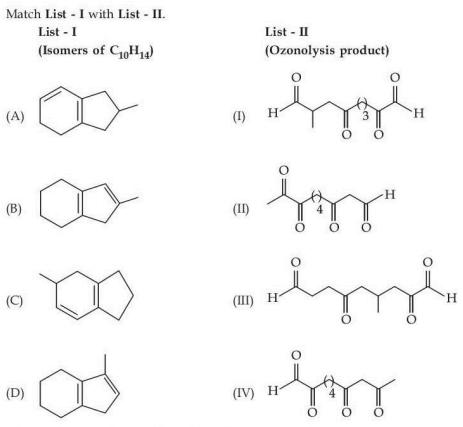
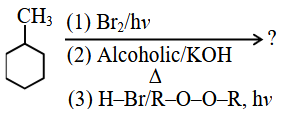
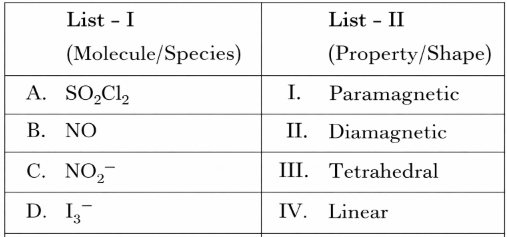
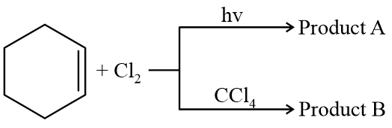
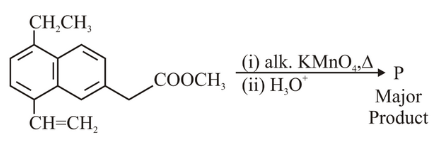
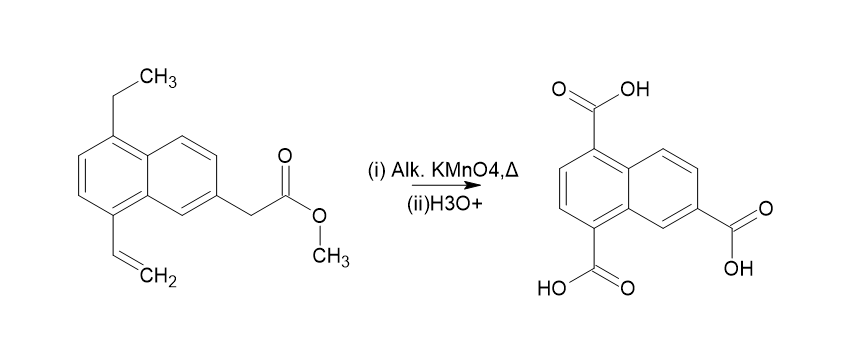
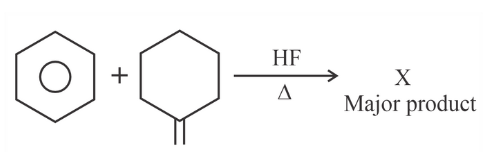
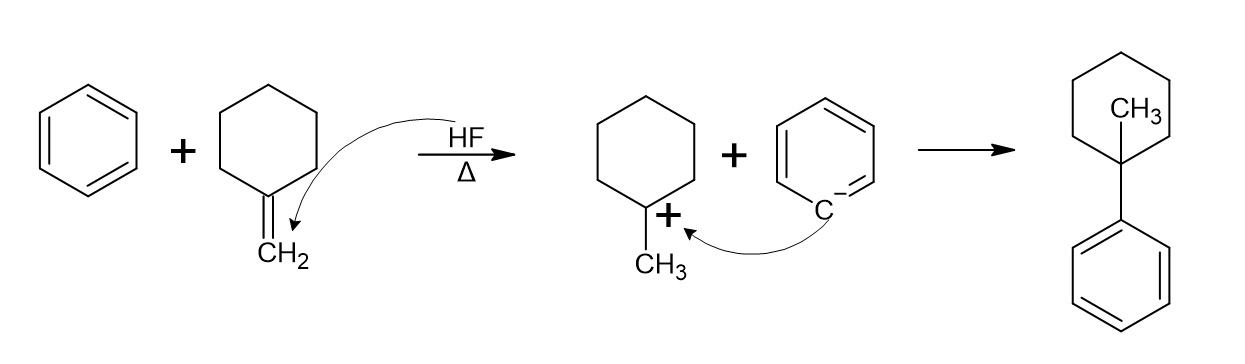
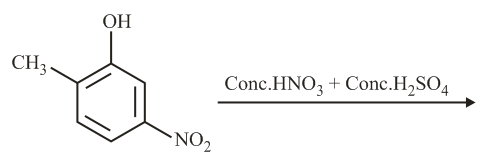
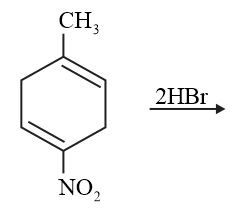
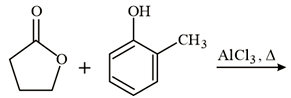
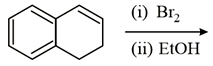
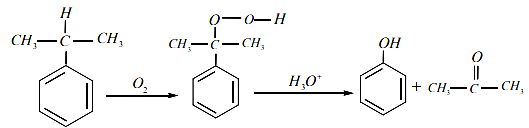
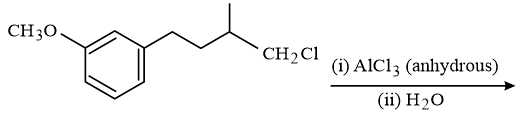
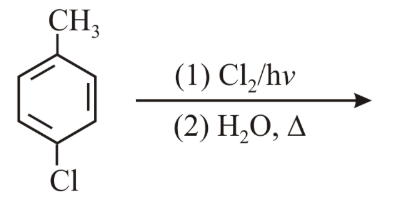
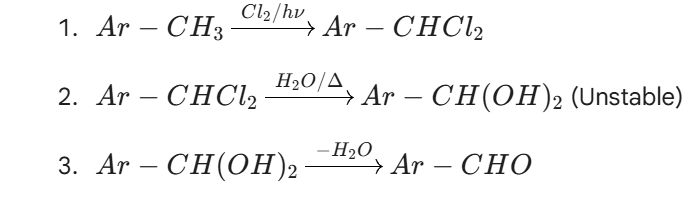
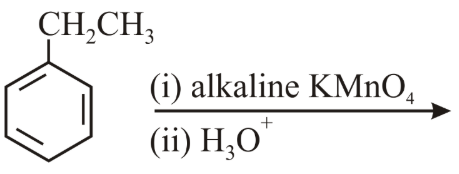
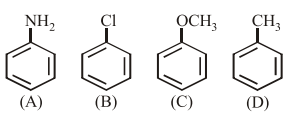
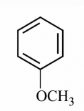
Identify the conect statements:
The presence of - $$NO_{2}$$ group in benzene ring
A. activates the ring towards electrophilic substitutions.
B. deactivates the ring towards electrophilic substitutions.
C. activates the ring towards nucleophilic substitutions.
D. deactivates the ring towards nucleophilic substitutions.
choose the correct answer from the options given below :
JEE Hydrocarbons - Aromatic Questions
The effect of the nitro group ($$-NO_2$$) on the benzene ring arises from its strong electron-withdrawing nature, which is due to both its $$-I$$ (inductive) and $$-M$$ (mesomeric/resonance) effects.
It pulls electron density away from the benzene ring.
Electrophilic aromatic substitution (EAS) requires electron density on the ring to attack the electrophile. Since $$-NO_2$$ withdraws electron density, it deactivates the ring towards electrophilic substitution. Statement B is correct.
Nucleophilic aromatic substitution (NAS) is favoured when the ring is electron-deficient, because the nucleophile attacks a carbon bearing a partial positive charge. Since $$-NO_2$$ makes the ring electron-poor, it activates the ring towards nucleophilic substitution. Statement C is correct.
Statement A (activates ring towards EAS) is incorrect because the nitro group instead deactivates the ring. Similarly, Statement D (deactivates ring towards NAS) is incorrect because it activates the ring towards nucleophilic substitution.
Therefore, the correct statements are B and C, which corresponds to Option 2.
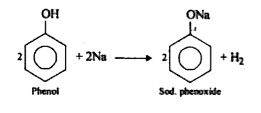
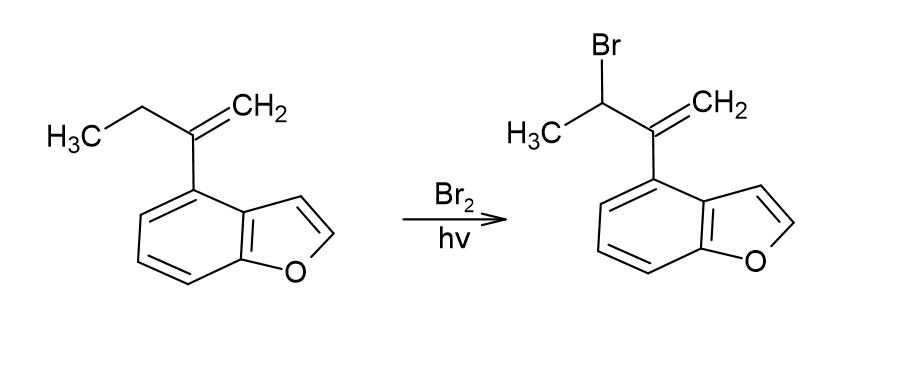
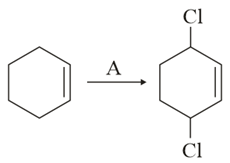
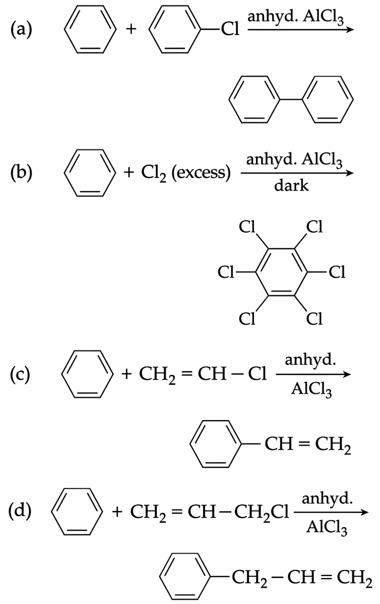
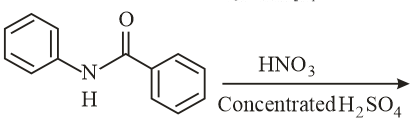
which of the following reaction is NOT correctly represented?
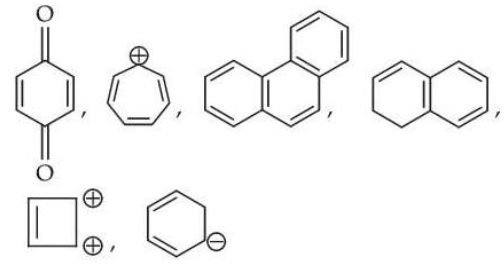
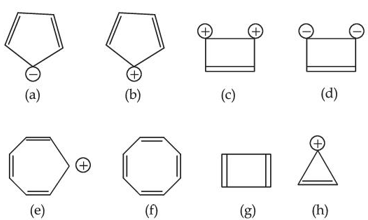
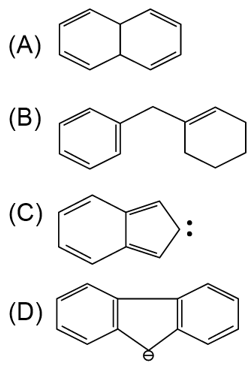
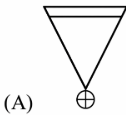
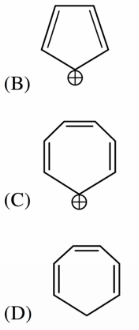
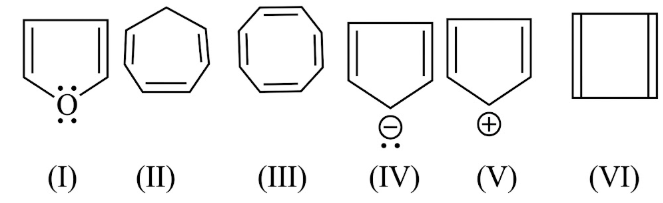
The total number of aromatic compounds/species from the following is
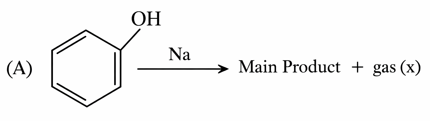
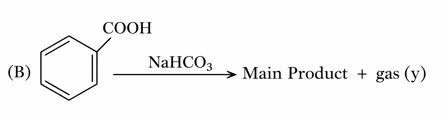
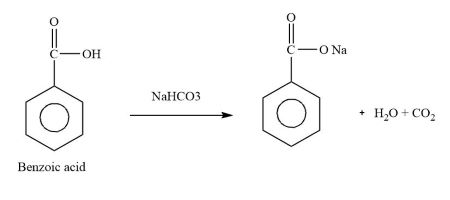
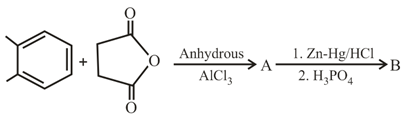
Consider the following two reactions A and B.
Numerical value of [ molar mass of x + molar mass of y] is __
gas(x) = $$H_2$$
molar mass (x) = 2g/mol
gas(y) = $$CO_2$$
molar mass (y) = 44 g/mol
molar mass of (x) + molar mass of (y): 2 + 44 = 46g/mol
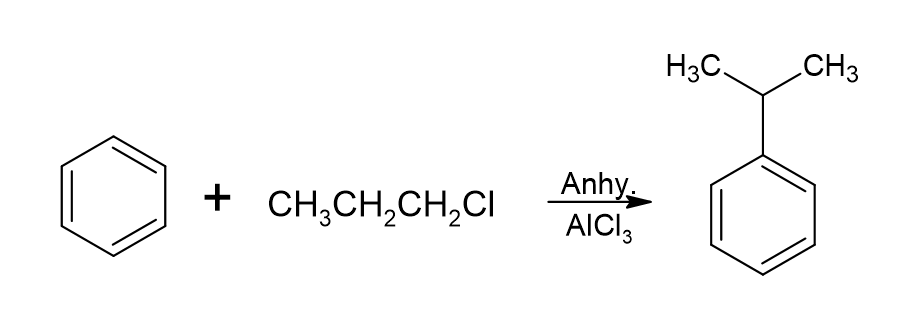
For the following Friedel Craft's alkylation reaction, which of the statements are correct?

A. Major product is n-propyl benzene.
B. iso-propyl carbocation intermediate is also generated.
C. Multiple substitution is inevitable.
D. Introducing electron-donating substituent on benzene will not produce any alkyl benzene.
Choose the correct answer from the options given below:
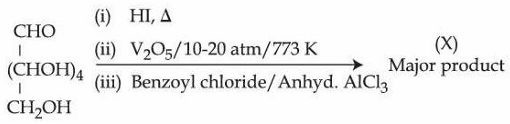
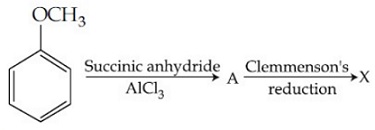
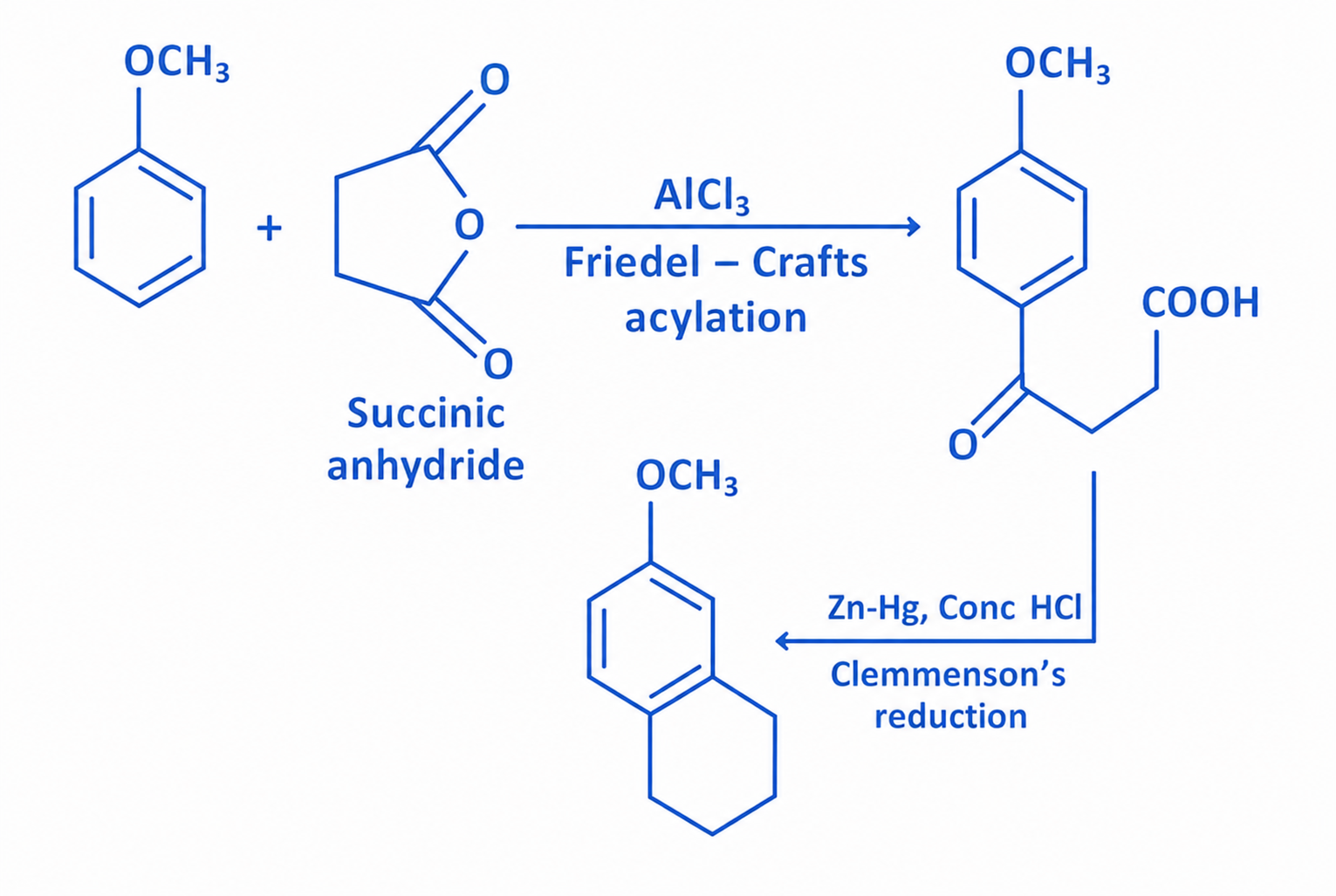
Consider the following reactions. Total number of electrons in the $$\pi$$ bonds and lone pair of electrons in the product (X) is :
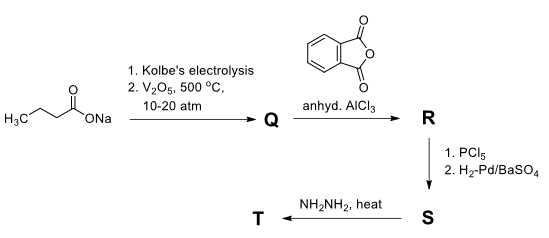
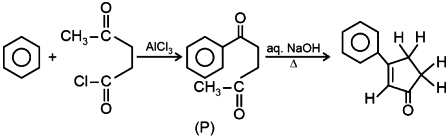
Consider the following reaction of benzene.
In compound (Q), the percentage of oxygen is ___ %. (Nearest integer)
Designate whether each of the following compounds is aromatic or not aromatic.
Choose the correct set of reagents for the following conversion:
The total number of compounds from below when treated with hot $$KMnO_{4}$$ giving benzoic acid is :
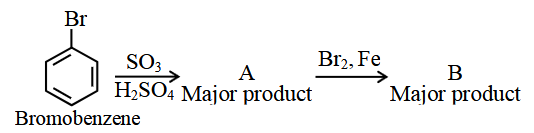
In the following series of reactions identify the major products A & B respectively.
Bromobenzene $$\xrightarrow{SO_3, H_2SO_4}$$ A (Major product) $$\xrightarrow{Br_2, Fe}$$ B (Major product)
Given below are two statements : Statement (I) : On nitration of m-xylene with $$HNO_{3}$$, $$H_{2}SO_{4}$$ followed by oxidation, 4-nitrobenzene-1,3-dicarboxylic acid is obtained as the major product. Statement (II) : $$-CH_{3}$$ group is o/p-directing while $$-NO_{2}$$ group is m-directing group. In the light of the above statements, choose the correct answer from the options given below :
We need to evaluate two statements about the nitration of m-xylene and the directing effects of substituents.
On nitration of m-xylene with $$HNO_3/H_2SO_4$$ followed by oxidation, 4-nitrobenzene-1,3-dicarboxylic acid is obtained as the major product. m-Xylene has two $$-CH_3$$ groups at positions 1 and 3 of the benzene ring, and both groups are ortho/para directing and activating. During nitration, the incoming $$NO_2^+$$ electrophile preferentially attacks the ring positions that are ortho or para to both methyl groups simultaneously. Position 2 is ortho to both methyl groups but is sterically hindered; positions 4 and 5 are each para to one methyl and ortho to the other. The major nitration product therefore has $$-NO_2$$ at position 4 (equivalently position 5 by symmetry), giving 1,3-dimethyl-4-nitrobenzene. Oxidation of both $$-CH_3$$ groups with a strong oxidizing agent such as $$KMnO_4$$ converts them to $$-COOH$$ groups, producing 4-nitrobenzene-1,3-dicarboxylic acid, which shows that Statement I is true.
The methyl group is an electron-donating group via hyperconjugation and the inductive effect, activating the ring and directing incoming electrophiles to ortho and para positions, whereas the nitro group is a strong electron-withdrawing group by resonance and inductive effects, deactivating the ring and directing electrophiles to the meta position. Thus Statement II is also true.
Since both statements are true, the correct answer is Option (4): Both Statement I and Statement II are true.

Choose the correct answer from the options given below :
Predict the major product of the following reaction sequence:
X g of nitrobenzene on nitration gave 4.2 g of m-dinitrobenzene. X = ________ g. (nearest integer)
[Given: molar mass (in g mol$$^{-1}$$) C: 12, H: 1, O: 16, N: 14]
For the conversion of nitrobenzene to m-dinitrobenzene, the nitration reaction is:
$$C_6H_5NO_2 + HNO_3 \rightarrow C_6H_4(NO_2)_2 + H_2O$$
This shows a $$1{:}1$$ molar ratio between nitrobenzene and m-dinitrobenzene.
Step 1: Calculate the molar mass of nitrobenzene, $$C_6H_5NO_2$$.
$$M_{\text{nitrobenzene}} = 6(12) + 5(1) + 1(14) + 2(16) = 72 + 5 + 14 + 32 = 123\ \text{g mol}^{-1}$$
Step 2: Calculate the molar mass of m-dinitrobenzene, $$C_6H_4(NO_2)_2$$.
$$M_{\text{dinitro}} = 6(12) + 4(1) + 2(14) + 4(16) = 72 + 4 + 28 + 64 = 168\ \text{g mol}^{-1}$$
Step 3: Use the stoichiometric mass ratio.
$$123\ \text{g nitrobenzene} \longrightarrow 168\ \text{g dinitrobenzene}$$
Step 4: For a yield of $$4.2\ \text{g}$$ of m-dinitrobenzene, the required mass of nitrobenzene is
$$X = 4.2 \times \frac{123}{168}\ \text{g}$$
$$X = 4.2 \times 0.7321\ (\text{since }123/168 = 0.7321)$$
$$X = 3.075\ \text{g}$$
Step 5: Rounding to the nearest integer:
$$X \approx 3\ \text{g}$$
Hence, the required mass of nitrobenzene is $$\mathbf{3\ g}$$.
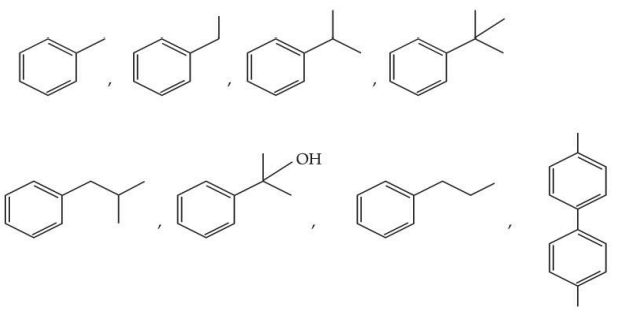
Isomeric hydrocarbons $$\rightarrow$$ negative Baeyer's test (Molecular formula $$C_{9}H_{12}$$) The total number of isomers from above with four different non-aliphatic substitution sites is -
Molecular formula $$C_9H_{12}$$: degree of unsaturation = $$\frac{2(9)+2-12}{2} = \frac{8}{2} = 4$$.
Since it gives a negative Baeyer's test (no alkene/alkyne), the 4 degrees of unsaturation come from a benzene ring. So these are alkylbenzenes with formula $$C_6H_5-C_3H_7$$.
The isomeric alkylbenzenes with $$C_9H_{12}$$ are:
1. n-propylbenzene
2. isopropylbenzene (cumene)
3. 1,2,3-trimethylbenzene (hemimellitene)
4. 1,2,4-trimethylbenzene (pseudocumene)
5. 1,3,5-trimethylbenzene (mesitylene)
6. 1-ethyl-2-methylbenzene
7. 1-ethyl-3-methylbenzene
8. 1-ethyl-4-methylbenzene
We need isomers with exactly 4 different non-aliphatic (aromatic) substitution sites, meaning 4 different types of aromatic H atoms.
Looking at 1,2,4-trimethylbenzene: positions on ring are C1(CH₃), C2(CH₃), C3(H), C4(CH₃), C5(H), C6(H). The three H atoms at C3, C5, C6 are all in different environments. So 3 types of aromatic H, not 4.
For 1-ethyl-2-methylbenzene: C1(Et), C2(Me), C3(H), C4(H), C5(H), C6(H). The H's at C3, C4, C5, C6 are in 4 different environments. This has 4 different aromatic substitution sites. ✓
For 1-ethyl-3-methylbenzene: C1(Et), C2(H), C3(Me), C4(H), C5(H), C6(H). The H's at C2, C4, C5, C6 are in 4 different environments. ✓
So 2 isomers have 4 different non-aliphatic substitution sites.
The answer is 2.
The total number of structural isomers possible for the substituted benzene derivatives with the molecular formula $$C_9H_{12}$$ is ________.
First compute the double-bond (or index of) unsaturation for the molecular formula $$C_9H_{12}$$.
The formula for a hydrocarbon is
$$\text{DBE}= \frac{2n+2-m}{2}$$
where $$n$$ and $$m$$ are the number of carbon and hydrogen atoms respectively.
For $$C_9H_{12}$$,
$$\text{DBE}= \frac{2(9)+2-12}{2}= \frac{20-12}{2}=4$$
Exactly four elements of unsaturation correspond to one benzene ring (1 ring + 3 π bonds). Hence every isomer must contain a single benzene nucleus and no other rings or multiple bonds. All variations will therefore come only from the nature, number and relative positions of the alkyl substituents attached to that ring.
Let the ring be $$C_6H_6$$. Each hydrogen on the ring that is replaced by an alkyl group reduces the ring hydrogens by 1 and adds the atoms of the substituent in their place.
We now distribute the three surplus carbons ($$9-6=3$$) and the six surplus hydrogens ($$12-6=6$$) among substituents so that the overall formula stays $$C_9H_{12}$$. The possibilities are:
Case 1:One three-carbon substituent (propyl).
The side chain can be straight (n-propyl, $$CH_3CH_2CH_2-$$) or branched (isopropyl, $$CH_3CH(CH_3)-$$). In a monosubstituted benzene all ring positions are equivalent, so each chain gives exactly one isomer.
Total isomers from this case = $$2$$.
Case 2:One ethyl ($$C_2H_5-$$) and one methyl ($$CH_3-$$) substituent.
With two different groups there are three distinct relative positions on the ring: ortho (1,2), meta (1,3), and para (1,4).
Total isomers from this case = $$3$$.
Case 3:Three methyl substituents (trimethylbenzenes).
The possible substitution patterns are
$$1,2,3$$-trimethylbenzene,
$$1,2,4$$-trimethylbenzene, and
$$1,3,5$$-trimethylbenzene.
Total isomers from this case = $$3$$.
Adding all distinct structural isomers:
$$2 + 3 + 3 = 8$$
Hence, the total number of structural isomers of aromatic hydrocarbons having the molecular formula $$C_9H_{12}$$ is 8.
Molality ($$m$$) of $$3M$$ aqueous solution of NaCl is : (Given : Density of solution $$= 1.25 \text{ g mL}^{-1}$$, Molar mass in $$\text{gmol}^{-1}$$: Na $$- 23$$, Cl $$- 35.5$$)
3M NaCl, density 1.25 g/mL. Molar mass NaCl = 58.5 g/mol.
In 1L solution: mass = 1250 g, moles NaCl = 3, mass NaCl = 175.5 g.
Mass of water = 1250 - 175.5 = 1074.5 g = 1.0745 kg.
Molality = 3/1.0745 = 2.79 m.
The correct answer is Option (3): 2.79 m.
The density of 'x' M solution ('X' molar) of NaOH is $$1.12 \text{ g mL}^{-1}$$, while in molality, the concentration of the solution is $$3 \text{ m (3 molal)}$$. Then $$x$$ is (Given : Molar mass of NaOH is $$40 \text{ g/mol}$$)
Molality = 3 m means 3 mol NaOH per 1 kg solvent. Mass of NaOH = 3 × 40 = 120 g. Total mass = 1000 + 120 = 1120 g.
Volume = 1120/1.12 = 1000 mL = 1 L. Molarity = 3/1 = 3 M.
The correct answer is Option (4): 3.0.
Match List I with List II

Choose the correct answer from the options given below:
Product A and B formed in the following set of reactions are:
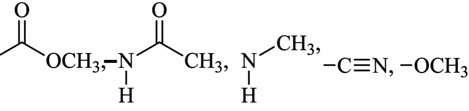
The set of meta directing functional groups from the following sets is:
We need to identify the set containing only meta-directing functional groups in electrophilic aromatic substitution.
Key concept: Meta-directing groups are electron-withdrawing groups (EWGs) that deactivate the ring. They include: $$-NO_2$$, $$-CHO$$, $$-COR$$, $$-COOH$$, $$-COOR$$, $$-SO_3H$$, $$-CN$$, $$-CF_3$$.
Ortho/para-directing groups include: $$-NH_2$$, $$-NHR$$, $$-OH$$, $$-OCH_3$$, $$-NHCOCH_3$$, halogens.
Option A: $$-CN, -NH_2, -NHR, -OCH_3$$
$$-NH_2$$, $$-NHR$$, $$-OCH_3$$ are ortho/para directors. Not all meta.
Option B: $$-NO_2, -NH_2, -COOH, -COOR$$
$$-NH_2$$ is an ortho/para director. Not all meta.
Option C: $$-NO_2, -CHO, -SO_3H, -COR$$
All four are electron-withdrawing, meta-directing groups. All meta.
Option D: $$-CN, -CHO, -NHCOCH_3, -COOR$$
$$-NHCOCH_3$$ (acetamido group) is an ortho/para director despite being a weaker activator. Not all meta.
The correct answer is Option C) $$-NO_2, -CHO, -SO_3H, -COR$$.
Identify product A and product B
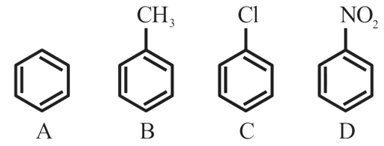
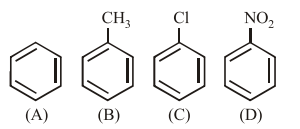
Which of the following compound will most easily be attacked by an electrophile?
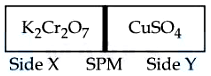
$$0.05$$ M $$CuSO_4$$ when treated with $$0.01$$ M $$K_2Cr_2O_7$$ gives green colour solution of $$Cu_2Cr_2O_7$$.
The two solutions are separated as shown below : [SPM : Semi Permeable Membrane]. Due to osmosis :
The correct order of reactivity in electrophilic substitution reaction of the following compounds is:
Which one of the following reactions is NOT possible?
Molarity (M) of an aqueous solution containing $$x$$ g of anhyd. $$CuSO_4$$ in $$500$$ mL solution at $$32°C$$ is $$2 \times 10^{-1}$$ M. Its molality will be ______ $$\times 10^{-3}$$ m. (nearest integer). [Given density of the solution $$= 1.25$$ g/mL]
Given: Molarity = 0.2 M, volume = 500 mL, density = 1.25 g/mL.
Moles of $$CuSO_4$$ = $$0.2 \times 0.5 = 0.1$$ mol.
Molar mass of anhydrous $$CuSO_4$$ = 64 + 32 + 64 = 160 g/mol.
Mass of $$CuSO_4$$ = $$0.1 \times 160 = 16$$ g.
Mass of solution = $$500 \times 1.25 = 625$$ g.
Mass of solvent (water) = $$625 - 16 = 609$$ g = 0.609 kg.
Molality = $$\frac{\text{moles of solute}}{\text{mass of solvent in kg}} = \frac{0.1}{0.609} = 0.16420$$ m.
Converting: $$0.16420$$ m = $$164.2 \times 10^{-3}$$ m.
Nearest integer: $$164 \times 10^{-3}$$ m.
The answer is $$\boxed{164}$$.
A solution containing $$10 \text{ g}$$ of an electrolyte $$AB_2$$ in $$100 \text{ g}$$ of water boils at $$100.52°C$$. The degree of ionization of the electrolyte $$(\alpha)$$ is ______ $$\times 10^{-1}$$. (nearest integer) [Given: Molar mass of $$AB_2 = 200 \text{ g mol}^{-1}$$, $$K_b$$ (molal boiling point elevation const. of water) $$= 0.52 \text{ K kg mol}^{-1}$$, boiling point of water $$= 100°C$$; $$AB_2$$ ionises as $$AB_2 \rightarrow A^{2+} + 2B^-$$]
Find the degree of ionization $$\alpha$$ for electrolyte $$AB_2$$.
Boiling point elevation is calculated as $$\Delta T_b = 100.52 - 100 = 0.52°C$$.
Since $$\Delta T_b = iK_bm$$, where $$m$$ is the molality, we first determine $$m$$.
Substituting the values gives $$m = \frac{10/200}{100/1000} = \frac{0.05}{0.1} = 0.5 \text{ mol/kg}$$.
Using $$\Delta T_b = iK_bm$$ again with $$0.52 = i \times 0.52 \times 0.5$$ leads to $$i = \frac{0.52}{0.26} = 2$$.
The dissociation of $$AB_2$$ is represented by $$AB_2 \rightarrow A^{2+} + 2B^-$$, yielding $$n = 3$$ ions.
Relating the van't Hoff factor to the degree of ionization via $$i = 1 + (n-1)\alpha$$, we have $$2 = 1 + 2\alpha$$, which gives $$\alpha = 0.5$$.
Therefore, $$\alpha = 0.5 = 5 \times 10^{-1}$$.
The correct answer is 5.
Among the following, total number of meta directing functional groups is (Integer based) $$-OCH_3$$, $$-NO_2$$, $$-CN$$, $$-CH_3$$, $$-NHCOCH_3$$, $$-COR$$, $$-OH$$, $$-COOH$$, $$-Cl$$
Meta-directing groups are electron-withdrawing groups that deactivate the ring and direct incoming electrophiles to the meta position.
Analyzing each group:
- $$-OCH_3$$: Ortho/para director (activating, +M effect)
- $$-NO_2$$: Meta director (deactivating, -M effect)
- $$-CN$$: Meta director (deactivating, -M effect)
- $$-CH_3$$: Ortho/para director (activating, +I effect)
- $$-NHCOCH_3$$: Ortho/para director (activating, lone pair on N)
- $$-COR$$: Meta director (deactivating, -M effect)
- $$-OH$$: Ortho/para director (activating, +M effect)
- $$-COOH$$: Meta director (deactivating, -M effect)
- $$-Cl$$: Ortho/para director (deactivating but o/p directing due to lone pairs)
Meta directing groups: $$-NO_2, -CN, -COR, -COOH$$ = 4 groups.
The answer is $$\boxed{4}$$.
An artificial cell is made by encapsulating $$0.2 \text{ M}$$ glucose solution within a semipermeable membrane. The osmotic pressure developed when the artificial cell is placed within a $$0.05 \text{ M NaCl}$$ solution at $$300 \text{ K}$$ is ______ $$\times 10^{-1} \text{ bar}$$. (nearest integer). [Given : $$R = 0.083 \text{ L bar mol}^{-1} \text{ K}^{-1}$$] Assume complete dissociation of $$NaCl$$
An artificial cell containing 0.2 M glucose is placed in a 0.05 M NaCl solution (complete dissociation yields 0.1 M total ion concentration). The osmotic pressure can be calculated using the formula $$\pi = iCRT$$, where $$i$$ is the van ’t Hoff factor, $$C$$ the molar concentration, $$R$$ the gas constant, and $$T$$ the temperature.
For the glucose solution (a non-electrolyte with $$i = 1$$), the osmotic pressure inside the cell is $$\pi_{inside} = 1 \times 0.2 \times R \times T$$. For the NaCl solution (with $$i = 2$$ under complete dissociation), the osmotic pressure outside the cell is $$\pi_{outside} = 2 \times 0.05 \times R \times T = 0.1 \times R \times T$$.
The net osmotic pressure difference is given by $$\pi = \pi_{inside} - \pi_{outside} = (0.2 - 0.1) \times R \times T = 0.1 \times 0.083 \times 300$$ which evaluates to $$2.49 \text{ bar} = 24.9 \times 10^{-1} \text{ bar} \approx 25 \times 10^{-1} \text{ bar}$$.
The final answer is 25.
Consider the dissociation of the weak acid HX as given below $$HX(aq) \rightleftharpoons H^+(aq) + X^-(aq)$$, $$K_a = 1.2 \times 10^{-5}$$ [$$K_a$$ : dissociation constant]. The osmotic pressure of $$0.03$$ M aqueous solution of HX at $$300 \text{ K}$$ is _______ $$\times 10^{-2}$$ bar (nearest integer). [Given : $$R = 0.083 \text{ L bar mol}^{-1} \text{K}^{-1}$$]
We need to find the osmotic pressure of a 0.03 M aqueous solution of weak acid HX. The acid dissociates as $$HX \rightleftharpoons H^+ + X^-$$, and we are given $$K_a = 1.2 \times 10^{-5}$$, $$C = 0.03$$ M, $$T = 300$$ K, and $$R = 0.083$$ L bar mol$$^{-1}$$ K$$^{-1}$$.
We begin by finding the degree of dissociation, $$\alpha$$. At equilibrium, $$[HX] = C(1-\alpha)$$, $$[H^+] = C\alpha$$, and $$[X^-] = C\alpha$$, so
$$K_a = \frac{C\alpha \times C\alpha}{C(1-\alpha)} = \frac{C\alpha^2}{1-\alpha}$$
For small $$\alpha$$ ($$\alpha \ll 1$$), we approximate $$K_a \approx C\alpha^2$$, which gives
$$\alpha = \sqrt{\frac{K_a}{C}} = \sqrt{\frac{1.2 \times 10^{-5}}{0.03}} = \sqrt{4 \times 10^{-4}} = 0.02$$
Since $$\alpha = 0.02$$ (2%), the approximation $$\alpha \ll 1$$ is valid.
The van’t Hoff factor, $$i$$, for a substance that dissociates into 2 ions with degree of dissociation $$\alpha$$ is
$$i = 1 + \alpha(n - 1) = 1 + \alpha(2 - 1) = 1 + \alpha = 1 + 0.02 = 1.02$$
Finally, the osmotic pressure is given by
$$\pi = iCRT$$
Substituting the values,
$$\pi = 1.02 \times 0.03 \times 0.083 \times 300$$
First compute $$CRT$$:
$$CRT = 0.03 \times 0.083 \times 300 = 0.747$$ bar
Thus,
$$\pi = 1.02 \times 0.747 = 0.76194$$ bar
$$= 76.194 \times 10^{-2}$$ bar $$\approx 76 \times 10^{-2}$$ bar
The answer is 76.
Number of compounds from the following which cannot undergo Friedel-Crafts reactions is: ________. toluene, nitrobenzene, xylene, cumene, aniline, chlorobenzene, $$m$$-nitroaniline, $$m$$-dinitrobenzene
Friedel-Crafts reactions don't work with strongly deactivated aromatic rings (those with powerful electron-withdrawing groups).
Cannot undergo Friedel-Crafts: nitrobenzene (strongly deactivated), aniline (amine complexes with AlCl₃ catalyst), m-nitroaniline (strongly deactivated), m-dinitrobenzene (very strongly deactivated).
Can undergo: toluene, xylene, cumene (all activated), chlorobenzene (mildly deactivated but can still react).
Count of those that CANNOT: nitrobenzene, aniline, m-nitroaniline, m-dinitrobenzene = 4.
The answer is $$\boxed{4}$$.
A solution is prepared by adding 1 mole ethyl alcohol in 9 mole water. The mass percent of solute in the solution is _____ (Given : Molar mass in g/mol: Ethyl alcohol : 46, water: 18)
We need to find the mass percent of ethyl alcohol in a solution containing 1 mole ethyl alcohol and 9 moles of water.
Since the mass percent of solute is given by $$\text{Mass percent} = \frac{\text{Mass of solute}}{\text{Mass of solution}} \times 100$$, we note that the molar mass of ethyl alcohol is 46 g/mol and that of water is 18 g/mol.
Now the mass of ethyl alcohol in the solution is $$1 \times 46 = 46$$ g, and the mass of water is $$9 \times 18 = 162$$ g. Substituting these values, the total mass of the solution becomes $$46 + 162 = 208$$ g.
Therefore the mass percent of ethyl alcohol is $$\text{Mass percent} = \frac{46}{208} \times 100 = \frac{4600}{208} = 22.115\%$$, which rounds to approximately $$22\%$$.
The answer is $$\boxed{22}$$.
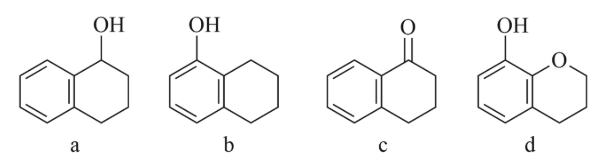
Among the given organic compounds, the total number of aromatic compounds is _______.
Total number of deactivating groups in aromatic electrophilic substitution reaction among the following is:
Molality of an aqueous solution of urea is 4.44 m. Mole fraction of urea in solution is $$x \times 10^{-3}$$. Value of $$x$$ is _____.
We need to find the mole fraction of urea in an aqueous solution with molality 4.44 m.
Molality (m) is defined as the number of moles of solute per kilogram of solvent:
$$m = \frac{n_{\text{solute}}}{W_{\text{solvent (kg)}}}$$
For molality = 4.44 m, we have 4.44 moles of urea in 1 kg (1000 g) of water.
Moles of water = $$\frac{1000}{18} = 55.56$$ mol
The mole fraction of urea is:
$$x_{\text{urea}} = \frac{n_{\text{urea}}}{n_{\text{urea}} + n_{\text{water}}} = \frac{4.44}{4.44 + 55.56} = \frac{4.44}{60} = 0.074$$
Given that the mole fraction = $$x \times 10^{-3}$$:
$$0.074 = x \times 10^{-3}$$
$$x = \frac{0.074}{10^{-3}} = 74$$
The answer is $$\boxed{74}$$.
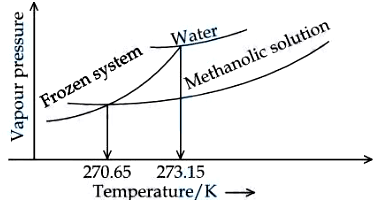
When '$$x$$' $$\times 10^{-2}$$ mL methanol (molar mass $$= 32 \text{ g}$$; density $$= 0.792 \text{ g/cm}^3$$) is added to $$100 \text{ mL}$$ water (density $$= 1 \text{ g/cm}^3$$), the following diagram is obtained. $$x =$$ ___________ (nearest integer).
[Given : Molal freezing point depression constant of water at $$273.15 \text{ K}$$ is $$1.86 \text{ K kg mol}^{-1}$$]
When a hydrocarbon A undergoes combustion in the presence of air, it requires $$9.5$$ equivalents of oxygen and produces $$3$$ equivalents of water. What is the molecular formula of A?
We need to find the molecular formula of hydrocarbon A that requires 9.5 equivalents of O$$_2$$ for combustion and produces 3 equivalents of water.
Write the general combustion equation.
For a hydrocarbon C$$_x$$H$$_y$$:
$$\text{C}_x\text{H}_y + \left(x + \frac{y}{4}\right)\text{O}_2 \to x\text{CO}_2 + \frac{y}{2}\text{H}_2\text{O}$$
Set up equations from the given data.
Moles of O$$_2$$ required: $$x + \frac{y}{4} = 9.5$$
Moles of H$$_2$$O produced: $$\frac{y}{2} = 3 \implies y = 6$$
Solve for $$x$$.
$$x + \frac{6}{4} = 9.5$$
$$x + 1.5 = 9.5$$
$$x = 8$$
Identify the molecular formula.
The molecular formula is C$$_8$$H$$_6$$.
The correct answer is Option A: C$$_8$$H$$_6$$.
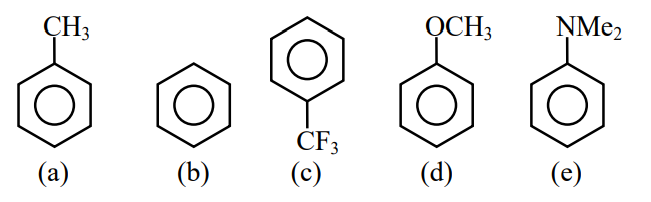
Decreasing order of reactivity towards electrophilic substitution for the following compounds is:
Arrange the following compounds in increasing order of rate of aromatic electrophilic substitution reaction.
Compound (c) [Strongly Deactivated] < Compound (a) [Weakly Activated] <Compound (b) [Strongly Activated] < Compound (d) [Highly Activated by two groups]}
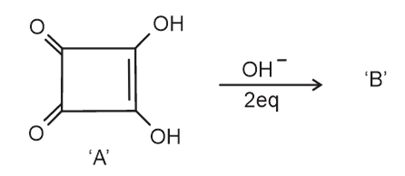
Correct statements for the given reaction are:

A. Compound 'B' is aromatic
B. The completion of above reaction is very slow
C. 'A' shows tautomerism
D. The bond lengths of C $$-$$ C in compound B are found to be same
Choose the correct answer from the options given below.
Given below are two statements, one is labelled as Assertion A and the other is labelled as Reason R.
Assertion A: Benzene is more stable than hypothetical cyclohexatriene.
Reason R: The delocalized $$\pi$$ electron cloud is attracted more strongly by nuclei of carbon atoms.
In the light of the above statements, choose the correct answer from the options given below:
This is an Assertion-Reason type question. We need to evaluate both statements independently and determine their truth values and relationship.
Evaluating Assertion A: "Benzene is more stable than hypothetical cyclohexatriene."
Cyclohexatriene is a hypothetical molecule with three isolated, localized C=C double bonds in a six-membered ring (i.e., without any resonance stabilization). In contrast, real benzene has a fully delocalized pi-electron system where the six pi electrons are spread over all six carbon atoms.
The experimental evidence for benzene's extra stability comes from its heat of hydrogenation. Cyclohexene (one C=C bond) has a heat of hydrogenation of about 120 kJ/mol. If cyclohexatriene existed with three isolated double bonds, its expected heat of hydrogenation would be $$3 \times 120 = 360$$ kJ/mol. However, the actual heat of hydrogenation of benzene is only about 208 kJ/mol. The difference, $$360 - 208 = 152$$ kJ/mol (approximately 36 kcal/mol), is called the resonance energy of benzene.
This large resonance stabilization energy confirms that benzene is indeed significantly more stable than the hypothetical cyclohexatriene. Assertion A is TRUE.
Evaluating Reason R: "The delocalized pi electron cloud is attracted more strongly by nuclei of carbon atoms."
This statement is false. The stability of benzene over cyclohexatriene is not due to the pi electrons being "attracted more strongly" by the carbon nuclei. The actual reason for benzene's enhanced stability is the delocalization of pi electrons over the entire ring. When electrons are delocalized over a larger region, their kinetic energy decreases (the electron wavelength increases and momentum decreases, by the uncertainty principle), and the overall electronic energy is lowered. This is the origin of resonance energy.
The nuclear attraction for electrons does not fundamentally change between benzene and cyclohexatriene -- both have the same number of carbon nuclei and pi electrons. The key difference is the delocalization that lowers the total energy of the system. Reason R is FALSE.
Since A is true and R is false, the correct answer is Option 1: A is true but R is false.
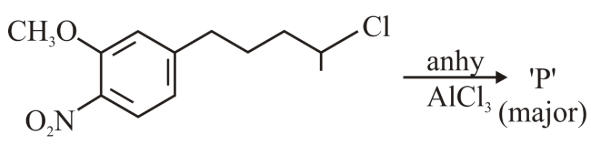
The major product 'P' formed in the given reaction is

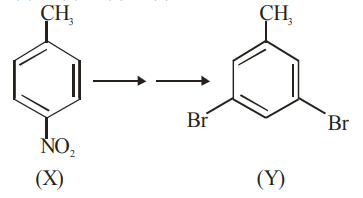
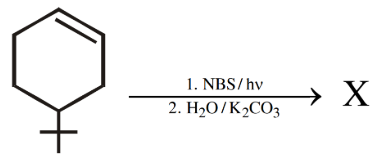
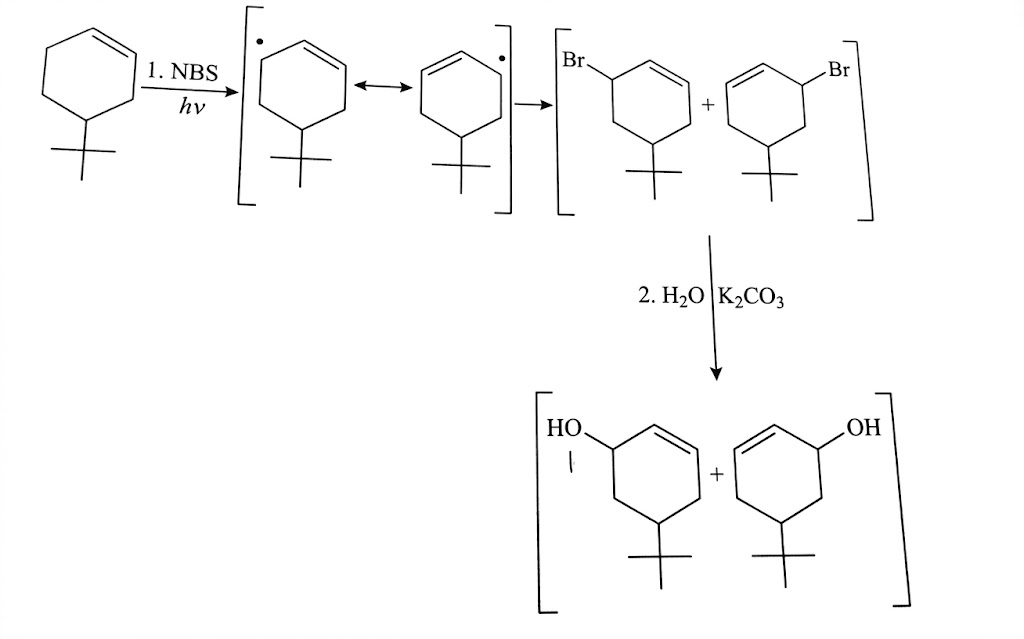
'X' is:
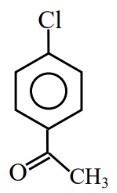
The major product formed in the Friedel-Craft acylation of chlorobenzene is
An organic compound 'A' with empirical formula C$$_6$$H$$_6$$O gives sooty flame on burning. Its reaction with bromine solution in low polarity solvent results in high yield of B. B is
The major product 'P' formed in the given reaction is
Number of isomeric compounds with molecular formula C$$_9$$H$$_{10}$$O which
(i) do not dissolve in NaOH
(ii) do not dissolve in HCl.
(iii) do not give orange precipitate with 2, 4-DNP
(iv) on hydrogenation give identical compound with molecular formula C$$_9$$H$$_{12}$$O is
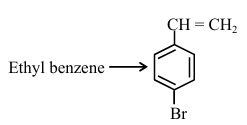
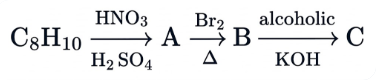
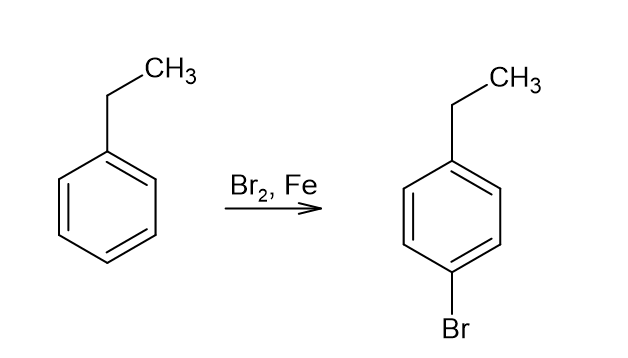
Product 'A' of following sequence of reactions is
Br2,fe would add bromine to the ethylbenzene and cl2/alc. koh would convert single bond to double bond resulting into option D
Given below are two statements. One is labelled as Assertion A and the other is labelled as Reason R.
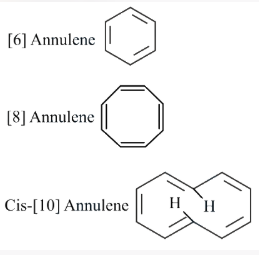
Assertion A: [6] Annulene, [8] Annulene and cis-[10] Annulene are respectively aromatic, not-aromatic and aromatic.

Reason R: Planarity is one of the requirements of aromatic systems.
In the light of the above statements, choose the most appropriate answer from the options given below.
We need to evaluate the Assertion and Reason about annulenes and aromaticity.
Assertion A: [6] Annulene, [8] Annulene and cis-[10] Annulene are respectively aromatic, not-aromatic and aromatic.
Recall Huckel's Rule: A compound is aromatic if it is cyclic, planar, fully conjugated, and has $$(4n + 2)$$ pi electrons.
Analysis of each annulene:
[6] Annulene (Benzene): Has 6 pi electrons. Using $$(4n + 2)$$ with $$n = 1$$: $$4(1) + 2 = 6$$. It is cyclic, planar, and fully conjugated. So it is aromatic. This part is correct.
[8] Annulene (Cyclooctatetraene): Has 8 pi electrons. $$8 = 4n$$ with $$n = 2$$, so it has $$4n$$ electrons (anti-aromatic if planar). However, it adopts a tub-shaped (non-planar) geometry to avoid anti-aromaticity. So it is non-aromatic. This part is correct.
cis-[10] Annulene (all-cis cyclodecapentaene): Has 10 pi electrons. $$4n + 2 = 10$$ with $$n = 2$$. While it satisfies Huckel's rule electronically, the all-cis configuration of [10] annulene is not planar due to angle strain and steric interactions between interior hydrogen atoms. Since it is not planar, it is not aromatic.
Therefore, Assertion A is incorrect because cis-[10] annulene is not aromatic (it fails the planarity requirement).
Reason R: "Planarity is one of the requirements of aromatic systems."
This is correct. Planarity is indeed a necessary condition for aromaticity to allow continuous overlap of p-orbitals.
Conclusion: A is not correct but R is correct.
The correct answer is Option D.
In the given reaction sequence, the major product 'C' is :
Which of the following compounds is not aromatic?
We need to identify which compound among the given options is not aromatic. A compound is aromatic if it is cyclic, planar, fully conjugated (every atom in the ring has a p-orbital), and has $$4n + 2$$ pi electrons, where $$n = 0, 1, 2, 3, \ldots$$.
In benzene there are six pi electrons. Applying Huckel’s rule gives:
$$4n + 2 = 6 \Rightarrow n = 1$$
Benzene is cyclic, planar, and fully conjugated, so it is aromatic.
The cyclopentadienyl anion ($$C_5H_5^-$$) has six pi electrons: four from the two double bonds and two from the lone pair on the carbanion. Huckel’s rule gives:
$$4n + 2 = 6 \Rightarrow n = 1$$
It is cyclic, planar, and fully conjugated, so it is aromatic.
Cyclooctatetraene ($$C_8H_8$$) has eight pi electrons from the four double bonds in the eight-membered ring. Huckel’s rule gives:
$$4n + 2 = 8 \Rightarrow n = 1.5$$
Because this is not an integer and $$8 = 4 \times 2$$ indicates 4n electrons (antiaromatic if planar), COT adopts a non-planar tub-shaped conformation to avoid antiaromaticity and is therefore non-aromatic.
The tropylium cation ($$C_7H_7^+$$) has seven carbons in a ring with an empty p-orbital on the carbocation and six pi electrons. Huckel’s rule gives:
$$4n + 2 = 6 \Rightarrow n = 1$$
It is cyclic, planar, and fully conjugated, so it is aromatic.
Hence, the correct answer is Option C: Cyclooctatetraene.
Arrange the following in increasing order of reactivity towards nitration
A. p-xylene
B. bromobenzene
C. mesitylene
D. nitrobenzene
E. benzene
Choose the correct answer from the options given below
We need to arrange the given compounds in increasing order of reactivity towards electrophilic aromatic nitration. The reactivity of a benzene ring towards nitration depends on the nature of the substituents attached to it — electron-donating groups (EDGs) activate the ring (increase reactivity), while electron-withdrawing groups (EWGs) deactivate the ring (decrease reactivity).
Let us analyze each compound:
D. Nitrobenzene: The nitro group ($$-NO_2$$) is a strong electron-withdrawing group that deactivates the benzene ring significantly. This makes nitrobenzene the least reactive towards nitration.
B. Bromobenzene: The bromo group ($$-Br$$) is a deactivating group (due to its electronegativity and $$-I$$ effect, which outweighs its weak $$+M$$ effect). So bromobenzene is less reactive than benzene itself, but more reactive than nitrobenzene.
E. Benzene: Benzene has no substituent and serves as the reference. It is more reactive than bromobenzene and nitrobenzene but less reactive than compounds with electron-donating groups.
A. p-Xylene: p-Xylene has two methyl groups ($$-CH_3$$) on the ring at the para positions. Methyl groups are electron-donating groups (through hyperconjugation and $$+I$$ effect), which activate the ring. Two methyl groups provide more activation than a single one, so p-xylene is more reactive than benzene.
C. Mesitylene: Mesitylene (1,3,5-trimethylbenzene) has three methyl groups on the ring. The cumulative electron-donating effect of three methyl groups makes mesitylene the most activated and therefore the most reactive towards nitration.
So the increasing order of reactivity towards nitration is:
$$D \lt B \lt E \lt A \lt C$$
(Nitrobenzene < Bromobenzene < Benzene < p-Xylene < Mesitylene)
Hence, the correct answer is Option B.
Halogenation of which one of the following will yield m-substituted product with respect to methyl group as a major product?
To determine the major product of an electrophilic aromatic substitution like halogenation on a benzene ring with two substituents, you must identify which group is the stronger activator. In the correct option (Option C, 2-methylphenol), the ring is attached to a methyl group (-CH3) and a hydroxyl group (-OH). While both are ortho/para-directing groups, the hydroxyl group is a much stronger activator due to the powerful resonance effect of the lone pairs on its oxygen atom. The methyl group only activates weakly through hyperconjugation. The golden rule in these reactions is that the more powerful activating group dictates the position of the incoming electrophile. Therefore, the -OH group takes control and directs the incoming halogen to the positions ortho and para to itself. If you look at the layout of the 2-methylphenol molecule, the available positions that are ortho and para to the -OH group happen to be located exactly meta to the methyl group. As a result, while the -OH group is simply following its normal directing rules, the final major product ends up being meta-substituted with respect to the methyl group.
Which of the following is not an example of benzenoid compound?
We need to identify which compound is not a benzenoid compound.
Benzenoid compounds are aromatic compounds that contain one or more benzene rings (fused or isolated). They are based on the benzene ring structure.
Non-benzenoid compounds are aromatic compounds that do not contain a benzene ring but still follow Huckel's rule of aromaticity ($$4n + 2$$ pi electrons in a planar, cyclic, conjugated system).
Let us examine each option:
Option A: Naphthalene — It consists of two fused benzene rings. It is a benzenoid compound.
Option B: Thiophene — It is a five-membered heterocyclic ring containing one sulphur atom. Its structure is:
$$C_4H_4S$$ — a five-membered ring with 6 pi electrons (4 from the two C=C double bonds and 2 from the lone pair on S). It is aromatic but does not contain a benzene ring. Therefore, thiophene is a non-benzenoid aromatic compound.
Option C: Anthracene — It consists of three linearly fused benzene rings. It is a benzenoid compound.
Option D: Phenanthrene — It consists of three angularly fused benzene rings. It is a benzenoid compound.
Therefore, the correct answer is Option B: Thiophene.
The major product formed in the given reaction is:
We need to determine the major product formed in the given electrophilic aromatic substitution reaction.
In electrophilic aromatic substitution, the substituent already present on the benzene ring determines the position of the incoming electrophile: ortho/para directors are electron-donating groups ($$-OH, -NH_2, -OR, -R, -NHCOR$$ and halogens), while meta directors are electron-withdrawing groups ($$-NO_2, -CN, -COOH, -CHO, -COR, -SO_3H$$).
Based on the question context (JEE 2022), the substituent on the aromatic ring is an ortho/para director. When both ortho and para positions are available, the para product is usually the major product due to steric factors.
The para-substituted product is the major product because the directing group directs the incoming electrophile to the ortho and para positions, and the para position is less sterically crowded than the ortho position, so the para product forms preferentially.
Hence, the correct answer is Option C: para-substituted product.
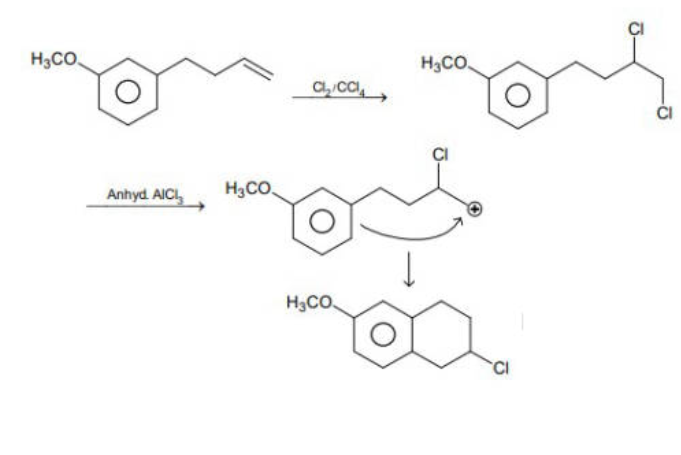
The stable carbocation formed in the above reaction is:

Consider the above reaction and predict the major product.
In the presence of sunlight, benzene reacts with $$Cl_2$$ to give product X. The number of hydrogens in X is ______.
We need to determine the product X when benzene reacts with $$Cl_2$$ in the presence of sunlight, and count the number of hydrogen atoms in X.
In the presence of sunlight (UV light), benzene undergoes an addition reaction with chlorine (not the usual electrophilic substitution that occurs in the presence of a Lewis acid catalyst like AlCl$$_3$$).
The addition of three molecules of $$Cl_2$$ to benzene gives benzene hexachloride (BHC), also known as Lindane:
$$C_6H_6 + 3Cl_2 \xrightarrow{h\nu} C_6H_6Cl_6$$In this reaction, the three double bonds of benzene are broken, and chlorine atoms add across each double bond.
The product $$C_6H_6Cl_6$$ (1,2,3,4,5,6-hexachlorocyclohexane) has 6 hydrogen atoms.
Therefore, the correct answer is 6.
The major product of the following reaction contains ______ bromine atom(s).
Which one of the following compounds is aromatic in nature?
Among the following, the aromatic compounds are:

Choose the correct answer from the following options:
Which of the following is an aromatic compound?
Which one of the following compounds is non-aromatic?
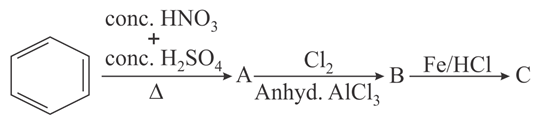
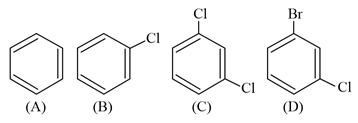
Identify correct A, B and C in the reaction sequence given below:
Meta Directing Groups:
The groups which direct the incoming group to the meta position are called meta directing groups.
Some examples of meta directing groups are:
-NO₂, -CHO, -COOH, -COOR, -COR, -CN, -SO₃H, -NH₃⁺, -CF₃, etc. So the Cl adds at the Meta Position. The compound B is formed (m-chloronitrobenzene).
The next step is reduction of the nitro group to amine group converting compound B (m-chloronitrobenzene), into compound C, (m-chloroaniline).
Option D corresponds to the right compounds.
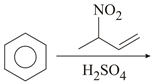
The major product of the following reaction is:
This is a Friedel-Crafts alkylation of benzene. The alkylating electrophile is generated by protonating the provided alkene using a strong acid catalyst.
Step 1: Protonation and Carbocation Formation
The sulfuric acid provides a proton $$\mathrm{(H^+)}$$ that attacks the electron-rich double bond of the alkene. Following Markovnikov’s rule, the proton adds to the terminal $$\mathrm{CH_2}$$ carbon to generate a secondary carbocation.
$$\mathrm{CH_3-CH(NO_2)-CH=CH_2 + H^+ \longrightarrow CH_3-CH(NO_2)-C^+H-CH_3}$$
While the adjacent nitro group $$\mathrm{(-NO_2)}$$ destabilises this intermediate through its strong electron-withdrawing inductive effect $$\mathrm{(-I)}$$, the secondary carbocation is still more stable than the alternative primary carbocation.
Step 2: Checking for Rearrangements
Carbocations often undergo hydride or alkyl shifts to form a more stable carbocation. Consider a possible hydride shift:
$$\mathrm{CH_3-CH(NO_2)-C^+H-CH_3 \xrightarrow{\text{Potential Hydride Shift}} CH_3-C^+(NO_2)-CH_2-CH_3}$$
If this shift occurred, the positive charge would be placed adjacent to the nitrogen atom of the nitro group. Since nitrogen in the $$\mathrm{-NO_2}$$ group already carries a formal positive charge, placing another positive charge nearby is highly unstable.
Therefore, no rearrangement occurs.
Step 3: Electrophilic Aromatic Substitution (EAS)
The benzene ring acts as a nucleophile and attacks the secondary carbocation. Aromaticity is restored after loss of a proton.
$$\mathrm{C_6H_6 + CH_3-CH(NO_2)-C^+H-CH_3 \longrightarrow C_6H_5-CH(CH_3)-CH(NO_2)-CH_3 + H^+}$$
The Major Product:
The final major product is $$\mathrm{(3\text{-}nitrobutan\text{-}2\text{-}yl)benzene}$$ or $$\mathrm{2\text{-}phenyl\text{-}3\text{-}nitrobutane}$$.
Structure:
$$\mathrm{Ph-CH(CH_3)-CH(NO_2)-CH_3}$$
Which one of the following compounds is not aromatic?

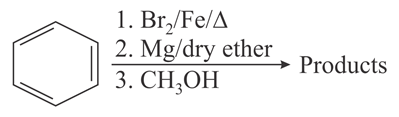
Consider the given reaction, percentage yield of :
For the following sequence of reactions, the correct products are:
Here is the summary of the chemical sequence and why the methyl group is left behind, broken down into key points:
- Step 1: Bromination: Benzene reacts with bromine and an iron catalyst to form bromobenzene.
- Step 2: Grignard Formation: The bromobenzene reacts with magnesium metal in dry ether. Magnesium inserts itself into the carbon-bromine bond, creating the highly reactive Grignard reagent (phenylmagnesium bromide).
- The Dual Nature of Grignard Reagents: Because the magnesium pushes its electrons onto the carbon ring, that specific carbon atom becomes heavily negatively charged. This makes it both a powerful nucleophile (wants to attach to other carbons) and an extremely strong base (desperate to grab free hydrogen protons).
- The Methanol Target: Methanol ($CH_3OH$) has an oxygen-hydrogen bond, making that specific hydrogen atom slightly acidic.
- The Speed Race: In chemistry, acid-base reactions are essentially instantaneous and significantly faster than nucleophilic attacks.
- The Final Outcome: Instead of taking the time to attack the carbon of the methyl group, the strongly basic Grignard reagent instantly snatches the easy, acidic hydrogen off the methanol.
- The Products: Grabbing that hydrogen converts the ring back into pure benzene, while the completely unreacted methyl group is left behind as a harmless methoxide byproduct.
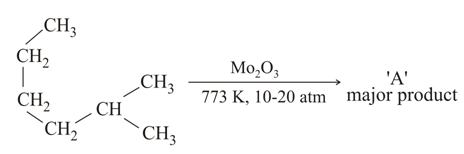
Identify A in the given chemical reaction.
Here is the information broken down into well-formatted paragraphs to make it much easier to read and study:
When n-alkanes containing six or more carbon atoms are subjected to high temperatures of 773 K and pressures of 10 to 20 atmospheres, they undergo a major structural transformation. This process requires the presence of specific catalysts, typically oxides of vanadium, molybdenum, or chromium supported over an alumina base.
Under these intense conditions, the straight-chain molecules undergo simultaneous dehydrogenation (the loss of hydrogen atoms) and cyclization (the forming of a ring). This converts the alkanes into benzene and its homologues. In organic chemistry, this transformative reaction is formally known as aromatization or catalytic reforming.
To illustrate this with a specific example, if the goal is to synthesize toluene (which is a seven-carbon homologue of benzene), a seven-carbon alkane such as 2-methylhexane or normal heptane can be used as the starting reactant.
The correct decreasing order of densities of the following compounds is:
The correct sequence of reagents used in the preparation of 4-bromo-2-nitroethylbenzene from benzene is:
The target molecule is 4-bromo-2-nitroethylbenzene. This is a benzene ring with an ethyl group, a bromo substituent at position 4 (para to ethyl), and a nitro group at position 2 (ortho to ethyl).
We need to build this from benzene. The ethyl group is an activating ortho/para director, while both $$-NO_2$$ and $$-Br$$ are meta directors (nitro) and ortho/para director (Br) respectively. The key challenge is introducing the ethyl group. Direct Friedel-Crafts alkylation can give rearrangement, so we use Friedel-Crafts acylation followed by Clemmensen reduction.
The correct sequence in option (2) is: First, $$CH_3COCl/AlCl_3$$ performs Friedel-Crafts acylation to give acetophenone. Then $$Zn\text{-}Hg/HCl$$ (Clemmensen reduction) reduces the carbonyl to give ethylbenzene. Next, $$Br_2/AlBr_3$$ brominates the ring; since the ethyl group is ortho/para directing, bromine goes to the para position giving 4-bromoethylbenzene. Finally, $$HNO_3/H_2SO_4$$ nitrates the ring; both the ethyl group (ortho/para director) and bromine (ortho/para director) direct the incoming nitro group to position 2 (ortho to ethyl and meta to bromine), giving 4-bromo-2-nitroethylbenzene.
Therefore, the correct answer is option (2).
Which among the following is the strongest acid?
When D loses a proton, it becomes aromatic (6e- in conjugation). Thus, it is the most acidic.
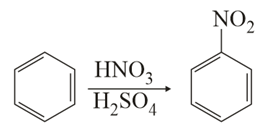
Benzene on nitration gives nitrobenzene in presence of HNO$$_3$$ and H$$_2$$SO$$_4$$ mixture, where:
In the nitration of benzene, a mixed acid of concentrated $$\text{HNO}_3$$ and concentrated $$\text{H}_2\text{SO}_4$$ is used. The role of each acid is determined by the Brønsted-Lowry concept of acids and bases.
$$\text{H}_2\text{SO}_4 + \text{HNO}_3 \rightarrow \text{HSO}_4^- + \text{H}_2\text{NO}_3^+$$
$$\text{H}_2\text{NO}_3^+ \rightarrow \text{H}_2\text{O} + \text{NO}_2^+$$
In this reaction, $$\text{H}_2\text{SO}_4$$ donates a proton to $$\text{HNO}_3$$, so $$\text{H}_2\text{SO}_4$$ acts as an acid. Since $$\text{HNO}_3$$ accepts the proton, it acts as a base. The electrophilic nitronium ion ($$\text{NO}_2^+$$) generated is the active species that attacks the benzene ring in the electrophilic aromatic substitution mechanism.
Therefore, $$\text{HNO}_3$$ acts as a base and $$\text{H}_2\text{SO}_4$$ acts as an acid.
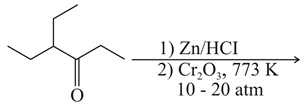
Considering the above reaction, the major product among the following is:
To determine the major product of this reaction sequence, we first identify the starting material as 4-ethylhexan-3-one. The first step utilizes zinc amalgam and hydrochloric acid (Zn/HCl), which are the standard reagents for a Clemmensen reduction. This reduction specifically targets the carbonyl group of the ketone, completely removing the oxygen atom and converting the carbonyl carbon into a simple methylene (-CH2-) group. As a result, the ketone is reduced to its corresponding alkane, forming the intermediate compound 3-ethylhexane.
In the second step, this 3-ethylhexane intermediate is treated with chromium(III) oxide (Cr2O3) at a high temperature of 773 K and a high pressure of 10 to 20 atm. These specific conditions trigger the aromatization (or dehydrocyclization) of alkanes. Because the intermediate contains a continuous chain of six carbon atoms, these severe conditions force the main chain to fold back on itself, eliminating hydrogen gas and forming a highly stable, six-membered aromatic benzene ring.
During the formation of this benzene ring, the ethyl group that was attached to the third carbon of the original hexane chain remains completely intact. It simply transitions into being a substituent attached to the newly formed aromatic ring. Therefore, by combining the newly formed benzene ring with the remaining ethyl group, the final major product of this entire reaction sequence is ethylbenzene.
Identify the reagent(s) 'A' and condition(s) for the reaction:
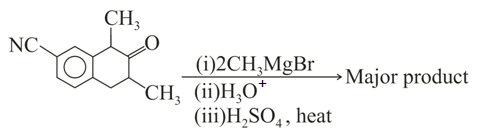
Which one of the following is the major product of the given reaction?
First, the two equivalents of the Grignard reagent (CH₃MgBr) react with the two separate electrophilic centers in the starting molecule.
One equivalent of CH₃MgBr nucleophilically attacks the ketone carbon on the non-aromatic ring. Following the acidic workup (H₃O⁺), this functional group is converted into a tertiary alcohol, placing a new methyl group at that position.
The second equivalent of CH₃MgBr attacks the nitrile group (-CN) located on the aromatic ring. The acidic workup hydrolyzes the resulting imine intermediate, converting the nitrile group into a methyl ketone, also known as an acetyl group (-COCH₃).
Finally, the addition of sulfuric acid (H₂SO₄) and heat induces the acid-catalyzed dehydration of the newly formed tertiary alcohol. A molecule of water is eliminated to create a carbon-carbon double bond. The elimination occurs preferentially between the alcohol carbon and the adjacent benzylic carbon (the carbon directly attached to the aromatic ring). This specific pathway is favored because it yields an alkene that is in direct conjugation with the aromatic benzene ring, providing significant thermodynamic stability through resonance.
Thus, the correct option is C.
The correct sequential addition of reagents in the preparation of 3-nitrobenzoic acid from benzene is:
We want to reach 3-nitrobenzoic acid starting from simple benzene. That target molecule possesses two substituents on the ring :
$$COOH \;( \text{meta-director})$$ and $$NO_2 \;( \text{meta-director}).$$
Because both groups are meta directing, the relative orientation we want (NO2 meta to COOH) will automatically arise if the nitro group is put on the ring before the carboxyl group is introduced. Hence we first introduce $$NO_2$$ by the classical nitration of benzene.
We have
$$C_6H_6 \xrightarrow{HNO_3/H_2SO_4 C_6H_5NO_2}$$
Now the ring already possesses a strong meta-directing nitro group. When we next brominate, electrophilic substitution will occur meta to the nitro group (because the o- and p-positions are deactivated). Using the usual Lewis-acid-promoted bromination we write
$$C_6H_5NO_2 \xrightarrow{Br_2/AlBr_3 3\!-\!BrC_6H_4NO_2}$$
The product is 3-bromonitrobenzene.
To transform the bromine atom into a carboxyl group we employ the sequence “Grignard formation → carbonation → acidic work-up.” Stating the general formula first :
$$ArBr + Mg \;\xrightarrow{\ ether\ ArMgBr} \qquad ArMgBr + CO_2 \to ArCO_2MgBr \qquad ArCO_2MgBr + H_3O^+ \to ArCO_2H$$
Applying it stepwise to our 3-bromonitrobenzene :
1. Formation of the Grignard reagent :
$$3\!-\!BrC_6H_4NO_2 + Mg \xrightarrow{\ dry\ ether\ 3\!-\!NO_2C_6H_4MgBr}$$
2. Carboxylation with dry carbon dioxide :
$$3\!-\!NO_2C_6H_4MgBr + CO_2 \to 3\!-\!NO_2C_6H_4CO_2MgBr$$
3. Acidic hydrolysis gives the desired acid :
$$3\!-\!NO_2C_6H_4CO_2MgBr + H_3O^+ \to 3\!-\!NO_2C_6H_4COOH$$
Combining all of the above, the reagent order must be
$$HNO_3/H_2SO_4 \;\longrightarrow\; Br_2/AlBr_3 \;\longrightarrow\; Mg/ether \;\longrightarrow\; CO_2 \;\longrightarrow\; H_3O^+$$
This precise sequence is listed in Option D of the question set.
Hence, the correct answer is Option 4.

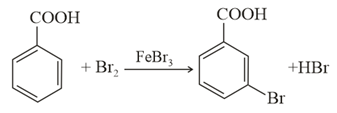
Consider the above reaction where 6.1 g of benzoic acid is used to get 7.8 g of m-bromo benzoic acid. The percentage yield of the product is ___.
(Round off to the Nearest integer)
[Given : Atomic masses : C = 12.0 u, H : 1.0 u, O : 16.0 u, Br = 80.0 u]

In the above reaction, 3.9 g of benzene on nitration gives 4.92 g of nitrobenzene. The percentage yield of nitrobenzene in the above reaction is ________ %. (Round off to the Nearest Integer).
(Given atomic mass: C: 12.0 u, H: 1.0 u, O: 16.0 u, N: 14.0 u)
The nitration of benzene produces nitrobenzene: $$C_6H_6 + HNO_3 \xrightarrow{H_2SO_4} C_6H_5NO_2 + H_2O$$. The molar mass of benzene ($$C_6H_6$$) is $$6 \times 12 + 6 \times 1 = 78$$ g/mol, and the molar mass of nitrobenzene ($$C_6H_5NO_2$$) is $$6 \times 12 + 5 \times 1 + 14 + 2 \times 16 = 123$$ g/mol.
From 3.9 g of benzene, the number of moles is $$\frac{3.9}{78} = 0.05$$ mol. Since the reaction has a 1:1 stoichiometry, the theoretical yield of nitrobenzene is $$0.05 \times 123 = 6.15$$ g.
The actual yield is 4.92 g. Therefore, the percentage yield is $$\frac{4.92}{6.15} \times 100 = 80\%$$.
Methylation of 10 g of benzene gave 9.2 g of toluene. Calculate the percentage yield of toluene (Nearest integer)
The methylation of benzene produces toluene according to the Friedel-Crafts alkylation reaction: $$\text{C}_6\text{H}_6 + \text{CH}_3\text{Cl} \xrightarrow{\text{AlCl}_3} \text{C}_6\text{H}_5\text{CH}_3 + \text{HCl}$$.
The molar mass of benzene is $$78 \text{ g/mol}$$ and that of toluene is $$92 \text{ g/mol}$$. Starting with 10 g of benzene, the moles of benzene are $$\frac{10}{78} = 0.1282 \text{ mol}$$. Since the stoichiometry is 1:1, the theoretical yield of toluene is $$0.1282 \times 92 = 11.795 \text{ g}$$.
The actual yield is 9.2 g. Therefore, the percentage yield is $$\frac{9.2}{11.795} \times 100 = 78.0\%$$.
The answer is $$78$$.
Consider the following chemical reaction.
$$CH \equiv CH \xrightarrow[2) CO, HCl, AlCl_3]{1) \text{Red hot Fe tube, 873 K}}$$ Product
The number of $$sp^2$$ hybridized carbon atom(s) present in the product is ______
In the first step, acetylene ($$CH \equiv CH$$) is passed through a red hot iron tube at 873 K, which causes cyclic trimerisation to form benzene ($$C_6H_6$$).
In the second step, benzene undergoes the Gattermann-Koch reaction with CO and HCl in the presence of anhydrous $$AlCl_3$$ as a catalyst. This reaction introduces an aldehyde group ($$-CHO$$) onto the benzene ring, producing benzaldehyde ($$C_6H_5CHO$$).
Now we count the number of $$sp^2$$ hybridized carbon atoms in benzaldehyde. The six carbon atoms in the benzene ring are all $$sp^2$$ hybridized (each forms three sigma bonds and participates in the delocalised $$\pi$$ system). The carbon atom of the aldehyde group ($$-CHO$$) is also $$sp^2$$ hybridized, as it forms a double bond with oxygen and two single bonds (with H and the ring carbon).
Therefore, the total number of $$sp^2$$ hybridized carbon atoms in benzaldehyde is $$6 + 1 = \mathbf{7}$$.
Preparation of Bakelite proceeds via reactions:
We start by recalling what Bakelite is. Bakelite is the very first synthetic polymer, technically called phenol-formaldehyde resin. It is obtained when phenol $$\left(C_{6}H_{5}OH\right)$$ reacts with formaldehyde $$\left(HCHO\right)$$ under either acidic or basic conditions and then undergoes further cross-linking.
The first stage of the process is the introduction of $$-CH_{2}OH$$ (hydroxymethyl) groups into the aromatic ring of phenol. In organic chemistry, whenever an aromatic ring such as benzene or phenol is attacked by an electron-deficient species, the mechanism is called electrophilic substitution. Here the electrophile is the carbon of formaldehyde, which carries a partial positive charge $$\left(\delta ^+\right)$$ because oxygen is more electronegative than carbon.
So, step one is an electrophilic substitution:
$$C_{6}H_{5}OH + HCHO \;\xrightarrow{acid / base\; C6H4(OH)(CH2OH)}$$
Because more than one $$-CH_{2}OH$$ group can enter the ring, we often get mixtures such as $$p$$- and $$o$$-hydroxymethyl phenol.
Now, once two phenol molecules each carry $$-CH_{2}OH$$ groups, they can link together. Two $$-CH_{2}OH$$ groups condense by eliminating a molecule of water $$\left(H_{2}O\right)$$ and form a methylene bridge $$\left(-CH_{2}-\right)$$ between two aromatic rings. This removal of water is literally a dehydration.
The dehydration step can be shown schematically as:
$$\bigl[C_{6}H_{4}(OH)(CH_{2}OH)\bigr]_2 \;\xrightarrow[-H_{2}O]{\; C6H4(OH)-CH2-C6H4(OH)}$$
So we clearly have two fundamental types of reactions taking place:
1. Electrophilic substitution (introduction of $$-CH_{2}OH$$ on the aromatic ring).
2. Dehydration (elimination of water to form methylene bridges, leading to polymer growth).
Looking at the options, Option C exactly states “Electrophilic substitution and dehydration,” which matches our mechanistic description.
Hence, the correct answer is Option C.
In the following reaction sequence the major products A and B are:
The major product obtained from the following reaction is:
The major product of the following reaction is:
Consider the following reactions:
Which of these reactions are possible?
Which of these will produce the highest yield Friedel Crafts reaction?
[P] on treatment with $$Br_2/FeBr_3$$ in $$CCl_4$$ produced a single isomer $$C_8H_7O_2Br$$ while heating [P] with sodalime gives toluene. The compound [P] is:
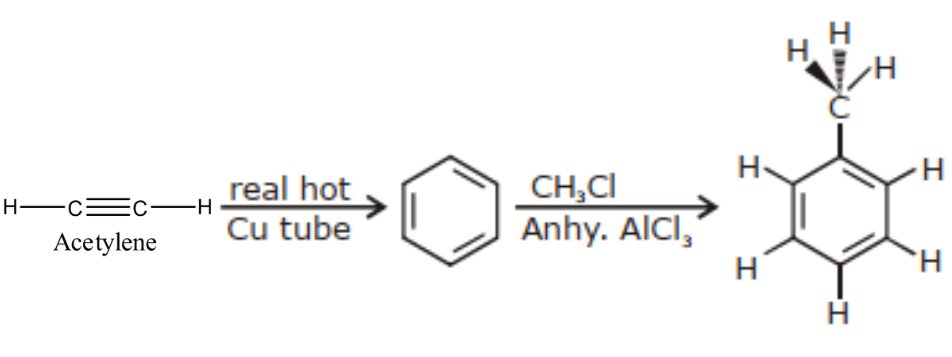
In the following sequence of reactions the maximum number of atoms present in molecule 'C' in one plane is __________.
A $$\xrightarrow[Cu tube]{\text{Red hot }}$$ B $$\xrightarrow[\text{Anhydrous AlCl}_3]{CH_3Cl(1 eq)}$$ C
(A is a lowest molecular weight alkyne)
Let us begin with compound A. The statement “A is a lowest molecular weight alkyne” means the alkyne with the smallest possible number of carbon atoms, i.e. ethyne (acetylene), whose formula is $$HC\equiv CH$$.
Now this ethyne is passed over a red-hot copper tube. The textbook reaction that occurs under these conditions is the trimerisation of ethyne to benzene: three molecules of ethyne cyclise and lose hydrogen as shown below
$$3\,HC\equiv CH \;\xrightarrow[\;873\;{\rm K}\;]{\text{Red-hot Cu}}\; C_6H_6 + 3\,H_2$$
Thus, compound B is benzene, $$C_6H_6$$.
Next, benzene is treated with one equivalent of methyl chloride in the presence of anhydrous $$AlCl_3$$. This is a classical Friedel-Crafts alkylation. First we state the general formula:
Friedel-Crafts alkylation: $$\quad C_6H_6 + RCl \;\xrightarrow{AlCl_3}\; C_6H_5R + HCl$$
Substituting $$R = CH_3$$ and taking only one equivalent (so that only a single substitution occurs), we obtain
$$C_6H_6 + CH_3Cl \;\xrightarrow{AlCl_3}\; C_6H_5CH_3 + HCl$$
Therefore compound C is methylbenzene, commonly called toluene, whose condensed formula is $$C_6H_5CH_3$$.
We are now asked: “what is the maximum number of atoms present in molecule C in one plane?” To answer this we must look at the geometry of every atom in toluene.
• The six ring carbons in benzene are $$sp^2$$ hybridised; all $$sp^2$$ atoms and the σ-bonds between them lie in a single plane.
• The five hydrogens that remain on the ring (one hydrogen is replaced by the methyl group) are each bonded through an $$sp^2$$ carbon; the C-H σ-bond in an $$sp^2$$ centre is also contained in the same trigonal plane. Hence each of these five hydrogens can lie in that plane.
• The ring carbon that bears the side chain is itself $$sp^2$$ and already counted among the six ring carbons.
• The first carbon of the side chain (the methyl carbon, $$CH_3$$) is $$sp^3$$. In a tetrahedral $$sp^3$$ centre the central carbon and any one of its three substituents can be chosen to lie in the same plane as the benzene ring; the other two substituents must protrude above and below the plane. Hence the methyl carbon itself and exactly one of its three hydrogens can be co-planar with the ring.
Counting these atoms explicitly:
$$\begin{aligned} \text{Ring carbons} &= 6\\ \text{Hydrogens on the ring} &= 5\\ \text{Methyl (side-chain) carbon} &= 1\\ \text{One hydrogen of the CH}_3 &= 1\\ \hline \text{Total atoms that can be in one plane} &= 6 + 5 + 1 + 1 = 13 \end{aligned}$$
No other atom of toluene can be added to this plane without forcing a tetrahedral angle to straighten, so 13 is the absolute maximum.
So, the answer is $$13$$.
Which of the following compounds is not aromatic?
What will be the major product in the following mononitration reaction?
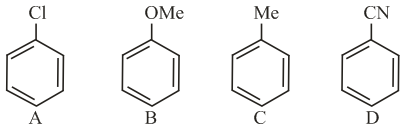
The increasing order of reactivity of the following compounds towards aromatic electrophilic substitution reaction is:
The ease of Electrophilic substitution is directly proportional to the strength of +M or +I group on the aromatic ring. Hence, B>C>A>D would be the right answer.
Which compound(s) out of the following is/are not aromatic?

Among the following four aromatic compounds, which one will have the lowest melting point?
Polysubstitution is a major drawback in:
We begin by recalling the meaning of the term $$\text{polysubstitution}$$. In aromatic electrophilic substitution, polysubstitution means that after the first substituent is introduced, further substitutions keep taking place on the same benzene ring, often yielding di- or tri-alkylated products rather than the desired mono-alkylated compound. This situation is undesirable because it lowers the yield of the required mono-substituted product and complicates purification.
Now we examine each of the given reactions one by one and analyse whether polysubstitution is an inherent drawback.
First, consider the Reimer-Tiemann reaction. In this reaction, phenol is treated with chloroform and a strong base to give salicylaldehyde. The reaction proceeds through a dichlorocarbene intermediate that inserts at the ortho and para positions. Once the formyl group $$\left( -\!\!CHO \right)$$ is installed, the ring becomes deactivated because the $$-CHO$$ group is $$-M$$ and $$-I$$ withdrawing, so further electrophilic attack is suppressed. Therefore polysubstitution is not a major issue in the Reimer-Tiemann reaction.
Next, we analyse Friedel-Crafts alkylation, in which an alkyl halide $$R-X$$ reacts with benzene in the presence of a Lewis acid such as $$AlCl_3$$ to give an alkylbenzene. The key mechanistic step is the generation of a carbocation $$R^+$$ (or a Lewis-acid-complexed equivalent), which is a very strong electrophile. After the first alkyl group attaches to the benzene ring, it exerts a $$+I$$ inductive effect and a $$+H$$ hyperconjugative effect, both of which activate the ring and make it still more electron-rich. Because of this increased activation, the freshly formed alkylbenzene reacts faster than the original benzene, so more alkyl cations attack it in subsequent steps. This chain of events produces di- and tri-alkylated products very easily. Thus polysubstitution is indeed a major drawback in Friedel-Crafts alkylation.
Now we look at the acetylation of aniline, typically performed with acetic anhydride $$\left( (CH_3CO)_2O \right)$$. In this reaction the amino group $$-NH_2$$ is converted into an amide $$-NHCOCH_3$$. The product contains the $$-NHCOCH_3$$ group, which is less activating than the parent $$-NH_2$$ group because the lone pair on nitrogen becomes partially delocalised into the carbonyl. Therefore the ring is not strongly activated toward further electrophilic attack, and polysubstitution is not a significant problem.
Finally, Friedel-Crafts acylation introduces an acyl group $$RCO-$$ using an acyl chloride $$RCOCl$$ and a Lewis acid such as $$AlCl_3$$. The acylium ion $$RCO^+$$ is generated as the electrophile. After the first acyl group enters the ring, the newly formed ketone group $$-COR$$ is strongly $$-M$$ and $$-I$$ withdrawing, which deactivates the ring. That deactivation greatly diminishes the likelihood of further substitutions, so polysubstitution is almost never observed in Friedel-Crafts acylation.
Comparing all four possibilities, we see that only Friedel-Crafts alkylation suffers from the intrinsic problem that the first substitution step makes the aromatic ring more reactive instead of less. This leads to the formation of multiple alkylated products unless stringent reaction control (large excess of benzene, low temperature, etc.) is employed.
Hence, the correct answer is Option 2.
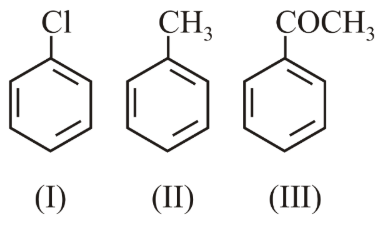
The increasing order of the reactivity of the following compounds towards electrophilic aromatic substitution reactions is:
Electrophilic aromatic substitution (EAS) proceeds faster when the benzene ring possesses higher electron density, because the aromatic π-cloud then stabilises the positively-charged σ-complex (arenium ion) that forms in the rate-determining step. In general, an electron-donating group (EDG) activates the ring, while an electron-withdrawing group (EWG) deactivates it. The magnitude of activation or deactivation depends on the balance of two electronic effects:
Inductive effect $$\; (\pm I)$$ and $$\text{Mesomeric / Resonance effect} \; (\pm M)$$
We now examine the substituent already attached to the ring in each of the three given compounds.
For toluene (compound II) the substituent is the methyl group, $$-CH_3$$. A methyl group exhibits a $$+I$$ (electron-releasing inductive) effect and can also donate electron density through hyperconjugation, which behaves like weak resonance donation. Both mechanisms increase electron density on the ring. Therefore toluene is activated toward EAS and reacts faster than benzene.
For chlorobenzene (compound I) the substituent is chlorine. Chlorine is more electronegative than carbon, so it withdraws electron density through the $$-I$$ inductive effect. At the same time, its lone pairs can participate in $$+M$$ resonance donation into the ring. Quantitatively, the $$-I$$ effect of chlorine is stronger than its $$+M$$ effect, giving a net deactivation. However, because some resonance donation is present, the deactivation is only moderate; chlorobenzene reacts a little more slowly than benzene but much faster than rings bearing strongly withdrawing carbonyl groups.
For acetophenone (compound III) the substituent is the acyl group, $$-COCH_3$$. The carbonyl oxygen pulls electron density strongly toward itself by both a powerful $$-M$$ (resonance withdrawal) and a $$-I$$ inductive effect. The combined withdrawal greatly lowers the π-electron density of the ring, making acetophenone strongly deactivated. Its rate toward EAS is far below that of benzene.
Summarising the relative strength of these effects:
$$\text{Rate (EAS)} \;\propto\; \text{Electron density on ring}$$
$$\begin{aligned} -COCH_3 &: \; -M \; \text{(very strong)} + -I \; \Longrightarrow \text{strongly deactivated} \\ Cl &: \; -I \; \text{(strong)} + +M \; \text{(moderate)} \Longrightarrow \text{moderately deactivated} \\ CH_3 &: \; +I \; \text{(moderate)} + \text{hyperconjugation} \Longrightarrow \text{activated} \end{aligned}$$
Hence the rate order is
Acetophenone (III)} \;\lt \; \text{Chlorobenzene (I)} \;\lt \; \text{Toluene (II)
So, the increasing order of reactivity towards electrophilic aromatic substitution is $$\mathrm{III \; \lt \; I \; \lt \; II}$$.
Hence, the correct answer is Option C.
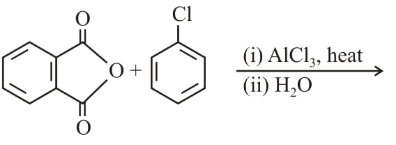
The major product of the following reaction is:
The reaction begins with a Friedel-Crafts Acylation where the Lewis acid catalyst, AlCl3, reacts with phthalic anhydride to open the anhydride ring and generate a powerful electrophilic acylium ion. This ion attacks the chlorobenzene ring, primarily at the para-position due to the directing influence of the chlorine atom and steric hindrance at the ortho-position. This first step produces a complex that, upon aqueous workup H2O, yields o-(4-chlorobenzoyl)benzoic acid.
The reaction stops here because the newly formed carbonyl group strongly deactivates the aromatic rings, making them resistant to further nucleophilic attack under these mild conditions. To achieve the second ring closure the dehydration step you would need a much stronger dehydrating agent like concentrated H2SO4 or Polyphosphoric Acid (PPA) and significant heat to force the carboxylic acid group to cyclize onto the remaining ortho-position of the chlorobenzene ring
The major product obtained in the given reaction is:
The major product of the following reaction is:
In the reaction given below what will be the major product at the end:

Options:
The products formed in the reaction of cumene with $$O_2$$ followed by treatment with dil HCl are:
The major product of the following reaction is:
In acidic medium KMnO4 is a strong oxidising agent in acidic medium and it will oxidise both the carbon substituted on benzene to carboxylic acid.
The increasing order of nitration of the following compounds is:
(A) Aniline, (B) Chlorobenzene, (C) Anisole, (D) Toluene
Which of the following molecules is least resonance stabilized?
Furan (A), Pyridine (B), and Benzene (D) are aromatic.
4,4-dimethylcyclohexa-2,5-dien-1-one (C) is non-aromatic. Hence, it is the least stable by resonance.
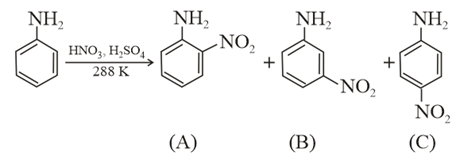
Which of the following compounds will form significant amount of meta product during mono-nitration reaction?
Aniline has a basic amino group ($$-NH_2$$). In the presence of strong acids, the lone pair on the nitrogen atom accepts a proton ($$H^+$$) to form the anilinium ion ($$-NH_3^+$$).
Aniline ($$-NH_2$$): Under normal conditions, the amino group is a powerful activating group and is ortho/para directing.
Anilinium Ion ($$-NH_3^+$$): Once protonated, the nitrogen carries a full positive charge. This makes it a strongly deactivating group that pulls electron density away from the ring via the inductive effect. Consequently, the anilinium ion is meta-directing.
Because a significant equilibrium concentration of the anilinium ion exists in the acidic nitrating mixture, the reaction yields a surprisingly high amount of the meta-isomer. A typical product distribution for the direct nitration of aniline is:
Para-product: ~51%, Meta-product: ~47% (Significant amount), Ortho-product: ~2%
While the other functional groups ($$-OH, -OCOCH_3, -NHCOCH_3$$) also have lone pairs, they are much less basic than the amino group in aniline.
Which of the following compounds is most reactive to an aqueous solution of sodium carbonate?
First we remind ourselves of a very common principle of acid-base chemistry: a base removes the most acidic hydrogen that is available. A hydrogen atom is called “acidic” when, after its removal as $$H^+$$, the conjugate base that remains is stabilised (generally by resonance or by an electron-withdrawing group). The better the stabilisation, the smaller the $$\mathrm{p}K_a$$ of the hydrogen-bearing compound and the more easily even a weak base can abstract that hydrogen.
In aqueous solution sodium carbonate provides the weak base $$CO_3^{2-}$$:
$$Na_2CO_3 \;\;\xrightarrow{H_2O}\;\; 2\,Na^+ + CO_3^{2-}$$
The carbonate ion itself is the species that can abstract an acidic hydrogen. Because $$CO_3^{2-}$$ is only a mild base, it can deprotonate a substrate only if the resulting conjugate base is appreciably stabilised. With this idea in mind we examine each of the four hydrocarbons offered in the question.
(i) Cyclopropane, $$C_3H_6$$
All six hydrogens are attached to ordinary sp3 carbon atoms. When one such proton is removed we would have a simple alkyl carbanion
$$C_3H_5^-$$
This carbanion has no resonance stabilisation and experiences strong angle strain; it is therefore highly unstable. The corresponding $$\mathrm{p}K_a$$ of cyclopropane is close to that of a normal alkane (well above 45). A base as weak as $$CO_3^{2-}$$ cannot remove such a proton.
(ii) Benzene, $$C_6H_6$$
All hydrogens in benzene are bound to sp2 ring carbons. Removal of one proton produces the phenyl carbanion
$$C_6H_5^-$$
Although this anion is conjugated with the ring, it is antiaromatic and hence severely destabilised. Consequently the $$\mathrm{p}K_a$$ of benzene is still extremely high (≈43). Again, $$CO_3^{2-}$$ is far too weak to effect deprotonation.
(iii) Toluene, $$C_6H_5CH_3$$
Toluene contains three types of hydrogen, but the ones of interest are the benzylic hydrogens on the $$CH_3$$ group. If one benzylic proton is abstracted we obtain the benzyl carbanion
$$C_6H_5CH_2^-$$
This anion is resonance-stabilised; the negative charge can be delocalised into the aromatic ring:
$$C_6H_5CH_2^- \;\;\rightleftharpoons\;\; C_6H_4CH_2 \; \text{(multiple resonance forms)}$$
Because of this stabilisation the $$\mathrm{p}K_a$$ of a benzylic hydrogen is appreciably lower (≈41) than that of a normal alkane and, more importantly, distinctly lower than the hydrogens in cyclopropane, benzene or naphthalene. Although $$CO_3^{2-}$$ is not strong enough to drive the equilibrium completely to the right, it can abstract a benzylic proton to a noticeable extent. Symbolically we can write
$$C_6H_5CH_3 + Na_2CO_3 \;\;\rightleftharpoons\;\; C_6H_5CH_2Na + NaHCO_3$$
The equilibrium lies far to the left, but the fact that it is accessible means that toluene is the most reactive of the four compounds toward aqueous sodium carbonate.
(iv) Naphthalene, $$C_{10}H_8$$
Like benzene, every hydrogen is attached directly to an sp2 carbon of the aromatic framework. Removal of a proton would break aromaticity in both fused rings, giving an extremely unstable anion. Its $$\mathrm{p}K_a$$ is even higher than that of benzene, so no reaction with $$CO_3^{2-}$$ occurs.
Putting all these points together, only toluene possesses hydrogens that are sufficiently acidic for even the mild base $$CO_3^{2-}$$ to abstract. Therefore toluene exhibits the greatest reactivity toward an aqueous solution of sodium carbonate, while the other hydrocarbons remain virtually inert.
Hence, the correct answer is Option C.
Which of the following compounds will not undergo Friedel Crafts reaction with benzene?
Friedel Crafts alkylation/acylation involves the formation of a stable electrophile (a carbocation).
The electrophiles formed from the compounds in options B, C, and D are stabilized by resonance.
Formation of a vinylic carbocation is very difficult as the $$C-Cl$$ bond is on a sp^2 hybridized carbon, and the resulting vinylic carbocation is highly unstable.
Thus, the compound in option A does not undergo Friedal Crafts reaction with benzene.
Consider the reaction sequence below:
X is:
The product of the reaction given below is:
Photochemical smog consists of excessive amount of X, in addition to aldehydes, ketones, peroxy acetyl nitrile (PAN). X is:
Photochemical smog is a type of air pollution formed when sunlight reacts with pollutants like nitrogen oxides (NOx) and volatile organic compounds (VOCs) released from vehicles and industries. The chemical reactions under sunlight produce secondary pollutants.
The question states that photochemical smog contains an excessive amount of X, along with aldehydes, ketones, and peroxy acetyl nitrile (PAN). We need to identify X from the options.
Recall the key components of photochemical smog. The primary pollutants are nitrogen oxides (NO and NO2) and VOCs. Sunlight triggers reactions that form secondary pollutants, including:
- Ozone (O3)
- Aldehydes (e.g., formaldehyde)
- Ketones
- Peroxyacyl nitrates (PAN)
Ozone is a major product. It forms when nitrogen dioxide (NO2) absorbs sunlight and breaks down:
$$ NO_2 \rightarrow NO + O $$Then, the oxygen atom reacts with oxygen molecules:
$$ O + O_2 \rightarrow O_3 $$This ozone accumulates and is a defining component of photochemical smog, causing respiratory issues and environmental harm.
Now, evaluate the options:
- Option A (CH4): Methane is a greenhouse gas but is not reactive enough to form photochemical smog. It does not produce aldehydes, ketones, or PAN in significant amounts under typical smog conditions.
- Option B (CO2): Carbon dioxide is a greenhouse gas from combustion but is not a key reactant or product in photochemical smog reactions. It does not contribute to smog formation.
- Option C (O3): Ozone is a central component of photochemical smog, produced in high concentrations from NOx and VOCs. It is present excessively and aligns with the given pollutants (aldehydes, ketones, PAN).
- Option D (CO): Carbon monoxide is emitted from incomplete combustion but is primarily a primary pollutant. It does not lead to the formation of aldehydes, ketones, or PAN in photochemical smog.
Thus, X must be ozone (O3), as it is excessively produced and characteristic of photochemical smog.
Hence, the correct answer is Option C.
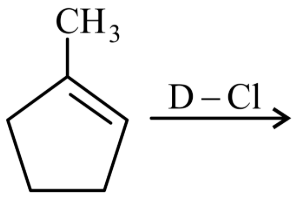
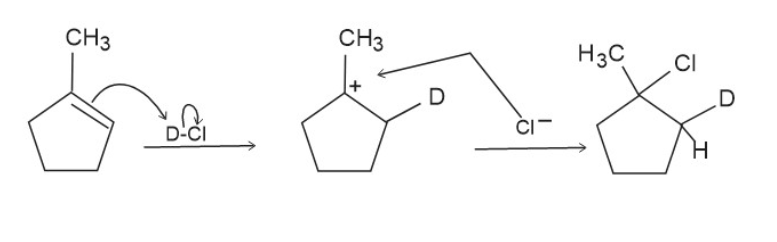
What is the major product expected from the following reaction?
Where D is an isotope of hydrogen.
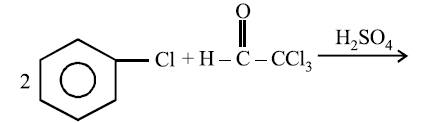
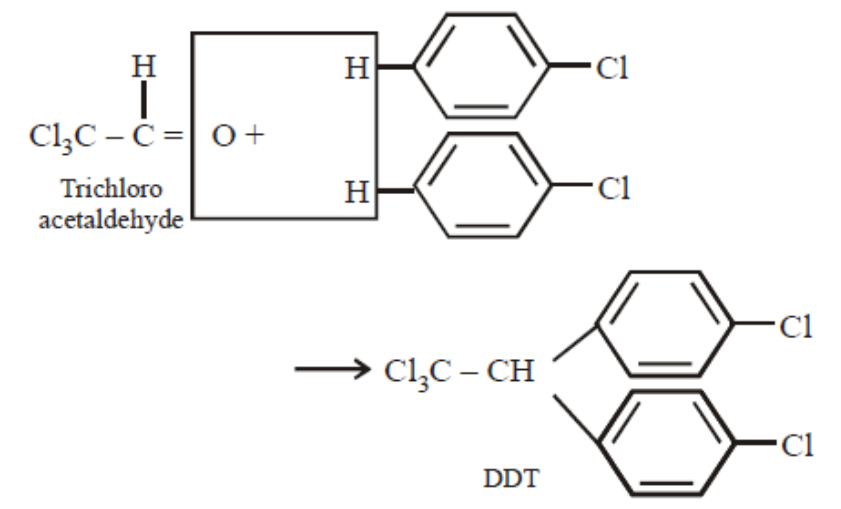
Chlorobenzene reacts with trichloro acetaldehyde in the presence of H$$_2$$SO$$_4$$. The major product formed is:
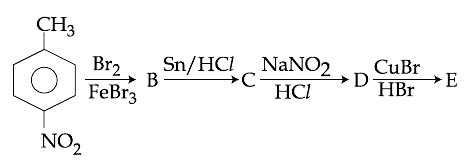
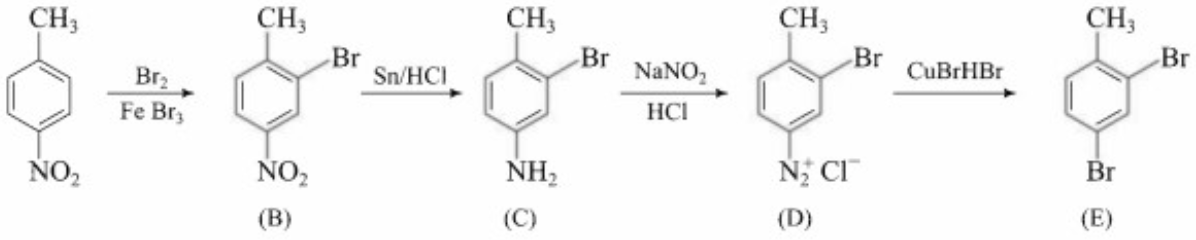
In a set of reactions p-nitrotoluene yielded a product E.
The product E would be:
Which one of the following reactions will not result in the formation of carbon-carbon bond?
To determine which reaction does not result in the formation of a carbon-carbon bond, we need to analyze each option step by step. Let's recall the key features of each reaction.
Starting with option A: Friedel Craft's acylation. This reaction involves an aromatic compound reacting with an acyl chloride (R-COCl) in the presence of a Lewis acid catalyst like AlCl₃. The acyl group attaches to the aromatic ring, forming a new bond between the carbonyl carbon of the acyl group and a carbon atom of the aromatic ring. For example, benzene reacts with acetyl chloride to form acetophenone: $$C_{6}H_{6} + CH_{3}COCl \xrightarrow{\text{AlCl}_3} C_6H_5COCH_3$$ Here, a new carbon-carbon bond is formed between the benzene ring carbon and the carbonyl carbon of the acetyl group. Thus, this reaction does form a carbon-carbon bond.

Next, option B: Reimer-Tieman reaction. This reaction is used for ortho-formylation of phenols. Phenol reacts with chloroform (CHCl₃) in the presence of a strong base like NaOH to produce salicylaldehyde (2-hydroxybenzaldehyde). The mechanism involves the formation of dichlorocarbene (:CCl₂), which attacks the ortho position of the phenoxide ion. This results in a new bond between the carbon of the benzene ring and the carbon of the formyl group. The reaction is: $$C_{6}H_{5}OH + CHCl_{3} + NaOH -\gt o-HOC_{6}H_{4}CHO$$ A carbon-carbon bond is formed between the aromatic carbon and the carbon of the -CHO group. Therefore, this reaction also forms a carbon-carbon bond.
Now, option C: Cannizaro reaction. This is a disproportionation reaction that occurs with aldehydes lacking an alpha hydrogen, such as formaldehyde or benzaldehyde. In this reaction, one molecule of aldehyde is oxidized to a carboxylic acid, while another molecule is reduced to an alcohol. For example, formaldehyde undergoes the Cannizaro reaction: $$2HCHO -\gt [\text{NaOH] HCOONa + CH3OH}$$ The mechanism involves a hydride ion transfer from one aldehyde molecule to another. There is no formation of a new carbon-carbon bond; instead, bonds are rearranged to form C-O bonds in the carboxylate and alcohol. The carbon atoms remain separate—no coupling occurs. Hence, this reaction does not form a carbon-carbon bond.
Finally, option D: Wurtz reaction. This reaction couples two alkyl halides using sodium metal in dry ether solvent. For instance, two molecules of bromoethane react to form butane: $$2CH_{3}CH_{2}Br + 2Na -\gt CH_{3}CH_{2}CH_{2}CH_{3} + 2NaBr$$ Here, the alkyl groups from the halides combine, forming a new carbon-carbon bond between the two carbon atoms. Thus, this reaction clearly forms a carbon-carbon bond.
In summary:
- Friedel Craft's acylation (A) forms a carbon-carbon bond.
- Reimer-Tieman reaction (B) forms a carbon-carbon bond.
- Cannizaro reaction (C) does not form a carbon-carbon bond.
- Wurtz reaction (D) forms a carbon-carbon bond.
Hence, the correct answer is Option C.
Which one of the following is most stable?
Option A is a tertiary ($$3^\circ$$) allylic carbocation. The positive charge sits on a carbon attached to three other carbons, and it is directly adjacent to a conjugated double-bond system. Furthermore, the double bond is in conjugation with a phenyl ($$\text{Ph}$$) ring, which allows extensive delocalization of the positive charge throughout the aromatic ring via resonance. Hence, it is the most stable.
A major component of Borsch reagent is obtained by reacting hydrazine hydrate with which of the following?
The major component of Borsch reagent is 2,4- dinitrophenyl hydrazine which can be obtained by reaction of 2,4-dinitrochloro benzene and hydrazine.
Which of the following would not give 2-phenylbutane as the major product in a Friedel-Crafts alkylation reaction?
To solve this question, we need to determine which option does not produce 2-phenylbutane as the major product in a Friedel-Crafts alkylation reaction. Friedel-Crafts alkylation involves attaching an alkyl group to a benzene ring, forming a new carbon-carbon bond. The electrophile is typically a carbocation, which can rearrange to form a more stable carbocation. The target molecule, 2-phenylbutane, has the structure $$Ph-CH(CH_{3})CH_{2}CH_{3}$$, where the carbon attached to the benzene ring is secondary.
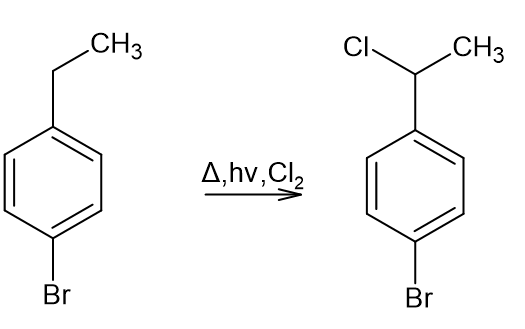
Now, let's evaluate each option step by step.
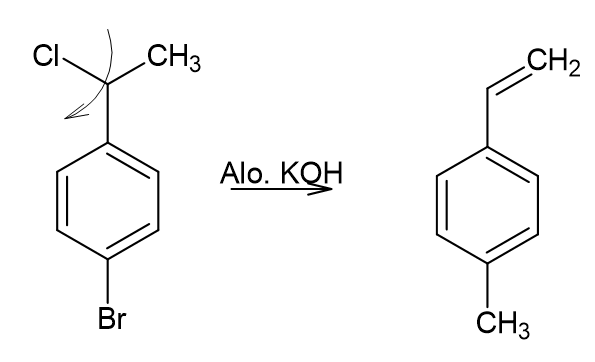
Option A: 1-butene + HF
1-butene is $$CH_{2}=CH-CH_{2}-CH_{3}$$. With HF, protonation occurs at the terminal carbon, forming a secondary carbocation: $$CH_{2}=CH-CH_{2}-CH_{3} + H+ \rightarrow CH_{3}-CH+-CH_{2}-CH_{3}$$. This carbocation attacks benzene in a Friedel-Crafts alkylation, yielding $$Ph-CH(CH_{3})CH_{2}CH_{3}$$, which is 2-phenylbutane. Thus, this option gives the desired product as the major product.
Option B: 2-butanol + H$$_2$$SO$$_4$$
2-butanol is $$CH_{3}-CH(OH)-CH_{2}-CH_{3}$$. With H$$_2$$SO$$_4$$, dehydration occurs, protonating the hydroxyl group and losing water to form a secondary carbocation: $$CH_{3}-CH(OH)-CH_{2}-CH_{3} + H+ \rightarrow CH_{3}-CH(OH_{2}+)-CH_{2}-CH_{3} \rightarrow CH_{3}-CH+-CH_{2}-CH_{3} + H_{2}O$$. This carbocation attacks benzene, forming $$Ph-CH(CH_{3})CH_{2}CH_{3}$$ (2-phenylbutane). No rearrangement occurs, as the secondary carbocation is stable. Hence, this option gives 2-phenylbutane as the major product.
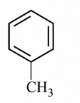
Option C: Butanoyl chloride + AlCl$$_3$$ then Zn, HCl
Butanoyl chloride is $$CH_{3}CH_{2}CH_{2}C(=O)Cl$$. With AlCl$$_3$$, Friedel-Crafts acylation occurs, forming an acylium ion: $$CH_{3}CH_{2}CH_{2}C(=O)Cl + AlCl_{3} \rightarrow CH_{3}CH_{2}CH_{2}C{\equiv}O^+ + AlCl_{4}-$$. This electrophile attacks benzene, yielding the ketone $$Ph-C(=O)-CH_{2}CH_{2}CH_{3}$$ (phenyl propyl ketone). The subsequent step, "then Zn, HCl", refers to Clemmensen reduction, which reduces the carbonyl group to a methylene group: $$Ph-C(=O)-CH_{2}CH_{2}CH_{3} \rightarrow Ph-CH_2-CH_2CH_2CH_3$$ (1-phenylbutane). This is a straight-chain alkylbenzene, whereas 2-phenylbutane is branched. Therefore, this option does not give 2-phenylbutane as the major product.
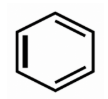
Option D: Butyl chloride + AlCl$$_3$$
Butyl chloride typically refers to n-butyl chloride, $$CH_{3}CH_{2}CH_{2}CH_{2}Cl$$. With AlCl$$_3$$, it forms a primary carbocation: $$CH_{3}CH_{2}CH_{2}CH_{2}Cl + AlCl_{3} \rightarrow CH_{3}CH_{2}CH_{2}CH_{2}+ + AlCl_{4}-$$. Primary carbocations are unstable and rearrange via a hydride shift: $$CH_{3}CH_{2}CH_{2}CH_{2}+ \rightarrow CH_{3}CH_{2}CH+CH_{3}$$ (a more stable secondary carbocation). This carbocation attacks benzene, forming $$Ph-CH(CH_{3})CH_{2}CH_{3}$$ (2-phenylbutane). Due to rearrangement, this option gives 2-phenylbutane as the major product.
In summary, Options A, B, and D all yield 2-phenylbutane as the major product, while Option C yields 1-phenylbutane. Therefore, Option C does not give 2-phenylbutane as the major product.
Hence, the correct answer is Option C.
Given
In the above compounds correct order of reactivity in electrophilic substitution reactions will be:
Electrophilic aromatic substitution reactivity depends on electron density, where electron-donating groups (EDGs) activate the ring and electron-withdrawing groups (EWGs) deactivate it.
$$-CH_3$$ (B) activates via hyperconjugation, while $$-Cl$$ (C) and $$-NO_2$$ (D) deactivate the ring through $$-I$$ and $$-M$$ effects respectively.
Consequently, toluene (B) is the most reactive followed by benzene (A), with nitrobenzene (D) being the least reactive due to strong deactivation.
The correct order of reactivity is B > A > C > D
Which of the following compounds are antiaromatic
In the below mentioned compounds the decreasing order of reactivity towards electrophilic substitution is
(i)
(ii)
(iii)
(iv)
The product of the reaction between ethyl benzene and N-bromosuccinamide is
The electrophile, $$E^{\oplus}$$ attacks the benzene ring to generate the intermediate $$\sigma$$-complex. Of the following, which $$\sigma$$-complex is of lowest energy?
The reaction of toluene with $$Cl_2$$ in presence of $$FeCl_3$$ gives predominantly
Presence of a nitro group in a benzene ring
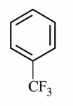
The compound formed as a result of oxidation of ethyl benzene by $$KMnO_4$$ is