Join Our JEE Preparation Group
Prep with like-minded aspirants; Get access to free daily tests and study material.
Sign in
Please select an account to continue using cracku.in
↓ →
Join Our JEE Preparation Group
Prep with like-minded aspirants; Get access to free daily tests and study material.
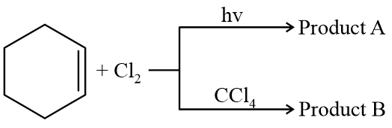
The reaction of $$Cl_2$$ with an alkene depends on the reaction conditions.
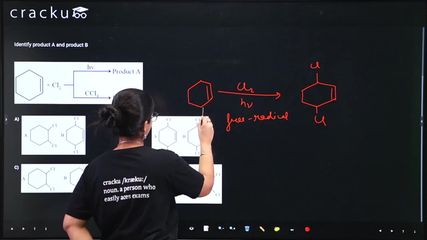
When $$Cl_2/h\nu$$ is used, the reaction proceeds through a free-radical substitution mechanism. Chlorine radicals abstract allylic hydrogen atoms, generating resonance-stabilized allylic radicals. As a result, substitution occurs at the allylic positions while the double bond remains unchanged.
Therefore, product A is 3,6-dichlorocyclohexene, in which the double bond is retained and chlorine atoms are present at the allylic carbons.
When $$Cl_2/CCl_4$$ is used, the reaction proceeds through an electrophilic addition mechanism. The electron-rich $$\pi$$ bond attacks $$Cl_2$$, leading to the formation of a chloronium ion intermediate. Subsequent attack by $$Cl^-$$ results in addition of chlorine atoms across the double bond.
Therefore, product B is 1,2-dichlorocyclohexane, in which the double bond is removed and chlorine atoms are attached to the two carbons that originally formed the double bond. Thus, product A contains an intact double bond with allylic chlorination, whereas product B contains vicinal dichlorination across the former double bond.
Hence, the correct answer is Option D.
Was this solution helpful?
Click on the Email ☝️ to Watch the Video Solution
Create a FREE account and get:
_1.webp)

Educational materials for JEE preparation

Ask our AI anything

AI can make mistakes. Please verify important information.
AI can make mistakes. Please verify important information.