
Join Our JEE Preparation Group
Prep with like-minded aspirants; Get access to free daily tests and study material.
Sign in
Please select an account to continue using cracku.in
↓ →
Join Our JEE Preparation Group
Prep with like-minded aspirants; Get access to free daily tests and study material.
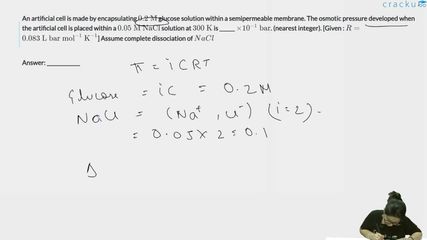
An artificial cell is made by encapsulating $$0.2 \text{ M}$$ glucose solution within a semipermeable membrane. The osmotic pressure developed when the artificial cell is placed within a $$0.05 \text{ M NaCl}$$ solution at $$300 \text{ K}$$ is ______ $$\times 10^{-1} \text{ bar}$$. (nearest integer). [Given : $$R = 0.083 \text{ L bar mol}^{-1} \text{ K}^{-1}$$] Assume complete dissociation of $$NaCl$$
Correct Answer: 25
An artificial cell containing 0.2 M glucose is placed in a 0.05 M NaCl solution (complete dissociation yields 0.1 M total ion concentration). The osmotic pressure can be calculated using the formula $$\pi = iCRT$$, where $$i$$ is the van ’t Hoff factor, $$C$$ the molar concentration, $$R$$ the gas constant, and $$T$$ the temperature.
For the glucose solution (a non-electrolyte with $$i = 1$$), the osmotic pressure inside the cell is $$\pi_{inside} = 1 \times 0.2 \times R \times T$$. For the NaCl solution (with $$i = 2$$ under complete dissociation), the osmotic pressure outside the cell is $$\pi_{outside} = 2 \times 0.05 \times R \times T = 0.1 \times R \times T$$.
The net osmotic pressure difference is given by $$\pi = \pi_{inside} - \pi_{outside} = (0.2 - 0.1) \times R \times T = 0.1 \times 0.083 \times 300$$ which evaluates to $$2.49 \text{ bar} = 24.9 \times 10^{-1} \text{ bar} \approx 25 \times 10^{-1} \text{ bar}$$.
The final answer is 25.
Was this solution helpful?
Click on the Email ☝️ to Watch the Video Solution
Create a FREE account and get:
_1.webp)

Educational materials for JEE preparation

Ask our AI anything

AI can make mistakes. Please verify important information.
AI can make mistakes. Please verify important information.
