
Join Our JEE Preparation Group
Prep with like-minded aspirants; Get access to free daily tests and study material.
Sign in
Please select an account to continue using cracku.in
↓ →
Join Our JEE Preparation Group
Prep with like-minded aspirants; Get access to free daily tests and study material.
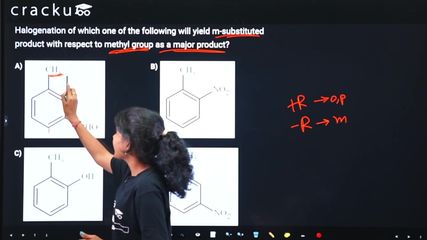
Halogenation of which one of the following will yield m-substituted product with respect to methyl group as a major product?
To determine the major product of an electrophilic aromatic substitution like halogenation on a benzene ring with two substituents, you must identify which group is the stronger activator. In the correct option (Option C, 2-methylphenol), the ring is attached to a methyl group (-CH3) and a hydroxyl group (-OH). While both are ortho/para-directing groups, the hydroxyl group is a much stronger activator due to the powerful resonance effect of the lone pairs on its oxygen atom. The methyl group only activates weakly through hyperconjugation. The golden rule in these reactions is that the more powerful activating group dictates the position of the incoming electrophile. Therefore, the -OH group takes control and directs the incoming halogen to the positions ortho and para to itself. If you look at the layout of the 2-methylphenol molecule, the available positions that are ortho and para to the -OH group happen to be located exactly meta to the methyl group. As a result, while the -OH group is simply following its normal directing rules, the final major product ends up being meta-substituted with respect to the methyl group.
Was this solution helpful?
Click on the Email ☝️ to Watch the Video Solution
Create a FREE account and get:
_1.webp)

Educational materials for JEE preparation

Ask our AI anything

AI can make mistakes. Please verify important information.
AI can make mistakes. Please verify important information.
