
 Group
Group
 Group
Group


 Preferred Source

 Google Discover
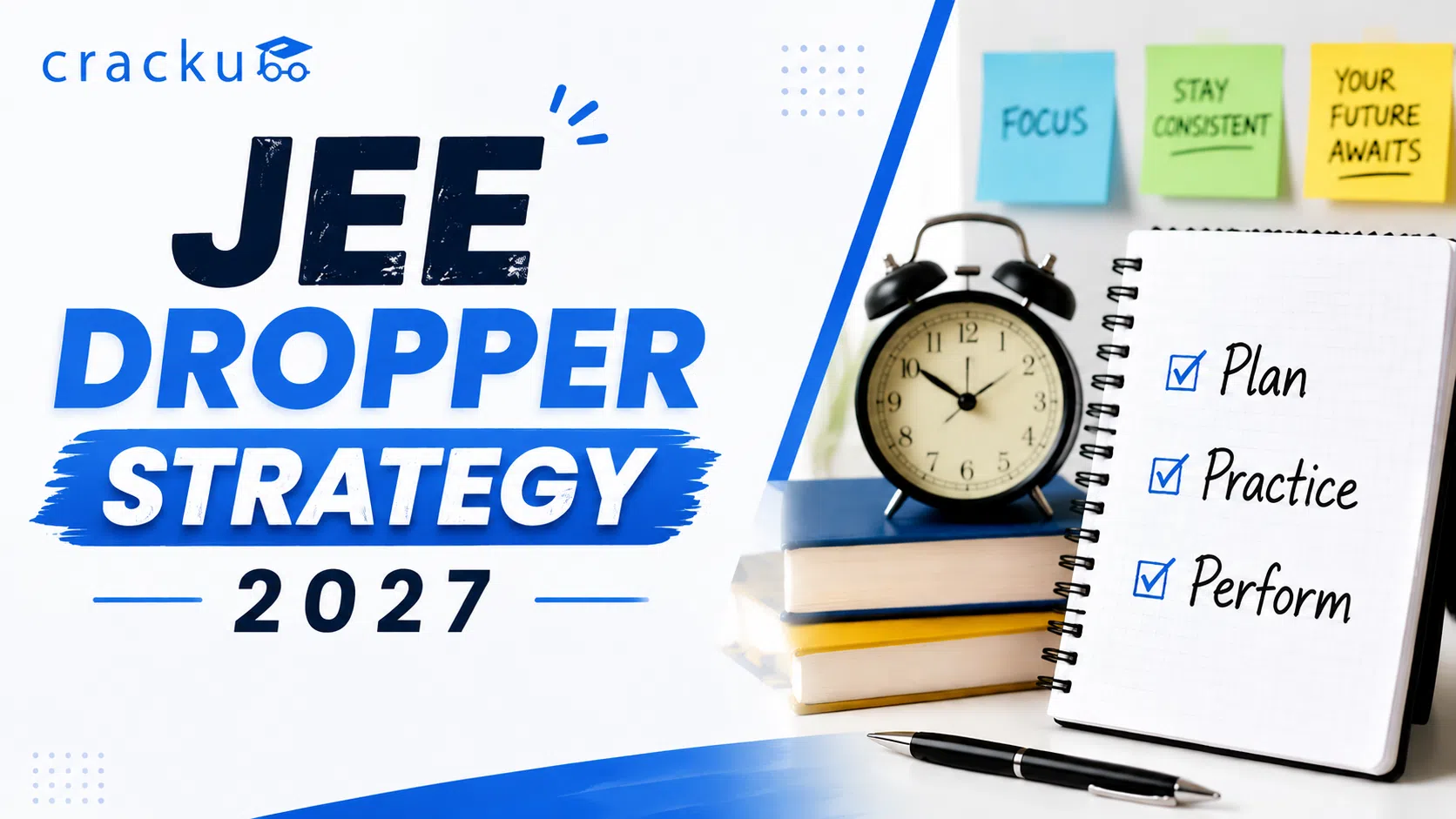
Taking a drop year for JEE 2027 is one of the highest-stakes decisions a student can make. Done right, it works: between 50% and 60% of students at top IITs are droppers who came back with a focused plan and executed it without compromise. Done wrong, it produces a second year of the same mistakes with a worse outcome. This guide lays out the complete JEE Dropper Blueprint for 2027: a phase-by-phase strategy, subject-specific study plan, preparation tips, a mistake audit, and an honest answer to whether the drop is worth it.The drop year is not an extended holiday. It is a 12-month job. The only difference between a dropper who cracks IIT and one who does not is the seriousness with which they treat those 12 months.
JEE Dropper Strategy 2027
The JEE 2027 Dropper Blueprint runs across four distinct phases from June 2026 to exam day. Each phase has a single overriding objective; mixing objectives across phases is one of the primary reasons droppers underperform.
Phase | Timeline | Core Objective |
|---|---|---|
Phase 1: Foundation and Deconstruction | June to July 2026 | Restart from zero; eliminate passive learning; lock down Class 11 foundations before touching Class 12 |
Phase 2: Targeted Syllabus Mastery | August to October 2026 | Cover the full syllabus by mid-December; master the 30 chapters that account for 75% of the paper |
Phase 3: Mock Test Autopsy | November to January 2027 | Use mock tests as diagnostic X-rays; categorise every error; practice the 90-Second Skip Rule |
Phase 4: Daily Execution and Revision | February to Exam Day | Three-round revision framework; 6 to 10 hours of intense daily self-study; peak simulation mode |
The single most important mindset shift: The enemy is not JEE difficulty. The enemy is the illusion of competence. Watching a lecture, understanding it in the moment, and feeling prepared is not the same as being able to reproduce that understanding under timed, high-pressure exam conditions. The only thing that builds real competence is active, aggressive problem solving done immediately after theory, not hours later and not the next day.Practise with JEE Questions to apply the Golden Ratio of 1:1 theory-to-problem-solving time from the first day of your drop year.
Also Read: JEE Mains 2027, Exam Dates, Registration & Eligibility Criteria
JEE Dropper Study Plan 2027
Phase 1: June to July 2026: Foundation and Deconstruction
Regardless of what you scored in JEE 2026, restart from zero. This is not self-punishment; it is the correct pedagogical approach. JEE tests interconnected concepts and there are almost certainly gaps in your Class 11 foundation that you are unaware of, gaps that become catastrophic at Class 12 difficulty levels. Two mandatory dependencies that cannot be skipped: Work Energy Theorem must be mastered before you touch Electrodynamics, and the Mole Concept is non-negotiable before you progress to any Physical Chemistry topic.
Phase 2: August to October 2026: Targeted Syllabus Mastery
The goal of Phase 2 is to complete the full JEE syllabus by mid-December 2026. This sounds straightforward but requires ruthless prioritisation. Focus on the top 30 chapters that together account for approximately 75% of the marks in any given JEE paper. The table below presents the subject-wise priority list and strategy.
Subject | Priority Chapters | Key Strategy |
|---|---|---|
Physics | Mechanics, Electrodynamics, Current Electricity, Modern Physics | Current Electricity is the single highest-return chapter; it can yield up to three questions. Modern Physics offers formula-driven easy marks. Master these two before anything else. |
Chemistry | General Organic Chemistry (GOC), p-block, d-block, f-block, Mole Concept | NCERT line by line for all Inorganic Chemistry, no exceptions. GOC is the operating system for the rest of Organic Chemistry; if GOC is weak, all of Organic will be weak. |
Mathematics | Calculus, Coordinate Geometry | Mathematics is the most time-consuming subject in JEE. Aim for extreme problem-solving velocity. Calculus and Coordinate Geometry together cover the largest share of marks. |
The Golden Ratio: For every one hour of theory covered, you must immediately follow with one hour of active, aggressive problem solving from that exact topic. Not the next day. Not after finishing the chapter. Immediately. This is the single most important habit that separates productive droppers from those who feel busy but are not improving.
Phase 3: November 2026 to January 2027: Mock Test Autopsy
From November onwards, mock tests become the primary tool. But the value of a mock test is not in the score; it is entirely in the analysis. Every mock test should be treated as a diagnostic X-ray that tells you exactly where your preparation is broken.
The Error Log system categorises every wrong answer into exactly one of five buckets. Keeping this log and reviewing it weekly is the mechanism by which a dropper closes gaps systematically rather than randomly.
Error Bucket | What It Means | How to Address It |
|---|---|---|
Concept Error | You did not know the underlying theory or principle being tested | Go back to the source material, not YouTube; read the textbook line by line for that topic |
Approach Error | You knew the theory but used the wrong formula or method | Practise identifying question type before starting calculations; build a question-type recognition habit |
Setup Error | You could not translate the physical situation into a mathematical equation | Slow down during problem reading; practise translating words into variables before touching the calculator |
Calculation Error | You made arithmetic mistakes during an otherwise correct attempt | Never do mental math; write every unit; write every step; slow beats wrong every time |
Misread Error | You read the question incorrectly (for example, 'incorrect' as 'correct') | Circle or underline the instruction keyword before beginning; re-read the final line of every question |
The 90-Second Skip Rule: If you cannot identify the mathematical pathway to solve a question within 90 seconds of reading it, skip it and move on. This is not giving up; it is exam intelligence. A question you cannot solve in 90 seconds will almost certainly take 8 to 12 minutes, time that could earn you 12 or more marks elsewhere in the paper. Return to skipped questions only if time permits.
Phase 4: February to Exam Day: Daily Execution and Revision
Phase 4 is about peak performance, not new learning. No new topics. No new books. Only revision, speed, and simulation. The Three-Round Revision Framework runs across this entire phase.
Revision Round | Focus | What to Do |
|---|---|---|
Round 1: Foundations | Late November to December | Revisit core concepts across all three subjects; close any remaining conceptual gaps; ensure no topic from the top 30 chapters has an unresolved Concept Error |
Round 2: PYQ Speed | January | Work through Previous Year Questions at speed; JEE PYQs from 2019 to 2026 are the closest available proxy for the actual exam style, difficulty, and question type distribution |
Round 3: Peak Simulation | February to Exam Day | Full-length timed mock tests under exact exam conditions; 6 AM start, phone out of the room, no interruptions; review error logs after every test and close gaps immediately |
Daily hours in Phase 4 should be between 6 and 10 hours of genuine, distraction-free self-study. If Mathematics is your weakest subject, make it your first subject of the day, beginning at 6:30 AM when cognitive capacity is highest. Never study your weakest subject when you are tired.
Also Read: JEE Main Syllabus 2027 PDF, Weightage, Important Topics
JEE Dropper Preparation Tips 2027
The following preparation tips are drawn from the patterns observed across successful JEE droppers at top IITs.
- Begin the drop year on June 1, not September, not after the result shock fades; every week of June lost is a week from Phase 2 stolen
- Use NCERT line by line for all of Inorganic Chemistry without exception; no shortcut, no summary notes can substitute this for p-block, d-block, and f-block topics
- Treat General Organic Chemistry (GOC) as the operating system for all of Organic Chemistry; if the foundations of GOC are shaky, every named reaction and mechanism in Organic becomes fragile
- Never do mental arithmetic during problem solving; write every unit, every step; the habit of writing prevents Calculation Errors during the actual exam
- Star or bookmark difficult problems from every chapter rather than flagging them for later; revisit starred problems weekly and track whether they can now be solved independently
- Use JEE Previous Year Questions from 2019 to 2026 as the gold standard for Phase 3 and 4 practice; PYQs are the closest available proxy for the actual exam difficulty and style
- Take a minimum of two full-length mock tests per week in Phase 3; do the error log analysis before reading the solutions; resist the urge to check the answer key immediately after finishing
Also Read: JEE Mains Registration 2027, Form, Fees & Important Dates
Is Taking a Drop for JEE 2027 the Right Decision?
The answer depends on one question that requires brutal honesty: did you prepare seriously for JEE 2026 or did you coast? If you coasted, prepared inconsistently, or did not start early, then a drop year with genuine full-time commitment has a high probability of producing a dramatically better outcome.
If you prepared seriously and fully for JEE 2026 and still did not crack it, the drop year still has a real shot, but the margin for error is smaller. You will need to identify exactly what went wrong: was it Concept Errors (gaps in understanding), Approach Errors (wrong strategy), or Execution Errors (test-taking psychology and time management)? The answer determines whether another year of the same approach will help or whether you need to fundamentally change your method.
The data point that matters: 50% to 60% of students at top IITs took a drop year. The majority of students who commit fully to a structured drop year with no distractions and a disciplined phase-wise plan improve their rank substantially. The students for whom it does not work are almost always those who treated the drop year as another version of Class 12, with school breaks, social media, and inconsistent effort.
Common Mistakes JEE Droppers Must Avoid
The mistakes below are the most frequently observed reasons that JEE droppers do not improve significantly over their previous attempt, despite having a full additional year. Every item on this list is avoidable with awareness and discipline.
| Common Mistake | Why It Fails | What to Do Instead |
|---|---|---|
| Passive watching of video lectures at 2x speed without solving problems | Creates an illusion of competence; the brain recognises the material but cannot reproduce it under exam pressure | Follow the Golden Ratio: one hour of theory followed immediately by one hour of active problem solving |
| Moving to Class 12 topics before mastering Class 11 foundations | JEE questions test multiple layers of concepts simultaneously; a weak foundation in one area causes collapse across multiple topics | Do not touch Electrodynamics until Work Energy Theorem is mastered; do not touch Physical Chemistry until the Mole Concept is solid |
| Treating mock tests as scorecard events rather than diagnostic tools | Looking only at the score misses the real value of mock tests; improvement comes from error analysis | After every mock, categorise every wrong answer into one of the five error buckets before reviewing solutions |
| Keeping the phone in the same room during study sessions | Even a phone placed nearby reduces focus and creates mental split attention | Remove the phone from the room completely during study sessions |
| Freezing on hard questions during the exam | Spending too much time on one question wastes time that could earn easier marks elsewhere | Apply the 90-Second Skip Rule strictly; if no clear approach appears, move on immediately |
| Attempting social media or maintaining social obligations during the drop year | A drop year needs full focus; distractions reduce consistency and output | Treat the drop year as a 12-month job with no weekends and minimal distractions |
The most dangerous mistake of all: Starting Phase 2 (syllabus coverage) without completing Phase 1 (foundation repair). A dropper who jumps directly into Electrodynamics revision without having locked down Work Energy Theorem will encounter the same conceptual walls they hit during their first attempt. Phase 1 exists specifically to prevent this. It is not optional, and it is not possible to rush it. Begin practising now with JEE Mains Online Coaching to build momentum from the first day of your drop year rather than waiting to feel ready.
JEE Dropper Strategy 2027: Conclusion
The JEE Dropper Strategy 2027 is built around a clear, phase-wise system that transforms preparation from random study into structured execution. By focusing on foundation building, targeted syllabus completion, and disciplined mock test analysis, droppers can systematically improve accuracy and performance. The Golden Ratio of theory and practice ensures that learning is always converted into problem-solving ability, which is essential for cracking IIT-level exams.
Success in a drop year depends more on consistency than intelligence. Students who follow the error log system, apply the 90-second rule, and revise using PYQs consistently see measurable improvement in their ranks. With the right discipline and structured approach, the drop year becomes not a second chance, but the most powerful opportunity to secure an IIT seat.