For the following questions answer them individually
In a single slit diffraction experiment, a slit of width $$(0.016\pm 0.002)\,\mathrm{mm}$$ is used to measure the wavelength of a monochromatic light source. In the diffraction pattern, the angular distance between the central maximum and first minimum is measured to be $$(2^\circ\pm 40')$$. The value of the fractional error in the measurement of wavelength is:
[Given: $$\sin(2^\circ)=0.035$$]
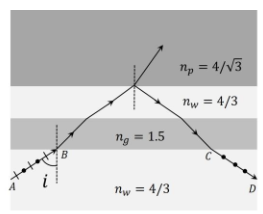
As shown in the figure, a ray $$AB$$ of unpolarized light enters from water of refractive index $$n_w=4/3$$ into a medium of refractive index $$n_p=4/\sqrt{3}$$ after passing through a glass plate of refractive index $$n_g=1.5$$ and a layer of water. At a particular incident angle $$i$$ the reflected ray $$CD$$ is polarized in the direction as shown in the figure. The value of $$i$$ (in degrees) is:
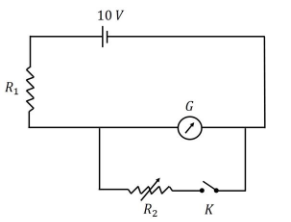
As shown in the figure, the resistance of a galvanometer $$G$$ can be found by the half-deflection method. Here the resistance $$R_2$$ is adjusted such that when the key $$K$$ is closed the deflection in the galvanometer becomes half of the value as compared to when $$K$$ is open. Half-deflection is obtained at $$R_2=4\,\Omega$$ and thus the galvanometer resistance is found to be $$6\,\Omega$$. In this half-deflection condition the current (in mA) through the resistor $$R_1$$ is:
In a new system of units, the units of mass, length, time and current are $$5\,\mathrm{kg}$$, $$5\,\mathrm{m}$$, $$5\,\mathrm{s}$$ and $$5\,\mathrm{A}$$, respectively. If $$\mu_0$$ and $$\epsilon_0$$ are the permeability and permittivity of free space, respectively, then in this new system of units, the magnitude of one SI unit of $$\sqrt{\mu_0/\epsilon_0}$$, is:
Question Stem for Question Nos. 15 and 16
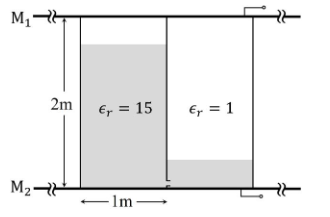
A container of height $$2\,\mathrm{m}$$, length $$2\,\mathrm{m}$$ and breadth $$1\,\mathrm{m}$$ is made of insulating vertical walls and two large area horizontal metal plates ($$M_1$$ and $$M_2$$) which extend far beyond the vertical walls in all directions. The container is partitioned into two equal chambers with a thin insulating vertical wall. The partition wall contains a small hole of cross-sectional area $$\sqrt{10}\,\mathrm{cm^2}$$ near its bottom edge. Initially the hole is closed and the left chamber of the container is completely filled with a liquid of dielectric constant $$\epsilon_r=15$$ and the right chamber is empty ($$\epsilon_r=1$$). At time $$t=0$$, the hole is opened and the liquid flows from the left chamber to the right chamber. In both the chambers, the space above the liquid has $$\epsilon_r=1$$ and is maintained at atmospheric pressure. The schematic of the container at a time $$t>0$$ is shown in the figure.
[Given: acceleration due to gravity is $$10\,\mathrm{ms^{-2}}$$.]
The height (in m) of the liquid in left chamber at $$t=500\,\mathrm{s}$$ is:
Question Stem for Question Nos. 15 and 16
A container of height $$2\,\mathrm{m}$$, length $$2\,\mathrm{m}$$ and breadth $$1\,\mathrm{m}$$ is made of insulating vertical walls and two large area horizontal metal plates ($$M_1$$ and $$M_2$$) which extend far beyond the vertical walls in all directions. The container is partitioned into two equal chambers with a thin insulating vertical wall. The partition wall contains a small hole of cross-sectional area $$\sqrt{10}\,\mathrm{cm^2}$$ near its bottom edge. Initially the hole is closed and the left chamber of the container is completely filled with a liquid of dielectric constant $$\epsilon_r=15$$ and the right chamber is empty ($$\epsilon_r=1$$). At time $$t=0$$, the hole is opened and the liquid flows from the left chamber to the right chamber. In both the chambers, the space above the liquid has $$\epsilon_r=1$$ and is maintained at atmospheric pressure. The schematic of the container at a time $$t>0$$ is shown in the figure.
[Given: acceleration due to gravity is $$10\,\mathrm{ms^{-2}}$$.]
The difference in the capacitance (in F) between the metal plates at $$t=0$$ and that at $$t=500\,\mathrm{s}$$ is $$(8-n)\epsilon_0$$, where $$\epsilon_0$$ is the permittivity of free space. The value of $$n$$ is:
Question Stem for Question Nos. 17 and 18
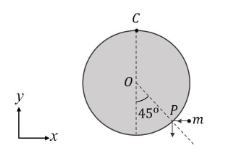
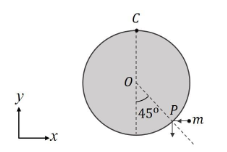
A uniform circular disk of radius $$0.2\,\mathrm{m}$$ and mass $$1\,\mathrm{kg}$$ is pivoted at its top point $$C$$ such that it can rotate freely around $$C$$ in the $$XY$$ plane, as shown in the figure. Initially, when the disk is at rest, a particle of mass $$20\,\mathrm{g}$$, travelling along negative $$x$$ direction in the $$XY$$ plane with speed $$100\,\mathrm{ms^{-1}}$$, hits the circumference of the disk at a point $$P$$. After collision the particle moves along negative $$y$$ direction at a speed of $$90\,\mathrm{ms^{-1}}$$.
[Given: the acceleration due to gravity $$(g)=-10\hat{j}\,\mathrm{ms^{-2}}$$]
After the collision the disk starts to rotate around point $$C$$ in the $$XY$$ plane. The maximum change in the height (in m) of its center $$O$$ is:
Question Stem for Question Nos. 17 and 18
A uniform circular disk of radius $$0.2\,\mathrm{m}$$ and mass $$1\,\mathrm{kg}$$ is pivoted at its top point $$C$$ such that it can rotate freely around $$C$$ in the $$XY$$ plane, as shown in the figure. Initially, when the disk is at rest, a particle of mass $$20\,\mathrm{g}$$, travelling along negative $$x$$ direction in the $$XY$$ plane with speed $$100\,\mathrm{ms^{-1}}$$, hits the circumference of the disk at a point $$P$$. After collision the particle moves along negative $$y$$ direction at a speed of $$90\,\mathrm{ms^{-1}}$$.
[Given: the acceleration due to gravity $$(g)=-10\hat{j}\,\mathrm{ms^{-2}}$$]
Amount of energy loss (in J) in the collision is:
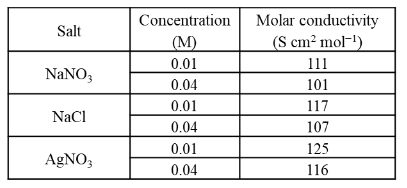
At 300 K, the molar conductivities of the aqueous solutions of three salts at two different concentrations are given below:
The conductivity of a saturated aqueous solution of AgCl is $$1.40\times 10^{-6}$$ S cm$$^{-1}$$ at 300 K. If the solubility of AgCl in water at 300 K is $$X$$ mol L$$^{-1}$$, then $$\log_{10}(X^{-1})$$ is
(Assume that AgCl dissolved in water ionizes completely and that the molar conductivity of saturated AgCl solution is equal to its limiting molar conductivity.)
The correct order of ONO bond angle in the given species is