JEE WhatsApp Group



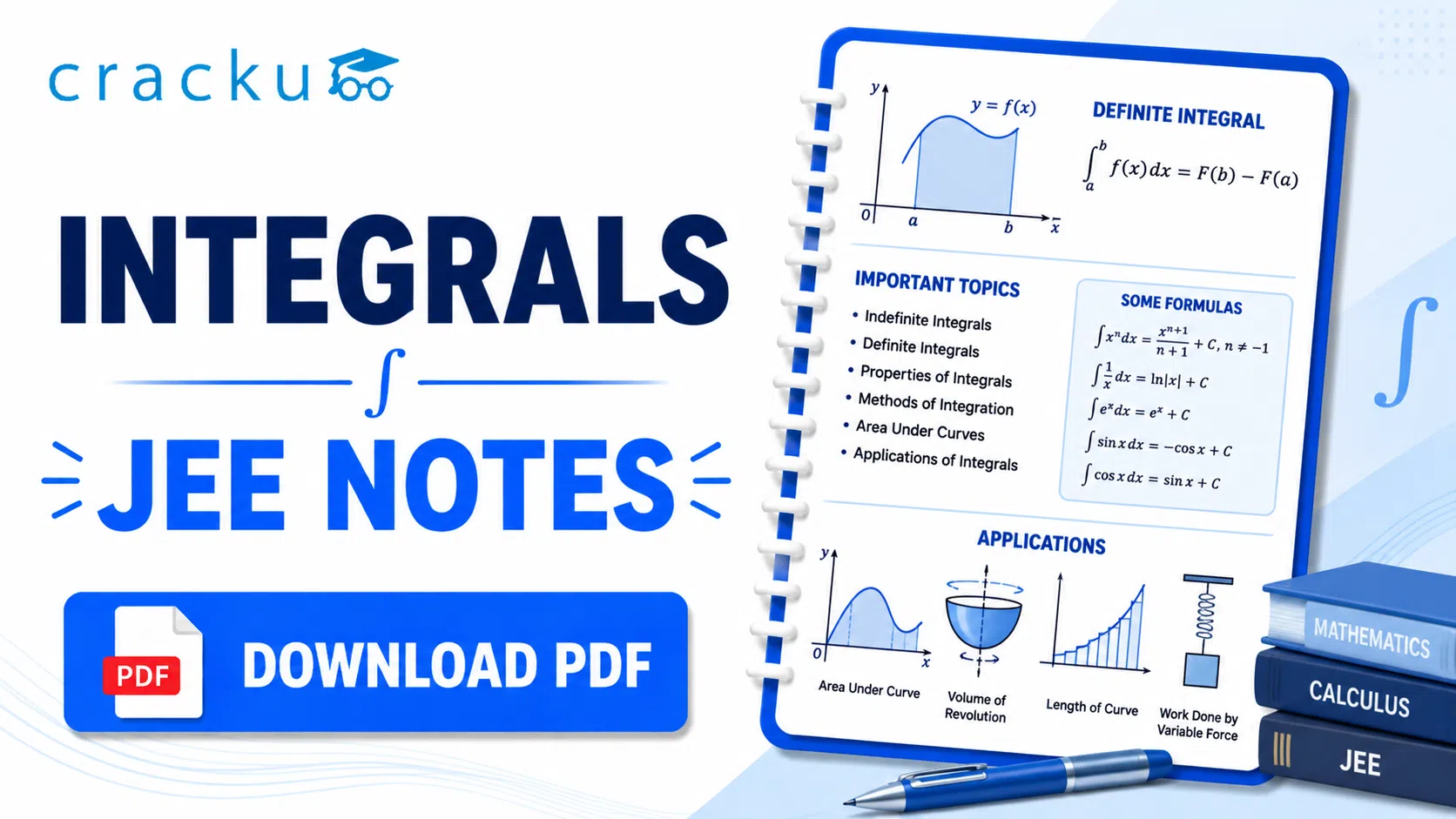
Integrals JEE Notes give you a one-page core of everything the exam needs: definition, techniques, properties and ready-to-use results. Skim the bolded points, verify the solved questions, and tick the chapter off your to-do list.
Integrals JEE Notes: Important Concepts
Integral calculus is the inverse process of differentiation. The syllabus divides it into:
- Indefinite integral $$\displaystyle \int f(x)\,dx=F(x)+C$$ representing a family of antiderivatives.
- Definite integral $$\displaystyle \int\_{a}^{b} f(x)\,dx$$ giving a unique real number, geometrically the signed area between the curve and the x-axis.
- Applications: area between curves, volumes of revolution and other geometric measures.
Two ideas knit the entire chapter:
- The Fundamental Theorem of Calculus (FTC), $$\displaystyle\frac{d}{dx}\int\_{a}^{x} f(t)\,dt=f(x)$$ and $$\displaystyle\int\_{a}^{b} f(x)\,dx=F(b)-F(a).$$
- All integration techniques transform a tough integrand into a standard form whose antiderivative is known.
Marks trend: 1 easy question on standard results or substitution in JEE Main almost every year, and 1 moderate multi-step definite integral or area question in JEE Advanced on alternate years.
Indefinite Integrals: Basic Techniques
1. Substitution
Choose $$x=g(t)$$ so that $$f(x)\,dx$$ becomes $$F(t)\,dt$$. The method excels for composite functions or when the integrand is a derivative lurking inside.
Most used pattern: $$\displaystyle\int f(g(x))\,g'(x)\,dx = \int f(u)\,du = F(u)+C$$ with $$u=g(x).$$
2. Integration by Parts
When the integrand is a product, $$\displaystyle\int u\,dv = u\,v-\int v\,du.$$ Remember ILATE (Inverse trigonometric, Logarithmic, Algebraic, Trigonometric, Exponential) for choosing u.
3. Partial Fractions
For rational functions $$\dfrac{P(x)}{Q(x)}$$ where $$\deg P<\deg Q$$, split into simpler fractions whose antiderivatives are tabulated.
4. Trigonometric Transformations
- Use $$t=\tan\dfrac{x}{2}$$ for integrals involving $$\sin x$$ and $$\cos x$$ in rational form (Weierstrass).
- For $$\sqrt{a^2-x^2}$$, $$x=a\sin\theta$$ works best, and so on for similar radicals.
5. Standard Integrals
| Form | Antiderivative |
|---|---|
| $$\displaystyle\int x^n\,dx$$, $$n\neq-1$$ | $$\dfrac{x^{n+1}}{n+1}+C$$ |
| $$\displaystyle\int e^{ax}\,dx$$ | $$\dfrac{e^{ax}}{a}+C$$ |
| $$\displaystyle\int \sin ax\,dx$$ | $$-\dfrac{\cos ax}{a}+C$$ |
| $$\displaystyle\int \sec^2 x\,dx$$ | $$\tan x + C$$ |
| $$\displaystyle\int \dfrac{dx}{x^2+a^2}$$ | $$\dfrac{1}{a}\tan^{-1}\dfrac{x}{a}+C$$ |
Worked Examples
- Substitution
Evaluate $$I=\displaystyle\int (3x^2+2x)e^{x^3+x^2}\,dx$$.
Put $$u=x^3+x^2$$, $$du=(3x^2+2x)\,dx$$.
Hence $$I=\int e^{u}\,du=e^{u}+C=e^{x^3+x^2}+C.$$
Answer: $$e^{x^{3}+x^{2}}+C$$ - Partial Fractions
$$\displaystyle\int \dfrac{3x+7}{(x+2)(x-1)}\,dx$$ splits as $$\dfrac{A}{x+2}+\dfrac{B}{x-1}$$ with $$A=2, B=1$$.
So $$\int \left(\dfrac{2}{x+2}+\dfrac{1}{x-1}\right)\!dx=2\ln|x+2|+\ln|x-1|+C.$br/> Answer: $$2\ln|x+2|+\ln|x-1|+C$$ - ILATE
$$\displaystyle\int x\sin x\,dx$$:
Let $$u=x,$$ $$dv=\sin x\,dx.$$
Then $$du=dx,$$ $$v=-\cos x.$$ $$\int x\sin x\,dx = -x\cos x+\int\cos x\,dx= -x\cos x+\sin x+C.$$ Answer: $$\sin x - x\cos x + C$$ - Trigonometric Substitution
$$\displaystyle\int \dfrac{dx}{\sqrt{4-x^2}}$$.
Put $$x=2\sin\theta,$$ $$dx=2\cos\theta\,d\theta.$$ Integral becomes $$\int\frac{2\cos\theta}{2\cos\theta}\,d\theta=\theta+C.$$
Back-substitute $$\theta=\sin^{-1}(x/2).$$
Answer: $$\sin^{-1}\dfrac{x}{2}+C$$
After covering the patterns above, drill mixed problems from the JEE Questions bank to lock the techniques in.
Definite Integrals and Properties
Fundamental Theorem Recap
Once you know an antiderivative $$F(x)$$, calculate $$\displaystyle\int\_{a}^{b} f(x)\,dx = F(b)-F(a).$$
Algebra of Definite Integrals
| Property | Explanation |
|---|---|
| $$\int\_{a}^{a} f(x)\,dx=0$$ | Zero width interval |
| $$\int\_{a}^{b} f(x)\,dx=-\int\_{b}^{a} f(x)\,dx$$ | Reversing limits changes sign |
| $$\int\_{a}^{b} k\,f(x)\,dx=k\int\_{a}^{b} f(x)\,dx$$ | Constant multiple comes out |
| $$\int\_{a}^{b} [f(x)\pm g(x)]\,dx=\int\_{a}^{b} f(x)\,dx\pm\int\_{a}^{b} g(x)\,dx$$ | Linearity |
Special Properties Frequently Asked
- Symmetry about mid-point: $$\displaystyle\int\_{0}^{a} f(x)\,dx=\int\_{0}^{a} f(a-x)\,dx.$$
- Even–odd test: If $$f(x)$$ is even, $$\displaystyle\int\_{-a}^{a} f(x)\,dx=2\int\_{0}^{a} f(x)\,dx$$; if odd, the value is 0.
- Periodic property: For period $$T$$, $$\int\_{a}^{a+T} f(x)\,dx=\int\_{0}^{T} f(x)\,dx.$
- Substitution in limits: $$\displaystyle\int\_{a}^{b} f(x)\,dx=\int\_{g(a)}^{g(b)} f(g^{-1}(t))\,\left|\dfrac{dx}{dt}\right|\,dt.$
Beta–Gamma Connections
At JEE Advanced level, standard results of $$\Beta(m,n)$$ and $$\Gamma(n)$$ occasionally appear. Keep $$\displaystyle\int\_{0}^{1} x^{m-1}(1-x)^{n-1}\,dx=\dfrac{\Gamma(m)\Gamma(n)}{\Gamma(m+n)}$$ handy.
Solved Examples
- Symmetry
Evaluate $$\displaystyle\int\_{0}^{\pi} x\sin x\,dx.$$ Using $$f(\pi -x)= (\pi -x)\sin(\pi -x)= (\pi -x)\sin x.$$ $$I=\int\_{0}^{\pi} (\pi -x)\sin x\,dx.$$ Add the two expressions: $$2I=\pi\int\_{0}^{\pi}\sin x\,dx=\pi[ -\cos x ]\_{0}^{\pi}= \pi( -(-1)-(-1))=2\pi.$$ So $$I=\pi.$$ Answer: $$\pi$$ - Periodic Split
Compute $$\displaystyle\int\_{0}^{3\pi} |\sin x|\,dx.$$ Period of $$|\sin x|$$ is $$\pi.$$ Hence $$I=3\int\_{0}^{\pi}|\sin x|\,dx=3\times 2.$$ (Since area under one hump is 2.) Answer: $$6$$ - Limit Comparison
$$\displaystyle\int\_{0}^{1} \frac{\ln(1+x)}{1+x^{2}}\,dx.$$ Put $$x=\tan\theta, dx=\sec^{2}\theta\,d\theta.$$ Limits: $$x=0\rightarrow\theta=0,$$ $$x=1\rightarrow\theta=\pi/4.$$ Integral becomes $$\int\_{0}^{\pi/4} \ln(1+\tan\theta)\,d\theta.$$ Now use $$\theta\rightarrow \dfrac{\pi}{4}-\theta$$ symmetry (exercise). Answer: $$\dfrac{\pi}{8}\ln 2$$ - FTC Direct
If $$F(x)=\displaystyle\int\_{2}^{x^{2}} \sqrt{1+t^{3}}\,dt,$$ find $$F'(x).$$ $$F'(x)=\sqrt{1+(x^{2})^{3}}\cdot 2x =2x\sqrt{1+x^{6}}.$$ Answer: $$2x\sqrt{1+x^{6}}$$
For pattern variety, study the same questions in past papers via JEE Mains Previous Papers; many limits-changing tricks repeat every alternate year.
Applications of Integrals: Area and Volume
Area Under a Curve
Area between $$y=f(x)$$ and the x-axis from $$x=a$$ to $$x=b$$ (where $$f(x)\ge 0$$) is $$A=\displaystyle\int\_{a}^{b} f(x)\,dx$$. If the curve dips below, split the interval or take absolute value.
Area Between Two Curves
If $$f(x)\ge g(x)$$ on $$[a,b]$$, area $$=\displaystyle\int\_{a}^{b}[f(x)-g(x)]\,dx.$
Volume of Revolution
- Disc method: Revolve $$y=f(x)$$ about x-axis: $$V=\pi\int\_{a}^{b}[f(x)]^{2}\,dx.$$
- Shell method: Revolve around y-axis: $$V=2\pi\int\_{a}^{b} x\,f(x)\,dx.$$
Arc Length & Surface Area*
(*JEE Advanced only) Length of a smooth curve $$y=f(x)$$ on $$[a,b]$$ is $$L=\displaystyle\int\_{a}^{b}\sqrt{1+(f'(x))^{2}}\,dx.$$ Surface area when revolved about the x-axis: $$S=2\pi\int\_{a}^{b} f(x)\sqrt{1+(f'(x))^{2}}\,dx.$$
Solved Examples
- Area between curves
Find the area enclosed by $$y=x$$ and $$y=x^{2}$$. Points of intersection: $$x=0$$ and $$x=1.$$ Area $$=\displaystyle\int\_{0}^{1} (x-x^{2})\,dx=\left[\dfrac{x^{2}}{2}-\dfrac{x^{3}}{3}\right]\_{0}^{1}=\dfrac{1}{2}-\dfrac{1}{3}=\dfrac{1}{6}.$$ Answer: $$\dfrac{1}{6}$$ square units - Disc method
Find the volume when region under $$y=\sqrt{x}$$ from $$x=0$$ to $$x=4$$ is revolved about the x-axis. $$V=\pi\int\_{0}^{4} (\sqrt{x})^{2}\,dx =\pi\int\_{0}^{4}x\,dx=\pi\left[\dfrac{x^{2}}{2}\right]\_{0}^{4}=8\pi.$$ Answer: $$8\pi$$ cubic units - Shell method
Region between $$y=4-x^{2}$$ and the x-axis, revolved about y-axis. Intersection at $$x=\pm 2.$$ $$V=2\pi\int\_{0}^{2} x(4-x^{2})\,dx=2\pi\int\_{0}^{2} (4x-x^{3})\,dx=2\pi\left[2x^{2}-\dfrac{x^{4}}{4}\right]\_{0}^{2}=2\pi(8-4)=8\pi.$$ Answer: $$8\pi$$ cubic units - Length of curve (Advanced)
$$y=\ln\cosh x$$ from $$0$$ to $$1$$. $$\frac{dy}{dx}=\tanh x.$$ $$L=\int\_{0}^{1}\sqrt{1+\tanh^{2}x}\,dx=\int\_{0}^{1}\text{sech}\,x\,dx=\arctan(\sinh x)\Big|\_{0}^{1}=\arctan(\sinh 1).$$ Answer: $$\tan^{-1}(\sinh 1)$$
Area/volume questions are favourite in Advanced. Browse similar ones in JEE Advanced Previous Papers to spot recurring algebraic curves.
Important Formulas and Results at a Glance
| Serial | Formula | Remarks |
|---|---|---|
| 1 | $$\displaystyle\int\frac{dx}{x^{2}-a^{2}}=\frac{1}{2a}\ln\left|\frac{x-a}{x+a}\right|+C$$ | Use partial fractions |
| 2 | $$\displaystyle\int\sec x\,dx=\ln|\sec x+\tan x|+C$$ | Derive via multiplying numerator and denominator by $$\sec x+\tan x$$ |
| 3 | $$\displaystyle\int\sin^{m}x\cos^{n}x\,dx$$ | If one exponent is odd, peel one factor and substitute $$\sin^{2}x=1-\cos^{2}x$$ or vice-versa |
| 4 | $$\displaystyle\int\_{0}^{\pi/2}\sin^{m}x\cos^{n}x\,dx=\frac{1}{2}\Beta\!\left(\frac{m+1}{2},\frac{n+1}{2}\right)$$ | Advanced shortcut |
| 5 | Property $$\displaystyle\int\_{0}^{a} f(x)\,dx = \int\_{0}^{a} f(a-x)\,dx$$ | Powerful for symmetric limits |
| 6 | Reduction: $$I\_{n}=\int\sin^{n}x\,dx \Rightarrow I\_{n}= -\frac{\sin^{n-1}x\cos x}{n}+\frac{n-1}{n}I\_{n-2}$$ | Derive by parts |
| 7 | Area between curves $$= \int\_{x\_1}^{x\_2}|f(x)-g(x)|\,dx$$ | Split intervals if crossover exists |
| 8 | Volume (disc) $$= \pi\int y^{2}\,dx$$ | Axis of revolution: x-axis |
| 9 | Differentiation under the integral sign $$\displaystyle\frac{d}{d\alpha}\int\_{a}^{b} f(x,\alpha)\,dx=\int\_{a}^{b}\frac{\partial f}{\partial\alpha}\,dx$$ | Feynman trick, rarely but beautifully asked |
| 10 | Wallis product (Advanced) $$\displaystyle\int\_{0}^{\pi/2}\sin^{n}x\,dx \sim\sqrt{\dfrac{\pi}{2n}}$$ as $$n\to\infty$$ | Useful for asymptotics |
Print this table or copy it into your personal JEE Formula Sheets so that you never hunt for a reduction again during the last week.
JEE Important Points, Common Mistakes and Quick Revision
- Always check continuity at the limits. An integrand blowing up at an endpoint demands an improper integral approach.
- For $$\displaystyle\int\_{0}^{\pi}$$ questions, test even-odd or $$f(\pi -x)$$ symmetry before you integrate blindly.
- Manipulate definite integrals into $$I + I$$ or $$I - I$$ patterns; nearly 50 % of elegant solutions rest on that trick.
- Carry the derivative of the inside function in your mind: if it is present up to a constant, substitution is king.
- Units: areas are square units, volumes cubic. Losing units seldom costs marks but flags conceptual sloppiness.
- Keep a running catalogue of standard integrals. In rapid-fire quizzes, recall speed saves significant time.
- Finally, mix fresh questions daily. The test series on our JEE Mains Online Coaching platform alternates purely indefinite sets with application-heavy mock sections so your mind switches context quickly.
.webp)