JEE WhatsApp Group



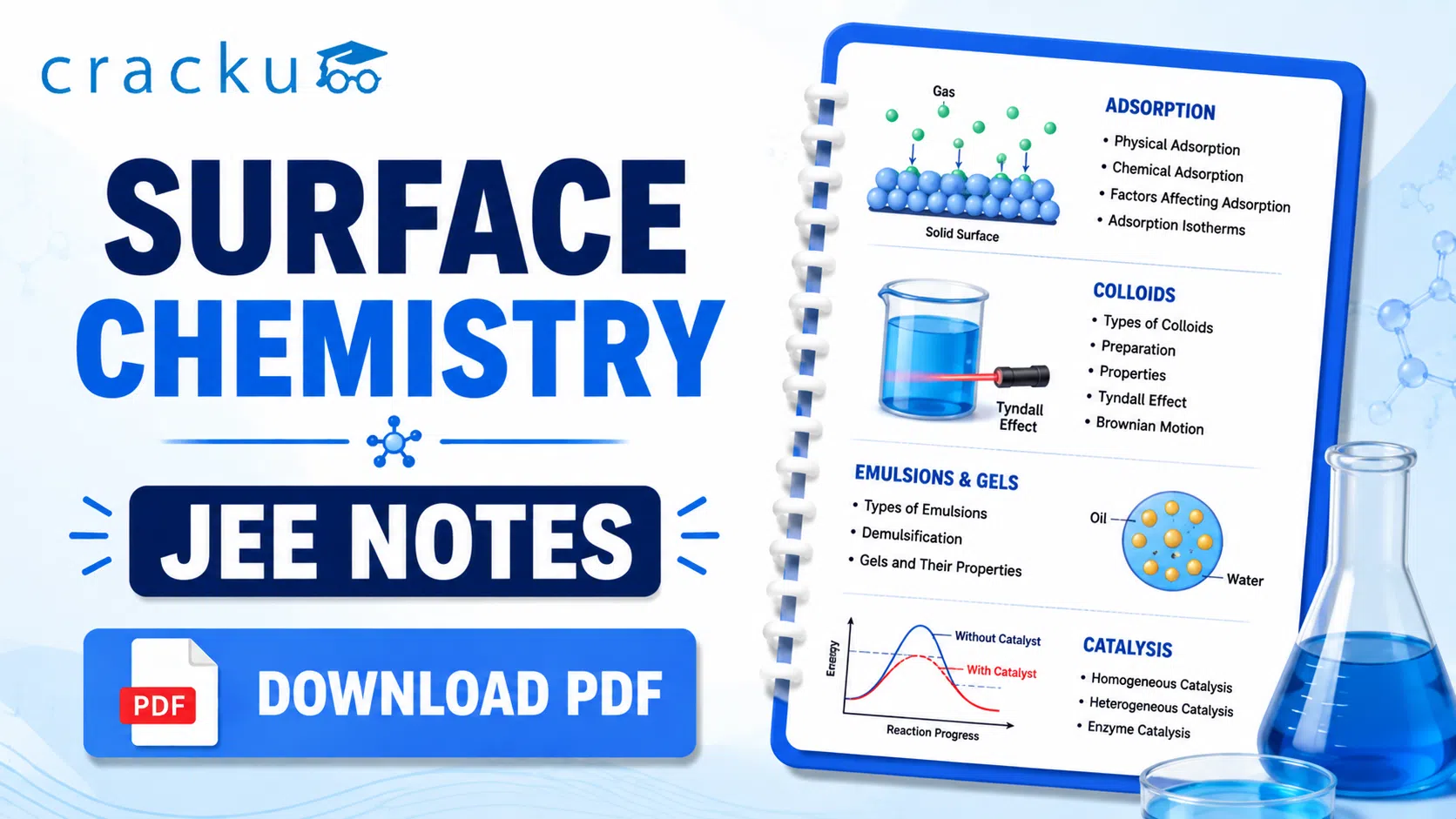
Surface Chemistry JEE Notes focus on phenomena that occur at interfaces: the thin boundary layers where solids, liquids and gases meet. The chapter blends theory with applications that JEE loves to test through concise numerical problems and conceptual traps.
Surface Chemistry JEE Notes: Important Concepts
Below is a bird’s-eye view of what you must master before the exam. Tick every box during revision:
- Adsorption: physical vs chemical, energetics, isotherms.
- Colloidal state: classification, preparation, purification, properties (Tyndall, Brownian, zeta potential).
- Emulsions and gels: types, demulsification, applications.
- Catalysis: homogeneous, heterogeneous, enzyme kinetics, autocatalysis.
- Surface area measurement: BET equation, monolayer capacity.
Make sure you can move swiftly between definitions, equations and everyday examples: that is exactly how recent JEE papers frame their MCQs.
Adsorption: Isotherms, Kinetics and Applications
Types of Adsorption
- Physisorption: weak van der Waals forces, low heat of adsorption (20–40 kJ mol-1), multilayer possible, decreases with rise in temperature.
- Chemisorption: strong chemical bonds, high heat of adsorption (80–200 kJ mol-1), monolayer, shows activation energy.
Important Isotherms
| Isotherm | Equation | Linear Form | Key Points |
|---|---|---|---|
| Freundlich | $$\dfrac{x}{m}= k P^{1/n}$$ | $$\log\dfrac{x}{m}= \log k + \dfrac1n\log P$$ | Empirical, fits low-pressure region well. |
| Langmuir | $$\theta = \dfrac{K P}{1+K P}$$ | $$\dfrac{P}{x/m}= \dfrac{1}{k'}+\dfrac{P}{k''}$$ | Assumes monolayer, no lateral interaction. |
| BET (multilayer) | $$\dfrac{P}{V(P_0-P)}=\dfrac1{V_m C} + \dfrac{C-1}{V_m C}\dfrac{P}{P_0}$$ | Plot $$\dfrac{P}{V(P_0-P)}$$ vs $$\dfrac{P}{P_0}$$ is straight. | Used for surface area calculations. |
Temperature Effect: Adsorption Isostere
At constant surface coverage $$\theta$$, a plot of $$\ln P$$ vs $$1/T$$ is linear with slope $$-\Delta H/R$$. JEE occasionally frames questions on calculating heat of adsorption using this relation.
Worked Example 1: Freundlich Parameters
Gas adsorption data at 298 K on 1 g activated charcoal: when $$P=0.4$$ atm, $$x=0.12$$ g; when $$P=1.2$$ atm, $$x=0.30$$ g.
- Determine $$k$$ and $$n$$ for the Freundlich isotherm.
- Predict $$x$$ when $$P=2.5$$ atm.
Using $$\log(x/m)=\log k+(1/n)\log P$$ and solving two linear equations, we get $$1/n=0.59$$ and $$k=0.38$$. For $$P=2.5$$ atm, $$x/m=0.38\times(2.5)^{0.59}=0.61$$. Hence 0.61 g of gas adsorb per gram of charcoal.
For more variety of numerical practice, browse mixed-level JEE Questions tagged “Surface Chemistry”.
Applications You Must Quote
- Gas masks, humidity control, chromatography (stationary phase).
- Haber process promoters (K2O/Al2O3 on Fe).
- Activated charcoal in sewage treatment.
Colloids, Emulsions and Associated Phenomena
Classification by Dispersed Phase/Medium
| Type | Dispersed Phase | Dispersion Medium | Example |
|---|---|---|---|
| Sols | Solid | Liquid | Paints, gold sol |
| Gels | Liquid | Solid | Hair jelly, silica gel |
| Emulsions | Liquid | Liquid | Milk, mayonnaise |
| Aerosols | Solid/Liquid | Gas | Smoke, fog |
Preparation and Purification
- Dispersion methods: Bredig’s arc, peptisation, ultrasonic disintegration.
- Condensation methods: reduction, double decomposition, hydrolysis.
- Purification: dialysis, electrodialysis, ultrafiltration, ultracentrifugation.
Properties Tested in JEE
- Tyndall Effect: scattering of light by colloidal particles, basis of ultramicroscope.
- Brownian Motion: random zig-zag due to molecular bombardment.
- Electrophoresis and Electro-osmosis: movement under electric field, measures zeta potential.
- Coagulation: Hardy–Schulze rule: precipitating power $$\propto$$ valency3 of counter-ion.
Worked Example 2: Hardy–Schulze Rule
A negatively charged arsenic sulphide sol is coagulated by electrolyte solutions as follows:
| Electrolyte | Coagulation Value (mmol L-1) |
|---|---|
| NaCl | 85 |
| CaCl2 | 8.6 |
| AlCl3 | 0.72 |
Verify Hardy–Schulze rule.
Coagulating power is the reciprocal of coagulation value. Ratio $$\text{Na}^+:\text{Ca}^{2+}:\text{Al}^{3+}=1:9.9:118$$ which roughly follows $$1:z^{3}$$, confirming the rule. Hence higher counter-ion valency yields stronger coagulating power.
Emulsions in a Nutshell
- Oil in water (O/W): milk, vanishing cream. Destabilised by demulsification agents like electrolytes.
- Water in oil (W/O): butter, cold cream.
- Emulsifying agents: soaps for O/W, metal soaps for W/O; reduce interfacial tension.
Catalysis and Surface Reactions
Homogeneous vs Heterogeneous
- Homogeneous: reactants and catalyst in same phase, e.g. $$\text{NO}$$ in lead chamber process.
- Heterogeneous: different phase, mainly solid catalysts for gaseous/liquid reactants (contact process: $$\text{V}_2\text{O}_5$$).
Key Theories
$$\text{Rate} = k' \theta = k' \dfrac{K P}{1+K P}$$ (Langmuir–Hinshelwood mechanism)
Rate depends on surface coverage $$\theta$$; explains why catalytic rate first rises with pressure then plateaus.
Turnover Frequency (TOF)
$$\text{TOF} = \dfrac{\text{moles of product per second}}{\text{moles of surface active sites}}$$ – a quantitative measure often appearing in Advanced passages.
Enzyme Catalysis Essentials
- Highly specific “lock and key” or “induced fit”.
- Optimum temperature (around 37 °C) and pH (≈7 for most enzymes).
- Inhibition: competitive vs non-competitive.
Worked Example 3: Surface Area via BET
An adsorbent gives the following BET data at 77 K: slope $$s=9.2\times10^{-3}$$ and intercept $$i=4.1\times10^{-4}$$ in the standard BET plot for N2. If monolayer volume $$V_m=1/(s+i)$$ and one mole of N2 at 77 K occupies 22 400 mL, calculate surface area given that one N2 molecule occupies $$16.2\times10^{-20}\,\text{m}^2$$.
First, $$V_m=1/(9.2\times10^{-3}+4.1\times10^{-4})=1/9.61\times10^{-3}=104.1\,\text{mL}$$.
Moles in monolayer $$=104.1/22400=4.65\times10^{-3}\,\text{mol}$$.
Molecules $$=4.65\times10^{-3}\times6.022\times10^{23}=2.80\times10^{21}$$.
Surface area $$=2.80\times10^{21}\times16.2\times10^{-20}=45.4\,\text{m}^2$$.
Total surface area ≈ 45 m2.
If you need structured mentoring on interpreting such multilayer adsorption graphs, explore our concept-led JEE Mains Online Coaching modules that integrate chemistry with quick calculation drills.
Important Formulas and Results at a Glance
$$\dfrac{x}{m}= k P^{1/n}\qquad\qquad \theta = \dfrac{K P}{1+K P}$$
| Concept | Formula | Typical Units |
|---|---|---|
| Freundlich constant $$n$$ | $$n = \dfrac{1}{\text{slope of }\log(x/m)\text{ vs }\log P}$$ | dimensionless |
| Heat of adsorption | $$\Delta H = -R\,\text{slope}$$ of $$\ln P$$ vs $$1/T$$ at constant $$\theta$$ | kJ mol-1 |
| BET monolayer volume | $$V_m = \dfrac1{s+i}$$ (from BET plot) | cm3 (STP) |
| Coagulation by electrolytes | Hardy–Schulze: $$\text{P} \propto 1/z^{3}$$ | mmol L-1 |
| Turnover frequency | $$\text{TOF} = \dfrac{\text{moles product}}{\text{moles active sites}\times t}$$ | s-1 |
Download a consolidated PDF of such formulas from our curated JEE Formula Sheets page and stick it on your wall for daily one-minute recalls.
JEE Important Points, Common Mistakes and Quick Revision
- Units trap: Adsorption capacity $$x/m$$ is often given in mg g-1; always convert to g g-1 before using in Freundlich equations.
- Isotherm region: Langmuir holds at moderate pressures; at very high pressures $$x/m$$ saturates – don’t extrapolate linearly.
- Hardy–Schulze rule direction: valency of the counter-ion, not of the colloid’s own charge.
- Freundlich constants change with temperature; quoting them without temperature makes your answer incomplete.
- Enzyme kinetics questions occasionally disguise Michaelis constant $$K_m$$ in Surface Chemistry; remember $$v = V_{\max}[S]/(K_m+[S])$$.
- Graph reading: Every recent JEE Advanced paper featured at least one slope-based question. Practise plotting by hand once so scale reading feels natural.
After revising the above, solve past MCQs from JEE Mains Previous Papers of 2019-2023 to test speed on these exact pitfalls.