
 Group
Group
 Group
Group


 Preferred Source

 Google Discover
IIT Fee Structure 2026
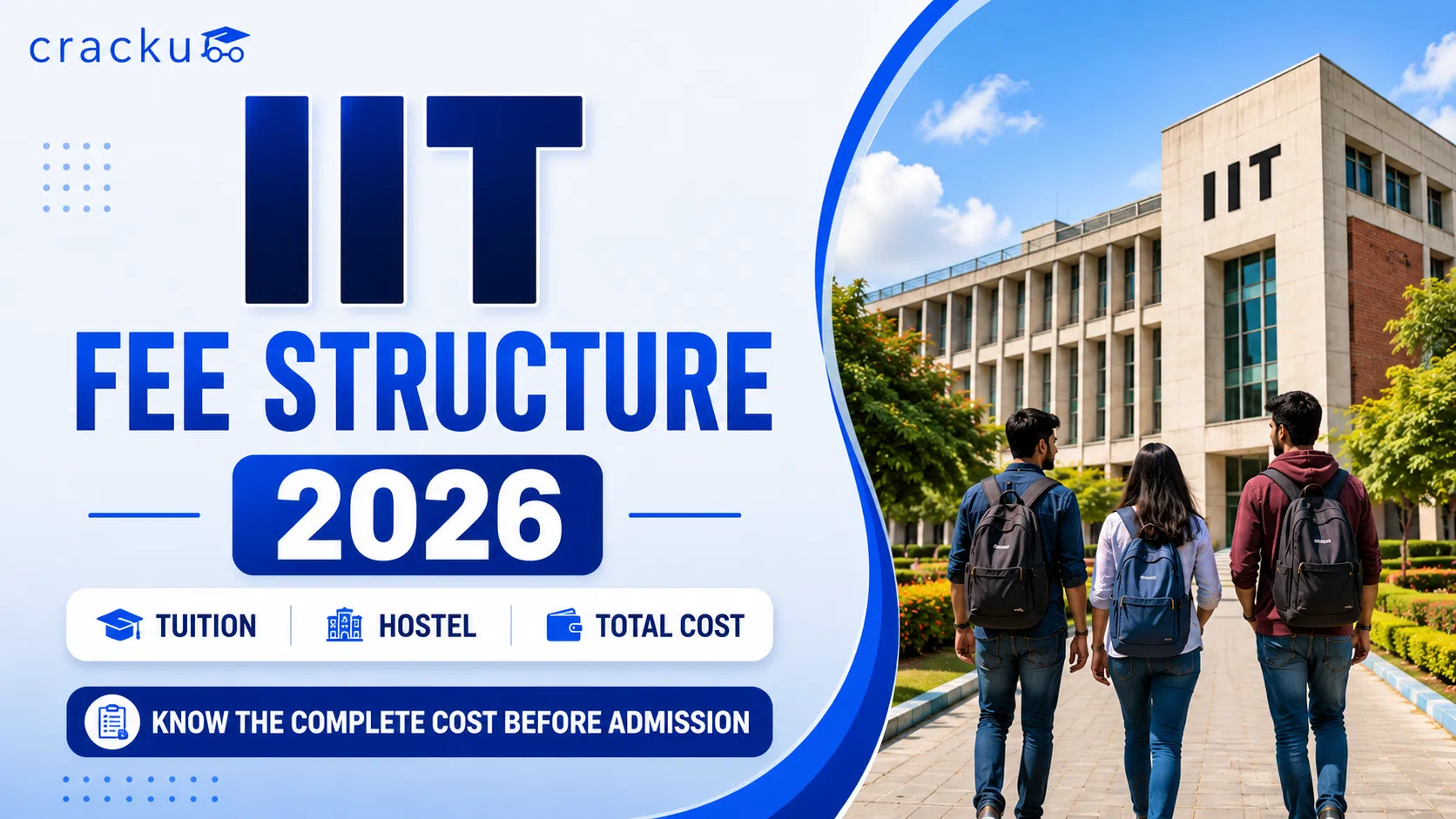
For students admitted to an Indian Institute of Technology through JoSAA 2026, understanding the complete fee structure before counselling is essential for accurate financial planning. The realistic total outgo for a 4-year BTech at an IIT for General, OBC-NCL, and EWS students with annual family income above Rs. 5 lakh ranges from approximately Rs. 10.0 lakh to Rs. 13.5 lakh, depending on the campus location and hostel infrastructure. A fact that many candidates misunderstand: tuition fees are uniform across all 23 IITs at Rs. 1,00,000 per semester, regardless of campus location or branch. Every rupee of variation in total cost between IITs comes from non-tuition components such as hostel rent, mess charges, and campus-specific levies.
Standard BTech Fee Components Breakdown
The IIT BTech fee structure is made up of several distinct components, each with different payment frequency and refundability. Some are charged every semester; others are paid once at admission and partially or fully refunded at graduation. Candidates should budget for the total outgo, not just the tuition fee, when comparing IIT options during choice filling. The table below presents all standard components and their typical amounts; verify the precise schedule for your allotted institute on the official fee notice at the time of joining.
Fee Component | Frequency | Approx. Amount | Refundable? |
|---|---|---|---|
Tuition Fee | Per semester (8 semesters) | Rs. 1,00,000 per semester (Rs. 8,00,000 total) | No |
Registration / Examination Fee | Per semester | Rs. 1,000 to Rs. 6,500 per semester | No |
Gymkhana / Student Activity Fee | Per semester | Rs. 500 to Rs. 2,500 per semester | No |
Medical / Health Centre Fee | Per semester | Rs. 300 to Rs. 2,000 per semester | No |
Institute Insurance and Welfare Fee | Per semester or annual | Rs. 150 to Rs. 1,600 per semester | No |
One-time Admission / Enrolment Fee | Once at admission | Rs. 5,000 to Rs. 16,000 (varies by IIT) | No |
Caution Deposit (Academic and Library) | Once at admission | Rs. 3,000 to Rs. 10,000 (varies by IIT) | Yes, at graduation |
Hostel Base Seat Rent and Amenities | Per semester | Rs. 5,000 to Rs. 24,000 per semester (varies by room type and IIT; IIT Delhi upper range reflects combined rent, amenity, and establishment charges) | No |
Hostel Caution Deposit | Once at admission | Rs. 4,000 to Rs. 15,000 (varies by IIT) | Yes, on vacating |
Mess Advance / Food Charges | Per semester | Rs. 18,000 to Rs. 36,000 per semester (actual usage adjusted at semester end) | Partially adjustable |
Electricity and Water Charges | Per semester | Rs. 1,500 to Rs. 8,000 per semester | No |
JoSAA Seat Acceptance Fee (SAF) adjustment: The SAF paid during JoSAA counselling (Rs. 30,000 for General/OBC-NCL/EWS; Rs. 15,000 for SC/ST/PwD) is adjusted against first-semester fees at the time of final admission. Under JoSAA 2026 Business Rules, two scenarios apply. Scenario 1 (successful admission): Rs. 5,000 is retained by JoSAA as a non-refundable administrative processing charge; the remaining balance (Rs. 25,000 for General/OBC-NCL/EWS; Rs. 10,000 for SC/ST/PwD) is credited toward first-semester dues at the allotted IIT. Scenario 2 (voluntary withdrawal or exit before final rounds): an additional withdrawal processing fee of Rs. 7,000 applies; combined with the initial processing charge, a total of Rs. 12,000 is deducted and the refundable balance returned is Rs. 18,000 (General/OBC-NCL/EWS) or Rs. 3,000 (SC/ST/PwD). Candidates who see a different refund figure on their payment slip should confirm which scenario applies before raising a grievance.
Also Read: IIT Placements 2026, Check Average Package, Top Recruiters
IIT Tuition Fees
The tuition fee is Rs. 1,00,000 per semester across all 23 IITs, totalling Rs. 8,00,000 for the complete 4-year BTech programme. This rate applies to General, OBC-NCL, and EWS students whose annual family income exceeds Rs. 5 lakh. For students below that threshold, a structured mandatory tuition remission policy reduces the fee automatically upon submission of valid documentation. This remission is not a competitive scholarship; it is an entitlement that applies to every eligible student who produces the required income certificate.
SC, ST, and PwD students receive a full tuition waiver at all IITs regardless of family income. They are not required to submit income certificates for the waiver. General, OBC-NCL, and EWS students with income between Rs. 1 lakh and Rs. 5 lakh receive a two-thirds remission, paying approximately Rs. 33,333 per semester. Those with income below Rs. 1 lakh per annum pay zero tuition.
Family Income Slab | Tuition Fee per Semester | Annual Tuition | 4-Year Total Tuition | Category |
|---|---|---|---|---|
Above Rs. 5 lakh per annum | Rs. 1,00,000 | Rs. 2,00,000 | Rs. 8,00,000 | General / OBC-NCL / EWS (full fee) |
Rs. 1 lakh to Rs. 5 lakh per annum | Rs. 33,333 (approx. 1/3rd of full fee) | Rs. 66,667 | Rs. 2,66,667 | General / OBC-NCL / EWS (partial remission) |
Below Rs. 1 lakh per annum | Rs. 0 (full remission) | Rs. 0 | Rs. 0 | General / OBC-NCL / EWS (full remission) |
Any income level | Rs. 0 (full waiver) | Rs. 0 | Rs. 0 | SC / ST students (regardless of income) |
Any income level | Rs. 0 (full waiver) | Rs. 0 | Rs. 0 | PwD students (regardless of category or income) |
Merit-cum-Means (MCM) Scholarship: Approximately 25% of UG students at most IITs qualify for the MCM scholarship, which provides additional financial support beyond standard tuition remission. At IIT Kanpur, MCM recipients with family income below Rs. 4.5 lakh receive either a Rs. 1,000 per month pocket allowance or free basic mess with Rs. 250 per month, in addition to the full tuition waiver. At IIT Delhi, the MCM scheme officially covers approximately 25% of UG engineering students per the 2025-26 prospectus. Eligibility criteria and benefit amounts vary by IIT; candidates should check the scholarship page of their specific institute after admission.
Also Read: IIT vs IIIT Placements 2026, Top Recruiters, Average Packages
IIT Hostel Fees
Hostel accommodation is mandatory for most BTech students at IITs, particularly in the first year. Hostel fees cover room rent, maintenance, and utilities; mess charges are billed separately each semester based on actual consumption, with an advance collected at the start of the semester. The combined annual cost of hostel and mess at most IITs falls between Rs. 40,000 and Rs. 1,00,000 depending on room type, location, and the institute's tariff.
Metro campuses carry higher costs: IIT Bombay and IIT Delhi, situated in Mumbai and New Delhi respectively, have substantially higher hostel rents and city-level living expenses than non-metro campuses. IIT Kharagpur, IIT Roorkee, and IIT BHU Varanasi are among the most affordable for total living costs. The table below lists approximate hostel fees per semester for major IITs; figures should be confirmed against the official institute fee schedule before admission.
IIT | Hostel Fee per Semester (Rent and Utilities) | Mess Advance per Semester | Hostel Caution Deposit (One-time) | Notes |
|---|---|---|---|---|
IIT Bombay | Rs. 16,900 | Rs. 22,500 | Included in admission charges | Higher urban maintenance costs; city-level living expenses |
IIT Delhi | Rs. 8,000 to Rs. 23,600 (standard BTech students are allocated to traditional non-AC hostels at the lower end; upper range reflects newly constructed premium hostel blocks) | Rs. 30,000 to Rs. 36,000 | Rs. 15,000 | Highest total campus cost; upper hostel range applies to newer premium wings, not standard UG allocation |
IIT Madras | Rs. 8,000 to Rs. 12,000 | Rs. 18,000 to Rs. 22,000 | Rs. 4,000 to Rs. 8,000 | Moderate, balanced campus tariff; non-metro |
IIT Kanpur | Rs. 5,000 to Rs. 12,740 | Rs. 18,000 to Rs. 22,000 | Rs. 5,000 | Economical self-contained residential campus |
IIT Kharagpur | Rs. 3,000 to Rs. 8,000 | Rs. 18,000 to Rs. 22,000 | Rs. 5,000 | Oldest IIT; large residential campus; lowest hostel rents |
IIT Roorkee | Rs. 5,000 to Rs. 10,000 | Rs. 18,000 to Rs. 22,000 | Rs. 5,000 | Non-metro campus; mid-range tariff structure |
IIT Guwahati | Rs. 1,000 to Rs. 6,300 (rent and maintenance; electricity and water billed separately) | Rs. 20,000 | Rs. 10,000 | Lower structural rent; utility charges add to semester total |
IIT BHU Varanasi | Rs. 6,000 to Rs. 10,000 | Rs. 18,000 to Rs. 22,000 | Rs. 9,000 | Consistently among lowest overall historical fee sheets |
Hostel fees for SC/ST/PwD students: Tuition fee waivers do not cover hostel rent, mess charges, electricity, or other non-academic fees. SC/ST/PwD students pay the standard hostel and mess rates that apply to all students. As an additional provision, some IITs including IIT Bombay provide free mess facility to SC/ST students with parental income below Rs. 4.5 lakh per annum. This is institute-specific; candidates should verify this benefit directly with the allotted IIT at admission.
IIT College-wise Fee Structure
Since tuition fees are identical at all IITs, the only basis for comparing total cost across campuses is the non-tuition component: hostel rent, mess charges, one-time admission fees, and institute-specific levies. A full-fee-paying General category student must budget for 8 semesters of hostel rent, 8 semesters of mess advances, one-time deposits, and semester-level academic charges in addition to Rs. 8 lakh of tuition. When all components across 8 semesters are correctly accounted for, the realistic 4-year total outgo for a General category student sits between Rs. 10.0 lakh and Rs. 13.5 lakh depending on the IIT and hostel type. IIT BHU Varanasi and IIT Kanpur are consistently the most affordable at Rs. 9.50 lakh to Rs. 10.50 lakh total; IIT Delhi is the most expensive at Rs. 12.50 lakh to Rs. 13.50 lakh, though standard BTech students are typically allocated to traditional non-AC hostels, with the upper cost range applying to newer premium hostel blocks. The table below summarises 4-year total costs for both full-fee-paying and waiver-category students.
IIT | Base 4-Year Tuition | Total 4-Year Outgo (General/OBC-NCL/EWS, Income Above Rs. 5L) | Total 4-Year Outgo (SC/ST/PwD, Tuition Waived) |
|---|---|---|---|
IIT BHU Varanasi | Rs. 8,00,000 | Rs. 9.50 lakh to Rs. 10.20 lakh | Rs. 1.50 lakh to Rs. 2.20 lakh |
IIT Kanpur | Rs. 8,00,000 | Rs. 9.60 lakh to Rs. 10.50 lakh | Rs. 1.60 lakh to Rs. 2.50 lakh |
IIT Kharagpur | Rs. 8,00,000 | Rs. 10.50 lakh to Rs. 11.20 lakh | Rs. 1.80 lakh to Rs. 2.50 lakh |
IIT Guwahati | Rs. 8,00,000 | Rs. 10.50 lakh to Rs. 11.30 lakh | Rs. 2.00 lakh to Rs. 2.80 lakh |
IIT Madras | Rs. 8,00,000 | Rs. 10.90 lakh to Rs. 11.80 lakh | Rs. 2.00 lakh to Rs. 3.00 lakh |
IIT Roorkee | Rs. 8,00,000 | Rs. 11.20 lakh to Rs. 12.00 lakh | Rs. 2.00 lakh to Rs. 2.80 lakh |
IIT Hyderabad | Rs. 8,00,000 | Rs. 11.60 lakh to Rs. 12.50 lakh | Rs. 2.20 lakh to Rs. 3.20 lakh |
IIT Gandhinagar | Rs. 8,00,000 | Rs. 11.70 lakh to Rs. 12.60 lakh | Rs. 2.20 lakh to Rs. 3.20 lakh |
IIT Bombay | Rs. 8,00,000 | Rs. 12.00 lakh to Rs. 12.90 lakh | Rs. 2.50 lakh to Rs. 3.50 lakh |
IIT Delhi | Rs. 8,00,000 | Rs. 12.50 lakh to Rs. 13.50 lakh | Rs. 2.50 lakh to Rs. 3.80 lakh |
Newer IITs (Jammu, Bhilai, Dharwad, Tirupati etc.) | Rs. 8,00,000 | Rs. 10.00 lakh to Rs. 12.10 lakh (hostel infrastructure varies widely by campus) | Rs. 2.00 lakh to Rs. 3.50 lakh |
Verification advisory: All figures are indicative, based on 2025-26 official fee circulars and publicly available institute data. IIT fee structures are reviewed by the IIT Council periodically and may be revised for 2026-27. Candidates must confirm their exact fee dues on the JoSAA payment screen and the official fee schedule of their allotted IIT before making any payment.
Also Read: Top 10 IIT Colleges in India 2026, Rankings, Placements, Cutoff
IIT Category-wise Fee Structure
IIT fee concessions operate on two distinct and independent tracks. The first is category-based: SC, ST, and PwD students receive a mandatory full tuition waiver at all IITs regardless of family income, with no income certificate required. The second is income-based: General, OBC-NCL, and EWS students receive proportionate tuition remission if their annual family income is below Rs. 5 lakh. A student cannot combine both tracks; the category-based waiver is absolute for SC/ST/PwD and the income criterion applies only to the remaining categories. The table below consolidates the complete fee structure across all combinations.
Category | Tuition Fee Benefit | 4-Year Tuition Paid | Eligibility Condition | Additional Benefits |
|---|---|---|---|---|
General / OBC-NCL / EWS (Family income above Rs. 5 lakh) | No concession; full tuition | Rs. 8,00,000 | No income-based restriction | Merit-cum-Means scholarship available to approx. 25% of UG students |
General / OBC-NCL / EWS (Family income Rs. 1 to Rs. 5 lakh) | Two-thirds tuition remission | Rs. 2,66,667 (approx.) | Income certificate from competent authority required at admission | May be eligible for MCM scholarship with pocket allowance |
General / OBC-NCL / EWS (Family income below Rs. 1 lakh) | Full tuition remission | Rs. 0 | Income certificate required; verified each year | Full tuition waiver plus possible mess support at some IITs |
SC / ST (any income) | Full tuition waiver (mandatory) | Rs. 0 | Valid SC/ST certificate required; income not considered | Free mess facility available at some IITs for SC/ST students below Rs. 4.5 lakh income |
PwD (any category, any income) | Full tuition waiver (mandatory) | Rs. 0 | Valid PwD certificate (minimum 40% disability) required | Additional disability support provisions as per institute policy |
EWS (above Rs. 5 lakh effective income) | No concession beyond standard EWS reservation | Rs. 8,00,000 | EWS certificate required for reservation; no separate fee concession unless income criteria met | Can apply for MCM scholarship if income qualifies |
Documentation at admission: Income-based remission for General/OBC-NCL/EWS students requires a valid income certificate issued by a competent authority (Tehsildar or equivalent) for the current financial year. This certificate must be re-submitted annually to retain the remission. SC/ST/PwD certificates must be issued in the prescribed national format by the appropriate authority. All documents must be uploaded during JoSAA online reporting and verified physically at the institute at the time of joining.
IIT Fee Structure 2026: Conclusion
Understanding the IIT Fee Structure 2026 is crucial before participating in JoSAA counselling and finalizing college preferences. While the tuition fee remains the same across all IITs, the total cost of education varies because of hostel rent, mess expenses, institute charges, and campus-specific facilities. Students should calculate the complete four-year expenditure instead of focusing only on tuition fees to make informed financial decisions.
The good news is that IITs provide substantial financial support through tuition fee waivers, income-based remissions, and Merit-cum-Means scholarships. SC, ST, and PwD students receive full tuition waivers, while eligible General, OBC-NCL, and EWS candidates can significantly reduce their educational expenses through income-based concessions. Before paying any fee, candidates should always verify the latest fee schedule released by their allotted IIT and JoSAA authorities.
.webp)