91- 6303239042


 Group
Group
How to Calculate MBA ROI Using Fees and Salary?
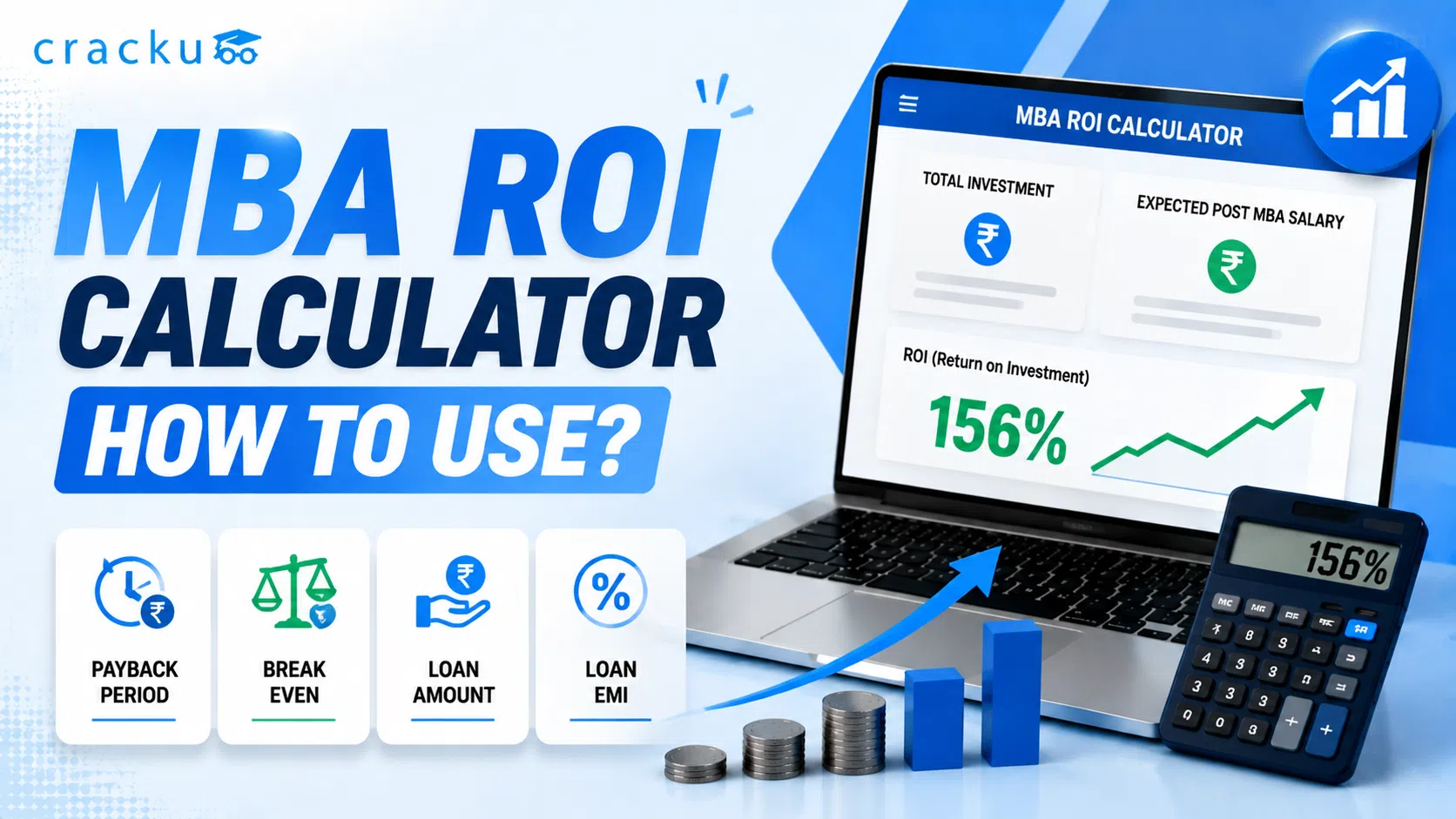
An MBA can open bigger career doors, but the price tag deserves careful checking. Fees alone can reach ₹30 lakh, while two years without salary add another hidden cost. So, what makes an MBA financially worthwhile after graduation? MBA ROI Calculator answers that question by comparing what you spend against what you could gain.
The calculation includes fees, living costs, loan interest, salary growth, and opportunity cost. Instead of relying only on placement headlines, you can compare both career paths and see when your investment starts working for you.
What Is MBA ROI and Why Does It Matter?
MBA ROI measures the financial return generated by an MBA against its total cost. It is more useful than comparing fees with the first salary alone.
Think of MBA investment like planting a tree that needs time before bearing fruit. The initial cost can feel heavy, while salary growth gradually changes the picture.
A practical ROI calculation should compare two possible paths:
- MBA path: MBA costs, lost salary, post-MBA earnings, and salary growth.
- Non-MBA path: Salary you could earn without leaving employment for an MBA.
- Financial difference: Extra wealth created by choosing the MBA route.
This comparison prevents a common mistake: treating the post-MBA salary as pure financial gain.
For example, a ₹25 lakh MBA followed by a ₹30 LPA salary sounds attractive. However, leaving a ₹10 LPA job for two years changes the real calculation considerably.
The MBA ROI CalcBulator can make this comparison easier by putting both career paths side by side.
How to Calculate MBA ROI Using Fees and Salary?
A basic ROI calculation starts with the total financial benefit generated through the MBA.
ROI % = (Cumulative MBA Earnings − Cumulative Non-MBA Earnings − Total Cost) ÷ Total Cost × 100
The calculation becomes more useful when the total cost includes expenses beyond tuition fees.
MBA ROI Component | What It Means |
MBA Fees | Tuition and compulsory academic charges |
Living Expenses | Accommodation, food, travel, and personal costs |
Opportunity Cost | Salary given up during full-time MBA study |
Loan Interest | Interest paid when education financing is used |
MBA Earnings | Salary earned after completing the MBA |
Non-MBA Earnings | Salary expected without pursuing an MBA |
Suppose an MBA costs ₹20 lakh, while living expenses add ₹2 lakh. If ₹10 lakh salary disappears during study, the real cost becomes ₹32 lakh.
The calculator can then compare this amount against earnings from both career paths.
A Simple MBA ROI Example: How to Calculate Your True MBA Cost and Returns
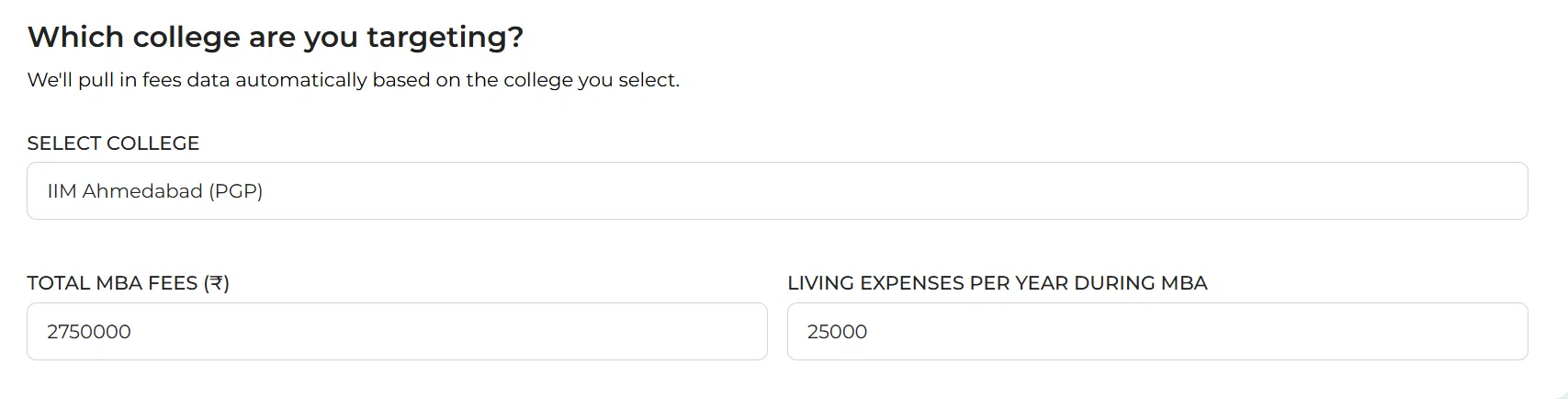
Step 1: Select Your Target College
Start by selecting the MBA college you are considering. The calculator automatically pulls the relevant fee information based on your choice.
You can change your expenses per year during MBA to calculate the ROI in a realistic way.
Step 2: Enter Your Expected MBA Fees and Expenses
Next, enter the fees and expenses you expect during your MBA. You can either use official college data as a benchmark or enter your own estimate.
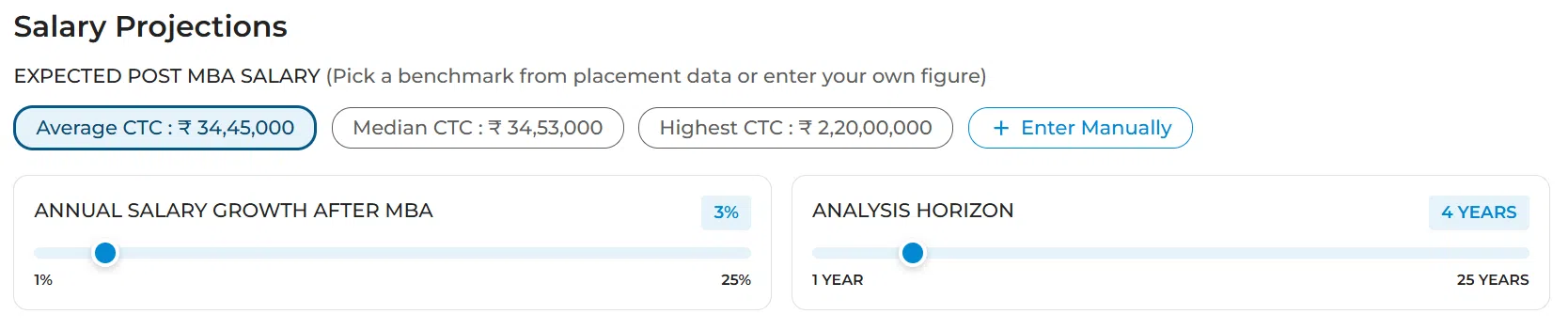
Step 3: Set Your Salary Growth Rate
Enter the annual salary growth you expect after completing your MBA.
The default assumption is: Annual Salary Growth: 3%
You can adjust this percentage based on your industry, career path, and expected promotions.
Step 4: Choose Your Analysis Horizon
Select how long you want to evaluate the MBA investment.
For this example: Analysis Horizon: 4 years
The calculator compares your estimated earnings and wealth over four years after graduation.
Step 5: Add Your Education Loan Details
If you plan to finance your MBA through an education loan, enter the expected loan details.
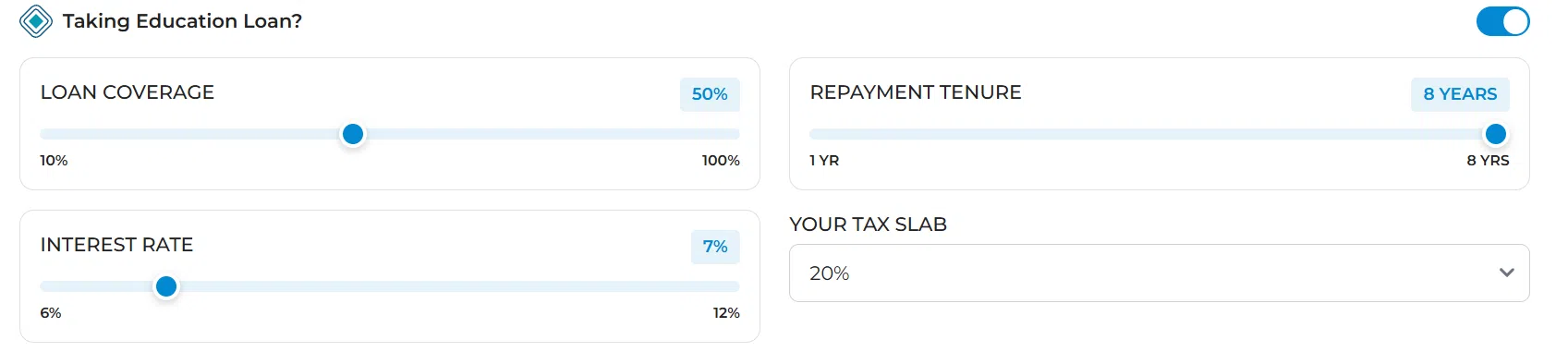
The calculator then estimates your monthly EMI and total interest payable.
Step 6: Enter Your Tax Slab
Select your applicable income-tax slab from the available options, ranging from 0% to 30%.
Tax information matters because it can affect your actual take-home salary and potential education-loan tax benefits.
Step 7: Add Your Current Employment Details
If you are currently employed, indicate that you have a job before starting your MBA.
You can then enter your current annual CTC and estimate what you could earn without an MBA.
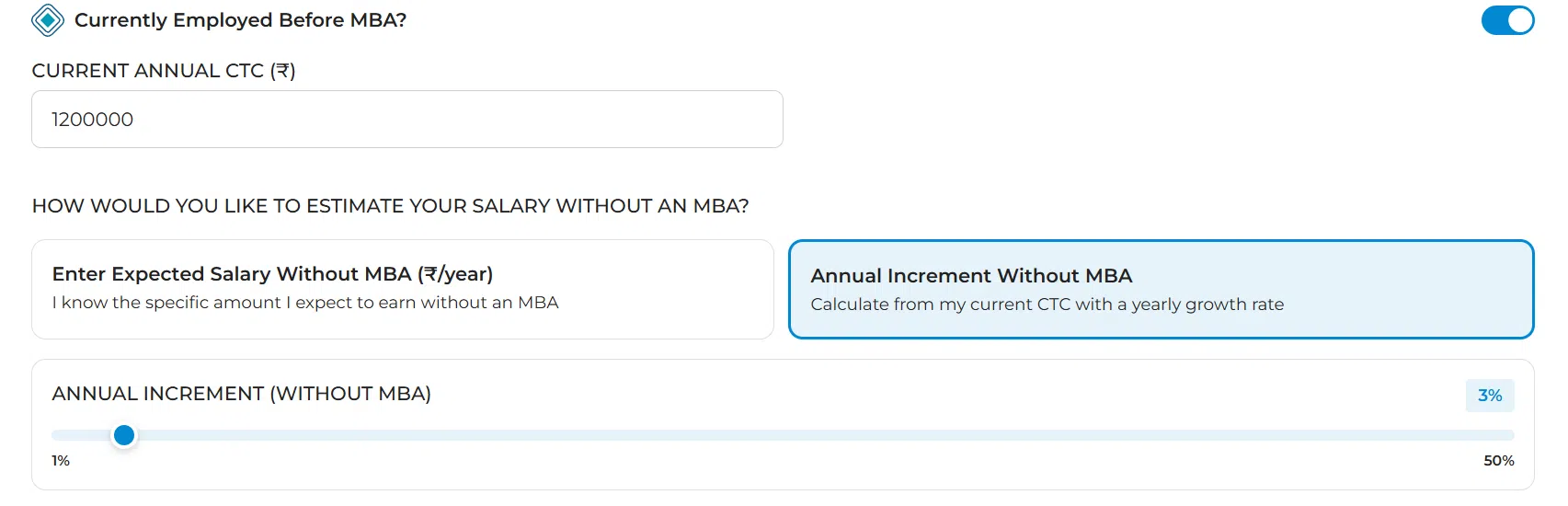
For the non-MBA scenario, you can choose between two approaches:
- Enter an expected salary: Use a specific amount you expect to earn without an MBA.
- Calculate from current CTC: Start with your current salary and apply an annual growth rate.
Then click on Calculate
Step 8: Compare Your MBA and Non-MBA Outcomes
Once all inputs are entered, the calculator compares your projected financial outcomes with and without an MBA.

The ₹43.26 lakh wealth delta represents the additional wealth generated through the MBA route compared with continuing without an MBA over four years.
Step 9: Understand the True Cost of Your MBA
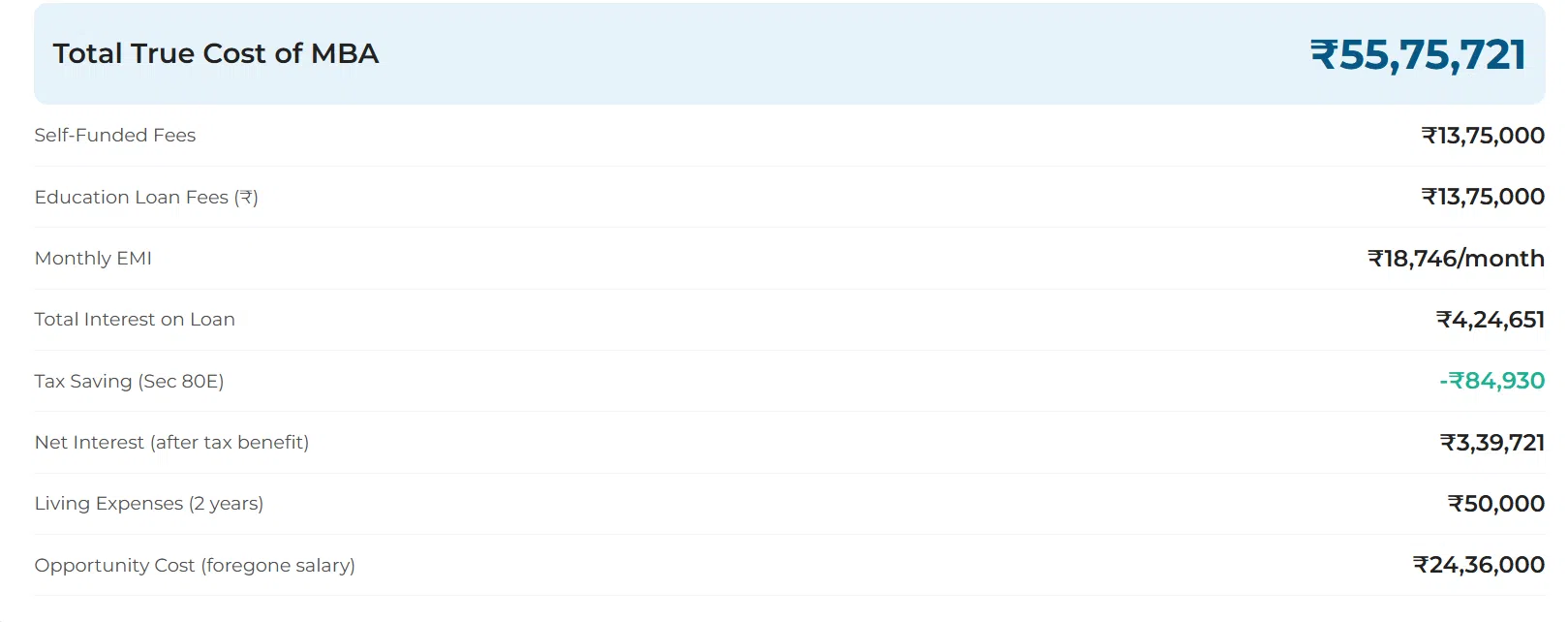
The calculator goes beyond tuition fees to calculate the Total True Cost of MBA.
Step 10: Evaluate Your MBA Break-Even Point
The final step is to check when your additional earnings recover the investment made in your MBA.
In this example, the estimated break-even point is Year 2 after graduation.
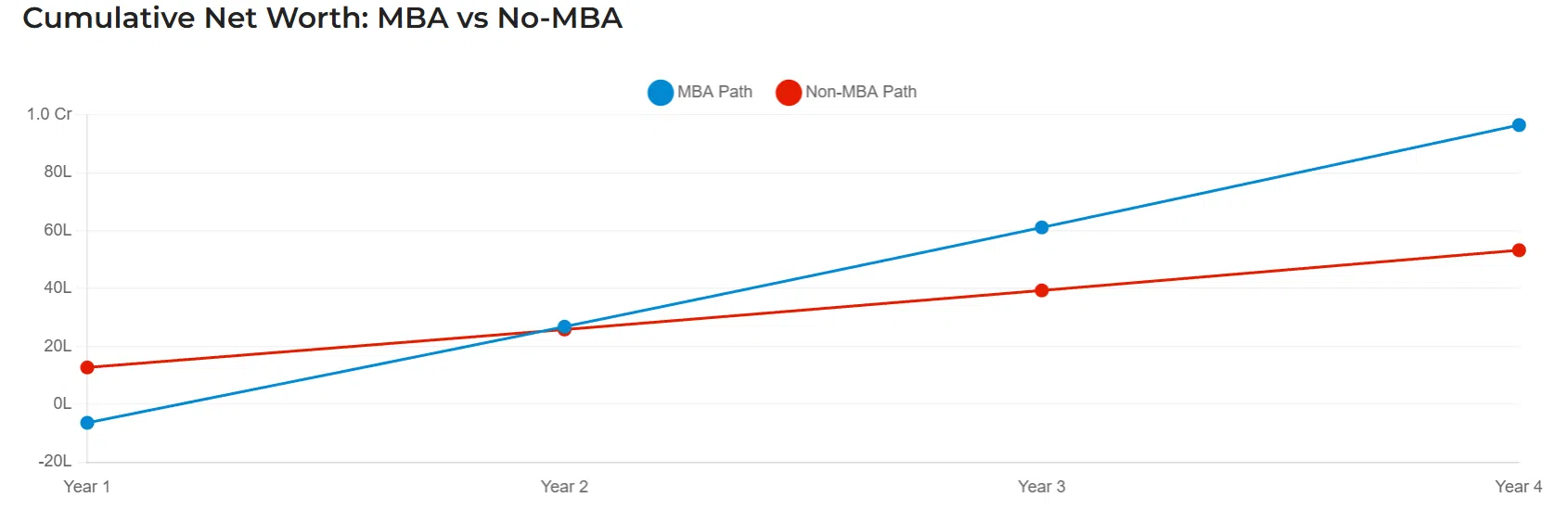
That means the additional financial benefits from the MBA are projected to offset its costs by the second year after graduation.
The calculator also estimates a ₹43.26 lakh additional wealth advantage by Year 4, helping you understand the longer-term financial impact rather than focusing only on your starting salary.
Year | MBA Salary | Non-MBA Salary | MBA Net Worth | Non-MBA Net Worth | Net Worth Gap |
1 | ₹34,45,000 | ₹12,73,080 | ₹-6,40,956 | ₹12,73,080 | ₹-19.14L |
2 | ₹35,48,350 | ₹13,11,272 | ₹26,82,437 | ₹25,84,352 | ₹0.98L |
3 | ₹36,54,800 | ₹13,50,611 | ₹61,12,282 | ₹39,34,963 | ₹21.77L |
4 | ₹37,64,445 | ₹13,91,129 | ₹96,51,770 | ₹53,26,092 | ₹43.26L |
The MBA path still trails slightly after two years because its initial investment needs time to recover.
That is why the break-even year can reveal more than a headline salary figure.
What Costs Should You Include in MBA ROI?
MBA fees are only the visible part of the bill. A realistic calculation should capture every major cost attached to the degree.
Cost | Included in ROI? | Why It Matters |
Tuition Fees | Yes | Direct education expense |
Hostel and Living Costs | Yes | Required spending during the programme |
Books and Materials | Yes | Academic expenses add to total investment |
Travel Costs | Yes | Regular commuting can increase yearly spending |
Lost Salary | Yes | Represents the opportunity cost of leaving employment |
Loan Interest | Yes | Financing increases the effective MBA cost |
Loan Principal | Avoid Repetition | Principal already represents financed expenses |
For working professionals, opportunity cost can become the biggest hidden expense.
Someone earning ₹12 LPA before an MBA could sacrifice roughly ₹24 lakh across two years. Therefore, a ₹20 lakh programme may effectively represent a ₹44 lakh financial commitment.
However, fresh graduates may face little or no salary opportunity cost. Their calculation can therefore look considerably different.
How Does an Education Loan Affect MBA ROI?
An education loan can reduce the immediate financial burden, but interest changes the final picture.
The loan amount, interest rate, repayment tenure, and repayment start date can all affect MBA ROI. Therefore, checking EMI alongside expected salary creates a clearer financial picture.
Loan Factor | Effect on MBA ROI |
Higher Loan Amount | Increases repayment burden |
Higher Interest Rate | Raises total financing cost |
Longer Tenure | Reduces EMI but can increase total interest |
80E Deduction | Can reduce taxable income through eligible interest deduction |
Employer Sponsorship | Can lower personal investment significantly |
The calculator can account for loan coverage, interest rate, and repayment tenure. It can then show the net interest cost after considering the eligible tax benefit.
Also Read: How To Get Education Loan For IIM? Compare Interest Rates
How to Calculate the MBA Payback Period?
The MBA payback period tells you when the MBA investment has effectively recovered.
Break-even = The year when the MBA cumulative net worth overtakes the non-MBA path.
This differs from simply dividing MBA fees by salary.
For instance, an MBA costing ₹25 lakh does not automatically have a payback period of one year because salary cannot be treated as pure profit.
Year | MBA Path | Non-MBA Path | Financial Gap |
Year 1 | ₹18 L | ₹12 L | -₹10 L |
Year 2 | ₹38 L | ₹25 L | -₹2 L |
Year 3 | ₹60 L | ₹40 L | +₹5 L |
Year 4 | ₹84 L | ₹56 L | +₹13 L |
In this simplified example, the MBA path crosses the non-MBA path during Year 3.
Salary growth can therefore turn a negative starting position into a positive long-term result.
Also Read: MBA Fee Recovery Period 2026: How Many Years Does It Take?
Average vs Median Package: Which Should You Use for MBA ROI?
Median CTC is usually a safer benchmark for MBA ROI calculations than the highest package.
MBA average salary can rise when a few exceptional offers pull the number upward. Median salary shows the midpoint of the placement distribution, making it easier to set realistic expectations.
Salary Benchmark | Best Use |
Average CTC | General placement comparison |
Median CTC | Conservative ROI projection |
Highest CTC | Understanding top-end career outcomes |
Personal Estimate | Scenario planning based on career goals |
Consider the difference across the best MBA colleges in India:
Institute | Fees | Average Package | ROI Ratio |
FMS Delhi | ₹2.40 L | ₹30.10 LPA | 12.54 |
IIM Lucknow | ₹20.75 L | ₹33.20 LPA | 1.60 |
IIM Calcutta | ₹27.00 L | ₹34.23 LPA | 1.27 |
IIM Bangalore | ₹26.50 L | ₹34.88 LPA | 1.32 |
SPJIMR Mumbai | ₹26.57 L | ₹33.75 LPA | 1.27 |
IIM Ahmedabad | ₹27.50 L | ₹34.45 LPA | 1.25 |
IIM Kozhikode | ₹23.58 L | ₹28.18 LPA | 1.19 |
IIM Indore | ₹25.15 L | ₹29.57 LPA | 1.18 |
XLRI Jamshedpur | ₹30.60 L | ₹31.42 LPA | 1.03 |
ISB Hyderabad | ₹39.51 L | ₹34.21 LPA | 0.87 |
The ratio offers an easy understanding, but it is not the same as true MBA ROI.
A proper ROI calculation should include opportunity cost, salary growth, living expenses, loan interest, and the non-MBA salary path.
Placement quality also depends on
- recruiter diversity,
- Summer internships,
- Career role growth.
Therefore, salary should act as one piece of the puzzle rather than the entire picture.
Also Read: Best ROI MBA Colleges in India 2026, Fees, Placement Report
Conclusion
MBA ROI is not only about comparing MBA fees with the first salary after graduation. A realistic calculation should include tuition fees, living expenses, loan interest, opportunity cost, and future salary growth. Using an MBA ROI Calculator helps students understand the actual financial impact of their decision.
Before selecting an MBA college, aspirants should analyse both short-term costs and long-term career benefits. A higher package does not always mean better ROI, as factors like fees, placement consistency, and career progression also matter. The right MBA investment is the one that creates sustainable financial growth over time.