91- 6303239042
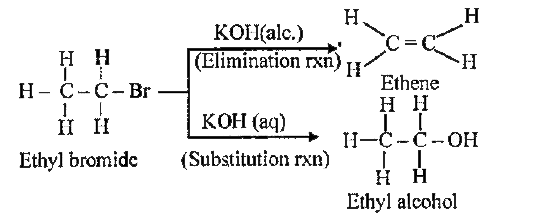
$$\text{R--CH}_2\text{CH}_2\text{X} + \text{Alcoholic KOH} \xrightarrow{\Delta} \text{R--CH=CH}_2 \quad (E2\text{ Elimination})$$
$$\text{R--CH}_2\text{CH}_2\text{X} + \text{Aqueous KOH} \to \text{R--CH}_2\text{CH}_2\text{OH} \quad (S_N2\text{ Substitution})$$
Concept:
- Alcoholic KOH: Contains alkoxide ions ($$\text{RO}^-$$), which act as strong, bulky bases favoring dehydrohalogenation ($$E2$$ elimination to yield alkenes following Saytzeff's Rule).
- Aqueous KOH: Contains hydrated hydroxide ions ($$\text{OH}^-$$), which act as strong nucleophiles with low basic character due to solvation, favoring nucleophilic substitution ($$S_N$$).