91- 6303239042
$$\text{Rate} = k[\text{R--X}]$$
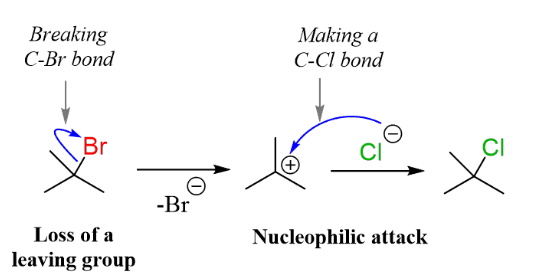
$$\text{R--X} \xrightarrow{\text{Slow (RDS)}} \text{R}^+ + \text{X}^- \xrightarrow{\text{Fast, }\text{Nu}^-} \text{R--Nu}$$
Concept: A two-step mechanism proceeding via a planar carbocation intermediate. Step 1 (heterolytic cleavage of the $$\text{C--X}$$ bond) is slow and rate-determining. Because the planar carbocation can be attacked from either face by the nucleophile, the reaction results in racemization (or partial inversion with slight excess of inversion product).
Reactivity Order: $$3^\circ > 2^\circ > 1^\circ > \text{CH}_3\text{X}$$ (governed by carbocation stability).
Solvent Effect: Favored by polar protic solvents (e.g., $$\text{H}_2\text{O}$$, $$\text{CH}_3\text{OH}$$, $$\text{CH}_3\text{COOH}$$ ) which stabilize carbocations and halide ions through solvation.
Rearrangements: Carbocation rearrangements (1,2-hydride or 1,2-methyl shifts) can occur to yield a more stable intermediate before nucleophilic attack.