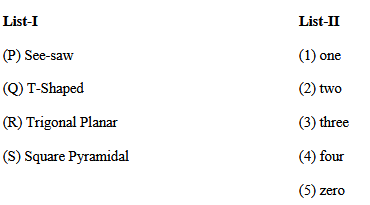
For every species listed we first determine the steric number (S. N. = σ-bonds + lone pairs on the central atom) and then read the corresponding VSEPR geometry.
Case 1: SOCl2
S (6 e⁻) forms three σ-bonds (2 Cl, 1 O) and retains one lone pair → S. N. = 4 → tetrahedral electron arrangement → molecular shape = trigonal pyramidal.
Case 2: XeOF4
Xe (8 e⁻) makes five σ-bonds (O + 4 F) and keeps one lone pair → S. N. = 6 → octahedral e-geometry → molecular shape = square pyramidal.
Case 3: ClF3
Cl (7 e⁻) is joined to three F atoms and possesses two lone pairs → S. N. = 5 → trigonal-bipyramidal e-geometry → molecular shape = T-shaped.
Case 4: ClF5
Cl (7 e⁻) forms five σ-bonds and has one lone pair → S. N. = 6 → square pyramidal.
Case 5: XeF5+
Xe contributes (8 − 1) = 7 e⁻, bonds to five F atoms and retains one lone pair → S. N. = 6 → square pyramidal.
Case 6: SO32−
S forms three σ-bonds with O atoms and carries one lone pair → S. N. = 4 → trigonal pyramidal.
Case 7: XeF3+
Xe supplies 7 e⁻ (8 − 1), bonds to three F atoms and keeps two lone pairs → S. N. = 5 → T-shaped.
Case 8: SF4
S (6 e⁻) uses four σ-bonds and one lone pair → S. N. = 5 → seesaw (distorted trigonal bipyramid).
Collecting the shapes:
• seesaw → SF4 (1 species)
• T-shaped → ClF3, XeF3+ (2 species)
• pyramidal shapes (either trigonal or square) → SOCl2, SO32−, XeOF4, ClF5, XeF5+ (5 species)
• square-pyramidal in particular → XeOF4, ClF5, XeF5+ (3 species)
Thus
(P) seesaw → 1
(Q) T-shaped → 2
(R) pyramidal → 5
(S) square-pyramidal → 3
Matching these numbers with List-II gives:
Option A: (P)→(1), (Q)→(2), (R)→(5), (S)→(3)
 91- 6303239042