91- 6303239042



 Group
Group
 Group
Group


 Preferred Source

 Google Discover
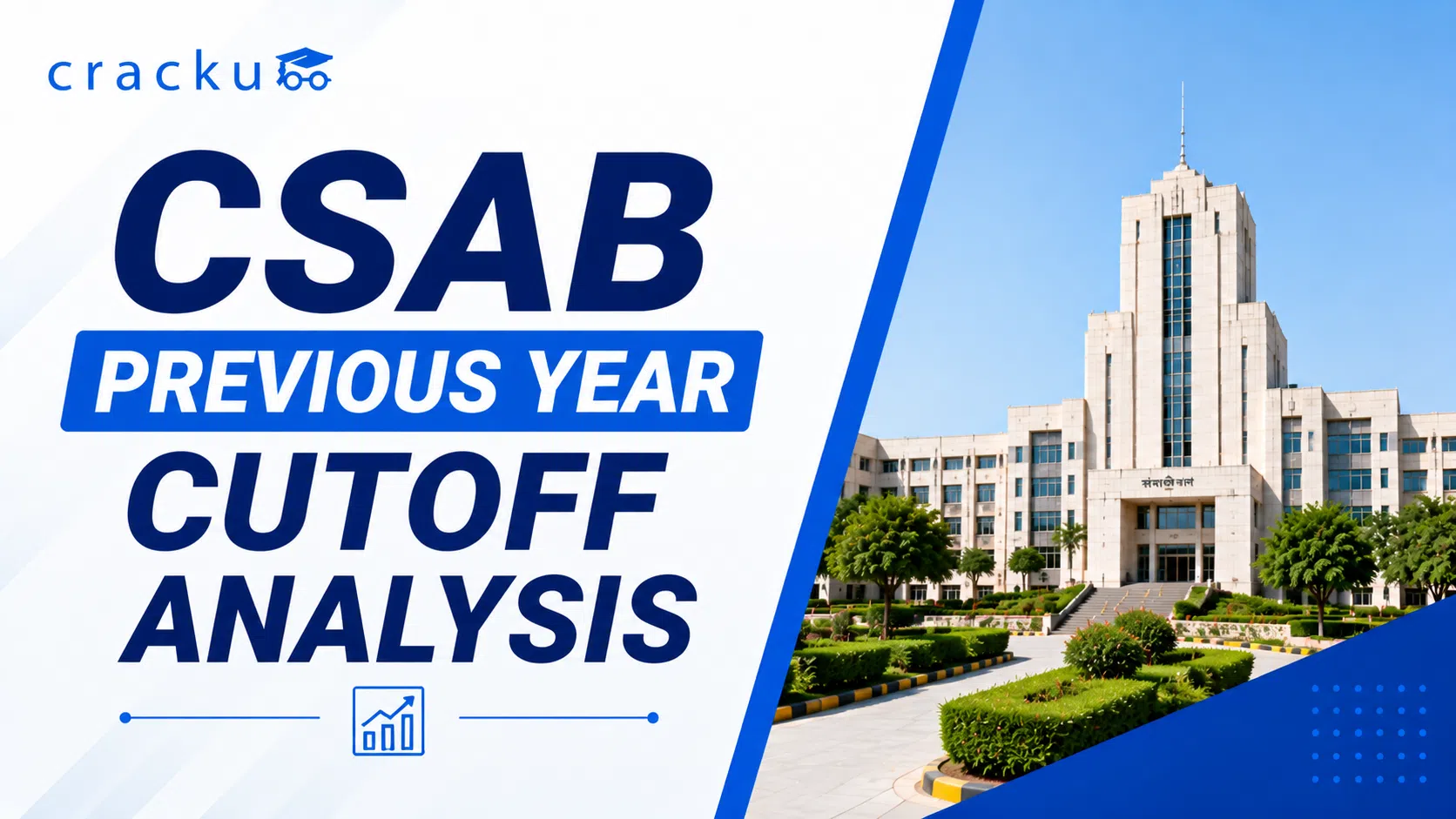
CSAB Previous Year Cutoff Analysis
The Central Seat Allocation Board (CSAB) conducts special counselling rounds to fill seats remaining vacant in NITs, IIITs, and GFTIs after JoSAA's six rounds conclude. CSAB typically runs two special rounds, with cutoffs released as opening and closing ranks after each round on csab.nic.in. Since the highest-ranked candidates have already secured JoSAA seats, CSAB cutoffs are typically 5 to 15 percent more relaxed than JoSAA Round 6 for the same institute and branch, particularly for non-CSE branches and newer NITs. Top NITs and popular branches like CSE and ECE, however, remain competitive even in CSAB.
Understanding previous year CSAB cutoffs across NITs, IIITs, and GFTIs helps candidates with moderate ranks assess their realistic admission chances and plan choice lists effectively.
Particular | Detail |
Conducting Body | Central Seat Allocation Board (CSAB) |
Participating Institutes | 31 NITs + IIEST Shibpur (NIT+ system), 26 IIITs, and 35+ GFTIs |
Basis for Allotment | JEE Main All India Rank (AIR), category, and choice order |
Cutoff Format | Opening rank and closing rank, released round-wise |
Counselling Types | NUET, Special Round, and Supernumerary Round |
CSAB vs JoSAA Cutoff | CSAB cutoffs are typically 5 to 15 percent more relaxed than JoSAA Round 6 |
Official Website | csab.nic.in |
CSAB Previous Year Cutoff
CSAB 2025 Special Round data (General category, Other State quota) shows closing ranks clustering into clear tiers. Top NITs like NIT Trichy, NIT Warangal, and NIT Surathkal closed CSE between rank 1,000 and 1,605, nearly as tight as JoSAA Round 6. Mid-tier NITs like NIT Bhopal, NIT Nagpur, and NIT Patna closed CSE between 3,000 and 8,000, with ECE and Electrical in the 8,000 to 18,000 range and core branches like Mechanical and Civil stretching from 18,000 to 32,000. Newer NITs (Meghalaya, Nagaland, Sikkim) extended CSE cutoffs from 28,000 to 55,000. Top IIITs like IIIT Allahabad and ABV-IIITM Gwalior closed under 10,000 for CSE; mid-range IIITs ranged from 15,000 to 35,000. Competitive GFTIs like PEC Chandigarh closed CSE between 10,000 and 18,000, while state university GFTIs remained open above 40,000 to 1,00,000.
CSAB cutoffs are typically 5 to 15 percent more relaxed than JoSAA Round 6 for the same institute and branch. Non-CSE branches at top NITs see the largest relaxation. All figures above are based on CSAB 2025 Special Round data and are indicative. Official cutoffs are published on csab.nic.in.
Also Read: CSAB Schedule 2026, Registration, Fees & Seat Allotment
CSAB Previous Year Cutoff for NITs
Thirty-one NITs participated in CSAB 2025, along with IIEST Shibpur, which is classified under the NIT+ system and not as a standard GFTI. Top NITs like NIT Trichy, NIT Warangal, and NIT Surathkal have very limited post-JoSAA vacancy, so CSAB cutoffs remain nearly as tight as JoSAA Round 6. Mid-tier and newer NITs tend to have more vacant seats and more relaxed closing ranks.
NIT | Branch | CSAB 2025 Closing Rank (General CRL, OS) | CSAB 2024 Closing Rank (General CRL, OS) |
NIT Trichy | CSE | ~1,368 to 1,605 | ~1,200 to 1,450 |
NIT Warangal | CSE | ~1,000 to 1,500 | ~950 to 1,400 |
NIT Surathkal | Mechanical | ~10,786 to 14,036 | ~10,200 to 13,500 |
NIT Calicut | CSE | ~2,000 to 2,800 | ~1,900 to 2,700 |
NIT Bhopal | CSE | ~3,500 to 5,500 | ~3,200 to 5,200 |
NIT Patna | CSE | ~5,000 to 8,000 | ~4,800 to 7,800 |
NIT Srinagar | CSE | ~15,000 to 28,000 | ~14,000 to 26,000 |
NIT Meghalaya | CSE | ~28,000 to 45,000 | ~27,000 to 43,000 |
NIT Nagaland | CSE | ~32,000 to 55,000 | ~30,000 to 52,000 |
NITs operate on a Home State (HS) and Other State (OS) quota split of 50:50. HS candidates can often secure seats at higher CRL ranks under the HS quota. All figures above are for the Other State (OS) quota. Source: CSAB 2024 and 2025 Special Round data.
Also Read: CSAB Cut-off 2026, NITs, IIITs & GFTIs Previous Year Analysis
CSAB Previous Year Cutoff for IIITs
Twenty-six IIITs participated in CSAB 2025. Unlike NITs, IIITs have no home state or other state quota; all seats are allotted on an all-India basis. Both IIIT Hyderabad and IIIT Delhi do not participate in CSAB or JoSAA counselling: IIIT Hyderabad admits via UGEE and IIIT Delhi admits via JAC Delhi, both running fully independent admissions processes. Top CSAB-participating IIITs like IIIT Allahabad and ABV-IIITM Gwalior close under rank 10,000 for CSE; newer IIITs extend up to 30,000 to 35,000 in the same branch.
IIIT | Branch | CSAB 2025 Closing Rank (General CRL) | CSAB 2024 Closing Rank (General CRL) |
IIIT Allahabad | CSE / IT | Under 10,000 | Under 9,500 |
ABV-IIITM Gwalior | CSE / IT | Under 10,000 | Under 9,500 |
IIIT Lucknow | CSE | ~15,000 to 22,000 | ~14,000 to 20,000 |
IIIT Pune | CSE | ~18,000 to 26,000 | ~17,000 to 25,000 |
IIIT Surat | CSE | ~22,000 to 30,000 | ~21,000 to 29,000 |
IIIT Guwahati | CSE | ~20,000 to 28,000 | ~19,000 to 27,000 |
Newer IIITs (various) | CSE / ECE | 30,000 to 35,000 | 28,000 to 33,000 |
IIIT Hyderabad (admits via UGEE) and IIIT Delhi (admits via JAC Delhi) do not participate in CSAB or JoSAA counselling. All cutoff ranks in this table are CRL (Common Rank List) ranks, the same metric used across all CSAB categories. Figures are indicative based on CSAB 2024 and 2025 Special Round data.
CSAB Previous Year Cutoff for GFTIs
Over 35 GFTIs (Government Funded Technical Institutes) participated in CSAB 2025. Note that IIEST Shibpur, while sometimes listed alongside GFTIs, is officially classified under the NIT+ system and is covered in the NIT section. Among standard GFTIs, competitive institutes like PEC Chandigarh and BIT Mesra have cutoffs comparable to mid-tier NITs. State universities and lesser-known GFTIs remain accessible even for candidates ranked above 80,000 to 1,00,000 in the General category.
GFTI | Branch | CSAB 2025 Closing Rank (General CRL) | CSAB 2024 Closing Rank (General CRL) |
PEC Chandigarh | CSE | ~10,000 to 18,000 | ~9,500 to 17,000 |
BIT Mesra, Ranchi | CSE | ~12,000 to 22,000 | ~11,500 to 21,000 |
Assam University, Silchar | CSE | ~30,000 to 50,000 | ~28,000 to 47,000 |
Mizoram University | CSE / ECE | ~60,000 to 1,00,000+ | ~55,000 to 95,000 |
Other State University GFTIs | CSE / ECE | Up to 1,00,000+ | Up to 1,00,000+ |
GFTIs are a genuine last-resort option for candidates with ranks above 40,000 to 45,000 who missed seats in NITs and IIITs across all JoSAA rounds. Source: CSAB 2024 and 2025 Special Round data.
CSAB Previous Year Category Wise Cutoff
An important distinction: unlike JoSAA, which uses Category Ranks (e.g., SC rank, OBC-NCL rank) for seat allotment within reserved categories, CSAB Special Rounds conduct all seat allocation strictly using the All India Common Rank List (CRL) rank. Every cutoff published by CSAB, whether for General, EWS, OBC-NCL, SC, ST, or PwD, is expressed as a CRL rank. Reserved category candidates are simply eligible to fill seats in their respective category pools, but the rank used to determine their position is always their CRL rank, not a category rank.
This means reserved category candidates with a relatively higher CRL rank (i.e., a weaker All India position) can still secure seats in top institutes, because the category pools have fewer competitors and thus higher CRL rank cut-offs. The table below shows the approximate CRL rank range at which each category's seats typically fill at top and mid-tier NITs, based on CSAB 2023, 2024, and 2025 data for CSE.
Category | Approx. CRL Rank at Which Seats Fill (CSE, Top NITs) | Practical Implication |
General (Open CRL) | ~1,000 to 1,605 | Most competitive; only top-ranked candidates secure seats |
EWS | ~1,200 to 2,500 CRL | Slightly relaxed CRL cut-off vs General; same CRL rank system |
OBC-NCL | ~2,500 to 4,500 CRL | Noticeably higher CRL cut-off; broad access at mid-tier NITs and IIITs |
SC | ~10,000 to 15,000 CRL | Significantly higher CRL cut-off; top NIT CSE accessible to SC candidates around rank 13,000 to 15,000 |
ST | ~18,000 to 30,000+ CRL | Most relaxed CRL cut-off; top NITs accessible to ST candidates at ranks well above 20,000 |
PwD | Further relaxed within each category pool | PwD sub-quota applied within each of the above category pools; CRL rank still used |
As a reference: the CSAB 2025 closing CRL rank for CSE at NIT Trichy was approximately 1,368 to 1,605 for General (Open); for SC candidates the closing CRL rank at the same institute was approximately 13,859; for OBC-NCL it was approximately 3,500 to 5,000 CRL. All of these are CRL ranks, not category ranks. Category-wise CRL cut-offs also differ by quota (Home State vs Other State) at NITs. SC/ST candidates from the home state benefit from both the HS quota advantage and the category pool relaxation simultaneously, allowing access to top NIT seats at significantly higher CRL ranks. Candidates targeting reserved category seats in top NITs can do JEE Mains Online Coaching to build rank-improving preparation across all three JEE Main subjects.
CSAB Previous Year Cutoff Trends (2025, 2024, 2023)
Tracking CSAB cutoffs across 2023, 2024, and 2025 reveals stable patterns for top institutes and demand shifts for newer ones. The table below covers CSE closing ranks at representative NITs, IIITs, and GFTIs for the General-OS category, Special Round 1 data.
Institute | Branch | CSAB 2025 Closing Rank | CSAB 2024 Closing Rank | CSAB 2023 Closing Rank |
NIT Trichy | CSE | ~1,368 to 1,605 | ~1,200 to 1,450 | ~1,150 to 1,400 |
NIT Warangal | CSE | ~1,000 to 1,500 | ~950 to 1,400 | ~900 to 1,350 |
NIT Surathkal | CSE | ~1,000 to 1,500 | ~1,000 to 1,450 | ~950 to 1,400 |
NIT Bhopal | CSE | ~3,500 to 5,500 | ~3,200 to 5,200 | ~3,000 to 4,800 |
NIT Patna | CSE | ~5,000 to 8,000 | ~4,800 to 7,800 | ~4,500 to 7,200 |
NIT Meghalaya | CSE | ~28,000 to 45,000 | ~27,000 to 43,000 | ~25,000 to 40,000 |
IIIT Allahabad | CSE / IT | Under 10,000 | Under 9,500 | Under 9,000 |
ABV-IIITM Gwalior | CSE / IT | Under 10,000 | Under 9,500 | Under 9,000 |
IIIT Lucknow | CSE | ~15,000 to 22,000 | ~14,000 to 20,000 | ~13,000 to 19,000 |
PEC Chandigarh (GFTI) | CSE | ~10,000 to 18,000 | ~9,500 to 17,000 | ~9,000 to 16,000 |
Three patterns emerge consistently. CSE cutoffs at top NITs like Trichy, Warangal, and Surathkal have remained stable in the 1,000 to 1,600 General-OS range, with only marginal tightening of 100 to 200 ranks annually. Mid-tier NITs show a slight upward drift year on year. Newer NITs and IIITs see the largest fluctuation, varying by 2,000 to 5,000 ranks based on seat intake and preference shifts.
- CSAB Round 2 closing ranks are generally more relaxed than Round 1 across all institute types, as more allotted seats go unfilled after Round 1 reporting.
- Non-CSE branches such as Civil, Mechanical, Chemical, and Metallurgy show the largest relaxation in CSAB vs JoSAA, often by 15 to 25 percent at top NITs.
- The gap between JoSAA Round 6 and CSAB closing ranks is smallest at top NITs for CSE and ECE, and largest at GFTIs and newer IIITs for non-circuit branches.
All trend data above is based on CSAB Special Round 1 closing ranks for the General (Open) category, Other State quota, Gender-Neutral seat pool across 2023, 2024, and 2025. These are approximate indicative figures. Official CSAB cutoffs are published round-wise on csab.nic.in after each special round concludes.
Also Read: Best Colleges Available Through CSAB 2026, Check Now
CSAB Previous Year Cutoff Analysis: Conclusion
The CSAB previous year cutoff analysis helps candidates understand how opening and closing ranks have changed across NITs, IIITs and GFTIs. Cutoffs for top NITs and high-demand branches such as CSE and ECE usually remain competitive, while newer institutes, GFTIs and non-circuit branches may offer admission opportunities at higher JEE Main ranks. Candidates should compare institute-wise, branch-wise, category-wise and quota-wise cutoff trends before preparing their CSAB choice list.
Previous year cutoffs should be treated as indicative rather than guaranteed admission ranks because vacancies, seat intake and candidate preferences can change every year. Candidates should fill the maximum number of eligible choices and arrange them in their genuine order of preference. Combining the latest vacancy data with CSAB cutoff trends, JoSAA closing ranks and personal branch preferences can help candidates make a more practical and informed admission decision.