Raman can do a piece of work in 16 days. Satish can do the same work in 8 days while Ashok can do it in 32 days. All of them worked together when they started, but Satish left after 2 days. Raman left 3 days before the completion of work. How long did it take to complete the entire work?
CMAT Speed Time Distance Work Questions
Let us assume that the work to be done is 32 units i.e. the LCM of 8, 16 and 32.
Efficiencies of Raman, Satish and Ashok are 2, 4 and 1 units per day respectively.
Let us assume that they completed the work in X days.
Satish worked for 2 days, Raman worked for X-3 days and Ashok worked for X days which led to the completing of work in X days.
Total work done: 2*4 + (X-3)*2 + X*1 = 3X + 2.
This is equal to Total work = 32.
3X + 2 = 32
==> X = 10 days.
Amit can do 50% more work than Bhushan in same time. Bhushan alone can do a piece of work in 30 hours. Bhushan starts working and had already worked for 12 hours when Amit joins him. How many hours should Bhushan and Amit work together to complete the remaining work?
Let the efficiency of Bhushan be $$x$$ units/hr.
So, efficiency of Amit be $$1.5x$$ units/hr.
Given, Bhushan alone can do a piece of work in 30 hours.
So, total work = $$30x$$ units
Given, Bhushan starts working and had already worked for 12 hours.
So, work done by Bhushan = $$12x$$ units
So, remaining work = $$30x-12x=18x$$ units
Now, this remaining work will be completed by both Amit and Bhushan.
So, required number of hours = $$\dfrac{18x}{x+1.5x}=\dfrac{18x}{2.5x}=\dfrac{180}{25}=7.2$$ hours.
So, correct answer is option (D).
A man takes 4 hours 20 minutes in walking to a certain place and riding back. If he walks on both sides, he loses 1 hour. The time he would take by riding both ways is
Let $$T_w$$ be the time taken to walk one way and $$T_r$$ be the time taken to ride one way.
So, $$T_w+T_r=$$ $$4$$ hours $$20$$ minutes
or, $$T_w+T_r=260$$ ---->(1)
Now, it is given, if he walks on both sides, he loses 1 hour
so, $$2T_w=260+60=320$$ ---->(2)
Multiplying equation (1) by 2 and subtracting equation (2) from it,
$$2T_r=520-320=200$$
So, time taken in riding both ways = 200 minutes = 3 hours and 20 minutes.
So, correct answer is option (C).
In a race A, B and C take part A beats B by 30 meters, B beats C by 20 meters and A beats C by 48 meters.
Given below are two statements:
Statement I : The length of the race is 300 meters.
Statement II : The speed of A, B and C are in the ratio 50 : 45 : 40.
In the light of the above statements, choose the correct answer from the options given below:
Let say length of race be $$D$$ metres and speed of $$A$$, $$B$$ and $$C$$ be $$S_A,\ S_B,\ S_c$$ m/s.
Now, A beats B by 30 meters
So, $$\dfrac{S_A}{S_B}=\dfrac{D}{D-30}$$ --->(1)
Also, B beats C by 20 meters
So, $$\dfrac{S_B}{S_C}=\dfrac{D}{D-20}$$ ----->(2)
Also, A beats C by 48 meters.
So, $$\dfrac{S_A}{S_C}=\dfrac{D}{D-48}$$ ---->(3)
Multiplying (1) and (2) and equating with option (3),
$$\dfrac{D}{D-30}\times\ \dfrac{D}{D-20}=\dfrac{D}{D-48}$$
or, $$D\left(D-48\right)=\left(D-30\right)\left(D-20\right)$$
or, $$D^2-48D=D^2-50D+600$$
or, $$50D-48D=600$$
or, $$2D=600$$
or, $$D=300$$ meters
Putting the value of $$D$$ in (1) and (2),
$$\dfrac{S_A}{S_B}=\dfrac{300}{300-30}=\dfrac{300}{270}=\dfrac{10}{9}=\dfrac{50}{45}$$
$$\dfrac{S_B}{S_C}=\dfrac{300}{280}=\dfrac{15}{14}=\dfrac{45}{42}$$
The speed of A, B and C are in the ratio 50 : 45 : 42.
So, the correct answer is option C, statement I is true but statement II is false.
In a circus there were a leopard and a tiger walking in the two different rings having same radii. It was observed that when leopard moved 3 steps, tiger moved 5 steps in the same time, but the distance traversed by leopard in 5 steps is equal to the distance traversed by tiger in 4 steps. How many rounds that a leopard made till when tiger completed 100 rounds?
Let the distance travelled by leopard in one step be $$x$$ units.
It is given, distance traversed by leopard in 5 steps is equal to the distance traversed by tiger in 4 steps
So, distance travelled by tiger in one step = $$\dfrac{5x}{4}$$ units.
Now, leopard moved 3 steps and tiger moved 5 steps in the same time.
So, in the same time, leopard is moving $$3\times\ x=3x$$ units.
And, distance travelled by the tiger = $$5\times\ \dfrac{5x}{4}=\dfrac{25x}{4}$$ units.
So, speed ratios of leopard and tiger
= $$\dfrac{3x}{\dfrac{25x}{4}}=\dfrac{12x}{25x}=\dfrac{12}{25}$$
So, number of rounds covered by leopard = $$\dfrac{12}{25}\times\ 100=48$$
3 men and 18 women together take 2 days to complete a piece of work. How many days will 9 women alone take to complete the piece of work; if 6 men alone can complete the piece of work in 3 days?
Let the work done by 1 man and 1 woman in 1 day, m and w, respectively.
It is given that 3 men and 18 women together take 2 days to complete a piece of work.
Total work = (3m+18w)*2
6 men alone can complete the piece of work in 3 days = 6m*3 = 18m
Work done is the same for both cases.
So, 18m = 6m+36w
12m = 36w
m = 3w
Total work = 18m = 18*3w = 54w
Therefore, 9 women will complete the work in x days. = 9w*x = 54w
Thus, x = 6 days.
Given below are two statements :
Statement I :
Ram and Shyam can finish a task by working together in 6 days. If Shyam can finish the task by working alone in 8 days, then Ram alone will take 24 days to finish it.
Statement II :
If 6 persons working 8 hours a day earn ₹8,400 per week, then 9 person working 6 hours a day will earn ₹9,450 per week.
In the light of the above statements, choose the correct answer from the options given below :
Statement I :
If Shyam can finish the task by working alone in 8 days, so he will do $$\dfrac{6}{8}\times100=75\%$$ os the work in 6 days.
The remaining 25% is done by Ram is 6 days.
So, if Ram does 25% of the work in 6 days, he will take $$\dfrac{100}{25}\times6=24$$ days to complete the work alone.
Hence, the given statement is true.
Statement II :
Assume 1 person does 1 man hour work in one hour
So, in one week, working 8 hours a day,
The total work done by 6 person is $$6\times8\times7=336$$ man hours
Assume the payment to be Rs. $$x$$ per man-hour
So, $$336x=8400$$
or, $$x=25$$
The total man hours for 9 persons working 6 hours a day for a week will be
$$9\times6\times7=378$$
So, the money earned is $$378x=378\times25=9450$$
Hence, the given statement is true.
A train travelling at 48 km/h completely crosses another train having half the length of first train and travelling in opposite direction at 42 km/h in 12 seconds. The train having speed 48 km/h also passes a railway platform in 45 seconds. What is the length of the platform ?
Assume the length of the first train to be $$x$$ m
So, the length of the second train is $$0.5x$$ m
The total length to be covered = $$1.5x$$ m
As they are travelling in the opposite directions, their speed will add in relative frame
So, the combined speed is $$48+42\ =\ 90\ $$kmph or $$\ 90\times\dfrac{5}{18}=25$$ m/s
So, $$\dfrac{1.5x}{25}=12$$
$$1.5x=300$$
or, $$x=200$$ m
Given it passes the station in 45 sec
Let the length of the station be $$l$$ m
So, $$\dfrac{l+x}{48\times\dfrac{5}{18}}=45$$
$$l+x=600$$
$$l=400$$ m
Hence, the answer is 400 m
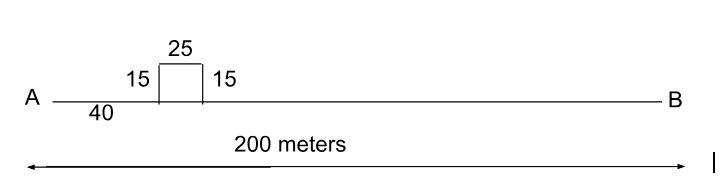
Seeta and Geeta start moving towards each other from two places 200 m apart. After walking 40 m, Geeta turns left and goes 15 m, then she turns right and goes 25 m. She then turns right again and comes back to the road on which she had started walking. If Seeta and Geeta walk with the same speed, what is the distance between them now?
Let us assume Seeta and Geeta are at A and B initially.
Distance between A and B = 200 m.
Seeta and Geeta have the same speed.
So, their travel distance will be the same since they start together.
Seeta travels = 40+25 = 65 meters in the horizontal direction from Point A and 15+15 = 30 meters in the vertical direction.
Total distance travelled by Seeta = 65+30 = 95 meters.
Hence, Geeta also travels = 95 meters.
Since Seeta travels only 65 meters on line AB, and Geeta travels = 95 meters on line AB.
Distance between them = 200-65-95 = 40 meters.