A and B started a business with investment of ₹ 4500 and ₹ 2700 respectively.
Find the share of profit of A in the total annual profit of ₹ 256.
CMAT Averages, Ratio and Proportion Questions
Profits of A and B will be in the ratio of investments, i.e. 4500:2700 = 5:3
Total profit = Rs 256
A's profit = $$\frac{5}{8}\left(256\right)=5\left(32\right)$$ = Rs 160
The answer is option C.
Which of the following statements are true?
A. If $$x : y = 3 : 1$$ then $$x^{3} - y^{3} = \frac{10}{11}$$
B. If $$x = y + 12, x : y = 3:2$$ and $$z:y = 1:3$$, the $$z + x = 44$$
C. If $$3x = 8y$$ and $$5y = 9z$$, then $$\frac{x}{z} = \frac{72}{15}$$
Choose the most appropriate answer from the options given below:
Statement A:
x : y = 3 : 1
$$x^3-y^3=\left(3k\right)^3-k^3=26k^3$$
This implies value of $$x^3-y^3$$ cannot be determined from the given information.
Therefore, statement A is incorrect.
Statement B:
It is given,
x = y + 12 and x:y = 3:2
Let x = 3k and y = 2k
3k = 2k + 12
k = 12
x = 36 and y = 24
It is given, z : y = 1 : 3
z = $$\frac{24}{3}=8$$
z + x = 36 + 8 = 44
Therefore, statement B is correct.
Statement C:
It is given, 3x = 8y and 5y = 9z
x : y = 8 : 3 = 24 : 9
y : z = 9 : 5
x : y : z = 24 : 9 : 5
x : z = 24 : 5 = 72 : 15
Therefore, statement C is correct.
The answer is option C.
Average of a, b and c is 11; average of c, d and e is 17; average of e and f is 22 and average of e and c is 17. What is the average of a, b, c, d, e and f?
It is given,
$$\ \frac{\ a+b+c}{3}=11$$
a + b + c = 33 ...... (1)
$$\ \frac{\ c+d+e}{3}=17$$
c + d + e = 51 ...... (2)
$$\ \frac{\ e+f}{2}=22$$
e + f = 44 ...... (3)
$$\ \frac{\ e+c}{2}=17$$
e + c = 34 ...... (4)
(1) + (2) + (3) - (4) we get the sum of a, b, c, d, e and f
a + b + c + d + e + f = (a+b+c) + (c+d+e) + (e+f) - (e+c) = 33 + 51 + 44 - 34 = 94
Average = $$\frac{94}{6}=\frac{47}{3}=15\frac{2}{3}$$
The answer is option A.
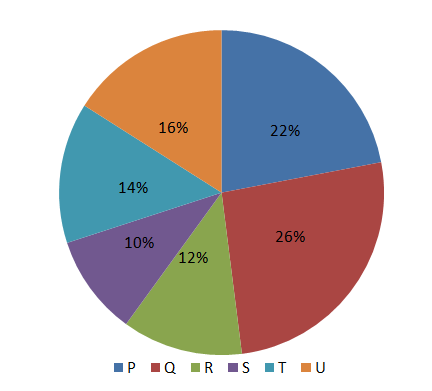
The cost of the three components A, B and C of an electronic machine worth ₹12,000 in 2020 is given as a Pie-chart as shown below :
In the following year, the cost of these three components A, B, and C increased by 10%, 20%, and 10% respectively. The cost of the three components A, B, and C respectively in 2021, was
In 2020:
Cost of component A = $$\frac{90}{360}\times12000=3000$$
Cost of component B = $$\frac{120}{360}\times12000=4000$$
Cost of component C = $$\frac{150}{360}\times12000=5000$$
In 2021:
Cost of component A = 1.1*3000 = Rs 3300
Cost of component B = 1.2*4000 = Rs 4800
Cost of component C = 1.1*5000 = Rs 5500
The answer is option B.
If x > 0, then which of the following expressions are equal to 3.6% of $$\frac{5x}{12}$$?
A. 3 percent of 20x
B. x percent of $$\frac{3}{2}$$
C. 3x percent of 0.2
D. 0.05 percent of 3x
E. $$\frac{3x}{200}$$
Choose the correct answer from the options given below:
It is given, x > 0
3.6% of $$\frac{5x}{12}$$ = $$\frac{3.6}{100}\times\frac{5x}{12}=\frac{36}{1000}\times\frac{5x}{12}=\frac{3x}{200}$$
A) 3 percent of 20x = $$\frac{3\left(20x\right)}{100}=\frac{3x}{5}\ne\ \frac{3x}{200}$$
B) x percent of $$\frac{3}{2}$$ = $$\frac{x}{100}\left(\frac{3}{2}\right)=\frac{3x}{200}$$
C) 3x percent of 0.2 = $$\frac{3x}{100}\left(0.2\right)=\frac{6x}{1000}=\frac{3x}{500}\ne\ \frac{3x}{200}$$
D) 0.05 percent of 3x = $$\frac{0.05}{100}\left(3x\right)=\frac{3x\left(5\right)}{10000}=\frac{3x}{2000}\ne\ \frac{3x}{200}$$
E) $$\frac{3x}{200}$$
Only B and E are equal to the calculated value.
Therefore, the answer is option D.
Let a, b and c be the ages of three persons P, Q and R respectively where a $$\leq$$ b $$\leq$$ c are natural numbers. If the average age of P, Q, R is 32 years and if the age of Q is exactly 6 years more than that of P, then what is the minimum possible value of c?
It is given,
a + b + c = 96 and $$a\le\ b\le\ c$$
It is also given that age of Q is 6 years more than the age of P, i.e. b = a + 6
Minimum value c can take is equal to b, i.e. a + 6
a + a + 6 + a + 6 = 96
3a = 84
a = 28
Minimum possible value of c = 28 + 6 = 34 years
The answer is option A.
Frequently Asked Questions
Yes, Averages, Ratio and Proportion is an important topic in the Quantitative Aptitude section of CMAT. It tests a candidate's arithmetic skills and ability to solve numerical and comparison-based problems efficiently.
The number of Averages, Ratio and Proportion questions varies from year to year. CMAT does not prescribe a fixed number of questions from any specific Quantitative Aptitude topic.
CMAT may include questions on simple and weighted averages, ratios, proportions, partnerships, mixtures and alligation, direct and inverse proportion, and comparison-based arithmetic problems.
Understand the fundamental concepts and formulas, practice a variety of question types regularly, improve calculation speed, and solve previous year questions and mock tests to strengthen accuracy.
Most Averages, Ratio and Proportion questions in CMAT are of easy to moderate difficulty. With conceptual clarity and regular practice, candidates can solve them accurately and efficiently.
Cracku's CMAT Averages, Ratio and Proportion Questions provide topic-wise practice, detailed solutions, and exam-oriented problems that help candidates improve conceptual understanding, speed, and confidence for CMAT 2027.