What is the probability of getting a ‘nine’ or ‘ten’ on a single throw of two dice?
CMAT 2018 Slot 2 Question Paper
For the following questions answer them individually
Solution
 Share
Share
Probability = Expected number of outcomes/ Total number of outcomes.
Total number of outcomes we get in a single throw of two dice = $$6\times 6$$ = 36.
Possible cases of getting 'nine' in a single throw of two dice:
dice 1 dice 2
three six..................(1)
six three................(2)
four five..................(3)
five four...................(4)
So, total of 4 cases.
Possible cases of getting 'ten' in a single throw of two dice:
dice 1 dice 2
four six.....................(1)
six four....................(2)
five five....................(3)
So, total of 3 cases.
Expected number of outcomes = Total possible cases of getting 'nine' or 'ten' in a single throw of two dice = 4 + 3 = 7 .
So, Probability = $$\frac {7} {36}$$
The length of a room exceeds its breadth by 2 meters. If the length be increased by 4 meters and the breadth decreased by 2 meters, the area remains the same. Find the surface area of its walls if the height is 3 meters.
Solution
Let the breadth(b) of the room be 'x' metres.
then, length(l) of the room = x+2 metres.
Area(A) = $$l\times b$$ = x(x+2) $$m^2$$
Given, length is increased by 4 meters and the breadth decreased by 2 meters
Then, new length(l') of the room = x+6 metres
new breadth(b') of the room = x-2 metres
New Area(A') of the room = $$l'\times b'$$ = (x+6)(x-2) $$m^2$$
Also given that, A = A'
$$\Rightarrow x(x+2) = (x+6)(x-2)$$
$$\Rightarrow x^2+2x = x^2+4x-12$$
$$\Rightarrow 2x = 12$$
$$\Rightarrow x = 6$$
Therefore the length of the room (l) = 8 metres
and breadth of the room (b) = 6 metres
and given height of the room (h) = 3 metres
Since the room will be in the shape of a cuboid, Surface area = 2 ($$l\times b+b\times h+l\times h$$)
But the Surface area of Walls = Total Surface area - Area of Roof and Floor = 2 ($$l\times b+b\times h+l\times h) - 2 (l\times b) = 2 (8\times 3+6\times 3) = 84 m^2$$
Hence, Surface Area of walls = 84 $$m^2$$.
A bus covers a distance of first 50 km in 40 minutes, next 50 km at a speed of 2 km per minute and the next 30 km at a speed of 1.0 km per minute. What is its average speed during the entire journey?
Solution
Average Speed = Total distance covered $$\div$$ Total time taken
Total distance travelled = 50 + 50 + 30 = 130 km.
Total time taken = Time taken to travel first 50 km + Time taken to travel next 50 km + Time taken to travel next 30 km = $$40 + 50\div 2 + 30\div 1 = 95$$ minutes = $$\frac{95}{60}$$ hours.
$$\Rightarrow$$ Average Speed = $$130\div \frac{95}{60} = 82.1$$ kmph

Three wheels making 60, 36 and 24 revolutions in a minute start with a certain point in their circumference ownwards. Find when they will again come together in the same position.
Solution
First wheel makes 60 revolutions in 1 minute
$$\Rightarrow$$ It makes 60 revolutions in 60 seconds
$$\Rightarrow$$ It makes 1 revolution in 1 second.
This implies, after every 1 second the certain point at which the wheel started its revolution reaches its initial position.
Similarly, Second wheel and Third wheel makes 36 and 24 revolutions in 1 minute respectively.
$$\Rightarrow$$ Second and Third wheel makes 1 revolution in $$\frac{5}{3} and \frac{5}{2}$$ seconds respectively.
So for all the multiples of $$\frac{5}{3} and \frac{5}{2}$$ seconds the certain point of second wheel and third wheel reaches its initial position respectively.
After LCM {1, $$\frac{5}{3}, \frac{5}{2}$$} seconds all the three wheels will come together in the same position.
LCM of fractions = LCM of numerators/ HCF of denominators
$$\Rightarrow$$ LCM {1,$$\frac{5}{3}, \frac{5}{2}$$} = LCM {1,5,5}$$\div$$HCF {1,3,2} = 5$$\div$$1 = 5.
Hence, after 5 seconds all the wheels will come again together in the same position.
A certain amount of money invested at 10% per annum compound interest for two years became Rs. 2000.
What is the initial investment?
Solution
If the principle amount 'P' when compounded annually for 'n' years at 'R%" interest rate per annum becomes P'.
Then $$P' = P {[1 +\frac{R}{100}]}^{n}$$
Given P' = 2000, n = 2 years, R = 10%
$$\Rightarrow P = P'\div {[1 +\frac{R}{100}]}^{n}$$
$$\Rightarrow P = 2000\div {[1 +\frac{10}{100}]}^{2}$$
$$\Rightarrow P = 2000\div 1.21$$
$$\Rightarrow P = 1653$$
Hence the initial amount P = Rs. 1,653.
If the height of a right circular cone is increased by 200% and the radius of the base is reduced by 50%, then the volume of the cone.
Solution
The Volume of the right circular cone of base radius 'r' and height 'h' is given by 'V' = $$\frac{1}{3} \pi r^2h$$
Given 'h' has been increased by 200%
$$\Rightarrow$$ New height h' = h[1 +$$\frac{200}{100}$$] = 3h
also,radius of the base is reduced by 50%
$$\Rightarrow$$ New base radius r' = r[1 - $$\frac{50}{100}$$] = $$\frac{r}{2}$$
New Volume of the cone with new base radius r' and new height h' is given by V' = $$\frac{1}{3} \pi r'^2h'$$ = $$\frac{1}{3} \pi (\frac{r}{2})^2(3h) = \frac{3V}{4}$$.
Change in Volume = $$\frac{New Volume - Old Volume}{Old Volume}\times 100 = \frac{\frac{3V}{4} - V}{V}\times 100 = -25$$
Hence the new volume decreased by 25 %.

An electric appliance is priced at Rs. 600 initially. Because of market recession, price was successively reduced three times, each time by 10% of the price after the earlier reduction. What is the current price?
Solution
Initial price is given as 'I' = Rs. 600
After the first reduction, the initial price is reduced by 10%
$$\Rightarrow$$ the new price I' = $$600[1 - \frac{10}{100}] = 540$$
After second reduction, I' is reduced by 10%
$$\Rightarrow$$ the new price I'' = $$540[1 - \frac{10}{100}] = 486$$
After third reduction, I'' is reduced by 10%
$$\Rightarrow$$ the new price I''' = $$486[1 - \frac{10}{100}] = 437.4$$
Hence the Current price after three successive reductions is Rs. 437.4
Below given is the Table showing Age-wise Ownership of mobiles:

If 1 crore mobiles were sold last year, how many LG sets were sold?
Solution
Let say,
The number mobiles sold in last year of the brands LG, SAMSUNG, NOKIA, SONY, MICRO-MAX be A, B, C, D, and E respectively.
Given that A+B+C+D+E = 1 crore.
But from the given data, the values of A, B, C, D, and E cannot be found out.
So the number of LG sets sold last year cannot be determined.
$$\sqrt{188+ \sqrt{51+ \sqrt{169}}}$$ = ?
Solution
$$\sqrt{188+ \sqrt{51+ \sqrt{169}}}$$ = $$\sqrt{188+ \sqrt{51+13}}$$ = $$\sqrt{188+ \sqrt{64}}$$ = $$\sqrt{188+ 8}$$ = $$\sqrt{196}$$ = 14
.webp)
In what time will Rs. 6,250 amount to Rs. 6,632.55 at 4% compound interest payable half-yearly?
Solution
If the principle amount 'P' when compounded half-yearly at R% interest rate per annum for 'n' years, the new amount is P'.
then $$P' = P{[1 + \frac{R}{2\times 100}]}^{n}$$
Given P' = 6,632.55, P = 6,250 and R = 4%
$$\Rightarrow 6,632.55 = 6,250{[1 + \frac{4}{2\times 100}]}^{n}$$
$$\Rightarrow 1.061 = {1.02}^{n}$$
Taking logarithm on both sides we get,
n = log(1.061)$$\div$$log(1.02) = 3
Since n refers to half a year in this case, the number of years will be $$\frac{3}{2}$$ years.
Expenditures of a Company (in Lakh Rupees) per Annum Over the given Years was as under.

What is the average salary expenditure(in Lakh Rupees) per Annum during this period?
Solution
Average Salary Expenditure (in Lakh Rupees) per annum = Total salary expenditure in all these years$$\div$$Total number of years
= $$\frac{576+682+648+672+740}{5}$$
= 663.6
Number of different categories of goods sold in the city over the years (in thousands) is as given under:

In which of the following years was the number of refrigerators sold approximately 25% of the number of cell phones sold?
Solution
Option A:
In 2011, number of Refrigerators sold =60
number of Cell phones sold = 336
$$\Rightarrow$$ number of refrigerators sold as a percentage of number of cell phones sold = $$\frac{60}{336}\times 100 = 17.85$$
Option B:
In 2012, number of Refrigerators sold = 79
number of Cell phones sold = 404
$$\Rightarrow$$ number of refrigerators sold as a percentage of number of cell phones sold = $$\frac{79}{404}\times 100$$ = 19.5
Option C:
In 2013,number of Refrigerators sold = 93
number of Cell phones sold = 411
$$\Rightarrow$$ number of refrigerators sold as a percentage of number of cell phones sold = $$\frac{93}{411}\times 100$$ = 22.6
Option D:
In 2014, number of Refrigerators sold = 112
number of Cell phones sold = 442
$$\Rightarrow$$ number of refrigerators sold as a percentage of number of cell phones sold = $$\frac{112}{442}\times 100$$ = 25.33
Hence Option D is the correct answer.
.webp)
In the figure, PQ is a diameter of the circle. Angle PQS = $$35^\circ$$. Find angle QRS.

Solution

SInce PQ is the diameter, the angle subtended by it at R is 90 deg. i.e., $$\angle$$ PRQ = 90 deg.
Let $$\angle$$ RPQ = $$\theta$$, then $$\angle$$RQP = 90 - $$\theta$$
As the angles subtended by a chord in same segment are equal, $$\angle$$RPQ = $$\angle$$RSQ = $$\theta$$
In triangle RSQ, $$\angle$$QRS + $$\angle$$RSQ + $$\angle$$RQS = 180
$$\Rightarrow$$ $$\angle$$QRS + $$\theta$$ + 35 + 90 - $$\theta$$ = 180
$$\Rightarrow$$ $$\angle$$QRS = 180 - 125 = 55 deg.
Hence $$\angle$$QRS = 55 deg.
If x = $$\sqrt[6]{5}$$ and y = $$\sqrt[5]{4}$$, Which of the following is true?
Solution
Given x = $$\sqrt[6]{5}$$ and y = $$\sqrt[5]{4}$$
which can also be written as x = $$5^{\frac{5}{30}}$$ and y = $$4^{\frac{6}{30}}$$
which can be further written as x = $$\sqrt[30]{5^5}$$ and y = $$\sqrt[30]{4^6}$$
As we know $$4^6 > 5^5$$
$$\Rightarrow \sqrt[30]{4^6} > \sqrt[30]{5^5} $$
$$\Rightarrow$$ y > x
If a and b are positive real numbers and $$a * b$$ denotes $$\sqrt{a \times b}$$, what is the value of 8 * (4 * 16)?
Solution
Given, If a and b are positive real numbers then a * b denotes √ab
Consider 4 * 16 = $$\sqrt{4\times 16} = \sqrt64 = 8$$
then 8 * 8 = $$\sqrt{8\times 8} = \sqrt64 = 8$$
Hence the value of 8 * (4 * 16) = 8
.webp)
The average age of three men is 50 years and their ages are in the proportion 3:5:7. The age of the youngest man is:
Solution
Given the proportion of ages of three men are 3:5:7.
Let their ages be 3k, 5k, 7k ,where k is any constant.
Given average of ages of three men = 50
$$\Rightarrow \frac{3k+5k+7k}{3} = 50$$
$$\Rightarrow \frac{15k}{3} = 50$$
$$\Rightarrow 5k = 50$$
$$\Rightarrow k = 10$$
Therefore the ages of three men are 30, 50, and 70 years.
The age of the youngest men is 30 years.
By selling mangoes at the rate of 64 for Rs. 2,000, the vendor loses 40%. How many should he sell for Rs.1000 so as to gain 20%?
Solution
If 64 mangoes are sold at Rs.2000, each mango will be sold at Rs. $$\frac{2000}{64}$$
Hence Selling price (S.P) of each mango = Rs. 31.25
Given loss percentage of vendor at this S.P = 40%
Loss percentage = $$\frac{C.P - S.P}{C.P}\times 100$$
$$\Rightarrow \frac{40}{100} = \frac{C.P - S.P}{C.P}$$
$$\Rightarrow S.P = 0.6\times C.P$$
$$\Rightarrow C.P = \frac{31.25}{0.6} = 52$$
Therefore Cost Price of 1 mango (C.P) = Rs. 52
Let us calculate the S.P of each mango in order to get a 20% gain.
Gain percentage = $$\frac{S.P - C.P}{C.P}\times 100$$
$$\Rightarrow \frac{20}{100} = \frac{S.P - C.P}{C.P}$$
$$\Rightarrow S.P = 1.2\times C.P$$
$$\Rightarrow S.P = 62.5$$
So, to get a gain of 20% we need to sell each mango at Rs. 62.5
Let say we sold 'x' number of mangoes.
Selling price of these 'x' number of mangoes (S.P) = Rs. 62.5x
But given that this S.P = Rs. 1000
$$\Rightarrow 62.5x = 1000$$
$$\Rightarrow x = \frac{1000}{62.5} = 16$$.
Therefore a total of 16 mangoes are to be sold for Rs. 1000 to get a gain of 20%.
The area of a triangle metal plate with base 88 cm and altitude 64 cm is to be reduced to one-fourth of its original area by making a hole of circular shape at the center. The radius of this hole will be:-
Solution
Area of triangular metal plate with base(b) = 88 cm and altitude(h) = 64 cm is given as A = $$\frac{1}{2} b\times h = \frac{1}{2} 88\times 64 = 2816 cm^2$$
Given this area is to be reduced to one-fourth by making a hole in the shape of circle
$$\Rightarrow$$ Reduction in the area of the triangle = Area of the circular hole
$$\Rightarrow\frac{3}{4}\times A=\pi r^2$$
$$\Rightarrow \frac{\frac{3}{4}\times 2816}{\pi} = r^2$$
$$\Rightarrow r = \sqrt672 = 4\sqrt42 $$
So, the radius of the circular hole = $$4\sqrt42$$ cm.
.webp)
Find the value of $$\sqrt{\frac{2 + \sqrt3}{2 - \sqrt3}}$$
Correct to three places of decimal.
Solution
Let us consider $$\frac{2 + \sqrt3}{2 - \sqrt3}$$
Rationalising the denominator by multiplying and diving with 2+$$\sqrt3$$ we get,
$$\frac{(2 + \sqrt3)\times (2 + \sqrt3) }{(2 - \sqrt3)\times (2 + \sqrt3) } = \frac {(2 + \sqrt3)^2}{4 - 3} = (2 + \sqrt3)^2$$
Now,
$$\sqrt{\frac{2 + \sqrt3}{2 - \sqrt3}} = \sqrt{(2 + \sqrt3)^2} = 2 + \sqrt3 = 2 + 1.732 = 3.732$$
A mixture of petrol and kerosene weighing 5 kg contains 5% kerosene. How much more kerosene (approx.) must be added into it to make it 10%?
Solution
Initial amount of Kerosene(I) = 5% of 5 kg mixture of petrol and kerosene = $$\frac{5}{100}\times 5000 = 250$$ grams
Let say 'x' gm of Kerosene is added to the mixture.
The final amount of Kerosene in the mixture after the addition is given as 10%.
$$\Rightarrow \frac{250 + x}{5000 + x} = \frac{10}{100}$$
$$\Rightarrow 2500 + 10x = 5000 + x$$
$$\Rightarrow 9x = 2500$$
$$\Rightarrow x = 275$$ gm approximately.
Therefore additionally 275 gm of kerosene is to be added to the mixture to make it 10%.
A student who gets 20% marks fails by 20 marks, but another student who gets 36% marks gets 44 marks more than minimum passing marks. Find the maximum number of marks and percentage necessary for passing.
Solution
Let the maximum number of marks be 'x' and minimum passing marks be 'y'.
Given, A student who gets 20% marks fails by 20 marks.
$$\Rightarrow \frac{20}{100}\times x = y - 20$$
$$\Rightarrow 20x = 100y - 2000$$.................(1)
Also given that, another student who gets 36% marks gets 44 marks more than minimum passing marks.
$$\Rightarrow \frac{36}{100}\times x = y + 44$$
$$\Rightarrow 36x = 100y + 4400$$....................(2)
(2) - (1) $$\Rightarrow$$ 16x = 6400
$$\Rightarrow$$ x = 400
From (1) or (2), we get y = 100
Hence, maximum number of marks = x = 400
Percentage necessary for passing = $$\frac{y}{x}\times 100$$ = 25%

If 26 horses or 20 bullocks eat up the fodder in store in 170 days, in what time will 10 horses and 8 bullocks finish the same quantity of fodder?
Solution
Let amount eaten by each horse and each bullock in one day be 'h' units and 'b' units respectively.
So Total fodder = Total effciency$$\times$$Total number of days
$$\Rightarrow$$ Total work = 26$$\times$$h$$\times$$170 = 20$$\times$$b$$\times$$170
$$\Rightarrow$$ b = 1.3h............(1)
The amount of fodder eaten by 10 horses and 8 bullocks in one day = 10h + 8b = 10h + 8(1.3h) = 20.4h
Time taken by them to eat the same amount of fodder = total fodder/amount eaten by them in one day
= $$\frac{ 26\times h\times 170}{20.4h}$$
= 216.67 days
A boat covers 24 km upstream and 72 km downstream in 8 hours, while it covers 48 km upstream and 108 km downstream in 14 hours. Find the speed of the boat in still water and the speed of the stream respectively.
Solution
Let the speed of the boat in still water be V and speed of the stream be V'.
Relative speed of boat in upstream = V - V', as water stream flows against the direction of boat.
whereas Relative speed of boat in downstream = V + V', as water stream flows in the direction of boat.
Case (1)
Given Total time taken = Time taken during upstream + Time taken during downstream = 8 hours.
$$\Rightarrow \frac{24}{V - V'} + \frac{72}{V + V'} = 8$$
$$\Rightarrow 3 [\frac{1}{V - V'} + \frac{3}{V + V'}] =1$$.............(1)
$$\Rightarrow 3 [4V - 2V'] = V^2 - V'^2$$......................(2)
Case (2)
Given Total time taken = Time taken during upstream + Time taken during downstream = 14 hours
$$\Rightarrow \frac{48}{V - V'} + \frac{108}{V + V'} = 14$$
$$\Rightarrow 6 [\frac{4}{V - V'} + \frac{9}{V + V'}] = 7$$
$$\Rightarrow 6[13V - 5V'] = 7 [V^2 - V'^2]$$...................(3)
Dividing equation (3) by (2), we get
$$\frac{2 [13V - 5V']}{4V - 2V'} = 7$$
$$\Rightarrow 26V - 10V' = 28V - 14V'$$
$$\Rightarrow V = 2V'$$
Substituting this value in equation (1) we get,
$$\Rightarrow 3 [\frac{1}{V'} + \frac{1}{V'}] =1$$
$$\Rightarrow V' = 6$$
$$\Rightarrow V = 12$$
Hence, Speed of the boat in still water = 12 km/h.
and Speed of the stream = 6 km/h.
A shopkeeper sells rice at the cost price, but uses false weight. He gains 20% in this process. What weight does he uses for one kilogram?
Solution
Let say cost price(C.P) of 1 kg(1000 g) of rice be Rs. 100
Given Shopkeeper is selling rice at cost price,
$$\Rightarrow$$ Selling price(S.P) = C.P = Rs. 100
If he had used correct weight of 1000 g then C.P would have also been Rs. 100.
But given that he uses false weight. Let the weight he had used be 'x' g.
For 1000 g of rice the C.P = Rs. 100
$$\Rightarrow$$ For '1' g of rice the C.P will be Rs. $$\frac{1}{10}$$
$$\Rightarrow$$ For 'x' g of rice the C.P will be Rs. $$\frac{x}{10}$$
Given that, by using this false weight the shop keeper gains 20%.
Gain percentage = $$\frac{S.P - C.P}{C.P}\times 100$$
$$\Rightarrow \frac{20}{100} = \frac{S.P - C.P}{C.P}$$
$$\Rightarrow S.P = 1.2\times C.P$$
$$\Rightarrow 100 = 1.2\times \frac{x}{10}$$
$$\Rightarrow x = 833.33$$
Hence the false weight used is 833.33 g
Working together, Rakesh, Prakash and Ashok can finish the same job in an hour. Also, if Prakash works for an hour, and then Ashok works for four hours, the job will be completed. If Rakesh can do the job an hour quicker than Prakash, how many hours would Ashok take to complete the job alone?
Solution
Let the efficiencies of Rakesh, Prakash, and Ashok be 'r' 'p' and 'a' respectively.
GIven that Rakesh can do a job an hour quicker than Prakash.
So let time taken by Prakash be 't' hours, then time taken by Rakesh will be 't-1' hours.
Total work(W) = Efficiency$$\times$$ Time taken = p$$\times$$ t = r$$\times$$ (t-1)
$$\Rightarrow$$ t = $$\frac{r}{r-p}$$....................(1)
Given that, Working together, Rakesh, Prakash and Ashok can finish the same job in an hour.
$$\Rightarrow$$ Total work(W) = (r+p+a) (1) units.............(2)
Also given that, if Prakash works for an hour, and then Ashok works for four hours, the job will be completed.
$$\Rightarrow$$ Total work(W) = p(1) + a(4) units...........(3)
Equating (2) and (3), we get
(r+p+a) (1) = p(1) + a(4)
$$\Rightarrow$$ r = 3a..............(4)
Substituting this value in equation (1), we get
t = $$\frac{3a}{3a-p}$$.............(5)
As the Total work is always constant, p$$\times$$ t = p(1) + a(4)
$$\Rightarrow$$ t = 1 + 4$$\frac{a}{p}$$.......(6)
Equating (5) and (6), we get
$$\frac{3a}{3a-p} = 1 + 4\frac{a}{p}$$
Let $$\frac{a}{p}$$ = 'k'
$$\Rightarrow \frac{3k}{3k-1} = 1 + 4k$$
$$\Rightarrow 3k = 12k^2 + 3k - 4k -1$$
$$\Rightarrow 12k^2 - 4k - 1 = 0$$
Solving for k, we get k = $$\frac{1}{2} or -\frac{1}{6}$$[which is not possible]
Hence k = $$\frac{1}{2}$$
$$\Rightarrow$$ p =2a.............(7)
Substituting (4) and (7) in equation (2) we get,
Total work(W) = 6a units.
Time taken by Ashok alone to do the job = Total work/ Efficiency of Ashok
= 6a/a
=6 hours.
Looking at Sweety, Raj says to his friend, “Sweety is the grand-daughter of the elder brother of my father”.
How is Sweety related to Raj?
Solution
Elder brother of Raj's father = Raj's uncle
Now, Sweety is grand-daughter of Raj's uncle.
=> Sweety is Raj's niece.
=> Ans - (A)
Seven experts N ,G, M, W, J, K and L give expert advice sessions to the XII class students. These sessions can take place either before the school, during lunch period or after the school. In scheduling these sessions the following conditions are followed.
At least two experts must hold the sessions before school.
At least three experts must hold their sessions after school.
M is not available after school and J is available only after school.
W always takes extra session during lunch.
G will take session before school only if N is also scheduled before school.
All the following statements could be true except:
Solution
The minimum number of people taking classes after school is 3.
The minimum number of people taking classes before school is 2.
Hence the maximum number of people taking classes during lunch must be 2.
Hence the number of people taking classes during lunch and after school cannot be equal.
Option D is the correct answer.
Six male friends A, B, C, D, E and F are married to R, S, U, V, T and W, not necessarily is same order.
Following facts are known about them:-
• R and S are A’s sisters.
• Neither R nor T are wiv es of C.
• W is wife of E and V is wife of B .
• D is not married to R, S or T.
Who is A’s wife?
Solution
To find : A's wife = ?
It is given that R and S are A's sisters.
Also, W is wife of E and V is wife of B.
Thus, we have : (A,) (B,V) (C,) (D,) (EW)
Also, T is married neither to C nor to D, => T is wife of A.
=> Ans - (C)
If southeast becomes east and northwest becomes west and all the other directions are changed in the same direction. Then what will be the direction for north?
Solution

If southeast becomes east and northwest becomes west, thus we have to tilt the direction $$45^\circ$$ clockwise. (to the right)
Thus, direction of north will be northeast.
=> Ans - (D)
Inspector arrested three persons- Kalia, Raza, Shera - on suspicion, in a theft case. It was found the one among these three was the thief. During the interrogation their replies were as follows.
Kalia: I am not the thief. Raza is the thief.
Raza: I am not the thief. Either Kalia or Sh era is the thief.
Shera: I am not the thief. Raza is not the thief.
If exactly one person among them always speaks the truth, another always speaks lies and the third alternates
between the truth and lies, then who is the thief?
Solution
Case 1 : If Kalia speaks truth
=> Raza is the thief, which means Raza's first statement is a lie.
Case 1(a) : Raza speaks lie and truth alternatively.
=> Second statement cannot be true.
Case 1(b) : Raza always lies.
=> Raza is a thief, and the other ones are not.
This can only mean Shera speaks truth and lie alternatively, which positively concludes above statements.
$$\therefore$$ Raza is the thief.
=> Ans - (C)
A, B, C and D are four medical representatives of a company. Each of them must visit exactly two of the eight cities- Delhi, Chennai , Kolkata, Hyderabad, Bangalore, Mumbai, Lucknow and Patna - and each city is visited by only one person. C does not visit Mumbai and Delhi, While D does not visit Kolkata and Hyderabad. B does not visit Lucknow and Patna. Whereas A does not visit Bangalore and Chennai. Patna and Bangalore are visited neither by B nor by C.
If Delhi and Lucknow were visited by A, then which one of the following cities could B visit?
Solution
According to the statements,

If A visited Delhi and Lucknow, then B can only visit two of Chennai, Kolkata, Hyderabad or Mumbai.
=> Ans - (D)
Among the five numbers W, Y, C, D, M. W is greater than C but less than M, whereas, Y is greater than D but not less than M. Which of the following can be the greatest of the five?
Solution
W is greater than C but less than M, : M > W > C
Y is greater than D but not less than M, : Y > D and Y $$\geq$$ M
Combining above statements, we get : Y $$\geq$$ M > W > C and Y > D
Thus, either Y or M is the greatest.
=> Ans - (D)
A tutor has 10 students - A, B, C, D, E, F, G, H, I and J- to form four groups for tutorials. No group can have more than four students. No two groups can have the same number of students. C and G must be in the same group. A and F must be in the same group. I should be alone and is in one group. B and E cannot be in the same roup. F and E must be in different groups.
If A, D, F and J form a group, then the other two groups can be:-
Solution
No group can have more than four students. No two groups can have the same number of students.
=> The four groups will have 1,2,3,4 students respectively.
I should be alone and is in one group, => $$G_1=I$$
Given : A, D, F and J form a group, => $$G_4=A,D,F,J$$
Also, C and G must be in the same group. B and E cannot be in the same group.
=> B belongs with C and G, => $$G_3=B,C,G$$
and $$G_2=E,H$$
=> Ans - (C)
A bookie has to inspect five horses A, B, C, D and E. If he inspects B, he cannot inspect C immediately. If he inspects A, he cannot go to E after that. Which of the following can be the correct order of his inspection?
Solution
If he inspects B, he cannot inspect C immediately, => C cannot be to the immediate right of B, and thus first two options are eliminated.
If he inspects A, he cannot go to E after that, similarly third option is also not possible.
Thus, proper order : D,C,B,E,A
=> Ans - (D)
Below given question contains six statements labelled A, B, C, D, E and F followed by four combinations of three statements. Choose the set in which the statements are logically related i.e the third statement can be deduced from the first two statements together.
Read the information carefully and answer the question.
A) All honest persons are good natured.
B) Some good natured persons are not honest.
C) Some honest persons are good natured.
D) All honest person are obese.
E) All obese person are good natured.
F) Some good natured person are hon est.
Solution
(A) : The two statements (A & C) are contradictory, hence it is invalid.
(B) : This also contain A and C, hence it is also invalid.
(C) : The statements are B and F are again contradictory, hence it is also invalid.
(D) : All honest person are obese, and all obese are good natured, hence all honest persons are good natured.
=> Ans - (D)
R1, R2, R3, R4, R5, R6, R7 are seven places on a map. The following places are connected by two-way roads: R1 and R2; R1 and R6; R3 and R6; R3 and R4; R6 and R7; R4 and R5; R2 and R3; R5 and R7. No other
road exists. The shortest route (the route with the least number of intermediate places) from R1 to R7 is:-
Solution
The road map when we connect all the 1-way roads is :

Thus, the shortest route to go from R1 to R7 : R1-R6-R7
=> Ans - (D)
A, B, C, D and E are five rods. E is longer than A which is longer than C and lighter than C, which is lighter than D. B is shorter than D, and heavier than it. E is longer than D, and heavier than it.
If B is the heaviest of all, then which of the following can be the lightest of all the five rods?
Solution
Comparing the rods on the basis of weight
A is lighter than C, which is lighter than D, : D > C > A
B is heavier than D, : B > D
E is heavier than D, : E > D
It is given that B is the heaviest, and combining above statements, we get : B > E > D > C > A
Thus, A is the shortest.
=> Ans - (B)
A, B and C are three films that are screened by three theatres PVR, DT and Regal in three consecutive slots. No film should be screened in the same slot by any two theaters. If DT screens film B in the first slot and PVR exhibits film C in the third slot, then which of these must be TRUE?
Solution
DT screens film B in the first slot and PVR exhibits film C in the third slot
This means only Regal can exhibit the remaining film A in the remaining slot, i.e. second slot.
=> Ans - (C)
Five capitals A, B, C, D and E are connected by different modes of transport as follows.
A and B are connected by boat as well as by rail.
D and C are connected by bus and by boat.
B and E are connected only by air.
A and C are connected only by boa t.
E and C are connected by rail and by bus.
Which of the following pair of capitals are connected by any of the routes directly (without going through any
other capital)?
Solution
We get the following :
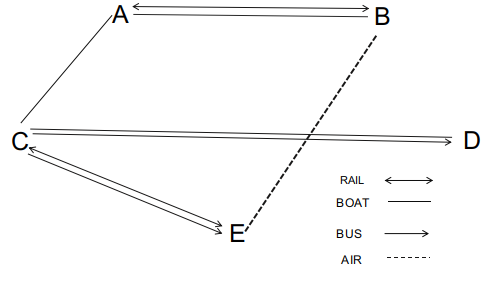
We can say none of the given options are connected directly
so D is the correct answer.
Insert the missing character.

Solution
The middle number is the sum of numbers assigned to their adjacent alphabets as, A=1, B=2, C=3,.......,Z=26
EJO + TYE $$\equiv5+10+15+20+25+5=80$$
DHL + PTX $$\equiv4+8+12+16+20+24=84$$
Similarly, CFI + LOR $$\equiv3+6+9+12+15+18=63$$
=> Ans - (A)
P, Q, R, S and T are the five corners of a table with five sides. Chairs A, B, C, D and E are placed along the sides joining the angular corners. Neither P, Q, R, S, T nor A, B, C, D and E are necessarily in that order. Chair A is along the side joining the corner P and R. S is to the immediate right of P, and R is between P and T. Chair B is along the side of Q and T. Chairs D and E are next to B on either side. The corners that join the side where the chair C is placed are:-
Solution
Chair A is along the side joining the corner P and R. S is to the immediate right of P, => R is to the left of P.
R is between P and T, => Q is to the immediate right of S.
Chair B is along the side of Q and T. Chairs D and E are next to B on either side. => C is to the immediate right of A.

Thus, the corners that join the side where the chair C is placed are : P and S.
=> Ans - (D)
Eight persons Jai, Kabir, Lakshaya, Mannu, Neetu, Om, Punita and Surbhi sit in two parallel rows with four seats in each row facing each other. Jai and Kabir are not in the same row. Neetu sits to the immediate left of Lakshaya in the same row but opposite to Om. Punita and Kabir have only two persons between them. Jai and Neetu have only one person between them.
Which of these pairs of persons can sit diagonally opposite each other?
Solution
Punita and Kabir are in the same row
So jai is in opposite row , Neetu and Lakshya will also be in the same row as Jai.
we get the arrangement as :

Option C is the correct answer.
A, B, C, D, E, F, G, H and I are nine employees in a company, who go to meet two managers Ram and
Deepak to talk to them about their Paris project. Each manager has time for only three employees. D has a
priority and must be given preference by Ram or Deepak. F and B do not wish to go to the same manager. G
goes to Ram only and H goes to Deepak only. C comes back saying that neither of the two managers has time to
see him. A does not go with F and I does not go with E. B and I do not go together. If E, F and G go together and are seen by one of the managers, then which manager sees whom, assuming that C has opted out of the talks?
Solution
G goes to Ram only and it is given that EFG go together so they will go together to Ram. Now A does not go with F so A goes to Deepak, I do not go with E so I go to Deepak F and B do not go to same so B goes to Deepak
so we have
Ram - F,G,E
Deepak - A,I,B,H
Now D can go to both
And as per options the correct answer is Deepak - D, I, H or D, B, H
There are three boxes of three different colours- Green, Blue and Red, and 6 toys of which 2 are of Green colour, 2 are of Blue colour and 2 are of Red colour. The toys are packed in the three boxes such that each box has 2 toys of different colours in it and also the colour of the box is different from the colour of the toys packed in it. Now, 10 chocolates are kept in these boxes in such a way that the Green box has the maximum possible chocolates in it whereas, the Red box has the least possible chocolates in it. Each box should have at least one chocolate and no two boxes have the same number of chocolates.
Which of the following is true?
Solution
Given that there are 3 boxes of green blue red colours
According to the given condition,that the box color toy is not present in respective box,
green box has blue and red toys
Blue box has Green and red toys
Red box has Green and blue toy
There are 10 chocolates The least number of chocolates are in red box. Given that atleast one chocolate in red box
and maximum possible number of chocolates in Green box
that is 7 is the maximum number of chocolates because 2 chocolates are kept in blue box.
Therefore, option D is correct that is the box which has green and red toys has 2 chocolates. such box is Blue box which has 2 chocolates in it.
A, B, C are three girls who go to buy six items- P, Q, R, S, T and U. Each one of them buys two different items in such a way that if A buys R, then B buys neither P nor S. If B buys Q, then C buys neither U nor T. If A buys R and T, then B buys:-
Solution
Given : If A buys R, then B does not but P or S.
Now A buys R and T, then B cannot buy P and S, thus the only two items left for him to buy are Q and U.
=> Ans - (B)
Below given question has a main statement followed by four statements labeled A, B, C and D. Choose the ordered pair of statements, where the first statement implies the second and the two statements are logically consistent with the main statement.
You cannot catch the bus unless it is morning.
(A) This is morning.
(B) You can catch the bus.
(C) This is not morning.
(D) You cannot catch the bus.
Solution
(A) : The statements are clearly contradictory, hence it is invalid.
(B) : Again the statements, this is morning and this is not morning are invalid.
(C) : The order CB is not logically consistent with the given statement.
(D) : This order is valid, and states this is not morning, hence you cannot catch the bus.
=> Ans - (D)
If m + n means m is sister of n,
m - n means m is brother of n,
m x n means m is daughter of n,
m ÷ n means m is mother of n,
How many females can be shown by the given relationship?
$$a + b - c + d - e \times f$$
Solution
a+b: a is the sister of b
b-c: b is the brother of c
c+d: c is the sister of d
d-e : d is the brother of e
e*f: e is the daughter of f.
We can state that a(female), b(male),c(female), d(male), e (female), f(male or female).
Hence D is the correct answer.
Three coins are tossed in the air and two of the coins land with tails face upwards. What are the chances on the next toss of the coins that at least two of the coins will land with the tails facing upwards?
Solution
Three coins are tossed in the air and two of the coins land with tails face upwards.
Assuming that the coins are fair and the first part does not try to indicate that they are not fair. The outcomes that make at least two coins heads are :
HHT, HHH, HTH, THH
Thus, outcome is 4 out of 8 = 50%
=> Ans - (A)
A family of three generation comprises of seven members - A, B, C, D, E, F and G. There are two married couples-one each of first and second generation respectively. They travel in three different cars -Audi, BMW and Honda so that no car has more than three members and there is at least one female in each car. C, who is a grand-daughter, does not travel with her grandfather and grandmother. B travels with his father E in BMW. F travels with her grand-daughter D in Audi. A travels with her daughter in Honda.
Which of the following is one of the married couples?
Solution
Given that F is a grandmother and travels with her granddaughter D in Audi. Similarly, A travels with her daughter in a honda. Since A doesn't belong to the first generation as F is the grandmother and each car must have at least one female.
We are provided 2 cars and each car has 2 females each. Hence the third car with the father and son must have a female in order to satisfy the condition of one female each in the car.
Hence one female must be traveling along with E and B who are father and son. The only possible way in order to fill the two married couples are :
E must be the grandfather and belongs to the first generation and B must be his son who is married to A.
Hence the two couples are EF, AB
P, Q, R, S, T and U are six members of a family. R is not the mother of Q but Q is the son of R. P and R are a married couple. T is the brother of R. U is the brother of Q. S is the daughter of P.
T is S 's _________.
Solution
R is not the mother of Q but Q is the son of R
=> R is father of Q
P and R are a married couple
=> P(f) is wife of R(m), and Q(m) is their son.
U is the brother of Q. S is the daughter of P
=> Q(m), U(m) and S(f) are siblings and children of P(f) and R(m).
Also, T is the brother of R
$$\therefore$$ T is S's uncle.
=> Ans - (A)
Read the passage carefully and answer the question that follows.
Passage I
All of us play but we are not athletes. We are homo ludens (Latin for play) and our playfulness is unproductive. But athletes play for profit and contest for prizes. It is the transformation of our play and games into athletics that leads to medals. What makes Haryana such a fine place for athletics in India? With barely 2% of India's population, people from Haryana won around 40% of the gold medals in the recently concluded CWG 2010.
People in Haryana tend to count the gold medals of the Hyderabadi shuttler, Saina Nehwal and the
Delhi wrestler, Sushil Kumar, in their tally. This is because both of them are Jats. People of this dominant caste form more than 20% of Haryana's population and, therefore, in popular perception, Haryana is Jat-land. All sports are oriented towards the Olympic slogan 'higher, faster, and stronger’. But the ones in which Haryana got medals stand for plain force and aggression like wrestling, boxing and shooting. Anthropologists call them contact sports because the opponents have bodily contact in them. Shooting is a combative sport because opponents use a combat weapon. Such sports are a substitute of war or training for it.
Haryana is India's pride in contact and combative games. I can think of t hree reasons for it, viz.
historical geography, peasant culture of perseverance and a feeble government policy. Firstly, the province has
a volatile history of continuous aggression due to its geographical location on the frontier. Secondly, the people of Haryana have valued physical strength and perseverance due to its peasant culture. Thirdly, the sports policy since 2006 has honed the killer athletic spirit in Haryana. The half-hearted policy does not create achievers but supports the successful ones among them. Punjab was divided on religious lines in 1947. The non-Sikh majority parts of this truncated Punjab were constituted as Haryana in 1966. Like a horseshoe, Haryana encircles Delhi from three sides and the culture of both is similar. At the popular level, people are rough and tough - meaning 'rough by tongue and tough in body'. In the medieval times, Haryana flourished when weak rulers ruled Delhi.
Most of the area remained under Delhi's tutelage but small principalities also dotted the arid
landscape of Haryana. Mostly, people of the region joined the Mughals and Marathas in repulsing invaders. But
the same locals did not mind plundering Delhi or looting the retreating armies sometimes. The British
colonialists expanded from the east. They conquered most of India with the help of soldiers from western UP
and Bihar. But, in the late 19th century, the colonial strategists honored ordinary peasant castes by calling them 'martial races' in united Punjab. This was a clever way of taming the aggression in this frontier region.
This smart move was also to recruit rural Punjabis in the colonial army so that they could be used
to thwart the southward expansion of Tsarist Russia. There is a family resemblance between military/hunting
activities and wrestling, shooting, races, riding or archery. For the military serving population of Haryana,
therefore, such sports come easily. Secondly, before the advent of machinery, agriculture was a backbreaking
occupation. The size of agricultural income had a direct relation with the quantity of sweat produced during
one's toil.
Why do people of Haryana tend to count the medals bagged by Saina Nehwal in the tally of their own state, though she is a Hyderabadi?
Solution
In the second paragraph of the passage, the author mentions, "People in Haryana tend to count the gold medals of the Hyderabadi shuttler, Saina Nehwal and the Delhi wrestler, Sushil Kumar, in their tally. This is because both of them are Jats. People of this dominant caste form more than 20% of Haryana's population and, therefore, in popular perception, Haryana is Jat-land."
From this, we can observe that option D is the correct answer.
What does the author means by saying “Our Playfulness is unproductive"?
Solution
In the first paragraph, the author mentions, "our playfulness is unproductive. But athletes play for profit and contest for prizes."
From this, we can infer that since most people do not play for material benefits like medals, prizes or profits, the author is calling their playfulness, unproductive.
Hence, the answer is option C.
Which of these is not a reason for so many athletes coming from Haryana?
Solution
From the third paragraph: "Firstly, the province has a volatile history of continuous aggression due to its geographical location on the frontier. Secondly, the people of Haryana have valued physical strength and perseverance due to its peasant culture."
From the last paragraph: "For the military serving population of Haryana, therefore, such sports come easily."
From the above-mentioned lines, we can infer options B, C and D to be true.
Hence, the answer is option A.
Why did the English call the ordinary peasants of Haryana, the 'martial race'?
Solution
In the last paragraph, the author mentions, "But, in the late 19th century, the colonial strategists honored ordinary peasant castes by calling them 'martial races' in united Punjab. This was a clever way of taming the aggression in this frontier region."
Hence, the answer is option C.
Which of the following is false according to the passage?
Solution
From the second-last paragraph:
1. " Like a horseshoe, Haryana encircles Delhi from three sides and the culture of both is similar."
2. "In the medieval times, Haryana flourished when weak rulers ruled Delhi."
3. "The half-hearted policy does not create achievers but supports the successful ones among them."
Options A, B and C can be inferred from the lines mentioned above.
Hence, the answer is option D.
Which of the following is true about the prevailing sports policy in Haryana?
Solution
From the second-last paragraph: "the sports policy since 2006 has honed the killer athletic spirit in Haryana. The half-hearted policy does not create achievers but supports the successful ones among them."
From this, we can infer option B. Option A is not mentioned in the paragraph.
Hence, the answer is option B.
Read the passage carefully and answer the question that follows.
Passage II
Putting a final lid on the Planning era, the Niti Aayog is gearing up to launch the three-year action plan
from April 1 after the end of 12th Five Year Plan on March 31.
Under the new system, sources said states will be encouraged to meet the targets of various schemes or
face the prospects of drying up of the fund flows.
“The 12th five years plan is coming to an end on March 31. The three-year action plan to be unveiled this
month will come in force from April 1, which will also end the prevailing system of the centre patiently waiting (for) the state governments to implement the schemes.
“Now, you either meet the target or you will face the prospects of the fund flow drying up,” a senior
Niti Aayog official said.
The official said ,“We have patiently waited for the state governments to adopt a number of reform oriented legislative bills. But our experiences have largely been negative... therefore, the reform agenda arrived
at after consensus will need to be adopted by them, and the states doing so will get incentives”.
Niti Aayog has also been entrusted the work on the 15-year Vision Document and a seven year
strategy, which would guide the government’s development works till 2030.
As compared to the previous Five Year Plans, the new NITI Aayog's stance towards the states is:
Solution
"Under the new system, sources said states will be encouraged to meet the targets of various schemes or
face the prospects of drying up of the fund flows."
Thus, the funds will be distributed based on the implementation of new schemes by the states. Hence, the answer is option D.
How has the experience of dealing with the states been so far?
Solution
"The official said,“We have patiently waited for the state governments to adopt a number of reform-oriented legislative bills. But our experiences have largely been negative."
Hence, the answer is option C.
What is the theme of this passage?
Solution
The author talks about the new three-year action plan of the NITI Aayog. They also mention the provisions added to make the states follow the new rules. The passage does not talk about the infrastructure development in India or the corruption.
Hence, option A is the answer.
Read the passage carefully and answer the question that follows.
Passage III
Twenty years ago on Thursday, Moscow started what it thought would be a "blitzkrieg" against
secular separatists in Chechnya, a tiny, oil-rich province in Russia's North Caucasus region that had declared its independence.
But the first Chechen war became Russia's Vietnam; the second war was declared a victory only in
2009. The two conflicts have reshaped Russia, Chechnya, their rulers - and those who oppose them. In 1994, shortly after Moscow invaded Chechnya in an effort to restore its territorial integrity, Akhmad Kadyrov, a bearded, barrel-chested Muslim scholar turned guerrilla commander, declared jihad on all Russians and said each Chechen should kill at least 150 of them.
That was the proportion of the populations on each side of the conflict: some 150 million Russians
and less than a million Chechens in a small, landlocked province, which the separatists wanted to carve out of Russia. Western media and politicians dubbed the Chechens "freedom fighters" - an army of Davids fighting the Russian Goliath.
Moscow was lambasted internationally for disproportionate use of force and rolling back on the
democratic freedoms that former leader Boris Yeltsin was so eager to introduce after the 1991 Soviet Union collapse. Tens of thousands died amid atrocities committed by both sides - and many more were displaced before 1996, when the Russians retreated, leaving Chechnya essentially independent. Retreating was a humiliation for Russia's military machine that less than a decade earlier had presented a seemingly formidable threat to the entire Western world.
Why did Russia declare war against Chechnya?
Solution
Options A, B, C: Nowhere explicitly mentioned or implied in the passage.
Option D: Since from the first paragraph, "Twenty years ago on Thursday, Moscow started what it thought would be a "blitzkrieg" against secular separatists in Chechnya, a tiny, oil-rich province in Russia's North Caucasus region that had declared its independence.", it can be inferred that the timing of Chechenya's independence and the Russian invasion coincided, the independence of Chechnya can be a possible reason for the invasion.
Thus, out of all the options, option D is the most appropriate one.
The correct option is D.
How did the first Russia Chechnya war come to an end?
Solution
In the last paragraph it has been mentioned that retreating was such a humiliating experience for the Russians.
Hence it can be inferred that the Russian military retreated. Option C is the correct answer.
What was western media's attitude about the conflict?
Solution
The penultimate paragraph states,"...Western media and politicians dubbed the Chechens "freedom fighters"—an army of Davids fighting the Russian Goliath." This suggests that the Western media shared sympathetic feelings toward the Chechens.
Option C most appropriately represents the Western media's attitude. None of the other options is implied in the passage.
Thus, the correct option is C.
Read the passage carefully and answer the question that follows.
Passage IV
Smokejumpers are often asked to address to organizations and the public groups about the importance of fire
protection, particularly fire deterrence and detection. Because smoke detectors reduce the risk of dying in a fire by half, smokejumpers often provide audiences with information on how to fix these protective devices in their homes. Specifically, they tell them these things: A smoke detector should be placed on each floor of a home. While sleeping, people are in particular risk of a surfacing fire, and there must be a detector outside each sleeping area. A good site for a detector would be a hallway that runs between living spaces and bedrooms. Because of the dead-air space that might be missed by turbulent hot air bouncing around above a fire, smoke detectors should be installed either on the ceiling at least four inches from the adjoining wall, or high on a wall at least four, but no further than twelve, inches from the ceiling. Detectors should not be mounted near windows, exterior doors, or other places where drafts might direct the smoke away from the unit. Nor should they be placed in kitchens and garages, where cooking and gas fumes are likely to cause bogus alarms.
What is the main focus of this passage?
Solution
The passage starts with the importance of smoke detectors and then explains in detail the considerations while installing them.
Option A: Though the passage mentions smoke jumpers in the starting, the main focus of the passage is on smoke detectors. Thus, this option can be eliminated.
Option B: Since the passage explains in detail the importance and considerations while installing the smoke detectors, this option aptly reflects the primary focus of the passage.
Option C: This option can be easily eliminated as this is not the primary focus of the passage.
Option D: This is a distorted inference as smoke detectors detect fires, not thwart them.
Thus, the correct answer is option B.
The passage states that, compared with people who do not have smoke detectors, persons who live in homes with smoke detectors have a:-
Solution
It can be inferred from these lines of passage, "Because smoke detectors reduce the risk of dying in a fire by half,
smokejumpers often provide audiences with information on how to fix these protective devices in their homes", that smoke detectors increase the survival in case of fire by 50%.
Since option A aptly reflects this inference, it is the correct answer.
Option B is a distorted inference as smoke detectors increase the chances of survival, not decrease the chance of preventing fire.
Options C and D are nowhere explicitly mentioned or implied in the passage.
Thus, the correct answer is A.
The passage indicates that one responsibility of smokejumpers is to:-
Solution
From the lines "Smokejumpers are often asked to address to organizations and the public groups about the importance of fire protection, particularly fire deterrence and detection", it can be inferred that one of the responsibilities of the smokejumpers is to spread the awareness about fire protection to organizations and groups.
Option A: Although smoke jumpers provide the information on the installation of smoke detectors, it cannot be inferred from the passage that they install smoke detectors in homes by themselves.
Option B: This is not implied anywhere in the passage.
Option C: Although it can be inferred from the passage that smoke jumpers address the organizations and groups about the importance of fire protection, it would be far-fetched to say that they develop fire safety programs.
Option D: This option aptly represents the responsibility of smoke jumpers given in the starting lines of the passage.
Thus, the correct option is D.
For the following questions answer them individually
Choose the word or the phrase that has most nearly the opposite meaning for the word given below.
DORMANT
Solution
Dormant - lazy, inactive
Opposite to dormant is rampant, which means fast or active. Therefore, Option B is the correct answer.
Couchant: Lying down but alert (not necessarily active).
Potent: Powerful or strong (not directly opposite to dormant).
Prostrate: Lying flat, often weak or inactive (similar to dormant).
Choose the word or the phrase that has most nearly the opposite meaning for the word given below.
EXIGUOUS
Solution
exiguous - small, scanty
Opposite of exiguous is large.
Answer is option C.
Complete the analogy.
SOAP : RINSE :: __________
Solution
Soap is used for "rinsing". Thus, we have to choose the option where the second term mentions the use of the object mentioned in the first term.
Among the options, only option A has the required relationship.
Choose the option that represents the correct arrangement of the following words to form a meaningful sentence.
1. developing
2. Nina enters and apologizes
3. as
4. ,
5. is
6. later
7. her self-portraits
8. she
9. in her darkroom
10. for running away
Solution
The correct sentence is "later, as she is developing her self-portraits in her darkroom Nina enters and apologizes for running away"
The correct order is (6, 4, 3, 8, 5, 1, 7, 9, 2, 10).
Hence, the answer is option A.
The following question has a set of three statements. Each statement can be classified as one of the following.
(i) Facts, which deal with pieces of information that one has heard, seen or read, and which are open to discovery or verification (the answer option indicates such a statement with an 'F').
(ii) Inferences, which are conclusions drawn about the unknown, on the basis of the known (the answer option indicates such a statement with an 'I').
(iii) Judgements, which are opinions th at imply approval or disapproval of persons, objects, situations and occurrences in the past, the present or the future (the answer option indicates such a statement with a 'J').
Identify the Fact(F), Judgement(J) and Inference(I) from the given sentences
1) “I don’t see Ritu. She said she was tired, so she must have gone home to bed.”
2) “Ram’s been at the gym a lot; he must be trying to lose weight.”
3) “Shera is a dog, and all dogs love belly rubs. So Shera must love belly rubs.”
Solution
The three statements given are inferences since we are drawing conclusions based on known facts.
Statement 1: The speaker does not see Ritu. Ritu had told the speaker that she was tired. From this known information, the speaker is concluding that Ritu must have gone home to bed.
Statement 2: The speaker knows that Ram is going to the gym a lot. From this information, the speaker is inferring that Ram must have been trying to lose weight.
Statement 3: It is known that Shera is a dog and all dogs love belly rubs. The speaker thus, infers from this that Shera must love belly rubs, too.
Hence, the answer is option B.
Which of the following idiom/ phrase means ‘like a spy’?
Solution
Cloak and dagger - involving secrecy or mystery
Forty winks - a short sleep
The alpha and the omega - beginning and the end
Lay bare - to reveal something
Option A is the most appropriate one.
Answer is option A.
From the options give below, find the closest substitute for the underlined expression.
It is not surprising for a teenager who stays away from school without good reason to invent fantastic tales to escape punishment.
Solution
truant - people who stay away from school without any reason or explanation.
Answer is option C.
From the options given below, fill in the blank with the word/phrase that most appropriately completes the following sentence.
The Supreme Court __________ the decree of the lower court.
Solution
"To set aside" means "to declare a legal decision or process to be invalid."
Thus, for the given sentence, option C is the correct choice.
A word and its definition is given followed by four sentences. Choose the option that best fits with the definition.
Evanescent:
Solution
"Evanescent" means "something that fades quickly".
Options A, B and C can be eliminated since they are not things that fade away. Rainbow mentioned in option C is something that fades away quickly.
Hence, the answer is option C.
There are four sentences given below labelled (1-4). From the options given, choose the option that states the grammatically correct sentence(s).
When a magnifying glass was used, the cell appeared green. (1)
Under a magnifying glass, the cell appeared green. (2)
When a large catch of fish was desired, a seine was hauled through the water. (3)
When a seine was hauled through the water, many fish were caught. (4)
Solution
Option A and Option B have the same meaning and both are gramatically correct.
In case of Option C and Option D, the cause and effect has been reversed while the sentences are gramatically correct.
Even though cause and effect have been reversed, both sentences make logical sense independently.
i.e. when there was an intent to catch lots of fish, seine(fishing net) was hauled(spread across)
And when a seine was spread across, many fish were caught.
Hence, All sentences are gramatically and logically correct.
Hence, the right option is D.
Chennai has been included in the UNESCO Creative Cities Network for its rich ___________ tradition.
Pandit Bhimsen Gururaj Joshi was the famous Indian vocalist in which of the following the classical tradition?
Which is the most spoken among the North Munda Group of Languages?
What is the motif of Rs 200 bank note?
Which of the following is true about Atal Pension Yojana (APY)?
Which of the following are Plant decomposers?
Ayodhya used to be the capital of which ancient kingdom?
Which of the following is/are tributaries of Ganges in India?
Dance patterns considered sacred to Lord Shiva are in:-
Gayatri mantra, the highly revered mantra is from which of the following?
UIDAI comes under:-
Who amongst the following repudiated his knighthood in protest against Jallianwala Bagh tragedy?
Telangana is bordered by which of the following states?
Which one of the following is the best description of ‘Google Station’?
The term ‘Big Data’, refers to
Who is called a Classified Service Voter?
________ is used in Boxing.
Activities prohibited in eco-sensitive zones are:-
1) Flying over protected areas in an aircraft or hot air balloon
2) Major hydro-power projects
3) Setting up of hotels and reso rts
4) Setting of saw mills
Which of the following marketable products are available from bee keeping?
1) Propolis
2) Royal jel ly
3) Venom
Which of the following articles is omitted due to the GST Constitutional Amendment Bill?
The below given image is of which of the following:

Which of the following is true for wires of the same material and diameter?
Jana, a Boston based start-up, offers which of the following services?
Second Generation Ethanol is prepared from:-
Which of the following statement/s is/are correct regarding ‘Zika disease’?
1. Zika virus disease is transmitted primarily by Aedes mosquitoes.
2. Till date no vaccine or medicine has been proven effective agains t Zika disease.
3. Mild fever, skin rash, muscle and joint pain are some of the symptoms of the zik a virus disease.
