91- 6303239042
 CAT WhatsApp Group



 Preferred Source

 Google Discover
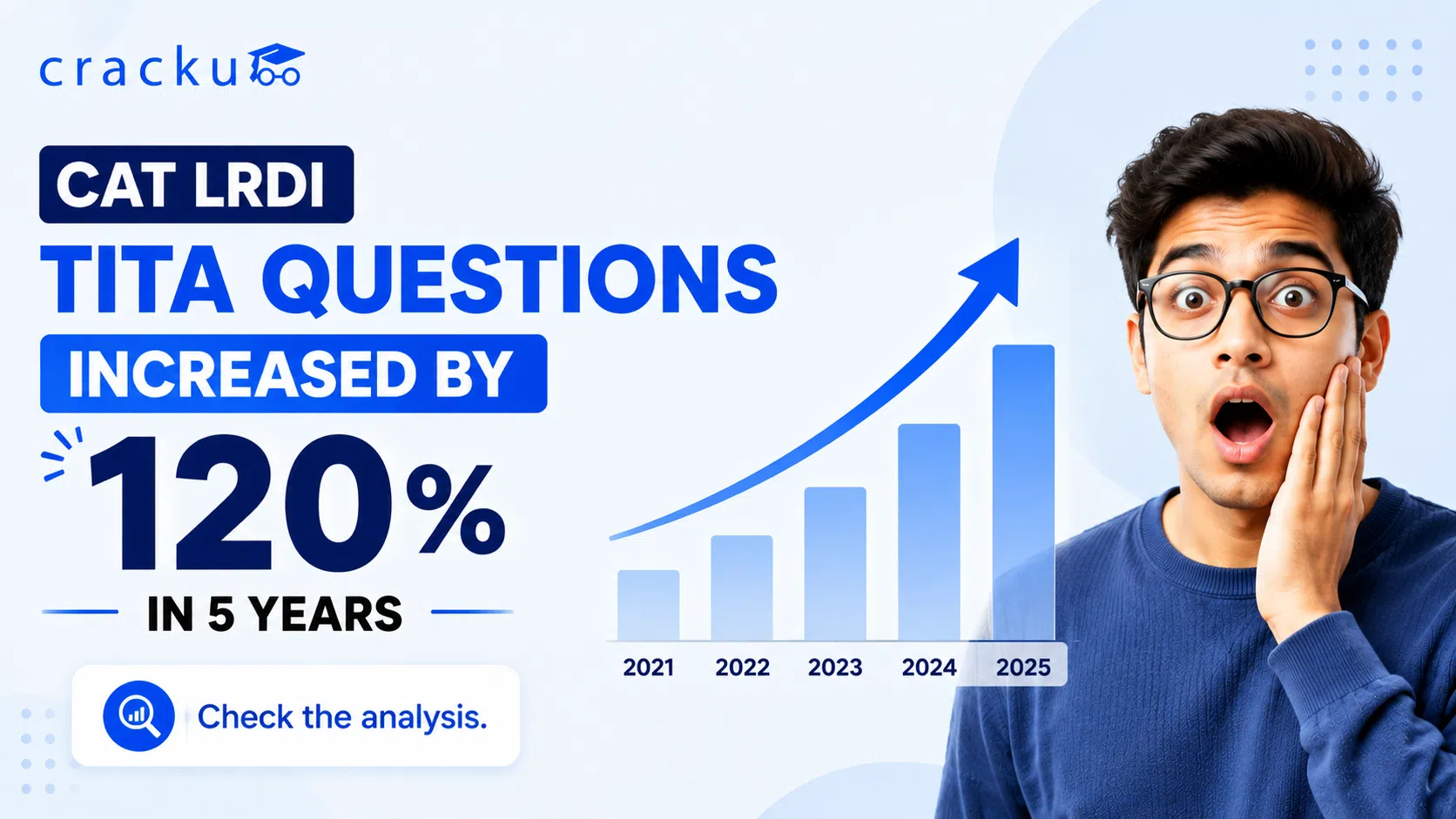
Most CAT aspirants know LRDI TITA questions carry no negative marking. What very few have done is actually sit with five years of previous year papers and study what those answers look like, which set types produce them, and whether there is a pattern worth using on exam day. This blog does exactly that.
Check the below pdf to know the frequency of each TITA answer in last 5 years across slots.
CAT LRDI TITA Frequency Table PDF
How Many TITA Questions Appear in CAT LRDI Each Year?
Before looking for patterns, here is the baseline.
Year | Total LRDI Questions | MCQs | TITA Questions | TITA % of LRDI |
2021 | 20 | 15 | 5 | 20% |
2022 | 20 | 14 | 6 | 30% |
2023 | 20 | 12 | 8 | 40% |
2024 | 22 | 12 | 10 | 45.45% |
2025 | 22 | 11 | 11 | 50% |
Unlike the Quant TITA questions, where the count has been locked at 8 for five straight years, LRDI tells a very different story. The number of TITA questions has been steadily rising - from just 5 in 2021 to 11 in 2025, which is now exactly half of all LRDI questions. IIMs have been deliberately moving away from MCQs in LRDI, likely to reduce the advantage of back-substitution and option elimination.
Check the below pdf for all LRDI TITA Questions with Answers in the last 5 years
CAT LRDI TITA Questions and Answers PDF
Which Set Types Produce the Most TITA Questions?
Not all LRDI set types produce TITA questions equally. Based on previous year paper analysis across 2021-2025, here is how set types behave.
Set Type | Examples from PYQs | TITA Questions per Set (Typical) | Overall TITA Frequency |
Player ratings, Number of rounds/players, Score in specific round | 2-3 per set | Very High | |
Maximum/Minimum concept in 3/4 set venn | 2-3 per set | Very High | |
Number of people sitting between X & Y | 1-2 per set | High | |
Logic/Certainty | "How many can be determined with certainty?" | 1 per set | Moderate |
Rank or Count Based | 1 per set | Moderate |
Games & Tournaments and Certainty (type questions in sets) are the most TITA-heavy. This makes sense structurally - questions like "how many items did X sell?" or "what was Y's score?" have specific numerical answers that are least likely to be reverse-engineered from options. Arrangement-based sets are also there but slightly less TITA-heavy.
What Do CAT LRDI TITA Answers Actually Look Like?
This is where LRDI differs significantly from Quant. In Quant, TITA answers can range from single digits to four-digit numbers depending on the topic. In LRDI, the range is far more compressed.
Looking at all LRDI TITA answers from 2021 to 2025:
Answer Range | Frequency | Typical Question Type |
0 to 9 | Very high (~53%) 2,3,4 & 6 - Most repeated | Specific Rounds / Ranking / Teams in Games & Tournament, Logic / Certainty. |
10 to 99 | Moderate (~36%) 40 - Most repeated | Number of people, Item counts, Group sizes |
100 to 999 | Low (~6%) | Registration counts, Total Items / Time / Distances. |
1000 and above | Rare (~5%) | Money spent, Travel costs |
The single most important practical observation: over half of all LRDI TITA answers in the last five years are single-digit numbers between 0 and 9.
CAT LRDI TITA Answer Patterns Set-Type Wise in the Last 5 Years
Here is a more granular breakdown based on the actual PYQ data, mapped to specific question formats within each set type.
Set Type | Question Sub-type | Typical Answer Range | Answer Usually... |
Games & Tournament | Individual score at end of round | 0 - 100 | Small integer (0 - 20 common) |
Players / Teams in a specific round | 0 - 10 | Single digit | |
Seating & Arrangement | Seat / Position number | 1 - 20 | Single digit |
Position of a person with respect to other | 0 - 5 | Single digit | |
Venn Diagram | Maxima / Minima Concept in 3/4 set venn | Varies | Depends on question type. |
Logic / Certainty | "How many can be determined?" | 0 - 10 | 2, 3, or 4 most common |
Scheduling | Slots / Visa / Process scheduling | 10 - 100 | Integer |
Counting | Number of items sold / places visited | 0 - 50 | Small integer |
Total money spent / received by someone | 100 - 1000 | 2-digit integer |
One pattern specific to LRDI that you won't see in Quant: the answer 0 appears frequently. “How many employees changed groups more than once?" (Answer: 0) .
So, it is advisable to always make calculative guesses when you don’t have enough time to solve a set.
Key Patterns in CAT LRDI TITA Answers Across 5 Years
After going through five years of data, these are the clearest patterns:
1. The count has seen consistent increase since 2021: Every year, LRDI has seen an increase in the number of questions in TITA.
2. Single-digit answers dominate: More than half of all LRDI TITAs produce answers between 0 and 9. This is your primary sanity check. A three-digit answer on an LRDI TITA is possible but rare - mostly limited to numerical calculation sets involving money, distance, or totals.
3. Scoring and counting sets are your best TITA opportunities: These sets consistently produce clean, verifiable answers. If you have cracked the set logic, the TITA answer is straightforward to get right.
4. The answer 0 is legitimate and appears regularly: Do not assume a zero means you have made a mistake. CAT setters deliberately build conditions where nothing qualifies. If your work says zero, check once and submit.
5. Clean round numbers in numerical sets: When a TITA question involves ticket counts, money, or distances, the answer almost always comes out to a multiple of 5, 10, or 50.
6. TITA questions are usually the hardest in their set: Unlike Quant, where TITA and MCQ difficulty can be similar, in LRDI the TITA question is typically the one that requires the most complete understanding of the set. It often appears last in the question sequence for a reason - you need everything else solved before you can answer it.
Should You Attempt LRDI TITA Questions Without Completing the Full Set?
In Quant, you can pick up a TITA question, read it, solve it independently, and submit. In LRDI, a TITA question almost never exists in isolation. The answer depends on the full set solution. So the real decision is not "should I attempt this TITA?" - it is "should I invest time in this set, knowing it has a TITA inside?"
Here is how to think about it:
Attempt the set first if: The set has a clear, structured premise (seating, scheduling, scoring) and the TITA question is a counting or certainty question ("how many can be determined?"). These are the most predictable and reward complete set solving.
Be cautious if: The set involves multi-step calculations across many entities, or highly conditional logic. Even if you crack the set, the TITA question might require an extra layer of work.
Use the answer range as a check: Once you have an answer, do check the conditions again to be sure. Most LRDI TITAs should give you something between 0 and 10.
One thing that works in your favour: Since LRDI TITAs tend to cluster in sets with scoring and counting, if you are good at those set types, you are sitting on a disproportionate number of TITA opportunities with no downside. Used correctly, cracking two or three such sets completely, TITAs included, can add 6-9 marks to your LRDI score with zero negative marking risk.