 91- 6303239042
What is the percentage increase in investment of B, C, D and E from year 1 to year 3?
Sign in
Please select an account to continue using cracku.in
↓ →
 CAT WhatsApp Group
Direction for questions: Answer the questions based on the following information. The data given in the table shows the investment details in country ‘Fortune Land’ of companies A, B, C, D, E and F. Figures in the table are in US dollars in billions.

What is the percentage increase in investment of B, C, D and E from year 1 to year 3?
Total investment by B, C, D and E in year 1 = 24.11 Billion
Total investment by B, C, D and E in year 3 = 77.4 Billion
Increase = 77.4 - 24.11 = 53.29 Billion
% Increase = $$\frac{53.29}{24.11}*100$$ = 221%
What is the ratio of investments of E to F for the years 1 to 3?
Total investment of E = 57.8 Billion
Total investment of F = 93.2 Billion
Ratio = 57.8 : 93.2 = 19:31
What is D’s contribution as a percentage of total investments in year 2?
Total contribution in year 2 = 6.7 + 7.5 + 12.5 + 5.6 + 17.4 + 25.3 = 75 billion
Contibution by D in year 2 = 5.6
% contribution by D = $$\frac{5.6}{75}*100$$ = 7.4%

For which company is investment not increased from year 1 to year 3?
Investment has increased for all the companies.
By what percentage is the investments of companies D,E,F greater than the investments of companies A, B, C in year 2?
Investments of A, B and C = 6.7 + 7.5 + 12.5 = 26.7
Investments of A, B and C = 5.6 + 17.4 + 25.3 = 48.3
Difference = 21.6
% difference = $$\frac{21.6}{26.7}*100$$ = 80.8%
If a number 774958A96B is to be divisible by 8 and 9, the respective values of A and B will be
According to the divisible rule of 9, the sum of all digits should be divisible by 9.
i.e. 55+A+B = 9k
So sum can be either 63 or 72.
For 63, A+B should be 8.
In given options, option B has values of A and B whose sum is 8 and by putting them we are having a number which divisible by both 9 and 8.
Hence answer will be B.

Which of the following values of x do not satisfy the inequality $$(x^2 - 3x + 2 > 0)$$ at all?
After solving given equation, we will have inequality resolved to:
(x-1)(x-2)>0
Or we can say range of x will be as follows:
x<1; x>2
Hence, option A has a set of values which don't lie in the possible range of x.
So the answer will be A.
If a ration shop is to be set up within 2 km of each city, how many ration shops will be required?
Consider the following scenario:
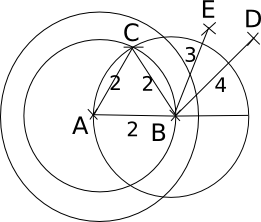
One ration shop can be set up at C, so that it covers A,C and B. Another ration shop can be set up between E and D(such that distance of the shop from either of them is not greater than 2) so that it services both E and D.
So, two ration shops are required to be set up for them to be within 2 km of each city. Option a) is the correct answer.
If a ration shop is to be set up within 3 km of each city, how many ration shops will be required?
Consider the following scenario:
So, if a ration shop is setup on the line joining A and E, just inside the 3 km radius circle, it will be within 3 km of each city.

A cube of side 12 cm is painted red on all the faces and then cut into smaller cubes, each of side 3 cm. What is the total number of smaller cubes having none of their faces painted?
Total number of cubes will be = $$\frac{12 \times 12 \times 12}{3 \times 3 \times 3}$$ = 64
Cubes with 3 sides painted = cubes at corner sides = 8
Cubes with 2 sides painted = cubes on lines = 24
Cubes with 1 sides painted = cubes on middle of surface = 24
So cubes with no side painted = 64 - (8+24+24) = 8
If ABCD is a square and BCE is an equilateral triangle, what is the measure of ∠DEC?
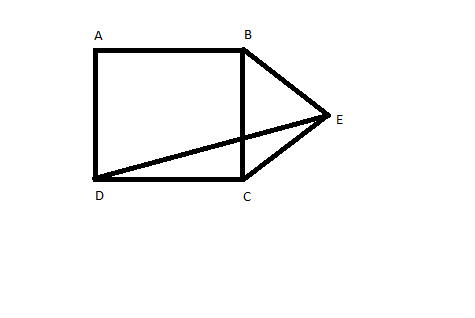
According to given diagram, as triangle BCE is equilateral CE=BE=DC
Hence angle CDE = angle CED
So angle DEC = $$\frac{180-150}{2} = 15$$
Instead of a metre scale, a cloth merchant uses a faulty 120 cm scale while buying, but uses a faulty 80 cm scale while selling the same cloth. If he offers a discount of 20%, what is his overall profit percentage?
Let's say the cost of the cloth is x rs per metre. Because of the faulty meter, he is paying x for 120 cms when buying.
So cost of 100 cms = 100x/120.
He is selling 80 cms for x, so selling price of 100cms of cloth is 100x/80.
discount = 20%
so the effective selling price is .8*100x/80= x
profit = SP-CP= x - 100x/120 = x/6
Profit % = x/6 divided by 100x/120 = 20%

From a circular sheet of paper with a radius 20 cm, four circles of radius 5 cm each are cut out. What is the ratio of the uncut to the cut portion?
Area of the large sheet =$$\pi {20}^2$$
Area of the 4 circle of sheet = $$4\pi {5}^2$$
Required ratio =[$$\pi {20}^2 - 4\pi {5}^2$$]:[$$4\pi {5}^2$$] = 4-1 = 3:1
A wooden box of thickness 0.5 cm, length 21 cm, width 11 cm and height 6 cm is painted on the inside. The expenses of painting are Rs. 70. What is the rate of painting per square centimetres?
Inside dimensions of cube are as follows:
Length = $$21 - 2*(0.5) = 20$$
Width = $$11 - 2*(0.5) = 10$$
Height = $$6 - 0.5 = 5.5$$ (As top surface is open)
So total area painted = $$2(20 \times 5.5) + 2(10 \times 5.5) + (10 \times 20)$$
$$= 220 + 110 + 200$$
$$= 530$$ sq. cm.
Cost of painting 530 sq. cm. is 70
So cost per sq. cm. = $$\frac{70}{530} = 0.1$$ (nearly)
Answer the questions based on the following information. A, S, M and D are functions of x and y, and they are defined as follows.
$$A(x, y)=x + y$$
$$S(x, y)=x-y$$
$$M(x, y)=xy$$
$$D(x,y)=\frac{x}{y}$$. $$y\neq0$$
What is the value of $$M(M(A(M(x, y),S(y, x)),x),A(y, x))$$for $$x=2, y=3$$?
Given expression can be reduced to
M ( x(xy+y-x) , (y+x) )
Or x(x+y)(xy+y-x)
After putting value of x and y , expression will reduce to a value = 70.

What is the value of $$S[M(D(A(a, b), 2), D(A(a, b), 2)), M(D(S(a, b), 2), D(S(a, b), 2))]$$?
Given expression can be reduced to:
$$S[M(\frac{a+b}{2}),(\frac{a+b}{2})), M((\frac{a- b}{2}, (\frac{a-b}{2})]$$
= $$S[(\frac{(a+b)}{2})^2, (\frac{(a-b)}{2})^2]$$
= $$(\frac{a+b}{2})^2 - (\frac{(a-b)}{2})^2 $$
= ab
The cost of diamond varies directly as the square of its weight. Once, this diamond broke into four pieces with weights in the ratio 1 : 2 : 3 : 4. When the pieces were sold, the merchant got Rs. 70,000 less. Find the original price of the diamond.
Let the original weight of the diamond be equal to $$10k$$. So, after breaking into 4 pieces, the parts of the diamond weight $$k, 2k, 3k,4k$$
The price of the diamond varies directly in proportion to the weight. Let us assume, the $$P=C*W^2$$ where $$C$$ is a constant and $$W$$ is the weight of the diamond.
Therefore, the original price is $$C*10k*10k = 100k^2*C$$
The new weight is $$Ck^2 + C(2k)^2 + C(3k)^2 + C(4k)^2 = 30k^2C$$
The decrease in the price equals 70,000. So, $$100k^2C-30k^2C = 70000$$
Or, $$k^2C = 1000$$
Therefore the original price = $$100k^2C = 100000$$
If n is any odd number greater than 1, then $$n(n^2 - 1)$$ is
Let's say n=2k+1 where k=1,2,3....
So $$n(n^2-1) = 4k(k+1)(2k+1)$$
As above expression is already divisible by 4 simultaneously $$k(k+1)(2k+1)$$ will always be divisible by 6.
Hence complete term will be divisible by 24.

The figure shows a circle of diameter AB and radius 6.5 cm. If chord CA is 5 cm long, find the area of triangle ABC.
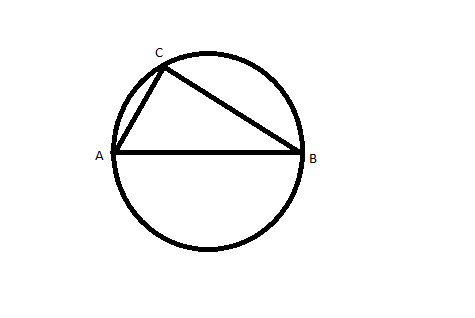
According to given dimensions, triangle will be a right angled triangle.
So BC = 12
And area = $$\frac{1}{2} \times 12 \times 5$$
= 30
Answer the questions based on the following information. A watch dealer incurs an expense of Rs. 150 for producing every watch. He also incurs an additional expenditure of Rs. 30,000, which is independent of the number of watches produced. If he is able to sell a watch during the season, he sells it for Rs. 250. If he fails to do so, he has to sell each watch for Rs. 100.
If he is able to sell only 1,200 out of 1,500 watches he has made in the season (and the rest 300 are sold out of season), then he has made a profit of
Cost price per watch = 150
Cost price for 1500 watches = $$1500 \times 150$$ = 225000
Total expense = 225000 + 30000 = 255000
Selling price for season = $$1200 \times 250$$ = 300000
For out of season = $$300 \times 100$$ = 30000
Total selling = 300000 + 30000 = 330000
Profit = 330000 - 255000 = 75000
If he produces 1,500 watches, what is the number of watches that he must sell during the season in order to break-even, given that he is able to sell all the watches produced?
Break even implies that cost price is equal to selling price
Hence let's say in season x watches were sold
Cost price will be = $$1500 \times 150 + 30000 = 255000$$
So total selling price = $$250x + (1500 -x) 100 = 255000 $$
Or $$x = 700$$

Once I had been to the post office to buy five-rupee, two-rupee and one-rupee stamps. I paid the clerk Rs. 20, and since he had no change, he gave me three more one-rupee stamps. If the number of stamps of each type that I had ordered initially was more than one, what was the total number of stamps that I had when I left the post office?
As shopkeeper gave 3 one-rupee change for 20 rs. change, Buyer must have ordered for a total of 17 rs. stamps.
Now buyer ordered for at least more than 1 stamp for each type
Hence the minimum he bought was:
2 stamp for 5 rupees = 10 rs.
2 stamp for 2 rupees = 4 rs.
2 stamp for 1 rupee = 2 rs.
For the total to be seventeen, the buyer must have purchased 3 one rupee stamps.
And 3 one rupee stamps were also there as changes given by shopkeeper.
So total number of stamps = 2+2+(3+3) = 10
In triangleABC, ∠B is a right angle, AC = 6 cm, and D is the mid-point of AC.
The length of BD is
A circle is circumscribed to triangle ABC.
For this circle D will be centre of circle, and AD , DC , BD will radius of this circle.
Hence AD=BD=DC=3 cm
Answer the questions based on the following information. A salesman enters the quantity sold and the price into the computer. Both the numbers are two-digit numbers. But, by mistake, both the numbers were entered with their digits interchanged.Although, the total sales value remained the same, i.e. Rs. 1,148, the total inventory sold got reduced by 54.
What is the actual price per piece?
Total sales value $$= 1148 = 4\cdot7\cdot41$$
Let AB be the actual price of the product and CD be the actual quantity.
Since the quantity sold reduced by 54 upon reversing
$$CD-DC\ =\ (10\cdot C+D)-\left(10\cdot D+C\right)=9\cdot\left(C-D\right)$$
wkt, $$9\cdot\left(C-D\right)=54\ \ \longrightarrow\ \ C-D=6$$
Now, wkt, $$AB\cdot CD=1148\ \ \&\ \ BA\cdot DC=1148$$
The possible values of CD are $$93$$, $$82$$, & $$71$$
Since only 82 divides 1148, $$CD=82$$, Therefore, $$AB=14$$
Actual price and Actual quantity are 14 and 82 respectively.
Alternatively,
Since final value $$= 1148 = 4\cdot7\cdot41$$ remains the same,
1148 can be represented as product of interchangeable numbers i.e. $$41 \times 28$$ and $$82 \times 14$$
As inventory sold reduced by 54, so, the entry of quantity sold should be 28 and price entry will be 41, and hence, actual price has to be 14 and actual sales volume has to be 82.

What is the actual quantity sold?
Total sales value $$= 1148 = 4\cdot7\cdot41$$
Let AB be the actual price of the product and CD be the actual quantity.
Since the quantity/inventory increased by 54 upon reversing
$$CD-DC\ =\ (10\cdot C+D)-\left(10\cdot D+C\right)=9\cdot\left(C-D\right)$$
wkt, $$9\cdot\left(C-D\right)=54\ \ \longrightarrow\ \ C-D=6$$
Now, wkt, $$AB\cdot CD=1148\ \ \&\ \ BA\cdot DC=1148$$
The possible values of CD are $$93, 82 $$ & $$ 71$$
Since only 82 divides 1148, $$CD=82$$, Therefore, $$AB=14$$
Actual price and Actual quantity are 14 and 82 respectively.
Alternatively,
Since final value $$= 1148 = 4\cdot7\cdot41$$ remains the same,
1148 can be represented as product of interchangeable numbers i.e. $$41 \times 28$$ and $$82 \times 14$$
As inventory decreased by 54, so, the quantity sold should be 82 and actual price will be 14.
In a locality, two-thirds of the people have cable TV, one-fifth have VCR, and one-tenth have both. What is the fraction of people having atleast one among cable -TV and VCR?
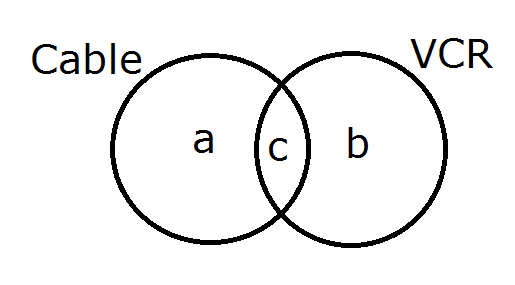
Let the distribution of people having cable TV and VCR be as given in the diagram above.
Hence, $$a+c =\frac{2}{3}$$
$$b+c=\frac{1}{5}$$
and $$c=\frac{1}{10}$$
We need to find $$a+b+c=?$$
This equals $$(a+b)+(b+c)-c = \frac{2}{3}+\frac{1}{5}-\frac{1}{10}$$
Which equals $$\frac{20+6-3}{30}=\frac{23}{30}$$
Find the value of $$\dfrac{1}{1 + \dfrac{1}{3-\dfrac{4}{2+\dfrac{1}{3-\dfrac{1}{2}}}}}$$ + $$\dfrac{3}{3 - \dfrac{4}{3+\dfrac{1}{2-\dfrac{1}{2}}}}$$
$$\frac{1}{1 + \frac{1}{3-\frac{4}{2+\frac{1}{3-\frac{1}{2}}}}}$$
=$$\frac{1}{1 + \frac{1}{3-\frac{4}{2+\frac{1}{\frac{5}{2}}}}}$$
=$$\frac{1}{1 + \frac{1}{3-\frac{4}{2+\frac{2}{5}}}}$$
=$$\frac{1}{1 + \frac{1}{3-\frac{20}{12}}}$$
=$$\frac{1}{1 + \frac{1}{3-\frac{20}{12}}}$$
=$$\frac{1}{1 + \frac{12}{16}}$$
=$$\frac{1}{\frac{28}{16}}$$
=$$\frac{16}{28}$$
Similarly, Second term can be reduced to $$\frac{33}{21}$$ or $$\frac{11}{7}$$
Sum will be = $$\frac{11}{7}$$ + $$\frac{4}{7}$$ = $$\frac{15}{7}$$

Given the quadratic equation $$x^2 - (A - 3)x - (A - 2)$$, for what value of $$A$$ will the sum of the squares of the roots be zero?
For summation of square of roots to be zero, individual roots should be zero.
Hence summation should be zero i.e. A-3=0 ; A = 3
And product of roots will also be zero i.e. A-2 = 0 ; A =2
So there is no unique value of A which can satisfy above equation.
The figure shows the rectangle ABCD with a semicircle and a circle inscribed inside in it as shown. What is the ratio of the area of the circle to that of the semicircle?

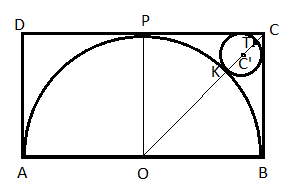
Let the center be O and the point at which the semicircle intersects CD be P.
Let the radius of the semicircle be R and the circle be r.
OP = R and OC = R$$\sqrt{2}$$
OC - OT = CC' - TC'
$$R\sqrt{2} - R - 2r$$ = $$r\sqrt{2} - r$$
=> $$R\sqrt{2} - R$$ = $$r\sqrt{2} + r$$
=> r = $$\frac{(\sqrt{2}-1)R}{\sqrt{2}+1}$$
=> r = $$(\sqrt{2}-1)^2$$R
Ratio of areas will be $$r^2 : \frac{R^2}{2}$$ = $$2(\sqrt{2}-1)^4$$ : 1
I bought 5 pens, 7 pencils and 4 erasers. Rajan bought 6 pens, 8 erasers and 14 pencils for an amount which was half more what I had paid. What per cent of the total amount paid by me was paid for the pens?
Let the cost of pen, pencil and eraer be x,y,z respectively
5x+7y+4z = A
6x+8z+14y = 3A/2
4x + 16/3 z + 28/3 y = A
Comparing two equations
5x+7y+4z = 4x+16/3 z + 28/3 y
x = 7/3 y + 4/3 z
3x = 7y+4z
Now required percentage = $$\frac{5x}{5x+7y+4z}\times100=\frac{5x}{5x+3x}=62.5$$%

In a mile race, Akshay can be given a start of 128 m by Bhairav. If Bhairav can give Chinmay a start of 4 m in a 100 m dash, then who out of Akshay and Chinmay will win a race of one and half miles, and what will be the final lead given by the winner to the loser? (One mile is 1,600 m.)
Akshay can complete 1600 - 128 = 1472 m and Bhairav can completer 1600 m in the same time.
Bhairav can complete 100 m and Chinmay can complete 96 m in the same time.
=> Bhairav can complete 1600 m and Chinmay can complete 1536 m in the same time.
=> Akshay can complete 1472 m and Chinmay can complete 1536 m in the same time.
1.5 miles => 2400 m
Distance travelled by Akshay by the time Chinmay completes 1.5 miles = $$\frac{1472}{1536}*2400$$ = 2300 m
=> Akshay lost by 100 m, which is $$\frac{1}{16}th$$ of a mile.
Two liquids A and B are in the ratio 5 : 1 in container 1 and 1 : 3 in container 2. In what ratio should the contents of the two containers be mixed so as to obtain a mixture of A and B in the ratio 1 : 1?
Fraction of A in contained 1 = $$\frac{5}{6}$$
Fraction of A in contained 2 = $$\frac{1}{4}$$
Let the ratio of liquid required from containers 1 and 2 be x:1-x
x($$\frac{5}{6}$$) + (1-x)($$\frac{1}{4}$$) = $$\frac{1}{2}$$
$$\frac{7x}{12}$$ = $$\frac{1}{4}$$
=> x = $$\frac{3}{7}$$
=> Ratio = 3:4
A man travels three-fifths of a distance AB at a speed 3a, and the remaining at a speed 2b.If he goes from B to A and return at a speed 5c in the same time, then
$$\frac{\frac{3x}{5}}{3a} + \frac{\frac{2x}{5}}{2b} = \frac{2x}{5c}$$
(Where x is distance between A and B; $$\frac{\frac{3x}{5}}{3a}$$ = time taken to cover the distance with speed 3a ; $$\frac{\frac{2x}{5}}{2b}$$ = time taken to cover the distance with speed 2b; $$\frac{2x}{5c}$$ = time taken to cover the distance x from B to A then return.)
$$\frac{\frac{3x}{5}}{3a} + \frac{\frac{2x}{5}}{2b} = \frac{2x}{5c}$$
Or $$\frac{1}{a} + \frac{1}{b} = \frac{2}{c}$$

A man travels from A to B at a speed x km/hr. He then rests at B for x hours. He then travels from B to C at a speed 2x km/hr and rests for 2x hours. He moves further to D at a speed twice as that between B and C. He thus reaches D in 16 hr. If distances A-B, B-C and C-D are all equal to 12 km, the time for which he rested at B could be
Total time taken to reach at D:
$$\frac{12}{x} + x + \frac{12}{2x} + 2x + \frac{12}{4x} = 16$$
Or $$3x^2 - 16x + 21 = 0$$
From the options we can see that only, $$x$$ = 3hr satisfies the equation. Thus, A is the right choice.
Out of two-thirds of the total number of basketball matches, a team has won 17 matches and lost 3 of them. What is the maximum number of matches that the team can lose and still win more than three- fourths of the total number of matches, if it is true that no match can end in a tie?
Total matches played = 17+3 = 20
Total matches = 20*$$\frac{3}{2}$$ = 30
Number of wins required = 75% of 30 = 22.5 = 23 wins
23-17 = 6 more wins are required out of 10 matches to maintain 75% win recor which means there would be 4 losses.
The price of a Maruti car rises by 30% while the sales of the car come down by 20%. What is the percentage change in the total revenue?
let's say price of maruti car is x rs.
Sales = y
revenue = xy
Changed price = 1.3x
changed value of sales = 0.8y
new revenue = 1.04 xy
Percentage change in revenue = 4%

The points of intersection of three lines $$2x+3y-5=0, 5x-7y+2=0$$ and $$9x-5y-4=0$$
For points to be coincident, value of determinant should not be equal zero, so that they have a unique value of system.
Here value of determinant is not equal to zero, simultaneously not any two lines are parallel or perpendicular.
So system has a unique value
Hence points are coincident.
A man has 9 friends: 4 boys and 5 girls. In how many ways can he invite them, if there has to be exactly 3 girls in the invitees?
Selecting 3 girls from 5 girls can be done in $$^5C_3$$ ways => 10 ways
Each of the boys may or may not be selected => 2 * 2 * 2 * 2 = 16 ways
=> 16 * 10 = 160 ways
In a watch, the minute hand crosses the hour hand for the third time exactly after every 3 hr 18 min and 15s of normal time. What is the time gained or lost by this watch in one day?
In a normal watch, the minute hand crosses the hour's hand after every 1 hour 5 minutes and 27 seconds.
So, the third time the hour's hand crosses the minute's hand is after 3 hours 16 minutes and 21 seconds.
In this watch, the time taken for this to happen is 3 hours 18 minutes and 15 seconds.
Hence, the watch loses 1 minute and 54 seconds after every 3 hours 18 minutes and 15 seconds.
18 minutes and 15 seconds = 1095 seconds = 1095/3600 $$\approx$$ .304 hours.
=> 3 hours 18 minutes and 15 seconds = 3.304 hours
So, time lost in a day is $$1\frac{54}{60}*\frac{24}{3.304} = \frac{114}{60}*\frac{24}{3.304} \approx 13.8$$
So, the time lost by the watch in a day is approximately equal to 13 minutes and 48 seconds.

I sold two watches for Rs. 300 each, one at the loss of 10% and the other at the profit of 10%. What is the percentage of loss(-) or profit(+) that resulted from the transaction?
Selling price of first watch = 300
Profit = 10%
cost price = $$\frac{300}{1.1}$$
Selling price of second watch = 300
Loss = 10%
cost price = $$\frac{300}{0.9}$$
Total selling price of transaction= 600
Total cost price of transaction = $$300(\frac{10}{11} + \frac{10}{9}) = 600 (\frac{100}{99})$$
Loss = $$600 (\frac{100}{99} - 1)$$
%loss = $$(600 (\frac{100}{99} - 1)) \div (600(\frac{100}{99})) \times 100 = 1$$
Answer the questions based on the following information. A series $$S_{1}$$ of five positive integers is such that the third term is half the first term and the fifth term is 20 more than the first term. In series $$S_{2}$$, the nth term is defined as the difference between the (n+1)th term and the nth term of series $$S_{1}$$, $$S_{2}$$ is an arithmetic progression with a common difference of 30.
First term of $$S_{1}$$ is
Assume the first series as a,b,a/2,c,a+20
and second series as x1,x2,x3,x4
x1=b-a, x2= a/2-b, x3=c-a/2, and x4=a+20-c
x2-x1=30 => 3a-4b=60
and x4-x3=30 => 3a-4c=20
and x4-x2=60 => a-2c+2b=80
Solving we get, a=100, b=60, and c=70
S1= 100,60,50,70,120
S2 = -40, -10, 20, 50
Fourth term of $$S_{2}$$
Assume the first series as a,b,a/2,c,a+20
and second series as x1,x2,x3,x4
x1=b-a, x2= a/2-b, x3=c-a/2, and x4=a+20-c
x2-x1=30 => 3a-4b=60
and x4-x3=30 => 3a-4c=20
and x4-x2=60 => a-2c+2b=80
Solving we get, a=100, b=60, and c=70
S1= 100,60,50,70,120
S2 = -40, -10, 20, 50

What is the difference between fourth terms of $$S_{1}$$ and $$S_{2}$$ ?
Assume the first series as a,b,a/2,c,a+20
and second series as x1,x2,x3,x4
x1=b-a, x2= a/2-b, x3=c-a/2, and x4=a+20-c
x2-x1=30 => 3a-4b=60
and x4-x3=30 => 3a-4c=20
and x4-x2=60 => a-2c+2b=80
Solving we get, a=100, b=60, and c=70
S1= 100,60,50,70,120
S2 = -40, -10, 20, 50
Difference = 20
What is the average value of the terms of series $$S_{1}$$?
Assume the first series as a,b,a/2,c,a+20
and second series as x1,x2,x3,x4
x1=b-a, x2= a/2-b, x3=c-a/2, and x4=a+20-c
x2-x1=30 => 3a-4b=60
and x4-x3=30 => 3a-4c=20
and x4-x2=60 => a-2c+2b=80
Solving we get, a=100, b=60, and c=70
S1= 100,60,50,70,120
S2 = -40, -10, 20, 50
Avg. = $$(100+60+50+70 +120) \div 5 = 80$$
What is the sum of series $$S_{2}$$?
Assume the first series as a,b,a/2,c,a+20
and second series as x1,x2,x3,x4
x1=b-a, x2= a/2-b, x3=c-a/2, and x4=a+20-c
x2-x1=30 => 3a-4b=60
and x4-x3=30 => 3a-4c=20
and x4-x2=60 => a-2c+2b=80
Solving we get, a=100, b=60, and c=70
S1= 100,60,50,70,120
S2 = -40, -10, 20, 50
Sum = 20

Answer the questions based on the following information.
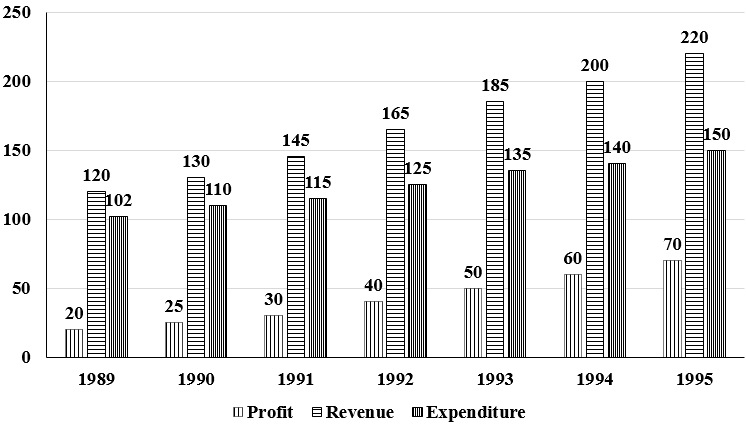
The average revenue collected in the given 7 years is approximately
Average will be = $$(120 + 130 + 145 + 165 + 185 + 200 + 220) \div 7 = 166$$ (nearly)
The expenditure for the 7 years together form what per cent of the revenues during the same period?
Total expenditure = 102 + 110 + 115 + 125 + 135 + 140 + 150 = 877
Total revenue = 120 + 130 + 145 + 165 + 185 + 200 + 220 = 1165
%expenditure to revenue = $$\frac{877}{1165} \times 100$$ = 75 (nearly)
Which year showed the greatest percentage increase in profit as compared to the previous year?
percentage increase in profit in year 1990 = 25%
in 1991 = 20%
in 1992 = 33.33%
in 1993 = 25%
in 1994 = 20%
in 1995 = 16.66%
So highest %increase is in year 1992.

In which year was the growth in expenditure maximum as compared to the previous year?
%increase in expenditure in year 1990 = above 7 but lower than 8
in year 1991 = near to 4
in year 1992 = above 8
in year 1993 = 8%
in year 1994 = lower than 4
in year 1995 = above 7 but lower than 8
Hence highest percentage increase is in year 1992
If the profit in 1996 shows the annual rate of growth as it had shown in 1995 over the previous year, then what approximately will be the profit in 1996?
%increase in profit in year 1995 = 16.66%
With this increment, profit in year 1996 = 70(1+$$(16.66 \div 100)$$) = 82 (nearly)
Answer the questions based on the following information, which gives data about certain coffee producers in India.

What is the maximum production capacity (in '000 tonnes) of Lipton for coffee?
Percentage capacity of production for Lipton coffee = 64.8%
Let's say maximum production = $$x$$
So 1.64 = $$x \times \frac{64.8}{100}$$
or $$x = 2.53$$

Which company out of the four companies mentioned above has the maximum unutilised capacity (in '000 tonnes)?
Maximum unutilized capacity => Minimum unitized capacity
MAC has the least utilized capacity.
What is the approximate total production capacity (in ‘000 tonnes) for coffee in India?
Let's total coffee production is = x
So $$x \times \frac{61.3}{100} = 11.6$$
x = 18.9 (nearly)
Among the four brands, the highest price for coffee per kilogram is for
The price per kilogram sales of each of the four brands is given below.
Brooke Bond - Rs. 122.16
Nestle - Rs. 131.77
Lipton - Rs. 121.03
MAC - Rs. 118.71
Hence, the correct answer is Nestle

What percent of the total market share (by sales value) is controlled by ‘others’?
Summation of sales value of all coffees (excluding others) = 31.15 + 26.75 + 15.25 + 17.45 = 90.6
Total value = 132.8
Others = 132.8 - 90.6 = 42.2
% share for others = $$ \frac{42.2}{132.8} \times 100 $$ = 31.77 $$\approx$$ 32
Answer the questions based on the following information. Mulayam Software Co., before selling a package to its clients, follows the given schedule.
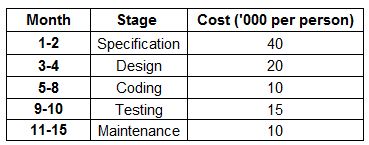
The number of people employed in each month is:

Due to overrun in ‘design’, the design stage took 3 months, i.e. months 3, 4 and 5. The number of people working on design in the fifth month was 5. Calculate the percentage change in the cost incurred in the fifth month. (Due to improvement in ‘coding’ technique, this stage was completed in months 6-8 only.)
In given table, value of cost for 5th month = $$(N) \times (C)$$ (No.of employer for 5th month = N and cost per person for 5th month = C)
So value of cost for 5th month before overrun = $$4 \times 10 = 40$$
value of cost for 5th month after overrun = $$ 5 \times 20 = 100 $$
Change = 60
%change = $$\frac{60}{40} \times 100$$ = 150
With reference to the above question, what is the cost incurred in the new ‘coding’ stage? (Under the new technique, 4 people work in the sixth month and 5 in the eighth.)
As coding is done in 6-8 months,
So total person employed = 4+5+5 = 14
cost per person for 6-8 month = 10000
Total cost will be = $$(14 \times 10000)$$ = 140,000

What is the difference in cost between the old and the new techniques?
In new technique, increment in 5th month cost ('000) = $$(5 \times 20 - 4 \times 10)$$ = 60
Under the new technique, which stage of software development is most expensive for Mulayam Software Co.?
Total incurred cost for testing = $$(4+1)\times 15 = 75$$
Incurred cost for specification = $$(2+3) \times 40 = 200$$
Incurred cost for coding = $$(4+5+5) \times 10 = 140$$
Incurred cost for design = $$(3+4+5) \times 20 = 240$$
Hence design is most expensive for the company.
Which five consecutive months have the lowest average cost per man-month under the new technique?
Lowest cost per person is for coding and maintenance i.e. 10 rs.
But for consecutive five months avg. for coding and any other will be more than consecutive 5 months for maintenance.
So avg. cost for five months of maintenance is = $$\frac{(3+3+1+1+1) \times 10}{9} = 10$$
Which is lowest among all others

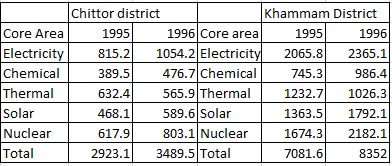
By what per cent was the total investment in the two districts more in 1996 as compared to 1995?
Total investment in 1996 = 3489.5 + 8352 = 11841.5
Total investment in 1995 = 7081.6 + 2923.1 = 10004.7
change = 1836.8
%change = $$\frac{1836.8}{10004.7} \times 100 $$
As we can see with apprximation method that above value will be less than 20 and more than 18
Hence most appropriate answer will be D) = 18
The investment in electricity and thermal energy in 1995 in these two districts formed what per cent of the total investment made in that year?
Total investment in year $$1995 = 7081.6 + 2923.1 = 10004.7$$
Total electricity and thermal invesment in year 1995 for both villages = $$815.2 + 632.4 + 2065.8 + 1232.7 = 4726.1$$
Percentage investment = $$\frac{4726.1}{10004.7} \times 100$$
Through approximation method, we can say that above value will be less than 50 and more than 47
Hence among all options, B will be most appropriate answer.
In Khammam district, the investment in which area in 1996 showed the highest percentage increase over the investment in that area in 1995?
In Electricity, the increase in investment is 300, which is less that 15%.
In Chemical, the increase is 241.1, which is greater than 32%.
In Thermal, there was a decrease in investment.
In Solar, the increase is 428.6, which is less than 32%.
In Nuclear, the increase in investment is 507.8, which is less than 31%.
Hence, the investment is the highest in chemical core area.
Approximately how many times was the total investment in Chittoor to the total investment in Khammam?
Total investment in chittoor = 2923.1 + 3489.5 = 6412.6
Total investment in khammam = 7081.6 + 8352 = 15433.6
Ratio = $$15433.6 \div 6412.6 = 2.4$$ (nearly)
If the total investment in Khammam shows the same rate of increase in 1997, as it had shown from 1995 to 1996, what approximately would be the total investment in Khammam in 1997?
Increase in 1996 compared to 1995 for khammam = 8352 - 7081.6 = 1270.4
With approximation method, we can say that %increase is above 17 and lower than 18.
Hence for 1997 investment will be have an increment of 18% nearly
So in 1997, investment = $$8352 (1+ \frac{18}{100}) = 9855$$ crore (nearly)
Answer the questions based on the following graph.
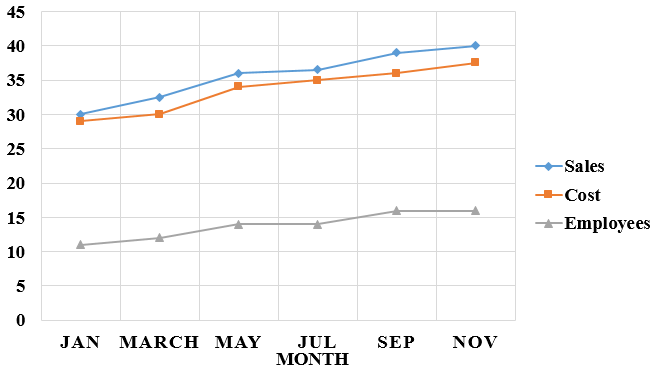
Employess in thousand Sales - cost = profit
(all values are integers)
Which month records the highest profit percentage?
As it is given that profit = sales - cost
So profit for september = $$\frac{3}{36} \times 100$$ = 8% (Nearly)
profit for march = $$\frac{3}{30} \times 100$$ = 10% (nearly)
profit for july = $$\frac{2}{35} \times 100$$ < 10%
profit for may = $$\frac{2}{36} \times 100$$ <10%
So highest percentage profit is for march month.
In which month is the total increase in the cost highest as compared to two months ago?
In the diagram, we can see the sudden increase in MAY, and there was no such increase again during the given period.
Hence, May is the answer.
In which month is the percentage increase in sales two months before, the highest?
This percentage is maximum in May which is equal to $$\frac{36-32}{32} = 1/8$$/
Which month has the highest profit per employee?
The profit per employee will be hishest when the ratio of profit to the number of employees is the highest. It happens in march and the value is $$\frac{33-30}{12} = \frac{1}{4}$$
Assuming that no employees left the job, how many more people did the company take on in the given period?
We can see that the end value is a little more than 15000 but not more than 16000.
So the increase in number of employees is between 5000 to 6000.
According to the options, it is 5800.
Answer the questions based on the following information. The first table gives the percentage of students in MBA class, who sought employment in the areas of finance, marketing and software. The second table gives the average starting salaries of the students per month, (rupees in thousands) in these areas. The third table gives the number of students who passed out in each year.
Table 1:

Table 2:

Table 3:

The number of students who get jobs in finance is less than the students getting marketing jobs, in the 5 years, by
Percentage of students more in marketing jobs than in finance jobs are 14%, 31%, 20%, 18% and 0% in 1992, 1993, 1994, 1995 and 1996 respectively.
=> Number of people = 14*800/100 + 31*650/100 + 20*1100/100 + 18*1200/100 = 112 + 202 + 220 + 216 = 750
What is the percentage increase in the average salary of finance from 1992 to 1996?
Finance salary increase = 9810 - 5450 = 4360
% increase = $$\frac{4360}{5450}*100$$ = 80%
The average annual rate at which the initial salary offered in software increases is
Total increase in 4 years = 8640 - 5290 = 3350
% increase = $$\frac{3350}{8640}$$ = 63.3%
Average per-year growth = 63.3/4 = 15.9%
What is the average monthly salary offered to a management graduate in 1993?
As we do not know the average salary for students who did not pursue Finance, Marketing or Software jobs, we cannot find the average salary of all the students in 1993.
Hence, a unique value cannot be determined.
In 1994, students seeking jobs in finance earned ___ more than those opting for software (per annum).
Number of students in 1994 passed out = 1100.
Number of students in 1994 from finance = 23% of 1100 = 23*11
Number of students in 1994 from software = 21% of 1100 = 21*11
Difference in salary = 12(23*11*7550-21*11*7050) = 3379200 = 33.8 lakhs
Each question is followed by two statements, I and II. Mark the answer
A tractor travelled a distance 5 m. What is the radius of the rear wheel?
I. The front wheel rotates ‘N’ times more than the rear wheel over this distance.
II. The circumference of the rear wheel is ‘t’ times that of the front wheel.
In either of the statements, a numerical value is not given.
With the given information, we can only find the radius in terms of N and T.
Hence, the radius cannot be determined using both the statements as well.
What is the ratio of the two liquids A and B in the mixture finally, if these two liquids kept in three vessels are mixed together? (The containers are of equal volume.)
I. The ratio of liquid A to liquid B in the first and second vessel is 3 : 5, 2 : 3 respectively.
II. The ratio of liquid A to liquid B in vessel 3 is 4:3.
The proportions of liquid A in vessels 1, 2 and 3 are $$\frac{3}{8}$$, $$\frac{2}{5}$$ and $$\frac{4}{7}$$ respectively.
LCM of 8, 5 and 7 is 280 => Assume each container ha 280 litres.
=> Quantity of liquid A in vessels 1, 2 and 3 are 105, 112 and 160 respectively.
=> Total volume of A = 377 litres
Total volume of B = 840 - 377 = 463 litres
Hence, ratio can be found using both the statements and neither statement alone can be used to find the ratio.
If a,b and c areintegers,is(a-b+c)>(a+b-c)?
I. b is negative.
II. c is positive.
For (a-b+c) > (a+b-c)
Considering first statement alone
if b<0, we can't say anything affirmative about inequality as information about c is unavailable.
Considering second statement alone,
if c>0, we can't say anything about b.
Now if we consider both statement together
i.e. b<0 and c>0, then term (-b+c) will be positive and additive to a whether term (b-c) will be negative and subtracting from a.
Hence (a-b+c) > (a+b-c).
And answer will be D.
If α and β are the roots of the equation $$(ax^2+bx+c=0)$$, then what is the value of $$(α^2 +β^2)$$?
I.$$α+β=\frac{-b}{a}$$
II.$$αβ =\frac{c}{a}$$
$$(α^2 +β^2)$$ can be reduced to $$(α+β)^2 - 2(αβ)$$
Now as we can see, we need both values of (α+β) and (αβ) to solve the equation.
Hence answer will be D.
What is the cost price of the article?
I. After selling the article, a loss of 25% on cost price is incurred.
II. The selling price is three-fourths of the cost price.
Considering first statement alone:
When loss is 25% on cost price, selling price will be $$\frac{3}{4}$$th of cost price but we can't get the absolute value of cost price.
Considering second statement alone:
As this statement can also be derived from 1st statement, but we need some other informations to get value of cost price
So answer will be A.
What is the selling price of the article?
I. The profit on sales is 20%.
II. The profit on each unit is 25% and the cost price is Rs. 250.
Cosidering first statement alone:
sp = $$\frac{6cp}{5}$$ (Where cp is cost price and sp is selling price)
But nothing absolute value can be derived from this information only
Now considering second statement alone:
sp = $$\frac{5cp}{4}$$ (Where sp is selling price and cp is cost price)
cp is equals to 250 rs.
Now we can derive value of sp from above equation.
Hence answer will be C.
How many different triangles can be formed?
I. There are 16 coplanar, straight lines.
II. No two lines are parallel.
Considering given statements, we can't find an absolute number of triangles as lines in a plane can be concurrent also with several other possibilities.
So answer will be A.
What is the total worth of Lakhiram's assets?
I. A compound interest at 10% on his assets, followed by a tax of 4% on the interest, fetches him Rs. 1,500 this year.
II. The interest is compounded once every four months.
Considering statement 1 alone, together with all the information we also need information about the time period of compounding interest which is given in second statement.
Hence we can find value of assets using both the statements together.
So answer will be D.
How old is Sachin in 1997?
I. Sachin is 11 years younger than Anil whose age will be a prime number in 1998.
II. Anil's age was a prime number in 1996.
Anil's age is a prime number in both 1996 and 1998. Hence, Anil's age in 1996 and 1998 are twin primes ( Prime numbers that differ by 2). Anil's age in 1996 and 1998 can be (11,13),(17,19) ,(29,31),.......and so on. Since a unique set cannot be determined, option A is the right answer.
What is the number of type-2 widgets produced, if the total number of widgets produced is 20,000? The company produces only two types of widgets.
I. If the production of type-1 widgets increases by 10% and that of type-2 decreases by 6%, the total production remains the same.
II. The ratio in which type-1 and type-2 widgets are produced is 2 : 1.
Considering 1st statement alone:
When total number of widgets is 20000
let's say share of type-1 = x
and share of type-2 = y
So x+y = 20000
and 1.1x+0.94y = 20000
Hence we can find value of x and y by statement 1 alone.
Now considering second statement alone;
$$x+y = 20000$$
$$\frac{x}{y} = \frac{2}{1}$$
Hence with second statement also, we can find value of x and y
So answer will be B.
Arrange the four sentences so that all six together make a logical paragraph.
1. It doesn't take a highly esteemed medical expert to conclude that women handle pain better than men.
A. First the men would give birth, and then take six months to recover.
B. As for labour pains, the human species would become extinct if men had to give birth.
C. They do, however, make life hell for everyone else with their non-stop complaining about how bad they feel.
D. The men in my life, including my husband and my father, would not take a Tylenol for pain even if their lives depend on it.
6. And by the time they finish sharing their excruciating experience with their buddies, all reproduction would come to a halt.
C has to follow a sentence that makes it clear if men were being referred to or women. So, it can't be the first line. This rules out option C. Sentences A and B talk about reproduction and hence would be the last two sentences before 6. This rules out options A and D. So, B is the correct choice.
Arrange the four sentences so that all six together make a logical paragraph.
1. A few years ago, hostility towards Japanese-Americans was so strong that I thought they were going to reopen the detention camps here in Kolkata.
A. Today Asians are a success story.
B. I cannot help making a comparison to the anti-Jewish sentiment in Nazi Germany when Jewish people were successful in business.
C. But do people applaud President Clinton for improving foreign trade with Asia?
D. Now, talk about the ‘Arkansas-Asia Connection’ is broadening that hatred to include all Asian- Americans.
6. No, blinded by jealousy, they complain that it is the Asian-Americans who are reaping the wealth.
C has to be the last sentence as 6 answers the question with a "no". D has to be the first sentence as it talks about Asian Americans as against Japanese Americans. Hence it is a continuation of 1. It also uses the term "now" as a contrast of "a few years ago" used in 1. A follows B as it used the word "today" as a contrast to Nazi Germany. Hence the correct option is A.
Arrange the four sentences so that all six together make a logical paragraph.
1. Michael Jackson, clearly no admirer of long engagements, got married abruptly for the second time in three years.
A. The latest wedding took place in a secret midnight ceremony in Sydney, Australia.
B. It is also the second marriage for the new missus, about whom little is known.
C. The wedding was attended by the groom's entourage and staff, according to Jackson's publicist.
D. The bride, 37-year-old Debbie Rowe, who is carrying Jackson's baby, wore white.
6. All that is known is that she is a nurse for Jackson's dermatologist.
B is the last sentence as the sentence 6 starts with "All that is known" and B states that very little is known about her. D and B are mandatory pairs as both talk about bride. A is the starting sentence as it throws light on wedding ceremony. The correct sequence is 1ACDB6.
Arrange the four sentences so that all six together make a logical paragraph.
1. Liz Taylor isn't just unlucky in love.
A. She, and husband Larry Fortensky, will have to pay the tab — $4,32,600 in court costs.
B. The duo claimed that a 1993 story about a property dispute damaged their reputations.
C. Taylor has just filed a defamation suit against the National Enquirer.
D. She is unlucky in law too.
6. Alas, all levels of the California court system disagreed.
D is the first sentence as it continues what 1 started ie. Liz Taylor is unlucky. C is the second sentence as it describes how Liz is unlucky in law. A has to be before B as A talks about Liz and her husband. B refers to "the duo". So, the correct order is DCAB.
1.Hiss was serving as Head of the Endowment on August 3, 1948, when Whittaker Chambers reluctantly appeared before the House Un-American Activities Committee.
A. Chambers, a portly rumpled man with a melodramatic style, had been a Communist courier but had broken with the party in 1938.
B. When Nixon arranged a meeting of the two men in New York, Chambers repeated his charges and Hiss his denials.
C. Summoned as a witness, Hiss denied that he had ever been a Communist or had known Chambers.
D. He told the Committee that among the members of a secret Communist cell in Washington during the 1930s was Hiss.
6. Then, bizarrely, Hiss asked Chambers to open his mouth.
A is the first sentence as it introduces Mr. Chambers
B has to follow C as it mentions "Hiss' denials" that was initially mentioned in C.
C has to follow D as it mentions "communist" links of Hiss which was initially mentioned in D.
So, the order is ADCB
1.Since its birth, rock has produced a long string of guitar heroes.
A. It is a list that would begin with Chuck Berry and continue with Hendrix, Page and Clapton.
B. These are musicians celebrated for their sheer instrumental talent, and their flair for expansive, showy and sometimes self-indulgent solos.
C. It would also include players of more recent vintage, like Van-Halen and Living Colour's Vemon Reid.
D. But with the advent of alternative rock and grunge, guitar heroism became uncool.
6. Guitarists like Peter Buck and Kurt Cobain shy away from exhibitionism.
1 talks about a long string of guitar heroes. A continues with the list. So, A should be the first sentence in the list. C extends the list with a few extra guitar heroes. So, C has to come next. B discusses how the "above" guitarists are instrumentally talented and showy. 6 talks about how some guitarists are not showy. So, the line before it should introduce the non - guitar heroes. So, D comes before 6.
1.For many scientists, oceans are the cradle of life.
A. But all over the world, chemical products and nuclear waste continue to be dumped into them.
B. Coral reefs, which are known to be the most beautiful places of the submarine world, are fast disappearing.
C. The result is that many species of fish die because of this pollution.
D. Of course man is the root cause behind these problems.
6. Man has long since ruined the places he visits — continents and oceans alike.
Option A starts the issue by highlighting the damage done to oceans. Option C highlights the consequences. Option B further extends the issue by highlighting the damage done to Coral Reefs. Option D concludes the sentence. hence the correct sequence is ACBD.
1.Am I one of the people who are worried that Bill Clinton's second term might be destroyed by the constitutional crisis?
A. On the other hands, ordinary citizens have put the campaign behind them.
B. In other words, what worries me is that Bill Clinton could exhibit a version of what George Bush used to refer to as Big Mo.
C. That is, he might have so much campaign momentum that he may not be able to stop campaigning.
D. Well, it's true that I've been wondering whether a President could be impeached for refusing to stop talking about the bridge we need to build to the 21st century.
6. They now prefer to watch their favourite soaps and ads on TV rather than senators.
Sentence D is the first sentence because the sentence preceding to it is a question and the sentence following it is an answer. Sentence B is the rephrase of of sentence D. Option C follows B as it describes "Big Mo." Option A concludes the paragraph. The correct sequence is DBCA.
1. So how big is the potential market?
A. But they end up spending thousands more each year on hardware overhaul and software upgradation.
B. Analysts say the new machines will appeal primarily to corporate users.
C. An individual buyer can pick up a desktop computer for less than $2,000 in America.
D. For them, the NCs best-drawing card is its promise of much lower maintenance costs.
6. NCs, which automatically load the latest version of whatever software they need could put an end to all that.
CA is a pair because C introduces the desktop computer and A talks about the computer parts in detail.
Just before the last sentence A must come because sentence 6 talks about the software, an idea that is introduced in sentence A.
Among the given options, only option C satisfies the above conditions.
1. Historically, stained glass was almost entirely reserved for ecclesiastical spaces.
A. By all counts, he has accomplished that mission with unmistakable style.
B. "It is my mission to bring it kicking and screaming out of that milieu," says Clarke.
C. The first was the jewel-like windows he designed for a Cistercian Church in Switzerland.
D. Two recent projects show his genius in the separate worlds of the sacred and the mundane.
6. The second was a spectacular, huge skylight in a shopping complex in Brazil.
A has to follow B as it refers to a "mission" that is discussed in B. C has to the last as it talks about the first project and 6 talks about a second project. D has to be before C as it introduces the projects. So, the sequence is BADC.
Find the odd word out from each of the following sets of four word.
Impetuosity, zealousness and effervescence relate to actions that are done impulsively without significant thought. Equanimity, on the other hand, refers to action that's done slowly involving a fair amount of thought.
Intrusion involves a solid object moving through existing formations. All the other three actions relate to liquids.
Guilelessness is the odd one in the given options. Guilelessness refers to sincere and straightforward attitude. The other options subtly refer to astute skills.
Taxi, cruiser and cab are related.
Amble means to walk slowly.
Hence, amble is the odd one out.
Hiatus means to pause or break.
=> Hiatus, pause and break are related.
=> End is the odd one out.
Directions: In each of the following questions a pair of capitalised words is followed by four pair of words. You are required to mark as the answer the pair of words which have a relationship between them most similar to the relationship between the capitalised pair.
Liquid : Gaseousness
Serum is a component of blood, which is in the liquid state. Fume is in the gaseous state. They correspond to the given relationship of liquid: gaseousness. None of the other options match this relationship.
Fission : Fusion
Fission means division of particles and fusion means joining of particles.
Separation and combination share a similar relationship.
Hence, option B is the answer.
Doubt : Faith
Atheism is to not believe in religion.
This relationship is similar to that of Doubt and Faith.
Hence, option A is the answer.
Brick : Building
In the given capitalised words, bricks form the building blocks of a building. Similarly, words are the building blocks of a dictionary. Hence, that is the answer.
Such a relationship is not found in any of the other pairs of words.
Dulcet : Raucous
Dulcet means sweet (like in song). Raucous means harsh (like in bad music). They are opposites. Theory and practical are not opposites. Sweet and song are not opposites. Similarly, crazy and insane are not opposites.
The correct answer to the question is (c). Palliative means relieving symptoms. Exacerbating is the making the situation worse. They are opposites.
Action : Reaction
Action and Reaction belong to a group, where the first activity does something and the other responds to it. Assail means attack.When someone attacks us, we respond by defending ourselves. So, that is the best option for this question. Death and disease are not actions (Death and disease happen to us) and Rebirth is not a reaction.
Hence B is the correct otpion.
Malapropism : Words
Malapropism (also called dogberryism) relates to using a different word with similar sound as the original giving a humorous meaning. Anachronism is a similar play of events from different periods of time. Hence (a) is the correct answer.
Jinjanthropism is not an English word. Ellipsis relates to omission of words from a sentence that are superfluous. Catechism is a set of questions and answers of Christian religion. None of these have the same relationship as the original analogy.
Anterior : Posterior
Anterior refers to the front. Posterior refers to the rear. Head and tail are not necessarily at the front and rear for all organisms. Option D is the correct answer.
Direction: In each of the following questions, a part of a sentence is left blank. Choose from among the four options given below each question, the one which would best fill the blanks.
When we call others dogmatic, what we really object to is ___.
Dogma is a set of principles that are held to be irrefutably true. It's not in any way related to dogs or extremism.
I am an entertainer. ___ , I have to keep smiling because in my heart laughter and sorrow have an affinity.
Option D and C are inappropriate as they repeat the same information that is mentioned in the first sentence ie. that the writer is in the business of entertainment.
Option B should have been even when I am depressed inside instead
The stock markets ___. The state they are in right now speaks volumes about this fact.
The stock markets are plural and hence should be followed by "are". The use of "used to" is grammatically incorrect as "used to" is used for small equipment etc and not for large markets.
Political power is just as permanent as today's newspaper. Ten years down the line, ___ the most powerful man in any state today.
Options A and D are incorrect as they don't have a preposition like "about"
Option B has a wrong tense. "will" can't be followed by "was" (future tense and past tense in the same sentence)
___ , the more they remain the same.
(a) is incorrect as it doesn't have the "the more..., the more..." pattern in the sentence.
(c) is incorrect as it doesn't introduce the pronoun "they" even though it is used twice in the sentence.
(d) is inappropriate as it makes the sentence redundant by not conveying any new information.
Although, it has been more than 50 years since Satyajit Ray made Pather Panchali, ___ refuse to go away from the mind.
It's haunting images is the correct answer. The haunting images doesn't make it clear as to how haunting images are related to the movie. Haunted means something to do with a ghost. The movie is not a related to ghosts. The haunt of its images is a singular noun and needs to be followed by "refuses".
So, option B is the correct choice.
Directions: In each of the following questions, a part of the paragraph or sentences has been underlined:From the choices given to you, you are required to choose the one which would best replace the underlined part.
The Romanians may be restive under Soviet direction but they are tied to Moscow by ideological and military links.
The word "direction" is the key in this sentence.
"Ideology" relates best to the key word "direction".
Hence, option A is the answer.
In a penetrating study, CBS-TV focuses on these people without hope, whose bodies are cared for by welfare aid, but whose spirit is often neglected by a disinterested society.
For parallelism to exist, the phrase must start with "whose" because the following phrase starts with "whose".
Bodies and spirit are more related than hopelessness and spirit.
Hence, option A is the answer.
Contemplating whether to exist with an insatiable romantic temperament, he was the author and largely the subject of a number of memorable novels.
Contemplate means think about. The dependent clause "Thinking to exist with a romantic temperament" does not relate to the independent clause.
Option D is wrong as using it with the independent clause is grammatically incorrect.
Realistic details and romantic temperament is a better combination than brilliant mind and romantic temperament in the given context.
Hence, option B is the answer.
How many times have I asked myself: when is the world going to start to make sense? There is a monster out there, and it is rushing towards me over the uneven ground of consciousness.
Option D is wrong as it says "sensibility is in me" and the second phrase says "rushing towards me" => Contradiction
A monster is unrelated in the given context => Option A is wrong.
"World is rushing towards me" does not make sense => Option B is wrong.
Hence, option C is the answer.
In Martin Amis' new novel, the narrator is trapped and hurtling towards a terrible secret, its resolution and the dreadful revelations it brings, ally to give an excruciating vision of guilt.
Since the underlined part is preceded by a comma, B and D provide an abrupt transition. Since the author is talking about resolution and the dreadful revelations, singular verb 'is' cannot follow it. A is grammatically correct and fits well in the context. Thus, A is the correct answer.
Victory is everything in the Indian universe and Tendulkar will be expected to translate his genius to that effect. To contemplate any other option is to contemplate the risk of failure.
"To contemplate the risk of failure" is not failure itself. The correct option is (c). Any other action has the potential of failure.
"Failure is not an action that can be contemplated". is incorrect as failure is not an action, its an outcome. and "Failure is not an option." indicates the same information that is mentioned in the first part of the statement. (Victory is everything)
Direction for questions:Given below are six statements followed by sets of three. You are to mark the option in which the statements are most logically related.
1. Some pins are made of tin
2. All tin is made of copper
3. All copper is used for pins
4. Some tin is copper
5. Some pins are used for tin
6. Some copper is used for tin
The syllogism can be described by the Venn diagram below.
3. All copper is used for pins
4. Some tin is copper
1. Some pins are made of tin

1. An ostrich lays eggs
2. All birds lay eggs
3. Some birds can fly
4. An ostrich cannot fly
5. An ostrich is a bird
6. An ostrich cannot swim
Option A: 251
All birds lay eggs and an ostrich is a bird => An ostrich lays eggs
Hence, the third sentence can be deduced from the first two.
=> Option A is the answer.
1. Some paper is wood
2. All wood is good
3. All that is good is wood
4. All wood is paper
5. All paper is good
6. Some paper is good
We can analyze the syllogism based on the Venn Diagram shown. All wood is good. All wood is paper. Some paper is good.

1. All bricks are tricks
2. Some tricks are shrieks
3. Some that are shrieks are bricks
4. Some tricks are not bricks
5. All tricks are shrieks
6. No tricks are shrieks
Option A: 513
All bricks are tricks and all tricks are shrieks => All bricks are shrieks.
=> Some shrieks are bricks.
Hence, the third statement can be deduced from the first two.
Hence, option A is the answer.
1. Some sand is band
2. All sandal is band
3. All band is sand
4. No sand is sandal
5. No band is sand
6. Some band is sandal
231 definitely follows. If all sandal is band and all band is sand, then some sand will definitely be band.
165 is incorrect as 1 and 5 are contradictory statements.
453 is a possibility but not a certainty. Thus it is also incorrect.
354 is also incorrect as 3 and 5 are contradictory.
1. No wife is a life
2. All life is strife
3. Some wife is strife
4. All that is wife is life
5. All wife is strife
6. No wife is strife
In 2, it is stated that all life is strife and in 4, it is stated that all wife is life.
It means all wife is also strife which is stated in 5.
1. Some crows are flies
2. Some flies are mosquitoes
3. All mosquitoes are flies
4. Some owls are flies
5. All owls are mosquitoes
6. Some mosquitoes are not owls
If All owls are mosquitoes and some owls are flies, it means some flies are also mosquitos because all the owls fall into the subset of mosquitoes and some owls are flies. Therefore some flies will be mosquitoes.
1. Six is five
2. Five is not four
3. Some five is ten
4. Some six is twelve
5. Some twelve is five
6. Some ten is four
Six is five indicates six is exactly similar to five.The 4th sentence means that some part of six is twelve. This implies that some part of six is similar to twelve. Six is exactly similar to five, it means somes part of five is exactly similar to twelve which is stated in 5.
1. Poor girls want to marry rich boys
2. Rich girls want to marry rich boys
3. Poor girls want to marry rich girls
4. Rich boys want to marry rich girls
5. Poor girls want to marry rich girls
6. Rich boys want to marry poor girls
This question can be understood with the help of given venn diagram.
PG = Poor Girls, RB = Rich Boys, RG = Rich Girls
The diagram concludes that PG want to marry RG.

Arrange the four sentences in their proper order so that they make a logically coherent paragraph.
A.Still, Sophie might need an open heart surgery later in life and now be more prone to respiratory infections.
B. But with the news that his infant daughter Sophie has a hole in her heart, he appears quite vulnerable.
C. While the condition sounds bad, it is not life threatening, and frequently corrects itself.
D. Sylvester Stallone has made millions and built a thriving career out of looking invincible.
Statement D describes the career of Sylvestor Stallone by stating that he looked invincible in his career. Option B is the extension of D where the author describes the contradictory situation. Option C is the logical extension of B where the author states abut her condition. Option A properly concludes the paragraph.
A. However, the severed head could not grow back if fire could be applied instantly to the amputated part.
B. To get rid of this monstrosity was truly a Herculean task, for as soon as one head was cut off, two new ones replaced it.
C. Hercules accomplished this labour with the aid of an assistant who cauterized the necks as fast as Hercules cut off the heads!
D. One of the twelve labours of Hercules was the killing of hydra, a water monster with nine heads.
The paragraph starts with D where the task of killing of hydra is stated. Option B is the logical extension of D as it talks about the task. Option A follows B as it talks about the weak point of the strength presented in B. option C correctly concludes the paragraph.
A. That Hollywood is a man's world is certainly true, but it is not the whole truth.
B. Even Renaissance film actress, Jodie Foster, who hosts this compendium of movie history, confesses surprise at this.
C. She says that she had no idea that women were so active in the industry even in those days.
D. During the silent era, for example, female scriptwriters outnumbered males 10 to 1.
A introduces the main subject of the paragraph. D tells us more about A by giving examples. BC is the logical pair as "She" in C refers to Jodie Foster mentioned in B. So the correct sequence is ADBC
A. Its business decisions are made on the timely and accurate flow of information.
B. It has 1,700 employees in 13 branch and representative offices across the Asia-Pacific region.
C. For employees to maintain a competitive edge in a fast-moving field, they must have quick access to JP Morgan's proprietary trade related data.
D. JP Morgan's is one of the largest banking institutions in the US and a premier international trading firm.
Option D is the proper starting point where it introduces JP Morgan. Option B extends option D as it tells about the enormity of JP Morgan. Option A and C are the mandatory pair where A talks about the timely decisions and C states the reasons for such timely decisions. The correct sequence is DBAC.
1. The Saheli Programme, run by the US Cross-Cultural Solutions, is offering a three week tour of India that involves a lot more than frenzied sightseeing.
2. Participants interested in women's issues will learn about arranged marriages, dowry and infanticide.
3. Holiday packages include all sorts of topics, but female infanticide must be the first for tourism.
4. Interspersed with these talks and meetings are visits to cities like New Delhi and Agra, home to the Taj Mahal.
1 should start the para as it introduces the Saheli Programme. It also states that an offer being made by the programme. 3 further takes the idea forward and gives details about it. 2 and 4 form a pair as 4 refers to some talks, the topic for which is mentioned in 2. Thus, the correct order is 1324.
A. Something magical is happening to our planet.
B. Some are calling it a paradigm shift.
C. Its getting smaller.
D. Others call it business transformation.
The sentence A is the first line in the sequence as it introduces the subject of the paragraph ie our planet. This is also apparent from the fact that all the four options have A as the first sentence. C is the second sentence as it describes what is happening to the subject (it is getting smaller). B would be the third sentence, it describes what's being said about the subject. D would be the last sentence as it follows B in the sequence. (Some say... and others say.... are always listed in this order.)
I want to stress this personal helplessness we are all stricken with in the face of a system that has passed beyond our knowledge and control. To bring it nearer home, I propose that we switch off from the big things like empires and their wars to more familiar little things. Take pins for example! I do not know why it is that I so seldom use a pin when my wife cannot get on without boxes of them at hand; but it is so; and I will therefore take pins as being for some reason specially important to women.
There was a time when pinmakers would buy the material; shape it; make the head and the point; ornament it; and take it to the market, and sell it and the making required skill in several operations. They not only knew how the thing was done from beginning to end, but could do it all by themselves. But they could not afford to sell you a paper of pins for the farthing. Pins cost so much that a woman's dress allowance was calling pin money.
By the end of the 18th century Adam Smith boasted that it took 18 men to make a pin, each man doing a little bit of the job and passing the pin on to the next, and none of them being able to make a whole pin or to buy the materials or to sell it when it was made. The most you could say for them was that at least they had some idea of how it was made, though they could not make it. Now as this meant that they were clearly less capable and knowledgeable men than the old pin-makers, you may ask why Adam Smith boasted of it as a triumph of civilisation when its effect had so clearly a degrading effect. The reason was that by setting each man to do just one little bit of the work and nothing but that, over and over again, he became very quick at it. The men, it is said, could turn out nearly 5000 pins a day each; and thus pins became plentiful and cheap. The country was supposed to be richer because it had more pins, though it had turned capable men into mere machines doing their work without intelligence and being fed by the spare food of the capitalist just as an engine is fed with coals and oil. That was why the poet Goldsmith, who was a farsighted economist as well as a poet, complained that 'wealth accumulates, and men decay'.
Nowadays Adam Smith's 18 men are as extinct as the diplodocus. The 18 flesh-and-blood men have been replaced by machines of steel which spout out pins by the hundred million. Even sticking them into pink papers is done by machinery. The result is that with the exception of a few people who design the machines, nobody knows how to make a pin or how a pin is made: that is to say, the modern worker in pin manufacture need not be one-tenth so intelligent, skilful and accomplished as the old pinmaker; and the only compensation we have for this deterioration is that pins are so cheap that a single pin has no expressible value at all. Even with a big profit stuck on to the cost-price you can buy dozens for a farthing; and pins are so recklessly thrown away and wasted that verses have to be written to persuade children (without success) that it is a sin to steal, if even it’s a pin.
Many serious thinkers, like John Ruskin and William Morris, have been greatly troubled by this, just as Goldsmith was, and have asked whether we really believe that it is an advance in wealth to lose our skill and degrade our workers for the sake of being able to waste pins by the ton. We shall see later on, when we come to consider the Distribution of Leisure, that the cure for this is not to go back to the old free for higher work than pin-making or the like. But in the meantime the fact remains that the workers are now not able to make anything themselves even in little bits. They are ignorant and helpless, and cannot lift their finger to begin their day's work until it has all been arranged for them by their employer's who themselves do not understand the machines they buy, and simply pay other people to set them going by carrying out the machine maker's directions.
The same is true for clothes. Earlier the whole work of making clothes, from the shearing of the sheep to the turning out of the finished and washed garment ready to put on, had to be done in the country by the men and women of the household, especially the women; so that to this day an unmarried woman is called a spinster. Nowadays nothing is left of all this but the sheep shearing; and even that, like the milking of cows, is being done by machinery, as the sewing is. Give a woman a sheep today and ask her to produce a woollen dress for you; and not only will she be quite unable to do it, but you are likely to find that she is not even aware of any connection between sheep and clothes. When she gets her clothes, which she does by buying them at the shop, she knows that there is a difference between wool and cotton and silk, between flannel and merino, perhaps even between stockinet and other wefts; but as to how they are made, or what they are made of, or how they came to be in the shop ready for her to buy, she knows hardly anything. And the shop assistant from whom she buys is no wiser. The people engaged in the making of them know even less; for many of them are too poor to have much choice of materials when they buy their own clothes.
Thus the capitalist system has produced an almost universal ignorance of how things are made and done, whilst at the same time it has caused them to be made and done on a gigantic scale. We have to buy books and encyclopaedias to find out what it is we are doing all day; and as the books are written by people who are not doing it, and who get their information from other books, what they tell us is twenty to fifty years out of date knowledge and almost impractical today. And of course most of us are too tired of our work when we come home to want to read about it; what we need is cinema to take our minds off it and feel our imagination.
It is a funny place, this word of capitalism, with its astonishing spread of education and enlightenment. There stand the thousands of property owners and the millions of wage workers, none of them able to make anything, none of them knowing what to do until somebody tells them, none of them having the least notion of how it is made that they find people paying them money, and things in the shops to buy with it. And when they travel they are surprised to find that savages and Esquimaux and villagers who have to make everything for themselves are more intelligent and resourceful! The wonder would be if they were anything else. We should die of idiocy through disuse of our mental faculties if we did not fill our heads with romantic nonsense out of illustrated newspapers and novels and plays and films. Such stuff keeps us alive, but it falsifies everything for us so absurdly that it leaves us more or less dangerous lunatics in the real world.
Excuse my going on like this; but as I am a writer of books and plays myself, I know the folly and peril of it better than you do. And when I see that this moment of our utmost ignorance and helplessness, delusion and folly, has been stumbled on by the blind forces of capitalism as the moment for giving votes to everybody, so that the few wise women are hopelessly overruled by the thousands whose political minds, as far as they can be said to have any political minds at all, have been formed in the cinema, I realise that I had better stop writing plays for a while to discuss political and social realities in this book with those who are intelligent enough to listen to me.
A suitable title to the passage would be
The author talks about capitalism in the passage. Also, he had a negative connotation towards capitalism.
Between B and D, B is more suitable because D has a positive tone towards capitalism.
Why do you think that the author gives the example of Adam Smith?
In the passage, the author discusses how spreading the production of a pin from one person to 18 people led to an increase in overall production but a decay in quality of labor. Hence, he believes that this is an undesirable way of producing things. By giving the example, the author tries to show how the economist Adam Smith was proud of an achievement in production that had substantial negative impact on people. Thus, only option B correctly conveys this sentiment.
Which of the following is true as far as pins are concerned?
"By the end of the 18th century Adam Smith boasted that it took 18 men to make a pin."
"Now, the men, it is said, could turn out nearly 5000 pins a day each."
These two statements can be used to infer that it took much longer to make a pin earlier.
The reason that children have to be taught that stealing a pin is wrong is that
"And the only compensation we have for this deterioration is that pins are so cheap that a single pin has no expressible value at all. Even with a big profit stuck on to the cost-price you can buy dozens for a farthing; and pins are so recklessly thrown away and wasted that verses have to be written to persuade children (without success) that it is a sin to steal, if even it’s a pin."
From the above statement, we can say that option B is the correct answer.
It may be inferred from the passage that the author
Consider the lines "There was a time when pinmakers would buy the material; shape it; make the head and the point; ornament it; and take it to the market, and sell it and the making required skill in several operations. They not only knew how the thing was done from beginning to end, but could do it all by themselves."
The author is complaining how despite increased volume of production, the workers have lost their skills and a single worker does not have the complete knowledge to make things. He calls the people who make everything for themselves intelligent and resourceful. Hence it can be inferred that he supports craftsmanship over bulk production.
Hence, option A is the correct answer.
Which of the following is not against the modern capitalistic system of mass production?
Though the new pin makers were less knowledgeable than the old pin makers, Adam Smith boasted it as a triumph in civilization because of the mass production that the new pin makers could make.
Hence, Adam Smith is not against mass production.
Goldsmith's dictum, "wealth accumulates, and men decay," in the context of the passage, probably means
In the passage, the author talks about how men forget the nuances of individual ability as they get better off monetarily. Option B correctly summarises the dictum.
When the author says that a woman now is likely to know about any connection between sheep and clothes, he is probably being
The author is not showing any revenge => Not vindictive
The author is not showing exaggerated patriotism => Not chauvinistic
He never meant any disrespect => Not demeaning.
Satirical is the correct answer.
Which of the following can be a suitable first line to introduce the hypothetical next paragraph at the end of the passage?
Option B is irrelevant to the passage.
The author does not mention machines as gods => Option C is wrong.
The quality of leisure activities differs from person to person. This serves as a suitable first line of the next paragraph as the author discussed about leisure in the passage.
Now let us turn back to inquire whether sending our capital abroad, and consenting to be taxed to pay emigration fares to get rid of the women and men who are left without employment in consequence, is all that capitalism can do when our employers, who act for our capitalists in industrial affairs, and are more or less capitalists themselves in the earlier stages of capitalistic development, find that they can sell no more of their goods at a profit, or indeed at all, in their own country.
Clearly they cannot send abroad the capital they have already invested, because it has all been eaten up by the workers, leaving in its place factories and railways and mines and the like; and these cannot be packed into a ship's hold and sent to Africa It is only the freshly saved capital that can be sent out of the country. This, as we have seen, does go abroad in heaps of finished products. But the British land held by him on long lease, must, when once he has sold all the goods at home that his British customers can afford to buy, either shut up his works until the customers have worn out their stock of what they have bought, which would bankrupt him (for the landlord will not wait), or else sell his superfluous goods somewhere else; that is, he must send them abroad Now it is not easy to send them to civilized countries, because they practise Protection, which means that they impose heavy taxes (customs duties) on foreign goods. Uncivilized countries, without Protection, and inhabited by natives to whom gaudy calicoes and cheap showy brassware are dazzling and delightful novelties, are the best places to make for at first.
But trade requires a settled government to put down the habit of plundering strangers. This is not a habit of simple tribes, who are often friendly and honest. It is what civilized men do where there is no law to restrain them. Until quite recent times it was extremely dangerous to be wrecked on our own coasts, as wrecking, which meant plundering wrecked ships and refraining from any officious efforts to save the lives of their crews, was a well-established business in many places on our shores. The Chinese still remember some astonishing outbursts of looting perpetrated by English ladies of high position, at moments when law was suspended and priceless works of art were to be had for the grabbing. When trading with aborigines begins with the visit of a single ship, the cannons and cutlasses carried may be quite sufficient to overawe the natives if they are troublesome. The real difficulty begins when so many ships come that a little trading station of white men grows up and attracts the white ne'er-do-wells and violent roughs who are always being squeezed out of civilization by the pressure of law and order. It is these riff-raff who turn the place into a sort of hell in which sooner or later missionaries are murdered and traders plundered Their home governments are appealed to put a stop to this. A gunboat is sent out and inquiry made. The report after the inquiry is that there is nothing to be done but set up a civilized government, with a post office, police, troops and the navy in the offing. In short, the place is added to some civilized Empire. And the civilized taxpayer pays the bill without getting a farthing of the profits.
Of course the business does not stop there. The riff-raff who have created the emergency move out just beyond the boundary of the annexed territory, and are as great a nuisance as ever to the traders when they have exhausted the purchasing power of the included natives and push on after fresh customers. Again they call on their home government to civilize a further area; and so bit by bit the civilized Empire grows at the expense of the home taxpayers, without any intention or approval on their part, until at last although all their real patriotism is centred on their own people and confined to their own country, their own rulers, and their own religious faith; they find that the centre of their beloved realm has shifted to the other hemisphere. That is how we in the British Islands have found our centre moved from London to the Suez Canal, and are now in the position that out of every hundred of our fellow-subjects, in whose defence we are expected to shed the last drop of our blood, only 11 are whites or even Christians. In our bewilderment some of us declare that the Empire is a burden and a blunder, whilst others glory in it as a triumph. You and I need not argue with them just now, our point for the moment being that, whether blunder or glory, the British Empire was quite unintentional. What should have been undertaken only as a most carefully considered political development has been a series of commercial adventures thrust on us by capitalists forced by their own system to cater to foreign customers before their own country's needs were one-tenth satisfied.
It may be inferred that the passage was written
From the passage, we cannot infer that author was in a bad mood or that he was working in the British foreign service. Also, there is nothing to suggest that the author's country was overrun by the British. However, we can infer that the passage belongs to a period when the British was still a colonial power. Refer to the following sentence: "This, as we have seen, does go abroad in heaps of finished products". The tense of this sentence gives us a hint that the passage was written when the British was still a colonial power.
According to the author, the habit of plundering the strangers
"But trade requires a settled government to put down the habit of plundering strangers. This is not a habit of simple tribes, who are often friendly and honest. It is what civilized men do where there is no law to restrain them."
From the above statement, we can say that option A is true.
Which of the following does not come under the aegis of capital already invested?
Refer to the following lines:"This, as we have seen, does go abroad in heaps of finished products. But the British land held by him on long lease, must, when once he has sold all the goods at home that his British customers can afford to buy, either shut up his works until the customers have worn out their stock of what they have bought, which would bankrupt him (for the landlord will not wait), or else sell his superfluous goods somewhere else" In this passage the author tries to give the reasons of trade of finished goods not coming under capital already invested. The correct option is c
Which of the following may be called the main complaint of the author?
Refer to the following lines:"Of course the business does not stop there. The riff-raff who have created the emergency move out just beyond the boundary of the annexed territory, and are as great a nuisance as ever to the traders when they have exhausted the purchasing power of the included natives and push on after fresh customers. Again they call on their home government to civilize a further area; and so bit by bit the civilized Empire grows at the expense of the home taxpayers, without any intention or approval on their part, until at last although all their real patriotism is centred on their own people and confined to their own country, their own rulers, and their own religious faith; they find that the centre of their beloved realm has shifted to the other hemisphere." In this paragraph, the author highlights how the civilized empire grows at the expense of home taxpayers without their consent. Hence the answer is D.
Why do the capitalistic traders prefer the uncivilized countries to the civilized ones?
Refer to the following lines:"Now it is not easy to send them to civilized countries, because they practise Protection, which means that they impose heavy taxes (customs duties) on foreign goods. Uncivilized countries, without Protection, and inhabited by natives to whom gaudy calicoes and cheap showy brassware are dazzling and delightful novelties, are the best places to make for at first." These lines confirm option b to be the answer.
The word 'officious', in the context of the passage, means
The meaning of officious is self important or bumptious which matches with option A
According to the author, the main reason why capitalist go abroad to sell their goods is
Refer to the following lines:"Again they call on their home government to civilize a further area; and so bit by bit the civilized Empire grows at the expense of the home taxpayers, without any intention or approval on their part, until at last although all their real patriotism is centred on their own people and confined to their own country, their own rulers, and their own religious faith; they find that the centre of their beloved realm has shifted to the other hemisphere."
In the passage the author talks about how the capitalists come in the country on pretext of selling goods and ultimately rule the entire nation.
That the doctrines connected with the name of Mr Darwin are altering our principles has become a sort of commonplace thing to say. And moral principles are said to share in this general transformation. Now, to pass by other subjects, I do not see why Darwinism need change our ultimate moral ideas. It will not modify our conception of the end, either for the community or the individual, unless we have been holding views which long before Darwin were out of date. As to the principles of ethics I perceive, in short, no sign of revolution. Darwinism has indeed helped many to a truer conception of the end, but I cannot admit that it has either originated or modified that conception.
And yet in ethics Darwinism after all perhaps be revolutionary. It may lead not to another view about the end, but to a different way of regarding the relative importance of the means. For in the ordinary moral creed those means seem estimated on no rational principle. Our creed appears rather to be an irrational mixture of jarring elements. We have the moral code of Christianity, accepted in part and in part rejected practically by all save a few fanatics. But we do not realise how in its very principle the Christian ideal is false. And when we reject this code for another and in part a sounder morality, we are in the same condition of blindness and of practical confusion. It is here that Darwinism, with all the tendencies we may group under that name, seems destined to intervene. It will make itself felt, I believe, more and more effectually. It may force on us in some points a correction of our moral views, and a return to a non-Christian and perhaps a Hellenic ideal. I propose to illustrate here these general statements by some remarks on Punishment.
Darwinism, I have said, has not even modified our ideas of the Chief Good. We may take that as — the welfare of the community realised in its members. There is, of course, a question as to the meaning to be given to welfare. We may identify that with mere pleasure, or again with mere system, or may rather view both as inseparable aspects of perfection and individuality. And the extent and nature of the community would once more be a subject for some discussion. But we are not forced to enter on these controversies here. We may leave welfare undefined, and for present purposes need not distinguish the community from the state. The welfare of this whole exists, of course, nowhere outside the individuals, and the individuals again have rights and duties only as members in the whole. This is the revived Hellenism — or we may call it the organic view of things — urged by German Idealism early in the present century.
What is most probably the author's opinion of the existing moral principles of the people?
"As to the principles of ethics I perceive, in short, no sign of revolution"
This statement reveals that the author feels that there is no need to modify our core moral principles.
Option B is the best fit.
According to the author, the doctrines of Mr Darwin
"I do not see why Darwinism need change our ultimate moral ideas".
According to the above statement, option C fits the best.
What, according to the passage, is the Chief Good?
"Darwinism, I have said, has not even modified our ideas of the Chief Good We may take that as — the welfare of the community realised in its members."
The answer is directly available in the above sentence.
Option C is the answer.
It is implied in the passage that
In this paasage, the author suports Hellenism and argues that we need such ideas in the wrld. Refer the given lines:". And the extent and nature of the community would once more be a subject for some discussion. But we are forced to enter on these controversies here. We may leave welfare undefined, and for present purpose need not distinguish the community from the state. The welfare of this whole exists, of course, nowhere outside the individuals, and the individuals again have rights and duties only as members in the whole. This is the revived Hellenism — or we may call it in the organic view of things — urged by German Idealism early in the present century." Here the author highlights the support of Hellenism and argues that the welfare will exist due to hellenism.
According to the author, the moral code of Christianity
Refer to the following lines:
"We have the moral code of Christianity, accepted in part; rejected practically by all save a few fanatics. But we do not realise how in its very principle the Christian ideals is false. And when we reject this code for another and in part a sounder morality, we are in the same condition of blindness and of practical confusion."
The above lines means the moral code of Christianity is accepted by only a section of people, except a few extremists it is largely rejected by people. We do not realize that how Christian Ideals is principally false. If we reject the code for another we will be in the same lack of perception and confusion.
This suggests that the moral code of Christianity is not followed by the most people.
Governments looking for easy popularity have frequently been tempted into announcing give-aways of all sorts; free electricity, virtually free water, subsidised food, cloth at half price, and so on. The subsidy culture has gone to extremes. The richest farmers in the country get subsidised fertiliser. University education, typically accessed by the wealtier sections, is charged at a fraction of cost. Postal services are subsidised, and so are railway services. Bus fares cannot be raised to economical levels because there will be violent protests, so bus travel is subsidised too. In the past, price control on a variety of items, from steel to cement, meant that industrial consumers of these items got them at less than actual cost, while the losses of the public sector companies that produced them were borne by the taxpayer! A study, done a few years ago, came to the conclusion that subsidies in the Indian economy total as much as 14.5 per cent of gross domestic product. At today's level, that would work out to about Rs. 1,50,000 crore.
And who pays the bill? The theory — and the political fiction on the basis of which it is sold to unsuspecting voters — is that subsidies go to the poor, and are paid for by the rich. The fact is that most subsidies go to the ‘rich’ (defined in the Indian context as those who are above the poverty line, and much of the tab goes indirectly to the poor. Because the hefty subsidy bill results in fiscal deficits, which in turn push up rates of inflation — which, as everyone knows, hits the poor the hardest of all. Indeed, that is why taxmen call inflation the most regressive form of taxation.
The entire subsidy system is built on the thesis that people cannot help themselves, therefore governments must do so. That people cannot afford to pay for a variety of goods and services, and therefore the government must step in. This thesis has been applied not just in the poor countries but in the rich ones as well; hence the birth of the welfare state in the West, and an almost Utopian social security system; free medical care, food aid, old age security, et al. But with the passage of time, most of the wealthy nations have discovered that their economies cannot sustain this social safety net, which infact reduces the desire among people to pay their own way, and takes away some of the incentive to work. In short, the bill was unaffordable, and their societies were simply not willing to pay. To the regret of many, but because of the laws of economics are harsh, most Western societies have been busy pruning the welfare bill.
In India, the lessons of this experience — over several decades, and in many countries — do not seem to have been learnt. Or, they are simply ignored in the pursuit of immediate votes. People who are promised cheap food or clothing do not in most cases look beyond the gift horses — to the question of who picks up the tab The uproar over higher petrol, diesel and cooking gas prices ignored this basic question: if the user of cooking gas does not want to pay for its cost, who should pay? Diesel in the country is subsidised, and if the trucker or owner of a diesel generator does not want to pay for its full cost, who does he or she think should pay the balance of the cost? It is a simple question, nevertheless it remains unasked.
The Deve Gowda government has shown some courage in biting the bullet when it comes to the price of petroleum products. But it has been bitten by a much bigger subsidy bug. It wants to offer food at half its cost to everyone below the poverty line, supposedly estimated at some 380 million people. What will be the cost? And, of course, who will pick up the tab? The Andhra Pradesh Government has been bankrupted by selling rice at Rs. 2 per kg. Should the Central Government be bankrupted too, before facing up to the question of what is affordable and what is not? Already, India is perenially short of power because the subsidy on electricity has bankrupted most electricity boards, and made private investment wary unless it gets all manner of state guarantees.
Delhi’s subsidised bus fares have bankrupted the Delhi Transport Corporation., whose buses have slowly disappeared from the capital's streets. It is easy to be soft and sentimental, by looking at programmes that will be popular. After all, who doesn't like a free lunch? But the evidence is surely mounting that the lunch isn't free at all. Somebody is paying the bill. And if you want to know who, take a look at the country's poor economic performance over the years.
Which of the following should not be subsidised now, according to the passage?
In the whole part of the passage the author laments the subsidy system and highlights that how subsidy system is inefficient and hits the poor the hardest. in all of the options the author substantiates removing subsidy.
The statement that subsidies are paid for by the rich and go to the poor is
"The theory — and the political fiction on the basis of which it is sold to unsuspecting voters — is that subsidies go to the poor, and are paid for by the rich."
The author has used the word fiction for the above theory.
Hence, option D is the answer.
Why do you think that the author calls the Western social security system Utopian?
Refer to the following sentences: "This thesis has been applied not just in the poor countries but in the rich ones as well; hence...incentive to work". In these sentences, the author is pointing out the fact that the belief in the efficacy of the system in the western countries was false because it could not possibly be sustained. Option a) brings this out clearly and is the correct answer.
It can be inferred from the passage that the author
"Because the hefty subsidy bill results in fiscal deficits, which in turn push up rates of inflation — which, as everyone knows, hits the poor the hardest of all."
The author feels that subsidy is more destructive to the economy than constructive.
Option B is the best fit.
Which of the following is not a victim of extreme subsidies?
"Because the hefty subsidy bill results in fiscal deficits, which in turn push up rates of inflation — which, as everyone knows, hits the poor the hardest of all." => Addresses option A
"The Andhra Pradesh Government has been bankrupted by selling rice at Rs. 2 per kg." => Addresses option C
"Delhi’s subsidised bus fares have bankrupted the Delhi Transport Corporation." => Addresses option B
Hence, option D is the answer.
What, according to the author, is a saving grace of the Deve Gowda government?
"The Deve Gowda government has shown some courage in biting the bullet when it comes to the price of petroleum products."
The only statement that is said in a positive connotation about Deve Gowda government by the author is about petroleum products' prices.
His government was not able to avoid subsidy issue.
Hence, option A is the answer.
A suitable title to the passage would be-
The author talks about subsidy in a negative connotation throughout the passage.
Option A talks about the same in a sarcastic way.
Hence, option A is the answer.
Which of the following is not true, in the context of the passage?
"The fact is that most subsidies go to the ‘rich’ (defined in the Indian context as those who are above the poverty line, and much of the tab goes indirectly to the poor." => Addresses option A
" Because the hefty subsidy bill results in fiscal deficits, which in turn push up rates of inflation." => Addresses option B and D
Hence, option C is the answer.
The membrane-bound nucleus is the most prominent feature of the eukaryotic cell. Schleiden and Schwann, when setting forth the cell doctrine in the 1830s, considered that it had a central role in growth and development. Their belief has been fully supported even though they had only vague notions as to what that role might be, and how the role was to be expressed in some cellular action. The membraneless nuclear area of the prokaryotic cell, with its tangle of fine threads, is now known to play a similar role.
Some cells, like the sieve tubes of vascular plants and the red blood cells of mammals, do not possess nuclei during the greater part of their existence, although they had nuclei when in a less differentiated state. Such cells can no longer divide and their life span is limited Other cells are regularly multinucleate. Some, like the cells of striated muscles or the latex vessels of higher plants, become so through cell fusion. Some, like the unicellular protozoan paramecium, are normally binucleate, one of the nuclei serving as a source of hereditary information for the next generation, the other governing the day-to-day metabolic activities of the cell. Still other organisms, such as some fungi, are multinucleate because cross walls, dividing the mycelium into specific cells, are absent or irregularly present. The uninucleate situation, however, is typical for the vast majority of cells, and it would appear that this is the most efficient and most economical manner of partitioning living substance into manageable units. This point of view is given credence not only by the prevalence of uninucleate cells, but because for each kind of cell there is a ratio maintained between the volume of the nucleus and that of the cytoplasm. If we think of the nucleus as the control centre of the cell, this would suggest that for a given kind of cell performing a given kind of work, one nucleus can ‘take care of’ a specific volume of cytoplasm and keep it in functioning order. In terms of material and energy, this must mean providing the kind of information needed to keep flow of materials and energy moving at the correct rate and in the proper channels. With the multitude of enzymes in the cell, materials and energy can of course be channelled in a multitude of ways; it is the function of some information molecules to make channels of use more preferred than others at any given time. How this regulatory control is exercised is not entirely clear.
The nucleus is generally a rounded body. In plant cells, however, where the centre of the cell is often occupied by a large vacuole, the nucleus may be pushed against the cell wall, causing it to assume a lens shape. In some white blood cells, such as polymorphonucleated leukocytes, and in cells of the spinning gland of some insects and spiders, the nucleus is very much lobed The reason for this is not clear, but it may relate to the fact that for a given volume of nucleus, a lobate form provides a much greater surface area for nuclear-cytoplasmic exchanges, possibly affecting both the rate and the amount of metabolic reactions. The nucleus, whatever its shape, is segregated from the cytoplasm by a double membrane, the nuclear envelope, with the two membranes separated from each other by a perinuclear space of varying width. The envelope is absent only during the time of cell division, and then just for a brief period The outer membrane is often continuous with the membranes of the endoplasmic reticulum, a possible retention of an earlier relationship, since the envelope, at least in part, is formed at the end cell division by coalescing fragments of the endoplasmic reticulum. The cytoplasmic side of the nucleus is frequently coated with ribosomes, another fact that stresses the similarity and relation of the nuclear envelope to the endoplasmic reticulum. The inner membrane seems to posses a crystalline layer where it abuts the nucleoplasm, but its function remains to be determined.
Everything that passes between the cytoplasm and the nucleus in the eukaryotic cell must transverse the nuclear envelope. This includes some fairly large molecules as well as bodies such as ribosomes, which measure about 25 mm in diameter. Some passageway is, therefore, obviously necessary since there is no indication of dissolution of the nuclear envelope in order to make such movement possible. The nuclear pores appear to be reasonable candidates for such passageways. In plant cells these are irregularly, rather sparsely distributed over the surface of the nucleus, but in the amphibian oocyte, for example, the pores are numerous, regularly arranged, and octagonal and are formed by the fusion of the outer and inner membrane.
Which of the following kinds of cells never have a nuclei?
Sieve tubes and red blood cells of mammals do not have nuclei during a greater part of their existence but they have nuclei when they are in a less differentiated state.
Prokaryotic cells have nuclei according to the passage.
Hence, the answer is "none of these".
According to the first paragraph, the contention of Schleiden and Schwann that the nucleus is the most important part of the cell has
Refer to the following lines:"Schleiden and Schwann, when setting forth the cell doctrine in the 1830s, considered that it had a central role in growth and development. Their belief has been fully supported even though they had only vague notions as to what that role might be, and how the role was to be expressed in some cellular action." Here the author suggests that although the contention is true but Schleiden and Schwann had only little idea at the time. Option A is correct.
It may be inferred from the passage that the vast majority of cells are
Refer to the following lines:"The uninucleate situation, however, is typical for the vast majority of cells, and it would appear that this is the most efficient and most economical manner of partitioning living substance into manageable units". It correctly summarises option c.
What is definitely a function of the nuclei of the normally binucleate cell?
Option b can be inferred from the given lines:"Some, like the unicellular protozoan paramecium, are normally binucleate, one of the nuclei serving as a source of hereditary information for the next generation, the other governing the day-to-day metabolic activities of the cell."
The function of the crystalline layer of the inner membrane of the nucleus is
The function of the crystalline layer is undetermined yet.
Hence, option D is the answer.
Why, according to the passage, is the polymorphonucleated leukocyte probably lobed?
"In some white blood cells, such as polymorphonucleated leukocytes, and in cells of the spinning gland of some insects and spiders, the nucleus is very much lobed The reason for this is not clear, but it may relate to the fact that for a given volume of nucleus, a lobate form provides a much greater surface area for nuclear-cytoplasmic exchanges, possibly affecting both the rate and the amount of metabolic reactions."
From the above statement, we can say that option C is true.
Why, according to the passage, do the fungi multinucleate?
Fungi multinucleate because they frequently do not have cross walls, which divide mycelium into specific cells.
Hence, option B is the answer.
The second plan to have to examine is that of giving to each person what she deserves. Many people, especially those who are comfortably off, think this is what happens at present: that the industrious and sober and thrifty are never in want, and that poverty is due to idleness, improvidence, drinking, betting, dishonesty, and bad character generally. They can point to the fact that a labour whose character is bad finds it more difficult to get employment than one whose character is good; that a farmer or country gentleman who gambles and bets heavily, and mortgages his land to live wastefully and extravagantly, is soon reduced to poverty; and that a man of business who is lazy and does not attend to it becomes bankrupt. But this proves nothing that you cannot eat your cake and have it too; it does not prove that your share of the cake was a fair one. It shows that certain vices make us rich. People who are hard, grasping, selfish, cruel, and always ready to take advantage of their neighbours, become very rich if they are clever enough not to overreach themselves. On the other hand, people who are generous, public spirited, friendly, and not always thinking of the main chance, stay poor when they are born poor unless they have extraordinary talents. Also as things are today, some are born poor and others are born with silver spoons in their mouths: that is to say, they are divided into rich and poor before they are old enough to have any character at all. The notion that our present system distributes wealth according to merit, even roughly, may be dismissed at once as ridiculous. Everyone can see that it generally has the contrary effect; it makes a few idle people very rich, and a great many hardworking people very poor.
On this, intelligent Lady, your first thought may be that if wealth is not distributed according to merit, it ought to be; and that we should at once set to work to alter our laws so that in future the good people shall be rich in proportion to their goodness and the bad people poor in proportion to their badness. There are several objections to this; but the very first one settles the question for good and all. It is, that the proposal is impossible and impractical. How are you going to measure anyone's merit in money? Choose any pair of human beings you like, male or female, and see whether you can decide how much each of them should have on her or his merits. If you live in the country, take the village blacksmith and the village clergyman, or the village washerwoman and the village schoolmistress, to begin with. At present, the clergyman often gets less pay than the blacksmith; it is only in some villages he gets more. But never mind what they get at present: you are trying whether you can set up a new order of things in which each will get what he deserves. You need not fix a sum of money for them: all you have to do is to settle the proportion between them. Is the blacksmith to have as much as the clergyman? Or twice as much as the clergyman? Or half as much as the clergyman? Or how much more or less? It is no use saying that one ought to have more the other less; you must be prepared to say exactly how much more or less in calculable proportion.
Well, think it out. The clergyman has had a college education; but that is not any merit on his part: he owns it to his father; so you cannot allow him anything for that. But through it he is able to read the New Testament in Greek; so that he can do something the blacksmith cannot do. On the other hand, the blacksmith can make a horse-shoe, which the parson cannot. How many verses of the Greek Testament are worth one horse-shoe? You have only to ask the silly question to see that nobody can answer it.
Since measuring their merits is no use, why not try to measure their faults? Suppose the blacksmith swears a good deal, and gets drunk occasionally! Everybody in the village knows this; but the parson has to keep his faults to himself. His wife knows them; but she will not tell you what they are if she knows that you intend to cut off some of his pay for them. You know that as he is only a mortal human being, he must have some faults; but you cannot find them out. However, suppose he has some faults he is a snob; that he cares more for sport and fashionable society than for religion! Does that make him as bad as the blacksmith, or twice as bad, or twice and quarter as bad, or only half as bad? In other words, if the blacksmith is to have a shilling, is the parson to have six pence, or five pence and one-third, or two shillings? Clearly these are fools' questions: the moment they bring us down from moral generalities to business particulars it becomes plain to every sensible person that no relation can be established between human qualities, good or bad, and sums of money, large or small.
It may seem scandalous that a prize-fighter, for hitting another prize-fighter so hard at Wembley that he fell down and could not rise within ten seconds, received the same sum that was paid to the Archbishop of Canterbury for acting as Primate of the Church of England for nine months; but none of those who cry out against the scandal can express any better in money the difference between the two. Not one of the persons who think that the prize-fighter should get less than the Archbishop can say how much less. What the prize- fighter got for his six or seven months' boxing would pay a judge's salary for two years; and we all agree that nothing could be more ridiculous, and that any system of distributing wealth which leads to such absurdities must be wrong. But to suppose that it could be changed by any possible calculation that an ounce of archbishop of three ounces of judge is worth a pound of prize-fighter would be sillier still. You can find out how many candles are worth a pound of butter in the market on any particular day; but when you try to estimate the worth of human souls the utmost you can say is that they are all of equal value before the throne of God:And that will not help you in the least to settle how much money they should have. You must simply give it up, and admit that distributing money according to merit is beyond mortal measurement and judgement.
Which of the following is not a vice attributed to the poor by the rich?
"that the industrious and sober and thrifty are never in want, and that poverty is due to idleness, improvidence, drinking, betting, dishonesty, and bad character generally."
Idleness, Alcoholism(drinking) and gambling(betting) are mentioned in the passage whereas drug addiction is not.
Hence, option B is the answer.
What, according to the author, do the generous and public spirited people need to become rich?
"On the other hand, people who are generous, public spirited, friendly, and not always thinking of the main chance, stay poor when they are born poor unless they have extraordinary talents."
According to the author generous people need extraordinary talents to become rich.
In the passage, which kind of people are not mentioned as likely to get rich quickly?
"People who are hard, grasping, selfish, cruel, and always ready to take advantage of their neighbours, become very rich if they are clever enough not to overreach themselves."
Only "ambitious people" is not mentioned in the above statement.
Hence, option D is the answer.
What, according to the author, is the main problem in distributing wealth according to the goodness or badness of human beings?
"The very first one settles the question for good and all. It is, that the proposal is impossible and impractical. How are you going to measure anyone's merit in money?"
From this statement, we can say that the author feels that there are no standards to judge goodness or badness in relation to money.
Hence, option C is the answer
Which of the following about the author's thinking may be inferred from the passage?
"Everyone can see that it generally has the contrary effect; it makes a few idle people very rich, and a great many hardworking people very poor."
From this statement, we can say that the author feels that the distribution of wealth is in favour of the rich. Hence, option B can be inferred.
The author does not agree with the sentiment that the poor will become rich only if the work hard. He believes that the world is unfair to them. Hence, he will not agree with option A.
Though the author says that being deceitful can make a person rich, he does not recommend being deceitful. Hence, option C is incorrect.
Option D is not supported by any information given in the passage.
This passage most probably is a part of
"On this, intelligent Lady, your first thought may be that if ..... "
Through the words "intelligent lady", we can say that the author has written this letter to someone.
Hence, option C is the answer.
The word 'improvidence' in the context of the passage, means
Improvidence is spending extravagantly.
Hence, option A is the answer.
The author gives the example of the Archbishop of Canterbury and the prize-fighter to
The author gave the example of Archbishop to illustrate why the wealth cannot be distributed according to human souls.
Option A is similar to the above statement.
Hence, A is the answer.
The conventional wisdom says that this is an issue-less election. There is no central personality of whom voters have to express approval or dislike; no central matter of concern that makes this a one-issue referendum like so many elections in the past; no central party around which everything else revolves — the Congress has been displaced from its customary pole position, and no one else has been able to take its place. Indeed, given that all-seeing video cameras of the Election Commission, and the detailed pictures they are putting together on campaign expenditure, there isn't even much electioning: no slogans on the walls, no loudspeakers blaring forth at all hours of the day and night, no cavalcades of cars heralding the arrival of a candidate at the local bazaar. Forget it being an issue-less election, is this an election at all?
Perhaps the ‘fun’ of an election lies in its featuring someone whom you can love or hate. But Narasimha Rao has managed to reduce even a general election, involving nearly 600 million voters, to the boring non-event that is the trademark of his election rallies, and indeed of everything else that he does. After all, the Nehru-Gandhi clan has disappeared from the political map, and the majority of voters will not even be able to name P.V.Narasimha Rao as India's Prime Minister. There could be as many as a dozen prime ministerial candidates ranging from Jyoti Basu to Ramakrishna Hegde, and from Chandra Shekar to (believe it or not) K.R.Narayanan. The sole personality who stands out, therefore, is none of the players, but the umpire: T.N.Seshan. .
As for the parties, they are like the blind men of Hindustan, trying in vain to gauge the contours of the animal they have to confront. But it doesn't look as if it will be the mandir-masjid, nor will it be Hindutva or economic nationalism. The Congress will like it to be stability, but what does that mean for the majority? Economic reform is a non-issue for most people with inflation down to barely 4 per cent, prices are not top of the mind either. In a strange twist, after the hawala scandal, corruption has been pushed off the map too.
But ponder for a moment, isn't this state of affairs astonishing, given the context? Consider that so many ministers have had to resign over the hawala issue; that a governor who was a cabinet minister has also had to quit, in the wake of judicial displeasure; that the prime minister himself is under investigation for his involvement in not one scandal but two; that the main prime ministerial candidate from the opposition has had to bow out because he too has been charged in the hawala case; and that the head of the ‘third force’ has his own little (or not so little) fodder scandal to face. Why then is corruption not an issue — not as a matter of competitive politics, but as an issue on which the contenders for power feel that they have to offer the prospect of genuine change? If all this does not make the parties (almost all of whom have broken the law, in not submitting their audited accounts every year to the income tax authorities) realise that the country both needs — and is ready for-change in the Supreme Court; the assertiveness of the Election Commission, giving new life to a model code of conduct that has been ignored for a quarter country; the independence that has been thrust upon the Central Bureau of Investigation; and the fresh zeal on the part of tax collectors out to nab corporate no-gooders. Think also that at no other point since the Emergency of 1975-77 have so many people in power been hounded by the system for their misdeeds.
Is this just a case of a few individuals outside the political system doing the job, or is the country heading for a new era? The seventies saw the collapse of the national consensus that marked the Nehruvian era, and ideology took over in the Indira Gandhi years. That too was buried by Rajiv Gandhi and his technocratic friends. And now, we have these issue-less elections. One possibility is that the country is heading for a period of constitutionalism as the other arms of the state reclaim some of the powers they lost, or yielded, to the political establishment. Economic reform free one part of Indian society from the clutches of the political class. Now, this could spread to other parts of the system. Against such a dramatic backdrop, it should be obvious that people (voters) are looking for accountability, for ways in which to make a corrupted system work again. And the astonishing thing is that no party has sought to ride this particular wave; instead all are on the defensive, desperately evading the real issues. No wonder this is an ‘issue-less’ election.
Why does the author probably say that the sole personality who stands out in the elections is T.N.Seshan?
Refer to the following sentences: "There could be as many as a dozen prime ministerial candidates ranging from Jyoti Basu to Ramakrishna Hegde, and from Chandra Shekar to (believe it or not) K.R.Narayanan. The sole personality who stands out, therefore, is none of the players, but the umpire: T.N.Seshan". The author is of the opinion that it is a level playing field as far as the candidates are concerned so the stand-out personality is the umpire. The drama unfolds depending on the strictures of the umpire. So, option c) is the correct answer.
A suitable title to the passage would be
The first line, the last line and most of the discussion in the passage are about "issue-less elections".
Hence, option B fits to be a suitable title.
Which of the following are not under scrutiny for alleged corruption, according to the passage?
"The main prime ministerial candidate from the opposition has had to bow out because he too has been charged in the hawala case."
"The head of the ‘third force’ has his own fodder scandal to face."
"The prime minister himself is under investigation for his involvement in not one scandal but two"
From these statements, we can say that options A, B and C can be eliminated.
Hence, option D is the answer.
Why does the author say that almost all parties have broken the law?
"almost all of whom have broken the law, in not submitting their audited accounts every year to the income tax authorities".
Through this sentence, we can say that parties failed to submit audited accounts to tax authorities and hence the author feels that the parties broke the law.
According to the passage, which of the following has not been responsible for the winds of change blowing throughout the country?
Pay heed to the following excerpt:
{If all this does not make the parties (almost all of whom have broken the law, in not submitting their audited accounts every year to the income tax authorities) realise that the country both needs — and is ready for-change in the Supreme Court; the assertiveness of the Election Commission, giving new life to a model code of conduct that has been ignored for a quarter country; the independence that has been thrust upon the Central Bureau of Investigation; and the fresh zeal on the part of tax collectors out to nab corporate no-gooders. Think also that at no other point since the Emergency of 1975-77 have so many people in power been hounded by the system for their misdeeds.}
The author attributes the above factors to the 'winds of change blowing throughout the country.' Hence, Options B, C and D have been presented as important factors that portend a nation on the brink of transformation, while Option A has not been presented in the passage. Though the author talks about "people (voters)...looking for accountability", this doesnot translate to "greater awareness" in the masses.
Hence, the correct choice is Option C.
According to the passage, which of the following is not mentioned as even having the potential to be an issue in the current elections?
There was no instance in the passage where the author talked about women or their empowerment.
Hence, option B is the answer as it has not been mentioned anywhere in the passage.
Start your IIM journey with the right preparation and crack CAT 2026.

Educational materials for CAT preparation
 Share
Share
