A small jar contained water, lime and sugar in the ratio of 90:7:3. A glass contained only water and sugar in it. Contents of both (small jar and glass) were mixed in a bigger jar and the ratio of contents in the bigger jar was 85:5:10 (water, lime and sugar respectively). Find the percentage of water in the bigger jar?
XAT Mixtures and Solutions Questions
The ratio of contents in the bigger jar was 85:5:10 (water, lime and sugar respectively).
Let volume of water be $$85x$$
Percentage of water in bigger jar = $$\ \frac{\ 85x}{85x+5x+10x}\times100$$ = $$85$$%
Option E is correct.
Six drums are used to store water. Five drums are of equal capacity, while the sixth drum has double the capacity of each of these five drums. On one morning, three drums are found half full, two are found two-thirds full and one is found completely full. It is attempted to transfer all the water to the smaller drums. How many smaller drums are adequate to store the water?
Let's five small drums have a capacity of 1 unit capacity each and one bigger drum has that of 2 units capacity. We need to consider two cases here. One with minimum volume and the other with maximum volume.
Case 1: Minimum value is possible if the bigger drum is half filled. So, total volume of water = 1 + 2 * (1/2) + 2 * (2/3) + 1 = 26/6 ~ 4.3
Case 2: Maximum value is possible if the bigger drum is completely full. So, total volume of water = 2 + 3 * (1/2) + 2 * (2/3) = 29/6 = 4.833
In any case volume of water is more than 4 units and less than 5 units. Hence, exactly 5 smaller drums are adequate to store the water.
A mixture comprises water and liquids A and B. The volume of water is 1/3rd of the total mixture and the volume of liquids A and B are in the ratio 5:3. To remove the water, the mixture is passed through a porous medium which completely absorbs the water and partially absorbs liquid A. Altogether this porous medium absorbs 200 ml of the initial mixture. If the ratio of volume of liquids A and B in the residual concentrated mixture becomes 7:9 then find the volume of water absorbed by the porous medium.
Liquids A and B are in the ratio 5:3. The volume of water is one-third the total mixture.
Let us assume the volume of the total mixture to be 24x.
Volume of liquid A = 10x
Volume of liquid B = 6x
Volume of water = 8x
The mixture is passed through some medium that absorbs water completely and some quantity of liquid A.
Water absorbed = 8x
Let the amount of liquid A absorbed be y.
8x+y = 200
=> y = 200-8x -----(1)
It has been given that (10x-y)/6x = 7/9
Substituting (1), we get,
(10x-200+8x)/6x = 7/9
(18x-200)/6x = 7/9
162x-1800=42x
120x = 1800
=> x = 1800/120
Amount of water absorbed = 8*1800/120 = 120 ml.
Therefore, option E is the right answer.
Product M is produced by mixing chemical X and chemical Y in the ratio of 5 : 4. Chemical X is prepared by mixing two raw materials, A and B, in the ratio of 1 : 3. Chemical Y is prepared by mixing raw materials, B and C, in the ratio of 2 : 1. Then the final mixture is prepared by mixing 864 units of product M with water. If the concentration of the raw material B in the final mixture is 50%, how much water had been added to product M?
Let the quantities of the chemicals X and Y, mixed to produce product M be $$5c$$ and $$4c$$ respectively.
X is prepared by mixing A and B in the ratio = 1 : 3
=> Quantity of B in X = $$\frac{3}{4} \times 5c = \frac{15 c}{4}$$
Y is prepared by mixing B and C in the ratio = 2 : 1
Quantity of B in Y = $$\frac{2}{3} \times 4c = \frac{8 c}{3}$$
Quantity of B in M = $$\frac{15 c}{4} + \frac{8 c}{3} = \frac{77 c}{12}$$
Now, 864 units of M was mixed with water to prepare the final mixture.
=> Total quantity of M = $$9c = 864$$ => $$c = \frac{864}{9} = 96$$
Concentration of raw material B in the final mixture is 50 %
=> Quantity of final mixture = $$\frac{100}{50} \times \frac{77}{12} \times 96 = 1232$$
$$\therefore$$ Quantity of water added to M = $$1232 - 864 = 368$$ units
Tina, Mina, Gina, Lina and Bina are 5 sisters, aged in that order, with Tina being the eldest. Each of them had to carry a bucket of water from a well to their house. Their buckets’ capacities were proportional to their ages. While returning, equal amount of water got splashed out of their buckets. Who lost maximum amount of water as a percentage of the bucket capacity?
Let the capacities of bucket of water carried by Tina, Mina, Gina, Lina and Bina respectively be $$W_T, W_M, W_G, W_L, W_B$$
It is given that : $$W_T > W_M > W_G > W_L > W_B$$
Let they spill $$x$$ litres of water from the bucket.
Thus, %age of water spilled by them respectively be
= $$\frac{x}{W_T} \times 100 $$, $$\frac{x}{W_M} \times 100$$, $$\frac{x}{W_G} \times 100$$, $$\frac{x}{W_L} \times 100$$, $$\frac{x}{W_B} \times 100$$
$$\because W_T > W_M > W_G > W_L > W_B$$
$$\therefore \frac{x}{W_T} \times 100$$ < $$ \frac{x}{W_M} \times 100$$ < $$\frac{x}{W_G} \times 100$$ < $$\frac{x}{W_L} \times 100$$ < $$\frac{x}{W_B} \times 100$$
Thus, Bina lost maximum amount of water as a percentage of the bucket capacity.
Gopal sells fruit juice mixture using orange juice and pineapple juice. Gopal prepares this mixture by drawing out a jug of orange juice from a 10 litre container filled with orange juice, and replacing it with pineapple juice. If Gopal draws out another jug of the resultant mixture and replaces it with pineapple juice, the container will have equal volumes of orange juice and pineapple juice. The volume of the jug in litres, is
Let volume of jug = $$v$$ litre
After first replacement, volume of orange juice = $$(10 - v)$$ litre
Volume of pineapple juice = $$v$$ litre
After second replacement, volume of orange juice remaining
= $$(10 - v) - (\frac{10 - v}{10} v) = \frac{(10 - v)^2}{10}$$
Volume of pineapple juice remaining = $$v - \frac{v^2}{10} = \frac{v (10 - v)}{10}$$
Total volume of pineapple juice = $$\frac{v (10 - v)}{10} + v = \frac{20v - v^2}{10}$$
It is given that container has equal volumes of both juices.
=> $$\frac{(10 - v)^2}{10} = \frac{20v - v^2}{10}$$
$$100 + v^2 - 20v = 20v -v^2$$
$$2v^2 -40v +100=0$$
=> $$v^2 - 20v + 50 = 0$$
=> $$v = 17.07 , 2.93$$
$$\because$$ Container is 10 litres, => $$v \neq 17.07$$
$$\therefore v = 2.93$$ litres
A medical practitioner has created different potencies of a commonly used medicine by dissolving tables in water and using the resultant solution. Potency 1 solution: When 1 tablet is dissolved in 50
ml, the entire 50 ml is equivalent to one dose. Potency 2 solution: When 2 tablets are dissolved in
50 ml, the entire 50 ml of this solution is equivalent to 2 doses, ... and so on. This way he can give fractions of tablets based on the intensity of infection and the age of the patient. For particular patient, he administers 10 ml of potency 1, 15 ml of potency 2 and 30 ml of potency 4. The dosage administered to the patient is equivalent to
50 ml of potency 1 solution is equivalent to 1 tablet, 50 ml of potency 2 solution i equivalent to 2 tablets and so on.
Hence, 10 ml of potency 1 solution is equivalent to
= $$\frac{10}{50} = \frac{1}{5}$$
Similarly, 15 ml of potency 2 solution corresponds to = $$\frac{15}{50} \times 2 = \frac{3}{5}$$
and 30 ml of potency 4 solution corresponds to = $$\frac{30}{50} \times 4 = \frac{12}{5}$$
$$\therefore$$ Required dosage
= $$\frac{1}{5} + \frac{3}{5} + \frac{12}{5}$$
= $$\frac{16}{5} = 3.2$$ tablets
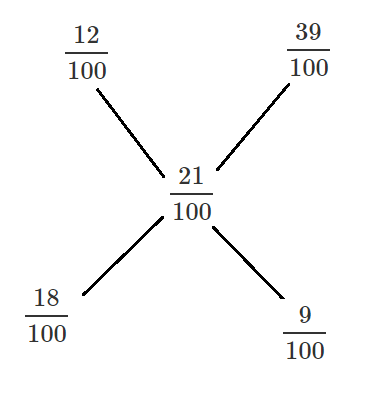
Ram prepares solutions of alcohol in water according to customers’ needs. This morning Ram has prepared 27 litres of a 12% alcohol solution and kept it ready in a 27 litre delivery container to be shipped to the customer. Just before delivery, he finds out that the customer had asked for 27 litres of 21% alcohol solution. To prepare what the customer wants, Ram replaces a portion of 12% solution by 39% solution. How many litres of 12% solution are replaced?
Let Ram replaces $$x$$ litres of 12 % sol. with 39 % solution
Now, quality of 12 % solution in 27 litre = $$\frac{12}{100} \times 27$$
=> After replacing we have volume of 12 % solution
= $$(\frac{12}{100} \times 27) - (\frac{12 x}{100}) + (\frac{39 x}{100})$$
= $$\frac{324 + 27 x}{100}$$
This is equal to 27 litre of 21 % solution.
=> $$\frac{324 + 27 x}{100} = \frac{21}{100} \times 27$$
=> $$27x = 567 - 324 = 243$$
=> $$x = \frac{243}{27} = 9$$
Alternate Solution:
The mixture of two solutions 12% alcohol and 39% alcohol should yield 21% alcohol solution.
Using allegation:
The ratio = 18/9 =2:1
So the amount of 39% solution required = 27*1/(2+1) =9
A manufacturer has 200 litres of acid solution which has 15% acid content. How many litres of acid solution with 30% acid content may be added so that acid content in the resulting mixture will be more than 20% but less than 25%?
Let the volume of the solution with 30 % acid content lie between $$v_1$$ and $$v_2$$, where we get a 20% acid solution for $$v_1$$
For $$v_2$$, we get a 25 % acid solution as the resultant mixture.
=> $$15 \% (200) + 30 \% (v_1) = 20 \% (200 + v_1)$$
=> $$30 + 0.3 v_1 = 40 + 0.2 v_1$$
=> $$0.1 v_1 = 10$$ => $$v_1 = 10 \times 10 = 100$$ litres
Similarly, $$15 \% (200) + 30 \% (v_2) = 25 \% (200 + v_2)$$
=> $$30 + 0.3 v_2 = 50 + 0.25 v_2$$
=> $$0.05 v_2 = 20$$ => $$v_2 = 20 \times 20 = 400$$ litres
$$\therefore$$ For the acid content in the resultant mixture to lie between 20 % and 25 %, the volume of the 30 % concentration acid solution must lie between 100 litres and 400 litres.