Group
Group
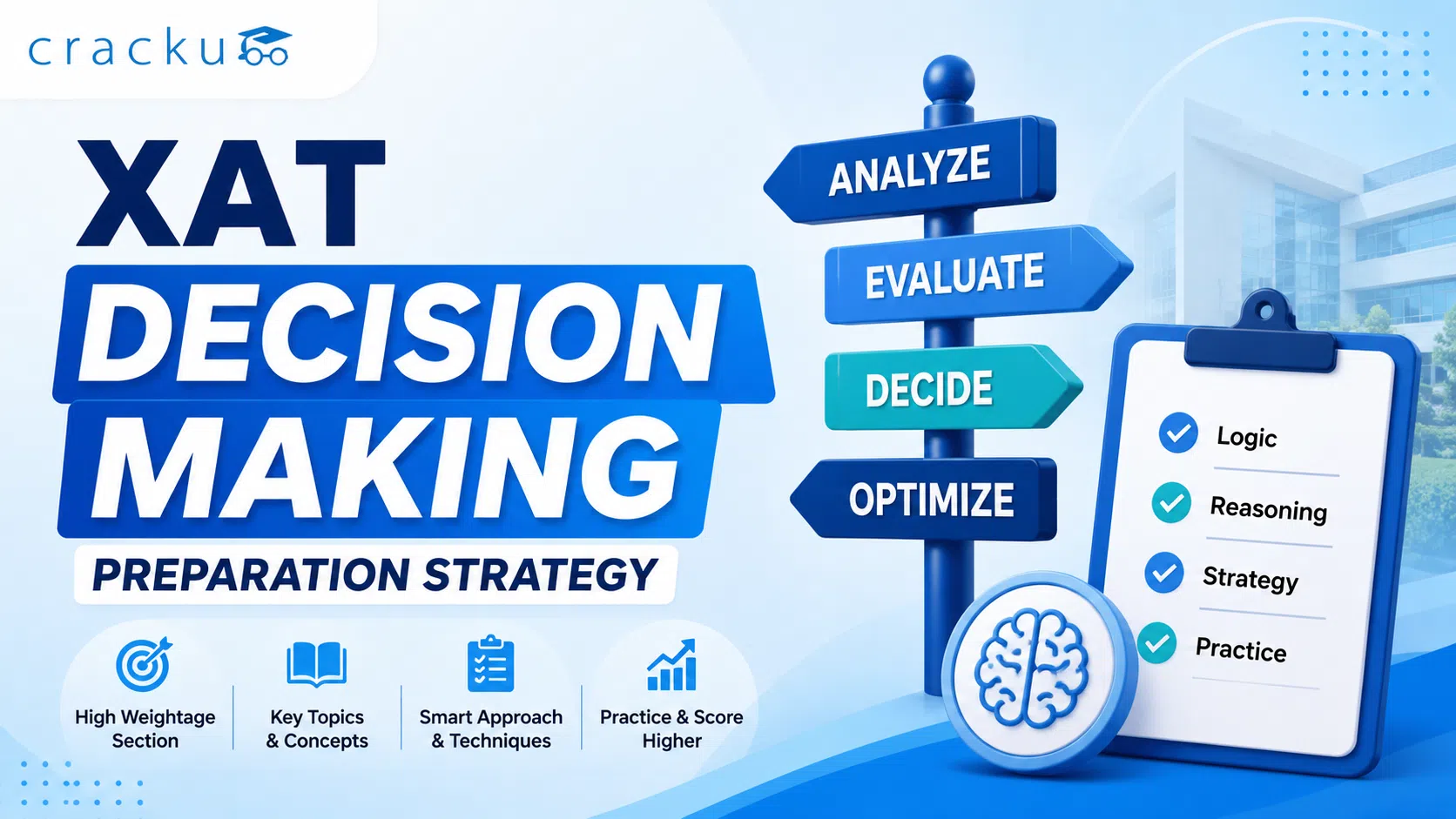
If you're targeting XLRI Jamshedpur or any of the 150+ B-schools that accept XAT scores, there's one section that decides more admits than any other: Decision Making (DM). It's the one area CAT, NMAT, and SNAP don't test -which means generic aptitude tricks won't fully carry you here.
This guide lays out a practical strategy for the Decision Making section, the exact areas to cover from the broader exam blueprint, where to find reliable past question papers and a quick formula reference sheet, and how to put full-length practice tests to real use -not just for confidence, but for measurable percentile gains.
XAT Decision Making Preparation Strategy
Every other MBA entrance exam tests speed and accuracy. This particular section tests judgment. The exam pattern is split into Decision Making (21 questions), Verbal and Logical Ability (26 questions), and Quantitative Ability and Data Interpretation (28 questions) in Part 1, with a separate 20-question General Knowledge section in Part 2. The full paper runs 180 minutes, with Part 1 covering 170 minutes and no sectional time limit.
That "no sectional time limit" detail matters more than most candidates realize. It means you control how long you spend on each block -and spending it wisely on the judgment-based caselets is the single biggest lever on your overall result.
Top scorers in this section have consistently reported that the most logical-sounding answer isn't always correct -the better option usually balances empathy with protecting organisational interests, which is XLRI's signature expectation. Keep that filter in mind for every caselet you attempt.
XAT Decision Making Syllabus 2027
There's no officially released blueprint, but based on years of past papers, the recurring topic list includes:
- Analytical Reasoning (decision-making sets)
- Situational Decision Making
- Ethical Dilemmas
- Business Issues & Case-based Caselets
- Social Dilemmas
- Data Arrangement, Conditioning & Grouping
- Assumptions, Premises, and Conclusions
These eight areas -reasoning sets, situational judgment, ethics-led scenarios, business problems, social dilemmas, caselets, and assumption-conclusion logic -form the backbone of this section year after year.
It's widely considered one of the most distinctive and scoring parts of the paper, built around real-life situations and business decision-making rather than pure number-crunching. Doing well requires understanding the caselet format, then balancing logical and ethical thinking without overreaching into excessive or inaccurate conclusions.
A quick note on volume: this part typically carries around 20–22 caselet-based questions, though the exact count can shift slightly each year.
Read Also, XAT Decision Making Syllabus 2027 PDF, Important Topics
XAT Decision Making Preparation Tips
Read every caselet twice before touching the options
Most wrong answers come from misreading a constraint, not from poor logic. The second read is where you catch the detail you skimmed past the first time.
Build a "values filter," not just a logic filter
Questions here reward answers that are fair to all stakeholders -employees, customers, and the organization -over choices that are purely profit-maximizing or purely employee-friendly. Practice spotting the balanced option, not just the one that sounds smartest.
Time-box each caselet set
Since Part 1 has no sectional limit, candidates often overspend here and run out of time for the quant-heavy section. Decide your time budget during practice and stick to it on exam day.
Eliminate extreme options first
Choices that involve firing someone immediately, ignoring a rule entirely, or taking a unilateral drastic action are rarely correct. Measured, process-respecting answers are consistently rewarded.
Practice ethical dilemmas separately from business caselets
They test different instincts. Ethics-based scenarios reward integrity-first thinking; business scenarios reward stakeholder-balanced, outcome-aware thinking. Don't apply one lens to both.
Track your "changed-mind" answers
Whenever you flip an answer after reviewing it, log why. Over a few attempts, you'll notice a pattern in the kind of trap you fall for -that's a more useful insight than any generic tip.
Treat GK as bonus prep, not core prep
General Knowledge marks aren't counted toward your overall percentile and only matter at the admission interview stage, so don't let current-affairs cramming eat into your core practice time.
How to Practice XAT Decision Making with Mock Tests
Solving a full XAT mock isn't the same as learning from it. Here's a framework that converts a test attempt into real improvement:
- Sit it under real conditions -same time of day, same 180-minute block, no pausing.
- Review section by section -analyze each part of the paper separately; a flat overall score tells you nothing actionable.
- Categorize every mistake as a misread, a values-filter error, or a time-pressure guess. This single habit fixes more score loss than any new trick.
- Re-attempt the missed caselets after 48 hours without looking at the original options, to check whether you actually internalized the reasoning or just memorized the answer.
- Track your trend across at least 8–10 attempts, not a single score. Given the subjectivity in this section, one test isn't a reliable signal.
Aim for at least one full simulated test a week in your final two months, rising to twice a week in the last three weeks before exam day.
Read Also, XAT Syllabus 2027, Section-wise Pattern, Download PDF
Why Past Papers Still Matter More Than New Tests
Original question papers from earlier years remain the gold standard for this kind of prep because they reflect the actual judgment calibration the examiners use -something even a well-built mock vendor can only approximate. Topic patterns are typically derived directly from these real papers, which is why coaching institutes lean so heavily on them when building their own question banks.
Practical way to use them:
- Solve at least the last 8–10 years of caselet sets, untimed first, to build pattern recognition.
- Re-solve the same sets timed, six weeks later, to measure genuine improvement.
- Note recurring themes -HR conflicts, marketing ethics, channel-partner disputes, leadership succession -these repeat in spirit even when the specifics change.
Read Also, XAT Score vs Percentile 2027, Expected, Previous Year Analysis
A Quick Reference Sheet for the Quant Section
Decision Making itself is formula-light, but your overall result depends heavily on Quantitative Ability & Data Interpretation. That section covers Arithmetic, Algebra, Geometry, Number System, and Modern Mathematics on the math side, and Bar Graphs, Pie Charts, Tables, Line Graphs, Data Sufficiency, and Mixed Graphs on the data side.
A good one-page reference for this section should cover:
- Percentages, profit & loss, and ratio shortcuts
- Time-speed-distance and time-and-work core relations
- Number system divisibility rules
- Geometry -mensuration and coordinate basics
- Quick shortcuts for averages, percentage change, and approximation in data sets
Keep it on your phone or printed near your study desk for daily revision rather than a one-time read.
Read Also, XAT Cut Off 2027, Sectional Cutoff & Top MBA Colleges
Best Online Coaching for XAT 2027
There's no single universally "best" option here -the right platform depends on your starting level, budget, and whether you want live mentorship or self-paced structure. When evaluating any program, check for:
- A dedicated Decision Making module with caselet practice, not just verbal/quant content rebranded for this exam
- Updated full-length and sectional tests that reflect the current pattern
- Access to genuine past papers with reasoning-based, not just answer-key, solutions
- Performance analytics that break mistakes down by type, not just overall accuracy
- A current-affairs feed for the GK component, since that needs daily input rather than last-minute cramming
A platform worth a closer look: Cracku's XAT coaching
Cracku's XAT online coaching is one program built specifically around this exam rather than repurposed CAT material. The course is led by Sayali Kale, an IIM Ahmedabad alumna who has placed All-India Rank 1 in the exam multiple years running, alongside CAT 100-percentiler Maruti Konduri.
What's included is fairly comprehensive for a single program:
- Over 180 concept videos spanning the full syllabus, each roughly an hour long
- 150+ concept-level tests and 200+ topic tests, all with worked solutions
- More than 1,000 practice questions across sections
- 10 full-length simulated tests with video walkthroughs and percentile analysis
- 15 sectional tests, including dedicated sets for the Decision Making block specifically
- A day-wise study plan you can follow from enrollment through to exam day
- 80+ GK reference PDFs and supporting videos for the current-affairs component
- Doubt-resolution support tied to individual questions and videos
Several past test-takers have specifically credited the program's Decision Making sectionals and concept videos for helping them turn a weak spot into a scoring strength. If you're deciding between building your own prep plan from scratch versus following a structured one, it's worth comparing a free trial caselet set from a couple of platforms -including this one -before committing, since explanation style matters as much as content volume.
XAT Decision Making Preparation Strategy: Conclusion
Decision Making rewards a calm, balanced, stakeholder-aware mindset more than raw aptitude -which is exactly why it can become your highest-scoring section with the right practice. Combine consistent full-length test attempts, deep review of genuine past papers, a tight one-page reference sheet for the quant section, and disciplined caselet practice across the topics above, and this section stops being the exam's scariest part -it becomes your edge.