CAT WhatsApp Group


How to Prepare for XAT After CAT
You just wrapped up your CAT attempt. Maybe you feel confident, maybe you feel uncertain -either way, one thing is clear: the MBA admission season is far from over. XAT is the next major exam on the calendar, and for thousands of aspirants, it represents a genuine shot at XLRI Jamshedpur, one of the most respected B-schools in India.
The good news is that your CAT preparation has already done a lot of the heavy lifting. The question is how to use that foundation without wasting the limited weeks between the two exams.
XAT Preparation After CAT
The first thing to understand after CAT is that you are not starting from scratch. Quant, Verbal Ability, and Reading Comprehension -areas you spent months building -directly carry over to XAT. What shifts is the exam's character. XAT has a more analytical and management-oriented texture, and it demands a deliberate reset in thinking style, not a rebuild of fundamentals.
Give yourself two to three days to decompress after CAT before jumping into XAT mode. This is not time wasted -it prevents burnout and helps you approach XAT with a fresh perspective rather than residual exam fatigue.
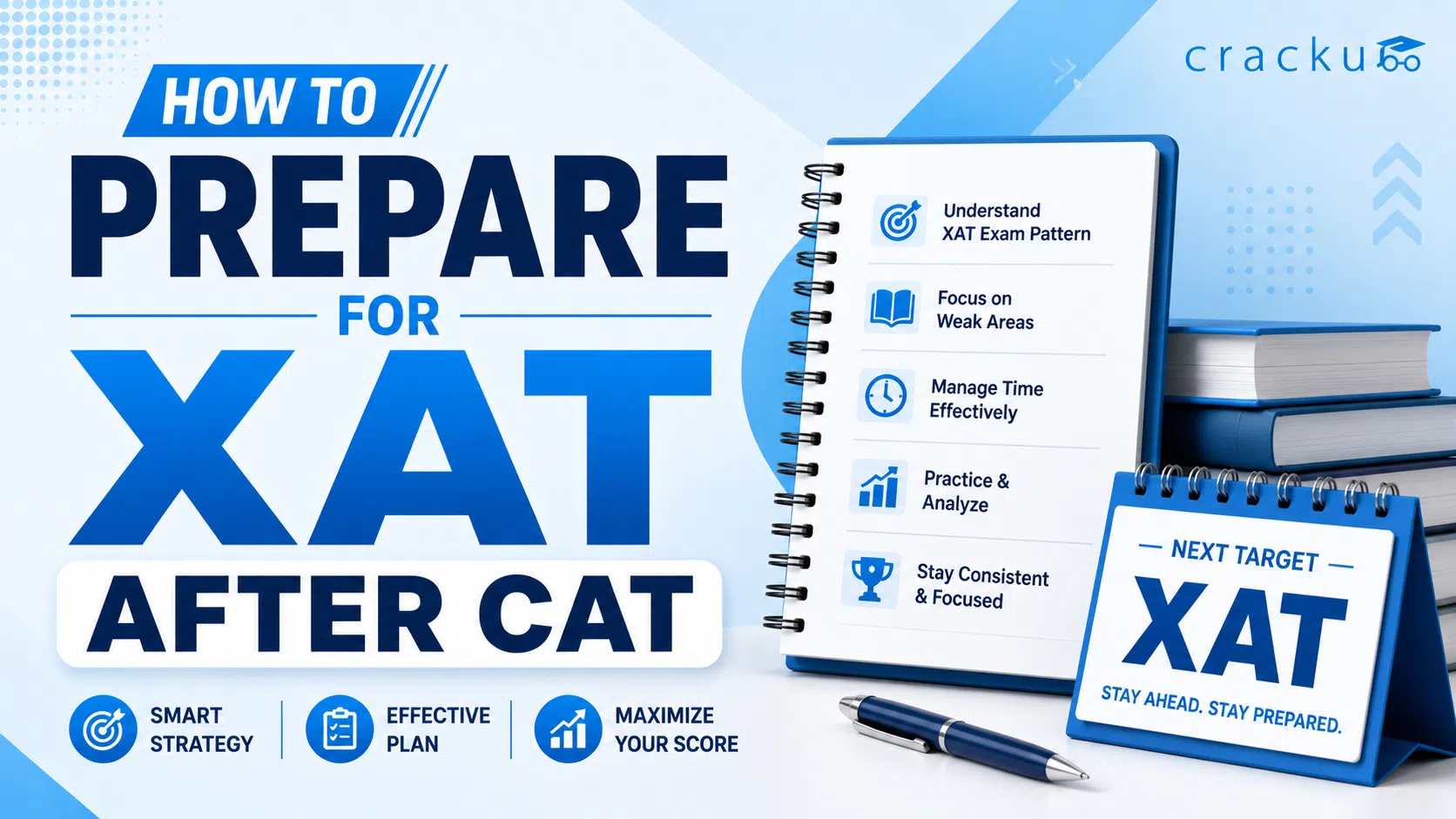
Once you restart, the priority is to map exactly which skills transfer and which areas need dedicated attention. Verbal and Quant can largely continue with moderate practice to maintain sharpness. Decision Making is where most candidates need to spend the bulk of their fresh effort. It is XAT's most defining section and has no real equivalent in CAT preparation.
Build a weekly schedule that devotes proportional time based on your gap areas. If your CAT Verbal was strong, you can maintain it with two to three sessions per week. If your Quant was inconsistent, continue working on weak topics rather than abandoning the momentum you built. Decision Making should receive fresh, focused daily practice starting from the first week.
Mock tests should be central to your schedule rather than an afterthought. Take XAT-specific mocks from the second week onward and use each one as a diagnostic. Time yourself rigorously because XAT's time pressure operates differently from CAT's.
Read Also, XAT 2027 Preparation Strategy by Sayali Mam, Check Now
What is the best strategy for XAT after CAT exam?
The most effective strategy is to work smart with the time available rather than trying to replicate the intensity of a full preparation cycle.
Audit what you already know. Spend a day categorising your strengths and gaps across XAT's sections -Verbal and Logical Ability, Decision Making, Quantitative Ability and Data Interpretation, and General Knowledge. Your CAT performance gives you a reasonable baseline for the first three. GK is a separate matter that requires independent attention.
Prioritise Decision Making above everything else. This section is where XAT scores diverge most sharply among candidates. It tests your ability to reason through business scenarios, ethical dilemmas, and complex situations with limited information. There is no shortcut here -consistent practice with varied question sets is what builds the required judgment. Work through past XAT papers specifically for this section.
Use timed practice, not just content review. Many post-CAT aspirants make the mistake of reading through material without testing under pressure. XAT has a combined time limit for the main paper, and managing that clock while switching between section types is a skill that only develops through repeated mock attempts.
Attack GK methodically. General Knowledge in XAT covers business events, economic policy, international affairs, and static GK. In the weeks between CAT and XAT, follow a structured current affairs review covering at least the past six months. Pair this with quick revision of business GK through monthly magazines and factual summaries.
Attempt previous year XAT papers. This is non-negotiable. Past papers reveal the kind of nuance and ambiguity built into XAT questions -particularly Decision Making -that no concept note can teach you. Start with recent years and work backward.
Take at least five to six full-length XAT mocks. Not CAT mocks. XAT-specific simulations that replicate the exact pattern, question style, and timing of the actual exam. Analyse each mock the same day and identify recurring errors rather than chasing a perfect score in isolation.
Read Also, XAT Previous Year Papers With Solutions, Download PDF's
Difference Between XAT and CAT
Understanding the structural differences between these two exams helps you calibrate your preparation rather than treating one as a clone of the other.
Pattern and Structure: CAT is conducted by the IIMs and has three sections -Verbal Ability and Reading Comprehension, Data Interpretation and Logical Reasoning, and Quantitative Aptitude. XAT, administered by XLRI, has a different structure that includes Verbal and Logical Ability, Decision Making, Quantitative Ability and Data Interpretation, and General Knowledge, with the GK section scored separately.
Decision Making: This is the most significant structural difference. XAT is the only major MBA entrance exam in India that has a dedicated Decision Making section. The questions require candidates to evaluate scenarios involving ethical conflict, resource allocation, managerial judgment, and outcome-based reasoning. There is no equivalent in CAT.
Question Character: CAT questions tend to be more mathematically precise and have a definitive correct answer rooted in logic or calculation. XAT questions -especially in Decision Making and Verbal -often involve layers of interpretation, making the reasoning process as important as the final answer.
Difficulty Level: Both exams are considered high difficulty, but in different ways. CAT pushes candidates on calculation speed, data complexity, and reading comprehension depth. XAT pushes more on analytical reasoning, ethical judgment, and the ability to handle ambiguity.
Negative Marking: Both exams carry negative marking, but XAT also penalises candidates for leaving too many questions unattempted, which affects strategy. Balancing attempts while maintaining accuracy requires a different approach than CAT's relatively straightforward attempt-vs-skip calculus.
Essay Writing: XAT has historically included an Essay Writing component (separate from the scored paper) that tests written communication ability. CAT does not include this.
Time Pressure: XAT's main paper is taken as a single block without section-specific time limits, which means candidates must manage their own pacing across all sections. CAT has individual section timers. This makes XAT's time management both more flexible and more demanding.
Target Institutions: CAT scores are used by IIMs and many other top MBA programmes. XAT scores are primarily used for admission to XLRI and a wide network of other B-schools that accept XAT. Some institutions accept both, but the exam you prioritise depends on your target colleges.
Read Also, XAT Syllabus 2027, Section-wise Pattern, Download PDF
Best Online Coaching For XAT Preparation
For candidates in the post-CAT phase with limited time, the quality of preparation resources matters considerably more than volume. Spending weeks re-reading generic material you already know is less useful than accessing targeted, exam-specific content that helps you practise efficiently.
When evaluating online preparation resources for XAT, a few factors matter most: the availability of XAT-specific mock tests, the quality of Decision Making practice material, analytics that help you identify where time is being lost, and the depth of explanation accompanying solved questions.
Cracku's XAT preparation platform offers a set of resources built around these requirements. The platform includes full-length XAT mock tests that simulate the actual exam pattern, along with topic-wise practice questions across all sections. For Decision Making specifically -the section most candidates struggle to prepare for independently -there is structured practice material with detailed explanations that walk through the reasoning process, not just the correct answer.
The course includes concept videos and revision resources that help candidates who want to revisit core areas without going through a full CAT-style syllabus review. For the GK section, there is targeted material covering the areas that historically appear in XAT.
What makes such platforms genuinely useful in the post-CAT phase is the analytics layer. Being able to see where you are losing time, which question types have low accuracy, and how your mock performance compares across attempts helps you prioritise better than a generic study plan.
Live classes for XAT, where available, also help candidates stay accountable and get direct guidance on areas like essay writing and Decision Making frameworks that are harder to self-study.
If you are evaluating preparation resources, look for platforms that combine actual XAT-pattern mocks with strong explanatory content and a structured progression from concept to full-paper simulation. The weeks after CAT are short, and the right tools make the difference between a scattered revision and a genuinely focused sprint.
How to Prepare for XAT After CAT: Conclusion
Preparing for XAT after CAT is more about strategic adaptation than starting a new preparation journey. Since Quantitative Aptitude, Verbal Ability, and Reading Comprehension overlap significantly, candidates can use their CAT foundation and focus on the unique aspects of XAT, especially Decision Making and General Knowledge.
The key to success lies in consistent practice, targeted mock tests, and understanding the distinct nature of the XAT exam. By following a structured study plan and dedicating focused time to XAT-specific sections, aspirants can maximize their chances of securing admission to XLRI and other top management institutes accepting XAT scores.