Let us denote Ayub and Rana as A and R respectively for simplicity.
Let the speed of A and B in still water be Sa and Sr respectively and the speed of river be r.
r = 3 kmph = 50 $$\ \frac{\ m}{\min}$$ (clockwise)
Sr = 3 kmph = 50 $$\ \frac{\ m}{\min}$$ (clockwise)
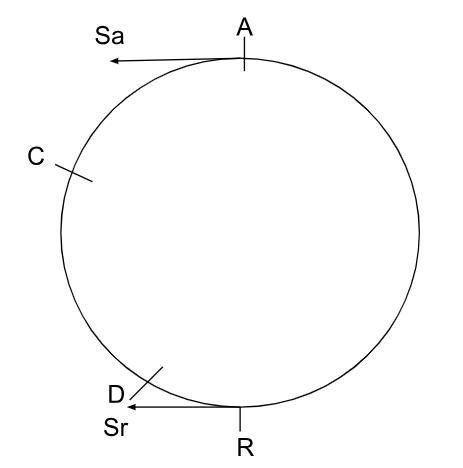
Since A is swimming in counter clockwise direction and R is swimming in clockwise direction, let C be the point where they meet for the first time.
Distance travelled by A = AC = 60m
Speed of A = (Sa-50) $$\ \frac{\ m}{\min}$$ (as he is travelling in counter clockwise direction which is upstream)
Time taken by A to reach C = $$\ \frac{\ 60}{Sa-50}\min$$
Speed of R = (Sr+50) $$\ \frac{\ m}{\min}$$ (as he is travelling in clockwise direction which is downstream)
= 100 $$\ \frac{\ m}{\min}$$
Since, the time taken by R to reach C is the same as the time taken by A to reach C (as they started swimming at the same time), distance travelled by R = RC = $$\ \frac{\ 100\times\ 60}{Sa-50}m$$
Total distance travelled by both A and R = AC + RC = $$\ \frac{\ 6000}{Sa-50}+60\ m$$
As A and R travelled in opposite directions from exactly diametrical ends, the distance A to R will be half of the circumference of the circle.
$$\pi\ r$$ = $$\ \frac{\ 6000}{Sa-50}+60\ m$$ $$\longrightarrow\ i$$
Now, let's assume that they meet again at D after R travelled for 180m,
Time taken for them to meet again = $$\ \frac{\ 180}{100}\min$$
Distance travelled by A = CD (in counter clockwise direction) = $$\ \frac{\ \left(Sa-50\right)\times\ 180}{100}m$$
Distance travelled by R = CD (in clockwise direction) = 180m
Total distance travelled = $$\ \frac{\ \left(Sa-50\right)\times\ 180}{100}m$$ + 180 m
This distance will be equal to the circumference of the circle.
Hence, $$2\pi\ r$$ = $$\ \frac{\ \left(Sa-50\right)\times\ 180}{100}m$$ + 180 m $$\longrightarrow\ ii$$
Take the value of $$\pi\ r$$ from equation i and substitute it in equation ii.
$$\ \frac{\ 12000}{Sa-50}+120=\ \frac{\ 180\left(Sa-50\right)}{100}+180$$
Let the value of Sa-50 be t.
$$\ \frac{\ 12000}{t}+120=\ \frac{\ 180\left(t\right)}{100}+180$$
$$\ 3t^2+100t-20000=0$$
t = $$\ \frac{\ 200}{3}$$, -100 (Not possible as the speed can't be negative)
Sa-50 = $$\ \frac{\ 200}{3}$$
Sa = $$\ \frac{\ 350}{3}\ \frac{\ m}{\min}$$
Use this value in equation ii to get, $$2\pi\ r$$ = 300m
Speed of A when he is swimming in clockwise direction = $$\ \frac{\ 350}{3}+50$$
= $$\ \frac{\ 500}{3}\ \frac{\ m}{\min}$$
Time taken by A to complete one round of the circular strip = $$\ \frac{300}{\ \frac{\ 500}{3}\ }\min$$
= $$\ \frac{\ 9}{5}\min$$ = 1 min 48 sec
Hence, the time taken by A to complete one round of the circular strip is 1 min 48 sec.
$$\therefore\ $$ The answer is D.
 91- 6303239042
 Share
Share
.png)