91- 6303239042


 Group
Group
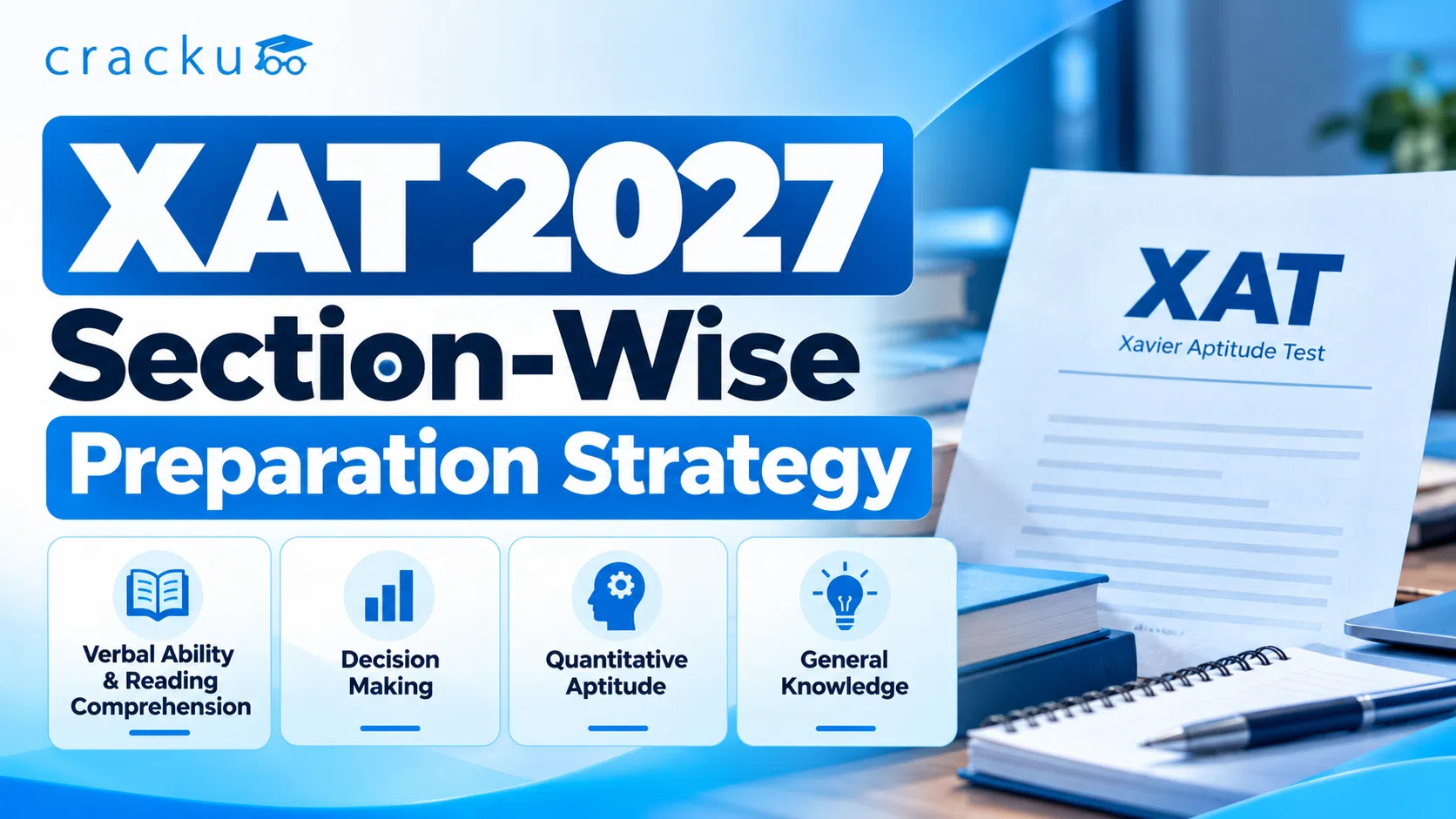
The biggest challenge in XAT is that students don't know how to strategise sectional preparation. Each section of the XAT syllabus requires a different approach. Your first step should start with understanding how to prepare for each section rather than trying to study everything at once. This article helps you understand the XAT 2027 preparation strategy for every section, along with important topics, previous-year paper practice and mock-test strategies to help aspirants structure their preparation.
XAT 2027 Section-Wise Preparation Strategy
XAT 2027 preparation can be complicated, with heavy competition and fast-evolving exam patterns. Yet, having a strong XAT Section-wise preparation strategy for 2027 will help students make it a manageable and goal-oriented journey.
The XAT exam tests different skills through
- Verbal Ability and Logical Reasoning,
- Decision Making,
- Quantitative Ability and Data Interpretation, and
- General Knowledge.
The section wise strategy will work whether you are a first-time or repeat aspirant. A clear approach toward each section of the XAT is important for securing a strong overall performance and improving your chances of admission to leading management institutes.
Each section of the XAT exam syllabus, be it VALR, QADI, DM, or GK, needs to have its different kind of preparation strategy, wherein one must emphasise accuracy, concept clarity, and practice efficiency.
XAT Verbal and Logical Ability Preparation Strategy
The Verbal section in XAT is often considered difficult. This section includes how to tackle reading comprehension passages with questions, critical reasoning questions, and tricky grammar questions. Along with that, RCs require deep comprehension, extensive vocabulary, and consistent reading of long texts to become proficient, so advanced preparation often helps. Students need to identify logical relationships and evaluate answer choices carefully.
- Start reading RC regularly to enhance reading speed.
- Practice dense RCs from philosophy, psychology, and other abstract topics.
- Solve previous years' papers to understand the style of passages and reasoning-based questions.
- Work on your grammar: modifiers, tense usage, parallelism, and subject–verb agreement.
- Practice Critical Reasoning (CR): questions based on assumptions, paradoxes, and inference.
- Build vocabulary by reading newspapers, articles or editorials every day.
XAT Decision-Making Preparation Strategy
Decision-making is the most unique part of the XAT exam. It is not asked in any other management entrance exams. It checks your ability to make
- ethical judgments,
- logical reasoning, and
- balanced decision-making in business-related issues.
In order to understand the patterns and to develop the right mindset for decision-making, it is important to read through previous years' sets of cases.
- Go through the previous 5 years' DM papers to understand the pattern, logic and question type.
- Avoid using emotional or biased decisions and rather make decisions with ethical, logical, reasonable options.
- Know different approaches for decision-making, e.g., the stakeholder approach, long versus short-term considerations, and the fairness principle.
- Practise regularly with business, HR, operational, and situational sets.
- The most important part is XAT Decision making questions practice. Solve as many DM sets as you can from diverse topics.
XAT Quantitative Ability and DI Preparation Strategy
XAT QADI requires conceptual application and not a calculation-focused solution based on shortcuts. DI generally comprises logic-driven puzzles and unique chart representations. XAT QADI has 28 questions, and the ideal time to solve them is 60-65 minutes.
- Know the syllabus: Go through all QADI topics asked in XAT. Focus more on basic topics like Arithmetic and Algebra.
- Understand the Fundamentals: Study every concept clearly before trying difficult questions.
- Keep a formula notebook: Write all formulas and tricks in one notebook for quick revision.
- Solve XAT previous year papers: It helps you understand what kind of questions appear.
- Take topic-wise mock tests: practise different topics one by one. It helps you find which areas you need to improve.
- Be accurate: Avoid guessing answers. Wrong answers can reduce your score. With accuracy, try to maintain speed and practise more and more.
Read More: XAT QADI Preparation Strategy 2027, Syllabus, Important Topics
XAT General Knowledge Preparation Strategy
The GK section has a separate 10-minute time allocation and does not carry any negative marking. Though the GK section is not calculated in the main percentile calculation, it forms an important constituent of XLRI's final selection process as well as a deciding factor in personal interviews. Therefore, students should not ignore this part of the XAT exam.
- Know about the GK syllabus and question type: Students first have to understand the XAT GK syllabus as well as the important topics which they need to cover before starting their GK preparation.
- Read Current Affairs Daily: Give each day around 20 minutes for reading important current events through newspapers or magazines. Focus on global business news, international treaties, corporate news, governance events, national policy announcements and major international sports events.
- Cover Static GK Regularly: Cover one or two topics daily from static GK. Keep revising such topics as history, the Indian Constitution, physical geography, location-based facts, and international institutions like the UN, IMF and World Bank.
- Focus on Business & Economy: Read daily about basic economics and economic sectors, including bank mergers and acquisitions, banking, financial institutions, government policies, and important economic decisions.
- Practise Previous XAT Questions and XAT Mock Tests: Solve XAT previous-year papers to understand the exam's question style and difficulty level. Also try to solve a few sectional mocks of GK and analyse incorrect answers and revise the topics where you need improvement.
- Increase Revision Before XAT: During the last two to three months, focus more on revision than collecting new information.
XAT 2027 Section-Wise Mock Test Strategy
XAT section-wise mock tests are made to help students strengthen their preparation by focusing on individual sections of the XAT exam. These tests closely relate to the latest XAT syllabus, exam pattern, and difficulty level, helping students to improve their performance in Verbal Ability & Reading Comprehension (VARC), Decision Making (DM), and Quantitative Ability & Data Interpretation (QA-DI).
Regular sectional test practice helps candidates find strengths and weaknesses, improve speed and accuracy, and develop effective test-taking strategies. Each test is carefully made to copy the actual XAT exam experience and provide meaningful performance insights.
XAT Section | Mock Test Strategy |
Verbal & Logical Ability (VALR) | 1. Practise RCs under a time limit. 2. Analyse incorrect options after every mock. 3. Track accuracy and reading speed. 4. Practise critical reasoning and para-based questions regularly. |
Decision Making (DM) | 1. Solve caselets within a fixed time. 2. Compare all options before answering. 3. Analyse the reasoning behind every wrong answer. 4. Practise previous-year XAT DM questions. |
Quantitative Ability & DI (QA & DI) | 1. Take sectional mocks for speed and accuracy. 2. Track time spent on lengthy questions. 3. Analyse calculation and conceptual errors. 4. Practise mixed DI sets and important QA topics. |
General Knowledge (GK) | 1. Take short timed GK tests regularly. 2. Revise current affairs and static GK together. 3. Maintain a list of frequently missed topics. 4. Practise answering quickly within the 10-minute section limit. |
XAT 2027 Section-Wise Preparation Strategy: Conclusion
A well-planned XAT 2027 section-wise preparation strategy can make preparation more structured and effective. Since VALR, Decision Making, QADI and General Knowledge test different skills, aspirants should avoid following the same preparation method for every section. Regular concept revision, targeted question practice and solving XAT previous-year papers can help improve accuracy and confidence.
Along with daily preparation, include XAT sectional mock tests and full-length mocks in your study plan. Analyse every test to identify weak topics, time-consuming questions and recurring mistakes. Consistent practice, smart question selection and regular revision can help you build a balanced XAT 2027 preparation strategy for the exam.