91- 6303239042



 Preferred Source

 Google Discover
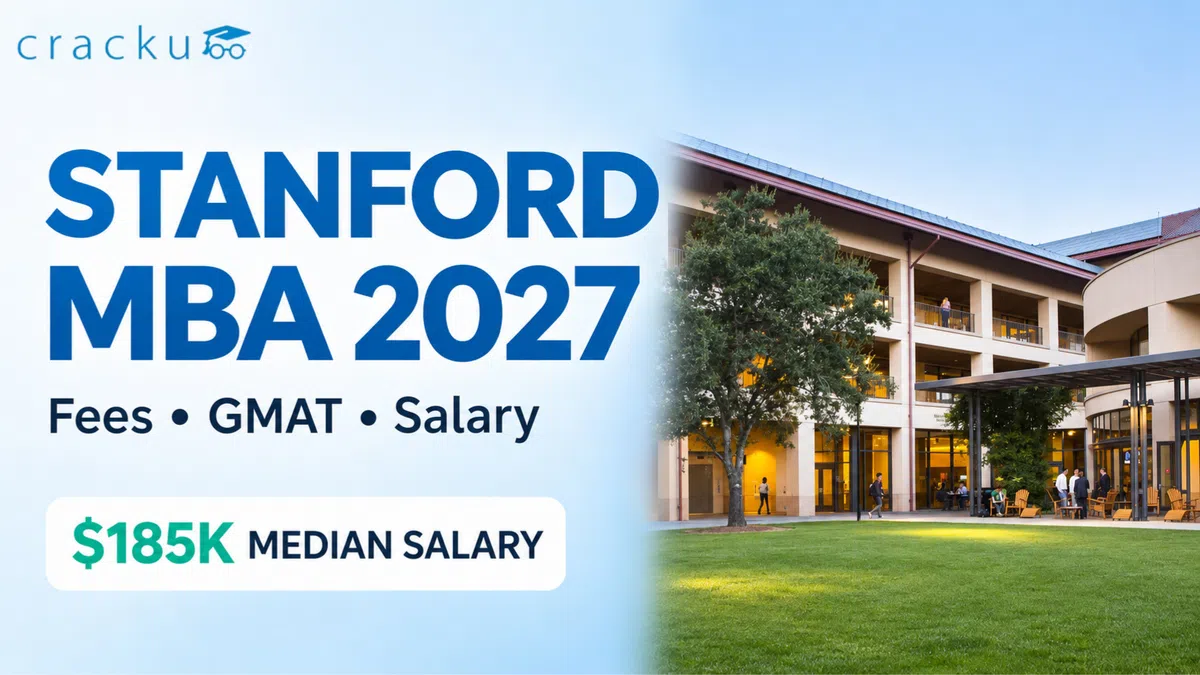
The Stanford MBA programme, offered by the Stanford Graduate School of Business (GSB), is a two-year, full-time MBA known for its focus on leadership, innovation and entrepreneurship. Located in Silicon Valley, Stanford GSB attracts students from different academic and professional backgrounds who want to build successful careers, start businesses or take on leadership roles.
Getting into Stanford GSB is highly competitive. The university looks beyond academic scores and professional achievements to understand an applicant's leadership potential, intellectual curiosity and personal goals. In this article, we discuss the Stanford MBA class profile, GMAT scores, admission requirements, 2027 application deadlines, tuition fees, scholarships and average salaries based on the latest officially available information.
Stanford MBA Class Profile and Acceptance Rate
Stanford GSB has one of the smallest MBA cohorts among leading global business schools. Its latest published class profile is for the Class of 2028, which includes 436 students from 66 countries.
The class brings together students with experience in consulting, technology, finance, healthcare, entrepreneurship and several other fields. This diversity is an important part of Stanford's learning environment, where students learn from one another's professional and personal experiences.
Here is the latest Stanford MBA class profile:
Class Profile Parameter | Stanford MBA Class of 2028 |
Applications received | 5,876 |
Enrolled students | 436 |
Women | 45% |
International students | 39% |
Countries represented | 66 |
Average work experience | 5.2 years |
Average undergraduate GPA | 3.8 |
First-generation college graduates | 14% |
Students with advanced degrees | 18% |
Source: Stanford GSB MBA Class Profile, September 2026.
The average work experience of 5.2 years shows that most students have already spent several years working before joining the MBA programme. However, Stanford does not require a minimum number of years of work experience. Candidates with different professional backgrounds and career stages are considered.
Consulting accounts for 21% of the incoming class's professional backgrounds, followed by investment management, private equity and venture capital at 18%, and technology at 15%.
One of the entrance exam routes to get into Stanford GSB is through the GMAT. Before one starts to prepare for GMAT, it is useful to start off with the Free GMAT Mock Test. The test helps students understand their current score level, and also how it compares to the scores achieved by students at not just Stanford GSB, but also other top business schools around the world.
Stanford MBA Acceptance Rate
Stanford GSB is among the most selective business schools in the world. Although the university publishes application and enrolment figures, it does not provide an official acceptance rate.
Stanford follows a holistic admission process. Along with academic performance and test scores, the admissions committee considers leadership experience, personal achievements, career goals and the contributions applicants can make to the Stanford community.
A strong GMAT score can certainly help improve one’s chances of admission at Stanford GSB. GMAT Courses by 785 Scorer offer candidates structured learning with detailed study plans, formula books and concept videos from GMAT top scorers!
What GMAT Score Do You Need for Stanford MBA?
Stanford GSB requires applicants to submit a valid GMAT or GRE score. However, there is no minimum GMAT score required for admission, and Stanford does not prefer one examination over the other.
The latest Stanford MBA Class of 2028 profile reports an average GMAT Focus Edition score of 695. This provides a useful benchmark for students preparing to apply to Stanford.
Stanford MBA Average GMAT and GRE Scores
Test | Average Score | Reported Score Range |
GMAT (Previous Edition) | 743 | 650–780 |
GMAT Focus Edition | 695 | 535–805 |
GRE Quantitative | 165 | 150–170 |
GRE Verbal | 163 | 151–170 |
Source: Stanford GSB MBA Class Profile, Class of 2028.
The average GMAT Focus score of 695 is a useful target to have when preparing for GMAT, but it is not a cutoff. Stanford has admitted students with scores below this average, as reflected in the reported score range.
A strong GMAT score can demonstrate academic readiness, particularly in quantitative reasoning, verbal reasoning and data interpretation. However, a high score alone does not guarantee admission. Stanford also considers leadership, career progression, personal achievements and the applicant's reasons for pursuing an MBA.
One of the resources that can help candidates during their preparation is guidance from GMAT top scorers. GMAT Expert Mentorship offers candidates personalised guidance, structured study plans, profile evaluation, b-school shortlisting, and other guidance from experts!
Stanford MBA Admission Requirements and Deadlines 2027
Stanford GSB follows a holistic admission process that evaluates candidates based on their academic background, professional experience, leadership abilities and personal qualities.
The main Stanford MBA admission requirements are:
- Educational qualification: Applicants must hold a bachelor's degree or an equivalent qualification. Eligible three-year undergraduate degrees from India are accepted.
- GMAT or GRE score: A valid GMAT or GRE score is required. Stanford does not specify a minimum score.
- Academic transcripts: Applicants must provide their undergraduate academic records and details of any additional qualifications.
- Professional experience: Candidates must submit a resume outlining their employment history, responsibilities and achievements. There is no minimum work experience requirement.
- Letters of recommendation: Two recommendations are required. One should come from the current direct supervisor or an appropriate alternative, while the other should come from someone else who has supervised the applicant's work.
- Essays: Applicants must submit two personal essays explaining their values, aspirations and reasons for choosing Stanford.
- English proficiency: TOEFL, IELTS or PTE scores are required for applicants who do not meet Stanford's English-language education requirements.
- Interview: Shortlisted applicants are invited to an interview with a Stanford GSB alumnus or a member of the admissions team.
The standard Stanford MBA application fee is $275. Eligible deferred-enrolment applicants can receive a reduced application fee of $100, and fee waivers are available under specified circumstances.
Stanford evaluates candidates from a wide range of academic and professional backgrounds. Applicants do not need to come from consulting, finance or technology to be considered for admission.
Stanford MBA Application Deadlines for 2027
Stanford GSB follows a three-round application process for the 2026–27 admission cycle.
Application Round | Application Deadline | Decision Notification |
Round 1 | September 9, 2026 | December 9, 2026 |
Round 2 | January 6, 2027 | April 1, 2027 |
Round 3 | April 7, 2027 | May 27, 2027 |
Source: Stanford GSB Official MBA Deadlines.
All applications must be submitted by 4:00 PM Pacific Time on the respective deadline.
Applicants should complete their GMAT or GRE, prepare their essays and contact their recommenders well before the deadline. Stanford requires recommendation letters and the application fee to be submitted within the same deadline.
Candidates looking to kickstart their GMAT preparation should check out: Free GMAT Preparation Resources
Stanford MBA Fees and Scholarships
The Stanford MBA is a significant financial investment. The total cost includes tuition fees, accommodation, living expenses, medical insurance and other university charges.
For the 2026–27 academic year, Stanford GSB estimates the first-year cost of attendance at $140,940 for a single student.
Stanford MBA Fees 2026–27
Expense | Single Student | Married Student |
Tuition | $89,187 | $89,187 |
Living expenses | $19,950 | $36,972 |
Housing | $22,152 | $33,015 |
Medical insurance | $8,808 | $8,808 |
Health fee | $843 | $843 |
Total | $140,940 | $168,825 |
Source: Stanford GSB Cost of Attendance.
These figures represent the estimated cost for the first academic year. Students must also budget for the second year of the MBA programme.
Actual expenses will depend on accommodation, lifestyle and personal circumstances. Expenses associated with Stanford's Global Experience Requirement are not included in the estimates above.
International students pay the same tuition fees as domestic students. Indian applicants should also account for travel expenses, visa costs and exchange-rate fluctuations while planning their MBA budget.
Stanford MBA Scholarships and Financial Aid
Stanford GSB offers need-based fellowships to help eligible students finance their MBA education.
Unlike merit-based scholarships, these fellowships are awarded based on financial need rather than GMAT scores or academic rankings.
Stanford follows a need-blind admission policy, meaning an applicant's financial resources do not influence the admission decision.
According to Stanford GSB, the average fellowship awarded to students in the Class of 2026 was approximately $50,000 per year, or $100,000 over two years.
These fellowships do not need to be repaid.
Stanford also offers student loans and other financial assistance. The university calculates an expected student contribution based on the admitted student's financial circumstances, and eligible students can receive a combination of fellowships and loans.
Indian applicants are eligible to apply for need-based financial aid. The availability of support is an important consideration for candidates who may otherwise find the cost of a Stanford MBA difficult to manage.
Stanford MBA Placements and Average Salary
Stanford GSB graduates pursue careers across technology, finance, consulting, healthcare, entrepreneurship and other industries.
The university's Silicon Valley location, alumni network and relationships with employers provide students with access to a wide range of career opportunities.
According to the latest published Stanford GSB employment outcomes for the MBA Class of 2025, 90% of job-seeking graduates received employment offers within three months of graduation, while 81% had accepted an offer during the same period.
The median base salary reported for Stanford MBA graduates was $185,000.
Stanford MBA Employment Statistics
Employment Parameter | Class of 2025 |
Median base salary | $185,000 |
Job seekers receiving offers within 3 months | 90% |
Job seekers accepting offers within 3 months | 81% |
Graduates pursuing their own ventures | 16% |
Leading employment industries | Technology, Finance, Consulting |
Source: Stanford GSB Employment Outcomes
The median base salary represents the midpoint of reported salaries, rather than the average earnings of all graduates. Signing bonuses, performance bonuses and other benefits are not included in this figure.
Stanford MBA Placements by Industry
Technology, finance and consulting continue to attract a large share of Stanford MBA graduates.
Based on the Class of 2025 employment report, the distribution of accepted full-time positions across the three leading industries was:
Industry | Share of Accepted Full-Time Jobs |
Technology | 35% |
Finance | 33% |
Consulting | 11% |
Technology emerged as the largest employment sector, accounting for 35% of accepted full-time jobs. Finance followed closely at 33%, with graduates pursuing opportunities in investment management, private equity, venture capital and other financial services. Consulting accounted for 11%, reflecting continued interest in strategy, management and advisory roles.
Stanford also saw increasing interest in enterprise technology and AI-related businesses, with graduates taking roles in product management, sales, customer success and business development.
Apart from traditional employment, entrepreneurship remains a major career path for Stanford MBA students.
The Class of 2025 employment report shows that 16% of graduates pursued their own ventures. Stanford's startup ecosystem, entrepreneurship courses and investor networks provide students with opportunities to develop business ideas while pursuing their MBA.
These outcomes highlight the variety of career paths available after a Stanford MBA, extending beyond conventional corporate placements.
Stanford MBA Essays and Application Process
Essays are an important part of the Stanford MBA application. They help the admissions committee understand an applicant's personality, values, motivations and future aspirations beyond academic scores and professional achievements.
For the 2026–27 admission cycle, Stanford GSB requires two personal essays.
Stanford MBA Essay Questions 2027
Essay 1: What matters most to you, and why?
Word limit: 650 words
This essay focuses on the applicant's personal values and experiences.
Stanford wants to understand what genuinely matters to you and how your experiences have shaped your beliefs, decisions and priorities.
A strong response should reflect personal experiences rather than simply highlight professional achievements. Applicants can discuss important life events, relationships, challenges or experiences that influenced their thinking.
Essay 2: Why Stanford for you?
Word limit: 350 words
This essay focuses on the applicant's aspirations and reasons for choosing Stanford GSB.
Candidates should explain their future goals and how the Stanford MBA programme can help them achieve those goals.
The response should demonstrate a clear understanding of Stanford's academic environment, learning opportunities and community.
Rather than listing the university's achievements or rankings, applicants should explain how specific aspects of the Stanford experience connect with their personal and professional ambitions.
Source: Stanford GSB Official Essay Requirements.
How to Strengthen Your Stanford MBA Application
A competitive Stanford MBA application should present a clear and authentic picture of the candidate.
Applicants should focus on the following areas:
- Demonstrate leadership: Discuss situations where you took responsibility, influenced others or helped achieve meaningful outcomes.
- Highlight professional impact: Include specific examples of contributions and achievements rather than simply listing job responsibilities.
- Show intellectual curiosity: Explain how you approach challenges, learn new skills and explore unfamiliar ideas.
- Choose the right recommenders: Select people who know your work well and can provide detailed examples of your strengths and development.
- Connect your goals with Stanford: Explain why the Stanford MBA is relevant to your future plans and what you hope to gain from the programme.
- Maintain authenticity: Use genuine experiences and personal reflections instead of trying to present an idealised profile.
Stanford places considerable importance on authenticity. Applicants should write their essays in their own words and ensure that their responses accurately reflect their experiences and perspectives.
A strong application does not necessarily require an extraordinary career achievement. What matters is how clearly applicants demonstrate their growth, decisions, values and potential to contribute.
Is Stanford MBA Worth It for Indian Students?
Stanford MBA is an attractive option for Indian students seeking international career opportunities, leadership roles or exposure to entrepreneurship.
The programme offers access to a diverse student community, experienced faculty, a global alumni network and companies across major industries.
With a reported median base salary of $185,000 for the Class of 2025, Stanford graduates have access to strong earning opportunities. However, the overall value of the MBA also depends on individual career goals, the cost of attendance and the professional opportunities students pursue after graduation.
Indian applicants should focus on building a well-rounded profile that combines strong academic preparation, meaningful work experience, leadership potential and clear career aspirations.
A competitive GMAT score can strengthen the application, but Stanford looks at the complete profile before making admission decisions.
For candidates aiming to join Stanford in 2027, the next step is to understand the admission requirements, prepare for the GMAT or GRE and build an application that clearly communicates their achievements, values and reasons for pursuing an MBA at Stanford GSB.