91- 6303239042


 Group
Group


 Preferred Source

 Google Discover
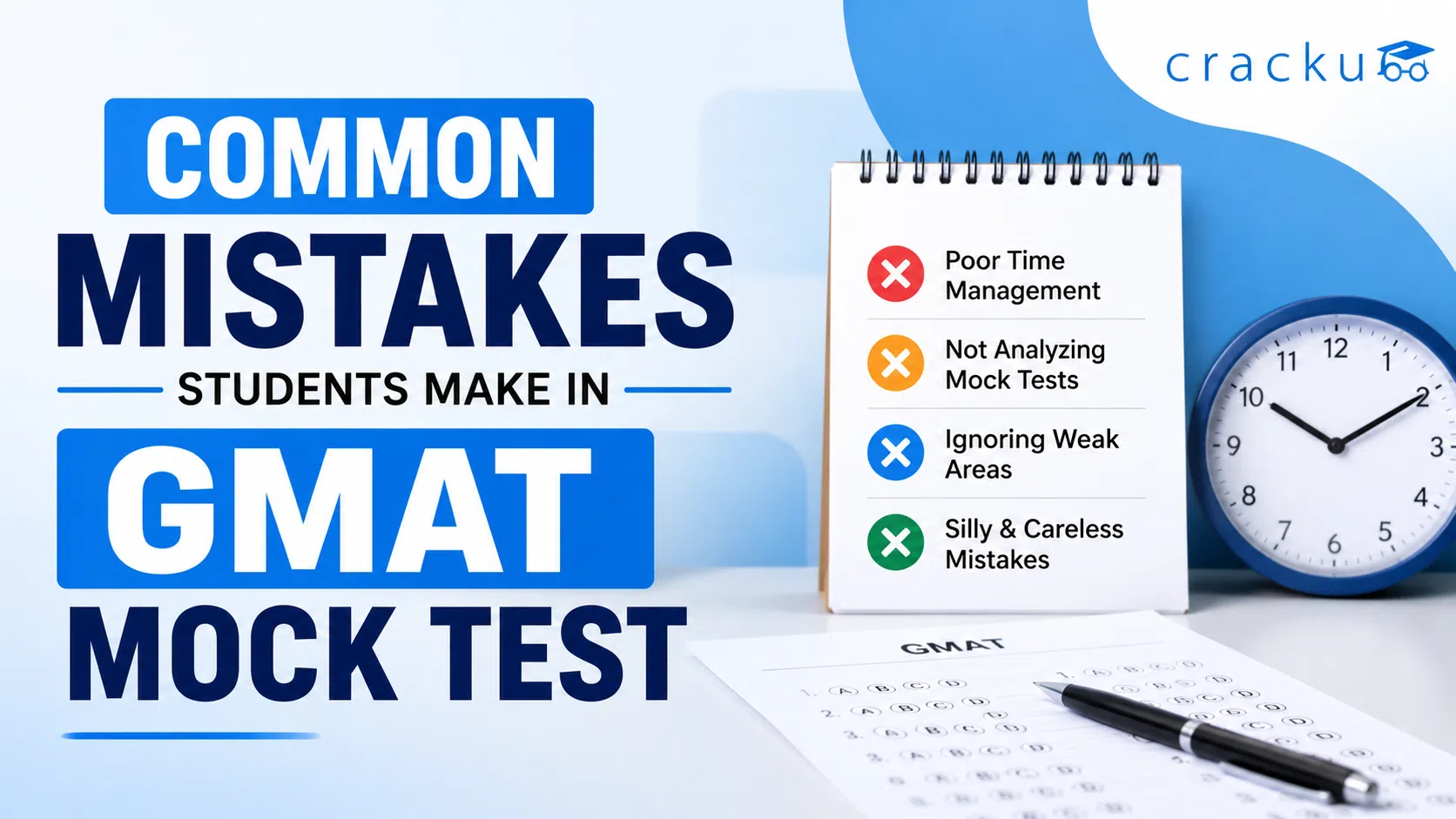
Common Mistakes Students Make in GMAT Mock Tests
GMAT mock tests are one of the most powerful tools in your preparation. They replicate the real exam environment and show you exactly where you stand. But most students do not use them the right way. They take mock after mock without learning from their mistakes, which leads to flat scores and wasted study time.
If you are preparing for the GMAT and your score is not moving, chances are you are making one or more of the errors listed in this guide. Read on to understand what those mistakes are and how to fix them before your next mock.
Common Mistakes in GMAT Preparation
Many errors students make during GMAT mock tests actually start much earlier, during general preparation. These habits quietly carry into mocks and reduce their usefulness.
The table below summarises the most commonly seen mistakes, the reason behind each one, and a straightforward fix you can apply right away.
Common Mistake | Why It Happens | Quick Fix |
Taking mocks without review | Students focus on quantity over quality | Spend 2-3 hours reviewing every mock |
Skipping strict time limits | Comfort-seeking during practice | Always use the official timer |
Ignoring weak sections | Spending time only on strengths | Build a section-wise study plan |
Using only unofficial mocks | Easier access to free resources | Use GMAC Official Prep software |
Not maintaining an error log | Seems time-consuming | Log every wrong answer with reason |
One important note: many students rely heavily on unofficial or free mock tests from third-party platforms. While these can be helpful for extra practice, they do not fully replicate the adaptive algorithm or question style of the actual GMAT. GMAC, the body that administers the GMAT, offers Official GMAT Prep software at mba.com, which provides the most accurate simulation of your expected score on exam day.
GMAT Mock Test Strategy
A good GMAT mock test strategy is not just about finishing the test. It is about how you approach each mock from start to finish, and what you do with the results afterward.
Here is what a structured mock test strategy looks like:
- Take every mock in a quiet, distraction-free environment. Try to sit at the same time of day as your scheduled exam.
- Follow the official timer strictly. Never pause the test or give yourself extra time on any question.
- Complete all three sections without skipping, just as you would on the actual GMAT.
- After each mock, spend at least two to three hours on a detailed review before moving on to the next one.
- Space your mocks out. One well-reviewed mock per week is far more effective than multiple rushed ones in a short period.
- Use the official GMAC mocks for the most accurate score prediction, especially as your exam date approaches.
The GMAT Focus Edition, which is the current version of the exam, consists of three sections: Quantitative Reasoning, Verbal Reasoning, and Data Insights. Each section is weighted equally in the final score. The total score ranges from 205 to 805 in increments of 10, according to GMAC.
How to Improve GMAT Mock Test Score
Improving your GMAT mock test score requires targeted effort, not just more practice. The most effective method is a structured post-mock review process. Use the checklist below after every mock to make your review more focused and productive.
Review Area | What to Check | How Often |
Wrong answers | Concept gap or careless error? | After every mock |
Time per question | Which questions took over 3 minutes? | After every mock |
Accuracy by section | Which section has the lowest accuracy? | After every mock |
Repeated error patterns | Same mistake type appearing again? | Every 2 to 3 mocks |
Score trend | Is performance improving over time? | Every 2 to 3 mocks |
Once you spot your weak areas, adjust your study plan accordingly. If Data Insights is consistently your lowest-scoring section, allocate a larger share of your weekly study hours to it before the next mock.
Tracking your score across multiple mocks is also important. If you are not seeing improvement after three or four mocks, it is a clear sign that your review process needs to change, not the number of mocks you are taking.
Taking Too Many GMAT Mocks Without Proper Analysis
This is one of the most common traps GMAT aspirants fall into. The belief is straightforward: the more mocks you take, the better you get. But in reality, taking a mock without reviewing it properly is almost like not taking it at all.
Here is what productive mock test usage looks like in practice:
- After each mock, note down every question you got wrong and categorise the reason: was it a concept you did not know, a silly mistake, or a time-related error?
- Maintain a running error log where you record question type, topic, and the correct approach.
- Revisit your error log before taking the next mock so you are not walking in with the same blind spots.
- Reattempt the questions you got wrong, ideally two to three days after the mock, to test whether you have actually understood the concept.
Most GMAT coaching experts generally suggest taking around five to six full-length mocks during your preparation, though this can vary depending on your study timeline and starting score. What matters more than the number is the quality of review that follows each mock. The official GMAC mocks available through the mba.com platform are considered the most reliable predictors of your actual exam score.
Ignoring Time Management During GMAT Practice Tests
Poor time management is one of the biggest reasons students underperform on the GMAT. Many students rush through early questions to save time, or spend too long on a difficult question hoping to get it right. Both approaches hurt the final score.
The table below shows the official time structure for each section of the GMAT Focus Edition as per GMAC:
Section | No. of Questions | Time Allowed | Avg. Time / Question |
Quantitative Reasoning | 21 | 45 minutes | ~2 min 8 sec |
Verbal Reasoning | 23 | 45 minutes | ~1 min 57 sec |
Data Insights | 20 | 45 minutes | ~2 min 15 sec |
During mock tests, students often avoid skipping questions because it feels like giving up. But on the GMAT, spending more than two to three minutes on a single question is rarely worth it. Practicing strategic skipping during mocks helps build the discipline you need on exam day.
A simple habit to build during mocks: check your progress at the halfway point of each section. If you have used more than half of the available time on fewer than half of the questions, you need to pick up pace immediately. Practicing this checkpoint habit during every mock will help you develop a natural sense of pacing.
Repeating the Same Accuracy Mistakes in Every Mock
If your score is not improving despite taking multiple mocks, the most likely reason is that you are repeating the same types of mistakes without addressing them. This is a very common pattern among GMAT test-takers who review answers but do not track patterns across mocks.
Common accuracy pitfalls include:
- Misreading Critical Reasoning questions and picking answers that seem close but are not quite right.
- Making calculation errors in Quantitative Reasoning by solving mentally instead of writing out each step.
- Skimming Reading Comprehension passages too quickly and missing key details needed to answer accurately.
- Confusing Data Sufficiency answer choices because the logic of the question type was not fully internalised.
- Second-guessing correct first instincts and changing answers unnecessarily under time pressure.
The fix is to build awareness of your error patterns. After every two to three mocks, go back through your error log and look for question types or topics that keep appearing. Those are your highest-priority areas before the next mock.
Improving accuracy also means practicing the elimination method. On the GMAT, being able to rule out two or three clearly wrong answer choices significantly improves your chances of selecting the correct one, even when you are unsure of the exact answer.
To sum it up: GMAT mock tests work best when you treat each one as a learning tool, not just a score check. Avoid the trap of volume over quality, manage your time section by section, and commit to a structured review after every mock. These habits, practiced consistently, will reflect clearly in your final GMAT score.
Common Mistakes Students Make in GMAT Mock Tests: Conclusion
GMAT mock tests are one of the most effective ways to measure your preparation level and improve your final exam performance. However, simply taking multiple mocks is not enough. Students who carefully analyse their mistakes, manage time properly, and focus on weak areas usually see much better score improvement over time. A structured review process after every mock can make a huge difference in your overall GMAT preparation.
To improve your GMAT mock test score, focus more on quality practice instead of the number of mocks taken. Use official GMAT mock tests whenever possible, maintain an error log, and track your progress regularly. By avoiding common GMAT mock test mistakes and following the right strategy, you can build confidence and achieve a higher score on the actual exam.