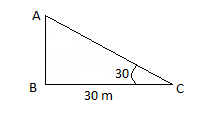
A ladder leaning against a wall makes an angle $$\theta$$ with the horizontal ground such that $$\tan \theta = \frac{12}{5}.$$ If the height of the top of the ladder from the wall is 24 m, then what is the distance (in m) of the foot of the ladder from the wall?
$$\frac{\sin^2 52^\circ + 2 + \sin^{2} 38^\circ}{4 \cos^{2} 43^\circ - 5 + 4 \cos^{2} 47^\circ}$$ is:
A
3
B
$$\frac{1}{3}$$
C
-$$\frac{1}{3}$$
D
-3
ladder is resting against a wall. The angle between the foot of the ladder and wall is $$60^\circ$$, and the foot of the ladder is 3.6 m away from the wall. The length of the ladder (in m) is:
If $$4(cosec^2 57 - \tan^2 33) - \cos 90 + y * \tan^2 66 * \tan^2 24 = \frac{y}{2}$$, then the value of y is:
Let A and B be two towers with the same base. From the mid point of the line joining their feet, the angles of elevation of the tops of A and B are $$30^\circ$$ and $$45^\circ$$, respectively. The ratio of the heights of A and B is :
A
1 : 3
B
1: $$\sqrt{3}$$
C
$$\sqrt{3}$$: 1
D
3: 1
If $$4 \theta$$ is an acute angle , and $$\cot 4 \theta = \tan(\theta - 5^\circ)$$ is an acute angle, and $$\cot 46 = \tan(6 - 5^\circ)$$, then what is the value of $$\theta$$?
A
$$19^\circ$$
B
$$45^\circ$$
C
$$21^\circ$$
D
$$24^\circ$$
If $$4 - 2 \sin^2 \theta - 5 \cos \theta = 0, 0^\circ < \theta < 90^\circ$$, then the value of $$\cos \theta - \tan \theta$$ is:
A
$$\frac{1 + 2 \sqrt 3}{2}$$
B
$$\frac{2 - \sqrt 3}{2}$$
C
$$\frac{2 + \sqrt 3}{2}$$
D
$$\frac{1 - 2 \sqrt 3}{2}$$
Solve for $$ \theta: \cos^{2} - \sin^{2} \theta = \frac{1}{2}, 0 < \theta < 90^\circ$$.
A
$$45^\circ$$
B
$$60^\circ$$
C
$$30^\circ$$
D
$$40^\circ$$
If $$\cot \theta = \frac{1}{\sqrt{3}}, 0^\circ < \theta^\circ < 90^\circ$$ then the value of $$\frac{2 - \sin^{2} \theta}{1 - \cos^{2} \theta} + (\cosec^{2} \theta - \sec \theta)$$ is:
A person was standing on a road near a mall. He was 1215 m away from the mall and able to see the top of the mall from the road in such a way that the top of a tree, which is in between him and the mall, was exactly in line of sight with the top of the mall. The tree height is 20 m and it is 60 m away from him. How tall (in m) is the mall?
Let A and B be two towers with same base. From the midpoint of the line joining their feet. the angles of elevation of the tops of A and B are $$30^\circ$$ and $$60^\circ$$, respectively. The ratio of the heights of B and A is:
A
$$1 : 3$$
B
$$3 : 1$$
C
$$1 : 2$$
D
$$1 : \sqrt{3}$$
What is the average of sixty terms given below?
A
$$\cos^{2}x$$
B
0.5
C
1
D
$$\cos^{2}x\sin^{2}x$$
If $$3 \sin^2 \theta - \cos \theta - 1 = 0, 0^\circ < \theta < 90^\circ$$, then what is the value of $$\cot \theta + \cosec \theta ?$$
A
$$\frac{3\sqrt{2}}{2}$$
B
$$2\sqrt{3}$$
C
$$\sqrt{5}$$
D
$$2\sqrt{5}$$
If $$\sin A = \frac{1}{2}, A$$ is an acute angle, then find the value of $$\frac{\tan A - \cot A}{\sqrt{3}(1 + \cosec A)}$$
A
$$\frac{4\sqrt{3}}{9}$$
B
$$\frac{2}{9}$$
C
$$-\frac{2}{9}$$
D
$$-\frac{4\sqrt{3}}{9}$$
If $$\frac{\cos^2 \theta}{\cot^2 \theta + \sin^2 \theta - 1} = 3, 0^\circ < \theta < 90^\circ$$, then the value of $$(\tan \theta + \cosec \theta)$$ is:
A
$$\frac{5\sqrt{3}}{3}$$
B
$$3\sqrt{3}$$
C
$$2\sqrt{3}$$
D
$$\frac{4\sqrt{3}}{3}$$
$$1 + 2 \tan^2 \theta + 2 \sin \theta \sec^2 \theta, 0^\circ < \theta < 90^\circ$$, is equal to:
A
$$\frac{1 - \cos \theta}{1 + \cos \theta}$$
B
$$\frac{1 + \cos \theta}{1 - \cos \theta}$$
C
$$\frac{1 - \sin \theta}{1 + \sin \theta}$$
D
$$\frac{1 + \sin \theta}{1 - \sin \theta}$$
If $$\frac{\sin^2 \theta}{\tan^2 \theta - \sin^2 \theta} = 5, \theta$$ is an acute angle, then the value of $$\frac{24\sin^2\theta-15\sec^2\theta}{6\operatorname{cosec}^2\theta-7\cot^2\theta}$$ is:
View Explanation
Hide Explanation
$$\frac{\sin^2\theta}{\tan^2\theta-\sin^2\theta}=5$$
$$\frac{\sin^2\theta}{\frac{\sin^2\theta\ }{\cos^2\theta\ }-\sin^2\theta}=5$$
$$\frac{\sin^2\theta}{\sin^2\theta\ \left(\frac{1\ }{\cos^2\theta\ }-1\right)}=5$$
$$\frac{\cos^2\theta}{1-\cos^2\theta\ }=5$$
$$\frac{\cos^2\theta}{\sin^2\theta\ \ }=5$$
$$\cot^2\theta\ \ =5$$
$$\operatorname{cosec}^2\theta\ =1+\cot^2\theta\ =1+5=6$$
$$\sin^2\theta=\frac{1}{\operatorname{cosec}^2\theta}\ =\frac{1}{6}$$
$$\cos^2\theta\ =1-\sin^2\theta=1-\frac{1}{6}=\frac{5}{6}$$
$$\sec^2\theta\ =\frac{1}{\cos^2\theta\ }=\frac{6}{5}$$
$$\frac{24\sin^2\theta-15\sec^2\theta}{6\operatorname{cosec}^2\theta-7\cot^2\theta}=\frac{24\left(\frac{1}{6}\right)-15\left(\frac{6}{5}\right)}{6\left(6\right)-7\left(5\right)}$$
$$=\frac{4-18}{36-35}$$
$$=-14$$
Hence, the correct answer is Option C
If $$\frac{\sin\theta+\cos\theta}{\sin\theta-\cos\theta}=5$$, then the value of $$\frac{4\sin^2\theta+3}{2\cos^2\theta+2}$$ is:
A
$$\frac{75}{17}$$
B
$$\frac{75}{34}$$
C
$$\frac{1}{2}$$
D
$$\frac{3}{2}$$
View Explanation
Hide Explanation
$$\frac{\sin\theta+\cos\theta}{\sin\theta-\cos\theta}=5$$
$$\sin\theta+\cos\theta=5\sin\theta\ -5\cos\theta\ $$
$$4\sin\theta=6\cos\theta\ $$
$$\tan\theta\ =\frac{3}{2}$$
$$\sec\theta\ =\sqrt{\left(\frac{3}{2}\right)^2+1}=\frac{\sqrt{13}}{2}$$
$$\cos\theta\ =\frac{2}{\sqrt{13}}$$
$$\sin\theta\ =\sqrt{1-\left(\frac{2}{\sqrt{13}}\right)^2}=\frac{3}{\sqrt{13}}$$
$$\frac{4\sin^2\theta+3}{2\cos^2\theta+2}=\frac{4\left(\frac{3}{\sqrt{13}}\right)^2+3}{2\left(\frac{2}{\sqrt{13}}\right)^2+2}$$
$$=\frac{\frac{36}{13}+3}{\frac{8}{13}+2}$$
$$=\frac{\frac{36+39}{13}}{\frac{8+26}{13}}$$
$$=\frac{75}{34}$$
Hence, the correct answer is Option B
For $$0^\circ < \theta < 90^\circ, \frac{1}{\cos \theta} + \frac{1}{\tan \theta - \sec \theta}$$ is equal to:
A
$$\sec \theta$$
B
$$-\sec \theta$$
C
$$-\tan \theta$$
D
$$\tan \theta$$
If $$3 \tan \theta = 2\sqrt{3} \sin \theta, 0^\circ < \theta < 90^\circ$$, then find the value of $$2 \sin^2 2\theta - 3 \cos^2 3\theta$$.
A
1
B
$$\frac{3}{2}$$
C
$$\frac{1}{2}$$
D
$$-\frac{3}{2}$$
View Explanation
Hide Explanation
$$3\tan\theta=2\sqrt{3}\sin\theta$$
$$3\frac{\sin\theta\ }{\cos\theta\ }=2\sqrt{3}\sin\theta$$
$$\cos\theta\ =\frac{3}{2\sqrt{3}}$$
$$\cos\theta\ =\frac{\sqrt{3}}{2}$$
$$\theta\ =30^{\circ\ }$$ [$$0^\circ < \theta < 90^\circ$$]
$$2\sin^22\theta-3\cos^23\theta=2\sin^260^{\circ\ }-3\cos^290^{\circ\ }$$
= $$2\left(\frac{\sqrt{3}}{2}\right)^2-3\left(0\right)^2$$
= $$\frac{3}{2}$$
Hence, the correct answer is Option B
If $$\sec(5 \alpha - 15^\circ) = \cosec(15^\circ - 2 \alpha)$$, then the value of $$\cos \alpha + \sin 2 \alpha + \tan(1.5 \alpha)$$ is:
A
$$\sqrt{3} + 1$$
B
$$\sqrt{2} - 1$$
C
$$\sqrt{3} - 1$$
D
$$\sqrt{2} + 1$$
If $$\sin^2 \theta = 2 \sin \theta - 1, 0^\circ \leq \theta \leq 90^\circ $$, then find the value of: $$\frac{1 + \cosec \theta}{1 - \cos \theta}$$.
View Explanation
Hide Explanation
$$\sin^2\theta=2\sin\theta-1$$
$$\sin^2\theta-2\sin\theta+1=0$$
$$\left(\sin\theta-1\right)^2=0$$
$$\sin\theta-1=0$$
$$\sin\theta=1$$
$$0^{\circ}\le\theta\le90^{\circ}$$
$$\Rightarrow$$ $$\theta=90^{\circ}$$
$$\frac{1+\operatorname{cosec}\theta}{1-\cos\theta}=\frac{1+\operatorname{cosec}90^{\circ\ }}{1-\cos90^{\circ\ }}$$
$$=\frac{1+1\ }{1-0\ }$$
$$=2$$
Hence, the correct answer is Option C
If $$\tan \theta = \sqrt{5}$$, then the value of $$\frac{\cosec^2 \theta + \sec^2 \theta}{\cosec^2 \theta - \sec^2 \theta}$$ is:
A
$$-\frac{7}{5}$$
B
$$\frac{7}{5}$$
C
$$-\frac{3}{2}$$
D
$$\frac{3}{2}$$
If $$\sin \left(\frac{2A + B}{2}\right) = \cos \left(\frac{2A - B}{2}\right) = \frac{\sqrt{3}}{2}, 0^\circ < \frac{2A + B}{2} < 90^\circ$$ and $$0^\circ < \frac{2A + B}{2} < 90^\circ$$ then find the value of $$\sin[3(A - B)]$$.
A
$$\frac{\sqrt{3}}{2}$$
B
$$\frac{1}{\sqrt{2}}$$
C
$$\frac{1}{2}$$
D
1
If $$\sin(20 + x)^\circ = \cos 60^\circ, 0 \leq (20 + x) \leq 90$$, then find the value of $$2 \sin^2(3x + 15)^\circ - \cosec^2(2x + 10)^\circ$$.
A
3
B
-3
C
$$-\frac{1}{3}$$
D
-2
View Explanation
Hide Explanation
$$\sin(20+x)^{\circ}=\cos60^{\circ}$$
$$\sin(20+x)^{\circ}=\sin30^{\circ}$$
$$20+x=30$$
$$x=10$$
$$2\sin^2(3x+15)^{\circ}-\operatorname{cosec}^2(2x+10)^{\circ}=2\sin^245^{\circ}-\operatorname{cosec}^230^{\circ}$$
$$=2\left(\frac{1}{\sqrt{2}}\right)^2-\left(2\right)^2$$
$$=2\left(\frac{1}{2}\right)-4$$
$$=1-4$$
$$=-3$$
Hence, the correct answer is Option B
If $$\sin^2 \theta - \cos^2 \theta - 3 \sin \theta + 2 = 0, 0^\circ < \theta < 90^\circ$$, then what is the value of $$\frac{1}{\sqrt{\sec \theta - \tan \theta}}$$ is:
A
$$\sqrt[4]{3}$$
B
$$\sqrt[2]{2}$$
C
$$\sqrt[2]{3}$$
D
$$\sqrt[4]{2}$$
View Explanation
Hide Explanation
$$\sin^2\theta-\cos^2\theta-3\sin\theta+2=0$$
$$\sin^2\theta-\left(1-\sin^2\theta\ \right)-3\sin\theta+2=0$$
$$2\sin^2\theta-3\sin\theta+1=0$$
$$2\sin^2\theta-2\sin\theta-\sin\theta\ +1=0$$
$$2\sin\theta\ \left(\sin\theta\ -1\right)-1\left(\sin\theta\ -1\right)=0$$
$$\left(\sin\theta\ -1\right)\left(2\sin\theta\ -1\right)=0$$
$$\sin\theta\ -1=0$$ or $$2\sin\theta\ -1=0$$
$$\sin\theta\ =1$$ or $$\sin\theta\ =\frac{1}{2}$$
$$\theta\ =90^{\circ\ }$$ or $$\theta\ =30^{\circ\ }$$
Given, $$0^\circ < \theta < 90^\circ$$
$$\Rightarrow$$ $$\theta\ =30^{\circ\ }$$
$$\frac{1}{\sqrt{\sec\theta-\tan\theta}}=\frac{1}{\sqrt{\sec30^{\circ\ }-\tan30^{\circ\ }}}$$
$$=\frac{1}{\sqrt{\frac{2}{\sqrt{3}}\ -\frac{1}{\sqrt{3}}}}$$
$$=\frac{1}{\sqrt{\frac{1}{\sqrt{3}}}}$$
$$=\sqrt[\ 4]{3}$$
Hence, the correct answer is Option A
Find the value of $$\frac{3}{4} \cot^2 30^\circ + \cos^2 30^\circ - 3\cosec^2 60^\circ + \tan^2 60^\circ$$
A
-4
B
10
C
$$\frac{\sqrt{3}}{4}$$
D
2
If $$2 \cos^2 \theta - 5 \cos \theta + 2 = 0, 0^\circ < \theta < 90^\circ$$, then the value of $$(\sec \theta + \tan \theta)$$ is:
A
$$2 + \sqrt{3}$$
B
$$1 - \sqrt{3}$$
C
$$1 + \sqrt{3}$$
D
$$2 - \sqrt{3}$$
View Explanation
Hide Explanation
$$2\cos^2\theta-5\cos\theta+2=0$$
$$2\cos^2\theta-4\cos\theta-\cos\theta+2=0$$
$$2\cos\theta\left(\cos\theta-2\right)-1\left(\cos\theta-2\right)=0$$
$$\left(\cos\theta-2\right)\left(2\cos\theta-1\right)=0$$
$$\cos\theta=2$$ or $$\cos\theta=\frac{1}{2}$$
$$\cos\theta=2$$ is not possible.
So, $$\cos\theta=\frac{1}{2}$$
$$\sec\theta=2$$
$$\tan\theta=\sqrt{\sec^2\theta-1}=\sqrt{4-1}=\sqrt{3}$$
$$\therefore$$ $$\left(\sec\theta+\tan\theta\right)=2+\sqrt{3}$$
Hence, the correct answer is Option A
If $$\frac{1}{1 - \sin \theta} + \frac{1}{1 + \sin \theta} = 4 \sec \theta, 0^\circ < \theta < 90^\circ$$, then the value of $$\cot\theta+\operatorname{cosec}\theta$$ is:
A
$$\frac{4\sqrt{3}}{3}$$
B
$$\sqrt{3}$$
C
$$\frac{5\sqrt{3}}{3}$$
D
$$3\sqrt{3}$$
View Explanation
Hide Explanation
$$\frac{1}{1-\sin\theta}+\frac{1}{1+\sin\theta}=4\sec\theta$$
$$\frac{1+\sin\theta\ +1-\sin\theta\ }{1-\sin^2\theta}=\frac{4}{\cos\theta}$$
$$\frac{2}{\cos^2\theta}=\frac{4}{\cos\theta}$$
$$\cos\theta=\frac{1}{2}$$
$$0^\circ < \theta < 90^\circ$$
$$\Rightarrow$$ $$\theta=60^{\circ}$$
$$\cot\theta+\operatorname{cosec}\theta=\cot60^{\circ}+\operatorname{cosec}60^{\circ}$$
= $$\frac{1}{\sqrt{3}}+\frac{2}{\sqrt{3}}$$
= $$\frac{3}{\sqrt{3}}$$
= $$\sqrt{3}$$
Hence, the correct answer is Option B
If $$\tan \theta + 3 \cot \theta - 2\sqrt{3} = 0, 0^\circ < \theta < 90^\circ$$, then what is the value of $$(\cosec^2 \theta + \cos^2 \theta)?$$
A
$$\frac{2}{3}$$
B
$$\frac{19}{12}$$
C
$$\frac{14}{3}$$
D
$$\frac{11}{12}$$
View Explanation
Hide Explanation
$$\tan\theta+3\cot\theta-2\sqrt{3}=0$$
$$\tan\theta+\frac{3}{\tan\theta\ }-2\sqrt{3}=0$$
$$tan^2\theta-2\sqrt{3}\tan\theta\ +3=0$$
$$\left(\tan\theta\ -\sqrt{3}\right)^2=0$$
$$\tan\theta\ -\sqrt{3}=0$$
$$\tan\theta\ =\sqrt{3}$$
$$0^\circ < \theta < 90^\circ$$
$$\Rightarrow$$ $$\theta\ =60^{\circ\ }$$
$$\operatorname{cosec}^2\theta+\cos^2\theta=\operatorname{cosec}^260^{\circ\ }+\cos^260^{\circ\ }$$
= $$\left(\frac{2}{\sqrt{3}}\right)^2\ +\left(\frac{1}{2}\right)^2$$
= $$\frac{4}{3}\ +\frac{1}{4}$$
= $$\frac{16+3}{12}$$
= $$\frac{19}{12}$$
Hence, the correct answer is Option B
Simplify: $$\frac{(\sin \theta + \sec \theta)^2 + (\cos \theta + \cosec \theta)^2}{(1 + \sec \theta \cosec \theta)^2}, 0^\circ < \theta < 90^\circ$$
The value of $$\frac{\tan13^{\circ}\tan36^{\circ}\tan45^{\circ}\tan54^{\circ}\tan77^{\circ}}{2\sec^260^{\circ}(\sin^260^{\circ}-3\cos60^{\circ}+2)}$$ is:
A
$$\frac{1}{10}$$
B
$$-\frac{1}{4}$$
C
$$\frac{1}{4}$$
D
$$-\frac{1}{10}$$
View Explanation
Hide Explanation
$$\frac{\tan13^{\circ}\tan36^{\circ}\tan45^{\circ}\tan54^{\circ}\tan77^{\circ}}{2\sec^260^{\circ}(\sin^260^{\circ}-3\cos60^{\circ}+2)}=\frac{\tan13^{\circ}\tan36^{\circ}\left(1\right)\tan\left(90-36^{\circ}\right)\tan\left(90-13^{\circ\ }\right)}{2\left(2\right)^2\left(\left(\frac{\sqrt{3}}{2}\right)^2-3\left(\frac{1}{2}\right)+2\right)}$$
$$=\frac{\tan13^{\circ}\tan36^{\circ}\cot36^{\circ}\cot13^{\circ\ }}{2\left(4\right)\left(\frac{3}{4}-\frac{3}{2}+2\right)}$$
$$=\frac{1}{8\left(\frac{3-6+8}{4}\right)}$$
$$=\frac{1}{2\left(5\right)}$$
$$=\frac{1}{10}$$
Hence, the correct answer is Option A
The value of
$$\frac{\cosec \theta}{\cosec \theta - 1} + \frac{\cosec \theta}{\cosec \theta + 1} - \tan^2 \theta, 0^\circ < \theta < 90^\circ$$, is equal to:
A
$$\sec^2 \theta + 1$$
B
$$\sec^2 \theta$$
C
$$2 \sec^2 \theta$$
D
$$1 - \tan^2 \theta$$
$$\frac{\cot^3 \theta}{\cosec^2 \theta} + \frac{\tan^3 \theta}{\sec^2 \theta} + 2\sin \theta \cos \theta = ?$$
A
$$\cosec \theta \sec \theta$$
B
$$\sin \theta \cos \theta$$
C
$$\cosec^2 \theta \sec^2 \theta$$
D
$$\sin^2 \theta \cos \theta$$
In $$\triangle$$ABC, right angled at B, if cot A = $$\frac{1}{2}$$, then the value of $$\frac{\sin A(\cos C + \cos A)}{\cos C(\sin C - \sin A)}$$ is
View Explanation
Hide Explanation
cot A = $$\frac{\text{Adjacent side}}{\text{Opposite side}}$$ $$\frac{1}{2}$$
$$\frac{\sin A(\cos C + \cos A)}{\cos C(\sin C - \sin A)}$$ = $$\frac{\frac{2}{\sqrt{5}}\left(\frac{2}{\sqrt{5}}+\frac{1}{\sqrt{5}}\right)}{\frac{2}{\sqrt{5}}\left(\frac{1}{\sqrt{5}}-\frac{2}{\sqrt{5}}\right)}$$
= $$\frac{\left(\frac{3}{\sqrt{5}}\right)}{\left(-\frac{1}{\sqrt{5}}\right)}$$
= -3
Hence, the correct answer is Option B
The value of $$\frac{\sec^2 60^\circ \cos^2 45^\circ + \cosec^2 30^\circ}{\cot 30^\circ \sec^2 45^\circ - \cosec^2 30^\circ \tan 45^\circ}$$ is:
A
$$-3(2 + \sqrt{3})$$
B
$$3(2 - \sqrt{3})$$
C
$$-3(2 - \sqrt{3})$$
D
$$3(2 + \sqrt{3})$$
View Explanation
Hide Explanation
$$\frac{\sec^260^{\circ}\cos^245^{\circ}+\operatorname{cosec}^230^{\circ}}{\cot30^{\circ}\sec^245^{\circ}-\operatorname{cosec}^230^{\circ}\tan45^{\circ}}=\frac{\left(2\right)^2.\left(\frac{1}{\sqrt{2}}\right)^2+\left(2\right)^2}{\left(\sqrt{3}\right)\left(\sqrt{2}\right)^2-\left(2\right)^2.\left(1\right)}$$
$$=\frac{4\times\frac{1}{2}+4}{2\sqrt{3}-4}$$
$$=\frac{6}{2\sqrt{3}-4}$$
$$=\frac{3}{\sqrt{3}-2}$$
$$=\frac{3}{\sqrt{3}-2}\times\frac{\sqrt{3}+2}{\sqrt{3}+2}$$
$$=\frac{3\left(\sqrt{3}+2\right)}{3-4}$$
$$=-3\left(2+\sqrt{3}\right)$$
Hence, the correct answer is Option A
Find the value of $$\tan35^{\circ}\cot40^{\circ}\tan45^{\circ}\cot50^{\circ}\tan55^{\circ}$$.
A
$$\frac{1}{\sqrt{2}}$$
B
$$\frac{1}{2}$$
C
-1
D
1
View Explanation
Hide Explanation
$$\tan35^{\circ}\cot40^{\circ}\tan45^{\circ}\cot50^{\circ}\tan55^{\circ}=\tan35^{\circ}\cot40^{\circ}\tan45^{\circ}\cot\left(90-40^{\circ}\right)\tan\left(90-35^{\circ}\right)$$
$$=\tan35^{\circ}\cot40^{\circ}\left(1\right)\tan40^{\circ}\cot35^{\circ}$$
$$=1$$
Hence, the correct answer is Option D
If $$\sec 31^\circ = x,$$ then $$\sin^2 59^\circ + \frac{1}{\sec^2 31^\circ} - \frac{1}{\sec^2 59^\circ \cosec^2 59^\circ}$$ is equal to:
A
$$\frac{x^2 - 2}{x^2}$$
B
$$\frac{2 - x^2}{x}$$
C
$$\frac{2 - x^2}{x^2}$$
D
$$\frac{x^2 - 2}{x}$$
Find the value of $$\frac{\tan^2 30^\circ}{\sec^2 30^\circ} + \frac{\cosec^2 45^\circ}{\cot^2 45^\circ} - \frac{\sec^2 60^\circ}{\cosec^2 60^\circ}$$
A
$$-\frac{3}{4}$$
B
$$\frac{5}{4}$$
C
$$\frac{13}{4}$$
D
$$\frac{23}{12}$$
View Explanation
Hide Explanation
$$\frac{\tan^230^{\circ}}{\sec^230^{\circ}}+\frac{\operatorname{cosec}^245^{\circ}}{\cot^245^{\circ}}-\frac{\sec^260^{\circ}}{\operatorname{cosec}^260^{\circ}}=\frac{\left(\frac{1}{\sqrt{3}}\right)^2}{\left(\frac{2}{\sqrt{3}}\right)^2}+\frac{\left(\sqrt{2}\right)^2}{\left(1\right)^2}-\frac{\left(2\right)^2}{\left(\frac{2}{\sqrt{3}}\right)^2}$$
$$=\frac{\frac{1}{3}}{\frac{4}{3}}+\frac{2}{1}-\frac{4}{\frac{4}{3}}$$
$$=\frac{1}{4}+2-\frac{4\times3}{4}$$
$$=\frac{-3}{4}$$
Hence, the correct answer is Option A
Find the value of $$\operatorname{cosec}(60^{\circ}+A)-\sec(30^{\circ}-A)+\frac{\operatorname{cosec}49^{\circ}}{\sec41^{\circ}}$$.
View Explanation
Hide Explanation
$$\operatorname{cosec}(60^{\circ}+A)-\sec(30^{\circ}-A)+\frac{\operatorname{cosec}49^{\circ}}{\sec41^{\circ}}$$
= $$\operatorname{cosec}(60^{\circ}+A)-\sec(90^{\circ}-60^{\circ}-A)+\frac{\operatorname{cosec}49^{\circ}}{\sec\left(90-49\right)^{\circ}}$$
$$\left[\sec\left(90\ -\theta\right)=\operatorname{cosec}\theta\right]$$
= $$\operatorname{cosec}\left(60^{\circ}+A\right)-\sec\left(90^{\circ}-\left(60^{\circ}+A\right)\right)+\frac{\operatorname{cosec}49^{\circ}}{\operatorname{cosec}49^{\circ}}$$
= $$\operatorname{cosec}\left(60^{\circ}+A\right)-\operatorname{cosec}\left(60^{\circ}+A\right)+1$$
= 1
Hence, the correct answer is Option A
Find the value of $$\frac{8 \sin 30^\circ \sin^2 60^\circ - 4 \sin 90^\circ - \sec^2 45^\circ}{\tan^2 45^\circ - \cot^2 30^\circ}$$.
A
$$-\frac{1}{2}$$
B
$$\frac{5}{2}$$
C
$$\frac{3}{4}$$
D
$$\frac{3}{2}$$
If $$\cot \theta = \frac{15}{8}, \theta$$ is an acute angle, then find the value of $$\frac{(1 - \cos \theta)(2 + 2 \cos \theta)}{(2 - 2 \sin \theta)(1 + \sin \theta)}$$.
A
$$\frac{225}{64}$$
B
$$\frac{64}{225}$$
C
$$\frac{16}{15}$$
D
$$\frac{8}{15}$$
View Explanation
Hide Explanation
$$\cot\theta=\frac{15}{8}$$
$$\tan\theta=\frac{8}{15}$$
$$\sec\theta=\sqrt{1+\tan^2\theta\ }=\sqrt{1+\left(\frac{8}{15}\right)^2}=\sqrt{\frac{289}{225}\ }=\frac{17}{15}$$
$$\cos\theta=\frac{15}{17}$$
$$\sin\theta=\sqrt{1-\cos^2\theta\ }=\sqrt{1-\left(\frac{15}{17}\right)^2}=\sqrt{1-\frac{225}{289}}=\sqrt{\frac{64}{289}}=\frac{8}{17}$$
$$\frac{(1-\cos\theta)(2+2\cos\theta)}{(2-2\sin\theta)(1+\sin\theta)}=\frac{\left(1-\frac{15}{17}\right)\left[2+2\left(\frac{15}{17}\right)\right]}{\left[2-2\left(\frac{8}{17}\right)\right]\left(1+\frac{8}{17}\right)}$$
$$=\frac{\left(\frac{2}{17}\right)\left[\frac{64}{17}\right]}{\left[\frac{18}{17}\right]\left(\frac{25}{17}\right)}$$
$$=\frac{2\times64}{18\times25}$$
$$=\frac{64}{225}$$
Hence, the correct answer is Option B
If $$\frac{\cosec \theta + \cot \theta}{\cosec \theta - \cot \theta} = 7$$, then the value of $$\frac{4 \sin^2 \theta - 1}{4 \sin^2 \theta + 5}$$ is:
A
$$-\frac{1}{9}$$
B
$$\frac{1}{3}$$
C
$$-\frac{1}{3}$$
D
$$\frac{1}{9}$$
$$(\sqrt{\sec^2 \theta + \cosec^2 \theta})\left(\frac{\sin \theta(1 + \cos \theta)}{1 + \cos \theta - \sin^2 \theta}\right), 0^\circ < \theta < 90^\circ$$ is equal to:
A
$$\sec^2 \theta$$
B
$$\cosec^2 \theta$$
C
$$\cot \theta$$
D
$$\tan \theta$$
If $$7 \cos^2 \theta + 5 \sin^2 \theta - 6 = 0, (0^\circ < \theta < 90^\circ)$$, then what is the value of $$\sqrt{\frac{\cosec \theta + \tan \theta}{\sec \theta - \cot \theta}}$$
A
$$\sqrt{2} + 1$$
B
$$\sqrt{2} - 1$$
C
$$\sqrt{3} + 1$$
D
$$\sqrt{3} - 1$$
The value of $$4(\sin^4 30^\circ + \cos^4 30^\circ) - 3(\sin^2 45^\circ - 2 \cos^2 45^\circ)$$ is:
Find the value of $$\cot 25^\circ \cot 35^\circ \cot 45^\circ \cot 55^\circ \cot 65^\circ$$.
A
$$\frac{1}{\sqrt{3}}$$
B
$$\sqrt{3}$$
C
$$\frac{\sqrt{3}}{2}$$
D
1
If $$5 \sin^2 \theta - 4 \cos \theta - 4 = 0, 0^\circ < \theta < 90^\circ$$, then the value of $$(\cot \theta + \cosec \theta)$$ is:
A
$$\frac{\sqrt{6}}{2}$$
B
$$\frac{\sqrt{6}}{3}$$
C
$$\frac{3}{2}$$
D
$$\frac{2}{3}$$
If $$3 \cos^2 \theta - 4 \sin \theta + 1 = 0, 0^\circ < \theta < 90^\circ$$, then $$\tan \theta + \sec \theta = ?$$
A
$$2\sqrt{5}$$
B
$$2\sqrt{3}$$
C
$$3\sqrt{3}$$
D
$$\sqrt{5}$$
The value of
A
$$\frac{2(\sqrt{3} - 2)}{3}$$
B
$$\frac{1}{3}(\sqrt{3} + 2)$$
C
$$\frac{2(\sqrt{3} + 2)}{3}$$
D
$$\frac{1}{3}(\sqrt{3} - 2)$$
If $$\cos \theta - \sin \theta = \sqrt{3} \cos(90^\circ - \theta), 0^\circ < \theta < 90^\circ$$ then find the value of $$\tan \theta - cot \theta$$.
A
$$\frac{3 - 2\sqrt{3}}{(1 + \sqrt{3})}$$
B
$$-\frac{3 + 2\sqrt{3}}{(1 + \sqrt{3})}$$
C
$$-\frac{3 + 2\sqrt{3}}{(1 - \sqrt{3})}$$
D
$$\frac{3 + 2\sqrt{3}}{(1 + \sqrt{3})}$$
If $$\sin(A + B) = 1$$ and $$\cos(A - B) = \frac{\sqrt{3}}{2}, A + B \leq 90^\circ$$ and $$A > B$$, then the value of $$\frac{5 \sin^2 B + 4 \tan^2 A}{2 \sin B \cos A}$$ is:
A
$$16\frac{1}{2}$$
B
18
C
20
D
$$26\frac{1}{2}$$
If $$\cos(2 \theta + 54^\circ) = \sin \theta, 0^\circ < (2 \theta + 54^\circ) < 90^\circ$$, then what is the value of $$\frac{1}{\cot 5 \theta + \sec \frac{5 \theta}{2}}$$?
A
$$\frac{\sqrt{3}}{2}$$
B
$$\frac{2\sqrt{3}}{3}$$
C
$$\frac{\sqrt{3}}{3}$$
D
$$\frac{1}{3}$$
If $$\sin^6 \theta + \cos^6 \theta = \frac{1}{3}, 0^\circ < \theta < 90^\circ$$, then what is the value of $$\sin \theta \cos \theta$$?
A
$$\frac{\sqrt{2}}{3}$$
B
$$\frac{\sqrt{6}}{6}$$
C
$$\frac{\sqrt{2}}{\sqrt{3}}$$
D
$$\frac{2}{9}$$
View Explanation
Hide Explanation
$$\sin^6\theta+\cos^6\theta=\frac{1}{3}$$
$$\left(\sin^2\theta\right)^3+\left(\cos^2\theta\right)^3=\frac{1}{3}$$
$$\left(\sin^2\theta+\cos^2\theta\right)\left(\sin^4\theta-\sin^2\theta\ \cos^2\theta+\cos^4\theta\ \right)=\frac{1}{3}$$
$$\left(1\right)\left(\sin^4\theta+\cos^4\theta+2\sin^2\theta\ \cos^2\theta-3\sin^2\theta\ \cos^2\theta\ \right)=\frac{1}{3}$$
$$\left(\sin^2\theta+\cos^2\theta\right)^2-3\sin^2\theta\ \cos^2\theta\ =\frac{1}{3}$$
$$1-3\sin^2\theta\ \cos^2\theta\ =\frac{1}{3}$$
$$3\sin^2\theta\ \cos^2\theta\ =\frac{2}{3}$$
$$\sin^2\theta\ \cos^2\theta\ =\frac{2}{9}$$
$$\sin\theta\ \cos\theta=\frac{\sqrt{2}}{3}$$
Hence, the correct answer is Option A
The value of $$\sin^2 60^\circ \cos^2 45^\circ + 2 \tan^2 60^\circ - \cosec^2 30^\circ$$ is equal to:
A
$$\frac{17}{24}$$
B
$$\frac{19}{8}$$
C
$$-\frac{17}{24}$$
D
$$-\frac{19}{8}$$
View Explanation
Hide Explanation
$$\sin^260^{\circ}\cos^245^{\circ}+2\tan^260^{\circ}-\operatorname{cosec}^230^{\circ}=\left(\frac{\sqrt{3}}{2}\right)^2.\left(\frac{1}{\sqrt{2}}\right)^2+2\left(\sqrt{3}\right)^2-\left(2\right)^2$$
$$=\frac{3}{4}.\frac{1}{2}+2\left(3\right)-4$$
$$=\frac{3}{8}+6-4$$
$$=\frac{3}{8}+2$$
$$=\frac{3+16}{8}$$
$$=\frac{19}{8}$$
Hence, the correct answer is Option B
If $$4 \sin^2 (2x - 10)^\circ = 3, 0 \leq (2x - 10) \leq 90$$, then find the value of $$\frac{\sin^4(x - 5)^\circ + \cos^4 (x - 5)^\circ}{1 - 2 \sin^2 (3x - 15)^\circ \cos^2(3x - 15)^\circ}$$
A
$$\frac{5}{8}$$
B
$$-1$$
C
$$1$$
D
$$-\frac{5}{8}$$
Find the value of $$\sin^4 30^\circ + \cos^4 30^\circ - \sin 25^\circ \cos 65^\circ - \sin 65^\circ \cos 25^\circ$$
A
$$-\frac{3}{8}$$
B
0
C
$$\frac{5}{8}$$
D
$$\frac{13}{8}$$
If $$0^\circ < \theta < 90^\circ, \sqrt{\frac{\sec^2 \theta + \cosec^2 \theta}{\tan^2 \theta - \sin^2 \theta}}$$ is equal to:
A
$$\sec^3 \theta$$
B
$$\cosec^3 \theta$$
C
$$\sin^2 \theta$$
D
$$\sec^2 \theta$$
View Explanation
Hide Explanation
$$\sqrt{\frac{\sec^2\theta+\operatorname{cosec}^2\theta}{\tan^2\theta-\sin^2\theta}}=\sqrt{\frac{\frac{1}{\cos^2\theta}+\frac{1}{\sin^2\theta}}{\frac{\sin^2\theta\ }{\cos^2\theta}-\sin^2\theta}}$$
$$=\sqrt{\frac{\frac{\sin^2\theta+\cos^2\theta\ }{\cos^2\theta\sin^2\theta}}{\frac{\sin^2\theta-\sin^2\theta\cos^2\theta\ }{\cos^2\theta}}}$$
$$=\sqrt{\frac{1\ }{\cos^2\theta\sin^2\theta}\times\frac{\cos^2\theta\ }{\sin^2\theta\left(1-\cos^2\theta\right)\ }}$$
$$=\sqrt{\frac{1\ }{\sin^2\theta}\times\frac{1}{\sin^2\theta\left(\sin^2\theta\right)\ }}$$
$$=\sqrt{\frac{1\ }{\sin^6\theta}\ }$$
$$=\sqrt{\operatorname{cosec}^6\theta\ }$$
$$=\operatorname{cosec}^3\theta\ $$
Hence, the correct answer is Option B
If $$3 \sec \theta + 4 \cos \theta - 4\sqrt{3} = 0$$ where $$\theta$$ is an acute angle then the value of $$\theta$$ is:
A
$$20^\circ$$
B
$$30^\circ$$
C
$$60^\circ$$
D
$$45^\circ$$
View Explanation
Hide Explanation
$$3\sec\theta+4\cos\theta-4\sqrt{3}=0$$
$$\frac{3}{\cos\theta\ }+4\cos\theta-4\sqrt{3}=0$$
$$4\cos^2\theta-4\sqrt{3}\cos\theta\ +3=0$$
$$4\cos^2\theta-2\sqrt{3}\cos\theta\ -2\sqrt{3}\cos\theta+3=0$$
$$2\cos\theta\ \left(2\cos\theta-\sqrt{3}\right)\ -\sqrt{3}\left(2\cos\theta-\sqrt{3}\right)=0$$
$$\ \left(2\cos\theta-\sqrt{3}\right)\left(2\cos\theta-\sqrt{3}\right)=0$$
$$\ \left(2\cos\theta-\sqrt{3}\right)^2=0$$
$$\ 2\cos\theta-\sqrt{3}=0$$
$$\cos\theta=\frac{\sqrt{3}}{2}$$
$$\theta=30^{\circ\ }$$
Hence, the correct answer is Option B
If $$\sin \alpha + \sin \beta = \cos \alpha + \cos \beta = 1$$, then $$\sin \alpha + \cos \alpha =$$?
View Explanation
Hide Explanation
$$\sin\alpha+\sin\beta=1$$
$$\sin^2\alpha+\sin^2\beta+2\sin\alpha\ \sin\beta\ =1$$......(1)
$$\cos\alpha+\cos\beta=1$$
$$\cos^2\alpha+\cos^2\beta+2\cos\alpha\ \cos\beta\ =1$$......(2)
Adding (1) and (2),
$$\left(\sin^2\alpha\ +\cos^2\alpha\right)+\left(\sin^2\beta\ +\cos^2\beta\right)+2\sin\alpha\ \sin\beta\ +2\cos\alpha\ \cos\beta\ =1+1$$
$$1+1+2\sin\alpha\ \sin\beta\ +2\cos\alpha\ \cos\beta\ =2$$
$$2\left[\cos\alpha\ \cos\beta+\sin\alpha\ \sin\beta\right]=0$$
$$\cos\left(\beta-\alpha\right)=0$$
$$\beta-\alpha=90^{\circ\ }$$
$$\beta\ =90^{\circ\ }+\alpha\ $$
$$\sin\alpha+\sin\beta=1$$
$$\sin\alpha+\sin\left(90^{\circ}-\alpha\ \right)=1$$
$$\sin\alpha+\cos\alpha=1$$
Hence, the correct answer is Option C
In $$\triangle PQR, \angle Q = 90^\circ$$. If $$\tan R = \frac{1}{3}$$, then what is the value of $$\frac{\sec P(\cos R + \sin P)}{\cosec R(\sin R - \cosec P)}$$?
A
$$\frac{18}{7}$$
B
$$-\frac{18}{7}$$
C
$$-\frac{2}{7}$$
D
$$\frac{2}{7}$$
If $$2 \sin (3x - 15)^\circ = 1, 0^\circ < (3x - 15) < 90^\circ$$, then find the value of $$\cos^2 (2x + 15)^\circ + \cot^2 (x + 15)^\circ$$.
A
$$\frac{7}{2}$$
B
$$1$$
C
$$-\frac{7}{2}$$
D
$$\frac{5}{2}$$
If x is a real quantity, whatis the minimum value of $$(25 \cos^2 x + 9 \sec^2 x)$$
The value of $$\frac{\sqrt{2}\tan(60^\circ - \theta) \tan(30^\circ + \theta)}{\sin^2 (45^\circ + \theta) + \sin^2 (45^\circ - \theta)}$$ is:
A
$$\sqrt{2}$$
B
2
C
1
D
$$\frac{1}{\sqrt{2}}$$
The value of $$\frac{\tan(45^\circ - \alpha)}{\cot(45^\circ + \alpha)} - \frac{(\cos 19^\circ + \sin 71^\circ)(\sec 19^\circ + \cosec 71^\circ)}{\tan 12^\circ \tan 24^\circ \tan 66^\circ \tan 78^\circ}$$ is:
The value of $$\sec^4 \theta (1 - \sin^4 \theta) - 2 \tan^2 \theta$$ is:
A
$$\frac{1}{2}$$
B
1
C
-1
D
0
View Explanation
Hide Explanation
$$\sec^4\theta(1-\sin^4\theta)-2\tan^2\theta=\sec^4\theta\ -\sec^4\theta\ \sin^4\theta\ -2\tan^2\theta\ $$
$$=\sec^4\theta\ -\frac{\sin^4\theta}{\cos^4\theta\ }\ -2\tan^2\theta\ $$
$$=\sec^4\theta\ -\tan^4\theta-2\tan^2\theta\ $$
$$=\left(\sec^2\theta\ +\tan^2\theta\ \right)\left(\sec^2\theta\ -\tan^2\theta\ \right)-2\tan^2\theta\ $$
$$=\left(\sec^2\theta\ +\tan^2\theta\ \right)\left(1\right)-2\tan^2\theta\ $$
$$=\sec^2\theta\ +\tan^2\theta\ -2\tan^2\theta\ $$
$$=\sec^2\theta\ -\tan^2\theta\ $$
$$=1$$
Hence, the correct answer is Option B
Find the value of $$\sin^2 60^\circ + \cos^2 30^\circ - \sin^2 45^\circ - 3 \sin^2 90^\circ$$.
A
$$\frac{1}{3}$$
B
$$-1\frac{3}{4}$$
C
$$-2\frac{1}{2}$$
D
$$-2$$
View Explanation
Hide Explanation
$$\sin^260^{\circ}+\cos^230^{\circ}-\sin^245^{\circ}-3\sin^290^{\circ}=\left(\frac{\sqrt{3}}{2}\right)^2+\left(\frac{\sqrt{3}}{2}\right)^2-\left(\frac{1}{\sqrt{2}}\right)^2-3\left(1\right)^2$$
$$=\frac{3}{4}+\frac{3}{4}-\frac{1}{2}-3$$
$$=\frac{3+3-2-12}{4}$$
$$=\frac{-8}{4}$$
$$=-2$$
Hence, the correct answer is Option D
If $$\cos(A - B) = \frac{\sqrt{3}}{2}$$ and $$\cot(A + B) = \frac{1}{\sqrt{3}}$$ Where A - B and A + B are acute angles, then (2A - 3B) is equal to:
A
$$45^\circ$$
B
$$30^\circ$$
C
$$15^\circ$$
D
$$60^\circ$$
$$(\operatorname{cosec}A-\cot A)(1+\cos A)=?$$
A
$$\cos A$$
B
$$\sin A$$
C
$$\cot A$$
D
$$\cosec A$$
View Explanation
Hide Explanation
$$(\operatorname{cosec}A-\cot A)(1+\cos A)=\left(\frac{1}{\sin A}-\frac{\cos A}{\sin A}\right)\left(1+\cos A\right)$$
= $$\left(\frac{1-\cos A}{\sin A}\right)\left(1+\cos A\right)$$
= $$\left(\frac{1-\cos^2A}{\sin A}\right)$$
= $$\frac{\sin^2A}{\sin A}$$
= $$\sin A$$
Hence, the correct answer is Option B
$$(\sec \theta + \tan \theta)^2 + \frac{1 + \cosec \theta}{1 - \cosec \theta}, 0^\circ < \theta < 90^\circ$$ is:
Simplify $$\sec^2 \alpha \left(1 + \frac{1}{\cosec \alpha}\right)\left(1 - \frac{1}{\cosec \alpha}\right)$$.
A
$$\tan^4 \alpha$$
B
$$\sin^2 \alpha$$
C
1
D
-1
View Explanation
Hide Explanation
$$\sec^2\alpha\left(1+\frac{1}{\operatorname{cosec}\alpha}\right)\left(1-\frac{1}{\operatorname{cosec}\alpha}\right)=\frac{1}{\cos^2\alpha}\left(1+\sin\alpha\right)\left(1-\sin\alpha\right)$$
$$=\frac{1}{\cos^2\alpha}\left(1-\sin^2\alpha\right)$$
$$=\frac{1}{\cos^2\alpha}\left(\cos^2\alpha\right)$$
$$=1$$
Hence, the correct answer is Option C
If $$2 \cos^2 \theta = 3 \sin \theta, 0^\circ < \theta < 90^\circ$$, then the value of $$(sec^2 \theta - \tan^2 \theta + \cos^2 \theta)$$ is:
A
$$\frac{9}{4}$$
B
$$\frac{5}{4}$$
C
$$\frac{3}{4}$$
D
$$\frac{7}{4}$$
The value of $$\frac{\tan^2 30^\circ + \sin^2 90^\circ + \cot^2 60^\circ + \sin^2 30^\circ \cos^2 45^\circ}{\sin 60^\circ \cos 30^\circ - \cos 60^\circ \sin 30^\circ}$$ is:
A
$$\frac{47}{12}$$
B
$$\frac{37}{12}$$
C
$$\frac{43}{12}$$
D
$$\frac{25}{12}$$
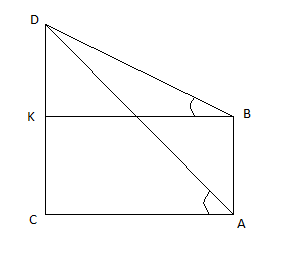
As observed from the top of a lighthouse, 45 m high above the sea-level, the angle of depression of a ship, sailing directly towardsit, changes from $$30^\circ$$ to $$45^\circ$$. The distance travelled by the ship during the period of observation is: (Your answer should be correct to one decimalplace.)
A
32.9 m
B
33.4 m
C
36.9 m
D
24.8 m
View Explanation
Hide Explanation
Let AB be the light house of height 45 m. Let CD = $$x$$ m
In right $$\triangle$$ ABC,
=> $$tan(\angle ACB)=\frac{AB}{BC}$$
=> $$tan(45^\circ)=1=\frac{45}{BC}$$
=> $$BC=45$$ m
In right $$\triangle$$ ABD,
=> $$tan(\angle ADB)=\frac{AB}{BD}$$
=> $$tan(30^\circ)=\frac{1}{\sqrt3}=\frac{45}{45+x}$$
=> $$x+45=45\sqrt3$$
=> $$x=45(\sqrt3-1)$$
=> $$x=45\times0.732=32.9$$ m
=> Ans - (A)
A 22 m long ladder (whose foot is on the ground) leans against a wall making an angle of $$60^\circ$$ with the ground. What is the height (in m) of the point where the ladder touches the wall from the ground?
A
$$\frac{22\sqrt{2}}{3}$$
B
$$11\sqrt{2}$$
C
11
D
$$11\sqrt{3}$$
View Explanation
Hide Explanation
Let AC be the ladder of height 22 m and $$\angle$$ ACB = $$60^\circ$$
In right $$\triangle$$ ABC,
=> $$sin(\angle ACB)=\frac{AB}{AC}$$
=> $$sin(60^\circ)=\frac{\sqrt3}{2}=\frac{h}{22}$$
=> $$h=11\sqrt3$$ m
=> Ans - (D)
The angles of elevation of a pole from two points which are 75 m and 48 m away from its base are $$\alpha$$ and $$\beta$$, respectively. If $$\alpha$$ and $$\beta$$ are complementary, then the height of the tower is:
A
54.5 m
B
61.5 m
C
60 m
D
50 m
View Explanation
Hide Explanation
$$\angle \alpha +\angle \beta = 90\degree$$ (complementary angle)
OA = 48 m
OB = 75 m
$$tan\beta = \frac{OP}{OA}$$
$$tan\beta = \frac{OP}{48}$$
$$tan\alpha = \frac{OP}{75}$$
$$tan(90 - \beta) = \frac{OP}{75}$$
$$cot\beta = \frac{OP}{75}$$
$$tan\beta = \frac{1}{cot\beta}$$
$$\frac{OP}{48} = \frac{75}{OP}$$
OP = $$\sqrt{75 \times 48} = \sqrt{3600}$$ = 60 m
The height of tower is 60 m.
If $$3 + \cos^2 \theta = 3(\cot^2 \theta + \sin^2 \theta), 0^\circ < \theta < 90^\circ$$, then what is the value of $$(\cos \theta + 2 \sin \theta)$$?
A
$$3\sqrt{2}$$
B
$$\frac{\sqrt3 + 2}{2}$$
C
$$\frac{2\sqrt{3} + 1}{2}$$
D
$$\frac{3\sqrt{3} + 1}{2}$$
View Explanation
Hide Explanation
Given : $$3 + \cos^2 \theta = 3(\cot^2 \theta + \sin^2 \theta), 0^\circ < \theta < 90^\circ$$
=> $$3+(1-sin^2\theta)=3(cosec^2\theta-1)+3sin^2\theta$$
=> $$4-4sin^2\theta=\frac{3}{sin^2\theta}-3$$
=> $$7sin^2\theta-4sin^4\theta=3$$
Let $$sin^2\theta=x$$
=> $$4x^2-7x+3=0$$
=> $$(x-1)(4x-3)=0$$
=> $$x=1,\frac{3}{4}$$
=> $$sin\theta=1,\frac{\sqrt3}{2}$$
$$\because \theta<90^\circ$$, => $$\theta=60^\circ$$
$$\therefore$$ $$(\cos \theta + 2 \sin \theta)$$
= $$cos(60^\circ)+2sin(60^\circ)$$
= $$\frac{1}{2}+(2\times\frac{\sqrt3}{2})$$
= $$\frac{2\sqrt3+1}{2}$$
=> Ans - (C)
A kite is flying at a height of 123 m. The thread attached to it is assumed to bestretched straight and makes an angle of $$60^\circ$$ with the level ground. The length ofthe string is (nearest to a whole number):
A
140 m
B
139 m
C
142 m
D
138 m
View Explanation
Hide Explanation
Let AC be the string of kite = $$x$$ m
In right $$\triangle$$ ABC,
=> $$sin(\angle ACB)=\frac{AB}{AC}$$
=> $$sin(60^\circ)=\frac{\sqrt3}{2}=\frac{123}{x}$$
=> $$x=\frac{246}{\sqrt3}$$
=> $$x=82\sqrt3\approx142$$ m
=> Ans - (C)
Aclock tower stands at the crossing of two roads whichpoint in the north-south and the east-westdirections. P, Q, R and S are points on the roads due north, east, south and west respectively, where the angles of elevation of the top of the tower are respectively, $$\alpha, \beta, \gamma$$ and $$\delta$$, Then $$\left(\frac{PQ}{RS}\right)^2$$ is equal to:
A
$$\frac{\tan^2 \alpha + \tan^2 \delta}{\tan^2 \beta + \tan^2 \gamma}$$
B
$$\frac{\tan^2 \alpha + \tan^2 \beta}{\tan^2 \gamma + \tan^2 \delta}$$
C
$$\frac{\cot^2 \alpha + \cot^2 \beta}{\cot^2 \gamma + \cot^2 \delta}$$
D
$$\frac{\cot^2 \alpha + \cot^2 \delta}{\cot^2 \beta + \cot^2 \gamma}$$
View Explanation
Hide Explanation
From the give question, we draw the diagram is given below
Now by the 3D view
Let the height of tower = h
$$ \frac{h}{x} = \tan \alpha $$ ......(1) ( alpha angle of elevation of tower with point P)
Similarly, $$\frac{h}{y} = \tan \beta $$ ..... (2)
$$\frac {h}{z} = \tan \gamma $$ .......(3)
$$\frac{h}{a} = \tan \rho$$ -- (4)
From Equestion (1)(2)(3)(4)
$$x = \frac{h} {\tan \alpha} , a= \frac{h} {\tan \rho} , y= \frac{h} {\tan \beta} , z= \frac{h}{\tan \gamma} $$
Now PQ = $$ \sqrt {x^2 +y^2} $$
= $$\sqrt{ \frac {h^2}{\tan^2 \alpha} + \frac{h^2}{ \tan^2 \beta} }$$ ...... Equestion (5)
RS = $$\sqrt { z^2 + a^2} $$
= $$\sqrt{\frac{h^2} {\tan^2 \gamma} + \frac{h^2} {\tan^2 \rho } }$$ ......... equestion (6)
Equestion (5) divided by Equestion (6)
$$ (\frac{PQ}{RS} )^2= \frac{ \cot^2 \alpha + \cot^2 \beta} { \cot^2 \gamma + \cot^2 \rho } $$
therefore Option (C) Ans
If $$\cos^2 \theta - \sin^2 \theta = \tan^2 \phi$$ then which of the following is true?
A
$$\cos \theta \cos \phi =1$$
B
$$\cos^2 \phi - \sin^2 \phi = \tan^2 \theta$$
C
$$\cos^2 \phi - \sin^2 \phi = \cot^2 \theta$$
D
$$\cos \theta \cos \phi = \sqrt{2}$$
View Explanation
Hide Explanation
Expression : $$\cos^2 \theta - \sin^2 \theta = \tan^2 \phi$$
=> $$cos^2\theta-sin^2\theta=\frac{sin^2\phi}{cos^2\phi}$$
=> $$\frac{cos^2\theta-sin^2\theta}{cos^2\theta+sin^2\theta}=\frac{sin^2\phi}{cos^2\phi}$$
By componendo and dividendo
=> $$\frac{-sin^2\theta}{cos^2\theta}=\frac{sin^2\phi-cos^2\phi}{sin^2\phi+cos^2\phi}$$
=> $$cos^2\phi-sin^2\phi=tan^2\theta$$
=> Ans - (B)
The angle of elevation ofthe top of a tree from a point on the ground which is 300 m away from thetree is $$30^\circ$$. When the tree grew up, its angle ofelevation ofthe top of it became $$60^\circ$$ from the same point. How much did the tree grow? (nearest to an integer)
A
342 m
B
364 m
C
384 m
D
346 m
View Explanation
Hide Explanation
we draw the diagram is given below
Ab is the height that tree grew up
Let AB= h
In $$\triangle BCD $$
$$\frac{BC} {CD} = \tan \30^\circ $$
BC =$$ 300 \times \frac{1}{\sqrt {3}} $$
BC = $$100 \sqrt {3}$$ m
In $$ \triangle ACD $$
$$ \frac{AC} {CD} = \tan 60^\circ $$
$$ \Rightarrow \frac{AB+BC} {300} = \sqrt {3} $$
$$ AB + 100 \sqrt {3} = 300 \sqrt {3} $$
$$ AB = 300 \sqrt{3} - 100 \sqrt{3} $$
$$ AB = 200 \sqrt{3} $$
$$ AB = 200 \times 1.73 $$
$$ AB = 346 $$
therefore the tree grow = 346 m Ans
If $$\tan (11 \theta) = \cot (7 \theta)$$, then what is the value of $$\sin^2 (6 \theta) + \sec^2 (9 \theta) + \cosec^2 (12 \theta)$$?
A
$$\frac{35}{12}$$
B
$$\frac{23}{6}$$
C
$$\frac{31}{12}$$
D
$$\frac{43}{12}$$
View Explanation
Hide Explanation
Given : $$\tan (11 \theta) = \cot (7 \theta)$$
=> $$\tan (11 \theta) = \tan (90^\circ-7 \theta)$$
=> $$11\theta=90^\circ-7\theta$$
=> $$11\theta+7\theta=18\theta=90^\circ$$
=> $$\theta=5^\circ$$
To find : $$\sin^2 (6 \theta) + \sec^2 (9 \theta) + \cosec^2 (12 \theta)$$
= $$sin^2(30^\circ)+sec^2(45^\circ)+cosec^2(60^\circ)$$
= $$\frac{1}{4}+2+\frac{4}{3}$$
= $$\frac{3+24+16}{12}=\frac{43}{12}$$
=> Ans - (D)
If $$\cosec \theta = 1.25,$$ then $$\frac{4 \tan \theta - 5 \cos \theta + 1}{\sec \theta + 4 \cot \theta -1} = ?$$
A
$$\frac{1}{2}$$
B
$$\frac{9}{10}$$
C
$$2$$
D
$$\frac{10}{11}$$
View Explanation
Hide Explanation
Given that $$\cosec \theta = 1.25 = \dfrac {5}{4}$$
so $$\sin \theta = \dfrac{4}{5} $$
then $$\cos \theta = \dfrac {3}{5} $$, $$\tan \theta = \dfrac {4}{3}$$, $$\cot \theta = \dfrac{3}{4}$$
Hence $$ \dfrac {4 \tan \theta - 5 \cos \theta + 1}{ \sec \theta + 4 \cot \theta -1}$$
$$\Rightarrow \dfrac {4\times \dfrac{4}{3} - 5 \times \dfrac{3}{5} +1} {\dfrac{5}{3} + 4\times \dfrac{3}{4} -1}$$
$$\Rightarrow \dfrac{ \dfrac{16}{3} -2} {\dfrac {5} {3} +2} $$
$$\Rightarrow \dfrac{16-6}{5+6}$$
$$\Rightarrow \dfrac{10}{11} $$ Ans
A ladder leaning against a window of a house makes an angle of 60° with the ground. Ifthe distance of the foot of the ladder from the wall is 4.2 m, then the height of the point, where the ladder touches the window from the ground is Closest to:
A
7. 3 m
B
6.8 m
C
7.8 m
D
7 m
View Explanation
Hide Explanation
As per the given question,
The ladder is making $$60^\circ$$ with the ground
and the foot of the ladder is (x)=4.2m from the wall.
We know that $$\tan\theta=\dfrac{h}{x}$$
$$\tan 60^\circ=\dfrac{h}{4.2}$$
$$x=\sqrt{3}\times 4.2=1.732\times 4.2\simeq=7.3 m$$
If $$\frac{\cos \theta}{1 - \sin \theta} + \frac{\cos \theta}{1 + \sin \theta} = 4, 0^\circ < \theta < 90^\circ$$ then what is the value of $$(\sec \theta + \cosec \theta + \cot \theta)$$?
A
$$1 + 2\sqrt{3}$$
B
$$\frac{1 + 2\sqrt{3}}{3}$$
C
$$\frac{2 + \sqrt{3}}{3}$$
D
$$2 + \sqrt{3}$$
View Explanation
Hide Explanation
$$\frac{\cos \theta}{1 - \sin \theta} + \frac{\cos \theta}{1 + \sin \theta} = 4$$
$$\frac{cos\theta + sin\theta cos\theta+cos\theta-sin\theta cos\theta}{sin^2\theta - 1}$$ = 4
$$\frac{2cos\theta}{cos^2\theta}$$ = 4
$$cos\theta = \frac{1}{2}$$
$$\theta = 60\degree$$
$$(\sec \theta + \cosec \theta + \cot \theta)$$
= $$(\sec60\degree+ \cosec60\degree + \cot60\degree)$$
= 2 + $$\frac{2}{\sqrt3} + \frac{1}{\sqrt3} = \frac{2\sqrt{3} + 2 + 1}{3} = 2 + \sqrt{3}$$
If $$2\sin \theta + 15 \cos^2 \theta = 7, 0^\circ < \theta < 90^\circ$$ then what is the value of $$\frac{3 - \tan \theta}{2 + \tan \theta}$$?
A
$$\frac{1}{4}$$
B
$$\frac{5}{8}$$
C
$$\frac{1}{2}$$
D
$$\frac{3}{4}$$
View Explanation
Hide Explanation
Given that $$2 \sin \theta + 15 cos^2 \theta =7 $$
$$\Rightarrow 2\sin \theta + 15 ( 1- \sin^2 \theta ) - 7 = 0 $$
$$\Rightarrow 15 \sin^2 \theta - 2 \sin \theta - 8 = 0 $$
$$ \Rightarrow 15 \sin^2 \theta + 10 \sin \theta - 12 \sin \theta - 8 = 0 $$
$$\Rightarrow (3 \sin \theta + 2) (5\sin \theta - 4) = 0 $$
$$\Rightarrow \sin \theta = \dfrac{4}{5} $$ ,$$ \sin \theta = - \dfrac{2}{3} $$
then valid value $$\sin \theta = \dfrac {4}{5}$$
so $$\cos \theta = \dfrac {3}{4} $$, $$\tan \theta = \dfrac {4}{3}$$
hence $$\dfrac {3 - \tan \theta} {2 + \tan \theta }$$
$$\Rightarrow \dfrac {3 - \dfrac{4}{3}} { 2 + \dfrac {4} {3}}$$
$$\Rightarrow \dfrac {9- 4}{6+4}$$
$$\Rightarrow \dfrac {5}{10} $$
$$\Rightarrow \dfrac {1}{2} $$ Ans
If $$0 \leq \theta \leq 90^\circ$$, and $$(2\theta + 50^\circ) = \cos (4\theta + 16^\circ)$$, then what is the value of $$\theta$$ (in degrees)?
A
$$8^\circ$$
B
$$10^\circ$$
C
$$12^\circ$$
D
$$4^\circ$$
A pole of length 7 m is fixed vertically on the top of a tower. The angle of elevation of the top of the pole observed from a point on the ground is $$60^\circ$$ and the angle of depression of the same point on the ground from the top of the tower is $$45^\circ$$. The height (in m) of the tower is:
A
$$7(2\sqrt{3} - 1)$$
B
$$\frac{7}{2}(\sqrt{3} + 2)$$
C
$$7\sqrt{3}$$
D
$$\frac{7}{2}(\sqrt{3} + 1)$$
View Explanation
Hide Explanation
As per the given question,
Length of the pole is DC=7m
The angle of elevation of the top of the tower $$=45^\circ$$
Now, $$\tan 60^\circ=\dfrac{BC}{AB}$$
$$\Rightarrow \sqrt{3}=\dfrac{BC}{AB}$$
$$\Rightarrow AB=\dfrac{BC}{\sqrt{3}}------(i)$$
Now, In the $$\triangle ABD$$
$$\Rightarrow \tan 45^\circ=\dfrac{BD}{AB}$$
$$\Rightarrow 1=\dfrac{BD}{AB}$$
$$\Rightarrow AB=BD------(ii)$$
From (i) and (ii)
$$\Rightarrow BD=\dfrac{DC+BD}{\sqrt{3}}$$
$$\Rightarrow BD=\dfrac{7+BD}{\sqrt{3}}$$
$$\Rightarrow BD\sqrt{3}=7+BD$$
$$\Rightarrow BD(\sqrt{3}-1)=7$$
$$\Rightarrow BD=\dfrac{7}{\sqrt{3}-1}$$
$$\Rightarrow BD=\dfrac{7(\sqrt{3}+1)}{(\sqrt{3}-1)(\sqrt{3}+1)}$$
$$\Rightarrow BD=\dfrac{7(\sqrt{3}+1)}{3-1}$$
$$\Rightarrow BD=\dfrac{7(\sqrt{3}+1)}{2}$$
The angle of elevation of a ladder leaning against a wall is $$60^\circ$$ and the foot of the ladder is 6.5 m away from the wall. The length of the ladder is:
A
$$6.5 \sqrt{3}$$ m
B
$$13 \sqrt{3}$$ m
C
12 m
D
13 m
View Explanation
Hide Explanation
from the above question we draw the diagram
Let Lenght ladder = AC
then from the $$ \triangle ABC $$,
$$ \cos 60^\circ = \frac {AB} {AC} $$
$$\Rightarrow \frac{1}{2} = \frac {6.5} {AC}$$
$$\Rightarrow AC = 13 m $$
therefore The length of the ladder = 13 Ans
If $$7 \sin^2 \theta + 3 \cos^2 \theta = 4, 0^\circ < \theta < 90^\circ$$, then the value of $$(\tan^2 2 \theta + \cosec^2 2 \theta)$$ is:
A
7
B
$$\frac{15}{4}$$
C
$$\frac{13}{3}$$
D
$$\frac{13}{4}$$
View Explanation
Hide Explanation
Expression : $$7 \sin^2 \theta + 3 \cos^2 \theta = 4, 0^\circ < \theta < 90^\circ$$
=> $$7sin^2\theta+3(1-sin^2\theta)=4$$
=> $$4sin^2\theta=1$$
=> $$sin\theta=\sqrt{\frac{1}{4}}$$
=> $$\theta=sin^{-1}(\frac{1}{2})=30^\circ$$
To find : $$(\tan^2 2 \theta + \cosec^2 2 \theta)$$
= $$tan^2(60^\circ)+cosec^2(60^\circ)$$
= $$3+\frac{4}{3}=\frac{13}{3}$$
=> Ans - (C)
If $$\frac{1}{\cosec \theta + 1} + \frac{1}{\cosec \theta -1} = 2 \sec \theta, 0^\circ < \theta < 90^\circ$$, then the value of $$\frac{\tan \theta + 2 \sec \theta}{\cosec \theta}$$ is:
A
$$\frac{2+\sqrt{3}}{2}$$
B
$$\frac{4+\sqrt{2}}{2}$$
C
$$\frac{2+\sqrt{2}}{2}$$
D
$$\frac{4+\sqrt{3}}{2}$$
View Explanation
Hide Explanation
Given that $$\dfrac{1}{\cosec\theta +1} + \dfrac {1}{\cosec \theta -1} = 2 \sec \theta $$
$$\Rightarrow \dfrac {\cosec \theta - 1 + \cosec \theta +1}{ \cosec^2 \theta -1} = 2\sec \theta $$
$$\Rightarrow \dfrac{2 \cosec \theta}{\cot^2 \theta} = 2 \sec \theta $$
$$\Rightarrow \dfrac {1}{\sin \theta} \times \dfrac {\sin^2 \theta}{\cos^2 \theta} = \dfrac {1}{\cos \theta} $$
$$\Rightarrow \dfrac{\sin \theta}{\cos \theta} = 1 $$
$$\Rightarrow \tan \theta =1$$
$$\Rightarrow \theta = \dfrac{\pi}{4}$$
then value $$\dfrac {\tan \theta + 2 \sec \theta}{\cosec \theta}$$
$$\Rightarrow \dfrac {\tan \dfrac{\pi}{4} + 2 \sec \dfrac {\pi}{4}}{\cosec \dfrac{\pi}{4}}$$ (put the value $$\theta $$)
$$\Rightarrow \dfrac{1 + 2\sqrt{2}} {\sqrt {2}}$$ multiply by $$ \sqrt {2}$$
$$\Rightarrow \dfrac {4 + \sqrt {2}}{2} $$ Ans
An observer who is 1.62 m tall is 45 m away from a pole. The angle of elevation of the top of the pole from his eyes is $$30^\circ$$. The height (in m) ofthe pole is closest to:
A
26.2
B
27.6
C
25.8
D
26.8
View Explanation
Hide Explanation
Given that observer 1.62 m away from 45 m angle $$30^\circ$$
AB= 45 m
then in the diagram
from the above figure $$\tan 30^\circ = \frac{h-1.62} {45} $$
$$\Rightarrow h-1.62 = 45 \times \frac{1} {\sqrt{3}} $$
$$\Rightarrow h= 45 \times \frac{1} {\sqrt{3}} + 1.62 $$
$$\Rightarrow h= 45 \times 0.577 +1.62 $$
$$\Rightarrow h= 27.58 $$ m
$$\Rightarrow h= 27.6 $$ m Ans
If $$21 \tan \theta = 20$$, then $$(1 + \sin \theta + \cos \theta) : (1 - \sin \theta + \cos \theta) = ?$$
A
5 : 2
B
3 : 1
C
7 : 3
D
2 : 1
View Explanation
Hide Explanation
Given that $$21 \tan \theta = 20$$
$$ \tan \theta = \dfrac{20}{21}$$
then $$(1 + \sin \theta + \cos \theta) : (1 - \sin \theta + \cos \theta)$$
$$\dfrac{(1 + \sin \theta + \cos \theta)}{ (1 - \sin \theta + \cos \theta)}$$
dividing $$\cos \theta $$
$$\dfrac {(\sec \theta + \tan \theta + 1)}{(\sec \theta - \tan \theta + 1)} $$
we know that $$\sec^2 \theta - \tan^2 \theta = 1 $$
then $$\Rightarrow \dfrac{(\sec \theta +\tan \theta) (\sec^2 \theta - \tan^2 \theta)} {(\sec \theta - \tan \theta + 1)}$$
$$\Rightarrow (\sec \theta + \tan \theta) $$
Now $$ \tan \theta = \dfrac{20}{21} $$
we know that $$ 1 + \tan^2 \theta = \sec^2 \theta $$
$$\Rightarrow 1 + \dfrac{400}{441} = \sec^2 \theta $$
$$\Rightarrow \sec \theta = \dfrac{29}{21}$$
hence $$\sec \theta + \tan \theta $$
$$\Rightarrow \dfrac{29}{21}+ \dfrac{20}{21}$$ (put the value)
$$\Rightarrow \dfrac{49}{21}$$
$$\Rightarrow \dfrac{7}{3} $$ Ans
If $$3(\cot^2 \theta - \cos^2 \theta) = 1 - \sin^2 \theta, 0^\circ < \theta < 90^\circ$$, then the $$\theta$$ equal to
A
$$30^\circ$$
B
$$60^\circ$$
C
$$45^\circ$$
D
$$15^\circ$$
View Explanation
Hide Explanation
$$3(\cot^2 \theta - \cos^2 \theta) = 1 - \sin^2 \theta, 0^\circ < \theta < 90^\circ$$
$$\Rightarrow 3(\dfrac{\cos^2\theta}{\sin^2\theta} - \cos^2 \theta) = 1 - \sin^2 \theta$$
$$\Rightarrow 3\cos^2\theta(\dfrac{1-\sin^2\theta}{\sin^2\theta} ) = 1 - \sin^2 \theta$$
$$\Rightarrow \tan^2\theta=3$$
$$\Rightarrow \tan\theta=\sqrt{3}=\tan 60^\circ$$
$$\theta=60^\circ$$
If $$(\cos \theta + \sin \theta) : (\cos \theta - \sin \theta) = (\sqrt{3} + 1) : (\sqrt{3} - 1), 0^\circ < \theta < 90^\circ$$, then what is the value of $$\sec \theta$$?
A
1
B
2
C
$$\sqrt{2}$$
D
$$\frac{2\sqrt3}{3}$$
View Explanation
Hide Explanation
Given that $$(\cos \theta + \sin \theta) : (\cos \theta - \sin \theta) = (\sqrt{3} + 1) : (\sqrt{3} - 1)$$
$$\Rightarrow \sqrt{3} \cos \theta - \cos \theta + \sqrt{3} \sin \theta - \sin \theta = \sqrt{3} \cos \theta + \cos \theta - \sqrt{3} \sin \theta - \sin \theta $$
$$\Rightarrow 2 \sqrt {3} \sin \theta = 2 \cos \theta $$
$$\Rightarrow \tan \theta = \dfrac {1}{\sqrt {3}} $$
$$\Rightarrow \theta = \tan^-1 \dfrac{1} {\sqrt {3}}$$
$$\Rightarrow \theta = 30^{\circ} $$
then $$ \sec \theta = \sec \30^\circ$$
= $$ \dfrac{2} {\sqrt {3}} $$ Ans
From the top of a house A in a street, the angles of elevation and depression of the top and foot of another house B on the opposite side of the street are $$60^\circ$$ and $$45^\circ$$, respectively. If the height of house A is 36 m, then what is the height of house B? (Your answer should be nearest to an Integer.)
A
91 m
B
93 m
C
94 m
D
98 m
View Explanation
Hide Explanation
From the above question, we draw the diagram is given below
In $$ \triangle ADC $$
$$ \tan 45^\circ = \frac{DC} {AD} $$
$$ \Rightarrow 1 = \frac{36} {AD}$$
$$\Rightarrow AD = 36 m $$
In $$\triangle ADB $$
$$ \tan 60^\circ = \frac{BD}{AD}$$
$$ \Rightarrow BD= 36 \times \sqrt {3} $$
then Length of Building = BD + DC
$$ \Rightarrow 36 \sqrt{3} + 36 $$
$$\Rightarrow 36 (1+\sqrt{3}) $$
$$ \Rightarrow 36 \times (1+1.73) $$
$$\Rightarrow 36 \times 2.73 $$
$$\Rightarrow 98.28 $$
therefore Height of house B= 98 m Ans
The value of $$\tan^2 48^\circ - \cosec^2 42^\circ + \cosec(67^\circ + \theta) - \sec(23^\circ - \theta)$$is:
View Explanation
Hide Explanation
$$\tan^2 48^\circ - \cosec^2 42^\circ + \cosec(67^\circ + \theta) - \sec(23^\circ - \theta)$$
Now, we know that $$\cosec(90-\theta)=\sec\theta$$
So,$$\tan^2 48^\circ - \sec^2 (90^\circ-42^\circ) + \cosec(67^\circ + \theta) - \sec(23^\circ - \theta)$$
$$\Rightarrow \tan^2 (48^\circ) - \sec^2 (48^\circ) + \cosec(67^\circ + \theta) - \cosec(90^\circ-(23^\circ - \theta))$$
$$\Rightarrow \tan^2 (48^\circ) - \sec^2 (48^\circ) + \cosec(67^\circ + \theta) - \cosec(67^\circ - \theta)$$
$$\Rightarrow -1$$
From a point 12 m above the water level, the angle of elevation of the top of a hill is $$60^\circ$$ and the angle of depression of the base of the hill is $$30^\circ$$. What is the height (in m)of the hill?
A
36
B
$$48\sqrt{3}$$
C
48
D
$$36\sqrt{3}$$
If $$0 \leq \theta \leq 90^\circ$$, and $$\sec^{107} \theta + \cos^{107} \theta = 2$$, then $$(\sec \theta + \cos \theta)$$ is equal to:
A
$$2^{-107}$$
B
1
C
2
D
$$\frac{1}{2}$$
Two points A and B are on the ground and on opposite sides of a tower. A is closer to the foot of tower by 42 m than B. If the angles of elevation ofthe top of the tower, as observed from A and B are $$60^\circ$$ and $$45^\circ$$, respectively. then the height of the tower is closest to:
A
87.6 m
B
98.6 m
C
88.2 m
D
99.4 m
View Explanation
Hide Explanation
Height of tower = OP
AB = 42 m
$$tan45\degree = \frac{OP}{OA}$$
1 = OP/OA
OP = OA
$$tan60\degree = \frac{OP}{OA + AB}$$
$$\sqrt{3} = \frac{OP}{OP+ 42}$$
$$\sqrt{3} \times$$ (OP + 42) = OP
OP= $$\frac{42\sqrt{3}}{0.732} = \frac{72.744}{0.732}$$= 99.37 = 99.4 m
The height of tower is 99.4 m.
If $$\sin \theta - \cos \theta = 0, 0^\circ < \theta < 90^\circ$$, then the value of $$\sin^4 \theta + \cos^4 \theta$$ is:
A
$$\frac{1}{3}$$
B
$$1$$
C
$$\frac{1}{2}$$
D
$$\frac{1}{4}$$
View Explanation
Hide Explanation
Given,
$$sin\theta-cos\theta=0$$
$$sin\theta=cos\theta$$
$$sin\theta=sin(90-\theta)$$
$$\theta=90-\theta$$
$$\theta+\theta=90$$
$$2\theta=90$$
$$\theta=45$$
$$sin^4\theta+cos^4\theta$$
$$sin^4(45)+cos^4(45)$$
$$(\dfrac{1}{\sqrt2})^4+(\dfrac{1}{\sqrt2}^4)$$
$$\dfrac{1}{4}+\dfrac{1}{4}$$
$$\dfrac{1}{2}$$
A pole stands vertically on a road, which goes in the north-south direction. P, Q are two points towards the north of the pole, such that PQ = b, and the angles ofelevation ofthe top ofthe pole at P, Q are a, B respectively. Then the height of the pole is:
A
$$\frac{b}{\tan \beta + \tan \alpha}$$
B
$$\frac{b}{\cot \beta - \cot \alpha}$$
C
$$\frac{b}{\tan \beta - \tan \alpha}$$
D
$$\frac{b \tan \alpha}{\tan \beta}$$
From the top of a lamp post of height x metres, two objects on the ground on the sameside of it (and in line with the foot of the lamp post) are observed at angles of depression of $$30^\circ$$ and $$60^\circ$$, respectively. The distance between the objects is $$32\sqrt{3}$$ m. The value of x is:
View Explanation
Hide Explanation
from the question we draw the diagram
Let BD =$$y $$
In the $$\triangle ABC $$
$$ \tan 30^\circ = \frac{x} {32\sqrt {3} +y} $$
$$ \frac {1} {\sqrt {3} } = \frac {x} {32 \sqrt {3} +y} $$ ...... Equestion (1)
then $$\triangle ABC $$
$$ \tan 60^\circ = \frac{x} {y} $$
$$ \sqrt {3} = \frac{x} {y} $$
$$ y = \frac {x} {\sqrt {3} } $$
Put the value $$ y $$ in Equation (1)
$$ \frac {1} {\sqrt {3}} = \frac {x} { 32 \sqrt {3} + \frac {x} {\sqrt {3}}} $$
$$\Rightarrow 32 + \frac{x}{3} = x $$
$$ \Rightarrow 2 \frac {x}{3} = 32 $$
$$\Rightarrow x = 48 $$ Ans
The angles of elevation of the top of a tower from two points on the ground at distances 32 m and 18 m from its base and in the same straight line with it are complementary. The height(in m) of the tower is .....
View Explanation
Hide Explanation
Let $$ \angle ADB = \theta $$
then $$\angle ACD = (90^\circ - \theta) $$
In right triangle $$ \triangle ABD $$
$$ \tan \theta = \frac{AB}{BD} $$
$$\tan \theta = \frac{AB} {32} $$...........(1)
$$\triangle ABC $$
$$ \tan(90^\circ - \theta) = \frac{AB}{BC} $$
$$ \cot \theta = \frac{AB}{18} $$ ...........(2)
Multiplying Equation (1) and Equation (2)
$$ \tan \theta \times \frac{1}{\tan \theta} = \frac{AB}{32} \times \frac{AB}{18} $$
$$ 1 = \frac{(AB)^2} {32 \times 18} $$
$$ AB = \sqrt {18 \times 32 } $$
$$ \Rightarrow AB = 2 \times 2 \times 2 \times 3 $$
$$ \Rightarrow AB = 24 $$
The height of tower = 24 m Ans
If $$\sqrt{2} \sin(60^\circ - \alpha) = 1, 0^\circ < \alpha < 90^\circ$$, then $$\alpha$$ is equal to:
A
$$45^\circ$$
B
$$30^\circ$$
C
$$15^\circ$$
D
$$60^\circ$$
View Explanation
Hide Explanation
As per the given question,
$$\sqrt(2) \sin(60^\circ - \alpha)= 1 $$ and $$0^\circ < \alpha < 90^\circ$$
$$\Rightarrow \sin(60^\circ - \alpha) = \dfrac{1}{\sqrt(2)}$$
$$\Rightarrow \sin(60^\circ - \alpha) = \sin(45^\circ) $$ ( put the value )
Taking the inverse of both side with $$\sin$$
$$\Rightarrow (60^\circ - \alpha) = 45^\circ $$
$$\Rightarrow \alpha = 60^\circ - 45^\circ $$
$$\alpha = 15^\circ $$ Ans
The value of $$\frac{1 - 2 \sin^2 \theta \cos^2 \theta}{\sin^4 \theta + \cos^4 \theta} - 1$$ is:
A
-1
B
1
C
$$-2 \sin^2 \theta \cos^2 \theta$$
D
0
View Explanation
Hide Explanation
$$\frac{1 - 2 \sin^2 \theta \cos^2 \theta}{\sin^4 \theta + \cos^4 \theta} - 1$$
= $$\frac{1 - 2 \sin^2 \theta \cos^2 \theta - \sin^4 \theta - \cos^4 \theta}{\sin^4 \theta + \cos^4 \theta}$$
= $$\frac{1 - (sin^2 \theta + \cos^2 \theta)^2 }{\sin^4 \theta + \cos^4 \theta}$$
= $$\frac{1 - 1}{\sin^4 \theta + \cos^4 \theta}$$ = 0
The value of $$\frac{3(1 - 2 \sin^{2}x)}{\cos^{2}x - \sin^{2}x}$$ is:
View Explanation
Hide Explanation
$$\frac{3(1-2sin^{2}x)}{cos^{2}x-sin^{2}x}$$
= $$\frac{3(1-2sin^{2}x)}{1-sin^{2}x-sin^{2}x}$$
Solve the following.
View Explanation
Hide Explanation
$$\frac{2sin22^{0}}{cos68^{0}}-\frac{2cot75^{0}}{5tan15^{0}}-\frac{8tan45^{0}tan20^{0}tan40^{0}tan50^{0}tan70^{0}}{5}$$
$$\frac{2sin22^{0}}{cos(90 - 22)}-\frac{2cot(90 - 15)}{5tan15^{0}}-\frac{8tan45^{0}tan(90 - 70)tan(90 - 50)tan50^{0}tan70^{0}}{5}$$
$$\frac{2sin22^{0}}{sin22^{0}}-\frac{2tan15^{0}}{5tan15^{0}}-\frac{8tan45^{0}cot50^{0}cot70^{0}tan50^{0}tan70^{0}}{5}$$
$$2-\frac{2}{5}-\frac{8tan45^{0}}{5}$$
$$2-\frac{2}{5}-\frac{8}{5}$$ = 0
If $$\sec \theta + \tan \theta = p, 0^\circ < \theta < 90^\circ$$, then $$\frac{p^2 - 1}{p^2 + 1}$$ is equal to:
A
$$\cosec \theta$$
B
$$\sin \theta$$
C
$$\cos \theta$$
D
$$2 \cosec \theta$$
View Explanation
Hide Explanation
$$\sec \theta + \tan \theta = p$$
$$(\sec \theta + \tan \theta)^2 = p^2$$ ---(1)
$$\frac{p^2 - 1}{p^2 + 1}$$
From eq(1),
= $$\frac{(\sec \theta + \tan \theta)^2 - 1}{(\sec \theta + \tan \theta)^2 + 1}$$
= $$\frac{\sec^2 \theta + \tan^2 \theta + 2\sec \theta \tan \theta - 1}{\sec^2 \theta + \tan^2 \theta + 2\sec \theta \tan \theta + 1}$$
= $$\frac{(\sec^2 \theta - 1) + \tan^2 \theta + 2\sec \theta \tan \theta}{\sec^2 \theta + 2\sec \theta \tan \theta + (\tan^2 \theta + 1)}$$
= $$\frac{2 \tan^2 \theta + 2\sec \theta \tan \theta }{2\sec^2 \theta + 2\sec \theta \tan \theta}$$
= $$\frac{\tan^2 \theta + \sec \theta \tan \theta }{\sec^2 \theta + \sec \theta \tan \theta}$$
= $$\frac{\tan \theta(\tan \theta + \sec \theta)}{\sec \theta (\sec \theta + \tan \theta)}$$
= $$\frac{\tan \theta}{\sec \theta}$$ = $$\sin\theta$$
If $$x = 4 \cos A + 5 \sin A$$ and $$y = 4 \sin A - 5 \cos A$$, then the value of $$x^2 + y^2$$ is:
View Explanation
Hide Explanation
$$x = 4 \cos A + 5 \sin A$$
$$y = 4 \sin A - 5 \cos A$$
$$x^2 + y^2$$
= $$(4 \cos A + 5 \sin A)^2 + (4 \sin A - 5 \cos A)^2$$
($$(a + b)^2 = a^2 + b^2 + 2ab$$)
$$= (16 \cos^2 A + 25 \sin^2 A + 40\cos A\sin A) + (16 \sin^2 A + 25 \cos^2 A - 40\cos A\sin A)^2$$
($$ \sin^2 A + \cos^2 A = 1$$)
= 16 + 25 = 41
Solve the following.
View Explanation
Hide Explanation
$$\frac{\sin 40^\circ}{\cos 50^\circ} + \frac{\cosec 50^\circ}{\sec 40^\circ} - 4 \cos 50^\circ \cosec 40^\circ$$
=$$\frac{\sin 40^\circ}{\cos(90^\circ - 40^\circ)} + \frac{\cosec(90^\circ - 40^\circ)}{\sec 40^\circ} - 4 \cos(90^\circ - 40^\circ) \cosec 40^\circ$$
= 1 + 1 - 4 = -2
The value of $$(\cosec A + \cot A + 1)(\cosec A - \cot A + 1) - 2 \cosec A$$ is:
A
$$2 \cosec A$$
B
$$4 \cosec A$$
C
$$0$$
D
$$2$$
View Explanation
Hide Explanation
$$(cosecA+cotA+1)(cosecA-cotA+1)-2cosecA$$
= $$(cosecA + 1)^2 - (cotA)^2 - 2cosecA$$
($$\because a^2 - b^2 = (a + b)(a - b)$$)
= $$cosec^2A + 1 + 2cosecA - cot^2A - 2cosecA$$
($$cosec^2A - cot^2A = 1)
= 1 + 1 = 2
If $$2 \sin \theta - 8 \cos^2 \theta + 5 = 0, 0^\circ < \theta < 90^\circ$$, then what is the value of $$(\tan 2\theta + \cosec 2\theta)?$$
A
$$3\sqrt{3}$$
B
$$\frac{4\sqrt{3}}{3}$$
C
$$2\sqrt{3}$$
D
$$\frac{5\sqrt{3}}{3}$$
View Explanation
Hide Explanation
$$2 \sin \theta - 8 \cos^2 \theta + 5 = 0$$
$$\Rightarrow2 \sin \theta - 8(1 - \sin^2 \theta) + 5 = 0$$
$$\Rightarrow8 \sin^2 \theta + 2 \sin \theta - 3 = 0$$
$$\Rightarrow8 \sin^2 \theta + 6 \sin \theta- 4 \sin \theta- 3 = 0$$
$$\Rightarrow4\sin \theta(2\sin \theta - 1) + 3(2\sin \theta - 1) = 0$$
$$\Rightarrow(4\sin \theta + 3)(2\sin \theta - 1) = 0$$
$$\Rightarrow\sin \theta = 1/2$$
$$\Rightarrow\theta = 30\degree$$
$$(\tan 2\theta + \cosec 2\theta)$$
= $$(\tan 2 \times 30\degree+ \cosec 2 \times 30\degree)$$
= $$(\tan 60\degree+ \cosec 60\degree)$$
=$$\sqrt3 + \frac{2}{\sqrt3}$$
=$$ \frac{5}{\sqrt3} = \frac{5\sqrt3}{3}$$
If $$x \cos A - y \sin A = 1$$ and $$x \sin A + y \cos A = 4$$, then the value of $$17x^{2} + 17y^{2}$$ is:
View Explanation
Hide Explanation
$$x \cos A - y \sin A=1$$
Take the square of both sides,
$$(x \cos A - y \sin A)^2=1$$
$$(x \cos A)^2 - 2xy \sin A \cos A + (y \sin A)^2 = 1$$ ---(1)
($$\because (a + b)^2 = a^2 + b^2 + 2ab$$)
$$x \sin A + y \cos A = 4$$
Take the square of both sides,
$$(x \sin A + y \cos A)^2=16$$
$$(x \sin A)^2 + 2xy \sin A \cos A + (y \cos A)^2 =16$$ ---(2)
Addition of eq(1) and eq(2),
$$(x \cos A)^2 + (x \sin A)^2 + (y \sin A)^2 + (y \cos A)^2 = 17$$
$$x^2 + y^2 = 17$$
$$17x^{2}+17y^{2} = 17 \times 17$$
$$17x^{2}+17y^{2} = 289$$
if $$0 < A, B < 45^\circ, \cos(A + B) = \frac{24}{25}$$ and $$\sin(A - B) = \frac{15}{17}$$, then $$\tan 2A$$ is
A
1
B
0
C
$$\frac{416}{87}$$
D
$$\frac{213}{4}$$
View Explanation
Hide Explanation
$$\tan 2A$$
= tan((A + B) + (A - B))
=$$\frac{tan(A + B) + tan(A + B)}{1 - tan(A + B)tan(A + B)}$$ ---(1)
$$(\because tan(a + b) = \frac{tana + tanb}{1 - tana.tanb})$$
tan(A + B) = $$\frac{sin(A + B)}{cos(A - B)}$$
tan(A + B) = $$\frac{\sqrt{1 - cos^2(A + B)}}{cos(A + B)}$$
tan(A + B) = $$\frac{\sqrt{1 - (24/25)^2}}{(24/25)}$$
tan(A + B) = $$\frac{\sqrt{49/25}}{(24/25)}$$ = 7/24
tan(A - B) = $$\frac{sin(A - B)}{cos(A - B)}$$
tan(A - B)= $$\frac{sin(A - B)}{\sqrt{1 - sin^2(A - B)}}$$
tan(A - B) = $$\frac{15/17}{\sqrt{1 - (15/17)^2}}$$
tan(A - B) = $$\frac{15/17}{\sqrt{64/17)^2}}$$ = 15/8
From eq(1),
=$$\frac{\frac{7}{24} +\frac{15}{8}}{1 - \frac{7}{24}.\frac{15}{8}}$$
=$$\frac{416}{87}$$
The value of $$\frac{\tan 30^\circ \cosec 60^\circ + \tan 60^\circ \sec 30^\circ}{\sin^2 30^\circ + 4 \cot^2 45^\circ - \sec^2 60^\circ}$$ is:
A
$$\frac{2}{3}$$
B
$$\frac{32}{99}$$
C
$$\frac{8}{3}$$
D
$$\frac{32}{3}$$
View Explanation
Hide Explanation
$$\frac{\tan 30^\circ \cosec 60^\circ + \tan 60^\circ \sec 30^\circ}{\sin^2 30^\circ + 4 \cot^2 45^\circ - \sec^2 60^\circ}$$
On put the values,
= $$\frac{\frac{1}{\sqrt3} \times \frac{2}{\sqrt3} + \sqrt3 \times \frac{2}{\sqrt3}}{(\frac{1}{2})^2 + 4 \times 1 - 2^2}$$
= $$\frac{\frac{2}{3} + 2}{\frac{1}{4} + 4 - 4}$$
= $$\frac{\frac{8}{3}}{\frac{1}{4}}$$
= $$\frac{32}{3}$$
If $$\tan \theta - \cot \theta = \cosec \theta, 0^\circ < \theta < 90^\circ$$, then what is the value of $$\frac{2 \tan \theta - \cos \theta}{\sqrt{3} \cot \theta + \sec \theta}$$?
A
$$\frac{3\sqrt{3} - 1}{6}$$
B
$$\frac{4\sqrt{3} - 1}{6}$$
C
$$\frac{2\sqrt{3} - 1}{3}$$
D
$$\frac{2(2\sqrt{3} - 1)}{3}$$
View Explanation
Hide Explanation
$$\tan \theta - \cot \theta = \cosec \theta$$
$$\tan \theta - \frac{1}{tan \theta} = \cosec \theta$$
$$\tan^2 \theta - 1 = \cosec \theta\tan \theta$$
$$\sec^2 \theta - 1 - 1 = \sec \theta$$
$$\sec^2 \theta - \sec \theta - 2 = 0$$
$$\sec^2 \theta - 2\sec \theta + \sec \theta - 2 = 0$$
$$\sec \theta(\sec \theta - 2) +1(\sec \theta - 2) = 0$$
$$ (\sec \theta + 1)(\sec \theta - 2) = 0$$
For $$0^\circ < \theta < 90^\circ$$,
$$\sec \theta$$ = 2
$$\cos \theta$$ = 1/2
$$\theta = 60\degree$$
Now,
$$\frac{2 \tan \theta - \cos \theta}{\sqrt{3} \cot \theta + \sec \theta}$$
Put the value of $$\theta$$,
= $$\frac{2 \tan 60\degree - \cos60\degree}{\sqrt{3} \cot 60\degree + \sec 60\degree}$$
= $$\frac{2\sqrt3- \frac{1}{2}}{\sqrt{3} \times \frac{1}{\sqrt3}+ 2}$$
= $$\frac{4\sqrt3- 1}{6}$$
The value of $$4\left[\frac{(1 - \sec A)^{2} + (1 + \sec A)^{2}}{1 + \sec^{2}A}\right]$$ is :
View Explanation
Hide Explanation
$$4\left[\frac{(1 - \sec A)^{2} + (1 + \sec A)^{2}}{1 + \sec^{2}A}\right]$$
= $$4\left[\frac{1 + \sec^{2}A - 2\sec A + 1 + \sec^{2}A + 2\sec A}{1 + \sec^{2}A}\right]$$
= $$4\left[\frac{2(1 + \sec^{2}A) }{1 + \sec^{2}A}\right]$$ = 8
The value of $$\frac{\tan 30^\circ + \tan 60^\circ}{\cos 30^\circ}$$ is:
A
$$1 + \sqrt{3}$$
B
$$\frac{8}{\sqrt{3}}$$
C
$$\frac{8}{3}$$
D
$$\sqrt{3} + 3$$
View Explanation
Hide Explanation
$$\frac{\tan 30^\circ + \tan 60^\circ}{\cos 30^\circ}$$
put the value in the above expression,
= $$\frac{\frac{1}{\sqrt{3}} + \sqrt{3}}{\frac{\sqrt{3}}{2}}$$
= $$\frac{1+3}{\sqrt{3}} \times$$ $$2/\sqrt3$$
= $$\frac{8}{3}$$
Whatis the value of $$\frac{\cosec(78^\circ + \theta) - \sec(12^\circ - \theta) - \tan(67^\circ + \theta) + \cot(23^\circ - \theta)}{\tan 13^\circ \tan37^\circ \tan45^\circ \tan53^\circ \tan77^\circ}$$
View Explanation
Hide Explanation
$$\frac{\cosec(78^\circ + \theta) - \sec(12^\circ - \theta) - \tan(67^\circ + \theta) + \cot(23^\circ - \theta)}{\tan 13^\circ \tan37^\circ \tan45^\circ \tan53^\circ \tan77^\circ}$$
$$\frac{\cosec(90^\circ - (12^\circ - \theta)) - \sec(12^\circ - \theta) - \tan(90^\circ - (23^\circ - \theta)) + \cot(23^\circ - \theta)}{\tan 13^\circ \tan37^\circ \tan45^\circ \tan53^\circ \tan77^\circ}$$
$$\frac{\sec(12^\circ - \theta) - \sec(12^\circ - \theta) - \cot(23^\circ - \theta) + \cot(23^\circ - \theta)}{\tan 13^\circ \tan37^\circ \tan45^\circ \tan53^\circ \tan77^\circ}$$
$$\frac{0}{\tan 13^\circ \tan37^\circ \tan45^\circ \tan53^\circ \tan77^\circ}$$ = 0
If $$2 \sin \theta + 15 \cos^2 \theta = 7, 0^\circ < \theta < 90^\circ$$, then $$\tan \theta + \cos \theta + \sec \theta =$$
A
$$3\frac{3}{5}$$
B
3
C
$$3\frac{4}{5}$$
D
4
View Explanation
Hide Explanation
$$2 \sin \theta + 15 \cos^2 \theta = 7$$
$$2 \sin \theta + 15 (1 - sin^2 \theta) = 7$$
$$2 \sin \theta + 15 - 15 sin^2 \theta = 7$$
$$2 \sin \theta + 8 - 15 sin^2 \theta = 0$$
$$15 sin^2 \theta - 2 \sin \theta - 8 = 0 $$
$$sin^2 \theta - \frac{2\sin \theta}{15} - \frac{8}{15} = 0 $$
$$sin^2 \theta + \frac{2\sin \theta}{3} - \frac{4\sin \theta}{5} - \frac{8}{15} = 0 $$
$$sin \theta(sin \theta + \frac{2}{3}) - \frac{4}{5}(sin \theta + \frac{2}{3}) = 0 $$
$$(sin \theta - \frac{4}{5})(sin \theta + \frac{2}{3}) = 0$$
For $$0^\circ < \theta < 90^\circ$$,
$$sin \theta = \frac{4}{5}$$
Perpendicular = 4
Hypotenuses = 5
By triplet 3-4-5,
Base = 3
Now,
$$\tan \theta + \cos \theta + \sec \theta$$
= $$\frac{4}{3} + \frac{3}{5} +\frac{5}{3}$$
= $$\frac{20 + 9 + 25}{15}$$
= $$\frac{54}{15}$$ = $$\frac{18}{5}$$
= $$3\frac{3}{5}$$
If $$7 \sin^2 \theta - \cos^2 \theta + 2 \sin \theta = 2, 0^\circ < \theta < 90^\circ$$, then the value of $$\frac{\sec 2\theta + \cot 2\theta}{\cosec 2\theta + \tan 2\theta}$$ is:
A
$$\frac{2\sqrt{3} + 1}{3}$$
B
1
C
$$\frac{1}{5}(1 + 2\sqrt{3})$$
D
$$\frac{2}{5}(1 + \sqrt{3})$$
View Explanation
Hide Explanation
$$7 \sin^2 \theta - \cos^2 \theta + 2 \sin \theta = 2$$
$$\Rightarrow$$ $$7 \sin^{2} \theta - \cos^{2} \theta + 2 \sin \theta - 2 = 0$$
$$\Rightarrow$$ $$7 \sin^{2} \theta - (1 - \sin^{2} \theta) + 2 \sin \theta - 2 = 0$$
$$\Rightarrow$$ $$8 \sin^{2} \theta + 2 \sin \theta - 3 = 0$$
$$\Rightarrow$$ $$8 \sin^{2} \theta + 6 \sin \theta - 4\sin \theta- 3 = 0$$
$$\Rightarrow$$ $$2\sin \theta(4 \sin\theta + 3) -1(4 \sin\theta + 3) = 0$$
$$\Rightarrow$$ $$(2\sin \theta - 1)(4 \sin\theta + 3) = 0$$
For $$ 0^\circ < \theta < 90^\circ$$,
$$\sin \theta = 1/2$$
$$\theta = 30\degree$$
$$\frac{\sec 2 \times 30+ \cot 2\times 30}{\cosec 2\times 30 + \tan 2\times 30}$$
$$\Rightarrow$$ $$\frac{\sec 60 + \cot 60}{\cosec 60 + \tan 60}$$
$$\Rightarrow$$ $$\frac{2\sqrt3 + 1}{2+ 3}$$
$$\Rightarrow$$ $$\frac{2\sqrt3 + 1}{5}$$
In the figure, what is the value of $$\cot \theta ?$$
A
$$\frac{17}{18}$$
B
$$\frac{15}{17}$$
C
$$\frac{15}{8}$$
D
$$\frac{8}{15}$$
View Explanation
Hide Explanation
From the triangle,
PQ$$^2$$ + QR$$^2$$ = PR$$^2$$
$$\Rightarrow$$ 8$$^2$$ + QR$$^2$$ = 17$$^2$$
$$\Rightarrow$$ 64 + QR$$^2$$ = 289
$$\Rightarrow$$ QR$$^2$$ = 225
$$\Rightarrow$$ QR = 15 cm
$$\therefore\ $$ $$\cot\theta\ =\frac{\text{Adjacent side}}{\text{Opposite side}}=\frac{QR}{PQ}=\frac{15}{8}$$
Hence, the correct answer is Option C
The value of $$\cos 0^\circ \cos 30^\circ \cos 45^\circ \cos 60^\circ \cos 90^\circ$$ is:
A
5
B
3
C
0
D
$$\frac{\sqrt{6}}{8}$$
View Explanation
Hide Explanation
$$\cos 0^\circ \cos 30^\circ \cos 45^\circ \cos 60^\circ \cos 90^\circ$$ = 0
($$\because \cos 0^\circ = 0$$)
What is the value of $$\sin 30^\circ + \cos 30^\circ - \tan 45^\circ $$?
A
$$\frac{\sqrt{3} - 1}{2}$$
B
$$\frac{\sqrt{2} + 1}{\sqrt{2}}$$
C
$$\frac{\sqrt{3} + 1}{2}$$
D
$$\frac{1 - \sqrt{3}}{2}$$
View Explanation
Hide Explanation
$$\sin 30^\circ + \cos 30^\circ - \tan 45^\circ $$
= $$1/2 + \frac{\sqrt3}{2} - 1$$
= $$\frac{1 + \sqrt3 - 2}{2}$$
= $$\frac{\sqrt3 - 1}{2}$$
If $$\cot \theta + \tan\theta = 2 \sec \theta, 0^\circ < \theta < 90^\circ $$, then the value of $$\frac{\tan 2 \theta - \sec \theta}{\cot 2 \theta + \cosec \theta}$$
A
$$\frac{2\sqrt{3}-1}{5}$$
B
$$\frac{3-\sqrt{2}}{5}$$
C
$$\frac{2\sqrt{3}-1}{11}$$
D
$$\frac{3-\sqrt{2}}{11}$$
View Explanation
Hide Explanation
$$\cot \theta + \tan\theta = 2 \sec \theta$$
On putting the value of $$\theta$$ = 30$$\degree$$
$$\cot30\degree + \tan30\degree = 2 \sec30\degree$$
$$ \sqrt3 + \frac{1}{\sqrt3} = 2 \times \frac{2}{\sqrt3}$$
$$\frac{4}{\sqrt3} = \frac{4}{\sqrt3}$$
$$\frac{\tan 2 \theta - \sec \theta}{\cot 2 \theta + \cosec \theta}$$
= $$\frac{\tan 2 \times 30\degree - \sec30\degree }{\cot 2 \times 30\degree + \cosec30\degree }$$
= $$\frac{\sqrt{\ 3}-\frac{2}{\sqrt{\ 3}}}{\frac{1}{\sqrt{\ 3}}+2}$$
= $$\frac{\frac{1}{\sqrt{\ 3}}}{\frac{1 + 2\sqrt3}{\sqrt{\ 3}}}$$
= $$\frac{1}{1 + 2\sqrt3} \times \frac{1 - 2\sqrt3}{1 - 2\sqrt3}$$
= $$\frac{1}{1 + 2\sqrt3} \times \frac{1 - 2\sqrt3}{1^2 - (2\sqrt3)^2}$$
= $$\frac{2\sqrt3 - 1}{11}$$
If $$5 \cos \theta - 12 \sin \theta = 0$$, then what is the value of $$\frac{1 + \sin \theta + \cos \theta}{1 - \sin \theta + \cos \theta}$$
A
$$\dfrac{5}{4}$$
B
$$\dfrac{3}{2}$$
C
$$\dfrac{3}{4}$$
D
$$\dfrac{5}{2}$$
$$5 \cos \theta - 12 \sin \theta = 0$$
$$tan \theta = \frac{5}{12}$$
We know that $$tan \theta = \dfrac{perpendicular}{base}$$ so,
By the triplet 5-12-13,
Hypotenuse = 13
$$sin \theta = \dfrac{5}{13}$$
$$cos \theta = \dfrac{12}{13}$$
$$\dfrac{1 + \sin \theta + \cos \theta}{1 - \sin \theta + \cos \theta}$$
= $$\dfrac{1 + \dfrac{5}{13} + \dfrac{12}{13}}{1 - \dfrac{5}{13} + \dfrac{12}{13}}$$
= $$\dfrac{30}{20} = \dfrac{3}{2}$$
If $$5 \sin^2 \theta + 14 \cos \theta = 13, 0^\circ < \theta < 90^\circ$$, then what is the value of $$\frac{\sec \theta + \cot \theta}{\cosec \theta + \tan \theta}$$?
A
$$\frac{40}{29}$$
B
$$\frac{32}{27}$$
C
$$\frac{21}{28}$$
D
$$\frac{9}{8}$$
View Explanation
Hide Explanation
$$5 \sin^2 \theta + 14 \cos \theta = 13$$
$$5(1 - cos^2 \theta)+ 14 \cos \theta = 13$$
$$-5cos^2 \theta + 14 \cos \theta = 8$$
$$5cos^2 \theta - 10 \cos \theta - 4 \cos \theta + 8 = 0$$
$$5cos \theta(\cos \theta - 2) - 4 (\cos \theta - 2) = 0$$
$$(5cos \theta - 4)(\cos \theta - 2) = 0$$
$$(\cos \theta - 2) $$(it is not possible)
For $$0^\circ < \theta < 90^\circ$$,
$$(5cos \theta - 4) = 0$$
$$cos \theta = 4/5$$
by triplet 3-4-5,
$$\sin \theta = 3/5$$
Now,
$$\dfrac{\sec \theta + \cot \theta}{\cosec \theta + \tan \theta}$$
= $$\dfrac{\sec \theta(1 + \frac{1}{\sin \theta})}{\sec \theta(\cosec \theta\cos \theta + \sin \theta)}$$
= $$\dfrac{1 + \frac{1}{\sin \theta}}{\cosec \theta\cos \theta + \sin \theta}$$
= $$\dfrac{1 + \frac{5}{3}}{\frac{5}{3} \times \frac{4}{5} + \frac{3}{5}}$$
= $$\dfrac{\frac{8}{3}}{ \frac{4}{3} + \frac{3}{5}}$$
If $$\frac{\sec \theta - \tan \theta}{\sec \theta + \tan \theta} = \frac{3}{5}$$, then the value of $$\frac{\cosec \theta + \cot \theta}{\cosec \theta - \cot \theta}$$ is:
A
$$24 + \sqrt{15}$$
B
$$31 + 8\sqrt{15}$$
C
$$27 + \sqrt{15}$$
D
$$33 + 4\sqrt{15}$$
View Explanation
Hide Explanation
$$\frac{\sec \theta - \tan \theta}{\sec \theta + \tan \theta} = \frac{3}{5}$$
Divide numerator and den. by tan$$\theta$$,
$$\frac{\cosec \theta - 1}{\cosec \theta + 1} = \frac{3}{5}$$
Using componendo dividendo rule,
(if $$\frac{p + q}{p - q} = \frac{a}{b} then \frac{p}{q} = \frac{a + b}{a - b}$$)
cosec$$\theta = \frac{5 + 3}{5 - 3} = 4
$$cot^2θ =cosec^2θ −1$$
$$\therefore \cot^2 \theta = 4^2 - 1$$
$$\therefore \cot \theta = \sqrt {15}$$
$$\frac{cosec \theta + cot \theta}{cosec \theta - cot \theta} = \frac{4 + \sqrt{15}}{4 - \sqrt{15}}$$
Rationalizing, we get
= $$\frac{4 + \sqrt {15}}{4 - \sqrt {15}} \times \frac{4 + \sqrt {15}}{4 + \sqrt {15}}$$
= 31 + 8$$\sqrt{15}$$
The expression $$3 \sec^2 \theta \tan^2 \theta + \tan^6 \theta - \sec^6 \theta$$ is equal to:
View Explanation
Hide Explanation
$$3 \sec^2 \theta \tan^2 \theta + \tan^6 \theta - \sec^6 \theta$$
= $$-3 \sec^2 \theta \tan^2 \theta(\tan^2 \theta - \sec^2 \theta) + \tan^6 \theta - \sec^6 \theta$$
($$\because \tan^2 \theta - \sec^2 \theta = -1$$)
= ($$\tan^2 \theta - \sec^2 \theta$$)^3
($$\because(a - b)^3 = a^3 - b^3 - 3ab(a - b)$$)
= $$(-1)^3$$ = -1
The value of $$\frac{\sin 30^\circ \sin 60^\circ}{\cos 60^\circ \cos 30^\circ } - \tan 45^\circ$$ is:
A
5
B
0
C
$$\frac{2-\sqrt{2}}{2}$$
D
2
View Explanation
Hide Explanation
$$\frac{\sin 30^\circ \sin 60^\circ}{\cos 60^\circ \cos 30^\circ } - \tan 45^\circ$$
Put the values in the expression,
$$\frac{\frac{1}{2} \times \frac{\sqrt3}{2}}{\frac{1}{2} \times \frac{\sqrt3}{2} } - 1$$
= 1 - 1 = 0
In the given figure, $$\cos\theta$$ is equal to:
A
$$\frac{5}{13}$$
B
$$\frac{12}{13}$$
C
$$\frac{5}{12}$$
D
$$\frac{12}{5}$$
View Explanation
Hide Explanation
In $$\triangle$$PQR,
QR$$^2$$ + PR$$^2$$ = PQ$$^2$$
$$\Rightarrow$$ 12$$^2$$ + PR$$^2$$ = 13$$^2$$
$$\Rightarrow$$ 144 + PR$$^2$$ = 169
$$\Rightarrow$$ PR$$^2$$ = 25
$$\Rightarrow$$ PR = 5 units
$$\therefore\ $$ $$\cos\theta=\frac{\text{adjacent side}}{\text{hypotenuse}}=\frac{\text{PR}}{\text{PQ}}=\frac{5}{13}$$
Hence, the correct answer is Option A
If $$11 \sin^{2} \theta - \cos^{2} \theta + 4 \sin \theta - 4 = 0, 0^\circ < \theta < 90^\circ$$, then what is the value of $$\frac{\cos 2\theta + \cot 2 \theta}{\sec 2 \theta - \tan 2 \theta}$$
A
$$\frac{12+7\sqrt{3}}{6}$$
B
$$\frac{12+5\sqrt{3}}{3}$$
C
$$\frac{10+5\sqrt{3}}{3}$$
D
$$\frac{10+7\sqrt{3}}{6}$$
View Explanation
Hide Explanation
$$11 \sin^{2} \theta - \cos^{2} \theta + 4 \sin \theta - 4 = 0$$
$$11 \sin^{2} \theta - (1 - \sin^{2} \theta) + 4 \sin \theta - 4 = 0$$
$$12 \sin^{2} \theta + 4 \sin \theta - 5 = 0$$
$$12 \sin^{2} \theta + 10 \sin \theta - 6\sin \theta- 5 = 0$$
$$2\sin \theta(6 \sin\theta + 5) -1(6 \sin\theta + 5) = 0$$
$$(2\sin \theta - 1)(6 \sin\theta + 5) = 0$$
For $$ 0^\circ < \theta < 90^\circ$$,
$$\sin \theta = 1/2$$
$$\theta = 30\degree$$
$$\frac{\cos 2\theta + \cot 2 \theta}{\sec 2 \theta - \tan 2 \theta}$$
On putting the value of $$\theta$$,
$$\frac{\cos 2\times 30 + \cot 2 \times 30}{\sec 2 \times 30 - \tan 2 \times 30}$$
$$\frac{\cos 60 + \cot 60}{\sec60 - \tan 60}$$
$$\frac{\frac{1}{2} + \frac{1}{\sqrt3}}{2 - \sqrt3}$$
$$\frac{2 + \sqrt3}{2\sqrt3(2 - \sqrt3)}$$
$$\frac{2 + \sqrt3}{4\sqrt3- 6}$$
$$\frac{2 + \sqrt3}{4\sqrt3- 6} \times \frac{4\sqrt3 + 6}{4\sqrt3 + 6}$$
$$\frac{(2 + \sqrt3)(4\sqrt3 + 6)}{(4\sqrt3)^2- 6^2} $$
$$\frac{8\sqrt3 + 12 + 12 + 6\sqrt3}{12} $$
$$\frac{12 + 7\sqrt3}{6} $$
If $$(2 \sin A + \cosec A) = 2 \sqrt{2}$$, $$0^\circ < A < 90^\circ$$ then the value of $$2(\sin^{4}A + \cos^{4}A)$$ is:
View Explanation
Hide Explanation
$$(2 \sin A + \cosec A) = 2 \sqrt{2}$$
To find the value A, we satisfy the above equation so put the value of A = 45$$\degree$$
$$(2 \sin 45 \degree + \cosec 45 \degree) = 2 \sqrt{2}$$
$$(2 \times \frac{1}{\sqrt{2}} + \sqrt{2}) = 2 \sqrt{2}$$
$$ 2\sqrt{2} = 2\sqrt{2}$$
$$2(\sin^{4}A + \cos^{4}A)$$
= $$2(\sin^{4}45 \degree + \cos^{4}45\degree)$$
= $$2((\frac{1}{\sqrt{2}})^{4} + (\frac{1}{\sqrt{2}})^{4})$$
= $$2(\frac{1}{4} + \frac{1}{4}) = 2(\frac{1}{2}) = 1$$
If $$3 \sec^2 \theta + \tan \theta = 7, 0^\circ < \theta <90^\circ$$, then the value of $$\frac{\cosec 2 \theta + \cos \theta}{\sin 2 \theta + \cot \theta}$$ is:
A
$$\frac{2 + 3\sqrt{2}}{4}$$
B
$$\frac{3 + \sqrt{2}}{2}$$
C
$$\frac{2 + \sqrt{2}}{4}$$
D
$$\frac{2 + \sqrt{3}}{2}$$
View Explanation
Hide Explanation
$$3 \sec^2 \theta + \tan \theta = 7$$
$$3 (1 + tan^2\theta) + \tan \theta = 7$$
$$4tan^2\theta = 4$$
$$tan^2\theta = 1$$
$$\theta = 45\degree$$
$$\frac{\cosec 2 \theta + \cos \theta}{\sin 2 \theta + \cot \theta}$$
= $$\frac{\cosec 2 \times 45\degree + \cos 45\degree}{\sin 2 \times 45\degree + \cot 45\degree}$$
= $$\frac{\cosec 90\degree + \cos 45\degree}{\sin 90\degree + \cot 45\degree}$$
Put the value of $$\theta$$,
= $$\frac{1 + \frac{1}{\sqrt{2}}}{1 + 1}$$
= $$\frac{\sqrt{2} + 1}{2\sqrt{2}}$$
= $$\frac{\sqrt{2} + 1}{2\sqrt{2}}$$ $$\times \frac{\sqrt{2}}{\sqrt{2}}$$
= $$\frac{\sqrt{2} + 2}{4}$$
The value of $$\cos 10^\circ \cos 30^\circ \cos 50^\circ \cos 70^\circ \cos 90^\circ$$ is:
View Explanation
Hide Explanation
$$cos10^{0}cos30^{0}cos50^{0}cos70^{0}cos90^{0}$$
= $$cos10^{0}cos30^{0}cos50^{0}cos70^{0}\times 0$$
($$\because cos90^{0} = 0$$)
= 0
If $$12 \cos^2 \theta - 2 \sin^2 \theta + 3\cos \theta = 3, 0^\circ < \theta < 90^\circ$$, then what is the value of $$\frac{\cosec \theta + \sec \theta}{\tan \theta + \cot \theta}$$?
A
$$\frac{4 + \sqrt{3}}{4}$$
B
$$\frac{1 + 2\sqrt{2}}{2}$$
C
$$\frac{1 + \sqrt{3}}{2}$$
D
$$\frac{2 + \sqrt{3}}{4}$$
View Explanation
Hide Explanation
$$12 \cos^2 \theta - 2 \sin^2 \theta + 3\cos \theta = 3$$
$$12 \cos^2 \theta - 2(1 - \cos^2 \theta) + 3\cos \theta = 3$$
$$14 \cos^2 \theta + 3\cos \theta = 5$$
Put the value of $$\theta = 60\degree$$,
$$14 \cos^2 60\degree + 3\cos 60\degree = 5$$
$$14 \times \frac{1}{2} + 3 \times \frac{1}{2} = 5$$
5 = 5
L.H.S. = R.H.S.
$$\frac{\cosec \theta + \sec \theta}{\tan \theta + \cot \theta}$$
= $$\frac{\cosec 60\degree + \sec 60\degree}{\tan 60\degree + \cot 60\degree}$$
= $$\frac{\frac{2}{\sqrt3} + 2}{\sqrt3 + \frac{1}{\sqrt3}}$$
= $$\frac{\frac{2 + 2\sqrt3}{\sqrt3}}{\frac{3 + 1}{\sqrt3}}$$
= $$\frac{1 + \sqrt3}{2}$$
The value of $$(\cosec 30^\circ - \tan 45^\circ) \cot 60^\circ \tan 30^\circ$$ is:
A
$$\frac{1}{3}$$
B
$$1$$
C
$$3$$
D
$$\frac{1}{\sqrt{3}}$$
View Explanation
Hide Explanation
$$(\cosec 30^\circ - \tan 45^\circ) \cot 60^\circ \tan 30^\circ$$
On put the value,
= $$(2 - 1)\frac{1}{\sqrt3} \times \frac{1}{\sqrt3}$$
= 1/3
If $$A + B = 45^\circ$$, then the value of $$2(1 + \tan A)(1 + \tan B)$$ is:
View Explanation
Hide Explanation
$$A + B = 45^\circ$$
On taking tan both sides,
$$tan(A + B) = tan(45^\circ)$$
$$\frac{\tan A + \tan B}{1 - \tan A \tan B} = 1$$
$$\tan A + \tan B = 1 - \tan A \tan B$$
$$\tan A + \tan B + \tan A \tan B = 1$$ ---(1)
Now,
$$2(1 + \tan A)(1 + \tan B)$$
= $$2(1 + \tan A + \tan B + \tan A \tan B)$$
from the eq(1),
= $$2(1 + 1)$$
= 4
If $$(\cos^{2} \theta - 1)(1 + \tan^{2} \theta) + 2 \tan^2 \theta = 1, 0^\circ < \theta < 90^\circ$$ then $$\theta$$ is:
A
$$ 30^\circ $$
B
$$ 90^\circ $$
C
$$ 60^\circ $$
D
$$ 45^\circ $$
View Explanation
Hide Explanation
$$(\cos^{2} \theta - 1)(1 + \tan^{2} \theta) + 2 \tan^2 \theta = 1$$
$$\frac{-\sin^{2} \theta}{cos^2 \theta} + 2 \tan^2 \theta = 1$$
$$-\tan^2 \theta + 2 \tan^2 \theta = 1$$
$$\tan^2 \theta = 1$$
For 0^\circ < \theta < 90^\circ$$,
$$\theta = 45\degree$$
Solve the following.
View Explanation
Hide Explanation
$$\left(\frac{\sin 27^\circ}{\cos 63^\circ}\right) - \left(\frac{\cos 27^\circ}{\sin 63^\circ}\right)^{2}$$
$$\left(\frac{\sin(90^\circ - 63^\circ)}{\cos 63^\circ}\right) - \left(\frac{\cos(90^\circ - 63^\circ)}{\sin 63^\circ}\right)^{2}$$
= $$\left(\frac{\\cos 63^\circ}{\cos 63^\circ}\right) - \left(\frac{\sin 63^\circ}{\sin 63^\circ}\right)^{2}$$
= 1 - 1 = 0
The value of $$\frac{\sec^6 \theta - \tan^6 \theta - 3\sec^2 \theta \tan^2 \theta + 1}{\cos^4 \theta - \sin^4 \theta + 2 \sin^2 \theta + 2}$$ is:
A
$$\frac{3}{4}$$
B
$$\frac{2}{3}$$
C
$$\frac{1}{2}$$
D
$$1$$
View Explanation
Hide Explanation
$$\frac{\sec^6 \theta - \tan^6 \theta - 3\sec^2 \theta \tan^2 \theta + 1}{\cos^4 \theta - \sin^4 \theta + 2 \sin^2 \theta + 2}$$
= $$\frac{\sec^6 \theta - \tan^6 \theta - 3\sec^2 \theta \tan^2 \theta(\sec^2 \theta - \tan^2 \theta) + 1}{(\cos^2 \theta - \sin^2 \theta)(\cos^2 \theta + \sin^2 \theta) + 2 \sin^2 \theta + 2}$$
($$(a - b)^3 = a^3 - b^3 - 3ab(a - b)$$)
($$a^2 - b^2 = (a+b)(a-b)$$)
= $$\frac{(\sec^6 \theta - \tan^6 \theta)^3 + 1}{\cos^2 \theta - \sin^2 \theta + 2 \sin^2 \theta + 2}$$
= $$\frac{1 + 1}{\cos^2 \theta + \sin^2 \theta + 2}$$
= $$\frac{2}{1 + 2}$$
= $$\frac{2}{3}$$
If $$5 \sin \theta = 4$$, then the value of $$\frac{\sec \theta + 4 \cot \theta}{4 \tan \theta - 5 \cos \theta}$$ is:
A
$$\frac{3}{2}$$
B
$$1$$
C
$$\frac{5}{4}$$
D
$$2$$
View Explanation
Hide Explanation
$$5 \sin \theta = 4$$
$$\sin \theta = 4/5$$
$$\frac{perpendicular}{hypotenuses} = \frac{4}{5}$$
By triplet 3-4-5,
Base = 3
$$cos\theta = base/hypotenuses = 3/5$$
$$tan\theta = perpendicular/base = 4/3$$
$$\frac{\sec \theta + 4 \cot \theta}{4 \tan \theta - 5 \cos \theta}$$
= $$\frac{\frac{1}{\cos \theta} + \frac{4}{\tan \theta}}{4 \tan \theta - 5 \cos \theta}$$
= $$\frac{\frac{1}{3/5} + \frac{4}{4/3}}{4 \times 4/3 - 5 \times 3/5}$$
= $$\frac{\frac{5}{3} + 3}{4 \times 4/3 - 5 \times 3/5}$$
= $$\frac{\frac{14}{3}}{\frac{16}{3} - 3}$$
= $$\frac{14}{7}$$ = 2
The value of $$\frac{\tan^2 \theta - \sin^2 \theta}{2 + \tan^2 \theta + \cot^2 \theta}$$ is:
A
$$\cosec^6 \theta$$
B
$$\cos^4 \theta$$
C
$$\sin^6 \theta$$
D
$$\sec^4 \theta$$
View Explanation
Hide Explanation
$$\frac{\tan^2 \theta - \sin^2 \theta}{2 + \tan^2 \theta + \cot^2 \theta}$$
= $$\frac{\tan^2 \theta - \sin^2 \theta}{1 + \tan^2 \theta + 1 + \cot^2 \theta}$$
= $$\frac{\tan^2 \theta - \sin^2 \theta}{\sec^2 \theta + \cosec^2 \theta}$$
= $$\frac{\tan^2 \theta - \sin^2 \theta}{\frac{1}{\cos^2 \theta} +\frac{1}{\sin^2 \theta}}$$
= $$\frac{(\tan^2 \theta - \sin^2 \theta)(\sin^2\theta\cos^2 \theta)}{\cos^2 \theta + \sin^2 \theta}$$
= $$(\tan^2 \theta - \sin^2 \theta)(\sin^2\theta\cos^2 \theta)$$
= $$ \sin^4 \theta - \sin^4 \theta\cos^2 \theta$$
= $$ \sin^4 \theta(1 - \cos^2 \theta)$$ = $$ \sin^4 \theta \sin^2 \theta = \sin^6 \theta$$
The value of the expression $$\cosec(85^\circ + \theta) - \sec(5^\circ - \theta) - \tan(55^\circ + \theta) + \cot(35^\circ - \theta)$$ is:
A
$$\frac{3}{2}$$
B
0
C
-1
D
1
View Explanation
Hide Explanation
$$\cosec(85^\circ + \theta) - \sec(5^\circ - \theta) - \tan(55^\circ + \theta) + \cot(35^\circ - \theta)$$
= $$\cosec(85^\circ + \theta) - \sec(90 - (85^\circ + \theta)) - \tan(55^\circ + \theta) + \cot(90 - (55^\circ + \theta))$$
= $$\cosec(85^\circ + \theta) - \cosec(85^\circ + \theta) - \tan(55^\circ + \theta) + \tan(55^\circ + \theta) $$
= 0
If A lies in the first quadrant and $$6 \tan A = 5$$, then the value of $$\frac{8 \sin A - 4 \cos A}{\cos A + 2 \sin A}$$ is:
View Explanation
Hide Explanation
$$6 \tan A = 5$$
$$\tan A = \frac{5}{6}$$
$$\frac{8 \sin A - 4 \cos A}{\cos A + 2 \sin A}$$
= $$\frac{cos A(8 \tan A - 4)}{\cos A(1 + 2 \tan A)}$$
= $$\frac{8 \tan A - 4}{1 + 2 \tan A}$$
Put the value of $$\tan \theta$$,
= $$\frac{8 \times \frac{5}{6} - 4}{1 + 2 \times \frac{5}{6}}$$
= $$\frac{\frac{20}{3} - 4}{1 + \frac{5}{3}}$$
= $$\frac{\frac{8}{3}}{\frac{8}{3}}$$ = 1
If $$\sec \theta - \tan \theta = \frac{x}{y}, (0 < x < y)$$ and $$0^\circ < \theta < 90^\circ$$, then $$\sin \theta$$ is equal to:
A
$$\frac{x^2 + y^2}{y^2 - x^2}$$
B
$$\frac{x^2 + y^2}{2xy}$$
C
$$\frac{y^2 - x^2}{x^2 + y^2}$$
D
$$\frac{2xy}{x^2 + y^2}$$
View Explanation
Hide Explanation
$$\sec \theta - \tan \theta = \frac{x}{y}$$ ---(1)
$$\frac{1}{\sec \theta - \tan \theta} = \frac{y}{x}$$
$$\frac{\sec^2 \theta - \tan^2 \theta}{\sec \theta - \tan \theta} = \frac{y}{x}$$
$$\sec \theta + \tan \theta = \frac{y}{x}$$ ---(2)
From eq(1) and (2),
$$\sec \theta - \tan \theta + \sec \theta + \tan \theta = \frac{x}{y} + \frac{y}{x}$$
$$2\sec \theta = \frac{x^2 + y^2}{xy} $$
$$\sec \theta = \frac{x^2 + y^2}{2xy} $$
$$\cos \theta = \frac{2xy}{x^2 + y^2} $$
Base = 2xy
Hypotenuses = {x^2 + y^2}
By Pythagoras,
$$(p)^2 + (2xy)^2 = (x^2 + y^2)^2$$
$$(p)^2 = x^4 + y^4 + 2x^2y^2 - 4x^2y^2
$$p = x^2 - y^2 = y^2 - x^2
sin$$\theta = p/h = \frac{y^2 - x^2}{x^2 + y^2}$$
Solve the following. $$\sin0^\circ \sin30^\circ \sin45^\circ \sin60^\circ \sin90^\circ = ?$$
A
0
B
4
C
$$\frac{\sqrt{6}}{8}$$
D
1
View Explanation
Hide Explanation
$$\sin0^\circ \sin30^\circ \sin45^\circ \sin60^\circ \sin90^\circ = ?$$
$$Sin0^\circ = o$$
So,
? = 0
If $$5 \cos^{2} \theta + 1 = 3 \sin^{2} \theta, 0^\circ < \theta < 90^\circ$$, then what is the value of $$\frac{\tan \theta + \sec \theta}{\cot \theta + \cosec \theta}$$
A
$$\frac{3+2\sqrt{3}}{2}$$
B
$$\frac{2+3\sqrt{3}}{3}$$
C
$$\frac{2+3\sqrt{3}}{2}$$
D
$$\frac{3+2\sqrt{3}}{3}$$
View Explanation
Hide Explanation
$$5 \cos^{2} \theta + 1 = 3 \sin^{2} \theta$$
$$5 \cos^{2} \theta + \sin^{2} \theta + \cos^{2} \theta = 3 \sin^{2} \theta$$
$$6 \cos^{2} \theta = 2 \sin^{2} \theta$$
$$\tan^{2} \theta = 3$$
$$\tan \theta = \sqrt3$$
$$\frac{\tan \theta + \sec \theta}{\cot \theta + \cosec \theta}$$
= $$\frac{\tan 60\degree + \sec 60\degree}{\cot 60\degree + \cosec 60\degree}$$
= $$\frac{\sqrt{3} + 2}{\frac{1}{\sqrt3} + \frac{2}{\sqrt3}}$$
= $$\frac{\sqrt{3} + 2}{\sqrt3}$$
= $$\frac{3 + 2\sqrt{3}}{3}$$
If $$6tan\theta-5\sqrt3sec\theta+12cot\theta=0,0^{0}<\theta<90^{0}$$, hen the value of $$(cosec\theta+sec\theta)$$ is:
A
$$\frac{3+2\sqrt{3}}{2}$$
B
$$\frac{2(3+2\sqrt{3})}{3}$$
C
$$\frac{2}{3}(3+\sqrt{3})$$
D
$$\frac{3+\sqrt{3}}{2}$$
View Explanation
Hide Explanation
$$6tan\theta-5\sqrt3sec\theta+12cot\theta=0,0^{0}<\theta<90^{0}$$
$$\frac{6sin\theta}{cos\theta}-5\sqrt3(\frac{1}{cos\theta}) + \frac{12cos\theta}{sin\theta} = 0
$$\frac{6sin^2\theta - 5\sqrt3sin\theta + 12cos^2\theta}{sin\theta cos\theta}$$ = 0
$$\frac{6sin^2\theta + 6cos^2\theta- 5\sqrt3sin\theta + 6cos^2\theta}{sin\theta cos\theta}$$ = 0
$$\frac{6- 5\sqrt3sin\theta + 6cos^2\theta}{sin\theta cos\theta}$$ = 0
$$6- 5\sqrt3sin\theta + 6(1 - sin^2 \theta) = 0$$
$$6sin^2 \theta + 5\sqrt3sin\theta - 12 = 0$$
From LHS,
Put the $$\theta = 60 \degree$$
$$6sin^2 \theta + 5\sqrt3sin\theta - 12$$
$$6sin^2 60 \degree + 5\sqrt3sin60 \degree - 12$$
$$6(\frac{\sqrt3}{2})^2 + 5\sqrt3 \times \frac{\sqrt3}{2} - 12$$
$$\frac{18}{4} + \frac{15}{2} - 12$$ = 0
= RHS
$$(cosec\theta+sec\theta)$$
Put the $$\theta = 60 \degree$$,
= $$(cosec60 \degree+sec60 \degree)$$
= $$\frac{2}{\sqrt3} + 2$$
= $$\frac{2 + 2\sqrt3}{\sqrt3}$$
= $$\frac{2\sqrt3 + 6}{3}$$
= $$\frac{2}{3}(\sqrt3 + 3)$$
If $$\frac{\sin A + \cos A}{\cos A} = \frac{17}{12}$$, then the value of $$\frac{1 - \cos A}{\sin A}$$ is:
A
-5
B
1
C
$$\frac{5}{12}$$
D
$$\frac{1}{5}$$
View Explanation
Hide Explanation
$$\frac{\sin A + \cos A}{\cos A} = \frac{17}{12}$$
$$\frac{\cos A(\frac{\sin A}{\cos A} + 1)}{\cos A} = \frac{17}{12}$$
tan A + 1 = $$\frac{17}{12}$$
tan A = $$\frac{17}{12}$$ - 1 = $$\frac{5}{12}$$
By triplet 5-12-13,
Perpendicular = 5
base = 12
hypotenuse = 13
so,
Sin A = perpendicular/hypotenuse = 5/13
cos A = base/hypotenuse = 12/13
Now,
$$\frac{1 - \cos A}{\sin A}$$
= $$\frac{1 - \frac{12}{13}}{\frac{5}{13}}$$ = 1/5
If $$5cot\theta=3$$, find the value of $$\frac{6sin\theta-3cos\theta}{7sin\theta+3cos\theta}$$.
A
$$\frac{11}{40}$$
B
$$\frac{20}{41}$$
C
$$\frac{21}{44}$$
D
$$\frac{44}{21}$$
View Explanation
Hide Explanation
$$5cot\theta=3$$
$$cot\theta=3/5$$
$$\frac{6sin\theta-3cos\theta}{7sin\theta+3cos\theta}$$
= $$\frac{sin\theta(6-\frac{3cos\theta}{sin\theta})}{sin\theta(7 + \frac{3cos\theta}{sin\theta})}$$
= $$\frac{6 - 3cot\theta}{7 + 3cot\theta}$$
Put the value of cot$$\theta$$,
= $$\frac{6 - 3 \times \frac{3}{5}}{7 + 3\times \frac{3}{5}}$$
= $$\frac{6 -\frac{9}{5}}{7 + \frac{9}{5}}$$
=$$\frac{21}{44}$$
If $$7 \cos^2 \theta + 3 \sin^2 \theta = 6, 0^\circ < \theta < 90^\circ,$$ then the value of $$\frac{\cot^2 2\theta + \sec^2 2\theta}{\tan^2 2\theta - \sin^2 2\theta}$$ is:
A
$$\frac{52}{27}$$
B
$$\frac{26}{15}$$
C
$$\frac{28}{27}$$
D
$$\frac{49}{45}$$
View Explanation
Hide Explanation
$$7 \cos^2 \theta + 3 \sin^2 \theta = 6$$
$$7(1 - \sin^2\theta) + 3 \sin^2 \theta = 6$$
$$7 - 7\sin^2\theta + 3 \sin^2 \theta = 6$$
$$4\sin^2\theta = 1$$
$$\sin\theta = 1/2$$
($$For 0^\circ < \theta < 90^\circ,$$)
$$\theta = 30\degree$$
$$\frac{\cot^2 2\theta + \sec^2 2\theta}{\tan^2 2\theta - \sin^2 2\theta}$$
$$\frac{\cot^2 2 \times 30\degree + \sec^2 2 \times 30\degree}{\tan^2 2 \times 30\degree - \sin^2 2 \times 30\degree}$$
$$\frac{\cot^2 60\degree + \sec^2 60\degree}{\tan^2 60\degree - \sin^2 60\degree}$$
$$\frac{(\frac{1}{\sqrt3})^2 + 2^2}{(\sqrt{3})^2 - (\frac{\sqrt3}{2})^2}$$
$$\frac{\frac{1}{3} + 4}{3 - \frac{3}{4}}$$
$$\frac{\frac{13}{3} }{\frac{9}{4}}$$ = 52/27
Seema flies a kite on a 16 m string at an inclination of $$60^{0}$$. What is the height (h) of the kite above the ground?
A
$$4\sqrt3$$ m
B
$$8\sqrt3$$ m
C
$$6\sqrt3$$ m
D
$$16\sqrt3$$ m
View Explanation
Hide Explanation
sin$$\theta$$ = perpendicular/hypotenuse
sin60$$\degree$$ = height/16
$$\frac{\sqrt3}{2}$$ = height/16
Height = 8$$\sqrt3$$
$$\therefore$$ Kite is 8$$\sqrt3$$ m above of the ground.
The value of $$\sqrt{\tan^2 60^\circ + \sin 90^\circ} - 2 \tan 45^\circ$$ is:
View Explanation
Hide Explanation
$$\sqrt{\tan^2 60^\circ + \sin 90^\circ} - 2 \tan 45^\circ$$
On putting the values,
$$\sqrt{(\sqrt3)^2 + 1} - 2 \times 1$$
$$\sqrt{(4} - 2 $$
= 2 - 2 = 0
If A lies in third quadrant, and $$20 \tan A = 21$$, then the value of $$\frac{5 \sin A - 2 \cos A}{4 \cos A - \frac{5}{7} \sin A}$$
A
$$\frac{-65}{29}$$
B
$$\frac{1}{5}$$
C
$$\frac{5}{29}$$
D
$$\frac{13}{12}$$
View Explanation
Hide Explanation
$$20 \tan A = 21$$
$$\tan A = 21/20$$
$$\frac{5 \sin A - 2 \cos A}{4 \cos A - \frac{5}{7} \sin A}$$
= $$\frac{\cos A(5 \frac{\sin A}{\cos A} - 2)}{\cos A(4 - \frac{5\sin A}{7\cos A})}$$
= $$\frac{5\tan A - 2}{4 - \frac{5}{7} \tan A}$$
On put the value of tan A,
= $$\frac{5 \times \frac{21}{20}- 2}{4 - \frac{5}{7} \times \frac{21}{20}}$$
= $$\frac{\frac{13}{20}}{ \frac{13}{4}}$$ = $$\frac{1}{5}
The value of $$\frac{(\cos 9^\circ + \sin 81^\circ)(\sec 9^\circ + \cosec 81^\circ)}{2 \sin^2 63^\circ + 1 + 2 \sin^2 27^\circ}$$ is:
A
$$\frac{1}{2}$$
B
$$\frac{4}{3}$$
C
$$2$$
D
$$1$$
View Explanation
Hide Explanation
$$\frac{(\cos 9^\circ + \sin 81^\circ)(\sec 9^\circ + \cosec 81^\circ)}{2 \sin^2 63^\circ + 1 + 2 \sin^2 27^\circ}$$
= $$\frac{(\cos(90 - 81) + \sin 81^\circ)(\sec (90 - 81) + \cosec 81^\circ)}{2 \sin^2 63^\circ + 1 + 2 \sin^2(90 - 63)}$$
= $$\frac{(\sin 81^\circ + \sin 81^\circ)(\cosec 81^\circ +\cosec 81^\circ)}{2 \sin^2 63^\circ + 1 + 2 \cos^2 63^\circ}$$
= $$\frac{(2\sin 81^\circ)(2\cosec 81^\circ}{2 + 1}$$ = $$\frac{4}{3}$$
A ladder leaning against a wall makes an angle $$\theta$$ with the horizontal ground such that $$\sin\theta = \frac{12}{13}$$. If the foot of the ladder is 7.5 m from the wall, then what is the height of the point where the top of the ladder touches the wall?
A
8 m
B
15 m
C
18 m
D
12 m
View Explanation
Hide Explanation
$$\sin 18^\circ - \cos 72^\circ$$ is equal to:
A
$$\frac{1}{2}$$
B
0
C
2
D
1
A boy is standing near a pole which is 2.7 m high and the angle of elevation is 30“. The distance of the boy from the pole is ($$\surd3$$=1.73):
A
4.68 m
B
4.63 m
C
4.53 m
D
4.42 m
From the top of a 10 m high building, the angle of elevation of the top of a tower is 60° and the angle of depression of the foot of the tower is $$\phi$$ , such that tan $$\phi = \frac{2}{3}$$ . What is the height of the tower to nearest metres?
A
35 m
B
36 m
C
34 m
D
33 m
$$\frac{\cosec 31^\circ}{\sec 59^\circ}$$ is equal to:
$$(1+\cot^2\theta)(1-\cos^2\theta)$$ is equal to:
A
0
B
1
C
Not defined
D
$$\frac{1}{2}$$
View Explanation
Hide Explanation
$$\left(1+\cot^2\theta\ \right)\left(1-\cos^2\theta\ \right)$$
$$\left(1+\frac{\cos^{^2}\theta\ }{\sin^2\theta\ }\right)\left(1-\cos^2\theta\ \right)$$
$$\left(1+\frac{\cos^{^2}\theta\ }{\sin^2\theta\ }\right)\left(\sin^2\theta\ \right)$$
$$\left(\sin^2\theta\ +\cos^2\theta\ \right)$$
$$1$$
From the top of a hill 96 m high. the angles of depression of two cars parked on the same side of the hill (at same level as the base of the hill) are $$30^\circ$$ and $$60^\circ$$ respectively. The distance between the cars is:
A
165 m
B
111 m
C
220 m
D
243 m
If $$\sec 2x = \cosec (3x - 45^\circ )$$. then $$x$$ is equal to:
A
$$27^\circ$$
B
$$40^\circ$$
C
$$45^\circ$$
D
$$35^\circ$$
The value of $$\frac{\sin^2 60^\circ + \cos^2 30^\circ - \sec 35^\circ.\sin 55^\circ}{\sec 60^\circ+\cosec 30^\circ}$$ is equal to:
A
$$\frac{1}{3}$$
B
$$\frac{1}{4}$$
C
$$\frac{1}{2}$$
D
$$\frac{1}{8}$$
The value of $$\sin^2 30^\circ .\cos^2 45^\circ + 2\tan^2 30^\circ - \sec^2 60^\circ $$ is equal to:
A
$$-\frac{13}{12}$$
B
$$-\frac{77}{24}$$
C
$$-\frac{25}{12}$$
D
$$-\frac{1}{12}$$
From the top of 75 m high tower, the angle of depression of two points P and Q on opposite side of the base of the tower on level ground is $$\theta$$ and $$\phi$$ , such that $$\tan \theta = \frac{3}{4}$$ and $$\tan \phi = \frac{5}{8}$$. What is the distance between the points P and Q?
A
190 m
B
200 m
C
180 m
D
220 m
From the top of a 120 m high tower, the angle of depression of the top of a pole is $$45^\circ$$ and the angle of depression of the foot of the pole is $$\theta$$, such that $$\tan \theta = \frac{3}{2}$$, What is the height of the pole?
A
80 m
B
40 m
C
60 m
D
75 m
From the top of a 12 m high building, the angle of elevation of the top of a tower is $$60^\circ$$ and the angle of depression of the foot of the tower is $$\theta$$ , such that $$\tan\theta=\frac{3}{4}$$ What is the height of the tower $$( \sqrt3=1.73)$$ ?
A
37.95 m
B
39.68 m
C
41.41 m
D
36.22 m
View Explanation
Hide Explanation
If $$2\cos^2 \theta + 3\sin \theta = 3$$, where $$0^\circ < \theta < 90^\circ$$, then what is the value of $$\sin^2 2\theta + \cos^2 \theta + \tan^2 2\theta + \cosec^2 2\theta$$?
A
$$\frac{35}{12}$$
B
$$\frac{29}{3}$$
C
$$\frac{35}{6}$$
D
$$\frac{29}{6}$$
View Explanation
Hide Explanation
$$2\cos^2 \theta + 3\sin \theta = 3$$
If $$ x = a sin\theta - b cos \theta, y = a cos \theta + b sin \theta $$ , then which of the following is true?
A
$$ x^2 + y^2 = a^2 + b^2 $$
B
$$ \frac{x^2}{y^2} + \frac{a^2}{b^2} = 1 $$
C
$$ x^2 + y^2 = a^2 - b^2 $$
D
$$ \frac{x^2}{a^2} + \frac{y^2}{b^2} = 1 $$
View Explanation
Hide Explanation
solution
$$ x = a sin\theta - b cos \theta$$ {squaring x}
$$ y = a cos \theta + b sin \theta $$ {squaring y}
$$ x^2 = a ^2 sin^2\theta + b^2 cos^2 \theta -2absin\theta cos \theta$$
$$ y^2 = a ^2 sin^2\theta + b^2 cos^2 \theta +2absin\theta cos \theta$$
adding both
we get
$$ x^2 $$+ $$ y^2 $$ = $$a ^2 sin^2\theta + b^2 cos^2 \theta -2absin\theta cos \theta$$ + $$a ^2 sin^2\theta + b^2 cos^2 \theta +2absin\theta cos \theta$$
$$ x^2 $$+ $$ y^2 $$ = $$a ^2 sin^2\theta + b^2 cos^2 \theta + a ^2 sin^2\theta + b^2 cos^2 \theta$$ { $$\because cos^2 \theta +sin^2 \theta = 1$$}
$$ x^2 $$+ $$ y^2 $$ = $$a ^2 (sin^2\theta + sin^2\theta) + b^2 (cos^2 \theta + cos^2 \theta)$$
$$ x^2 $$+ $$ y^2 $$ = $$ a^2 $$+ $$ b^2 $$
The shadow of a tower. when the angle of elevation of the sun is $$60^\circ$$ is found to be 15 in shorter than when it is $$45^\circ$$. The height of the tower is:
A
26.5 m
B
35.5 m
C
41.5 m
D
20.5 m
When the sun's angle of depression changes from $$30^\circ$$ to $$60^\circ$$. the length of the shadow of a tower decreases by 70 m. What is the height of the tower?
A
45.65 m
B
60.55 m
C
65.55 m
D
36.55 m
View Explanation
Hide Explanation
Let the initial distance of the shadow from the foot of the tower be x m
$$tan 30^\circ = \dfrac{h}{x}$$
=> $$\dfrac{1}{\sqrt{3}} = \dfrac{h}{x}$$
=> $$x = h\sqrt{3}$$
$$tan 60^\circ = \dfrac{h}{x-70}$$
=> $$\sqrt{3} = \dfrac{h}{x-70}$$
=> $$\sqrt{3} = \dfrac{h}{h\sqrt{3}-70}$$
=> $$h = \sqrt{3}(h\sqrt{3}-70)$$
=> $$h = 3h - 70\sqrt{3}$$
=> $$2h = 70\sqrt{3}$$
=> $$h = 35\sqrt{3} = 35\times1.73 = 60.55 m$$
Therefore, The height of the tower = 60.55 m
The angle of elevation of a flying drone from a point on the ground is $$60$$ degrees. After flying away from the point for 5 seconds the angle of elevation drops to $$30$$ degrees. If the drone is flying horizontally at a constant height of $$1000\surd3$$ m, the distance travelled by the drone is:
A
2000 m
B
1000 m
C
3000 m
D
4000 m
Initially, the drone was PD away from the point of observation (P).
$$\Rightarrow$$ Tan (APD) $$=\dfrac{\text{AD}}{\text{DP}}$$
$$\Rightarrow$$ Tan $$60$$ $$=\dfrac{1000\sqrt{\ 3}}{\text{PD}}$$
$$\Rightarrow$$ $$\sqrt{\ 3}=\dfrac{1000\sqrt{\ 3}}{\text{PD}}$$
$$\Rightarrow$$ PD $$=1000$$ m.
Similarly, in triangle BCP, we are given that angle BPC is $$30$$ degrees, as the angle of elevation changed.
$$\Rightarrow$$ Tan $$30$$ $$=\dfrac{1000\sqrt{\ 3}}{\text{PC}}$$
$$\Rightarrow$$ $$\dfrac{1}{\sqrt{\ 3}}=\dfrac{1000\sqrt{\ 3}}{\text{PC}}$$
$$\Rightarrow$$ PC $$=3000$$ m.
The distance travelled by the drone is CD, i.e. $$3000-1000=2000$$ m.
Hence, Option A is correct.
$$(\cosec A - \sin A)^2 + (\sec A - \cos A)^2 - (\cot A - \tan A)^2$$ is equal to.
View Explanation
Hide Explanation
$$(\cosec A - \sin A)^2 + (\sec A - \cos A)^2 - (\cot A - \tan A)^2$$
What is the angle of elevation of the sun from the top of a vertical pole when its height is equal to the length of its shadow?
A
$$90^\circ$$
B
$$60^\circ$$
C
$$45^\circ$$
D
$$30^\circ$$
If $$x=a\ \cos\theta+b\ \sin\theta$$ and $$y=a\ \sin\theta-b\ \cos\theta$$, the value of $$x^2+y^2$$ is:
A
$$a^2-b^2$$
B
$$a-b$$
C
$$a^2+b^2$$
D
$$a+b$$
View Explanation
Hide Explanation
$$x=aCos\theta + bSin\theta $$
$$x^2=(aCos\theta +bSin\theta)^2$$
$$=a^2Cos^2\theta+b^Sin^2\theta+2ab$$
$$Cos\theta Sin\theta $$.
Similarly,
$$y^2=b^2Cos^2\theta +a^2Sin^2\theta$$
$$-2abCos\theta Sin\theta$$.
So,$$x^2+y^2$$
$$=(a^2+b^2)Cos^2\theta + (a^2+b^2)$$
$$Sin^2\theta$$.
$$=(a^2+b^2)(Cos^2\theta+Sin^2\theta).$$
we know,$$Cos^2\theta +Sin^2\theta=1$$.
So,$$x^2+y^2=a^2+b^2.$$
Option C is correct.
A and B are standing on the same side of a wall and observe that the angles of elevation to the top of the wall are $$45^\circ$$ and $$60^\circ$$ respectively. If the height of the wall is 50 M. the distance between A and B is: (Use $$\sqrt3=1.73$$ and $$\sqrt2=1.41$$)
A
25.07 m
B
21.10 m
C
17.38 m
D
14.65 m
View Explanation
Hide Explanation
So, $$50/(distance A)=tan45°=1$$
or, distance of $$A=50 m.$$
$$50/(distance of B)=tan60°=√3$$
or,distance of B $$=50/√3=28.86m.$$
So,distance between A and B
$$=50-28.86=21.14.$$
So, Option B is correct.
The value of $$\left[ \frac{\sin^2 24^\circ+\sin^2 66^\circ}{\cos^2 24^\circ+\cos^2 66^\circ} + \sin^2 61^\circ + \cos 61^\circ \sin 29^\circ \right]$$ is equal to:
View Explanation
Hide Explanation
we know that :
If $$\tan x = \cot (45^\circ + 2x)$$, then what is the value of $$x$$?
A
$$45^\circ$$
B
$$20^\circ$$
C
$$15^\circ$$
D
$$\frac{45^\circ}{2}$$
The value of $$4\sin^230^\circ+3\cot^2 60^\circ$$ is:
A
$$1$$
B
$$\frac{1}{\sqrt{3}}$$
C
$$2$$
D
$$0$$
View Explanation
Hide Explanation
$$Sin30°=1/2$$ and $$Cot60°=1/√3$$
So,$$4×Sin^230°=4×(1/4)=1$$
and $$3×Cot^260°=3×(1/3)=1$$
So,Sum of these two is 2.
Option C is correct.
The value of $$\cos^2 45^\circ + \sin^2 30^\circ - \sin^2 60^\circ$$ is equal to.
A
$$\frac{3}{2}$$
B
$$\frac{1}{2}$$
C
0
D
1
A ladder leaning against a wall makes an angle of 60° with the horizontal. If the foot of the ladder is 10 m away from the wall. what is the length of the ladder?
A
34.6 m
B
40 m
C
17.3 m
D
20 m
View Explanation
Hide Explanation
Given,
$$\angle\ ACB=\ 60^{\circ\ }$$
BC= 10 cm
We know that, $$\cos\ \theta\ =\frac{Base}{Hypotenuse}$$
$$\cos\ \theta\ =\frac{BC}{AC}$$
$$\cos\ 60^{\circ\ }=\ \frac{10}{AC}$$
$$\frac{1}{2}\ =\ \frac{10}{AC}$$
$$AC=20m$$
If $$2\sin 3\theta = 1$$, then the value of $$\theta$$ is:
A
$$30^\circ$$
B
$$20^\circ$$
C
$$10^\circ$$
D
$$45^\circ$$
The value of $$\frac{\sin30^\circ-\cos60^\circ+\cot^2 45^\circ}{\cos30^\circ-\tan 45^\circ+\sin 90^\circ}$$ is equal to:
A
$$\frac{\sqrt{3}}{4}$$
B
$$\frac{2\sqrt{3}}{3}$$
C
$$\frac{\sqrt{3}}{2}$$
D
$$\frac{3}{2}$$
View Explanation
Hide Explanation
we know that,
sin30=$$\frac{1}{2}$$. cos60=$$\frac{1}{2}$$ , cot45=$$1$$, cos30=$$\ \frac{\sqrt{\ 3}}{2}$$, sin90= $$1$$, tan45=$$1$$,
putting values into equation we get,
$$\frac{\left\{\frac{1}{2\ }-\frac{1}{2}+1^{2\ }\right\}}{\frac{\sqrt{\ 3}}{2}-1+1}\ =\frac{2\sqrt{\ }3}{3}\ ans$$
If $$\sin (A+ B) = \frac{\sqrt3}{2}$$ and $$\tan (A— B) = \frac{1}{\sqrt3}$$, then $$(2A + 3B)$$ is equal to:
A
$$120^\circ$$
B
$$135^\circ$$
C
$$130^\circ$$
D
$$125^\circ$$
If the height of a pole and the distance between the pole and a man standing nearby are equal, what would be the angle of elevation to the top of the pole?
A
$$60^\circ$$
B
$$90^\circ$$
C
$$30^\circ$$
D
$$45^\circ$$
View Explanation
Hide Explanation
Here,
$$height distance(h)=base distance(b).$$
So,$$tan(angle)=(h/b)=1=tan (45°).$$
So, angle of elevation$$=45°.$$
Option D is correct.
The top of a broken tree touches the ground at an angle of 60° and at a distance of 45 m from the base of the tree. The total height of the tree is: (Use $$\sqrt{3}=1.73$$ and $$\sqrt{2}=1.41$$)
A
167.85 m
B
153.45 m
C
141.3 m
D
137.24 m
View Explanation
Hide Explanation
$$tan60°=(height of non broken part/45).$$
So,height of non broken part$$=45√3=77.94$$
So,
$$77.94^2+45^2=height of broken part^2$$
or,$$height of broken part=√8100=90.$$
So, the height of tree$$=77.94+90=167.94.$$
A is correct choice.
If $$5\cos \theta - 12 \sin \theta = 0$$,the value of $$\frac{2\sin \theta + \cos \theta}{\cos \theta - \sin \theta}$$is:
A
$$1\frac{75}{119}$$
B
$$3\frac{1}{7}$$
C
$$2\frac{34}{35}$$
D
$$3\frac{2}{3}$$
If $$\tan3x=\cot(30^\circ+2x)$$, then what is the value of $$x$$ ?
A
$$18^\circ$$
B
$$12^\circ$$
C
$$10^\circ$$
D
$$15^\circ$$
$$\frac{4}{3} \tan^2 60^\circ + 3 \cos^2 30^\circ - 2 \sec^2 30^\circ - \frac{3}{4} \cot^2 60^\circ$$ is equal to:
A
$$\frac{8}{3}$$
B
$$\frac{5}{4}$$
C
$$\frac{7}{3}$$
D
$$\frac{10}{3}$$
View Explanation
Hide Explanation
$$\frac{4}{3} \tan^2 60^\circ + 3 \cos^2 30^\circ - 2 \sec^2 30^\circ - \frac{3}{4} \cot^2 60^\circ$$
$$= \dfrac{4}{3}\times(\sqrt{3})^2 + 3 \times (\dfrac{\sqrt{3}}{2})^2 - 2\times(\dfrac{2}{\sqrt{3}})^2 - \dfrac{3}{4}\times(\dfrac{1}{\sqrt{3}})^2$$
The value of $$\cot^2 A - \frac{1}{\sin^2 A}$$ is equal to:
If $$4\tan\theta=3,\frac{5\sin\theta-3\cos\theta}{5\sin\theta+3\cos\theta}$$ is equal to:
A
$$\frac{1}{9}$$
B
$$\frac{1}{3}$$
C
$$9$$
D
$$3$$
View Explanation
Hide Explanation
$$4\tan\theta\ =3.$$
or,$$\frac{\sin\ \theta\ \ }{\cos\ \theta\ }=\ \frac{\ 3}{4}.$$
Let say,$$\sin\theta\ =3k\ and\ \cos\theta\ =4k.$$
So,$$\ \frac{\ 5\sin\ \theta\ -3\cos\ \theta\ }{5\sin\ \theta\ +3\cos\ \theta\ }$$
$$\ =\frac{\ 5\times\ 3k\ -3\times\ 4k\ }{5\times\ 3k\ +3\times\ 4k\ }$$
$$\ =\frac{\ 15k\ -12k\ }{15k\ +12k\ }$$
$$\ =\frac{\ 3k\ }{27k\ }$$
$$\ =\frac{\ 1\ }{9}.$$
A is correct choice.
The length of shadow of a vertical pole on the ground is 24 m. If the angle of elevation of the sun at that time is $$\theta$$, such that $$\sin \theta = \frac{5}{13}$$ , then what is the height of the pole?
A
18 m
B
12 m
C
8 m
D
10 m
A girl 1.2 m tall can just see the sun over a 3.62 m tall wall which is 2.42 m away from her. The angle of elevation of the sun is:
A
$$60^\circ$$
B
$$30^\circ$$
C
$$90^\circ$$
D
$$45^\circ$$
From the top of 120 m high lighthouse, the angle of depression of two ships on opposite side of the base of the lighthouse is $$30^\circ$$ and $$60^\circ$$. What is the distance between the ships? (rounded oft)
A
327 m
B
177 m
C
277 m
D
127 m
From a point P on a level ground, the angle of elevation of the top of a tower is $$30^\circ$$. If the tower is 270 m high. the distance of point P from the foot of the tower is:
A
476.65 m
B
367.65 m
C
467.65 m
D
376.65 m
Given, Height of the tower = 270 m
If $$\cos \theta = \frac{1}{\surd10}$$, then $$\tan \theta$$ is equal to:
A
3
B
$$\surd3$$
C
$$ \frac{1}{\surd3}$$
D
$$\frac{1}{3}$$
The angle of elevation of top of a tower from a point P, on the ground is $$\theta$$ such that tan $$\theta = \frac{12}{5}$$ . If distance of the point P, from the base of the tower is 75 m, what is the height of the tower?
A
160 m
B
200 m
C
190 m
D
180 m
$$1 + \frac{\tan^2 A}{1 + \sec A}$$ is equal to:
A
$$\sec A$$
B
$$\cosec A$$
C
$$\cos A$$
D
$$\sin A$$
The value of the expression $$(\cos^6 \theta + \sin^6 \theta - 1)(\tan^2 \theta + \cot^2 \theta + 2)$$ is:
View Explanation
Hide Explanation
$$(\cos^6 \theta + \sin^6 \theta - 1)(\tan^2 \theta + \cot^2 \theta + 2)$$
The value of $$\left(\frac{sinA}{1-cosA} + \frac{1-cosA}{sinA}\right) \div \left(\frac{cot^2A}{1+cosecA} + 1\right)$$ is:
A
$$\frac{3}{2}$$
B
$$\frac{1}{2}$$
C
1
D
2
View Explanation
Hide Explanation
$$\left(\frac{sinA}{1-cosA} + \frac{1-cosA}{sinA}\right) \div \left(\frac{cot^2A}{1+cosecA} + 1\right)$$
=$$\left(\frac{\frac{1}{2} + (1- \frac{1}{\sqrt{2}})^2}{(\frac{1}{\sqrt{2}})(1- \frac{1}{\sqrt{2}})}\right) \div \left(\frac{1 + 1+\sqrt{2}}{1+\sqrt{2}}\right)$$
= $$\left(\frac{\frac{1}{2} + 1 + \frac{1}{2} - \sqrt{2}}{(\frac{1}{\sqrt{2}})(1- \frac{1}{\sqrt{2}})}\right) \div \left(\frac{2+\sqrt{2}}{1+\sqrt{2}}\right)$$
= $$\left(\frac{2 - \sqrt{2}}{(\frac{1}{\sqrt{2}}- \frac{1}{2})}\right) \div \left(\frac{2+\sqrt{2}}{1+\sqrt{2}}\right)$$
= $$\left(\frac{2 - \sqrt{2}}{\frac{2 - \sqrt{2}}{2\sqrt{2}}}\right) \div \left(\frac{2+\sqrt{2}}{1+\sqrt{2}}\right)$$
= $$2\sqrt{2} \times \frac{1+\sqrt{2}}{2+\sqrt{2}}$$ = 2
The value of $$(1 + \cot \theta - \cosec \theta )(1 + \cos \theta + \sin \theta)\sec \theta = ?$$
A
-2
B
2
C
$$\sec \theta \cosec \theta$$
D
$$\sin \theta \cos \theta$$
View Explanation
Hide Explanation
$$(1 + \cot \theta - \cosec \theta )(1 + \cos \theta + \sin \theta)\sec \theta$$
$$\frac{(2 \sin A)(1 + \sin A)}{1 + \sin A + \cos A}$$ is equal to:
A
$$1 + \sin A - \cos A$$
B
$$1 - \sin A \cos A$$
C
$$1 + \cos A - \sin A$$
D
$$1 + \sin A \cos A$$
View Explanation
Hide Explanation
$$\frac{(2 \sin A)(1 + \sin A)}{1 + \sin A + \cos A}$$
If $$\frac{1 + sin \phi}{1 - sin \phi} = \frac{p^2}{q^2}$$, then $$sec \phi$$ is equal to
A
$$\frac{2 P^2 Q^2}{p^2 + q^2}$$
B
$$\frac{1}{2} \left(\frac{q}{p} + \frac{p}{q}\right)$$
C
$$\frac{1}{p^2}+\frac{1}{q^2}$$
D
$$\frac{ P^2 q^2}{p^2+q^2}$$
View Explanation
Hide Explanation
$$\frac{1 + sin \phi}{1 - sin \phi} = \frac{p^2}{q^2}$$
If $$ 7sin^2 \theta + 3cos^2\theta = 4 $$, then the value of $$ tan \theta is ( \theta $$ is acute)
A
$$ \frac{1}{\sqrt{3}} $$
B
$$ \frac{1}{\sqrt{2}} $$
C
$$ 1 $$
D
$$ {\sqrt{3}} $$
View Explanation
Hide Explanation
Given that $$ 7sin^2 \theta + 3cos^2\theta = 4 $$
=> $$ 3sin^2 \theta + 3cos^2\theta + 4 sin^2 \theta = 4 $$
=> $$ 3(sin^2 \theta + cos^2\theta) + 4 sin^2 \theta = 4 $$
=> $$ 3 + 4 sin^2 \theta = 4 $$
=> $$ 4 sin^2 \theta = \frac{4}{3} $$
=> $$ sin^2 \theta = \frac{1}{3} $$
=> $$ sin \theta = \frac{1}{\sqrt{3}} $$
=> $$ \theta $$ = $$30^\circ $$
Therefore, $$ tan30^\circ $$ = $$ \frac{1}{\sqrt{3}}$$
If $$ \tan A = n \tan B and \sin A = m \sin B,$$ then the value of $$ \cos^2 A$$ is
A
$$ \frac{m^2 +1}{n^2 +1} $$
B
$$ \frac{m^2 -1}{n^2 -1} $$
C
$$ \frac{m^2 +1}{n^2 -1} $$
D
$$ \frac{m^2 - 1}{n^2 +1} $$
View Explanation
Hide Explanation
Given that $$ \tan A = n \tan B $$ and $$\sin A = m \sin B$$ ---- (1)
=> $$\frac{\sin A}{\cos A}$$ = n$$\frac{\sin B}{\cos B}$$
=> $$\frac{m\sin B}{\cos A}$$ = n $$\frac{\sin B}{\cos B}$$
=> $$\frac{\cos A}{\cos B}$$ = $$\frac {m}{n}$$ ----- (2)
Squaring equation (1), we get
=> $$\sin^2 A = m^2 \sin^2 B$$
=> $$ 1-\cos^2 A = m^2 (1-cos ^2 B) $$
=> $$ cos ^2 B = \frac {m^2 -1 + \cos^2 A}{m^2}$$ ---- (3)
Squaring equation (2) and substituting equation (3) in equation (2), we get
=> $$ cos^2 A = [\frac{m^2}{n^2}][\frac {m^2 -1 + \cos^2 A}{m^2}]$$
=> $$ n^2 cos^2 A= m^2 -1 + \cos^2 A $$
=> $$ cos ^2 A = \frac {m^2 -1}{n^2 -1} $$
The value of $$\frac{ sec\phi\left(1-\sin\phi\right)\left(\sin \phi +\cos \phi \right)\left(\sec \phi +\tan \phi \right)}{ \sin\phi\left(1+\tan\phi\right)+\cos\phi\left(1+\cot\phi\right)}$$ is equal to:
A
$$2cos\phi$$
B
$$cosec\phi sec\phi$$
C
$$2sin\phi$$
D
$$sin\phi cos\phi$$
View Explanation
Hide Explanation
= $$\frac{\sqrt{3} + 1}{ \sqrt{3}\left(1 + \sqrt{3}\right)+\left(\frac{1 + \sqrt{3}}{\sqrt{3}}\right)}$$
= $$\frac{1}{ \sqrt{3}+\frac{1}{\sqrt{3}}}$$ = $$\frac{\sqrt{3}}{4}$$
= $$\frac{\sqrt{3}}{4}$$
If \sin A + \sin^A = 1,$$ then the value of $$ \cos^A + \cos^4 A is
A
$$ 1\frac{2}{3} $$
B
$$ 2 $$
C
$$ 1\frac{1}{2} $$
D
$$ 1 $$
View Explanation
Hide Explanation
Information provided in the question is not in a understandable format. Please review and provide correct data.
The value of $$\frac{\sec^2 \theta}{\cosec^2 \theta} + \frac{\cosec^2 \theta}{\sec^2 \theta} - (\sec^2 \theta + \cosec^2 \theta)$$ is:
View Explanation
Hide Explanation
$$\frac{\sec^2 \theta}{\cosec^2 \theta} + \frac{\cosec^2 \theta}{\sec^2 \theta} - (\sec^2 \theta + \cosec^2 \theta)$$
If $$\sin \theta = \sqrt{3} \cos \theta, 0^\circ < \theta < 90^\circ$$, then the value of $$2 \sin^2 \theta + \sec^2 \theta + \sin \theta \sec \theta + \cosec \theta$$ is:
A
$$\frac{33 + 10\sqrt{3}}{6}$$
B
$$\frac{19 + 10\sqrt{3}}{6}$$
C
$$\frac{33 + 10\sqrt{3}}{3}$$
D
$$\frac{19 + 10\sqrt{3}}{3}$$
View Explanation
Hide Explanation
$$\sin \theta = \sqrt{3} \cos \theta, 0^\circ < \theta < 90^\circ$$
If $$ \sec \theta - \tan \theta = \frac{1}{\sqrt{3}} $$ then value of $$ \sec\theta \tan \theta$$ is
A
$$ \frac{2}{{3}} $$
B
$$ \frac{2}{\sqrt{3}} $$
C
$$ \frac{1}{\sqrt{3}} $$
D
$$ \frac{4}{\sqrt{3}} $$
View Explanation
Hide Explanation
Given that $$ \sec \theta - \tan \theta = \frac{1}{\sqrt{3}} $$ ------> (1)
We know that $$sec^2 \theta - tan^2 \theta $$ = 1
=> $$(sec \theta - tan \theta)(sec \theta + tan \theta)$$ =1
=> $$sec \theta + tan \theta $$ = $$\sqrt{3}$$ ---------> (2)
Solving equations (1) and (2) , we get
$$ sec \theta $$ = $$\frac{2}{ \sqrt{3}}$$ and $$ tan \theta $$ = $$\frac{1}{ \sqrt{3}}$$
Therefore $$ sec \theta tan \theta $$ = $$ \frac {2}{3} $$
The value of $$tan^2 \phi+cot^2 \phi-sec^2 \phi cosec^2 \phi$$ is equal to
View Explanation
Hide Explanation
$$tan^2 \phi+cot^2 \phi-sec^2 \phi cosec^2 \phi$$
The value of $$\frac{(\cos 9^\circ + \sin 81^\circ)(\sec 9^\circ + \cosec 81^\circ)}{\sin 56^\circ sec 34^\circ + \cos 25^\circ \cosec 65^\circ}$$ is:
A
4
B
$$\frac{1}{2}$$
C
2
D
$$\frac{1}{4}$$
View Explanation
Hide Explanation
$$\frac{(\cos 9^\circ + \sin 81^\circ)(\sec 9^\circ + \cosec 81^\circ)}{\sin 56^\circ sec 34^\circ + \cos 25^\circ \cosec 65^\circ}$$
$$\left(\sec\phi-\tan\phi\right)^2\left(1+\sin\phi\right)^2\div sin^2 \phi$$ = ?
A
$$cos \phi$$
B
$$cot^2 \phi$$
C
$$sec \phi$$
D
$$cos^2 \phi$$
View Explanation
Hide Explanation
$$\left(\sec\phi-\tan\phi\right)^2\left(1+\sin\phi\right)^2\div sin^2 \phi$$
If $$\theta$$ lies in the first quadrant and $$\cos^2 \theta - \sin^2 \theta = \frac{1}{2}$$, then the value of $$\tan^2 2\theta + \sin^2 3\theta$$ is:
A
$$\frac{7}{2}$$
B
3
C
4
D
$$\frac{4}{3}$$
View Explanation
Hide Explanation
$$\cos^2 \theta - \sin^2 \theta = \frac{1}{2}$$
What is the value of $$\cosec(65^\circ + \theta) - \sec(25^\circ - \theta) + \tan^2 20^\circ - \cosec^2 70^\circ $$ ?
View Explanation
Hide Explanation
$$\cosec(65^\circ + \theta) - \sec(25^\circ - \theta) + \tan^2 20^\circ - \cosec^2 70^\circ $$
A businessman's earning increase by 25%in one year but decreases by 4%in the next. Goingby this pattern, after 5 years, his total earnings would be Rs.72000. Whatis his present earning?
A
Rs.10000
B
Rs.80000
C
Rs.40000
D
Rs.54000
View Explanation
Hide Explanation
using the chaining method
we can write 25% = $$\frac{1}{4}$$ , 4% = $$\frac{1}{25}$$
1st years increase 4-----> 5
2nd year decrease 25 ----> 24
3rd year increase 4--------> 5
4th year decrease 25 ----> 24
5th years increase 4-----> 5
-------------------------------------
intial --->final ratio is 5--------> 9
after 5 years earning is 9 --->72000
present earning = 5 $$\times 8000$$ = rs 40000
$$\frac{\left(1+\cos\theta\right)^2+\sin^2\theta}{\left(\text{coec}^2\theta-1\right)\sin^2\theta}=$$
A
$$\cos\theta\left(1+\sin\theta\right)$$
B
$$2 \cos\theta\left(1+\sec\theta\right)$$
C
$$\sec\theta\left(1+\sin\theta\right)$$
D
$$2 \sec\theta\left(1+\sec\theta\right)$$
View Explanation
Hide Explanation
$$\frac{\left(1+\cos\theta\right)^2+\sin^2\theta}{\left(\text{coec}^2\theta-1\right)\sin^2\theta}$$
The value of
$$ cot41^\circ. cot42^\circ. cot43^\circ.co44. cot45^\circ. cot46^\circ.cot47^\circ.cot48^\circ. cot49^\circ $$
A
B
1
C
$$\frac{\sqrt{3}}{2}$$
D
$$\frac{1}{\sqrt{2}}$$
The value of $$\frac{2(\sin^6 \theta + \cos^6 \theta) - 3(\sin^4 \theta + \cos^4 \theta)}{\cos^4 \theta - \sin^4 \theta - 2 \cos^2 \theta}$$ is:
View Explanation
Hide Explanation
$$\frac{2(\sin^6 \theta + \cos^6 \theta) - 3(\sin^4 \theta + \cos^4 \theta)}{\cos^4 \theta - \sin^4 \theta - 2 \cos^2 \theta}$$
What is the value of $$2 \sin 15$$° $$\cos 15$$° - $$4 \sin^3 15$$° $$\cos 15$$°?
A
$$\frac{3}{\surd3}$$
B
$$\frac{\surd3}{2}$$
C
$$\frac{\surd3}{4}$$
D
$$\frac{1}{2}$$
What is the value of $$[(\cos 7A + \cos 5A)÷(\sin 7A - \sin 5A)]$$?
A
$$\tan A$$
B
$$\tan 4A$$
C
$$\cot 4A$$
D
$$\cot A$$
View Explanation
Hide Explanation
We have cos 7A +Cos 5A = 2cos 6A cos A (1) cos C +cos D = 2cos(C+D)/2 cos (C-D)/2
What is the value of $$\frac{2(1 - \sin^2 \theta)\cosec^2 \theta}{\cot^2 \theta(1 + \tan^2 \theta)} - 1$$?
A
$$\sin 2\theta$$
B
$$\sin^2 \theta$$
C
$$\cos^2 \theta$$
D
$$\cos 2\theta$$
View Explanation
Hide Explanation
$$\frac{2(1-\sin^2\theta)\operatorname{cosec}^2\theta}{\cot^2\theta(1+\tan^2\theta)}-1\ .$$
$$=\frac{2\cos^2\theta\ \operatorname{cosec}^2\theta}{\frac{\cos^2\theta}{\sin^2\theta\ }.\sec^2\theta\ }-1\ .$$
$$=\frac{2\cos^2\theta\ \operatorname{cosec}^2\theta\sin^2\theta\ }{\cos^2\theta.\sec^2\theta\ }-1\ .$$
$$=\frac{2\ .\ 1.\ \ 1}{\sec^2\theta\ }-1\ .$$
$$=2\ \cos^2\theta\ -1\ .$$
$$=\cos2\theta\ \ .$$
D is correct choice.
What is the value of $$\frac{\left\{(\sin 4x + \sin 4y) [(\tan 2x - 2y)]\right\}}{(\sin 4x - \sin 4y)}$$?
A
$$\tan 2 (2x + 2y)$$
B
$$\tan^2$$
C
$$\cot (x - y)$$
D
$$\tan (2x + 2y)$$
View Explanation
Hide Explanation
$$\frac{\left\{(\sin4x+\sin4y)[(\tan2x-2y)]\right\}}{(\sin4x-\sin4y)}$$
$$=\frac{2\times\sin\left(\frac{4x+4y}{2}\right)\times\ \cos\left(\frac{4x-4y}{2}\right)\left(\tan2x-2y\right)}{2\times\ \cos\left(\frac{4x+4y}{2}\right)\times\sin\left(\frac{4x-4y}{2}\right)}\ .$$
$$=\tan\left(2x+2y\right).\cot\left(2x-2y\right).\tan\left(2x-2y\right)\ .$$
$$=\tan\left(2x+2y\right)\ .$$
D is correct choice.
What is the value of $$\frac{\left[\sin (y - z) + \sin (y + z) + 2 \sin y\right]}{\left[\sin (x - z) + \sin (x + z) + 2 \sin x\right]}$$?
A
$$\cos x \sin y$$
B
$$\frac{(\sin y)}{(\sin x)}$$
C
$$\sin z$$
D
$$\sin x \tan y$$
What is the value of $$\frac{[(\sin x + \sin y) (\sin x - \sin y)]}{[(\cos x + \cos y) (\cos y - \cos x)]}?$$
View Explanation
Hide Explanation
$$\dfrac{[(\sin x + \sin y) (\sin x - \sin y)]}{[(\cos x + \cos y) (\cos y - \cos x)]}$$
What is the value of $$[(\sin 7x - \sin 5x) \div (\cos 7x + \cos 5x)] - [(\cos 6x - \cos 4x) \div (\sin 6x + \sin 4x)]$$?
A
1
B
$$2 \tan x$$
C
$$\tan 2 x$$
D
$$\tan (\frac{3x}{2})$$
If $$\sin x = \frac{1}{2}$$ and $$\sin y = \frac{2}{3}$$, then what is the value of $$\left[\frac{(6 \cos^2 x - 4 \cos^4 x)}{(18 \cos^2 y - 27 \cos^4 y)}\right]$$
A
$$\frac{27}{20}$$
B
$$\frac{15}{14}$$
C
$$\frac{25}{21}$$
D
$$\frac{17}{14}$$
$$\left(\frac{1-\tan\theta}{1-\cot\theta}\right)^2+1=$$
A
$$\cosec^2\theta$$
B
$$\sec^2\theta$$
C
$$\sin^2\theta$$
D
$$\cos^2\theta$$
View Explanation
Hide Explanation
$$\left(\frac{1-\tan\theta}{1-\cot\theta}\right)^2+1$$
What is the value of $$[(\cos^3 2\theta + 3 \cos 2\theta) \div (\cos^6 \theta - \sin^6 \theta)]$$?
What is the value of $$\frac{[1 - \sin (90 - 2A)]}{[1 + \sin (90 + 2A)]}$$?
A
$$\sin A \cos A$$
B
$$\cot^2A$$
C
$$\tan^2A$$
D
$$\sin^2A \cos A$$
What is the value of $$\frac{(32 \cos^6 x - 48 \cos^4 x + 18 \cos^2 x - 1)}{[4 \sin x \cos x \sin (60 - x) \cos (60 - x) \sin (60 + x) \cos (60 + x)]}$$?
A
$$4 \tan 6x$$
B
$$4 \cot 6x$$
C
$$8 \cot 6x$$
D
$$8 \tan 6x$$
View Explanation
Hide Explanation
We know :
$$\cos\ \left(2X\right)=2\cos^2X-1\ .$$
Now replace X=3x :
$$\cos6X=2\cos^23X-1\ .$$
Again, we know : $$\cos3X=4\cos^3X-3\cos X\ .$$
So, $$\cos6X=2\left(4\cos^3X-3\cos X\ \right)^2-1\ .$$
or, $$\cos6X=2\left(16\cos^6X+9\cos^2X\ -24\cos^3X\ \cos X\right)-1\ .$$
or, $$\cos6X=32\cos^6X+18\cos^2X\ -48\cos^4X\ -1\ .$$
Now,
$$4 sin (60-x).sin x. sin(60+x)$$
$$= 4 (sin 60.cos x - cos60 sin x).sin x. (sin 60.cos x + cos60 sin x)$$
$$=4\left(\frac{\sqrt{3}}{2}.\cos x-\sin x\times\frac{1}{2}\right).\sin x.\ \left(\frac{\sqrt{3}}{2}.\cos x+\sin x\times\frac{1}{2}\right)$$
$$= 4 sin x.(3/4. cos^2x - sin ^2x\times1/4)$$
$$= sin x.(3 cos^2x - sin ^2x)$$
$$= sin x [cos^2 x - sin^2 x + 2.cos^2 x]$$
$$= sin x.[cos^2 x - sin^2 x] + cos x.2 sin x.cos x$$
$$= sin x. cos 2x + cos x.sin 2x$$
$$= sin (x + 2x)$$
$$= sin 3x$$
Similarly, $$4\cos x.\cos\left(60+x\right).\cos\left(60-x\right)=\cos3x\ .$$
So, $$\frac{(32\cos^6x-48\cos^4x+18\cos^2x-1)}{[4\sin x\cos x\sin(60-x)\cos(60-x)\sin(60+x)\cos(60+x)]}$$
$$=\frac{4\times2\times\cos6x}{2\times\sin3x\times\cos3x}$$
$$=8\cot6x\ .$$
C is correct choice.
What is the value of $$\frac{\cos 2A + 2\cos^2 A - 2\cos 2A \cos A}{\sin 2A - 2\sin^2 A \sin 2A }$$?
A
$$2 \cot A$$
B
$$2 \tan A$$
C
$$\cot A$$
D
$$\tan A$$
What is the value of $$\left[ \frac{(\tan 5\theta + \tan 3\theta)}{4} \cos 4\theta (\tan 5\theta - \tan 3\theta)\right] $$?
A
$$\sin 2\theta$$
B
$$\cos 2\theta$$
C
$$\tan 4\theta$$
D
$$\cot 2\theta$$
What is the value of $$\left\{\frac{[\sin (x + y) - 2 \sin x + \sin (x - y)]}{[\cos (x - y) + \cos (x + y) - 2 \cos x]}\right\} \times \left[\frac{(\sin 10x - \sin 8x)}{(\cos 10x + \cos 8x)}\right]$$?
A
0
B
$$\tan^2 x$$
C
1
D
$$2 \tan x$$
If $$\sec\theta+\tan\theta=p,\left(p>1\right)$$ then $$\frac{\operatorname{cosec}\theta+1}{\operatorname{cosec}\theta-1} = ?$$
A
$$\frac{p+1}{p-1}$$
B
$$p^2$$
C
$$\frac{p-1}{p+1}$$
D
$$2p^2$$
View Explanation
Hide Explanation
$$\sec\theta+\tan\theta=p$$ ----(1)
$$\sqrt{\frac{\cot\theta+\cos\theta}{\cot\theta-\cos\theta}}$$ is equal to:
A
$$\sec\theta+\tan\theta$$
B
$$1 + \sec\theta\tan\theta$$
C
$$1 - \sec\theta\tan\theta$$
D
$$\sec\theta-\tan\theta$$
View Explanation
Hide Explanation
$$\sqrt{\frac{\cot\theta+\cos\theta}{\cot\theta-\cos\theta}}$$
What is the value of $$\cos 15$$° + $$\cos 105$$°?
A
$$\surd3$$
B
$$\frac{1}{\surd2}$$
C
$$\frac{\surd3}{2}$$
D
$$\frac{1}{\surd3}$$
What is the value of cos 15° - cos 165°?
A
$$\frac{\surd3}{\surd2}$$
B
$$\frac{2}{(\surd3 - 1)}$$
C
$$\frac{\surd3 + 1}{\surd2}$$
D
$$\frac{\surd3 + 1}{2}$$
View Explanation
Hide Explanation
cos 15 = cos (45-30)
=> cos 15 = cos 45 * cos 30 + sin 45 * sin 30
=> cos 15 = (1/√2)* (√3/2) + (1/√2)*(1/2)
=> cos 15 = (√3 + 1 )/2√2
$$\cos15^{\circ\ }-\cos165^{\circ\ }=\cos15^{\circ\ }+\cos15^{\circ\ }=2\cos15^{\circ\ }.$$
So,
$$\cos15^{\circ\ }-\cos165^{\circ\ }=\frac{\sqrt{3}+1}{\sqrt{2}}\ .$$
C is correct choice.
What is the value of $$\frac{\left[2 \cot \times \frac{(p - A)}{2}\right]}{\left[1 + \tan^2 \times \frac{(2p - A)}{2}\right]}$$?
A
$$2 \sin^2 \frac{A}{2}$$
B
$$\cos A$$
C
$$\sin A$$
D
$$2 \cos^2 \frac{A}{2}$$
What is the value of $$\left(\frac{4}{3}\right) \cot^2 \left(\frac{p}{6}\right) + 3 \cos^2 (150^\circ)$$ $$- 4 \cosec^2 45^\circ$$ + $$8 \sin \left(\frac{p}{2}\right)$$?
A
$$\frac{25}{4}$$
B
1
C
$$-\frac{7}{2}$$
D
$$\frac{13}{2}$$
View Explanation
Hide Explanation
p=pi
What is the value of $$\sin$$ 75° + $$\sin$$ 15°?
A
$$\surd3$$
B
$$2\surd3$$
C
$$\surd(\frac{3}{2})$$
D
$$\frac{3}{\surd2}$$
What is the value of
$$[\sin (90$$° - $$10\theta) - \cos (p - 6\theta)]/[\cos (\frac{p}{2} - 10\theta) - \sin (p - 6\theta)]$$?
A
$$\tan 2\theta$$
B
$$\cot 2\theta$$
C
$$\cot \theta$$
D
$$\cot 3\theta$$
What is the value of $$\tan \left(\frac{\pi}{4} + A\right) \times \tan \left(\frac{3\pi}{4} + A\right)?$$
A
1
B
0
C
$$\cot \frac{A}{2}$$
D
-1
View Explanation
Hide Explanation
We know $$\tan\ \frac{\pi}{4}=1\ ;\ \tan\ \frac{3}{4}\pi\ \ =-1\ $$
If $$3(\cot^2 \phi - \cos \phi) = \cos^2 \phi, 0^\circ < \phi < 90^\circ$$, then the value of $$(\tan^2 \phi + \cosec^2 \phi + \sin^2 \phi)$$ is:
A
$$\frac{13}{3}$$
B
$$\frac{61}{12}$$
C
$$\frac{25}{12}$$
D
$$\frac{15}{4}$$
View Explanation
Hide Explanation
$$3(\cot^2 \phi - \cos \phi) = \cos^2 \phi$$
If $$5\sin\theta-4\cos\theta=0,0^{\circ}<\theta<90^{\circ}$$, then the value of $$\frac{5\sin\theta-2\cos\theta}{5\sin\theta+3\cos\theta}$$is:
A
$$\frac{3}{8}$$
B
$$\frac{3}{7}$$
C
$$\frac{2}{7}$$
D
$$\frac{5}{8}$$
View Explanation
Hide Explanation
$$5\sin\theta-4\cos\theta=0,0^{\circ}<\theta<90^{\circ}$$
If $$P + Q + R = 60$$°, then what is the value of $$\cos Q \cos R (\cos P - \sin P) + \sin Q \sin R (\sin P - \cos P)$$?
A
$$\frac{1}{2}$$
B
$$\frac{\surd3}{2}$$
C
$$\frac{1}{\surd2}$$
D
$$\surd2$$
If $$\sec \theta (\cos \theta + \sin \theta) = \surd2$$, then what is the value of $$\frac{(2 \sin \theta)}{(\cos \theta - \sin \theta)}$$?
A
$$3\surd2$$
B
$$\frac{3}{\surd2}$$
C
$$\frac{1}{\surd2}$$
D
$$\surd2$$
View Explanation
Hide Explanation
$$\sec\theta(\cos\theta+\sin\theta)=\surd2$$
or, $$(1+\tan\theta)=\surd2\ .$$
or,$$\theta=\tan^{-1}\left(\sqrt{2}-1\right)=22.5^{\circ\ }\ .$$
So,
$$\frac{(2\sin\theta)}{(\cos\theta-\sin\theta)}\ $$
$$=\frac{(2\sin22.5^{\circ\ })}{(\cos22.5^{\circ\ }-\sin22.5^{\circ\ })}\ $$
$$=1.41=\sqrt{2}\ .$$
D is correct choice.
If $$\sin (A - B) = \frac{1}{2}$$ and $$\cos (A + B) = \frac{1}{2}$$, then what is the value of $$\sin A \cos A + \sin^2 A \sin B \cos B + \cos^3 A \cos B \tan A$$?
A
$$\frac{1}{2}$$
B
$$\frac{3}{4}$$
C
$$\frac{1}{4}$$
D
$$\frac{3}{2}$$
If $$\tan \theta + \sec \theta = \frac{(x - 2)}{(x + 2)}$$, then what is the value of $$\cos \theta$$?
A
$$\frac{(x^2 - 1)}{(x^2 + 1)}$$
B
$$\frac{(2x^2 - 4)}{(2x^2 + 4)}$$
C
$$\frac{(x^2 - 4)}{(x^2 + 4)}$$
D
$$\frac{(x^2 - 2)}{(x^2 + 2)}$$
View Explanation
Hide Explanation
$$\tan\theta+\sec\theta=\frac{(x-2)}{(x+2)}$$
we know, $$\left(\tan\theta+\sec\theta\right)\left(\sec\theta\ -\tan\theta\ \right)=1\ .$$
So, $$\left(\sec\theta\ -\tan\theta\ \right)=\frac{x+2}{x-2}\ .$$
So, $$2\sec\theta\ =\frac{x+2}{x-2}\ +\frac{x-2}{x+2}=\frac{x^2+4x+4+x^2-4x+4}{x^2-4}=\frac{2\left(x^2+4\right)}{x^2-4}\ .$$
or, $$\cos\theta\ =\frac{x^2-4}{x^2+4}\ .$$
So, C is correct choice.
The value of $$\sin^2 48^\circ + \sin^2 42^\circ - \sec^2 30^\circ + \tan^2 60^\circ $$ is equal to:
A
2
B
$$\frac{7}{3}$$
C
$$\frac{8}{3}$$
D
$$\frac{5}{3}$$
View Explanation
Hide Explanation
$$\sin 42^\circ$$ = $$\sin (90 - 42)^\circ$$ = $$\cos 48^\circ$$
$$\sin^2 48^\circ + \cos^2 48^\circ - \sec^2 30^\circ + \tan^2 60^\circ$$ = 1 - $$\frac{4}{3}$$ + 3 =$$\frac{8}{3}$$
(Since we know that $$sin ^2 \theta + cos ^2\theta = 1, tan 60^o = \sqrt{3}, sec 60^o = \frac{2}{\sqrt{3}}$$)
What is the value of $$[(\cos 3\theta + 2\cos 5\theta + \cos 7\theta) \div (\cos \theta + 2\cos 3\theta + \cos 5\theta)] + \sin 2\theta \tan 3\theta$$?
A
$$\cos 2\theta$$
B
$$\sin 2\theta$$
C
$$\tan 2\theta$$
D
$$\cot \theta \sin 2\theta$$
What is the value of $$\left[(\sec 2\theta + 1)\sqrt{\sec^2 \theta -1}\right] \times \frac{1}{2} (\cot \theta - \tan \theta)$$
A
0
B
1
C
$$\cosec \theta$$
D
$$\sec \theta$$
View Explanation
Hide Explanation
we know $$\sqrt{\ \sec^2\theta\ -1}=\tan\theta\ $$
What is the value of $$\sin (B - C) \cos (A - D) + \sin (A - B) \cos (C - D) + \sin (C - A) \cos (B - D)?$$
A
$$\frac{3}{2}$$
B
-3
C
1
D
0
If $$ (1 + \tan^2 \theta) + (1 + ( \tan^2 \theta)^{-1}) = k, then \sqrt k = ?$$
A
$$\cosec \theta \cos \theta$$
B
$$\sin \theta \cos \theta$$
C
$$\cosec \theta \sec \theta$$
D
$$\sin \theta \sec \theta$$
View Explanation
Hide Explanation
$$ (1 + \tan^2 \theta) + (1 + ( \tan^2 \theta)^{-1})$$ = k
= where θ is replaced by x
use this identity to solve this problem tanx = $$\frac{sinx}{cosx}$$
from the question
= (1+$$\frac{sin^2x}{cos^2x}$$) + (1+$$\frac{1}{tan^2x}$$) = k
= ($$\frac{cos^2x+sin^2x}{cos^2x}$$)+(1+$$\frac{1}{sin^2x÷cos^2x}$$) = k
= use this trigonometric identity $$\cos^2 \theta + \sin^2 \theta$$ = 1
= ($$\frac{1}{cos^2x}$$) + (1+$$\frac{cos^2x}{sin^2x}$$) = k
= ($$\frac{1}{cos^2x}$$) + ($$\frac{sin^2x+cos^2x}{sin^2x}$$) = k
= ($$\frac{1}{cos^2x}$$) + ($$\frac{1}{sin^2x}$$) t ake the order of this then
= on further simplification it becomes
= ($$\frac{cos^2x+sin^2x}{cos^2x × sin^2x}$$) = k
= ($$\frac{1}{cos^2x × sin^2x}$$) = k
we need to find √k hence after squaring we get = $$\frac{1}{cosx × sinx}$$
where $$\frac{1}{cosx}$$ = secx AND $$\frac{1}{sinx}$$ = cosecx from the trigonometric inverse functions
Hence the solution is cosecx secx
If $$\cosec \theta = \frac{13}{12}, then \sin \theta + \cos \theta - \tan \theta$$ is equal to:
A
$$\frac{139}{65}$$
B
$$\frac{91}{65}$$
C
$$-\frac{71}{65}$$
D
$$\frac{71}{65}$$
View Explanation
Hide Explanation
$$\cosec \theta =\frac{H}{P}= \frac{13}{12}$$
H= 13, P= 12, B= 5 (We know that $$hypotnuse^2 = side^2 + side^2. So we will get B = 5$$
$$\sin \theta + \cos \theta - \tan \theta$$
$$\frac{P}{H}+\frac{B}{H}-\frac{P}{B}$$
$$\frac{12}{13}+\frac{5}{13}-\frac{12}{5}=-\frac{71}{65}$$
If $$\cot \theta = \sqrt7$$, then the value of $$\frac{\cosec^2 \theta - \sec^2 \theta}{\cosec^2 \theta + \sec^2 \theta}$$ is:
A
$$\frac{7}{9}$$
B
$$\frac{3}{4}$$
C
$$\frac{8}{9}$$
D
$$\frac{2}{3}$$
If $$\frac{\cos^2 \theta}{\cot^2 \theta - \cos^2 \theta} = 3, 0^\circ < \theta < 90^\circ$$, then the value of $$\cot \theta + \cosec \theta$$ is:
A
$$\sqrt3$$
B
$$\frac{\sqrt3}{2}$$
C
$$2\sqrt3$$
D
$$3\frac{\sqrt3}{4}$$
View Explanation
Hide Explanation
Given that,
$$\frac{\cos^2 \theta}{\cot^2 \theta - \cos^2 \theta} = 3$$
$$\Rightarrow \cos^2 \theta=3( \cot^2\theta-\cos^2 \theta)$$
$$\Rightarrow \cos^2 \theta +3 \cos^2 \theta=3\cot^2\theta$$
$$\Rightarrow 4\cos^2 \theta =3\cot^2\theta$$
$$\Rightarrow 4\cos^2 \theta =3\dfrac{\cos^2 \theta}{\sin^2 \theta}$$
$$\Rightarrow \sin^2 \theta=\dfrac{3}{4}$$
$$\Rightarrow \sin^2 \theta=\dfrac{3}{4}$$
$$\Rightarrow \sin \theta=\dfrac{\sqrt 3}{2}=\sin 60$$
$$\theta=60$$
Now, substituting the values,
$$\Rightarrow \cot \theta + \cosec \theta =\cot 60^\circ+\cosec 60^\circ$$
$$\Rightarrow \cot 60^\circ+\cosec 60^\circ=\dfrac{1}{\sqrt 3}+\dfrac{2}{\sqrt 3}=\dfrac{3}{\sqrt3}=\sqrt{3}$$
What is the value of (cos 40° - cos 140°)/(sin 80° + sin 20°)?
A
$$2\surd3$$
B
$$\frac{2}{\surd3}$$
C
$$\frac{1}{\surd3}$$
D
$$\surd3$$
View Explanation
Hide Explanation
Solve the numerator,
⇒ cos 40° - cos140° = - 2 sin[(140° + 40°)/2] × sin[(40° - 140°)/2]
⇒ cos 40° - cos140° = 2 sin[(140° + 40°)/2] × sin[(140° - 40°)/2]
⇒ cos 40° - cos 140° = 2sin90°.sin50°
⇒ cos 40° - cos 140° = 2sin50°
Solve the denominator,
sin 80° + sin 20° = 2 sin[(80° + 20°)/2] × cos[(80° - 20°)/2]
⇒ sin 80° + sin 20° = 2sin50°.cos30°
⇒ sin80° + sin20° = 2sin50° × (√3/2)
Replacing the respective value in the given equation:
(cos40° - cos140°)/(sin80° + sin20°) = (2sin50°)/(2sin50° × √3/2) = 2/√3
B is correct choice.
What is the value of $$\cos(90 + 75$$°)?
A
$$2+\surd3$$
B
$$-2-\surd3$$
C
$$\surd3+1$$
D
$$-\surd3-1$$
What is the value of $$\frac{[1 - \tan(90 - \theta)]^2}{[\cos^2(90 - \theta)]} - 1$$?
A
$$-\sin 2\theta$$
B
$$-\cos 2\theta$$
C
$$\cos 2\theta$$
D
$$\sin 2\theta$$
View Explanation
Hide Explanation
$$\frac{[1-\tan(90-\theta)]^2}{[\sec^2(90-\theta)]}-1$$
$$=\frac{[1-\cot(\theta)]^2}{[\cosec^2(\theta)]}-1\ .$$
$$=[1-\frac{2\cos(\theta)}{\sin\left(\theta\ \right)}.\ \frac{\sin^2\left(\theta\ \right)}{1}-1\ .$$
$$=-\sin\left(2\theta\ \right)\ .$$
A is correct choice.
What is the value of $$\frac{1}{\sin^4 (90 - \theta)}+\frac{1}{[\cos^2 (90 - \theta)] - 1}?$$
A
$$\tan^2 \theta sec^2 \theta$$
B
$$\sec^4 \theta$$
C
$$\tan^4 \theta$$
D
$$\tan^2 \theta \sin^2 \theta$$
View Explanation
Hide Explanation
$$\frac{1}{\sin^4(90-\theta)}+\frac{1}{[\cos^2(90-\theta)]-1}\ .$$
$$=\frac{1}{\cos^4\theta}-\frac{1}{1-\sin^2\theta\ }\ .$$
$$=\frac{1}{\cos^4\theta}-\frac{1}{\cos^2\theta\ }\ .$$
$$=\frac{1-\cos^2\theta\ }{\cos^4\theta}\ .$$
$$=\frac{\sin^2\theta\ }{\cos^4\theta}\ .$$
$$=\tan^2\theta\ \sec^2\theta\ .$$
A is correct choice.
What is the value of $$\frac{[2 \sin (45 + \theta) \sin (45 - \theta)]}{\cos 2\theta}$$?
A
0
B
$$\tan 2\theta$$
C
$$\cot 2\theta$$
D
1
What is the value of $$\frac{\left\{[4 \cos (90 - A) \sin^3(90 + A)] - [4 \sin (90 + A) \cos^3(90 - A)]\right\}}{\cos\left[\frac{180 + 8A}{2}\right]}$$?
What is the value of sin $$(630$$° + $$A) + \cos A$$?
A
$$\frac{\surd3}{2}$$
B
$$\frac{1}{2}$$
C
0
D
$$\frac{2}{\surd3}$$
If $$(A + B + C) = 90$$°, then what is the value of $$\sin \left(\frac{A}{2}\right) \sin \left[\frac{(180 — B — C)}{2}\right] + \cos \left(\frac{A}{2}\right) \sin \frac{(B + C)}{2}$$?
A
$$\frac{1}{2}$$
B
1
C
$$\frac{1}{\surd2}$$
D
$$\frac{\surd3}{2}$$
View Explanation
Hide Explanation
We have :
If $$\sec \theta - \tan \theta = P$$, then $$\cosec \theta = ?$$
A
$$\frac{2P}{1 - P^2}$$
B
$$\frac{1 - P^2}{1 + P^2}$$
C
$$\frac{P^2 + 1}{1 - P^2}$$
D
$$\frac{2P}{1 + P^2}$$
View Explanation
Hide Explanation
As per the given question,
$$\Rightarrow \sec \theta - \tan \theta = P$$
$$\Rightarrow \dfrac{1}{\cos \theta} - \dfrac{\sin \theta}{\cos\theta} = P$$
$$\Rightarrow \dfrac{1-\sin \theta}{\cos \theta} = P$$
Squaring both side of the given equation,
$$\Rightarrow \dfrac{(1-\sin \theta)^2}{(\cos \theta)^2} = P^2$$
$$\Rightarrow \dfrac{(1-\sin \theta)^2}{1-\sin^2\theta} = P^2$$
$$\Rightarrow \dfrac{(1-\sin \theta)^2}{(1-\sin\theta)(1+\sin\theta)} = P^2$$
$$\Rightarrow \dfrac{(1-\sin \theta)}{(1+\sin\theta)} = P^2$$
$$\Rightarrow 1-\sin \theta = P^2(1+\sin\theta)$$
$$\Rightarrow 1-\sin \theta = P^2+P^2\sin\theta$$
$$\Rightarrow \sin\theta(P^2+1)=1-P^2$$
$$\Rightarrow \sin\theta=\dfrac{1-P^2}{(P^2+1)}$$
Hence $$\cosec \theta=\dfrac{P^2+1}{1-P^2}$$
If $$\tan^2 \theta - 3 \sec \theta + 3 = 0, 0^\circ < \theta < 90^\circ$$, then the value of $$ \sin \theta + \cot \theta$$ is:
A
$$\frac{5\sqrt3}{3}$$
B
$$\frac{5\sqrt3}{6}$$
C
$$2\sqrt3$$
D
$$3\sqrt3$$
View Explanation
Hide Explanation
We know
The value of $$\sin^2 64^\circ + \cos 64^\circ \sin 26^\circ + 2 \cos 43^\circ \cosec 47^\circ$$ is:
View Explanation
Hide Explanation
$$\sin^2 64^\circ + \cos 64^\circ \sin 26^\circ + 2 \cos 43^\circ \cosec 47^\circ$$
What is the value of
$$\cos [\frac{(180 - \theta)}{2}] \cos [\frac{(180 - 9\theta)}{2}] + \sin [\frac{(180 - 3\theta)}{2}] \sin [\frac{(180 - 13\theta)}{2}]?$$
A
$$sin 2\theta \sin 4\theta$$
B
$$\cos 2\theta \cos 6\theta$$
C
$$\sin 2\theta \sin 6\theta$$
D
$$\cos 2\theta \cos 4\theta$$
What is the value of $$\frac{[1 +2 \cot^2(90 - x) - 2\cosec(90 - x) \cot(90 - x)]}{[\cosec(90 - x) - \cot(90 - x)]}$$?
A
$$\cos x + \sin x$$
B
$$\sin x - \cos x$$
C
$$\sec x + \tan x$$
D
$$\sec x - \tan x$$
View Explanation
Hide Explanation
$$\frac{[1+2\cot^2(90-x)-2\operatorname{cosec}(90-x)\cot(90-x)]}{[\operatorname{cosec}(90-x)-\cot(90-x)]}$$
$$=\frac{[1+2\tan^2(x)-2\sec(x)\tan(x)]}{[\sec(x)-\tan(x)]}$$
$$=\frac{[\sec^2x-\tan^2x+2\tan^2(x)-2\sec(x)\tan(x)]}{[\sec(x)-\tan(x)]}$$
$$=\frac{[\sec\left(x\right)-\tan\left(x\right)]^2}{[\sec(x)-\tan(x)]}\ .$$
$$=[\sec\left(x\right)-\tan\left(x\right)]\ .$$
D is correct choice.
What is the value of $$\frac{[1 - \tan (90 - \theta) + \sec (90 - \theta)]}{[\tan (90 - \theta) + \sec (90 - \theta) + 1]}$$?
A
$$\cot (\frac{θ}{2})$$
B
$$\tan (\frac{θ}{2})$$
C
$$\sin \theta$$
D
$$\cos \theta$$
View Explanation
Hide Explanation
$$\frac{[1-\tan(90-\theta)+\sec(90-\theta)]}{[\tan(90-\theta)+\sec(90-\theta)+1]}$$
$$=\frac{[1-\cot\theta\ +\operatorname{cosec}\theta]}{[\cot\theta+\operatorname{cosec}\theta+1]}\ .$$
$$=\frac{\sin\theta\ -\cos\theta\ +1}{\sin\theta\ +1+\cos\theta\ }\ .$$
Now,
$$\sin\theta\ +1-\cos\theta\ =\frac{2\tan\frac{\theta}{2}+1+\tan^2\frac{\theta}{2}\ -1+\tan^2\frac{\theta\ }{2}\ \ }{1+\tan^2\ \frac{\theta}{2}\ }$$
And,
$$\sin\theta\ +1+\cos\theta\ =\frac{2\tan\frac{\theta}{2}+1+\tan^2\frac{\theta}{2}\ +1-\tan^2\frac{\theta\ }{2}\ \ }{1+\tan^2\ \frac{\theta}{2}\ }$$
So,
$$\frac{[1-\tan(90-\theta)+\sec(90-\theta)]}{[\tan(90-\theta)+\sec(90-\theta)+1]}$$
$$=\frac{2\tan\frac{\theta}{2}\left(1+\tan\frac{\theta}{2}\right)}{2\left(\tan\frac{\theta}{2}+1\right)}\ .$$
$$=\tan\frac{\theta}{2}\ .$$
B is correct choice.
What is the value of $$\frac{[\tan (90 - A) + \cot (90 - A)]^2}{[2 \sec^2 (90 - 2A)]}$$?
View Explanation
Hide Explanation
$$\frac{[\tan(90-A)+\cot(90-A)]^2}{[2\sec^2(90-2A)]}$$
$$=\frac{[\cot(A)+\tan(A)]^2}{\frac{2}{\sin^2\left(2A\right)}}\ .$$
$$=\frac{\left[\frac{\cos(A)}{\sin\left(A\right)}+\frac{\sin(A)}{\cos\left(A\right)}\right]^2}{\frac{2}{4\left(\sin A\ \cos A\right)^2}}\ .$$
$$=2\left[\frac{\cos(A)}{\sin\left(A\right)}+\frac{\sin(A)}{\cos\left(A\right)}\right]^2\left(\sin\left(A\right)\cos\left(A\right)\right)^2\ .$$
$$=2\left[\cos^2(A)+\sin^2(A)\right]^2\ .$$
$$=2\left(1\right)^2\ .$$
$$=2\ .$$
C is correct choice.
What is the value of $$[(\sin 59$$° $$\cos 31$$° + $$\cos 59$$° $$\sin 31$$°) $$\div$$ ($$\cos 20$$° $$\cos 25$$° - $$\sin 20$$° $$\sin 25$$°$$)]$$?
A
$$\frac{1}{\surd2}$$
B
$$\frac{2}{\surd2}$$
C
$$\surd3$$
D
$$\surd2$$
View Explanation
Hide Explanation
sinAcosb + sinBcosA= sin(A+B)
cosAcosB - cosAcosB= cos(A+B)
So, $$sin(A+B)\div cos(A-B)=sin(59+31)\div cos(25+20)$$= $$sin 90\div cos 45$$= $$1\div1\div\sqrt{2}=\sqrt{2}$$
Therefore, Option D is correct.
What is the value of sin (90° + 2A)[4 - $$\cos^2$$ (90° - 2A)]?
A
$$2(\cos^3 A - \sin^3 A)$$
B
$$2(\cos^3 A + \sin^3 A)$$
C
$$4(\cos^6 A+ \sin^6 A)$$
D
$$4(\cos^6 A - \sin^6 A)$$
If $$\cos \theta = \frac{2p}{1 + p^2}$$, then $$\tan \theta$$ is equal to:
A
$$\frac{1 - p^2}{2p}$$
B
$$\frac{p^2}{1 + p^2}$$
C
$$\frac{1 - p^2}{1 + p^2}$$
D
$$\frac{2p}{1 - p^2}$$
View Explanation
Hide Explanation
Given that,
$$\cos \theta = \frac{2p}{1 + p^2}$$
$$\sin \theta=\sqrt{1-\cos^2\theta}=\sqrt{1-(\frac{2p}{1 + p^2})^2}=\sqrt{\dfrac{(1+p^2)^2-4p^2}{(1+p^2)^2}}$$
$$\sin \theta=\sqrt{\dfrac{1+p^4+2p^2-4p^2}{(1+p^2)^2}}=\sqrt{\dfrac{1+p^4-2p^2}{(1+p^2)^2}}=\sqrt{\dfrac{(1-p^2)^2}{(1+p^2)^2}}=\dfrac{1-p^2}{1+p^2}$$
So, $$\tan \theta=\dfrac{\dfrac{1-p^2}{1+p^2}}{ \frac{2p}{1 + p^2}}=\dfrac{1-p^2}{2p}$$
If $$\tan 4 \theta = \cot (2\theta + 30^\circ)$$, then $$\theta$$ is equal to:
A
$$20^\circ$$
B
$$25^\circ$$
C
$$15^\circ$$
D
$$10^\circ$$
View Explanation
Hide Explanation
Given that,
$$\tan 4 \theta = \cot (2\theta + 30^\circ)$$
We know that $$\cot (90-A)=\tan A$$
Hence,
$$\Rightarrow \cot(90^\circ-4\theta)=\cot (2\theta +30^\circ)$$
$$\Rightarrow 90^\circ -4\theta=2\theta + 30^\circ$$
$$\Rightarrow 6\theta=90^\circ -30^\circ$$
$$\Rightarrow \theta=\dfrac{60^\circ}{6}=10^\circ$$
What is the value of $$[\cos (90 + A)\div \sec (270 - A)] + [\sin (270 + A)\div \cosec (630 - A)]$$?
A
$$3 \sec A$$
B
$$\tan A \sec A$$
C
0
D
1
What is the value of $$\cos (90 - B) \sin (C - A) + \sin (90 + A) \cos (B + C) - \sin (90 - C) \cos (A + B)$$?
A
1
B
$$\sin ( A + B - C)$$
C
$$\cos ( B + C - A)$$
D
0
What is the value of $$\cot (90 - x) \sin^4 (90 - x) + \cot (180 - x) \sin^4 (180 - x)$$?
A
$$\frac{(\cos 4x)}{4}$$
B
$$\frac{(\sin^2 2x)}{2}$$
C
$$\frac{(\cos^2 2x)}{2}$$
D
$$\frac{(\sin 4x)}{4}$$
What is the value of $$\frac{[\sin (90 - A) + \cos (180 - 2A)]}{[\cos (90 - 2A) + \sin (180 - A)]}$$?
A
$$\sin (\frac{A}{2}) \cos A$$
B
$$\cot (\frac{A}{2})$$
C
$$\tan (\frac{A}{2})$$
D
$$\sin A \cos (\frac{A}{2})$$
View Explanation
Hide Explanation
$$\frac{[\sin(90-A)+\cos(180-2A)]}{[\cos(90-2A)+\sin(180-A)]}$$
$$=\frac{[\cos A-\cos2A]}{[\sin(2A)+\sin(A)]}\ .$$
$$=\frac{2.\sin\frac{3A}{2}.\ \sin\frac{A}{2}}{2.\ \sin\frac{3A}{2}.\cos\frac{A}{2}}\ .$$
$$=\tan\frac{A}{2}\ .$$
C is correct choice.
What is the value of
$$ \left\{ \sin (90 + x) \cos [\pi - (x - y)] \right\}$$ $$+ \left\{ \cos (90 + x) \sin [\pi - (x - y)] \right\}$$?
A
$$-\cos y$$
B
$$-\sin y$$
C
$$\cos x$$
D
$$\tan y$$
View Explanation
Hide Explanation
We know that : $$Sin\left(A+B\right)=SinACosB+CosASinB\ .$$
So, $$\left\{ \sin (90 +x) \cos [\pi - (x - y)] \right\}$$ $$+ \left\{ \cos (90 + x) \sin [\pi - (x - y)] \right\}$$
$$=Sin\left(\left(90^{\circ\ }+x\right)+\pi\ -\left(x-y\right)\right)\ .$$
$$=Sin\left(90^{\circ\ }+x+180^{\circ\ }-x+y\right)\ .$$
$$=Sin\left(270^{\circ\ }+y\right)\ .$$
$$=-Cos\ y\ .$$
A is correct choice.
What is the value of $$\sin(180 - \theta) \sin(90 - \theta) - \left[\frac{\cot(90 - \theta)}{1 + \tan^2 \theta}\right]$$
A
$$\cos^2 \theta \sin \theta$$
B
$$\frac{\cot \theta}{1 + \cot^2 \theta}$$
C
$$\frac{\tan \theta}{1 + \tan^2 \theta}$$
D
0.
View Explanation
Hide Explanation
$$\sin(180-\theta)\sin(90-\theta)-\left[\frac{\cot(90-\theta)}{1+\tan^2\theta}\right]$$
$$=\sin\theta\ \cos\theta-\left[\frac{\tan\theta}{\sec^2\theta}\right]$$
$$=\sin\theta\ \cos\theta-\left[\frac{\sin\theta}{\cos\theta}.\ \frac{\cos^2\theta\ }{1}\right]$$
$$=\sin\theta\ \cos\theta-\left[\sin\theta\ \cos\theta\ \right]$$
$$=0\ .$$
D is correct choice.
What is the value of
$$[\tan^2 (90 - \theta) - \sin^2 (90 - \theta)] \cosec^2 (90 - \theta) \cot^2 (90 - \theta)?$$
View Explanation
Hide Explanation
$$[(\sin^2 (90 - \theta)/\cos^2 (90 - \theta)) - \sin^2 (90 - \theta)] \cos^2 (90 - \theta) /(\sin^4 (90 - \theta))$$
If $$2 \sin \theta = 5 \cos \theta, then \dfrac{\sin \theta + \cos \theta}{\sin \theta - \cos \theta}$$ is equal to:
A
$$\frac{5}{3}$$
B
$$\frac{9}{5}$$
C
$$\frac{2}{3}$$
D
$$\frac{7}{3}$$
View Explanation
Hide Explanation
$$2\sin \theta = 5 \cos \theta$$
=>$$\dfrac{sin \theta}{\cos \theta} = \frac{5}{2}$$
=>$$\dfrac{\sin \theta + \cos \theta}{\sin \theta - \cos \theta}$$
Divide both numerator and denominator by $$\cos \theta$$,
= $$\dfrac{\frac{5}{2} + 1}{\frac{5}{2} -1}$$
=$$\dfrac{\frac{7}{2}}{\frac{3}{2}}$$
=$$\dfrac{7}{3}$$
So , the answer would be option d) 7:3
If $$\frac{1}{\operatorname{cosec}\theta-1}+\frac{1}{\operatorname{cosec}\theta+1}=2\sec\theta$$, $$0^\circ < \theta < 90^\circ$$, then the value of $$(\cot \theta + \cos \theta)$$ is:
A
$$\frac{2 + \sqrt3}{\sqrt2}$$
B
$$\frac{2 + \sqrt2}{2}$$
C
$$\frac{1 + \sqrt2}{2}$$
D
$$1 + \sqrt2$$
View Explanation
Hide Explanation
$$\frac{1}{\operatorname{cosec}\theta-1}+\frac{1}{\operatorname{cosec}\theta+1}=2\sec\theta$$
$$\frac{\operatorname{cosec}\theta\ +1+\operatorname{cosec}\theta\ -1}{\operatorname{cosec}^2\theta-1}=2\sec\theta$$
$$\frac{2\operatorname{cosec}\theta\ \ }{\cot^2\theta\ }=2\sec\theta$$
$$\frac{\operatorname{cosec}\theta\ }{\sec\theta\ }\ =\cot^2\theta\ $$
$$\cot\theta\ =\cot^2\theta\ $$
$$\cot^2\theta\ -\cot\theta\ =0$$
$$\cot\theta\ \left(\cot\theta\ -1\right)\ =0$$
$$\Rightarrow$$ $$\cot\theta=0$$ or $$\cot\theta-1=0$$
$$\Rightarrow$$ $$\cot\theta=0$$ or $$\cot\theta=1$$
$$\Rightarrow$$ $$\theta=90^{\circ\ }$$ or $$\theta=45^{\circ\ }$$
Since $$0^\circ < \theta < 90^\circ$$
$$\Rightarrow$$ $$\theta=45^{\circ\ }$$
$$\therefore\ $$ $$\cot\theta+\cos\theta=\cot45^{\circ\ }+\cos45^{\circ\ }$$
$$=1+\frac{1}{\sqrt{2}}$$
$$=\frac{\sqrt{2}+1}{\sqrt{2}}$$
$$=\frac{\left(\sqrt{2}+1\right)\times\sqrt{2}}{\sqrt{2}\times\sqrt{2}}$$
$$=\frac{2 + \sqrt2}{2}$$
Hence, the correct answer is Option B
On walking 100 metres towards a building in a horizontal line, the angle of elevation of its top changes from 45° to 60°. What will be the height (in metres) of the building?
A
$$50(3 + \surd3)$$
B
$$100(\surd3 + 1)$$
C
$$150$$
D
$$100\surd3$$
The value of
$$ \sin^2 42^\circ + \sin^2 48^\circ + \tan^2 60^\circ - \cosec 30^\circ$$ is equal to:
View Explanation
Hide Explanation
$$ \sin^2 42^\circ + \sin^2 48^\circ + \tan^2 60^\circ - \cosec 30^\circ$$
= $$ \sin^2 42^\circ + \cos^2 42^\circ + \tan^2 60^\circ - \cosec 30^\circ$$
= 1 + 3 - 2 = 2
{Using $$\sin^2\theta + \cos^2\theta = 1, \tan60\degree = \sqrt{3} , \cosec30\degree = 2$$}
So , the answer would be option d)2.
Two trees are standing along the opposite sides of a road. Distance between the two trees is 400 metres. There is a point on the road between the trees. The angle of depressions of the point from the top of the trees are 45° and 60°. If the height of the tree which makes 45°angle is 200 metres, then what will be the height (in metres) of the other tree?
A
200
B
$$200\surd3$$
C
$$100\surd3$$
D
250
A tower stands on the top of a building which is 40 metres high. The angle of depression of a point situated on the ground from the top and bottom of the tower are found to be 60° and 45° respectively. What is the height (in metres) of tower?
A
$$20\surd3$$
B
$$30(\surd3 + 1)$$
C
$$40(\surd3 - 1)$$
D
$$50(\surd3 - 1)$$
Height of a tower is 120 metres. The angle of elevation of the top of tower from a point B is 75°. Point B is on the ground level. What is the distance (in metres) of point B from the base of tower?
A
$$120(2 - \surd3)$$
B
$$180(3 - \surd3)$$
C
$$180(\surd3 - 1)$$
D
$$150(\surd3 - 1)$$
If $$4 - 2 \sin ^2 \theta - 5 \cos \theta = 0, 0^\circ < \theta < 90^\circ$$, then the value of $$ \sin \theta + \tan \theta$$ is:
A
$$\frac{3\sqrt{2}}{2}$$
B
$$\frac{3\sqrt{3}}{2}$$
C
$$3\sqrt{2}$$
D
$$2\sqrt{3}$$
View Explanation
Hide Explanation
$$4 - 2 \sin ^2 \theta - 5 \cos \theta = 0$$
Using the equation ,
$$ \sin ^2 \theta + \cos ^2 \theta = 1$$ , in above equation ,
$$4 - 2 (1 - \cos ^2 \theta) - 5 \cos \theta = 0$$
$$4 - 2 + 2\cos ^2 \theta - 5 \cos \theta = 0$$
$$2\cos ^2 \theta - 5 \cos \theta +2 = 0$$
$$\cos\theta = \frac{5 \pm \sqrt{25 -16}}{4}$$
$$\cos\theta = \frac{5 \pm 3}{4}$$
$$\cos\theta = 2 or \frac{1}{2}$$
$$\cos\theta can't be more than 1, so \cos\theta=\frac{1}{2}$$
$$\sin\theta = \frac{\sqrt{3}}{2}$$
$$\tan\theta = \sqrt{3}$$
$$ \sin \theta + \tan \theta = \frac{\sqrt{3}}{2} + \sqrt{3} = \frac{3\sqrt{3}}{2}$$
So , the answer would be Option b)$$\frac{3\sqrt{3}}{2}$$.
If $$\frac{\sin^2 \phi - 3 \sin \phi + 2}{\cos^2 \phi} = 1$$ where $$0^\circ < \phi < 90^\circ$$, then what is the value of $$(\cos 2 \phi + \sin 3 \phi + \cosec 2 \phi)$$?
A
$$\frac{2 + \sqrt{3}}{3}$$
B
$$\frac{3 + 4 \sqrt{3}}{6}$$
C
$$\frac{9 + 4 \sqrt{3}}{6}$$
D
$$\frac{3 + 2 \sqrt{3}}{3}$$
View Explanation
Hide Explanation
$$\frac{\sin^2 \phi - 3 \sin \phi + 2}{\cos^2 \phi} = 1$$
If $$\sin \theta = \frac{a}{\sqrt{a^2 + b^2}}, 0^\circ < \theta < 90^\circ$$, then the value of $$\sec \theta + \tan \theta$$
A
$$\frac{\sqrt{a^2 + b^2} + a}{b}$$
B
$$\frac{\sqrt{a^2 + b^2} + b}{2a}$$
C
$$\frac{\sqrt{a^2 + b^2} + a}{2b}$$
D
$$\frac{\sqrt{a^2 + b^2} + b}{a}$$
If $$\tan \theta = \frac{2}{3}, then \frac{3 \sin \theta - 4 \cos \theta}{3 \sin \theta + 4 \cos \theta}$$ is equal to:
A
$$-\frac{1}{3}$$
B
$$\frac{2}{3}$$
C
$$-\frac{2}{3}$$
D
$$\frac{1}{3}$$
View Explanation
Hide Explanation
$$\tan \theta = \frac{2}{3}$$
$$\frac{prependicular}{base}=\frac{2}{3},hypotenuse=\sqrt{\ 13}$$
$$\sin=\frac{p}{h},\cos=\frac{b}{h}$$
$$ \frac{3 \sin \theta - 4 \cos \theta}{3 \sin \theta + 4 \cos \theta}$$
$$\frac{\left(\frac{6}{\sqrt{\ 3}}-\frac{12}{\sqrt{\ 3}}\right)}{\frac{6}{\sqrt{\ 3}}+\frac{12}{\sqrt{\ 3}}}=-\frac{6}{18}=-\frac{1}{3}$$
$$\left(\frac{1}{1 + \sin^2 \theta} + \frac{1}{1 + \cosec^2 \theta}\right)$$ =
A
$$\cosec^2 \theta$$
B
2
C
1
D
$$\sin^2 \theta$$
View Explanation
Hide Explanation
$$\left(\frac{1}{1 + \sin^2 \theta} + \frac{1}{1 + \cosec^2 \theta}\right)$$
where Cosec(t) = $$\frac{1}{sint}$$ transform the expression
=$$\frac{1}{1+sin^2t}$$ + $$\frac{1}{1+ (1÷sin^2t)}$$
=$$\frac{1}{1+sin^2t}$$ + $$\frac{1}{(sin^2t+1÷sin^2t)}$$
=$$\frac{1}{1+sin^2t}$$ + $$\frac{sin^2t}{sin^2t+1}$$ take the orders of this then reduce simplification is
=$$\frac{1+ sin^2t}{1+sin^2t}$$
= 1
$$\left(\frac{2\tan30^{\circ}}{1-\tan^230^{\circ}}\right)$$ =
A
$$\sqrt3$$
B
$$\frac{1}{\sqrt3}$$
C
$$\frac{1}{3}$$
D
3
View Explanation
Hide Explanation
$$\left(\frac{2\tan30^{\circ}}{1-\tan^230^{\circ}}\right)=\frac{2\left(\frac{1}{\sqrt{3}}\right)}{1-\left(\frac{1}{\sqrt{3}}\right)^2}$$
$$=\frac{2\left(\frac{1}{\sqrt{3}}\right)}{1-\frac{1}{3}}$$
$$=\frac{\frac{2}{\sqrt{3}}}{\frac{2}{3}}$$
$$=\frac{3}{\sqrt{3}}$$
$$=\sqrt{3}$$
Hence, the correct answer is Option A
The upper part of a tree broken over by the wind make an angle of 60° with the ground. The distance between the root and the point where top of the tree touches the ground is 25 metres. What was the height (in metres) of the tree?
A
84.14
B
93.3
C
98.25
D
120.24
If $$\sec 4\theta = \cosec (\theta + 20^\circ)$$, then $$\theta$$ is equal to:
A
$$22^\circ$$
B
$$18^\circ$$
C
$$14^\circ$$
D
$$20^\circ$$
View Explanation
Hide Explanation
$$\sec 4\theta = \cosec (\theta + 20^\circ)$$
$$\operatorname{cosec}\left(90-4\theta\ \right)=\operatorname{cosec}\left(\theta\ +20^{^{\circ\ }}\right)$$
$$90-4\theta\ =\theta\ +20^{^{\circ\ }}=5\theta\ =70^{\circ\ }$$
$$\theta\ =14^{\circ\ }$$
If $$\sin 3 \theta = \cos (20^\circ - \theta)$$, then $$\theta$$ is equal to:
View Explanation
Hide Explanation
$$\sin 3 \theta = \cos (20^\circ - \theta)$$
= $$\cos (90 -(\theta + 70))$$
=$$\sin(\theta + 70)$$
$$3\theta = \theta + 70$$
$$\theta = 35\degree$$
So , the answer would be option b)35.
Mohit is standing at some distance from a 60 meters tall building. Mohit is 1.8 meters tall. When Mohit walks towards the building, then the angle of elevation from his head becomes 60° from 45°. How much distance (in metres) Mohit covered towards the building?
A
$$18.6(4 - \surd3)$$
B
$$58.2 - 24.6\surd3$$
C
$$19.4(\surd3+1)$$
D
$$19.4(3 - \surd3)$$
The height of a tower is 300 meters. When its top is seen from top of another tower,then the angle of depression is 60°. The horizontal distance between the bases of the two towers is 120 metres. What is the height (in metres) of the small tower?
A
88.24
B
106.71
C
92.15
D
112.64
The value of $$\left[\frac{\sin^2 24^\circ + \sin^2 66^\circ}{\cos^2 24^\circ + \cos^2 66^\circ} + \sin^2 61^\circ + \cos 61^\circ \sin 29^\circ\right]$$ is:
View Explanation
Hide Explanation
As per the given question,
$$\left[\frac{\sin^2 24^\circ + \sin^2 66^\circ}{\cos^2 24^\circ + \cos^2 66^\circ} + \sin^2 61^\circ + \cos 61^\circ \sin 29^\circ\right]$$
We know that $$\sin(90^\circ-\theta=\cos \theta$$ and $$\cos(90^\circ-\theta)=\sin\theta$$, so this property in the above equation,
$$\Rightarrow \left[\frac{\sin^2 24^\circ + (\cos (90^\circ-66^\circ)^2}{\cos^2 24^\circ + (\sin (90^\circ-66^\circ)^2} + \sin^2 61^\circ + \cos 61^\circ \cos(90^\circ- 29^\circ)\right]$$
$$\Rightarrow \left[\frac{\sin^2 24^\circ + \cos^2 24^\circ}{\cos^2 24^\circ + \sin^2 24^\circ} + \sin^2 61^\circ + \cos 61^\circ \cos61^\circ\right]$$
We know that $$\sin^2\theta+\cos^2 \theta=1$$, so using this property in the above equation,
$$\Rightarrow \left[1 + \sin^2 61^\circ + \cos^2 61^\circ \right]$$
$$\Rightarrow 1 + 1=2$$
The value of $$\sin^2 32^\circ + \sin^2 58^\circ - \sin 30^\circ + \sec^2 60^\circ$$ is equal to:
View Explanation
Hide Explanation
$$\sin \theta = \sin(90 - \theta) =\cos \theta$$
$$\sin^2 58^\circ = \cos^2 58^\circ$$
So , $$\sin^2 32^\circ + \cos^2 32^\circ - \sin 30^\circ + \sec^2 60^\circ$$
= 1 - $$\frac{1}{2}$$ + 4
=4.5
$$\frac{\sin \theta - \cos \theta + 1}{\sin \theta + \cos \theta - 1}$$ = ?
A
$$\sec \theta + \tan \theta$$
B
$$\sec \theta \tan \theta$$
C
$$\sec \theta - \tan \theta$$
D
$$\sec \theta \sin \theta$$
View Explanation
Hide Explanation
As per the given question,
$$\frac{\sin \theta - \cos \theta + 1}{\sin \theta + \cos \theta - 1}$$
Now taking the conjugate of the given equation,
$$\Rightarrow \frac{(\sin \theta - \cos \theta + 1)(\sin \theta + \cos \theta + 1)}{(\sin \theta + \cos \theta - 1)(\sin \theta + \cos \theta + 1)}$$
$$\Rightarrow \dfrac{\sin^2 \theta + \sin\theta \cos \theta +\sin \theta- \sin \theta \cos \theta-\cos^2\theta-\cos\theta+\sin\theta+\cos\theta+1}{\sin^2 \theta + \sin\theta \cos \theta +\sin \theta+ \sin \theta \cos \theta+\cos^2\theta+\cos\theta0-\sin\theta-\cos\theta-1}$$
Here few terms are in equal and opposite sign so they will cancel out to each other
$$\Rightarrow \dfrac{\sin^2\theta+2\sin\theta}{2\sin\theta\cos\theta}$$
$$\Rightarrow \dfrac{\sin\theta}{\cos\theta}+\dfrac{1}{\cos\theta}$$
$$\Rightarrow \tan\theta+\sec\theta$$
If $$3 \sin \theta = 4 \cos \theta, then \tan^2 \theta + \sin \theta - \cos \theta$$ is equal to:
A
$$\frac{88}{45}$$
B
2
C
$$\frac{89}{45}$$
D
$$\frac{17}{9}$$
View Explanation
Hide Explanation
Given that,
$$3 \sin \theta = 4 \cos \theta$$
$$\tan \theta=\dfrac{4}{3}$$
Let AB=4 and BC=3
From the phythagoras theorem,
$$AB^2+BC^2=AC^2$$
Now, substituting the values,
$$\Rightarrow AC=\sqrt{AB^2+BC^2}$$
$$\Rightarrow AC=\sqrt{4^2+3^2}$$
$$\Rightarrow AC=\sqrt{25}=5$$
Now, substituting the values in $$\tan^2 \theta + \sin \theta - \cos \theta$$
$$\Rightarrow \dfrac{4}{3}^2+\dfrac{4}{5}-\dfrac{3}{5}$$
$$\Rightarrow \dfrac{16}{9}+\dfrac{4-1}{5}$$
$$\Rightarrow \dfrac{16}{9}+\dfrac{1}{5}$$
$$\Rightarrow \dfrac{80}{45}+\dfrac{9}{45}$$
$$\Rightarrow \dfrac{89}{45}$$
If $$\sin \theta = 4 \cos \theta$$, then what is the value of $$\sin \theta \cos \theta$$ ?
A
$$\frac{2}{9}$$
B
$$\frac{3}{10}$$
C
$$\frac{4}{17}$$
D
$$\frac{3}{4}$$
View Explanation
Hide Explanation
Given that,
$$\sin \theta = 4 \cos \theta$$
So,
$$\dfrac{\sin \theta}{ \cos \theta} = 4$$
$$\tan \theta = 4$$
$$\tan \theta=\dfrac{AB}{BC}=\dfrac{4}{1}$$
$$\Rightarrow AB^2+BC^2=AC^2$$
$$\Rightarrow 4^2+1= AC^2$$
$$\Rightarrow \sqrt{17} =AC$$
So
$$\sin \theta=\dfrac{AB}{AC}=\dfrac{4}{\sqrt{17}}$$
$$\cos \theta=\dfrac{BC}{AC}=\dfrac{1}{\sqrt{17}}$$
Now, substituting the values,
$$\sin \theta \cos \theta =\dfrac{4}{\sqrt{17}} \times \dfrac{1}{\sqrt{17}}=\dfrac{4}{17}$$
The value of $$\frac{1}{\sin \theta} - \frac{\cot^2 \theta}{1 + \cosec \theta}$$ is:
View Explanation
Hide Explanation
$$\frac{1}{\sin \theta} - \frac{\cot^2 \theta}{1 + \cosec \theta}$$
where θ is replaced by t
Using cot(t)=$$\frac{cost}{sint}$$ and cosec=$$\frac{1}{sint}$$
$$\frac{1}{sint}$$ - $$\frac{cot^2t}{1+cosect}$$
$$\frac{1}{sint}$$ - $$\frac{cos^2t÷sin^2t}{1+(1÷sint)}$$
$$\frac{1}{sint}$$ - $$\frac{cos^2t÷sin^2t}{(sint+1)÷sint}$$
$$\frac{1}{sint}$$ - $$\frac{cos^2t}{sin^2t}$$ × $$\frac{sint}{sint+1}$$
$$\frac{1}{sint}$$ - $$\frac{cos^2t}{sint(sint+1)}$$
use this identity $$\cos^2 \theta +\sin^2 \theta$$=1
hence $$\frac{1}{sint}$$ - $$\frac{1-sin^2t}{sint(sint+1)}$$
Use this identity $$(a^2-b^2)$$= (a+b)(a-b)
=$$\frac{1}{sint}$$ - $$\frac{(1+sint) × (1-sint )}{sint(sint+1)}$$
=$$\frac{1}{sint}$$ - $$\frac{1-sint }{sint}$$
=$$\frac{1-(1-sint)}{sint}$$
=$$\frac{1-(1+sint)}{sint}$$
=$$\frac{sint}{sint}$$
= 1
The value of $$\sin^230^{\circ}\cos^245^{\circ}+4\tan^230^{\circ}+\frac{1}{2}\sin^290^{\circ}+2\cos90^{\circ}$$ is:
A
2
B
$$\frac{47}{24}$$
C
$$\frac{15}{8}$$
D
$$\frac{23}{12}$$
View Explanation
Hide Explanation
$$\sin^230^{\circ}\cos^245^{\circ}+4\tan^230^{\circ}+\frac{1}{2}\sin^290^{\circ}+2\cos90^{\circ}=\left(\frac{1}{2}\right)^2\left(\frac{1}{\sqrt{2}}\right)^2+4\left(\frac{1}{\sqrt{3}}\right)^2+\frac{1}{2}\left(1\right)^2+2\left(0\right)$$
$$=\left(\frac{1}{4}\right)\left(\frac{1}{2}\right)+4\left(\frac{1}{3}\right)+\frac{1}{2}$$
$$=\frac{1}{8}+\frac{4}{3}+\frac{1}{2}$$
$$=\frac{3+32+12}{24}$$
$$=\frac{47}{24}$$
Hence, the correct answer is Option B
If $$tan\theta-cot\theta=0$$ and $$\theta$$ is positive acute angle then the value of $$ \frac{tan(\theta+15)}{tan(\theta-15)}$$
A
$$\frac{1}{3}$$
B
$$\sqrt{3}$$
C
$$\frac{1}{\sqrt{3}}$$
D
3
The value of $$\sin^2 38^\circ + \sin^2 52^\circ + \sin^2 30^\circ - \tan^2 45^\circ$$ is equal to:
A
$$\frac{1}{3}$$
B
$$\frac{1}{4}$$
C
$$\frac{3}{4}$$
D
$$\frac{1}{2}$$
View Explanation
Hide Explanation
$$\sin^2 38^\circ + \sin^2 52^\circ + \sin^2 30^\circ - \tan^2 45^\circ$$
$$\sin^2 38^\circ +\sin^2 (90-38)^\circ + \sin^2 30^\circ - \tan^2 45^\circ$$
$$\sin^2 38^\circ +\cos^2 38^\circ + \sin^2 30^\circ - \tan^2 45^\circ$$
$$1+\frac{1}{4}-1=\frac{1}{4}$$
The value $$\cosec(67^\circ + \theta) - \sec(23^\circ - \theta) + \cos 15^\circ \cos 35^\circ \cos 55^\circ \cos 60^\circ \cos 75^\circ$$ is:
A
2
B
0
C
1
D
$$\frac{1}{2}$$
View Explanation
Hide Explanation
$$\cosec(67^\circ + \theta) - \sec(23^\circ - \theta) + \cos 15^\circ \cos 35^\circ \cos 55^\circ \cos 60^\circ \cos 75^\circ$$
If $$\sec \theta = \frac{13}{5}, then \tan \theta - \sin \theta + \cos \theta$$ is equal to:
A
$$\frac{23}{13}$$
B
$$\frac{118}{65}$$
C
$$\frac{121}{65}$$
D
$$\frac{124}{65}$$
$$\sec\theta$$ = $$\frac{13}{5}$$
$$\cos\theta$$ = $$\frac{5}{13}$$
$$\sin\theta$$ = $$\sqrt{1- \cos^2 \theta}$$ = $$\sqrt{1- \frac{5}{13}^{2}}$$ = $$\frac{12}{13}$$
$$\tan\theta$$ = $$\frac {sin\theta}{cos\theta}$$ = $$\frac{12}{13} \div \frac{5}{13}$$ = $$\frac{12}{5}$$
$$\tan \theta - \sin \theta + \cos \theta$$ = $$\frac{12}{5}$$ - $$\frac{12}{13}$$ + $$\frac{5}{13}$$ = $$\frac{121}{65}$$
The value of $$\cot^2 62^\circ - \sec^2 28^\circ + \cosec^2 30^\circ + \tan^2 60^\circ $$ is equal to:
A
$$\frac{16}{3}$$
B
8
C
$$\frac{10}{3}$$
D
6
The value of $$\frac{\sin (78^\circ + \theta) - \cos (12^\circ - \theta) + (\tan^2 70^\circ - \cosec^2 20^\circ)}{\sin 25^\circ \cos 65^\circ + \cos 25^\circ \sin 65^\circ}$$ is:
View Explanation
Hide Explanation
$$\frac{\sin (78^\circ + \theta) - \cos (12^\circ - \theta) + (\tan^2 70^\circ - \cosec^2 20^\circ)}{\sin 25^\circ \cos 65^\circ + \cos 25^\circ \sin 65^\circ}$$
The value of $$\sin^2 60^\circ - \cos^2 45^\circ + \sec 60^\circ + \cos^2 40^\circ + \cos^2 50^\circ$$ is equal to:
A
$$\frac{9}{14}$$
B
$$\frac{13}{4}$$
C
$$\frac{11}{4}$$
D
$$\frac{7}{2}$$
If $$\sin \theta = \frac{p^2 -1}{p^2 + 1}$$, then $$\cos \theta $$ is equal to:
A
$$\frac{2p}{1+p^2}$$
B
$$\frac{p}{p^2-1}$$
C
$$\frac{p}{1+p^2}$$
D
$$\frac{2p}{p^2-1}$$
View Explanation
Hide Explanation
$$\sin \theta = \frac{p^2 -1}{p^2 + 1}$$
We know that $$\sin ^2 \theta + \cos ^2 \theta = 1$$
=> $$ cos ^2 \theta = 1 - \sin^2 \theta $$
=> $$ cos \theta = \sqrt {1-sin^2\theta}$$
$$\cos \theta = \sqrt{1- (\frac{p^2 -1}{p^2 + 1})^2}$$
= $$\sqrt{1- (\frac{p^4 +1 -2p^2}{p^4+ 1 +2p^2})}$$
=$$\sqrt{ \frac{p^4+ 1 +2p^2 - p^4 -1 + 2p^2}{p^4+ 1 +2p^2})}$$
=$$\sqrt{ \frac{ 4p^2}{p^4+ 1 +2p^2}}$$
=$$\frac{2p}{1+p^2}$$
So , the answer would be Option a)$$\frac{2p}{1+p^2}$$.
If $$\tan 4\theta = \cot(40^\circ - 2\theta), then \theta$$ is equal to:
A
$$25^\circ$$
B
$$30^\circ$$
C
$$20^\circ$$
D
$$35^\circ$$
View Explanation
Hide Explanation
As per the question,
$$\tan 4\theta = \cot(40^\circ - 2\theta)$$
We know that $$\cot \theta=\tan(90^\circ- \theta)$$
So, $$\tan 4\theta = \tan(90^\circ -40^\circ + 2\theta)$$
$$\tan 4\theta = \tan(50^\circ + 2\theta)$$
Hence, $$4\theta =50^\circ +2 \theta$$
$$\Rightarrow 2\theta =50^\circ $$
$$\Rightarrow \theta =25^\circ $$
If $$12 \cot^2 \theta - 31 \cosec \theta + 32 = 0, 0^\circ < \theta < 90^\circ$$, then the value of $$\tan \theta$$ will be:
A
$$\frac{4}{5}, \frac{4}{3}$$
B
$$\frac{4}{3}, \frac{3\sqrt7}{7}$$
C
$$\frac{5}{4}, \frac{4}{3}$$
D
$$\frac{4}{5}, \frac{5\sqrt7}{7}$$
View Explanation
Hide Explanation
As per the given question,
$$12 \cot^2 \theta - 31 \cosec \theta + 32 = 0, 0^\circ < \theta < 90^\circ$$
$$12(\cosec^2 \theta-1)-31 \cosec \theta+32=0$$
$$12 \cosec^2 \theta-31 \cosec \theta+20=0$$
Let $$\cosec \theta=x$$
$$12 x^2-31x+20=0$$
$$12x^2-15x-16x+20=0$$
$$3x(4x-5)-4(4x-5)=0$$
$$(4x-5)(3x-4)=0$$
So, $$x=\dfrac{5}{4}$$ or $$x=\dfrac{4}{3}$$
So, $$\sin \theta=\dfrac{4}{5}$$ or $$\sin \theta=\dfrac{3}{4}$$
Hence, $$\tan \theta=\dfrac{4}{3} or \tan \theta=\dfrac{3}{\sqrt 7}$$
$$\tan \theta=\dfrac{4}{3} or \tan \theta=\dfrac{3\sqrt 7}{7}$$
If $$\sin 5 \theta = \cos(50^\circ - 3\theta), then \theta$$ is equal to:
A
$$25^\circ$$
B
$$15^\circ$$
C
$$20^\circ$$
D
$$30^\circ$$
View Explanation
Hide Explanation
$$\sin5\theta=\cos(50^\circ-3\theta)$$
$$\cos\left(90^{\circ\ }-5\theta\ \right)=\cos\left(50^{\circ\ }-3\theta\ \right)$$
$$90^{\circ\ }-5\theta\ =50^{\circ\ }-3\theta\ $$
$$\theta=20^{\circ\ }\ $$
$$\left(\frac{\sin \theta - 2 \sin^3 \theta}{2 \cos^3 \theta - \cos \theta}\right)^2 + 1, \theta$$ ≠
A
$$2 \tan^2 \theta$$
B
$$\cot^2 \theta$$
C
$$\cosec^2 \theta$$
D
$$\sec^2 \theta$$
View Explanation
Hide Explanation
As per the given question,
$$\Rightarrow \left(\frac{\sin \theta - 2 \sin^3 \theta}{2 \cos^3 \theta - \cos \theta}\right)^2 + 1$$
Now, $$\Rightarrow \dfrac{\sin^2\theta}{\cos^2\theta} \left(\frac{1- 2 \sin^2 \theta}{2 \cos^2 \theta - 1}\right)^2 + 1$$
We know that $$\Rightarrow \cos 2\theta=2\cos^2\theta =1-2\sin^2\theta=\cos^2\theta-\sin^2\theta$$
Now, $$\Rightarrow \dfrac{\sin^2\theta}{\cos^2\theta} \left(\frac{\cos 2 \theta}{\cos2\theta}\right)^2 + 1$$
$$\Rightarrow \dfrac{\sin^2\theta}{\cos^2\theta} + 1$$
Now taking LCM ,
$$\Rightarrow \dfrac{\sin^2\theta+\cos^2\theta}{\cos^2\theta}=\dfrac{1}{\cos^2\theta}=\sec^2\theta$$
The value of $$\frac{(\sin \theta - \cos \theta)(1 + \tan \theta + \cot \theta)}{1 + \sin \theta \cos \theta} = ?$$
A
$$\sec \theta - \cosec \theta$$
B
$$\cosec \theta - \sec \theta$$
C
$$\sin \theta + \cos \theta$$
D
$$\tan \theta - \cot \theta$$
View Explanation
Hide Explanation
$$\frac{(\sin \theta - \cos \theta)(1 + \tan \theta + \cot \theta)}{1 + \sin \theta \cos \theta}$$
The value of $$\sqrt{\frac{\cosec \phi - \cot \phi}{\cosec \phi + \cot \phi}} \div \frac{\sin \phi}{1 + \cos \phi}$$ is equal to:
A
$$\cosec \phi$$
B
$$\frac{1}{2}$$
C
$$\sec \phi$$
D
$$1$$
View Explanation
Hide Explanation
$$\sqrt{\frac{\cosec \phi - \cot \phi}{\cosec \phi + \cot \phi}} \div \frac{\sin \phi}{1 + \cos \phi}$$
when $$2 \sin^2 \theta = 3 \cos \theta, and 0 \leq \theta \leq 90^\circ, then \theta = ? $$
A
$$60^\circ$$
B
$$90^\circ$$
C
$$30^\circ$$
D
$$45^\circ$$
If $$12 \sin \theta = 5 \cos \theta, then \sin \theta + \cos \theta - \cot \theta$$ is equal to:
A
$$-\frac{71}{65}$$
B
$$\frac{139}{156}$$
C
$$\frac{116}{156}$$
D
$$-\frac{16}{65}$$
View Explanation
Hide Explanation
We get $$\tan\ \theta\ =\frac{12}{5}$$
The value of $$\sec^2 28^\circ - \cot^2 62^\circ + \sin^2 60^\circ + \cosec^2 30^\circ$$ is equal to:
A
$$\frac{19}{4}$$
B
3
C
$$\frac{7}{2}$$
D
$$\frac{23}{4}$$
View Explanation
Hide Explanation
$$\sec^2 28^\circ - \cot^2 62^\circ + \sin^2 60^\circ + \cosec^2 30^\circ$$
We know that $$\sec(90^\circ -A)=\cosec A, \cosec(90^\circ -A)=\sec A$$ and $$\sin^2 A+\cos^2 A=1 $$
$$\frac{2 + \tan^2 \theta + \cot^2 \theta}{\sec \theta \cosec \theta}$$ is equal to:
A
$$\cot \theta$$
B
$$\cos \theta \sin \theta$$
C
$$\sec \theta \cosec \theta$$
D
$$\tan \theta$$
View Explanation
Hide Explanation
$$\frac{2 + \tan^2 \theta + \cot^2 \theta}{\sec \theta \cosec \theta}$$
= $$\frac{1 + \tan^2 \theta +1 + \cot^2 \theta}{\sec \theta \cosec \theta}$$
=$$\frac{ \sec^2 \theta + \cosec^2 \theta}{\sec \theta \cosec \theta}$$
=$$\frac{ \frac{1}{\cos^2 \theta} + \frac{1}{\sin^2 \theta}}{\frac{1}{sin\theta cos\theta}}$$
= $$\frac{1}{sin\theta cos\theta}$$
= $$\sec\theta\cosec\theta$$
So , the answer would be option c)$$\sec\theta\cosec\theta$$.
The value of: $$\frac{\sin 44^\circ}{\cos 46^\circ} + \sin^2 60^\circ - \cos^2 45^\circ + \sec 60^\circ$$ is equal to:
A
$$\frac{13}{4}$$
B
$$\frac{11}{3}$$
C
$$\frac{11}{4}$$
D
$$\frac{7}{4}$$
View Explanation
Hide Explanation
Given that,
$$\frac{\sin 44^\circ}{\cos 46^\circ} + \sin^2 60^\circ - \cos^2 45^\circ + \sec 60^\circ$$
$$\sin(90^\circ-\theta)=\cos(\theta)$$
$$\Rightarrow \frac{\cos (90-46)^\circ}{\cos 46^\circ} + \sin^2 60^\circ - \cos^2 45^\circ + \sec 60^\circ$$
$$\Rightarrow \frac{\cos 46^\circ}{\cos 46^\circ} + \sin^2 60^\circ - \cos^2 45^\circ + \sec 60^\circ$$
$$\Rightarrow 1 + \sin^2 60^\circ - \cos^2 45^\circ + \sec 60^\circ$$
$$\Rightarrow 1 +\dfrac{3}{4} - \dfrac{1}{2} +2$$
$$\Rightarrow \dfrac{4+3-2+8}{4}=\dfrac{13}{4}$$
If $$3 \sin \theta = 2 \cos \theta, then \frac{4 \sin \theta - \cos \theta}{4 \cos \theta + \sin \theta}$$ is equal to:
A
$$\frac{5}{7}$$
B
$$\frac{5}{8}$$
C
$$\frac{5}{14}$$
D
$$\frac{5}{11}$$
View Explanation
Hide Explanation
$$3 \sin \theta = 2 \cos \theta$$
$$\frac{\sin \theta}{\cos \theta} =\frac{2}{3}$$
$$ \frac{4 \sin \theta - \cos \theta}{4 \cos \theta + \sin \theta}$$
Divide both numerator and denominator by $$\cos\theta$$ ,
$$\frac{4\tan \theta -1 }{4 + \tan \theta}$$
= $$\frac{5}{14}$$
So , the answer would be option c)$$\frac{5}{14}$$.
If $$\cos \theta = \frac{4}{5}, then \sin^2 \theta \cos \theta + \cos^2 \theta \sin \theta$$ is equal to:
A
$$\frac{16}{25}$$
B
$$\frac{84}{125}$$
C
$$\frac{14}{25}$$
D
$$\frac{82}{125}$$
View Explanation
Hide Explanation
Given that,
$$\cos \theta = \frac{4}{5}$$
So, $$\sin \theta=\sqrt{1-\cos^2 \theta}=\sqrt{1-(\dfrac{4}{5})^2}=\dfrac{3}{5}$$
Now, substituting the values in $$\sin^2 \theta \cos \theta + \cos^2 \theta \sin \theta$$
$$\Rightarrow (\dfrac{3}{5})^2\times \dfrac{4}{5} +(\dfrac{4}{5})^2\times \dfrac{3}{5}$$
$$\Rightarrow \dfrac{36}{125}+\dfrac{48}{125}$$
$$\Rightarrow \dfrac{84}{125}$$
If $$\cosec 2 \theta = \sec (3 \theta - 15^\circ), then \theta $$ is equal to:
A
$$22^\circ$$
B
$$20^\circ$$
C
$$25^\circ$$
D
$$21^\circ$$
View Explanation
Hide Explanation
$$\cosec2\theta = \sec(3\theta - 15)$$
=$$ \sec(3\theta +90 - 105)$$
= $$\sec(90 - (-3\theta + 105)$$
{$$sec(90 - \theta) = cosec\theta$$}
$$\cosec2\theta = \cosec(-3\theta + 105)$$
$$2\theta = -3\theta + 105$$
$$\theta = 21$$
So , the answer would be option d)$$21^\circ$$.
If $$\cosec 3\theta = \sec(20^\circ + 2\theta), then \theta$$ is equal to:
A
$$14^\circ$$
B
$$20^\circ$$
C
$$30^\circ$$
D
$$15^\circ$$
View Explanation
Hide Explanation
$$\cosec 3\theta = \sec(20^\circ + 2\theta)$$
We know that $$\cosec (90^\circ-\theta)=\sec \theta$$
$$\Rightarrow \cosec 3\theta = \cosec(90^\circ - 20^\circ - 2\theta)$$
$$\Rightarrow \cosec 3\theta = \cosec(70^\circ - 2\theta)$$
From the above,
$$\Rightarrow 3\theta=70^\circ-2\theta$$
$$\Rightarrow 5\theta=70^\circ$$
$$\Rightarrow \theta=14^\circ$$
The value of $$\frac{\sin \theta + \cos \theta - 1}{\sin \theta - \cos \theta + 1} \times \frac{\tan^2 \theta(\cosec^2 \theta -1)}{\sec \theta - \tan \theta}$$ is:
A
0
B
-1
C
1
D
$$\frac{1}{2}$$
View Explanation
Hide Explanation
$$\frac{\sin \theta + \cos \theta - 1}{\sin \theta - \cos \theta + 1} \times \frac{\tan^2 \theta(\cosec^2 \theta -1)}{\sec \theta - \tan \theta}$$
If $$\tan \theta = \frac{3}{4}, then \frac{4 \sin \theta - \cos \theta}{4 \sin \theta - \cos \theta}$$ is equal to:
A
$$\frac{3}{5}$$
B
$$\frac{1}{4}$$
C
$$\frac{1}{2}$$
D
$$\frac{2}{5}$$
Let $$a = \frac{2 \sin x}{1 + \sin x + \cos x}$$ and $$b = \frac{c}{1 + \sin x}$$. Then a = b, if c = ?
A
$$1 - \sin x \cos x$$
B
$$1 + \sin x - \cos x$$
C
$$1 + \sin x \cos x$$
D
$$1 + \cos x - \sin x$$
View Explanation
Hide Explanation
Given that,
$$a = \frac{2 \sin x}{1 + \sin x + \cos x}$$ and $$b = \frac{c}{1 + \sin x}$$
If $$a=b$$
$$ \frac{2 \sin x}{1 + \sin x + \cos x}=\frac{c}{1 + \sin x}$$
$$\Rightarrow c= \frac{2 \sin x(1 + \sin x)}{1 + \sin x + \cos x}$$
Now, multiplying and dividing by the conjugate of the denominator, in the given ratio
$$\Rightarrow c= \frac{2 \sin x(1 + \sin x)(1 + \sin x - \cos x)}{(1 + \sin x + \cos x)(1 + \sin x - \cos x)}$$
$$\Rightarrow c= \frac{2 \sin x(1 + \sin x)(1 + \sin x - \cos x)}{(1 + \sin x)^2 -( \cos x)^2}$$
$$\Rightarrow c= \frac{2 \sin x(1 + \sin x)(1 + \sin x - \cos x)}{(1 + \sin^2 x+2\sin x - \cos^2 x)}$$
$$\Rightarrow c= \frac{2 \sin x(1 + \sin x)(1 + \sin x - \cos x)}{(\sin^2 x+\cos^2 x + \sin^2 x+2\sin x - \cos^2 x)}$$
$$\Rightarrow c= \frac{2 \sin x(1 + \sin x)(1 + \sin x - \cos x)}{(2 \sin^2 x+ x+2\sin x) }$$
$$\Rightarrow c= \frac{2 \sin x(1 + \sin x)(1 + \sin x - \cos x)}{2\sin x( \sin x+1 )}$$
$$\Rightarrow c= 1 + \sin x - \cos x$$
The value of $$\frac{1}{\sec x - \tan x} - \frac{1}{\cos x}, 0^\circ < x < 90^\circ,$$ is equal to:
A
$$2 \cos x$$
B
$$\tan x$$
C
$$2 \sec x$$
D
$$\cot x$$
View Explanation
Hide Explanation
$$\frac{1}{\sec x - \tan x} - \frac{1}{\cos x}$$
simplifying the sum secx-tanx
use the identity tanx=$$\frac{sinx}{cosx}$$
then use the identity secx=$$\frac{1}{cosx}$$
$$\frac{1}{1÷cosx-sinx÷cosx}$$ - $$\frac{1}{cosx}$$
$$\frac{1}{1-sinx÷cosx}$$ - $$\frac{1}{cosx}$$
$$\frac{cosx}{1-sinx}$$ - $$\frac{-1}{cosx}$$
order factor for (1-sinx)cosx
$$\frac{cos^2x-1+sinx}{cosx(1-sinx)}$$
use the identity
$$\cos^2 \theta +\sin^2 \theta$$=1
$$\sin^2 \theta$$=1-$$\cos^2 \theta$$
-$$\sin^2 \theta$$ = -(1-$$\cos^2 \theta$$)
-$$\sin^2 \theta$$= -1+$$\cos^2 \theta$$
where θ is replaced by x
H ence = $$\frac{-1+cos^2x+sinx}{cosx(1-sinx)}$$
= $$\frac{-sin^2x+sinx}{cosx(1-sinx)}$$
. = $$\frac{sinx(1-sinx)}{cosx(1-sinx)}$$
cancel (1-sinx)(1-sinx)
then =$$\frac{sinx}{cosx}$$
by using the identity we know that tanx=$$\frac{sinx}{cosx}$$
The value of $$\sqrt{\sec^2 \theta + \cosec^2 \theta} \times \sqrt{\tan^2 \theta - \sin^2 \theta}$$ is equal to:
A
$$\sin \theta \sec^2 \theta$$
B
$$\cosec \theta \sec^2 \theta$$
C
$$\cosec \theta \cos^2 \theta$$
D
$$\sin \theta \cos^2 \theta$$
View Explanation
Hide Explanation
As per the question,
$$\sqrt{\sec^2 \theta + \cosec^2 \theta} \times \sqrt{\tan^2 \theta - \sin^2 \theta}$$
$$\Rightarrow \sqrt{\dfrac{1}{\cos^2 \theta} + \dfrac{1}{\sin^2 \theta}} \times \sqrt{\dfrac{\sin^2\theta}{\cos^2 \theta} - \sin^2 \theta}$$
$$\Rightarrow \sqrt{\dfrac{\sin^2 \theta + \cos^2 \theta }{ \cos^2 \theta \sin^2 \theta} }\times\sqrt{\dfrac{\sin^2\theta}{\cos^2 \theta} - \sin^2 \theta}$$
We know that,$$ \sin^2 \theta + \cos^2 \theta=1$$
$$\Rightarrow \sqrt{\dfrac{\sin^2\theta}{ \cos^2 \theta \sin^2 \theta (\cos^2 \theta)} -\dfrac{ \sin^2\theta}{ \cos^2 \theta \sin^2 \theta}}$$
$$\Rightarrow \sqrt{\dfrac{1}{ \cos^4 \theta} -\dfrac{ 1}{ \cos^2 \theta }}$$
$$\Rightarrow \sqrt{\dfrac{1-\cos^2\theta}{ \cos^4 \theta }}$$
$$\Rightarrow \sqrt{\dfrac{\sin^2\theta}{ \cos^4 \theta }}$$
$$\Rightarrow \sin \theta \sec^2 \theta $$
If $$3 \cos^2 A + 7 \sin^2 A = 4$$, then what is the value of $$\cot A$$, given that A is an acute angle?
A
1
B
$$\frac{\sqrt3}{2}$$
C
$$\frac{1}{\sqrt3}$$
D
$$\sqrt3$$
View Explanation
Hide Explanation
As per the given question,
$$3 \cos^2 A + 7 \sin^2 A = 4$$
$$\Rightarrow 3 \cos^2 A + 3 \sin^2 A +4 \sin^2 A = 4$$
We know that $$\sin^2 \theta+\cos^2\theta=1$$
$$\Rightarrow 3 (\cos^2 A + \sin^2 A )+4 \sin^2 A = 4$$
$$\Rightarrow 3 (1 )+4 \sin^2 A = 4$$
$$\Rightarrow 4 \sin^2 A = 1$$
$$\Rightarrow \sin A = \dfrac{1}{2}=\sin\dfrac{\pi}{6}$$
$$\Rightarrow A=\dfrac{\pi}{6}$$
Hence, $$\cot\theta=\cot \dfrac{\pi}{6}=\sqrt3$$
If $$3 \sin \theta = 2 \cos^2 \theta, 0^\circ < \theta < 90^\circ$$, then the value of $$(\tan^2 \theta + \sec^2 \theta - \cosec^2 \theta)$$ is:
A
-2
B
$$-\frac{7}{3}$$
C
$$\frac{7}{3}$$
D
2
If $$\cot \theta = \frac{3}{4}, then \sin \theta + \cos \theta - \tan \theta$$ is equal to:
A
$$\frac{1}{15}$$
B
$$-\frac{1}{20}$$
C
$$\frac{1}{20}$$
D
$$\frac{2}{15}$$
View Explanation
Hide Explanation
Given that,
$$\cot \theta = \frac{3}{4}$$
$$\Rightarrow \sin \theta + \cos \theta - \tan \theta$$
If $$\frac{\tan \theta + \sin \theta}{\tan \theta - \sin \theta} = \frac{k + 1}{k - 1}$$, then k = ?
A
$$\cosec \theta$$
B
$$\sec \theta$$
C
$$\cos \theta$$
D
$$\sin \theta$$
$$\sec^2 29^\circ - \cot^2 61^\circ + \sin^2 60^\circ + \cosec^2 30^\circ$$ is equal to:
A
$$\frac{23}{4}$$
B
$$\frac{11}{4}$$
C
$$\frac{19}{4}$$
D
$$\frac{15}{4}$$
View Explanation
Hide Explanation
We know that $$\sec(90^\circ-\theta)$$ = $$\cosec\theta$$
$$\sec29^\circ=\cosec61^\circ$$
Now, $$\cosec^{2}61^\circ-\cot^{2}61^\circ+\sin^{2}60^\circ+\cosec^{2}30^\circ$$
= $$1+\frac{3}{4}+\frac{4}{1}$$ Since, ( $$\cosec^{2}\theta-\cot^{2}\theta=1$$)
= $$\frac{23}{4}$$
The value of $$\theta$$, when $$\sqrt3 \cos \theta + \sin \theta = 1 (0^\circ \leq \theta \leq 90^\circ)$$, is:
A
$$90^\circ$$
B
$$30^\circ$$
C
$$60^\circ$$
D
$$0^\circ$$
View Explanation
Hide Explanation
As per the given question,
$$\sqrt3 \cos \theta + \sin \theta = 1 (0^\circ \leq \theta \leq 90^\circ)$$
Dividing the 2 on both side of the equation,
$$\Rightarrow \dfrac{\sqrt3}{2}\times \cos \theta +\dfrac{1}{2}\times \sin \theta = \dfrac{1}{2}$$
Now, $$\cos 30 \cos \theta +\sin 30 \sin \theta = \cos 60$$
We know that $$\cos(\theta+\phi)=\cos \theta \cos \phi -\sin \phi \sin \theta$$
$$\Rightarrow \cos(\theta-30) = \cos 60$$
$$\Rightarrow \theta-30=60$$
If $$\cos^2 \theta - 3 \cos \theta + 2 = \sin^2 \theta, 0^\circ < \theta < 90^\circ$$, then the value of $$2 \cosec \theta + 4 \cot \theta$$ is:
A
$$\frac{8\sqrt3}{3}$$
B
$$\frac{4\sqrt3}{4}$$
C
$$2\sqrt{3}$$
D
$$4\sqrt{3}$$
If $$\frac{\cos \theta}{1 - \sin \theta} + \frac{\cos \theta}{1 + \sin \theta} = 4, 0^\circ < \theta < 90^\circ$$, then the value of $$(\tan \theta + \cosec \theta)$$ is:
A
$$\frac{5\sqrt2}{2}$$
B
$$\frac{5\sqrt2}{3}$$
C
$$\frac{5\sqrt3}{3}$$
D
$$\frac{4\sqrt3}{3}$$
If $$\frac{\tan \theta}{1 - \cot \theta} + \frac{\cot \theta}{1 - \tan \theta} = 1 + k$$, then k =
A
$$\cot \theta + \sec \theta$$
B
$$\tan \theta + \sec \theta$$
C
$$\tan \theta \cosec \theta$$
D
$$\cosec \theta \sec \theta$$
View Explanation
Hide Explanation
= $$\frac{\tan \theta}{1 - \cot \theta} + \frac{\cot \theta}{1 - \tan \theta}$$
= $$\frac{\tan \theta}{1 - \1÷tan \theta} + \frac{\cot \theta}{1 - \tan \theta}
If $$\tan x = \cot(45^\circ+ 2x)$$, then what is value of x?
A
$$15^\circ$$
B
$$20^\circ$$
C
$$45^\circ$$
D
$$\frac{45^\circ}{2}$$
View Explanation
Hide Explanation
Given,
$$\tan x = \cot(45^\circ+ 2x)$$
We know that, $$\tan(90^\circ-\theta)=\cot \theta$$
$$\Rightarrow \tan x = \tan(90^\circ-45^\circ- 2x)$$
$$\Rightarrow \tan x = \tan(45^\circ- 2x)$$
$$\Rightarrow x = 45^\circ- 2x$$
$$\Rightarrow 3x = 45^\circ$$
$$\Rightarrow x = 15^\circ$$
The value of $$\sin^2 20^\circ + \sin^2 70^\circ - \tan^2 45^\circ + \sec 60^\circ$$ is equal to:
View Explanation
Hide Explanation
Given that,
$$\sin^2 20^\circ + \sin^2 70^\circ - \tan^2 45^\circ + \sec 60^\circ$$
We know that, $$\cos(90-\theta)=\sin \theta$$
$$\sin^2 20^\circ + \cos^2 (90^\circ-70^\circ) - \tan^2 45^\circ + \sec 60^\circ$$
$$\Rightarrow \sin^2 20^\circ + \cos^2 20^\circ - \tan^2 45^\circ + \sec 60^\circ$$
We know that $$\sin^2 \theta +\cos^2 \theta=1$$
So,
$$\Rightarrow 1 - \tan^2 45^\circ + \sec 60^\circ$$
We know that $$\tan 45=1$$ and $$\cos 60^\circ=\dfrac{1}{2}$$
Now, substituting the values
$$\Rightarrow= 1 - 1+ \dfrac{1}{\cos 60^\circ}$$
$$\Rightarrow= 1 - 1+ \dfrac{2}{1}$$
$$\Rightarrow= 2$$
A student got 24% marks in an exam and he failed by 56 marks. If he got 60% marks, then his marks are 70 more than the minimum passing marks. What is the maximum marks for the exam?
View Explanation
Hide Explanation
Let maximum marks in the exam = $$100x$$ and minimum passing marks = $$y$$
=> Minimum passing marks = $$y=24x+56$$ --------------(i)
Also, $$y=60x-70$$ ----------------(ii)
Comparing both the equations, we get :
=> $$24x+56=60x-70$$
=> $$36x=70+56=126$$
=> $$x=\frac{126}{36}=3.5$$
$$\therefore$$ Maximum marks = $$100\times3.5=350$$
=> Ans - (A)
If $$\left(\frac{\tan \theta - \sec \theta + 1}{\tan \theta + \sec \theta - 1}\right) \sec \theta = \frac{1}{k}$$, then k =
A
$$1 + \sin \theta$$
B
$$1 - \cos \theta$$
C
$$1 + \cos \theta$$
D
$$1 - \sin \theta$$
If $$\sin \theta = \cos(50^\circ + \theta)$$, then $$\theta$$ is equal to:
A
$$20^\circ$$
B
$$35^\circ$$
C
$$25^\circ$$
D
$$30^\circ$$
View Explanation
Hide Explanation
$$\sin \theta = \cos(50^\circ + \theta)$$
$$\cos\left(90^{\circ\ }-\theta\ \right)=\cos\left(50^{\circ\ }+\theta\ \right)$$
$$90^{\circ\ }-\theta\ =50^{\circ\ }+\theta\ $$
$$2\theta\ =40^{\circ\ }$$
$$\theta\ =20^{\circ\ }$$
If $$0^\circ < \theta < 90^\circ$$ and $$\cos^2 \theta = 3(\cot^2 \theta - \cos^2 \theta)$$ then the value of $$\left(\frac{1}{2} \sec \theta + \sin \theta \right)^{-1}$$ is:
A
$$2(\sqrt3 - 1)$$
B
$$\sqrt3 + 1$$
C
$$\sqrt3 + 2$$
D
$$2(2 - \sqrt3)$$
View Explanation
Hide Explanation
From the given question,
$$\cos^2 \theta = 3(\cot^2 \theta - \cos^2 \theta)$$
$$\Rightarrow \cos^2 \theta = 3\left( \dfrac{\cos^2 \theta}{\sin^2 \theta} - \cos^2 \theta \right)$$
$$\Rightarrow \cos^2 \theta = 3\left( \dfrac{\cos^2 \theta- \cos^2 \theta \sin^2 \theta}{\sin^2 \theta} \right)$$
$$\Rightarrow \cos^2 \theta = 3 \cos^2 \theta\left( \dfrac{1- \sin^2 \theta}{\sin^2 \theta} \right)$$
$$\Rightarrow \cos^2 \theta = 3 \cos^2 \theta\left( \dfrac{ \cos^2 \theta}{\sin^2 \theta} \right)$$
$$\Rightarrow \cos^2 \theta \sin^2 \theta= 3 \cos^2 \theta\left( \cos^2 \theta \right)$$
$$\Rightarrow \cos^2 \theta \sin^2 \theta= 3 \cos^4 \theta$$
$$\Rightarrow 3 \cos^4 \theta -\cos^2 \theta \sin^2 \theta= 0$$
$$\Rightarrow 3 \cos^4 \theta -\cos^2 \theta(1- \cos^2 \theta)= 0$$
$$\Rightarrow 3 \cos^4 \theta -\cos^2 \theta+ \cos^4 \theta= 0$$
$$\Rightarrow 4 \cos^4 \theta -\cos^2 \theta= 0$$
$$\Rightarrow \cos^2(4 \cos^2 \theta -1)= 0$$
$$\Rightarrow 4 \cos^2 \theta -1= 0 $$ and $$\cos^2 \theta= 0$$
$$\Rightarrow 4 \cos^2 \theta= 1 $$ and $$\cos^2 \theta= 0$$
$$\Rightarrow \cos^2 \theta= \dfrac{1}{4} $$ and $$\cos \theta=\cos( \dfrac{ \pi}{2})= 0$$
$$\Rightarrow \cos \theta= \dfrac{1}{2}=\cos{\dfrac{\pi}{3}} $$ and $$\cos \theta=\cos( \dfrac{ \pi}{2})= 0$$
Hence, $$\theta=\dfrac{\pi}{3}$$ And $$\theta=\dfrac{\pi}{2}$$
As per the question it is given that $$ 0<\theta<\dfrac{\pi}{2}$$
Now, substituting the values of $$\theta=\dfrac{\pi}{3}$$
$$\Rightarrow \left(\frac{1}{2} \sec (\dfrac{\pi}{3}) + \sin (\dfrac{\pi}{3}) \right)^{-1}$$
$$\Rightarrow \left(\frac{1}{2} 2+ \dfrac{\sqrt 3}{2} \right)^{-1}$$
$$\Rightarrow \left(1+ \dfrac{\sqrt 3}{2} \right)^{-1}$$
$$\Rightarrow \left( \dfrac{2+\sqrt 3}{2} \right)^{-1}$$
$$\Rightarrow \left( \dfrac{2}{2+\sqrt 3} \right)$$
Now, taking the conjugate of the denominator,
$$\Rightarrow \left( \dfrac{2(2-\sqrt 3)}{(2+\sqrt 3)(2-\sqrt 3)}\right)= \dfrac{2(2-\sqrt 3)}{(4- 3)}= 2(2-\sqrt 3)$$
If $$\cosec 4\theta = \sec (60^\circ - 2\theta), then \theta $$ is equal to:
A
$$25^\circ$$
B
$$20^\circ$$
C
$$15^\circ$$
D
$$18^\circ$$
View Explanation
Hide Explanation
since , $$cosecA=secB$$ if $$A+B$$ = $$90^\circ$$
So, $$4\theta+(60^\circ-2\theta)$$ = $$90^\circ$$
$$\Rightarrow$$ $$2\theta=30^\circ$$
$$ \Rightarrow$$ $$\theta=15^\circ$$
If $$\sin^2 \alpha + \sin^2 \beta$$ , then the value of $$\cos \frac{\alpha + \beta}{2}$$ is
The value of $$\cot \frac{\pi}{20} \cot \frac{3\pi}{20}\cot \frac{5\pi}{20}\cot \frac{7\pi}{20}\cot \frac{9\pi}{20}$$ is
A
-1
B
$$\frac{1}{2}$$
C
0
D
1
If $$\sin \theta + \cos \theta = \frac{17}{13} , 0 < \theta < 90^\circ$$ ,then the value of $$\sin \theta - \cos \theta$$ is
A
$$\frac{5}{17}$$
B
$$\frac{3}{19}$$
C
$$\frac{7}{10}$$
D
$$\frac{7}{13}$$
From the top of a tower, the angles of depression of two objects on the ground on the same side of it, are observed to be $$60^\circ$$ and $$30^\circ$$ respectively and the distance between the objects is $$400 \surd3$$ m. The height (in m) of the tower is:
A
800
B
800 $$\sqrt3$$
C
600
D
600 $$\sqrt3$$
View Explanation
Hide Explanation
BC = $$400 \surd3$$ m
If $$\tan \theta .\tan 2\theta = 1$$, then the value of $$\sin^2 2\theta + \tan^2 2\theta$$ is equal to
A
$$\frac{3}{4}$$
B
$$\frac{10}{3}$$
C
$$3\frac{3}{4}$$
D
3
P and Q are two points on the ground on either side of a pole. The angles of elevation of the top of the pole as observed from P and Q are $$60^\circ$$ and $$30^\circ$$, respectively and the distance between them is $$84\sqrt3$$ m. What is the height (in m) of the pole?
View Explanation
Hide Explanation
In $$\triangle POC$$,
- If x tan $$60^\circ$$ + cos $$45^\circ$$ = sec $$45^\circ$$ then the value of $$x^{2}$$ + 1 is
A
$$\frac{6}{7}$$
B
$$\frac{7}{6}$$
C
$$\frac{5}{6}$$
D
$$\frac{6}{5}$$
View Explanation
Hide Explanation
Given that x tan $$60^\circ$$ + cos $$45^\circ$$ = sec $$45^\circ$$
We know that value of tan $$60^\circ$$ = $$ \sqrt{3}$$, cos $$45^\circ$$ = $$\frac {1}{\sqrt{2}}$$ and sec $$45^\circ$$ = $$\sqrt{2}$$
=> x$$ \sqrt{3}$$+ $$\frac {1}{\sqrt{2}}$$ = $$\sqrt{2}$$
=> x$$ \sqrt{6}$$ + 1= 2
=> x$$ \sqrt{6}$$ = 1
=> x= $$ \frac{1}{\sqrt{6}}$$
Therefore $$ x^2 + 1 $$ = $$\frac{1} {6} $$ + 1 = $$ \frac{7}{6} $$
If $$5 cos\theta+ 12 sin\theta$$=13, $$0<\theta<90^\circ$$ then value of $$sin\theta$$
A
-$$\frac{12}{13}$$
B
$$\frac{5}{13}$$
C
$$\frac{12}{13}$$
D
$$\frac{6}{13}$$
If $$\sec A + \tan A = a$$, then the value of $$\cos A$$ is
A
$$\frac{a^2 + 1}{2a}$$
B
$$\frac{2a}{a^2 + 1}$$
C
$$\frac{a^2 - 1}{2a}$$
D
$$\frac{2a}{a^2 - 1}$$
The value of the expression $$(1 + \sec 22^\circ + \cot 68^\circ)(1 - \cosec 22^\circ + \tan 68^\circ)$$is
View Explanation
Hide Explanation
$$(1 + \sec 22^\circ + \cot 68^\circ)(1 - \cosec 22^\circ + \tan 68^\circ)$$
$$(1 + \sec 22^\circ + \tan22^\circ)(1 - \cosec 22^\circ + \cot22^\circ)$$
$$(1 + \frac{1}{cos 22^\circ} + \frac{sin 22^\circ}{cos 22^\circ})(1 - \frac{1}{sin 22^\circ} +\frac{cos 22^\circ}{sin 22^\circ})$$
$$( \frac{1+cos 22^\circ +sin 22^\circ}{cos 22^\circ}) $$ $$( \frac{cos 22^\circ +sin 22^\circ -1}{sin 22^\circ})$$
$$\frac{sin^2 22^\circ + cos^2 22^\circ + 2cos22^\circ \times sin22^\circ -1}{ cos 22^\circ sin 22^\circ }$$
$$\frac{1 + 2cos 22^\circ sin 22^\circ -1}{ cos 22^\circ sin 22^\circ }$$ = 2
If $$\frac{\sin \theta}{1 + \cos \theta} + \frac{1 + \cos \theta}{\sin \theta} = \frac{4}{\sqrt{3}}, 0^\circ < \theta < 90^\circ$$, then the value of $$(\tan \theta + \sec \theta)^{-1}$$ is:
A
$$2 - \sqrt{3}$$
B
$$3 - \sqrt{2}$$
C
$$2 + \sqrt{3}$$
D
$$3 + \sqrt{2}$$
View Explanation
Hide Explanation
$$\frac{\sin \theta}{1 + \cos \theta} + \frac{1 + \cos \theta}{\sin \theta} = \frac{4}{\sqrt{3}}$$
If $$\sin P + \cosec P = 2$$, then the value of $$\sin^7 P + \cosec^7 P$$ is
If $$x \sin^3 \theta + y \cos^3 \theta = \sin \theta \cos \theta and x \sin \theta - y \cos \theta = 0$$, then the value of $$x^2 + y^2$$ equals
A
1
B
$$\frac{1}{2}$$
C
$$\frac{3}{2}$$
D
2
View Explanation
Hide Explanation
$$x \sin^3 \theta + y \cos^3 \theta = \sin \theta \cos \theta $$ --> eq 1
$$ x \sin \theta - y \cos \theta = 0$$
$$ x \sin \theta = y \cos \theta$$ --->eq2
substituting in eq1
$$y\cos \theta \sin^2 \theta + y \cos^3 \theta = \sin \theta \cos \theta $$
taking $$ y\cos \theta common$$
$$y\cos \theta (\sin^2 \theta + \cos^2 \theta )= \sin \theta \cos \theta $$ { we know $$\sin^2 \theta + \cos^2 \theta = 1$$}
$$y\cos \theta= \sin \theta \cos \theta $$
$$y= \sin \theta$$
substituting in eq 2
$$ x \sin \theta = \sin \theta \cos \theta$$
x = $$\cos \theta$$
$$x^2 + y^2$$ = $$\sin^2\theta + \cos^2\theta$$ = 1
x, y be two acute angles, x + y < $$90^\circ$$ and sin(2x -$$20^\circ$$) = cos(2y + $$20^\circ$$), the value of tan(x + y) is
A
$$\surd{3}$$
B
$$\frac{1}{\surd{3}}$$
C
1
D
2+$$\surd{2}$$
View Explanation
Hide Explanation
The value of $$\sin\theta and \cos \theta are equal when \theta=45\degree$$
2x - 20 = 45 =>x = 32.5
2y + 20 =45 => y = 12.5
$$\tan(32.5+12.5) = \tan45\degree = 1$$
So, the answer would be option c)1
If $$a^{2}sec^{2} x-b^{2} tan^{2} x$$=$$c^{2}$$ then the value of $$sec^{2} x+tan^{2} x $$ is equal to ($$ b^{2} \neq a^{2}$$)
A
$$\frac{b^{2}-a^{2}+2C^{2}}{b^{2}+a^{2}}$$
B
$$\frac{b^{2}+a^{2}-2C^{2}}{b^{2}-a^{2}}$$
C
$$\frac{b^{2}-a^{2}-2C^{2}}{b^{2}+a^{2}}$$
D
$$\frac{b^{2}-a^{2}}{b^{2}+a^{2}+2 C^{2}}$$
View Explanation
Hide Explanation
Given that $$a^{2}sec^{2} x-b^{2} tan^{2} x$$=$$c^{2}$$
=> $$a^{2}(1+tan^{2} x)-b^{2} tan^{2} x$$=$$c^{2}$$
=> $$a^2+tan^{2}x(a^2-b^2)=c^{2}$$
=> $$tan^{2}x=\frac{c^2-a^2}{a^2-b^2}$$
Therefore,
$$sec^{2} x+tan^{2} x $$
= $$1+2tan^{2}x$$
=$$1+2(\frac{c^2-a^2}{a^2-b^2})$$
=$$\frac{b^{2}+a^{2}-2C^{2}}{b^{2}-a^{2}}$$
If $$\cos x . \cos y + \sin x . \sin y = -1$$ then $$\cos x + \cos y$$ is
If $$\sec \theta + \tan \theta = m (>1)$$, then the value of $$\sin \theta is (0^\circ < \theta < 90^\circ)$$
A
$$\frac{1 - m^2}{1 + m^2}$$
B
$$\frac{m^2 - 1}{m^2 + 1}$$
C
$$\frac{m^2 + 1}{m^2 - 1}$$
D
$$\frac{1 + m^2}{1 - m^2}$$
View Explanation
Hide Explanation
$$\sec \theta + \tan \theta = m (>1)$$
let $$\theta = 45\degree$$
$$\surd{2}+ 1 = m$$
$$m^2 = 3+2\surd{2}$$
$$m^2 - 1 = 3+2\surd{2} -1$$ = $$2+2\surd{2}$$
$$m^2 + 1 = 3+2\surd{2} +1$$ = $$2+2\surd{2}$$
$$\frac{m^2 - 1}{m^2 + 1} = \frac{2+2\surd{2}}{2+2\surd{2}}$$ = $$\frac{1}{\surd{2}} = sin\theta$$
-(1 + sec $$20^\circ$$ + cot $$70^\circ$$)(1 - cosec $$20^\circ$$ + tan$$70^\circ$$) is equal to
View Explanation
Hide Explanation
(1 + sec $$20^\circ$$ + cot $$70^\circ$$)(1 - cosec $$20^\circ$$ + tan$$70^\circ$$)
= (1 + sec $$20^\circ$$ + tan $$20^\circ$$)(1 - cosec $$20^\circ$$ + cot$$20^\circ$$)
= (1 + $$\frac{1}{cos20^\circ}$$ + $$\frac{sin20^\circ}{cos20^\circ}$$)(1 - $$\frac{1}{sin20^\circ}$$ + $$\frac{cos20^\circ}{sin20^\circ}$$)
= ($$\frac{1+cos20^\circ+sin20^\circ}{cos20^\circ}$$)($$\frac{sin20^\circ-1+cos20^\circ}{sin20^\circ}$$)
= $$\frac{(cos20^\circ+sin20^\circ)^2-1}{cos20^\circ sin20^\circ}$$
= $$\frac{2cos20^\circ sin20^\circ}{cos20^\circ sin20^\circ}$$
=2
If $$(a^2 - b^2)\sin \theta + 2ab \cos \theta = a^2 + b^2$$, then $$\tan \theta =$$
A
$$\frac{2ab}{a^2 - b^2}$$
B
$$\frac{a^2 - b^2}{2ab}$$
C
$$\frac{ab}{a^2 - b^2}$$
D
$$\frac{a^2 - b^2}{ab}$$
View Explanation
Hide Explanation
$$(a^2 - b^2)\sin \theta + 2ab \cos \theta = a^2 + b^2$$
divide it by $$ a^2 + b^2$$
we get
$$\frac{(a^2 - b^2)\sin \theta}{a^2 + b^2} + \frac{2ab \cos \theta}{a^2 + b^2} = 1$$ ($$\because \sin^2 \theta + \cos^2 \theta = 1$$)
here $$\sin \theta = \frac{(a^2 - b^2)}{a^2 + b^2} $$
$$\cos \theta = \frac{2ab}{a^2 + b^2} $$
$$\tan \theta = \frac{\sin \theta}{\cos \theta}$$= $$ \frac{(a^2 - b^2)}{2ab}$$
The value of the expression $$2(\sin^6 \theta + \cos^6 \theta) -3 (\sin^4 \theta + \cos^4 \theta)+1$$ is
If $$\cos \theta = \frac{x^2 - y^2}{x^2 + y^2}$$ then the value of $$\cot \theta$$ is equal to [If $$0 \leq \theta \leq 90^\circ$$]
A
$$\frac{2xy}{x^2 - y^2}$$
B
$$\frac{2xy}{x^2 + y^2}$$
C
$$\frac{x^2 + y^2}{2xy}$$
D
$$\frac{x^2 - y^2}{2xy}$$
If $$tan ^4\theta + tan^2\theta$$ = 1 then the value of $$cos^4\theta + cos^2\theta$$ is
View Explanation
Hide Explanation
Is it $$tan 4\theta or \tan^4\theta$$
If $$2y \cos \theta = x \sin \theta and 2x \sec \theta - y \cosec \theta = 3$$, then the value of $$x^2 + 4y^2$$ is
View Explanation
Hide Explanation
$$let \theta = 45\degree$$
$$2y \frac{1}{\sqrt{2}} = x\frac{1}{\sqrt{2}} $$ = 2y= x
$$ 2x \sqrt{2} - y \sqrt{2} = 3$$
2x - y = $$\frac{3}{\sqrt{2}}$$ {substituting y= $$\frac{x}{2}$$}
x= $$ \sqrt{2}$$
y= $$\frac{1}{ \sqrt{2}}$$
value of $$x^2 + 4y^2$$ = $$\sqrt{2}^2 + 4\frac{1}{ \sqrt{2}^2}$$ = 2+2 = 4
The distance between two pillars is 120 metres. The height of one pillar is thrice the other. The angles of elevation of their tops from the midpoint of the line connecting their feet are complementary to each other. The height (in metres) of the taller pillar is (Use : $$\surd3 = 1.732$$)
A
34.64
B
51.96
C
69.28
D
103.92
The value of 8$$(sin6\theta+cos6\theta)-(sin4\theta+cos4\theta)$$ is equal to
The value of (coseca — sina) (seca — cosa) (tana + cota)
If $$x = \cosec \theta - \sin \theta$$ and $$y = \sec \theta - \cos \theta$$, then the relation between x and y is
A
$$x^2 + y^2 + 3 = 1$$
B
$$x^2y^2(x^2 + y^2 + 3) = 1$$
C
$$x^2(x^2 + y^2 - 5) = 1$$
D
$$y^2(x^2 + y^2 - 5) = 1$$
A hydrogen filled balloon ascending at the rate of 18 kmph was drifted by wind. Its angle of elevation at 10th and 15th minutes were found to be $$60^\circ$$ and $$45^\circ$$ respectively. The wind speed (in whole numbers) during the last five minutes, approximately, is equal to
A
7 km/hr
B
11 km/hr
C
26 km/hr
D
33 km/hr
A vertical tower stands on a horizontal plane and is surmounted by a vertical flag staff of height h. At a point on the plane, the angle of elevation of the bottom of the flag staff is $$\alpha$$ and that of the top of the flag staff is $$\beta$$. Then the height of the tower is
A
$$h \tan \alpha$$
B
$$\frac{h \tan \alpha}{\tan \beta - \tan \alpha}$$
C
$$\frac{h \tan \alpha}{\tan \alpha - \tan \beta}$$
D
None of these
From a point exactly midway between the foot of two towers P and Q,the angles of elevation of their tops are $$30^\circ$$ and $$60^\circ$$, respectively. The ratio of the height of P to that of Q is:
A
1 : 3
B
1 : 2
C
$$1 : 2\sqrt{3}$$
D
$$2 : 3\sqrt{3}$$
View Explanation
Hide Explanation
AO = OB
In $$\triangle AOP$$,
The angle of elevation of an aeroplane as observed from a point 30 m above the transparent water-surface of a lake is $$30^\circ$$ and the angle of depression of the image of the aeroplane in the water of the lake is $$60^\circ$$. The height of the aeroplane from the water-surface of the lake is
A
60 m
B
45 m
C
50 m
D
75 m
The angles of depression of two ships from the top of a light house are $$60^\circ$$ and $$45^\circ$$ towards east. If the ships are 300 m apart, the height of the light house is
A
$$200(3 + \surd3)$$ meter
B
$$250(3 + \surd3)$$ meter
C
$$150(3 + \surd3)$$ meter
D
$$160(3 + \surd3)$$ meter
The expression of $$\frac{\cot \theta + \cosec \theta - 1}{\cot \theta + \cosec \theta + 1}$$ is equal to
A
$$\frac{1 + \cos \theta}{\sin \theta}$$
B
$$\frac{1 - \cos \theta}{\sin \theta}$$
C
$$\frac{\cot \theta + 1}{\cosec \theta}$$
D
$$\frac{\cot \theta - 1}{\cosec \theta}$$
The value of
$$(\tan 29^\circ \cot 61^\circ - \cosec^2 61^\circ) + \cot^2 54^\circ - sec^2 36^\circ + (sin^2 1^\circ + sin^23^\circ + \sin^2 5^\circ + --- + \sin^2 89^\circ)$$ is:
A
$$20\frac{1}{2}$$
B
$$21$$
C
$$22\frac{1}{2}$$
D
$$22$$
View Explanation
Hide Explanation
$$(\tan 29^\circ \cot 61^\circ - \cosec^2 61^\circ) + \cot^2 54^\circ - sec^2 36^\circ + (sin^2 1^\circ + sin^23^\circ + \sin^2 5^\circ + --- + \sin^2 89^\circ)$$
What is the simplified value of $$[\frac{2}{(cotA-tanA)}]$$
A
$$sin A cos A$$
B
$$tan 2A$$
C
$$tan^{2} A$$
D
$$sin^2A cos^2A$$
View Explanation
Hide Explanation
Expression : $$[\frac{2}{(cotA-tanA)}]$$
= $$2\div(cotA-tanA)$$
= $$2\div(\frac{cosA}{sinA}-\frac{sinA}{cosA})$$
= $$2\div(\frac{cos^2A-sin^2A}{sinAcosA})$$
= $$2\times(\frac{sinAcosA}{cos^2A-sin^2A})$$
= $$\frac{2sinAcosA}{cos^2A-sin^2A}$$
= $$\frac{sin2A}{cos2A}=tan2A$$
=> Ans - (B)
What is the simplified value of $$(\frac{2}{cot\frac{A}{2}+tan\frac{A}{2}})$$ ?
A
$$sinA$$
B
$$cos\frac{A}{2}$$
C
$$cos^2 A$$
D
$$2sin\frac{A}{2}$$
View Explanation
Hide Explanation
Expression : $$(\frac{2}{cot\frac{A}{2}+tan\frac{A}{2}})$$
= $$(2)\div(\frac{cos\frac{A}{2}}{sin\frac{A}{2}}+\frac{sin\frac{A}{2}}{cos\frac{A}{2}})$$
= $$(2)\div(\frac{sin^2\frac{A}{2}+cos^2\frac{A}{2}}{sin\frac{A}{2}cos\frac{A}{2}})$$
= $$2\times sin\frac{A}{2}cos\frac{A}{2}$$
= $$sinA$$ [$$\because 2sin\theta cos\theta=sin2\theta$$]
=> Ans - (A)
What is the simplified value of $$[\frac{(tan^2 θ - sin^2 θ)}{(tan^2 θsin^2 θ)}]$$ ?
View Explanation
Hide Explanation
$$[\frac{(tan^2 θ - sin^2 θ)}{(tan^2 θsin^2 θ)}]$$
$$\left(\frac{\sin^2\theta\left(\frac{1}{\cos^2\theta}-1\right)}{\tan^2\theta\sin^2\theta}\ =\ \frac{\left(1-\cos^2\theta\right)}{\tan^2\theta\cos^2\theta}\right)$$
$$\frac{\sin^2\theta}{\sin^2\theta}\ =\ 1$$
What is the value of (1/√2 Cot 45°) + (1/√3 Cosec 60°)?
A
(√6 + 1)/√3
B
√3
C
(1 + 3√2)/√3
D
(3 + 2√2)/3√2
View Explanation
Hide Explanation
Expression : (1/√2 Cot 45°) + (1/√3 Cosec 60°)
= $$(\frac{1}{\sqrt2}\times1)+(\frac{1}{\sqrt3}\times\frac{2}{\sqrt3})$$
= $$\frac{1}{\sqrt2}+\frac{2}{3}$$
= $$\frac{3+2\sqrt2}{3\sqrt2}$$
=> Ans - (D)
What is the value of 2 Sec 45° + Tan 30° ?
A
(2√6 + 1)/√3
B
C
(2√2 + 3)/√6
D
(9 + 2√3)/9
View Explanation
Hide Explanation
2 Sec 45° + Tan 30°= 2√2 + 1/√3 = (2√6 + 1)/√3
So the answer is option A.
What is the value of Cot 60°- Cos 45° ?
A
(9 - 2√3)/9
B
(2√6 - 1)/√3
C
(1 - 2√3)/2
D
(√2 - √3)/√6
View Explanation
Hide Explanation
Cot 60°- Cos 45° = $$\frac{1}{\sqrt{3}}-\frac{1}{\sqrt{2}}=\frac{\sqrt{2}-\sqrt{3}}{\sqrt{6}}$$
so the answer is option D.
What is the value of Tan 45° + 4/√3 Sec 60°?
A
(√3 + 8)/√3
B
(√3 + 8)/3
C
(√3 - 8)/√3
D
(√3 - 8)/3
View Explanation
Hide Explanation
Expression : Tan 45° + 4/√3 Sec 60°
= $$(1)+(\frac{4}{\sqrt3} \times 2)$$
= $$1+\frac{8}{\sqrt3}=\frac{\sqrt3+8}{\sqrt3}$$
=> Ans - (A)
Δ ABC is right angled at B. If m∠A = 60°, then what is the value of sec C.sin A?
View Explanation
Hide Explanation
Given : m∠A = 60° and m∠B = 90°
=> In $$\triangle$$ ABC,
=> ∠A + ∠B + ∠C = 180°
=> ∠C + 60° + 90° = 180°
=> ∠C = 180° - 150° = 30°
To find : sec C.sin A
= $$sec(30^\circ) \times sin(60^\circ)$$
= $$\frac{2}{\sqrt3}\times\frac{\sqrt3}{2}=1$$
=> Ans - (D)
Δ ABC is right angled at B. If m∠A = 60°, then what is the value of Cot C?
View Explanation
Hide Explanation
B = 90° A = 60°
then C = 30° ($$\because A+B+C = 180$$°)
cot C = cot 30° = √3
So the answer is option C.
If sec (3x - 20°) = cosec (3y + 20°), then what is the value of tan (x + y)?
A
$$1$$
B
$$\sqrt3$$
C
$$\frac{1}{\sqrt{3}}$$
D
$$\frac{2}{\sqrt{3}}$$
View Explanation
Hide Explanation
Given : $$sec(3x-20^\circ)=cosec(3y+20^\circ)$$
=> $$sec(3x-20^\circ)=cosec[90^\circ-(-3y+70^\circ)]$$
$$\because cosec(90^\circ-\theta)=sec\theta$$
=> $$sec(3x-20^\circ)=sec(-3y+70^\circ)$$
=> $$3x-20^\circ=-3y+70^\circ$$
=> $$3x+3y=70+20=90^\circ$$
=> $$x+y=\frac{90}{3}=30^\circ$$ -----------(i)
$$\therefore$$ $$tan(x+y)=tan(30^\circ)=\frac{1}{\sqrt3}$$
=> Ans - (C)
What is the simplified value of $$(\frac{1}{secA+tanA})^2$$ ?
A
$$sec A + tan A$$
B
$$sin A - cos A$$
C
$$\frac{(1 - sin A)}{(1 + sin A)}$$
D
$$\frac{(1 - cos A)}{(1 + cos A)}$$
View Explanation
Hide Explanation
Expression : $$(\frac{1}{secA+tanA})^2$$
= $$(\frac{}{\frac{1}{cosA}+\frac{sinA}{cosA}})^2$$
= $$(\frac{cosA}{1+sinA})^2=\frac{cos^2A}{(1+sinA)^2}$$
= $$\frac{1-sin^2A}{(1+sinA)^2}=\frac{(1-sinA)(1+sinA)}{(1+sinA)^2}$$
= $$\frac{1-sinA}{1+sinA}$$
=> Ans - (C)
What is the simplified value of $$\sqrt{\frac{cosecA-1}{cosecA+1}}$$ ?
A
$$cosecA$$
B
$$secA - tanA$$
C
$$cosec^2A$$
D
$$tanA - cosecA$$
View Explanation
Hide Explanation
Expression : $$\sqrt{\frac{cosecA-1}{cosecA+1}}$$
= $$\sqrt{\frac{\frac{1}{sinA}-1}{\frac{1}{sinA}+1}}$$
= $$\sqrt{\frac{\frac{1-sinA}{sinA}}{\frac{1+sinA}{sinA}}}=\sqrt{\frac{1-sinA}{1+sinA}}$$
= $$\sqrt{\frac{1-sinA}{1+sinA}\times\frac{(1-sinA)}{(1-sinA)}}$$
= $$\sqrt{\frac{(1-sinA)^2}{1-sin^2A}}=\sqrt{\frac{(1-sinA)^2}{cos^2A}}$$
= $$\frac{1-sinA}{cosA} = (\frac{1}{cosA})-(\frac{sinA}{cosA})$$
= $$secA-tanA$$
=> Ans - (B)
If Cosec θ = 25/7 , then what is the value of Cos θ?
A
25/24
B
7/24
C
24/25
D
7/25
View Explanation
Hide Explanation
Cosec θ = 25/7
sin θ = 7/25
cos θ = 1- $$sin^{2}$$θ = 1 - $$(7/25)^{2}$$ = 24/25
So the answer is option C.
If $$cotA=\frac{n}{(n+1)}$$ and $$cotB=\frac{1}{(2n+1)}$$, then what is the value of cot (A + B)?
View Explanation
Hide Explanation
Given : $$cotA=\frac{n}{(n+1)}$$ and $$cotB=\frac{1}{(2n+1)}$$
To find : $$cot(A+B)$$
= $$\frac{cotAcotB-1}{cotA+cotB}$$
= $$(\frac{n}{n+1}\times\frac{1}{2n+1}-1)\div(\frac{n}{n+1}+\frac{1}{2n+1})$$
= $$(\frac{n}{(n+1)(2n+1)}-1)\div(\frac{n(2n+1)+1(n+1)}{(n+1)(2n+1)})$$
= $$(\frac{n-(n+1)(2n+1)}{(n+1)(2n+1)})\div(\frac{2n^2+n+n+1}{(n+1)(2n+1)})$$
= $$\frac{n-(2n^2+3n+1)}{(n+1)(2n+1)}\times\frac{(n+1)(2n+1)}{2n^2+2n+1}$$
= $$\frac{-2n^2-2n-1}{2n^2+2n+1}=-1$$
=> Ans - (A)
If Sin θ = 20/29, then what is the value of Cos θ?
A
29/21
B
21/29
C
21/20
D
20/29
View Explanation
Hide Explanation
Given : $$sin\theta=\frac{20}{29}$$
Using, $$sin^2\theta+cos^2\theta=1$$
=> $$cos^2\theta=1-(\frac{20}{29})^2$$
=> $$cos^2\theta=1-\frac{400}{841}=\frac{441}{841}$$
=> $$cos\theta=\sqrt{\frac{441}{841}}=\frac{21}{29}$$
=> Ans - (B)
If Tan θ = 7/24, then what is the value of Sec θ?
A
24/25
B
24/7
C
25/7
D
25/24
View Explanation
Hide Explanation
Expression : $$tan\theta=\frac{7}{24}$$
Using, $$sec^2\theta-tan^2\theta=1$$
=> $$sec^2\theta=1+(\frac{7}{24})^2$$
=> $$sec^2\theta=1+\frac{49}{576}=\frac{625}{576}$$
=> $$sec\theta=\sqrt{\frac{625}{576}}=\frac{25}{24}$$
=> Ans - (D)
If Tan θ = 9/40, then Sec θ = ?
A
40/41
B
9/41
C
41/40
D
41/9
View Explanation
Hide Explanation
Tan θ = 9/40
W.K.T
$$sec^{2}θ=1+tan^{2}θ=1+(81/1600)=1681/1600$$
$$\Rightarrow secθ=41/40$$ ($$\because 41^2 = 1681$$)
so the answer is option C.
What is the simplified value of $$(cosec^4 A - cot^2 A) - (cot^4 A + cosec^2 A)?$$
View Explanation
Hide Explanation
Expression : $$(cosec^4 A - cot^2 A) - (cot^4 A + cosec^2 A)$$
= $$(cosec^4A-cot^4A)+(-cosec^2A-cot^2A)$$
= $$[(cosec^2A+cot^2A)(cosec^2A-cot^2A)]+(-cosec^2A-cot^2A)$$
Using, $$(cosec^2A-cot^2A=1)$$
= $$(cosec^2A-cosec^2A)+(cot^2A-cot^2A)=0$$
=> Ans - (A)
What is the simplified value of $$(sec^4A - tan^2A) - (tan^4A + sec^2A)$$ ?
View Explanation
Hide Explanation
Expression : $$(sec^4A - tan^2A) - (tan^4A + sec^2A)$$
= $$(sec^4A-tan^4A)+(-sec^2A-tan^2A)$$
= $$[(sec^2A+tan^2A)(sec^2A-tan^2A)]+(-sec^2A-tan^2A)$$
Using, $$(sec^2A-tan^2A=1)$$
= $$(sec^2A-sec^2A)+(tan^2A-tan^2A)=0$$
=> Ans - (C)
What is the value of $$sin(\frac{-\pi}{3})+cos(\frac{-\pi}{6})$$ ?
View Explanation
Hide Explanation
Expression : $$sin(\frac{-\pi}{3})+cos(\frac{-\pi}{6})$$
$$\because sin(-\theta)=-sin\theta$$ and $$cos(-\theta)=cos\theta$$
= $$-sin(\frac{\pi}{3})+cos(\frac{\pi}{6})$$
= $$-\frac{\sqrt3}{2}+\frac{\sqrt3}{2}$$
= $$0$$
=> Ans - (A)
If θ is acute angle and tanθ - cotθ = 0, then what is the value of $$tan^{26}θ + cot^{100}θ$$ ?
View Explanation
Hide Explanation
Given : $$tan\theta-cot\theta=0$$
=> $$tan\theta=cot\theta$$
=> $$tan\theta=\frac{1}{tan\theta}$$
=> $$tan^2\theta=1$$
=> $$tan\theta=\sqrt1=1$$
=> $$\theta=tan^{-1}(1)=45^\circ$$
To find : $$tan^{26}θ + cot^{100}θ$$
= $$tan^{26}(45^\circ)+cot^{100}(45^\circ)$$
= $$1+1=2$$
=> Ans - (D)
If $$sin^3θ - sec^2θ = 1$$, then what is the value of $$[3tan^2(\frac{5\theta}{2})-1]$$ ?
If $$cosec^2$$ θ = 625/576, then what is the value of [(sin θ - cos θ)/(sin θ + cos θ)]?
A
1
B
31/17
C
17/31
D
14/25
View Explanation
Hide Explanation
Given : $$cosec^2\theta=\frac{625}{576}$$
=> $$cosec\theta=\sqrt{\frac{625}{576}}=\frac{25}{24}$$
=> $$sin\theta=\frac{24}{25}$$
Using, $$sin^2\theta+cos^2\theta=1$$
=> $$cos^2\theta=1-(\frac{24}{25})^2$$
=> $$cos^2\theta=1-\frac{576}{625}=\frac{(625-576)}{625}=\frac{49}{625}$$
=> $$cos\theta=\sqrt{\frac{49}{625}}=\frac{7}{25}$$
$$\therefore$$ $$(sin\theta-cos\theta)=\frac{24}{25}-\frac{7}{25}=\frac{17}{25}$$
Similarly, $$(sin\theta+cos\theta)=\frac{24}{25}+\frac{7}{25}=\frac{31}{25}$$
To find : $$\frac{(sin\theta-cos\theta)}{(sin\theta+cos\theta)}$$
= $$\frac{17}{25}\div\frac{31}{25}$$
= $$\frac{17}{25}\times\frac{25}{31}=\frac{17}{31}$$
=> Ans - (C)
If $$sec^2 θ + tan^2 θ = \frac{5}{3}$$, then what is the value of tan 2θ?
A
$$2\sqrt{3}$$
B
$$\sqrt{3}$$
C
$$\frac{1}{\sqrt{3}}$$
D
Cannot be determined
View Explanation
Hide Explanation
Given : $$sec^2 θ + tan^2 θ = \frac{5}{3}$$ --------------(i)
Also, $$sec^2\theta-tan^2\theta=1$$ -----------(ii)
Subtracting equation (ii) from (i), we get :
=> $$2tan^2\theta=\frac{5}{3}-1=\frac{2}{3}$$
=> $$tan^2\theta=\frac{2}{3}\times\frac{1}{2}=\frac{1}{3}$$
=> $$tan\theta=\sqrt{\frac{1}{3}}$$
=> $$\theta=tan^{-1}(\frac{1}{\sqrt3})$$
=> $$\theta=30^\circ$$
$$\therefore$$ $$tan2\theta=tan(60^\circ)=\sqrt3$$
=> Ans - (B)
What is the simplified value of (1- sin A cos A)(sin A + cos A)?
A
$$sin^2A - cos^2A$$
B
$$sin^3A + cos^3A$$
C
$$0$$
D
$$cos^2A - sin^2A$$
View Explanation
Hide Explanation
Expression : $$(sinA+cosA)(1-sinAcosA)$$
Using, $$sin^2A+cos^2A=1$$
= $$(sinA+cosA)(sin^2A+cos^2A-sinAcosA)$$
Also, we know that : $$x^3+y^3=(x+y)(x^2+y^2-xy)$$
= $$sin^3A+cos^3A$$
=> Ans - (B)
What is the simplified value of (cos A + sin A)(cot A + tan A)?
A
sec A + cosec A
B
sin A + cos A
C
tan A + cot A
D
sec A - cosec A
View Explanation
Hide Explanation
Expression : (cos A + sin A)(cot A + tan A)
= $$(cosA+sinA)(\frac{cosA}{sinA}+\frac{sinA}{cosA})$$
= $$(cosA+sinA)(\frac{sin^2A+cos^2A}{sinAcosA})$$
= $$\frac{cosA+sinA}{sinAcosA}$$
= $$\frac{cosA}{sinAcosA}+\frac{sinA}{sinAcosA}$$
= $$\frac{1}{sinA}+\frac{1}{cosA}=cosecA+secA$$
=> Ans - (A)
What is the simplified value of (cosec A + sin A)(cosec A - sin A)?
A
$$cos^2A + cot^2A$$
B
$$2cos^2A$$
C
$$2cot^2A$$
D
$$2cosA - cotA$$
View Explanation
Hide Explanation
Expression : $$(cosecA+sinA)(cosecA-sinA)$$
= $$(\frac{1}{sinA}+sinA)(\frac{1}{sinA}-sinA)$$
= $$(\frac{1+sin^2A}{sinA})(\frac{1-sin^2A}{sinA})$$
= $$\frac{(1+sin^2A)(cos^2A)}{sin^2A}$$
= $$\frac{cos^2A}{sin^2A}+cos^2A$$
= $$cot^2A + cos^2A$$
=> Ans - (A)
What is the simplified value of $$cosec2A + cot2A$$ ?
A
$$sec A$$
B
$$sec (A/2)$$
C
$$cot A$$
D
$$cot^2 A$$
View Explanation
Hide Explanation
Expression : $$cosec2A + cot2A$$
= $$\frac{1}{sin2A}+\frac{cos2A}{sin2A}$$
= $$\frac{1+cos2A}{sin2A}$$
= $$\frac{1+(2cos^2A-1)}{2sinAcosA}$$
= $$\frac{2cos^2A}{2sinAcosA}$$
= $$\frac{cosA}{sinA}=cotA$$
=> Ans - (C)
What is the simplified value of $$cosec^6A - cot^6A - 3 cosec^2A cot^2A$$ ?
View Explanation
Hide Explanation
Expression : $$cosec^6A - cot^6A - 3 cosec^2A cot^2A$$
= $$(cosec^2A)^3-(cot^2A)^3-3(cosec^2A)(cot^2A)(1)$$
Using, $$(cosec^2A-cot^2A=1)$$
= $$(cosec^2A)^3-(cot^2A)^3-3(cosec^2A)(cot^2A)(cosec^2A-cot^2A)$$
Using, $$x^3-y^3-3xy(x-y)=(x-y)^3$$
= $$(cosec^2A-cot^2A)^3$$
= $$(1)^3=1$$
=> Ans - (D)
What is the simplified value of $$\frac{sin2A}{1+cos2A} ?$$
A
tan A
B
cot A
C
sin A
D
cos A
View Explanation
Hide Explanation
$$\frac{sin2A}{1+cos2A}=\frac{2sinAcosA}{2cos^{2}A}=tanA$$
so the answer is option A.
What is the simplified value of (sec A + cos A)(sec A - cos A)?
A
$$2 tan^2A$$
B
$$2 sin^2 A$$
C
$$sin^2 A - tan^2 A$$
D
$$sin^2 A + tan^2 A$$
View Explanation
Hide Explanation
Expression : $$(secA+cosA)(secA-cosA)$$
= $$(\frac{1}{cosA}+cosA)(\frac{1}{cosA}-cosA)$$
= $$(\frac{1+cos^2A}{cosA})(\frac{1-cos^2A}{cosA})$$
= $$(1+cos^2A)(\frac{sin^2A}{cos^2A})$$
= $$\frac{sin^2A}{cos^2A}+sin^2A$$
= $$tan^2A+sin^2A$$
=> Ans - (D)
What is the simplified value of $$sec^4 θ - sec^2 θ tan^2 θ$$ ?
A
$$cosec^2 θ$$
B
$$sec^2 θ$$
C
$$cot^2 θ$$
D
$$sec θ - tan θ$$
View Explanation
Hide Explanation
Expression : $$sec^4 θ - sec^2 θ tan^2 θ$$
= $$sec^2\theta(sec^2\theta-tan^2\theta)$$
$$\because (sec^2\theta-tan^2\theta=1)$$
= $$sec^2\theta(1)=sec^2\theta$$
=> Ans - (B)
What is the simplified value of $$sec^6 A - tan^6 A - 3 sec^2 A tan^2A$$?
A
-1
B
0
C
1
D
sec A tan A
View Explanation
Hide Explanation
Expression : $$sec^6 A - tan^6 A - 3 sec^2 A tan^2A$$
= $$[(sec^2A)^3-(tan^2A)^3]-3sec^2Atan^2A$$
Using, $$x^3-y^3=(x-y)(x^2+y^2+xy)$$
= $$[(sec^2A-tan^2A)(sec^4A+tan^4A+sec^2Atan^2A)]-3sec^2Atan^2A$$
Also, $$(sec^2A-tan^2A=1)$$
= $$sec^4A+tan^4A-2sec^2Atan^2A$$
Using, $$x^2+y^2-2xy=(x-y)^2$$
= $$(sec^2A-tan^2A)^2$$
= $$(1)^2=1$$
=> Ans - (C)
What is the simplified value of $$sin^{2}$$ (90 - θ) - [{sin(90 - θ)sin θ}/tan θ]?
A
1
B
cosec θ
C
0
D
cos θ
View Explanation
Hide Explanation
Expression : $$sin^2(90^\circ-\theta)-[\frac{sin(90^\circ-\theta)sin\theta}{tan\theta}]$$
Using, $$sin(90^\circ-\theta)=cos\theta$$
= $$cos^2\theta-(\frac{cos\theta sin\theta}{tan\theta})$$
= $$cos^2\theta-(\frac{cos\theta sin\theta}{\frac{sin\theta}{cos\theta}})$$
= $$cos^2\theta-cos^2\theta=0$$
=> Ans - (C)
What is the value of (1/2) Sec 30° + √2 Tan 60°?
A
(1 + 3√2)/√3
B
(√3 + 2)/√3
C
√3 + 2
D
(√3 + 2)/2
View Explanation
Hide Explanation
(1/2) Sec 30° + √2 Tan 60°
= (1/2) (2/√3) + √2 (√3)
= 1/√3 + √6
= (1 + 3√2)/√3
So the answer is option A.
What is the value of √2 Sec 45° + (1/√3)Tan 30°?
A
(1 + √3)/2
B
(1 + 3√2)/√3
C
7/3
D
(3 + 2√2)/3√2
View Explanation
Hide Explanation
Expression : √2 Sec 45° + (1/√3)Tan 30°
= $$(\sqrt2 \times \sqrt2)+(\frac{1}{\sqrt3} \times \frac{1}{\sqrt3})$$
= $$2+\frac{1}{3}=\frac{7}{3}$$
=> Ans - (C)
What is the value of √2 Sec 45° - Tan 30°?
A
(2√3 - 1)/3
B
(√3 - 1)/√3
C
(2√3 - 1)/√3
D
(√3 - 1)/3
View Explanation
Hide Explanation
√2 Sec 45° - Tan 30° = √2(√2) - 1/√3 = 2 - 1/√3 = (2√3 - 1)/√3
So the answer is option C.
What is the value of Cot 45° + Cosec 60°?
A
(√6 + 1)/√3
B
(1 + √c)/2
C
5/√3
D
(√3 + 2)/√3
View Explanation
Hide Explanation
Cot 45° + Cosec 60°= 1 + 2/√3 = (√3+2)/√3
So the answer is option D.
What is the value of Cot 60° - Sec 30° ?
A
-1/3
B
-1/√3
C
1/√3
D
1/3
View Explanation
Hide Explanation
Expression : Cot 60° - Sec 30°
= $$\frac{1}{\sqrt3}-\frac{2}{\sqrt3}$$
= $$\frac{1-2}{\sqrt3}=\frac{-1}{\sqrt3}$$
=> Ans - (B)
What is the value of Cot 60° - Sec 45° ?
A
(√2 - √3)/√6
B
(√3 - 3√2)/3
C
(1 - 2√2)/2
D
(1 - √3)/2
View Explanation
Hide Explanation
Cot 60°- Sec 45° = $$\frac{1}{\sqrt{3}}-\sqrt{2}=\frac{1-\sqrt{6}}{\sqrt{3}} \times \frac{\sqrt{3}}{\sqrt{3}}$$ = $$\frac{\sqrt{3}-3\sqrt{2}}{3}$$
so the answer is option B.
What is the value of $$[\frac{1}{(1-tan\theta)}]-[\frac{1}{(1+tan\theta)}]$$ ?
A
$$tan θ$$
B
$$cot2θ$$
C
$$tan2θ$$
D
$$cot θ$$
View Explanation
Hide Explanation
Expression : $$[\frac{1}{(1-tan\theta)}]-[\frac{1}{(1+tan\theta)}]$$
= $$\frac{(1+tan\theta)-(1-tan\theta)}{(1-tan\theta)(1+tan\theta)}$$
= $$\frac{2tan\theta}{1-tan^2\theta}$$
= $$(\frac{2sin\theta}{cos\theta})\div(1-\frac{sin^2\theta}{cos^2\theta})$$
= $$(\frac{2sin\theta}{cos\theta})\div(\frac{cos^2\theta-sin^2\theta}{cos^2\theta})$$
= $$(\frac{2sin\theta}{cos\theta})\times(\frac{cos2\theta}{cos^2\theta})$$
= $$\frac{2sin\theta cos\theta}{cos2\theta}$$
= $$\frac{sin2\theta}{cos2\theta}=tan2\theta$$
=> Ans - (C)
What is the value of Sin 30° - √2 Cos 30°?
A
(1 - √6)/√2
B
(1 - √6)/2
C
(3 - √6)/2
D
(3 - √6)/√2
View Explanation
Hide Explanation
Sin 30° - √2 Cos 30°
1/2 - √2 (√3/2)
(1 - √6)/2
So the answer is option B.
What is the value of Sin 30° + Cos 30°?
A
(√6 + 1)/√3
B
(√3 + 2)/√3
C
(1 + √3)/2
D
5/√3
View Explanation
Hide Explanation
Sin 30° + Cos 30° = 1/2 + √3/2 = (1 + √3)/2
So the answer is option C.
What is the value of Sin 60° + (1/2) Cosec 45°?
A
(√3 + 2)/2
B
(√3 + √2)/√2
C
(√3 + 2)/√2
D
(√3 + √2)/2
View Explanation
Hide Explanation
Sin 60° + (1/2) Cosec 45°
√3/2 + (1/2) √2
(√3 + √2)/2
So the answer is option D.
What is the value of Tan 45° - 1/√3 Sec 60°?
A
(1 - 2√3)/2
B
(√2 - √3)/√6
C
(3 - 2√3)/3
D
(1 - 2√2)/2
View Explanation
Hide Explanation
Tan 45° - 1/√3 Sec 60° = 1 - (1/√3) (2) = 1 - 2/√3 = (√3-2)/√3 = [(√3-2)/√3][√3/√3] = (3 - 2√3)/3
So the answer is option C.
What is the value of Tan 60° + Cosec 60°?
A
5/3
B
2/√3
C
5/√3
D
2/3
View Explanation
Hide Explanation
Expression : Tan 60° + Cosec 60°
= $$(\sqrt3)+(\frac{2}{\sqrt3})$$
= $$\frac{3+2}{\sqrt3}=\frac{5}{\sqrt3}$$
=> Ans - (C)
A tower is broken at a point P above the ground. The top of the tower makes an angle 60° with the ground at Q. From another point R on the opposite side of Q angle of elevation of point P is 30°. If QR = 180 m, then what is the total height (in metres) of the tower?
A
$$90$$
B
$$45\sqrt{3}$$
C
$$45(\sqrt{3}+1)$$
D
$$45(\sqrt{3}+2)$$
View Explanation
Hide Explanation
In $$\triangle$$ PRS,
=> $$tan(30^\circ)=\frac{PS}{RS}$$
=> $$\frac{1}{\sqrt3}=\frac{x}{d}$$
=> $$d=\sqrt3x$$ ------------(i)
Similarly, in $$\triangle$$ PQS,
=> $$tan(60^\circ)=\frac{PS}{SQ}$$
=> $$\sqrt3=\frac{x}{180-d}$$
=> $$180\sqrt3-3x=x$$ [Using equation (i)]
=> $$x+3x=4x=180\sqrt3$$
=> $$x=\frac{180\sqrt3}{4}=45\sqrt3$$ ------------(ii)
Again, in $$\triangle$$ PQS,
=> $$sin(60^\circ)=\frac{PS}{PQ}$$
=> $$\frac{\sqrt3}{2}=\frac{x}{y}$$
=> $$\sqrt3y=2(45\sqrt3)$$ [Using equation (ii)]
=> $$y=\frac{90\sqrt3}{\sqrt3}=90$$ -----------(iii)
Adding equations (ii) and (iii), we get :
=> $$x+y=45\sqrt3+90$$
=> Height of tower = $$45(\sqrt3+2)$$ m
=> Ans - (D)
∆ ABC is right angled at B. If m∠A = 30°., then Sec C =?
View Explanation
Hide Explanation
B = 90° A = 30°
then C = 60° ($$\because A+B+C = 180$$°)
Sec C = Sec 60° = 2
So the answer is option C.
Δ DEF is right angled at E. If m∠D = 45°, then what is the value of cosecF X cotD?
View Explanation
Hide Explanation
E = 90° D = 45°
then F = 45° ($$\because D+E+F = 180$$°)
cosecF X cotD = cosec45 * cot45 = √2 * 1 = √2
So the answer is option D.
If A = 30°, B = 60° and C = 135°, then what is the value of $$sin^3A + cos^3B + tan^3C - 3sin A cos B tan C$$ ?
View Explanation
Hide Explanation
Given : A = 30°, B = 60° and C = 135°
To find : $$sin^3A + cos^3B + tan^3C - 3sin A cos B tan C$$
= $$[sin(30^\circ)]^3+[cos(60^\circ)]^3+[tan(135^\circ)]^3-3[sin(30^\circ)][cos(60^\circ)][tan(90^\circ)]$$
= $$(\frac{1}{2})^3+(\frac{1}{2})^3+(-1)^3-3(\frac{1}{2})(\frac{1}{2})(-1)$$
= $$\frac{1}{8}+\frac{1}{8}-1+\frac{3}{4}$$
= $$\frac{1}{4}-\frac{1}{4}=0$$
=> Ans - (A)
If tan θ + cot θ = x, then what is the value of $$tan^4θ + cot^4θ$$ ?
A
$$(x^3-3)^2+2$$
B
$$(x^4 - 2x) + 4$$
C
$$x(x-4) + 2$$
D
$$x^2(x^2-4) + 2$$
View Explanation
Hide Explanation
Given : $$tan\theta+cot\theta=x$$
Squaring both sides,
=> $$(tan\theta+cot\theta)^2=(x)^2$$
=> $$tan^2\theta+cot^2\theta+2(tan\theta)(cot\theta)=x^2$$
=> $$tan^2\theta+cot^2\theta+2=x^2$$ [$$\because tan\theta cot\theta=1$$]
=> $$tan^2\theta+cot^2\theta=x^2-2$$
Again squaring both sides, we get :
=> $$(tan^2\theta+cot^2\theta)^2=(x^2-2)^2$$
=> $$tan^4\theta+cot^4\theta+2(tan^2\theta)(cot^2\theta)=x^4-4x^2+4$$
=> $$tan^4\theta+cot^4\theta+2=x^4-4x^2+4$$
=> $$tan^4\theta+cot^4\theta=x^2(x^2-4)+4-2$$
=> $$tan^4\theta+cot^4\theta=x^2(x^2-4)+2$$
=> Ans - (D)
What is the simple value of $$[\frac{cos^{2}\theta}{1+sin\theta}-\frac{sin^{2}\theta}{1+cos\theta}]^{2}$$ ?
A
$$sin θ$$
B
$$1-sin2θ$$
C
$$1+sin{2}θ$$
D
$$1 - sinθ$$
View Explanation
Hide Explanation
Expression : $$[\frac{cos^{2}\theta}{1+sin\theta}-\frac{sin^{2}\theta}{1+cos\theta}]^{2}$$
= $$[\frac{1-sin^2\theta}{1+sin\theta}-\frac{1-cos^2\theta}{1+cos\theta}]^2$$
= $$[\frac{(1-sin\theta)(1+sin\theta)}{1+sin\theta}-\frac{(1-cos\theta)(1+cos\theta)}{1+cos\theta}]^2$$
= $$[(1-sin\theta)-(1-cos\theta)]^2$$
= $$(cos\theta-sin\theta)^2$$
= $$cos^2\theta+sin^2\theta-2sin\theta cos\theta$$
= $$1-sin2\theta$$
=> Ans - (B)
What is the simplified value of (cosec A - sin A)(sec A - cos A)(tan A + cot A)?
View Explanation
Hide Explanation
Expression : (cosec A - sin A)(sec A - cos A)(tan A + cot A)
= $$(\frac{1}{sinA}-sinA)(\frac{1}{cosA}-cosA)(\frac{sinA}{cosA}+\frac{cosA}{sinA})$$
= $$(\frac{1-sin^2A}{sinA})(\frac{1-cos^2A}{cosA})(\frac{sin^2A+cos^2A}{sinA cosA})$$
$$\because(sin^2A+cos^2A=1)$$
= $$(\frac{cos^2A}{sinA})(\frac{sin^2A}{cosA})(\frac{1}{sinA cosA})$$
= $$\frac{sin^2Acos^2A}{sin^2Acos^2A}=1$$
=> Ans - (C)
What is the simplified value of $$(\frac{cosecA}{cotA+tanA})^2$$ ?
A
$$2cos^2 A$$
B
$$1 - sin^2 A$$
C
$$sec^2 A$$
D
$$secA - tanA$$
View Explanation
Hide Explanation
Expression : $$(\frac{cosecA}{cotA+tanA})^2$$
= $$[(\frac{1}{sinA})\div(\frac{cosA}{sinA}+\frac{sinA}{cosA})]^2$$
= $$[(\frac{1}{sinA})\div(\frac{sin^2A+cos^2A}{sinAcosA})]^2$$
= $$(\frac{1}{sinA}\times \frac{sinAcosA}{1})^2$$
= $$(cosA)^2=cos^2A$$
= $$1-sin^2A$$
=> Ans - (B)
What is the simplified value of $$(\frac{secA}{cotA + tanA})^{2}$$ ?
A
$$1-cos^{2}A$$
B
$$2sin^{2}A$$
C
$$sec^{2}A$$
D
$$cosec^{2}A$$
E
$$cot^{2}A$$
View Explanation
Hide Explanation
$$(\frac{secA}{cotA + tanA})^{2}$$
=$$(\frac{secA}{\frac{1}{tanA} + tanA})^{2}$$
=$$(\frac{secA}{\frac{sec^{2}A}{tanA}})^{2}$$
=$$(sinA)^{2}$$
=$$1-cos^{2}A$$
so the answer is option A.
What is the simplified value of (sin A - cosec A)(sec A - cos A) (tan A + cot A)?
View Explanation
Hide Explanation
Expression : (sin A - cosec A)(sec A - cos A) (tan A + cot A)
= $$(sinA-\frac{1}{sinA})(\frac{1}{cosA}-cosA)(\frac{sinA}{cosA}+\frac{cosA}{sinA})$$
= $$(\frac{sin^2A-1}{sinA})(\frac{1-cos^2A}{cosA})(\frac{sin^2A+cos^2A}{sinAcosA})$$
Using, $$sin^2A+cos^2A=1$$
= $$(\frac{-cos^2A}{sinA})(\frac{sin^2A}{cosA})(\frac{1}{sinAcosA})$$
= $$\frac{-sin^2Acos^2A}{sin^2Acos^2A}=-1$$
=> Ans - (B)
What is the simplified value of $$\sqrt{\frac{1-sinA}{1+sinA}}$$ ?
A
tan A
B
sec A
C
secA + tanA
D
secA - tanA
View Explanation
Hide Explanation
Expression : $$\sqrt{\frac{1-sinA}{1+sinA}}$$
Rationalizing the denominator, we get :
= $$\sqrt{\frac{1-sinA}{1+sinA}}\times\sqrt{\frac{1-sinA}{1-sinA}}$$
= $$\sqrt{\frac{(1-sinA)^2}{(1+sinA)(1-sinA)}}$$
= $$\sqrt{\frac{(1-sinA)^2}{1-sin^2A}}$$
= $$\sqrt{\frac{(1-sinA)^2}{cos^2A}}=\frac{1-sinA}{cosA}$$
= $$\frac{1}{cosA}-\frac{sinA}{cosA}=secA-tanA$$
=> Ans - (D)
What is the simplified value of $$\sqrt{\frac{cosec\theta}{cosec\theta-1}+\frac{cosec\theta}{cosec\theta+1}}$$ ?
A
$$\sqrt{2}sec\theta$$
B
$$\sqrt{2}cosec\theta$$
C
$$sec^2 \theta$$
D
$$2 sec \theta$$
View Explanation
Hide Explanation
Expression : $$\sqrt{\frac{cosec\theta}{cosec\theta-1}+\frac{cosec\theta}{cosec\theta+1}}$$
= $$\sqrt{\frac{cosec\theta(cosec\theta+1)+cosec\theta(cosec\theta-1)}{(cosec\theta-1)(cosec\theta+1)}}$$
= $$\sqrt{\frac{(cosec^2\theta+cosec\theta)+(cosec^2\theta-cosec\theta)}{cosec^2\theta-1}}$$
Using, $$(cosec^2\theta-cot^2\theta=1)$$
= $$\sqrt{\frac{2cosec^2\theta}{cot^2\theta}}=\sqrt{2cosec^2\theta tan^2\theta}$$
= $$\sqrt{\frac{2}{sin^2\theta}\times\frac{sin^2\theta}{cos^2\theta}}$$
= $$\sqrt{\frac{2}{cos^2\theta}}=\sqrt{2sec^2\theta}$$
= $$\sqrt2sec\theta$$
=> Ans - (A)
What is the simplified value of $$\sqrt{\frac{secA-1}{secA+1}}$$ ?
A
$$cosec A - cot A$$
B
$$sec A - tan A$$
C
$$sec^2A$$
D
$$sec A + cosec A$$
View Explanation
Hide Explanation
Expression : $$\sqrt{\frac{secA-1}{secA+1}}$$
= $$\sqrt{\frac{\frac{1}{cosA}-1}{\frac{1}{cosA}+1}}$$
= $$\sqrt{\frac{\frac{1-cosA}{cosA}}{\frac{1+cosA}{cosA}}}=\sqrt{\frac{1-cosA}{1+cosA}}$$
= $$\sqrt{\frac{1-cosA}{1+cosA}\times\frac{(1-cosA)}{(1-cosA)}}$$
= $$\sqrt{\frac{(1-cosA)^2}{1-cos^2A}}=\sqrt{\frac{(1-cosA)^2}{sin^2A}}$$
= $$\frac{1-cosA}{sinA} = (\frac{1}{sinA})-(\frac{cosA}{sinA})$$
= $$cosecA-cotA$$
=> Ans - (A)
What is the simplified value of $$\sqrt{\frac{sec\theta}{sec\theta-1}+{\frac{sec\theta}{sec\theta+1}}}$$ ?
A
$$cosec\theta$$
B
$$\sqrt2cosec\theta$$
C
$$2sec^2\theta$$
D
$$sec \theta$$
View Explanation
Hide Explanation
Expression : $$\sqrt{\frac{sec\theta}{sec\theta-1}+\frac{sec\theta}{sec\theta+1}}$$
= $$\sqrt{\frac{sec\theta(sec\theta+1)+sec\theta(sec\theta-1)}{(sec\theta-1)(sec\theta+1)}}$$
= $$\sqrt{\frac{(sec^2\theta+sec\theta)+(sec^2\theta-sec\theta)}{sec^2\theta-1}}$$
Using, $$(sec^2\theta-tan^2\theta=1)$$
= $$\sqrt{\frac{2sec^2\theta}{tan^2\theta}}=\sqrt{2sec^2\theta cot^2\theta}$$
= $$\sqrt{\frac{2}{cos^2\theta}\times\frac{cos^2\theta}{sin^2\theta}}$$
= $$\sqrt{\frac{2}{sin^2\theta}}=\sqrt2cosec\theta$$
=> Ans - (B)
What is the value of $$\frac{3}{2}(\frac{\cos 39}{\sin51})-\sqrt{\sin^2 39+\sin^2 51}=?$$
A
1/2
B
5/2
C
0
D
Both 1/2 and 5/2
View Explanation
Hide Explanation
Expression : $$\frac{3}{2}(\frac{\cos 39}{\sin51})-\sqrt{\sin^2 39+\sin^2 51}=?$$
= $$\frac{3}{2}(\frac{\cos (90-51)}{\sin51})-\sqrt{\sin^2 (90-51)+\sin^2 51}$$
= $$\frac{3}{2}(\frac{\sin 51}{\sin51})-\sqrt{\cos^2 51+\sin^2 51}$$
= $$\frac{3}{2}-\sqrt1$$
= $$\frac{3}{2}-1=\frac{1}{2}$$
=> Ans - (A)
What is the value of [sec θ/(sec θ - 1)] + [sec θ/(sec θ + 1)] ?
A
$$2 sin^2 θ$$
B
$$2(1 + tan^2 θ)$$
C
$$2 cosec^2 θ$$
D
$$sin^2 θ$$
View Explanation
Hide Explanation
Expression : $$\frac{sec\theta}{sec\theta-1}+\frac{sec\theta}{sec\theta+1}$$
= $$\frac{sec\theta(sec\theta+1)+sec\theta(sec\theta-1)}{(sec\theta-1)(sec\theta+1)}$$
= $$\frac{(sec^2\theta+sec\theta)+(sec^2\theta-sec\theta)}{sec^2\theta-1}$$
Using, $$(sec^2\theta-tan^2\theta=1)$$
= $$\frac{2sec^2\theta}{tan^2\theta}=2sec^2\theta cot^2\theta$$
= $$\frac{2}{cos^2\theta}\times\frac{cos^2\theta}{sin^2\theta}$$
= $$\frac{2}{sin^2\theta}=2cosec^2\theta$$
=> Ans - (C)
If 2 cos θ = 2 - sin θ, then what is the value of cos θ?
A
1 or 3/5
B
1 or -1/2
C
-1 or-1/2
D
-1 or 3/5
View Explanation
Hide Explanation
Given : $$2cos\theta=2-sin\theta$$
=> $$2cos\theta=2-\sqrt{1-cos^2\theta}$$
=> $$\sqrt{1-cos^2\theta}=2-2cos\theta$$
Squaring both sides,
=> $$(\sqrt{1-cos^2\theta})^2=(2-2cos\theta)^2$$
=> $$1-cos^2\theta=4+4cos^2\theta-8cos\theta$$
Let $$cos\theta=x$$
=> $$5x^2-8x+3=0$$
=> $$5x^2-5x-3x+3=0$$
=> $$5x(x-1)-3(x-1)=0$$
=> $$(5x-3)(x-1)=0$$
=> $$x=cos\theta=1,\frac{3}{5}$$
=> Ans - (A)
If 5 sec θ - 3 tan θ = 5, then what is the value of 5 tan θ - 3 sec θ?
View Explanation
Hide Explanation
Given : $$5sec\theta-3tan\theta=5$$
Squaring both sides, we get :
=> $$(5sec\theta-3tan\theta)^2=(5)^2$$
=> $$25sec^2\theta+9tan^2\theta-2(5sec\theta)(3tan\theta)=25$$
Using, $$sec^2\theta-tan^2\theta=1$$
=> $$25(1+tan^2\theta)+9(sec^2\theta-1)-30(tan\theta)(sec\theta)=25$$
=> $$25+25tan^2\theta+9sec^2\theta-9-2(5tan\theta)(3sec\theta)=25$$
=> $$(5tan\theta)^2+(3sec\theta)^2-2(5tan\theta)(3sec\theta)=9$$
=> $$(5tan\theta-3sec\theta)^2=(3)^2$$
=> $$5tan\theta-3sec\theta=3$$
=> Ans - (C)
If Cos θ = 15/17 , then what is the value of Cosec θ?
A
17/8
B
8/17
C
8/15
D
17/15
View Explanation
Hide Explanation
Given : $$cos\theta=\frac{15}{17}$$
Using, $$sin^2\theta+cos^2\theta=1$$
=> $$sin^2\theta=1-(\frac{15}{17})^2$$
=> $$sin^2\theta=1-\frac{225}{289}=\frac{64}{289}$$
=> $$sin\theta=\sqrt{\frac{64}{289}}=\frac{8}{17}$$
$$\therefore$$ $$cosec\theta=\frac{1}{sin\theta}=\frac{17}{8}$$
=> Ans - (A)
If Cos θ = 35/37, then what is the value of Cosec θ?
A
37/12
B
33/12
C
35/12
D
12/35
View Explanation
Hide Explanation
cos θ = 35/37
sin θ = 12/37 (37²-35²=12²)
cosec θ = 37/12
So the answer is option A.
If Cosec θ = 17/8, then what is the value of Cos θ?
A
15/8
B
15/17
C
8/15
D
17/15
View Explanation
Hide Explanation
Given : $$cosec\theta=\frac{17}{8}$$
=> $$sin\theta=\frac{8}{17}$$
Using, $$sin^2\theta+cos^2\theta=1$$
=> $$cos^2\theta=1-(\frac{8}{17})^2$$
=> $$cos^2\theta=1-\frac{64}{289}=\frac{225}{289}$$
=> $$cos\theta=\sqrt{\frac{225}{289}}=\frac{15}{17}$$
=> Ans - (B)
If Cosec θ = 25/7 , then what is the value of Cot θ?
A
24/25
B
7/24
C
7/25
D
24/7
View Explanation
Hide Explanation
Cosec θ = 25/7
W.K.T
$$cosec^{2}θ=1+cot^{2}θ$$
$$625/49=1+cot^{2}θ$$
$$625/49-1=cot^{2}θ$$
$$576/49=cot^{2}θ$$
cot θ = 24/7
so the answer is option D.
If Cot θ = 24/7, then Sin θ = ?
A
24/25
B
8/25
C
7/25
D
9/25
View Explanation
Hide Explanation
from the diagram, Sin θ = opp/hyp = 7/25
So the answer is option C.
If Cot θ = 24/7, then what is the value of Sec θ?
A
7/25
B
25/24
C
8/25
D
9/25
View Explanation
Hide Explanation
Given : $$cot\theta=\frac{24}{7}$$
=> $$tan\theta=\frac{7}{24}$$
Using, $$sec^2\theta-tan^2\theta=1$$
=> $$sec^2\theta=1+(\frac{7}{24})^2$$
=> $$sec^2\theta=1+\frac{49}{576}=\frac{625}{576}$$
=> $$sec\theta=\sqrt{\frac{625}{576}}=\frac{25}{24}$$
=> Ans - (B)
If cot A = [sin B/(1 - cos B)], then what is the value of cot 2A?
A
cot(B/2)
B
cot 2B
C
cot B
D
tan B
View Explanation
Hide Explanation
Given : $$cotA=\frac{sinB}{1-cosB}$$ -----------(i)
To find : $$cot2A=\frac{cot^2A-1}{2cotA}$$
Substituting value from equation (i),
= $$[(\frac{sinB}{1-cosB})^2-1]\div[2(\frac{sinB}{1-cosB})]$$
= $$(\frac{sin^2B-(1-cosB)^2}{(1-cosB)^2})\times(\frac{(1-cosB)}{2sinB})$$
= $$\frac{sin^2B-(1-cosB)^2}{2sinB(1-cosB)}$$
= $$\frac{sin^2B-(1+cos^2B-2cosB)}{2sinB(1-cosB)}$$
= $$\frac{sin^2B-1-cos^2B+2cosB}{2sinB(1-cosB)}$$
Using, $$sin^2\theta-1=-cos^2\theta$$
= $$\frac{-2cos^2B+2cosB}{2sinB(1-cosB)}$$
= $$\frac{2cosB(1-cosB)}{2sinB(1-cosB)}$$
= $$\frac{cosB}{sinB}=cotB$$
=> Ans - (C)
If $$\frac{1}{cos\theta}-\frac{1}{cot\theta}=\frac{1}{p}$$, then what is the value of cos θ?
A
$$\frac{(p+1)}{(p-1)}$$
B
$$\frac{(p^2+1)}{2p}$$
C
$$\frac{2(p^2+1)}{p}$$
D
$$\frac{(2p)}{p^2+1}$$
View Explanation
Hide Explanation
Expression : $$\frac{1}{cos\theta}-\frac{1}{cot\theta}=\frac{1}{p}$$
=> $$\frac{1}{cos\theta}-\frac{sin\theta}{cos\theta}=\frac{1}{p}$$
=> $$\frac{1-\sqrt{1-cos^2\theta}}{cos\theta}=\frac{1}{p}$$
Let $$cos\theta=x$$
=> $$1-\sqrt{1-x^2} = \frac{x}{p}$$
=> $$1-\frac{x}{p}=\sqrt{1-x^2}$$
Squaring both sides, we get :
=> $$(1-\frac{x}{p})^2=(\sqrt{1-x^2})^2$$
=> $$1+\frac{x^2}{p^2}-2\frac{x}{p}=1-x^2$$
=> $$\frac{x^2}{p^2}-2\frac{x}{p}+x^2=0$$
=> $$\frac{x^2-2xp+x^2p^2}{p^2}=0$$
=> $$x-2p+xp^2=0$$
=> $$x(1+p^2)=2p$$
=> $$x=cos\theta=\frac{2p}{1+p^2}$$
=> Ans - (D)
If Sec θ = 13/12, then what is the value of Sin θ?
A
5/13
B
12/5
C
12/13
D
5/12
View Explanation
Hide Explanation
Sec θ = 13/12
cos θ = 12/13
sin θ = 5/13 (13²-12²=5²)
So the answer is option A.
If Sec θ = 25/24 , then what is the value of Sin θ?
A
24/25
B
7/25
C
24/7
D
25/7
View Explanation
Hide Explanation
sec θ = 25/24
cos θ = 24/25
sin θ = 1- $$cos^{2}$$θ = 1 - $$(24/25)^{2}$$ = 7/25
So the answer is option B.
If Sin θ = 12/13, then what is the value of Cot θ?
A
13/12
B
5/13
C
5/12
D
13/5
View Explanation
Hide Explanation
sin θ = 12/13
cos θ = 1- $$sin^{2}$$θ = 1 - $$(12/13)^{2}$$ = 5/13
Cot θ = Cos θ/Sin θ = 5/12
So the answer is option C.
If Sin θ = 20/29 , then what is the value of Sec θ ?
A
29/21
B
29/20
C
21/20
D
21/29
View Explanation
Hide Explanation
Sin θ = 20/29
cos θ = 21/29 ($$\because 29^{2} = 20^{2} + 21^{2}$$)
Sec θ = 29/21
So the answer is option A.
If sin 5θ + sin θ = sin 3θ and 0 < θ < (π/2), then what is the value of θ (in degrees)?
View Explanation
Hide Explanation
Expression : $$sin5\theta+sin\theta=sin3\theta$$
Using, $$sinC+sinD = 2sin(\frac{C+D}{2})cos(\frac{C-D}{2})$$
=> $$2sin(\frac{5\theta+\theta}{2})cos(\frac{5\theta-\theta}{2})=sin3\theta$$
=> $$2sin3\theta cos2\theta=sin3\theta$$
=> $$cos2\theta=\frac{1}{2}$$
=> $$2\theta=cos^{-1}(\frac{1}{2})$$
=> $$2\theta=60^\circ$$
=> $$\theta=\frac{60}{2}=30^\circ$$
=> Ans - (A)
If Tan θ = 4/3, then what is the value of Sin θ?
View Explanation
Hide Explanation
Tan θ = 4/3 = opp/adj
hyp = $$\sqrt{opp^{2}+adj^{2}}=\sqrt{4^{2}+3^{2}}=5$$
Sin θ = opp/hyp = 4/5
So the answer is option B.
If tan A = 1/2 and tan B = 1/3, then what is the value of tan (2A + B)?
View Explanation
Hide Explanation
Given : $$tanA=\frac{1}{2}$$ and $$tanB=\frac{1}{3}$$
Now, $$tan2A=\frac{2tanA}{1-tan^2A}$$
=> $$tan2A=(2\times\frac{1}{2})\div(1-\frac{1}{4})$$
=> $$tan2A=1\div\frac{3}{4}$$
=> $$tan2A=\frac{4}{3}$$
To find : $$tan(2A+B)$$
= $$\frac{tan2A+tanB}{1-tan2A.tanB}$$
= $$(\frac{4}{3}+\frac{1}{3})\div(1-(\frac{4}{3})(\frac{1}{3}))$$
= $$(\frac{5}{3})\div(1-\frac{4}{9})$$
= $$(\frac{5}{3})\div(\frac{9-4}{9})$$
= $$\frac{5}{3}\times\frac{9}{5}=3$$
=> Ans - (B)
If $$tan^2θ + cot^2θ = 2$$, then what is the value of 2secθ - cosec θ?
A
0
B
1
C
$$2\sqrt2$$
D
$$\sqrt2$$
View Explanation
Hide Explanation
Given : $$tan^2θ + cot^2θ = 2$$
=> $$tan^2θ + cot^2θ - 2=0$$
=> $$tan^2\theta+cot^2\theta-2(tan\theta)(cot\theta)=0$$ [$$\because tan\theta cot\theta=1$$]
=> $$(tan\theta-cot\theta)^2=0$$
=> $$tan\theta-cot\theta=0$$
=> $$tan\theta=cot\theta$$
=> $$tan\theta=tan(90^\circ-\theta)$$
=> $$\theta=90^\circ-\theta$$
=> $$\theta+\theta=2\theta=90^\circ$$
=> $$\theta=\frac{90}{2}=45^\circ$$
$$\therefore$$ $$2sec\theta-cosec\theta$$
= $$2sec(45^\circ)-cosec(45^\circ)$$
= $$2\sqrt2-\sqrt2=\sqrt2$$
=> Ans - (D)
What is the least value of $$tan^2θ + cot^2θ + sin^2θ + cos^2θ + sec^2θ + cosec^2θ$$ ?
View Explanation
Hide Explanation
Expression : $$tan^2θ + cot^2θ + sin^2θ + cos^2θ + sec^2θ + cosec^2θ$$
Using, $$(sec^2\theta-tan^2\theta=1)$$ and $$(cosec^2\theta-cot^2\theta=1)$$
= $$(sin^2\theta+cos^2\theta)+tan^2\theta+cot^2\theta+(1+tan^2\theta)+(1+cot^2\theta)$$
= $$1+1+1+2tan^2\theta+2cot^2\theta$$
= $$3+2(tan^2\theta+cot^2\theta)$$
Minimum value of $$(tan^2\theta+cot^2\theta)=2$$
= $$3+2(2)=3+4=7$$
=> Ans - (D)
What is the simplified value of 1 + tan A tan (A/2) ?
A
sin A/2
B
cos A
C
sec A
D
sin A
View Explanation
Hide Explanation
1 + tan A tan (A/2)
=$$1+\dfrac{2tan(A/2)}{1-tan^{2}(A/2)}\times tan(A/2)$$
=$$\dfrac{1-tan^{2}(A/2)+2tan^{2}(A/2)}{1-tan^{2}(A/2)}$$
=$$\dfrac{1+tan^{2}(A/2)}{1-tan^{2}(A/2)}$$
=$$sec2(A/2)=secA$$
so the answer is option C.
What is the simplified value of $$(cos^4 A - sin^4 A)$$?
A
0
B
2 cos 2A
C
cos 2A
D
1
View Explanation
Hide Explanation
Expression : $$(cos^4 A - sin^4 A)$$
= $$(cos^2A-sin^2A)(cos^2A+sin^2A)$$
$$\because(cos^2A+sin^2A=1)$$
= $$(cos^2A-sin^2A)(1)=cos^2A-sin^2A$$
= $$cos2A$$
=> Ans - (C)
What is the simplified value of $$[{\frac{cosA}{(1-tanA)}+{\frac{sinA}{(1-cotA)}}}]^2$$ ?
A
$$sinA + cosA$$
B
$$1 + sin2A$$
C
$$1 + cos^2A$$
D
$$tanA + cotA$$
View Explanation
Hide Explanation
Expression : $$[{\frac{cosA}{(1-tanA)}+{\frac{sinA}{(1-cotA)}}}]^2$$
= $$[(\frac{cosA}{1-\frac{sinA}{cosA}})+(\frac{sinA}{1-\frac{cosA}{sinA}})]^2$$
= $$[(\frac{cos^2A}{cosA-sinA})-(\frac{sin^2A}{cosA-sinA})]^2$$
= $$(\frac{cos^2A-sin^2A}{cosA-sinA})^2$$
= $$(\frac{(cosA-sinA)(cosA+sinA)}{cosA-sinA})^2$$
= $$(cosA+sinA)^2$$
= $$cos^2A+sin^2A+2sinAcosA$$
= $$1+sin2A$$
=> Ans - (B)
What is the simplified value of $$\frac{tanA}{1-cotA}+\frac{cotA}{1-tanA}-\frac{2}{sin2A}$$ ?
View Explanation
Hide Explanation
Expression : $$\frac{tanA}{1-cotA}+\frac{cotA}{1-tanA}-\frac{2}{sin2A}$$
= $$\frac{tanA(1-tanA)+cotA(1-cotA)}{(1-tanA)(1-cotA)}-\frac{2}{2sinAcosA}$$
= $$\frac{tanA+cotA-(tan^2A+cot^2A)}{1-tanA-cotA+tanAcotA}-\frac{1}{sinAcosA}$$
= $$\frac{tanA+cotA-[(tanA+cotA)^2-2]}{1-(tanA+cotA)+1}-\frac{1}{sinAcosA}$$ [$$\because tanx.cotx=1$$]
Let $$(tanA+cotA)=x$$ -----------(i)
= $$\frac{x-x^2+2}{2-x}-\frac{1}{sinAcosA}$$
= $$\frac{(2-x)(x+1)}{2-x}-\frac{1}{sinAcosA}$$
= $$x+1-\frac{1}{sinAcosA}$$ ------------(ii)
From equation (i), => $$\frac{sinA}{cosA}+\frac{cosA}{sinA}=x$$
=> $$\frac{sin^2A+cos^2A}{sinAcosA}=x$$
=> $$\frac{1}{sinAcosA}=x$$
Substituting above value in equation (ii), we get :
= $$x+1-x=1$$
=> Ans - (C)
What is the simplified value of $$\sqrt{\frac{1}{sin^2A}+\frac{1}{cos^2A}}$$ ?
A
$$sinA - cosA$$
B
$$tanA + cotA$$
C
$$sin^2A$$
D
$$tanA - cotA$$
View Explanation
Hide Explanation
Expression : $$\sqrt{\frac{1}{sin^2A}+\frac{1}{cos^2A}}$$
= $$\sqrt{\frac{sin^2A+cos^2A}{sin^2A.cos^2A}}$$
= $$\sqrt{\frac{1}{sin^2A.cos^2A}}=\frac{1}{sinA.cosA}$$
= $$\frac{sin^2A+cos^2A}{sinA.cosA}$$
= $$\frac{sin^2A}{sinA.cosA}+\frac{cos^2A}{sinA.cosA}$$
= $$\frac{sinA}{cosA}+\frac{cosA}{sinA}=tanA+cotA$$
=> Ans - (B)
If tanθ+cotθ = 2 then the value of $$tan^nθ + cot^nθ$$ is
A
$$2n$$
B
$$\frac{2n}{2}$$
C
$$2^\frac{1}{2}$$
D
$$2$$
View Explanation
Hide Explanation
Given : $$tan\theta+cot\theta=2$$
Squaring both sides
=> $$(tan\theta+cot\theta)^2=(2)^2$$
=> $$tan^2\theta+cot^2\theta+2.tan\theta.cot\theta=4$$
$$\because (tan\theta.cot\theta=1)$$
=> $$tan^2\theta+cot^2\theta=4-2=2$$
Again squaring both sides, we get : $$tan^4\theta+cot^4\theta=2$$
Thus, $$tan^n\theta+cot^n\theta=2$$
=> Ans - (D)
If cosx = siny and cot ( x-40°) = tan (50°-y), then the value of x and y are ;
A
x = 70°, y = 20°
B
x = 75°, y = 15°
C
x = 85°, y = 5°
D
x = 80°, y = 10°
View Explanation
Hide Explanation
Given : $$cos x=sin y$$
=> $$sin(90^\circ-x)=siny$$
=> $$(90^\circ-x)=y$$
=> $$x+y=90^\circ$$ ---------(i)
Also, $$cot(x-40^\circ)=tan(50^\circ-y)$$
=> $$cot(x-40^\circ)=tan[90^\circ-(40^\circ+y)]$$
Using, $$tan(90^\circ-\theta)=cot \theta$$
=> $$cot(x-40^\circ)=cot(40^\circ+y)$$
=> $$x-40^\circ=40^\circ+y$$
=> $$x-y=80^\circ$$ -----------(ii)
Adding equations (i) and (ii), => $$2x=80^\circ+90^\circ=170^\circ$$
=> $$x=\frac{170^\circ}{2}=85^\circ$$
and $$y=90^\circ-85^\circ=5^\circ$$
=> Ans - (C)
If tanθ + cotθ = 5, then the value of $$tan^2θ + cot^2θ$$ is
View Explanation
Hide Explanation
Given : tanθ + cotθ = 5
Squaring both sides
=> $$(tan\theta+cot\theta)^2=(5)^2$$
=> $$tan^2\theta+cot^2\theta+2(tan\theta)(cot\theta)=25$$
=> $$tan^2\theta+cot^2\theta=25-2=23$$
=> Ans - (C)
If sec 15θ = cosec 15θ (0° < θ < 10°) then value of θ is
View Explanation
Hide Explanation
Given : $$sec(15\theta)=cosec(15\theta)$$
=> $$\frac{1}{cos(15\theta)}=\frac{1}{sin(15\theta)}$$
=> $$\frac{sin(15\theta)}{cos(15\theta)}=1$$
=> $$tan(15\theta)=1$$
=> $$15\theta=tan^{-1}(1)$$
=> $$15\theta=45^\circ$$
=> $$\theta=\frac{45}{15}=3^\circ$$
=> Ans - (D)
If θ is acute angle and sin(θ+18°)= 1/2, then the value of θ in circular measure is
A
π/12 radians
B
π/15 radians
C
2π/5 radians
D
3π/13 radians
View Explanation
Hide Explanation
Given : $$sin(\theta+18^\circ)=\frac{1}{2}$$
=> $$sin(\theta+18^\circ)=sin(30^\circ)$$
=> $$\theta+18^\circ=30^\circ$$
=> $$\theta=30^\circ-18^\circ=12^\circ$$
Now, $$180^\circ=\pi$$ radians
=> $$12^\circ=\frac{\pi}{180} \times 12=\frac{\pi}{15}$$ radians
=> Ans - (B)
A straight tree breaks due to storm and the broken part bends so that the top of the tree touches the ground making an angle of 30° with the ground . The distance from the foot of the tree to the point , where the top touches the ground is 10 m. Find the total height of the tree?
A
$$10\sqrt{3}$$ m
B
$$\frac{10\sqrt3}{3}$$ m
C
$$10(\sqrt{3}+1)$$ m
D
$$10(\sqrt{3}-1)$$ m
View Explanation
Hide Explanation
(AB+BC) = $$h$$ is the whole height of the tree, the tree breaks down from point A, BC = 10 m
In $$\triangle$$ ABC,
=> $$tan(30^\circ)=\frac{AB}{BC}$$
=> $$\frac{1}{\sqrt{3}}=\frac{AB}{10}$$
=> $$AB=\frac{10}{\sqrt{3}}$$ m ---------(i)
Again, in $$\triangle$$ ABC,
=> $$cos(30^\circ)=\frac{BC}{AC}$$
=> $$\frac{\sqrt{3}}{2}=\frac{10}{AC}$$
=> $$AC=\frac{20}{\sqrt{3}}$$ m ----------(ii)
Adding equations (i) and (ii),
=> $$AB+AC=\frac{10}{\sqrt{3}}+\frac{20}{\sqrt{3}}$$
=> $$h=\frac{30}{\sqrt{3}}=10\sqrt{3}$$ m
=> Ans - (A)
If θ be positive acute angle and 5cosθ + 12sinθ = 13, then the value of cosθ is
A
12/13
B
5/13
C
5/12
D
1/5
View Explanation
Hide Explanation
Expression : $$5cos\theta + 12sin\theta=13$$
=> $$12sin\theta=13-5cos\theta$$
Squaring both sides,
=> $$(12sin\theta)^2=(13-5cos\theta)^2$$
=> $$144sin^2\theta = 169+25cos^2\theta-130cos\theta$$
=> $$144(1-cos^2\theta)=169+25cos^2\theta-130cos\theta$$
=> $$144-144cos^2\theta=169+25cos^2\theta-130cos\theta$$
=> $$169cos^2\theta-130cos\theta+25=0$$
=> $$(13cos\theta-5)^2=0$$
=> $$13cos\theta=5$$
=> $$cos\theta=\frac{5}{13}$$
=> Ans - (B)
If θ is positive acute angle and $$4sin^{2}$$θ = 3, then the value of tan θ - cot θ/2 is
View Explanation
Hide Explanation
Given : $$4sin^{2}$$θ = 3
=> $$sin^2\theta=\frac{3}{4}$$
=> $$sin \theta=\sqrt{\frac{3}{4}}=\frac{\sqrt{3}}{2}$$
=> $$sin \theta = sin(60^\circ)$$
=> $$\theta = 60^\circ$$
To find : tan θ - cot θ/2
= $$tan(60^\circ)-cot(30^\circ)$$
= $$\sqrt{3}-\sqrt{3}=0$$
=> Ans - (B)
From a point on a bridge across the river, the angles of depression of the banks on opposite sides of the river are 30° and 45° respectively. If the bridge is at a height of 2.5m from the banks, then the width of the river is (take √3 = 1.732)
A
5.83m
B
6.83m
C
5.76m
D
6.87m
View Explanation
Hide Explanation
AC is the height of the bridge = 2.5 m
Width of river = BD = ?
In $$\triangle$$ ACD,
=> $$tan(\angle ACD)=\frac{AC}{CD}$$
=> $$tan(45^\circ)=1=\frac{2.5}{CD}$$
=> $$CD=2.5$$ m
Similarly, in $$\triangle$$ ABC,
=> $$tan(30^\circ)=\frac{2.5}{BC}$$
=> $$\frac{1}{\sqrt{3}}=\frac{2.5}{BC}$$
=> $$BC = 2.5 \times 1.732 = 4.33$$ m
$$\therefore$$ BD = BC + CD
= $$2.5 + 4.33=6.83$$ m
=> Ans - (B)
If tan θ = tan 30° . tan 60° and θ is an acute angle , then 2θ is equal to
View Explanation
Hide Explanation
Expression : $$tan(\theta)=tan(30^\circ)tan(60^\circ)$$
=> $$tan(\theta)=\frac{1}{\sqrt{3}} \times \sqrt{3}$$
=> $$tan(\theta)=1$$
=> $$\theta=tan^{-1}(1)$$
=> $$\theta=45^\circ$$
$$\therefore$$ $$2\theta=2 \times 45=90^\circ$$
=> Ans - (C)
The angle of elevation of the top of a pillar from the foot and the top of a building 20 m high, are 60° and 30° respectively. The height of the pillar is
A
10 m
B
10√3m
C
60 m
D
30 m
View Explanation
Hide Explanation
CE is the building = 20 m and BD = CE = 20 m
AD is the pillar = ?
Let AB = $$x$$ m and DE = BC = $$y$$ m
Also, $$\angle$$ AED = 60° and $$\angle$$ ACB = 30°
In $$\triangle$$ ADE, => $$tan(\angle AED)=\frac{AD}{DE}$$
=> $$tan(60)=\sqrt{3}=\frac{x+20}{y}$$
=> $$x+20=y\sqrt{3}$$ --------------(i)
In $$\triangle$$ ABC, => $$tan(\angle ACB)=\frac{AB}{BC}$$
=> $$tan(30)=\frac{1}{\sqrt{3}}=\frac{x}{y}$$
=> $$y=x\sqrt3$$
Substituting it in equation (i), we get :
=> $$x+20=(x\sqrt{3}) \times \sqrt3$$
=> $$x+20=3x$$
=> $$3x-x=2x=20$$
=> $$x=\frac{20}{2}=10$$ m
$$\therefore$$ AD = AB + BD = 10 + 20 = 30 m
=> Ans - (D)
If a.sin 45°.cos 45°.tan60° = $$tan^2$$45° - cos60° then find the value of a ?
A
$$\frac{1}{\sqrt{3}}$$
B
$${\sqrt{3}}$$
C
$$1$$
D
$$\frac{{\sqrt{3}}}{2}$$
View Explanation
Hide Explanation
Expression : a.sin 45°.cos 45°.tan60° = $$tan^2$$45° - cos60°
=> $$a \times (\frac{1}{\sqrt{2}}) \times (\frac{1}{\sqrt{2}}) \times (\sqrt{3})=(1)^2-(\frac{1}{2})$$
=> $$\frac{\sqrt{3}}{2}a=1-\frac{1}{2}=\frac{1}{2}$$
=> $$a=\frac{1}{2} \times \frac{2}{\sqrt{3}}$$
=> $$a=\frac{1}{\sqrt{3}}$$
=> Ans - (A)
If α + β = 90° and α:β = 2:1, then the ratio of cosα to cosβ is
A
1:√3
B
1:3
C
1:√2
D
1:2
View Explanation
Hide Explanation
Given : α + β = 90° and α:β = 2:1
Let $$\alpha=2x$$ and $$\beta=x$$
=> $$2x+x=90^\circ$$
=> $$x=\frac{90}{2}=30^\circ$$
=> $$\alpha = 60^\circ$$ and $$\beta=30^\circ$$
$$\therefore$$ $$\frac{cos\alpha}{cos\beta}=\frac{cos(60^\circ)}{cos(30^\circ)}$$
= $$\frac{\frac{1}{2}}{\frac{\sqrt{3}}{2}}=\frac{1}{\sqrt{3}}$$
=> Ans - (A)
If PA and PB tangents to a circle with center such that $$\angle APB$$=80° then $$\angle AOP$$ =
View Explanation
Hide Explanation
Given : $$\angle$$ APB = $$80^\circ$$
To find : $$\angle$$ AOP = $$\theta$$ = ?
Solution : $$\angle$$ APO = $$\frac{1}{2} \times$$ $$\angle$$ APB
=> $$\angle$$ APO = $$\frac{1}{2} \times 80^\circ=40^\circ$$
Also, the radius of a circle intersects the tangent at the circumference of circle at $$90^\circ$$
=> $$\angle$$ OAP = $$90^\circ$$
In $$\triangle$$ AOP
=> $$\angle$$ AOP + $$\angle$$ APO + $$\angle$$ OAP = $$180^\circ$$
=> $$\theta + 40^\circ+90^\circ=180^\circ$$
=> $$\theta=180^\circ-130^\circ$$
=> $$\theta=50^\circ$$
=> Ans - (B)
Given that $$tan(\theta+15^{\circ})=\sqrt3$$. Then the value of θ is?
View Explanation
Hide Explanation
Given : $$tan(\theta+15^{\circ})=\sqrt3$$
=> $$tan(\theta+15^\circ)=tan(60^\circ)$$
=> $$\theta+15^\circ=60^\circ$$
=> $$\theta=60-15=45^\circ$$
=> Ans - (C)
If $$cos^4θ - sin^4θ$$ = 1/3, then the value of $$tan^2θ$$ is
View Explanation
Hide Explanation
Given : $$cos^4\theta-sin^4\theta=\frac{1}{3}$$
=> $$(cos^2\theta-sin^2\theta)(cos^2\theta+sin^2\theta)=\frac{1}{3}$$
=> $$(cos^2\theta-sin^2\theta)(1)=\frac{1}{3}$$
=> $$cos^2\theta-sin^2\theta=\frac{1}{3}$$ -------------(i)
Also, $$cos^2\theta+sin^2\theta=1$$ ----------(ii)
Adding equations (i) and (ii),
=> $$2cos^2\theta=1+\frac{1}{3}=\frac{4}{3}$$
=> $$cos^2\theta=\frac{2}{3}$$
Similarly, $$sin^2\theta=\frac{1}{3}$$
$$\therefore$$ $$tan^2\theta=\frac{sin^2\theta}{cos^2\theta}$$
= $$\frac{\frac{1}{3}}{\frac{2}{3}}=\frac{1}{2}$$
=> Ans - (A)
If $$sec^2\theta+tan^2\theta=\sqrt3$$ then $$sec^4\theta-tan^4\theta$$ then the value is
A
$$\frac{1}{\sqrt{3}}$$
B
$$1$$
C
$$\sqrt3$$
D
$$0$$
View Explanation
Hide Explanation
Given : $$sec^2\theta+tan^2\theta=\sqrt3$$ ----------(i)
To find : $$sec^4\theta-tan^4\theta$$
= $$(sec^2\theta-tan^2\theta)(sec^2\theta+tan^2\theta)$$
Using equation (i), we get :
= $$1 \times \sqrt{3}=\sqrt3$$
=> Ans - (C)
If sinθ + cosθ = 1, then the sinθ cosθ is equal to
View Explanation
Hide Explanation
Given : $$sin\theta+cos\theta=1$$
Squaring both sides,
=> $$(sin\theta+cos\theta)^2=1$$
=> $$sin^2\theta+cos^2\theta+2sin\theta cos\theta=1$$
Using, $$(sin^2\theta+cos^2\theta=1)$$
=> $$1+2sin\theta cos\theta=1$$
=> $$2sin\theta cos\theta=1-1=0$$
=> $$sin\theta cos\theta=0$$
=> Ans - (A)
If $$sin^2\theta-cos^2\theta=\frac{1}{4}$$, then the value of $$sin^4\theta-cos^4\theta$$ is
View Explanation
Hide Explanation
Given : $$sin^2\theta-cos^2\theta=\frac{1}{4}$$ -------(i)
To find : $$sin^4\theta-cos^4\theta$$
= $$(sin^2\theta-cos^2\theta)(sin^2\theta+cos^2\theta)$$
$$\because$$ $$(sin^2\theta+cos^2\theta=1)$$ ---------(ii)
Substituting values from equations (i) and (ii), we get :
= $$(\frac{1}{4}) \times 1 = \frac{1}{4}$$
=> Ans - (B)
If $${\sqrt{6}}tan\theta=\sqrt{2}$$ and $$0^\circ<\theta<45^\circ$$, then the value of $$sin\theta+\sqrt{3}cos\theta-2tan^2\theta$$ is
View Explanation
Hide Explanation
Given : $${\sqrt{6}}tan\theta=\sqrt{2}$$
=> $$tan\theta=\frac{\sqrt2}{\sqrt6}=\frac{1}{\sqrt3}$$
=> $$\theta=30^\circ$$
$$\therefore$$ $$sin\theta+\sqrt{3}cos\theta-2tan^2\theta$$
= $$sin(30^\circ)+\sqrt3cos(30^\circ)-2tan^2(30^\circ)$$
= $$\frac{1}{2}+(\sqrt3\times\frac{\sqrt3}{2})-2(\frac{1}{\sqrt3})^2$$
= $$\frac{1}{2}+\frac{3}{2}-\frac{2}{3}$$
= $$\frac{3+9-4}{6}=\frac{8}{6}=\frac{4}{3}$$
=> Ans - (B)
If $$tan 45^{\circ}=cot\theta$$, then the value of θ
A
$$\pi$$
B
$$\frac{\pi}{9}$$
C
$$\frac{\pi}{2}$$
D
$$\frac{\pi}{4}$$
View Explanation
Hide Explanation
Expression : $$tan 45^{\circ}=cot\theta$$
=> $$cot\theta=1$$
=> $$\theta=cot^{-1}(1)$$
=> $$\theta=45^\circ$$
Now, $$180^\circ = \pi^c$$
=> $$45^\circ = \pi \times \frac{45}{180}=\frac{\pi}{4}$$ radians
=> Ans - (D)
If tan (5x - 10°) = cot (5y + 20°), then the value of x + y is
A
15°
B
16°
C
$$22\frac{1}{2}$$°
D
24°
View Explanation
Hide Explanation
Expression : tan (5x - 10°) = cot (5y + 20°)
=> $$tan(5x-10^\circ)=cot[90^\circ-(-5y+70^\circ)]$$
Using, $$cot(90^\circ-\theta)=tan\theta$$
=> $$tan(5x-10^\circ)=tan(-5y+70^\circ)$$
=> $$5x-10^\circ=-5y+70^\circ$$
=> $$5x+5y=70^\circ+10^\circ$$
=> $$5(x+y)=80^\circ$$
=> $$(x+y)=\frac{80^\circ}{5}=16^\circ$$
=> Ans - (B)
The value of $$(sec^{2}45^\circ-cot^{2}45^\circ)-(sin^{2}30^\circ+sin^{2}60^\circ)$$ is
View Explanation
Hide Explanation
Expression : $$(sec^{2}45^\circ-cot^{2}45^\circ)-(sin^{2}30^\circ+sin^{2}60^\circ)$$
= $$[(\sqrt{2})^2-(1)^2]-[(\frac{1}{2})^2+(\frac{\sqrt{3}}{2})^2]$$
= $$(2-1)-(\frac{1}{4}+\frac{3}{4})$$
= $$1-1=0$$
=> Ans - (C)
Which of the following relations is correct for $$0<\theta<90^{\circ}$$
A
sinθ = sin2θ
B
sinθ < sin2θ
C
sinθ > sin2θ
D
sinθ = cosecθ
View Explanation
Hide Explanation
Let $$\theta = 30^\circ$$
If x = a cosθ + b sinθ and y = b cosθ - a sinθ, then $$x^2 + y^2$$ is equal to
A
$$ab$$
B
$$a^2+b^2$$
C
$$a^2-b^2$$
D
$$1$$
View Explanation
Hide Explanation
Expression 1 : $$x=acos\theta+bsin\theta$$
Squaring both sides
=> $$x^2=a^2cos^2\theta+b^2sin^2\theta+2ab(sin\theta)(cos\theta)$$ ------------(i)
Expression 2 : $$y=bcos\theta-asin\theta$$
Squaring both sides,
=> $$y^2=b^2cos^2\theta+a^2sin^2\theta-2ab(sin\theta)(cos\theta)$$ ------------(ii)
Adding equations (i) and (ii), we get :
=> $$x^2+y^2=[a^2cos^2\theta+b^2cos^2\theta+2absin\theta cos\theta]+[a^2sin^2\theta+b^2sin^2\theta-2absin\theta cos\theta]$$
= $$cos^2\theta(a^2+b^2)+sin^2\theta(a^2+b^2)$$
= $$(a^2+b^2)(cos^2\theta+sin^2\theta)$$
= $$a^2+b^2$$
=> Ans - (B)
The value of $$\frac{sin\theta}{1+cos\theta}+\frac{sin\theta}{1-cos\theta}$$ is
A
2sinθ
B
2cosθ
C
2secθ
D
2cosecθ
View Explanation
Hide Explanation
Expression : $$\frac{sin\theta}{1+cos\theta}+\frac{sin\theta}{1-cos\theta}$$
= $$\frac{sin\theta(1-cos\theta)+sin\theta(1+cos\theta)}{(1+cos\theta)(1-cos\theta)}$$
= $$\frac{(sin\theta-sin\theta cos\theta)+(sin\theta+sin\theta cos\theta)}{1-cos^2\theta}$$
= $$\frac{2sin\theta}{sin^2\theta}$$
= $$\frac{2}{sin\theta}=2cosec\theta$$
=> Ans - (D)
If $$tan \alpha=2$$, then the value of $$\frac{sin\alpha}{sin^3\alpha+cos^3\alpha}$$ is
A
$$\frac{2}{9}$$
B
$$\frac{\sqrt{5}}{9}$$
C
$$\frac{10}{9}$$
D
$$\frac{5\sqrt{5}}{9}$$
View Explanation
Hide Explanation
Given : $$tan \alpha=2$$ ----------(i)
=> $$\frac{sin\alpha}{cos\alpha}=2$$
=> $$\frac{\sqrt{1-cos^2\alpha}}{cos\alpha}=2$$
=> $$\sqrt{1-cos^2\alpha}=2cos\alpha$$
Squaring both sides,
=> $$1-cos^2\alpha=4cos^2\alpha$$
=> $$4cos^2\alpha+1cos^2\alpha=1$$
=> $$cos^2\alpha=\frac{1}{5}$$ ----------(ii)
=> $$sin^2\alpha=1-\frac{1}{5}=\frac{4}{5}$$ ------------(iii)
To find : $$\frac{sin\alpha}{sin^3\alpha+cos^3\alpha}$$
Dividing both numerator and denominator by $$cos\alpha$$
= $$\frac{\frac{sin\alpha}{cos\alpha}}{\frac{sin^3\alpha}{cos\alpha}+\frac{cos^3\alpha}{cos\alpha}}$$
= $$\frac{tan\alpha}{tan\alpha .sin^2\alpha+cos^2\alpha}$$
Substituting values from equations (i),(ii) and (iii),
= $$\frac{2}{2\times\frac{4}{5}+\frac{1}{5}}$$
= $$\frac{2}{\frac{9}{5}}=\frac{10}{9}$$
=> Ans - (C)
If $$sin\theta\times cos\theta=\frac{1}{2}$$. The value of sinθ - cosθ is where 0°< θ< 90°
A
$$0$$
B
$$\sqrt2$$
C
$$2$$
D
$$1$$
View Explanation
Hide Explanation
Given : $$sin\theta\times cos\theta=\frac{1}{2}$$
Using, $$(sin\theta-cos\theta)^2=sin^2\theta+cos^2\theta-2(sin\theta)(cos\theta)$$
=> $$(sin\theta-cos\theta)^2=1-2(\frac{1}{2})$$
=> $$(sin\theta-cos\theta)^2=1-1=0$$
=> $$sin\theta-cos\theta=0$$
=> Ans - (A)
A, B and C are three points on a circle with centre O. The tangent at C meets BA produced at T. If ∠ATC = 30° and ∠ACT = 48°,then what is the value of ∠AOB ?
A
78°
B
96°
C
102°
D
108°
View Explanation
Hide Explanation
Given : ∠ATC = 30° and ∠ACT = 48°
To find : ∠AOB = $$\theta$$ = ?
Solution : OA = OC = radius
=> $$\angle OAC=\angle OCA = x$$
Similarly, $$\angle OAB=\angle OBA = y$$
In $$\triangle$$ ACT,
=> $$\angle ACT+\angle ATC + \angle CAT=180^\circ$$
=> $$48^\circ+30^\circ \angle CAT=180^\circ$$
=> $$\angle CAT=180^\circ-78^\circ=102^\circ$$ -------------(i)
Also, radius intersects the tangent at the circumference of the circle at right angle.
=> $$\angle OCT=90^\circ$$
=> $$x+48^\circ=90^\circ$$
=> $$x=90^\circ-48^\circ=42^\circ$$ -------------(ii)
Now, at point A, => $$y+x+\angle CAT=180^\circ$$ [Supplementary angles]
Using equations (i) and (ii),
=> $$y+42^\circ+102=180^\circ$$
=> $$y=180^\circ-144^\circ=36^\circ$$ ------------(iii)
In $$\triangle$$ AOB,
=> $$\angle OBA+\angle OAB + \angle AOB=180^\circ$$
=> $$y+y+\theta=180^\circ$$
Using equation (iii), we get ;
=> $$(2 \times 36^\circ)+\theta=180^\circ$$
=> $$\theta=180^\circ-72^\circ=108^\circ$$
=> Ans - (D)
129 meter from the foot of a cliff on level of ground, the angle of elevation of the top of a cliff is 30°. The height of this cliff is
A
$$50\sqrt3$$ metre
B
$$45\sqrt3$$ metre
C
$$43\sqrt3$$ metre
D
$$47\sqrt3$$ metre
View Explanation
Hide Explanation
Given : BC = 129 m and $$\angle$$ ACB = $$30^\circ$$
To find : AB is the cliff = ?
Solution : In $$\triangle$$ ABC,
=> $$tan(30^\circ)=\frac{AB}{BC}$$
=> $$\frac{1}{\sqrt{3}}=\frac{AB}{129}$$
=> $$AB=\frac{129}{\sqrt{3}}$$
=> $$AB = 43\sqrt3$$ m
=> Ans - (C)
A pilot in an aeroplane at an altitude of 200 m observes two points lying on either side of a river. If the angles of depression of the two points be 45° and 60°, then the width of the river is
A
$$(200+\frac{200}{\sqrt{3}})$$ m
B
$$(200-\frac{200}{\sqrt{3}})$$ m
C
$$400\sqrt{3}$$ m
D
$$(\frac{400}{\sqrt{3}})$$ m
View Explanation
Hide Explanation
Given : A is the aeroplane and AD = 200 m
To find : Width of river = BC = ?
Solution : In $$\triangle$$ ADC
=> $$tan(60^\circ)=\frac{AD}{DC}$$
=> $$\sqrt{3}=\frac{200}{DC}$$
=> $$DC=\frac{200}{\sqrt{3}}$$ m
Similarly, in $$\triangle$$ ABD
=> $$tan(45^\circ)=\frac{AD}{DB}$$
=> $$1=\frac{200}{DB}$$
=> $$DB=200$$ m
$$\therefore$$ BC = BD + DC
= $$(200 + \frac{200}{\sqrt{3}})$$ m
=> Ans - (A)
From a point, 40 m apart from the foot of a tower, the angle of elevation of its top is 60°. The height of the tower is
A
$$40/\sqrt{3}$$ m
B
$$40/\sqrt{2}$$ m
C
$$40\sqrt{3}$$ m
D
$$40\sqrt{2}$$ m
View Explanation
Hide Explanation
AB is the tower = $$h$$ = ?
In $$\triangle$$ ABC,
=> $$tan(60^\circ)=\frac{AB}{BC}$$
=> $$\sqrt{3}=\frac{h}{40}$$
=> $$h=40\sqrt{3}$$ m
=> Ans - (C)
If 3sinθ+ 4cosθ = 5 (0< θ <90 ) then the value of sinθ is
A
$$\frac{1}{5}$$
B
$$\frac{2}{5}$$
C
$$\frac{3}{5}$$
D
$$\frac{4}{5}$$
View Explanation
Hide Explanation
Expression : $$3sin\theta + 4cos\theta=5$$
=> $$4cos\theta=5-3sin\theta$$
Squaring both sides,
=> $$(4cos\theta)^2=(5-3sin\theta)^2$$
=> $$16cos^2\theta = 25+9sin^2\theta-30sin\theta$$
=> $$16(1-sin^2\theta)=25+9sin^2\theta-30sin\theta$$
=> $$16-16sin^2\theta=25+9sin^2\theta-30sin\theta$$
=> $$25sin^2\theta-30sin\theta+9=0$$
=> $$(5sin\theta-3)^2=0$$
=> $$5sin\theta=3$$
=> $$sin\theta=\frac{3}{5}$$
=> Ans - (C)
If $$\frac{cos\theta}{1-sin\theta}+\frac{cos\theta}{1+sin\theta}=4$$ then the value of $$\theta(0<\theta<90^{\circ})$$ is
View Explanation
Hide Explanation
Given : $$\frac{cos\theta}{1-sin\theta}+\frac{cos\theta}{1+sin\theta}=4$$
=> $$\frac{cos\theta(1+sin\theta)+cos\theta(1-sin\theta)}{(1-sin\theta)(1+sin\theta)}=4$$
=> $$(cos\theta+cos\theta sin\theta)+(cos\theta-cos\theta sin\theta)=4(1-sin^2\theta)$$
=> $$2cos\theta=4cos^2\theta$$
=> $$2cos\theta=1$$
=> $$cos\theta=\frac{1}{2}$$
=> $$\theta=cos^{-1}(\frac{1}{2})$$
=> $$\theta=60^\circ$$
=> Ans - (A)
If $$\frac{\sin\theta+\cos\theta}{\sin\theta-\cos\theta}=3$$ then the value of $$\sin^4\theta-\cos^4\theta$$ is
View Explanation
Hide Explanation
Given : $$\frac{\sin\theta+\cos\theta}{\sin\theta-\cos\theta}=3$$
=> $$sin\theta+cos\theta=3sin\theta-3cos\theta$$
=> $$3sin\theta-sin\theta=3cos\theta+cos\theta$$
=> $$2sin\theta=4cos\theta$$
=> $$\frac{sin\theta}{cos\theta}=\frac{4}{2}$$
=> $$tan\theta=2$$
Using, $$sec^2\theta-tan^2\theta=1$$
=> $$sec^2\theta=1+(2)^2=5$$
$$\therefore$$ $$cos^2\theta=\frac{1}{5}$$
Similarly, $$sin^2\theta=\frac{4}{5}$$
To find : $$\sin^4\theta-\cos^4\theta$$
= $$(sin^2\theta-cos^2\theta)(sin^2\theta+cos^2\theta) = (sin^2\theta-cos^2\theta)$$ [$$\because sin^2\theta+cos^2\theta=1$$]
= $$\frac{4}{5}-\frac{1}{5}=\frac{3}{5}$$
=> Ans - (D)
If Ɵ is positive acute angle and $$7cos^{2}$$Ɵ + 3 $$sin^{2}$$ Ɵ = 4, then the value of θ is
View Explanation
Hide Explanation
Expression : $$7cos^{2}$$Ɵ + 3 $$sin^{2}$$ Ɵ = 4
Using, $$sin^2\theta+cos^2\theta=1$$
=> $$7cos^2\theta+3(1-cos^2\theta)=4$$
=> $$7cos^2\theta+3-3cos^2\theta=4$$
=> $$4cos^2\theta=4-3=1$$
=> $$cos^2\theta=\frac{1}{4}$$
=> $$cos\theta=\sqrt{\frac{1}{4}}=\frac{1}{2}$$
=> $$\theta=cos^{-1}(\frac{1}{2})$$
=> $$\theta=60^\circ$$
=> Ans - (A)
If $$\pi sin\theta=1,\pi cos\theta=1$$ then $$\sqrt{3}tan(\frac{2}{3}\theta)+1$$ the value is
A
$$1$$
B
$$\sqrt3$$
C
$$2$$
D
$$\frac{1}{\sqrt{3}}$$
View Explanation
Hide Explanation
Given : $$\pi sin\theta=1,\pi cos\theta=1$$
=> $$sin\theta=cos\theta$$
=> $$sin\theta=sin(90^\circ-\theta)$$
=> $$\theta=90^\circ-\theta$$
=> $$\theta+\theta=2\theta=90^\circ$$
=> $$\theta=\frac{90}{2}=45^\circ$$
To find : $$\sqrt{3}tan(\frac{2}{3}\theta)+1$$
= $$\sqrt{3}tan(\frac{2}{3} \times 45^\circ)+1$$
= $$\sqrt{3}tan(30^\circ)+1$$
= $$(\sqrt3 \times \frac{1}{\sqrt{3}})+1$$
= $$1+1=2$$
=> Ans - (C)
If $$tan3\theta\times tan7\theta=1$$, then the value of $$tan(\theta+36^{\circ})$$ is
A
$$\frac{1}{\sqrt{3}}$$
B
$$0$$
C
$$1$$
D
$$\sqrt3$$
View Explanation
Hide Explanation
Given : $$tan3\theta\times tan7\theta=1$$
=> $$tan3\theta=\frac{1}{tan7\theta}$$
=> $$tan3\theta=cot7\theta$$
=> $$tan3\theta=tan(90^\circ-7\theta)$$
=> $$3\theta=90^\circ-7\theta$$
=> $$3\theta+7\theta=10\theta=90^\circ$$
=> $$\theta=\frac{90}{10}=9^\circ$$
$$\therefore$$ $$tan(\theta+36^{\circ})$$
= $$tan(9+36)^\circ=tan(45^\circ)=1$$
=> Ans - (C)
The height of a tower is 50√3 m. The angle of elevation of a tower from a distance 50 m from its feet is
View Explanation
Hide Explanation
Given : AB is the tower = $$50\sqrt{3}$$ m and BC = 50 m
To find : $$\angle$$ ACB = $$\theta$$ = ?
Solution : In $$\triangle$$ ABC
=> $$tan(\theta)=\frac{AB}{BC}$$
=> $$tan(\theta)=\frac{50\sqrt{3}}{50}$$
=> $$tan(\theta)=\sqrt{3}$$
=> $$\theta=tan^{-1}(\sqrt{3})$$
=> $$\theta=60^\circ$$
=> Ans - (C)
The value of $$\frac{sin^263^\circ+sin^227^\circ}{cos^217^\circ+cos^273^\circ}$$ is
View Explanation
Hide Explanation
Expression : $$\frac{sin^263^\circ+sin^227^\circ}{cos^217^\circ+cos^273^\circ}$$
= $$(sin^263^\circ+sin^2(90-63)^\circ)\div(cos^217^\circ+cos^2(90-17)^\circ)$$
Using, $$sin(90^\circ-theta)=cos \theta$$ and $$cos(90^\circ-\theta)=sin \theta$$
= $$(sin^263^\circ+cos^263^\circ)\div(cos^217^\circ+sin^217^\circ)$$
Using, $$(sin^2\theta+cos^2\theta=1)$$
= $$(1)\div(1)=1$$
=> Ans - (B)
The value of $$sec^217^\circ-\frac{1}{tan^273^\circ}-sin17^\circ sec73^\circ$$
View Explanation
Hide Explanation
Expression : $$sec^217^\circ-\frac{1}{tan^273^\circ}-sin17^\circ sec73^\circ$$
Using, $$sec(90^\circ-\theta)=cosec \theta$$ and $$cot(90^\circ-\theta)=tan \theta)$$
= $$[sec^217^\circ-cot^273^\circ]-[sin17^\circ \times sec(90^\circ-17^\circ)]$$
= $$[sec^217^\circ-tan^2(90^\circ-17^\circ)]-[sin17^\circ \times cosec17^\circ]$$
Using, $$sin\theta cosec\theta=1$$ and $$(sec^2\theta-tan^2\theta=1)$$
= $$(sec^217^\circ-tan^217^\circ)-1$$
= $$1-1=0$$
=> Ans - (B)
If the angle of elevation of a cloud from a point 200 m above a lake is 30° and the angle of depression of its reflection in the lake is 60°. Then the height of the cloud above the lake is
A
100 m
B
200 m
C
300 m
D
400 m
View Explanation
Hide Explanation
Given : F is the reflection of cloud at point A and CE = 200 m
To find : AE = ?
Solution : In $$\triangle$$ ABC,
=> $$tan(30^\circ)=\frac{AC}{BC}$$
=> $$\frac{1}{\sqrt3}=\frac{x}{BC}$$
=> $$BC=x\sqrt3$$ -------------(i)
Similarly, in $$\triangle$$ BCF,
=> $$tan(60^\circ)=\frac{CF}{BC}$$
=> $$\sqrt3=\frac{x+200+200}{x\sqrt3}$$ [Using (i)]
=> $$3x=x+400$$
=> $$3x-x=2x=400$$
=> $$x=\frac{400}{2}=200$$ m
$$\therefore$$ AE = AC + CE
= $$200+200=400$$ m
=> Ans - (D)
If x=aCosθCosΦ, y = aCosθSinΦ and z= aSinθ, then the value of $$x^2+ y^2 + z^2$$ is
A
$$2a^2$$
B
$$4a^2$$
C
$$9a^2$$
D
$$a^2$$
View Explanation
Hide Explanation
Expression 1 : $$x=acos\theta cos\phi$$
Squaring both sides, => $$x^2=a^2cos^2\theta cos^2\phi$$ -------------(i)
Expression 1 : $$y=acos\theta sin\phi$$
Squaring both sides, => $$y^2=a^2cos^2\theta sin^2\phi$$ -------------(ii)
Expression 1 : $$z=asin\theta$$
Squaring both sides, => $$z^2=a^2sin^2\theta$$ -------------(iii)
Adding equations (i),(ii) and (iii)
=> $$x^2+y^2+z^2=(a^2cos^2\theta cos^2\phi)+(a^2cos^2\theta sin^2 \phi)+(a^2sin^2\theta)$$
=> $$x^2+y^2+z^2=a^2cos^2\theta (cos^2\phi+sin^2\phi)+a^2sin^2\theta$$
=> $$x^2+y^2+z^2=a^2cos^2\theta+a^2sin^2\theta$$
=> $$x^2+y^2+z^2=a^2(cos^2\theta+sin^2\theta)$$
=> $$x^2+y^2+z^2=a^2$$
=> Ans - (D)
Two men standing on same side of a pillar 75 metre high, observe the angles of elevation of the top of the pillar to be 30° and 60° respectively the distance between two men is
A
$$50\sqrt3$$ m
B
$$100$$
C
$$\frac{75}{\sqrt{3}}$$ m
D
$$25{\sqrt{3}}$$ m
View Explanation
Hide Explanation
Given : CD is the pillar = 75 m
To find : AB = $$x$$ = ?
Solution : In $$\triangle$$ BCD,
=> $$tan(60^\circ)=\frac{CD}{DB}$$
=> $$\sqrt{3}=\frac{75}{DB}$$
=> $$DB=\frac{75}{\sqrt{3}}$$
=> $$DB=25\sqrt{3}$$ -----------(i)
Again, in $$\triangle$$ ACD,
=> $$tan(30^\circ)=\frac{CD}{AD}$$
=> $$\frac{1}{\sqrt{3}}=\frac{75}{x+25\sqrt{3}}$$ [Using (i)]
=> $$x+25\sqrt{3}=75\sqrt{3}$$
=> $$x=75\sqrt{3}-25\sqrt{3}=50\sqrt{3}$$ m
=> Ans - (A)
A 1.6 m tall observer is 45 meters away from a tower. The angle of elevation from his eye to the top of the tower is 30°, then the height of the tower in meters is (Take √3 = 1.732)
A
25.98
B
26.58
C
27.58
D
27.98
Given : CE is the observer of height = 1.6 m and he is at distance of DE = 45 m from tower
To find : Height of tower AD = ?
Solution : By symmetry, BC = DE = 45 m and BD = CE = 1.6 m
In $$\triangle$$ ABC,
=> $$tan(\angle ACB)=\frac{AB}{BC}$$
=> $$tan(30^\circ)=\frac{AB}{45}$$
=> $$\frac{1}{\sqrt{3}}=\frac{AB}{45}$$
=> $$AB=\frac{45}{\sqrt{3}}=15\sqrt{3}$$ m
=> $$AB=15 \times 1.732=25.98$$ m
$$\therefore$$ Height of tower, AD = AB + BD
= $$25.98+1.6 = 27.58$$ m
=> Ans - (C)
If $$tan\theta=\frac{8}{15}$$, the value of $$\sqrt{\frac{1-sin\theta}{1+sin\theta}}$$ is
View Explanation
Hide Explanation
Given : $$tan\theta=\frac{8}{15}$$
Using, $$sec^2\theta-tan^2\theta=1$$
=> $$sec^2\theta=1+(\frac{8}{15})^2=1+\frac{64}{225}$$
=> $$sec^2\theta=\frac{225+64}{225}=\frac{289}{225}$$
=> $$sec\theta=\sqrt{\frac{289}{225}}=\frac{17}{15}$$
To find : $$\sqrt{\frac{1-sin\theta}{1+sin\theta}}$$
= $$\sqrt{\frac{1-sin\theta}{1+sin\theta}} \times \sqrt{\frac{1-sin\theta}{1-sin\theta}}$$
= $$\sqrt{\frac{(1-sin\theta)^2}{(1-sin\theta)(1+sin\theta)}}=\sqrt{\frac{(1-sin\theta)^2}{1-sin^2\theta}}$$
= $$\sqrt{\frac{(1-sin\theta)^2}{cos^2\theta}}=\frac{1-sin\theta}{cos\theta}$$
= $$\frac{1}{cos\theta}-\frac{sin\theta}{cos\theta}=sec\theta-tan\theta$$
= $$\frac{17}{15}-\frac{8}{15}=\frac{17-8}{15}$$
= $$\frac{9}{15}=\frac{3}{5}$$
=> Ans - (C)
If the angle of elevation of the top of a pillar from the ground level is raised from 30o to 60o, the length of the shadow of a pillar of height 50√3 will be decreased by
A
60 m
B
75 m
C
100 m
D
50 m
Given : CD is the pillar = $$50\sqrt{3}$$ m
To find : AB = $$x$$ = ?
Solution : In $$\triangle$$ BCD,
=> $$tan(60^\circ)=\frac{CD}{DB}$$
=> $$\sqrt{3}=\frac{50\sqrt{3}}{DB}$$
=> $$DB=\frac{50\sqrt{3}}{\sqrt{3}}$$
=> $$DB=50$$ -----------(i)
Again, in $$\triangle$$ ACD,
=> $$tan(30^\circ)=\frac{CD}{AD}$$
=> $$\frac{1}{\sqrt{3}}=\frac{50\sqrt{3}}{x+50}$$ [Using (i)]
=> $$x+50=50\sqrt{3} \times \sqrt{3}=150$$
=> $$x=150-50=100$$ m
=> Ans - (C)
The angle of elevation of the top of a tower from a point A on the ground is 30˚. On moving a distance of 20 metres towards the foot of the tower to a point B, the angle of elevation increases to 60˚. The height of the tower in metres is
View Explanation
Hide Explanation
Given : CD is the tower and AB = 20 m
To find : CD = $$h$$ = ?
Solution : Let DB = $$x$$ m
In $$\triangle$$ BCD,
=> $$tan(60^\circ)=\frac{CD}{DB}$$
=> $$\sqrt{3}=\frac{h}{x}$$
=> $$x=\frac{h}{\sqrt{3}}$$ -----------(i)
Again, in $$\triangle$$ ACD,
=> $$tan(30^\circ)=\frac{CD}{AD}$$
=> $$\frac{1}{\sqrt{3}}=\frac{h}{x+20}$$
=> $$x+20=\sqrt{3}h$$
Substituting value of $$x$$ from equation (i), we get :
=> $$\sqrt{3}h-\frac{h}{\sqrt{3}}=20$$
=> $$\frac{2h}{\sqrt{3}}=20$$
=> $$h=20 \times \frac{\sqrt{3}}{2}$$
=> $$h=10\sqrt{3}$$ m
=> Ans - (C)
The angles of elevation of the top of a temple, from the foot and the top of a building 30 m high, are 60° and 30° respectively. Then height of the temple is
A
50 m
B
43 m
C
40 m
D
45 m
View Explanation
Hide Explanation
CE is the building = 30 m and AD is the temple
By symmetry, BD = CE = 30 m and DE = BC = $$y$$ m
Let AB = $$x$$ m
Also, $$\angle$$ AED = 60° and $$\angle$$ ACB = 30°
In $$\triangle$$ ADE, => $$tan(\angle AED)=\frac{AD}{DE}$$
=> $$tan(60)=\sqrt{3}=\frac{x+30}{y}$$
=> $$x+30=y\sqrt{3}$$ ------------(i)
In $$\triangle$$ ABC, => $$tan(\angle ACB)=\frac{AB}{BC}$$
=> $$tan(30)=\frac{1}{\sqrt{3}}=\frac{x}{y}$$
=> $$y=x\sqrt{3}$$
Substituting it in equation (i), we get :
=> $$x+30=(x\sqrt{3}) \times \sqrt{3}=3x$$
=> $$3x-x=2x=30$$
=> $$x=\frac{30}{2}=15$$ m
$$\therefore$$ AD = AB + BD = 15 + 30 = 45 meters
=> Ans - (D)
The angles of elevation of the top of a tower from two points at a distance of 4 m and 9 m from the base of the tower and in the same straight line with it are complementary. The height of the tower is
View Explanation
Hide Explanation
Given : CD is the tower, BD = 4 m and AD = 4 + 5 = 9 m
To find : CD = $$h$$ = ?
Solution : $$\angle$$ DBC and $$\angle$$ DAC are complementary
=> $$\angle$$ DAC = $$\theta$$ and $$\angle$$ DBC = $$(90^\circ-\theta)$$
In $$\triangle$$ BCD,
=> $$tan(90^\circ-\theta)=\frac{CD}{DB}$$
=> $$cot(\theta)=\frac{h}{4}$$ -----------(i)
Similarly, in $$\triangle$$ ACD,
=> $$tan(\theta)=\frac{CD}{DA}$$
=> $$tan(\theta)=\frac{h}{9}$$ -----------(ii)
Multiplying equations (i) and (ii), we get :
=> $$tan(\theta)cot(\theta)=\frac{h}{4} \times \frac{h}{9}$$
=> $$1=\frac{h^2}{36}$$
=> $$h^2=36$$
=> $$h=\sqrt{36}=6$$ m
=> Ans - (D)
The angles of elevation of top and bottom of a flag kept on a flagpost from 30 metres distance, are 45o and 30o respectively. Height of the flag is [taking $$\sqrt3 = 1.732$$]
A
$$12\sqrt3$$ m
B
$$15$$ m
C
$$14.32$$ m
D
$$12.68$$ m
View Explanation
Hide Explanation
Given : CD = 30 m and $$\angle$$ CDB = $$30^\circ$$ and $$\angle$$ CDA = $$45^\circ$$
To find : AB is the flag = $$h$$ = ?
Solution : In $$\triangle$$ BCD,
=> $$tan(30^\circ)=\frac{BC}{CD}$$
=> $$\frac{1}{\sqrt{3}}=\frac{BC}{30}$$
=> $$BC = \frac{30}{\sqrt{3}}=10\sqrt{3}$$ m
=> $$BC = 10 \times 1.732 = 17.32$$ m
Similarly, in $$\triangle$$ ACD,
=> $$tan(45^\circ)=\frac{AC}{CD}$$
=> $$1=\frac{AC}{30}$$
=> $$AC = 30$$
=> $$AB+BC=30$$
=> $$h=30-17.32=12.68$$ m
=> Ans - (D)
The thread of a kite makes 60° angle with the horizontal plane. If the length of the thread be 80 m, then the vertical height of the kite will be
A
$$\frac{40}{\sqrt{3}}$$ m
B
$$80\sqrt3$$
C
$$80$$ m
D
$$40\sqrt3$$
View Explanation
Hide Explanation
Given : AC is the thread of the kite = 80 m
To find : AB = $$h$$ = ?
Solution : In $$\triangle$$ ABC,
=> $$sin(60^\circ)=\frac{AB}{AC}$$
=> $$\frac{\sqrt{3}}{2}=\frac{h}{80}$$
=> $$h=80 \times \frac{\sqrt{3}}{2}$$
=> $$h=40\sqrt{3}$$ m
=> Ans - (D)
The value of tan80° tan10° + $$sin^2$$70° + $$sin^2$$20° is
View Explanation
Hide Explanation
Expression : $$tan(80^\circ)tan(10^\circ)+sin^2(70^\circ)+sin^2(20^\circ)$$
= $$tan(80^\circ)tan(90^\circ-80^\circ)+sin^2(70^\circ)+sin^2(90^\circ-70^\circ)$$
Using, $$tan(90^\circ-\theta)=cot\theta$$ and $$sin(90^\circ-\theta)=cos\theta$$
= $$tan(80^\circ)cot(80^\circ)+sin^2(70^\circ)+cos^2(70^\circ)$$
Using, $$(sin^2\theta+cos^2\theta=1)$$ and $$tan\theta cot\theta=1$$
= $$1+1=2$$
=> Ans - (C)
Two ships are sailing in the sea on the two sides of a light house. The angle of elevation of the top of the light house as observed from the two ships are 30° and 45° respectively. If the light house is 100m high, the distance between the two ships is :(take $$\sqrt3=1.73$$)
A
173m
B
200m
C
273m
D
300m
View Explanation
Hide Explanation
Given : AD is the lighthouse = 100 m
To find : Distance between the ships = BC = ?
Solution : In $$\triangle$$ ADC
=> $$tan(30^\circ)=\frac{AD}{DC}$$
=> $$\frac{1}{\sqrt{3}}=\frac{100}{DC}$$
=> $$DC=100{\sqrt{3}}$$
=> $$DC=100 \times 1.73=173$$ m
Similarly, in $$\triangle$$ ABD
=> $$tan(45^\circ)=\frac{AD}{DB}$$
=> $$1=\frac{100}{DB}$$
=> $$DB=100$$ m
$$\therefore$$ BC = BD + DC
= $$100+173=273$$ m
=> Ans - (C)
If tan $$\theta$$ + cot $$\theta$$ = 2 then the value of $$\theta$$ is
View Explanation
Hide Explanation
given that tan $$\theta$$ + cot $$\theta$$ = 2
$$\frac{sin \theta}{cos \theta}$$ + $$\frac{cos \theta}{sin \theta}$$ = 2
$$sin^2 \theta + cos^2 \theta$$ = 2 $$sin \theta cos \theta $$
$$sin 2\theta$$ = 1
it implies , $$2\theta$$ = 90
$$\theta$$ = 45
The value of $$(\sin^2 7\frac{1^{\circ}}{2}+\sin^2 82\frac{1^{\circ}}{2}+\tan^2 2^{\circ} \tan^2 88^{\circ})$$ is
View Explanation
Hide Explanation
$$\sin 7\frac{1^{\circ}}{2} = \sin (90^{\circ}- 82\frac{1^{\circ}}{2}) = \cos 82\frac{1^{\circ}}{2} $$
Find the value of $$1 - 2 sin^{2} θ + sin^{4} θ.$$
A
$$sin^{4} θ$$
B
$$cos^{4} θ$$
C
$$cosec^{4} θ$$
D
$$sec^{4} θ$$
View Explanation
Hide Explanation
Here,
$$1 - 2 sin^{2} θ + sin^{4} θ.$$ = $$1^2 + (sin^2 \theta)^2 - 2 \times 1 \times sin^2 \theta$$
it is similar to $$(a-b)^2$$ = $$a^2 + b^2 - 2ab$$
So,
$$1^2 + (sin^2 \theta)^2 - 2 \times 1 \times sin^2 \theta$$ = $$(sin^2 \theta - 1)^2$$......(1)
Now $$sin^2 \theta + cos^2 \theta$$ = 1.....(2)
From equation 1 and 2
$$(sin^2 \theta - 1)^2$$ = $$(sin^2 \theta - sin^2 \theta - cos^2 \theta)^2$$
= $$(cos^2 \theta)^2$$
= $$cos^4 \theta$$
If $$\cos\pi$$x$$=x^{2}-x+\frac{5}{4}$$ the value ue of x will be
A
0
B
1
C
-1
D
None of the above
View Explanation
Hide Explanation
As we can see, the least value of the expression is 5/4 = 1.25>1.
The numerical value of $$1+\frac{1}{\cot^{2}63^{\circ}}-\sec^{2}27^{\circ}+\frac{1}{\sin^{2}63^{\circ}}-cosec^{2}27^{\circ}$$ is
View Explanation
Hide Explanation
We need to find the value of $$1+\frac{1}{\cot^{2}63^{\circ}}-\sec^{2}27^{\circ}+\frac{1}{\sin^{2}63^{\circ}}-cosec^{2}27^{\circ}$$
we know that ,
$$\frac{1}{cot^2 \theta}$$ = $$tan^2 \theta$$.............(1)
$$\frac{1}{sin^2 \theta}$$ = $$cosec^2 \theta$$...........(2)
and 1 + $$tan^2 \theta$$ = $$sec^2 \theta$$.................(3)
Using equations 1 ,2 and 3
= $$1+\frac{1}{\cot^{2}63^{\circ}}-\sec^{2}27^{\circ}+\frac{1}{\sin^{2}63^{\circ}}-cosec^{2}27^{\circ}$$
= 1 + $$tan^2 63$$ - $$sec^2 27$$ + $$cosec^2 63$$ - $$cosec^2 27$$
= $$sec^2 63$$ - $$sec^2 27$$ + $$cosec^2 63$$ - $$cosec^2 27$$
= $$sec^2 (90-27)$$ - $$sec^2 27$$ + $$cosec^2 (90-27)$$ - $$cosec^2 27$$
=$$cosec^2 27$$ - $$sec^2 27$$ + $$sec^2 27$$ - $$cosec^2 27$$
= 0
If x sin 60°.tan 30° = sec 60°.cot 45°, then the value of x is
sin 60° = $$\frac{\sqrt(3)}{2}$$
tan 30 = $$\frac{1}{\sqrt(3)}$$
sec 60 = 2
cot 45 = 1
x $$\frac{\sqrt(3)}{2}$$ $$\frac{1}{\sqrt(3)}$$ = $$(2\times1)$$
x = 4
The simplest value of cot 9° cot 27° cot 63° cot 81° is
here we need to find the value of cot 9° cot 27° cot 63° cot 81°.................(1)
cot 9° = cot (90 - 81)° = tan 81°............(2)
cot 27° = cot (90 - 63)° = tan 63° ...............(3)
using equations 1, 2 and 3
cot 9° cot 27° cot 63° cot 81° = tan 81° tan 63° cot 63° cot 81° = 1
$$55^{3} + 17^{3} - 72^{3}$$ + 201960 is equal to
$$55^{3} + 17^{3} - 72^{3}$$ + 201960
we know that $$a^3 + b^3 + c^3 - 3 a b c$$ = 0 ,if a+b+c = 0
here , the equation $$55^{3} + 17^{3} - 72^{3}$$ + 201960 = $$55^{3} + 17^{3} + (-72)^{3} - 3 \times 55 \times 17 \times (-72)$$
a = 55 , b = 17 , c = -72
55+17+(-72) = 0
hence , $$55^{3} + 17^{3} - 72^{3}$$ + 201960 = 0
If $$\theta$$=60°then $$\frac{1}{2}\sqrt{1+\sin\theta}+ \frac{1}{2}\sqrt{1-\sin\theta}$$ is equal to
A
$$\cot\frac{\theta}{2}$$
B
$$\sec\frac{\theta}{2}$$
C
$$\sin\frac{\theta}{2}$$
D
$$\cos\frac{\theta}{2}$$
View Explanation
Hide Explanation
at $$\theta$$=60°
sin 60 = $$\frac{\sqrt3}{2}$$
So,
$$\frac{1}{2}\sqrt{1+\sin 60}+ \frac{1}{2}\sqrt{1-\sin60}$$ =
$$sin^{6}θ + cos^{6} θ$$ is equal to
A
$$1$$
B
$$1 - 3 sin^{2} θ cos^{2} θ$$
C
$$1 - 3 sin θ cos θ$$
D
$$1 + 3 sin^{2} θ cos^{2} θ$$
View Explanation
Hide Explanation
$$sin^6 θ + cos^6 θ = (sin^2θ)^3 + (cos^2θ)^3 $$
The value of $$sin^{2} 30^{\circ} cos^{2} 45^{\circ}$$ + $$5tan^{2} 30^{\circ}$$ + $$\frac{3}{2} sin^{2} 90^{\circ}$$ - $$3 cos^{2} 90^{\circ}$$ is
A
$$3\frac{7}{24}$$
B
$$3\frac{3}{24}$$
C
$$3\frac{1}{24}$$
D
$$3\frac{5}{24}$$
View Explanation
Hide Explanation
Expression : $$sin^{2} 30^{\circ} cos^{2} 45^{\circ}$$ + $$5tan^{2} 30^{\circ}$$ + $$\frac{3}{2} sin^{2} 90^{\circ}$$ - $$3 cos^{2} 90^{\circ}$$
= $$[(\frac{1}{2})^2 * (\frac{1}{\sqrt{2}})^2]$$ + $$5(\frac{1}{\sqrt{3}})^2 + \frac{3}{2}(1^2) - 3(0)^2$$
= $$ (\frac{1}{4}*\frac{1}{2}) + \frac{5}{3} + \frac{3}{2}$$
= $$ \frac{3+40+36}{24}$$
= $$\frac{79}{24} = 3\frac{7}{24}$$
If 2 sin θ cos θ = 1, then the value of tan θ + cot θ is
It is given that 2 sin θ cos θ = 1
we know that (sinθ)^2 + (cos θ ) ^2 = 1
so , 2 sin θ cos θ = (sin θ)^2 + (cos θ )^2 ........(1)
Dividing the whole equation 1 by sin θ cos θ, we get
2 = (sinθ)/(cosθ) + (cosθ)/(sinθ)
tan θ + cot θ = 2
If $$cos^{2} θ - sin^{2} θ = \frac{1}{3}$$ , where 0 ≤ θ ≤ π/2 then the value of $$cos^{4} θ - sin^{4} θ$$ is
A
$$\frac{1}{3}$$
B
$$\frac{2}{3}$$
C
$$\frac{1}{9}$$
D
$$\frac{2}{9}$$
View Explanation
Hide Explanation
Expression : $$cos^{2} θ - sin^{2} θ = \frac{1}{3}$$
We know that $$cos^2 \theta + sin^2 \theta = 1$$
Adding the above two equations, we get :
=> $$2cos^2 \theta = \frac{4}{3}$$
=> $$cos^2 \theta = \frac{2}{3}$$
Squaring both sides,
=> $$cos^4 \theta = \frac{4}{9}$$
Similarly, subtracting those two equations, we get :
=> $$sin^2 \theta = \frac{1}{3}$$
=> $$sin^4 \theta = \frac{1}{9}$$
Now, to find : $$cos^{4} θ - sin^{4} θ$$
= $$\frac{4}{9} - \frac{1}{9}$$
= $$\frac{3}{9} = \frac{1}{3}$$
If tan θ + cot θ = 2, 0 < 0 <90°, then the value of θ is
View Explanation
Hide Explanation
$$tan θ + 1/tanθ = 2$$$$$$$$$$ = 2 sin θ$$. cos θ = 1/2 $$ = 45 degrees, this relation will hold true. Therefore, option C is the right answer.
A solid sphere and a hemisphere have the same radius. Then the ratio of their respective total surface areas is
A
2 : 1
B
1 : 2
C
4 : 3
D
3 : 4
Let the common radius be "r" units
area of sphere = 4$$\pi r^2$$
area of hemi-sphere = 2$$\pi r^2$$ + $$\pi r^2$$ = 3$$\pi r^2$$
$$\frac{\text{Area of Sphere}}{\text{Area of Hemisphere}}$$ = $$\frac{4\pi r^2}{ 3\pi r^2}$$
= $$\frac{4}{3}$$
If secθ + tanθ = 5, then the value of the $$\frac{\tan\theta+1}{\tan\theta-1}$$
A
$$\frac{11}{7}$$
B
$$\frac{13}{7}$$
C
$$\frac{15}{7}$$
D
$$\frac{17}{7}$$
View Explanation
Hide Explanation
sec$$^2 \theta $$ - tan$$^2 \theta$$ =1
$$ = \frac{34}{14}$$
If $$(sin α + cosec α)^{2} + (cos α + sec α)^{2} = k + tan^{2}α + cot^{2}α,$$ then the value of k is
View Explanation
Hide Explanation
Consider , $$(sin α + cosec α)^{2} + (cos α + sec α)^{2}$$
If tanθ = 1/√11 0 < θ < π/2, then the value of $$\frac{cosec^{2}\theta-\sec^2\theta}{cosec^2\theta+\sec^2\theta}$$
A
$$\frac{3}{4}$$
B
$$\frac{4}{5}$$
C
$$\frac{5}{6}$$
D
$$\frac{6}{7}$$
View Explanation
Hide Explanation
Expression : $$tan\theta = \frac{1}{\sqrt{11}}$$
We know that, $$sec\theta = \sqrt{1 + tan^2 \theta}$$
=> $$sec\theta = \sqrt{1 + \frac{1}{11}} = \sqrt{\frac{12}{11}}$$
Now, $$cosec\theta = \frac{sec\theta}{tan\theta}$$
=> $$cosec\theta = \sqrt{12}$$
To find : $$\frac{cosec^{2}\theta-\sec^2\theta}{cosec^2\theta+\sec^2\theta}$$
= $$\frac{12 - \frac{12}{11}}{12 + \frac{12}{11}}$$
= $$\frac{1 - \frac{1}{11}}{1 + \frac{1}{11}}$$
= $$\frac{10}{12} = \frac{5}{6}$$
The expression $$1- \frac{cos^2A}{1- sin A}$$
A
- sin A
B
sin A
C
cos A
D
tan A
View Explanation
Hide Explanation
we need to find value of $$1-\frac{cos^2A}{1- sin A}$$
We know that 1 = $$sin^2 \theta + cos ^2 \theta$$
Using this we can say $$1+\frac{cos^2A}{1- sin A}$$ = 1 - $$\frac{1- sin^2 A}{1-sin A}$$
= 1 - 1 - sinA
= - sin A
If $$tan^{2} θ = 1 - e^{2}$$ , then the value of $$secθ + tan^{3} θ cosecθ$$ is
A
$$(2+e^2)^\frac{3}{2}$$
B
$$(2-e^2)^\frac{1}{2}$$
C
$$(2+e^2)^\frac{1}{2}$$
D
$$(2-e^2)^\frac{3}{2}$$
View Explanation
Hide Explanation
we know , 1 + $$tan^2 \theta$$ = $$sec^2 \theta$$
given that $$tan^{2} θ = 1 - e^{2}$$
$$sec^2 \ theta$$ - 1 = 1- $$e^2$$
$$sec^2 \theta$$ = 2- $$e^2$$...........(1)
Now , $$secθ + tan^{3} θ cosecθ$$ = $$sec \theta + tan^{2} \theta tan \theta cosec \theta$$
= $$sec \theta(1+ tan^2 \theta)$$ = $$sec^3 \theta$$................(2)
Using equation 1 and 2
$$secθ + tan^{3} θ cosecθ$$ = $$(2-e^2)^\frac{3}{2}$$
The angle of elevation of the top of a vertical tower situated perpendicularly on a plane is observed as 60° from a point P on the same plane. From another point Q, 10m vertically above the point P, the angle of depression of the foot of the tower is 30°. The height of the tower is
A
15 m
B
30 m
C
20 m
D
25 m
View Explanation
Hide Explanation
In the given problem, distance between tower and point of observation will be the adjacent side and tower will be the opposite side.
The shadow of a tower standing on a level ground is found to be 40 metre longer when the suns altitude is 30° than when it is 60°. Find the length of the tower,
A
20√3 m
B
10 m
C
10√3 m
D
20 m
View Explanation
Hide Explanation
We know that, length of shadow will be equal to the adjacent side and the height of tower is the opposite side of the triangle. = 40 = 40 m.
If sin 21°= x/y then sec21°- sin 69° is equal to
A
$$\frac{x^{2}}{y\sqrt{y^{2}-x^{2}}}$$
B
$$\frac{y^{2}}{x\sqrt{y^{2}-x^{2}}}$$
C
$$\frac{x^{2}}{y\sqrt{x^{2}-y^{2}}}$$
D
$$\frac{y^{2}}{x\sqrt{x^{2}-y^{2}}}$$
View Explanation
Hide Explanation
Given , sin 21°= x/y . So , cos21°=$$\sqrt{1-sin^{2}21°}$$ . cos21=$$\sqrt{1-(\frac{x}{y})^{2}}$$
The length of the shadow of a tower is 9 metres when the sun’s altitude is 30°. What is the height of the tower ?
A
$$3\sqrt{3}$$ m
B
$$4\frac{1}{2}$$ m
C
$$9\sqrt{3}$$ m
D
$$\frac{9\sqrt{3}}{2}$$ m
View Explanation
Hide Explanation
Length of shadow will be the adjacent side.
Height of tower will be the opposite side.
Which one of the following is true for 0° < θ< 90° ?
A
$$\cos\theta\leq\cos^{2}\theta$$
B
$$\cos\theta>\cos^{2}\theta$$
C
$$\cos\theta<\cos^{2}\theta$$
D
$$\cos\theta\geq\cos^{2\theta}$$
View Explanation
Hide Explanation
We know that, cos values for angles from 0 to 90 degrees is positive is less than 1. $$1^2 = 1 $$. So except for cos 90 and cos 0, the value of $$cos^2 A $$ will be less than cos A ( Since we are effectively squaring a number less than 1 and positive). Hence, option B is the right answer.
If sec α + tan α = 2, then value of sin α is (assume that 0 < α < 90°)
View Explanation
Hide Explanation
We know $$sec^2 \alpha - tan^2 \alpha = 1$$$$(sec \alpha + tan \alpha) = 2$$ $$sec \alpha = \frac{5}{4}$$
If x ($$\sin$$ 60) $$\tan^{2}$$ 30° - $$\tan$$ 45° = cosec 60° $$\cot$$ 30° - $$\sec^{2}$$ 45°, then x =
A
2$$\surd3$$
B
-2$$\surd3$$
C
6
D
-4
View Explanation
Hide Explanation
sin 60 = $$\frac{\surd3}{2}$$
tan 30 = $$\frac{1}{\surd3}$$
tan 45 = 1
cosec 60 = $$\frac{2}{\surd3}$$
cot 30 = $$\surd3$$
sec 45 = $$\surd2$$
using the above values in: x sin 60° $$tan^{2}$$ 30° - tan 45° = cosec 60° cot 30° - $$sec^{2}$$ 45°
x $$\times \frac{\surd3}{2} \times$$ $$\frac{1}{\surd3}^2$$ - 1 = $$\frac{2}{\surd3} \times$$ $$\surd3$$ - $$\surd2 ^2$$
x = 2$$\surd3$$
If $$x\sin^{2} 60^{\circ}-\frac{3}{2} \sec60^{\circ} \tan^{2}30^{\circ}$$ + $$\frac{4}{5}\sin^{2}45^{\circ}\tan^{2}60^{\circ}=0$$ then x is
A
B
$$-4$$
C
$$-\frac{4}{15}$$
D
$$-2$$
View Explanation
Hide Explanation
Remember that
tan 60° = √3
So the above euation becomes
x(√3/2)^2-(3/2)*2*(1/√3)^2+(4/5)*1(/√2)^2*(√3)^2=0
3x/4-1+6/5=0
x=(1-6/5) *4/3
x=-4/15
The value of $$\theta$$, which satisfies the equation $$\surd3 tan \theta$$ + 3 = 3 secθ, 0° ≤ θ < 90° is
A
15° or 0°
B
30° or 0°
C
45° or 0°
D
60° or 0°
Given that $$\surd3 tan \theta$$ + 3 = 3 secθ
Using 1) $$\frac{sin \theta }{cos \theta}$$ = $$tan \theta$$
and 2) $$\frac{1}{cos \theta}$$ = $$sec \theta$$
$$\surd3 tan \theta$$ + 3 = 3 secθ
$$\surd3 \frac{sin \theta}{cos \theta}$$ + 3 = 3 $$\frac{1}{cos \theta}$$
$$\surd3 sin \theta + 3 cos \theta$$ = 3
$$\theta$$ = 0 or 60
A right pyramid 6 m height has a square base of which the diagonal is $$\sqrt{1152} m$$. Volume of the pyramid is
A
144 m
B
288 m
C
576 m
D
1152 m
It is given that base of pyramid is square and diagonal is given as $$\sqrt{1152} m$$
we know diagonal of sqaure is $$\sqrt{2}$$ a , where a is the side of sqaure
so, $$\sqrt{1152} m$$ = $$\sqrt{2} a$$
a = 24 m
Area of base = $$\text{side}^2$$ = $$24^2$$ = 576
Height of pyramid = 6 m
Volume of right pyramid = $$\frac{1}{3} {\times \text{Base Area} \times \text{Height}}$$ = $$\frac{1}{3} \times 576 \times 6$$ =
If 3 sin θ + 5 cos θ = 5, then the value of 5 sin θ - 3 cos θ will be
View Explanation
Hide Explanation
3 sin θ + 5 cos θ = 5
If $$sin\frac{\pi{x}}{2}=x^{2}-2x+2$$, then the value of x is
A
0
B
1
C
-1
D
None of these
View Explanation
Hide Explanation
$$sin\frac{\pi{x}}{2}=x^{2}-2x+2$$ cannot be equal to -2. Any negative value of x will increase the value of expression beyond 4.
If $$7\sin\alpha=24 \cos\alpha;0<\alpha<\frac{\pi}{2},$$ then the value of $$14\tan\alpha-24\cot\alpha$$ is equal to
View Explanation
Hide Explanation
Given:
Sin x/cos x=tan x=24/7
Cos x/ sin x= cot x = 7/24
To find: 14tanx-24cot x
(14*24)/7 - (7*24)/24
48-7
41
If θ is an acute angle and tan θ + cot θ = 2, then the value of $$tan^{5} θ + cot^{5} θ$$ is
View Explanation
Hide Explanation
tan θ + cot θ = 2
The value of $$\frac{sin 43^{\circ}}{cos 47^{\circ}}+\frac{cos 19^{\circ}}{sin 71^{\circ}}-8cos^{2}60^{\circ}$$ is
View Explanation
Hide Explanation
we need to find value of $$\frac{sin 43^{\circ}}{cos 47^{\circ}}+\frac{cos 19^{\circ}}{sin 71^{\circ}}-8cos^{2}60^{\circ}$$
$$\frac{sin (90-47)}{cos 47}+\frac{cos (90-17)}{sin 71}-8cos^{2}60$$
$$\frac{cos47)}{cos 47}+\frac{sin17)}{sin 71}-8( \frac{1}{2})^2$$
= 0
Among the angles 30°, 36°, 45°, 50° one angle cannot be an exterior angle of a regular polygon. The angle is
Given options for exterior angles are 30°, 36°, 45°, 50°
we know that sum of all exterior angles in a regular polygon = 360°
now, individual exterior angle in regular polygon = $$\frac{360}{n}$$
where , n = number of sides in a polygon.
and hence we can say n should be a positive integer as number of sides can not be in fraction or negative .
Now start, checking given angles.
If exterior angle is 30° , then number of sides = $$\frac{360}{30}$$ = 12
If exterior angle is 36° , then number of sides = $$\frac{360}{36}$$ = 10
, then number of sides = $$\frac{360}{45}$$ = 8
If exterior angle is 50° , then number of sides = $$\frac{360}{50}$$ = $$\frac{36}{5}$$
as one can see that in last option of exterior angle 50°, number of sides is coming in fraction and hence this option is not valid.
The simple value of tan 1°. tan 2°. tan 3° ..................... tan 89° is
View Explanation
Hide Explanation
Given , tan 1°. tan 2°. tan 3° ..................... tan 89°
If sinθ = 0.7, then cos θ, 0 ≤ θ < 90°, is
A
0.3
B
√0.49
C
√0.51
D
√0.9
Given that : sinθ = 0.7
we know that : $$sin^2 \theta + cos^2 \theta$$ = 1
$$cos^2 \theta$$ = 1 - $$0.7^2$$ = 1 - 0.49 = 0.51
$$cos \theta$$ = $$\surd 0.51$$
The value of (sec θ + cosec θ) when θ = 45°, is
View Explanation
Hide Explanation
We know that sec A = 1/cos A and cosec A = 1/sin A. When A = 45 degrees, both these values will be equal to √2 (Since sin 45 = cos 45 =1/√2)..
The value of $$sin^{2} 65^{\circ} + sin^{2} 25^{\circ} + cos^{2} 35^{\circ} + cos^{2} 55^{\circ}$$ is
$$sin^{2} 65^{\circ} + sin^{2} 25^{\circ} + cos^{2} 35^{\circ} + cos^{2} 55^{\circ}$$
= $$sin^{2} (90-25) + sin^{2} 25 + cos^{2} (90-55) + cos^{2} 55$$
we know $$sin (90 - \theta)$$ = $$cos \theta$$
& , $$cos (90 - \theta)$$ = $$sin \theta$$
using above identities ,
$$sin^{2} (90-25) + sin^{2} 25 + cos^{2} (90-55) + cos^{2} 55$$ = $$cos^{2} (25) + sin^{2} (25) + sin^{2} (55) + cos^{2} (55)$$
using $$sin^2 \theta$$ + $$cos^2 \theta$$ = 1
$$cos^{2} (25) + sin^{2} 25 + sin^{2} (55) + cos^{2} 55$$ = 1 + 1 = 2
The value of x which satisfies the equation $$2 \csc^{2} 30^{\circ}+x \sin^{2}60^{\circ}-\frac{3}{4}\tan^{2}30^{\circ}=10$$ is
View Explanation
Hide Explanation
Remember that
x=3
$$\frac{\tan^{2}\theta}{\sec\theta+1}-sec\theta$$ is equal to
A
1
B
0
C
-1
D
None of these
View Explanation
Hide Explanation
we need to find value of : $$\frac{\tan^{2}\theta}{\sec\theta+1}-sec\theta$$
we know , 1 + $$tan^2 \theta$$ = $$sec^2 \theta$$,
So
$$\frac{\tan^{2}\theta}{\sec\theta+1}-sec\theta$$ = $$\frac{sec^2 \theta - 1}{sec \theta + 1}$$ - $$sec \theta$$
$$sec \theta - 1$$ - $$sec \theta$$
= -1
If $$2\sin\theta+\cos\theta-\frac{7}{3}$$ then the value of $$(\tan^{2}\theta-\sec^{2}\theta)$$ is
A
0
B
-1
C
$$\frac{3}{7}$$
D
$$\frac{7}{3}$$
View Explanation
Hide Explanation
tan2 θ - sec2θ
⇒ - (sec2θ - tan2 θ)
⇒ -1 because sec2θ - tan2 θ = 1
If $$\frac{2tan^230^{\circ}}{1-tan^230^{\circ}}+sec^{2}45^{\circ}-sec^{2}0^{\circ}$$ = x sec 60°, then the value of x is
View Explanation
Hide Explanation
we know ,
tan 30 = $$\frac{1}{\surd3}$$
sec 45 = $$\surd2$$
sec 0 = 1
sec 60 = 2
using the above values in
L.H.S :: $$\frac{2tan^230^{\circ}}{1-tan^230^{\circ}}+sec^{2}45^{\circ}-sec^{2}0^{\circ}$$ = $$\frac{2 (\frac{1}{\surd3})^2}{1 - (\frac{1}{\surd3})^2}$$ + $$(\surd2)^2$$ - $$1^2$$
= 1 + 2 - 1 = 2
it is given that ,
2 = x sec 60 = 2x
x = 1
The value of $$\frac{1}{\sqrt{2}}sin\frac{\pi}{6}cos\frac{\pi}{4}-cot\frac{\pi}{3}sec\frac{\pi}{6}+\frac{5tan\frac{\pi}{4}}{12sin\frac{\pi}{2}}$$ is equal to
A
$$0$$
B
$$1$$
C
$$2$$
D
$$\frac{3}{2}$$
View Explanation
Hide Explanation
Expression : $$\frac{1}{\sqrt{2}}sin\frac{\pi}{6}cos\frac{\pi}{4}-cot\frac{\pi}{3}sec\frac{\pi}{6}+\frac{5tan\frac{\pi}{4}}{12sin\frac{\pi}{2}}$$
= $$\frac{1}{\sqrt{2}} (\frac{1}{2} * \frac{1}{\sqrt{2}}) - (\frac{1}{\sqrt{3}} * \frac{2}{\sqrt{3}}) + \frac{5*1}{12*1}$$
= $$(\frac{1}{\sqrt{2}} * \frac{1}{2\sqrt{2}}) - \frac{2}{3} + \frac{5}{12}$$
= $$\frac{1}{4} - \frac{1}{4}$$
= $$0$$
From a point 20 m away from the foot of a tower, the angle of elevation of the top of the tower is 30°. The height of the tower is
A
10 √3 m
B
20 √3 m
C
$$\frac{10}{\sqrt{3}}$$ m
D
$$\frac{20}{\sqrt{3}}$$ m
View Explanation
Hide Explanation
Perpendicular AB= height of tower
Base BC = distance b/w base of tower and the point
Hypotenuse AC= segment b/w top of the tower and the point
Angle of elevation ACB =30°
tan 30° = Perpendicular / Base = 1/√3
Perpendicular = Base*1/√3
Base is 20 m.
So height of tower is 20/√3m.
if sin θ= 3/5 is equal to $$\frac{\tan\theta+\cos\theta}{\cot\theta+cosec\theta}$$ is equal to
A
$$\frac{29}{60}$$
B
$$\frac{31}{60}$$
C
$$\frac{34}{60}$$
D
$$\frac{37}{60}$$
View Explanation
Hide Explanation
Expression : $$sin \theta = \frac{3}{5}$$
We know that, $$cos \theta = \sqrt{1 - sin^2 \theta}$$
=> $$cos \theta = \sqrt{1 - \frac{9}{25}} = \sqrt{\frac{16}{25}}$$
=> $$cos \theta = \frac{4}{5}$$
Similarly, $$tan \theta = \frac{3}{4}$$
$$cot \theta = \frac{4}{3}$$
$$cosec \theta = \frac{5}{3}$$
To find : $$\frac{\tan \theta+\cos \theta}{\cot \theta+cosec \theta}$$
Using above values, we get :
= $$\frac{\frac{3}{4} + \frac{4}{5}}{\frac{4}{3} + \frac{5}{3}}$$
= $$\frac{\frac{31}{20}}{\frac{9}{3}}$$
= $$\frac{31}{60}$$
If $$\tan\theta=\frac{\sin\alpha-\cos\alpha}{\sin\alpha+\cos\alpha}$$ then $$\sin\alpha+\alpha$$ is
A
$$\pm\sqrt{2}\sin\theta$$
B
$$\pm\sqrt{2}\cos\theta$$
C
$$\pm\frac{1}{\sqrt{2}}\sin\theta$$
D
$$\pm\frac{1}{\sqrt{2}}\cos\theta$$
If x = α secα cosβ, y = b secα sinβ, z = c tan α, then the value of $$\frac{x^2}{a^2}+\frac{y^2}{b^2}-\frac{z^2}{c^2}$$
View Explanation
Hide Explanation
From question $$z^2 = c^2 sec^2α tan^2α $$$$ sec^2 α - tan^2α =1$$ Hence Option C is the correct answer.
If 29 tan θ = 31, then the value of $$\frac{1+2sin\theta cos\theta}{1-2\sin\theta\cos\theta}$$
View Explanation
Hide Explanation
29 tan θ = 31
sin θ/cos θ = 31/29
by C.D rule,
$$\frac{sinθ+cosθ}{sinθ-cosθ}=\frac{31+29}{31-29}=\frac{60}{2}=30$$
now,
$$\frac{1+2sin\theta cos\theta}{1-2\sin\theta\cos\theta}$$
= $$\frac{sin^{2}\theta+cos^{2}\theta+2sin\theta cos\theta}{sin^{2}\theta+cos^{2}\theta-2\sin\theta\cos\theta}$$
= $$\frac{(sin\theta+cos\theta)^{2}}{(sin\theta-\cos\theta)^{2}}$$
= $$30^{2}$$
= 900.
so the answer is option B.
If $$7 sin^{2} θ + 3 cos^{2} θ = 4$$, (0° < θ < 90°), then the value of tanθ is
A
$$\frac{1}{\sqrt{3}}$$
B
$$\frac{1}{2}$$
C
$$1$$
D
$$\sqrt{3}$$
View Explanation
Hide Explanation
$$7 sin^{2} θ + 3 cos^{2} θ = 4$$
$$\rightarrow7 sin^{2} θ + 3 - 3sin^{2} θ = 4$$
$$\rightarrow4 sin^{2} θ = 1$$
$$\rightarrow$$sin θ = $$\pm\frac{1}{2}$$
but (0° < θ < 90°) so θ = 30
then tan θ = tan30 = $$\frac{1}{\sqrt{3}}$$
so the answer is option A.
If a cos θ + b sin θ = p and a sin θ - b cos θ = q, then the relation between a, b, p and q is
A
$$a^{2}- b^{2} = p^{2} - q^{2}$$
B
$$a^{2} + b^{2} = p^{2}+ q^{2}$$
C
$$a+b=p+q$$
D
$$a- b=p-q$$
View Explanation
Hide Explanation
Expression 1 : a cos θ + b sin θ = p
Squaring both sides, we get :
=> $$a^2 cos^2 \theta + b^2 sin^2 \theta + 2ab sin\theta cos\theta = p^2$$ --------Eqn(1)
Expression 2 : a sin θ - b cos θ = q
Squaring both sides, we get :
=> $$a^2 sin^2 \theta + b^2 cos^ \theta - 2ab sin\theta cos\theta = q^2$$ ----------Eqn(2)
Adding eqns (1) & (2)
=> $$a^2 (sin^2 \theta+cos^2 \theta) + b^2 (sin^2 \theta + cos^2 \theta) = p^2 + q^2$$
=> $$a^{2} + b^{2} = p^{2}+ q^{2}$$
If $$\frac{x^2}{a^2}+\frac{y^2}{b^2}-\frac{z^2}{c^2}$$ and $$\frac{\sin\alpha}{\sin\beta}=b$$ then the value of $$\sin^{2}\beta$$ in trems of a and b is
A
$$\frac{a^{2}+1}{a^{2}-b^{2}}$$
B
$$\frac{a^{2}-b^{2}}{a^2+b^2}$$
C
$$\frac{a^2-1}{a^2-b^2}$$
D
$$\frac{a^2-1}{a^2+b^2}$$
$$tan 9^{\circ}=\frac{p}{q}$$ then the value of $$\frac{\sec^281^{\circ}}{1+\cot^281^{\circ}}$$ is
A
$$\frac{q}{p}$$
B
$$1$$
C
$$\frac{p^2}{q^2}$$
D
$$\frac{q^2}{p^2}$$
View Explanation
Hide Explanation
we need to find value of $$\frac{\sec^281^{\circ}}{1+\cot^281^{\circ}}$$
given that : $$tan 9$$ = $$\frac{p}{q}$$
Using : 1 + $$tan^2 \theta$$ = $$sec^2 \theta$$ and $$cot^2 \theta$$ = $$tan^2 \theta$$
$$\frac{\sec^281^{\circ}}{1+\cot^281^{\circ}}$$
= $$\frac{1+tan^2 81}{1+tan^2 81}$$ x $$tan^2 81$$
= $$tan^2 81$$ = $$tan^2 (90-9)$$ = $$cot^2 9$$ = $$\frac{q^2}{p^2}$$
The value of $$\frac{\cos^260^{\circ}+4\sec^230^{\circ}-\tan^245^{\circ}}{\sin^230^{\circ}+\cos^230^{\circ}}$$
A
$$\frac{55}{12}$$
B
$$\frac{65}{12}$$
C
$$\frac{67}{12}$$
D
$$\frac{67}{10}$$
View Explanation
Hide Explanation
We need to find value of $$\frac{\cos^260^{\circ}+4\sec^230^{\circ}-\tan^245^{\circ}}{\sin^230^{\circ}+\cos^230^{\circ}}$$
we know that $$sin^2 \theta + cos^2 \theta$$ = 1
So, $$\frac{\cos^260^{\circ}+4\sec^230^{\circ}-\tan^245^{\circ}}{\sin^230^{\circ}+\cos^230^{\circ}}$$ = $$\frac{\cos^260^{\circ}+4\sec^230^{\circ}-\tan^245^{\circ}}{1}$$
$$cos^2 60 = \frac{1}{2}^2$$
$$sec^2 30 = \frac{2}{\surd 3}$$
$$tan^2 45$$ = 1
So, $$\frac{\cos^260^{\circ}+4\sec^230^{\circ}-\tan^245^{\circ}}{1}$$ = $$\frac{1}{4} + 4\frac{4}{3} - 1^2$$
=$$\frac{55}{12}$$
If a sinθ + b cosθ = c then the value of a cos θ - b sin θ is :
A
$$\pm\sqrt{-a^{2}+b^{2}+c^{2}}$$
B
$$\pm\sqrt{a^{2}+b^{2}-c^{2}}$$
C
$$\pm\sqrt{a^{2}-b^{2}-c^{2}}$$
D
$$\pm\sqrt{a^{2}-b^{2}+c^{2}}$$
View Explanation
Hide Explanation
a sinθ + b cosθ = c
on squaring both sides , we get
$$a^2 sin^2 \theta$$ + $$b^2 cos^2 \theta$$ + 2 a b $$sin \theta cos \theta$$ = $$c^2$$ ...............(1)
We need to find value of : a sinθ - b cosθ.....(2)
So, on squaring both sides of equation 2,we get
( a cosθ - b sinθ)$$^2$$ = $$a^2 cos^2 \theta$$ + $$b^2 sin^2 \theta$$ - 2 a b $$cos \theta sin \theta$$......(3)
Adding equation 1 and 3, we can say
c$$^2$$ + (a cos θ - b sin θ)$$^2$$ = $$a^2 cos^2 \theta$$ + $$b^2 sin^2 \theta$$ + $$a^2 sin^2 \theta$$ + $$b^2 cos^2 \theta$$
c$$^2$$ + (a cos θ - b sin θ)$$^2$$ = $$a^2 cos^2 \theta$$ + $$b^2 sin^2 \theta$$ + $$a^2 sin^2 \theta$$ + $$b^2 cos^2 \theta$$
c$$^2$$ + (a cos θ - b sin θ)$$^2$$ = $$a^2 cos^2 \theta$$ + $$a^2 sin^2$$ + $$b^2 cos^2 \theta$$ + $$b^2 sin^2$$
c$$^2$$ + ( a cos θ - b sin θ)$$^2$$ = $$a^2 + b^2 $$
(a cos θ - b sin θ)$$^2$$ = $$a^2 + b^2 $$ - c$$^2$$
( a cos θ - b sin θ) = $$\pm\sqrt{a^{2}+b^{2}-c^{2}}$$
If x= a secθ cos Φ , y = b secθ sin Φ z = c tan θ, then, the value of $$\frac{x^{2}}{a^{2}}+\frac{y^{2}}{b^{2}}-\frac{z^{2}}{c^{2}}$$ is :
View Explanation
Hide Explanation
$$x= a secθ cos Φ$$
$$y= b secθ sin Φ$$
$$z= c tanθ $$
If $$\frac{sec\theta+tan\theta}{sec\theta-tan\theta}=\frac{5}{3}$$, then $$ sin\theta $$ is equal to :
A
$$\frac{1}{4}$$
B
$$\frac{1}{3}$$
C
$$\frac{2}{3}$$
D
$$\frac{3}{4}$$
View Explanation
Hide Explanation
$$\frac{sec\theta+tan\theta}{sec\theta-tan\theta}=\frac{5}{3}$$
$$3sec\theta + 3tan\theta$$ = $$5sec\theta - 5tan\theta$$
$$2sec\theta$$ = $$8tan\theta$$
$$sin\theta$$ = $$\frac{1}{4}$$
Evaluate: tan 1° tan 2° tan 3° …………….tan 89°
View Explanation
Hide Explanation
tan 1° tan 2° tan 3° …………….tan 88° tan 89°
= tan 1° tan 2° tan 3 ° ...........tan 43° tan 44° tan 45° cot 44° cot 43°..........cot 2° cot 1°
As we know tan 1° X cot 1° = tan 2° X cot 2° = ........................= tan 44° X cot 44° = 1
and tan 45° = 1
hence ,
tan 1° tan 2° tan 3° …………….tan 88°tan 89° = 1
The value of cos 1° cos 2° cos 3° ………. cos 177° cos 178° cos 179° is :
A
$$0$$
B
$$\frac{1}{2}$$
C
1
D
$$\frac{1}{\sqrt{2}}$$
View Explanation
Hide Explanation
cos 1° cos 2° cos 3° ………. cos 177° cos 178° cos 179°
here in this question when we are progressing from 1° to 179° one by one then in between we will get cos90° whose value is 0 and hence
$$cos 1^{\circ} \times cos 2^{\circ} \times cos 3^{\circ} \times $$ …… $$\times 0 \times cos 91^{\circ}$$ …. $$cos 177^{\circ} \times cos 178^{\circ} \times cos 179^{\circ}$$ = 0
If $$sin θ + cosec θ = 2$$, then the value of $$sin^{2} θ + cosecs^{2} θ$$ is :
View Explanation
Hide Explanation
we need to find : $$sin^{2} θ + cosec^{2} θ$$
Given that :$$sin θ + cosec θ = 2$$
So squaring both sides
$$(sin θ + cosec θ )^2= (2)^2$$
$$ sin^2 \theta + cosec^2 \theta + 2sin \theta cosec \theta$$ = 4
$$ sin^2 \theta + cosec^2 \theta $$ = 4-2 = 2
At an instant, the length of the shadow of a pole is , √3 times the height of the pole. The angle of elevation of the Sun at that moment is
View Explanation
Hide Explanation
Let height of pole = AB = $$h$$
Length of shadow = BC = $$x$$
Angle of elevation of sun = $$\angle$$ACB = $$\theta$$ = ?
Acc to ques : $$x = \sqrt{3} h$$
In $$\triangle$$ABC
=> $$tan \theta = \frac{AB}{BC}$$
=> $$tan \theta = \frac{h}{x}$$
=> $$tan \theta = \frac{h}{\sqrt{3} h} = \frac{1}{\sqrt{3}}$$
=> $$\theta$$ = 30°
If θ is positive acute angle and $$3 (sec^2 θ + tan^2 θ) = 5$$, then which one is true ?
A
cos 2θ = sin 2θ
B
cos 2θ= sin θ
C
cos 2θ = tan θ
D
cos 2θ= cos θ
View Explanation
Hide Explanation
Given : $$3 (sec^2 θ + tan^2 θ) = 5$$
=> $$sec^2 θ + tan^2 θ = \frac{5}{3}$$ ------------(i)
Also, $$sec^2\theta-tan^2\theta=1$$ -------------(ii)
Adding both equations, => $$2sec^2\theta=\frac{8}{3}$$
=> $$cos^2\theta=\frac{3}{4}$$
=> $$cos\theta=\frac{\sqrt3}{2}=cos(30^\circ)$$
=> $$\theta=30^\circ$$
Now, $$cos(60^\circ)=sin(30^\circ)$$
=> $$cos(2\theta)=sin(\theta)$$
=> Ans - (B)
If θ is positive acute angle Find whether the equation 3 $$(\sec^{2}\theta-\tan^{2}\theta)=5$$ is true or not ?
A
True
B
False
C
can not be determined
D
None of these
View Explanation
Hide Explanation
Given that : 3 $$(\sec^{2}\theta-\tan^{2}\theta)=5$$
we know that 1 + $$tan^2 \theta = sec^2 \theta$$
using the above identity ,
L.H.S :: 3 $$(\sec^{2}\theta-\tan^{2}\theta)$$ = 3 $$(1 + tan^2 \theta - tan^2 \theta)$$ = 3
R.H.S :: 5
As , L.H.S =/= R.H.S the given equation is false
If the angles of elevation of a balloon from two consecutive kilometre-stones along a road are 30° and 60° respectively, then the height of the balloon above the
A
$$\frac{\sqrt{3}}{2}$$ km
B
$$\frac{1}{2}$$ km
C
$$\frac{2}{\sqrt{3}}$$ km
D
$$3\sqrt{3}$$
View Explanation
Hide Explanation
It is given that BC = 2 km
Let BD = x => CD = (2 - x) km
From $$\triangle$$ABD
=> $$tan 30 = \frac{AD}{BD}$$
=> $$\frac{1}{\sqrt{3}} = \frac{AD}{x}$$
=> $$AD = \frac{x}{\sqrt{3}}$$
From $$\triangle$$ADC
=> $$tan 60 = \frac{AD}{CD}$$
=> $$\sqrt{3} = \frac{\frac{x}{\sqrt{3}}}{2 - x}$$
=> $$3 (2 - x) = x$$
=> $$x = \frac{3}{2}$$
Now, height of balloon above ground = $$AD = \frac{\frac{3}{2}}{\sqrt{3}}$$
= $$\frac{\sqrt{3}}{2}$$ km
Evaluate : 3 cos 80° cosec 10° + 2 cos 59° cosec 31°
View Explanation
Hide Explanation
We need to find find value of : 3 cos 80° cosec 10° + 2 cos 59° cosec 31°
3 cos 80 cosec (90-80) + 2 cos 59 cosec (90 - 59)
3 cos 80 sec 80 + 2 cos 59 sec 59
as, cos 80 sec 80 = cos 59 sec 59 = 1, then
3 cos 80 sec 80 + 2 cos 59 sec 59 = 3 + 2 = 5
Evaluate : 3 cos 80° cosec 10° + 2 cos 59° cosec 31°
View Explanation
Hide Explanation
Expression : 3 cos 80° cosec 10° + 2 cos 59° cosec 31°
= $$3 \frac{cos 80^{\circ}}{sin 10^{\circ}} + 2 \frac{cos 59^{\circ}}{sin 31^{\circ}}$$
= $$3 \frac{cos 80^{\circ}}{sin (90^{\circ} - 80^{\circ})} + 2 \frac{cos 59^{\circ}}{sin (90^{\circ} - 59^{\circ})}$$
= $$3 \frac{cos 80^{\circ}}{cos 80^{\circ}} + 2 \frac{cos 59^{\circ}}{cos 59^{\circ}}$$
= 3 + 2 = 5
If secθ + tanθ = √3 (0°≤ θ ≤ 90°), then tan 3θ is
A
undefined
B
1/√3
C
considered as infinity
D
√3
View Explanation
Hide Explanation
secθ + tanθ = √3 $$ sec 30^o + tan 30^o = \frac{2}{\sqrt{3}} + \frac{1}{\sqrt{3}} = \sqrt{3} $$
The value of $$\frac{1}{cosec\theta - cot\theta} - \frac{1}{sin\theta}$$
A
$$cot\theta$$
B
$$cosec\theta$$
C
$$tan\theta$$
D
$$1$$
View Explanation
Hide Explanation
$$\frac{sin\theta}{1-cos\theta} - \frac{1}{sin\theta}$$
Value of (tan 1° tan2 ° tan3° ………….. tan 89°) is :
View Explanation
Hide Explanation
We need to find the value of : tan 1° tan 2° tan 3° …………….tan 88° tan 89°
= tan 1° tan 2° tan 3 ° ...........tan 43° tan 44° tan 45° cot 44° cot 43°..........cot 2° cot 1°
As we know tan 1° X cot 1° = tan 2° X cot 2° = ........................= tan 44° X cot 44° = 1
and tan 45° = 1
hence ,
tan 1° tan 2° tan 3° …………….tan 88°tan 89° = 1
(3π/5) radians is equal to
A
100°
B
120°
C
108°
D
180°
View Explanation
Hide Explanation
We know that $$\pi^c = 180^{\circ}$$
=> $$(\frac{3 \pi}{5})^c = \frac{180}{\pi} \times \frac{3 \pi}{5}$$
= 108°
$$(3\pi/5)$$ radians is equal to
A
100°
B
120°
C
108°
D
180°
View Explanation
Hide Explanation
To convert an angle from radians to Degree, we multiply the given value in radian with $$\frac{180}{\pi}$$
So $$\frac{3 \pi}{5}$$ x $$\frac{180}{ \pi}$$ = 108°
If $$\cos\theta + \sin\theta = \sqrt{2}\cos\theta$$, then $$\cos\theta - \sin\theta$$ is
A
-$$\sqrt{2}\cos\theta$$
B
-$$\sqrt{2}\sin\theta$$
C
$$\sqrt{2}\sin\theta$$
D
$$\sqrt{2}\tan\theta$$
View Explanation
Hide Explanation
$$\sin^2 \theta + \cos^2 \theta = 1$$
If sin (60° - θ) = cos (Ψ - 30°), then the value of tan (Ψ - θ) is (assume that θ and Ψ are both positive acute angles with θ < 60° and Ψ > 30°).
View Explanation
Hide Explanation
We know that between 0 and 90 degrees, sin and cos values are equal only for 45 degrees. = 75 degrees. - θ = 60 degrees.
The numerical value of $$\frac{1}{1+cot^2 θ} + \frac{3}{1+tan^2 θ} + 2sin^2 θ $$ is
View Explanation
Hide Explanation
Expression : $$\frac{1}{1+cot^2 θ} + \frac{3}{1+tan^2 θ} + 2sin^2 θ $$
= $$\frac{1}{1 + \frac{cos^2 \theta}{sin^2 \theta}} + \frac{3}{1 + \frac{sin^2 \theta}{cos^2 \theta}} + 2 sin^2 \theta$$
= $$\frac{sin^2 \theta}{cos^2 \theta + sin^2 \theta} + \frac{3 cos^2 \theta}{cos^2 \theta + sin^2 \theta} + 2 sin^2 \theta$$
= $$sin^2 \theta + 3 cos^2 \theta + 2 sin^2 \theta$$
= $$3 (cos^2 \theta + sin^2 \theta) = 3$$
The numerical value of $$\frac{1}{1+\cot^{2}\theta}+\frac{3}{1+\tan^{2}\theta}+2\sin^{2}\theta$$ is
View Explanation
Hide Explanation
$$\frac{1}{1+\cot^{2}\theta}+\frac{3}{1+\tan^{2}\theta}+2\sin^{2}\theta$$
We know that ,
$$1 + cot^2 \theta$$ = $$cosec^2 \theta$$
$$1 + tan^2 \theta$$ = $$sec^2 \theta$$
$$\frac{1}{cosec^2 \theta}$$ + $$\frac{3}{sec^2 \theta}$$ + 2$$sin^2 \theta$$
$$sin^2 \theta + 2sin^2 \theta + 3cos^2 \theta$$
3( $$(sin^2 \theta + cos^2 \theta)$$) = 3
If 2 sin θ cos θ = 1, then the value of tan θ + cot θ is
View Explanation
Hide Explanation
It is given that 2 sin θ cos θ = 1
we know that (sinθ)^2 + (cos θ ) ^2 = 1
so , 2 sin θ cos θ = (sin θ)^2 + (cos θ )^2 ........(1)
Dividing the whole equation 1 by sin θ cos θ, we get
2 = (sinθ)/(cosθ) + (cosθ)/(sinθ)
tan θ + cot θ = 2
If sec θ + tan θ = 2 + √5, then the value of sin θ + cos θ is :
A
$$\frac{3}{\sqrt{5}}$$
B
$$\sqrt{5}$$
C
$$\frac{7}{\sqrt{5}}$$
D
$$\frac{1}{\sqrt{5}}$$
View Explanation
Hide Explanation
given sec θ + tan θ = 2 + √5-------(1)
we know that,
$$sec^{2}θ-tan^{2}θ=1$$
$$(sec θ + tan θ).(sec θ - tan θ)=1$$
(2 + √5).(sec θ - tan θ)=1
(sec θ - tan θ)=√5-2 ------(2)
on solving (1)&(2)
secθ=√5 $$\Rightarrow$$ cosθ=1/√5
tan θ=2 $$\Rightarrow$$ sin θ/cosθ=2 $$\Rightarrow$$ sinθ=2.cosθ $$\Rightarrow$$ sinθ =2/√5
$$\Rightarrow$$ sin θ + cos θ = 1/√5 + 2/√5
$$\Rightarrow$$ sin θ + cos θ = 3/√5
so the answer is option A.
If tan θ + cot θ = 2, then the value of $$tan^2\theta+cot^2\theta$$ is
View Explanation
Hide Explanation
Given : $$tan\theta+cot\theta=2$$
Using, $$(x+y)^2=x^2+y^2+2xy$$
=> $$(tan\theta+cot\theta)^2=tan^2\theta+cot^2\theta+2tan\theta cot\theta$$
Also, $$\because tan\theta=\frac{1}{cot\theta}$$
=> $$(tan\theta+cot\theta)^2=tan^2\theta+cot^2\theta+2$$
=> $$(2)^2=tan^2\theta+cot^2\theta+2$$
=> $$tan^2\theta+cot^2\theta=4-2=2$$
=> Ans - (A)
The value of $$\frac{4}{1+tan^2 θ} + \frac{1}{1+cot^2 θ} + 3 sin^2 θ$$
View Explanation
Hide Explanation
Expression : $$\frac{1}{1+cot^2 θ} + \frac{4}{1+tan^2 θ} + 3 sin^2 θ $$
= $$\frac{1}{1 + \frac{cos^2 \theta}{sin^2 \theta}} + \frac{4}{1 + \frac{sin^2 \theta}{cos^2 \theta}} + 3 sin^2 \theta$$
= $$\frac{sin^2 \theta}{cos^2 \theta + sin^2 \theta} + \frac{4 cos^2 \theta}{cos^2 \theta + sin^2 \theta} + 3 sin^2 \theta$$
= $$sin^2 \theta + 4 cos^2 \theta + 3 sin^2 \theta$$
= $$4 (cos^2 \theta + sin^2 \theta) = 4$$
The value of $$\frac{4}{1+\tan^{2}\alpha}+\frac{3}{1+\cot^{2}\alpha}+ \sin^{2}\alpha$$ is
View Explanation
Hide Explanation
we need to find the value of $$\frac{4}{1+\tan^{2}\alpha}+\frac{3}{1+\cot^{2}\alpha}+ \sin^{2}\alpha$$
We know that ,
1 + $$tan^2 \alpha$$ = $$sec^2 \alpha$$
1 + $$cot^2 \alpha$$ = $$cosec^2 \alpha$$
Using above mentioned identities
$$\frac{4}{sec^2 \alpha}$$ + $$\frac{3}{cosec^2 \alpha}$$ + $$sin^2 \alpha$$
4$$cos^2 \alpha$$ + 4$$sin^2 \alpha$$
4($$cos^2 \alpha$$ + $$sin^2 \alpha)$$
=4
The value of(1 + cot θ - cosec θ) (1 + tan θ + sec θ) is equal to
View Explanation
Hide Explanation
$$(1 + cot θ - cosec θ) = (1+\frac{cos θ}{sinθ} - \frac{1}{sinθ})$$
If $$cos^4\theta-sin^4\theta=\frac{2}{3}$$, then the value of $$1-2sin^2\theta$$ is,
A
0
B
$$\frac{2}{3}$$
C
$$\frac{1}{3}$$
D
$$\frac{4}{3}$$
View Explanation
Hide Explanation
$$cos^4\theta-sin^4\theta=(cos^2\theta-sin^2\theta)(cos^2\theta+sin^2\theta)=cos^2\theta-sin^2\theta=\frac{2}{3}$$
If tan θ + cot θ = 2, then the value of $$tan^n \theta + cot^{n}\theta$$(0° < θ < 90°, n is an integer) is
View Explanation
Hide Explanation
Given tan θ + cot θ = 2
The eliminant of θ from x cosθ - y sin θ = 2 and x sin θ + y cos θ = 4 will give
A
$$x^{2} + y^{2} = 20$$
B
$$3x^{2} + y^{2} = 20$$
C
$$x^{2} - y^{2} = 20$$
D
$$3x^{2} - y^{2} =10$$
View Explanation
Hide Explanation
Given that :
x cosθ - y sin θ = 2 ..............(1)
x sin θ + y cos θ = 4 .............(2)
Squaring both the equations and adding them.
(x cosθ - y sin θ)$$^{2}$$ + (x sin θ + y cos θ)$$^{2}$$ = 4+16
x$$^{2}$$ cos$$^{2}$$ θ - 2xy cosθ sinθ + y$$^{2}$$ sin$$^{2}$$ θ + y$$^{2}$$ cos$$^{2}$$ θ + 2xy cosθ sinθ + x$$^{2}$$ sin$$^{2}$$ θ = 20
x$$^{2}$$ cos$$^{2}$$ θ + y$$^{2}$$ sin$$^{2}$$ θ + y$$^{2}$$ cos$$^{2}$$ θ + x$$^{2}$$ sin$$^{2}$$ θ = 20
x$$^{2}$$ cos$$^{2}$$ θ + x$$^{2}$$ sin$$^{2}$$ θ + y$$^{2}$$ sin$$^{2}$$ θ + y$$^{2}$$ cos$$^{2}$$ θ = 20
$$x^{2} + y^{2} = 20$$
The eliminant of θ from x cosθ - y sin θ = 2 and x sin θ + y cos θ = 4 will give
A
$$x^2 + y^2 = 20$$
B
$$3x^2 + y^2 = 20$$
C
$$x^2 - y^2 = 20$$
D
$$3x^2 - y^2 =10$$
View Explanation
Hide Explanation
Expression 1 : $$xcos \theta - ysin \theta = 2$$
Squaring both sides :
=> $$x^2cos^2 \theta + y^2sin^2 \theta - 2xy sin \theta cos \theta = 4$$
Similarly, squaring expression 2, we get :
=> $$x^2sin^2 \theta + y^2cos^2 \theta + 2xy sin \theta cos \theta = 16$$
Adding above equations,
=> $$x^2 (cos^2 \theta + sin^2 \theta) + y^2 (cos^2 \theta + sin^2 \theta) = 20$$
=> $$x^2 + y^2 = 20$$
The value of $$3(sin x- cos x)^4$$ + $$6(sin x + cos x)^2$$ + $$4(sin^{6}x + cos^{6}x)$$ is
View Explanation
Hide Explanation
Expression : $$3(sin x- cos x)^4$$ + $$6(sin x + cos x)^2$$ + $$4(sin^{6}x + cos^{6}x)$$
= $$3 (sin x - cos x)^2 (sin x - cos x)^2 + 6 (sin^2 x + cos^2 x + 2 . sin x . cos x) + 4 [(sin^2 x)^3 + (cos^2 x)^3]$$
= $$3 (sin^2 x + cos^2 x - 2 . sin x . cos x) ( sin^2 x + cos^2 x - 2 . sin x . cos x) + 6 (1 + 2 . sin x . cos x) + 4[(sin^2 x + cos^2 x) (sin^4 x + cos^4 x - sin^2 x . cos^2 x)]$$
= $$3 (1 - 2 . sin x . cos x)^2 + 6 + 12 . sin x . cos x + 4 [(sin^2 x + cos^2 x)^2 - 3 . sin^2 x . cos^2 x]$$
= $$3 (1 + 4 . sin^2 x . cos^2 x - 4 . sin x . cos x) + 6 + 12 . sin x . cos x + 4 - 12 . sin^2 x . cos^2 x$$
= $$3 + 12 . sin^2 x . cos^2 x - 12 . sin x . cos x + 6 + 12 . sin x . cos x + 4 - 12 . sin^2 x . cos^2 x$$
= $$3 + 6 + 4 = 13$$
The value of $$3(sinx- cosx)^{4}+6(sinx+cosx)^{2}+4(sin^{6}x + cos^{6}x)$$ is
View Explanation
Hide Explanation
$$(sin^{6}x + cos^{6}x) = ((sin^2)^3x + (cos^2)^3x)$$
The value of $$(sin^{2} 25^{\circ} + sin^{2} 65^{\circ})$$ is :
A
$$\frac{\sqrt{3}}{2}$$
B
1
C
0
D
$$\frac{2}{\sqrt{3}}$$
View Explanation
Hide Explanation
the given equation is $$(sin^{2} 25^{\circ} + sin^{2} 65^{\circ})$$
we know that $$sin^{2} 25^{\circ}$$ = $$sin^2(90-65)$$ = $$cos^265$$
So, $$(sin^{2} 25^{\circ} + sin^{2} 65^{\circ})$$ = $$cos^2$$65+ $$sin^{2} 65$$
and we know that $$sin^2 \theta + cos^2 \theta $$ = 1
Hence $$cos^265$$+ $$sin^{2} (65)$$ = 1
If $$cosx+cos^{2}x=1$$, the numerical value of $$(sin^{12}x+3sin^{10}x+3sin^{5}x+sin^{6}x-1)$$ is :
View Explanation
Hide Explanation
given that : $$cosx+cos^{2}x=1$$
$$cosx+cos^{2}x= sin^2 x +cos^2 x$$
$$sin^2x = cos x $$ .........(1)
Now we need to find value of :
$$(sin^{12}x+3sin^{10}x+3sin^{5}x+sin^{6}x-1)$$
Usng equation 1 , $$(sin^{12}x+3sin^{10}x+3sin^{5}x+sin^{6}x-1)$$ = $$(cos^{6}x+3cos^{5}x+3sin^{5}x+sin^{6}x-1)$$
= 1 + 3 -1
= 3
If $$tan\theta$$ = 3/4 and $$\theta$$ is acute, then $$cosec\theta$$ is equal to
A
$$\frac{5}{3}$$
B
$$2$$
C
$$\frac{1}{2}$$
D
$$4$$
View Explanation
Hide Explanation
$$\frac{sin \theta}{cos \theta} = \frac{3}{4}$$
sin θ - 3 sin θ + 2 = 0 will be true if
A
0 ≤ θ <90
B
0 < θ <90
C
θ = 0°
D
θ = 90°
View Explanation
Hide Explanation
Expression : $$sin \theta - 3sin \theta + 2 = 0$$
=> $$2sin \theta = 2$$
=> $$sin \theta = 1 = sin 90^{\circ}$$
=> $$\theta = 90^{\circ}$$
$$sin^{2}$$ $$\theta - 3 sin \theta + 2 = 0$$ will be true if
A
$$0 \leq \theta <90$$
B
$$0 < \theta <90$$
C
$$\theta = 0$$°
D
$$\theta = 90$$°
View Explanation
Hide Explanation
Given that $$sin^{2}$$ θ - 3 sin θ + 2 = 0
$$sin^{2}$$ θ - 2 sin θ - sin θ + 2 = 0
sin θ (sin θ - 2) - 1 (sin θ - 2) = 0
(sin θ - 2)(sin θ - 1) = 0
here,
sin θ = 2 is not a possible value as max value of sin θ = 1
and so sin θ = 1
and sin θ takes value 1 at θ = 90 degree
The angle of elevation of a tower from a distance 100 m from its foot is 30°. Height of the tower is :
A
$$\frac{100}{\sqrt{3}}$$ m
B
$$50\sqrt{3}$$ m
C
$$\frac{200}{\sqrt{3}}$$ m
D
$$100\sqrt{3}$$ m
View Explanation
Hide Explanation
it is given that angle of elevation of a tower from a distance 100 m from its foot is 30°
using,
tan 30 = $$\frac{H}{100}$$
$$\frac{1}{\surd 3}$$ = $$\frac{H}{100}$$
H = $$\frac{100}{\surd 3 }$$ m
The value of $$cosecθ secθ( \frac{1+sinθ}{cosθ} - \frac{cosθ}{1+sinθ}) - 2tan^{2}θ$$
View Explanation
Hide Explanation
Expression : $$cosecθ secθ( \frac{1+sinθ}{cosθ} - \frac{cosθ}{1+sinθ}) - 2tan^{2}θ$$
= $$cosec \theta sec \theta (\frac{(1 + sin \theta)^2 - cos^2 \theta}{cos \theta (1 + sin \theta)}) - 2tan^2 \theta$$
= $$\frac{1 + sin^2 \theta + 2sin \theta - cos^2 \theta}{cos^2 \theta (sin \theta + sin^2 \theta)} - 2tan^2 \theta$$
= $$\frac{2sin^2 \theta + 2sin \theta}{cos^2 \theta (sin \theta + sin^2 \theta)} - 2tan^2 \theta$$
= $$\frac{2}{cos^2 \theta} - 2tan^2 \theta$$
= $$2sec^2 \theta - 2tan^2 \theta$$
= $$2 (sec^2 \theta - tan^2 \theta) = 2 * 1 = 2$$
The value of $$(\frac{1+sin\theta}{cos\theta}+\frac{cos\theta}{1+sin\theta})-2tan^{2}\theta$$ is
A
4
B
2$$sec\theta$$ + 2$$tan^{2}\theta$$
C
2$$sec\theta$$ - 2$$tan^{2}\theta$$
D
- 2$$sec\theta$$ - 2$$tan^{2}\theta$$
View Explanation
Hide Explanation
$$(\frac{1+sin\theta}{cos\theta}+\frac{cos\theta}{1+sin\theta})$$ - 2t$$an^2 \theta$$
$$\frac{(1+sin\theta)^2 + (cos\theta)^2}{cos\theta(1+sin\theta)}$$ - 2$$tan^{2}\theta$$
$$\frac{1+(sin\theta)^2 + (cos\theta)^2 + 2 sin\theta cos\theta}{cos\theta(1+sin\theta)}$$ - 2$$tan^{2}\theta$$
using $$sin^2 \theta + cos^2 \theta$$ = 1
$$\frac{1+1 + 2 sin\theta}{cos\theta(1+sin\theta)}$$ - 2$$tan^{2}\theta$$
$$\frac{2(1 + sin\theta)}{cos\theta(1+sin\theta)}$$ - 2$$tan^{2}\theta$$
2$$sec\theta$$ - 2$$tan^{2}\theta$$
$$\frac{sin\theta}{x} = \frac{cos\theta}{y}$$, then $$sin\theta-cos\theta$$ is equal to
A
$$x-y$$
B
$$x+y$$
C
$$\frac{x-y}{\sqrt{x^{2}+y^{2}}}$$
D
$$\frac{y-x}{\sqrt{x^{2}+y^{2}}}$$
View Explanation
Hide Explanation
$$\frac{sin\theta}{x} = \frac{cos\theta}{y}$$
Reaaranging the given data , we get
$${tan\theta}$$ = $$\frac{x}{y}$$
Now taking $${cos\theta}$$ common from $$sin\theta-cos\theta$$,we get
= $$cos\theta{(tan\theta) - 1}$$............(1)
Imagine a right angle triangle
From this triangle , we can calculate values of $$cos\theta$$ and $$tan\theta$$ and hence putting the values in equation 1
we get = $$\frac{y}{\surd (x^2 + y^2)}$$ ($$\frac{x}{y} $$- 1)
= $$\frac{x-y}{\sqrt{x^{2}+y^{2}}}$$
If sin θ + cosec θ = 2 then the value of $$sin^{5}θ + cosec^{5} θ$$ is
View Explanation
Hide Explanation
Expression : $$sin \theta + cosec \theta = 2$$
=> $$sin \theta + \frac{1}{sin \theta} = 2$$
=> $$sin^2 \theta - 2sin \theta + 1 = 0$$
=> $$(sin \theta -1)^2 = 0$$
=> $$sin \theta = 1$$
and $$cosec \theta = 1$$
$$\therefore sin^5 \theta +cosec^5 \theta = 1 + 1 = 2$$
If sin θ + cosec θ = 2 then the value of $$sin^{5}\theta+cosec^{5}\theta$$ is
View Explanation
Hide Explanation
Since $$cosecθ = \frac{1}{sinθ}$$
The value of $$\frac{1}{1 + tan^2\theta}$$ + $$\frac{1}{1 + cot^2\theta}$$ is
A
1
B
2
C
$$\frac{1}{2}$$
D
$$\frac{1}{4}$$
View Explanation
Hide Explanation
$$1 + \tan ^2 \theta = \sec ^2 \theta$$
The value of $$(\frac{\cos^2A(\sin A+\cos A)}{cosec^2A(\sin A- \cos A)}+\frac{sin^2(sin A - cos A}{sec^2 A(sin A(sinA+cos A})$$
View Explanation
Hide Explanation
$$(\frac{\cos^2A(\sin A+\cos A)}{cosec^2A(\sin A- \cos A)} )= \frac{\cos^2A \sin^2A(\sin A+\cos A)}{(\sin A- \cos A)}$$
The value of $$[\frac{cos^2A(sinA + cosA)}{cosec^2A(sinA-cosA)} + \frac{sin^2A(sinA - cos A)}{sec^2A(sinA + cos A)}]$$$$(sec^2A - cosec^2 A)$$
View Explanation
Hide Explanation
Expression : $$[\frac{cos^2A(sinA + cosA)}{cosec^2A(sinA-cosA)} + \frac{sin^2A(sinA - cos A)}{sec^2A(sinA + cos A)}]$$$$(sec^2A - cosec^2 A)$$
= $$[cos^2A sin^2A \frac{(sinA + cosA)}{(sinA - cosA)} + cos^2A sin^2A \frac{(sinA - cosA)}{(sinA + cosA)}] (sec^2A - cosec^2A)$$
= $$(cos^2A sin^2A) [\frac{(sinA + cosA)^2 + (sinA - cosA)^2}{(sinA - cosA)(sinA + cosA)}] (\frac{1}{cos^2A} - \frac{1}{sin^2A})$$
= $$(cos^2A sin^2A) (\frac{sin^2A - cos^2A}{cos^2A sin^2A}) [\frac{(sin^2A + cos^2A + 2 sinA cosA) + (sin^2A + cos^2A - 2 sinA cosA)}{sin^2A - cos^2A}]$$
= $$1 + 2 sinA cosA + 1 - 2 sinA cosA$$
= $$2$$
Maximum value of $$(2sin\theta+3 cos\theta)$$ is
A
2
B
$$\sqrt{13}$$
C
$$\sqrt{15}$$
D
1
View Explanation
Hide Explanation
$$\because$$ Maximum Value of $$a\sin{\theta}+b\cos{\theta}=\sqrt{a^{2}+b^{2}}$$
If cot A + cosec A = 3 and A is an acute angle, then the value of cos A is :
View Explanation
Hide Explanation
cosec A + cot A =3
If $$cotA+\frac{1}{cotA}=2$$, then $$\cot^{2}A+\frac{1}{\cot^{2}A}$$ is equal to
View Explanation
Hide Explanation
Expression : $$cotA+\frac{1}{cotA}=2$$
Squaring both sides, we get :
=> $$cot^2 A + \frac{1}{cot^2 A} + 2.cot A.\frac{1}{cot A} = 4$$
=> $$cot^2 A + \frac{1}{cot^2 A} = 4 - 2 = 2$$
P and Q are two points observed from the top of a building 10√3 m high. If the angles of depression of the points are complementary and PQ = 20m, then the distance of P from the building is
A
25 m
B
45 m
C
30 m
D
40 m
View Explanation
Hide Explanation
The height of a tower is h and the angle of elevation of the top of the tower is a. On moving a distance h/2 towards, the tower, the angle of elevation becomes 0. The value of cotα - cot β is
View Explanation
Hide Explanation
Here, $$\angle$$ACB = $$\alpha$$ and $$\angle$$ADB = $$\beta$$
AB = tower = $$h$$ metre
and CD = $$\frac{h}{2}$$ metre
From $$\triangle$$ABC
=> $$tan \alpha = \frac{AB}{BC} = \frac{h}{BC}$$
=> $$BC = h cot \alpha$$ ----------Eqn(1)
From $$\triangle$$ABD
=> $$tan \beta = \frac{AB}{BD} = \frac{h}{BC - CD}$$
=> $$tan \beta = \frac{h}{h cot \alpha - \frac{h}{2}}$$
=> $$h cot \alpha - \frac{h}{2} = h cot \beta$$
=> $$h (cot \alpha - cot \beta) = \frac{h}{2}$$
=> $$cot \alpha - cot \beta = \frac{1}{2}$$
If A and B are complementary angles, then the value of $$sin A cos B + cos A sin B tan A tan B + sec^2 A - cot^2 B$$ is
View Explanation
Hide Explanation
B = 90-A (Since the angles are complementary.
If $$f(x) = sin^{2} x + cosec^{2} x$$, then the minimum value of f(x) is
View Explanation
Hide Explanation
Expression : $$f(x) = sin^{2} x + cosec^{2} x$$
= $$(sin x - cosec x)^2 + 2.sin x.cosec x$$
= $$(sin x - cosec x)^2 + 2$$
Since, $$(sin x - cosec x)^2$$ is always positive
=> Min value of f(x) = 2
If sec x + cos x = 3, then $$tan^{2}x - sin^{2}x$$ is
View Explanation
Hide Explanation
Expression : $$sec x + cos x = 3$$
Squaring both sides, we get :
=> $$sec^2 x + cos^2 x + 2.sec x . cos x = 9$$
=> $$sec^2 x + cos^2 x = 9-2 = 7$$
To find : $$tan^{2}x - sin^{2}x$$
= $$sec^2 x - 1 - (1 - cos^2 x)$$
= $$sec^2 x + cos^2 x - 2 = 7-2 = 5$$
A car is travelling on a straight road leading to a tower. From a point at a distance of 500 m from the tower, as seen by the driver, the angle of elevation of the top of the tower is 30°. After driving towards the tower for 10 seconds, the angle of elevation of the top of the tower as seen by the driver is found to be 60°. Then the speed of the car is
A
135 km/hr.
B
110 km/hr.
C
120 km/hr.
D
90 km/hr.
View Explanation
Hide Explanation
BC = 500 m
Let CD be $$x$$ => BD = $$500 - x$$
From $$\triangle$$ABC
=> $$tan 30 = \frac{AB}{BC}$$
=> $$\frac{1}{\sqrt{3}} = \frac{AB}{500}$$
=> $$AB = \frac{500}{\sqrt{3}}$$ m
Now, from $$\triangle$$ABD
=> $$tan 60 = \frac{AB}{BD}$$
=> $$\sqrt{3} = \frac{\frac{500}{\sqrt{3}}}{500 - x}$$
=> $$3 (500 - x) = 500$$
=> $$3x = 1000$$
$$\therefore x = \frac{1000}{3}$$ metre = $$\frac{1}{3}$$ km
Also, speed of car = $$\frac{distance}{time}$$
= $$\frac{\frac{1}{3}}{\frac{10}{60 * 60}}$$ km/hr
= 120 km/hr
In a right angled triangle ABC, ∠B is the right angle and AC = 2√5 cm. If AB - BC = 2 cm then the value of $$(cos^2 A - cos^2 C)$$ is :
View Explanation
Hide Explanation
The least value of $$2sin^2 θ + 3cos^2 θ$$ is
View Explanation
Hide Explanation
$$2sin^2 θ$$ $$ =2 \times (1-cos^2 θ) $$
A boy standing in the middle of a field, observes a flying bird in the north at an angle of elevation of 30° and after 2 minutes, he observes the same bird in the south at an angle of elevation of 60°. If the bird flies all along in a straight line at a height of 50 m, then its speed in km/h is :
View Explanation
Hide Explanation
= 0.200 $$\times$$ 30 k m / h r
If Θ is a positive acute angle and tan Θ+ cot Θ = 2, then the value of sec 0 is
A
$$\frac{1}{\sqrt{2}}$$
B
$${\sqrt{2}}$$
C
$$1$$
D
$$0$$
View Explanation
Hide Explanation
Expression : $$tan \theta + cot \theta = 2$$
=> $$tan \theta + \frac{1}{tan \theta} = 2$$
=> $$tan^2 \theta - 2tan \theta + 1 = 0$$
=> $$(tan \theta - 1)^2 = 0$$
=> $$tan \theta = 1$$
$$\therefore sec\theta = \sqrt{1 + tan^2 \theta}$$
= $$\sqrt{1 + 1} = \sqrt{2}$$
If 4x = sec θ and 4/x = tan θ then $$(x^2 - \frac{1}{x^2})$$ is
View Explanation
Hide Explanation
$$4x = sec θ$$$$x^2 = \frac{sec^2 θ}{16}$$
If 2 - cos^2 θ = 3 sin θ cos θ, sin θ ≠ cos θ then tan θ is
View Explanation
Hide Explanation
$$2-cos^2 \theta = 1+1-cos^2 \theta = 1+sin^2 \theta$$
If sin p + cosec p = 2, then the value of $$sin^{7}p + cosec^{7}p$$ is
View Explanation
Hide Explanation
Expression : $$sin p + cosec p = 2$$
=> $$sin p + \frac{1}{sin p} = 2$$
=> $$sin^2 p - 2sin p + 1 = 0$$
=> $$(sin p -1)^2 = 0$$
=> $$sin p = 1$$
and $$cosec p = 1$$
$$\therefore sin^7 p +cosec^7 p = 1 + 1 = 2$$
The angle of depression of a point from the top of a 200 m high tower is 45°. The distance of the point from the tower is
A
$$\frac{200}{\sqrt{3}}$$
B
$$200 m$$
C
$$200\sqrt{3} m$$
D
None of these
View Explanation
Hide Explanation
AB = tower = 200 m
$$\angle$$DAC = $$\angle$$ACB = 45
From $$\triangle$$ABC
=> $$tan 45 = \frac{AB}{BC}$$
=> $$1 = \frac{200}{BC}$$
=> $$BC = 200 m$$
If sin θ + cos θ = √2 cos (90 - θ), then cot θ is
A
√2 + 1
B
0
C
√2
D
√2 - 1
View Explanation
Hide Explanation
cos (90 - θ) = √2 sin θ =√2 sin θ = √2 √2 - 1
If $$sin θ + cos θ = \sqrt{2} sin (90^{\circ} - θ)$$, then cot θ is equal to
A
$$\sqrt{2}+1$$
B
$$\frac{1}{\sqrt{2}}+2$$
C
$$\sqrt{20}-1$$
D
None of these
View Explanation
Hide Explanation
Expression : $$sin θ + cos θ = \sqrt{2} sin (90^{\circ} - θ)$$
=> $$sin \theta + cos \theta = \sqrt{2} cos \theta$$
=> $$sin \theta = cos \theta (\sqrt{2} - 1)$$
=> $$\frac{cos \theta}{sin \theta} = \frac{1}{\sqrt{2} - 1}$$
=> $$cot \theta = \frac{1}{\sqrt{2} - 1} \times \frac{\sqrt{2} + 1}{\sqrt{2} + 1}$$
=> $$cot \theta = \sqrt{2} + 1$$
If $$sin θ + sin^2θ + sin^3θ = 1$$, then $$cos^6θ - 4cos^4θ + 8cos^2θ$$ is equal to
View Explanation
Hide Explanation
Expression : $$sin θ + sin^2θ + sin^3θ = 1$$
=> $$sin \theta + sin^3 \theta = 1 - sin^2 \theta$$
=> $$sin \theta (1 + sin^2 \theta) = cos^2 \theta$$
Squaring both sides
=> $$(sin^2 \theta) (1 + sin^2 \theta)^2 = cos^4 \theta$$
=> $$(1 - cos^2 \theta) (1 + 1 - cos^2 \theta)^2 = cos^4 \theta$$
=> $$(1 - cos^2 \theta) (4 - 4cos^2 \theta + cos^4 \theta) = cos^4 \theta$$
=> $$4 - 4cos^2 \theta + cos^4 \theta - 4cos^2 \theta + 4cos^4 \theta - cos^6 \theta = cos^4 \theta$$
=> $$- cos^6 \theta + 4cos^4 \theta - 8cos^2 \theta + 4 = 0$$
=> $$cos^6 \theta - 4cos^4 \theta + 8cos^2 \theta = 4$$
From the top of a cliff 90 metre high, the angles of depression of the top and bottom of a tower are observed to be 30° and 60° respectively. The height of the tower is :
A
45 m
B
60 m
C
75 m
D
30 m
View Explanation
Hide Explanation
Given: CD = 90 meter;($$\sqrt{3}$$ × B D ×$$\frac{\sqrt{3}}{2}$$ ) − B D 2 = A B (3×BD×32)−BD2=AB AB = BD _____________ (2)A D =$$\frac{180}{\sqrt{3}}$$ B D = A D/$$\sqrt{3}$$ =180/$$\sqrt{3} \times \sqrt{3} $$ = 60 meter
If A and B are positive acute angles such that sin (A — B) =1/2 and cos (A+ B) = 1/2 , then A and B are given by
A
A = 45°, B = 15°
B
A = 15°, B = 45°
C
A = 30°, B = 30°
D
None of these
View Explanation
Hide Explanation
$$sin (A - B) = \frac{1}{2} = sin 30^{\circ}$$
=> $$A - B = 30^{\circ}$$ ----------Eqn(1)
Again, $$cos (A + B) = \frac{1}{2} = cos 60^{\circ}$$
=> $$A + B = 60^{\circ}$$ ---------Eqn(2)
Adding eqns (1) & (2)
$$2A = 90^{\circ}$$
=> $$A = 45^{\circ}$$ and $$B = 15^{\circ}$$
If tan(x + y) tan(x - y) = 1, then the value of tan x is :
View Explanation
Hide Explanation
$$tan(x + y) = \frac{tan x + tan y}{1- tan x tan y}$$$$tan(x+y)tan(x-y) =1$$
If $$x sin^3 θ + y cos^3 θ = sin θ cos θ$$ and x sin θ = y cos θ, sin θ ≠ 0, cos θ ≠ 0, then $$x^2 + y^2$$ is
View Explanation
Hide Explanation
$$x sin^3 θ $$ = $$ x sin θ \times sin^2 θ $$=$$ y cos θ \times cos^2 θ $$=$$ (x sin θ \times sin^2 θ) $$ + $$( y cos θ \times cos^2 θ )$$ = $$x sin θ \times (sin^2 θ +cos^2 θ)$$$$ sin^2 θ + cos^2 θ =1$$$$y=sin θ$$
sin (45 + θ) - cos (45 - θ) is
A
2 sin θ
B
1
C
2 cos θ
D
0
View Explanation
Hide Explanation
Expression : sin (45 + θ) - cos (45 - θ)
= $$sin [90 - (45 - \theta)] - cos (45 - \theta)$$
$$\because cos (90 - \theta) = sin \theta$$
= $$cos (45 - \theta) - cos (45 - \theta)$$
= 0
A man is climbing a ladder which is inclined to the wall at an angle of 30°. If he ascends at a rate of 2 m/s, then he approaches the wall at the rate of
A
1.5 m/s
B
1 m/s
C
2 m/s
D
2.5 m/s
View Explanation
Hide Explanation
Let BC = x and AC = y
$$\therefore sin 30 = \frac{BC}{AC}$$
=> $$\frac{1}{2} = \frac{x}{y}$$
=> $$y = 2x$$
After 1 second, required speed, $$x = \frac{y}{2}$$
= $$\frac{2}{2} = 1$$ m/s
If $$7 sin^{2} + 3 cos^{2} = 4$$, and θ is a positive acute angle, then tan θ is equal to
A
$$1/3$$
B
$$1/7$$
C
$$\frac{1}{\sqrt{3}}$$
D
$${\sqrt{3}}$$
View Explanation
Hide Explanation
Expression : $$7 sin^{2} \theta + 3 cos^{2} \theta = 4$$
=> $$7 (1 - cos^2 \theta) + 3cos^2 \theta = 4$$
=> $$7 - 4cos^2 \theta = 4$$
=> $$cos^2 \theta = \frac{3}{4}$$
=> $$sec^2 \theta = \frac{4}{3}$$
$$\therefore tan \theta = \sqrt{sec^2 \theta - 1} = \sqrt{\frac{4}{3} - 1}$$
= $$\frac{1}{\sqrt{3}}$$
Value of $$2 (sin^6 θ + cos^6 θ) - 3 (sin^4 θ + cos^4 θ) + 1 $$is
View Explanation
Hide Explanation
Expression : $$2 (sin^6 θ + cos^6 θ) - 3 (sin^4 θ + cos^4 θ) + 1 $$
= $$2[(sin^2 \theta)^3 + (cos^2 \theta)^3] - 3 (sin^4 \theta + cos^4 \theta) + 1$$
Using, $$a^3 + b^3 = (a + b)(a^2 + b^2 - ab)$$
= $$2[(sin^2 \theta + cos^2 \theta) (sin^4 \theta + cos^4 \theta - sin^2 \theta . cos^2 \theta)] - 3 (sin^4 \theta + cos^4 \theta) + 1$$
= $$2sin^4 \theta + 2cos^4 \theta - 2sin^2 \theta cos^2 \theta - 3sin^4 \theta - 3cos^4 \theta + 1$$
= $$-(sin^4 \theta + cos^4 \theta + 2sin^2 \theta cos^2 \theta) + 1$$
= $$-(sin^2 \theta + cos^2 \theta)^2 + 1$$
= -1 + 1 = 0
$$\frac{sec^{2}\theta-\cot^{2}(90^{\circ}-\theta)}{cosec^{2}67^{\circ}-\tan^{2}23^{\circ}}+sin^{2}40^{\circ}+sin^{2}50^{\circ}$$ is equal to
View Explanation
Hide Explanation
Expression : $$\frac{sec^{2}\theta-\cot^{2}(90^{\circ}-\theta)}{cosec^{2}67^{\circ}-\tan^{2}23^{\circ}}+sin^{2}40^{\circ}+sin^{2}50^{\circ}$$
= $$\frac{sec^2 \theta - tan^2 \theta}{cosec^2 67 - tan^2 (90 - 67)} + sin^2 40 + sin^2 (90 - 40)$$
= $$\frac{1}{cosec^2 67 - cot^2 67} + sin^2 40 + cos^2 40$$
= $$1 + 1 = 2$$
If $$tanθ = \frac{a}{b}$$, then $$\frac{a sin \theta + b cos \theta}{a sin \theta - b cos\theta}$$ is
A
$$\frac{a}{a^2+b^2}$$
B
$$\frac{b}{a^2+b^2}$$
C
$$\frac{a^2-b^2}{a^2+b^2}$$
D
$$\frac{a^2 + b^2}{a^2-b^2}$$
View Explanation
Hide Explanation
To find : $$\frac{a sin \theta + b cos \theta}{a sin \theta - b cos\theta}$$
Dividing numerator and denominator by $$cos \theta$$, we get :
= $$\frac{a tan \theta + b}{a tan \theta - b}$$
Also, it is given that $$tanθ = \frac{a}{b}$$
= $$\frac{a \times \frac{a}{b} + b}{a \times \frac{a}{b} - b}$$
= $$\frac{\frac{a^2 + b^2}{b}}{\frac{a^2 - b^2}{b}}$$
= $$\frac{a^2 + b^2}{a^2 - b^2}$$
The value of $$\frac{sin39^{\circ}}{cos51^{\circ}}$$ + $$2 tan11^{\circ} tan31^{\circ} tan45^{\circ} tan59^{\circ} tan79^{\circ}$$ - $$3(sin^{2}21^{\circ} + sin^{2}69^{\circ})$$ is
View Explanation
Hide Explanation
Expression : $$\frac{sin39^{\circ}}{cos51^{\circ}}$$ + $$2 tan11^{\circ} tan31^{\circ} tan45^{\circ} tan59^{\circ} tan79^{\circ}$$ - $$3(sin^{2}21^{\circ} + sin^{2}69^{\circ})$$
= $$\frac{sin 39^{\circ}}{cos (90^{\circ} - 39^{\circ})}$$ + $$2 \times tan 11^{\circ} \times tan 31^{\circ}$$ $$\times 1 \times tan (90^{\circ} - 31^{\circ}) \times tan (90^{\circ} - 11^{\circ})$$ - $$3 [sin^2 21^{\circ} + cos^2 (90^{\circ} - 21^{\circ})]$$
= $$\frac{sin 39^{\circ}}{sin 39^{\circ}}$$ + $$2 \times tan 11^{\circ} \times cot 11^{\circ} \times tan 31^{\circ} \times cot 31^{\circ}$$ - $$3(sin^2 21^{\circ} + cos^2 21^{\circ})$$
= $$1 + 2 - 3 = 0$$
The least value of 4cosec^2 α + 9sin^2 α is:
View Explanation
Hide Explanation
We know that cosecα = 1/ sinα , hence applying A.M ≥ G.M logic, we get
If secθ - cosecθ = 0, then the value of (secθ + cosecθ) is :
A
$$\frac{\sqrt{3}}{2}$$
B
$$\frac{2}{\sqrt{3}}$$
C
$$0$$
D
$$2 \times \sqrt{2}$$
View Explanation
Hide Explanation
If secθ - cosecθ = 0 Then θ = 45$$^o$$ =cosec 45$$^o$$ = $$\sqrt{2}$$ = $$2 \times \sqrt{2}$$
If p sin θ = √3 and p cos θ = 1, then the value of p is :
A
$$\frac{1}{2}$$
B
$$\frac{2}{\sqrt{3}}$$
C
$$\frac{-1}{\sqrt{3}}$$
D
$$2$$
View Explanation
Hide Explanation
p sin θ = √3 and p cos θ = 1 = √3 =60$$^o$$
$$sec^4 θ - sec^2 θ$$ is equal to
A
$$tan^2 θ - tan^4 θ$$
B
$$tan^2 θ + tan^4 θ$$
C
$$cos^4 θ - cos^2 θ$$
D
$$cos^2 θ - cos^4 θ$$
View Explanation
Hide Explanation
$$sec^4 θ - sec^2θ$$ = $$\frac{1}{cos^4 θ} - \frac{1}{cos^2 θ}$$$$\frac{1}{cos^4θ} - \frac{1}{cos^2θ}$$= $$\frac{1 - cos^2θ}{cos^4θ}$$= $$tan^2 θ \times $$ $$ (tan^2 +1)$$
$$tan^2 θ \times $$ $$ (tan^2 +1)$$ = $$tan^2 θ + tan^4 θ $$
If x*sin^3 θ + y *cos^3 θ = sinθ * cosθ ≠ 0 and x sinθ - y cosθ = 0, then value of (x^2 + y^2 ) is
A
1
B
sinθ - cosθ
C
sinθ + cosθ
D
0
View Explanation
Hide Explanation
Given, xsinθ -ycosθ = 0y = x s i n θ c o s θ ⇒y=xsinθcosθ Given the expression:x s i n $$^3$$ θ +( x s i n θ/ c o s θ) × c o s $$^3$$ θ = s i n θ c o s θ x sin3θ + x sinθcos$$^2$$θ = sinθcosθy = x s i n θ/ c o s θ
If $$u_n = cos^n α + sin^n α$$, then the value of $$2u_6 - 3u_4 +1$$ is :
View Explanation
Hide Explanation
$$u_6 = cos^6 α + sin^6 α$$$$2 u_6= 2cos^6 α + 2sin^6 α$$ $$3 u_4= 3cos^4 α + 3sin^4 α$$
$$1 - \frac{sin^2 A}{1 + cos A} + \frac{1 + cos A}{sin A} - \frac{sin A}{1 - cos A}$$
View Explanation
Hide Explanation
$$ \frac{sin^2 A}{1 + cos A} - \frac{sin A}{1 - cos A} = \frac{sin^2 A(1 - cos A)+sin A(1+cos A)}{1^{2} - cos^{2} A} =\frac{sin^2 A(1 - cos A)+sin A(1+cos A)}{ sin^{2} A} $$
If tanθ - cotθ = α and cosθ sinθ = b, then the value of (a^2 + 4) (b^2 - 1)^2 is:
View Explanation
Hide Explanation
Sin(2a) = 2sin(a/2)cos(a/2)(s i n θ/ c o s θ) −( c o s θ/ s i n θ)=a (sin$$^2$$ θ − cos $$^2$$ θ) / c o s θ s i n θ = a =− 2 c o s 2 θ/ s i n 2 θ = a
If sin (x + y) = cos [3(x + y)], then the value of tan[2(x + y)] is :
A
$$\sqrt{3}$$
B
1
C
0
D
$$\frac{1}{\sqrt{3}}$$
View Explanation
Hide Explanation
Given,
sin (x + y) = cos [3(x + y)]sin C − sin D = 2 sin[( C − D)/ 2] cos [( C+ D)/ 2]
If (a^2 - b^2) sin θ + 2 ab cosθ = a^2 + b^2, then the value of tanθ is
A
$$\frac{a^2+b^2}{2ab}$$
B
$$\frac{a^2-b^2}{2}$$
C
$$\frac{a^2-b^2}{2ab}$$
D
$$\frac{a^2+b^2}{2}$$
View Explanation
Hide Explanation
Cos(a - b) = cosa cosb + sina sinb
(a$$^2$$ - b$$^2$$) sinθ + 2ab cosθ = a$$^2$$ + b$$^2$$
$$5tan\theta = 4$$, then the value of $$(\frac{5sin\theta - 3cos\theta}{5sin\theta + 3cos\theta})$$ is
A
$$\frac{1}{7}$$
B
$$\frac{2}{7}$$
C
$$\frac{5}{7}$$
D
$$\frac{2}{5}$$
View Explanation
Hide Explanation
Taking $$cos\theta$$ outside in numerator and in denominator and making $$tan\theta$$
The least value of $$(4sec^2\theta + 9cosec^2\theta)$$ is
View Explanation
Hide Explanation
$$4sec^2\theta+9cosec^2\theta$$
The value of (1 + sec 20° + cot 70°) * (1 - cosec 20° + tan 70°) is ?
View Explanation
Hide Explanation
cot 70° = cot (90° - 20°) = tan 20°
If 0 ≤ α ≤ π/2 and 2sinα + 15 cos^2 α = 7 then the value of cot α is :
A
$$\frac{1}{2}$$
B
$$\frac{5}{4}$$
C
$$\frac{3}{4}$$
D
$$\frac{1}{4}$$
View Explanation
Hide Explanation
2 sin α + 15 cos$$^2$$ α = 7
A tree is broken by the wind. If the top of the tree struck the ground at an angle of 30° and at a distance of 30 m from the root, then the height of the tree is
A
25√3 m
B
30√3 m
C
15√3 m
D
20√3 m
View Explanation
Hide Explanation
Hence Option B is the correct answer.
If $$x=cosec\theta-sin\theta$$ and $$y=sec\theta-cos\theta$$, then the value of $$x2y2(x2 + y2 + 3)$$
View Explanation
Hide Explanation
$$x=cosec\theta - sin\theta=\frac{cos^2\theta}{sin\theta}=cot\theta cos\theta$$
If $$ 0 \leq \theta \leq \frac{\pi}{2}$$, $$2ycos\theta=sin\theta$$ and $$\frac{x}{2cosec\theta}=y$$, then the value of $$x^2-4y^2$$ is
View Explanation
Hide Explanation
$$2y=tan\theta$$
If $$cos A + cos^2 A = 1$$, then $$sin^2 A + sin^4 A$$ is equal to
View Explanation
Hide Explanation
$$Sin^2A = 1 - Cos^2A$$
If sin 2θ =1/2, then the value of cos (75° - θ) is :
A
$$1$$
B
$$\frac{1}{2}$$
C
$$\frac{\sqrt{3}}{2}$$
D
$$\frac{1}{\sqrt{2}}$$
View Explanation
Hide Explanation
If sin2$$\theta$$ = 1/2
If $$\alpha$$ is a positive acute angle and $$2sin\alpha + 15cos^{2}\alpha = 7$$, then the value of cota is:2
A
$$3/4$$
B
$$2/3$$
C
$$\frac{\sqrt{5}}{2}$$
D
$$\frac{2}{\sqrt{5}}$$
View Explanation
Hide Explanation
sin²$$\alpha$$ +cos²$$\alpha$$ =1 (identity)
If $$sin\theta + \sin^2\theta = 1$$, then the value of cos12$$\theta$$ + 3cos10$$\theta$$ + cos6$$\theta$$ + 3cos8$$\theta$$ - 1 is
View Explanation
Hide Explanation
Given equation can be written as $$(cos^4\theta + cos^2\theta)^3 -1$$
 91- 6303239042


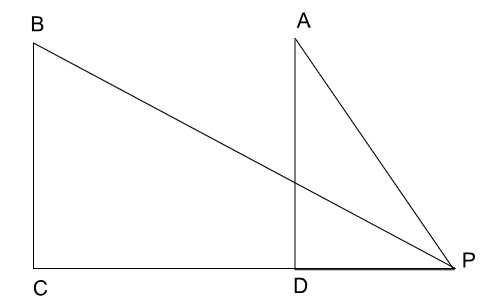


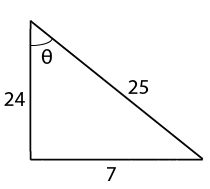


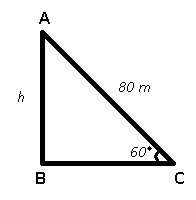

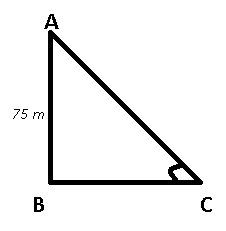
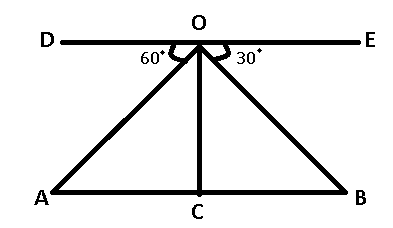

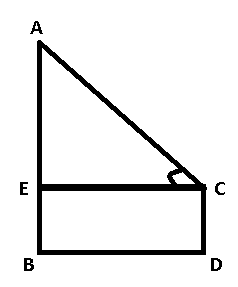
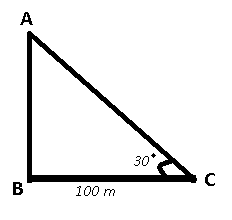
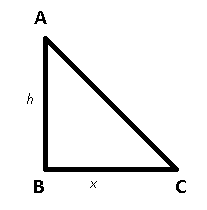
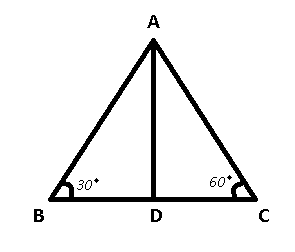


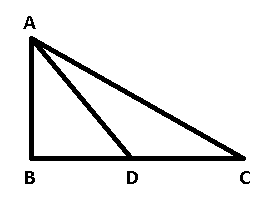
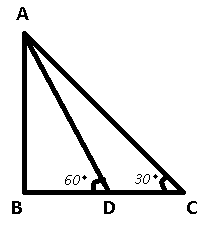
 By Pythagoras theorem,