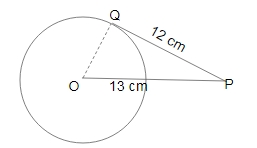
What is the total surface area of a cone whose radius is 15 cm and height is 8 cm?
Question 2
Find the area of the triangle whose height is 35.7 cm and the base is 1/7th of the height.
Question 3
Calculate the area of a right-angled triangle with a base of 22 cm and height corresponding to that base is 15 cm.
Question 4
How many spherical balls of radius 8 cm can be made by melting a hemisphere of radius 48 cm?
Question 5
The radius of a hemisphere is 3.5 cm. What will be its volume?
Question 6
Find the area of a triangle with a base of 12 cm and the height corresponding to that base is 1/3rd the length of the base.
Question 7
What is the curved surface area of a cylinder having radius of base as 70 cm and height as 14 cm?
Question 8
The radius of a circle is increased by 35 percent. What will be the percentage increase in its area?
Question 9
Parallel sides of a trapezium are 15 cm and 16 cm and its area is 961 $$cm^{2}$$. What is the distance between parallel sides?
Question 10
The radius of a hemisphere is 2.1 cm. What will be its volume?
Question 11
What is the total surface area of a cone whose radius is 24 cm and height is 10 cm?
Question 12
The diameter of a hemisphere is 21 cm. What is the total surface area of the hemisphere?
Question 13
Radius of a sphere is increased by 50 percent. What will be the percentage increase in its volume?
Question 14
The length of the side of a cube is 13 cm. What is the lateral surface area of the cube?
Question 15
What is the total surface area of a cylinder having radius of base as 4.2 cm and height as 8 cm?
Question 16
Find the area of die right angled triangle if the longest side of a right angled triangle is 17 cm and the height is 15 cm.
Question 17
Height of a cone is 24 cm and radius of its base is 10.5 cm. What is the volume of the cone?
Question 18
If the perimeter of a rhombus is 200 cm and one of its diagonal is 80 cm, then what ts the area of the rhombus?
Question 19
If total surface area of a cube is 600 cm$$^2$$, then what is the volume of cube?
Question 1
A pyramid has an equilateral triangle as its base, of which each side is 8 cm. Its slant edge is 24 cm. The whole surface area of the pyramid (in $$cm^{2}$$) is:
Question 2
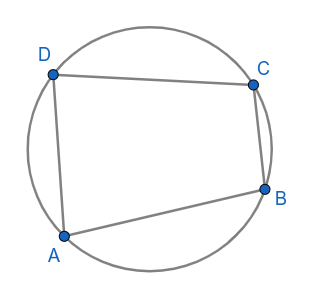
A circle touches all four sides of a quadrilateral ABCD. If AB = 18 cm, BC = 21 cm and AD = 15 cm, then length CD is:
Question 3
What is the volume of a cylinder if the radius of the cylinder is 10 cm and height is 20 cm? (Take $$\pi = 3.14$$)
Question 4
The total surface area of a square-based right pyramid is 1536 $$m^{2}$$, of which 37.5% is the area of the base of the pyramid. What is the volume (in $$m^{3}$$) of this pyramid?
Question 5
If the diameter of a sphere is reduced to its half, then the volume would be:
Question 6
If the volume of a sphere is 38808 $$cm^{3}$$, then its surface area is:
Question 7
In a circle of radius 42 cm, an arc subtends an angle of 60° at the centre. Find the length of the arc.
(Take $$ \pi = \cfrac{22}{7}$$)
Question 8
The area of a rhombus having one side measuring 17 cm and one diagonal measuring 16 cm is:
Question 9
The radius of a circle is 1.75 cm. What is the circumference of the circle?
(Take $$ \pi = \frac{22}{7}$$)
Question 10
The radius of the base of a right circular cone is 5 cm. Its slant height is 13 cm. What is its volume (in $$cm^{3}$$ , rounded off to 1 decimal place)? (Take $$ \pi = \frac{22}{7}$$)
Question 11
A conical shape vessel has a radius of 21 cm and has a slant height of 25 cm. If the curved part of the vessel is to be painted white, find the cost (in ₹) of painting at the rate of ₹1.5 per $$cm^{2}$$.
Question 12
In a $$\triangle PQR$$ and $$\triangle ABC, \angle P = \angle A$$ and $$AC = PR$$. Which of the following conditions is true for triangle PQR and ABC to be congruent?
Question 13
The total surface area of a solid hemisphere is 4158 $$cm^{2}$$. Find its volume (in $$cm^{3}$$).
Question 14
Let C be a circle with centre O and radius 5 cm. Let PQ be a tangent to the circle and A be the point of tangency. Let B be a point on PQ such that the length of AB is 12 cm. If the line joining O and B intersects the circle at R, find the length of BR (in cm).
Question 15
What is the volume of the largest sphere that can be carved out of a wooden cube of sides 21 cm? (Take $$ \pi = \frac{22}{7}$$)
Question 16
What will be the difference between the total surface area and the curved surface area of a hemisphere having 4 cm diameter?
Question 17
The area of an equilateral triangle is $$4\sqrt{3} cm^{2}$$. Find the side (in cm) of the triangle.
Question 18
Find the area of a triangle whose length of two sides are 4 cm and 5 cm and the angle between them is $$45^{\circ}$$.
Question 19
The cost of painting the total surface area of a 30 m high solid right circular cylinder at the rate of ₹25 per $$m^{2}$$ is ₹18,425. What is the volume (in $$m^{3}$$) of this cylinder [use $$ \pi \frac{22}{7}$$]?
Question 20
What is the length (in cm) of the transverse common tangent between two circles with radii 6 cm and 4 cm, given that the distance between their centres is 14 cm?
For two circles, the length of the transverse common tangent is
$$\Rightarrow$$ $$L=\sqrt{d^2-(r_1+r_2)^2}$$
Given: $$r_1=6,\qquad r_2=4,\qquad d=14$$
$$\Rightarrow$$ $$L=\sqrt{14^2-(6+4)^2}$$
$$\Rightarrow$$ $$\sqrt{196-100}$$
$$\Rightarrow$$ $$\sqrt{96}=4\sqrt{6}$$
Hence, the length of the transverse common tangent is $$4\sqrt{6}\text{ cm}$$
Question 21
The areas of the two triangles are in the ratio 4 : 3 and their heights are in the ratio 6 : 5. Find the ratio of their bases.
Question 22
The volume of a sphere is given by 130977 $$cm^{3}$$. Its surface area (in $$cm^{2}$$) is:
Question 23
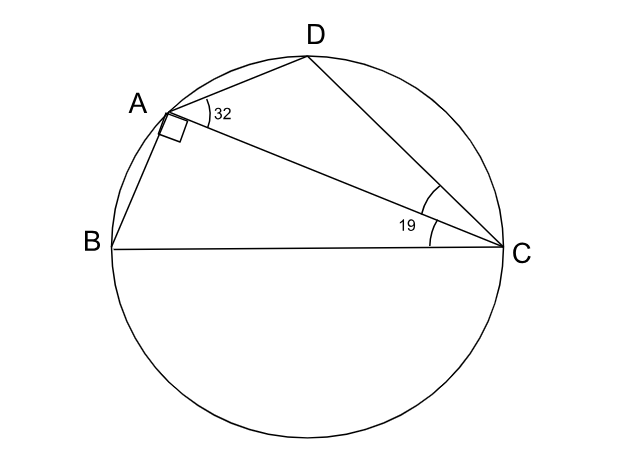
ABCD is a cyclic quadrilateral and BC is a diameter of the related circle on which A and D also lie. $$\angle BCA = 19^{\circ}$$ and $$\angle CAD = 32^{\circ}$$. What is the measure of $$\angle ACD$$?
Find the number of diagonals of a regular polygon, sum of whose interior angles is $$2700^{\circ}$$.
Question 25
PQR is an equilateral triangle inscribed in a circle. S is any point on the arc QR. Measure of $$\frac{1}{2} < PSQ$$ is:
Question 26
If the height of a cone is 7 cm and the diameter of the circular base is 12 cm, then its volume is (nearest to integer):
Question 27
The area of a rectangular field is 480 $$m^{2}$$. If the length is 20% more than the breadth, then the length of the rectangular field is:
Question 28
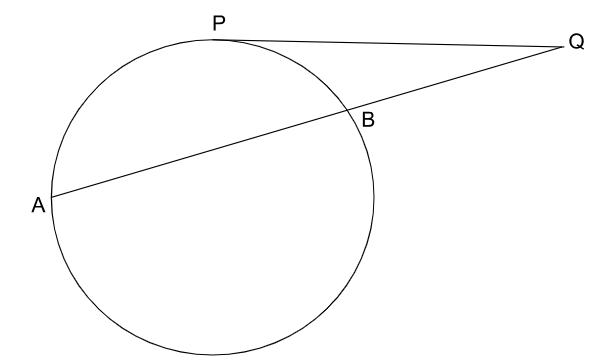
In a circle centred at O, PQ is a tangent at P. Furthermore, AB is the chord of the circle and is extended to Q. If PQ = 12 cm and QB = 8 cm, then the length of AB is equal to:
Using the tangent-secant theorem: $$PQ^2=QB \times QA$$
$$\Rightarrow$$ $$12^2=8\times (8+AB)$$
$$\Rightarrow$$ $$18=8+AB$$
$$\Rightarrow$$ $$AB=10$$ cm.
Question 29
The curved surface area of a cone whose base radius is 7 cm and slant height is 10 cm is:
Question 30
A sector of a circle has a central angle of $$45^{\circ}$$ and an arc length of 22 cm. Find the radius of the. circle. [Use $$\pi = \frac{22}{7}$$]
Question 31
Find the area of a rhombus if the perimeter of the rhombus is 52 cm, and one of its diagonals is 10 cm long.
Question 32
The diameter of a hemisphere is equal to the diagonal of a rectangle of length 4 cm and breadth 3 cm. Find the total surface area (in $$cm^{2}$$ ) of the hemisphere.
Question 33
A cylindrical metallic rod of diameter 2 cm and length 45 cm is melted and converted into wire of uniform thickness and length 5 m. The diameter of the wire is:
Question 34
Find the total surface area of a sphere whose volume is $$\cfrac{256}{3} \pi cm^{3}$$.
Question 35
If the base radius and the height of a right circular cone are increased by 10%, then the percentage increase in the volume is:
Question 36
If one of the interior angles of a regular polygon is $$\frac{15}{16}$$ times of one of the interior angles of a regular decagon, then find the number of diagonals of the polygon.
Question 37
Some medicine in liquid form is prepared in a hemispherical container of diameter 36 cm. When the container is full of medicine, the medicine is transferred to small cylindrical bottles of diameter 6 cm and height 6 cm. How many bottles are required to empty the container?
Question 38
The volume of a right circular cone having a base diameter of 14 cm is 196π $$cm^{3}$$. Find the perpendicular height of this cone
Question 39
A cylinder has some water in it at a height of 16 cm. If a sphere of radius 9 cm is put into it, then find the rise in the height of the water if the radius of the cylinder is 12 cm.
Question 40
If perimeter of the circle is 13.2 cm, then the radius of the circle is ____________.
(Take $$ \pi = \cfrac{22}{7}$$)
Question 41
If the radius of two circles be 6 cm and 9 cm and the length of the transverse common tangent be 20 cm, then find the distance between the two centres.
For two circles with radii $$r_1=6$$ cm and $$r_2=9$$ cm, the length of the transverse common tangent is $$20$$ cm.
For a transverse common tangent,
$$\Rightarrow$$ $$L^2=d^2-(r_1+r_2)^2$$, where $$L$$ is the length of the tangent.
$$\Rightarrow$$ $$20^2=d^2-(6+9)^2$$
$$\Rightarrow$$ $$400=d^2-225$$
$$\Rightarrow$$ $$d^2=625$$
$$\Rightarrow$$ $$d=25$$ cm.
Question 42
The area of an equilateral triangle is 173.2 $$cm^{2}$$. Its side will be __________.
Question 43
The perimeter of a sector of a circle is 24 cm and the radius is 3 cm. Calculate the area (in $$cm^{2}$$) of the sector.
Question 44
In two circles centred at O and O’, the distance between the centres of both circles is 17 cm. The points of contact of a direct common tangent between the circles are P and Q. If the radii of both circles are 7 cm and 15 cm, respectively, then the length of PQ is equal to:
Question 45
In a triangle LMN, OP is a line segment drawn parallel to the side MN. OP intersects the sides LM and LN at O and P, respectively. If LM = 15 cm, OM = 4 cm, and PN = 5 cm, then what is the length (in cm) of the side LN?
Question 46
The sides of a triangle are in the ratio 5 : 12 : 13 and its perimeter is 90 cm. Find its area (in $$cm^{2}$$).
Question 47
In a $$\triangle ABC$$, the bisectors of angle ABC and angle ACB intersect each other at point O. If the angle BOC is $$125^{\circ}$$, then the angle BAC is equal to:
Question 48
In a $$\triangle PQR, \angle P : \angle Q : \angle R = 3 ∶ 4 ∶ 8$$. The shortest side and the longest side of the triangle, respectively, are:
Question 49
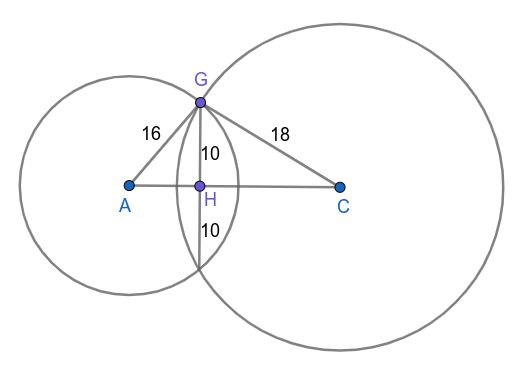
Two circles of radius 13 cm and 15 cm intersect each other at points A and B. If the length of the common chord is 12 cm, then what is the distance between their centres?
Question 50
In a triangle ABC, if $$\angle B = 90^{\circ}, \angle C = 45^{\circ}$$ and AC = 4 cm, then the value of BC is:
Question 51
A right square pyramid having lateral surface area is 624 $$cm^{2}$$ . If the length of the diagonal of the square is $$24\sqrt{2}$$, then the volume of the pyramid is:
Question 52
The area of a sector of a circle of radius 8 cm, formed by an arc of length 4.6 cm, is ___________.
Question 53
For a triangle ABC, D and E are two points on AB and AC such that $$AD = \frac{1}{6} AB, AE = \frac{1}{6} AC$$. If BC = 22 cm, then DE is __________. (Consider up to two decimals)
Question 54
The radii of the ends of a frustum of a solid right-circular cone 45 cm high are 28 cm and 7 cm. If this frustum is melted and reconstructed into a solid right circular cylinder whose radius of base and height are in the ratio 3 : 5, find the curved surface area (in $$cm^{2}$$) of this cylinder. [Use $$\pi = \frac{22}{7}$$]
Volume of cylinder = $$\pi\ r^2h=\pi\ \left(3x\right)^2\left(5x\right)=45\pi\ x^3$$
$$45\pi\ x^3=15\pi\ \times49\times21$$
$$x=7$$
CSA of cylinder = $$2\pi\ rh=2\times\dfrac{22}{7}\times\left(3\times7\right)\times\left(5\times7\right)=4620\ cm^2$$
Question 55
The sides of a rectangle are in the ratio of 3 : 8 and its area is 1944 $$cm^{2}$$. What is its perimeter?
Question 56
A solid sphere made of wax of radius 12 cm is melted and cast into solid hemispheres of radius 4 cm each. Find the number of such solid hemispheres.
Question 57
In a $$\triangle PQR, \angle P=90^{\circ}, \angle R=47^{\circ}$$ and $$PS \perp QR$$. Find the value of $$\angle QPS$$.
Question 58
Let ABC, PQR be two congruent triangles such that $$\angle A = \angle P = 90^{\circ}$$. If BC = 17 cm, PR = 8 cm, find AB (in cm).
Question 59
$$PQR$$ is a triangle. The bisectors of the internal angle $$\angle Q$$ and external angle $$\angle R$$ intersect at $$S$$. If $$\angle QSR = 40^{\circ}$$, then $$\angle P$$ is:
Question 60
The curved surface area (CSA) and the total surface area (TSA) of a hemisphere whose radius is 7 cm are:
Question 61
If the hypotenuse of a right-angled triangle is 29 cm and the sum of the other two sides is 41 cm, then the difference between the other two sides is:
Question 62
The height and the radius of the base of a right circular cone are in the ratio of 12 : 5. If its volume is 314 $$cm^{3}$$, then what is the slant height of the cone? (Use $$\pi = 3.14$$)
Question 63
If the radius of a sphere is doubled, then its surface area will be increased by:
Question 64
AB is a chord of a circle having radius 1.7 cm. If the distance of this chord AB from the centre of the circle is 0.8 cm, then what is the length (in cm) of the chord AB?
Question 65
E, F, G, and H are four points lying on the circumference of a circle to make a cyclic quadrilateral. If $$\angle FGH = 57^{\circ}$$, then what will be the measure of the $$\angle HEF$$?
Question 66
If the radius of a hemispherical balloon increases from 4 cm to 7 cm as air is pumped into it, find the ratio of the surface area of the new balloon to its original.
Question 67
The heights of two cones are in the ratio 7.: 5 and their diameters are in the ratio 10:21. What is the ratio of their volumes? ($$Where $$ \pi = \frac{22}{7}$$)
Question 68
If radius of a sphere is decreased by 48%, then by what percent does its surface area decrease?
Question 69
The difference between the length of two parallel sides of a trapezium is 12 cm. The perpendicular distance between these two parallel sides is 60 cm. If the area of the trapezium is 1380 $$cm^{2}$$, then find the length of each of the parallel sides (in cm).
Question 70
In a circle, chords AB and CD intersect internally at E. If CD = 18 cm, DE = 5 cm, AE = 13 cm, then the length of BE is:
Question 71
What is the area of a triangle whose sides are of lengths 12 cm, 13 cm and 5 cm?
Question 72
If the external angle of a regular polygon is 18°, then the number of diagonals in this polygon is:
Question 73
PQRS is a cyclic quadrilateral. If $$\angle P$$ is three times of $$\angle R$$ and $$\angle S$$ is four times of $$\angle Q$$, then the sum of $$\angle S + \angle R$$ will be:
Question 74
The centroid of an equilateral triangle PQR is L. If PQ = 6 cm, the length of PL is:
Question 75
In $$\triangle PQR,PQ=QR$$ and O is an interior point of $$\triangle PQR$$ such that $$\angle OPR= \angle ORP$$. Consider the following statements: (i) $$\triangle POR$$ is an isosceles triangle. (ii) O is the centroid of $$\triangle PQR$$. (iii) $$\triangle PQO$$ is congruent to $$\triangle RQO$$. Which of the above statements are correct?
Question 76
A hemispherical bowl of internal radius 18 cm is full of liquid. This liquid is to be filled in cylindrical bottles each of radius 3 cm and height 6 cm. How many bottles are required to empty the bowl?
Question 77
It is given that $$\triangle ABC \cong \triangle PQR, AB = 5 cm, \angle B = 40^{\circ}$$, and $$\angle A = 80^{\circ}$$. Which of the following options is true?
Question 78
A rectangular park is 120 m long and 104 m wide. A 1-m wide path runs along the boundary of the park, remaining completely inside the park area. Thus, the outside edges of the path run along the boundary wall of the park. The inside edges of the path are marked with a white line of negligible thickness. If it costs ₹2.50 to mark each metre with the white line, then how much would it cost (in ₹) to fully mark the inside edges of the path?
Question 79
What is the total surface area of a pyramid whose base is a square with side 8 cm and height of the pyramid is 3 cm?
Question 80
The breadth ‘b’ of a room is twice its height and half of its length. Find the length of the longest diagonal of the room.
Question 81
If the areas of two similar triangles are in the ratio 196 : 625, what would be the ratio of the corresponding sides?
Question 82
What is the perimeter of a square inscribed in a circle of radius 5 cm?
Question 83
If the surface area of a sphere is 30,184 $$cm^{2}$$ , then find its volume (Use $$\pi = \frac{22}{7}$$)
Question 84
A,B, C are three points such that AB = 9 cm, BC = 11 cm and AC = 20 cm. The number of circles passing through points A,B,C is:
Question 85
If the curved surface area of a cylinder is $$126 \pi cm^{2}$$ and its height is 14 cm, what is the volume of the cylinder?
Question 86
The length, breadth and the height of a cuboid are 24 cm, 18 cm and 12 cm respectively. It is melted to make smaller cubes. If the length of the side of the cube is 6 cm, then what is the number of cubes formed?
Question 87
A solid metallic sphere of radius 21 cm is melted and moulded into small right circular cones, each of radius 7 cm and height of 3 cm. The number of such cones is:
Question 88
In a trapezium ABCD, AB and DC are parallel to each other with a perpendicular distance of8 m between them. Also, (AD) = (BC) = 10 m, and (AB) = 15 m &lt; (DC). What is the perimeter (in m) of the trapezium ABCD?
Question 89
AB = 28 cm and CD = 22 cm are two parallel chords on the same side of the centre of a circle. The distance between them is 4 cm. The radius of the circle is ______ (Consider up to two decimals)
Question 90
The perimeter of an isosceles triangle is 100 cm. If the base is 36 cm, then find its semi perimeter (in centimetres).
Question 91
A prism and a pyramid have the same base and the same height. Find the ratio of the volumes of the prism and the pyramid.
Question 92
A hemispherical bowl has a radius of 7 cm. It is to be painted from inside as well as outside. Find the cost of painting it at the rate of Rs.40 per 20 $$cm^{2}$$ ? (Take thickness of the bowl as negligible).
Question 93
The sides of two similar triangles are in the ratio 5:7. The areas of these triangles are in the ratio:
Question 1
Points A and B are on a circle with centre O. PA and PB are tangents to the circle from an external point P. If PA and PB are inclined to each other at $$42^{\circ}$$, then find the measure of $$\angle$$ OAB.
Question 2
The diagonal of a rectangle is 12 cm long, and it is twice as long as one of the sides of the rectangle. What is the area of this rectangle?
$$144=\ 36\ +\left(another\ side\right)^2\ $$ $$144-36=\ \left(another\ side\right)^2\ $$ $$108=\ \left(another\ side\right)^2\ $$ $$\sqrt{108}=\ another\ side$$ $$6\sqrt{3}=\ another\ side$$ Area of this rectangle = product of both sides = $$6\times\ 6\sqrt{3}$$ = $$36\sqrt{3}$$ cm$$^2$$
Question 3
AB is the diameter of a circle with centre O. C and D are two points on the circumference of the circle on either side of AB. such that $$\angle CAB= 42^{\circ}$$ and $$\angle ABD = 57^{\circ}$$. What is difference (in degrees) between the measures of $$\angle CAD$$ and $$\angle CBD$$?
Question 4
A circle is inscribed in a ΔABC having sides AB = 16 cm, BC = 20 cm and AC = 24 cm, and side AB, BC and AC touches circle at D, E and F, respectively. The measure of AD is:
Question 5
The tops of two poles of heights 18 m and 30.5 meters connected by a wire. If the wire makes an angle of $$30^{\circ}$$ with the horizontal, what is the length (in m) of the wire?
Question 6
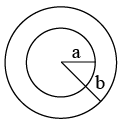
The inner circumference of a circular path enclosed between two concentric circles is 264 m. The uniform width of the circular path is 3 m. What is the area (in $$m^{2}$$, to the nearest whole number) of the path? (Taken $$\pi = \frac{22}{7}$$)
Question 1
The internal length, breadth and height of a cuboidal room are 12 m, 8 m and 10 m,respectively. The total cost (in ₹) of white washing only all four walls of the room at the cost of ₹25 per $$m^{2}$$ is:
Question 2
The base ofa triangle is equal to the perimeter of a square whose diagonalis $$6 \sqrt{2}$$ cm,and its height is equalto the side of a square whose areais 144 $$cm^{2} $$. Thearea ofthe triangle (in $$cm^{2} $$) is:
Question 3
The area of a square and rectangle are equal. The length of the rectangle is greater than the length of a side of the square by 10 cm and the breadth is less than 5 cm. The perimeter(in cm)of the rectangleis:
Question 4
A circle is inscribed in a triangle ABC. It touches side AB, BC and AC at points R, P and Q, respectively. If AQ = 2.6 cm, PC = 2.7 cm and BR = 3 cm, then the perimeter (in cm)of the triangle $$\triangle ABC$$ is:
Question 5
Chord AB of a circle is produced to a point P, and C is a point on the circle such that PC is a tangent to the circle. If PC = 12 cm, and BP = 10 cm, then the length of AB (in cm)is:
Question 6
The radius of the base of a cylinder is 14 cm andits volumeis 6160 $$cm^3$$, The curved surface area (in $$cm^2$$) is:
(Take $$\pi = \frac{22}{7}$$)
Question 7
If the volumeof a sphere is 4851 $$cm^{3}$$ then its surface area (in $$cm^{2}$$) is: (Take $$\pi = \frac{22}{7}$$)
Question 8
In $$\triangle ABC, \angle A = 68^\circ$$. If is the incentre of the triangle , then measure of $$\angle BIC$$ is:
Question 9
In a circle with centre O, AD is a diameter and AC is a chord. Point B is on AC such that OB = 7 cm and $$\angle OBA = 60^\circ$$. If $$\angle DOC = 60^\circ$$, then what is the length of BC?
Question 10
In a $$\triangle ABC$$, the bisector of $$\angle B$$ and $$\angle C$$ meet at O in the triangle. If $$\angle BOC = 134^\circ$$, then the measure of $$\angle A$$ is:
Question 11
Theratio of the total surface area and volumeof a sphereis 2 : 7. Its radiusis:
Question 12
In $$\triangle ABC, \angle A = 54^\circ$$. If I is the incenter of the triangle, then the measure of $$\angle BIC$$ is:
Question 13
The internal measures of a cuboidal room are with length as 12 m, breadth as 8 m and height as 10 m. The total cost (in ₹) of white washing all four walls of the room and also the ceiling of the room,if the cost of whitewashing is ₹25 per $$m^{2}$$ is :
Question 14
Let A and B be twocylinders such that the capacity ofA is the same as the capacity of B. Theratio of the diameters ofA and B is 1 : 4. Whatis the ratio of the heights ofA and B?
Question 15
$$PQRS$$ is a cyclic quadrilateral. If $$\angle P$$ is 4 times $$\angle R $$, and $$\angle S $$ is 3 times $$\angle Q$$, then the average of $$\angle Q$$ and $$\angle R $$ is:
Question 16
The sides of a triangle are 24 cm, 26 cm and 10 cm.At each of its vertex, circles of radius 4.2 cm are drawn. What is the area (in $$cm^$$) of the portion covered by the three sectors of the circle ? $$(\pi = \frac{22}{7})$$
Question 17
If each side of a square is decreased by 17%, then by what percentage does its area decrease?
Question 18
The sides PQ and PR of $$\triangle PQR $$ are produced to points S and T, respectively. The bisectors of $$\angle SQR$$ and $$\angle TRQ$$ meetat U. If $$\angle QUR = 59\circ$$, then the measure of $$\angle P$$ is:
Question 19
One side of a rhombus is 13 cm and one of its diagonals is 24 cm. What is the area (in $$cm^2$$) of rhombus?
Question 20
Thebaseof triangle is equal to the perimeter of a square whosediagonal is 9 $$\sqrt{2}$$ cm,andits height is equalto the side of a square whosearea is 144 $$cm^{2}$$. Thearea ofthe triangle (in $$cm^{2}$$) is:
Question 21
A ladder is resting against a wall, The angle between the foot of the ladder and the wall is $$45^\circ$$ and the foot of the ladder is 6.6 m away from the wall. The length of the ladder(in m)is:
Question 22
PA and PB are two tangents from a point P outside the circle with centre O. If A and are points on the circle such that $$\angle APB = 142^\circ$$, then $$\angle OAB$$ is equal to:
Question 23
The perimeter of a square is half the perimeter of a rectangle. The perimeter of the square is 40 m. If its breadth is two- thirds of its length, then what is the area (in $$m^2$$) of the rectangle?
Question 24
The perimeterof a right triangle is 60 cm and its hypotenuse is 26 cm. Whatis the area (in $$cm^{2}$$)ofthe triangle?
Question 25
In $$\triangle ABC, D$$ is the median from $$A$$ to $$BC, AB = 6 cm, AC = 8 cm$$ and $$BC = 10 cm$$ .The length of median $$AD$$(in cm)is
Question 26
Two circles of radii 15 cm and 10 cm intersect each other and the length of their common chord is 16 cm. What is the distance (in cm) between their centres?
Question 27
A 64 cm wide path is made arounda circular garden having a diameter of 10 metres. The area (in m?)ofthe path is closest to: $$(take \pi= \frac{22}{7})$$
Question 28
In $$\triangle ABC, BD \perp AC$$ at D. E is a point on BC such that $$\angle BEA = x^\circ$$. If $$\angle EAC = 62^\circ$$ and $$\angle EBD = 60^\circ$$,then the value of $$x$$ is:
Question 29
A solid metallic cylinder with a base radius of 3 cm and a height 120 of cm is melted and recast into a sphere of radius r cm. What is the value of r if there is a 10% metal loss in the conversion?
Question 30
AB is a chord of a circle with centre O and P is any point on the circle. If $$\angle APB = 122^\circ$$, then what is the measure of $$\angle OAB$$?
Question 31
If the radius of a circle is increased by 23%, then by what percentage will its area increase?
Question 32
If the radius of a sphere is increased by $$16\frac{2}{3}\%$$, then by what per cent would its surface area increase (correct to one decimal place)
Question 33
In circle with centre O and radius 13 cm, a chord AB is drawn. Tangentsat A and B intersect at P such that $$\angle APB = 60^\circ$$. If Distance of AB from the centre O is 5 cm, then what is the length (in cm) of AP?
Question 34
In $$\triangle ABC, D$$ and E are the points on sides AB and AC, respectively and $$DE \parallel BC$$. BC = 8 cm and DE = 5 cm. If the area of $$\triangle ADE = 45 cm^2$$, then what is the area (in cm$$^2$$) of $$\triangle ABC$$?
Question 35
Points P, Q, R, S and lie in this order on a circle with centre O. If chord TS is parallel to diameter PR and $$\angle RQT = 58^\circ$$ then find the measure (in degrees) of $$\angle RTS$$.
Question 36
The base of a triangle is increased by 30%. By what percentage (correct to two decimal places) can its height be increased so that the area increases by 50%?
Question 37
The radius of a cylinder is reduced to 50% of its actual radius. If its volume remains the same as before, then its height becomes k times the original height. The value of k is:
Question 38
$$\triangle ABC$$ is an equilateral triangle with side 18 cm. D is a point on BC such that $$BD = \frac{1}{3}BC$$ Then length(in cm) of AD is:
Question 39
A circle touches all the four sides of a quadrilateral ABCD whose sides are AB = 8.4 cm, BC = 9.8 cm and CD = 5.6 cm. The length of side AD, in cm, is:
Question 40
A rectangular plot is 420 m long and 84 m wide. lt is surrounded by semi-circular flower beds along all its sides. The area of the entire plot (in hectares) is $$x$$. The value of $$x$$ (correct to one decimal place) is (Taken $$\pi=\frac{22}{7}$$):
Question 41
A $$\triangle ABC$$ has sides 5 cm, 6 cm and 7 cm. AB extended touches a circle at P and AC extended touches the same circle at Q. Find the length (in cm) of AQ.
Question 42
A wooden piece in the shape of a cuboid is divided into five equal parts by cutting it with four cuts perpendicular to its length,and it turns out that each picece is a cube of volume 27 $$cm^{3}$$. That is the total surface area (in $$cm^{2}$$) of the cuboid?
Question 43
ABCD is a cyclic quadrilateral. Diagonals BD and AC intersect each other at E. If $$\angle BEC = 138^\circ$$ and $$\angle ECD = 35^\circ$$, then what is the measure of $$\angle BAC$$?
Question 44
If each side of a rectangle is increased by 12%, then by what percentage will its area increase?
Question 45
If the diameter of the base of a cone is 24 cm and its curved surface area is $$1395\frac{3}{7}$$ $$cm^{2}$$, then its height is: (Take $$\pi=\frac{22}{7}$$)
Question 46
If the length of a rectangle is increased by 80%, what would be the percentage decrease (correct to one place of decimal) in the width to maintain the same area?
Question 47
In $$\triangle ABC, AB$$ and AC produced to points D and E respectively. If the bisectors of angle CBD and angle BCE meet at point O, such that $$\angle BOC = 63^\circ$$, then $$\angle A = ?$$
Question 48
In $$\triangle ABC, \angle A= 90^\circ, AD \perp BC$$ at D. If AB = 12 cm and AC = 16 cm, then what is the length(in cm) of BD?
Question 49
In $$\triangle ABC, DE \parallel AB$$, where D and E are the points on sides AC and BC, respectively. If AD = x-3, AC = 2x, BE = x-2 and BC = 2x + 3, then what is the value of x?
Question 50
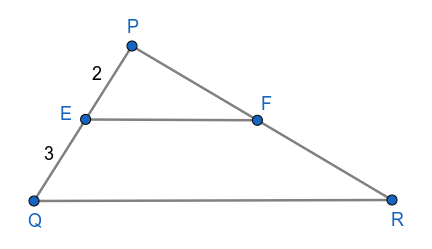
In triangle PQR, points E and F are on sides PQ and PR respectively such that EF is parallel to QR. If PE = 2 cm and EQ = 3 cm, then area($$\triangle$$ PQR) : area($$\triangle$$ PEF) is equal to:
$$\triangle$$PQR and $$\triangle$$PEF are similar triangles.
$$\Rightarrow$$ $$\frac{\text{Area of triangle PQR}}{\text{Area of triangle PEF}}$$ = $$\left(\frac{PQ}{PE}\right)^2$$
$$\Rightarrow$$ $$\frac{\text{Area of triangle PQR}}{\text{Area of triangle PEF}}$$ = $$\left(\frac{PE+EQ}{PE}\right)^2$$
$$\Rightarrow$$ $$\frac{\text{Area of triangle PQR}}{\text{Area of triangle PEF}}$$ = $$\left(\frac{2+3}{2}\right)^2$$
$$\Rightarrow$$ $$\frac{\text{Area of triangle PQR}}{\text{Area of triangle PEF}}$$ = $$\frac{25}{4}$$
$$\Rightarrow$$ Area of triangle PQR : Area of triangle PEF = 25:4
Hence, the correct answer is Option B
Question 51
Let $$\triangle ABC \sim \triangle PQR$$ and $$\frac{ar(\triangle ABC)}{ar(\triangle QPR)} = \frac{144}{49}$$. If AB = 12 cm, BC = 7 cm and AC = 9 cm, then PR(in cm) is equal to:
Question 52
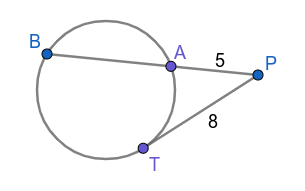
Tangent is drawn from a point P to a circle, which meets the circle at T such that PT = 8 cm. A secant PAB intersects the circle in points A and B. If PA= 5 cm, what is the length (in cm) of the chord AB?
The capacity of a cuboidal tank is 12288 kilolitres. Its length is 32 m, and its breadth and height are in the ratio of 3: 2. What is the breadth (in m) of the tank?
Question 54
The lengih (in m, correct to one decimal place) of the longest pole that can be fitted in a room of dimensions 12 m $$\times$$ 6 m $$\times$$ 4 m is:
Question 55
The length and breadth of a rectangle are increased by 25% and 32%, respectively. The percentage increase in the area of the resulting rectangle will be:
Question 56
The total surface area of a solid right circular cylinder of height 13cm, is 880 $$cm^{2}$$. Its volume (in $$cm^{2}$$) is 11k. The value of k is: (Taken $$\pi=\frac{22}{7}$$)
Question 57
In a circle, chords AB and CD intersect internally, at E. If CD = 16 cm, DE = 6 cm, AE = 12 cm, and BE = X cm then the value of x is:
Question 58
In a circle with centre O, AD is a diameter and AC is a chord. Point B is on AC such that OB = 7 cm and $$\angle OBA = 60^\circ$$. If $$\angle DOC = 60^\circ$$, then what is the length of BC (in cm)?
Question 59
In a $$\triangle ABC, \angle BAC=90^{0},AD$$ is drawn perpendicular from A on BC. Which among the following is the mean proportional between BD and BC?
Question 60
In $$\triangle ABC, AD$$ is the bisector of $$\angle A$$ meeting BC at D. If AC = 21 cm, BC = 11 cm and the length of BD is 3 cm less than DC, then the length(in cm) of side AB is:
Question 61
Ina trapezium PQRS, PQ is parallel to RS and diagonals PR and QS intersect at O. If PQ= 4 cm. SR = 10 cm, then what is area($$\triangle POQ$$) : area($$\triangle SOR$$) ?
Question 62
Point P lies outside a circle with centre O. Tangents PA and PB are drawn to meetthe circle at A and respectively. If $$\angle APB = 80^\circ$$, then $$\angle OAB$$ is equal to:
Question 63
Points A and B are on a circle with centre O. PAM and PBN are tangentsto the circle at A and B respectively from a point P outside the circle. Point Q is on the major arc AB such that $$\angle QAM = 58^\circ$$ and $$\angle QBN = 50^\circ$$, then find the measure (in degrees) of $$\angle APB$$.
Question 64
Points P and Q are on the sides AB and BC respectively of a triangle ABC, right angled at B. If AQ = 11 cm, PC = 8 cm, and AC = 13 cm, then find the length (in cm) of PQ.
The area of a parallelogram ABCD is $$300 cm^{2}$$, The distance between AB and CD is 20cm, and the distance between BC and AD is 30cm. What is the perimeter (in cm) of the parallelogram ?
Question 66
The length and breadth of a rectangle are 35 cm and 11 cm, respectively. What will be the circumference of the circle that inscribes this rectangle? (Take $$\pi=\frac{22}{7}$$)
Question 67
A rectangular room has an area of 60 $$m^{2}$$ and a perimeter of 34 m. The length of the diagonal of the rectangular room is same as the side of a square. The perimeter of the square (in m) is:
Question 68
In $$\triangle ABC, AD \perp BC$$ at D and AE is the bisector of $$\angle A$$. If $$\angle B = 62^\circ$$ and $$\angle C = 36^\circ$$, then what is the measure of $$\angle DAE ?$$
Question 69
Ina triangle ABC,a point D lies on AB and points E andF lie on BC suchthat DF is parallel to AC and DE is parallel to AF. If BE = 4 cm, EF = 6cm, then find the length (in cm) of BC.
Question 70
Points A and B are on a circle with centre O. Point C is on the major are AB. If $$\angle OAC = 35^\circ$$ and $$\angle OBC = 45^\circ$$, then what is the measure (in degrees) of the angle subtended by the minor are AB at the centre?
Question 71
The area of a triangular plot having sides 12 m, 35 m and 37 m is equal to the area of a rectangular field whose sides are in the ratio 7 : 3. The perimeter (in m) of the field is:
The area of a triangular plot is equal to the area of a rectangular field.
Area of a rectangular field = 210 cm$$^2$$
Sides of rectangular filed are in the ratio 7:3.
Let the sides of the rectangular field are 7p and 3p respectively.
7p x 3p = 210
p$$^2$$ = 10
p = $$\sqrt{10}$$
Perimeter of the rectangular field = 2(7p + 3p)
= 20p
= 20$$\sqrt{10}$$ cm
Hence, the correct answer is Option A
Question 72
The area of the curved surface of a right circular cylinder is 19.5 $$m^{2}$$ and its volume is 39 $$m^{3}$$. What is the radius (in m) of its base?
Question 73
The radius of a solid lead sphere is 2 cm. 2541 such spheres are melted and recast into a cube of edge $$x$$ cm. The value of $$x$$ is (take $$\pi=\frac{22}{7}$$):
Question 74
A solid metallic sphere of radius 8.4cm is melted and recast into a cone of height 18.9cm. What is the radius (in cm) of the base of the cone ?
Question 75
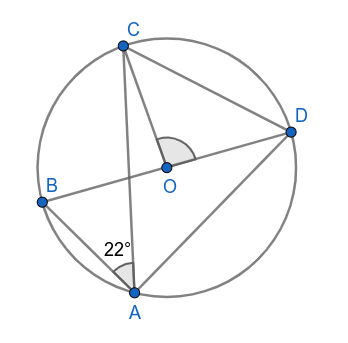
In a circle with centre O, points A, B, C and D in this order are concyclic such that BD is a diameter of the circle. If $$\angle$$BAC = 22$$^\circ$$, then find the measure (in degrees) of $$\angle$$COD.
Angle subtended by a chord at the center of the circle is twice the angle subtended by the chord on the point of a circle in the same segment.
$$\Rightarrow$$ $$\angle$$COD = 2$$\angle$$CAD
$$\Rightarrow$$ $$\angle$$COD = 136$$^\circ$$
Hence, the correct answer is Option B
Question 76
In triangle ABC, D is a point on BC such that BD : DC =3 : 4. E is a point on AD such that AE : ED = 2 : 3. Find the ratio area $$(\triangle ECD)$$ : area $$(\triangle AEB)$$.
Question 77
Let $$\triangle$$ABC $$\sim$$ $$\triangle$$RPQ and $$\frac{ar(\triangle \text{ABC})}{ar(\triangle \text{PQR})}=\frac{16}{25}$$. If PQ = 4 cm, QR = 6 cm and PR = 7 cm, then AC (in cm) is equal to:
The are of square is S, and that of the aquare formed by joining the mid-points of the given square is A. The value of $$\frac{A}{S}$$ is equal to:
Question 79
The area of a circular path enclosed by two concentric circles is 3080 m$$^2$$. If the difference between the radius of the outer edge and that of inner edge of the circular path is 10 m, what is the sum (in m) of the two radii? (Take $$\pi = \frac{22}{7}$$)
The area of the four walls of a room is 1152 $$m^{2}$$ and its length is $$\frac{5}{3}$$ times its breadth. If the height of the room is 12 m,then the area of its floor is:
Question 81
The internal and external diameters of a hollow hemispherical bowl are 18 cm and 22 cm, respectively. The total surface area (in $$cm^{2}$$) of the bowl is:
Question 82
The radii of the circular ends of a frustum of a cone are 20 cm and 13 cm and its height is 12 cm. What is the capacity (in litres) of the frustum (correct to one decimal place)? (Take $$\pi=\frac{22}{7}$$)
Question 83
The sides of a triangular field are 96 m, 110 m and 146 m. The cost of levelling the field at ₹5.60 per $$m^{2}$$ is:
Question 84
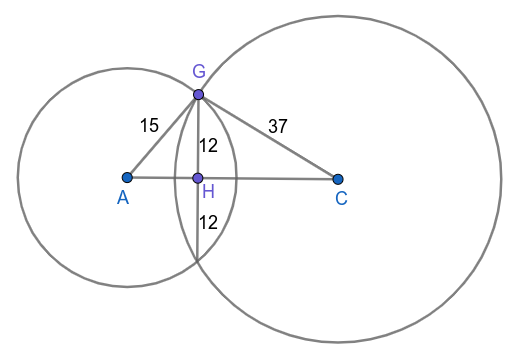
Two circles of radius 15 cm and 37 cm intersect each other at the points A and B. If the length of common chord is 24 cm, what is the distance (in cm) between the centres of the circles?
Distance between two circles = AC = AH + CH = 9 + 35 = 44 cm
Hence, the correct answer is Option A
Question 85
A cylindrical vessel of base radius 10.5 cm and height 30 cm is $$\frac{4}{5}$$ full of water. The entire water is poured into a rectangular tub of length 44 cm and breadth 36 cm. The height (in cm) to which the water level rises in the tub is: (Take $$\pi = \frac{22}{7}$$) (Assuming no overflow of water)
Question 86
A wire is in the form of a square of side 33 cm. If the wire is molded to form a circle, then what is the radius of the circle? (Use $$\pi=\frac{22}{7}$$)
Question 87
Angle between the internal bisectors of two angles $$\angle B$$ and $$\angle C$$ of a $$\triangle ABC$$, is $$132^\circ$$, then the value of $$\angle A$$ is:
Question 88
In $$\triangle ABC$$ and $$\triangle DEF$$ we have $$\frac{AB}{DF} = \frac{BC}{DE} = \frac{AC}{EF}$$, then which of the following is true?
The area of a circular park is 12474 m$$^2$$ . There is 3.5 m wide path around the park. What is the area (in m$$^2$$) of the path?(Take $$\pi = \frac{22}{7}$$)
The diameter of an iron ball used for shot-put is 21 cm. It is melted and then a cylinder of height 3.5 cm is made. The curved surface area of the cylinder will be: (Take $$\pi=\frac{22}{7}$$)
The perimeter of rectangular field is 386 m and the difference between its two adjacent sides is 95 m. The side of a square field, having the same area as that of the rectangle, is:
Question 92
$$\triangle ABC \sim \triangle PQR$$. The areas of $$\triangle ABC$$ and $$\triangle PQR$$ are 64 cm$$^2$$ and 81 cm$$^2$$, respectively and AD and PT are the medians of $$\triangle ABC$$ and $$\triangle PQR$$, respectively. If PT = 10.8 cm, then AD =?
Question 93
What is the volume(in cm$$^3$$a) ofa spherical shell whose inner and outerradii are respectively 2 cm and 3 cm ?
Question 94
A chord 21 cm long is drawn in a circle of diameter 25 cm. The perpendicular distance of the chord from the centre is:
Question 95
A radius of a circular park is 23 m. It has inside all around it, a 4 m wide path. Find the cost of paving the path at the rate ₹500/ $$m^{2}$$. (Take $$\pi=\frac{22}{7}$$)
Question 96
A solid cube of side 15 cm is dropped into a rectangular container of length 25 cm, breadth 20 cm and height 18 cm, which is partly filled with water. If the cube is completely submerged, then the rise of water level (in cm) is:
Question 97
Chord AB of circle of radius 10 cm is at a distance 8 cm from the centre O. If tangents drawn at A and B intersect at P, then the length of the tangent AP (in cm) is:
Question 98
From a wooden cubical block of side 10 cm, a sphere of radius 4.2 cm is carved out. How much wood is wasted in the process? (Use $$\pi=\frac{22}{7}$$)
Question 99
From each of the four corners of a rectangular sheet of dimensions 48 cm x 27 cm, a square of side 3.5 cm is cut off and a box is made. The volume of the box is:
Question 100
In a circle with centre O, AB is a chord of length 10 cm. Tangents at points A and B intersect outside the circle at P. If OP = 2 OA, then find the length (in cm) of AP.
Question 101
In $$\triangle ABC, AB = 20$$ cm, BC = 21 cm and AC = 29 cm. What is the value of $$\cot C + \cosec C - 2 \tan A$$?
Question 102
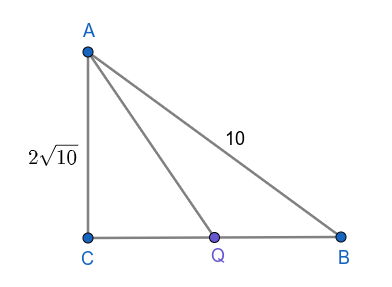
In $$\triangle$$ABC, $$\angle$$C = 90$$^\circ$$ and Q is the midpoint of BC. If AB = 10 cm and AC = $$2\sqrt{10}$$ cm, then the length of AQ is:
The total surface are of a hemisphere is very nearly equal to that of an equilateral triangle. The side of the triangle is how many times (approximately) of the radius of the hemisphere?
Question 104
Four solid cubes, each of volume 1728 $$cm^{3}$$, are kept in two rows having two cubes in each row. They form a rectangular solid with square base. The total surface area (in $$cm^{2}$$) of the resulting solid is:
Question 105
If the internal dimensions of a rectangular closed wooden box are 30 cm, 18 cm and 23 cm, what space (in $$cm^{2}$$) will it occupy, if the wood used is 1 cm thick?
Question 106
In a triangle ABC, point D lies on AB, and points E and F lie on BC suchthat DF is parallel to AC and DE is parallel to AF. If BE = 4 cm, CF = 3 cm, then find the length (in cm) of EF.
Question 107
In triangle ABC, P and Q are the mid points of AB and AC, respectively. R is a point on PQ such that PR : RQ = 3 : 5 and QR = 20 cm, then what is the length (in cm) of BC?
Question 108
Points A, D, C, B and E are concyclic. If $$\angle$$AEC = 50$$^\circ$$ and $$\angle$$ABD = 30$$^\circ$$, then what is the measure(in degrees) of $$\angle$$CBD?
$$\Rightarrow$$ x + 30$$^\circ$$ + 130$$^\circ$$ = 180$$^\circ$$
$$\Rightarrow$$ x = 20$$^\circ$$
$$\Rightarrow$$ $$\angle$$CBD = x = 20$$^\circ$$
Hence, the correct answer is Option A
Question 109
The area of a triangular field with sides 60 m, 175 m and 185 m is equal to that of a rectangular park whose sides are in the ratio of 21 : 10. The perimeter (in m) of the park is:
Question 110
The sum of the length, breadth and height of a cuboid is 28 cm. lf the total surface area of the cuboid is 558 $$cm^{2}$$ then its diagonal is:
Question 111
There is a rectangular plot, 120m long and 98m wide, with semi-circular flower beds along the breath on both sides of the plot. The cost of putting a fence all around the plot at ₹16.50 per m is: (Taken $$\pi=\frac{22}{7}$$)
Question 112
Two circles of radii 10 cm and 12 cm intersect each other and the length of their common chord is 16 cm. What is the distance (in cm) between their centres?
Question 113
The area of a trapezium, whose parallel sides are 25 cm and 19 cm long, is 330 $$cm^{2}$$. The distance between the sides (in cm) is:
Question 114
The material of a sphere of radius r is melted and recast into a hollow cylindrical sell of thickness a and outer radius b. What is its length asssuming that no material is lost in recasting?
Question 115
Two similar cylindrical jugs have heights 5 cm and 8 cm, respectively. If the capacity of the smaller jug is 64 $$cm^{3}$$, what is the capacity ( correct to 2 decimal places, in $$cm^{3}$$) of the larger jug?
Question 116
What is the length (in cm) of the smallest altitude of the triangle whose sides are 5 cm, 12 cm and 13 cm? (correct to one decimal place)
Question 117
ABCD is a cyclic quadrilateral such that when sides AB and DC are produced, they meet at E, and sides AD and BC meet at F, when produced. If $$\angle$$ADE = 80$$^\circ$$ and $$\angle$$AED = 50$$^\circ$$, then what is the measure of $$\angle$$AFB?
If one of the angles of a triangle is $$74^\circ$$, then the angle between the bisectors of the other two interior angles is:
Question 119
In a right angled triangle ABC, the lengths ofthe sides containing the right angle are 5 cm and 12 cm respectively. A circle is inscribed in the triangle ABC. Whatis the radius ofthe circle (in cm)?
Question 120
In $$\triangle ABC, D$$ and are the points on sides AB and AC,respectively such that $$\angle ADE = \angle B$$. If AD = 7 cm, BD = 5 cm and BC = 9 cm, then DE (in cm) is equal to:
Question 121
The area of the floor of a cubical room is 147 $$m^{2}$$. The length of the longest rod that can be kept in the room is:
Question 122
The base of a triangle is 8.5 cm and height is 14 cm. The height of another triangle, having base 14 cm and double the area of the first triangle, is:
Question 123
The bisector of $$\angle A$$ in $$\triangle ABC$$ meets side BC at D. If AB = 12 cm, AC = 15 cm and BC = 18 cm, then the length of DC is:
Question 124
The lengths of one side and a diagonal of a rectangle are 63 cm and 65 cm, respectively. What is the perimeter (in cm) of a square whose area is one-seventh of that of the rectangle?
Question 125
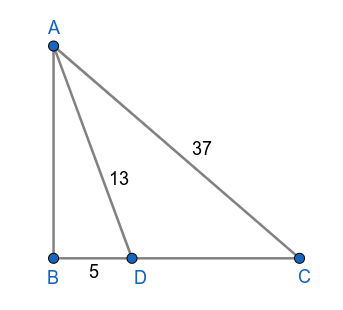
Triangle ABC is right angled at B and D is a point of BC such that BD = 5 cm, AD = 13 cm and AC = 37 cm. then find the length of DC in cm.
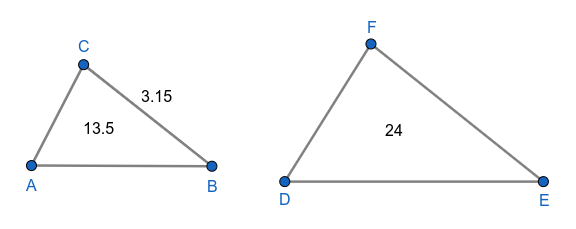
$$\triangle$$ABC $$\sim$$ $$\triangle$$DEF and the area of $$\triangle$$ABC is 13.5 cm$$^2$$ and the area of $$\triangle$$DEF is 24 cm$$^2$$ . If BC = 3.15 cm, then the length (in cm) of EF is:
If the area of the base of a cylinder is $$346.5 cm^{2}$$ and the area of the curved smface is $$990 cm^{2}$$, then its height is: (Taken $$\pi=\frac{22}{7}$$)
Question 128
If the height of a cylinder is increased by 30%, and the radius of its base is decreased by 15% then by what percentage will its curved surface area change?
Question 129
If the side of a square is increased by 40%, then its area will be increased by:
Question 130
Ina circle with centre O, PAX and PBY are the tangents to the circle at points A and B, from an external point P. Q is any point on the circle such that $$\angle QAX = 59^\circ$$ and $$\angle QBY = 72^\circ$$. What is the measure of $$\angle AQB$$?
Question 131
The perimeter of a circular lawn is 1232 m. There is 7 m wide path around the lawn. The area (in m$$^2$$) of the path is:(Take $$\pi = \frac{22}{7}$$)
The volume of a wall whose height is 10 times its width and whose length is 8 times its height is 51.2 m$$^3$$ . What is the cost(in ₹) of painting the wall on one side at the rate of ₹100/ m$$^2$$ ?
Area of one side of the wall = length x height = 80b x 10b = 800b$$^2$$ = 800 x $$\frac{4}{25}$$ = 128 m$$^2$$
The cost of painting the wall on one side at the rate of ₹100/ m$$^2$$ = 128 x 100 = ₹12800
Hence, the correct answer is Option A
Question 133
If the radius of a cylinder is decreased by 40% and the height is increased by 60% to form a new cylinder, then the volume will be decreased by:
Question 134
In triangle ABC, D and E are the mid points ofAB and BCrespectively. If area($$\triangle CED$$) = 8 cm$$^2$$, then what is the area(ADEC) in cm$$^2$$ ?
Question 135
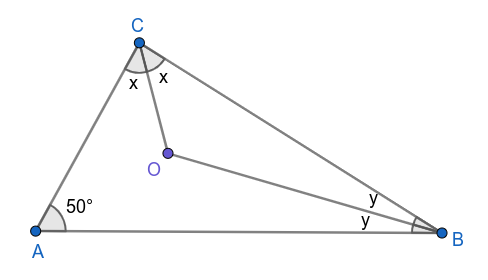
In $$\triangle$$ABC, $$\angle$$A = 50$$^\circ$$. If the bisectors of the angle B and angle C, meet at a point O, then $$\angle$$BOC is equal to:
Kamala has three cylindrical containers, each with radius 20 cm that she wants to fill with grain. If her bag of grain contains 100 kg grain, and she fills all three containers to a height of 70 cm, how much grain will be left in the bag, if 1 kg grain occupies 3000 $$cm^{2}$$ space? (Use $$\pi=\frac{22}{7}$$)
Question 137
The area of a table top in the shape of an equilateral triangle is $$9\sqrt{3}$$ cm$$^2$$. What is the length (in cm) of each side of the table?
The area of a table top in the shape of an equilateral triangle is $$9\sqrt{3}$$ cm$$^2$$.
$$\frac{\sqrt{3}}{4}$$a$$^2$$ = $$9\sqrt{3}$$
a$$^2$$ = 36
a = 6 cm
Length of each side of the table = 6 cm
Hence, the correct answer is Option A
Question 138
The cost of tiling the floor of a rectangular room is ₹9100 at ₹65 per m$$^2$$ . Theratio of the length and breadth of the floor is 7 : 5. The perimeter (in m ) of the floor of the room is:
Question 139
The radius of a cylinder is increased by 20% and its height is decreased by 45%. What is the percentage increase/decrease in the volume of the cylinder?
Question 140
The ratio of the curved surface area and total surface area of a cylinder is 4 : 7. If its volume is 4851 $$cm^{3}$$ , then its radius is: (Take $$\pi=\frac{22}{7}$$)
Question 141
Triangles ABC and DBCareright angled triangles with common hypotenuse BC. BD and ACintersect at P when produced. If PA= 8 cm, PC = 4 cm and PD = 3.2 cm, then the length of BD,in cm, is:
Question 142
A path 6 m wide runs around and outside of a rectangular plot of length 10 m and breadth 8 m. The area (in $$cm^{2}$$) of the path is:
Question 143
If the volume of a sphere is $$65\frac{10}{21} cm^{3}$$, then its surface area is: (Taken $$\pi=\frac{22}{7}$$)
Question 144
Length of eachside of a rhombusis 13 cm and oneof the diagonal is 24 cm. Whatis the area (in cm$$^2$$) of the rhombus?
Question 145
The radius of a metallic solid sphere is 21.6 cm. It is melted and drawn into a wire of uniform cross section. If the length of the wire is 259.2 m, then ihe radius of the wire is:
Question 146
The total surface area of a solid right circular cone is equal to that of a sphere of the same radius. The height of the cone is how many times the diameter of the sphere?
Question 147
What is the volume of the largest right circular cone that can be cut out of a cube of edge 12 cm (correct to two decimal places)?
Question 148
A container in the shape of a right circukar cone, whose radius and depth are equal, gets completely filled by 128000 sperical droplets, each of diameter 2mm. What is the radius (in cm) of the container?
Question 149
A metal cube of edge 18 cm is melted to form three smaller cubes, which are unequal in dimensions. If the edges of two smaller cubes are 9 cm and 15 cm, what is the surface area in (in $$cm^{2}$$) of the third smaller cube?
Question 150
ABCD is a cyclic quadrilateral. AB and DC meet at F, when produced. AD and BC meetat E, when produced. If $$\angle BAD = 68^\circ$$ and $$\angle AEB = 27^\circ$$, then whatis the measure of $$\angle BFC$$?
Question 151
In a circle with centre O, AB and CDare twoparallel chords on the sameside of the diameter. If AB = 12 cm, CD = 18 cm and distance between the chords AB and CD is 3 cm, then find the radius of the circle (in cm).
Question 152
In $$\triangle ABC, D$$ is a point on side AB such that BD = 3 cm and DA = 4 cm. E is a point on BC such that DE $$\parallel$$ AC,. Then Area of $$\triangle BDE$$ : Area of trapezium ACED =
Question 153
The length of a rectangle is three- fifth of the radius of a circle. The radius of the circle is equal to the side of a square whose area is 6400 $$m^{2}$$. The area (in $$m^{2}$$) of rectangle, if the breadth is 20 m is:
Now, Length of rectangle = three-fifth of radius of circle
l = $$\frac{3}{5}\times\ 80=48\ m$$
b = 20 m (given)
Area of rectangle = $$l\times\ b$$
= $$48\times\ 20=960\ m^2$$
Question 154
The radii of two concentric circles are 12 cm and 13 cm. AB is a diameter of the bigger circle. BD is a tangent to a smaller circle touchingit at D. Find the length (in cm) of AD? (correct to one decimal place)
Question 155
AB is a diameter of a circle. C and D are points on the opposite sides of the diameter AB, such that $$\angle ACD = 25^\circ$$. E is a point on the minor are BD. Find the measure of $$\angle BED$$ (in degrees).
Question 156
If the length of a rectangle is increased by 12% and the width is decreased by 10%, then the ratio of the areas of the original rectangle and the changed rectangle is:
Question 157
In the given figure, the area of the unshaded region is 35% of the area of the shaded region. What is the value of x?
Question 158
Sides AB and DCof a cyclic quadrilateral ABCD are produced to meetat E and sides AD and BC are produced to meet at F. If $$\angle ADC = 78^\circ$$ and $$\angle BEC = 52^\circ$$, then the measure of $$\angle AFB$$ is:
Question 159
The vertices of a $$\triangle ABC$$ lie on a circle with centre O. AO is produced to meetthe circle at the point P. D is a point on BC such that $$AD \perp BC$$. If $$\angle B = 68^\circ$$ and $$\angle C = 52^\circ$$, then the measure of $$\angle DAP$$ is:
Question 160
When a rectangle is divided into three equal parts, each of them turns out to be a square of area 16 $$cm^{2}$$. What is the perimeter (in cm) of the rectangle?
Question 161
A solid metal cube of edge 12 cm is immersed completely in water in a cylindrical vessel whose radius is 20 cm and height is 32 cm, and the water in the vessel is up to a height of 15 cm. The height (in cm) by which the water will rise in the vessel is (correct to one decimal place):
Question 162
A square park has area 4356 $$m^{2}$$. Taking its one round is same as taking one round of another circular park. Find the area of the circular park. (Use $$\pi=\frac{22}{7}$$)
Question 163
In a circle, a ten cm long chord is at a distance of 12 cm from the centre of the circle. Length of the diameter of the circle (in cm) is:
Question 164
In triangle ABC, AD is the bisector of $$\angle A$$. If AB = 5 cm, AC = 7.5 cm and BC = 10 cm, then whatis the distance of D from the mid-point of BC (in cm)?
Question 165
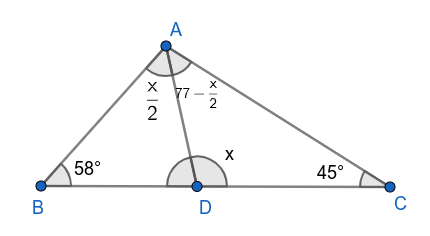
In $$\triangle$$ABC, D is a point on BC such that $$\angle$$BAD = $$\frac{1}{2} \angle$$ADC and $$\angle$$BAC = 77$$^\circ$$ and $$\angle$$C = 45$$^\circ$$. What is the measure of $$\angle$$ADB?
x + 45$$^\circ$$ + 77 - $$\frac{\text{x}}{2}$$ = 180$$^\circ$$
$$\frac{\text{x}}{2}$$ = 58$$^\circ$$
x = 116$$^\circ$$
$$\angle$$ADB = 180$$^\circ$$ - x
= 180$$^\circ$$ - 116$$^\circ$$
= 64$$^\circ$$
Hence, the correct answer is Option B
Question 166
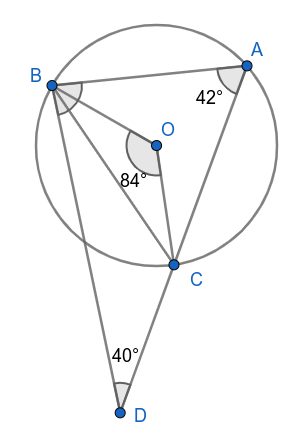
Points A, B and C are on circle with centre O such that $$\angle$$BOC = 84$$^\circ$$. If AC is produced to a point D such that $$\angle$$BDC = 40$$^\circ$$, then find the measure of $$\angle$$ABD (in degrees).
The difference between the areas of two concentric circles is $$88 cm^{2}$$. If the radius of the inner circle is 6 cm, then the area (in $$cm^{2}$$) of the larger circle is closest to: (Taken $$\pi=\frac{22}{7}$$)
Since the circles are concentric, the difference between their areas is $$\pi R^2-\pi(6)^2=88.$$
Substituting $$\pi=\dfrac{22}{7}$$ ,
$$\frac{22}{7}(R^2-36)=88.$$
or, $$ R^2-36=88\times\frac{7}{22}=28.$$
or, $$ R^2=64.$$
Hence, the area of the larger circle is $$ \pi R^2=\frac{22}{7}\times64=\frac{1408}{7}\approx201.14\text{ cm}^2.$$
Therefore, the area of the larger circle is closest to $$\boxed{201\text{ cm}^2}.$$
Question 168
The dimensions of a solid metallic cuboid are 36 cm, 54 cm and 24 cm. It is melted and recast into 8 cubes of same volume. The sum of the surface areas (in $$cm^{2}$$) of these 8 cubes is:
Question 169
The radius of the base of a cone and also that of a hemisphere each is 4 cm. Also, the volumes of these two solids are equal. The curved surface area of the cone is: (Taken $$\pi=\frac{22}{7}$$)
Question 170
The sum of the radius of the base and slant height of a right circular cone is 49 cm. If the total surface area is 1848 $$cm^{2}$$, then its height is: (Take $$\pi=\frac{22}{7}$$)
Question 171
Triangle ABC is right angled at B. BDis an altitude intersecting AC at D. If AC = 9 cm and CD = 3 cm, then find the measure of AB (in cm).
Question 172
A man walking at a speed of 3 km/h crosses a square field diagonally in 5 minutes. What is the area of the field (in m$$^2$$)?
Speed of the man = 3 km/h = 3 x $$\frac{1000}{60}$$ m/min = 50 m/min
Time taken to cross the field diagonally = 5 minutes
Length of the diagonal of the square field = 50 x 5 = 250 m
$$\sqrt{2}$$a = 250
a = $$\frac{250}{\sqrt{2}}$$ m
Area of the square field = a$$^2$$
= $$\left(\frac{250}{\sqrt{2}}\right)^2$$
= $$\frac{62500}{2}$$
= 31250 m$$^2$$
Hence, the correct answer is Option A
Question 173
A square has the perimeter equal to the circumference of a circle having radius 7 cm. What is the ratio of the area of the circle to area of the square?(Use $$\pi = \frac{22}{7}$$)
Circumference of the circle = $$2\times\frac{22}{7}\times7$$ = 44 cm
Perimeter of square is equal to the circumference of the circle.
Perimeter of the square = 44 cm
Let the side of the square = a
4a = 44
a = 11 cm
Ratio of the area of the circle to area of the square = $$\frac{22}{7}\times7^2\ :\ 11^2$$
= 14 : 11
Hence, the correct answer is Option C
Question 174
ABCD is cyclic quadrilateral in which $$\angle$$A = x$$^\circ$$, $$\angle$$B = 5y$$^\circ$$, $$\angle$$C = 2x$$^\circ$$ and $$\angle$$D = y$$^\circ$$. What is the value of (3x - y)?
Opposite angles in a cyclic quadrilateral are supplementary.
$$\angle$$A + $$\angle$$C = 180$$^\circ$$
x + 2x = 180$$^\circ$$
3x = 180$$^\circ$$
x = 60$$^\circ$$
$$\angle$$B + $$\angle$$D = 180$$^\circ$$
5y + y = 180$$^\circ$$
6y = 180$$^\circ$$
y = 30$$^\circ$$
3x - y = 3(60) - 30 = 150
Hence, the correct answer is Option C
Question 175
If the radius of a circle is increased by 19%, then by what percentage will its area increase?
Question 176
In a circle with centre O, AB and CD are parallel chords on the opposite sides of a diameter. If AB = 12 cm, CD = 18 cm and the distance between the chords AB and CD is 15 cm, then find the radius of the circle (in cm).
In $$\triangle ABC, D$$ is the mid-point of side AC and E is a point on side AB such that EC bisects BD at F. If AE = 30 cm, then the length of EB is:
Question 178
The area of a triangular field whose sides are 96 m, 110 m and 146 m is equal to the area of a rectangular park whose sides are in the ratio 10 : 11. The length of the longer side of the park is:
Question 179
The area of a triangular park with sides 78 m, 160 m and 178 m is equal to the area of a rectangular garden whose sides are in the ratio of 13 : 12. The smaller side (in m) of the garden is:
Question 180
The curved surface area of a cylinder is 462 cm$$^2$$ and its base area is 346.5 cm$$^2$$ . What is the volume (in cm$$^3$$) of the cylinder? (Use $$\pi = \frac{22}{7}$$)
Question 181
The length of a rectangle is three-fifth of the radius of a circle. The radius of the circle is equal to the side of a square, whose area is 6400 $$m^{2}$$. The perimeter (in m) of the rectangle, if the breadth is 15 m, is:
Question 182
The slant height and the diameter of the base of a right circular cone are 34 cm, respectively.Its volume (in $$cm^{3}$$) is:
Question 183
Whatis the area of the square (in cm$$^2$$) whose vertices lie on a circle of radius 5 cm?
Question 184
A solid metallic toy has a hemispherical base with radius 3.5 cm surmounted by a cone. If the height of the cone is the same as the radius of its base, then the volume of metal used in $$cm^{3}$$ is: (Take $$\pi=\frac{22}{7}$$)
Question 185
From an external point A, two tangents AB and AC have been drawnto a circle touching the circle at B and C respectively. P and Q are points on AB and AC respectively such that PQ touchesthe circle at R. IfAB = 11 cm, AP=7 cm and AQ = 9 cm, then find the length of PQ (in cm).
Question 186
In a circle with center O, AB is a diameter and CD is a chord such that $$\angle ABC = 34^\circ$$ and CD = BD. What is the measure of $$\angle DBC$$?
Question 187
The cost of leveling a square field at the rate of ₹52/$$m^{2}$$ is ₹1,30,000. What will be the cost of fencing its boundary at the rate of ₹35/m?
Question 188
The curved surface area of a cone is $$\frac{3432}{7}$$ $$cm^{2}$$ and its radius is 12 cm. Wha t is the radius of a sphere whose volume is 1.2 times the volume of the cone? (Take $$\pi=\frac{22}{7}$$)
Question 189
The perimeter of a semi-circle is 25.7 cm. Whatis its diameter (in cm)? $$(\pi = 3.14)$$
Question 190
The radius of spherical balloon increases from 6 cm to 10 cm when more air is pumped into it. The ratio in the surface area of the original balloon and the inflated balloon is:
Question 191
The sum of the height and radius of the base of a solid right circular cylinder is 46 cm. If the total surface area of the solid cylinder is 6072 $$cm^{2}$$, what is the volume ( in $$cm^{3}$$) of the cylinder? (Use $$\pi=\frac{22}{7}$$)
Question 192
The volume of a metallic cylindrical pipe is 1232 $$cm^{2}$$. If its external radius is 7 cm and thickness is 2 cm, then the length of the pipe (correct to one decimal place) (in cm) is: (Take $$\pi=\frac{22}{7}$$)
Question 193
To circles touch each other externally;the distance between their centres is 12 cm and the sume of their areas (in $$cm^{2}$$) is $$74\pi$$. What is the radius of the smaller circle?
Question 194
$$\triangle ABC$$ is incribed in a circle with center O, such that $$\angle ACB = 115^\circ$$. O is joined to A. What is the measure of $$\angle OAB$$?
Question 195
$$\triangle ABC$$ s an equilateral triangle. D is a point on side BC such that BD : BC = 1 : 3. If $$AD = 5\sqrt{7}$$ cm, then the side of the triangle is:
Question 196
Vertices A, B, C and D of a quadrilateral ABCD lie on a circle. $$\angle$$A is three times $$\angle$$C and $$\angle$$D is two times $$\angle$$B. What is the difference between the measures of $$\angle$$D and $$\angle$$C?
Difference between the measures of $$\angle$$D and $$\angle$$C = 120$$^\circ$$ - 45$$^\circ$$
= 75$$^\circ$$
Hence, the correct answer is Option C
Question 197
What is the area (in $$cm^{2}$$) of a trapezium whose parallel sides are 25 cm and 19 cm long, and the distance between them is 15 cm?
Question 198
What is the radius (in cm) ofa circle whose area is $$2\frac{17}{30}$$ times the sum of the areas of two triangles whose sides are 20 cm, 21 cm and 29 cm, and 11 cm, 60 cm and 61 cm (take $$\pi=\frac{22}{7}$$).
Question 199
A right circular cone is inscribed in a cube of side 9 cm occupying the maximum space possible. What is the ratio of the volume of the cube to the volume of the cone? (Take $$\pi=\frac{22}{7}$$)
Question 200
AB is a chord of a circle in minor segment with center O.C is a point on the minorarc of the circle between the points A and B. The tangents to the circle at A and B meetat the point P. If $$\angle ACB = 102^\circ$$, then whatis the measure of $$\angle APB$$?
Question 201
If the value of a cube is $$375\sqrt{3}cm^{3}$$ , then its diagonal is:
Question 202
In a circle with center O and radius 5 cm, AB and CD are two parallel chords of lengths 6 cm and x cm, respectively and the chords are on the opposite side of the centre O . The distance between the chords is 7 cm. What is the value of x?
Question 203
In a triangle ABC, length of the side AC is 4 cm more than 2 times the length of the side AB. Length of the side BC is 4 cm less than the three times the length of the side AB. If the perimeter of $$\triangle$$ABC is 60 cm, then its area (in cm$$^2$$) is:
The least munber of square tiles required to pave the ceiling of a room, 12 m 95 cm long and 3 m 85 cm broad, is:
Question 205
The maximum length of a pencil that can be kept in a rectangular box of dimensions 13 cm $$\times$$ 8 cm $$\times$$ 3 cm is:
Question 206
The total surface area of a solid cube is 294 $$cm^{2}$$. It is melted and recast into a right circular cylinder of radius 7 cm. What is the height (in cm, correct io one decimal place) of the cylinder? (Taken $$\pi = \frac{22}{7}$$)
Question 207
A solid right circular cone is cut into two parts by a plane parallel to its base and at a point one-third vertically below its vertex. What is the ratio of the volume of the smaller cone to that of the whole cone?
Question 208
The angles of a triangle are in AP (arithmetic progression). If measure of the smallest angle is $$50^\circ$$ less than that of the largest angle, then find the largest angle (in degrees).
The angles of triangle are in AP (arithmetic progression).
Let the angles are a, a+r, a+2r.
Measure of the smallest angle is $$50^\circ$$ less than that of the largest angle.
a = a + 2r - $$50^\circ$$
2r = $$50^\circ$$
r = $$25^\circ$$
Sum of the angles of triangle = $$180^\circ$$
a + a + r + a + 2r = $$180^\circ$$
3a + 3r = $$180^\circ$$
3a + $$75^\circ$$ = $$180^\circ$$
3a = $$105^\circ$$
a = $$35^\circ$$
Largest angle of triangle = a + 2r = $$35^\circ$$ + $$50^\circ$$ = $$85^\circ$$
Hence, the correct answer is Option B
Question 209
The area of a square shaped field is 1764 m$$^2$$. The breadth of a rectangular park is $$\frac{1}{6}$$th of the side of the square field and the length is four times its breadth. What is the cost (in ₹) of levelling the park at ₹30 per m$$^2$$ ?
Length of the diagonal of the cube = $$\sqrt{3}$$a
= 1.5$$\sqrt{3}$$ m
Hence, the correct answer is Option B
Question 212
A boy walked along two adjacent side of a rectagular field. If he had walked along the diagonal, then he would have saved a distance equal to one-fourth of the larger side. The ratio of the smaller to the larger side is:
Question 213
A circle is inscribed in a quadrilateral ABCD, touching sides AB, BC CD and DA at P, Q, R and S,respectively. If AS = 6cm, BC = 12 cm, and CR =5 cm,then the length ofAB (in cm) is:
Question 214
A heap of wheat is in the form of a cone whose base diameter is 8.4 m and height is 1.75 m. The heap is to be covered by canvass. What is the area (in m$$^2$$ ) of the canvas required? (Use $$\pi = \frac{22}{7}$$)
Question 215
A rectangular water reservoir contains 126 kilolitres of water. The depth of the reservoir is 3.5 m and its length measures 8 m. What is the width of the reservoir?
Question 216
If the width of the path around a square field is 4.5 in and the area of the path is $$252 m^{2}$$, then the length of the side of the field is:
Question 217
In a triangle ABC AB : AC = 5 : 2, BC =9 cm. BAis produced to D.and the bisector of the Angle CAD meets BC produced at E. Whatis the length (in cm) of CE?
Question 218
Points M and N are on the sides PQ and QR respectively of a triangle PQR. right angled at Q. If PN = 9 cm, MR = 7 cm, and MN = 3 cm, then find the length of PR (in cm).
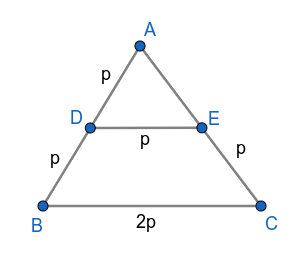
Triangle ABC is an equilateral triangle. D and E are points on AB and AC respectively such that DE is parallel to BC and is equal to half the length of BC. If AD + CE + BC = 30 cm, then find the perimeter (in cm) of the quadrilateral BCED.
Triangle ABC and triangle ADE are similar triangles.
$$\Rightarrow$$ $$\frac{AD}{AB}=\frac{DE}{BC}$$
$$\Rightarrow$$ $$\frac{AD}{AB}=\frac{p}{2p}$$
$$\Rightarrow$$ $$AD=\frac{1}{2}AB$$
$$\Rightarrow$$ $$AD=\frac{1}{2}\times2p$$
$$\Rightarrow$$ AD = p
Similarly, AE = p
and EC = AC - AE = 2p - p = p
AD + CE + BC = 30 cm
p + p + 2p = 30
4p = 30
p = $$\frac{15}{2}$$ cm
Perimeter of the quadrilateral BCED = BD + DE + CE + BC
= p + p + p + 2p
= 5p
= $$5\times\frac{15}{2}$$
= 37.5 cm
Hence, the correct answer is Option A
Question 220
24 spheres of the same size are made by melting a solid cylinder, whose diameter is 28 cm and height is 7 cm. The surface area of each sphere is: (Take $$\pi=\frac{22}{7}$$)
Question 221
A tank is 25 m long, 12 m wide and 6 m deep. The cost (in ₹) of plastering its walls and bottom at ₹10 per $$m^{2}$$ is:
Question 222
An open tank is 25 m long. 12 m wide and 6 m deep. The cost (in ₹) of plastering its walls and bottom from the inside at ₹15 per $$m^{2}$$ is:
Question 223
If the diameter of the base of a cone is 32 cm and its curved surface area is $$3268\frac{4}{7}$$ $$cm^{2}$$ , then its height is: (Taken $$\pi=\frac{22}{7}$$)
Question 224
Ina circle with centre O, a diameter AB is produced to a point P lying outside the circle and PT is a tangent to the circle at a point C onit. If $$\angle BPT = 28^\circ$$, then what is the measure of $$\angle BCP$$?
Question 225
The total surface area of a solid right circular cylinder is 1617 $$cm^{2}$$. If the diameter of its base is 21cm, then what is its volume (in $$cm^{2}$$)? (Taken $$\pi=\frac{22}{7}$$)
Question 226
Three circles, each having radius equal to 4 cm, are drawn with the vertices of an equilateral triangle as the centres. If the length of each side of the triangle is equal to 8 cm, then what is the area (in $$cm^{2}$$) of the portion of the triangle that is NOT covered by the sectors of the circles?
Question 227
Two circles of radii 18 cm and 16 cm intersect each other and the length of their common chord is 20 cm. What is the distance (in cm) between their centres?
Distance between centres of circles = AC = AH + CH = $$2\sqrt{39}$$ + $$4\sqrt{14}$$
Hence, the correct answer is Option D
Question 228
A circular wire of diameter 56 cm is folded in the shape of a rectangle whose sides are in the ratio of 7 : 4. The area enclosed by the rectangle is: (Take $$\pi=\frac{22}{7}$$)
Question 229
A typist uses a paper of size 32 cm $$\times$$ 20 cm. He leaves a margin of 2 cm each on all the sides. If he leaves a margin of 1 cm only on all the sides, then what is the percentage of the increase in the area available for typing (correct to 2 decimal places)?
Question 230
If length of a rectangle is increased to its three times and breadth is decreased to its half. then the ratio of the area of given rectangle to the area of new rectangle is:
Question 231
The area of a quadrant of a circle is $$\frac{\pi}{9}$$ m$$^2$$. Its radius (in metres) is equal to:
The area of a square shaped field is 1764 m$$^2$$ . The breadth ofa rectangular park is $$\frac{1}{3}rd$$ the side of the square field and its length is twotimesits breadth. Whatis the cost (in ₹) of levelling the park at ₹15 per m$$^2$$?
Question 233
The ratio of the volumes of a cone and a cylinder is 8 : 9 and their heights are in the ratio of 2 : 3. what is the ratio of the radii of their bases?
Question 234
$$\triangle ABC \sim \triangle DEF$$. If the areas of $$\triangle ABC$$ and $$\triangle DEF$$ are 100 cm$$^2$$ and 81 cm$$^2$$, respectively and the altitude of $$\triangle DEF$$ is 6.3 cm, then the corresponding altitude of $$\triangle ABC$$ is:
Question 235
What is the area (in cm$$^2$$) of a circle inscribed in a square of area 784 cm$$^2$$ ? (Take $$\pi = \frac{22}{7}$$)
Question 236
ABCD is a cyclic quadrilateral such that AB is the diameter ofthe circle and $$\angle ADC = 145^\circ$$, then what is the measure of $$\angle BAC$$?
Question 237
Achord AB of circle $$C_1$$, of radius 17 cm touches circle $$C_2$$, which is concentric to $$C_2$$, . The radius of $$C_2$$, is 8 cm. What is the length (in cm) of AB?
Question 238
If the length of a rectangle is increased by 40%, what would be the percentage decrease ( correct to one place of decimal) in the width to maintain the same area?
Question 239
The area (in $$cm^{2}$$) of a sector of a circle of radius 2 cm is $$\frac{4\pi}{5}$$. What is the central angle (in degrees) of the sector?
Question 240
The diameter of the base of a solid right circular cone is 22 cm and its height is 60 cm. The cost of polishing its curved surface at ₹1.40 per $$cm^{2}$$ is: (Take $$\pi=\frac{22}{7}$$)
Question 241
The perimeter and area of a rectangular sheet are 94 m and 420 $$m^{2}$$ respectively. The length of the diagonal will be:
Question 1
A wheel has diameter 84 cm, then how far does the wheel go (in metres) in 16 revolutions? (Take $$\pi = \frac{22}{7}$$)
Given that wheel Diameter = 84 cm and revolutions = 16
we know that, Perimeter = $$2 \pi r $$
$$\Rightarrow 2 \pi \dfrac{84}{2} $$
$$\Rightarrow 2 \times \dfrac{22}{7} \times 42 $$
$$\Rightarrow 2 \times 22 \times 6 $$
$$\Rightarrow 264 $$cm
Now, Does wheel go (in meter ) = $$ 264 \times 16 \times \dfrac{1}{100} $$
$$\Rightarrow 4224 \times \dfrac{1}{100} $$
$$\Rightarrow 42.24 $$ Meter Ans
Question 2
The internal length of a room is two times its breadth and three times its height. The total cost of painting its four walls at the rate of ₹25/m$$^2$$ is ₹3,600. What is the cost of laying a carpet on its floor at the rate of ₹90.50/m$$^2$$?
Given that $$\triangle$$ABC, AB = c cm, AC = b cm and CB = a cm. If $$\angle$$A= 2$$\angle$$
then we check Option
draw the diagram from the given information is given below
by pythgorous theorem
$$ a^2 = b^2 + c^2 $$
$$\Rightarrow a^2 = b^2 +c\times c $$
$$\Rightarrow a^2 = b^2 + cb $$(c=b)
put the value we can obtain
$$ \Rightarrow a^2 = b^2 +c^2 $$
therefore option (C) Ans
Question 5
In the Figure in $$\triangle$$ PQR PT $$\perp$$ QR at T and PS is the bisector of $$\angle QPR$$.If $$\angle PQR=78^\circ$$, and $$\angle TPS = 24^\circ$$ then the measure of $$\angle PRQ$$ is
The height of a right circular cone is 35 cm and the area of its curved surface is four times the area of its base. What is the volume of the cone (in $$10^{-3} m^3$$ and correct up to three decimal places)?
Given ABCD is a cyclic quadrilateral where AB=15,BC= 12,CD =10
is given below diagram
from the above diagram AC bisects BD
$$\triangle is similar \triangle BCD
$$ \frac{AB}{AD} = \frac{DC}{BC} $$
$$\Rightarrow \frac{15}{AD} = \frac{10}{12}$$
$$\Rightarrow AD = \frac{15\times 12} {10} $$
$$\Rightarrow AD = 18 cm
therefore Option (C) 18 cm Ans
Question 9
A solid metallic sphere of radius 6.3 cm is melted and recast into a right circular cone of height 25.2 cm. What is the ratio of the diameter of the base to the height of the cone?
The $$\triangle$$ ABC is a right angled triangle because
$$(14.5)^2=(10)^2+(10.5)^2=210.25$$
Also, circumradius of a right triangle is half of hypotenuse = $$\frac{14.5}{2}=7.25$$ cm
=> Ans - (D)
Question 12
$$\triangle ABC$$ is an equilateral triangle in which $$D, E$$ and $$F$$ are the points on sides $$BC, AC$$ and $$AB$$, respectively, such that $$AD \perp BC, BE \perp AC$$ and $$CF \perp AB$$. Which of the following is true?
Question 13
A circle touches the side BC of a $$\triangle$$ABC at P and also touches AB and AC produced at Q and R, respectively. If the perimeter of $$\triangle$$ABC = 26.4 cm, then the length of AQ is:
From the given question we draw the diagram is given below
From the above diagram
AQ = AR (from A) (Length drown from external tangent in equal)
BQ = BP (from B)
CP=CR (from C)
Perimeter of $$\triangle ABC = AB +BC+CA $$
= AB + (BP+PC) + (AR-CR)
Perimeter of $$\triangle ABC = (AB+BQ)+(PC)+(AQ-PC) $$
(Using the value AQ=AR, BQ=BP, CP=CR)
Perimeter of $$\triangle = 2AQ $$
$$\Rightarrow AQ= \frac{1}{2}\times perimeter of \triangle ABC $$
$$\Rightarrow AQ = \frac{1}{2} \times 26.4 $$
= $$\frac 13.2 cm $$Ans
Question 14
In $$\triangle ABC, \angle C = 90^\circ$$ and $$D$$ is a point on $$CB$$ such that $$AD$$ is the bisector of $$\angle A$$. If $$AC = 5 cm$$ and $$BC = 12cm$$, then what is the length of $$AD$$?
we know, $$cosA = \frac{5}{13}$$ $$\frac{5}{AD} = \sqrt{\frac{1 + \dfrac{5}{13}}{2}}$$ Solving this we get, $$\Rightarrow AD = \frac{5\sqrt{13}}{3}$$
$$\Rightarrow AD= 6.009$$
then Option (C) Ans
Question 15
Aright circular cylinder of maximum possible size is cut out from a solid wooden cube. The remaining material of the cube is what percentage of the original cube? (Take $$\pi$$= 3.14)
In the $$\triangle ABC where $$ \angle BAC = 90^\circ $$
then AD = $$ \frac{1}{2} BC $$
AD = $$ \frac{1} {2} \times 25 $$
AD = 12.5 cm Ans
Question 18
The tangent at a point A on a circle with center O intersects the diameter PQ of the circle, when extended,at point B. If $$\angle BAQ = 105^\circ$$, then $$\angle APQ$$ is equal to:
$$\Rightarrow \angle OPA = \angle APQ = 75^\circ $$ Ans
Question 19
The volume of a solid right circular cone is $$600 \pi cm^3$$, and the diameter of its base is 30 cm. The total surface area (in cm$$^2$$) of the cone is:
Let height of cone = $$h$$ cm and radius of base = 15 cm
=> Volume of cone = $$\frac{1}{3}\pi r^2h=600\pi$$
=> $$\frac{1}{3}\times225h=600$$
=> $$h=\frac{600}{75}=8$$ cm
Slant height of cone = $$l=\sqrt{(15)^2+(8)^2}=\sqrt{225+64}$$
=> $$l=\sqrt{289}=17$$ cm
$$\therefore$$ Total surface area of cone = $$\pi r(l+r)$$
= $$15\pi\times(17+15)=480\pi$$ $$cm^2$$
=> Ans - (B)
Question 20
The ratio of the volumes of two right circular cylinders A and B is $$\frac{x}{y}$$ and the ratio of their heights is a : b. What is the ratio of the radii of A and B?
The ratio of the radii of A and B = $$\sqrt{\frac{xb}{ya}}$$
Question 21
The volumeofa solid right circular cylinder is 5236 cm$$^3$$, and its height is 34 cm. What is its curved surface area (in cm$$^2$$)? (Take $$\pi = \frac{22}{7}$$)
From a point P which is at a distance of 10 cm from the centre O of a circle of radius 6 cm, a pair of tangents PQ and PR to the circle at point Q and respectively, are drawn. Then the area of the quadrilateral PQOR is equal to
Given that CA= 10, BC = 16 in the $$\triangle ABC $$
from the above triangle,
$$ \triangle ABC and \triangle DAC $$
$$\angle ADC = \angle BAC$$ (given that)
$$\Rightarrow \angle A = \angle D $$
$$ \angle B = \angle DAC $$
then $$\triangle ABC and $$ BDA $$
$$\Rightarrow \frac {AC} {DC} = \frac{BC}{AC} $$
$$\Rightarrow \frac {10}{CD} = \frac{16}{10} $$ (put the value)
$$\Rightarrow CD = \frac{100}{16} $$
$$\Rightarrow CD = 6.25 $$ CM Ans
Question 25
In $$\triangle$$ ABC, $$\angle C = 90^\circ$$. M and N are the mid-points of sides AB and AC,respectively. CM and BN intersect each other at D and $$\angle BDC = 90^\circ$$. If BC = 8 cm, then the length of BN is:
Question 26
A field is in the shape of a trapezium whoseparallel sides are 200 m and 400 m long, whereas each of other two sides is 260 m long. What is the area (in m$$^2$$)of the field?
Let ABCD be the trapezium and since the non parallel sides are equal, then CE = FD = 100 m
In right $$\triangle$$ ACE,
=> $$(AE)^2=(AC)^2-(CE)^2$$
=> $$(AE)^2=67600-10000$$
=> $$AE=\sqrt{57600}=240$$ m
$$\therefore$$ Area of trapezium = $$\frac{1}{2}h(AB+CD)$$
= $$\frac{1}{2}\times240\times(200+400)$$
= $$120\times600=72000$$ $$m^2$$
=> Ans - (C)
Question 27
The ratio of radius of the base and the heightof solid right circular cylinderis 2 : 3. If its volume is 202. 125 cm$$^3$$, then its total surface area is: (Take $$\pi = \frac{22}{7}$$)
60 discs each of diameter 21 cm and thickness $$\frac{1}{3}$$ cm are stacked one above the other to form rightcircular cylinder. What is its volume in $$m^3$$ if $$\pi = \frac{22}{7}$$?
A line touches a circle of radius 6 cm. Another line is drawn which is tangent to the circle. If the two lines are parallel, then the distance between them is:
A line which is parallel to a tangent will be another tangent.
Hence, distance between two parallel tangents = $$2r$$
= $$2\times6=12$$ cm
=> Ans - (B)
Question 31
Two circles of radii 5 cm and 3 cm intersect each other at A and B,and the distance betweentheir centres is 6 cm. The length (in cm) of the common chord AB is:
AB is a chord in a circle with centre O. AB is produced to C such that BC is equal to the radius of the circle. C is joined to O and produced to meet the circle at D. If $$\angle ACD = 32^\circ$$, then the measure of $$\angle AOD$$ is .........
The lengths of the parallel sides of a trapezium are 51 cm and 21 cm, and that of each ofthe other two sides is 39 cm. What is the area (in cm$$^2$$) of the trapezium?
From the above diagram, we apply the Pythagoras theorem in $$ \triangle ABC $$
then $$( AC)^2 = (39)^2 - (15)^2 $$
$$\Rightarrow (AC)^2 = 1521 - 225 $$
$$\Rightarrow (AC)^2 = 1296 $$
$$\Rightarrow AC = 36 $$
then Area of trapezium = $$ \frac {1}{2} \times (sum of sides) \times (Distance between them) $$
= $$ \frac {1}{2} \times (21+51) \times (36) $$
= $$ \frac {1}{2} \times 72 \times 36 $$
= $$36 \times 36 $$
= $$ 1296 cm^2 $$ Ans
Question 34
A chord of the larger among two concentric circles is of length 10 cm and it is tangent to the smaller circle. What is the area (in cm$$^2$$) of the annular portion between the two circles?
P is a point outside a circle with centre O, and it is 14 cm away from the centre. A secant PAB drawn from P intersects the circle at the points A and B such that PA = 10 cm and PB = 16 cm. The diameter of the Circle is:
P is a point outside a circle and is 26 cm away from its centre. A secant PAB drawn from intersects the circle at points A and B such that PB = 32 cm and PA= 18 cm. The radius of the circle (in cm)is:
A right circular cone of largest volumeis cut out from a solid wooden hemisphere. The remaining material is what percentage of the volume ofthe original hemisphere?
Area of trapezium = $$\frac{1}{2}\times$$ (sum of parallel sides) $$\times h$$
= $$\frac{1}{2}\times(27+13)\times8 $$
= $$4\times40=160$$ $$cm^2$$
= $$0.016$$ $$m^2$$
=> Ans - (A)
Question 42
Total surface area of aright circular cylinder is 1848 cm$$^2$$. The ratio of its total surface area to the curved surface area is 3: 1. The volume of the cylinder is:(Take $$\pi = \frac{22}{7}$$)
ABCD is a cyclic quadrilateral. The tangents to the circle at the points A and C on it, intersect at P. If $$\angle ABC = 98^\circ$$, then what is the measure of $$\angle APC$$?
Acircular wire of diameter 77 cm is bent in the form of a rectangle whose length is 142% of its breadth. What is the area of the rectangle? (Take $$\pi = \frac{22}{7}$$)
A cuboidal tank has 25000 litres of water. If the depth of the cuboid is $$\frac{1}{5}$$ of its length and breadth is $$\frac{1}{8}$$ of its length, then the length of the tank is:
A field is in the form of a circle. The cost of fencing around it at ₹12 per metre is ₹2,640. Whatis the area (in m$$^2$$) of the field? (Take $$\pi = \frac{22}{7}$$)
$$\triangle ABC \text{and} \triangle$$ BCD are similar triangle because-
BC is common line.
AB = AC and BD = DC
so,
$$\frac{AB}{BC} = \frac{BC}{DC}$$
$$\frac{12.5}{5} = \frac{5}{DC}$$
DC = $$\frac{25}{12.5}$$ = 2 cm
Question 49
PT is a tangent at the point R on circle with centre O. SQ is a diameter, which when produced meets the tangent PT at P. If $$\angle SPT = 32^\circ$$, then what will be the measure of $$\angle QRP$$?
Question 50
The sides AB, BC and AC of a $$\triangle$$ABC are 12 cm, 8 cm and 10 cm respectively. A circle is inscribed in the triangle touching AB, BC and AC at D, E and F, respectively. The difference between the lengths of AD and CE is:
According to the question, we draw the diagram is given below
AB= 12cm , BC= 8cm ,AC = 10cm
Now taking as an external point
thus AD=AF
$$Let AD = AF= x cm $$
so, BD= $$ 12-x $$, CE = $$8-(12-x)$$ and CF = $$10-x$$
then 12+8+10= $$x+x+12-x+12-x-4+x-4+x $$
30 = $$2x +16 $$
$$$ 2x= 14 $$
$$x= 7 $$
AD= 7 cm
CE = $$ 8 - (12-7)$$
CE= 8-5 = 3 cm
then difference between AD and CE is 7-3 = 4 cm
therefore Option (A) 4 cm Ans
Question 51
A cylinder 84 cm long is made of steel. Its external and internal diameters are 10 cm and 8 cm respectively. What is the volume of the steel in the cylinder (in $$10^{-3}m^3$$ and correct up to three decimalplaces)?
External radius = $$R=5$$ cm and internal radius = $$r=4$$ cm
Volume of steel = $$\pi R^2h-\pi r^2h$$
= $$\pi h(R^2-r^2)$$
= $$\frac{22}{7}\times84(5^2-4^2)$$
= $$264\times9=2376$$ $$cm^3$$
= $$2.376\times10^{-3}$$ $$cm^3$$
=> Ans - (B)
Question 52
A rectangular sheet of paper which is 88 cm long and 11 cm wideis rolled to form a cylinderof height equal to its width of the paper. What is the volumeofthe cylinder so formed?
circumference of base of cylinder=height of paper=88cm.
$$\rightarrow2\pi r=88$$
$$\rightarrow 2\times \dfrac{22}{7}\times r=88$$
$$\rightarrow r=\dfrac{88\times7}{44}$$
$$\rightarrow r= 14$$cm
volume of cylinder$$V=\pi r^2h$$
$$\rightarrow,V=\dfrac{22\times14^2\times11}{7}$$
$$\rightarrow,V=6776cm^3$$
Question 53
ABCD is cyclic quadrilateral. Sides AB and DC, when produced, meet at E, and sides BC and AD, when produced, meet at F. If $$\angle$$BFA = $$60^\circ$$ and $$\angle$$AED = $$30^\circ$$, then the measure of $$\angle$$ABC is:
PQRS is a rectangle. T is a point on PQ such that RTQ is an isosceles triangle and PT = 5 QT.If the area of triangle RTQ is $$12 \sqrt{3}$$ sq.cm, then the area of the rectangle PQRS is:
A conical vessel whose internal base radiusis 18 cm and height 60 cm is full of a liquid. The entire liquid of the vessel is emptied into a cylindrical vessel with internal radius 15 cm. The height (in cm) to which theliquid rises in the cylindrical vessel is:
Twelve solid hemispheres of the same size are melted and recastto in a right circular cylinder of diameter 7 cm and height 28 cm. Whatis the radius of the hemispheres?
Now the cost of levelling the park = $$ 2016 \times 8.50 $$
$$\Rightarrow Rs 17136 $$ Ans
Question 61
The radius and height of a right circular cone are in the ratio 1: (2.4). If its curved surface area is 2502.5 cm$$^2$$, then what is its volume(Take $$\pi$$=$$\frac{22}{7}$$)
In $$\triangle ABC, \angle = 90^\circ, AB = 16 cm$$ and $$AC = 12 cm$$. D is the midpoint of AC and $$DE \perp CB$$ at E. What is the area (in cm$$^2$$) of $$\triangle$$CDE?
from the given question we draw the diagram is given below
From the diagram , Let the $$ \triangle DEC, \angle c= \theta $$
$$ \tan \theta = \frac {16}{12}$$
$$\Rightarrow \tan \theta = \frac{4}{3}$$
$$\Rightarrow \theta = 53.13 $$
So, $$ \sin theta = \frac{DE}{DC} $$
$$\Rightarrow \sin 53.13 \times 6= DE $$
$$\Rightarrow DE = 4.8 $$
from the Pythagoras' Theorem
EC = 3.6
then Area of $$ \triangle CDE = \frac{1}{2} \times 3.6 \times 4.8 $$
$$ \Rightarrow 8.64 cm^2 $$ Ans
Question 65
A solid metallic sphere of radius x cm is melted and then drawn into 126 cones each of radius 3.5 cm and height 3 cm. There is no wastage of material in this process. What is the value of x?
Question 66
A solid metallic sphere of radius 8.4 cm is melted and recastinto a right circular cylinder ofradius 12 cm. Whatis the height of the cylinder? (Your answer should be correct to one decimal place.)
Question 67
If each side of an equilateral triangle is 12 cm, then its altitude is equal to:
Median = Altitude of any equilateral triangle = $$\frac{\sqrt3a}{2}$$
= $$\frac{\sqrt3}{2}\times12=6\sqrt3$$ cm
=> Ans - (C)
Question 68
The height of a cylinder is $$\frac{2}{3} rd$$ of its diameter. Its volume is equal to the volume of a sphere whose radius is 4 cm. What is the curved surface area (in cm$$^2$$) of the cylinder?
Here D is the diameter of the cylinder, so $$R=\dfrac{D}{2}$$ As per the given condition in the question, Volume of the cylinder= Volume of the sphere,
$$\pi R^2 h=\dfrac{4\pi r^3}{3}-------(i)$$
Now, substituting the value of h in the equation (i)
The area of the smaller circle to that of the larger circle is in proportion = $$\pi a^2 : \pi b^2 = a^2 : 4a^2 = 1 : 4$$
Question 70
In $$\triangle ABC, \angle A = 90^\circ$$, M is the midpoint of $$BC$$ and $$D$$ is a point on $$BC$$ such that $$AD \perp BC$$. If $$AB = 7$$ cm and $$AC = 24$$ cm, then $$AD : AM$$ is equal to:
PA & PB are the tangents to a circle, with Centre O from a point P outside it. We know that the tangents to a circle from an external point are equal in length so PA= PB. PA =PB
∠PBA = ∠PAB [Angles opposite to the equal sides of a triangle are equal.]
∠APB+ ∠PBA +∠PAB= 180° [Sum of the angles of a triangle is 180°]
A race track is in the shape of a ring whose inner and outer circumferences are 440 m and 506 m,respectively. What is the cost of levelling the track at ₹6/m$$^2$$? (Take $$\pi = \frac{22}{7}$$ )
ABC is an equilateral triangle. P,Q and R are the midpoints of sides AB,BC and CA, respectively. If the length of the side of the triangle ABC is 8 cm, then the area of $$ \triangle PQR $$ is:
AP and BP are tangents to the circle from the external point P. The line from the centre to the external point bisects the angle formed by this two tangents.
Given, AB = 10 cm, CD = 7 cm, SD = 4 cm and AS = 5 cm
AP and AS are tangents to the circle from point A.
$$\Rightarrow$$ AP = AS
$$\Rightarrow$$ AP = AS = 5 cm
DR and SD are tangents to the circle from point D.
$$\Rightarrow$$ DR = SD
$$\Rightarrow$$ DR = SD = 4 cm
AB = 10 cm
$$\Rightarrow$$ AP + BP = 10
$$\Rightarrow$$ 5 + BP = 10
$$\Rightarrow$$ BP = 5 cm
CD = 7 cm
$$\Rightarrow$$ DR + CR = 7
$$\Rightarrow$$ 4 + CR = 7
$$\Rightarrow$$ CR = 3 cm
BP and BQ are tangents to the circle from point B.
$$\Rightarrow$$ BP = BQ
$$\Rightarrow$$ BP = BQ = 5 cm
CQ and CR are tangents to the circle from point C.
$$\Rightarrow$$ CQ = CR
$$\Rightarrow$$ CQ = CR = 3 cm
$$\therefore\ $$BC = BQ + CQ = 5 + 3 = 8 cm
Hence, the correct answer is Option D
Question 80
In $$\triangle PQR, \angle Q = 85^\circ$$ and $$\angle R = 65^\circ$$. Points S and T are on the sides PQ and PR, respectively such that $$\angle STR = 95^\circ$$, and the ratio of the QR and ST is 9 : 5. If PQ = 21.6 cm, then the length of PT is:
In $$\triangle $$ ABC,if the ratio of angles is in the proportion 3 : 5 : 4, then the difference between the biggest and the smallest angles (in degrees)is:
By triplet 3-4-5, the triangle will be right angle triangle so,
5 will be hypotenuse.
Area of triangle = $$\frac{1}{2} \times base \times height = \frac{1}{2} \times 3 \times 4 = 6 cm^2$$
Question 86
A, B and C are three points on a circle such that the angles subtended by the chords AB and AC at the centre O are $$80^\circ$$ and $$120^\circ$$, respectively. The value of $$\angle BAC $$ is:
Circumference of disc = $$2 \pi r = 2 \times (22/7) \times 0.8 = 5.02
Length = 1.408 km = 1408 m
The number of revolutions = 1408/5.02 = 280
Question 89
In $$\triangle$$ ABC, AB = AC and AL is perpendicular to BC at L. In $$\triangle$$ DEF, DE = DF and DM is perpendicular to EF at M.If (area of $$\triangle$$ ABC) (area of $$\triangle$$ DEF) = 9:25, then $$\frac{DM + AL}{DM - AL}$$ is equal to:
(area of $$\triangle$$ ABC) : (area of $$\triangle$$ DEF) = 9:25
By property of similar triangle,
$$\frac{(DM)^2}{(AL)^2} = \frac{25}{9}$$
$$\frac{DM}{AL} = \frac{5}{3}$$
By componendo dividendo,
When $$\frac{x}{y} = \frac{a}{b}$$ then,
$$\frac{x + y}{x - y} = \frac{a + b}{a - b}$$
So,
$$\frac{DM + AL}{DM - AL} = \frac{5 + 3}{5 - 3}$$
$$\frac{DM + AL}{DM - AL} = \frac{8}{2} = 4$$
Question 90
A cylindrical vessel of radius 30 cm and height 42 cm is full of water. Its contents are emptied into a rectangular tub of length 75 cm and breadth 44 cm. The height (in cm) to which the water rises in the tub is: (Take $$\pi = \frac{22}{7}$$)
Volume of the cylindrical vessel = $$\pi r^2 h = \frac{22}{7} \times 30^2 \times 42$$
= 118800
If we replace the water from the cylindrical vessel to rectangular tub then volume should be equal of the cylindrical vessel rectangular tub.
Volume of the cylindrical vessel = Volume of rectangular tub
118800 = length $$\times breadth \times height$$
118800 = 75 $$\times 44 \times height$$
Height = 118800/3300 = 36 cm
Question 91
AB is a diameter of a circle with centre O. The tangentat a point C on the circle meets AB producedat Q. If $$\angle CAB = 42^\circ$$, then what is the measure of $$\angle CBA$$?
$$\frac{Area of \triangle MAN}{Area of \triangle ABC} = \frac{4^2}{9^2}$$
$$\frac{Area of \triangle MAN}{Area of \triangle ABC} = \frac{16}{81}$$
Let the area of $$\triangle MAN$$ be 16x and $$\triangle ABC$$ be 81x.
Area of quadrilateral MBCN =130 sqcm
Area of $$\triangle ABC$$ - area of $$\triangle MAN$$ =130 sqcm
81x - 16x = 130
x = 130/65 = 2
Area of $$\triangle$$ MAN = 16x = 16 $$\times$$ 2 = 32 sqcm.
Question 93
In $$\triangle$$ ABC,D is a point on BC such that AD is the bisector of $$\angle$$ A, AB = 11.7 cm, AC = 7.8 cm and BC = 13 cm. What is the length (in cm) of DC?
The circumference of the base of a conical tent is 66 m.If the height of the tent is 36 m, what is the area (in m$$^2$$) of the canvas used in making the tent?(Take $$\pi = \frac{22}{7}$$)
Area of canvas = $$\pi r l = \frac{22}{7} \times \frac{21}{2} \times 37.5$$ = 1237.5 sqm
Question 100
Diameter AB of a circle with centre O is produced to a point P such that PO = 16.8 cm. PQR is a secant which intersects the circle at Q and R such that PQ = 12 cm and PR = 19.2 cm.The length of AB (in cm) is :
$$\triangle$$ ABC is an equilateral triangle and AD $$\perp$$ BC, where D lies on BC. If AD = $$4\sqrt{3}$$ cm, then what is the perimeter (in cm) of $$\triangle$$ABC?
In $$\triangle ABC, AB = AC$$. A circle drawn through B touches AC at D and intersect AB at P. If D is the mid point of AC and AP 2.5 cm, then AB is equal to:
AD is a tangent and APB is a secant. So the tangent secant theorem can be applied,
$$AD^2 = AP \times AB$$
$$(\frac{AB}{2})^2 = 2.5 \times AB$$
$$\frac{AB^2}{4} = 2.5 \times AB$$
AB = 10 cm
Question 106
PAQ is a tangent to circle with centre O, at a point A on it. AB is a chord such that $$\angle BAQ = x^\circ(x < 90)$$. C is a point on the major arc AB such that $$\angle ACB = y^\circ$$. If $$\angle ABO = 32^\circ$$, then the value of $$x + y$$ is:
Question 107
PQRS is a cyclic quadrilateral in which PQ = x cm, QR= 16.8 cm, RS = 14 cm, PS = 25.2 cm, and PR bisects QS. What is the value of x ?
D is the midpointof side BC of $$\triangle ABC$$. Point E lies on AC such that $$CE = \frac{1}{3}AC$$. BE and AD intersect at G. What is $$\frac{AG}{GD}$$?
Area of an equilateral triangle = $$36\sqrt3 cm^{2}$$
$$\frac{\sqrt{3}a^2}{4}$$ = $$36\sqrt3 cm^{2}$$
a = 12 cm
Perimeter of the triangle = 3 $$\times$$ a = 3 $$\times$$ 12 = 36 cm
Question 111
In $$\triangle ABC, \angle B = 72^\circ$$ and $$\angle C = 44^\circ$$. Side BC is produced to D. The bisectors of $$\angle B$$ and $$\angle ACD$$ meet at E. What is the measure of $$\angle BEC$$?
In the figure, Two circles with centres P and Q touch externally at R. Tangents AT and BT meet the common tangent TR at T. If AP = 6 cm and PT = 10 cm, then BT = ?
Question 113
In $$\triangle ABC, AC = 8.4 cm$$ and $$BC = 14 cm$$. P is a point on AB such that CP= 11.2 cm and $$\angle ACP = \angle B$$. What is the length (in cm) of BP?
($$\because \angle$$ A is common and $$\angle ACP = \angle B$$)
$$\frac{AB}{AC} = \frac{BC}{CP} = \frac{AC}{AP}$$
From first two,
$$\frac{AB}{AC} = \frac{BC}{CP}$$
$$\frac{AB}{8.4} = \frac{14}{11.2}$$
AB = 10.5
From last two,
$$\frac{BC}{CP} = \frac{AC}{AP}$$
$$\frac{14}{11.2} = \frac{8.4}{AP}$$
AP = 6.72 cm
BP = AB - AP = 10.5 - 6.72 = 3.78 cm
Question 114
Two chords AB and CD of a circle with centre O intersect each other at P. If $$\angle BOC = 70^\circ$$ and $$\angle AOD = 100^\circ$$, then $$\angle APC$$ is:
In the given figure, MP is tangent to a circle with center A and NQ is a tangent to a circle with center B. If MP = 15 cm, NQ = 8 cm, PA = 17 cm and BQ = 10 cm, then AB is:
ABCD is a cyclic quadrilateral in which AB = 16.5 cm BC = x cm CD = 11 cm AD = 19.8 cm
By the property,
AB⋅BC = AD⋅DC
16.5 $$\times x = 19.8 \times 11$$
16.5 $$\times x = 217.8$$
x = 217.8/16.5 = 13.2 cm
Question 117
If the radius ofa right circular cylinder is decreased by 10%, and the heightis increased by 20%, then the percentage increase/decreasein its volumeis:
In the figure, $$PA$$ is a tangent from an external point $$P$$ to the circle with centre $$O$$. If $$\angle POB = 110^\circ$$, then the measure of $$\angle APO$$ is:
Question 119
In the given figure, a circle inscribed in $$\triangle$$ PQR touches its sides PQ, QR and RP at points S, T and U,respectively. If PQ = 15 cm, QR= 10 cm, and RP = 12 cm, then find the lengths of PS, QT and RU?
ABCD is a cyclic quadrilateral which sides AD and BC are produced to meet at P, and sides DC and AB meet at Q when produced. If $$\angle A = 60^\circ$$ and $$\angle ABC = 72^\circ$$, then \angle PDC - $$\angle DPC =$$
In $$\triangle ABC, \angle B = 68^\circ$$ and $$\angle C = 32^\circ$$. Sides $$AB$$ and $$AC$$ are produced to points $$D$$ and $$E$$, respectively. The bisectors of $$\angle DBC and \angle BCE$$ meet at F. What is the measure of $$\angle BFC$$?
In $$\triangle ABC, D, E$$ and $$F$$ are the midpoints of sides AB, BC and CA, respectively. If AB = 12 cm, BC = 20 cm and CA = 15 cm, then the value of $$\frac{1}{2}(DE + EF + DF)$$ is:
Sides AB and DC of cyclic quadrilateral ABCD are produced to meet at E, and sides AD and BCare produced to meet at F. If $$\angle BAD = 102^\circ$$ and $$\angle BEC = 38^\circ$$ then the difference between $$\angle ADC$$ and $$\angle AFB$$ is:
Difference between $$\angle BAD$$ and $$\angle AFB$$ = 62 - 40 = 22$$\degree$$
Question 138
The area of $$\triangle$$ ABC is 44 $$cm^2$$. If D is the midpoint of BC and E is the mid point of AB,then the area (in $$cm^2$$) of $$\triangle$$BDE is:
Two chords AB and CD of a circle are produced to intersect each other at a point P outside the circle. If AB = 7 cm, BP = 4.2 cm and PD = 2.8 cm, then the length of CD is:
Two circles of radii 7 cm and 5 cm intersect each other at A and B, and the distance between their centres is 10 cm. The length (in cm) of the common chord AB is:
The common chord AB = 2 $$\times \frac{2\sqrt{66}}{5} = \frac{4\sqrt{66}}{5}$$
Question 142
In a circle, AB is a the diameter and CD is a chord. AB and CD produced meet at a point P, outside the circle. If PD = 15.3 cm, CD = 11.9 cm and AP = 30.6 cm,then the radius of the circle is is:
Area of circle = $$\pi r^2 = \frac{22}{7} \times 14 \times 14 = 616 cm^2$$
Circumference of a circle = $$2\pi r = 2\times \frac{22}{7} \times$$ 14 = 88cm
Question 145
From an external point P, a tangent PQ is drawn to a circle, with the centre O, touching the circle at Q. If the distance of P from the centre is 13 cm and length of the tangent PQ is 12 cm, then the radius of the circle is:
Angle subtended by major arc at the centre is double the angle subtended by the major at any point on the circle.
$$\Rightarrow$$ $$\angle$$AOB = 2$$\angle$$AQB
$$\Rightarrow$$ 118$$^\circ$$ = 2$$\angle$$AQB
$$\Rightarrow$$ $$\angle$$AQB = 59$$^\circ$$
Hence, the correct answer is Option D
Question 148
In $$\triangle$$ ABC, D and E are the points on sides AC and BC, respectively such that DE parallel to AB. F is a point on CE such that DF $$\perp$$ CE. If CE = 6 cm, and CF = 2.5 cm, then BC is equal to:
Question 149
The area of the four walls of a room having length 6 m, breadth 4 m and height 4 m, is:
The diagonal of a square A is (a + b) units. What is the area (in square units) of the square drawn on the diagonal of square B whose area is twice the area of A?
The length of the direct common tangent = 2$$\sqrt{r1.r2}$$
r1 = 8 cm
r2 = 6 cm
The length of the direct common tangent = 2$$\sqrt{8 \times 6}$$
= 2$$\sqrt{48} = 2 \times 6.93 = 13.86 cm$$
Question 154
A, B and C are three points on a circle such that the angles subtended by the chord AB and AC at the centre O are $$110^\circ$$ and $$130^\circ$$, respectively. Then the value of $$\angle BAC$$ is:
In $$\triangle PQR, PQ = 24$$ cm and $$\angle Q = 58^\circ$$ S and T are the points on side PQ and PR, respectively, such that $$\angle STR = 122^\circ$$ and If PS = 14 cm and PT = 12 cm, then the length of RT is :
Area of a rhombus = (1/2) $$\times$$ multiplication of diagonals
= (1/2) $$\times 16 \times 12$$ = 96 $$cm^2$$
Question 159
PRT is a tangent to a circle with centre O, at the point R on it. Diameter SQ of the circle is produced to meet the tangent at P and QRis joined. If $$\angle QRP = 28^\circ$$, then the measure of $$\angle$$SPR is:
N solid metallic spherical balls are melted and recast into a cylindrical rod whose radius is 3 times that of a spherical ball and height is 4 times the radius of a spherical ball. The value of N is:
N $$\times$$ volume of solid metallic spherical balls = $$\times$$ volume of cylindrical rod N $$\times \frac{4}{3} \pi r^3 = \pi (3r)^2(4r)$$ N $$\times \frac{4}{3} = 36$$ N = 27
Question 2
The radius of the base of a right circular cylinder is increased by 20%. By what per cent should its height be reduced so that its volume remains the same as before?
Let the height be reduced by x%. r1 = 1.2r h1 = $$\frac{(100 - x)h}{100}$$ Volume of right circular cylinder = $$\pi r^2 h$$ $$\pi r^2 h = \pi (r1)^2 h1$$ $$r^2 h = (1.2r)^2 \times \frac{(100 - x)h}{100}$$ 100 = 1.44(100 - x) 1.44x = 44 x = $$\frac{44}{1.44} = 30 \frac{5}{9}$$
Question 3
The sides AB and AC of $$\triangle$$ABC are produced to P and Q respectively. The bisectors af $$\angle$$CBP and $$\angle$$BCQ meet at R. If the measure of $$\angle$$A is $$44^\circ$$, then what is the measure of, $$\frac{1}{2} \angle$$BOC ?
Let number of smaller spheres be n Now Volume of larger sphere = Volume of n spheres so we get $$\frac{4}{3}\pi\ \times\ 9^3=n\times\ \frac{4}{3}\pi\ \times\ 2^3$$ we get n =729/8 =91
Question 9
A steel vessel has a base of length 60 cm and breadth 30 cm. Water is poured in the vessel. A cubical steel box having edge of 30 cm is immersed completely in the vessel, By how much will the water rise?
Question 10
In the given figure, $$XYZ$$ is an equilateral triangle. $$\angle XAY=40^\circ, \angle XBZ=30^\circ$$ then $$\angle AXB$$ is equal to:
Figure
Question 11
One side of a rhombus is 26 cm and one of the diagonal is 48 cm. What is the area of the rhombus?
Question 12
ABCD is a cyclic quadrilateral such that AB is a diameter of the circle circumscribing it and angle ADC = $$148^\circ$$ . Then angle BAC is equal to:
Question 13
Let $$\triangle ABC\sim\triangle QPR$$ and $$\frac{ar(\triangle ABC)}{ar(\triangle QPR)}=\frac{9}{16}$$. If AB = 12 cm, BC = 6cm and AC = 9 cm, then PR is equal to:
Volume of Outer box=$$L\times\ B\times\ H=90\times\ 75\times\ 50$$
Volume of Outer box=337500 $$cm^3$$
To find the volume of inner box subtract thickness
new Dimensions are
$$L'=90-5=85cm$$ Thickness=2.5cm
B'=75-5=70cm
B'=50-5=45cm
Volume of inner box=$$L'\times\ B'\times\ H'=85\times\ 70\times\ 45$$ Volume of inner box=267750 $$cm^3$$ Volume of wood=Volume of outer box-Volume of inner box Volume of wood=337500-267750=69750 $$cm^3$$
Question 16
$$ABCD$$ is a cyclic quadrilateral such that $$AB$$ is the diameter of the circle circumscribing it and $$\angle ADC=155^\circ$$. then what is the measure of $$\angle BAC$$?
Question 17
If the surface area of a cube IS 1944 $$m^2$$, its volume is:
Iftwo equal circles whose centres are O and O' intersect each other at the point A and B, OO' = 12 cm and AB = 16 cm, then radius of the circle is:
Question 19
The sides of a triangle are in the ratio 3 : 2 : 4 and the perimeter is 72 cm. The sides are:
Question 20
Find the inner surface area of four walls of a rectangular room with length 7 m breadth 5 m and height 3.5 m
Question 21
The sides of a triangle are 16 cm, 30 cm and 34 cm respectively. At each vertices, circles of radius 7 cm are drawn. What is the area of the triangle. excluding the portion covered by the sectors of the triangle? ($$\pi = \frac{22}{7}$$ )
Question 22
Which of the following solids has the highest number of vertices?
$$ABCD$$ is a cyclic quadrilateral such that $$AB$$ is a diameter of the circle circumscribing it and angle $$ADC = 125^\circ$$. Then angle $$BAC$$ is equal to:
Sum of opposite angles of a quadrilateral is 180°.
So,$$\angle ADC+\angle ABC=180°.$$
or,$$\angle ABC=55°.$$
Again for semicircle,
$$\angle ACB= 90°.$$
$$\angle BAC =$$
$$180-\angle ACB-\angle ABC$$
or,$$\angle BAC=180-90-55=35°$$
D is correct choice.
Question 24
One side of a rhombus is 6.5 cm and one of it’s diagonal is 12 cm. What is the area of the rhombus?
Question 25
$$PA$$ and $$PB$$ are two tangents to a circle with centre $$O$$. from a point $$P$$ outside the circle. $$A$$ and $$B$$ are points on the circle. If $$\angle APB = 40$$°, then $$\angle OAB$$ is equal to:
Question 26
PA and PB are two tangents to a circle with centre O, from a point P outside the circle. A and B are points on the circle. If $$\angle OAB = 38^\circ$$, then $$\angle APB$$ is equal to:
Question 27
In $$\triangle ABC$$, D is a point on side BC such that $$\angle ADC = \angle BAC$$. If CA = 12 cm, CB = 8 cm, then CD is equal to:
$$\angle ADC = \angle BAC$$ $$\angle ACB = \angle ACD$$ So, $$\triangle$$ ABC ~ $$\triangle$$ DCA, So, $$\frac{BC}{AC} = \frac{AC}{CD}$$ $$\frac{8}{12} = \frac{12}{CD}$$ CD = 144/8 = 18 cm $$\therefore$$ The correct answer is option C.
Question 28
From a point $$P$$ outside the circle with centre $$O$$. two tangents $$PA$$ and $$PB$$ are drawn to meet the circle at $$A$$ and $$B$$ respectively. If $$\angle APB = 70^\circ$$. then $$\angle OAB$$ is equal to:
Question 29
How many soap cakes of size 8 cm x 4.5 cm x 2 cm can be kept in a carton of size 11 m x 0.82 m x 0.63 m? Latek
In the triangle given below, D and E are mid points of AF and AG respectively. F and G are lnid points of AB and AC respectively. If DE = 2.4 cm. then BC is equal to:
Question 33
The sides of a triangle are 8 cm, 15 cm, and 17 cm respectively. At each of its vertices, circles of radius 3.5 cm are drawn. What is the area of the triangle excluding the portion covered by the sectors of the circles $$(\pi=\frac{22}{7})$$ ?
If side of an equilateral triangle is a,then hieght of that triangle$$=a√3/2$$.
so,$$a√3/2=10√3.$$
or,$$a=20.$$
area$$=(1/2)×(a√3/2)×a$$
$$=(1/2)×10√3×20.$$
$$=100√3.$$
Option D is correct choice.
Question 35
If $$\triangle ABC \sim \triangle QPR, \frac{ar(ABC)}{ar(\triangle PQR)} = \frac{9}{4}, AC = 12 cm, AB = 18 cm$$ and $$BC == 15 cm$$ then $$PR$$ is equal to:
ABC is similar to PQR Now area of ABC : area of PQR = 9:4 = (side ratio )^2 so we get side ratio = 3:2 so AC:PR =3:2 so we get PR =8cm
Question 36
Side AB of a triangle ABC is 80 cm long, whose perimeter is 170 cm. If angle ABC = $$60^\circ$$, the shortest side of triangle ABC measures ......... cm.
Question 37
Find the cost of carpeting a room which is 11 m long and 6 m broad by a carpet which is 60 cm broad at the rate of ₹112.50 per meter.
Question 38
PA and PB are two tangents to a circle with centre O, from a point P outside the circle. A and B are points on the circle. If $$\angle PAB = 47^\circ$$, then $$\angle OAB$$ is equal to:
A field is 119 m $$\times$$ 18 m in dimension. A tank 17 m $$\times$$ 6 m $$\times$$ 3 m is dug out in the middle and the soil removed is evenly spread over the remaining part of the field. The increase in level on the remaining part of the field is:
Question 43
An 18 m deep well with diameter 7 m is dug and the earth from digging is spread evenly to form a platform 18 m $$\times$$ 14 m. The height of the platform is:
Question 44
The radius of a cylinder is increased by 120% and its height is decreased by 40%. What is the percentage increase in its volume?
 91- 6303239042