The Least Common Multiple of three different numbers is 120. Which of the following cannot be their Highest Common Factor?
SSC Number Systems Questions
What is the Least Common Multiple of 120, 240 and 480?
Find the numbers if the HCF of two numbers is 47 and their sum is 188.
What is the remainder when $$58^{29}$$ is divided by 5?
The least number which is exactly divisible by 27, 36, 56, 12 and 10?
What is the Highest Common Factor of $$2^{3} \times 3^{5}$$ and $$2^{4} \times 3^{6}$$?
The product of two numbers is 720 and their Highest Common Factor is 4. What is the Least Common Multiple of these numbers?
What is the Highest Common Factor of 12 8 and 24?
Which of the following number is divisible by 11?
Find the HCF of 27/50, 9/20, 6/25.
Least Common Multiple of 6 and 29 is X, Highest Common Factor of 6 and 29 is Y. Then what is the value of (X + 4Y)?
4 bells ring at intervals of 6, 8, 9 and 10 seconds. All the bells ring at the same time. After how many minutes will they ring together again'
For what value of M 58524M is divisible by 9?
The product of two numbers is 3375, and their HCF is 15. Find their LCM.
Find the greatest number which on dividing 60 and 90 leaves remainders 2 and 3 respectively.
Which of the following number is divisible by 11?
Tue Least Common Multiple of two prime numbers x and y. (x < y) is 141. Then what is the value of (y - 5x)?
What is the Least Common Multiple of $$2^{4} \times 3^{3}, 2^{5} \times 3^{2}$$ and $$2^{5} \times 3^{6}$$?
Find the LCM of 18 24 and 36.
Find the HCF of 31 and 73.
Find the maximum number of students among whom 1003 chocolates and 2703 candies can be distributed such that each student gets the same number of each.
What is the sum of all prime numbers between 30 and 50?
What is the smallest number that is a multiple of 5, 8 and 15?
Which of the following number is divisible by 4?
Which among the following is divisible by 4, 7 and 23?
Three numbers are in the ratio 3 : 9 : 11 and their HCF is 29. Find the numbers.
What will be the remainder when $$31 \times 32 \times 33$$ is divided by 5?
Convert $$0.4 \overline{27}$$ into fraction.
Find the HCF of 84, 126, and 168.
The HCF of 3888 and 3969 is:
Find the greatest number which when divides 261, 853 and 1221, leaves a remainder of 5 in each case.
Let the HCF of m and n be ‘a’ and let n = ab, LCM of m and n is given by:
Which is the smallest natural number that is exactly divisible by each of 96, 108 and 144?
Find the HCF of 240, 280 and 560.
The least number which should be added to 1351 so that the sum is exactly divisible by 2,4,6 and 8 is:
Find the greatest possible length (in metres) that can be used to exactly measure the lengths 6 m, 5 m 25 cm and 12 m 50 cm.
Two numbers are in the ratio of 4 : 3. The product of their HCF and LCM is 2700. The difference between the numbers is:
Find the LCM of 15, 24, 35 and 54.
Which of the following numbers leaves the remainder equal to the highest common factor of 6, 8 and 9, when divided by 6, 8 and 9?
Find the least number which is exactly divisible by 20, 28, 34, 60 and 75.
The product of two numbers is 20000. If their LCM is 800, then what is their HCF?
If $$a + b + c = 5$$ and $$ab + be + ca = 7$$ , then the value of $$a^{3} + b^{3} + c^{3} - 3abc$$ is:
The length and the breadth of the floor of a rectangular hall are 126 feet and 90 feet, respectively. What will be the area (in square feet) of each of the largest identical square tiles that can be used to tile this floor in a way that no part of the floor remains uncovered?
If $$a \alpha b, b \alpha \frac{1}{c}$$ and $$c \alpha d$$, then the relation between a and d is:
The largest number of four digits that is exactly divisible by 17 and 36 is:
The LCM of two prime numbers x and y (x > y) is 533. The value of 4y - x is:
The least common multiple of 12, 18 and 27 is :
What is the smallest perfect square number which is completely divisible by 4, 6, 9, 12 and 15?
What is the HCF of $$(x^{6} + 1) and (x^{4} - 1)$$?
The least common multiple of 210, 336 and 504 is :
The LCM of $$\frac{1}{3}, \frac{3}{5}, \frac{4}{7}$$ and $$\frac{9}{16}$$ is:
Find the HCF of 78, 84, 90 and 112.
The HCF and the LCM of two numbers are 5 and 175, respectively. If the ratio of the two numbers is 5:7, the larger of the two numbers is _______.
The LCM of two numbers is 660 and their HCF is 5. If one of the numbers is 55, find the other.
The product of two numbers is 726 and their HCF is 11, then their LCM is:
Find the LCM of $$\frac{3}{2}, \frac{81}{16}$$ and $$\frac{9}{8}$$.
Two numbers are in the ratio 12:7. If their HCF is 25, find the numbers.
A person has three iron bars whose lengths are 20, 30 and 40 metres, respectively. He wants to cut pieces of the same length from each of the three bars. What is the least number of total pieces if he cuts without any wastage?
Determine the LCM of two numbers if their HCF is 12 and their ratio is 13 : 15.
If the four-digit number 463y is divisible by 7, then what is the value of y?
Find the least number which when divided by 4, 9, 12 and 15, leaves the remainder 3 in each case.
The LCM and HCF of two numbers are 1105 and 5. If the LCM is 17 times the first number, then find the two numbers.
Three numbers are in the ratio of 5 : 7 : 9 and their LCM is 34,650. Their HCF is:
Two numbers are in the ratio 3 : 4. The product of their HCF and LCM is 2700. The sum of the numbers is:
Which is the largest number that divides each of 1036, 1813 and 3885 without leaving any remainder?
If the HCF of 45 and 55 is expressible in the form of 55 × 5 + 45m, then what is the value of m?
Find the LCM of 73 and 657.
What is the HCF of 12, 18 and 42?
The product of the two numbers is 1500 and their HCF is 10. The number of such possible pairs is/are:
The number 2918245 is divisible by which of the following numbers?
The largest three-digit number that gives the same remainder 2 when divided by 3, 5 and 9 is ________.
Which of the following numbers is divisible by 11?
The number 5769116 is divisible by which of the following numbers?
If the highest common factor (HCF) of x and y is 15, then the HCF of $$36x^{2} - 81y^{2}$$ and $$81x^{2} - 9y^{2}$$ is divisible by
The LCM of $$x^{2} − 8x + 15$$ and $$x^{2} − 5x + 6$$ is:
The number 1254216 is divisible by which of the following numbers?
What is the Least Common Multiple of lengths 80 cm, 90 cm and 112 cm?
The difference between the cubes of two given natural numbers is 6272, while the positive difference between the two given numbers is 8. What is the sum of the cubes of the two given numbers?
Which of the following is the smallest 5-digits number that is exactly divisible by 526?
Ramu had to select a list of numbers between 1 and 1000 (including both), which are divisible by both 2 and 7. How many such numbers are there?
120 apples, 240 oranges and 150 pears are packed in cartons in such a way that each carton has the same number of fruits, each carton contains only one type of fruit, and no fruit is left unpacked. What is the smallest possible number of cartons needed for the purpose?
120 apples, 240 oranges and 150 pears are packed in cartons in such a way that each carton has the same number of fruits, each carton contains only one type of fruit, and no fruit is left unpacked.
120 = $$2\times2\times\ 2\times\ 3\times\ 5$$
240 = $$2\times2\times2\times\ 2\times\ 3\times\ 5$$
150 = $$2\times3\times5\times5$$
So the HCF of 120, 240 and 150 = $$2\times\ 3\times\ 5$$ = 30
Smallest possible number of cartons needed for the purpose = $$\frac{120}{30}+\frac{240}{30}+\frac{150}{30}$$
= $$4+8+5$$
= 17
Find the value of k in the number 3426k if the number is divisible by 6 but NOT divisible by 5.
Five bells ring together at the intervals of 3, 5, 8, 9 and 10 seconds. All the bells ring simultaneously at the same time. They will again ring simultaneously after:
What is the sum of the digits of the least number which when divided by 15, 18 and 36 leaves the same remainder 9 in each case and is divisible by 11?
Two numbers are in the ratio 7 : 11. If their HCF is 28, then the sum of the two numbers is:
How many numbers between 400 and 700 are divisible by 5, 6 and 7?
If $$14331433 \times 1422 \times 1425$$ is divided by 10, then what is the remainder?
When a number is successively divided by 3, 4 and 7, the remainder obtained is 2, 3 and 5, respectively. What will be the remainder when 42 divides the same number?
How many numbers between 300 and 700 are divisible by 5, 6 and 8?
The HCFof two numbersis 29, and the other two factors of their LCM are 15 and 13. The smaller of the two numbers is:
The HCF of two numbersis 29, and the other two factors of their LCM are 15 and 13. The larger of the two numbers is:
When a numberis successively divided by 3, 4 and 7, the remainders obtained are 2, 3 and 5, respectively. What will be the remainder when 84 divides the same number?
Let x be the least number between 70000 and 75000 which on being divided by 225, 250 and 275 leaves a remainder of 61 in each case. The sum of the digits of x is:
The ratio of two numbers is 9: 13 and their HCF is 6. Their LCM is:
Three numbers are coprime to each other such that the product of the first two numbers is 88 and that of the last two numbers is 165.The sum of all three numbers is:
Two munbers A and B are, respectively, 20% and 56% more than a third number C. The ratio of the numbers A to B is:
What is the sum of the digits of the largest five digit number which is divisible by 5, 35, 39 and 65?
LCM of 5, 35, 39 and 65 = 1365
When the largest five digit number 99999 is divided by 1365, the remainder will be 354.
So, 99999 - 354 = 99645 is the largest five digit number divisible by 5, 35, 39 and 65.
Sum of the digits = 9 + 9 + 6 + 4 + 5 = 33
Hence, the correct answer is Option B
The LCM of two numbers is 90, whereas their HCF is 6. If one number is 12 more than the other, then the greater number is:
The sum of two numbers is 50 and their product is 525. The LCM of the two numbers is:
If the 9-digit number 89x64287y is divisible by 72, then what is the value of (3x + 2y)?
Find the sum of squares of the greatest value and the smallest value of K in the number so that the number 45082K is divisible by 3.
The difference between a positive number and its reciprocal increases by a foctor of $$\frac{175}{144}$$ when the number is made to increase by 20%. What is the number?
The smallest four-digit number which is exactly divisible by 18, 32 and 48 is:
What is the LCM of 0.126, 0.36 and 0.96?
Let x be the least number which on being divided by 8, 12, 15, 24, 25 and 40 leaves a remainder of 7 in each case. What will be the remainder when x is divided by 29?
How many numbers between 500 and 900, both inclusive,are exactly divisible by all the numbers, 12, 15, 20 and 30?
The least number which when divided by 15, 25, 35, 40 leaves remainders 10, 20, 30, 35. respectively, is:
The number 823p2q is exactly divisible by 7, 11 and 13. What is the value of (p - q)?
The sum of 3-digit numbers abc, cab and bca is not divisible by:
Sum of the numbers = $$\left(100a+10b+c\right)+\left(100c+10a+b\right)+\left(100b+10c+a\right)$$
= $$100\left(a+b+c\right)+10\left(a+b+c\right)+\left(a+b+c\right)$$
= $$111\left(a+b+c\right)$$
= $$37\times3\times\left(a+b+c\right)$$
Sum is not divisible by 31.
Hence, the correct answer is Option C
Find the smallest value of a so that 42a48b (a > b)is divisible by 11.
The product of two positive numbers is 1344 and their ratio is 7: 12. The smaller of these numbers is:
Let $$x$$ be the greatest number by which when 448, 678 and 908 are divided, the remainder in each case is 11 . When 147 is divided by $$x$$. the remainder is:
What least number must be subtracted from 2963 so that the resulting number when divided by 9, 10 and 15, the remainder in each case is 5?
If the 5 - digit number 593ab is divisible by 3, 7 and 11, then whatis the value of $$(a^2 - b^2 + ab)$$?
If the 8-digit number 888x53y4 is divisible by 72, then what is the value of (7x + 2y). for the maximum value of y ?
Let $$x$$ be the smallest 4-digit number such that when it is divided by 5, 6 and 7, it leaves the remainders 2, 3 and 4, respectively. The sum of the digits of $$x$$ is:
What is the smallest number which when divided by 72 and 96, respectively, leaves a remainder 5 in each case?
Which is the largest number that divides 827, 1149 and 1310 to leave the same remainder in each case?
Which number lying between 800 and 900 is such that when it is divided by either of 34 and 51, the remainder left is 19?
If the nine-digit number 7p5964q28 is completelydivisible by 88, whatis the value of $$(p^2 - q)$$ , forthe largest value of q, where p and q are natural numbers?
Let $$x$$ be the smallest 5-digit number such that when it is divided by 5, 6, 7 and 21, it leaves the same remainder 4. What is the sum of the digits of $$x$$?
Let x be the largest 4-digit number which is divisible by each of 16, 21, 24 and 28. The sum of the digits of X is:
What is the value of k such that number 72k460k is divisible by 6?
Given, 72k460k is divisible by 6.
72k460k is divisible by both 2 and 3.
So, k is even and sum of the digits is divisible by 3.
(7 + 2 + k + 4 + 6 + 0 + k = 19 + 2k) is divisible by 3.
since k is even, the only possibility is k = 4.
Hence, the correct answer is Option A
If me HCF of two numbers is 12 and LCM of me same two numbers is 48, then the square root of me product of these numbers is:
If a nine-digit number 7698x138y is divisible by 72, then the value of $$\sqrt{4x + y}$$ is:
The LCM and HCF of two positive numbers are 96 and 8, respectively. If the sum of the numbers is 56, then the difference between the numbers is:
Two numbers differ by 10. If their LCM is 120 and HCF is 10, then the sum of the numbers is:
If the 5-digit number 688xy is divisible by 3, 7 and 11, then what is the value of (5x + 3y)?
If the HCF of two numbers is 6 and LCM of the same two numbers is 54, then the square root of the product of these numbers is:
The value of $$5\frac{5}{29}-\left[\frac{15}{4}\div\left\{\frac{3}{4}\times\left(\frac{3}{2}-\frac{1}{5}-\frac{1}{3}\right)\right\}\right]$$ is:
According to the rule of BODMAS,
Parts of an equation enclosed in a 'brackets' must be solved first.
$$5\frac{5}{29}-\left[\frac{15}{4}\div\left\{\frac{3}{4}\times\left(\frac{45-6-10}{30}\right)\right\}\right]$$
$$5\frac{5}{29}-\left[\frac{15}{4}\div\left\{\frac{3}{4}\times\frac{29}{30}\right\}\right]$$
$$5\frac{5}{29}-\left[\frac{15}{4}\div\frac{29}{40}\right]$$
$$5\frac{5}{29}-\frac{150}{29}$$
$$\frac{150}{29}-\frac{150}{29}$$
= 0
Find the greatest value of b so that 30a68b (a > b) is divisible by 11.
Given, 30a68b is divisible by 11.
$$\Rightarrow$$ (3 + a + 8) - (0 + 6 + b) will be multiple of 11.
$$\Rightarrow$$ (a - b + 5) will be multiple of 11.
$$\Rightarrow$$ (a - b + 5) = 0 or (a - b + 5) = 11 or (a - b + 5) = 22 so on.
$$\Rightarrow$$ a - b = -5 or a - b = 6 or a - b = 17 so on.
Since a > b, a - b cannot be negative.
Both a and b are digits, so a - b cannot be a two digit number.
The only possibility is
a - b = 6
The pairs satisfying the above equation are (9,3), (8,2), (7,1), (6,0).
The greatest value of b can be 3.
Hence, the correct answer is Option C
If the 6-digit number 5x423y is divisible by 88, then what is the value of (5x - 8y)?
Ifa five digit number 247xyis divisible by 3, 7 and 11, then whatis the value of (2y-8x)?
If the seven-digit number 94x29y6is divisible by 72, then what is the value of (2x + 3y) for $$x \neq y$$?
Let $$x$$ be the greatest number of six digits which when divided by 5, 6, 7, 8 and 9, leaves the remainders 4, 5, 6, 7 and 8, respectively. What is the stun of the digits of $$x$$?
The HCF of two 2-digit numbers is 19 and their sum is 152. What is their difference?
What is the sume of the numbers between 300 and 400 such that when they are divided by 6, 12 and 16, it leaves no remainder?
Let $$x$$ be the least number between 56,000 and 60,000 which when divided by 40, 45, 50 and 55 leaves a remainder of 23 in each case. What is the sum of the digits of $$x$$ ?
Let $$x$$ be the least number divisible by 8, 12, 30, 36 and 45 and $$x$$ is also perfect square. What is the volue of $$x$$?
To find the least divisible number , we have find LCM of the given numbers
8, 12, 30, 36 , 45
LCM = $$2\times\ 2\times\ 2\times\ 3\times\ 3\times\ 5$$
= 360
As we have given, the number is also a perfect square
All the factors should be in pair, for making that we have to multiply it by 2 and 5 ,
i.e; $$2\times\ 2\times\ 2\times\ 2\times\ 3\times\ 3\times\ 5\times\ 5$$
= 3600
Hence, Option A is correct.
The sume of two numbers is 60 and their product is 875.The HCF of the numbers is
Find the difference between squares of the greatest value and the smallest value of P if the number 5306P2 is divisible by 3.
Find the sum of all the possible values of (a + b), so that the number 4a067b is divisible by 11.
Which of the following is an integer that is NOT a multiple of 7, 5 and 28?
If the 5-digit number 676xy is divisible by 3, 7 and 11, then whatis the value of (3x - 5y)?
The sum of two numbers is 140. If their LCM is 240 and HCF is 20, then find the smaller number.
When 3820, 4672 and 6163 are divided by the greatest number $$x$$, the remainder in each case is the same. What is the quotient when $$x$$ divides 1035?
When 5054,5906 and 7397 are divided by the greatest number $$x$$ , the remainder in each case is the same. The sum of the digits of $$x$$ is:
If the six-digit number 5z3x4y is divisible by 7, 11 and 13, then whatis the value of (x + y - z)?
Which of the following is exactly divisible by 6?
For divisibility by $$6 = 3\times 2 $$
the number must be even and sum of digit must be divisibility = 3
the check option (A) 4325672
4+3+2+5+6+7+2 = 29
it is not divisibile by 3
check (B) 5643252
sum fo given digit 5+6+4+3+2+5+2 = 27 it is divisible by 3 and hence it divisible by also 6
check option (C)96543111
sum of given digit 9+6+5+4+3+1+1+1 = 31 it is odd not divisible by 6
check option (D) 465466
sum of given digit 4+6+5+4+6+6 = 31 it is not divisible by 6
therefore Only Option (B)5643252 is divisible by 6
hence Option (C)5643252 Ans
If r is the remainder when each of 4749, 5601 and 7092 is divided by the greatest possible number d(>1), then the value of (d + r) will be:
Here, $$d$$ = H.C.F. of (5601-4749), (7092-5601) and (7092-4749)
= H.C.F. (852, 1491, 2343)
Prime factorisation of :
852 = $$2^2\times3\times71$$
1491 = $$3\times7\times71$$
2343 = $$3\times11\times71$$
=> H.C.F. = $$d=3\times71=213$$
Now, when any number say 4749 is divided by 213, remainder, => $$4749=213\times22+63$$
=> $$r=63$$
$$\therefore$$ $$d+r=213+63=276$$
=> Ans - (A)
Which is the largest six digit number, which when divided by 12, 15, 20, 24 and 30, leaves the remainders 8, 11, 16, 20 and 26 respectively.
The LCM of 12, 15 20,24, 30 = 120
the greatest of 6 digit = 999999
Dividing 999999 by 120 we get 39 as the remainder
Hence the 6 digit number divisible by 120 is (999999-39)
= 999960
Since 12-8=4 , 15-11 = 4, 20-16=4, 24-20= 4, 30-26 = 4
then reminder is each case is =4 less then the divior
Hence Requried number
999960-4 = 999956 Ans
How many natural numbers less than 1000 are divisible by 5 or 7 but NOT by 35?
Natural numbers less than 1000 divided by 5 are : 5,10,15,20,.....,990,995
=> Total numbers = $$\frac{(995-5)}{5}=198$$
Similarly, total numbers divided by 7 = $$\frac{(994-7)}{7}=141$$
and numbers divided by 35 = $$\frac{(980-35)}{35}=27$$
$$\therefore$$ Natural numbers less than 1000 are divisible by 5 or 7 but NOT by 35 = $$198+141-(2\times27)=285$$
=> Ans - (A)
Let x be the least number which when divided by 8, 9, 12, 14 and 36 leaves a remainder of 4 in each case, but x is divisible by 11. The sum of the digits of x is .........
Factor of 8 = $$2 \times 2 \times 2$$
Factor of 9 = $$3 \times 3$$
Factor of 12 = $$3 \times 2 \times 2$$
Factor of 14 = $$2 \times 7$$
Factor of 36 = $$2 \times 2 \times 3 \times 3$$
LCM of 8, 9, 12, 14 and 36 = $$2 \times 2 \times 2 \times 3 \times 3 \times 7$$ = 504
Possible number = 504 + remainder = 504 + 4 = 508
but it is not divisible by 11.
Another possible number = 504 $$\times$$ 2 + remainder = 1008 + 4 = 1012
It is divisible by 11.
Sum of number = 1 + 0 + 1 + 2 = 4
The value of $$\frac{1}{\sqrt{7-4\sqrt{3}}}$$ is closest to
$$ \frac{1}{ \sqrt{7-4\sqrt{3}}}$$
$$\Rightarrow \dfrac {1}{ (2)^2 + \sqrt {3}^2 - 2\times 2 \sqrt {3}} $$ factor of given expression
$$ \Rightarrow \dfrac{1}{( \sqrt {2- \sqrt{3}})^2}$$ used formula
$$ \Rightarrow \dfrac{1}{(2 - \sqrt {3})} $$(Remove Root )
$$\Rightarrow \dfrac{1}{2 - \sqrt {3}} \times \dfrac{2 +\sqrt {3}}{2 + \sqrt {3}}$$
$$\Rightarrow \dfrac{2 + \sqrt {3}}{4 -3} $$
$$\Rightarrow 2 + \sqrt {3} $$
$$\Rightarrow 2 + 1.73 $$
$$\Rightarrow 3.73 $$
$$\Rightarrow 3.7 $$ Ans
When 3738, 5659 and 9501 are divided by the greatest possible number x, the remainder in each case is y. What is the sum of x and y?
From the given numbers 3738, 5659, 9501
5659 - 3738 = 1921 , 9501 - 5659 = 3842 , 9501 - 3738 = 5763
then HCF of 1921,3842 , 5763 is 1921
so $$x = 1921 $$
when we will divide 3738 with 1921 reminder will be 1817 which is same for other two number also
so $$y = 1817 $$
$$x+y = 1921 + 1817 $$ = 3738 Ans
Let x be the least number divisible by 13, such that when x is divided by 4, 5, 6, 7, 8 and 12, the remainder in each case is 2. The sum of the digits of x is:
From the given 4,5,6,7,8,12
then $$4 = 2 \times 2 $$ , 5 = 5 , 6 = $$2 \times 3 $$, 7 = 7, 8 = $$ 2\times 2 \times 2 $$ , 12 = $$ 2 \times 2 \times 3 $$
then LCM = $$ 2 \times 2 \times 2 \times 5 \times 3 \times 7 $$
$$\Rightarrow 840 $$
so the number = 840 k + 2 (according to question)
which divisible by 13
put k = 1 number =842 (not divisible by 13)
k=2 number = 1682 (not divisible )
k= 3 number = 2522 (which is divisible)
so $$ x = 2522 $$
sum of digits = 2+5+2+2 = 11 Ans
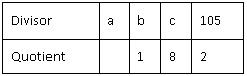
In finding the HCF of two numbersby division method, the quotients are 1, 8 and 2 respectively, and the last divisor is 105. What is the sum of the numbers?
Let the two numbers be $$a$$ and $$b$$
The table shows that when $$b$$ is divided by $$a$$, quotient is 1 and remainder is $$c$$, which becomes divisor in 2nd step and $$a$$ becomes dividend, now quotient is 8 and remainder is 105 and in the final step, 105 becomes divisor with $$c$$ being the dividend, 2 is quotient and remainder is 0.
Thus, $$c=105\times2+0=210$$
$$b=8c+105=8\times210+105=1785$$
$$a=1\times b+c=1785+210=1995$$
Thus, sum of numbers = $$a+b=1995+1785=3780$$
=> Ans - (C)
How many natural numbers up to 2001 are divisible by 3 or 4 but not 5?
If the 7-digit number x468y05is divisible by 11, then whatis the value of (x + y)?
Given numbers $$x 4 68y05 $$
For divisibility by 11 difference of the sum of digits at the alternate place is taken and made divisible by 11
then $$(x +6+y+5) - (4+8+0)$$
$$\Rightarrow (x+y+11)-12$$
$$\Rightarrow \dfrac (x+y-1){11}$$
Now (x+y) should be such number that on subtracting 1 from it we should get a number divisible by 11 so the probable
the answer would be 12 is $$(x=y)= 12
As $$ \dfrac{(x+y)-1}{11} $$
$$\Rightarrow \dfrac {12-1}{11}$$
$$\Rightarrow \dfrac {11}{11}= 1 $$
Ans = 12
If the 5-digit number 538xy is divisible by 3, 7 and 11, then the value of $$(x^2 + y^2)$$ is:
As divisible by 3, 7, 11
means divisible by $$ 3 \times 7 \times 11 $$
$$\Rightarrow 231 $$
then number $$231\times 233 $$
$$\Rightarrow 53823 $$
Hence $$x =2 , y = 3 $$
then $$(x^2 + y^2) = 2^2 + 3^2 $$
$$\Rightarrow 4 + 9 $$
$$\Rightarrow 13 $$ Ans
If the six-digit number 479 xyz is exactly divisible by 7, 11 and 13, then $$\left\{(y + z) \div x\right\}$$ is equal to:
Given that six-digit number$$ 479 xyz$$
written as 479479 then $$x=4,y=7,z=9$$
then $$\left\{(y + z) \div x\right\}$$
put the value
$$\left\{(7+ 9) \div 4\right\}$$
$$\Rightarrow \dfrac{9+7}{4}$$
$$\Rightarrow \dfrac{16}{4}$$
$$\Rightarrow 4 $$Ans
Let x be the least number of 4 digits that when divided by 2, 3, 4, 5, 6 and 7 leaves a remainder of 1 in each case. If x lies between 2000 and 2500, then what is the sum of the digits of x?
L.C.M. (2,3,4,5,6,7) = 420
Now, number of the form that when divided by 2, 3, 4, 5, 6 and 7 leaves a remainder of 1 in each case will be = $$x=420k+1$$ where $$k$$ is a constant.
Now, if $$x$$ lies between 2000 and 2500, then $$k=5$$
=> $$x=420\times5+1=2101$$
$$\therefore$$ Sum of digits = 4
=> Ans - (D)
Let x be the least number divisible by 16, 24, 30, 36 and 45, and x is also a perfect square. What is the remainder when x is divided by 123?
Prime factors of :
16 = $$2^4$$
24 = $$2^3\times3$$
30 = $$2\times3\times5$$
36 = $$2^2\times3^2$$
45 = $$3^2\times5$$
Thus, L.C.M. (16, 24, 30, 36 and 45) = $$x=2^4\times3^2\times5$$
Since, $$x$$ is also a perfect square, we need to multiply it by 5 (since it has odd power) = $$2^4\times3^2\times5^2$$
=> $$x=3600$$
Now, when 3600 is divided by 123, => $$3600=123\times29+33$$
Thus, remainder = 33
=> Ans - (D)
Let x be the least 4-digit number which when divided by 2, 3, 4, 5, 6 and 7 leaves a remainder of | in each case. If x lies between 2800 and 3000, then what is the sum of the digits of x?
Given numbers (2,3,4,5,6,7)
taken Lcm = 420 from given above numbers
Now, multiply of 420 are $$ 420 \times 1 = 420 $$
$$\Rightarrow 420 \times 2 = 840 $$
......................................
...................................
$$420 \times 7 = 2940 +1 = 2941 $$ (which is lies between 2800 and 2900)
then sum of digits = 2+9+4+1 = 16 Ans
The LCM of165, 176, 385 and 495 is k. When is divided by the HCF of the numbers, the quotientis p. What is the value of p?
As per the given question,
Numbers are 165, 176, 385 and 495
LCM of the above $$=2\times 3\times5\times 7\times 8\times 9\times 11=55440=K$$
HCF of the given number =11
Now, LCM is getting divided by HCF$$=\dfrac{55440}{11}=5040$$
The sum of two numbers is 1215 and their HCF is 81. If the numbers lie between 500 and 700, then the sum of the reciprocals of the numbers is .........
HCF of the two numbers is 81 so two numbers are 81x and 81y.
81(x + y) = 1215
x + y = 15
numbers lie between 500 and 700 so,
For the first number -
81 $$\times$$ 7 = 567
For the second number-
$$81 \times 8$$ = 648
sum of both numbers = 567 + 648 = 1215
The sum of the reciprocals of the numbers = $$\frac{1}{81x} + \frac{1}{81y}$$
= $$\frac{81x + 81y}{81x \times 81y} = \frac{1215}{567 \times 648} = \frac{1215}{367416}$$
= $$\frac{5}{1512}$$
The HCF and LCM of two numbers are 8 and 48 respectively. If the ratio of the two numbers is 2 : 3, then the larger of the two numbers is:
Given that, H C F = 8 and LC M = 48
let numbers are 2a and 3a Where " a" is a common factor
so we use HCF and LCM formula,
$$HCF\times LCM = 2a\times3a $$
$$\Rightarrow 8\times 48 = 6a^2 $$
$$\Rightarrow a^2 = \dfrac{8 \times48}{6} $$
$$\Rightarrow a^2= 64 $$
$$\Rightarrow a = 8 $$
then the largest number = 3a = $$3\times8$$=24Ans
If r is the remainder 2013 when each of 6454, 7306 and 8797is divided by the greatest number d(d > 1), then (d—r) is equal to:
Let the numbers are $$6454-r, 7306-r, 8797$$
Hence, the HCF of the number $$(7306-6454),(8797-7306), (8797-6454)$$
$$852=2\times 2\times 3\times 71$$
$$1491=3\times 71\times 7$$
$$2343=3\times 71\times 11$$
Hence, the HCF$$ d=3\times 71=213$$
Now, $$213\times 3+64$$
So, r=64, Hence, the required number $$=d-r=213-64=149$$.
When 2388, 4309 and 8151 are divided by a certain 3-digit number, the remainder in each case is the same. The remainder is:
Given that the number 2388, 4309, 8151
then 4309 - 2388 = 1921 = $$ 17 \times 113 $$
8151- 4309 = 3842 = $$ 2 \times 17 \times 113$$
Again 8151 - 2388 = 5766 = $$ 3 \times 17 \times 113 $$
HCF = $$ 17 \times 113 $$
Thus, $$\dfrac{2388}{113} = (Reminder = 15)$$
$$\dfrac {4309}{113} = (Reminder = 15)$$
$$\dfrac {8151}{113} = (Reminder = 15)$$
Then our Ans = 15
What is the HCF of $$\frac{4}{5}, \frac{6}{8}, \frac{8}{25} ?$$
HCF of $$\frac{4}{5}, \frac{6}{8}, \frac{8}{25} $$
= Ratio of HCF (4,6,8) : LCM (5,8,25)
= $$2:200=\frac{1}{100}$$
=> Ans - (B)
What is the sum ofthe greatest three digit number and the smallest four digit number such that their HCF is 23?
Greatest Three-digit number divisible by 23
then number = $$23\times 43$$ = 989
Smallest four-digit number divisible by 23
then number = $$23\times 44 $$= 1012
so total = 989 + 1012
= 2001Ans
When a certain number is divided by 65, the remainder is 56. When the same numberis divided by 13, the remainder is x . What is the value of $$\sqrt{5x - 2}$$?
As per question $$ \dfrac {56}{13 }$$
$$\Rightarrow 4 \dfrac{4}{13} $$
so x = 4 reminder
according to question the $$\sqrt{5x-2}$$
$$\Rightarrow \sqrt{18} $$ (put the value $$x$$)
$$\Rightarrow 3\sqrt {2}$$ Ans
The number 1563241234351 is:
1+6+2+1+3+3+1 = 17
5+3+4+2+4+5 = 23
The number is not divisible by 11 because the sum of alternative numbers is not equal to the sum of another alternative numbers.
rule of divisibility by 3 -
if sum of all digit of a number is divisible by 3 then number is divisible by 3.
1+5+6+3+2+4+1+2+3+4+3+5+1 = 40
The number not divisible by 3 because 40 is not divisible by 3.
The number neither divisible by 3 nor by 11.
If the number 1005x4 is completely divisible by 8, then the smallest integer in place of x will be:
Number = 1005x4
For the divisibility by 8, last 3 digit of a number is divide by 8 then number will be divisible by 8. So,
last 3 digits = 5x4
For the smallest integer x should be 0 and 504 is divisible by 8.
So, x = 0
What is the remainder when we divide $$5^{70} - 7^{70}$$ by 24 ?
When $$5^{70} + 7^{70}$$ is divide by 24,
$$\frac{5^{70} + 7^{70}}{24}$$
= $$\frac{(5^2)^{35} + (7^2)^{35}}{24}$$ = $$\frac{25^{35} + 49^{35}}{24}$$
= $$\frac{25^{35}}{24}+ \frac{49^{35}}{24}$$
Remainder = $$(1)^{35} - (1)^{35}$$ = 1 - 1 = 0
If integer n is divided by 5, the remainder is 2. What will be the remainder if 7n is divided by 5?
If integer n is divided by 5, the remainder is 2,
When integer is 7n then remainder also multiply by 7 so,
Remained = 2 $$\times$$ 7 = 14
Now,
14 is divided by 5 so,
Remainder = 4
If the nine-digit number 708x6y8z9 is divisible by 99, then whatis the value of x + y + z?
To be divisible by 99, the number has to be divisible by 11 and 9 both.
For divisibility by 11,
7 + 8 + 6 + 8 + 9 - 0 + x + y + z
(38 - x + y + z) has to be divisible by 11.
For divisibility by 9,
(38 + x + y + z) has to be divisible by 9.
By option C),
x + y + z = 16
(38 - x + y + z) = 38 - 16 = 22 is divisible by 11.
(38 + x + y + z) = 38 + 16 = 54 is divisible by 9.
If the given number 925x85 is divisible by 11, then the smallest value of x is:
For the divisibility by 11, the sum of the alternative digits should be equal so,
9 + 5 + 8 = 2 + x + 5
x = 15
Smallest value of x = 15 - 11 = 4
When 732 is divided by a positive integer x, the remainder is 12. How many values of x are there?
Number which fully divide by a positive integer x = number - remainder = 732 -12 = 720
720 is fully divide by positive integer x.
Factor of 720 = $$2^4 \times 3^2 \times 5
Total factor = (4 + 1).(2 + 1).(1 + 1) = 5.3.2 = 30
We combinations of these factors which are more than 12 and maximum 720 because remainder is 12.
Combination lees than 13 = 1, 2, 3, 4, 5, 6, 8, 9, 10, 12
Number of combination lees than 13 = 10
Number of values of x = 30 - 10 = 20
If 7 divided a positive integer n, the remainder is 2. Which ofthe following numbers gives a remainder of 0 when divided by 7?
If 7 divided a positive integer n, the remainder is 2.
Dividend = Quotient$$\times$$ Divisor + Remainder
n = Quotient$$\times$$ 7 + 2
For remainder 0 we should by add 5 in the number so,
Number = n + 5
The smallest number which may replace * in the number 1190*6 to make the number divisible by 9 is:
By the divisibility rule, if sum of all digits of a number is divisible by 9 the number will be divisible by 9.
Number =1190*6
Sum of the digits = 1 + 1+ 9 + 0 + * + 6 = 17 + *
For the smallest number, we took the minimum value of the '*'.
so, value of * = 1
Sum of all digit = 17 + 1 = 18
$$\therefore$$ the value of * will be 1.
What is the smallest integer that is a multiple of 5, 8 and 15?
Smallest integer that is a multiple of 5, 8 and 15 = 120
($$\because LCM of 5, 8 and 15 is 120.$$)
How many numbers are there from 200 to 800 which are neither divisible by 5 nor by 7?
Total numbers = (800 - 200) + 1 = 601
Number of terms which divide by 5
l = 800
a = 200
Common difference(d) = 5
l = a + (n-1)d
800 = 200 + (n - 1)5
n-1 = 120
n = 121
Number of terms which divide by 7
l = 798
a = 203
Common difference(d) = 7
l = a + (n-1)d
798 = 203 + (n - 1)7
n-1 = 85
n = 86
Number of terms which divide by 5 and 7
l = 770
a = 210
Common difference(d) = 35
l = a + (n-1)d
770 = 210 + (n - 1)35
n-1 = 16
n = 17
Number of terms which divide by either 5 or 7 = 121 + 86 - 17 = 190
Number of terms which divide by neither 5 nor 7 = 601 - 190 = 411
If the 6-digit numbers $$x35624$$ and $$1257y4$$ are divisible by 11 and 12, respectively, then what is the value of (5x - 2y ) ?
Divisibility rule of 11,
The sum of of alternative digit are equal so,
x + 5 + 2 = 3 + 6 + 4
x = 6
Divisibility rule of 12,
The number should be divisible by 3 and 4.
For the divisible by 4,
last 2 digits of the number should by divisible by 4 so possible value of y = 2
Value of (5x - 2y ) = $$5 \times 6 - 2 \times 2$$
= 30 - 4 = 26
The greatest number which should be replace '*’ in the number 146*48 to makeit divisible by 8 is:
For the divisible by 8, last 3 digits of the number should be divisible by 8 so,
*48 divisible by 8.
From the option A),
Put the value of x = 8,
Last 3 digit = 848
It if divisible by 8 so, greatest value of * will be 8.
What should replace * in the number 94*2357, so that numberis divisible by 11?
If the number 94*2357 is divisible by 11 then sum of all alternative digit will be equal. So,
9 + * + 3 + 7 = 4 + 2 + 5
* = 11 - 19 = -8
The value of * = 11 - 8 = 3
The largest number which should replace * in the number 2365*4 to make the number divisible by 4 is:
For the divisibility by 4, last 2 digit of the number should be divisible by 4. So,
For the largest number,
value of * = 8.
Whatis the smallest integer that is divisible by 3, 7 and 18?
LCM of of 3, 7 and 18 = 126
$$\therefore$$ 126 is the smallest integer that is divisible by 3, 7 and 18.
When 200 is divided by a positive integer x , the remainder is 8. How many values of x are there?
When 200 is divided by a positive integer x , the remainder is 8.
For completely divisible by x, number = 200 - 8 = 192
Factor of 192 = $$2^6 \times 3^1$$
Total number = (6 + 1)(1 + 2) = 14
Number which are less then 9 = 1, 2, 3, 4, 6, 8
Total number of values = 14 -6 = 8
If the number 687x29 is divisible by 9, then the value of 2x is:
Divisibility rule by 9, if the sum of all number is divisible by 9 then number is divisible by 9.
Sum of number = 6 + 8 + 7 + x + 2 + 9 = 32 + x
putting the value of x = 4
32 + 4 = 36 divisible by 9 so,
zx = 2 $$\times$$ 4 = 8
A General, while arranging his men, who were 6000 in number, inthe form of a square,found that there were 71 men left over. How many were arranged in each row?
Each member of a club contributes as much rupees and as much paise as the number of members of the club. If the total contribution is Rs. 2525, then the number of members of the club is
How many three digit numbers are there in which all the digits are odd?
1,3,5,7,9 are the odd digits
as all the digits are to be odd
In a three digit number each place can be filled with 5 numbers i.e either 1,3,5,7 or 9
and so 5*5*5=125 numbers
How many two digit prime numbers are there between 10 to 100 which remains prime numbers when the order of their digits is reversed?
9 such prime numbers are there in between 10 and 100.
Those are : 11,13,17,31,37,71,73,79 & 97.
B is correct choice.
If $$A = 1 - 10 + 3 - 12 + 5 - 14 + 7 + …$$ upto 60 terms, then what is the value of $$A$$?
$$A=1-10+3-12+5-14+7+\dots..upto\ 60\ terms\ .$$
or, $$A=\left(1+3+5+7+...59\right)-\left(10+12+14+....+68\right)\ .$$
or, $$A=\frac{\left(1+59\right)\times30}{2}-\frac{\left(10+68\right)\times30}{2}\ .$$
or, $$A=900-1170\ =-270\ .$$
D is correct choice.
If N = 1 + 11 + 111 + 1111 + … +111111111, then what is the sum of the digit's of N?
If the unit digit of $$(433 \times 456 \times 43N)$$ is $$(N + 2)$$, then what is the value of $$N$$?
If we multiply 433 and 456 then we will get 8 as unit digit .
But when 433 and 456 multiply together with 43N then the unit digit appears as 8N .
So,Unit digit of $$8N=N+2$$ .
It is possible only when N=6 .
So, D is correct choice.
What is the unit digit of the sum of first 111 whole numbers?
Sum of first 11 whole numbers is 0+1+2...110
i.e n(n+1)/2 =110*111/2
=55*111
Therefore units digit is 5
If $$N = 3^{14} + 3^{13} - 12$$, then what is the largest prime factor of $$N$$?
$$3^{14}+3^{13}-12$$
$$=3^{13}\left(3+1\right)-12=3.4\left(3^{12}-1\right)$$
$$=3.4\left(3^6-1\right)\left(3^6+1\right)$$
$$=3.4\left(3^2-1\right)\left(3^4+3^2+1\right)\left(3^2+1\right)\left(3^4-3^2+1\right)$$
$$=2^6.3.5.7.13,73$$
Largest prime factor is 73
D is correct choice.
M is the largest three digit number which when divided by 6 and 5 leaves remainder 5 and 3 respectively. What will be the remainder when M is divided by 11?
Lcm of (6,5) = 30
format is "30K + constant"
Constant is remainder.
let that remainder be N.
N/6 = 5 remainder
N could be 5,11,17,23,30,..
N/5 =3 remainder
N could be 3,8,13,18,23,28,...
The very first number common in both term is 23
So N is 23 I.e a constant term
30K + 23
Largest three digit number comes when K is 32
30 (32) + 23
= 983
So, it will give 4 remainder when divide by 11 .
D is correct choice.
$$\frac{9}{40}$$ converted to percentage is:
Four bells ring simultaneously at a certain instant. Thereafter they ring at intervals of 6, 8, 10 and 12 seconds respectively. In how many minutes will they ring together again for the first time?
Four bells ring simultaneously at a certain instant. Thereafter they ring at intervals of 6, 8, 10 and 12 seconds respectively
Now they will ring together again after LCM(6,8,10,12 ) seconds =120seconds = 2 minutes
Two numbers are in the ratio 5 : 11. If their HCF is 24, then the sum of two these numbers is:
Let numbers be 5x and 11x
Now we know that 5 and 11 are co prime numbers so their HCF is 1
Now for the HCF of 5x and 11x to be 24
The value of x has to be 24
So we get numbers as 120 and 264
Therefore their sum will be 120+264 = 384
Which of the following statement is true?
A is false TWO prime numbers are always co prime .
B is true LCM of two numbers is always divisible by their HCF.
C is false HCF *LCM = product of numbers
D is false HCF of two numbers is highest common divisor of two numbers
The number 106974 is divisible by which of the single digit numbers:
If the seven digit number 56x34y4 is divisible by 72, then what is the least value of (x + y)?
The face value of the digit 6 in 16008 is:
The square root of which of the following is a rational number?
we can solve this by option by option
Square root of rational numbers in the form of fractions
Step I: Obtain the fraction
Step II: If the given square root of the numerator and the denominator are the square roots of numerator and denominator respectively of the given fraction.
Step III: Find the square root of the numerator and denominator separately.
Step IV: Obtain the fraction whose numerator and denominator are the square roots of numerator and denominator respectively of the given fraction.
Step V: The fraction obtained in Step IV is the square root of the given fraction.
so by going option ,
we can covert 1489.96 into fracation = $$1489\ \frac{24}{25}$$
also write as $$\frac{37249}{25}$$
here 37249 is the square root of 193 and 25 is of 5
So option a is correct ans
The square root which of the following is a rational number?
Now
553536 is a perfect square
553536 = (744)^2
Now 5535.36 = 553536/100 = $$\left(\frac{744}{10}\right)^{^2}$$= (74.4)^2
The product of two numbers is 45360; if the HCF of the numbers is 36, then their LCM is:
We know that
product of two numbers=LCM×HCF
of these two numbers.
So, required LCM$$=45360/36=1260.$$
D is correct choice.
If the seven digit number 3x6349y is divisible by 88, then what will be the value of (2x + 3y)?
Two numbers are in the ratio 4 : 7. If their HCF is 26. then the sum of these two numbers will be:
Let numbers be 4x & 7x
we know that,
$$LCM\times\ HCF=\ \Pr oduct\ of\ two\ numbers$$
$$LCM\times\ 26=\ 7x\times\ 4x$$
LCM=$$\frac{14}{13}x^2$$
now LCM of 7x & 4x =$$28x$$
$$\longrightarrow\ 28x=\frac{14}{13}x^2$$
$$x=26$$
the sum of two numbers = $$7x+4x=7\times\ 26+4\times\ 26=286\ Ans$$
The number 30744 is divisible by which of the single digit numbers:
How many natural numbers are there between $$\surd 261$$ and $$\surd45109$$?
The least positive integer that should besubtracted from 3011$$\times$$3012 so that the different is a perfect square is
Given expression is 3011$$\times$$3012
If we consider a= 3011, we get a(a+1). To make this a perfect square, we have to subtract it by a, then it becomes
$$ a(a+1) - a $$ = $$ a^2 + a - a $$ = $$ a^2 $$
Therefore, 3011$$\times$$3012 will become a perfect square when it's subtracted by 3011.
The largest number of four digits that is exactly divisible by 15, 21 and 30 is:
The sum of three numbers is 777. The ratio between the first two numbers is 7: 9 and the ratio between the second and third number is 3 :7. The second number is:
When the integer n is divided by 7, the remainder is 3. What is the remainder if 5n is divided by 7?
Dividend = n
Divisor = 7
Quotient = Q
Remainder = 3
n = 7Q+3
Multiplying with 5,
5n = 35Q+15
Dividing with 7,
$$\dfrac{5n}{7} = \dfrac{35Q}{7}+\dfrac{15}{7}$$
Here, When 15 is divided by 7, remainder will be 1.
Therefore, 1 will be the remainder when 5n is divided by 7.
Two numbers are in the ratio 4 : 5. If their HCF is 16. then the sum of these two numbers is:
The number 66249 is divisible by which of the single digit numbers:
$$6+6+2+4+9=27$$
which is divisible by 3 & 9.
Option A is true.
What is the sum of the digits of the least number, which when divided by 15. 15 and 27 leaves the same remainder 9 in each case and is also completely divisible by 11 ?
210102 can be divided exactly by:
Two numbers are in the ratio 6 : 11. If their HCF is 28. then the sum of these two numbers is:
Let the numbers be 6x and 11x
Now HCF of 6x and 11x = 28
As we know 6 and 11 are co-prime and have HCF =1
so we can say for 6x and 11x to have HCF =28
x has to be 28
so we get numbers as 168 and 308
Now therefore sum of the numbers = 308+168 = 476
A, B and C start walking together from a point. Their steps measure 42 cm, 56 cm and 64 cm respectively. What is the minimum distance they should walk so that each takes exact number of steps?
What is the sum of the digits of the least number, which when divided by 12, 16 and 54. leaves the same remainder 7 in each case, and is also completely divisible by 13?
The LCM of two numbers is 168 and their HCF is 12. If the difference between the numbers is 60. what is the sum of the numbers?
Let the two numbers be a and b.
Product of two numbers = Product of their LCM and HCF
ab = 168*12 = 2016
Given, a-b = 60
$$(a+b)^2 = (a-b)^2+4ab$$
$$(a+b)^2 = 60^2+4\times2016 = 3600+8064 = 11664$$
Then, $$a+b = 108$$
Therefore, Sum of two numbers = 108.
What is the difference between the greatest four digit and the smallest four digit number using the digits 2, 9, 6 and 5 (each digit can be used only once)?
Given digits are 2,9,6,5
Smallest digit formed by given digits is = 2569
Greatest digit formed by given digits is = 9652
Difference between smallest and greatest digits=
9652-2569=7083
What is the sum of digits of the least number, which when divided by 15, 18 and 42 leaves the same remainder 8 in each case and is also divisible by 13?
The sum of two positive numbers is 14 and difference between their squares is 56. What is the sum of their squares?
$$x+y=14\ and\ x^2-y^2=56\ .$$
So, $$x-y=4\ .$$
So, $$x-y+x+y=4+14\ .$$
or, $$x=\frac{18}{2}=9\ .$$
So, $$y=5\ .$$
So, $$x^2+y^2=9^2+5^2=81+25=106\ .$$
A is correct choice.
The HCF and LCM of two numbers is 6 and 5040 respectively, If one of the numbers is 210, then the other number is:
The product of HCF and LCM of two numbers is 3321. If one of the numbers is 369, the HCF of the numbers is:
We know that :
The product of two numbers = Product of LCM and HCF
Now therefore substituting we get
3321 = 361 (HCF )
we get HCF = 9
The greatest number of 5 digits that is exactly divisible by each of 8, 12, 15 and is:
The number 45789 is divisible by which of the single digit numbers:
The sum of all possible three digit numbers formed by digits 3, 0 and 7, using each digit only once is:
If you wrote down all the numbers from 1 to 99, then how many times would you have written ‘7‘?
Total number in which 7 will occur at least once,is mentioned below,
7,17,27,37,47,57,67,77,87,97 - total 11 times 7 repeated.
70,71,72,73,74,75,76,78,79 - total 9 times 7 repeated
Hence total occurrence of 7 is 11+9=20
What is the value of $$1006^2 - 1007 \times 1005 + 1008 \times 1004 - 1009 \times 1003$$?
$$1006^2-1007\times1005+1008\times1004-1009\times1003$$
$$=1006^2-\left(1006^2-1\right)+\left(1006^2-2^2\right)-\left(1006^2-3^2\right)$$
$$=1006^2-1006^2+1+1006^2-4-1006^2+9\ .$$
$$=10-4\ .$$
$$=6\ .$$
A is correct choice.
The product of two numbers is 6760 and their HCF is 13. How many such pair of numbers can be formed?
Let the two numbers be 13x and 13y since HCF is divisible by two numbers.
13x $$\times$$ 13y = 6760
169xy = 6760
xy = 40
For HCF to be 13, there should be no common factors except 1.
Then, (x,y) can be (5,8) and (1,40).
Therefore, The numbers can be 13*5,13*8 = 65,104 and 13*1,13*40 = 13,520
Therefore, There can be 2 pairs of such numbers.
The smallest number that should be added to 8212 to obtain a perfect square is:
Which least number should be added to 1000 so that the number obtained is exactly divisible by 37?
If $$x$$ and $$y$$ are natural numbers such that $$x + y = 2017$$, then what is the value of $$(- 1)^x + (- 1)^y$$?
x+y =2017
Now x and y are natural numbers
Now as 2017 is odd number
we know that for the sum of two numbers to be odd
one has to be even and other has to be odd
so we can say always one of x and y will be odd and the other will be even for their sum to be 2017
Now (-1) raised to even = 1 and (-1) raised to odd = -1 so always this will cancel each other and sum will be 0
A number when divided by 361 gives a remainder 47. If the same number is divided by 19, the remainder obtained is
Let the number be N.
N = $$ 361 \times q + 47$$ , where q is the quotient.
N = $$ 19^2 \times q + 47$$
First part is divisible by 19 . Divide 47 by 19 , you will get remainder as 9.
So, the answer would be option d)9.
If $$x = \left(\frac{1}{8}\right)$$, which of the following has the largest values?
$$x=\frac{1}{8}.$$
So,
$$\frac{x}{2}=\frac{1}{16}=0.0625.$$
$$x^2=\frac{1}{64}=0.015625.$$
$$\sqrt{x}=\sqrt{\frac{1}{8}}=0.3535.$$
$$\frac{1}{x}=8.$$
So, $$\frac{1}{x}\ is\ largest\ .$$
D is correct choice.
- The numerator of a fraction is multiple of two numbers. One of the numbers is greater than the other by 2. The greater number is smaller than the denominator by 4. If the denominator 7+C (C > -7) is a constant, then the minimum value of the fraction is
A number, when divided successively by 4, 5 and 6, leaves remainders 2, 3 and 4 respectively. The least such number is
How many natural numbers are there between 1000 to 2000, which when divided by 341 leaves remainder 5?
Number should be in the form of, $$N=\left(341k+5\right)\ \ .\left(where,\ k=0,1,2,3,....\right)$$
So, There are only 3 numbers present between 1000 and 2000 which satisfy the above condition.
These are 1028,1369 and 1710 (when , k=3 , 4 and 5)
A is correct choice.
If the sum of ten different positive integers is 100, then what is the greatest possible number among these 10 numbers?
Given that sum of 10 different positive numbers so first 9 natural numbers can be taken and so
sum=1+2+....9
=9*10/2
=45
Total sum=100
Required number=100-45
=55
If x is the remainder when $$3^{61284}$$ is divided by 5 and y is the remainder when $$4^{96}$$ is divided by 6, then what is the value of (2x - y)?
x is the remainder when $$3^{61284}$$ is divided by 5
So, $$\frac{3^{61284}}{5}$$ = $$\frac{3^{4 \times 15321}}{5}$$
= $$\frac{3^{4}}{5}$$ = $$\frac{81}{5}$$
Remainder = 1
x = 1
y is the remainder when $$4^{96}$$ is divided by 6
So $$\frac{3^{96}}{6}$$ = $$\frac{3^{4 \times 24}}{5}$$
= $$\frac{4^{4}}{6}$$ = $$\frac{256}{6}$$
Remainder = 4
y = 4
Now,
(2x - y) = 2 - 4 = -2
Rs.2420 were divided among A, B, C so that A: B=5 : 4 and B : C = 9 : 10 then C gets
solution
A:B {multiplying A and B with 9}
5:4
B:C {multiplying B and C with 4}
9:10
we get A:B:C = 45:36:40
A+B+C = 45+36+40 = 121 units
121 units = 2420
1 unit = 20
amount with C = 40 units = 40$$\times$$20 = 800
A number, when divided by 296, gives 75 as the remainder. Ifthesamenumberis divided by 37 then the remainder will be
A number when divided by the sum of 555 and 445 gives two times their difference as quotient and 30 as the remainder. The number is
If $$A = 0.142857142857$$ and $$B = 0.16666$$ ......, then what is the value of $$\frac{(A + B)}{AB}$$?
$$A=0.142857142857$$
or, $$1000000A=142857+0.142857$$
or, $$1000000A=142857+A$$
or, $$A=\frac{142857}{999999}$$
or, $$A=\frac{1}{7}.$$
Now,
$$B=0.16666.........$$
or, $$100B=16+0.6666.........$$
or, $$100B=16+P\ \left(let\ say,\ P=0.6666....\right)$$
So, $$10P=6+0.66666.......$$
or, $$10P=6+P.$$
or, $$P=\frac{6}{9}=\frac{2}{3}.$$
So, $$100B=16+\frac{2}{3}=\frac{50}{3}.$$
or, $$B=\frac{1}{6}.$$
So, $$\frac{\left(A+B\right)}{AB}=\frac{\left(\frac{1}{6}+\frac{1}{7}\right)}{\frac{1}{6}.\frac{1}{7}}=\frac{\left(\frac{13}{6.7}\right)}{\left(\frac{1}{6.7}\right)}=13.$$
D is correct choice.
If N = 0.369369369369… and M = 0.531531531531…, then what is the value of $$(\frac{1}{N}) + (\frac{1}{M})$$?
N = 0.369369369369…
1000N=369.369....
999N=369
N=369/999
M = 0.531531531531…
1000M=531.531...
999M=531
M=531/999
$$(\frac{1}{N}) + (\frac{1}{M})$$= $$(\frac{999}{369}) + (\frac{999}{531})$$
=$$\frac{11100}{2419}$$
If the 11-digit number 5678x43267y is divisible by 72, then the value of $$\sqrt{5x + 8y}$$ is:
11-digit number 5678x43267y is divisible by 72.
It will be divisible by 9 and 8.
For the divisiblity by 8,
67y divisible by 8.
So value of y = 2
For the divisiblity by 9,
(5+6+7+8+x+4+3+2+6+7+y = 50 + x) divisible by 8.
So value of x = 54 - 50 = 4
$$\sqrt{5x + 8y}$$
= $$\sqrt{5\times 4 + 8\times 2}$$
= $$\sqrt{36}$$ = 6
The product of two numbers is 1575 and their quotient is $$\frac{9}{7}$$ Then the sum of the numberis
given, x*y = 1575 and x/y = 9/7.
So x = 9y/7
hence , (9y/7)*y = 1575
y^2 = (7/9)*1575 = 1225
y = (+/- 35.)
If y = 35, then x = 1575/35 = 45
. If y = -35, then x = -45.
So there are two solution sets, namely {45, 35} and {-45, -35)
And according to the options, the ans will be 45, 35.
The HCF of two numbers is 21 and their LCM is 221 times the HCF. If one of the numbers lies between 200 and 300, then the sum ofthe digits of the other number is:
HCF = 21
LCM = 221 $$\times$$ 21
Number of products = HCF $$\times$$ LCM
Number of products = 221 $$\times$$ 21 $$\times$$ 21
= 13 $$\times$$ 17 $$\times$$ 21 $$\times$$ 21
So 1 number = 13 $$\times$$ 21 = 273
Another number = 17 $$\times$$ 21 = 357
Sum of the digits of the other number = 3 + 5 + 7 = 15
The square root of $$\frac{(0.75)^{3}}{1-0.75}$$+$$[0.75+(0.75)^{2}+1]$$ is
What is the value of $$\frac{1}{(0.1)^2} + \frac{1}{(0.01)^2} + \frac{1}{(0.5)^2} + \frac{1}{(0.05)^2}?$$
$$\frac{1}{(0.1)^2}+\frac{1}{(0.01)^2}+\frac{1}{(0.5)^2}+\frac{1}{(0.05)^2}$$
$$=\frac{100}{1}+\frac{10000}{1}+\frac{100}{25}+\frac{10000}{25}$$
$$=100+10000+4+400\ .$$
$$=10504\ .$$
A is correct choice.
When a number x is divided by a divisor it is seen that the divisor = 4 times the quotient = double the remainder. If the remainder is 80 then the value of x is
If a nine-digit number 389 x 6378 y is divisible by 72, then the value of $$\sqrt{6x + 7y}$$ will be:
389x6378y is divisible by 72,
Factor of 72 = 8 $$\times$$ 9
So, number is divisible by 8 and 9 both.
Divisibility rule for 8,
78y (last three digits should be divisible by 8)
784 is divisible by 8 so,
Value of y = 4
Divisibility rule of 9,
3 + 8 + 9 + x + 6 + 3 + 7+ 8 + 4
= 48 + x
54 is divisible by 9
So, x = 54 - 48 = 6
Value of $$\sqrt{6x + 7y}$$
= $$\sqrt{6 \times 6 + 7 \times 4}$$
= $$\sqrt{36 + 28}$$ =$$\sqrt{64}$$
= 8
When 12, 16, 18, 20 and 25 divide the least number x, the remainder in each case is 4 but x is divisible by 7. What is the digit at the thousands’ place in x ?
Number = (LCM of 12, 16, 18, 20 and 25)k + 4
= 3600k + 4
The number should be divisible by the 7 so,
Value of K = 5
Number = 3600 $$\times$$ 5 + 4 = 18000 + 4 = 18004
The digit at the thousands’ place = 8
The LCM of two numbers x and yis 204 times their HCF. If their HCF is 12 and the difference between the numbers is 60, then x + y = ?
HCF = 12
LCM = 204 $$\times$$ 12
xy = 204 $$\times$$ 12 $$\times$$ 12 = 29376
x - y = 60
$$(x - y)^2$$ = 3600
$$x^2 + y^2 -2xy = 3600$$
$$(x + y)^2 -4xy = 3600$$
$$(x + y)^2 = 3600 + 4 \times 29376$$
$$(x + y)^2 = 121104$$
x + y = 348
On dividing a certain number by 342 we get 47 as remainder. If the same number is divided by 18, what will be the remainder ?
The greater of the two numbers whose product is 900 and sum exceeds their difference by 30 is
Let's consider two numbers as x & y.
Given that, Product of two numbers x & y is xy=900 ---- (1)
and sum of the two numbers exceeds the difference by 30
i.e.., $$(x+y)-(x-y)=30$$
=> 2y=30
=> y=15
Substituting y=15 in equation 1, we get x=60
The sum and product of two numbers are 12 and 35 respectively. The sum of their reciprocals will be
let the 2 numbers be x and y
sum of 2 numbers , x + y = 12
product of 2 numbers, xy = 35
reciprocal of x and y are $$ \frac{1}{x} and \frac{1}{y} $$ respectively
sum of their reciprocals = $$ \frac{1}{x} + \frac{1}{y} $$
= $$ \frac{x + y}{xy} $$
= $$\frac{12}{35} $$
What is the sum of
$$1\frac{1}{2}+4\frac{1}{6}+7\frac{1}{12}+10\frac{1}{20}$$.......... upto 20 terms?
$$1\frac{1}{2}+4\frac{1}{6}+7\frac{1}{12}+10\frac{1}{20}..........upto\ \ 20\ \ terms.$$
Or ,we can rewrite it as :
$$\left(1+4+7+10+.....+58\right)+\left(\frac{1}{2}+\frac{1}{6}+\frac{1}{12}+.....+\frac{1}{420}\right)$$
$$=\frac{20}{2}\left\{2\times1+\left(20-1\right)\times3\right\}+\left(\frac{1}{1.2}+\frac{1}{2.3}+\frac{1}{3.4}+.....+\frac{1}{20.21}\right)$$
$$=\frac{20\times59}{2}$$+
$$\left(\left(1-\frac{1}{2}\right)+\left(\frac{1}{2}-\frac{1}{3}\right)+\left(\frac{1}{3}-\frac{1}{4}\right)+.....+\left(\frac{1}{20}-\frac{1}{21}\right)\right)$$
$$=590+\left(1-\frac{1}{21}\right).$$
$$=590+\left(\frac{20}{21}\right).$$
$$=\frac{12410}{21}.$$
A is correct choice.
What is the unit digit of $$(217)^{413} \times (819)^{547} \times (414)^{624} \times (342)^{812}$$?
Power series of 7 i.e units digit 7 power expansion has 7,9,3 and 1 and it is raised to power 413 i.e 413/4 remainder 1 and so last digit is 7
Power series of 9 i.e units digit 9 power expansion has 9 and 1 and it is raised to power 547 i.e 547/2 remainder 1 and so last digit is 9
Power series of 4 i.e units digit 4 power expansion has 4 and 6 and it is raised to power 624 i.e 624/2 remainder 0 and so last digit is 6
Power series of 2 i.e units digit 2 power expansion has 2,4,8 and 6 and it is raised to power 812 i.e 812/4 remainder 0 and so last digit is 6
All the last digits product=7*9*6*6
=8
The following table shows the weight of 20 students:
The mode and median of the above data are, respectively:
Mode is the maximum number of students have the same weight. So here 6 students have 48 kg weight. Hence 48 will be the mode.
For Median, first, we need to arrange the given weight in the ascending order from left to right.
Total number of students = n = 20
Median = $$\frac{\left(\frac{n}{2}\right)th+\left(\frac{n}{2}+1\right)th}{2}$$
= $$\frac{\left(\frac{20}{2}\right)th+\left(\frac{20}{2}+1\right)th}{2}$$
= $$\frac{\left(10\right)th+\left(10+1\right)th}{2}$$
= $$\frac{\left(10\right)th+\left(11\right)th}{2}$$
= $$\frac{53+53}{2}$$
= 53
The mode ofthe data
26, 32, 26, 28, 26, 24, 31, 24 is:
MODE : The mode of a set of data values is the value that appears most often.
The mode of the data 26, 32, 26, 28, 26, 24, 31, 24 is 26 because 26 has appeared the most number of times.
Option D is correct.
What is the median of the given data?
2, 3, 2, 3, 6, 5, 4, 7
Data in ascending order = 2, 2, 3, 3, 4, 5, 6, 7
Thus, middle two terms (since there are even number of terms) = 3, 4
Thus, median = $$\frac{3+4}{2}=3.5$$
=> Ans - (C)
x is the greatest number by which, when 2460, 2633 and 2806 are divided, the remainder in each case is the same. What is the sum of digits of x?
As given in the question, the remainder is the same in each. So (2633-2460), (2806-2460) and (2806-2633) should be completely divisible by 'x'.
(2633-2460) = 173
(2806-2460) = 346
(2806-2633) = 173
As we know that 173 is a prime number. So the HCF of (173, 346 and 173) will be 173.
Hence x = 173
Sum of digits of x = 1+7+3
= 11
$$\frac{3}{4}\left(1 + \frac{1}{3}\right)\left(1 + \frac{2}{3}\right)\left(1 - \frac{2}{5}\right)\left(1 + \frac{6}{7}\right)\left(1 - \frac{12}{13}\right)$$ is equal to
$$ \frac{3}{4} \times \frac{4}{3} \times \frac{5}{3} \times \frac{3}{5} \times \frac{13}{7} \times \frac{1}{13} = \frac{1}{7} $$
HCF and LCM of two numbers p and q is A and B respectively, if A + B = p + q, then the value of $$A^3 + B^3$$ is:
As we know,
$$L.C.M\times\ H.C.F=product\ of\ numbers$$
So, $$A\times\ B=p\times\ q$$..........(i)
But A + B = p + q (given)........(ii)
As we know,
$$A^3+B^3=\left(A+B\right)\left(A^2-AB+B^2\right)$$
$$A^3+B^3=\left(A+B\right)\left(\left(A+B\right)^2-3AB^{ }\right)$$
So,
$$A^3+B^3=\left(p+q\right)\left(\left(p+q\right)^2-3pq\right)$$
So,
$$A^3+B^3=p^3+q^3$$
Hence, Option A is correct.
If $$X : Y : Z = 1 : 2 : 3$$ and, $$X^2 + Y^2 + Z^2 = 224$$, then what is the value of $$X + Y + Z$$?
$$X : Y : Z = 1 : 2 : 3$$
let X = a, Y= 2a , Z= 3a
now $$X^2 + Y^2 + Z^2 = 224$$ = $$\left(a\right)^{2} +\left(2a\right)^{2} +\left(3a\right)^{2} = 224$$
$$a^2 + 4a^2 + 9a^2 = 224$$
$$ 14a^2 = 224$$ , $$ a^2 = \frac{224}{14}$$ , $$ a^2 = 16$$
a=4
$$X + Y + Z$$ = $$a+2a+3a= 6a $$ = $$6\times 4$$ = 24
The L.C.M. of two different numbers are 30. Which of the following cannot be their H.C.F.?
Given LCM of two numbers is 30
Both numbers should be in the form of 30a and 30b where a and b are co-primes
In the following options 6,10 and 15 are factors of 30 but not 12 and so 12 cannot be the HCF
The median of the data 28, 31, 42, 37, 26, 34, 18, 23 is:
Arranging the data in ascending order : 18, 23, 26, 28, 31, 34, 37, 42
Median of 8 numbers is the mean of 4th and 5th numbers.
= $$\frac{28+31}{2}=\frac{59}{2}=29.5$$
=> Ans - (B)
What is the mean ofthe given data?
2, 3, 4, 5, 6, 7, 8, 9
Given numbers are 2,3,4,5,6,7,8,9
Mean = $$\dfrac{2+3+4+5+6+7+8+9}{8} = \dfrac{44}{8} = 5.5$$
What is the smallest number which when increased by 5 is divisible by 12, 18 and 30?
175 + 5 = 200
This a no. Which is divisible by all 3
115+5 = 120 is not divisible by 18 and remaining nos. Are bigger than 175
What is the value of $$\frac{39 \div 26 + 22 \div 11 \times 2 + 4 \times 3}{2 of 5 - 3(7 + 10 \div 2 - 3 \times 3)}$$?
$$\frac{39 \div 26 + 22 \div 11 \times 2 + 4 \times 3}{2 of 5 - 3(7 + 10 \div 2 - 3 \times 3)}$$
$$\frac{\frac{39}{26} + \frac{22}{11} \times 2 + 4 \times 3}{2 \times 5 - 3(7 + \frac{10}{2} - 3\times 3)}$$
$$\frac{\frac{3}{2} + 4 + 12}{10 - 3(7 + 5 -9)}$$
$$\frac{\frac{3 + 8 + 24}{2}}{10 - 3(3)}$$
$$\frac{\frac{35}{2}}{10 - 9}$$
$$\frac{35}{2}$$
A bowler has taken 0, 3, 2, 1, 5, 3, 4, 5, 5, 2, 2, 0, 0, 1 and 2 wickets in 15 consecutive matches.
What is the median of the given data?
Median is the middle most number after arranging in ascending order.
Arranging the given series in ascending order,
0,0,0,1,1,2,2,2,2,3,3,4,5,5,5
In the above series, 2 is the middle most number.
Hence, 2 is the median in the given series.
A frog was, at the bottom of a 80 m deep well. It attempted to come outof it by jumping. In each jumpit covered 1.15 m but slipped down by 0.75 m. The number ofjumpsafter which it would out of the well is:
Simplify:
7.8 - 0.4 of (5.1 - 3.8) + 9.3 x 1.5
$$7.8 - 0.4 of (5.1 - 3.8) + 9.3 \times 1.5$$
Using BODMAS,
$$=7.8 - 0.4 of (5.1 - 3.8) + 13.95$$
$$=7.8 - 0.4 of 1.3 + 13.95$$
$$=7.8 - 0.4 \times 1.3 + 13.95$$
$$=7.8 - 0.52 + 13.95$$
=21.75 - 0.52
$$=21.23$$
Option C is correct.
The LCM of 779, 943 and 123 is:
Prime factors of 779 are 19 and 41.
Prime factors of 943 are 23 and 41.
Prime factors of 123 are 3 and 41.
Therefore, LCM of 779, 943 and 123 is $$41\times19\times23\times3 = 53751$$
What is the value of $$\frac{\frac{2}{3} of \frac{9}{4} + \frac{1}{2} \div \frac{5}{4}}{1 - \frac{1}{3} + \frac{1}{4} \times \left(1 + \frac{1}{3}\right)}$$?
firstly solve bracket than apply bodmass rule
$$\frac{\frac{2}{3} of \frac{9}{4} + \frac{1}{2} \div \frac{5}{4}}{1 - \frac{1}{3} + \frac{1}{4} \times \left(1 + \frac{1}{3}\right)}$$
$$\frac{\frac{3}{2}+ \frac{1}{2} \div \frac{5}{4}}{\frac{2}{3} + \frac{1}{4} \times \frac{4}{3}}$$
$$\frac{\frac{3}{2}+ \frac{2}{5}}{\frac{2}{3} + \frac{1}{4} \times \frac{4}{3}}$$
$$\frac{\frac{3}{2}+ \frac{2}{5}}{\frac{2}{3} + \frac{1}{3}}$$
$$\frac{19}{10}$$
When 6892, 7105 and 7531 are divided by the greatest number x, then the remainder in each case is y. What is the value of (x - y)?
We have to find HCF of given numbers : 6892, 7105, 7531
7105 - 6892 = 213
7531 - 7105 = 426
426 - 213 = 213
So, Either the difference or the factor of difference is the HCF of those given number.
Here , 213 is the HCF.
When 6892, 7105, 7531 is divided by 213 we get 76 as an remainder
So, x = 213 and y = 76
According to Question :
x - y = 213 - 76 = 137
Hence, Option B is correct.
The product of two numbers is 6845, if the HCF of the numbers is 37, then the greater number is:
As we know that $$LCM\times\ HCF\ =\ one\ number\times\ another\ number$$
$$LCM\times\ 37\ =\ 6845$$
$$LCM=\frac{6845}{37}$$
LCM = 185 Eq.(i)
Let's assume the numbers are 37a and 37b.
So the LCM of 37a and 37b is 37ab.
Hence 37ab is equal to Eq.(i).
37ab = 185
ab = 5
If the value of a = 1, then the value of b = 5.
Similarly, If the value of a = 5, then the value of b = 1.
greater number = $$37\times\ 5$$
= 185
What is the greatest number which can exactly divide 192, 1056 and 1584?
HCF(Highest Common Factor) of the given numbers can exactly divide 192, 1056 and 1584. That number will be the greatest number.
For HCF, first, we need to obtain the factors of the given numbers.
192 = $$2\times\ 2\times\ 2\times2\times\ 2\times\ 2\ \times\ 3$$
1056 = $$2\times2\times\ 2\times2\times2\times3\times11$$
1584 = $$2\times2\times\ 2\times2\times3\times3\times11$$
So the HCF of (192, 1056 and 1584) = $$2\times2\times2\times2\times3$$
= 48
What is the median of the given data?
6, 2, 3, 5,9, 4, 8, 7
Firstly arrange the given no. Is asending order
6, 2, 3, 5,9, 4, 8, 7
2,3,4,5,6,7,8,9
Now find middle term
That is 5,6
Now take avg of it
$$\frac{5+6}{2}$$
=5.5
What is the value of $$(3 \times 4 of 12 \div 2) \div 9 \times 4 + 4 \div 8 + 3 \times 2 ?$$
using the BODMAS rule { priority brackets > of > division > multiplication > addition > subtraction}
solving the bracket first (1st priority brackets)
$$(3 \times 4 of 12 \div 2)$$ , now since 'of' is the priority hence it should be solved first
simplifying it we get
$$(3 \times 4\times12 \div 2)$$ (here 4 of 12 is $$4\times12$$ ) =$$(3 \times 4\times 6)$$
substituting in original question we get
$$(3 \times 4\times 6) \div 9 \times 4 + 4 \div 8 + 3 \times 2 $$
simpliying it further we get
$$\frac{(3 \times 4\times 6)}{9} \times 4 +\frac{4}{8}+ 3 \times 2 $$
= 32+$$\frac{1}{2}$$+ 6 = $$\frac{77}{2}$$
What is the value of
$$7 \div 2 - [3 of 7 \div 4 \div \left\{(2 \div 5) \times (25 \div 8) \div (5 \div 2)\right\}]$$?
$$7 \div 2 - [3 of 7 \div 4 \div \left\{(2 \div 5) \times (25 \div 8) \div (5 \div 2)\right\}]$$
$$7 \div 2 - [3 of 7 \div 4 \div \left\{\frac{2}{5} \times \frac{25}{8} \times \frac{2}{5}\right\}]$$
$$\frac{7}{2} - [3\times\frac{7}{4}\times\frac{2}{1}]$$
$$\frac{7}{2} - \frac{21}{2}$$
$$\frac{-14}{2}$$ = $$-7$$
If LCM of two numbers is 231, HCF of two numbers is 11 and one number is 77, the other number is:
As we know that $$one\ number\ \times\ other\ number\ =\ LCM\times\ HCF$$
If LCM of two numbers is 231, HCF of two numbers is 11 and one number is 77.
$$77\ \times\ other\ number\ =\ 231\times\ 11$$
$$7\ \times\ other\ number\ = 231$$
other number = 33
In finding the HCF of two numbers by division method, the last divisor is 17 and the quotients are 1. 11 and 2, respectively. What is sum of the two numbers?
Last divisor is 17 and quotients is 2 so
Second last divisor = 17 $$\times$$ 2 = 34
And quotients is 11 so,
Second last dividend = 34 $$\times$$ 11 + 17 = 391
quotients is 1 so,
first dividend = 391 $$\times$$ 1 + 34 = 425
Sum of the two numbers = 391 + 425 = 816
Let x be the smallest number greater than 600 which gives the remainders 2, 3 and 4, when divided by 5, 6 and 7, respectively. The sum of digits of x is:
Here we need to take the LCM of 5, 6 and 7. Because the required number is divided by these and leaves some remainders.
5 = $$5\times1$$
6 = $$3\times2\times1$$
7 = $$7\times1$$
LCM of 5, 6 and 7 = $$7\times5\times3\times2\times1$$
= 210
From the given information, we know that x is the smallest number greater than 600. So 210 is multiplied by 3 to obtain a number that is greater than 600.
Here the difference between remainders and their respective number from which these are divided is the same.
5-2 = 3
6-3 = 3
7-4 = 3
hence the required number = x = $$210\times3-3$$
= 630-3
= 627
the sum of digits of x = 6+2+7
= 15
The largest among the numbers $$\sqrt{7} - \sqrt{5}, \sqrt{5} - \sqrt{3}, \sqrt{9} - \sqrt{7}, \sqrt{11} - \sqrt{9}$$ is
The value of:
$$1.25 - [1 \div \left\{3 + (2 - 0.4 \times 2.5)\right\}]$$
Expression = $$1.25 - [1 \div \left\{3 + (2 - 0.4 \times 2.5)\right\}]$$
= $$1.25 - [1 \div \left\{3 + (2 -1)\right\}]$$
= $$1.25 - [1 \div (4)]$$
= $$1.25-0.25=1$$
=> Ans - (B)
What is the Highest Common Factor of $$\frac{7}{16}, \frac{21}{32}$$ and $$\frac{49}{8}$$?
HCF of fraction = $$\frac{HCF\ of\ numerators}{LCM\ of\ denominators}$$
HCF of $$\frac{7}{16}, \frac{21}{32}$$ and $$\frac{49}{8}$$ = $$\frac{HCF of 7,21,49}{LCM of 16,32,8} = \frac{7}{32}$$
So, the answer would be option d)$$\frac{7}{32}$$
What is the maximum number of students among whom 63 pens and 140 copies can be distributed in such a way that each student gets the same number of pens and same number of exercise books?
Maximum number of students among whom 63 pens and 140 copies can be distributed in such a way that each student gets the same number of pens and same number of exercise books = Highest Common Factor of 63 and 140
Prime factors of 63 are 7, 3, 3
Prime factors of 140 are 7, 2, 2, 5
Therefore, HCF of 63 and 140 is 7.
Therefore, Maximum number of students = 7.
$$21.6 \div 3.6 \times 2 + 0.25 \times 16 \div 4 - 6$$ is equal to:
$$21.6 \div 3.6 \times 2 + 0.25 \times 16 \div 4 - 6$$
=$$6 \times 2 + 0.25 \times 4 - 6$$
=$$12 +1- 6$$ =7
So, the answer would be option d)7.
In finding the HCF of two numbers by division method,the last divisor is 174 and the quotient are 1, 7 and 2, respectively. If the sum of the two numbersis divided by. the remainder is:
The average of 23, 27, 29, 36, 47 and x is 35. What is the value of x?
Given, Numbers are 23,27,29,36,47 and x.
Average = 35
$$\dfrac{23+27+29+36+47+x}{6} = 35$$
=> $$162+x = 210 => x = 48$$
The Least Common Multiple and Highest Common Factor of two numbers are 60 and 4 respectively. If their sum is 32, then what will be the difference of these two numbers?
Let the two numbers be a and b.
Product of two numbers = Product of their LCM and HCF
Hence, ab = 4*60 = 240
Given, a+b = 32
$$(a-b)^2 = (a+b)^2-4ab$$
$$= 32^2-4\times240 = 1024-960 = 64$$
$$(a-b) = 8$$
Hence, The difference between the two numbers = 8.
The least number that should be added to 2,397 so that the sum is exactly divisible by 3, 4, 5 and 6 ?
Numbers ending with 0 and 5 are exactly divisible by 5.
Hence adding 3 to the given number: 2397+3 = 2400
Then, 2400 is divisible by 3 as the sum of the digits 2+4+0+0 = 6 is divisible by 3.
2400 is divisible by 4 as last two digits 00 is divisible by 4.
2400 is divisible by 5 as the last digit ends with 0.
2400 is divisible by 6 as it is divisible by 3 and 2.
Therefore, The least number that should be added = 3.
The value of: $$3.8 + (8.2 \div 4.1 \times 2) - 4 \times 3 \div 1.2$$
As per the given question,
$$3.8 + (8.2 \div 4.1 \times 2) - 4 \times 3 \div 1.2$$
$$\Rightarrow 3.8 + (2 \times 2) - 4 \times 3 \div 1.2$$
$$\Rightarrow 3.8 +4 - 4 \times 3 \div 1.2$$
$$\Rightarrow 3.8 +4 - 4 \times \dfrac{1}{0.4}$$
$$\Rightarrow 3.8 +4 - 10$$
$$\Rightarrow 7.8 - 10$$
$$\Rightarrow -2.2$$
What is the mode of the given data?
3, 0, 1, 0, 2, 1, 2, 0, 1, 2, 1, 1, 1, 3, 2
Arranging in ascending order : 0, 0, 0, 1, 1, 1, 1, 1, 1, 2, 2, 2, 2, 3, 3
Thus, the most repeated term = Mode = 1
=> Ans - (A)
What is the value of $$(24 + 16 \times 5 - 8 of 4) \div 84 \times 48 \div 24 \times 6 + 4 + 3 ?$$
$$(24 + 16 \times 5 - 8 of 4) \div 84 \times 48 \div 24 \times 6 + 4 + 3 $$
$$\frac{(24 + 16\times5 - 8\times4)}{84}\times\frac{48}{24}\times6 + 4 + 3 $$
$$\frac{24 + 80 + 32}{7} + 4 + 3$$
$$\frac{72 + 28 + 21}{7}$$
$$\frac{121}{7}$$
What is the value of $$90 \times 3 \div 9 + 4 \div 2 \times 3 of 4 \times 8 \div (18 \times 2 - 4)$$?
$$90 \times 3 \div 9 + 4 \div 2 \times 3 of 4 \times 8 \div (18 \times 2 - 4)$$
$$30 + 4 \div 2 \times 12\times 8 \div 32$$
$$30 + 2 \times 12\times 8 \div 32$$
$$30 + 2 \times 12\div 4$$
$$30 + 2 \times 3$$
=36
What is the value of $$\left\{\frac{(0.7)^2 \div 0.14 + (0.6)^2 \div 0.18 + (0.5)^2 \div 0.05}{4(2.5 of 4 - 13 \times 0.25 \times 3)}\right\}$$?
Firstly solve bracket then apply bodmass
$$\left\{\frac{(0.7)^2 \div 0.14 + (0.6)^2 \div 0.18 + (0.5)^2 \div 0.05}{4(2.5 of 4 - 13 \times 0.25 \times 3)}\right\}$$
$$\left\{\frac{0.49 \div 0.14 + 0.36 \div 0.18 + 0.25 \div 0.05}{4(10 - 13 \times 0.25 \times 3)}\right\}$$
$$\left\{\frac{\frac {7}{2} + 2 + 5}{4(10 - 13 \times 0.25 \times 3)}\right\}$$
$$\left\{\frac{\frac {21}{2}}{4(10 - 9.75)}\right\}$$
$$\frac{21}{2}$$
When 5, 6, 8, 9 and 12 divide the least number 'x', the remainder of each case is 1, but x is divisible by 13. What will be the remainder when x is divided by 31?
When 5, 6, 8, 9 and 12 divide the least number 'x', the remainder of each case is 1.
LCM of 5, 6, 8, 9 and 12 ::
LCM of 5, 6, 8, 9 and 12 = $$2\times2\times2\times3\times3\times5$$
= 360
So x = (360a+1) Eq.(i)
(360a+1) is completely divisible by 13.
$$\frac{(360a+1)}{13}$$
$$\frac{(351a+9a+1)}{13}$$
$$27a+\frac{(9a+1)}{13}$$
So from the above, we can say that (9a+1) should be completely divisible by 13. For that we can try to put a = 1, 2, 3...
a = 1 then (9a+1) = 10
a = 2 then (9a+1) = 19
a = 3 then (9a+1) = 28
a = 4 then (9a+1) = 37
a = 5 then (9a+1) = 46
a = 6 then (9a+1) = 55
a = 7 then (9a+1) = 64
a = 8 then (9a+1) = 73
a = 9 then (9a+1) = 82
a = 10 then (9a+1) = 91
The least value of a = 10, when (9a+1) will be completely divisible by 13.
From Eq.(i) x = (360a+1)
= $$(360\times10+1)$$
= (3600+1)
3601
When x=3601 is divided by 31, the remainder is 5.
Let x be the greatest number which when divides 6475, 4984 and 4132, the remainder in each case is the same. What is the sum of digits of x a?
Let x be the greatest number which when divides 6475, 4984 and 4132, the remainder in each case is the same,then
6475 - 4984 = 1491
4984 - 4132 = 852
6475 - 4132 = 2343
Required Number = HCF of 1491, 852 and 2343
i.e; 213 is the HCF
Sum of the Digits = 2 + 1 + 3 = 6
Hence, Option D is correct.
The median of 31, 25, 17, 23, 45 and 59 is:
Arranging them in increasing order:
17,23,25,31,45,59
Median = $$\dfrac{25+31}{2} = \dfrac{56}{2} = 28$$
If LCM of two numbers 390 and 420 is 5460, then the HCF of two numbers is:
As we know that $$First\ number\times\ Second\ number\ =\ LCM\times\ HCF$$
If LCM of two numbers 390 and 420 is 5460
$$390\times\ 420\ =\ 5460\times\ HCF$$
HCF = $$\frac{(390\times420)}{5460}$$
= $$\frac{163800}{5460}$$
= 30
The median of the first seven prime numbers is:
first, seven prime numbers are 2, 3, 5, 7, 11, 13, 17.
Here the number of terms are 7. So n = 7.
median = $$\left(\frac{n+1}{2}\right)^{th}\ term$$
= $$\left(\frac{7+1}{2}\right)^{th}\ term$$
= $$\left(\frac{8}{2}\right)^{th}\ term$$
= $$4^{th}\ term$$
= 7
What is the fourth proportional to 3, 7 and 15?
Let the fourth proportional be x.
$$3 : 7 :: 15 : x$$
$$15\times7 = 3\times x$$
=> $$x = \dfrac{105}{3} = 35$$
Therefore, The fourth proportional to 3, 7 and 15 is 35.
What is the Highest Common Factor of $$2^3 \times 3^5 and 3^3 \times 5^2$$?
HCF of $$2^3 \times 3^5 and 3^3 \times 5^2$$ is the common number between the two terms with lowest power.
Here, 3 is common in both the terms. Lowest power of 3 is 3.
Hence, HCF of $$2^3 \times 3^5 and 3^3 \times 5^2$$ is $$3^3$$
What is the largest two digit number which when divided by 6 and 5 leaves remainder 1 in each case?
The LCM of 6,5 is 30
91 is divisible by 30 and leaves remainder 1
The Least Common Multiple and Highest Common Factor of two numbers are 75 and 5 respectively. If their difference is 10, then what will be the sum of these two numbers?
Let the two numbers be a and b.
Product of two numbers = Product of their LCM and HCF
ab = 5*75 = 375
a-b = 10
$$(a+b)^2 = (a-b)^2+4ab$$
=> $$(a+b)^2 = 10^2+4\times375$$ = 100+1500 = 1600$$
=> $$a+b = 40$$
Therefore, Sum of the two numbers = 40.
The product of two numbers is 720. If their Least Common Multiple is 360, then what will be the Highest common Factor of these two numbers?
We know that, Product of two numbers $$= LCM \times HCF$$
Given, Product of two numbers = 720
LCM = 360
Then, $$720 = 360 \times HCF$$
=> HCF = 2
- The sum of three numbers is 252. If the first number is thrice the second and third
number is two-third of the first, then the second number is
If $$56 \times 75 \times 60 \times 84 \times 210 = 2^p \times 3^q \times 5^r \times 7^s$$, then what is the value of $$\left[\frac{(p + q)}{s}\right] + r$$?
Writing each of the numbers in terms of prime factors we have
=7*2*2*2*3*5*5*2*2*5*3*2*2*3*7*5*3*2*7
=$$2^{8}*3^{4}*5^{4}*7^{3}$$
p=8 q=4 r=4 s=3
= $$\left[\frac{(p + q)}{s}\right] + r$$
=4+4
=8
If $$\left(\frac{1}{2^1}\right) + \left(\frac{1}{2^2}\right) + \left(\frac{1}{2^3}\right) ....... \left(\frac{1}{2^{10}}\right) = \frac{1}{k}$$, then what is the value of $$k$$?
$$\left(\frac{1}{2^1}\right)+\left(\frac{1}{2^2}\right)+\left(\frac{1}{2^3}\right).......\left(\frac{1}{2^{10}}\right)=\frac{1}{k}$$
or, $$\left(\frac{1}{2}\right)\ \frac{\left(1-\frac{1}{2^{10}}\right)}{\left(1-\frac{1}{2}\right)}=\frac{1}{k}\ .$$
or, $$\frac{1024-1}{1024}=\frac{1}{k}\ .$$
or, $$k=\frac{1024}{1023}.$$
B is correct choice.
The sum of the squares to two natural consecutive odd numbers is 394. The sum
of the numbers is
Let first no. Be x
2nd no.will be x+2
x²+(x+2)²=394
x²+x²+4x+4=394
2x²+4x=390
2(x²+2x)=390
x²+2x=195
x(x+2)=195
x+2=195/x
x=195/x-2
So no is 13 and 15
so the sum will be = 13+15 = 28
H.C.F and L.C.M of two numbers is 37 and 444 respectively. If one number is 111, the other number is:
H.C.F and L.C.M of two numbers is 37 and 444 respectively. If one number is 111.
As we know that $$LCM\times\ HCF\ =\ one\ number\ \times\ other\ number$$
$$444\times37 = 111 \times other\ number$$
$$4\times37 = other\ number$$
other number = 148
What is the difference between the mean and the median of the following data:
5, 7, 8, 13, 12, 14, 9, 2, 26, 10 ?
First, arrange the given data in ascending order from left to right.
2, 5, 7, 8, 9, 10, 12, 13, 14, 26
There are ten numbers. So n = 10.
median = $$\frac{\left(\frac{n}{2}\right)^{th}\ term\ +\ \left(\frac{n}{2}+1\right)^{th}\ term}{2}$$
= $$\frac{\left(\frac{10}{2}\right)^{th}\ term\ +\ \left(\frac{10}{2}+1\right)^{th}\ term}{2}$$
= $$\frac{5^{th}\ term\ +\ \left(5+1\right)^{th}\ term}{2}$$
= $$\frac{5^{th}\ term\ +\ 6^{th}\ term}{2}$$
= $$\frac{9+10}{2}$$
= $$\frac{19}{2}$$
= 9.5
mean = $$\frac{sum\ of\ data}{number\ of\ data}$$
= $$\frac{2+5+7+8+9+10+12+13+14+26}{10}$$
= $$\frac{106}{10}$$
= 10.6
difference between the mean and the median = 10.6-9.5
= 1.1
What is the sum of the digits of the largest six-digit number divisible by 3, 4, 5 and 6?
As we know that the largest six-digit number is 999999.
The required number should be divisible by 3, 4, 5 and 6.
So the LCM of 3, 4, 5 and 6 is 60.
When 999999 is divided by 60, then the remainder will be 39.
$$999999=60\times16666+39$$
Required number = 999999-39 = 999960
the sum of the digits of the required number = 9+9+9+9+6+0 = 42
What is the value of
$$32 \div 4 of 2 \times 3 + \left[5 of 6 - \left\{7 of 8 (10 + 6 of \frac{5}{6} \div 5 - 1) \div 80\right\}\right] - 7 \times 3 \div 2$$?
$$32 \div 4 of 2 \times 3 + \left[5 of 6 - \left\{7 of 8 (10 + 6 of \frac{5}{6} \div 5 - 1) \div 80\right\}\right] - 7 \times 3 \div 2$$
=$$32 \div 8 \times 3 + \left[30 - \left\{56 (10 + 5 \div 5 - 1) \div 80\right\}\right] - 7 \times 3 \div 2$$
=$$4 \times 3 + \left[30 - \left\{56 (10 + 1 - 1) \div 80\right\}\right] - 7 \times 3 \div 2$$
=$$12 + \left[30 - \left\{7\right\}\right] - 7 \times 3 \div 2$$
=$$12 + 21 - 7 \times 3 \div 2$$
=22.5
So, the answer would be option d)22.5
What is the value of $$\frac{3 of 24 \div 8 \times 3 + 4 \div 2 - 4 \times 5}{36 \div 12 \times 4 \div 2 + 5 \times (6 - 4)}$$?
=$$\frac{72\div 8 \times 3 + 4 \div 2 - 4 \times 5}{36 \div 12 \times 4 \div 2 + 5 \times 2}$$
= $$\frac{9 \times 3 + 2 - 20}{3 \times 2 + 5 \times 2}$$
= $$\frac{27+ 2 - 20}{6+ 10}$$
=$$\frac{9}{16}$$
If a 10-digit number 5 4 3 2 y 1 7 4 9 x is divisible by 72, then what is the value of (5x - 4y)?
For divisibility by 72, number should be divisible by 8 and 9.
For divisibility by 8,
49x should be divisible by 8.
So, value of x = 6
For divisibility by 9,
The sum of the number will be divided by 9.
So, 5 + 4 + 3 + 2 + y + 1 + 7 + 4 + 9 + x = 5 + 4 + 3 + 2 + y + 1 + 7 + 4 + 9 + 6 = 41 + y
Value of y = 4
($$\because$$ 45 is divided by 9)
Now,
5x - 4y = $$5 \times 6 + 4 \times 4$$
30 - 14 = 14
If $$A = 8 \div 4 \times (3 - 1) + 6 \times 3 \div 2 of 3 and B = 4 \div 8 \times 2 + 7 \times 3$$, then what is the value of $$A + B$$?
Applying the BODMAS { priority brackets > of > division > multiplication > addition > subtraction }
To solve A , first solve the subtraction in the brackets i.e (3-1) = 2
simplifying A, we get
$$A = 8 \div 4 \times 2 + 6 \times 3 \div 2 of 3 $$ = $$\frac{8}{4}\times 2 + \frac{6 \times 3}{6}$$ ( here 2 of 3 is $$2\times 3$$ = 6)
A= 7
similarly applying BODMAS we solve for B
$$B = 4 \div 8 \times 2 + 7 \times 3$$ = $$B = \frac{4}{8} \times 2 + 7 \times 3$$ = 22
B = 22
A+B = 7+22 = 29
The Least Common Multiple and Highest Common Factor of two numbers are 60 and 3 respectively. If their difference is 3, then what will be the sum of these two numbers?
Let the two numbers be a and b.
We know that the product of two numbers = Product of their LCM and HCF
ab = 3*60 = 180
Given, a - b = 3
We know that $$(a-b)^2 = (a+b)^2 - 4ab$$
$$3^2 = (a+b)^2 - 4\times180$$
=> $$9 = (a+b)^2 - 720$$
$$(a+b)^2 = 729 => a+b = 27$$
Therefore, Sum of the two numbers = 27
The value of: $$108 \div 36 \times 4 + 2.5 \times 4 \div 0.5 - 10$$
What is the value of $$\frac{2 \div 3 \times (1 + 3) + 5 - 6}{2 of 3 \div 5 \times 4 + 3 - 2}$$?
$$\frac{2 \div 3 \times (1 + 3) + 5 - 6}{2 of 3 \div 5 \times 4 + 3 - 2}$$
$$\frac{\frac{2}{3}\times4 + 5 - 6}{2\times\frac{3}{5}\times 4 + 3 - 2}$$
$$\frac{\frac{8}{3} + 5 - 6}{\frac{24}{5} + 3 - 2}$$
$$\frac{\frac{8 + 15 - 18}{3}}{\frac{24 + 15 - 10}{5}}$$
$$\frac{8 + 15 - 18}{3}\times\frac{5}{24 + 15 - 10}$$
$$\frac{5}{3}\times\frac{5}{29}$$
$$\frac{25}{87}$$
What is the value of
$$\frac{72 \div 9 + 3 - 6 - (2 \times 3) + 5 of 3 - (1 + 5 \times 2 - 2)}{8 \div 4 + 2 - (6 \times 8 \div 2) + (7 \times 4 - 2 \times 2)}$$?
$$\frac{72 \div 9 + 3 - 6 - (2 \times 3) + 5 of 3 - (1 + 5 \times 2 - 2)}{8 \div 4 + 2 - (6 \times 8 \div 2) + (7 \times 4 - 2 \times 2)}$$
= $$\frac{8 + 3 - 6 - 6 + 15 - (1 + 10 - 2)}{2 + 2 - (6 \times 4) + (28 - 4)}$$
= $$\frac{8 + 3 - 6 - 6 + 15 - 9}{2 + 2 - 24 + 24}$$
=$$\frac{5}{4}$$
So, the answer would be option b)$$\frac{5}{4}$$
What will be the Highest Common Factor of $$2^3 \times 3^5 \times 5^5$$ and $$3^1 \times 5^2 \times 7^1?$$
Highest Common Factor of $$2^3 \times 3^5 \times 5^5$$ and $$3^1 \times 5^2 \times 7^1$$ is :
Clearly, 2 and 7 are not common in both terms, hence it will not be a part of H.C.F., also highest common factor is the common number with the smaller power.
Hence, H.C.F. = $$3^1 \times 5^2$$
=> Ans - (D)
What will be the Highest Common Factor of 5, 10 and 20?
Factorization of $$5=5^1$$
$$10=2^1\times5^1$$
$$20=2^2\times5^1$$
$$\therefore$$ H.C.F. = 5
=> Ans - (A)
The ratio of two numbers is 4 : 5 and the sum of their cubes is 1512. The square of their difference is:
Let the two numbers be 4x and 5x
Sum of their cubes = $$4x^3 + 5x^3 = 64x^3 + 125x^3 = 189x^3$$
Given, $$189x^3 = 1512 => x^3 = 8 => x = 2$$
Then, Two numbers are 4x = 4*2 = 8 and 5x = 5*2 = 10
Therefore, Square of their difference = $$(10-8)^2 = 2^2 = 4$$
What is the Least Common Multiple of all even numbers between 5 and 13?
even no. between 5 to 13
6,8,10,12
6 = $$2\times 3$$
8 = $$2\times 2\times 2$$
10 = $$2\times 5$$
12 = $$2\times 2\times 3$$
Select the common terms
LCM = $$2\times 2\times 2\times 3\times 5$$
= 120
What is the median of the given data?
41, 43, 46, 50, 85, 61, 76, 55, 68, 95
Arrange the given data in ascending order.
41, 43, 46, 50, 55, 61, 68, 76, 85, 95
n = number of given data
n = 10
median = $$\frac{\left(\frac{n}{2}\right)^{th\ term}\ +\ \left(\frac{n}{2}+1\right)^{th\ term}}{2}$$
= $$\frac{\left(\frac{10}{2}\right)^{th\ term}\ +\ \left(\frac{10}{2}+1\right)^{th\ term}}{2}$$
= $$\frac{5^{th\ term}\ +\ \left(5+1\right)^{th\ term}}{2}$$
= $$\frac{5^{th\ term}\ +\ 6^{th\ term}}{2}$$
= $$\frac{55+61}{2}$$
= $$\frac{116}{2}$$
= 58
What will be the ratio of Highest common Factor and Least Common Multiple of two numbers 16 and 20?
HCF of 16 and 20 = 4
LCM of 16 and 20 = 80
Therefore, Required Ratio = 4 : 80 = 1 : 20
If A is the smallest three-digit number divisible by both 6 and 7 and B is the largest four-digit number divisible by both 6 and 7, then what is the value of (B - A)?
LCM of (6, 7) = 42
6 = $$2\times3$$
7 = 7
As per the information given in the question, the value of both A and B will be divisible by both 6 and 7. The LCM of these is 42. It means that the value of both A and B will be the multiple of 42.
If A is the smallest three-digit number divisible by both 6 and 7.
The smallest three-digit number is 100. When we divide 100 by 42, then the remainder will be 16. So we need to add (42-16) in 100.
So A = 100+(42-16)
A = 100+26
A = 126
B is the largest four-digit number divisible by both 6 and 7.
The largest four-digit number is 9999. When we 9999 by 42, then the remainder will be 3. So we need to subtract 3 from 9999.
So B = 9999-3
B = 9996
Value of (B - A) = 9996-126
= 9870
If the Least Common Multiple of 56, 57 and 58 is K, then what will be the Least Common Multiple of 56, 57, 58 and 59?
56 = $$2\times 2\times 2\times 7$$
57 = $$3\times 19$$
58 = $$2\times 29$$
lcm of 56,57,58 = 92568 which is equal to k
now,
56 = $$2\times 2\times 2\times 7$$
57 = $$3\times 19$$
58 = $$2\times 29$$
59 = $$59$$
then lcm of 56,57,58,59 = $$92568\times 59$$ = $$59\times k$$
What is the greatest 3-digit number divisible by 4, 5 and 6?
The greatest 3 digit number = 999
LCM of 4,5,6 = 60
Dividing 999 by 60, we get a remainder of 39.
Subtracting 999-39 = 960.
Therefore, 960 is the greatest 3 digit number divisible by 4,5,6.
What is the least number of four digits which is exactly divisible by 2, 4, 6 and 8?
For a number to be divisible 2,4,6,8 should be multiple of 2 and 3,as numbers 2,4,8 have common factor 2 and number 6 is a multiple of 2 and 3.
So, from the options given we get 1008 as a multiple of 2 and 3 both.
Hence option C is a correct choice
What is the mode of the given data?
21, 22, 23, 23, 24, 21, 22, 23, 21, 23, 24,23, 21, 23
Mode is the most repeated number of the series.
In the given series,
21 is repeated 4 times.
22 is repeated 2 times.
23 is repeated 6 times.
24 is repeated 2 times.
Therefore, 23 is the mode in the given series.
What is the value of $$\frac{\frac{3}{4} \div \frac{9}{32} + \frac{4}{3} \times \frac{2}{3} of \frac{27}{16}}{\frac{1}{2} \times \left(\frac{8}{3} - 2\right) \div \frac{4}{9} + \left(\frac{1}{3} + \frac{1}{6}\right)}$$?
Firstly solve bracket and then apply bodmass rule
$$\frac{\frac{3}{4} \div \frac{9}{32} + \frac{4}{3} \times \frac{2}{3} of \frac{27}{16}}{\frac{1}{2} \times \left(\frac{8}{3} - 2\right) \div \frac{4}{9} + \left(\frac{1}{3} + \frac{1}{6}\right)}$$
$$\frac{\frac{3}{4} \div \frac{9}{32} + \frac{4}{3} \times \frac{9}{8}}{\frac{1}{2} \times \frac {2}{3} \div \frac{4}{9} + \frac{1}{2}}$$
$$\frac{\frac{8}{3} + \frac{3}{2}}{\frac{3}{4} + \frac{1}{2}}$$
$$\frac{\frac{25}{6}}{\frac{5}{4}}$$
$$\frac{10}{3}$$
If x $$\times$$ y denotes H.C.F of x and y and x @ y denotes LCM of x and y, then the value of (72 $$\times$$ 84) @ 144 is:
If x $$\times$$ y denotes H.C.F of x and y and x @ y denotes LCM of x and y, then the is:
value of (72 $$\times$$ 84) @ 144 = LCM of [HCF of (72 and 84)] and 144 Eq.(i)
HCF of (72 and 84)
72 = $$2\times2\times2\times3\times3$$
84 = $$2\times2\times3\times7$$
So here 2, 2 and 3 are common. HCF of (72 and 84) = $$2\times2\times3$$ = 12 Eq.(ii)
Put Eq.(ii) in Eq.(i).
= LCM of 12 and 144 Eq.(iii)
LCM of (12 and 144)

LCM of (12 and 144) = $$2\times2\times2\times2\times3\times3$$
= 144
The difference between the mean and median of the data 66, 59, 68, 65, 62, 59, 58, 56, 63, 65 is:
Data in ascending order : 56, 58, 59, 59, 62, 63, 65, 65, 66, 68
Median = $$\frac{62+63}{2}=62.5$$
Mean = $$\frac{56+58+59+59+62+63+65+65+66+68}{10}=62.1$$
=> Difference = $$62.5-62.1=0.4$$
=> Ans - (A)
What is the difference of mean and median of the given data : 4, 13, 8, 15, 9, 21, 18, 23, 35, 1?
Mean:
No. of samples (n) = 10
Mean = $$\frac{\sum x}{n} = \frac{4+13+8+15+9+21+18+23+35+1}{10}= \frac{147}{10} = 14.7$$
Median:
Arranging the data in ascending order, we get:
1, 4, 8, 9, 13, 15, 18, 21, 23, 35
n = 10 (even)
Therefore, median is the average of 5th and 6th term.
Median = $$ \frac{13+15}{2} = 14$$
Mean - Median = 14.7 - 14 = 0.7
Therefore, Option A is correct.
What is the HCF of 20, 250 and 120?
$$20=2\times\ 2\times\ 5$$
$$250=2\times5\times5\times5$$
$$120=2\times2\times2\times3\times5\ $$
HCF means Highest Common Factor of the given numbers. So here 2 and 5 are common in the factor of all three numbers.
Hence HCF (20, 250 and 120) = $$2\times5$$
= 10
What will be the ratio of Highest common Factor and Least Common Multiple of two numbers 14 and 18?
Given numbers are 14 and 18.
LCM of 14 and 18 = 126
HCF of 14 and 18 = 2
Therefore, HCF : LCM = 2 : 126 = 1 : 63
When 7897, 8110 and 8536 are divided by the greatest number x, then the remainder in each case is the same. The sum of the digits of x is:
Let the remainder be k.
7897 - k = ax
8110 - k = bx
8536 - k = cx
Common factor is x.
So difference between the numbers,
8110 - 7897 = 213
8536 - 8110 = 426
8536 - 7897 = 639
HCF of 213, 426 and 639 is 213.
x = 213
Sum of the digits of x = 2 + 1 + 3 = 6
If Highest common Factor of two numbers is 8, then which of the following cannot be their Least Common Multiple?
LCM is divisible by HCF.
Hence, In the given options, 72, 24 and 48 can be the LCM of the two numbers.
68 is not divisible by 8.
Therefore, 68 cannot be their LCM.
The scores done by a bats man in a cricket series are 12, 25, 38, 56, 64, 86. What will be the median?
Scores in increasing order = 12, 25, 38, 56, 64, 86
$$\because$$ Number of terms is even, thus median = average of middle two numbers
= $$\frac{(38+56)}{2}=\frac{94}{2}=47$$
=> Ans - (C)
The smallest perfect square number divisible by each of 6 and 12 is:
LCM of 6 and 12 is 12.
12*1 = 12 is not a perfect square
12*2 = 24 is not a perfect square
12*3 = 36 is a perfect square.
Hence, 36 is the least perfect square divisible by 6 and 12.
When an integer n is divided by 8, the remainder is 3. What will be the remainder if 6n-1 is divided by 8 ?
Let the quotient is q,
$$n=8q+3$$-----------(i)
Now, multiplying 6 in the equation (i)
$$\Rightarrow 6n=48q+18$$
$$\Rightarrow 6n=8(6q+2)+2$$
$$\Rightarrow 6n-1=8(6q+2)+1$$
Hence, remainder will be 1.
60% of a number is 168, then what is the number?
60% of the number is 168.
Let's assume the number is 'y'.
60% of y = 168
0.6y = 168
y = 280
The median date of the year 2019 written as DD.MM is:
2019 is not a leap year, therefore the total number of days in the year 2019 is 365.
To find median day, $$\frac{365}{2} = 182.5$$
Therefore the 183rd day is the median day,which is 2nd july of 2019.
What is the value of: $$5 of 5 of 5 \div 5 + 5 - 6 \div 3 \times 4 + 2 + (3 \div 6 \times 2)?$$
$$5\times5\times\frac{5}{5}+5-\frac{6}{3}\times4+2+\frac{3}{6}\times2$$
$$25+5-8+2+1$$
25
14 observations are 10, 11, 11, 12, 13, 14, 12, 13, 10, 12, 12, 14, 14 and 15.
What is the median of the given observations?
Data in ascending order = 10, 10, 11, 11, 12, 12, 12, 12, 13, 13, 14, 14, 14, 15
Thus, middle two terms (since there are even number of terms) = 12, 12
Thus, median = $$\frac{12+12}{2}=12$$
=> Ans - (A)
A set of data is as under: 4, 2, 3, 2, 7, 4, 8, 5, 2, 4, 5, 6, 2, 5, 6, 6, 5, 4, 6, 5, 3, 5, 4, 3 What is the mode of the set?
4, 2, 3, 2, 7, 4, 8, 5, 2, 4, 5, 6, 2, 5, 6, 6, 5, 4, 6, 5, 3, 5, 4, 3
Arrange the given data in ascending order.
2, 2, 2, 2, 3, 3, 3, 4, 4, 4, 4, 4, 5, 5, 5, 5, 5, 5, 6, 6, 6, 6, 7, 8
Mode = maximum number of times a number is available in the given data set
= 5 (It is available six times in the given data set.)
A temple has five bells which ring at the intervals of 12, 15, 16, 20, and 25 minutes respectively. If they ring together at midnight, then at what time next will they ring together?
LCM of 12, 15, 16, 20, and 25

LCM = $$2\times2\times2\times2\times3\times5\times5$$ = 1200
60 minutes = 1 hour
1 minutes = $$\frac{1}{60}$$ hour
1200 minutes = $$\frac{1}{60}\times1200$$ hours = 20 hour
So after 20 hours, all the five bells will be ring together.
If they ring together at midnight(12 AM), then after 20 hours at 8 PM these will be rung together.
If a 10-digit number 2094x843y2 is divisible by 88, then the value of (5x—7y) for the largest possible value of x, is:
If Least Common Multiple of 23 and 24 is A and Highest Common Factor of 23 and 24 is B, then what is the value of A + B?
HCF of 23 and 24 = 1
LCM of 23 and 24 = 23 $$\times$$ 24 = 552
So , A+B =553
So, the answer would be option b)553.
Let x be the median of data: 33, 42, 28, 49, 32, 37, 52, 57, 35, 41.
If 32 is replaced by 36 and 41 by 63, then the median of the data, so obtained, is y. What is the value of (x + y)?
33, 42, 28, 49, 32, 37, 52, 57, 35, 41
Arrange the given data in ascending order from left to right.
28, 32, 33, 35, 37, 41, 42, 49, 52, 57
Median = $$\frac{\left(\frac{n}{2}\right)^{th}\ term\ +\left(\frac{n}{2}+1\right)^{th}\ term}{2}$$
Here n = the number of data
Median = x = $$\frac{\left(\frac{10}{2}\right)^{th}\ term\ +\left(\frac{10}{2}+1\right)^{th}\ term}{2}$$
= $$\frac{5^{th}\ term\ +\left(5+1\right)^{th}\ term}{2}$$
= $$\frac{5^{th}\ term\ +6^{th}\ term}{2}$$
= $$\frac{37+41}{2}$$
= $$\frac{78}{2}$$
x = 39
If 32 is replaced by 36 and 41 by 63, then the median of the data, so obtained, is y.
28, 36, 33, 35, 37, 63, 42, 49, 52, 57
Arrange the given data in ascending order from left to right.
28, 33, 35, 36, 37, 42, 49, 52, 57, 63
Median = y = $$\frac{\left(\frac{10}{2}\right)^{th}\ term\ +\left(\frac{10}{2}+1\right)^{th}\ term}{2}$$
= $$\frac{5^{th}\ term\ +\left(5+1\right)^{th}\ term}{2}$$
= $$\frac{5^{th}\ term\ +6^{th}\ term}{2}$$
= $$\frac{37 + 42}{2}$$
= $$\frac{79}{2}$$
y = 39.5
value of (x + y) = (39+39.5)
= 78.5
The mode of 2, 2, 3, 3, 5, 5, 5, 7, 8, 8, 9, 10 is:
Mode : The value that appears most often in a set of given data values.
Given Data : 2, 2, 3, 3, 5, 5, 5, 7, 8, 8, 9, 10
- Most number repeated in above data is 5.
So, Mode of the given data is 5.
Hence, Option A is correct.
The number of factors of 3600 is:
Factors of 3600 = $$2^4 \times 5^2 \times 3^2$$
The number of factors = $$(4 + 1) \times (2 + 1) \times (2 + 1) = 5 \times 3 \times 3$$ = 45
The numbers 6, 8, 11, 12, 2x - 8, 2x + 10, 35, 41, 42, 50 are written in ascending order. If their median is 25, then what is the mean of the numbers?
Numbers in ascending order : 6, 8, 11, 12, 2x - 8, 2x + 10, 35, 41, 42, 50
Median of 10 numbers is the mean of 5th and 6th numbers.
=> $$\frac{(2x-8)+(2x+10)}{2}=25$$
=> $$4x+2=50$$
=> $$x=\frac{48}{4}=12$$
Thus, sum of the numbers are = 6+8+11+12+16+34+35+41+42+50 = 255
$$\therefore$$ Mean = $$\frac{255}{10}=25.5$$
=> Ans - (C)
What is the HCF of $$2^3 \times 3^4 and 2^5 \times 3^2$$ ?
The HCF of $$2^3 \times 3^4 and 2^5 \times 3^2$$ :
Check for the highest power of 2 and 5 which is common
$$2^3 \times 3^2$$
What is the Highest Common Factor of 42, 168 and 210?
HCF OF 42 = $$3\times7\times2$$
HCF OF 168= $$2\times2\times2\times3\times7$$
HCF OF 210= $$2\times3\times5\times7$$
HCF = 42
What is the mode of the given data?
4, 3, 4, 3, 2, 2, 2, 5, 5, 3, 4, 6, 4, 3, 3
The mode of a data set is the number that occurs most frequent in the set
To find the mode :
Step 1: arrange numbers in ascending order
2, 2 , 2, 3, 3, 3, 3, 3, 4, 4, 4, 4, 5, 5, 6
Step 2 : count how many times each number occurs
2 three times
3 five times
4 four times
5 two times
6 one time
Step 3 : The number that occurs the most is the mode
3 is the mode
What is the value of $$\frac{3}{7} \div \frac{9}{21} + 2 - \frac{4}{3} + \frac{1}{2} of \frac{12}{5} \times \frac{25}{18} \div \frac{5}{9}$$?
$$\frac{3}{7} \div \frac{9}{21} + 2 - \frac{4}{3} + \frac{1}{2} of \frac{12}{5} \times \frac{25}{18} \div \frac{5}{9}$$
$$\frac{3}{7} \div \frac{9}{21} + 2 - \frac{4}{3} + \frac{6}{5} \times \frac{25}{18} \div \frac{5}{9}$$
$$1+ 2 - \frac{4}{3} + \frac{6}{5} \times \frac{5}{2}$$
$$1+ 2 - \frac{4}{3} + 3 $$
$$ 6 - \frac{4}{3} $$
=$$\frac{14}{3}$$
A certain sum is divided among p, q and r in a manner that for every rupee that p gets, q gets 75 paise and for every rupee that q gets, r gets 50 paise. If r’s share in the total sum is ₹ 36, then find the share of p.
A certain sum is divided among p, q and r in a manner that for every rupee that p gets, q gets 75 paise,
$$\frac{p}{q}=\frac{100}{75}=\frac{4}{3}$$
and for every rupee that q gets, r gets 50 paise.
$$\frac{q}{r}=\frac{100}{50}=\frac{2}{1}$$
To compare the ratio we need to equate both the ratios and make the value of q equal in both.
So multiplying both denominator and numerator we get,
$$\frac{q}{r}=\frac{6}{3}$$
$$\frac{p}{q}=\frac{8}{6}$$
Therefore, p : q : r :: 8 : 6 : 3
According to question,
If r’s share in the total sum is ₹ 36,
$$3 units = 36$$
$$1 unit = 12$$
Therefore, p's share = $$8\times12 = 96$$
Option A is correct.
If the sum of squares of two real numbers is 41 and their sum is 9. Then the sum of cubes of these two numbers is
x + y = 9
$$x^2 + y^2$$ = 41
$$(x + y)^2 = x^2 + y^2 + 2xy$$
81 = 41 + 2xy
xy =20
x - y = $$\sqrt{(x + y)^2 - 4xy}$$ = 1
So, x=5 , y=4
$$x^3 + y^3$$ = $$5^3 + 4^3$$ = 189
So, the answer would be option c)189.
The largest three digit number that is exactly divisible by 6, 7 and 8 is:
6 = $$2\times3\times1$$
7 = $$7\times1$$
8 = $$2\times2\times2\times1$$
The LCM of 6, 7 and 8 is 168.
The largest three-digit number is 999.
The required number should be completely divisible by 168 which is the LCM of 6, 7 and 8.
So when we will divide 999 by 168, then the remainder will be 159.
Hence the required number = 999-159
= 840
What is the mean of the given data?
23, 24, 25, 26, 27, 28, 29, 30, 31, 32
Given numbers are 23,24,25,26,27,28,29,30,31,32
Since this series is in Arithmetic Progression, Average of the series will be Average of the middle two numbers = $$\dfrac{27+28}{2} = 27.5$$
The HCF and LCM of two numbersare 12 and 240 respectively. If one of the number is 24, what is the another number
We know that HCF × LCM = Product of numbers
Let the other number be x
$$12\times 240 = 24 \times $$x
x $$= \frac{12\times240}{24} = 120$$
Other number is 120
Option A is correct
The value of: $$7.5 + (5.4 \div 4.5 \times 2) - 8 \times 4 \div 3.2$$
Given that,
$$7.5 + (5.4 \div 4.5 \times 2) - 8 \times 4 \div 3.2$$
$$\Rightarrow 7.5 + (1.2\times 2) - 8 \times 4 \div 3.2$$
$$\Rightarrow 7.5 + (2.4) - 8 \times 4 \div 3.2$$
$$\Rightarrow 7.5 + (2.4) - 8 \times 1.25$$
$$\Rightarrow 7.5 + (2.4) - 10.00$$
$$\Rightarrow 9.9 - 10.00$$
$$\Rightarrow -0.1$$
What is the L.C.M. of $$\frac{10}{21},\frac{20}{63},\frac{55}{56}$$ ?
LCM of a fraction = $$\dfrac{\text{LCM of Numerator}}{\text{HCF of denominator}}$$
L.C.M. of $$\dfrac{10}{21},\dfrac{20}{63},\dfrac{55}{56}$$:
Prime factors of 10 are 5 and 2
Prime factors of 20 are 5, 2 and 2
Prime factors of 55 are 5 and 11
Therefore, LCM of 10, 20 and 55 = $$5\times2\times2\times11 = 220$$
Prime factors of 21 = 7 and 3
Prime factors of 63 = 7, 3 and 3
Prime factors of 56 = 7, 2, 2, 2
Therefore, HCF of 21, 63 and 56 = 7.
Therefore, L.C.M. of $$\dfrac{10}{21},\dfrac{20}{63},\dfrac{55}{56} = \dfrac{220}{7}$$
The sum of squares of three positive integers is 323. If the sum of squares of two numbers is twice the third, their product is
When (67th + 67) is divided by 68, the remainderis
A = Highest CommonFactor of $$\frac{3}{4}$$ and $$\frac{9}{16}$$
B = Least Common Multiple of $$\frac{16}{5}$$ and $$\frac{4}{25}$$
What is the value of A + B?
LCM of fractions= $$\frac{LCM of numerators}{HCF of denominators}$$
HCF of fractions= $$\frac{HCF of numerators}{LCM of denominators}$$
A = Highest CommonFactor of $$\frac{3}{4}$$ and $$\frac{9}{16}$$ = $$\frac{3}{16}$$
B = Least Common Multiple of $$\frac{16}{5}$$ and $$\frac{4}{25}$$ = $$\frac{16}{5}$$
A+B = $$\frac{3}{16} + \frac{16}{5} = \frac{271}{80}$$
So, the answer would be option d)$$\frac{271}{80}$$
In a Company, number of engineers doubles itself in every 2 years. In how much time will the number of engineers become 1024 times of its original number?
Given that the number of engineers double itself in every 2 years
Engineers become $$2$$ times in $$2$$ years
$$1024 = 2^{10}$$
Then, Engineers become $$2^{10}$$ times in $$2\times10 = 20$$ years
Let x be the least number which when divided by 10, 12, 14 and 16 leaves the remainders 2, 4, 6 and 8, respectively, but x is divisible by 17. When x is divided by 52, the quotient is:
The given number leaves the same negative remainder when divided by 2,4,6 and 8 i.e 2-10,4-12,6-14,8-16=-8
So the given number will be in the form of LCM(10,12,14,16)k-8
=1680k-8
for k=1,2 the number obtained is not divisible by 17
for k=3 we have 1680*3-8
=5040-8
=5032
Required number is 5032/52=96.76
Product of Highest Common Factor and Least Common Multiple of two numbers is 216. If one of the numberis 12, then what will be the ratio of these two numbers?
Product of 2 numbers $$a$$ and $$b$$ = L.C.M.(a,b) $$\times$$ H.C.F.(a,b)
=> Second number = $$\frac{216}{12}=18$$
$$\therefore$$ Ratio of the two numbers = $$\frac{12}{18}=2:3$$
=> Ans - (C)
The Least Common Multiple and Highest common Factor of two numbers are 30 and 5 respectively. If their sum is 25, then what will be the difference of these two numbers?
Let the two numbers be a and b.
We know that Product of two numbers = Product of their LCM and HCF.
Then, ab = 30*5 = 150
a+b = 25
$$(a-b)^2 = (a+b)^2 - 4ab = 25^2 - 4\times150 = 625-600 = 25$$
=> a-b = 5
Therefore, The difference between the numbers = 5.
The median of the observations 10, 11, 13, 17, x + 2, x + 4, 31, 33, 36, 42, arranged in ascending order 24. What is the mean of the data?
Observations in ascending order : 10, 11, 13, 17, x + 2, x + 4, 31, 33, 36, 42
Median of 10 observations is the mean of 5th and 6th observation = $$\frac{(x+2)+(x+4)}{2}=24$$
=> $$2x=48-6=42$$
=> $$x=\frac{42}{2}=21$$
$$\therefore$$ Mean of the data = $$\frac{10+11+13+17+23+25+31+33+36+42}{10}$$
= $$\frac{241}{10}=24.1$$
=> Ans - (B)
The mode of a distribution is 24 and the mean is 60. What is its median?
The relationship between Mean, Median and Mode is
Mean - Median = 3(Mean - Median)
Given, Mean = 60
Mode = 24
Then, 60 - 24 = 3(60-Median)
=> 36 = 3(60-Median)
=> 12 = 60-Median
=> Median = 48.
What is the sum of the median and mode of the data
8, 1, 5, 4, 9, 6, 3, 6, 1, 3, 6, 9, 1, 7, 2, 6, 5 ?
Arrange the given data in ascending order which is given below.
1, 1, 1, 2, 3, 3, 4, 5, 5, 6, 6, 6, 6, 7, 8, 9, 9
Median = middle term of the given data after arranging them in ascending order
Here 17 numbers are given. So the median will be the 9th number from the left end. It's 5.
Mode = maximum number of times a number is occurring in the given data
= 6 (It is coming four times in the given data)
Sum of the median and mode of the data = 5+6
= 11
What is the value of
$$36 \div 8 \times 4 + 2 \div 4 - 1 + 5 of 3 \div (4 \times 2 - 3) - 3$$?
$$36 \div 8 \times 4 + 2 \div 4 - 1 + 5 of 3 \div (4 \times 2 - 3) - 3 $$
$$ = 36 \div 8 \times 4 + 2 \div 4 - 1 + 5 of 3 \div 5 - 3 $$
$$ =36 \div 8 \times 4 + 2 \div 4 - 1 + 15 \div 5 - 3 $$
$$ =\frac{9}{2} \times 4 + \frac{1}{2} - 1 + 3 - 3 $$
$$ =18 + \frac{1}{2} - 1 + 3 - 3 $$
$$ =18 + \frac{1}{2} + 3 - 4 $$
$$ = \frac{35}{2} $$
What is the value of $$\frac{\left(1 - \frac{1}{4}\right) + \left(\frac{1}{2} of \frac{1}{2}\right) \div \frac{2}{5}}{\frac{2}{5} \div \frac{1}{4} + \frac{3}{2} \left(2 - \frac{8}{5}\right)}$$?
Firstly solve bracket then apply bodmass
$$\frac{\left(1 - \frac{1}{4}\right) + \left(\frac{1}{2} of \frac{1}{2}\right) \div \frac{2}{5}}{\frac{2}{5} \div \frac{1}{4} + \frac{3}{2} \left(2 - \frac{8}{5}\right)}$$
$$\frac{\frac{3}{4}+\frac{1}{4} \div \frac{2}{5}}{\frac{2}{5} \div \frac{1}{4} + \frac{3}{5}}$$
$$\frac{\frac{3}{4}+\frac{5}{8}}{\frac{8}{5} + \frac{3}{5}}$$
$$\frac{5}{8}$$
Find the greatest number that will divide 47, 95 and 187 so as to leave the same remainder in each case.
In each case they leave the same remainder and so the HCF of differences between the numbers has to be taken
Difference 1=95-47=48
Difference 2=187-47=140
Difference 1=187-95=92
HCF of 48,140 and 92
48=2*2*2*2*3
140=2*2*5*7
92=2*2*23
HCF=4
If the HCF of two numbers is 6 and their LCM is 120, one such pair of numbers is:
Product of two numbers = $$LCM\times HCF$$
$$120\times6 = 720$$
$$24 \times 30 =720 =LCM\times HCF$$
Option A is correct.
If $$X^2 + Y^2= 100$$ and $$X : Y = 4 : 3$$, then what is the value of $$X^2 - Y^2$$?
let X:Y= 4a:3a
$$X^2 + Y^2= 100$$
Now put x, y value in above equation
$$(4a)^2 + (3a)^2= 100$$
$$25a^2 = 100$$
a = 2
X= 8
Y= 6
$$X^2 - Y^2$$ = $$8^2 - 6^2 $$ = 64 - 36 = 28
Let x be the greatest number such that when 12085, 16914 and 13841 are divided by it, the remainder in each case is same. The sum of digits of x is:
As in this case each number leaves the same remainder we have to find the HCF of differences of the three numbers i.e
13841-12085=1756
16914-13841=3073
16914-12085=4829
HCF of these three numbers is 439
sum=4+3+9=16
The ratio of two numbers is 14 : 25. If the difference between them is 264, then whichis the smaller of the two numbers?
Let the two numbers be 14x and 25x
Difference between the numbers = 25x - 14x = 11x
Given, 11x = 264 => x = 24
Then, Smallest number $$= 14x = 14\times24 = 336$$
The value of: $$28 + (5.2 \div 1.3 \times 2) - 6 \times 3 \div 8 + 2$$
$$28 + (5.2 \div 1.3 \times 2) - 6 \times 3 \div 8 + 2$$
As per the number system rule,
$$28 + (5.2 \div 1.3 \times 2) - 6 \times 3 \div 8 + 2$$
$$28 + (4\times 2)-6\times 3\div 8 +2$$
$$28 + (8) - 6 \times 3 \div 8 + 2$$
$$28 + (8) - 6 \times 0.375 + 2$$
$$28 + (8) - 2.25 + 2$$
$$38 - 2.25=35.75$$
The value of: $$5.8 + (7.4 \div 3.7 \times 5) - 6 \times 2 \div 2.5$$
$$5.8 + (7.4 \div 3.7 \times 5) - 6 \times 2 \div 2.5$$
$$5.8+\left(\left(2\times\ 5\right)-6\times\ \frac{2}{2.5}\right)$$
$$15.8-\frac{12}{2.5}$$
$$15.8-4.8=11$$
If ratio of two numbers is 7 : 11 and its H.C.F. is 13. Then L.C.M is:
Here the given H.C.F is 13. It means that both of the numbers will be multiple of 13.
here the ratio of two numbers is 7 : 11.
So the numbers are $$7\times13$$ and $$11\times13$$.
First number $$\times$$ Second number = L.C.M. $$\times$$ H.C.F
L.C.M. $$\times$$ 13 = $$7\times13\times11\times13$$
L.C.M. = $$7\times13\times11$$
= 1001
Let x be the least number which when divided by 15, 18, 20 and 27, the remainder in each case is 10 and x is a multiple of 31. What least number should be added to x to makeit a perfect square?
LCM of 15, 18, 20 and 27 = 540
Number = $$\frac{540k + 10}{31}$$
= $$\frac{527k + 13k + 10}{31}$$
Value of k = 4
So, number = 540 $$\times $$ 4 + 10 = 2160 + 10 = 2170
Square of 47 = 2209
Number added to make it perfect square = 2209 - 2170 = 39
The mode of the given data 2, 5, 5, 7, 2, 6, 8, 6, 9, 6 is:
Arrange the given data in ascending order which is given below.
2, 2, 5, 5, 6, 6, 6, 7, 8, 9
The maximum number of times a number is occurring is called mode. Here '6' is occurring three times. So '6' will be the mode.
The value of: $$7.2 + (8.4 \div 0.12 \times 0.2) - 5 \times 180 \div 3 + 3$$
$$7.2 + (8.4 \div 0.12 \times 0.2) - 5 \times 180 \div 3 + 3$$
$$7.2+14-300+3$$
$$24.2-300=-275.8$$
What is the greatest number that will divide 209 and 347 leaving remainder 5 and 7 respectively?
Given numbers are 209 and 347 and the remainders are 5 and 7 respectively
HCF of 209-5,347-7
HCF of 204 and 340
204=17*2*2*3
340=17*2*2*5
HCF=17*2=34
What is the highest number which when divides the numbers 1026, 2052 and 4102, leave remainders 2, 4 and 6 respectively?
Let's assume the highest number is 'y' when divides the numbers 1026, 2052 and 4102, leave remainders 2, 4 and 6 respectively.
So 1026-2 = 1024
2052-4 = 2048
4102-6 = 4096
Now we need to take the HCF of 1024, 2048 and 4096.
1024 = 1024
2048 = $$1024\times2$$
4096 = $$1024\times4$$
So the HCF for these = y = 1024
What is the median of 7, 18, 6, 9, 4, 15, 21, 14, 26?
7, 18, 6, 9, 4, 15, 21, 14, 26
Arrange this no.
4,6,7,9,14,15,18,21,26
Middle term is our median
= 14
What is the mode of given data?
4, 3, 7, 13, 16, 23, 3, 4, 7, 4, 3, 3, 9, 6, 9, 6
Number 3 is repeated more number of times when compared to other numbers.Therefore 3 is the answer.
What is the value of $$\left(1 + \frac{3}{4}\right) \times \frac{3}{21} of 5\frac{1}{3} \div \frac{128}{49} + \frac{2}{3} \times \frac{7}{11} \times \frac{121}{49} \div \left(\frac{15}{14} - \frac{2}{7}\right)$$?
$$\left(1 + \frac{3}{4}\right) \times \frac{3}{21} of 5\frac{1}{3} \div \frac{128}{49} + \frac{2}{3} \times \frac{7}{11} \times \frac{121}{49} \div \left(\frac{15}{14} - \frac{2}{7}\right)$$
$$\frac{7}{4}\times \frac{3}{21} of 5\frac{1}{3} \div \frac{128}{49} + \frac{2}{3} \times \frac{7}{11} \times \frac{121}{49} \div \frac{11}{14}$$
$$\frac{7}{4}\times \frac{16}{21}\div \frac{128}{49}+\frac{2}{3} \times \frac{7}{11} \times \frac{121}{49} \div \frac{11}{14}$$
$$\frac{7}{4}\times \frac{7}{24}+\frac{2}{3} \times \frac{7}{11} \times \frac{22}{7}$$
$$\frac{49}{96}+\frac{4}{3}$$
$$\frac{177}{96}$$
$$\frac{59}{32}$$
What will be the average of 16, 17, 18, ..... upto fifteen terms?
Sum of the terms in the series = $$\dfrac{n}{2}\times [2a+(n-1)d]$$
where n = number of terms, a = first term, d = difference between any two terms.
Sum of the terms = $$\dfrac{15}{2}\times [2\times16+(15-1)1] = \dfrac{15}{2}\times(32+14) = \dfrac{15}{2}\times46 = 15\times23 = 345$$
Average $$= \dfrac{345}{15} = 23$$
What will be the highest number which when divides 52 and 104 leaves remainder 4 and 8 respectively?
Required numbers are = 52-4 and 104-8 = 48 and 96
Thus, H.C.F. (48,96) = 48
=> Ans - (B)
Rs. 1050 are divided among A, B and C in such a way that the share of A is $$\frac{2}{5}$$ of the combined share of B and C. A will get
Rs. 1050 are divided among A, B and C
share of B and C = x
share of A = 1050 - x
$$ 1050 - x = \frac{2}{5} \times x $$
$$ 1050 = \frac{7x}{5} $$
On solving x =750
Share of A = 1050 - 750 = 300
The mode of the following data is 36. What is the value of x ?
As per given data,
Class interval of 30-40 has highest frequency, thatswhy it is modal class
As we know,
M = $$l+\left\{\frac{\left(f_1-f_0\right)}{2f_1-f_0-f_2}\right\}\times\ h$$
where, h= size of the class interval,
l = lower limit of the modal class,
$$f_{1=}$$ frequency of the modal class,
$$f_{_0=}$$ frequency of the class preceding the modal class
$$f_{_2=}$$ frequency of the class succeeding the modal class
putting the values from the given data :
$$36=30+\frac{\left(16-10\right)}{2\times\ 16-10-x}\times\ 10$$
$$36-30=\frac{6}{22-x}\times\ \ 10$$
$$22-x=10$$
$$x=12$$
Hence, Option D is correct.
Two positive numbers differ by 2001, When the larger number is divided by the smaller number, the quotient is 9 and the remainder is 41. The sum of the digits ofthe larger number is:
Let the 1 number be x.
Larger number = x + 2001
Quotient = x,
Dividend = x + 2001
$$Quotient \times divisor + remainder = dividend$$
$$9x + 41 = x + 2001$$
8x = 1960
x = 245
Larger number = 2001 + 245 = 2246
Sm of the larger number = 2 + 2 + 4 + 6 = 14
What is the difference between the mean and median of the given data:
4, 6, 3, 7, 10, 13, 16 and 5?
$$Mean=\frac{sum\ of\ data}{number\ of\ data}$$
$$=\frac{4+6+3+7+10+13+16+5}{8}$$
$$=\frac{64}{8}$$
= 8
For median, first we need to arrange the given data in ascending order from left to right.
3, 4, 5, 6, 7, 10, 13, 16
n = number of data = 8
median = $$\frac{\left(\frac{n}{2}\right)^{th}\ term\ +\ \left(\frac{n}{2}+1\right)^{th}\ term}{2}$$
= $$\frac{\left(\frac{8}{2}\right)^{th}\ term\ +\ \left(\frac{8}{2}+1\right)^{th}\ term}{2}$$
= $$\frac{4^{th}\ term\ +\ \left(4+1\right)^{th}\ term}{2}$$
= $$\frac{4^{th}\ term\ +\ 5^{th}\ term}{2}$$
= $$\frac{6+7}{2}$$
= $$\frac{13}{2}$$
= 6.5
difference between the mean and median = 8-6.5
= 1.5
What is the mean of the range, median and mode of the data given below?
1, 2, 5, 9, 6, 3, 9, 7, 4, 3, 9, 1, 9, 6, 8, 1
Data in ascending order : 1, 1, 1, 2, 3, 3, 4, 5, 6, 6, 7, 8, 9, 9, 9, 9
Now, range = highest - lowest = $$9-1=8$$
Median = $$\frac{5+6}{2}=5.5$$
Mode = 9
=> Mean of the 3 terms = $$\frac{8+5.5+9}{3}=7.5=7\frac{1}{2}$$
=> Ans - (A)
What is the value of x if the mean of 21, 26, 49 and x is 32?
Given numbers are 21,26,49 and x
Given, $$\dfrac{21+26+49+x}{4} = 32$$
=> $$\dfrac{96+x}{4} = 32$$
=> 96+x = 128
x = 32
Which is the least four-digit number which when divided by 5, 6 and 8 leaves remainder 2 in each case?
LCM of 5,6 and 8 is 120
Required number will be in the form of 120x+2 as all leave same remainder 2
We require least 4 digit number and so for x=9 we have 120*9+2=1080+2
=1082
A bowler has taken 0, 3, 2, 1, 5, 3, 4, 5, 5, 2, 2, 0, 0, 1 and 2 wickets in 15 consecutive matches. What is the mode of the given data?
Mode is the most repeated number of the series.
In the given series,
0 is repeated 3 times.
1 is repeated 2 times
2 is repeated 4 times.
3 is repeated 2 times.
4 is repeated 1 time.
5 is repeated 3 times.
Therefore, Mode of the given series = 2.
The HCF and LCM of 2 numbers are 2 and 60 respectively. If one of the numbers is 14 more than the other, then the smaller number is:
Let one number be x
Then other number will be x+14
We know that Product of two numbers = Product of LCM and HCF
$$x \times (x+14) = 2 \times 60$$
=> $$x^2 + 14x = 120$$
=> $$x^2 + 14x - 120 = 0$$
=> $$x^2 + 20x - 6x - 120 = 0$$
=> x(x+20) - 6(x+20) = 0
=> (x-6)(x+20) = 0
x = 6 or -20
Here, One number is 6, then the other number is 6+14 = 20
Therefore, The smallest number is 6.
The mean of a, b, c, d and e is 36. If the mean of b, d and e is 32, what is the mean of a and c?
The mean of a, b, c, d and e is 36. The mean of b, d and e is 32
Total of a, b, c, d and e $$=36\times5 = 180$$
Total of b, d and e $$=32\times 3 =96$$
Mean of a and c = $$\frac{180-96}{2} = 42$$
Option C is correct.
What is the Mode of the following data:
What is the value of
$$\frac{3}{4} of \left(\frac{1}{3} \div \frac{1}{2}\right) + \left(2 - \frac{2}{5}\right) \times \frac{3}{2} + \frac{2}{3}$$?
$$\frac{3}{4} of \left(\frac{1}{3} \div \frac{1}{2}\right) + \left(2 - \frac{2}{5}\right) \times \frac{3}{2} + \frac{2}{3}$$
$$\frac{3}{4}\times(\frac{1}{3}\times\frac{2}{1}) + (\frac{10 - 2}{5})\times\frac{3}{2} + \frac{2}{3}$$
$$\frac{3}{4}\times\frac{2}{3} + \frac{8}{5}\times\frac{3}{2} + \frac{2}{3}$$
$$\frac{6}{12} + \frac{24}{10} + \frac{2}{3}$$
$$\frac{30 + 144 + 40}{60}$$
$$\frac{214}{60}$$ = $$\frac{107}{30}$$
Therefore option A is the answer.
What percentage of numbers from 1 to 80 have 1 or 9 in the units digit?
From 1 to 9 each of 1 and 9 comes once at the units digit i.e 2 times(1 or 9)
From 10 to 19 each of 1 and 9 comes once at the units digit i.e 2 times
Similarly till 80 they come once for every ten numbers and so
Total=8*2=16 times
Total numbers =80
Percentage=((16)/(80))*100
=20%
$$36 \times 15 - 56 \times 784 \div 112 = ?$$
$$9\frac{3}{4} \div \left[2\frac{1}{6} \div \left\{4\frac{1}{3} - \left(2\frac{1}{2} +\frac{3}{4} \right)\right\}\right]$$ is equal to:
From the given question,
$$9\frac{3}{4} \div \left[2\frac{1}{6} \div \left\{4\frac{1}{3} - \left(2\frac{1}{2} +\frac{3}{4} \right)\right\}\right]$$
Starts solving from small brackets (),
$$\Rightarrow 9\frac{3}{4} \div \left[2\frac{1}{6} \div \left\{4\frac{1}{3} - \left(\frac{5}{2} +\frac{3}{4} \right)\right\}\right]$$
$$\Rightarrow 9\frac{3}{4} \div \left[2\frac{1}{6} \div \left\{4\frac{1}{3} - \left(\frac{10+3}{4} \right)\right\}\right]$$
$$\Rightarrow 9\frac{3}{4} \div \left[2\frac{1}{6} \div \left\{4\frac{1}{3} - \frac{13}{4}\right\}\right]$$
Start solving middle brackets {}
$$\Rightarrow 9\frac{3}{4} \div \left[2\frac{1}{6} \div \left\{\frac{13}{3} - \frac{13}{4}\right\}\right]$$
$$\Rightarrow 9\frac{3}{4} \div \left[2\frac{1}{6} \div \left\{\frac{13\times 4-13\times3}{3\times4} \right\}\right]$$
$$\Rightarrow 9\frac{3}{4} \div \left[2\frac{1}{6} \div \left\{\frac{52-39}{3\times4} \right\}\right]$$
$$\Rightarrow 9\frac{3}{4} \div \left[2\frac{1}{6} \div \frac{13}{12} \right]$$
Start solving large brackets []
$$\Rightarrow 9\frac{3}{4} \div \left[\frac{13}{6} \div \frac{13}{12} \right]$$
$$\Rightarrow 9\frac{3}{4} \div2$$
$$\Rightarrow \frac{39}{4} \div2$$
$$\Rightarrow \frac{39}{8}$$
If $$A = 2 \div 3 \times 4, B = 3 of 4 + (7 - 2)$$ and $$C = 4 + 5 - 6$$, then what is the value of $$A + B + C$$?
$$A = 2 \div 3 \times 4, B = 3 of 4 + (7 - 2)$$ and $$C = 4 + 5 - 6$$
First solve bracket then apply bodmas rule
$$A =\frac {8}{3} $$
B = $$3 of 4 + (7 - 2)$$
= $$12 + 5$$
= 17
C = $$4 + 5 - 6$$
=3
Then
A+B +C= $$\frac {8}{3} $$ +17 +3
=$$\frac {68}{3}$$
The greatest number which divides 928, 1247 and 1653 exactly,is:
928=29*2*2*2*2*2
1247=29*43
1653=29*57
Therefore HCF=29
The numbers of visitors every hour in a shop from 1 p.m. to 8 p.m. on Monday were recorded as 7, 10, 15, 22, 6, 4 and 13. The arithmetic mean of visitors is:
Number of visitors from 1 pm to 8 pm are $$7,10,15,22,6,4,13$$
Arithmetic mean = $$\dfrac{7+10+15+22+6+4+13}{7} = \dfrac{77}{7} = 11$$
What is the median of 6, 9, 13, 8, 3, 2, 5, 7 and 11?
Firstly arrange the number in asending order 6, 9, 13, 8, 3, 2, 5, 7 and 11
2,3,5,6,7,8,9,11,13
The middle term is median = 7
What is the value of $$\frac{3}{4} \div \left(\frac{1}{2} + \frac{1}{16}\right) + \frac{2}{3} of \frac{4}{9} \div \left(\frac{1}{3} - \frac{11}{81}\right) + \frac{1}{4} \times \frac{2}{3}$$?
$$\frac{3}{4} \div \left(\frac{1}{2} + \frac{1}{16}\right) + \frac{2}{3} of \frac{4}{9} \div \left(\frac{1}{3} - \frac{11}{81}\right) + \frac{1}{4} \times \frac{2}{3}$$
$$ \Rightarrow$$ $$\frac{3}{4} \div \frac{9}{16} + \frac{8}{27} \div \frac{16}{81} + \frac{1}{6}$$
$$ \Rightarrow$$ $$\frac{3}{4}\times\frac{16}{9}+\frac{8}{27}\times\frac{81}{16}+\frac{1}{6}$$
$$ \Rightarrow$$ $$\frac{4}{3}+\frac{3}{2}+\frac{1}{6}$$
$$ \Rightarrow$$ 3.
What will be the Least Common Multiple of $$2^2 \times 3^5 \times 7^3 and 2^4 \times 3^4 \times 7^1$$?
Least Common Multiple of $$2^2 \times 3^5 \times 7^3 and 2^4 \times 3^4 \times 7^1$$ is the product of prime number with their highest power.
Here, Highest power of 2 = $$2^4$$
Highest power of 3 = $$3^5$$
Highest power of 7 = $$7^3$$
Therefore, LCM of $$2^2 \times 3^5 \times 7^3 and 2^4 \times 3^4 \times 7^1 = 2^4 \times 3^5 \times 7^3$$
Whatis the median of the given data?
1, 3, 6, 2, 5, 8, 3, 8, 2
Arranging the given numbers in ascending order: 1,2,2,3,3,5,6,8,8
Median is the middle most number in the series which is 3.
If $$a + b + c = 1$$ and $$ab + bc + ca = \frac{1}{3}$$ then $$a : b : c$$ is
One of the factors of $$(8^{2k} + 5^{2k})$$, where k is an odd number, is:
$$(8^{2k} + 5^{2k})$$,k is odd nuber so,
Let the k be 1.
= $$(8^{2} + 5^{2})$$
= 64 + 25 = 89
$$\frac{0.1\times0.1\times0.1+0.02\times0.02\times0.02}{0.2\times0.2\times0.2+0.04\times0.04\times0.04}$$ is equal to
If $$N = 4^{11} + 4^{12} + 4^{13} + 4^{14}$$, then how many positive factors of $$N$$ are there?
$$N=4^{11}+4^{12}+4^{13}+4^{14}$$
or, $$N=4^{11}\left(1+4^1+4^2+4^3\right)=4^{11}\times5\times17\ .$$
So, $$N=2^{22}\times5\times17\ .$$
Case1 (1 factor) :
$$2,2^2,2^3,....,2^{22},5,17\ $$
Total 24 factors .
Case2 (2 factors) :
$$2\times5,2\times17,\ 2^2\times5,2^2\times17,....,5\times17\ .$$
Total $$2\times22+1=45\ $$factors .
Case3 (3 factors) :
$$2\times5\times17,\ 2^2\times5\times17,.......,2^{22}\times5\times17\ .$$
Total $$22$$ factors .
Case4 :
1 is also a factor .
Total number of factors = $$24+45+22+1=92\ .$$
A is correct choice.
N is the largest two digit number, which when divided by 3, 4 and 6 leaves the remainder 1, 2 and 4 respectively. What is the remainder when N is divided by 5?
Given remainders are 1,2 and 4 for 3,4 and 6 respectively so in each case negative remainder is 1-3,2-4,4-6
i.e -2,-2 and -2
So in each case it has same negative remainder so the number should be in the form of LCM(3,4,6)-2
i.e 12k-6
As given largest 2 digit number we have for k=8 ,12*8-2=96-2=94
When 94 is divided by 5 remainder is 4
The sum of three numbers is 2, the 1st number is $$\frac{1}{2}$$ times the 2nd number and the 3rd number is $$\frac{1}{4}$$ times the 2nd number. The 2nd number is
The sum of three positive numbersis 18 and their product is 162. If the sum of two numbersis equal to the third then the sum of squares of the numbersis
Let us consider the three positive numbers as x,y and z.
Sum of three positive numbers x+y+z=18 ---------> (1)
product of three numbers xyz=162 ----------> (2)
Given that sum of two numbers is equal to the third. i.e.., x+y=z
=> 2z=18
=> z=9
replacing z=9 in equation (1) & (2), we get x+y=9 and xy=18
Solving above, we get x=6 and y=3
therefore, sum of squares of the numbers = $$ 6^2+3^2+9^2$$=126
When a two-digit numberis multiplied by the sum of its digits, the product is 424. When the number obtained by interchanging its digits is multiplied by the sum of the digits, the result is 280. The sum ofthe digits of the given number is:
Let the ten's digit x and unit digit be y.
Number = 10x + y
A two-digit number is multiplied by the sum of its digits, the product is 424..
So,
(10x + y)(x + y) = 424
$$10x^2 + 11xy + y^2 = 424$$ ---(1)
And,
(10y + x)(x + y) = 280
$$11xy + 10y^2 + x^2 = 280$$ ---(2)
Eq (1) $$\div$$ eq (2),
$$\frac{10x + y}{10y + x} = \frac{424}{280}$$
$$\frac{10x + y}{10y + x} = \frac{53}{35}$$
10x + y = 53 ---(3)
10y + x = 35 ---(4)
Eq (4) multiply by 10,
100y + 10x = 350 ---(5)
From eq (3) and (5),
99y = 297
y = 3
From eq(4),
30 + x = 35
x = 5
Number = 10x + y = 10 $$\times$$ 5 + 3 = 53
The sum of the digits of the given number = 5 + 3 = 8
If the least common multiple of two numbers, 1728 and K is 5184, then how many values of K are possible?
Lcm 0f 1728 and K is 5184
$$1728=2^{6}*3^{3}$$
$$5184=2^{6}*3^{4}$$
So K can be $$ 2^{0}*3^{4},2^{1}*3^{4},2^{2}*3^{4},2^{3}*3^{4},2^{4}*3^{4},2^{5}*3^{4} and 2^{6}*3^{4}$$
So total of 7 values
The square root of$$ \frac{(0.75)^{3}}{1-0.75}+[0.75+(0.75)^{2}+1]$$
let us consider 0.75 as x. then equation becomes
$$ \sqrt[2]{x^3/(1-x) +(x+x^2+1)}$$
= $$ \sqrt[2]{[x^3 +(1-x)(x+x^2+1)] \div (1-x)}$$
= $$ \sqrt[2]{[x^3 +(1-x^3)] \div (1-x)}$$
= $$ \sqrt[2]{1 \div (1-x)}$$
If x is replaced by 0.75, we get
= $$ \sqrt[2]{1 \div 0.25}$$
= $$ \sqrt[2]4$$
=2
Three electronic devices make a beep after every 48 sec, 72 sec and 108 sec respectively. They beeped together at 10 a.m. The time when they will next make a beep together at the earliest is
$$x, y$$ and $$z$$ are prime numbers and $$x + y + z = 38$$. What is the maximum value of $$x$$?
We have x+y+z=38
And x,y,z are prime numbers
Now we will try to maximize one number and minimize the other two
In doing so
we get 38=31+7=31+5+2
so we can say maximum value of x will be 31
The sum of the digits of a two-digit number is $$\frac{1}{7}$$ of the number. The units digit is 4 less than the tens digit. If the number obtained on reversing its digits is divided by 7, the remainder will be:
Let the number be (10a + b).
ATQ,
a + b = $$\frac{10a + b}{7}$$
7a + 7b = 10a + b
6b = 3a
2b = a ---(1)
a - b = 4 ---(2)
From eq (1) and (2),
2b - b = 4
b = 4
a = 4 $$\times 2$$ = 8
Number = 10a + b = 10 $$\times 8 + 4 = 84
reverse of the number = 48
Remainder after divide by 7 = 48/7 = 6
$$4^{11}+4^{12}+4^{13}+4^{14}\ $$is divisible by_________.
Expression : $$4^{11}+4^{12}+4^{13}+4^{14}\ $$
= $$4^{11}(1+4+4^2+4^3)$$
= $$4^{11}\times(1+4+16+64)$$
= $$4^{11}\times(85)$$
$$\because$$ $$85$$ is divisible by 17, hence the above expression is also divisible by 17
=> Ans - (C)
$$\ 3^{11} + 3^{12} + 3^{13} + 3^{14}\ $$ is divisible by _____.
Expression : $$\ 3^{11} + 3^{12} + 3^{13} + 3^{14}\ $$
= $$3^{11}(1+3+3^2+3^3)$$
= $$3^{11}\times(1+3+9+27)$$
= $$3^{11}\times(40)$$
$$\because$$ $$40$$ is divisible by 8, hence the above expression is also divisible by 8
=> Ans - (B)
How many positive factors of 36 are there?
Number of positive factors of 36 are 1, 2, 3, 4, 6, 9, 12, 18, 36 i.e '9'
Hence, option C is the correct answer.
How many positive factors of 40 are there?
Prime factorization of $$40=(2)^3\times(5)^1$$
=> Number of factors = $$(3+1)\times(1+1)$$
= $$4\times2=8$$
=> Ans - (D)
The difference between a two-digit number and the number obtained by interchanging the digits is 27. What is the differences between the digits of the number ?
Let the unit's digit of the number be $$y$$ and ten's digit = $$x$$
=> Number = $$10x+y$$
After interchanging the digits, new number = $$10y+x$$
According to ques,
=> $$(10x+y)-(10y+x)=27$$
=> $$9x-9y=27$$
=> $$9(x-y)=27$$
=> $$(x-y)=\frac{27}{9}=3$$
$$\therefore$$ Differences between the digits of the number = 3
=> Ans - (A)
The HCF of two numbers 24 and their LCM is 216. If one of the number is 72, then the other number is
Let the number be $$a$$ and other number = $$b=72$$
We know that : $$H.C.F(a,b)\times L.C.M.(a,b)=a\times b$$
=> $$a\times72=24\times216$$
=> $$a=\frac{24\times216}{72}$$
=> $$a=24\times3=72$$
=> Ans - (B)
The sum of three consecutive even numbers is always divisible by ____.
Let the three consecutive even numbers be $$(2n-2),(2n),(2n+2)$$
=> Sum of numbers = $$(2n-2)+(2n)+(2n+2)=6n$$
Thus, the sum is always divisible by '6'
=> Ans - (B)
How many positive factors of 24 are there?
Prime factorization of $$24=(2)^3\times(3)^1$$
=> umber of positive factors = $$(3+1)\times(1+1)$$
= $$4\times2=8$$
=> Ans - (D)
The sum of all natural numbers from 75 to 97 is:
$$t_{n}$$=a+(n-1)d where
$$t_{n}=n^{th}$$ term,
a= first term
n=no. of terms
d= difference between terms
Here $$t_{n}$$= 97,a=74,d=1
97=74+(n-1)1
$$\Rightarrow$$97=73+n
$$\Rightarrow$$ n=23
Sum of natural numbers between 74 and 97 is
$$S_{n}$$=$$\frac{n}{2}$$[2a+(n-1)d]
Here n=23, a=74, d=1
$$S_{n}$$=$$\frac{23}{2}$$[74+(23-1)1]
= $$\frac{23}{2}\times172$$=$$23\times86$$=1978
$$\therefore$$ Sum of natural numbers between 74 and 97 is 1978
If a number is divided by 30 then it leaves 17 as a remainder. What will be the remainder when the same number is divided by 10?
The number when divided by 30 leaves remainder 17, => Number is of the form = $$N=30k+17$$, where $$k$$ is a whole number.
Now, when $$N$$ is divided by 10, we get : $$\frac{30k+17}{10}$$
= $$(\frac{30k}{10})+(\frac{17}{10})$$
$$\because30k$$ is completely divisible by 10, hence the second term will determine the remainder.
=> Remainder when 17 is divided by 10 is $$17\%10=7$$
=> Ans - (A)
Which smallest number must be subtracted from 400, so that the resulting number is completely divisible by 7?
On dividing 400 by 7, we get : $$400=7\times57+1$$
Thus, the smallest number which should be subtracted from 400 = 1
Also, $$400-1=399$$ is completely divisible by 7.
=> Ans - (B)
Which smallest number to be subtracted from 300, so that the resulting number is completely divisible by 9?
On dividing 300 by 9, we get : $$300=9\times33+3$$
Thus, the smallest number which should be subtracted from 300 = 3
Also, $$300-3=297$$ is completely divisible by 9.
=> Ans - (C)
How many numbers between 400 and 800 are divisible by 4, 5 and 6 ?
L.C.M. of (4,5,6) = 60
Numbers between 400 and 800 that are divisible by 60 are : 420, 480, ......., 780
The above series is an arithmetic progression with first term $$=a=420$$, common difference $$=d=60$$ and last term $$=l=780$$
Let number of terms be $$n$$
Thus, last term of an A.P. = $$l=a+(n-1)d$$
=> $$420+(n-1)\times(60)=780$$
=> $$(n-1)\times(60)=780-420=360$$
=> $$(n-1)=\frac{360}{60}=6$$
=> $$n=6+1=7$$
$$\therefore$$ Numbers between 400 and 800 are divisible by 4, 5 and 6 = 7
=> Ans - (A)
If 347P is divisible by 9, then what is the value of P?
If a number is divisible by 9, then the sum of its digits must also be divisible by 9.
Number : 347P
Sum of digits = $$3+4+7+P=(14+P)$$
Now, for above value to be divisible by 9, it should be equal to 18 (next highest multiple of 9)
=> $$14+P=18$$
=> $$P=18-14=4$$
=> Ans - (C)
A number when divided by 18 leaves remainder 15. What is the remainder when the same number is divided by 6?
The number when divided by 18 leaves remainder 15, => Number is of the form = $$N=18k+15$$, where $$k$$ is a whole number.
Now, when $$N$$ is divided by 6, we get : $$\frac{18k+15}{6}$$
= $$(\frac{18k}{6})+(\frac{15}{6})$$
$$18k$$ is completely divisible by 6, hence the second term will determine the remainder.
=> Remainder when 15 is divided by 6 is $$15\%6=3$$
=> Ans - (A)
The LCM of two numbers is 4 times their HCF. The sum of LCM and HCF is 125. If one of the numbers is 100, then the other number is
Let one of the numbers = $$x$$ and other number = 100
Let L.C.M = $$L$$ and H.C.F = $$H$$
According to ques, => $$L=4H$$ --------------(i)
and $$L+H=125$$
Substituting value from equation (i), we get : $$4H+H=5H=125$$
=> $$H=\frac{125}{5}=25$$
=> $$L=4\times25=100$$
Thus, product of numbers = $$L\times H$$
=> $$100\times x=100\times25$$
=> $$x=25$$
=> Ans - (B)
How many two digit numbers are divisible by 9?
2 digits numbers which are divisible by 9 are : 18,27,.....,99
Clearly, these numbers form an A.P. with first term, $$a=18$$, last term, $$l=99$$ and common difference, $$d=9$$
Let number of terms be $$n$$
=> Last term of an A.P. = $$l=a+(n-1)d$$
=> $$99=18+(n-1)9$$
=> $$(n-1)9=99-18=81$$
=> $$(n-1)=\frac{81}{9}=9$$
=> $$n=9+1=10$$
Thus, there are 10 two digit numbers that are divisible by 9.
=> Ans - (C)
If 123457Y is completely divisible by 8, then what will be the digit in place of Y?
Number : 123457Y
If a number is completely divisible by 8, then the last three digits of the number must also be divisible by 8.
=> $$57Y$$ must be divisible by 8 and the only three digit number starting with '57' which is divisible by 8 is = 576
=> $$Y=6$$
=> Ans - (D)
Which of the following number is divisible by 11?
If the positive difference between the sum of even digits and odd digits (starting from unit's place) is divisible by 11, then the number is also divisible by 11.
(A) : 44433 = $$(3+4+4)-(3+4)=11-7=4$$
(B) : 45332 = $$(2+3+4)-(3+5)=9-8=1$$
(C) : 23581 = $$(1+5+2)-(8+3)=8-11=3$$
(D) : 59609 = $$(9+6+5)-(0+9)=20-9=11$$
In the above numbers, only in the last option, 11 is divisible by 11, hence 59609 is divisible by 11.
=> Ans - (D)
Find the number lying between 900 and 1000 which when divided by 38 and 57 leaves in each case a remainder 23.
L.C.M. (38,57) = 114
Now, multiple of 114 between 900 and 1000 = 912
Now, the number which leaves remainder 23 = $$912+23=935$$
=> Ans - (C)
The product of two numbers is 2160 and their HCF is 12. Numbers of such possible pairs is
H.C.F. of the two numbers is 12, let the numbers be $$12x$$ and $$12y$$, where $$x$$ and $$y$$ are co-prime
Product = $$(12x)\times(12y)=2160$$
= $$xy=\frac{2160}{144}$$
=> $$xy=15$$
Now, factors of 15 = 1, 3, 5, 15
Thus, possible values of $$(x,y)=(1,15),(3,5)$$
$$\therefore$$ 2 such pairs are possible.
=> Ans - (B)
How many numbers are there from 300 to 700 which are divisible by 2, 3 and 7?
L.C.M.(2,3,7) = 42
=> Numbers from 300 to 700 which are divisible by 42 are = 336,378,420,...,672
This is an AP with first term = $$a=336$$ and common difference = $$d=42$$
Let number of terms = $$n$$
=> Last term = $$a+(n-1)d=672$$
=> $$336+(n-1)42=672$$
=> $$(n-1)42=672-336=336$$
=> $$n-1=\frac{336}{42}=8$$
=> $$n=8+1=9$$
=> Ans - (C)
What is the remainder when 2468 is divided by 37?
37*66 = 2442 is the least nearest multiple of 37.
The remainder when 2468 is divided by 37 = 2468 - 2442 = 26
so the answer is option A.
What least number must be added to 329, so that the sum is completely divisible by 7?
$$\frac{329}{7}=47$$
no need to add any number as 329 is divisible by 7.
so the answer is option B.
What least number must be added to 4131, so that the sum is completely divisible by 19?
Factorizing 4131 = 19 $$\times$$ 217 + 8
Thus, on dividing 4131 by 19, the remainder is 8
$$\therefore$$ The number that must be added to 4131 so that the sum obtained is completely divisible by 19
= 19 - 8 = 11
=> Ans - (B)
What is the average of all numbers between 8 and 74 which are divisible by 7?
The numbers between 8 and 74 which are divisible by 7 are 14, 21, 28, 35, 42, 49, 56, 63, 70.
sum = 378
average = 378/9 = 42.
SHORTCUT:
average = 7*(average of 2, 3, 4, 5, 6, 7, 8, 9, 10) = 7*(6) = 42.
so the answer is option C.
Amit donated 20% of his income to a school and deposited 20% of the remainder in his bank. If he is having Rs 12800 now, then what is the income (in Rs) of Amit?
Let Amit's income = Rs. $$100x$$
Amount donated to school = $$\frac{20}{100}\times100x=Rs.$$ $$20x$$
Amount left = Rs. $$(100x-20x)=Rs.$$ $$80x$$
Amount deposited in bank = $$\frac{20}{100}\times80x=Rs.$$ $$16x$$
Amount left = Rs. $$(80x-16x)=Rs.$$ $$64x$$
According to ques, => $$64x=12800$$
=> $$x=\frac{12800}{64}=200$$
$$\therefore$$ Amit's income = $$100\times200=Rs.$$ $$20,000$$
= Ans - (B)
If the expression $$px^3 - qx^2 - 7x - 6$$ is completely divisible by $$x^2 - x - 6$$, then what is the value of p and q respectively?
Expression : $$f(x)px^3 - qx^2 - 7x - 6$$ is divisible by $$x^2 - x - 6$$
=> $$x^2-x-6=0$$
=> $$(x-3)(x+2)=0$$
=> $$x=3,-2$$
Thus, $$f(3)=0$$
=> $$p(3)^3-q(3)^2-7(3)-6=0$$
=> $$27p-9q-21-6=0$$
=> $$27p-9q=27$$
=> $$3p-q=3$$ -----------(i)
Also, $$f(-2)=0$$
=> $$p(-2)^3-q(-2)^2-7(-2)-6=0$$
=> $$-8p-4q+14-6=0$$
=> $$8p+4q=8$$
=> $$2p+q=2$$ -----------(ii)
Adding equations (i) and (ii),
=> $$5p=3+2=5$$
=> $$p=1$$
Substituting it in equation (ii), => $$q=2-2(1)=0$$
=> Ans - (B)
A positive fraction is greater than its reciprocal by 72/77. What is the fraction?
Let the fraction be $$x$$
According to ques,
=> $$x-\frac{1}{x}=\frac{72}{77}$$
=> $$\frac{x^2-1}{x}=\frac{72}{77}$$
=> $$77x^2-77=72x$$
=> $$77x^2-72x-77=0$$
=> $$77x^2-121x+49x-77=0$$
=> $$11x(7x-11)+7(7x-11)=0$$
=> $$(7x-11)(11x+7)=0$$
=> $$x=\frac{11}{7},\frac{-7}{11}$$
$$\because x$$ is positive, => $$x=\frac{11}{7}$$
=> Ans - (B)
If the expression $$px^3 - 2x^2 - qx + 18$$ is completely divisible by $$(x^2 - 9)$$, then what is the ratio between p and q respectively?
Expression : $$f(x)=px^3 - 2x^2 - qx + 18$$ is divisible by $$(x^2 - 9)$$
=> $$x^2-9=0$$
=> $$x^2=9$$
=> $$x=\sqrt9=3$$
Thus, $$f(3)=0$$
=> $$p(3)^3-2(3)^2-q(3)+18=0$$
=> $$27p-18-3q+18=0$$
=> $$27p=3q$$
=> $$\frac{p}{q}=\frac{3}{27}=\frac{1}{9}$$
=> Ans - (A)
Sum of four times a fraction and 7 times its reciprocal is 16. What is the fraction?
Let that fraction be $$\frac{1}{x}$$
$$ 4(\frac{1}{x}) + 7x = 16$$
$$\Rightarrow (4+7x^{2}) = 16 \times x$$
$$\Rightarrow 7x^{2}-16x+4 = 0$$
$$\Rightarrow(x-\frac{14}{7})(x-\frac{2}{7})=0$$
$$\Rightarrow(x-2)(x-\frac{2}{7})=0$$
$$\Rightarrow x = 2 or 2/7$$
$$\Rightarrow \text{fraction} = \frac{1}{x} = 1/2 \text(or) 7/2$$
so the answer is option B.
Sum of twice a fraction and its reciprocal is 17/6. What is the fraction?
Let that fraction be $$\frac{1}{x}$$
$$2 \times \frac{1}{x} + x = \frac{17}{6}$$
$$\Rightarrow (2+x^{2}) = \frac{17}{6} \times x$$
$$\Rightarrow 6x^{2}-17x+12 = 0$$
$$\Rightarrow(x-\frac{8}{6})(x-\frac{9}{6})=0$$
$$\Rightarrow x = 4/3 or 3/2$$
$$\Rightarrow \text{fraction} = \frac{1}{x} = 3/4 \text(or) 2/3$$
so the answer is option C.
The sum of a fraction and 7 times its reciprocal is 11/2. What is the fraction?
Let the fraction be $$x$$
According to ques,
=> $$x+\frac{7}{x}=\frac{11}{2}$$
=> $$\frac{x^2+7}{x}=\frac{11}{2}$$
=> $$2x^2+14=11x$$
=> $$2x^2-11x+14=0$$
=> $$2x^2-4x-7x+14=0$$
=> $$2x(x-2)-7(x-2)=0$$
=> $$(x-2)(2x-7)=0$$
=> $$x=2,\frac{7}{2}$$
=> Ans - (A)
If 56M4 is completely divisible by 11, then what is the value of M?
For 56M4 to be completely divisible by 11
=> $$(4+6)-(M+5)$$ = 0 or 11
=> $$5-M=0$$
=> $$M=5$$
=> Ans - (D)
By what least number should 1200 be multiplied so that it becomes a perfect square?
Prime factorization of 1200 = $$2^4\times3\times5^2$$
Now, to make it a perfect square, all the powers should be even, but clearly power of 3 is 1, which is odd.
Thus, least number that should be multiplied by 1200 so that it becomes a perfect square = 3
=> $$1200\times3=3600=(60)^2$$
=> Ans - (B)
By which least number should 5000 be divided so that it becomes a perfect square?
Prime factorization of 5000 = $$2^3\times5^4$$
Now, to make it a perfect square, all the powers should be even, but clearly power of 2 is 3, which is odd.
Thus, least number that should be divided by 5000 so that it becomes a perfect square = 2
=> $$\frac{5000}{2}=2500=(50)^2$$
=> Ans - (A)
For what value of X, 211X will be a perfect square?
We know that $$(45)^2=2025$$
So, the next number = $$(46)^2=2116$$
Thus, X is replaced by 6
=> Ans - (C)
How many numbers are there between 1 to 200 which are divisible by 3 but not by 7?
Numbers between 1 to 200 which are divisible by 3 = 3,6,9,.........,198
This is an AP with first term $$a=3$$ and common difference $$d=3$$
Last term of AP = $$a+(n-1)d$$
=> $$3+(n-1)3=198$$
=> $$(n-1)3=198-3=195$$
=> $$(n-1)=\frac{195}{3}=65$$
=> $$n=65+1=66$$
Now, numbers which are divisible by L.C.M.(3,7) = 21 are : 21,42,63,......,189
Similarly, $$21+(n-1)21=189$$
=> $$(n-1)21=189-21=168$$
=> $$(n-1)=\frac{168}{21}=8$$
=> $$n=8+1=9$$
$$\therefore$$ Numbers between 1 to 200 which are divisible by 3 but not by 7 = $$66-9=57$$
=> Ans - (C)
How many numbers are there from 2000 to 7000 which are both perfect squares and perfect cubes?
Numbers which are both perfect squares and perfect cubes are of the form = $$k^6$$, where $$k$$ is a natural number.
Thus, numbers are = $$(1)^6$$ , $$(2)^6$$ , $$(3)^6$$ , $$(4)^6$$ , $$(5)^6$$
= 1 , 64 , 729 , 4096 , 15625 , and so on
From the list of above numbers, we can see that only 1 number i.e. 4096 lies between 2000 and 7000
=> Ans - (B)
How many numbers are there from 300 to 650 which are completely divisible by both 5 and 7?
the numbers which are divisible by both 5 and 7 means those must be divisible by 5X7=35
35th multiple after 300 = 315 = 35*9
35th multiple before 650 = 630 = 35*18
so total numbers which are divisible by 35 in between 300 & 650 are = 18-9+1 = 10.
so the answer is option C.
How many numbers are there from 700 to 950 (including both) which are neither divisible by 3 nor by 7?
Total numbers between 700 to 950 = $$950-700+1=251$$ ----------(i)
Numbers between 700 to 950 which are divisible by 3 = 702,705,708,.........,948
This is an AP with first term $$a=702$$ and common difference $$d=3$$
Last term of AP = $$a+(n-1)d$$
=> $$702+(n-1)3=948$$
=> $$(n-1)3=948-702=246$$
=> $$(n-1)=\frac{246}{3}=82$$
=> $$n=82+1=83$$ -------------(ii)
Similarly, numbers between 700 to 950 which are divisible by 7 = 700,707,714,.........,945
=> $$700+(n-1)3=945$$
=> $$(n-1)7=945-700=245$$
=> $$(n-1)=\frac{245}{7}=35$$
=> $$n=35+1=36$$ -------------(iii)
Now, numbers which are divisible by L.C.M.(3,7) = 21 are : 714,735,756,......,945
Similarly, $$n=12$$ ----------(iv)
$$\therefore$$ Numbers between 700 to 950 which are not divisible by 3 or 7 = $$251-83-36+12=144$$
=> Ans - (C)
What is the HCF of 6345 and 2160?
6345 = 3*3*3*5*47
2160 = 3*3*3*5*16
HCF = product of common prime factors = 3*3*3*5 = 135
So the answer is option B.
What is the largest 4 digit number that is exactly divisible by 93?
Largest 4 digit number = 9999
9999/93 = 107.52
So largest 4 digit multiple of 93 = 107*93 = 9951
So the answer is option D.
What is the LCM of 64 and 56?
(diagram)
so LCM of 64 & 56 is = 8*8*7 = 448
So the answer is option A.
What is the remainder when 6729 is divided by 35?
35*192 = 6720 is the least nearest multiple of 35.
The remainder when 6729 is divided by 35 = 6729 - 6720 = 9
so the answer is option C.
What is the sum of all prime numbers between 60 and 80?
Sum of all prime numbers between 60 and 80
= 61 + 67 + 71 + 73 + 79
= 351
=> Ans - (C)
What least number must be added to 213, so that the sum is completely divisible by 9?
213/9 = 23$$\frac{6}{9}$$ so 3 must be added to 213
So the answer is option A.
What least number must be subtracted from 3401, so that the number is completely divisible by 11?
3401/11 = 309$$\frac{2}{11}$$ so 2 must be subtracted from 3401
So the answer is option C.
What least value which should be added to 1812 to make it divisible by 7, 11 and 14?
L.C.M.(7,11,14) = 154
Now, on dividing 1812 by 154,
=> $$1812=154\times11+118$$
Thus, the least value which should be added to 1812 to make it divisible by 7, 11 and 14 = $$154-118=36$$
=> Ans - (B)
What will be the quotient when 2143 is divided by 38?
2143/38 = 56$$\frac{15}{38}$$
So the answer is option A.
Which of the following can't be the unit's digit of a perfect square?
The unit's digit of a perfect square number can be = 1,4,5,6,9
Thus, 8 can't be the unit's digit of a perfect square
=> Ans - (C)
After deducting 12% from a certain sum and then deducting 25% from the remainder, 2508 is left, then what is the initial sum?
Let initial sum = $$100x$$
After deducting 12%, sum left = $$\frac{(100-12)}{100}\times100x=88x$$
Similarly, after deducting 25%, sum left = $$\frac{75}{100}\times88x=66x$$
According to ques,
=> $$66x=2508$$
=> $$x=\frac{2508}{66}=38$$
$$\therefore$$ Initial sum = $$100\times38=3800$$
=> Ans - (D)
After deducting 60% from a certain number and then deducting 15% from the remainder, 1428 is left. What was the initial number?
$$\frac{100-15}{100}\times \frac{100-60}{100}\times X = 1428$$
$$\frac{85}{100}\times \frac{40}{100}\times X = 1428$$
$$\Rightarrow X = 4200$$
so the answer is option A.
For what value of k, the expression $$x^6 - 18x^3 + k$$ will be a perfect square?
Expression : $$x^6 - 18x^3 + k$$
Let $$x^3=y$$
= $$y^2-18y+k$$
= $$y^2-2(y)(9)+k$$
For above expression to be a perfect square, $$k=(9)^2=81$$
= $$y^2-2(y)(9)+81$$
= $$(y-9)^2$$
= $$(x^3-9)^2$$, which is a perfect square
=> Ans - (D)
If $$x^3 + 2x^2 - 5x + k$$ is divisible by x + 1, then what is the value of k?
$$f(x)=x^3 + 2x^2 - 5x + k$$ is divisible by $$(x+1)$$
=> $$x=-1$$ is a factor of $$f(x)$$
=> $$f(-1)=0$$
=> $$(-1)^3+2(-1)^2-5(-1)+k=0$$
=> $$-1+2+5+k=0$$
=> $$k=-6$$
=> Ans - (A)
A fraction is greater than its reciprocal by 9/20. What is the fraction?
Let that fraction be $$\frac{1}{x}$$
$$ (\frac{1}{x}) = x + 9/20$$
$$\Rightarrow 20x^{2}+9x-20 = 0$$
$$\Rightarrow(x+\frac{25}{20})(x-\frac{16}{20})=0$$
$$\Rightarrow(x+5/4)(x-4/5)=0$$
$$\Rightarrow x = -5/4 or 4/5$$
$$\Rightarrow \text{fraction} = \frac{1}{x} = -4/5 \text(or) 5/4$$
so the answer is option A.
A number is greater than 58 times its reciprocal by 3/4. What is the number?
Let that number be $$x$$
$$ 58(\frac{1}{x}) + \frac{3}{4} = x$$
$$\Rightarrow 4x^{2}-3x-232 = 0$$
$$\Rightarrow(x-\frac{32}{4})(x+\frac{29}{4})=0$$
$$\Rightarrow(x-8)(x+\frac{29}{4})=0$$
$$\Rightarrow x = 8 or -29/4$$
so the answer is option D.
A positive fraction is greater than twice its reciprocal by 7/15. What is the fraction?
Let the fraction be $$x$$
According to ques,
=> $$x-\frac{2}{x}=\frac{7}{15}$$
=> $$\frac{x^2-2}{x}=\frac{7}{15}$$
=> $$15x^2-30=7x$$
=> $$15x^2-7x-30=0$$
=> $$15x^2-25x+18x-30=0$$
=> $$5x(3x-5)+6(3x-5)=0$$
=> $$(3x-5)(5x+6)=0$$
=> $$x=\frac{5}{3},\frac{-6}{5}$$
$$\because x$$ is positive, => $$x=\frac{5}{3}$$
=> Ans - (B)
Sum of four times a fraction and 6 times its reciprocal is 11. What is the fraction?
Let that fraction be $$\frac{1}{x}$$
$$4 \times \frac{1}{x} + 6x = 11$$
$$\Rightarrow (4+6x^{2}) = 11 \times x$$
$$\Rightarrow 6x^{2}-11x+4 = 0$$
$$\Rightarrow(x-\frac{8}{6})(x-\frac{3}{6})=0$$
$$\Rightarrow x = 4/3 or 1/2$$
$$\Rightarrow \text{fraction} = \frac{1}{x} = 3/4 \text(or) 2$$
so the answer is option A.
Sum of twice a fraction and 3 times its reciprocal is 29/3. What is the fraction?
Let that fraction be $$\frac{1}{x}$$
$$ 2\frac{1}{x} + 3x = \frac{29}{3}$$
$$\Rightarrow (2+3x^{2}) = \frac{19}{4} \times x$$
$$\Rightarrow 9x^{2}-29x+6 = 0$$
$$\Rightarrow(x-\frac{27}{9})(x-\frac{2}{9})=0$$
$$\Rightarrow(x-3)(x-\frac{2}{9})=0$$
$$\Rightarrow x = 3 or 2/9$$
$$\Rightarrow \text{fraction} = \frac{1}{x} = 1/3 \text(or) 9/2$$
so the answer is option D.
The sum of a fraction and 10 times its reciprocal is 37/4. What is the fraction?
Let that fraction be $$\frac{1}{x}$$
$$ (\frac{1}{x}) + 10x = 37/4$$
$$\Rightarrow (4+40x^{2}) = 37 \times x$$
$$\Rightarrow 40x^{2}-37x+4 = 0$$
$$\Rightarrow(x-\frac{5}{40})(x-\frac{32}{40})=0$$
$$\Rightarrow(x-1/8)(x-\frac{4}{5})=0$$
$$\Rightarrow x = 1/8 or 4/5$$
$$\Rightarrow \text{fraction} = \frac{1}{x} = 8 \text(or) 5/4$$
so the answer is option A.
The sum of a fraction and 3 times its reciprocal is 37/10. What is the fraction?
Let the fraction be $$x$$
According to ques,
=> $$x+\frac{3}{x}=\frac{37}{10}$$
=> $$\frac{x^2+3}{x}=\frac{37}{10}$$
=> $$10x^2+30=37x$$
=> $$10x^2-37x+30=0$$
=> $$10x^2-25x-12x+30=0$$
=> $$5x(2x-5)-6(2x-5)=0$$
=> $$(2x-5)(5x-6)=0$$
=> $$x=\frac{5}{2},\frac{6}{5}$$
=> Ans - (A)
The sum of a fraction and 3 times its reciprocal is 31/6. What is the fraction?
Let that fraction be $$\frac{1}{x}$$
$$ \frac{1}{x} + 3x = \frac{31}{6}$$
$$\Rightarrow (1+3x^{2}) = \frac{31}{6} \times x$$
$$\Rightarrow 18x^{2}-31x+6 = 0$$
$$\Rightarrow(x-\frac{27}{18})(x-\frac{4}{18})=0$$
$$\Rightarrow(x-\frac{3}{2})(x-\frac{2}{9})=0$$
$$\Rightarrow x = 3/2 or 2/9$$
$$\Rightarrow \text{fraction} = \frac{1}{x} = 2/3 \text(or) 9/2$$
so the answer is option B.
The sum of a fraction and 3 times its reciprocal is 19/4. What is the fraction?
Let that fraction be $$\frac{1}{x}$$
$$ \frac{1}{x} + 3x = \frac{19}{4}$$
$$\Rightarrow (1+3x^{2}) = \frac{19}{4} \times x$$
$$\Rightarrow 12x^{2}-19x+4 = 0$$
$$\Rightarrow(x-\frac{16}{12})(x-\frac{3}{12})=0$$
$$\Rightarrow(x-\frac{4}{3})(x-\frac{1}{4})=0$$
$$\Rightarrow x = 4/3 or 1/4$$
$$\Rightarrow \text{fraction} = \frac{1}{x} = 3/4 \text(or) 4$$
so the answer is option A.
The sum of a non-zero number and twenty times its reciprocal is 9. What is the number?
$$ x + 20(\frac{1}{x}) = 9$$
$$\Rightarrow (x^{2}+20) = 9 \times x$$
$$\Rightarrow x^{2}-9x+20 = 0$$
$$\Rightarrow(x-4)(x-5)=0$$
$$\Rightarrow x = 4 or 5$$
so the answer is option D.
The sum of a number and 4 times its reciprocal is 5. What is the number?
Let the fraction be $$x$$
According to ques,
=> $$x+\frac{4}{x}=5$$
=> $$\frac{x^2+4}{x}=5$$
=> $$x^2+4=5x$$
=> $$x^2-5x+4=0$$
=> $$x^2-x-4x+4=0$$
=> $$x(x-1)-4(x-1)=0$$
=> $$(x-1)(x-4)=0$$
=> $$x=1,4$$
=> Ans - (A)
The pie chart shows the votes in 1000s polled in favour of six candidates (A, B, C, D, E, F) contesting for a particular seat. Study the diagram and answer the following questions.
Analysts believe that if candidate E had not stood in the fray then votes that he got would have been equally divided between F and C, then what would have been the result?
E got 16000 votes
16000 votes should be divided between F and C i.e; 8000 each
then F has 21000+8000 = 29000 votes
C has 6000+8000 = 14000 votes
now,
A = 27000
B = 11000
C = 14000
D = 9000
F = 29000
F would be the winner with a majority of 2000 votes
So the answer is option B.
When a number is divided by 56, the remainder will be 29. If the same number is divided by 8, then the remainder will be
When the number is divided by 56, remainder is 29
=> Let the number = 56+29 = 85
Now, if 85 is divided by 8, => $$85=8\times 10+5$$
Thus, remainder = 5
=> Ans - (C)
Find the least number which must be subtracted from 18265 to make it a perfect square
Square root of 18265 = $$\sqrt{18265} \approx 135.14$$
=> $$(135)^2$$ < $$18265$$ < $$(136)^2$$
Now, $$(135)^2=18225$$
=> Least number which must be subtracted from 18265 to make it a perfect square = $$18265-18225=40$$
=> Ans - (C)
If the sum of a number and its reciprocal be 2, then the number is
Let the number be $$x$$
=> $$x+\frac{1}{x}=2$$
=> $$x^2+1=2x$$
=> $$x^2-2x+1=0$$
=> $$(x-1)^2=0$$
=> $$x-1=0$$
=> $$x=1$$
=> Ans - (B)
The difference between the greatest and least five-digit numbers formed by the digits 2,5,0,6,8 is (repetition of digits are not allowed)
We have digits :0,2,5,6,8
Now the greatest 5 digit number :86520
The least 5 digit number : 20568
Now difference = 86520-20568 = 65,952
The sum of three consecutive natural numbers each divisible by 5, is 225. The largest among them is
Let the three consecutive natural numbers each divisible by 5 be $$(5x-5),(5x),(5x+5)$$
Sum = $$(5x-5)+(5x)+(5x+5)=225$$
=> $$15x=225$$
=> $$x=\frac{225}{15}=15$$
$$\therefore$$ Largest number = $$5(15)+5=75+5=80$$
=> Ans - (D)
The diagonal of a cube is $$\sqrt{192}$$ cm. Its volume is $$(cm^{3})$$ will be
Let side of cube = $$a$$ cm
=> Diagonal of cube = $$\sqrt3a$$ cm
=> $$\sqrt3a=\sqrt{192}$$
=> $$a=\sqrt{\frac{192}{3}}=\sqrt{64}$$
=> $$a=8$$ cm
$$\therefore$$ Volume of cube = $$(a)^3$$
= $$(8)^3=512$$ $$cm^3$$
=> Ans - (C)
The least number to be added to 13851 to get a number which is divisible by 87 is
Factorizing 13851 = 87 $$\times$$ 159 + 18
Thus, on dividing 13851 by 87, the remainder is 18
$$\therefore$$ The number that must be added to 13851 so that the sum obtained is completely divisible by 87
= 87 - 18 = 69
=> Ans - (D)
$$(2^{51}+2^{52}+2^{53}+2^{54}+2^{55})$$ is divisible by
Expression : $$(2^{51}+2^{52}+2^{53}+2^{54}+2^{55})$$
= $$2^{51}(1+2+2^2+2^3+2^4)$$
= $$2^{51}(1+2+4+8+16)$$
= $$2^{51} \times 31$$
Thus, the above expression is divisible by $$31k$$ and the only option that is divisible by 31 = 124
=> Ans - (C)
A positive number when decreased by 4, is equal to 21 times the reciprocal of this number. The number is:
Let the number be $$x$$
According to ques,
=> $$(x-4)=21 \times \frac{1}{x}$$
=> $$x^2-4x-21=0$$
=> $$x^2-7x+3x-21=0$$
=> $$x(x-7)+3(x-7)=0$$
=> $$(x-7)(x+3)=0$$
=> $$x=7,-3$$
$$\because$$ $$x$$ is positive, thus $$x \neq -3$$
$$\therefore$$ Number = $$7$$
=> Ans - (B)
If a perfect square, not divisible by 6, be divided by 6, the remainder will be
Let the perfect square numbers be 9,16,25,49,64,...
If 9 is divided by 6, then remainder = 3.
If 16 is divided by 6, then remainder = 4.
If 25 is divided by 6, then remainder = 1.
If 64 is divided by 6, then remainder = 4.
If 81 is divided by 6, then remainder = 3.
Hence, If a perfect square, not divisible by 6, be divided by 6, the remainder will be 1, 3 or 4.
The greatest perfect square number of 6 digits is
Let $$x^2$$ be the largest 6-digit perfect square.
The largest six digit number is 999,999 and so $$x^2$$ < 999,999
We know that $$(1,000)^2=1,000,000$$ which is only 1 more than 999,999 and so $$x^2$$ must be the next smaller square which is $$(1000-1)^2$$
= $$(999)^2$$ = 998,001
=> Ans - (B)
The least number, which when divided by 5, 6, 7 and 8 leaves a remainder 3 in each case, but when divided by 9 leaves no remainder, is:
L.C.M. of 5, 6, 7 and 8 = 840
Thus, required number is of the form = $$840k+3$$
Least value of $$k$$ for which $$(840k+3)$$ is divisible by 9 is $$k=2$$
$$\therefore$$ Required number = $$840 \times 2+3=1683$$
=> Ans - (B)
Sum of the factors of $$4b^2c^2 - (b^2 + c^2 - a^2)^2$$ is
Expression : $$4b^2c^2 - (b^2 + c^2 - a^2)^2$$
= $$(2bc)^2-(b^2+c^2-a^2)^2$$
Using, $$x^2-y^2=(x-y)(x+y)$$, where $$x=2bc$$ and $$y=b^2+c^2-a^2$$
= $$(2bc-b^2-c^2+a^2)(2bc+b^2+c^2-a^2)$$
= $$[a^2-(-2bc+b^2+c^2)][(2bc+b^2+c^2)-a^2]$$
= $$[a^2-(b-c)^2][(b+c)^2-a^2]$$
= $$[(a-b+c)(a+b-c)][(b+c-a)(b+c+a)]$$
Thus, sum of factors = $$(a-b+c)+(a+b-c)+(b+c-a)+(b+c+a)$$
= $$2a+2b+2c=2(a+b+c)$$
=> Ans - (B)
The cube of 105 is
Expression : $$(105)^3 = (100+5)^3$$
Using, $$(a+b)^3 = a^3+b^3+3ab(a+b)$$
= $$(100)^3+(5)^3+(3.100.5)(100+5)$$
= $$1000000+125+(1500 \times 105)$$
= $$1000000+125+157500=1157625$$
=> Ans - (A)
The least six digit number which is a perfect square is
100489 is the least 6 digit number which is a perfect square
The product of two 2-digit numbers is 2160 and their H.C.F. is 12. The numbers are
Let the two numbers be $$12x$$ and $$12y$$ respectively where $$x$$ and $$y$$ are co-primes
Product of numbers = $$(12x) \times (12y)=2160$$
=> $$xy=\frac{2160}{144}=15$$
Possible pairs of $$x$$ and $$y$$ whose H.C.F. is 1 = $$(3,5)$$
$$\therefore$$ Required numbers = $$(12 \times 3),(12 \times 5)$$
= 36 , 60
=> Ans - (C)
The least number which when divided by 6, 9, 12, 15 and 18 leaves the same remainder 2 in each case is :
The numbers 6,9,12,15,18 leaves same remainder 2 in each case.
So, what we need to do is find the L.C.M. of these numbers and add 2 to it
=> L.C.M. of 6,9,12,15,18 = 180
=> Required no. = 180+2 = 182
The value of $$\frac{1}{1+\sqrt{2}}+\frac{1}{\sqrt{2}+\sqrt{3}}+\frac{1}{\sqrt{3}+\sqrt{4}}+......+\frac{1}{\sqrt{8}+\sqrt{9}}$$ is
Expression : $$\frac{1}{1+\sqrt{2}}+\frac{1}{\sqrt{2}+\sqrt{3}}+\frac{1}{\sqrt{3}+\sqrt{4}}+......+\frac{1}{\sqrt{8}+\sqrt{9}}$$
After rationalizing, the denominator of each term will be 1, the numerator will be
= $$\sqrt{2}$$ - 1 + $$\sqrt{3}$$ - $$\sqrt{2}$$ + $$\sqrt{4}$$ - $$\sqrt{3}$$ +.......+ $$\sqrt{8}$$ - $$\sqrt{7}$$ + $$\sqrt{9}$$ - $$\sqrt{8}$$
Now, all the terms will cancel out except
= $$\sqrt{9}$$ - 1 = 3-1
= 2
The digit in the unit place in the square root of 66049 is
Square root of 66049 = 257
Thus, unit's digit = 7
If $$\frac{x^{24}+1}{x^{12}}=7$$ then the value of $$\frac{x^{72}+1}{x^{36}}$$ is
$$\frac{x^{24}+1}{x^{12}}$$ = 7
We need to find, $$\frac{x^{72}+1}{x^{36}}$$ = $$x^{36} + \frac{1}{x^{36}}$$
=> $$x^{12} + \frac{1}{x^{12}}$$ = 7
Cubing both sides, and using the formula $$(a+b)^{3}$$ = $$a^{3}+b^{3}$$+ 3ab(a+b) , we get :
=> $$x^{36} + \frac{1}{x^{36}} + 3*1*(x^{12}+\frac{1}{x^{12}})$$ = 343
=> $$x^{36} + \frac{1}{x^{36}}$$ + 21 = 343
=> $$x^{36} + \frac{1}{x^{36}}$$ = 343-21 = 322
If A and B are in the ratio 4 : 5 and the difference of their squares is 81, what is the value of A?
Let A = $$4x$$ and B = $$5x$$
Difference in their squares = $$(5x)^{2} - (4x)^{2}$$ = 81
=> 25$$x^{2}$$ - 16$$x^{2}$$ = 81
=> $$x^{2}$$ = $$\frac{81}{9}$$
=> $$x$$ = 3
value of A = 4*3 = 12
A certain sum will amount to 12,100 in 2 years at 10% per annum of compound interest, interest being compounded annually. The sum is
Let the sum = $$x$$
rate = 10% and time = 2 years
Amount after compound interest = $$x (1 + \frac{10}{100})^{2}$$ = 12100
=> $$\frac{121x}{100}$$ = 12100
=> $$x$$ = 10,000
What is the arithmetic mean of first 20 odd natural numbers ?
NOTE :- Sum of first 'n' odd natural numbers = n$$^{2}$$
Sum of first 'n' even natural numbers = n(n+1)
Sum of first 20 odd natural numbers = $$20^{2}$$ = 400
Arithmetic mean = 400/20 = 20
The HCF of $$x^{8}-1$$ and $$x^{4}+2x^{3}-2x-1$$ is
$$x^{8}-1$$ can be written as $$(x^{4}-1)(x^{4}+1)$$, which, in turn, can be written as $$(x^{2}-1)(x^{2}+1)(x^{4}+1)$$
$$x^{4}+2x^{3}-2x-1$$ can be written as $$(x^{2}-1)(x^{2}+2x +1)$$.
Hence, we can see that $$x^{2} - 1$$ is the HCF.
The least number that should be added to 2055, so that the sum is exactly divisible by 27 is
The remainder obtained by dividing 2055 by 27 = 3
So, the least number that should be 'subtracted' from 2055 to make it perfectly divisible by 27 = 3
and the least number that should be added = 27-3 = 24
$$\frac{1}{\sqrt{7}-\sqrt{6}}-\frac{1}{\sqrt{6}-\sqrt{5}}+\frac{1}{\sqrt{5}-2}-\frac{1}{\sqrt{8}-\sqrt{7}}+\frac{1}{3-\sqrt{8}}$$ is
$$\frac{1}{\sqrt{7}-\sqrt{6}}-\frac{1}{\sqrt{6}-\sqrt{5}}+\frac{1}{\sqrt{5}-2}-\frac{1}{\sqrt{8}-\sqrt{7}}+\frac{1}{3-\sqrt{8}}$$
Rationalizing each term, we get, the denominator of each term will be 1, we get :
= $$\sqrt{7}$$ + $$\sqrt{6}$$ - ($$\sqrt{6}$$ + $$\sqrt{5}$$) + $$\sqrt{5}$$ + 2 - ($$\sqrt{8}$$ + $$\sqrt{7}$$) + 3 + $$\sqrt{8}$$
= 2+3 = 5
If $$2+x\sqrt{3}$$=$$\frac{1}{2+\sqrt{3}}$$ then the simplest value of x is
$$2+x\sqrt{3}$$ = $$\frac{1}{2+\sqrt{3}}$$
Rationalizing the R.H.S.
=> $$2+x\sqrt{3}$$ = $$\frac{1}{2+\sqrt{3}}$$ * $$\frac{2-\sqrt{3}}{2-\sqrt{3}}$$
=> $$2+x\sqrt{3}$$ = $$\frac{2-\sqrt{3}}{4-3}$$
=> $$2+x\sqrt{3}$$ = $$2-\sqrt{3}$$
Comparing both sides, we get $$x$$ = -1
If $$\frac{m-a^2}{b^2+c^2}+\frac{m-b^2}{c^2+a^2}+\frac{m-c^2}{a^2+b^2}=3$$ then the value of m is
SInce solving this problem algebraically is a very tedious process, let us put some values for a,b, and c. Then, we will try to match the options.
Let a =1, b = 2 and c=3.
$$\frac{m-1}{13}+\frac{m-4}{10}+\frac{m-9}{5}=3$$
Taking LCM, we get,
$$\frac{10m-10+13m-52+26m-234}{130}=3$$
$$49m = 390 + 296$$
$$49m = 686$$
$$m = 14$$
Substituting a,b and c in options, only option C gives 14 as the answer. Hence, option C is the right answer.
Choose the correct relation(s) from the following:
(i) $$\sqrt{6}+\sqrt{2}=\sqrt{5}+\sqrt{3}$$
(ii) $$\sqrt{6}+\sqrt{2}<\sqrt{5}+\sqrt{3}$$
(iii) $$\sqrt{6}+\sqrt{2}>\sqrt{5}+\sqrt{3}$$
$$\sqrt{2}$$ = 1.414
$$\sqrt{3}$$ = 1.732
$$\sqrt{5}$$ = 2.236
$$\sqrt{6}$$ = 2.449
=> $$\sqrt{2}$$ + $$\sqrt{6}$$ = 3.863
and $$\sqrt{5}$$ + $$\sqrt{3}$$ = 3.968
=> $$\sqrt{2}$$ + $$\sqrt{6}$$ < $$\sqrt{5}$$ + $$\sqrt{3}$$
Thus, (ii) is correct.
For any integral value of n, $$3^{2n}$$ + 9n + 5 when divided by 3 will leave the remainder.
Expression = $$3^{2n}$$ + 9n + 5
= $$3^{2n}$$ + 9n + 3 + 2
Taking 3 common from each term, we get :
=> 3 ($$3^{2n-1}$$ + 3n + 1) + 2
Now, if we divide the above term by 3, remainder will be 2.
The least prime number is
0 and 1 are not prime numbers
Between 2 and 3(both prime numbers), 2 is smaller
2 is the least prime number. (It is also the only even prime number).
When 75 is added to 75% of a number, the answer is the number. Find 40% of that number.
Let number be $$100x$$
=> 75% of the number = $$\frac{75}{100} * 100x = 75x$$
Now, 75 + $$75x = 100x$$
=> $$x = \frac{75}{25} = 3$$
Number = 3*100 = 300
40 % of 300 = $$\frac{40}{100}$$ * 300 = 120
Find the least number which when divided by 12, 18, 36 and 45 leaves the remainder 8, 14, 32 and 41 respectively.
Since, (12-8) = (18-14) = (36-32) = (45-41) = 4
we, need to find the L.C.M. of 12,18,36,45 and subtract 4 from it to get the required answer.
=> L.C.M. of 12, 18, 36 and 45 = 180
=> 180 - 4 = 176
Ans - (B)
The least number which must be added to 1728 to make it a perfect square is ……………..
We know that, 41 * 41 = 1681
and 42 * 42 = 1764
So, the least number to be added in 1728 to make it a perfect square = 1764-1728
= 36
The term to be added to $$121a^{2}+64b^{2}$$ to make a perfect square is
$$121a^{2}+64b^{2}$$
= $$(11a)^{2} + (8b)^{2}$$
$$\because (x+y)^{2} = x^{2} + y^{2} + 2xy$$
$$\therefore$$ Required expression = $$2 * 11a * 8b$$
= $$176ab$$
$$4^{61} + 4^{62} + 4^{63} + 4^{64}$$ is divisible by
$$4^{61} + 4^{62} + 4^{63} + 4^{64}$$
Taking $$4^{61}$$ common from the above expression, we get :
=> $$4^{61}$$ ($$4^{0}$$ + $$4^{1}$$ + $$4^{2}$$ + $$4^{3}$$)
=> $$4^{61}$$ (1 + 4 + 16 + 64) = $$4^{61}$$ * 85
$$\because$$ 85 is divisible by 17
=> $$4^{61} + 4^{62} + 4^{63} + 4^{64}$$ is divisible by 17
The least number which must be added to the greatest number of 4 digits in order that the sum may be exactly divisible by 307 is
Greatest 4 digit number = 9999
When 9999 is divisible by 307, remainder obtained = 132
Least number which must be added = 132
To verify, 9999+132 = 10131, which is divisible by 307.
For what valsue (s) of k the expression $$p+\frac{1}{4}\sqrt{p}+k^{2}$$ is a perfect square ?
$$p+\frac{1}{4}\sqrt{p}+k^{2}$$
= $$(\sqrt{p})^{2} + 2 * \sqrt{p} * \frac{1}{8} + (\frac{1}{8})^{2} - (\frac{1}{8})^{2} + k^{2}$$
=> $$k^{2} = (\frac{1}{8})^{2}$$
=> $$k = \pm\frac{1}{8}$$
The average of 11 numbers is 63. If the average of first six numbers is 60 and the last six numbers is 65, then the 6th number is
Let the 11 numbers be $$N_{1}$$, $$N_{2}$$, $$N_{3}$$.......$$N_{11}$$
Average of 11 numbers = 63
=> $$N_{1}$$ + $$N_{2}$$ + $$N_{3}$$+.......+$$N_{11}$$ = 63*11 = 693 -----------Eqn{1}
Average of first 6 = 60
=> $$N_{1}$$ + $$N_{2}$$+...+$$N_{6}$$ = 60*6 = 360 -----------Eqn {2}
Average of last 6 = 65
=> $$N_{6}$$ + $$N_{7}$$+....+$$N_{11}$$ = 65*6 = 390 ----------Eqn{3}
Adding eqn 2 and 3, we get
$$N_{1}$$ + $$N_{2}$$+...+2*$$N_{6}$$+....+$$N_{11}$$ = 360+390 = 750
Subtracting eqn 1 from it, we will be left with
=> $$N_{6}$$ = 750-693 = 57
If 15% of x is same as 20 % of y then x: y is
15% of $$x = \frac{15}{100} * x = \frac{3x}{20}$$
20% of $$y = \frac{20}{100} * y = \frac{y}{5}$$
Now, both are equal
=> $$\frac{3x}{20}$$ = $$\frac{y}{5}$$
=> $$\frac{x}{y}$$ = $$\frac{20}{5*3}$$
= 4 : 3
If $$\frac{b-c}{a}+\frac{a+c}{b}+\frac{a-b}{c}=1$$ and a - b + c ≠ 0 then which one of the following relations is true ?
$$\frac{b-c}{a}+\frac{a+c}{b}+\frac{a-b}{c}=1$$
=> $$\frac{b-c}{a}+\frac{a-b}{c}+\frac{a+c}{b} - 1 = 0$$
=> $$\frac{b-c}{a}+\frac{a-b}{c}+\frac{a+c-b}{c} = 0$$
=> $$\frac{c-b}{a}+\frac{b-a}{c} = \frac{a+c-b}{b}$$
=> $$\frac{c^{2}-bc+ab-a^{2}}{ac} = \frac{a+c-b}{b}$$
=> $$\frac{(c^{2}-a^{2}) - (bc-ab)}{ac} = \frac{a+c-b}{b}$$
=> $$\frac{(c-a)(c+a) -b(c-a)}{ac} = \frac{a+c-b}{b}$$
=> $$\frac{(c-a)(c+a-b)}{ac} = \frac{a+c-b}{b}$$
=> $$\frac{c-a}{ac} = \frac{1}{b}$$
=> $$\frac{c}{ac} - \frac{a}{ac} = \frac{1}{b}$$
=> $$\frac{1}{a} - \frac{1}{c} = \frac{1}{b}$$
If x = √3 + √2 then the value of $$x^{3}-\frac{1}{x^{3}}$$ is
$$x = \sqrt{3} + \sqrt{2}$$
=> $$\frac{1}{x}$$ = $$\frac{1}{\sqrt{3}+\sqrt{2}}$$ = $$\frac{\sqrt{3} - \sqrt{2}}{(\sqrt{3} + \sqrt{2}) (\sqrt{3} - \sqrt{2})}$$
=> $$\frac{1}{x}$$ = $$\frac{\sqrt{3} - \sqrt{2}}{3 - 2}$$ = $$\sqrt{3} - \sqrt{2}$$
Now, $$x - \frac{1}{x}$$ = $$\sqrt{3} + \sqrt{2} - \sqrt{3} + \sqrt{2}$$
= 2$$\sqrt{2}$$
Using, $$(x - \frac{1}{x})^{3}$$ = $$x^{3} - \frac{1}{x^{3}} - 3(x - \frac{1}{x})$$
=> $$x^{3}-\frac{1}{x^{3}}$$ = $$(2\sqrt{2})^{3} + 3(2\sqrt{2})$$
= $$16\sqrt{2} + 6\sqrt{2} = 22\sqrt{2}$$
What is the product of the roots of the equation $$x^{2}-\sqrt{3}=0?$$
For an equation $$ax^{2} + bx + c = 0,
the product of the roots is given by = $$\frac{c}{a}$$
Comparing, $$x^{2}-\sqrt{3}=0$$ from above equation,
product of roots = $$\frac{-\sqrt{3}}{1} = -\sqrt{3}$$
If $$x=\frac{\cos\theta}{1-\sin\theta}$$, then $$\frac{\cos\theta}{1+\sin\theta}$$ is equal to
$$x=\frac{\cos\theta}{1-\sin\theta}$$ = $$\frac{\cos\theta (1 + \sin\theta)}{1-\sin\theta (1 + \sin\theta)}$$
=> $$x=\frac{\cos\theta (1 + \sin\theta)}{1-\sin^{2}\theta}$$
=> $$x=\frac{\cos\theta (1 + \sin\theta)}{\cos^{2}\theta}$$
=> $$x=\frac{1 + \sin\theta}{\cos\theta}$$
$$\therefore$$ $$\frac{\cos\theta}{1 + \sin\theta} = \frac{1}{x}$$
On what sum of money will the difference between S.I and C.I for 2 years at 5% per annum be equal to 25 ?
Let sum of money = $$100x$$
rate = 5%, time = 2 years
=> S.I. = $$\frac{100x * 5 * 2}{100} = 10x$$
=> C.I. = $$100x(1 + \frac{5}{100})^{2} - 100x$$
= $$100x(\frac{441}{400} - 1)$$
= $$100x(\frac{41}{400})$$ = $$\frac{41x}{4}$$
Required difference = $$\frac{41x}{4} - 10x$$ = 25
= $$\frac{x}{4}$$ = 25 => $$x$$ = 100
=> Sum = 100*100 = 10,000
If $$x-\frac{1}{x}=1$$, then the value of $$\frac{x^{4}-\frac{1}{x^{2}}}{3x^{2}+5x-3}$$ is
In the expression, $$\frac{x^{4}-\frac{1}{x^{2}}}{3x^{2}+5x-3}$$
Dividing numerator and denominator by $$x$$, we get
= $$\frac{x^{3}-\frac{1}{x^{3}}}{3x+5-\frac{3}{x}}$$ = $$\frac{x^{3}-\frac{1}{x^{3}}}{3(x-\frac{1}{x})+5}$$
= $$\frac{(x-\frac{1}{x})^{3} + 3(x-\frac{1}{x})}{3(x-\frac{1}{x})+5}$$
Now, putting $$x-\frac{1}{x}$$ = 1
we get, = $$\frac{1+3}{3+5} = \frac{4}{8} = \frac{1}{2}$$
If $$2^{x-1} + 2^{x+1} = 320$$, then the value of x is
$$2^{x-1} + 2^{x+1} = 320$$
=> $$\frac{2^{x}}{2} + 2^{x}.2 = 320$$
Let $$2^{x} = y$$
=> $$\frac{y}{2} + 2y = 320$$
=> $$5y = 640 => y = 128$$
Now, $$2^{x} = 128 = 2^{7}$$
=> $$x = 7$$
If a = 4011 and b = 3989 then value of ab = ?
If a = 4011 and b = 3989
ab = 4011 * 3989 = (4000 + 11) (4000 - 11)
= $$4000^{2} - 11^{2}$$ = 16000000 - 121
= 15999879
In the following number series a wrong number is given. Find out that number.
8, 18, 40, 86, 178, 370, 752
In the series : 8, 18, 40, 86, 178, 370, 752
The pattern followed is that we multiply the first number by 2 and add 2 to it, for the second number, we multiply by 2 and add 4, for the third, multiply by 2 and 6 and so on...
8 x 2 + 2 = 18
18 x 2 + 4 = 40
40 x 2 + 6 = 86
86 x 2 + 8 = 180
180 x 2 + 10 = 370
370 x 2 + 12 = 752
So, the wrong number is 178.
The difference of a number consisting of two digits from the number formed by interchanging the digits is always divisible by
let the digits of the no. be X and Y
number = 10x+y
reverse of no. = 10y+ x
now (10x+y) - (10y+x) = 9x-9y = 9(x-y)
as shown above that 9 will always be the factor, irrespective of the difference and the number
so it can be concluded that the resulting number will always be divisible by 9
The fourth root of 24010000 is
24010000 = (7*7*7*7)*(10*10*10*10)
=> $$\sqrt[4]{24010000} = 70$$
The greatest 4 digit mimber which is a perfect square, is
Since the number has 4 digits, its square root will always have 2 digits.
=> Greatest 2 digit no. = 99
Greatest 4 digit no. which is perfect square = $$99^2$$ = 9801
The number 323 has
The number 323 can be written as :
323 = 17 * 19
where, both 17 and 19 are prime numbers.
Thus, 323 has 2 prime factors.
Product of two coprime numbers is 117. Then their LCM is
Let the two numbers be a,b.
Hence a * b = L.C.M(a,b) * G.C.D(a,b)
It is given that a,b are co-primes, implies G.C.D(a,b) = 1
Hence from the above equation we get L.C.M(a,b) = a*b = 117
A positive integer when divided by 425 gives a remainder 45. When the same number is divided by 17, the remainder will be
Let the number be 45
So, when 45 is divided by 425 => remainder = 45
Now, when 45 is divided by 17
=> Remainder = 45%17 = 11
A positive integer when divided by 425 gives a remainder 45. When the same number is divided by 17, the remainder will be
Let the number be 45.
So, when 45 is divided by 425, the remainder is 45 and quotient is 0.
Now, when 45 is divided by 17, we get
quotient = 2
remainder = 11
$$(256)^{0.16} \times (256)^{0.09}$$ is
Expression : $$(256)^{0.16} \times (256)^{0.09}$$
= $$(256)^{0.16 + 0.09}$$
= $$(256)^{0.25}$$
= $$(4^4)^{\frac{1}{4}} = 4$$
$$(256)^{0.16}\times(256)^{0.09}$$ is
Using the property, $$x^{a} * x^{b} = x^{a+b}$$
=> $$(256)^{0.16}\times(256)^{0.09}$$ = $$(256)^{0.16+0.09}$$
= $$256^{0.25} = (4)^{4 * \frac{1}{4}}$$
= $$4^{1} = 4$$
A number x when divided by 289 leaves 18 as the remainder. The same number when divided by 17 leaves y as a remainder. The value of y is
The number is of the form 289n+18.
Which is equal to 17*(17n+1) +1
So, when the number is divided by 17, the reminder is 1
The greatest common divisor of $$3^{3^{333}}+1$$ and $$3^{3^{334}}+1$$ is :
Let $$X$$ = $$3^{3^{333}}+1$$
=> $$X-1$$ = $$3^{3^{333}}$$
Let $$Y$$ = $$3^{3^{334}}+1$$
$$Y-1$$ = $$3^{3^{334}}$$
$$Y-1$$ = $$(3^{3^{333}})^{3}$$
=> $$(Y-1) = (X-1)^{3}$$
On expanding, The 1s on both sides will get cancelled. Y can be represented in terms of X. This clearly indicates that X is a factor of Y.
Therefore, the HCF is $$3^{3^{333}}+1$$
Option C is the right answer.
The next term of the series 1, 5, 12, 24, 43 is
1+4=5
5+(4+3)=12
12+(4+3+5)=24
24+(4+3+5+7)=43
43+(4+3+5+7+9)=71
The least multiple of 13 which when divided by 4, 5, 6, 7 leaves remainder 3 in each case is
Number will be equal to 420t +3 = 13M
put values of M and t accordingly and find least value of it.
A certain number when divided by 899 leaves the remainder 65. When the same number is divided by 31, the remainder is :
if the number N is divided by 899 and leaves a remainder 65 then N = 899K + 65
and hence when N will be divided by 31
remainder of $$\frac{899K + 65}{31}$$ = Remainder of $$\frac{65}{31}$$ as 899 is completely divisible by 31
and hence remainder is 3
If 21 is added to a number, it becomes 7 less than thrice of the number. Then the number is
21+x=3x-7
or 2x=28
x = 14
The odd element in the sequence 3, 7, 13, 21, 33, 43, 57, is :
here the given sequence is 3, 7, 13, 21, 33, 43, 57
7 - 3 = 4
13 - 7 = 6
21 - 13 = 8
33 - 21 = 12
43 - 33 = 10
57 - 43 = 14
here we can see that difference between consecutive terms is increasing by 2 every time but due to presence of 33 the pattern is not getting formed and hence 31 is the right number in place of 33 and hence odd one out is 33
The least positive integer which is a perfect square and also divisible by each of 21, 36 and 66 is :
21 = 3 x 7
36 = $$3^2 x 2^2$$
66 = 2 x 3 x 11
and hence minimum number divisible by these numbers and perfect square is $$3^2 \times 2^2 \times 7^2 \times 11^2$$
= 213444
The greatest number that will divide 19,35 and 59 to leave the same remainder in each case is:
Let the same remainder in every case be y
hence we need to find HCF of 19-y ,35-y and 59- y
using difference method ,
35 - y - 19 + y = 16
59 - y - 35 + y = 24
HCF of 16 and 24 is 8
hence 8 is the highest number which on dividing 19, 35 and 59 will leave same remainder
The next term of the series -1, 6,25, 62,123, 214,_____ is :
let the missing term be y
here the given pattern is -1, 6,25, 62,123, 214 , y
- 1 6 25 62 123 214 y
7 19 37 61 91 y-214
12 18 24 30 36
and hence y - 214 - 91 = 36
y = 305 + 36 = 341
If the operation Θ is defined for all real numbers a and b by the relation $$aΘ b =a^{2}\frac{b}{{3}}$$ then $$2Θ {3Θ(-1)} = ?$$
It is given that $$aΘ b =a^{2}\frac{b}{{3}}$$
Applying the same rule for $$2Θ {3Θ(-1)}$$
= 2 Θ $${\frac{3^2 \times (-1)}{3}}$$
= 2 Θ -3
= $$\frac{2^2 \times (-3)}{3} = -4$$
The least number which should be multiplied to 243 to get a perfect cube is
243 = 3 * 3 * 3 * 3 * 3
= $$3^3 * 3^2$$
Thus, required number to be multiplied = 3
In a basket, there are 125 flowers. A man goes to worship and offers as many flowers at each temple as there are temples in the city. Thus he needs 5 baskets of flowers. Find the number of temples in the city.
Let the number of temples in the city be $$x$$
Also, he offers $$x$$ flowers in each temple
Total number of flowers he offered = $$x^2 = 5 \times 125$$
=> $$x = \sqrt{625} = 25$$
Product of the three consecutive numbers whose sum is 15,
Let the three consecutive numbers be $$(x-1) , (x) , (x+1)$$
Sum of these numbers = $$x - 1 + x + x + 1 = 15$$
=> $$x = 5$$
Numbers are = 4 , 5 & 6
Product of these numbers = 4*5*6 = 120
The least number which when divided by 25, 40 and 60 leaves the remainder 7 in each case is
The least number which when divided by 25, 40 and 60 leaves the remainder 7
= L.C.M. (25,40,60) + 7
= 600 + 7 = 607
The number nearest to 75070 which is divisible by 65, is
$$\frac{75070}{65}=1154.92$$
so the nearest multiple of 65 is $$65\times1155=75075$$
so the answer is option B.
The least number which is divisible by all the natural numbers upto and including 10 is
The least number which is divisible by all natural numbers from 1 to 10
= L.C.M.(1,2,3,4,5,6,7,8,9,10)
= 2520
The value of $$(3^2 - 2^2 )^2 + (5^2 - 4^2 )^2 + (6^2 - 5^2 )^2$$ is
Expression : $$(3^2 - 2^2 )^2 + (5^2 - 4^2 )^2 + (6^2 - 5^2 )^2$$
= $$[(3-2) (3+2)]^2 + [(5-4) (5+4)]^2 + [(6-5) (6+5)]^2$$
= $$25 + 81 + 121 = 227$$
The value of 2 × (2.11 + 2.23 + 2.16) is
Expression : 2 × (2.11 + 2.23 + 2.16)
= 2 * (6.50)
= 13
By what least number should 675 be multiplied to obtain a number which is a perfect cube ?
675 = $$5^2 \times 3^3$$
and hence in order to make it a perfect cube we need to multiply it with 5 .
675 x 5 = $$5^3 \times 3^3$$
$$\frac{1+876542\times876544}{876543\times876543}$$ is equal to
$$\frac{1 + (a-1)(a+1)}{a^2}$$ = 1
and as $$\frac{1+876542\times876544}{876543\times876543}$$ is of the same form so it is equal to 1
The least number which when divided by 35, 45, 55 leaves the remainder 18, 28, 38
respectively is
here we need to find least number which when divided by 35, 45, 55 leaves the remainder 18, 28, 38
35 - 18 = 17
45 - 28 = 17
55 - 38 = 17
the number will be of the form = LCM(35,45,55)K - 17
N = 3465k - 17
for least value put k = 1
N = 3448
The square root of $$(\frac{\sqrt{3} + \sqrt{2}}{\sqrt{3} - \sqrt{2}})$$
we need to calculate square root of $$(\frac{\sqrt{3} + \sqrt{2}}{\sqrt{3} - \sqrt{2}})$$
let $$(\frac{\sqrt{3} + \sqrt{2}}{\sqrt{3} - \sqrt{2}})$$ be = y
on rationalizing y , we get
y = $$(\surd2 + \surd3)^2$$
hence square root of y => $$\surd(y)$$ = $$\surd2 + \surd3$$
I multiplied a natural number by 18 and another by 21 and added the products. Which one of the following could be the sum?
let's say one number is n and another number is p
so acc. to question sum will be 18n+21p
and this number will be divisible by 3 so answer will be (A)
The remainder when 3^{21} is divided by 5 is
we need to find remainder of $$3^{21}$$ when divided by 5
9 gives a remainder -1 when divided by 5 and hence 10 pairs of 9 can be made from 3^21 and one 3 will be left which will give 3 as the remainder
and as we know that remainders are distributive in nature the question can be converted to that find remainder of $$\frac{3}{5}$$ which is equal to 3
When $$2^{33}$$ is divided by 10, the remainder will be
$$\frac{2^{33}}{10}$$ = > $$\frac{8^{11}}{10}$$ => $$\frac{-2^{11}}{10}$$
= > $$\frac{1024 \times -2}{10}$$
= > $$\frac{12}{10}$$ --> remainder 2
Which one of the following will completely divide 571 + 572 + 573 ?
Among all options only option C has unit digit 5, and in given equation unit digit will also be 5.
So only 155 can divide the given equation completely.
L.C.M. of two numbers is 120 and their H.C.F. is 10. Which of the following can be the sum of those two numbers?
We assume that numbers are $$hr_1$$ and $$hr_2$$ (where h= H.C.F. of numbers and $$r_1$$ and $$r_2$$ are prime factors)
So L.C.M. will be = $$hr_1r_2$$ = 120
or $$r_1r_2$$ = 12
So $$r_1$$ =4 and $$r_2$$ = 3 ; numbers will be 40 and 30, sum is 70
or $$r_1$$ = 12 and $$r_2$$ = 1 ; numbers will be 120 and 10, sum is 130
Hence only option D justifies.
The value of $$ 3 + \frac{3}{3 + \frac{1}{3+\frac{1}{3}}}$$ is
$$ 3 + \frac{3}{3 + \frac{1}{3+\frac{1}{3}}}$$
= $$ 3 + \frac{3}{3 +\frac{3}{10}}$$
= $$ 3 + \frac{3}{\frac{33}{10}}$$
= $$ 3 + \frac{30}{33}$$
= $$\frac{129}{33}$$
= $$\frac{43}{11}$$
so the answer is option B.
The value of $$\frac{2\frac{1}{3} - 1\frac{2}{11}}{3 + \frac{1}{3 + \frac{1}{3+ \frac{1}{3}}}}$$ is
$$\frac{2\frac{1}{3} - 1\frac{2}{11}}{3 + \frac{1}{3 + \frac{1}{3+ \frac{1}{3}}}}$$
= $$\frac{\frac{7}{3} - \frac{13}{11}}{3 + \frac{1}{3 + \frac{1}{\frac{10}{3}}}}$$
= $$\frac{\frac{77-39}{33}}{3 + \frac{1}{3 + \frac{3}{10}}}$$
= $$\frac{\frac{38}{33}}{3 + \frac{1}{\frac{33}{10}}}$$
= $$\frac{\frac{38}{33}}{3 + {\frac{10}{33}}}$$
= $$\frac{\frac{38}{33}}{\frac{109}{33}}$$
= $$\frac{38}{109}$$
so the answer is option A.
Find the unit digit in the product $$(4387)^{245} \times (621)^{72}$$.
we need to find unit digit of $$(4387)^{245} \times (621)^{72}$$
unit digit of $${4387^{245}}$$ = unit digit of $${7^1}$$ = 7
unit digit of $${621^{72}}$$ = 1
and hence 7 x 1 = 7 is the unit digit for the given expression
The last digit of $$(1001)^{2008}$$ + 1002 is
when we need to find unit digit of any question we focus on unit digits of the given equation
we know if any number ends with 1 then any power of it will give unit digit 1 hence $$1001^{2008}$$ will have last digit as 1
and so last digit of $$(1001)^{2008}$$ + 1002 = 1 + 2 = 3
When 'n' is divided by 5 the remainder is 2. What is the remainder when n2 is divided by 5?
n = 5k+2 (where k is quotient )
so $$n^2 = 25k^2 + 4 + 20k$$
Now when $$n^2$$ will divided by 5 , remainder will be 4.
A student was asked to divide a number by 6 and add 12 to the quotient. He, however, first added 12 to the number and then divided it by 6, getting 112 as the answer. The correct answer should have been
Let's say number is N
So according to student result is $$112= \frac{N+12}{6} $$
or N = 660
Correct answer will be = $$\frac{660}{6} +12 = 110+12 = 122$$
If √2 = 1.4142, find the value of $$2\sqrt{2} + \sqrt{2} + \frac{1}{2+\sqrt{2}} + \frac{1}{\sqrt{2} + 1}$$
Expression : $$2\sqrt{2} + \sqrt{2} + \frac{1}{2+\sqrt{2}} + \frac{1}{\sqrt{2} + 1}$$
= $$2\sqrt{2} + \sqrt{2} + [\frac{1}{2+\sqrt{2}}\times(\frac{2-\sqrt2}{2-\sqrt2})] + [\frac{1}{\sqrt{2} + 1}\times(\frac{\sqrt2-1}{\sqrt2-1})]$$
= $$3\sqrt2+\frac{2-\sqrt2}{2}+\frac{\sqrt2-1}{1}$$
= $$\frac{1}{2} [6\sqrt2+2-\sqrt2+2\sqrt2-2]$$
= $$\frac{1}{2}[7\sqrt2]$$
= $$3.5\times1.4142=4.9497$$
=> Ans - (B)
If x * y = $$(x + 3)^2 (y -1)$$, then the value of 5 * 4 is
it is given that x * y = $$(x + 3)^2 (y -1)$$
we need to calculate
5*4 = $$(5+3)^2 \times (4-1)$$
= 64 x 3
= 192
If X* Y = $$X^2 + Y^2 - XY$$ then 11 * 13 is
it is given that X* Y = $$X^2 + Y^2 - XY$$
we need to calculate 11*13
11*13 = $$11^2 + 13^2 - 11x 13 $$
= 147
$$\frac{(0.05)^2 + (0.41)^2 + (0.073)^2}{(0.005)^2 + (0.041)^2 + (0.0073)^2}$$ is
we need to calculate $$\frac{(0.05)^2 + (0.41)^2 + (0.073)^2}{(0.005)^2 + (0.041)^2 + (0.0073)^2}$$
here we know
0.005 = 0.05/10
0.041 = 0.41/10
0.0073 = 0.073/10
hence , $$\frac{(0.05)^2 + (0.41)^2 + (0.073)^2}{((0.05)/10)^2 + ((0.41)/10)^2 + ((0.073)/10)^2}$$ = 100
The value of $$\frac{(3.2)^3 - 0.008}{(3.2)^2 + 0.64 + 0.04}$$ is
we know that $${a^3 - b^3 = (a-b)(a^2 + b^2 + ab)}$$
$$\frac{(3.2)^3 - 0.008}{(3.2)^2 + 0.64 + 0.04}$$
= $$\frac{(3.2)^3 - (0.2)^3}{(3.2)^2 + 0.2 x 3.2 + (0.2)^2}$$
= 3.2 -0.2 (using the abive mentioned theorem)
= 3
If 9√x = √12 + √147 , then x = ?
given that 9√x = √12 + √147
$$\surd12$$ = 2$$\surd3$$
$$\surd147$$ = 7$$\surd3$$
hence ,
9$$\surd(x) = (2+7)\surd3$$
hence x = 3
If $$a^{1/3} =11$$, then the value of $$a^2 - 331a$$ is
given that $$a^{1/3} =11$$
hence a = 1331
we need to find value of
$$a^2 - 331a$$ = 1331(1331-331) = 1331 x 1000 = 1331000
The unit digit in the product $$122^{173}$$ is
As we know a number with unit digit 2 have repeating cycle of 2,4,8,6 after every fourth power
as power is 173 or (172+1) where till 172 , 43rd cycle will get complete and next unit digit will be 2.
If $$\sqrt{1+\frac{x}{961}} = \frac{32}{31}$$, then the value of x is
we need to find value of x and it is given to us that $$\sqrt{1+\frac{x}{961}} = \frac{32}{31}$$
$$\frac{32}{31}$$ = $$\sqrt{\frac{1024}{961}}$$
hence ,
$$\sqrt{1+\frac{x}{961}}$$ = $$\sqrt{\frac{1024}{961}}$$ = $$\sqrt{1 + \frac{63}{961}}$$
hence x = 63
If a and b are odd numbers, then which of the following is even ?
it is given that a and b are odd
sum of two odd numbers are even
a + b = even
if a number is multiplied by 2 it becomes an even number and hence
2ab = even
sum of two even numbers are even
a + b + 2ab = even
If the sum of two numbers be multiplied by each number separately, the products so obtained are 247 and 114. The sum of the numbers is
sum x 1st number = 247 = 19 x 13
sum x 2nd number = 114 = 19 x 6
hence sum of number = 19 as (13 + 6 = 19)
$$2^{16} - 1$$ is divisible by
we can write $$2^{16} - 1$$ as $$16^4 - 1^4$$
and we know $$a^n - b^n$$ is always divisible by (a-b) and (a+b) if n is even hence
$$16^4 - 1^4$$ will always be divisible by (16-1) and (16+1) and hence the answer is 17
Find a number, one-seventh of which exceeds its eleventh part by 100.
let the number be y
it is given that
$$\frac{y}{7}$$ = $$\frac{y}{11}$$ + 100
$$\frac{4y}{77}$$ = 100
y = 1925
The average of five numbers is 34.4. The average of the first and the second number is 46.5. The average of the fourth and the fifth number is 18. What is the third number ?
Average = $$\frac{total sum of elements}{number of elements}$$
Average of 5 numbers = 34.4
total of 5 numbers= 34.4 x 5 = 172
Similarly total sum of 1st and 2nd number = 46.5 x 2 = 93
Similarly total sum of 4th and 5th number = 18 x 2 = 36
3rd Number = 172 - (93+36) = 43
The L.C.M. of three different numbers is 120. Which of the following cannot be their H.C.F.?
if the LCM and HCF of same numbers are calculated then HCF should be a factor of LCM
and here LCM is given as 120 and here options which are 8 , 12, and 24 all these three are factors of LCM and hence can be the HCF but 35 is not a factor of 120 and hence can not be the HCF of the given numbers.
A number when divided by 49 leaves 32 as remainder. This number when divided by 7 will have the remainder as
It is given that when the number is divided by 49 it leaves the remainder 32 . Let the number be N
hence N = 49k + 32 form
now when N is divided by 7 it will leave the remainder 4 as 49 is divisible by 7 so only 32 will determine the remainder of this question
What is the least number which, when divided by 5, 6, 7, 8 gives the remainder 3 but is divisible by 9 ?
we need to find least number which, when divided by 5, 6, 7, 8 gives the remainder 3 but is divisible by 9
let the number be N
N = LCM(5,6,7,8)k + 3
N = 840k + 3
at k = 2
N = 1683 hence 1683 is the smallest number which can be divided by 5 , 6,7,8 and will leave remainder 3 and is also divisible by 9
Three numbers are in the ratio 3 : 4 : 5. The sum of the largest and the smallest equals the sum of the second and 52. The smallest number is
as the three numbers are in ratio of 3:4:5
let the smallest number be 3y
greatest number be 5y and other middle number be 4y
it is given that 3y + 5y = 4y + 52
y = 13
hence smallest number = 3 x 13 = 39
If $$17^{200}$$ is divided by 18, the remainder is
$$17^{200}=(18-1)^{200}$$
Hence, when it is divided by 18, the reminder equals $$(-1)^{200}=1$$
The unit digit in the sum of (124)372 + (124)373 is
Both of numbers have unit digit as 4 and it has a repeating cycle of 2 with unit digits as 4 and 6
so in first number power is 372 which is exactly divisible by 2 hence unit digit of first number will be 6.
and in second number power is 373 which exceeds one with the reapeating cycle of 2 hence its unit digit will be 4.
now unit digit of the sum will be 6+4 = 10
The H.C.F. and L.C.M. of, two numbers are 8 and 48 respectively. If one of the numbers is 24, then the other number is
Given:-
Numbers- First = 24
Second = x (suppose)
H.C.F. of numbers = 8
L.C.M. of numbers = 48
As we know:
H.C.F.* L.C.M. = Product of numbers
Hence
48*8 = 24*x
x = 16
The greatest number, which when subtracted from 5834, gives a number exactly divisible by each of 20, 28, 32 and 35, is
Given: Numbers- First = 5834
Second = x (Suppose)
And number (5834 - x) is divisible by each of 20,28,32,35
Let's say it is y
Hence 5834 - x = y
or x = 5834 - y
Now for x to be greatest y should be least
hence y should be least common multiple of 20,28,32,35
y = 1120
now x = 5834 - 1120
x = 4714
The ninth term of the sequence 0, 3, 8, 15, 24, 35, is
Given:
Sequence of numbers 0,3,8,15,24,35
To know:
9th term of the sequence
As we can see difference of sequence is in arthmatic progression of 3,5,7,9,11,13 and so on.
6th term of sequence is 35
and adding common difference for it (that is 13) , hence 7th term will be 48
accordingly 9th term will be 80
A number, when divided by 114, leaves remainder 21. If the same number is divided by 19, then the remainder will be
Let the given number be x
Let a be the quotient when x is divided by 114
So $$\frac{x}{114}$$ = a$$\frac{21}{114}$$
so x = 114a + 21
when x is divided by 19 it can be written as
$$\frac{x}{19} = \frac{114a + 21}{19}$$
114 is divisible by 19 and 21 leaves a remainder of 2.
Two numbers are in the ratio 3:4. Their L.C.M. is 84. The greater number is
Let the numbers be 3x, 4x
LCM of 3x and 4x is = 12x
So the number 84 is divisible by 12
$$\frac{84}{12}$$ = 7
The numbers are 7x3 = 21 , 7x 4 = 28
The greatest number is 28
The sixth term of the sequence 2, 6, 11, 17 is
As we can see there difference of the sequence is in arithmatic progression of difference 1
Second term = first term + 4
Third term = second term + 5
Fourth term = third term + 6
nth term = (n-1)th term + (4 + (n-1)*1)
Adding above equation we get
nth term = first term + (4+5+6....+(3+(n-1)))
hence 6th term will be 32.
A number, when divided by 136, leaves remainder 36. If the same number is divided by 17, the remainder will be
Number will be (136n + 36) where n is quotient
hence when it is divided by 17 remainder for $$\frac{136n +36}{17}$$ will be 2 as 136 is divisible by 17 and 36=34+2
A 4-digit number is formed by repeating a 2-digit number such as 1515, 3737, etc. Any number of this form is exactly divisible by
let's say digit is pqpq
or pq00 + pq
or pq*100 + pq
or pq (100 + 1)
or pq (101)
hence digit will always be divisible by 101
If a and b be positive integers such that $$a^2-b^2 = 19$$, then the value of a is
$$a^2-b^2 = 19$$
19 is a prime number
(a + b)(a - b) = 19 x 1
So a + b = 19
a - b = 1
Adding both the equations we get 2a = 20
a = 10
If p and q represent digits, what is the possible maximum value of q in the statement 5p9 + 327 + 2q8= 1114?
We can break the sum according to 500 + 10p +9 + 327 + 200 + 10q + 8 = 1114
or 1027 + 17 + 10(p+q) = 1114
or (p+q) = 7
so for q to be maximum p will be zero then q = 7
Out of six consecutive natural numbers, if the sum of first three is 27, what is the sum of the other three ?
let's say 6 consecutive numbers are (a-d), a, (a+d), (a+2d), (a+3d), (a+4d)
where d is the common difference i.e. 1 (given) and a is second term
summation of first three terms will be 3a = 27
hence second term a = 9
now sequence is 8,9,10,11,12,13,
so sum of last three terms 36
The sum of two numbers is 36 and their H.C.F and L.C.M. are 3 and 105 respectively. The sum of the reciprocals of two numbers is
let's say numbers are $$x$$ and $$y$$
hence sum of the reciprocals will be $$\frac{1}{x} + \frac{1}{y}$$
or $$\frac{x +y}{xy}$$
as $$x+y$$ = 36 (given)
and $$xy$$ = $$HCF \times LCM$$
= $$3 \times 105 = 315$$
after putting the values we will get summation of reciprocals equals to $$\frac{4}{35}$$
If'n' be any natural number. then by which largest number $$(n^3 - n)$$ is always divisible ?
$$(n^{3} - n) $$ can be written as n(n-1)(n+1)
for n to be any natural number, $$n^{3} - n$$ is a product 3 consecutive numbers starting from 1.
hence for any value of a min. product of 6 will be there hence it is always be divisible by 6.
Which of the following numbers can be obtained by inverting the order the digits and multiplying by an integer?
If the ratio of the number and its inverse is an integer, then given number can be obtained.
(A) : $$\frac{3768}{8673}=0.4$$
(B) : $$\frac{4893}{3984}=1.2$$
(C) : $$\frac{6294}{4926}=1.2$$
(D) : $$\frac{9801}{1089}=9$$
=> Ans - (D)