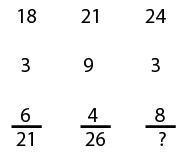
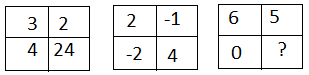
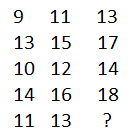
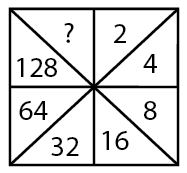
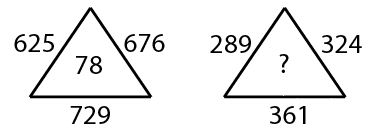
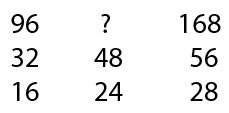
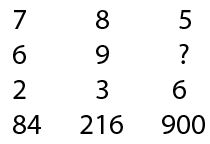
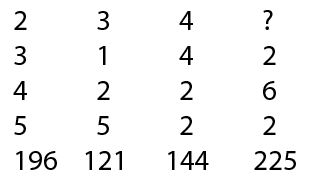
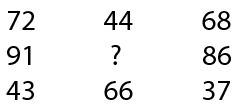
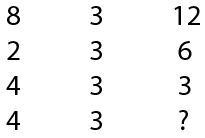
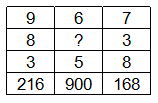
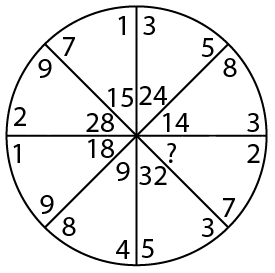
Which of the following numbers will replace the question mark(?) in the given series?
118, 113, 108, 103, 98, 93, ?
Sign in
Please select an account to continue using cracku.in
↓ →
Which of the following numbers will replace the question mark(?) in the given series?
118, 113, 108, 103, 98, 93, ?
Which of the following numbers will replace the question mark (?) in the given series?
31, 32, 36, ?, 61 , 86
Which of the following numbers will replace the question mark(?) in the given series?
85, 95, ?, 96, 83, 97
Which of the following numbers will replace the question mark(?) in the given series?
9, 15, 27, 33, 45, ?
Which of the following numbers will replace the question mark (?) in the given series?
24, 12, 36, 18, ?, 27
In the following question, select the missing number from the given series.
625, 600, 575, 550, 525 ?
In the following question, select the missing number from the given series.
50,52, 56,64,80,?
In the following question, select the missing number from the given series.
44, 46, 54, 86, 214,?
Which of the following numbers will replace the question mark(?) in the given series?
165, ?, 195,210,225, 240
In the following question, select the missing number from the given series.
1, 16, 31, 46, 61, ?
Which of the following numbers will replace the question mark (?) in the given series?
83, 79, 74, 68, 61, 53, ?
In the following question, select the missing number from the given series.
111, 122, 133, ?, 155, 166
In the following question, select the missing number from the given series.
2673, 891, 297, 99, ?, 11
In the following question, select the missing number from the given series.
40, 21 , 22, 34, 69, ?
Which of the following numbers will replace the question mark (?) in the given series?
18, 23, 32, 37, 46, ?
In the following question, select the missing number from the given series.
5, 19, 75, 299, 1195, ?
In the following question, select the missing number from the given series.
44, 13, 50, 9, 52, ?
In the following question, select the missing number from the given series.
5, 37, 70, 104, ?, 175
In the following question, select the missing number from the given series.
1, 3, 7, 13, ?, 31
Which of the following numbers will replace the question mark(?) in the given series?
2, 5, 11, 23, 47, ?, 191
Which of the following numbers will replace the question mark (?) in the given series?
12, 24, 48, 96, 192, ?
In the following question, select the missing number from the given series.
0, 1, 5, 14, 30, ?
Which of the following numbers will replace the question mark(?) in the given series?
15, 31 , 63, 127, 255, ?
Which of the following numbers will replace the question mark (?) in the given series?
99, 91 , ?, 74, 65, 57
Which of the following numbers will replace the question mark (?) in the given series?
62, 67, 74,83,94, 107,?
In the following question, select the missing number from the given series.
75, 77, 81 , 89, 105,?
In the following question, select the missing number from the given series.
5, 34, 1, 38, -3, ?
In the following question, select the missing number from the given series.
2916 972, 324, ?,36, 12
In the folJowing question, select the missing number from the given series.
990, 962, 934, 906, 878, ?
In the following question, select the missing number from the given series.
115, 94, 72, 49, 25, ?
In the following question, select the missing number from the given series.
863, 860 869, 842, 923, ?
In the following question, select the missing number from the given series.
10, 28, 46, 64, ?, 100
Which of the following numbers will replace the question mark(?) in the given series?
?, 36, 54, 72, 90, l08
Which of the following numbers will replace the question mark(?) in the given series?
8463, 8384, 8305, 8226,?, 8068
Which of the following numbers will replace the question mark (?) in the given series?
91, 111, 133, ?, 183, 211
Select the number from among the given options that can replace the question mark (?) in the following series.
31, 38, 47, 58, 71, ?
Study the given pattern carefully and select the number that can replace the question mark (?) in it.
(5, 14, 3)
(3, 24, 7)
(9, 30, ?)
(NOTE: Operations should be performed on the whole numbers, without breaking down the numbers into its constituent digits. E.g. 13- Operations on 13 such as adding/subtracting/multiplying etc. to 13 can be performed. Breaking down 13 into 1 and 3 and then performing mathematical operations on 1 and 3 is not allowed)
For each ordered triple $$(a,b,c)$$ observe the relation between the first, second and third numbers.
Compute the difference between the second and first numbers for the given triples:
$$b-a \;=\;14-5=9 \quad\text{when }(a,b,c)=(5,14,3)$$
$$b-a \;=\;24-3=21\quad\text{when }(a,b,c)=(3,24,7)$$
Now compare these differences with the third numbers:
$$9 = 3 \times 3 \qquad\text{and}\qquad 21 = 7 \times 3$$
The common pattern is therefore
$$b-a = 3c \quad\Longrightarrow\quad c = \frac{b-a}{3}$$
Apply this rule to the third triple $$(9,30,?)$$:
$$c = \frac{b-a}{3} = \frac{30-9}{3} = \frac{21}{3} = 7$$
Hence the missing number is $$7$$.
Option A which is: 7
Study the given pattern carefully and select the number that can replace the question mark (?) in it.
(4, 2, 6)
(9, 3, 9)
(24, 6, ?)
(NOTE: Operations should be performed on the whole numbers, without breaking down the numbers into its constituent digits. E.g. 13 - Operations on 13 such as adding/subtracting/multiplying etc. to 13 can be performed. Breaking down 13 into 1 and 3 and then performing mathematical operations on 1 and 3 is not allowed)
Select the set in which the numbers are related in the same way as are the numbers of the following sets.
(NOTE : Operations should be performed on the whole numbers, without breaking down the numbers into its constituent digits. E.g. 13 - Operations on 13 such as adding /subtracting /multiplying etc. to 13 can be performed. Breaking down 13 into 1 and 3 and then performing mathematical operations on 1 and 3 is NOT allowed)
(17, 26, 37)
(170, 197, 226)
Which of the following numbers will replace the question mark (?) in the given series?
2, 9, 37, 149, ?, 2389
Select the number from among the given options that can replace the question mark (?) in the following series.
23, 34, 45, 56, 67, ?
Select the number from among the given options that can replace the question mark (?) in the following series.
96, 85, 76, 69, ?
Which of the following numbers will replace the question mark (?) in the given series?
3, 5, 7, 12, 37, 69, 357, ?
Select the number from among the given options that can replace the question mark (?) in the following series.
4, 16, 64, 256, ?
Which of the following numbers will replace the question mark (?) in the given series?
$$\cfrac{1}{121}, \cfrac{1}{11}, 1, ?, 121$$
Select the number from among the given options that can replace the question mark (?) in the following series.
28, 39, 61, 94, 138, ?
Select the set in which the numbers are related in the same way as are the numbers of the given set. (NOTE: Operations should be performed on the whole numbers, without breaking down the numbers into its constituent digits. E.g. 13 - Operations on 13 such as adding /deleting /multiplying etc. to 13 can be performed. Breaking down 13 into 1 and 3 and then performing mathematical operations on 1 and 3 is not allowed.)
(4, 10, 23)
(8, 22, 47)
Which of the following numbers will replace the question mark (?) in the given series?
98, 105, 52.5, 59.5, ?, 36.75
Which of the following numbers will replace the question mark (?) in the given series?
38, 57, 40, 59, 42, ?
Which of the following numbers will replace the question mark(?) in the given series?
$$\left[\frac{1}{176}\right], \left[\frac{1}{88}\right], ?, \left[\frac{1}{22}\right], \left[\frac{1}{11}\right]$$
Which of the following numbers will replace the question mark (?) in the given series?
112, 103, 94, 85, 76, ?
Which of the following numbers will replace the question mark (?) in the given series?
90, 110, 132, ? , 182
Select the number from among the given options that can replace the question mark (?) in the following series.
13, 39, 65, 91, 117, ?
Which of the following numbers will replace the question mark (?) in the given series?
18, 27, 31, 43, 44, 59, 57, ?
Select the number from among the given options that can replace the question mark (?) in the following series.
61, 95, 138, 197, 279, ?
Select the number from among the given options that can replace the question mark (?) in the following series.
363, 344, 325, 306, ?
Select the number from among the given options that can replace the question mark (?) in the following series.
576, 288, 144, 72, ?
Which of the following numbers will replace the question mark (?) in the given series?
13, 14 , −2, 79, −177 ?
Which of the following numbers will replace the question mark (?) in the given series?
414, 410, 402, 390, 374, ?
Which of the following numbers will replace the question mark (?) in the given series?
112, 129, 150, 175, 204, ?
Select the number from among the given options that can replace the question mark (?) in the following series.
3360, 4080, ? , 5814
Which of the following numbers will replace the question mark (?) in the given series?
115, 130, 122, 137, 129, ?
Which number will replace the question mark (?) in the following series?
6, 20, 42, ?, 110, 156
Which of the following numbers will replace the question mark (?) in the given series?
352, 326, 284, 225, 148, ?
Which of the following numbers will replace the question mark (?) in the given series?
473, 517, 561, ?, 649, 693
Which of the following numbers will replace the question mark (?) in the given series?
17, 39, 43, 65, ?, 91
Select the number from among the given options that can replace the question mark (?) in the following series.
63, 78, 108, 153, ?
Select the number from among the given options that can replace the question mark (?) in the following series.
11, 12, 14, 17, ?
Study the given pattern carefully and select the number that can replace the question mark (?) in it.
First row: 19, 6, 37
Second row: 21, 8, 45
Third row: 72, 14, ?
(NOTE : Operations should be performed on the whole numbers, without breaking down the numbers into its constituent digits. E.g. 13 - Operations on 13 such as adding /subtracting /multiplying etc. to 13 can be performed. Breaking down 13 into 1 and 3 and then performing mathematical operations on 1 and 3 is not allowed)
Which of the following numbers will replace the question mark (?) in the given series?
93, ?, 102, 111, 123, 138
Which of the following numbers will replace the question mark (?) in the given series?
261, 232, 203, ?, 145, 116
Which of the following numbers will replace the question mark (?) in the given series?
5, 14, 17, ?, 37
Which of the following numbers will replace the question mark (?) in the given series?
191, 534, 318, 443, ?
Which of the following numbers will replace the question mark (?) in the given series?
48, 200, 540, ?, 2240
Select the number from among the given options that can replace the question mark (?) in the following series.
39, 51, 75, 111, ?
Select the set in which the numbers are related in the same way as are the numbers of the following sets.
(NOTE : Operations should be performed on the whole numbers, without breaking down the numbers into its constituent digits. E.g. 13 - Operations on 13 such as adding/subtracting/multiplying etc. to 13 can be performed. Breaking down 13 into 1 and 3 and then performing mathematical operations on 1 and 3 is not allowed)
(2, 35, 5)
(6, 50, 4)
Select the number from among the given options that can replace the question mark (?) in the following series.
48, 75, 108, ?, 192
Select the number from among the given options that can replace the question mark (?) in the following series.
58, 179, ?, 492, 688
Which of the following numbers will replace the question mark (?) in the given series?
35, ?, 40, 47, 45, 53
Which of the following numbers will replace the question mark (?) in the given series?
38, 64, 98, 140, ?
Which of the following numbers will replace the question mark (?) in the given series?
131, 133, 181, ?, 239
Select the number from among the given options that can replace the question mark (?) in the following series.
43, 47, 55, 67, ?
Which of the following numbers will replace the question mark (?) and complete the given number series?
15, 19 , 21, 25 , 27, ?
Which of the following numbers will replace the question mark (?) in the given series?
$$−1/729, −1/81, −1/9, ?$$
Select the number from among the given options that can replace the question mark (?) in the following series.
18, 21, 27, 36, ?
Select the set in which the numbers are related in the same way as are the numbers of the following sets.
(NOTE : Operations should be performed on the whole numbers, without breaking down the numbers into its constituent digits. E.g. 13 - Operations on 13 such as adding/subtracting/multiplying etc. to 13 can be performed. Breaking down 13 into 1 and 3 and then performing mathematical operations on 1 and 3 is not allowed)
(6, 12, 9)
(7, 23, 15)
Select the number from among the given options that can replace the question mark (?) in the following series.
242, 288, ?, 392, 450
Which of the following numbers will replace the question mark (?) in the given series?
1024, 256, 64, ?, 4
Which of the following numbers will replace the question mark (?) in the given series?
76, 99, 135, 185, 250, ?
Select the number from among the given options that can replace the question mark (?) in the following series.
189, 532, 316, ?, 377
Which of the following numbers will replace the question mark (?) in the given series?
4, 11, 19, 31, 52, 89, ?
Which of the following numbers will replace the question mark (?) in the given series
32, 32, 32, 34, ?, 106, 530
Which of the following numbers will replace the question mark (?) in the given series?
42, 53, 46, ?, 53, 66
Which of the following numbers will replace the question mark (?) in the given series?
990, 891, 792, ?, 594
Select the option that is related to the fifth number in the same way as the second number is related to the first number and the fourth number is related to the third number.
15 : 220 :: 10 : 95 :: 12 : ?
Which of the following numbers will replace the question mark (?) in the given series?
134, 129, 122, ?, 102, 89
Select the set in which the numbers are related in the same way as are the numbers of the given set. (NOTE: Operations should be performed on the whole numbers, without breaking down the numbers into its constituent digits. E.g. 13 - Operations on 13 such as adding /deleting /multiplying etc. to 13 can be performed. Breaking down 13 into 1 and 3 and then performing mathematical operations on 1 and 3 is not allowed.)
(7, 17, 35)
(5, 11, 23)
Which of the following numbers will replace the question mark (?) in the given series?
239, 274, 309, 354, 399, 454, ?
Which of the following numbers will replace the question mark (?) in the given series?
69, 70, 74, 83, ?, 124
Select the number from among the given options that can replace the question mark (?) in the following series.
218, 231, 248, 267, ?
Which of the following numbers will replace the question mark (?) in the given series?
25, 26, 28, 32, 40, ?
Which number will replace the question mark (?) in the following series?
16,32,?,192,576,1152
Select the number from among the given options that can replace the question mark(?) in the following series.
4, 11, 31, 65, 193, ?
Which numberwill replace the question mark (?) in the following numberseries?
52, 42, 34, 28, ?
Select the number from among the given options that can replace the question mark (?) in the following series.
6, 6, 8, 24, 28, 140, ?
Which number will replace the question mark (?) in the following number series?
16, 28, ? , 46, 52
Which numberwill replace the question mark (?) in the following numberseries?
124, 140, 128, 136, 132, ?
Select the number from among the given options that can replace the question mark (?) in the following series.
18, 29, 42, 59, 78, 101, ?
Select the number from among the given options that can replace the question mark (?) in the following series.
17, 20, 80, 85, ?, 517
Select the number from among the given options that can replace the question mark (?) in the following series.
121, 169, 225, 289, ?
Select the number from among the given options that can replace the question mark (?) in the following series.
5, 13, 22, 34, 51, 75, 108, 152, ?
Which number will replace the question mark (?) in the following series?
2430, ? , 270, 90, 30, 10
Which numberwill replace the question mark (?) in the following series?
46, 66, 94, 132, 182, ?
Select the number from among the given options that can replace the question mark (?) in the following series.
18, 3, 36, 6, 54, 9, ?
Which number will replace the question mark (?) in the following number series?
34, 42, 50, 56, 62, 66, ?
Select the figure from among the given options that can replace the question mark (?) in the following series.
Select the number from among the given options that can replace the question mark (?) in the following series.
5, 11, 25, 55, 117, 243, ?
Select the number from amongthe given options that can replace the question mark (?) in the following series.
215, 231, 256, 292, ?
Which number will replace the question mark (?) in the following number series?
5, 24, 61, 122, 213, ?
Select the number from among the given options that can replace the question mark (?) in the following series.
6, 7, 23, 41, 125, ?
Select the number from among the given options that can replace the question mark (?) in the following series.
68, 3, 63, 3, 57, 9, 50, 15, 42, 33, 33, ?
Select the number from among the given options that can replace the question mark (?) in the following series.
3, 20, 38, 52, 75, 82, 114, ?
Select the number from among the given options that can replace the question mark (?) in the following series.
4096, 1024, 256, 64, ?
Select the number that can replace the question mark (?) in the following series.
117, 98, 80, ?, 47, 32
Which number will replace the question mark (?) in the following number series?
12, 24, 36, 46, 56, ?, 72
Which number will replace the question mark (?) in the following series?
11, 13, 16, 26, 41, 67, 102, ?
Which of the following numbers will replace the question mark (?) in the given series?
140, 141, 133, 160, 96, ?
Which of the following numbers will replace the question mark (?) in the given series?
57, 71, 88, 109, 135, ?
Which of the following numbers will replace the question mark (?) in the given series?
27, 29, 32, 37, 44, 55, 68, ?
Which number will replace the question mark (?) in the following number series?
5, 17, 53, ?, 485
Which number will replace the question mark (?) in the following number series?
16, 32, 8, 48, 6, 60, 5, ?
Which number will replace the question mark (?) in the following number series?
128, 116, 126, 118, 124, ?
Which of the following numbers will replace the question mark (?) in the given series?
11, 22, 25, ?, 105, 630
Select the number from among the given options that can replace the question mark
(?) in the following series.
113, 109, 93, 88, 63, 57, ?
Select the numbers that will replace the question marks (?) in the given number series.
11, 12, 13, 13, 17, 16, 23, ?, ?
Which number will replace the question mark (?) in the following number series?
9, 12, 17, 26, 43, 76, ?, 270
Select the number from among the given options that can replace the question mark (?) in the following series.
37, 52, 74, 104, 143, ?
Which number will replace the question mark (?) in the following number series?
8, 13, 23, 43, ?
Which number will replace the question mark (?) in the following number series?
26, 28, 24, 30, 22, ?
Which of the following numbers will replace the question mark (?) in the given series?
68, 77, 89, 105, ?, 153
Which of the following numbers will replace the question mark (?) in the given series?
5, 20, 65, 200, ?
Which number will replace the question mark (?) in the following number series?
8, 16, 12, 32, 16, 64, ?
Which number will replace the question mark (?) in the following number series?
6, 12, 9, 36, 31, 186, ?
Which number will replace the question mark (?) in the following series?
25, 36, 51, 70, 93, 120, ?
Which number will replace the question mark (?) in the following number series?
4, 6, 9, 14, 23, 40, ?
Which of the following numbers will replace the question mark (?) in the given series?
25, 34, 52, ?, 160, 304
Select the number that will replace the question mark (?) in the given number series.
146, 90, 56, 34, 22, ?
Which number will replace the question mark (?) in the following number series?
266, 138, 74, 42, ?, 18
Which of the following numbers will replace the question mark (?) in the given series?
1080, 360, ?, 60, 30, 10, 5
Which of the following numbers will replace the question mark (?) in the given series?
21, 26, 41, 76, 141, ?
Which number will replace the question mark (?) in the following number series?
2, 12, 30, 56, 90, 132, ?
Which number will replace the question mark (?) in the following number series?
6, 15, 42, ?, 366, 1095
Select the number that will replace the question mark (?) in the given number series.
2, 5, 13, 29, ?
Which of the following numbers will replace the question mark (?) in the given series?
40, 40, 42, 126, 130, ?
Select the number that can replace the question mark (?) in the following pattern.
5 6 7 8 9
115 206 ? 502 719
Which number will replace the question mark (?) in the following number series?
19, 22, 28, 37, 40, ?, 55, 58
Which of the following numbers will replace the question mark (?) in the given series?
15, 15, 17, 51, 55, ?
Select the number from among the given options that can replace the question mark
(?) in the following series.
4, 9, 20, 43, ?, 185
Select the number that can replace the question mark (?) in the given number series.
30, 42, 56, 72, ?, 110
Which number will replace the question mark (?) in the following series?
175:51,58, 116; 123.123; ?
Which number will replace the question mark (?) in the following number series?
13, 16, 23, 36, 57, 88, ?, 188
Which number from the options will replace the question mark (?) in the following series?
2, 4, 8, 32, 256, ?
Which number will replace the question mark (?) in the following number series?
8, 18, 26, 32, 36, ?
Which numberwill replace the question mark (?) in the following series?
57, ?, 62, 71, 87, 112, 148
Which of the following numbers will replace the question mark (?) in the given series?
20, 44, 92, 188, 380, ?
Select the number from among the given options that can replace the question mark
(?) in the following series.
2, 5, 9, 16, 27, ?, 74
Select the number that can replace the question mark (?) in the given number series.
6, 7, 13, 20, 33, 53, ?
Select the number that can replace the question mark (?) in the given number series.
15, 19, 28, 44, ?, 105
Which number will replace the question mark (?) in the following number series?
54, 68, 78, 84, ?
Which number will replace the question mark (?) in the following number series?
48, 32, 23, 19, ?
Which number will replace the question mark (?) in the following number series?
168, 168, 84, 28, ?
Which of the following numbers will replace the question mark (?) in the given series?
42, 41, 45, 36, 52, 27, ?
Which of the following numbers will replace the question mark (?) in the given series?
40, 41, 50, 75, 124, ?
Which of the following numbers will replace the question mark (?) in the given series?
60, 120, 125, 250, 255, ?, 515
Which number will replace the question mark (?) in the following number series?
17, 20, 30, 45, 71, 106, ?
Which number will replace the question mark (?) in the following series?
8, 26, 73, 157, 284, 464, 705, 1017, ?
Which number will replace the question mark (?) in the following number series?
1, 11, 21, 1211, 3112, ?
Which number will replace the question mark (?) in the following number series?
6, 11, 18, 27, 38, ?
Which number will replace the question mark (?) in the following number series?
2, 3, 6, 10, 17, ?
Select the number that can replace the question mark (?) in the following series.
?, 7, 14, 42, 168
Select the numbers that will replace the question marks (?) in the given number series.
23, 25, 29, 35, 47, 50, ?, ?
Which number will replace the question mark (?) in the following number series?
24, 61, 122, 213, ?
Which number will replace the question mark (?) in the following number series?
7, 9, 13, 16, 25, 29, ?, 50
Which number will replace the question mark (?) in the following number series?
17, 20, 30, 45, 71, 106, ?
Which number will replace the question mark (?) in the following number series?
23, 19, 17, 13, ?
Which number will replace the question mark (?) in the following number series?
3, 7, 22, 45, 136, ?, 820
Which of the following numbers will replace the question mark (?) in the given series?
35, 50, 80, 125, 185, ?
Select the number from among the given options that can replace the question mark
(?) in the following series.
210, 201, 217, 192, 228, 179, ?
Which number will replace the question mark (?) in the following series?
112,.? , 83,70, 58, 47, 37
Which number will replace the question mark (?) in the following number series?
12, 18, 21, 27, 30, ?
Which of the following numbers will replace the question mark (?) in the given series?
60, 80, 64, 70, 68, 60, ?, 50
Select the number that does NOT belong to the given number series.
39, 46, 60, 82, 109, 144
Which number will replace the question mark (?) in the following number series?
15, 21, 24, 30 , ?
Which number will replace the question mark (?) in the following number series?
13, 20, 30, 45, 68, 103, ?, 230
Which of the following numbers will replace the question mark (?) in the given series?
50, 86, ?, 127, 136, 140, 141
Which number from the options will replace the question mark (?) in the following
series?
13, 6, 11, 5, 9, ?
Which number will replace the question mark (?) in the following number series?
5, 7, 9, 11, 18, ?, 34, 35, 59, 67
Which number will replace the question mark (?) in the following number series?
86, 74, 84, 76, ?, 78, 80
Which number from the options will replace the question mark (?) in the following series?
3, 13, 53, 213, ?
Which of the following numbers will replace the question mark (?) in the given series?
17, 17, 34, 102, 408, ?
Select the number from among the given options that can replace the question mark (?) in the following series.
24, 48, 51, 204, 209, ?
Which number from the options will replace the question mark (?) in the following
series?
1, 6, 7, 13, 20, 33, ?
Which number will replace the question mark (?) in the following number series?
91, 100, 94, 97, 101, 90, 112, ?
Which of the following numbers will replace the question mark (?) in the given series?
55, 68, 82, ?, 113, 130
Select the number from among the given options that can replace the question mark (?) in the following series.
24, 35, 51, 73, 102, ?
Select the number from among the given options that can replace the question mark (?) in the following series.
27, 30, 37, 50, ?, 98
Select the number from among the given options that can replace the question mark (?) in the following series.
28, 18, 12, 8, ?
Select the number from among the given options that can replace the question mark (?) in the following series.
11, 13, 19, 49, 109, 239, ?
Select the number from among the given options that can replace the question mark (?) in the following series.
10, 22, 35, 40, 72, 40, ?
Select the number from among the given options that can replace the question mark (?) in the following series.
13, 26, 52, 104, ?
Which number will replace the question mark (?) in the following series?
82,7, 119, 142, 168, 197
Identify the number that does NOT belong to the following series.
2, 6, 14, 30, 62, 126, 250
The series follows pattern as,
2 + $$2^2$$ = 2 + 4 = 6
6 + $$2^3$$ = 6 + 8 = 14
14 + $$2^3$$ = 14 + 16 = 30
30 + $$2^4$$ = 30 + 32 = 62
62 + $$2^5$$ = 62 + 64 = 126
126 + $$2^6$$ = 126 + 128 = 254
$$\therefore$$ The correct answer is option C.
Select the number that can replace the question mark (?) in the following series.
17, 21, 30, 46, 71, ?
The series follows pattern as,
17 + $$(2)^2$$ = 17 + 4 = 21
21 + $$(3)^2$$ = 21 + 9 = 30
30 + $$(4)^2$$ = 30 + 16 = 46
46 + $$(5)^2$$ = 46 + 25 = 71
71 + $$(6)^2$$ = 71 + 36 = 107
$$\therefore$$ The correct answer is option C.
Select the number that can replace the question mark (?) in the following series.
1, 5, 9, ?, 21
The numbers represent the position in the alphabet of the letters a, e, i, and o which are the first four vowels. The next number in the sequence is therefore 21 which represents the letter u.
$$\therefore$$ The correct answer is option D.
Select the numberthat can replace the question mark (?) in the followingseries.
17, 19, 22, 27, 34, 45, 58, ?
The series follows pattern as,
17 + 2 = 19
19 + 3 = 22
22 + 5 = 27
27 + 7 = 34
34 + 11 = 45
45 + 13 = 58
58 + 17 = 75
$$\therefore$$ The correct answer is option C.
In the given series one number is incorrect. Identify the INCORRECT number from among the options given.
3, 5, 7, 6, 10, 14, 12, 24, 28, 24, 40, 56
The Given series 3, 5, 7. 6, 10, 14, 12, 24, 28, 24, 40, 56
the number in 3 -3 pairs and multiple 2 and give the next pairs
(3,5,7) (6, 10, 14) (12, 24, 28) (24, 40,56)
then $$(3,5,7) \times 2 = (6,10,14) $$
next $$(6,10, 14) \times 2 = (12,20, 28) $$
therefore in the third pairs 24 is incorrect correct number 20
hence our and = 24
Select the number that can replace the question mark (?) in the following series.
40, 37, 43, 34, 46, ?
The series follows the pattern as,
40 - 3 = 37
37 + 6 = 43
43 - 9 = 34
34 + 12 = 46
46 - 15 = 31
$$\therefore$$ The correct answer is option A.
Select the number that can replace the question mark (?) in the following series.
39, 50, 63, 80, ?, 122, 147, 176
The series follows pattern as,
39 + 11 = 50
50 + (11 + 2 = 13) = 63
63 + (13 + 4 = 17) = 80
80 + (17 + 2 = 19) = 99
99 + (19 + 4 = 23) = 122
122 + (23 + 2 = 25) = 147
147 + (25 + 4 = 29) = 176
$$\therefore$$ The correct answer is option C.
Select the numberthat can replace the question mark (?) in the followingseries.
11, 12, 36, 41, ?, 296
The series follows pattern as,
11 + 1 = 12
12 $$\times$$ 3 = 36
36 + 5 = 41
41 $$\times$$ 7 = 287
287 + 9 = 296
$$\therefore$$ The correct answer is option B.
Select the number that can replace the question mark (?) in the following series.
105, 107, 103, ?, 101, 111
Given series 105, 107, 103, ?, 101, 111
the given series is mixed two series
first 105-2 = 103 and 103-2 101
second is 107+2 = 9 and 109+2= 111
therefore ? 107+2 = 109 Ans
Select the number that can replace the question mark (?) in the following series.
1537, 1539, 1543, ?, 1557, 1567
The series follows pattern as,
1537 + 2 = 1539
1539 + 4 = 1543
1543 + 6 = 1549
1549 + 8 = 1557
1567 + 10 = 1577
$$\therefore$$ The correct answer is option D.
Select the number that can replace the question mark (?) in the following series.
14, 17, 23, 32, 44, 59, ?
Given that series 14, 17, 23, 32, 44, 59,?
Difference of series 17-14 = 3 , 23-17 = 6, 32-23 = 9 , 44 - 32 = 12, 59- 44 = 15
difference of series going on 3, 6,9, 12, 15 , 18, ...... and so on
therefore 59 + 18 = 77 Ans
Select the numberthat can replace the question mark (?) in the following series.
87, 89, 92, 97, 104, 115, ? , 145
The series has the addition of prime numbers. Like as,
87 + 2 = 89
89 + 3 = 92
92 + 5 = 97
97 + 7 = 104
104 + 11 = 115
115 + 13 = 128
128 + 17 = 145
$$\therefore$$ The correct answer is option B.
Select the numberthat can replace the question mark (?) in the followingseries.
61, 63, 65, 77, 89, ? , 149, 205
61 + $$(1)^2$$ + 1 = 61 + 2 = 63
63 + $$(2)^2$$ - 2 = 63 + 2 = 65
65 + $$(3)^2$$ + 3 = 65 + 12 = 77
77 + $$(4)^2$$ - 4 = 77 + 12 = 89
89 + $$(5)^2$$ + 5 = 89 + 30 = 119
119 + $$(6)^2$$ - 6 = 119 + 30 = 149
149 + $$(7)^2$$ + 7 = 149 + 56 = 205
$$\therefore$$ The correct answer is option C.
Select the number that can replace the question mark (?) in the following series.
15, 18, 13, 20, 11, ?
Given series 15, 18, 13, 20, 11, ?
in the series going on two-part first
15 - 2 = 13
13 - 2 = 11 and so on
and $$ 2^{nd} part
18 = 2 = 20
20+2 = 22 (?)
? = 22 Ans
Select the number that can replace the question mark (?) in the following series.
1, 5, 11, 19, 29, 41, ?
For given series 1, 5, 11, 19, 29, 41, ?
take difference 5 -1 = 4
11-5 = 6
19-11 = 8
29-19= 10
41-29= 12
next ? - 41 = 14
? = 14+41 = 55 Ans
Select the number that can replace the question mark (?) in the following series.
35, 36, 40, 49, ? , 81
The series follows pattern as,
35 + $$1^2$$ = 36
36 + $$2^2$$ = 36 + 4 = 40
40 + $$3^2$$ = 40 + 9 = 49
49 + $$4^2$$ = 40 + 16= 56
56 + $$5^2$$ = 56 + 25 = 81
$$\therefore$$ The correct answer is option C.
Select the number that can replace the question mark (?) in the following series
45, 63, 101, 160, 241, ?
Given series is 45, 63, 101, 160, 241, ?
The logic here is difference of differences of the numbers are consecutive numbers as shown below

The next number will be 23 and the difference between the required number and 241 should be 104.
$$\therefore\ $$Required number = 241 + 104 = 345
Hence, the correct answer is Option B
Select the number that can replace the question mark (?) in the following series.
62, 66, 74, 90, ?
62 + 4 $$\times$$ 1 = 62 + 4 = 66
66 + 4 $$\times$$ 2 = 66 + 8 = 74
74 + 8 $$\times$$ 2 = 74 + 16 = 90
90 + 16 $$\times$$ 2 = 90 + 32 = 122
$$\therefore$$ The correct naswer is option D.
Select the number that can replace the question mark (?) in the following series.
6, 9, 14, 21, 30, 41, ?
The given number 6, 9,14,21,30,41 , ?
Difference of two number 9-6 = 3, 14-9= 5 , 21-14 = 7, 30 - 21= 9, 41 - 30 = 11 , ? - 41 = 13
then ? = 41+13 = 54
the rule is adding odd numbers
The Ans is 54
Which numberis wrongin the given series ?
7, 9, 15, 27, 51, 99
The difference between any 2 numbers is doubling with every step ahead.
Difference between 9 and 15 is 6
So the number just before 9 should have a difference of 3 with 9.
Hence, correct entry would be 9-3 = 6 and not 7
In the following number series, two numbers have been put within brackets. Select the most appropriate option for these numbers in relation to their inclusion in the series.
21, 24, 19, (29), 17, 28, (15), 30
Given series 21, 24, 19, (29), 17, 28, (15), 30
from the two series is going on
fist is 21 , 19, 17 ,( 15)
21-19= 2, 19-17= 2, 17-15= 2
the pattern is going dereaseing -2 to next number is going on
second is 24 , (29), 28, 30
the above series is follow add +2 number in each next series
24, 26, 28, 30
then the fist bracketed number (from left) is incorrect and second bracketed number (from left) is correct.
therefore Option (C) Ans
Select the number that can replace the question mark (?) in the following series.
40, 44, 22, 26, 13, ?
Given series 40, 44, 22, 26, 13,?
the given series follow pattern follow increase 4 and divide by 2
then
40 +4 = 44 , $$44\div 2 = 22 $$, 22 + 4 = 26, $$26\div 2 = 13 $$
therefore ? = 13 +4 = 17 Ans
Select the option that will fill in the blank and complete the given series.
6, 10, 19, 35, 60, _____
Given series 6, 10, 19, 35, 60, ____
difference of number
10-6= 4 , 19-10= 9, 35-19= 16 , 60- 35= 25
then we can say the series follow square of number 2, 3, 4 , 5 , 6 ... and so on
then next $$ 60 + 6^2 = 60+36 = 96$$ Ans
Find the wrong number in the given series.
3, 7, 15, 31, 64, 127
The logic here is
7 = 3 x 2 + 1
15 = 7 x 2 + 1
31 = 15 x 2 + 1
63 = 31 x 2 + 1
127 = 63 x 2 + 1
$$\therefore\ $$64 is the wrong number in the given series from the above pattern.
Select the number that can replace the question mark (?) in the following series.
1, 11, 35, 79, ?, 251
Given series 1, 11, 35, 79, ?, 251
the given series follow the pattern
1 = $$ (1)^3 + (1)^2 -1$$
11= $$ (2)^3+ (2)^2 -1$$
35 = $$ (3)^3+ (3)^2 -1$$
79 =$$ (4)^3+ (4)^2 -1$$
next ? = $$ (5)^3+ (5)^2 -1$$
? = 125 +25 -1
? = 150-1
? = 149 Ans
Select the option that will fill in the blank and complete the given series.
35, 52, 75, 110, 151, ___
Given series 35, 52, 75, 110, 151, ___
take the difference in the number
52-35= 17, 75-52= 32, 110-75= 35, 151-110 = 41.... and so on
again take a difference of difference
23-17= 6, 35-23= 12 , 41-35=6
next difference 41+ 12 = 53
in the series next number = 151+53 = 204 Ans
In the following number series, two numbers have been put within brackets. Select the most appropriate option for these numbers in relation to their inclusion in the series.
1, 5, 17, (39), 65, 101, (145), 197
Given that series 1, 5, 17, (39), 65, 101, (145), 197
the above is the pattern followed by given Below
$$ 0^2+1, 2^2 +1, 4^2+1, (6^2+1), 8^2+1, 10^2+1, (12^2+1), 14^2+1$$
$$\Rightarrow 1, 5, 17, (37), 65, 101, (145), 197$$
from the above, we can say Fist Bracket number is incorrect and the second bracket number is correct.
therefore Option (D) The First Bracketed number from the left is incorrect and the second bracketed number from the left is correct.
Select the number that can replace the question mark (?) in the following series.
7, 11, 20, 36, 61, ?
From the given series 7,11, 20, 36, 61,?
As given follow pattern $$ 7 + 2^2 = 11 $$
$$ 11 + 3^2 = 20 $$
$$ 20 + 4^2 = 36 $$
$$ 36 + 5^2 = 61 $$
next
$$ 61 + 6^2 = 97 $$ Ans
Identify the number that does NOT related to the following series.
25, 28, 23, 30, 21, 33
Forgiven number series 25, 28, 23, 30, 21, 33
followed in two-part
25-2 = 23
23-2 = 21
and 2nd
28+2 = 30
30+2 = 32 So 33 is not related to series
Ans = 33
Find the wrong number in the given series:
7, 15, 32, 65, 138
The logic here is
7 x 2 + 1 = 15
15 x 2 + 2 = 32
32 x 2 + 3 = 67
67 x 2 + 4 = 138
$$\therefore\ $$65 is the wrong number in the given series.
Hence, the correct answer is Option A
In the following number series, two numbers have been put within brackets. Select the most appropriate option for these numbers in relation to their inclusion in the series.
0, 7, 26, (65), 124, 215, (344), 511
Given series 0, 7, 26, (65), 124, 215, (344), 511
the above is pattern followed
$$ 1^3 -1 , 2^3-1, 3^3-1. (4^3-1), 5^3-1, 6^3-1, (7^3-1) , 8^3-1 $$
$$\Rightarrow 0, 7,26, (63) 124, 215, (342) 515 $$
then the Braacket number is incorrect Both (i.e not follow the pattern )
therefore (C) Both the Bracket number are incorrect. Ans
Select the option that is correct for the bracketed numbers with respect to their inclusion in the given series.
4,11, 30, (67), 128, 219, (346), 515
Given series 4,11, 30, (67), 128, 219, (346), 515
the above series is going on $$ 1^3 +3, 2^3 +3, 3^3 +3 ....... and so on
then
$$ 1^3+3 , 2^3+3, 3^3 +3, (4^3 +3) , 5^3 +3 , 6^3 + 3,( 7^3+3), 8^3+3 $$
$$ 4, 11 , 30, (67), 128, 219, (346), 515 $$
from the above line
the given Option (A) Both the Bracket numbers are correct Ans
Select the numberthat can replace the question mark (?) in the followingseries.
5, 10, 26, ?, 122, 170
$$(2)^2 + 1$$ = 4 + 1 = 5
$$(3)^2 + 1$$ = 9 + 1 = 10
$$(5)^2 + 1$$ = 25 + 1 = 26
$$(7)^2 + 1$$ = 49 + 1 = 50
$$(11)^2 + 1$$ = 121 + 1 = 122
$$(13)^2 + 1$$ = 169 + 1 = 170
$$\therefore$$ The correct answer is option B.
Select the option that will replace the question mark to complete the given series.
40, 50, 61, 73, 86, ?, 115
Given series,
40 , 50 , 61, 73, 86, ? , 115
Difference between two number like as
50-40 = 10,
61-50 = 11,
73- 61= 12,
86 - 73 = 13 ...... as so on.
Then our difference series 10, 11, 12, 13, 14, 15
Hence, next term will be =86+14=100
Ans 100
Select the number that can replace the question mark (?) in the following series.
13, 15, 19, 25, 33, ?
Given series 13, 15, 19, 25, 33, ?
the above series follows the pattern
13 + 2 = 15
15 + 4 = 19
19 + 6 = 25
25 + 8 = 33
then next follow pattern ? = 33 + 8 = 43 Ans
Find out the number which belongsto the given group of number from thefour alternatives.
5, 25, 90, 35, 60
All are multiples of 5. Hence, the most obvious choice would be some other number which is also a multiple of 5. Hence, 15.
Identify the number that does NOT belong to the following series.
104, 108, 54, 58, 29, 31
As per the given question,
104 , 108 , 54, 58 , 29, 31
Series is following the given pattern,
Series going on adding 4 then divide by 2,
104 +4 =108, 108 /2 = 54, 54 +4 = 58 , 58 /2 = 29 , 29 +4 = 33.
then given series 31 is wrong right is 33.
Ans is 31
Select the number that can replace the question mark (?) in the following series.
55, 58, 64, ? , 85
The series follows patter as,
55 + 3 = 58
58 + 6 = 64
64 + 9 = 73
73 + 12 = 85
$$\therefore$$ The correct answer is option D.
Select the number that can replace the question mark (?) in the following series
1, 1, 2, 3, 7, 22, ?
Given series 1, 1, 2, 3, 7, 22, ?
the series is going on multiply last two number and adding 1 its provide next number
, therefore, $$ 22\times 7 +1 $$
$$\Rightarrow 154 +1 $$
$$\Rightarrow 155 $$Ans
Select the numberthat can replace the question mark (?) in the following series.
45, 47, 53, 65, 85, ?
The series follows pattern as,
45 + 2 = 47
47 + (2 + 4 = 6) = 53
53 + (6 + 6 = 12) = 65
65 + (12 + 8 = 20) = 85
85 + (20 + 10 = 30) = 115
$$\therefore$$ The correct answer is option A.
Pick the odd number from the sequence below :
2, 3, 6, 7, 11, 15, 30
In first number: The number is first added to same number.
In second number: The answer should added by 1.
1 + 1 = 2
2 + 1 = 3
3 + 3 = 6
6 + 1 = 7
7 + 7 = 14
14 + 1 = 15
15 + 15 = 30
So, 11 is odd number.
Select the option that will fill in the blank and complete the given series.
14, 17, 23, 32, 44, ______
Given series 14, 17, 23, 32, 44, _____
take a difference of the series
17-14 = 3, 23-17= 6, 32-23=9, 44- 32= 12
then series increasing 3, 6, 9, 12 , 15, 18 ...... and so on
therefore ? = 44 + 15 = 59(D) Ans
Select the number that can replace the question mark (?) in the following series.
4, 25, 121, ? , 529, 961
The series follows as pattern,
$$(2)^2$$ = 4
$$(5)^2$$ = 25
$$(11)^2$$ = 121
$$(17)^2$$ = 289
$$(23)^2$$ = 529
$$(29)^2$$ = 961
$$\therefore$$ The correct answer is option B.
Select the option that will fill in the blank and complete the given series.
7, 16, 40, 84, _____, 252
Given series 7, 16, 40, 84, _____, 252
we take difference 16-7 = 9, 40-16= 24, 84- 40 = 44 .,...... and so on
Again we take a difference of difference 24-9 = 15, 44- 24 = 20, and next 25 and next 30 and so on
then add 44 + 25 = 69 (difference of next series number )
therefore 84 + 69 = 153 Ans
Select the number that can replace the question mark (?) in the following series.
17, 20, 15, 22, 13, ?
The series follows as pattern,
17 + 3 = 20
20 - 5 = 15
15 + 7 = 22
22 - 9 = 13
13 + 11 = 24
$$\therefore$$ The correct answer is option D.
Select the number that can replace the question mark (?) in the following series.
3, 12, 36, 80, ?, 248
Given series 3, 12, 36, 80, ?, 248
take of difference 12-3 = 9, 36-12= 24, 80-36= 44 ,......
Again take difference of difference 24-9 = 15 , 44-24 = 20 next 25 and so on
then 44 + 25 = 69
therefore ? = 80+ 69 = 149 Ans
Select the numberthat can replace the question mark (?) in the followingseries.
58, 73, 99, 138, 193, ? , 368
The series follows pattern as,
58 + 15 = 73
73 + (15 + 11 = 26) = 99
99 + (26 + 13 = 39) = 138
138 + (39 + 16 = 55) = 193
193 + (55 + 20 = 75) = 268
268 + (75 + 25 = 100) = 368
$$\therefore$$ The correct answer is option B.
Select the option that will replace the question mark to complete the given series.
7, 17, 41, 85, ?, 257
As per the given question,
7 , 17 , 41 , 85 , ? , 257
Take difference between given number
17-7 = 10,
41 - 17 = 24,
85 - 41= 44
Hence, series will be as per the given,
10, 24, 44 .....
Again taking the difference of the given term of the series with the next term.
24 -10 =14,
44 - 24 = 20 .... as so on.
Hence the required series will be 14, 20, 26, 32 ......
Then 44 + 26 = 70
so our series
7, 17 , 41, 85, 155 , 257
= 155 Ans
Choose the correct alternative from the given responses that will complete the series:
18, 54, 162, 486, 1458, ?
The logic here is
18 x 3 = 54
54 x 3 = 162
162 x 3 = 486
486 x 3 = 1458
It is a geometric progression with each successive term 3 times of the previous one.
Hence, the last term will be 1458 x 3 = 4374
Choose the correct alternative from the given responses that will complete the series:
20, 30, 42,56, 72, ?
The logic here is
30 - 20 = 10
42 - 30 = 12
56 - 42 = 14
72 - 56 = 16
Difference between successive terms is increasing by 2.
The next difference will be 18.
Hence, next term = 72+18 = 90
In the following questions, a series is given with one term missing. Choose the correct alternative from the given ones that will complete the series.
$$\left(\frac{1}{8}\right), \left(\frac{1}{4}\right), \left(\frac{1}{2}\right), 1, ?, 4$$
The series follows pattern as,
$$\frac{1}{8} \times 2 = \frac{1}{4}$$,
$$\frac{1}{4} \times 2 = \frac{1}{2}$$,
$$\frac{1}{2} \times 2 = 1$$,
$$1 \times 2 = 2$$,
2 $$\times$$ = 4$$
Missing term = 2
In the following questions, a series is given with one term missing. Choose the correct alternative from the given ones that will complete the series.
11, 12, 16, 25, ?
11 + $$1^2$$ = 12
12 + $$2^2$$ = 16
16 + $$3^3$$ = 25
25 + $$4^2$$ = 41
In the following questions, a series is given with one term missing. Choose the correct alternative from the given ones that will complete the series.
3, 9, 21, 45, ?
the series follows pattern as,
0 + 3 = 3
3 + 6= 9
9 + 12 = 21
21 + 24 = 45
45 + 48 = 93
$$\therefore$$ Option D is the correct answer.
In the following questions a series is given, with one term missing. Choose the correct alternative from the given ones that will completethe series.
1, 2, 8, ?, 148, 765
The series follows pattern as,
1 $$\times 1 + 1^2$$ = 2
2 $$\times 2 + 2^2$$ = 4 + 4 = 8
8 $$\times 3 + 3^2$$ = 24 + 9 = 33
33 $$\times 4 + 4^2$$ = 132 + 16 = 148
148 $$\times 5 +5 1^2$$ = 740 + 25 = 765
Missing term = 33
In the following questions a series is given, with one term missing. Choose the correct alternative from the given ones that will completethe series.
7, 12, 19, 28, 39, ?
The series follows pattern as,
7 + 5 = 12
12 + 7 = 19
19 + 9 = 28
28 + 11 = 39
39 + 13 = 52
Missing term = 52
In the following questions, choose the correct alternative from the given responses that will complete the series.
78, 86, ?, 88, 82, 90
The given series is an intersection of 2 series.
78, ?, 82 AND 86, 88, 90
We can see difference between successive terms is 2
Hence, ? is in place of 80
In the following questions, choose the correct alternative from the given responses that will complete the series.
3 7 13 ? 31 43 57
The difference between successive terms are consecutive even numbers.
7-3 = 4
13-7 = 6
Hence, fourth term - 13 = 8
Fourth term = 13+8 = 21
A series is given with one/ two term(s) missing . Choose the correct alternative from the given ones that will complete the series.
4, 14, 34, ?, 104, 154
The difference increases in the pattern: 10, 20, 30, 40, 50
Hence, after 34, we have 34+30 = 64
A series is given with one/ two term(s) missing . Choose the correct alternative from the given ones that will complete the series.
75, 77, 72, 80, 69, 83, ? , ?
The 2 overlapping series are:
75,72,69,.....
77,80,83,.....
Hence, the next 2 terms are 66 and 86
Find the next number in the given series.
101, 123, 147, 173, ?
Identify the correct option to complete the following series.
5, 8, 13, 20, 29, ........., 53, 68, 85
Select the correct option that will fill in the blank and complete the series.
5, ........, 10, 19, 35, 60
$$ 5 + 1^{2} = 6 $$
$$ 6 + 2^{2} = 10 $$
$$ 10 + 3^{2} =19 $$
$$ 19 + 4^{2} = 35 $$
$$ 35 + 5^{2} = 60 $$
Hence missing number series will be 6. $$ 5, 6 ,10, 19, 35, 60.... $$
Select the missing number from the given options.
Model is :
x
y
x/2 + y
So , the missing number will be 50/2 + 11 = 36
So , the answer would be option d)36.
Select the missing number from the given options.
Model is :
x
y
(x + y)/2
So , answer would be (86 + 12) $$\div$$ 2 = 49.
So , the answer would be option c)49.
Select the correct option that will fill in the blank and complete the series.
471, 479, 452, 516, 391, ........
Select the option that will correctly replace the question mark (?) in the series.
5, 17, 34, 61, ?
The pattern followed is that numbers with successive multiples of 5 between them are added.
5 + 12 = 17
17 + 17 = 34
34 + 27 = 61
61 + 42 = 103
=> Ans - (B)
Select the correct option that will fill in the blank and complete the series.
18, 36, 108, 432, 2160, .............
$$18\times2 =36$$
$$36\times3 = 108$$
$$108\times4 = 432$$
$$432\times5 = 2160$$
$$2160\times6= 12960$$
18, 36, 108, 432, 2160, 12960
Option B is correct.
Select the option that will fill in the blank and complete the given series.
0, 7, 26, 63, 124, 215, 342, 511, 728, .........
As per the given series,
0, 7, 26, 63, 124, 215, 342, 511, 728, .........
We can write it as,
$$(1^3-1),(2^3-1),(3^3-1),(4^3-1),(5^3-1),(6^3-1),(7^3-1),(8^3-1),(9^3-1),(10^3-1)$$
Hence, next term will be 1000-1 =999
Select the set of numbers that is similar to the following set.
{5, 10, 17 }
Select the term that will come next in the following series.
3, 4, 5, 6, 9, 10, 11, 12, 15, ?
3,4,5,6
NOW SKIP TWO NUMBERS 7 & 8 .
9, 10,11,12
NOW SKIP AGAIN TWO NUMBERS 13 & 14
15 , 16 ,17 ,18
SO THE NEXT IS 16.
Which fraction will replace the question mark (?) in the following series?
$$\frac{1}{4}, \frac{3}{5}, \frac{6}{7}, \frac{10}{11}, ?$$
Numerator -> 1,3,6,10,15 ( Difference between digits is being increased by 1)
Denominator -> 4,5,7,11,19 ( Difference between digits is being doubled)
Which number will come next in the following series?
1, 3, 7, 15, 31, 63, .......
it follows the series of $$2^n-1,\ where\ n=1,2,3,4.....$$.
So,next term will be= $$2^7-1=127.$$
Option B is correct.
Which number will follow next in the given number series?
8, 9, 17, 44, ?
Identify the number that does NOT belong in the given series.
0, 6, 24, 60, 120, 216
$$1^3-1=0.$$
$$2^3-2=6.$$
$$3^3-3=24.$$
$$4^3-4=60.$$
$$5^3-5=120.$$
$$6^3-6=210.$$
So, 216 is not belong to the series.
Select the correct option that will fill in the blank and complete the series.
Ans
6, 13, 28, 59, ......, 249
Select the correct option that will fill in the blank and complete the series.
16, 15, 12, 7,.......
Select the missing number from the given options
Model is
x
y
$$x^2 + y ^2$$
So , the missing number will be $$14^2 + 9^2$$=277
So, the answer would be option a)277
Select the number that will replace ? in the following series.
120, 128, 144, 168, ?, 240
Select the option that is related to the third numberin the same way as the second numberis related to the first number.
45 : 405 :: 49 : ?
Select the option that will correctly replace the question mark (?) in the series.
6, 21, 51, 96, ?
Consecutive multiples of 15 are added.
6 + 15 = 21
21 + 30 = 51
51 + 45 = 96
96 + 60 = 156
=> Ans - (A)
Select the option that will fill in the blank and complete the given series.
2, 5, 10, 17, 26, 37, ......... , 65, 82, 101
From the given series,
We can see that the difference between the terms is following a special patterns
2, 5, 10, 17, 26, 37, ......... , 65, 82, 101
$$d_1=5-2=3$$
$$d_2=10-5=5$$
$$d_3=17-10=7$$
$$d_4=26-17=9$$
$$d_5=37-26=11$$
$$d_6=50-37=13$$
Hence the blank space can be filled by 50.
Select the number that will come next in the following series.
1, 5, 9, 17, 25, 37, 49, 65, 81, .........
1-5=4
5-9=4
9-17=8
17-25=8
25-37=12
37-49=12
49-65=16
65-81=16
Hence,81+20= 101.
1, 5, 9, 17, 25, 37, 49, 65, 81,101...
Select the option that is related to the third term in the same way as the second term is related to the first term.
3 : 90, 5 : 130 ::7: ....., 9 : 738
Select the option that will correctly replace the question mark (?) in the series.
8, 19, 41, 74, ?
Which number will replace the question mark (?) in the following series?
16, 24, 36, ?, 81
In the following number series, two numbers have been put within brackets. Study the series carefully and select the correct alternative with respect to the series.
3, 9, (27), 81, (243), 729, 2187
Select the correct option that will fill in the blank and complete the series.
2, 5, 7, 12, ?, 31, 50
The above series is an example of fibonacci series, where the next term is the sum of previous 2 terms.
2 + 5 = 7
5 + 7 = 12
7 + 12 = 19
12 + 19 = 31
19 + 31 = 50
=> Ans - (B)
Select the term that will come next in the following series.
5, 9, ?, 29, 45
Which number will replace the question mark (?) in the following series?
102, 110, 126, 150, 182, ?
Find the next number in the given series.
2, 10, 84, ?
Select the correct option that will fill in the blank and complete the series.
0.3, 0.8, 2.3, 4.8, ..........
Select the option that will correctly replace the question mark (?) in the series.
109, 105, 89, 53, ?
Squares of consecutive even natural numbers are subtracted.
109 - $$(2)^2$$ = 105
105 - $$(4)^2$$ = 89
89 - $$(6)^2$$ = 53
53 - $$(8)^2$$ = -11
=> Ans - (D)
Select the set of numbers that is similar to the following set.
{9, 15, 24}
Identify the number that does NOT belong in the given series.
1, 8, 27, 64, 125, 216, 344, 512, 729
Each number in the given series is a perfect cube rather than 344.
$$344=2^3\times\ 43.$$
So,option D is correct.
Identify the number that will come in the following series.
2500, 2400, 2200, 1900, 1500, ........
The pattern followed is :
2500 - 100 = 2400
2400 - 200 = 2200
2200 - 300 = 1900
1900 - 400 = 1500
1500 - 500 = 1000
=> Ans - (A)
Select the correct option that will fill in the blank and complete the series.
14, 18, 24, 32, 42, ?
18-14 = +4
24-18 = +6
32-24 = +8
42-32 = +10
Hence last number 42 +12 = 54
14, 18, 24, 32, 42, 54
Select the option that is related to the third number in the same way as the second number is related to the first number.
9 : 19 :: 29 : ........
Select the option that will correctly replace the question mark (?) in the series.
102, 98, 82, 46, ?
Squares of consecutive even natural numbers are subtracted.
102 - $$(2)^2$$ = 98
98 - $$(4)^2$$ = 82
82 - $$(6)^2$$ = 46
46 - $$(8)^2$$ = -18
=> Ans - (D)
Select the correct option that will fill in the blank and complete the series.
88, 98, 83, 103, 78, ?
$$ 88, 98, 83, 103, 78, ? $$
$$ 88 - 98 = +10 $$
$$ 98 - 83 = -15 $$
$$ 83 - 103 = +20 $$
$$ 103 - 78 = -25 $$
Hence in next series we will add $$ +30 $$ in last number $$ 78 $$
$$ 78 + 30 = 108 $$
Hence Option A is 108.
Which number will replace the question mark (?) in the following series?
98, 95, 86, 82, 66, ?, 36
As per the question,
The given terms is following the a particular pattern.
$$98 \underrightarrow{-3} \ 95 \underrightarrow{-3^2} \ 86 \underrightarrow{-4} \ 82 \underrightarrow{-4^2} \ 66 \underrightarrow{-5} \ 61 \underrightarrow{-5^2} \ 36$$
Hence the missing terms will be 61.
Which number will replace the question mark (?) in the following series?
3, 7, 13, 27, ?, 107, 213
Select the correct option that will fill in the blank and complete the series.
145, 100, 65, 40, ?
145, 100, 65, 40, ?
145-100 = 45
100-65 = 35
65-40 = 25
40-15 = 25
So, there is a difference of 15,25,35,45 between each numbers.
Option D is correct.
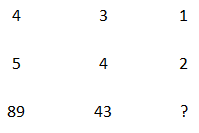
Select the missing number from the given options.
4, 5, 89 pattern is $$\left(4\times\ 5\right)\times\ 4+\left(4+5\right)=89$$
3, 4, 43 pattern is $$\left(3\times\ 4\right)\times\ 3+\left(3+4\right)=43$$
1, 2, 5 pattern is $$\left(1\times\ 2\right)\times\ 1+\left(1+2\right)=5$$
Select the option that will correctly replace the question mark (?) in the series.
20, 24, 40, 76, ?
Select the option that will correctly replace the question mark (?) in the series.
3, 15, 32, 59, ?
Which number will follow next in the given number series?
2, 37, 82, 137, ?
The pattern here followed is :
2 + 35 = 37
37 + 45 = 82
82 + 55 = 137
137 + 65 = 202
=> Ans - (A)
Which number will follow next in the given number series?
7, 8, 16, 43, ?
Which number will replace the question mark (‘7) in the following series?
1, 3, 4, 7, ?, 18, 29
Which number will replace the question mark (?) in the following series?
3, 7, 16, 35, ?, 153
Lets try to figure out the pattern in the series.
3
$$(3 \times 2) + 1 = 7$$
$$(7 \times 2) + 2 = 16$$
$$(16 \times 2) + 3 = 35$$
$$(35 \times 2) + 4 = 74$$
$$(74 \times 2) + 5 = 153$$
So , the answer would be Option b)74.
Select the correct option that will fill in the blank and complete the series.
117, 107, 92, 72, .........
117-10 = 107
107- 15 = 92
92- 20 = 72
72 - 25= 47
Hence, Correct Sequence will be 117, 107, 92, 72, 47
Select the correct option that will fill in the blank and complete the series.
$$\frac{3}{2} \frac{5}{2} \frac{7}{2} \frac{9}{2} \frac{11}{2}$$ ?
In numerator we have +1 in every next number Series. Hence Next Number will be $$ \frac{13}{2} $$
$$\frac{3}{2} \frac{5}{2} \frac{7}{2} \frac{9}{2} \frac{11}{2} \frac{13}{2}$$
Select the correct option that will fill in the blank and complete the series.
14, 21, 42, 105, 315, ?
Select the missing number from the given options.
As per the given table, only option B is following the pattern. The logic is mentioned in the below
Select the option that will correctly replace the question mark (?) in the series.
9, 10, 18, 45, ?
Which number will come next in the following series?
9, 196, 25, 169, 49, 144, 81, ..........
9,196,25,169,49,144,81........ can be written as $$3^2,14^2,5^2,13^2,7^2,12^2,9^2...…..$$
So, next number in the series should be $$11^2=121$$ .
A is correct choice.
Which number will follow next in the given number series?
3, 16, 29, 42, ?
Identify the number that does NOT belong in the given series.
5, 9, 17, 29, 55, 65
$$5+4=9,\ 9+4\times\ 2=17,\ 17+4\times\ 3=29,\ 29+4\times\ 4=45,45+4\times\ 5=65.$$
So, it should be 45, not 55.
Hence, A is correct choice.
Select the correct option that will fill in the blank and complete the series.
23, 34, 47, 62, ........
Select the set of numbers that is similar to the following set.
{9, 16, 23 }
Select the term that will come in the place of ?
7, 11, 19, 31, ?, 67
find out the difference between the first number and second no
7,11,19,31,?
11-7=4
19-11=8
31-19=12
4+4=8 ,8+4=12, 12+4=16
next term will be 31+16=47
Find the next number in the given series.
3, 13, 31, ?, 91
Select the correct option that will fill in the blank and complete the series.
5, 22, 39, 56, ......?
17 is added in all the terms
5 + 17 = 22
22 + 17 = 39
39 + 17 = 56
56 + 17 = 73
=> Ans - (C)
Select the correct option that will fill in the blank and complete the series.
1331, 121, 2197, 169, 3375, ..........
$$1331=11^3$$
$$121=11^2 $$
$$2197=13^3 $$
$$169=13^2$$
$$3375=15^3$$
$$225=15^2$$
Option C is correct
Select the option that is related to the third number in the same way as the second number is related to the first number.
12 : 145 : 8 :: .........
Select the option that will correctly replace the question mark (?) in the series.
9, 21, 38, 65, ?
The pattern followed is that numbers with successive multiples of 5 between them are added.
9 + 12 = 21
21 + 17 = 38
38 + 27 = 65
65 + 42 = 107
=> Ans - (D)
Which number will replace the question mark (?) in the following series?
3, ?, 101, 10202
$$3^2+1=10,\ 10^2+1=101,101^2+1=10202.$$
So, option B is correct.
Which number will replace the question mark (?) in the following series?
2, 5, 10, 17, 26, 37, ?, 65, 82, 101
Add (2n+1) where, $$n=1,2,3,4........$$ to number next to each other.
So, 7th term of the series will be, $$37+\ \left(2\times\ 6+1\right)=50.$$
So,option C is correct.
Select the correct option that will fill in the blank and complete the series.
43, 55, 79, 115, .....
Find the Difference between Digits.
43-55 =12
55-79 =24
79-115=36
If we observe carefully our series is in 12*1/12*2/12*3.
So we will add '48' to 115 to get our next digit 163
Select the correct option that will fill in the blank and complete the series.
12, 12, 13, 26, 28, 84, ?
$$ 12, 12, 13, 26, 28, 84, ....$$
$$ 12 \times 12 = 12 $$
$$ 12 + 1 = 13 $$
$$ 13 \times 2 = 26 $$
$$ 26 + 2 = 28 $$
$$ 28 \times 3 = 84 $$
$$ 84 + 3 = 87 $$
Hence $$87 $$ is correct Answer.
Select the correct option that will fill in the blank and complete the series.
25, 100, 200, 800, 1600, ?
Select the correct option that will fill in the blank and complete the series.
3, 5, 11, 21, 35, .... , 75.
Select the option that is related to the third number in the same way as the second number is related to the first number.
9 : 21 :: 27 : .....
Select the option that will correctly replace the question mark (?) in the series.
5, 6, 14, 45, ?
The pattern followed is :
5 $$\times1+1$$ = 6
6 $$\times2+2$$ = 14
14 $$\times3+3$$ = 45
45 $$\times4+4$$ = 184
=> Ans - (B)
Select the option that will correctly replace the question mark (?) in the series.
12, 22, 42, 82, ?
The pattern followed is :
12 + 10 = 22
22 + 20 = 42
42 + 40 = 82
82 + 80 = 162
=> Ans - (D)
Select the term that will come next in the following series.
57, 62, 31, 36, 18, ?
57, 62, 31, 36, 18, ?
First term
$$57 \ \underrightarrow{+5} \ 62$$
Second terms
$$62 \ \underrightarrow{half} \ \dfrac{62}{2}=31$$
Third terms
$$31 \ \underrightarrow{+5} \ 36$$
Fourth terms
$$36 \ \underrightarrow{half} \ \dfrac{36}{2} =18$$
Fifth terms
$$18 \ \underrightarrow{+5} \ 18+5 =23$$
Select the correct option that will fill in the blank and complete the series.
6, 9, 18, 27, ...., 81
Hence 18*3=54. Option D
Select the correct option that will fill in the blank and complete the series.
2, 8, 32, 128, 512, ?
2, 8, 32, 128, 512, 2048
$$2^1 = 2$$
$$2^3 = 8$$
$$2^5 = 32$$
$$2^7 = 128$$
$$2^9 = 512$$
$$2^{11} = 2048$$
Option D is correct.
Select the correct option that will fill in the blank and complete the series.
37, 26, 39, 24, 41, ............
37-26=11
26-39 =-13
39-24 = 15
24 -41 = -17
41- 22 =19
37, 26, 39, 24, 41, 22
Option A is correct.
Select the missing number from the given options.
Half of the middle number is taken and subtracted from the third number to obtain the result.
51-16=35
37-9=28
47-7=40
Select the option that is related to the third number in the same way as the second number is related to the first number.
4 : 8 : : 25 : .....
Which number will replace the question mark (?) in the following series?
5, 7, 11, 14, 23, ?, 43, 48
Identify the correct option to complete the following series.
1, 3, 5, 11, 21, 43, 85, 171, .............
In the following number series, two numbers have been put with in brackets. Study the series carefully and select the correct alternative with respect to the series.
0, 1, 4, 9, (15), 25, 36, 49, (64), 81
Clearly, the above series is a combination of square of consecutive whole numbers, but the first bracket number, i.e. 15 is incorrect as it is not a perfect square, while the second bracket number 64 is correct, as $$(8)^2=64$$
Thus, the first bracketed number(from the left) is incorrect and the second is correct.
=> Ans - (C)
Select the correct option that will fill in the blank and complete the series.
32, 144, ____, 2916, 13122, 59049
Select the correct option that will fill in the blank and complete the series.
8, 13, 21, 38, 62, 99, .........
8, 13, 21, 38, 62, 99, .........
8-13 = 5 (2*2 +1)
21-38 = 8 (3*3 -1)
38-21= 15 (4*4 +1)
62-38 =24(5*5 -1)
99-62= 37(6-6+1)
Hence Next Sequence will be (7*7-1)+99 =147
Identify the number that DOES NOT belong to the following series.
2, 9, 28, 64, 126, 217, 344, 513
Select the option that is related to the third number in the same way as the second number is related to the first number.
22 : 242 :: 18 : ?
Select the set of numbers that is similar to the following set of numbers.
{15, 21, 27}
The given series is in AP with a common difference of 6
20,28 and 36 are in AP with a common difference of 8.
Which number will replace the question mark (?) in the following series?
1, 4, 3, 4, 7, 7, 13, 13, ?
it is an alternative series. where 1,3,7,13 in a series and 4,4,7,13 are also in a series.
$$1+2=3$$
$$3+4=7$$
$$7+6=13$$
$$13+8=21$$
So, next number is 21 in the above series.
option D is correct.
Select the correct option that will fill in the blank and complete the series.
-1, 2,7, ?, 23, 34
Correct Answer is 14.
The difference between-1 and 2 is 1.
The difference between 2 and 7 is 5.
The difference between 7 and 14 is 7.
The difference between 14 and 23 is 9.
The difference between 23 and 34 is 11.
Select the correct option that will fill in the blank and complete the series.
52, 56, 65, 81, 106, .........
$$56-52=4=2^2$$
$$65-56 = 9 =3^2$$
$$81- 65=16=4^2$$
$$106-81 =25=5^2$$
$$142-106 = 36=6^2$$
Option C is correct.
Select the correct option that will fill in the blank and complete the series.
1, 3, 3, 6, 5, 12, 7, 24, 9, 48, 11, ......
Select the missing number from the given options.
Model of square is :
x
$$(x+y)^3$$
y
216 = $$6^3 = (5 + 1)^3$$
So , the answer would be option b)1.
Select the set of numbers that is similar to the following set of numbers.
{17, 13, 20}
Select the set of numbers that is similar to the following set.
{8, 19, 30}
Which number in the given series is Incorrect?
3, 7, 15, 27, 53, 63
$$7-3=1×4$$
$$15-7=2×4$$
$$27-15=3×4$$
$$43-27=4×4$$
$$63-43=5×4$$
So, it should be 43 instead of 53 in the given series.
A is correct choice.
Which number will come next in the following series?
3, 7, 16, 32, 57, .......
Which number will come next in the following series?
1, 2, 5, ...., 677
Pattern being followed here is $$n^2 + 1$$
Like $$1, 1^2 + 1, 2^2 + 1, 5^2 + 1.......
Hence 1, 2, 5, 26.......
(Same explanation more detailed required)
Which number will replace the question mark (?) in the following series?
7, 14, 33, 70, 131, ?
Difference between consecutive numbers have been taken.
$$14-7=7,\ 33-14=19,\ 70-33=37\ and\ 131-70=61\ .$$
again, these 7,19,37,61 are also in a series in following manner.
$$19-7=12,\ 37-19=18,\ 61-37=24.$$
So, next number will be added by 30 to 61(which will be 91). And it will be added to 131.
So, required number is $$=131+61+30=222.$$
option D is correct.
In the following question, select the number which can be placed at the sign of question mark (?) from the given alternatives
The pattern followed in each column is that twice the sum of the first three numbers is equal to the last number.
Eg :- $$2\times(9+6+4)=38$$
and $$2\times(3+2+5)=20$$
Similarly, $$2\times(7+8+3)=2\times18=36$$
=> Ans - (B)
Select the correct option that will fill in the blanks and complete the series.
6, 12, 3, 12, 24, 6, 18, ........, ........
Select the number that can replace the question mark (?) in the following series.
461, 481, 502, 524, 547, ?
461+20 = 481
481+21 = 502
502+22 = 524
524+23 = 547
547+24 = 571
Here 571 will come in place of question mark.
Study the given pattern carefully and select the number that can replace the question mark(?) in it.
1st row : 3 + 4 + 9 => 16 + 1 = 17
2nd row : 7 + 2 + 5 => 14 + 1 = 15
3rd row : 6 + 8 +3 => 17 + 1 = 18
Which number will replace the question mark (?) in the following series?
3, 4, 7, ll, 18, ?
Which number will replace the question mark (?) in the following series?
7, 9, 13, 15, ?, 21, 25
Select the number that can replace the question mark (?) in the following series.
39, 19, 58, 77, 135, ?
39+19 = 58
19+58 = 77
58+77 = 135
77+135 = 212
Hence 212 will come in place of the question mark.
Select the number that can replace the question mark (?) in the following series.
11, 14, 31, 14, 16, 34, 17, 18, 37, ?, 20, ?
11, 14, 31, 14, 16, 34, 17, 18, 37, ?, 20, ?
In the series, the first(11), fourth(14), seventh(17), and tenth(?) numbers are having a common difference of 3.
So the tenth number = 17+3 = 20
11, 14, 31, 14, 16, 34, 17, 18, 37, ?, 20, ?
In the series, the second(14), fifth(16), eighth(18), and eleventh(20) numbers are having a common difference of 2.
11, 14, 31, 14, 16, 34, 17, 18, 37, ?, 20, ?
In the series, the third(31), sixth(34), ninth(37), and twelveth(?) numbers are having a common difference of 3.
So the twelveth number = 37+3 = 40
Hence 20 and 30 will come in place of question mark respectively.
Select the set of numbers that is similar to the following set.
{9, 54, 6}
Select the correct option that will complete the series.
18, 12, 5, -3, -12, _____
Given Series :
18, 12, 5, -3, -12, _____
The pattern followed here is :
18 = 18 - 6 = 12
12 = 12 - 7 = 5
5 = 5 - 8 = -3
-3 = -3 - 9 = -12
-12 = -12 - 10 = -22
Hence, Option A is correct.
Select the correct option that will fill in the blank and complete the series.
9, 22, 48, 87, ......
Select the correct option that will fill in the blank and complete the series.
6, 11, 20, 45, 134, .......
Which number will replace the question mark (?) in the following series?
7, 10, 16, 19, 25, ?
The differences are altering between 3 and 6
7+3=10
10+6=16
16+3=19
19+6=25
Hence 25+3=28
Select the number that can replace the question mark (?) in the following series.
37, 33, 29, 25, ?
37, 33, 29, 25, ?
37 - 4 = 33
33 - 4 = 29
29 - 4 = 25
25 -4 = 21
37, 33, 29, 25, 21
Select the correct option that will fill in the blank and complete the series.
1, 3, 8, 19, 42, .........
The Correct Logic in above number series is.
1, 3, 8,19, 42, .........
1*2+1 =3
3*2+2=8
8*2+3=9
19*2+4=42
42*2+5=89
Select the correct option that will fill in the blank and complete the series.
12, 14, 17, 15, 22, 16, .....
The Logic is of Alternate number series.
Answer is Option B.
Select the correct option that will fill in the blank and complete the series.
0, 2, 3, 5, 10, 18, 33, 61, 112, .........
0, 2, 3, 5, 10, 18, 33, 61, 112
Pattern is Consider 0+2+3=5, 3+5+10=18, 5+10+18= 33,18+33+61=112, 33+61+112=206.
Select the option that will correctly replace the question mark (?) in the series.
7, 19, 36, 63, ?
The pattern followed is that numbers with successive multiples of 5 between them are added.
7 + 12 = 19
19 + 17 = 36
36 + 27 = 63
63 + 42 = 105
=> Ans - (B)
Select the option that will correctly replace the question mark (?) in the series.
13, 25, 42, 69, ?
The pattern followed is :
13 + 12 = 25
25 + 17 = 42
42 + 27 = 69
69 + 42 = 111
The difference between the numbers is 5,10,15 respectively.
=> Ans - (A)
Select the option that will correctly replace the question mark (?) in the series.
0, 8, 24, 48, ?
Multiples of 8 are added.
0 + 8 = 8
8 + 16 = 24
24 + 24 = 48
48 + 32 = 80
=> Ans - (D)
Select the term that will come next in the following series.
2, 7, 17, 32, 52, ?
2 + 5 = 7
7 + 10 = 17
17 + 15 = 32
32 + 20 = 52
so
52 + 25 = 77
Hence option (a) is correct.
Select the term that will come nextin the followingseries.
3,5,10, 20,37, ?
Which number will replace the question mark (?) in the following series?
115, ?, 134, 145, 157, 170
As per the given terms in the question,
115, ?, 134, 145, 157, 170
We can conclude that,
$$ 115 \underrightarrow{(+9)} 124 \underrightarrow{(+10)} 134 \underrightarrow{(+11)} 145 \underrightarrow{(+12)} 157 \underrightarrow{(+13)} 170 \underrightarrow{(+14)} 184 $$
Hence the question mark will be replaced by 124.
Which number will replace the question mark (?) in the following series?
5, 12, 26, 54, ?
The logic here is
12 - 5 = 7
26 - 12 = 14
54 - 26 = 28
The difference between consecutive numbers in the series is twice the previous difference. The next difference will be 56.
Let the required number = a
Similarly,
a - 54 = 56
$$\Rightarrow$$ a = 110
$$\therefore\ $$The required number = 110
Hence, the correct answer is Option C
In the following number series, two numbers have been put within brackets. Select the most appropriate option for these numbers in relation to their inclusion in the series.
2, 4, 6, 8, 10, (12), 14, 16, (18), 20
It is an A.P Series with a common difference of 2. So, both the numbers in bracket;(10) &(12), are correct.
Hence, option D is correct choice.
Select the correct option that will complete the series.
15, 31, ?, 127, 255
$$15\times\ 2+1 = 30+1 = 31$$
$$31\times\ 2+1 = 62+1 = 63$$
$$63\times\ 2+1 = 126+1 = 127$$
$$127\times\ 2+1 = 254+1 = 255$$
Here 63 will come in place of question mark.
Select the correct option that will complete the series.
108, 162, 243, ______
Given Series :
108, 162, 243, ______
The pattern followed here is :
Similarly, 243$$\times\ \frac{3}{2}=$$ 364.5
Hence, Option D is correct.
Select the correct option that will fill in the blank and complete the series.
15, 42, 123, ....., 1095
Select the number that can replace the question mark (?) in the following series.
26, 34, 41, 46, 56, ?
Given series :
26, 34, 41, 46, 56, ?
The pattern followed here is :
Hence, Option D is correct.
Select the number that can replace the question mark (?) in the following series.
16,17,21,30,46,?
The pattern followed is :
16 + $$(1)^2$$ = 17
17 + $$(2)^2$$ = 21
21 + $$(3)^2$$ = 30
30 + $$(4)^2$$ = 46
46 + $$(5)^2$$ = 71
=> Ans - (C)
Select the option that is related to the third number in the same way as the second number is related to the fast number.
15 : 25 :: 24 : .......
The pattern followed is:
5 x 3 = 15
5 x 5 = 25
Now, 24/3 = 8
Hence, 8 x 5 = 40
Which number will replace the question mark (?) in the following series?
1, 2, 6, 12, ?, 72, 216
Which number will replace the question mark (?) in the following series?
15, 17, 20, 25, 32, 43, ?
Prime numbers are added in each term to obtain the next one.
15+2 = 17
17+3 = 20
20+5 = 25
25+7 = 32
32+11 = 43
43+13 = 56
Hence 56 will come in place of the question mark.
Select the correct option that will fill in the blank and complete the series.
1440, 240, 48, ? , 4, 2
$$\frac{1440}{6}\ =\ 240$$
$$\frac{240}{5}\ =\ 48$$
$$\frac{48}{4}\ =\ 12$$
$$\frac{12}{3}=4$$
$$\frac{4}{2}=2$$
Hence 12 will come in place of question mark.
Select the correct option that will fill in the blank and complete the series.
4, 5, 14, 39, 88, 169, .........
In the following number series, two numbers have been put within brackets. Select the most appropriate option for these numbers in relation to their inclusion in the series.
1, 9, 25, 49, (81), 121, 169, (215), 289
The series is of squares of odd numbers. Out of the bracketed numbers 81 and 215, 81 is correct and 215 is incorrect.
$$9^{2} = 81$$
$$15^{2} = 225$$
Option C is correct.
In the following number series, two numbers have been put within brackets. Study the series carefully and select the correct alternative with respect to the series.
5, 11, 18, (25), 35, (45), 56
Each number is added by 6, 7, 8, 9, 10 and 11 respectively to get the next number.
5+6 = 11
11+7 = 18
18+8 = 26
26+9 = 35
35+10 = 45
45+11 = 56
The first number given in the bracket from the left end is wrong. Because as per the above-given logic 26 will come.
The second number given in the bracket from the left end is correct.
Hence option (d) is the correct answer.
Select the correct option that will complete the series.
441, 484, 529, 576, ........
$$21^2\ =\ 441$$
$$22^2\ =\ 484$$
$$23^2\ =\ 529$$
$$24^2\ =\ 576$$
$$25^2\ =\ 625$$
Hence 625 will come in place of blank.
Select the correct option that will complete the series
7.5, 4.7, 1.9, -0.9, ____
7.5-2.8 = 4.7
4.7-2.8 = 1.9
1.9-2.8 = -0.9
-0.9-2.8 = -3.7
Here -3.7 can complete the given series.
Select the number that can replace the question mark (?) in the following series.
1138, 1150, 1163, 1177, ?
The pattern followed is :
1138 + 12 = 1150
1150 + 13 = 1163
1163 + 14 = 1177
1177 + 15 = 1192
=> Ans - (C)
Select the option that is related to the third term in the same way as the second term is related to the first term. 32 : 274 : : 44 : ..........
Study the given pattern carefully and select the number that can replace the question mark(?) in it.
Here, $$ 3 \times 3 + 6 $$
=9+6
=15
Similarly,
$$ 5 \times 7+ 2 $$
=35+2
=37
In the following question, select the number which can be placed at the sign of question mark (?) from the given alternatives.
consider the first column
here add 5 + 6 + 2$$\times$$ 9 = 29
now consider the last column
here add 3 + 7 +2$$ \times $$ 8 = 18
following the same pattern
we get 1+x+2$$\times$$ 9 = 22
x + 19 = 22
x = 3
Select the number that can replace the question mark (?) in the following series.
279, 277, 273, 267, ?
Here, It's observed that difference between two terms is increasing by 2 each time.
279-277=2
277-273=4
273-267=6
Therefore, next difference would be 8. Then, 267-8=259.
Study the given pattern carefully and select the number that can replace the question mark (?)in it.
By studying the given pattern, It is observed that,
$$ ( {7}\times{7}) - 1=48$$
$$ ( {9}\times{5}) - 0=45$$
Therefore, $$ ( {11}\times{5}) - 1 = 54 $$
Select the correct option that will fill in the blank and complete the series.
12, 24, 96, 576, .......
Select the correct option that will fill in the blank and complete the series.
16, 2, 15, 4, 13, 7, 10, 11, 6, .........
Select the number that can replace the question mark (?) in the following series.
23, 29, 31, 37, 41, ?
The given numbers are part of series of consecutive prime numbers.
Therefore, the series will be 23, 29, 31, 37, 41, 43.
i.e. the next number in the series is 43.
Option D is correct.
Select the option that is related to the third number in the same way as the second number is related to the first number.
8 : 81 :: 10 : .....
The logic here is
$$\left(8+1\right)^2=9^2=81$$ $$\longrightarrow\ $$ $$\left(\text{first number}+1\right)^2=\text{second number}$$
Similarly, $$\left(\text{third number}+1\right)^2=\text{fourth number}$$
Fourth number = $$\left(10+1\right)^2=11^2=121$$
$$\therefore\ $$121 is related to 10 in the same way 81 is related to 8.
Hence, the correct answer is Option A
Select the correct option that will fill in the blank and complete the series.
35, 40, 50, 70. 110, ?
Select the correct option that will fill in the blank and complete the series.
1,5,2,6,3,7,4, .......
Select the number that can replace the question mark (?) in the following series.
423, 407, 439, 391, 455, ?
423-16 = 407
407+32 = 439
439-48 = 391
391+64 = 455
455-80 = 375
Hence 375 will come in place of question mark.
Select the number that can replace the question mark (?) in the following series.
13, 22, 33, 48, 69, ?
In this series double difference is applicable.
Let's assume 'y' in place of the question mark.

21+8 = y-69
29 = y-69
y = 69+29 = 98
hence 98 will come in place of the question mark.
Select the number that can replace the question mark (?) in the following series.
36, 73, 147, 295, ?
Given Series :
36, 73, 147, 295, ?
The pattern followed here is :
Hence, Option A is correct.
Study the given pattern carefully and select the number that can replace the question mark (?) in it.
Here in the first column (4+5+9)=18
Similarly in second column (11+6+13) =30
and in answer column (19+0+3)=22
Which number will replace the question mark (?) in the following series?
0.15, 0.20, 0.30, 0.45, 0.65, ?
$$0.15+0.05=0.20\longrightarrow\ 0.20+0.05\times\ 2=0.30\longrightarrow\ 0.30+0.05\times\ 3=0.45\longrightarrow\ 0.45+0.05\times\ 4=0.65\longrightarrow\ 0.65+0.05\times\ 5=0.90$$
So, Option A is correct .
Identify the number that does NOT belong in the given series.
2, 6, 6, 10, 8, 12, 12, 15, 14, 18
It is an alternative series.
(2,6,8,12,14) and (6,10,12,15,18).
every series is added by (+4,+2,+4,+2).
So, it should be (6,10,12,16,18).
So, 15 is not belong to series.
Option C is correct.
Select the correct option that will fill in the blank and complete the series.
10, 17, 26, 37, ..........
10+7 = 17
17+9 = 26
26+11 = 37
37+13 = 50
So here 50 will come in place of blank to complete the series.
Select the number pair that is analogous to the given number pair.
13 : 338
Select the number that can replace the question mark (?) in the following series.
2807, 1400, 697, ? , 171, 84
$$84\times2+3$$ = 168+3 = 171
$$171\times2+4$$ = 342+4 = 346
$$346\times2+5$$ = 692+5 = 697
$$697\times2+6$$ = 1394+6 = 1400
$$1400\times2+7$$ = 2800+7 = 2807
So here 346 will come in place of the question.
Select the number that can replace the question mark (?) in the following series.
72, 69, 64, ?, 48
72, 69, 64, ?, 48
72 - 3 = 69
69 - 5 = 64
64 -7 = 57
57 - 9 = 48
In the following question, select the missing number from the given series.
31, 17, 48, 65, 113, ?
From the given series we get the next term by adding the consecutive terms of the series.
31 + 17 = 48
48 + 17=65
65 + 48 = 113
113+ 65 = 178.
option (d) is correct.
In the following question, select the number which can be placed at the sign of question mark (?) from the given alternatives.
Here, (7+6+3) =16
$$ 16 \times 3 =48 $$
Similarly, (2+5+7)=14
Here, $$ 14 \times 3 = 42 $$
Select the number that can replace the question mark (?) in the following series.
3, 7, 15, 31, 63,?
$$3\times2+1 = 6+1 = 7$$
$$7\times2+1 = 14+1 = 15$$
$$15\times2+1 = 30+1 = 31$$
$$31\times2+1 = 62+1 = 63$$
$$63\times2+1 = 126+1 = 127$$
Hence 127 will come in place of question mark.
Select the number that can replace the question mark (?) in the following series.
16, 20, 29, 45, 70, ?
The pattern followed is :
16 + $$(2)^2$$ = 20
20 + $$(3)^2$$ = 29
29 + $$(4)^2$$ = 45
45 + $$(5)^2$$ = 70
70 + $$(6)^2$$ = 106
=> Ans - (A)
Select the number that can replace the question mark (?) in the following series.
13, 17, 19, 23, 29, ?
From the given series, It can be observed that they're all consecutive prime numbers.
So, next prime number in the series would be 31 after 29.
Select the number that can replace the question mark (?) in the following series.
600, 120, 30, 10, 5, ?
$$\frac{600}{5}\ =\ 120$$
$$\frac{120}{4}\ =\ 30$$
$$\frac{30}{3}\ =\ 10$$
$$\frac{10}{2}\ =\ 5$$
$$\frac{5}{1}\ =\ 5$$
Which number will replace the question mark (?) in the following series?
10, 17, 31, 52, 80, ?
Each term is added with the consequtive multiple of 7.
10+7 = 17
17+14 = 31
31+21 = 52
52+28 = 80
80+35 = 115
So here 115 will come in place of the question mark.
Select the correct option that will fill in the blank and complete the series.
6, 9, 15, 27, 51, ......
Select the number that can replace the question mark (?) in the following series.
101, 106, 116, 131, 151, ?
Given series :
101, 106, 116, 131, 151, ?
The pattern followed here is :
The difference between the two consecutive terms is increasing by 5.
i.e;
106 - 101 = 5
116 - 106 = 10
131 - 116 = 15
151 - 116 = 20
Similarly,
151 + 25 = 176
Option D is correct.
Which number will replace the question mark (?) in the following series?
15, 32, 55, ?, 127, 180
Let's assume assume 'y' in place of question mark.
Here the double difference is applicable.
So (y-55)-23 = 8
y-78 = 8
y = 78+8 = 86
simiallry (127-y)-(y-55) = 10
182-2y = 10
2y = 182-10 = 172
y = 86
simiallry (127-y)-53 = 12
74-y = 12
y = 74+12
y = 86
Hence 86 will come in place of the question mark.
Select the correct option that will complete the series.
1, 3, 9, 31, ____, 651
$$1\times1+2 = 1+2 = 3$$
$$3\times2+3 = 6+3 = 9$$
$$9\times3+4 = 27+4 = 31$$
$$31\times4+5 = 124+5 = 129$$
$$129\times5+6 = 645+6 = 651$$
Hence 651 will come in place of blank to complete the series.
Select the number that can replace the question mark (?) in the following series.
197, 220, 244, 269, 295, ?
197+23 = 220
220+24 = 244
244+25 = 269
269+26 = 295
295+27 = 322
Hence 322 will come in place of the question mark.
Select the correct option that will fill in the blank and complete the series.
21, 43, 85, 171, 341, .......
Logic of Question is..
21-43 = 22 (previous number 21+1 =22)
43-85 = 42 (previous number 43-1=42)
85-171 = 86 (previous number 85+1 =86)
171-341 = 170 (previous number 171-1=170)
Hence, 341+1=342
342 + 341 = 683
Select the correct option that will fill in the blank and complete the series.
45, 49, 58, 74, .........
$$ 45 - 49 = 4 (2^{2}) $$
$$ 49 - 58 = 9 (3^{2}) $$
$$58 - 74 = 16 (4^{2}) $$
Hence Next number will $$(5^{2}) = 25 + 74 = 99 $$
Hence Option C = 99 is right option.
Select the correct option that will fill in the blank and complete the series.
173, 182, 198, 223, 259, ..........
Select the correct option that will fill in the blank and complete the series.
37, 52, 77, 112, .......
Select the missing number from the given options.
In the given table,
The pattern is in all the column is same,
First-term of first column $$8=2^3$$ and third term =(second term)$$ 7+2=9$$
First-term of second column $$27=3^3$$ and third term =(second term)$$2 +3=5$$
So, first term of the third column will $$ 7-3=4 $$ Hence, the first term will be $$4^3=64$$
Hence, option A is the correct answer.
Select the option that will correctly replace the question mark (?) in the series.
7, 18, 40, 73, ?
Select the option that will correctly replace the question mark (?) in the series.
107, 103, 87, 51, ?
Squares of even natural numbers are subtracted.
107 - $$(2)^2$$ = 103
103 - $$(4)^2$$ = 87
87 - $$(6)^2$$ = 51
51 - $$(8)^2$$ = -13
=> Ans - (A)
Which number will come next in the following series?
5, 12, 31, 68, 129, ..........
5,12,31,68,129...... implies that
$$1^3+2^2,2^3+2^2,3^3+2^2,4^3+2^2,5^3+2^2,.......$$
So,next term should be $$6^3+2^2=216+4=220.$$
A is correct choice.
Which number will replace the question mark (?) in the following series?
3, 5, 10, 18, 29, ?, 60
Which number will replace the question mark (?) in the following series?
1, 5, 5, 25, ?, 3125
Which number will come next in the following series?
1, 4, 4, 16, 64, .......
Select the correct option that will fill in the blank and complete the series.
1, 3, 8, 19, ......., 89, 184.
Select the number that can replace the question mark (?) in the following series.
1500, 745, 370, 180, 87.5, ?
Let's assume 'y' in place of the question mark.
$$y\times2+10 =87.5$$
$$87.5\times2+5 = 175+5 = 180$$
$$180\times2+10 = 360+10 = 370$$
$$370\times2+5 = 740+5 = 745$$
$$745\times2+10 = 1490+10 = 1500$$
So $$y\times2+10 = 87.5$$
2y = 87.5-10
2y = 77.5
y = 38.75
Hence 38.75 will come in place of question mark.
Select the number that can replace the question mark (?) in the following series.
-1, 5, 23, 59, 119, 209,?
In the given series, the logic of double difference is applicable.

90+36 = ?-209
126 = ?-209
? = 209+126 = 335
So 335 will come in place of the question mark.
Select the number that can replace the question mark (?) in the following series.
31, 44, 58, 73, 89, ?
The pattern followed is :
31 + 13 = 44
44 + 14 = 58
58 + 15 = 73
73 + 16 = 89
89 + 17 = 106
=> Ans - (B)
Select the number that can replace the question mark (?) in the following series.
8, 8, 16, 48, ?
8 $$\times$$ 1 = 8
8 $$\times$$ 2 = 16
16 $$\times$$ 3 = 48
48 $$\times$$ 4 = 192
So, the answer would be option b)192.
Select the number that can replace the question mark (?) in the following series.
37, 43, 51, 61, 73, ?
Arithmetic progression with common difference 2
43-37 = 6
51-43 = 8
61-71 = 10
73- 61= 12
hence 73+14 = 87
In the following question, select the number which can be placed at the sign of question mark (?) from the given alternatives.
7+8+4=19-1=18
2+3+9=14-1=13
5+6+8=19-1=18
Select the correct option that will fill in the blank and complete the series.
2, 3, 9, 12, 30, 39, 93, ......
Select the correct option that will fill in the blank and complete the series.
22, 4, 16, 24, 6, 36, 26, 8, 64, 28, 10, ......
Select the number that can replace the question mark (?) in the following series.
12, 12, 24, 72, 288, ?
12, 12, 24, 72, 288, ?
12 $$\times $$ 1 = 12
12 $$\times $$ 2 = 24
24 $$\times $$ 3 = 72
72 $$\times $$ 4 = 288
288 $$\times $$ 5 = 1440
Select the number that can replace the question mark (?) in the following series.
961, 984, 1008, 1033, 1059, ?
984 - 961 = 23
1008 - 984 = 24
1033 -1008 = 25
1059 - 1033 =26
So, the next term is 1059 + 27 = 1086
So, the answer would be 1086.
Select the number that can replace the question mark (?) in the following series.
14, 17, 22, 29, 40, ?
The given series is following addition of the prime numbers. i.e.
14+3=17
17+5=22
22+7=29
29+11=40
40+13=53.
Hence 53 will be the next term.
Complete the following number series:
529, 441, 361, 289, ____
$$(23)^2=529$$
$$(21)^2=441$$
$$(19)^2=361$$
$$(17)^2=289$$
$$(15)^2=225$$
Hence 225 will come in place of blank space.
Select the correct option that will complete the series.
13, 42, 129, 390, .......
$$13\times3+3 = 39+3 = 42$$
$$42\times3+3 = 126+3 = 129$$
$$129\times3+3 = 387+3 = 390$$
$$390\times3+3 = 1170+3 = 1173$$
Hence 1173 will come in place of blank.
Select the correct option that will fill in the blank and complete the series.
3, 7, 11, 15, .....
Which number will replace the question mark (?) in the following series?
3, 5, 7, 8, 15, ?, 31, 26
Select the correct option that will complete the series
256, 384, 576, 864, ____
Each term is multiplied by 1.5 to obtain the next term.
$$256\times1.5 = 384$$
$$384\times1.5 = 576$$
$$576\times1.5 = 864$$
$$864\times1.5 = 1296$$
So here 1296 will be the next term.
Select the correct option that will fill in the blank and complete the series.
11, 22, 35, 50, ?
Select the number that can replace the question mark (?) in the following series.
307, 303, 299, 295, ?
Number series with common difference 4
307-4 =303
303-4=299
299-4=295
295-4=291
Select the number that can replace the question mark (?) in the following series.
1107, 1127, 1167, 1227, 1307, ?
Given series :
1107, 1127, 1167, 1227, 1307, ?
The pattern followed here is :
1127 - 1107 = 20
1167 - 1127 = 40
1227 - 1167 = 60
1307 - 1228 = 80
So, as we observed that the difference is increasing by 20.
So next number is 1307 + 100 = 1407
Hence, Option B is correct.
Select the numbers that can replace the question marks (?) in the following series.
36, 49, 51, 39, 53, 54, 42, 57, 57, 45, ?, ?
In the given series, 36, 49, 51, 39, 53, 54, 42, 57, 57, 45, ?, ?,
If we consider three consecutive numbers 36,49,51 as one set, 39,53,54 as one set and so on..
first position numbers in each set i.e.., 36,39,42,45, are increasing by a value of 3.
second position numbers in each set i.e.., 49,53,57, are increasing by a value of 4. therefore, next number would be 61.
third position numbers in each set i.e.., 51, 54, 57 are increasing by a value of 3. therefore, next number would be 60.
Therefore, correct answer is 61,60
Which number in the given series is incorrect?
3, 7, 7, 11, 9, 13, 13, 17, 15, 23
In the following question, select the number which can be placed at the sign of question mark (?) from the given alternatives.
The pattern followed for numbers present in each row is as below :
1st row : ($$ 9 \times 11$$) -5=94
3rd row : ($$ 6 \times 5$$) -14=16
Therefore, In 2nd row, It would be ($$ 7 \times 9$$) -13=50. Therefore, Option A is the right answer.
One term in the given number series is wrong. Find out the wrong term.
15, 17, 22, 32, 49, 76

In the given series double difference is applicable. So in the second difference 3, 5, and 7 are correct. But 10 is not the correct one. Because that is not maintaining the difference of 2. So instead of 10, it should be 9. Then 17+9 = 26 and 26+49 = 75.
Here 76 is the wrong number in the series.
Select the correct option that will complete the series.
7, 25, 79, 241, _____
$$7\times3+4 = 21+4 = 25$$
$$25\times3+4 = 75+4 = 79$$
$$79\times3+4 = 237+4 = 241$$
$$241\times3+4 = 723+4 = 727$$
Hence 727 will come in place of blank.
Select the correct option that will fill in the blank and complete the series.
97, 101, 103, 107, 109, ....
Which number will replace the question mark (?) in the following series?
60, 64, 32, 36, 18, ?
It is an alternative series of (60,32,18) and (64,36,22).
$$60-32=2\times\ 14.$$
$$32-18=14.$$
Similarly,
$$64-36=2\times\ 14.$$
$$36-22=14.$$
D is correct choice.
Which number will replace the question mark (?) in the following series?
105, 106, 114, 141, ?
$$105+\left(1\right)^3\ =\ 105+1\ =\ 106$$
$$106+\left(2\right)^3\ =\ 106+8\ =\ 114$$
$$114+\left(3\right)^3\ =\ 114+27\ =141$$
$$141+\left(4\right)^3\ =\ 141+64\ =205$$
Here 205 will come in place of the question mark.
Select the number-pair in which the two numbers are related in the same way as are the two numbers of the given number pair.
5 : 9
Select the number-pair in which the two numbers are related in the same way as are the two numbers of the given number pair.
1 : 8
Study the given pattern carefully and select the number that can replace the question mark (?)in it.
In each row, the number at the end is equal to thrice the sum of remaining numbers.
Eg :- $$3\times(7+6+3)=3\times16=48$$
and $$3\times(4+9+8)=3\times21=63$$
Similarly, $$3\times(2+5+7)=3\times14=42$$
=> Ans - (B)
Select the correct option that will complete the series.
8, 27, 64, 125, _____
$$2^3\ =\ 8$$
$$3^3\ =\ 27$$
$$4^3\ =\ 64$$
$$5^3\ =\ 125$$
$$6^3\ =\ 216$$
Hence 216 will come in place of the blank to complete the series.
Select the correct option that will fill in the blank and complete the series.
27, 39, 63, .....
Select the number that can replace the question mark (?) in the following series.
16, 49, 149, 450, 1354, ?
16, 49, 149, 450, 1354
16$$\times $$3 + 1 = 48 + 1 = 49
49 $$\times $$ 3 +2 = 147 + 2 = 149
149 $$\times $$ 3 + 3 = 447 +3 = 450
450 $$\times $$ 3 + 4 = 1350 + 4 = 1354
1354 $$\times $$ 3 + 5 = 4062 + 5 = 4067
Which number will replace the question mark (?) in the following series?
14, 15, 32, ?, 400
$$14\times1+1\ =\ 14+1\ =\ 15$$
$$15\times2+2\ =\ 30+2\ =\ 32$$
$$32\times3+3\ =\ 96+3\ =\ 99$$
$$99\times4+4\ =\ 396+4\ =\ 400$$
Hence 99 will come in place of the question mark.
Find the wrong term in the given number series:
34, 32, 35, 33, 36, 37
34-2 = 32
32+3 = 35
35-2 = 33
33+3 = 36
36-2 = 34
Hence 37 is not following the given logic. It will be the wrong number.
Select the correct option that will fill in the blank and complete the series.
3, 9, 36, 180.?
Select the number that can replace the question mark (?) in the following series.
3, 3, 6, 24, 192, ?
$$3\times1 = 3$$
$$3\times2 = 6$$
$$6\times4 = 24$$
$$24\times8 = 192$$
$$192\times16 = 3072$$
So here 3072 will come in place of the question mark.
Which number will replace the question mark (?) in the following series?
0, l, 5, 14, 30, ?
According to question,
$$0+1^2=\ 1$$
$$1+2^2=5$$
$$5+3^2=14$$
$$14+4^2=30$$
similalrly
$$30+5^2=55\ Ans$$
Select the correct option that will fill in the blank and complete the series.
2, 4, 16, 22, ..... 186.
Select the set of numbers that is similar to the following set of numbers.
(7, 16, 34)
Which letter will replace the question mark (?) in the following series?
FLO ,H?Q, JPS, LRU
In each cluster, the place value of the letter is added by 2 to obtain the next one.
FLO ==> (F+2) (L+2) (O+2) ==> HNQ
HNQ ==> (H+2) (N+2) (Q+2) ==> JPS
JPS ==> (J+2) (P+2) (S+2) ==> LRU
Here 'N' will come in place of the question mark.
Which number will replace the question mark (?) in the following series?
4, 9, 19, 39, 79, ?
4+5 = 9
9+10 = 19
19+20 = 39
39+40 = 79
79+80 = 159
Hence 159 will come in place of the question mark.
Choose the option which completes the given figure series.
If u see, Image One and Image two both has middle arrow in same direction, Similarly Image Three and Four has middle arrow in Same direction.
Hence if we match Image 5 with Image 6. Our Correct Answer is Option A.
In the following number series, two numbers have been put within brackets. Study the series carefully andselect the correct alternative with respect to the series.
0, 7, 26, 63, (124), 215, 342, (512)
The pattern followed in above statements is = $$n^3-1$$, where $$n$$ is natural number.
In the first bracket number, i.e. $$124=5^3-1$$
But, $$512\neq8^3-1$$
Thus, the first bracketed number(from the left) is correct and the second is incorrect.
=> Ans - (A)
Select the correct option that will fill in the blank and complete the series.
1, 0, 5, 124, 11, 1330, 17, ........
1, 0, 5, 124, 11, 1330, 17
$$1^3-1=0$$
$$5^3-1=124$$
$$11^3-1=1330$$
$$17^3-1=4912$$
Select the fraction that will next in the following series.
$$\frac{2}{3},\frac{4}{5},\frac{6}{7},\frac{8}{9},\frac{10}{11},\frac{12}{13},$$_____________
In the following series, the numerators are consecutive even numbers and the denominators are consecutive odds.
$$\frac{2}{3},\frac{4}{5},\frac{6}{7},\frac{8}{9},\frac{10}{11},\frac{12}{13}, \frac{14}{15}$$
Option A is correct.
Select the option that will correctly replace the question mark (?) in the series.
4, 16, 28, 40, ?
Select the option that will correctly replace the question mark (?) in the series.
112, 108, 92, 56, ?
Squares of even numbers are subtracted.
112 - $$2^2$$ = 108
108 - $$4^2$$ = 92
92 - $$6^2$$ = 56
56 - $$8^2$$ = -8
=> Ans - (A)
Select the term that will come next in the following series.
11, 13, 17, 23, 31, 41, 53, 67, 83, ?
As per the given series,
11, 13, 17, 23, 31, 41, 53, 67, 83, ?
$$11\underrightarrow{+2} 13 \underrightarrow{+4}17 \underrightarrow{+6} 23 \underrightarrow{+8} 31 \underrightarrow{+10} 41 \underrightarrow{+12} 53 \underrightarrow{+14} 67 \underrightarrow{+16} 83 \underrightarrow{+18}$$101
Which number will come next in the following series?
136, 137, 135, 138, 134, 139, ........
Which number will follow next in the given number series?
3, 18, 48, 93, ?
Which number will follow next in the given number series?
15, 12, 19, 14, 25, 16, ?
Hence, Correct Option is 33.
In the following question, select the missing number from the given series.
17, 31, 47, 65, ?
17+14 = 31
31+16 = 47
47+18 = 65
65+20 = 85
So 85 is the missing number in place of the question mark.
Select the correct option that will complete the series.
900, 450, 90, 45, 9, ?
$$900\times\ \frac{1}{2} = 450$$
$$450\times\ \frac{1}{5} = 90$$
$$90\times\ \frac{1}{2} = 45$$
$$45\times\ \frac{1}{5} = 9$$
$$9\times\ \frac{1}{2} = 4.5$$
Hence 4.5 will come in place of question mark.
Select the number-pair in which the two numbers are related in the same way as are the two numbers in the given pair.
65 : 126
Select the number that can replace the question mark (?) in the following series.
4, 2, 2, 3, 6, ?
$$4\times0.5 = 2$$
$$2\times1 = 2$$
$$2\times1.5 = 3$$
$$3\times2 = 6$$
$$6\times2.5 = 15$$
Hence 15 will come in place of question mark.
Select the number that can replace the question mark (?) in the following series.
3, 7, 22, 89, ?
The pattern is,
$$3 \times 2 + 1 = 7$$
$$7 \times 3 + 1 = 22$$
$$22 \times 4 + 1 = 89$$
$$89 \times 5 + 1 = 446$$
Therefore the answer is option D 446.
Select the number that can replace the question mark (?) in the following series.
13, 40, 121, 364, ?
The pattern is,
$$13 \times 3 + 1 = 40$$
$$40 \times 3 + 1 = 121$$
$$121 \times 3 + 1 = 364$$
$$364 \times 3 + 1 = 1093$$
Therefore option B 1093 is the answer.
Which number will replace the question mark (?) in the following series?
28, 32, 48, 84, ?
$$28+2^2\ =\ 28+4\ =\ 32$$
$$32+4^2\ =\ 32+16\ =\ 48$$
$$48+6^2\ =\ 48+36\ =\ 84$$
$$84+8^2\ =\ 84+64\ =\ 148$$
Here 148 will come in place of the question mark.
Identify the decimal number that will come next in the following series.
10, 9.9, 9.89, 9.889, 9.8889, .........
The pattern followed is that numbers of the form $$(\frac{1}{10})^n$$ are subtracted.
10 - $$0.1$$ = 9.9
9.9 - $$0.01$$ = 9.89
9.89 - $$0.001$$ = 9.889
9.889 - $$0.0001$$ = 9.8889
9.8889 - $$0.00001$$ = 9.88889
=> Ans - (D)
Select the correct option that will fill in the blank and complete the series.
35, 40, 55, 80, 115, ?
35, 40, 55, 80, 115, ?
The number series is as follows:-
35 - 40 = 5
40 - 55 = 15
55 - 80 = 25
80 - 115 = 35
(Next number should be 45) Hence 115 - 45 = 70
Select the correct option that will fill in the blank and complete the series.
1, 0, 4, 2, 9, 6, 16, 12, 25, .........
Select the option that will correctly replace the question mark (?) in the series.
15, 19, 35, 71, ?
Select the option that will correctly replace the question mark (?) in the series.
16, 20, 36, 72, ?
Select the option that will correctly replace the question mark (?) in the series.
9, 20, 42, 75, ?
Which number in the given series is INCORRECT?
11, 30, 67, 120, 219, 346
Which number will replace the question mark (?) in the following series?
118, 129, 141, 154, 168, ?
As per the given pattern in the question,
$$(118) \ \underrightarrow{+11} \ (129) \ \underrightarrow{+12} \ (141) \ \underrightarrow{+13} \ (154) \ \underrightarrow{+14} \ (168) \ \underrightarrow{+15} \ (183)$$
Hence, next term will be 183.
Which number will replace the question mark (?) in the following series?
116, 128, 146, 170, 200, ?
128 - 116 = 12
146 - 128 = 18
170 - 146 = 24
200 - 170 = 30
236 - 200 = 36
So, the answer would be option b)236.
Which number will replace the question mark (?) in the following series?
4, 10, 18, 38, ?, 150
In the following number series, two numbers have been put with in brackets. Study the series carefully andselect the correct alternative with respect to the series.
4, 6, 10, (12), 16, (14), 22
Select the correct option that will fill in the blank and complete the series.
0.25, 1, ....., 4, 6.25, 9
Select the option that will correctly replace the question mark (?) in the series.
100, 96, 80, 44, ?
Which number will replace the question mark (?) in the following series?
2, 5, 11, 23, 44, ?
As per the given question, the patterns are mentioned below.
2, 5, 11, 23, 44, ?
Hence, the correct answer is option D.
Find the missing number from the below options.
6 4 7
1 2 5
7 8 ?
Find the missing term to complete the given series.
MOC, LPC, KQD, ?, ISE
Identify the correct option to complete the following series.
50, 49, 47, 44, 40, 35, ........, 22
Select the correct option that will fill in the blank and complete the series.
2, 3, 4, 8, 16, 25, 52, .......
The pattern followed is :
2 + $$(1)^2$$ = 3
3 + $$(1)^3$$ = 4
4 + $$(2)^2$$ = 8
8 + $$(2)^3$$ = 16
16 + $$(3)^2$$ = 25
25 + $$(3)^3$$ = 52
52 + $$(4)^2$$ = 68
=> Ans - (C)
Select the correct option that will fill in the blank and complete the series.
43, 48, 58, 73, ...........
Which number will replace the question mark (?) in the following series?
2,3,6, 10, 17, 28,?
As we can see from the given pattern,
2,3,6, 10, 17, 28,?
First term- $$2+0+1=3$$
Second term $$3+2+1=6$$
Third term $$6+3+1=10$$
Fourth term $$10+6+1=17$$
Fifth term $$17+10+1=28$$
Sixth terms $$28+17+1=46$$
Hence the correct answer is 46.
In the following numberseries, two numbers have been put within brackets. Study the series carefully and select the correct alternative with respect to the series.
1, 1, 2, 6, 24, (121), 720, (5040), 40320
$$1\times1=1$$
$$1\times2=2$$
$$2\times3=6$$
$$6\times4=24$$
$$24\times5=120$$
$$120\times6=720$$
$$720\times7=5040$$
$$5040\times8=40320$$
Option B is correct.
Select the correct option that will fill in the blank and complete the series.
1024, ?, 1600, 2000, 2500, 3125
Correct Ans. 1280
Select the correct option that will fill in the blank and complete the series.
2, 7, 5, 10, 8, 13, ........
Select the option thatis related to the third number in the same way as the second number is related to the first number.
32 : 256 :: 16 : ?
Select the term that will come nextin the following series.
114, 127, 153, 192, 244, ?
127 - 114 = 13
153 - 127 = 26
192 - 153 =39
244 - 192 = 52
Difference is increasing by 13.
So , next term will be 244 + 65 = 309
So, the answer would be option a)309.
Which number will replace the question mark (?) in the following series?
7, 11, 18, 29, ?, 76
$$7\times\ 2-3=11$$
$$11\times\ 2-4=18$$
$$18\times\ 2\ -\ 7=29$$
$$29\times\ 2-11=47$$
$$47\times\ 2\ -\ 18=76$$
Here option 'A' is correct.
Select the number that can replace the question mark (?) in the following series.
63, 82, 102, 123, 145, ?
Pattern is
Difference of 63 and 82 = 19
82 and 102 = 20
102 and 123 = 21
123 and 145 = 22
145 and 168 = 23
therefore the answer is 168
Select the number that can replace the question mark (?) in the following series.
16, 17, 23, 18, 19, 26, 20, 21, 29, 22, ?, ?
16, 17, 23
18, 19, 26
20, 21, 29
22, ?, ?
Here the numbers are in sets of three which are given above.
In the first column 16, 18, 20, and 22 which are having a difference of 2.
In the second column 17, 19, and 21 which are having a difference of 2. So the number in place of the first question mark will be 23.
In the third column 23, 26 and 29 which are having a difference of 3. So the number in place of the second question mark will be 32.
Select the number that can replace the question mark (?) in the following series.
137, 148, 161, 176, 193, ?
Select the number that can replace the question mark (?) in the following series.
5, 10, 17, 26, 37, ?
Select the number that can replace the question mark (?) in the following series.
43, 31, 74, 105, 179, ?
Here the first and the second terms will be added to form the third term. Similarly the second and the third terms will be added to form the fourth term. With the same logic, the upcoming terms will be formed.
43+31 = 74
31+74 = 105
74+105 = 179
105+179 = 284
So 284 will come in place of the question mark.
Select the number that can replace the question mark (?) in the following series.
69, 109, 159, 219, 289, ?
7,14,23,34,?
Consecutive odd numbers starting from 7 are added.
7 + 7 = 14
14 + 9 = 23
23 + 11 = 34
34 + 13 = 47
=> Ans - (B)
15,23,31,39,___,55,63
The pattern followed is :
15 + 8 = 23
23 + 8 = 31
31 + 8 = 39
39 + 8 = 47
47 + 8 = 55
55 + 8 = 63
=> Ans - (B)
2, 3.5, 5, 6.5, 8, ___?
The pattern followed here is (n + 1.5)
2 + 1.5 = 3.5,
3.5 + 1.5 = 5,
5 + 1.5 = 6.5,
6.5 + 1.5 = 8,
8 + 1.5 = 9.5
Hence, option B is the correct answer.
In the following question, select the missing number from the given series.
4, 1, 16, 9, 36, 25, 64, 49, ?
Series : 4, 1, 16, 9, 36, 25, 64, 49, ?
The above series is a combination of two series at alternate positions.
First being square of even natural numbers and second of odd natural numbers.
1st : 4, 16, 36, 64, 100
2nd : 1, 9, 25, 49
=> Ans - (C)
In the following question, select the missing number from the given series.
121, 4, 144, 9, 169, 16, 196, ?
Series : 121, 4, 144, 9, 169, 16, 196, ?
The above series is a combination of two series at alternate positions.
First being square of consecutive numbers starting from 11 and second starting from square of '2'.
1st : 121, 144, 169, 196
2nd : 4, 9, 16, 25
=> Ans - (C)
32,58,92,134,____?
Hence, option B is the correct answer.
A series is given with one term missing. Select the correct alternative from the given ones that will complete the series.
T, P, L, H, ?
The pattern followed is :
T (-4 letters) = P
P (-4 letters) = L
L (-4 letters) = H
H (-4 letters) = D
=> Ans - (C)
A series is given with one term missing. Select the correct alternative from the given ones that will complete the series.
A, Z, C, X, E, V, G, T, ?, ?
Expression : A, Z, C, X, E, V, G, T, ?, ?
The above series is a combination of 2 series at alternate positions.
1st : A (+2 letters) = C (+2 letters) = E (+2 letters) = G (+2 letters) = I
2nd : Z (-2 letters) = X (-2 letters) = V (-2 letters) = T (-2 letters) = R
Thus, missing term = IR
=> Ans - (C)
A series is given with one term missing. Select the correct alternative from the given ones that will complete the series.
TVU, WYX, ZBA, ?
Expression : TVU, WYX, ZBA, ?
The pattern followed in each letter of the terms is :
1st letter : T (+3 letters) = W (+3 letters) = Z (+3 letters) = C
2nd letter : V (+3 letters) = Y (+3 letters) = B (+3 letters) = E
3rd letter : U (+3 letters) = X (+3 letters) = A (+3 letters) = D
Thus, missing term = CED
=> Ans - (C)
A series is given with one term missing. Select the correct alternative from the given ones that will complete the series.
A, D, I, P, ?
Consecutive odd numbers are added.
A (+3 letters) = D
D (+5 letters) = I
I (+7 letters) = P
P (+9 letters) = Y
=> Ans - (D)
A series is given with one term missing. Select the correct alternative from the given ones that will complete the series.
J, O, T, Y, D, ?
Expression : J, O, T, Y, D, ?
The pattern followed is that there is a gap of four English alphabets in between each pair of alphabets.
=> J (+5 letters) = O (+5 letters) = T (+5 letters) = Y (+5 letters) = D (+5 letters) = I
=> Ans - (A)
A series is given with one term missing. Select the correct alternative from the given ones that will complete the series.
W, T, Q, N, ?
The pattern followed is :
W (-3 letters) = T
T (-3 letters) = Q
Q (-3 letters) = N
N (-3 letters) = K
=> Ans - (B)
Find out the wrong number from the given series.
5,27,61,122,213,340,509
The pattern followed here is,
$$2^{3} - 3 = 5$$
$$4^{3} - 3 = 61$$
$$5^{3} - 3 = 122$$
$$6^{3} - 3 = 213$$ .......
$$3^{3} - 3= 24$$ (but 27 is given in the option)
Hence, option A is the correct answer.
In the folloeing series, the equations are sloved on the basis of a certain system. Find out the correct answer for the unsloved equation on that basis.
$$9\times8\times6=896 $$
$$7\times6\times8=678 $$
$$8\times7\times5=\ ?$$
2nd digit is placed at the 1st position, 1st digit is placed at the 2nd position while 3rd digit is placed at the last position
Hence for $$8\times7\times5$$ answer would be $$785$$
Hence, option B is the correct answer.
In the following question, select the missing number from the given series:
67, 70, 74, 77, 81, 84 ?
'3' and '4' are alternatively added.
67 + 3 = 70
70 + 4 = 74
74 + 3 = 77
77 + 4 = 81
81 + 3 = 84
84 + 4 = 88
=> Ans - (B)
In the following question, select the missing number from the given series.
1, 1, 3, 4, 5, 9, 7, 16, 9, 25, 11, ?
Series : 1, 1, 3, 4, 5, 9, 7, 16, 9, 25, 11, ?
It is a combination of 2 series at alternate positions.
Numbers at odd position are consecutive odd numbers, while numbers at even position are squares of consecutive natural numbers.
1st series : 1, 3, 5, 7, 9, 11
2nd series : 1, 4, 9, 16, 25, 36
=> Ans - (B)
Find the missing figure in the series from the given responses.
In the following question, select the missing number from the given series:
6, 19, 54, 167, 494, ?
The pattern followed is :
6 $$\times3+1$$ = 19
19 $$\times3-3$$ = 54
54 $$\times3+5$$ = 167
167 $$\times3-7$$ = 494
494 $$\times3+9$$ = 1491
=> Ans - (A)
In the following question, select the missing number from the given series.
?, 5, 15, 45, 113
If we reverse the series as : 113, 45, 15, 5, ?
Then number of the form = $$(n^3+n)$$ are subtracted, where $$n$$ is a natural number.
113 - $$(4^3+4)$$ = 45
45 - $$(3^3+3)$$ = 15
15 - $$(2^3+2)$$ = 5
5 - $$(1^3+1)$$ = 3
=> Ans - (C)
In the following question, select the related number from the given alternatives.
49 : 146 : : 63 : ?
Expression = 49 : 146 : : 63 : ?
The pattern followed is = $$n:3n-1$$
Eg :- $$(3\times49)-1=147-1=146$$
Similarly, $$(3\times63)-1=189-1=188$$
=> Ans - (B)
In the following question, select the related number from the given alternatives.
14 : 35 : : 18 : ?
Expression = 14 : 35 : : 18 : ?
The pattern followed is that the second number is the result of multiplying first number by 2.5
Eg :- $$14\times2.5=35$$
Similarly, $$18\times2.5=45$$
=> Ans - (C)
In the following question, select the related number from the given alternatives.
4 : 16 : : 9 : ?
Expression = 4 : 16 : : 9 : ?
The pattern followed is that = $$n:n^2$$
Eg :- $$(4)^2=16$$
Similarly, $$(9)^2=81$$
=> Ans - (B)
In the following question, select the related number from the given alternatives.
8 : 27 : : 64 : ?
Expression = 8 : 27 : : 64 : ?
The pattern followed is = $$(n)^3:(n+1)^3$$
Eg :- $$(2)^3:(2+1)^3=8:27$$
Similarly, $$(4)^3:(4+1)^3=64:125$$
=> Ans - (C)
In the following question, select the related number from the given alternatives.
18636 : 3106 : : 2508 : ?
Expression = 18636 : 3106 : : 2508 : ?
The second number in the pair is the result when first number is divided by 6.
Eg :- $$\frac{18636}{6}=3106$$
Similarly, $$\frac{2508}{6}=418$$
=> Ans - (A)
In the following question, select the related number from the given alternatives.
1 : 8 : : 216 : ?
Expression = 1 : 8 : : 216 : ?
The pattern followed is that = $$n^3:(n+1)^3$$
Eg :- $$1^3:(1+1)^3=1:8$$
Similarly, $$(6)^3:(6+1)^3=216:343$$
=> Ans - (A)
In the following question, select the related number pair from the given alternatives.
98 : 9604 : : ? : ?
Expression = 98 : 9604 : : ? : ?
The numbers are of the form = $$n:n^2$$
Now, $$(102)^2$$ ends in $$04$$ hence it is incorrect, similarly last two options are also eliminated.
=> $$(99)^2=9801$$
=> Ans - (B)
from the given alternatives.
11 : 121 : : 13 : ?
Expression = 11 : 121 : : 13 : ?
The numbers are of the form = $$n:n^2$$
Eg :- $$(11)^2=121$$
Similarly, $$(13)^2=169$$
=> Ans - (A)
Find the missing figure of the series from the given response.
In the following question, select the related number from the given alternatives.
7 : 63 : : 11 : ?
Expression = 7 : 63 : : 11 : ?
The numbers are of the form = $$n(n+2)$$
Eg :- $$7\times(7+2)=63$$
Similarly, $$11\times(11+2)=143$$
=> Ans - (A)
In the following question, select the missing number from the given series.
31, 32, 40, 67, 131, ?
Let the missing number in the series = a
The logic here is
32 - 31 = 1$$^3$$
40 - 32 = 2$$^3$$
67 - 40 = 3$$^3$$
131 - 67 = 4$$^3$$
The difference between numbers of the series is the cube of consecutive natural numbers.
The next difference should be 5$$^3$$ = 125.
Similarly,
a - 131 = 125
$$\Rightarrow$$ a = 256
$$\therefore\ $$The missing number in the series = 256
Hence, the correct answer is Option B
In the following question, select the missing number from the given alternatives.
14, 22, 49, 113, 238, ?
The logic here is
$$22-14=8=2^3$$
$$49-22=27=3^3$$
$$113-49=64=4^3$$
$$238-113=125=5^3$$
The difference between numbers is cube of consecutive numbers. The next difference should be $$6^3=216$$
Let the required number = a
Similarly, a - 238 = 216
$$\Rightarrow$$ a = 454
$$\therefore\ $$The required number = 454
Hence, the correct answer is Option C
In the following question, select the missing number from the given alternatives.
3, 7, 11, 63, 27, 215, ?, ?
In the following question, select the missing number from the given series.
11, 16, 21, 13, 19, 25, 15, 22, 29, ?, 25
The given series is a combination of three alternate series which are shown below
11, 13, 15, ?
16, 19, 22, 25
21, 25, 29
From the first series,
11 + 2 = 13
13 + 2 = 15
Similarly, the next number = 15 + 2 = 17
$$\therefore\ $$The missing number of the given series is 17.
Hence, the correct answer is Option B
In the following question, select the missing number from the given alternatives.
13, 23, 36, 59, 95, ?
The logic here is
13 + 23 = 36
23 + 36 = 59
36 + 59 = 95
Number in the series is sum of the previous two numbers.
Similarly, the next number in the series = 59 + 95 = 154
$$\therefore\ $$The missing number in the series = 154
Hence, the correct answer is Option B
In the following question, select the missing number from the given alternatives
51, 11, 62, 73, 135, ?
The logic here is
51 + 11 = 62
11 + 62 = 73
62 + 73 = 135
Number in the series is equal to sum of previous two numbers in the series.
Similarly, the next number in the series = 73 + 135 = 208
$$\therefore\ $$The missing number in the series = 208
Hence, the correct answer is Option A
In the following question, select the missing number from the given series.
41, 64, 110, 202, 386, ?
Given series is 41, 64, 110, 202, 386, ?
The logic here is difference between consecutive numbers is twice the previous difference as shown below

The next difference between the missing number and 386 should be 368.
Let the missing number = a
$$\Rightarrow$$ a - 386 = 368
$$\Rightarrow$$ a = 754
$$\therefore\ $$The missing number in the series = 754
Hence, the correct answer is Option A
In the following question, select the missing number from the given series.
76, 23, 99, 122, 221, ?
The logic here is
76 + 23 = 99
23 + 99 = 122
99 + 122 = 221
Number in the series is equal to the sum of the previous two numbers in the series.
Similarly, the next number in the series = 122 + 221 = 343
$$\therefore\ $$The missing number in the series = 343
Hence, the correct answer is Option C
In the following question, select the missing number from the given alternatives.
14, 35, 87.5, ?, 546.875
In the following question, select the missing number from the given series.
146, 154, 163, 227, 252, ?
In the following question, select the missing number from the given alternatives.
35, 39, 48, 64, 89, ?
Let the required number = a
The logic here is
39 - 35 = 4 = 2$$^2$$
48 - 39 = 9 = 3$$^2$$
64 - 48 = 16 = 4$$^2$$
89 - 64 = 25 = 5$$^2$$
The difference between the numbers of the series is square of consecutive numbers. The next difference should be 6$$^2$$ = 36.
Similarly, a - 89 = 36
$$\Rightarrow$$ a = 125
$$\therefore\ $$The required number = 125.
Hence, the correct answer is Option C
In the following question, select the missing number from the given series.
14, 16, 30, 45, 62, 132, ?, ?
The given series is a pair of alternate series 14, 30, 62, ... and 16, 45, 132, ...
In 14, 30, 62, ...
$$\left(14\times2\right)+2=30$$
$$\left(30\times2\right)+2=62$$
Similarly, the next number in the series = $$\left(62\times2\right)+2=126$$
In 16, 45, 132, ...
$$\left(16\times3\right)-3=45$$
$$\left(45\times3\right)-3=132$$
Similarly, the next number in the series = $$\left(132\times3\right)-3=393$$
$$\therefore\ $$The missing numbers in the given series are 126, 393
Hence, the correct answer is Option B
In the following question, select the missing number from the given series.
31, 44, 75, 119, 194, ?
The logic here is
31 + 44 = 75
44 + 75 = 119
75 + 119 = 194
A number in the given series is equal to the sum of the previous two numbers.
Similarly, the missing number = 119 + 194 = 313
Hence, the correct answer is Option B
In the following question, select the missing number from the given alternatives.
42, 21, 21, 31.5, 63, ?
The logic here is
$$42\times0.5=21$$
$$21\times1=21$$
$$21\times1.5=31.5$$
$$31.5\times2=63$$
Similarly, the next number $$=63\times2.5=157.5$$
Hence, the correct answer is Option B
In the following question, select the missing number from the given alternatives.
18, 45, 112.5, ?, 703.125
In the following question, select the missing number from the given series.
2112, 2328, 2671, 3183, ?, 4912
The logic here is
2328 - 2112 = 216 = 6$$^3$$
2671 - 2328 = 343 = 7$$^3$$
3138 - 2671 = 512 = 8$$^3$$
The differences between the consecutive numbers of the series are cubes of consecutive numbers.
The next difference should be 9$$^3$$
Let the missing number in the series = a
$$\Rightarrow$$ a - 3138 = 9$$^3$$
$$\Rightarrow$$ a - 3138 = 729
$$\Rightarrow$$ a = 3912
$$\therefore\ $$The missing number in the series = 3912
Hence, the correct answer is Option C
In the following question, select the missing number from the given alternatives.
41, 83, 167, 335, 671, ?
The logic here is
41 x 2 + 1 = 83
83 x 2 + 1 = 167
167 x 2 + 1 = 335
335 x 2 + 1 = 671
Similarly, the next number = 671 x 2 + 1 = 1343
$$\therefore\ $$The missing number in the series = 1343
Hence, the correct answer is Option B
In the following question, select the missing number from the given alternatives
46, 46, 69, 138, 345, ?
The logic here is
46 x 1 = 46
46 x 1.5 = 69
69 x 2 = 138
138 x 2.5 = 345
Similarly, the next number in the series = 345 x 3 = 1035
$$\therefore\ $$The missing number in the series = 1035
Hence, the correct answer is Option A
In the following question, select the missing number from the given series.
22, 105, 415, 1240, 2475, ?
Given series is 22, 105, 415, 1240, 2475, ?
The logic here is
$$\left(22\times5\right)-5=105$$
$$\left(105\times4\right)-5=415$$
$$\left(415\times3\right)-5=1240$$
$$\left(1240\times2\right)-5=2475$$
Similarly,
$$\left(2475\times1\right)-5=2470$$
$$\therefore\ $$The missing term in the series = 2470
Hence, the correct answer is Option B
In the following question, select the missing number from the given series.
46, 235, 945, 2840, 5685, ?
The logic here is
$$\left(46\times5\right)+5=235$$
$$\left(235\times4\right)+5=945$$
$$\left(945\times3\right)+5=2840$$
$$\left(2840\times2\right)+5=5685$$
$$\left(5685\times1\right)+5=5690$$
$$\therefore\ $$The missing number in the series = 5690
Hence, the correct answer is Option D
In the following question, select the missing number from the given alternatives..
43, 21.5, 21.5, 43, ?, 1376
In the following question, select the missing number from the given series.
2, 5, 28, 17, ?, 37, 344
In the following question, select the missing number from the given alternatives.
41, 13, 54, 67, 121, ?
The logic here is
41 + 13 = 54
13 + 54 = 67
54 + 67 = 121
A number in the series is equal to the sum of the previous two numbers in the series.
Similarly, the next number in the series = 67 + 121 = 188
Hence, the correct answer is Option B
In the following question, select the missing number from the given series.
6, 25, 62, 123, ?, 341
The given series is 6, 25, 62, 123, ?, 341
The logic here is
6 = 2$$^3$$ - 2
25 = 3$$^3$$ - 2
62 = 4$$^3$$ - 2
123 = 5$$^3$$ - 2
341 = 7$$^3$$ - 2
$$\therefore\ $$The missing number in the series = 6$$^3$$ - 2 = 214
Hence, the correct answer is Option C
In the following question, select the missing number from the given series.
44, 22, 33, 82.5, 288.75, ?
The logic here is
44 x 0.5 = 22
22 x 1.5 = 33
33 x 2.5 = 82.5
82.5 x 3.5 = 288.75
Similarly, the next number = 288.75 x 4.5 = 1299.375
$$\therefore\ $$The missing number = 1299.375
Hence, the correct answer is Option A
In the following question, select the missing number from the given alternatives.
14, 44, 135, 409, 1232, ?
The logic here is
$$\left(14\times3\right)+2=42+2=44$$
$$\left(44\times3\right)+3=132+3=135$$
$$\left(135\times3\right)+4=405+4=409$$
$$\left(409\times3\right)+5=1227+5=1232$$
Similarly, the next number $$=\left(1232\times3\right)+6=3696+6=3702$$
Hence, the correct answer is Option C
In the following question, select the missing number from the given alternatives.
30, 68, 130, 222, 350, ?
In the following question, select the missing number from the given series.
21, 22, 34.5, 71, 180, 543, ?
The logic here is
21 x 1 + 1 = 22
22 x 1.5 + 1.5 = 34.5
34.5 x 2 + 2 = 71
71 x 2.5 + 2.5 = 180
180 x 3 + 3 = 543
Similarly, the next number in the series = 543 x 3.5 + 3.5 = 1904
$$\therefore\ $$The missing number in the series = 1904
Hence, the correct answer is Option D
In the following question, select the missing number from the given alternatives.
41, 52, 65, 82, 101, ?
The logic here is
52 - 41 = 11
65 - 52 = 13
82 - 65 = 17
101 - 82 = 19
The difference between the numbers of the series are consecutive prime numbers.
The next difference should be 23.
Let the missing number = a
$$\Rightarrow$$ a - 101 = 23
$$\Rightarrow$$ a = 124
$$\therefore\ $$The missing number = 124
Hence, the correct answer is Option C
In the following question, select the missing number from the given alternatives
132, 475, 987, 1716, 2716, ?
The logic here is
475 - 132 = 343 = 7$$^3$$
987 - 475 = 512 = 8$$^3$$
1716 - 987 = 729 = 9$$^3$$
2716 - 1716 = 1000 = 10$$^3$$
The difference between consecutive numbers of series is equal cube of consecutive numbers.
The next difference should be 11$$^3$$ = 1331
Let the next number in the series = a
$$\Rightarrow$$ a - 2716 = 1331
$$\Rightarrow$$ a = 4047
$$\therefore\ $$The missing number in the series = 4047
Hence, the correct answer is Option B
In the following question, select the missing number from the given series.
9863, 7119, 4922, 3194, 1863, ?
Given series is 9863, 7119, 4922, 3194, 1863, ?
The logic here is
9863 - 7119 = 2744 = 14$$^3$$
7119 - 4922 = 2197 = 13$$^3$$
4922 - 3194 = 1728 = 12$$^3$$
3194 - 1863 = 1331 = 11$$^3$$
The difference between the numbers is the cube of consecutive numbers.
The next difference will be 10$$^3$$ = 1000
Let the missing number = a
$$\Rightarrow$$ 1863 - a = 1000
$$\Rightarrow$$ a = 863
$$\therefore\ $$The missing number in the series = 863
Hence, the correct answer is Option C
In the following question, select the missing number from the given series.
13, 13, 19.5, 39, 97.5, ?
The logic here is
13 x 1 = 13
13 x 1.5 = 19.5
19.5 x 2 = 39
39 x 2.5 = 97.5
Similarly, the next number in the series = 97.5 x 3 = 292.5
$$\therefore\ $$The missing number in the series = 292.5
Hence, the correct answer is Option D
In the following question, select the missing number from the given alternatives.
81, 23, 104, 127, 231, ?
In the following question, select the missing number from the given series.
56, 23, 79, 102, 181, ?
In the following question, select the missing number from the given alternatives.
9, 23, 50, 103, 208, ?
Given series is 9, 23, 50, 103, 208, ?
The logic here is difference of differences of the numbers is double the previous difference.

The next number should be 104 and the difference between the required number and 208 should be 209.
$$\therefore\ $$Required number = 208 + 209 = 417
Hence, the correct answer is Option C
In the following question, select the missing number from the given series.
53, 19, 72, 91, ?, 254
The given series is 53, 19, 72, 91, ?, 254
The logic here is
53 + 19 = 72
19 + 72 = 91
72 + 91 = 163
91 + 163 = 254
Number in the series is equal to previous two numbers in the series.
$$\therefore\ $$The missing number in the series = 163
Hence, the correct answer is Option B
What will come in place of question mark (?) in the given equation?
9 ? 11 ? 6 ? 3 ? 9 = 117
Expression : 9 ? 11 ? 6 ? 3 ? 9 = 117
(A) : +, -, ÷ and x
$$\equiv9+11-6\div3\times9=117$$
L.H.S. = $$20-(2\times9)=20-18=2\neq$$ R.H.S.
(B) : x, +, ÷ and x
$$\equiv9\times11+6\div3\times9=117$$
L.H.S. = $$99+(2\times9)=99+18=117=$$ R.H.S.
=> Ans - (B)
From the given number series select the most appropriate series that follows some order
None of the given options follow any logic except option (A).
In each step, a multiple of 7 is added and subtracted.
00+28 = 28
28+21 = 49
49-14 = 35
35-7 = 28
In the following question, a series is given with one or more number (s) missing. Choose the correct alternative from the given options.
0.2, 0.16, 0.072, 0.0256, ?
Which one set of letters when sequentially placed at the gaps in the given letter series shall complete it ?
B_f_ _ _ ndfg _
Find the missing number 10, 12, 9, 13, 8, __, 7
The pattern followed here is alternate addition and subtraction with 2,3,4,5,6
10 + 2 = 12,
12 - 3 = 9,
9 + 4 = 13,
13 - 5 = 8,
8 + 6 =14........
Hence, option C is the correct answer.
In the following question, a series is given with one or more number (s) missing. Choose the correct alternative from the given options.
7, 51, 8, 65, 9, ?
The pattern followed is :
$$(7)^2+2=51$$
$$(8)^2+1=65$$
$$(9)^2+0=81$$
=> Ans - (C)
In the following question, a series is given with one or more number (s) missing. Choose the correct alternative from the given options.
?, 5, 30, 186, 1309, 10480
The pattern followed is :
0.25 $$\times$$ $$4+4$$ = 5
5 $$\times$$ $$5+5$$ = 30
30 $$\times$$ $$6+6$$ = 186
186 $$\times$$ $$7+7$$ = 1309
1309 $$\times$$ $$8+8$$ = 10480
=> Ans - (A)
In the following question, a series is given with one or more number (s) missing. Choose the correct alternative from the given options.
22, 22, 23, 20, 16, 17, 17, ?, ?, 8
Series : 22, 22, 23, 20, 16, 17, 17, ?, ?, 8
The pattern followed in the alternate terms, i.e. (22,23,16,17,?) , (22,20,17,?,8) is :
Thus, missing term : 13, 10
=> Ans - (D)
107,97,82,62,?
Given series 107 97 82 62 37
The pattern followed here is that every number is subtracted from 5 multiple starting from 10
107 - 10 = 97,
97 - 15 = 82,
82 - 20 = 62,
62 - 25 = 37.
Hence, option D is the correct answer.
Which group of letters when sequentially placed at the gaps in the given letter series shall complete it?
A E__ F C G __H __ I F J __K
in the alphabetical series that is A B C D E F G H I J K L M N O P Q R S T U V W X Y Z
after every letter the third letter to it is placed before it i.e
A E B F C G D H E I F J G K
making option A the correct answer
A I B J C K ?
There are two series in the given question
A, B, C, D and I, J, K, L
The missing elements are D and L
Hence, option C is the correct answer.
In the following question, select the missing number from the given series.
7, 10, 14, 19, 25, ?
Consecutive integers starting from 3 are added.
7 + 3 = 10
10 + 4 = 14
14 + 5 = 19
19 + 6 = 25
25 + 7 = 32
=> Ans - (A)
In the following question, select the missing number from the given series.
1, 7, 3, 9, 6, 12, 10, 16, 15, ?
Series : 1, 7, 3, 9, 6, 12, 10, 16, 15, ?
There are 2 series at alternate positions, in which consecutive integers starting from 2 are added.
Series are : (1,3,6,10,15) and (7,9,12,16,?)
1st : 1 (+2) = 3 (+3) = 6 (+4) = 10 (+5) = 15
2nd : 7 (+2) = 9 (+3) = 12 (+4) = 16 (+5) = 21
=> Ans - (D)
In the following question, select the missing number from the given series.
1, 8, 29, 92, 281, ?
Numbers of the form $$(7\times3^n)$$ are added, where $$n$$ is whole number.
1 $$+(7\times3^0)$$ = 8
8 $$+(7\times3^1)$$ = 29
29 $$+(7\times3^2)$$ = 92
92 $$+(7\times3^3)$$ = 281
281 $$+(7\times3^4)$$ = 848
=> Ans - (D)
In the following question, select the missing number from the given series.
2, 7, 22, 67, ?
Numbers of the form $$(5\times3^n)$$ are added, where $$n$$ is whole number.
2 $$+(5\times3^0)$$ = 7
7 $$+(5\times3^1)$$ = 22
22 $$+(5\times3^2)$$ = 67
67 $$+(5\times3^3)$$ = 202
=> Ans - (D)
In the following question, select the related number from the given alternatives.
102 : 10404 : : 107 : ?
Expression = 102 : 10404 : : 107 : ?
The pattern followed is = $$x:x^2$$
Eg :- $$(102)^2=10404$$
Similarly, $$(107)^2=11449$$
=> Ans - (A)
In the following question, select the related number from the given alternatives.
7 : 50 : : 11 : ?
Expression = 7 : 50 : : 11 : ?
The pattern followed is = $$x:x^2+1$$
Eg :- $$7:7^2+1=7:50$$
Similarly, $$(11)^2+1=121+1=122$$
=> Ans - (C)
In the following question, select the related number from the given alternatives.
12 : 1728 : : 17 : ?
Expression = 12 : 1728 : : 17 : ?
The pattern followed is = $$x:x^3$$
Eg :- $$(12)^3=1728$$
Similarly, $$(17)^3=4913$$
=> Ans - (A)
In the following question, select the missing number from the given series.
1, 4, 13, 40, 121, ?
Numbers of the form $$3^n$$ are added, where $$n$$ is natural number.
1 $$+$$ $$(3)^1$$ = 4
4 $$+$$ $$(3)^2$$ = 13
13 $$+$$ $$(3)^3$$ = 40
40 $$+$$ $$(3)^4$$ = 121
121 $$+$$ $$(3)^5$$ = 364
=> Ans - (C)
In the following question, select the missing number from the given series.
84, 42, 44, 22, 24, 12, ?
The numbers are alternatively divided and added by '2'
84 $$\div$$ $$2$$ = 42
42 $$+$$ $$2$$ = 44
44 $$\div$$ $$2$$ = 22
22 $$+$$ $$2$$ = 24
24 $$\div$$ $$2$$ = 12
12 $$+$$ $$2$$ = 14
=> Ans - (B)
In the following question, select the missing number from the given series.
2, 5, 11, 23, ?
The pattern followed is that numbers of the form $$(3\times2^n)$$ are added.
2 $$+(3\times2^0)$$ = 5
5 $$+(3\times2^1)$$ = 11
11 $$+(3\times2^2)$$ = 23
23 $$+(3\times2^3)$$ = 47
=> Ans - (A)
In the following question, select the missing number from the given series.
2, 3, 7, 16, 32, ?
The pattern followed is :
2 $$+(1)^2$$ = 3
3 $$+(2)^2$$ = 7
7 $$+(3)^2$$ = 16
16 $$+(4)^2$$ = 32
32 $$+(5)^2$$ = 57
=> Ans - (A)
In the following question, select the missing number from the given series.
8, 11, 14, 17, 20, ?
The pattern followed is :
8 + 3 = 11
11 + 3 = 14
14 + 3 = 17
17 + 3 = 20
20 + 3 = 23
=> Ans - (C)
In the following question, select the missing number from the given series.
18, 14, 10, 6, ?
The pattern followed is :
18 - 4 = 14
14 - 4 = 10
10 - 4 = 6
6 - 4 = 2
=> Ans - (A)
In the following question, select the missing number from the given series.
43, 45, 42, 46, 41, 47, ?
Expression : 43, 45, 42, 46, 41, 47, ?
The above series is a combination of two series at alternate positions, the numbers at odd positions are in decreasing order and the numbers at even positions are in increasing order.
1st series (odd positions) : 43, 42, 41, 40
2nd series (even positions) : 45, 46, 47
Thus, missing term = 40
=> Ans - (B)
In the following question, select the missing number from the given series.
1, 25, ?, 361, 841, 1681
Expression : 1, 25, ?, 361, 841, 1681
The pattern followed is that there is a difference of consecutive even numbers between the square roots of above numbers.
$$(1)^2=1$$
$$(5)^2=25$$
$$(11)^2=121$$
$$(19)^2=361$$
$$(29)^2=841$$
$$(41)^2=1681$$
=> Ans - (D)
In the following question, select the missing number from the given series.
4, 13, 41, 126, 382, ?
The pattern followed is :
4 $$\times3+1$$ = 13
13 $$\times3+2$$ = 41
41 $$\times3+3$$ = 126
126 $$\times3+4$$ = 382
382 $$\times3+5$$ = 1151
=> Ans - (C)
In the following question, select the missing number from the given series.
16, 17, 25, 52, 116, ?
Cubes of consecutive natural numbers are added.
16 + $$(1)^3$$ = 17
17 + $$(2)^3$$ = 25
25 + $$(3)^3$$ = 52
52 + $$(4)^3$$ = 116
116 + $$(5)^3$$ = 241
=> Ans - (C)
In the following question, select the related number from the given alternatives.
10 : 101 : : 12 : ?
Expression = 10 : 101 : : 12 : ?
The pattern followed is = $$x:x^2+1$$
Eg :- $$10:(10)^2+1=10:101$$
Similarly, $$(12)^2+1=144+1=145$$
=> Ans - (A)
In the following question, select the related number from the given alternatives.
3476 : 20 : : 4235 : ?
Expression = 3476 : 20 : : 4235 : ?
The second number is equal to the sum of digits of first number.
Eg :- $$3+4+7+6=20$$
Similarly, $$4+2+3+5=14$$
=> Ans - (A)
In the following question, select the related number from the given alternatives.
2237 : 84 : : 3642 : ?
Expression = 2237 : 84 : : 3642 : ?
The second number is the product of digits of first number.
Eg :- $$2\times2\times3\times7=84$$
Similarly, $$3\times6\times4\times2=144$$
=> Ans - (A)
In the following question, select the missing number from the given series.
17, 19, 22, 24, 27, ?
'2' and '3' are alternatively added.
17 + 2 = 19
19 + 3 = 22
22 + 2 = 24
24 + 3 = 27
27 + 2 = 29
=> Ans - (B)
In the following question, select the missing number from the given series.
14, 18, 21, 25, 28, ?
'4' and '3' are alternatively added.
14 + 4 = 18
18 + 3 = 21
21 + 4 = 25
25 + 3 = 28
28 + 4 = 32
=> Ans - (A)
In the following question, select the missing number from the given series.
14, 21, 35, 56, 84, ?
The pattern followed is :
14 $$+(7\times1)$$ = 21
21 $$+(7\times2)$$ = 35
35 $$+(7\times3)$$ = 56
56 $$+(7\times4)$$ = 84
84 $$+(7\times5)$$ = 119
=> Ans - (D)
In the following question, select the missing number from the given series.
2, 3, 10, 39, ?, 1175
The pattern followed is :
2 $$\times2-1$$ = 3
3 $$\times3+1$$ = 10
10 $$\times4-1$$ = 39
39 $$\times5+1$$ = 196
196 $$\times6-1$$ = 1175
=> Ans - (A)
In the following question, a series is given, with one term missing. Choose the correct alternative from the given ones that will complete the series.
10, 11, 14, 23, 50, ___?
The common difference between the numbers is multiplied with 3 and added.
10 + 1 = 11,
11 + 3 = 14,
14 + 9 = 23,
23 + 27 = 50,
50 + 81 = 131.
Hence, option D is the correct answer.
In the following question, a series is given, with one term missing. Choose the correct alternative from the given ones that will complete the series.
15, 20, 30, ?, 65
15 + 5 = 20,
20 + 10 = 30,
30 + 15 = 45,
45 + 20 = 65.
Hence, option B is the correct answer.
In the following question, a series is given, with one term missing. Choose the correct alternative from the given ones that will complete the series.
37, 32, 26, 19, ?
37 - 5 = 32,
32 - 6 = 26,
26 - 7 = 19,
19 - 8 = 11.
Hence, option B is the correct answer.
In the following question, select the related number from the given alternatives.
431 : 12 : : 345 : ?
Expression = 431 : 12 : : 345 : ?
The pattern followed is that the second number is the product of digits of first number.
Eg :- $$4\times3\times1=12$$
Similarly, $$3\times4\times5=60$$
=> Ans - (B)
In the following question, select the related number from the given alternatives.
105 : 11025 : : 109 : ?
Expression = 105 : 11025 : : 109 : ?
The pattern followed is = $$x:x^2$$
Eg :- $$105:(105)^2=105:11025$$
Similarly, $$(109)^2=11881$$
=> Ans - (A)
In the following question, select the related number from the given alternatives.
12 : 1726 : : 8 : ?
Expression = 12 : 1726 : : 8 : ?
The pattern followed is = $$x:x^3-2$$
Eg :- $$12:(12)^3-2=12:1726$$
Similarly, $$(8)^3-2=512-2=510$$
=> Ans - (B)
In the following question, select the missing number from the given series.
3, 7, 13, 27, 53, ?
The pattern followed is :
3 $$\times2+1$$ = 7
7 $$\times2-1$$ = 13
13 $$\times2+1$$ = 27
27 $$\times2-1$$ = 53
53 $$\times2+1$$ = 107
=> Ans - (A)
In the following question, select the missing number from the given series.
35, 50, 63, 82, ?, 122
The pattern followed is :
$$(6)^2-1$$ = 35
$$(7)^2+1$$ = 50
$$(8)^2-1$$ = 63
$$(9)^2+1$$ = 82
$$(10)^2-1$$ = 99
$$(11)^2+1$$ = 122
=> Ans - (B)
In the following question, select the missing number from the given series.
14, 22, 37, 61, 96, ?
The pattern followed is :
14 $$+(3)^2-1$$ = 22
22 $$+(4)^2-1$$ = 37
37 $$+(5)^2-1$$ = 61
61 $$+(6)^2-1$$ = 96
96 $$+(7)^2-1$$ = 144
=> Ans - (C)
In the following question, select the missing number from the given series.
263, 277, 290, 302, 313, ?
The pattern followed is :
263 + 14 = 277
277 + 13 = 290
290 + 12 = 302
302 + 11 = 313
313 + 10 = 323
=> Ans - (A)
In the following question, select the related number from the given alternatives.
11 : 121 : : 12 : ?
Expression = 11 : 121 : : 12 : ?
The pattern followed is = $$x:x^2$$
Eg :- $$11:(11)^2=11:121$$
Similarly, $$(12)^2=144$$
=> Ans - (A)
In the following question, select the related number from the given alternatives.
15 : 256 : : 14 : ?
Expression = 15 : 256 : : 14 : ?
The pattern followed is = $$x:(x+1)^2$$
Eg :- $$15:(15+1)^2=15:256$$
Similarly, $$(14+1)^2=(15)^2=225$$
=> Ans - (A)
In the following question, select the related number from the given alternatives.
108 : 11664 : : 107 : ?
Expression = 108 : 11664 : : 107 : ?
The pattern followed is = $$x:x^2$$
Eg :- $$108:(108)^2=108:11664$$
Similarly, $$(107)^2=11449$$
=> Ans - (A)
In the following question, select the related number from the given alternatives
110 : 12100 : : 170 : ?
Expression = 110 : 12100 : : 170 : ?
The numbers are of the form = $$n:n^2$$
Eg :- $$(110)^2=12100$$
Similarly, $$(170)^2=28900$$
=> Ans - (B)
In the following question, select the related number from the given alternatives
8 : 63 : : 9 : ?
Expression = 8 : 63 : : 9 : ?
The numbers are of the form = $$n:n^2-1$$
Eg :- $$(8)^2-1=63$$
Similarly, $$(9)^2-1=80$$
=> Ans - (A)
In the following question, select the related number from the given alternatives
236 : 4936 : : 724 : ?
Expression = 236 : 4936 : : 724 : ?
The pattern followed is that the digits in the second number are individually squares of digits of first number.
Eg :- $$(2^2=4)$$, $$(3^2=9)$$, $$(6^2=36)$$ $$\equiv4936$$
Similarly, $$(7^2=49)$$, $$(2^2=4)$$, $$(4^2=16)$$ $$\equiv49416$$
=> Ans - (A)
Select the missing letter/number from the given responses.
?, 187, 2057, 22627
Every number is multiplied by 11.
17 x 11 = 187,
187 x 11 = 2057,
2057 x 11 = 22627.
Hence, option D is the correct answer.
In the following question, select the missing number from the given series.
84, 42, 28, 21, ?
The pattern followed is :
84 $$\div(1+\frac{1}{1})=$$ 42
42 $$\div(1+\frac{1}{2})=$$ 28
28 $$\div(1+\frac{1}{3})=$$ 21
21 $$\div(1+\frac{1}{4})=$$ 16.8
=> Ans - (B)
In the following question, select the missing number from the given series.
2.2, 14.8, 40, 90.4, ?
Numbers of the form : $$12.6\times(2)^n$$ are added, where $$n$$ is a whole number.
2.2 $$+$$ $$12.6\times(2)^0$$ = 14.8
14.8 $$+$$ $$12.6\times(2)^1$$ = 40
40 $$+$$ $$12.6\times(2)^2$$ = 90.4
90.4 $$+$$ $$12.6\times(2)^3$$ = 191.2
=> Ans - (A)
In the following question, select the missing number from the given series.
3, 7, 16, 35, ?
The pattern followed is :
3 $$\times2+1$$ = 7
7 $$\times2+2$$ = 16
16 $$\times2+3$$ = 35
35 $$\times2+4$$ = 74
=> Ans - (C)
In the following question, select the missing number from the given series.
1, 4, 3, 16, 6, 36, 10, 64, 15, 100, ?
Series : 1, 4, 3, 16, 6, 36, 10, 64, 15, 100, ?
The pattern followed is that there are 2 alternate series.
1st : 4, 16, 36, 64, 100 = Squares of consecutive even numbers.
2nd : 1, 3, 6, 10, 15, ? = consecutive integers are added.
1 + 2 = 3
3 + 3 = 6
6 + 4 = 10
10 + 5 = 15
15 + 6 = 21
=> Ans - (A)
In the following question, select the missing number from the given series.
11, 8, 4, - 1, ?
The pattern followed is :
11 - 3 = 8
8 - 4 = 4
4 - 5 = -1
-1 - 6 = -7
=> Ans - (D)
In the following question, select the missing number from the given series.
33, 40, 48, 57, 67, ?
The pattern followed is :
33 + 7 = 40
40 + 8 = 48
48 + 9 = 57
57 + 10 = 67
67 + 11 = 78
=> Ans - (C)
In the following question, select the missing number from the given series.
33, 10, 43, 53, 96, ?
The above series is same as Fibonacci series, where previous numbers are added to get the next numbers.
33 + 10 = 43
10 + 43 = 53
43 + 53 = 96
53 + 96 = 149
=> Ans - (D)
In the following question, select the missing number from the given series.
13, 24, 37, 61, 98, ?
The above series is same as Fibonacci series, where previous numbers are added to get the next numbers.
13 + 24 = 37
24 + 37 = 61
37 + 61 = 98
61 + 98 = 159
=> Ans - (A)
In the following question, select the missing number from the given series.
9, 19, 37, 75, 149, ?
The pattern followed is :
9 $$\times$$ $$2+1$$ = 19
19 $$\times$$ $$2-1$$ = 37
37 $$\times$$ $$2+1$$ = 75
75 $$\times$$ $$2-1$$ = 149
149 $$\times$$ $$2+1$$ = 299
=> Ans - (D)
In the following question, select the missing number from the given series.
23, 11, 34, 45, 79, ?
The above series is same as Fibonacci series, where previous numbers are added to get the next numbers.
23 + 11 = 34
11 + 34 = 45
34 + 45 = 79
45 + 79 = 124
=> Ans - (B)
In the following question, select the related number from the given alternatives.
122 : 145 : : 226 : ?
Expression = 122 : 145 : : 226 : ?
The pattern followed is = $$[(n)^2+1]:[(n+1)^2+1]$$
Eg :- $$(11)^2+1=122$$ and $$(11+1)^2+1=144+1=145$$
Similarly, $$(15)^2+1=226$$
=> $$(15+1)^2+1=256+1=257$$
=> Ans - (C)
In each of the following questions, a series is given, with one term missing. Choose the correct alternative from the given ones that will complete the series.
50, 65, 82, ?, 122
The pattern followed here is,
50 + 15 = 65,
65 + 17 = 82,
82 + 19 = 101,
101 + 21 = 122.
Hence, option A is the correct answer.
In the given series one word/one term/one number is missing. Select the correct alternative from the given ones that will complete the series.
7, 3, _____, -2, -3
In the given series one word/one term/one number is missing. Select the correct alternative from the given ones that will complete the series.
7, ?, -2, -8, -15
The series follows the pattern as,
-15 + 7 = -8
-8 + 6 = -2
-2 + 5 = 3
3 + 4 = 7
$$\therefore$$ Missing term is 3.
In the given series one word/one term/one number is missing. Select the correct alternative from the given ones that will complete the series.
7, 5, 2, ?, -7
The series follows pattern as,
7 - 2 = 5
5 - 3 = 2
2 - 4 = -2
-2 - 5 = -7
$$\therefore$$ The correct answer is option A.
In the given series one word/one term/one number is missing. Select thecorrect alternative from the given ones that will complete the series.
13, 11, 8, ?, -1
The series folows the pattern as,
13 - 2 = 11
11 - 3 = 8
8 - 4 = 4
4 - 5 = -1
$$\therefore$$ The correct answer is option C.
In the given series one word/one term/one number is missing. Select the correct alternative from the given ones that will complete the series.
$$2.5, \frac{13}{6}, \frac{11}{6}, ............, \frac{7}{6}$$
In the given series one word/one term/one number is missing. Select the correct alternative from the given ones that will complete the series.
$$\frac{3}{2},\frac{2}{3},?,-1,\frac{-11}{6}$$.
We can write the series as,
$$\frac{9}{6},\frac{4}{6},?,\frac{-6}{6},\frac{-11}{6}$$.
Here, denominator is same in each number and numerator is decreasing by -5, so the next number of the given series would be -1/6.
In the given series one word/one term/one number is missing. Select the correct alternative from the given ones that will complete the series.
-2, $$\frac{-1}{2}$$, 1, ?, 4
-2 + 1.5 = $$\frac{-1}{2}$$
$$\frac{-1}{2}$$ + 1.5 = 1
1 + 1.5 = 2.5
2.5 + 1.5 = 4
$$\therefore$$ The correct answer is option C.
In the given series one word/one term/one number is missing. Select the correct alternative from the given ones that will complete the series.
-11/4, -2, -5/4, ?, 1/4
-11/4 + 3/4 = -2
-2 + 3/4 = -5/4
-5/4 + 3/4 = -1/2
-1/2 + 3/4 = 1/4
$$\therefore$$ the correct answer is option D.
In the given series one word/one term/one number is missing. Select the correct alternative from the given ones that will complete the series.
101, 103, 107, 109, 113, ________.
In the given series one word/one term/one number is missing. Select the correct alternative from the given ones that will complete the series.
37, 41, ?, 47, 53
Series has prime numbers so,
Missing number = 43
In the given series one word/one term/one number is missing. Select the correct alternative from the given ones that will complete the series.
29, 31, 37, ?, 43
It is the series of prime numbers.
$$\therefore$$ The correct answer is option C.
In the given series one word/one term/one number is missing. Select the correct alternative from the given ones that will complete the series.
19, ?, 29, 31, 37
Series follows the prime numbers so,
Missing number = 23
$$\therefore$$ The correct answer is option B.
Which of the following group of numbers follows the trend?
111O, O1111, 11111O, __________.
In the following question, select the related number from the given alternatives.
ACOUSTIC : 91 : : RENOUNCE : ?
The sum of numerical representation of the alphabets will be :
ACOUSTIC = 1 + 3 + 15 + 21 + 19 + 20 + 9 + 3 = 91
Similarly, RENOUNCE = 18 + 5 + 14 + 15 + 21 + 14 + 3 + 5 = 95
=> Ans - (A)
In the given series one word/one term/one number is missing. Select the correct alternative from the given ones that will complete the series.
11, 6, ?, -7, -15
In the given series one word/one term/one number is missing. Select the correct alternative from the given ones that will complete the series.
$$-3, \frac{-4}{3}, \frac{1}{3}, ?, \frac{11}{3}$$
In the given series one word/one term/one number is missing. Select the correct alternative from the given ones that will complete the series.
17, 19, 23, ?, 31
In the following question, select the related number from the given alternatives.
50 : 65 : : 122 : ?
The pattern followed is = $$(n)^2+1:(n+1)^2+1$$
Eg = $$7^2+1:8^2+1=50:65$$
Similarly, $$11^2+1=122$$
and $$12^2+1=144+1=145$$
=> Ans - (B)
In the following question, select the related number from the given alternatives.
48 : 63 : : 80 : ?
Expression = 48 : 63 : : 80 : ?
The pattern followed is = $$(n^2-1):(n+1)^2-1$$
Eg = $$7^2-1:8^2-1=49:63$$
Similarly, $$9^2-1=80$$
and $$(9+1)^2-1=100-1=99$$
=> Ans - (C)
In the following question, select the related number from the given alternatives.
49 : 169 : : 66 : ?
Expression : 49 : 169 : : 66 : ?
The pattern followed = $$49=(4+9)^2=(13)^2=169$$
Similarly, $$66=(6+6)^2=(12)^2=144$$
=> Ans - (C)
In the following question, select the related number from the given alternatives.
562 : 30 : : 663 : ?
Expression = 562 : 30 : : 663 : ?
The pattern followed is that all the digits are multiplied and then divided by 2.
Eg = $$\frac{5\times6\times2}{2}=5\times6=30$$
Similarly, $$\frac{6\times6\times3}{2}=3\times18=54$$
=> Ans - (C)
In the following question, select the related number from the given alternatives.
65 : 82 : : 145 : ?
Expression = 65 : 82 : : 145 : ?
The pattern followed is = $$(n^2+1):(n+1)^2+1$$
Eg = $$8^2+1:9^2+1=65:82$$
Similarly, $$12^2+1=145$$
and $$(12+1)^2+1=169+1=170$$
=> Ans - (D)
In the following question, select the related number from the given alternatives.
56 : 41 : : 94 : ?
Expression = 56 : 41 : : 94 : ?
The pattern followed is = $$(5+6)+(5\times6)=11+30=41$$
Similarly, $$(9+4)+(9\times4)=13+36=49$$
=> Ans - (A)
In the following question, select the related number from the given alternatives.
9143 : 9963 : : 6731 : ?
Expression : 9143 : 9963 : : 6731 : ?
By adding the digits,
=> 9143 = 9 + 1 + 4 + 3 = 17
and 9963 = 9 + 9 + 6 + 3 = 27
Similarly, 6731 = 6 + 7 + 3 + 1 = 17
(A) : 1368 = 1 + 3 + 6 + 8 = 18
(B) : 5666 = 5 + 6 + 6 + 6 = 23
(C) : 8964 = 8 + 9 + 6 + 4 = 27
(D) : 9694 = 9 + 6 + 9 + 4 = 28
=> Ans - (C)
In the following question, select the related number from the given alternatives.
243 : 819 : : 163 : ?
Expression = 243 : 819 : : 163 : ?
The pattern followed is = $$2\times4\times3=24$$
Now, $$(24)^2=576$$
and $$576+243=819$$
Similarly, $$1\times6\times3=18$$
and $$(18)^2=324$$
Thus, $$324+163=487$$
=> Ans - (A)
In the following question, select the related number from the given alternatives.
5 : 130 : : 6 : ?
Expression = 5 : 130 : : 6 : ?
The pattern is = $$n:n^3+n$$
Eg = $$5:5^3+5=5:130$$
Similarly, $$6^3+6=216+6=222$$
=> Ans - (C)
In the following question, select the related number from the given alternatives.
7 : 48 : : 11 : ?
Expression : 7 : 48 : : 11 : ?
The pattern followed is : $$n:n^2-1$$
Eg : $$7:7^2-1=7:48$$
Similarly, $$11^2-1=121-1=120$$
=> Ans - (A)
In the following question, select the related number from the given alternatives.
243 : 578 : : 163 : ?
Expression = 243 : 578 : : 163 : ?
The pattern followed is = $$2\times4\times3=24$$
Now, $$(24)^2+2=576+2=578$$
Similarly, $$1\times6\times3=18$$
Thus, $$(18)^2+2=324+2=326$$
=> Ans - (B)
In the following question, select the related number from the given alternatives.
3 : 27 : : 4 : ?
The pattern is = $$n:n^3$$
Eg = $$3:3^3 = 3:27$$
Similarly, $$4^3=64$$
=> Ans - (B)
In the following question, select the related number group from the given alternatives.
19 : 367 : : ? : ?
Expression : 19 : 367 : : ? : ?
The pattern is $$n:n^2+6$$
Eg = $$19:19^2+6=19:367$$
Now, only the first option matches above criteria
= $$21^2+6=441+6=447$$
=> Ans - (A)
In the following question, select the related number pair from the given alternatives.
534 : 2 : : ? : ?
In the following question, select the related number from the given alternatives.
40 : 100 : : 56 : ?
Expression : 40 : 100 : : 56 : ?
The pattern followed is = $$n:2.5n$$
Eg = $$40:2.5(40)=40:100$$
Similarly, $$2.5\times56=140$$
=> Ans - (A)
In the following question, select the related number from the given alternatives.
7 : 56 : : 11 : ?
Expression : 7 : 56 : : 11 : ?
The pattern followed = $$n:n^2+n$$
Eg = $$7:7^2+7=7:56$$
Similarly, $$11^2+11=121+11=132$$
=> Ans - (C)
A series is given, with one number missing. Choose the correct alternative from the given ones that will complete the series.
3, 5/3, 1/3, ? , -7/3, -11/3
The pattern followed is :
3 $$-\frac{4}{3}$$ = $$\frac{5}{3}$$
$$\frac{5}{3}$$ $$-\frac{4}{3}$$ = $$\frac{1}{3}$$
$$\frac{1}{3}$$ $$-\frac{4}{3}$$ = $$\frac{-3}{3}$$ = -1
-1 $$-\frac{4}{3}$$ = $$\frac{-7}{3}$$
$$\frac{-7}{3}$$ $$-\frac{4}{3}$$ = $$\frac{-11}{3}$$
=> Ans - (C)
A series is given, with one number missing. Choose the correct alternative from the given ones that will complete the series.
2, 5, 10, 17, ? , 37
Consecutive odd numbers are added.
2 + 3 = 5
5 + 5 = 10
10 + 7 = 17
17 + 9 = 26
26 + 11 = 37
=> Ans - (D)
A series is given, with one number missing. Choose the correct alternative from the given ones that will complete the series.
0, 3, 8, ? , 24, 35
The above numbers are of the form $$n^2-1$$
$$1^2-1$$ = 0
$$2^2-1$$ = 3
$$3^2-1$$ = 8
$$4^2-1$$ = 15
$$5^2-1$$ = 24
$$6^2-1$$ = 35
=> Ans - (A)
A series is given, with one number missing. Choose the correct alternative from the given ones that will complete the series.
99, 90.7, 82.4, ? , 65.8, 57.5
The pattern followed is that '8.3' is subtracted from all the numbers.
99 - 8.3 = 90.7
90.7 - 8.3 = 82.4
82.4 - 8.3 = 74.1
74.1 - 8.3 = 65.8
65.8 - 8.3 = 57.5
=> Ans - (D)
In the following question, select the missing number from the given series.
2, 4, 13, 41, 106, ?
The pattern followed is :
2 + $$(1^3+1)$$ = 4
4 + $$(2^3+1)$$ = 13
13 + $$(3^3+1)$$ = 41
41 + $$(4^3+1)$$ = 106
106 + $$(5^3+1)$$ = 232
=> Ans - (D)
In the following question, select the missing number from the given series.
2, 5, 17, 71, ?
The pattern followed is :
2 $$\times2+1$$ = 5
5 $$\times3+2$$ = 17
17 $$\times4+3$$ = 71
71 $$\times5+4$$ = 359
=> Ans - (C)
In the following question, select the missing number from the given series.
19, 11, 13, 16, 15, 17, 13, 19, 21, ?
The given series are a combination of 3 series with a gap of two numbers, which are :
I : 19 , 16 , 13 , _
II : 11 , 15 , 19
III : 13 , 17 , 21
The missing number is a part of the first series (difference of -3), so next number = 10
=> Ans - (A)
In the following question, select the missing number from the given series.
13, 27, 56, 115, ?
The pattern followed is :
13 $$\times2+1$$ = 27
27 $$\times2+2$$ = 56
56 $$\times2+3$$ = 115
115 $$\times2+4$$ = 234
=> Ans - (D)
In the following question, select the missing number from the given series.
1, 3, 6, 10, 15, ?
Consecutive natural numbers are added.
1 + 2 = 3
3 + 3 = 6
6 + 4 = 10
10 + 5 = 15
15 + 6 = 21
=> Ans - (B)
In the following question, select the related number from the given alternatives.
4 : 17 : : 7 : ?
Expression : 4 : 17 : : 7 : ?
The pattern followed is = $$n:n^2+1$$
Eg = $$4:4^2+1=4:17$$
Similarly, $$7^2+1=49+1=50$$
=> Ans - (B)
A series is given, with one number missing. Choose the correct alternative from the given ones that will complete the series.
1, 0.125, 1/27, 1/64, ? , 1/216
The series is of the form $$'\frac{1}{n^3}'$$
$$\frac{1}{1^3}$$ = 1
$$\frac{1}{2^3}$$ = $$\frac{1}{8}$$ = 0.125
$$\frac{1}{3^3}$$ = $$\frac{1}{27}$$
$$\frac{1}{4^3}$$ = $$\frac{1}{64}$$
$$\frac{1}{5^3}$$ = $$\frac{1}{125}$$ = 0.008
$$\frac{1}{6^3}$$ = $$\frac{1}{216}$$
=> Ans - (D)
A series is given, with one number missing. Choose the correct alternative from the given ones that will complete the series.
-4, ?, 3, 8, 14, 21
It follows the sequence of n+(a+1) Where a is a natural number sequence starting from 3.
-4 + 3 = -1
-1 + 4 = 3
3 + 5 = 8
8 + 6 = 14
14 + 7 = 21
Hence Option D is correct
In the following question, select the missing number from the given series.
1, 3, 6, 11, 18, ?
The pattern followed is that prime numbers are added to each number.
1 + 2 = 3
3 + 3 = 6
6 + 5 = 11
11 + 7 = 18
18 + 11 = 29
=> Ans - (C)
A series is given, with one number missing. Choose the correct alternative from the given ones that will complete the series.
100, -20, 4, ? , 0.16, -0.032
Each number is divided by $$-5$$
100 $$\div-5$$ = -20
-20 $$\div-5$$ = 4
4 $$\div-5$$ = -0.8
-0.8 $$\div-5$$ = 0.16
0.16 $$\div-5$$ = -0.032
=> Ans - (D)
A series is given, with one number missing. Choose the correct alternative from the given ones that will complete the series.
1, 0.25, 1/9, ? , 0.04, 1/36
Numbers of the form $$'\frac{1}{n^2}'$$ are written.
$$\frac{1}{1^2}$$ = 1
$$\frac{1}{2^2}$$ = $$\frac{1}{4}$$ = 0.25
$$\frac{1}{3^2}$$ = $$\frac{1}{9}$$
$$\frac{1}{4^2}$$ = $$\frac{1}{16}$$ = 0.0625
$$\frac{1}{5^2}$$ = $$\frac{1}{25}$$ = 0.04
$$\frac{1}{6^2}$$ = $$\frac{1}{36}$$
=> Ans - (A)
A series is given, with one number missing. Choose the correct alternative from the given ones that will complete the series.
3/5, 1.4, 11/5, ? , 19/5, 4.6
The pattern followed is that $$'\frac{4}{5}'$$ is added to each number.
$$\frac{3}{5}$$ $$+\frac{4}{5}$$ = $$\frac{7}{5}=1.4$$
1.4 $$+\frac{4}{5}$$ = $$\frac{11}{5}$$
$$\frac{11}{5}$$ $$+\frac{4}{5}$$ = $$\frac{15}{5}=3$$
3 $$+\frac{4}{5}$$ = $$\frac{}{5}$$
$$\frac{19}{5}$$ $$+\frac{4}{5}$$ = $$\frac{23}{5}=4.6$$
=> Ans - (D)
A series is given, with one number missing. Choose the correct alternative from the given ones that will complete the series.
1.5, 9/4, 3, ? , 4.5, 21/4
The pattern followed is that in each number $$\frac{3}{4}$$ is added.
1.5 $$+\frac{3}{4}$$ = $$\frac{9}{4}$$
$$\frac{9}{4}$$ $$+\frac{3}{4}$$ = $$\frac{12}{4}=3$$
3 $$+\frac{3}{4}$$ = $$\frac{15}{4}$$
$$\frac{15}{4}$$ $$+\frac{3}{4}$$ = $$\frac{18}{4}=4.5$$
4.5 $$+\frac{3}{4}$$ = $$\frac{21}{4}$$
=> Ans - (A)
A series is given, with one number missing. Choose the correct alternative from the given ones that will complete the series.
-7/4, -1, -0.25, ? , 5/4, 2
The pattern followed is that the $$'\frac{3}{4}'=0.75$$ is added to each number.
-1.75 + 0.75 = -1
-1 + 0.75 = -0.25
-0.25 + 0.75 = 0.5
0.5 + 0.75 = 1.25
1.25 + 0.75 = 2
=> Ans - (A)
A series is given, with one number missing. Choose the correct alternative from the given ones that will complete the series.
400, -200, 100, ? , 25, -12.5
The pattern is that each number is divided by -2
400 $$\div-2$$ = -200
-200 $$\div-2$$ = 100
100 $$\div-2$$ = -50
-50 $$\div-2$$ = 25
25 $$\div-2$$ = -12.5
=> Ans - (A)
A series is given, with one number missing. Choose the correct alternative from the given ones that will complete the series.
-4, ? , 1, 3.5, 6, 8.5
The pattern followed is :
-4 + 2.5 = -1.5
-1.5 + 2.5 = 1
1 + 2.5 = 3.5
3.5 + 2.5 = 6
6 + 2.5 = 8.5
=> Ans - (C)
A series is given, with one number missing. Choose the correct alternative from the given ones that will complete the series.
6, 18, 54, ? , 486, 1458
Each number is multiplied by 3
6 $$\times3$$ = 18
18 $$\times3$$ = 54
54 $$\times3$$ = 162
162 $$\times3$$ = 486
486 $$\times3$$ = 1458
=> Ans - (D)
A series is given, with one number missing. Choose the correct alternative from the given ones that will complete the series.
111, 107.5, 104, ? , 97, 93.5
The sequence is "N-3.5"
111 - 3.5 = 107.5
107.5 - 3.5 = 104
104- 3.5 = 100.5
100.5 - 3.5 = 97
97 - 3.5 = 93.5
Hence Answer is Option C
In the following question, select the missing number from the given series.
6, 9 , 15, 24, 39, 63, ?
In the given series, first number + second number = next number
6 + 9 = 15
9 + 15 = 24
15 + 24 = 39
24 + 39 = 63
39 + 63 = 102
=> Ans - (C)
In the following question, select the missing number from the given series.
19, 38, ?, 228, 684, 1368
The numbers are first multiplied by 2 and then by 3, then again by 2 and then 3 and so on.
19 $$\times2$$ = 38
38 $$\times3$$ = 114
114 $$\times2$$ = 228
228 $$\times3$$ = 684
684 $$\times2$$ = 1368
=> Ans - (C)
In the following question, select the missing number from the given series.
13, 16, 11, 18, 9, 20, ?
Expression : 13, 16, 11, 18, 9, 20, ?
It is a combination of 2 series at alternate positions, one is a decreasing odd series and other is the increasing even number series.
Thus, missing number is part of odd series : 13, 11, 9, 7
=> Ans - (D)
In the following question, select the missing number from the given series.
1357, 3085, 5282, 8026, ?
Cubes of successive integers starting from 12 is added to each number.
1357 $$+(12)^3$$ = 3085
3085 $$+(13)^3$$ = 5282
5282 $$+(14)^3$$ = 8026
8026 $$+(15)^3$$ = 11401
=> Ans - (D)
In the following question, select the missing number from the given series.
7, 19, 42, 87, ?
The pattern followed is :
7 $$\times2+5$$ = 19
19 $$\times2+4$$ = 42
42 $$\times2+3$$ = 87
87 $$\times2+2$$ = 176
=> Ans - (B)
In the following question, select the missing number from the given series.
3, 4, 5, 4, 9, 10, 6, 16, 15, 9, 25, 20, 13, 36, ?
The given series is a combination of three series with a gap of 2 letters between them which are :
I : 3 , 4 , 6 , 9 , 13
II : 4 , 9 , 16 , 25 , 36
III : 5 , 10 , 15 , 20
The missing letter is after 36, so it's part of the third series. Clearly, next letter in this series = 25
=> Ans - (B)
In the following question, select the missing number from the given series.
21, 25, 52, 68, 193, ?
The pattern is between the difference between successive numbers which is :
21 $$+2^2$$ = 25
25 $$+3^3$$ = 52
52 $$+4^2$$ = 68
68 $$+5^3$$ = 193
193 $$+6^2$$ = 229
=> Ans - (A)
In the following question, select the missing number from the given series.
3, 8, 5, 27, 8, 64, 12, 125, 17, ?
The given series is a combination of 2 series at alternate positions :
I : 3 , 5 , 8 , 12 , 17
II : 8 , 27 , 64 , 125
The missing number is from the second series which is the cube of natural numbers, next number = $$6^3=216$$
=> Ans - (A)
In the following question, select the missing number from the given series.
19, 26, 45, 71, 116, ?
The pattern is that the next number is the sum of previous 2.
19 + 26 = 45
26 + 45 = 71
45 + 71 = 116
71 + 116 = 187
=> Ans - (D)
In the following question, select the missing number from the given series.
5, 13, 40, 104, ?
Cubes of natural numbers starting from 2 are added.
5 $$+2^3$$ = 13
13 $$+3^3$$ = 40
40 $$+4^3$$ = 104
104 $$+5^3$$ = 229
=> Ans - (A)
In the following question, select the missing number from the given series.
9, 18, 72, 576, ?
Number of the form $$2^n$$ is multiplied.
9 $$\times2^1$$ = 18
18 $$\times2^2$$ = 72
72 $$\times2^3$$ = 576
576 $$\times2^4$$ = 9216
=> Ans - (D)
In the following question, select the missing number from the given series.
3, 7, 16, 35, ?
The pattern followed is :
3 $$\times2+1$$ = 7
7 $$\times2+2$$ = 16
16 $$\times2+3$$ = 35
35 $$\times2+4$$ = 74
=> Ans - (B)
In the given series one word/one term/one number is missing. Select the correct alternative from the given ones that will complete the series.
-7, -3, ?, 8, 15
In the given series one word/one term/one number is missing. Select the correct alternative from the given ones that will complete the series.
2, 1.25, ?, $$\frac{-1}{4}$$, -1
In the given series one word/one term/one number is missing. Select the correct alternative from the given ones that will complete the series.
13, ?, 19, 23, 29
In the given series one word/one term/one number is missing. Select the correct alternative from the given ones that will complete the series.
-9, -2, ?, 15, 25
The series follows pattern as,
-9 + 7 = -2
-2 + 8 = 6
6 + 9 = 15
15 + 10 = 25
Missing term = 6
In the given series one word/one term/one number is missing. Select the correct alternative from the given ones that will complete the series.
$$3, \frac{5}{3}, \frac{1}{3}, ?, \frac{-7}{3}$$
The series follows the pattern as,
$$3 - \frac{4}{3} = \frac{5}{3}$$
$$\frac{5}{3} - \frac{4}{3} = \frac{1}{3}$$
$$\frac{1}{3} - \frac{4}{3} = -1$$
$$-1 - \frac{4}{3} = \frac{-7}{3} $$
Missing term = -1
$$\therefore$$ The correct answer is option B.
In the given series one word/one term/one number is missing. Select the correct alternative from the given ones that will complete the series.
31, ?, 41, 43, 47
The series follows pattern as,
31+ 6 = 37
37 + 4 = 41
41 + 2 = 43
Missing term = 37
$$\therefore$$ The correct answer is option B.
In the given series one word/one term/one number is missing. Select the correct alternative from the given ones that will complete the series
-2, 1, 5, ?, 16
The series follows pattern as,
-2 + 3 = 1
1 + 4 = 5
5 + 5 = 10
10 + 6 = 16
Missing term = 10
In the given series one word/one term/one number is missing. Select the correct alternative from the given ones that will complete the series
$$\frac{-10}{3}$$,?,$$\frac{-2}{3}$$,$$\frac{2}{3}$$,2
The series follows pattern as,
$$\frac{-10}{3} + \frac{4}{3} = \frac{-6}{3} = -2$$
$$-2 + \frac{4}{3} = \frac{-6}{3} = \frac{-2}{3}$$
$$\frac{-2}{3} + \frac{4}{3} = \frac{2}{3}$$
$$\frac{2}{3} + \frac{4}{3} = 2$$
Missing term = -2
In the given series one word/one term/one number is missing. Select the correct alternative from the given ones that will complete the series
23, 29, ?, 37, 41
The series follows pattern as,
23 + (2 + 4) = 29
29 + (6 - 4) = 31
31 + (2 + 4) = 37
Missing term = 31
The missing number in the given series is:
15 (105) 14 , 13 (?) 12
The pattern followed is that the number in the middle is obtained by multiplying the other two numbers and dividing the result by 2.
Eg : $$\frac{15\times14}{2}=105$$
Similarly, $$\frac{13\times12}{2}=13\times6=78$$
=> Ans - (B)
Find the missing number in the series:
219, 211, 204, 198, ?, 189
The pattern followed is :
219 - 8 = 211
211 - 7 = 204
204 - 6 = 198
198 - 5 = 193
193 - 4 = 189
=> Ans - (C)
A series is given, with one term missing. Choose the correct alternative from the given ones that will complete the series.
1,3,7,13,21,?
Consecutive even numbers are added.
1 + 2 = 3
3 + 4 = 7
7 + 6 = 13
13 + 8 = 21
21 + 10 = 31
=> Ans - (C)
Which one number when placed at the sign of interrogation shall complete the series
3, 6, 18, 72, ...?..., 2160
Consecutive natural numbers are multiplied.
3 $$\times2$$ = 6
6 $$\times3$$ = 18
18 $$\times4$$ = 72
72 $$\times5$$ = 360
360 $$\times6$$ = 2160
=> Ans - (D)
Choose the correct alternative that will replace the question mark in the given series:
DHL, PTX, BFJ, ?
Expression : DHL, PTX, BFJ, ?
The pattern followed is that there are 11 missing terms between each letter of the terms.
1st letter : D (+12 letters) = P (+12 letters) = B (+12 letters) = N
2nd letter : H (+12 letters) = T (+12 letters) = F (+12 letters) = R
3rd letter : L (+12 letters) = X (+12 letters) = J (+12 letters) = V
Thus, missing term = NRV
=> Ans - (B)
A series is given below with one term missing. Choose the correct alternative from the given ones that will complete the series.
124, 235, 346, 457, ?
Expression : 124, 235, 346, 457, ?
The pattern followed is that each digit of the numbers forms consecutive natural numbers.
1st digit : 1 , 2 , 3 , 4 , 5
2nd digit : 2 , 3 , 4 , 5 , 6
3rd digit : 4 , 5 , 6 , 7 , 8
Thus, missing number = 568
=> Ans - (D)
Which number will complete the series?
1,8,27,64,125,216,________
These are cubes of natural numbers.
$$1^3$$ = 1
$$2^3$$ = 8
$$3^3$$ = 27
$$4^3$$ = 64
$$5^3$$ = 125
$$6^3$$ = 216
$$7^3$$ = 343
=> Ans - (B)
A series is given, with one term missing. Choose the correct alternative from the given ones that will complete the series.
6,11,21,36,56,?
The pattern followed is that multiples of 5 are added.
6 + 5 = 11
11 + 10 = 21
21 + 15 = 36
36 + 20 = 56
56 + 25 = 81
=> Ans - (C)
A series is given, with one term missing. Choose the correct alternative from the given ones that will complete the series.
2, 7, 14, 23, 34, ?
Consecutive odd numbers starting from 5 are added.
2 + 5 = 7
7 + 7 = 14
14 + 9 = 23
23 + 11 = 34
34 + 13 = 47
=> Ans - (A)
A series is given, with one term missing. Choose the correct alternative from the given ones that will complete the series.
4, 9, 16, 25, 36, ?
The series is a square of natural numbers.
$$2^2$$ = 4
$$3^2$$ = 9
$$4^2$$ = 16
$$5^2$$ = 25
$$6^2$$ = 36
$$7^2$$ = 49
=> Ans - (A)
A series is given, with one term missing. Choose the correct alternative from the given ones that will complete the series.
41, 43, 47, 53, ?
Consecutive even numbers are added.
41 + 2 = 43
43 + 4 = 47
47 + 6 = 53
53 + 8 = 61
=> Ans - (C)
A series is given, with one term missing. Choose the correct alternative from the given ones that will complete the series.
6, 10, 18, 34, ?, 130
Numbers of the form $$2^n$$ are added.
6 $$+2^2$$ = 10
10 $$+2^3$$ = 18
18 $$+2^4$$ = 34
34 $$+2^5$$ = 66
66 $$+2^6$$ = 130
=> Ans - (C)
A series is given with one term missing, Choose the correct alternative from the given ones that will complete the series.
19, 28, 39, 52, ?, 84
Consecutive odd numbers are added.
19 + 9 = 28
28 + 11 = 39
39 + 13 = 52
52 + 15 = 67
67 + 17 = 84
=> Ans - (C)
A series is given, with one term missing. Choose the correct alternative from the given ones that will complete the series.
6, 12, 36, 144, 720, 4320, ?
The numbers are multiplied by natural numbers.
6 $$\times2$$ = 12
12 $$\times3$$ = 36
36 $$\times4$$ = 144
144 $$\times5$$ = 720
720 $$\times6$$ = 4320
4320 $$\times7$$ = 30240
=> Ans - (B)
Find the missing number in the following series:
43, 172, 86, 344, ?
The pattern followed is that the numbers are alternatively multiplied by '4' and $$'\frac{1}{2}'$$
43 $$\times4$$ = 172
172 $$\times\frac{1}{2}$$ = 86
86 $$\times4$$ = 344
344 $$\times\frac{1}{2}$$ = 172
=> Ans - (B)
Find the missing number in the series
2, 3, 8, ?, 112, 565
The pattern followed is :
2 $$\times1+1$$ = 3
3 $$\times2+2$$ = 8
8 $$\times3+3$$ = 27
27 $$\times4+4$$ = 112
112 $$\times5+5$$ = 565
=> Ans - (C)
Find the wrong number in the series:
28, 33, 31, 36, 34, 29
The pattern followed is :
28 + 5 = 33
33 - 2 = 31
31 + 5 = 36
36 - 2 = 34
34 + 5 = 39
=> Ans - (D)
Which number comes next in the series?
1, 5, 2, 6, 3, 7, ?
The pattern followed is :
1 + 4 = 5
5 - 3 = 2
2 + 4 = 6
6 - 3 = 3
3 + 4 = 7
7 - 3 = 4
=> Ans - (C)
Which number will complete the series?
14, 27, 52, 101, 198, ?
The pattern followed is :
14 + (14 - 1) = 27
27 + (27 - 2) = 52
52 + (52 - 3) = 101
101 + (101 - 4) = 198
198 + (198 - 5) = 391
=> Ans - (C)
Which number will complete the series?
6 , 8 , 17 , 19 , 28 , 30 , ?
The numbers '2' and '9' are alternatively added.
6 + 2 = 8
8 + 9 = 17
17 + 2 = 19
19 + 9 = 28
28 + 2 = 30
30 + 9 = 39
=> Ans - (D)
Which number will complete the series?
63, 72, 81, 90, ____, 108
The pattern followed is :
63 + 9 = 72
72 + 9 = 81
81 + 9 = 90
90 + 9 = 99
99 + 9 = 108
=> Ans - (B)
Find the missing number :
2, 10, 20, 32, 46, ?
let the missing number be y
10 - 2 = 8
20 - 10 = 10
32 - 20 = 12
46 - 32 = 14
as we can see that difference is getting increased by 2 and hence
y - 46 = 16
y = 62
Which number is wrong in the given series?
12439, 23549, 34659, 45769
here we need to find the wrong number in 12439, 23549, 34659, 45769
as we will add the digits of every number
12439 : 1+2+3+4+9 = 19
23549 : 2+3+5+4+9 = 23
34659 : 3+4+6+5+9 = 27
45769 : 4+5+7+6+9 = 31
As we can see that in very case the sum of digits of number is a prime number except in case of 34659 and hence 34659 is the odd one out
In each of the following questions, select the missing number from the given responses.
Here in every pattern the middle term is product of all terms surrounding it
for example , 60 = 1 x 3 x 4 x 5
84 = 6 x 7 x 1 x 2
and hence the missing term in third pattern is = 3 x 10 x 3 x 1 = 90
In each of the following questions, select the missing number from the given responses.
in this question let the missing term be y
here , 21 = $$\surd(64) + \surd(49) + \surd(36)$$
hence , y = $$\surd(121) + \surd(100) + \surd(81)$$ = 30
In each of the following questions, select the missing number from the given responses.
let the missing term be y
here in every figure ,
12 = 2 x 2 x 3
30 = 2 x 3 x 5
-5 = 5 x 1 x -1
and hence,
y = 3 x 4 x -1 = -12
In each of the following questions, select the missing number from the given responses.
Let the missing term be y
in this figure we can see that
64 = $$4^3$$
343 = $$7^3$$
and hence y = $$11^3$$ = 1331
In each of the following questions, select the missing number from the given responses.
I. 40 32 72 12
II. 30 24 54 9
III. 54 ? 90 15
here the given pattern is I. 40 32 72 12
II. 30 24 54 9
III. 54 ? 90 15
let the missing term be y
as we can see that in 1st pattern
72 = 40 + 32
in 2nd pattern 54 = 30 + 24
and hence in 3rd pattern
90 = y + 54
y = 36
In the following questions, select the missing number from the given responses.
The pattern followed is : Sum of first row and the positive difference between second and third rows.
=> 18 + (6-3) = 21 and 21 + (9-4) = 26
Similarly, 24 + (8-3) = 24 + 5 = 29
=> Ans - (C)
In the following questions, select the missing number from the given responses.
in this question let the missing term be y
here , 21 = $$\surd(64) + \surd(49) + \surd(36)$$
hence , y = $$\surd(121) + \surd(100) + \surd(81)$$ = 30
In the following questions, select the missing number from the given responses.
let the missing term be y
here terms in 4th column are equal to terms in 3rd column divided by 5
8 = 40 / 5
12 = 60 / 5
and hence , y = 90 / 5 = 18
In the following questions, select the missing number from the given responses.
let the missing term be y
here in every column the 4th term is product of 1st and 2nd term in every column
8 = 2 x 4
64 = 4 x 16
and hence y = 2 x 4 = 8
In the following five questions, select the missing number from the given responses.


let the missing term be y
here in 1st figure , the pattern is (3 x 2 x 4) = 24
in 2nd figure , (2 x -1 x -2 ) = 4
in 3rd figure also the same thing will be followed ,
y = (6 x 5 x 0 ) = 0
In the following five questions, select the missing number from the given responses.

let the missing term be y
here we can see that in every column the term in 4th row is multiple of terms in other rows
112 = 7 x 8 x 2
160 = 5 x 4 x 8
and this pattern will also follow in 3rd column and hence
162 = 3 x 9 x y
y = 6
In the following five questions, select the missing number from the given responses.

In the following five questions, select the missing number from the given responses.
let the missing term be y
here ,
36 = 14 + 12 + 7 + 3
and hence
54 = 9 + 11 + 16 + y
y = 18
In the following five questions, select the missing number from the given responses.


let the missing term be y
here we can see that in 1st column
9 + 4 = 13
13 - 3 = 10
10 + 4 = 14
14 - 3 = 11
now in 2nd column
11 + 4 = 15
15 - 3 = 12
12 + 4 = 16
16 - 3 = 13
hence the same thing will be followed in column 3 and so ,
13 + 4 = 17
17 - 3 = 14
14 + 4 = 18
18 - 3 = 15 and hence y = 15
In the following two questions, a series is given, with one term missing. Choose the correct alternative from the given ones that will complete the series.
3, 5, 9, 17, ?
here the given pattern is 3, 5, 9, 17, ?
let the missing term be y
we can see that
5 - 3 = 2^1
9 -5 = 4 = 2^2
17 - 9 = 8 = 2^3
as we can see that every time the difference between consecutive terms is getting increased by power of 2
and hence , y - 17 = 2^4 = 16
y = 33
In the following two questions, a series is given, with one term missing. Choose the correct alternative from the given ones that will complete the series.
4, 6, 10, 16, 24, ?
here the given pattern is 4, 6, 10, 16, 24, ?
let the missing term be y
6 - 4 = 2
10 - 6 = 4
16 - 10 = 6
24 - 16 = 8
as we can see that every time the difference is getting increased by 2 so
y - 24 = 10
y = 34
In each of the following questions, select the missing number from the given responses.
let the missing number be y
here we can see as we start moving in clock wise direction from "2" we will realize that every time the number is getting doubled and hence in the missing box we will fill double of 128 which is 256 and so , y = 256
In each of the following questions, select the missing number from the given responses.
Here in every pattern the middle term is product of all terms surrounding it
for example , 60 = 1 x 3 x 4 x 5
84 = 6 x 7 x 1 x 2
and hence the missing term in third pattern is = 3 x 10 x 3 x 1 = 90
In each of the following questions, select the missing number from the given responses.
let the missing term be y
here we can see that in first figure
78 = $$\surd(625) + \surd(676) + \surd(729)$$
and hence same pattern will follow in second figure
y = $$\surd(289) + \surd(324) + \surd(361)$$ = 54
In each of the following questions, select the missing number from the given responses.
Let the missing term be y
In this image we can see that in ever column the last term is square of the previous term , i.e
36 = $$6^2$$
81 = $$9^2$$
hence the missing term is going to be
y = $$12^2$$ = 144
In each of the following questions. a series is given, with one term missing. Choose the correct alternative from the given ones that will complete the series.
325, 259. 204, 160, 127, 105, ?
here the given pattern is 325, 259. 204, 160, 127, 105, ?
and so let the missing number be y
here we can see that
259 - 325 = -66
204 - 259 = -55
160 - 204 = -44
127 - 160 = -33
105 - 127 = -22
here we can see that every time the difference is reducing by -11
so , y - 105 = -11
y = 94
In each of the following questions. a series is given, with one term missing. Choose the correct alternative from the given ones that will complete the series.
AZBY, CXDW, EVFU, ?
AZBY:
A is the first letter in the alphabetical series. It is followed by the first letter from the last, Z.
B is the second letter in the alphabetical series. It is followed by the second last letter, Y.
The next term starts with 'C', the letter following B.
CXDW:
C is the third letter from the start and X is the third letter from the end.
D is the fourth letter from the start and W is the fourth letter from the end.
The next term starts with 'E', the letter following D.
EVFU:
E is the fifth letter from the start and V is the fifth letter from the end.
F is the sixth letter from the start and U is the sixth letter from the end.
Logically, the next term must start with 'G'.
G is the seventh letter from the start. The seventh letter from the end is T.
H is the eighth letter from the start. The eighth letter from the end is S.
Therefore, the next term must be GTHS. Hence, option C is the right answer.
In each of the following questions, a series is given, with one term missing. Choose the correct alternative from the given ones that will complete the series.
1, 2, 2, 4, 3, 8, 7, 10, ?
It is a combination of 2 series, one at odd places and other at even places.
1) : 1,2,3,7, 11,12,13,17 (Difference is 1,1,4,1,1,4,...)
2) : 2,4,8,10, 14,16,20 (Difference is 2,4,2,4,2,....)
=> Ans - (A) : 11
In each of the following questions, a series is given, with one term missing. Choose the correct alternative from the given ones that will complete the series.
0, 7, 26, 63, ?
let the missing term be y
here the given series is 0, 7, 26, 63, y
as we can see that :
0 = 0^2 -1
7 = 2^3 - 1
26 = 3^3 - 1
63 = 4^3 - 1
as we can see that all number are equal to cub of consecutive whole numbers minus 1 and hence ,
y = 5^3 - 1= 124
What will come in place of the question mark (?) in the series?
3, 8, 27, 112, (?), 3396
Let the missing term be y
here the sequence is 3, 8, 27, 112, y, 3396
here the pattern is :
8 = 3 x 2 + 2
27 = 8 x 3 + 3
112 = 27 x 4 + 4
so from the highlighted pattern , we can say that
y = 112 x 5 + 5 = 565
$$\frac{15}{20}+\frac{4}{5}\times\frac{2}{3}\times\frac{8}{5}=?$$
$$\frac{15}{20}$$ + $$\frac{4}{5} \times \frac{2}{3} \times \frac{8}{5}$$
= $$\frac{15}{20}+\frac{64}{75}$$
= $$\frac{225+256}{300}$$
= $$\frac{481}{300}$$
=1.6
If 1 + 4=9, 2 + 8=18, 3+6 = 15 then 7 + 8 = ?
Here we are given :
1 + 4=9
2 + 8=18
3+6 = 15
So if the number is , x + y then it is equal to [(x+y) + y]
here we need to calculate value of 7 + 8 = [(7 + 8) + 8] = 23
In each of the following questions, select the missing number from the given responses.
let the missing term be y
here terms in last row of every column is 3rd multiple of every term in 1st row of every corresponding column
18 = 6 x 3
24 = 8 x 3
and hence
y = 7 x 3 = 21
In each of the following questions, select the missing number from the given responses.
Here we can see in 1st and 2nd column that term in last rows are multiple of terms in other rows , i.e
In column 1, 60 = 5 x 3 x 4
In column 2 , 84 = 2 x 6 x 7
So this pattern will follow in 3rd column and hence the missing term = 3 x 5 x 2 = = 30
In each of the following questions, select the missing number from the given responses.
let the missing term be y
as we can see that in 1st and 2nd column
product of 1st two elements = product of last two elements
14 x 2 = 7 x 4 (in 1st column)
and, 10 x 3 = 3 x 10 (in 2nd column)
so in 3rd column it will also follow
and hence , 22 x 4 = 11 x y
y = 8
In each of the following questions, a series is given, with
one term missing. Choose the correct alternative from the given ones that will complete the series.
2, 20, 56, 110, ? .
Let the missing number be y
here the given sequence is 2, 20, 56, 110, y
we can the see the hidden pattern as :
20 -2 = 18 x 1
56 - 20 = 18 x 2
110 - 56 = 18 x 3
as we can see the difference in every succesive case is increasing multiple of 18
hence , y - 110 = 18 x 4 = 72
y = 110 + 72 = 182
In each of the following questions, a series is given, with
one term missing. Choose the correct alternative from the given ones that will complete the series.
121, 222, 424, ?
Let the missing number is y
here the given pattern is 121, 222, 424, y
the hidden pattern here is that in every successive number the unit and ten's digit place is getting doubled compared to previous one and the middle term is remaining same in every case which is equal to 2
hence , y = 828
In each of the following questions, a series is given, with one term missing. Choose the correct alternative from the given ones that will complete the series.
2, 2, 4, 6, ?, 10, 8, 14, 10
here the given pattern is 2, 2, 4, 6, ?, 10, 8, 14, 10
let the missing term be y
here 2 series are present
1st series : 2, 4, y, 8, 10
2nd series: 2, 6, 10, 14
as we can see that the missing term is a part of 1st series
and in 1st series difference between consecutive terms is 2
so 4-2 = y-4
y = 6
In each of the following questions, a series is given, with one term missing. Choose the correct alternative from the given ones that will complete the series.
3, 8, 18, 35, ? , 98
Numbers of the form $$(n^2+1)$$ are added.
3 $$+(2^2+1)$$ = 8
8 $$+(3^2+1)$$ = 18
18 $$+(4^2+1)$$ = 35
35 $$+(5^2+1)$$ = 61
61 $$+(6^2+1)$$ = 98
=> Ans - (A)
In each of the following questions, a series is given with one term missing. Choose the correct alternative from the given ones that will complete the series.
5, 11, 21, 43, 85, ?
Let the missing number be y
here the given sequence is 5, 11, 21, 43, 85, y
11 = 5 x 2 + 1
21 = 11 x 2 - 1
43 = 21 x 2 + 1
85 = 43 x 2 -1
So the pattern is that next term is twice of previous term +1 for digits at even places and Twice the previous term - 1 for numbers at odd places , hence
y = 85 x 2 +1 = 170 +1 = 171
In each of the following questions, a series is given with one term missing. Choose the correct alternative from the given ones that will complete the series.
12, 27, 85, 345, ?
let the missing number be y
here the given sequence is 12, 27, 85, 345, y
we can see that
27 = 12 x 2 + 3
85 = 27 x 3 + 4
345 = 85 x 4 + 5
So from the existing pattern ,
y = 345 x 5 + 6 = 1731
In each of the following questions, a series is given with one term missing. Choose the correct alternative from the given ones that will complete the series.
ADGJ, YVSP, KNQT, ?
The letters of terms in odd places have two letters in between them and each letter succeeds the previous letter.
ADGJ = ABCDEFGHIJ
The letters of terms in even places have two letters in between them and each letter preceeds the previous letter.
YVSP = YXWVUTSRQP
Hence the fourth term would be OLIF.
Option C is the correct answer.
In each of the following questions, find out the wrong number in the series.
27, 81, 1331, 125
here we need to find the odd one out in 27, 81, 1331, 125
as we know
27 = 3^3
81 = 3^4
1331 = 11^3
125 = 5^3
here we can clearly see that 81 is the only number which is not a perfect cube and hence 81 is the odd one out
In each of the following questions, find out the wrong number in the series.
17, 23, 31, 41, 53, 69
here we need to find the odd one out in 17, 23, 31, 41, 53, 69
as we can see that
23 - 17 = 6
31 - 23 = 8
41 -31 = 10
53 - 41 = 12
69 - 53 = 16
here we can see that difference between consecutive terms is increasing by 2 every single time but in last case the difference increased by 4 and hence 69 is the odd one out .
In each of the following questions, select the missing number from the given responses.
let the missing term be y
here as we can see in column 1 and column 3 , terms of column 3 are sqaures of terms in column 1
and similarly terms in column 4 are squares of terms in column 2
and hence
y = $$7^2$$ = 49
In each of the following questions, select the missing number from the given responses.
let the missing term be y
here in column 1st and 2nd we can see that
product of 1st two terms = product of last two terms
25 x 12 = 5 x 60 (in 1st column)
18 x 17 = 2 x 153 (in 2nd column)
so this pattern will follow for 3rd column also
and hence , 36 x 16 = y x 96
y = 6
In each of the following questions, select the missing number from the given responses.
900, 899, 891, 864, 800, ?
Let the missing number be x
900-899 = (1)^2
899-891 = 8 = (2)^3
891-864 = 27 = (3)^3
864-800 = 64 = (4)^3
as we can see the pattern between differences of consecutive numbers is of type (n)^3
so x-800 = (5)^3,this implies that x= 675
In each of the following questions, a series is given,with one term missing. Choose the correct alternative from the given ones that will complete the series.
2, 3, 5, 9, 17, ? .
Let the missing term be y
here the given sequence is 2, 3, 5, 9, 17
here we can see that
3 = 2 x 2 - 1
5 = 3 x 2 -1
9 = 5 x 2 - 1
17 = 9 x 2 -1
As the every next term is twice of previous term and minus 1 from it .
So, y = 17 x 2 - 1 = 33
In each of the following questions, a series is given,with one term missing. Choose the correct alternative from the given ones that will complete the series.
7, 12, 22, 42, 82, ? .
Given sequence is 7, 12, 22, 42, 82
Let the missing term be y
12 - 7 = 5
22 - 12 = 10
42 - 22 = 20
82 - 42 = 40
As we can see that every time the difference is getting doubled so,
y - 82 = 80
y = 162
In each of the following questions, a series is given,with one term missing. Choose the correct alternative from the given ones that will complete the series.
ACE, BDF, CEG, ? .
In the given Pattern ACE, BDF, CEG , we can see that first term of every sequence is a pattern of continuing alphabets A, B, C... starting from A so 1st term of unknown part is D
and 2nd term of every sequence is a pattern of continuing alphabets C, D, E... starting from C, so 2nd term of unknown part is F
and 3rd term of every sequence is a pattern of continuing alphabets E, F, G... starting from E, so third term of unknown part is H
and hence the unknown sequence = DFH
In each of the following questions, a series is given,with one term missing. Choose the correct alternative from the given ones that will complete the series.
ABC PQR DEF STU ? .
Here the given pattern is ABC PQR DEF STU
as we can see that alphabets from A to Z are divided in to groups of 3 and written at position at every alternate positions:
ABC (PQR) DEF (STU) GHI
hence the missing pattern is GHI
In each of the following questions, a series is given, with one term missing. Choose the correct alternative from the given ones that will complete the series.
0, ? , 8 27, 64, 125
here the given pattern is 0, ? , 8 27, 64, 125
let the missing term be y
as we can see that every pateern is a cube of consecutive whole number starting from 0
0 = 0^3
8 = 2^3
64 = 4^3
125 = 5^3
so the missing term is , y = 1 ^ 3 = 1
In each of the following questions, a series is given, with one term missing. Choose the correct alternative from the given ones that will complete the series.
1, 5, 25, 125, ? , ? , ?
we have been give a series as 1, 5, 25, 125, ? , ? , ?
here we can see that every term is a power of 5
1 = 5 ^ 0
5 = 5 ^ 1
25 = 5 ^ 2
125 = 5 ^ 3
so the next term will also be power of 5 and the terms are 5 ^ 4, 5 ^ 5 , 5^6 i,e 625, 3125, 15625
In each of the following questions, select the missing number from the given responses:
let the missing term be y
here , in 1st column ,
16 x 2 = 32
32 x 3 = 96
in 3rd column ,
28 x 2 = 56
56 x 3 = 168
so in 2nd column the same pattern is going to get followed
24 x 2 = 48
48 x 3 = 144
and hence y = 144
In each of the following questions, select the missing number from the given responses:
let the missing term be y
here in 1st column we can see that 84 = 7 x 6 x 2
in 2nd column we can see that 216 = 8 x 9 x 3
so in 3rd column the same thing is going to get followed ,
and hence 900 = 5 x y x 6
y = 30
In each of the following questions, select the missing number from the given responses:
let the missing term be y
as we an see that on every column ,
196 = $$(2+3+4+5)^2$$
121 = $$(3+1+2+5)^2$$
144 = $$(4+4+2+2)^2$$
and hence this same pattern will follow in every column
so , 225 = $$(y+2+6+2)^2$$
y = 5
In each of the following questions, a series is given, with one term missing. Choose the correct alternative from the given ones that will complete the series.
3, 11, 38, 102, 227,?
here the given series is 3, 11, 38, 102, 227,?
let the missing term be y
we can see that
11 - 3 = 8 = 2^3
38 - 11 = 27 = 3^3
102 - 38 = 64 = 4^3
227 - 102 = 125 = 5^3
hence y - 227 = 6^3 = 216
y = 216 + 227 = 443
In each of the following questions, a series is given, with one term missing. Choose the correct alternative from the given ones that will complete the series.
3,15, 8, 24, 15, 35, ? , 48, 35
the given pattern is 3,15, 8, 24, 15, 35, ? , 48, 35
let the missing term be y
here we can see that 2 series are running
1st series : 3 , 8 , 15 , y , 35
2nd series : 15, 24 , 35 , 48
as the missing term is a part of 1st pattern then
8 - 3 = 5
15 - 8 = 7
as the difference is increasing by 2 every time and hence
y - 15 = 9
y = 24
In each of the following questions, choose the correct alternative from the given ones that will complete the series.
512, 256, 128, ?, 32, 16, 8
Each term is half of its preceeding term.
Hence the complete series will be
512,256,128,64,32,16,8
Hence Option C is the correct answer.
In each of the following questions, choose the correct alternative from the given ones that will complete the series.
30, 130, 630, ?
The series is 030,130,630
The first digit of each term is one more than five times the first digit of the previous term followed by 30.
130 = ((10$$\times$$ 5 +1) 30
630 = ((1 $$\times$$ 5 +1) 30
Hence the term after 630 = ((6 $$\times$$ 5) +1) 30 = 3130.
Hence Option B is the correct answer.
In each of the following questions, select the related word/letters/numbers from the given alternatives.
29 : 87 : : 79 : ?
let the missing number be y
29 : 87 : : 79 : y
$$\frac{29}{87} = \frac{79}{y}$$
y = $$\frac{87 \times 79}{29}$$
y = 237
In each of the following questions, select the related word/letters/numbers from the given alternatives.
$$\frac{1}{8}:\frac{1}{64}::\frac{1}{16}:\frac{1}{?}$$
$$\frac{1}{8}:\frac{1}{64}$$ = 8
let the missing number be y
$$\frac{1}{16}:\frac{1}{y}$$ = 8
y = 128
In each of the following questions, select the missing number from the given responses.
let the missing term be y
here we can see that numbers in row 3 are multiple of numbers in row 1 and row 2
48 = 8 x 6
36 = 4 x 9
and hence , y = 7 x 9 = 63
In each of the following questions, select the missing number from the given responses.
let the missing term be y
here numbers in 3rd row of every column = square of number in 2nd row in same column - square of number in 1st row in same column
33 = $$7^2$$ - $$4^2$$
27 = $$6^2$$ - $$3^2$$
21 = $$5^2$$ - $$2^2$$
and hence same pattern will follow in 1st column
and so, y = $$9^2$$ - $$2^2$$ = 77
In each of the following questions, find the missing number from the given responses.
The values in column 2 have the same digits.
Value in Colum 1 - Units/Tens digit of value in Column 2 = Value in column 3.
Let the unknown number be $$xx$$
91 - $$x$$ = 86
$$x$$ = 5
$$xx$$ =55
The missing number is 55.
ption D is the correct answer.
In each of the following questions, find the missing number from the given responses.
(Value in row 1 $$\times$$ value in row 2) + Value in Row 3 = Value in Row 4
Let the unknown be $$x$$.
(9$$\times$$6) + 9 = $$x$$
Hence $$x$$ = $$63$$
Hence Option A is the correct answer
In each of the following questions, find the missing number from the given responses.
The pattern followed is that the fourth number in each column is the cube root of the product of the first three numbers.
Eg : $$\sqrt[3]{8\times2\times4}=\sqrt[3]{64}=4$$
and $$\sqrt[3]{3\times3\times3}=\sqrt[3]{27}=3$$
Similarly, $$\sqrt[3]{12\times6\times3}=\sqrt[3]{216}=6$$
=> Ans - (B)
Find out the wrong number in the sequence
102, 101, 98, 93, 86, 74, 66, 53
The Series follows pattern
102
102 -1 =101
101 -3 =98
98 -5 =93
93 -7 =86
Since 1,3,5 and 7 are subtracted in order to get the next term
So 7 +2 =9
should be subtracted in order to get next term
So
next term should be
86 -9 =77
77 -11 =66
66-13 =53
So option C is correct
The set which resembles the given set 1, 5, 12 is
Expression = $$(1+5)\times2=6\times2=12$$
(A) : $$(7+11)\times2=18\times2=36\neq35$$
(B) : $$(4+8)\times2=12\times2=24$$
(C) : $$(10+14)\times2=24\times2=48\neq44$$
(D) : $$(9+13)\times2=22\times2=44\neq42$$
=> Ans - (B)
Find the correct set of numbers from the given alternatives.
(4, 3, 2), (16, 9, 4), (256, 81, 16), (65536, ? , ? )
In the given series each element of the next term is obtained by squaring the corresponding element of each previous term
So
the missing second and third value from the last term is
$$ 81^{2} $$ =6561 and
$$ 16^{2} $$ = 256
respectively
40% of 1620 + 30% of 960 = ? % of 5200
40% of 1620 = $$\frac{40 \times 1620}{100}$$ = $$ 648 $$
30% of 960 = $$\frac{30 \times 960}{100}$$ = $$ 288 $$
648 + 288 = 936
Let the unknown percentage be $$x$$.
$$ 936 = x \% of 5200$$
$$x = \frac{936 \times 100}{5200} = 18 $$
Hence option D is the correct answer.
In each of the following questions, select the missing number from the given responses :

54 -30 = 24
112 -42 = 70
Similarly
? -28 =38
? = 66
In each of the following questions, select the missing number from the given responses :
216 209 202
522 515 508
633 626 ?
In each row the next term is obtained by subtracting 7 from the previous term
In Row 1
216,216-7 =209,209-7 =202
In Row 2
522,522-7 =515 ,515-7 =508
In Row 3
633, 633-7 =626, 626-7 =619
So ? = 619
In each of the following questions, select the missing number from the given responses :

$$(15+12)/9$$ =3
$$(44+28)/9$$ =8
Similarly
$$(64+53)/9$$ =13
In each of the following questions, select the missing number from the given responses :
95, 115, 145, 155, ?
The pattern followed is that each number is the result of product of '5' and consecutive prime numbers starting with 19.
$$5\times19=95$$
$$5\times23=115$$
$$5\times29=145$$
$$5\times31=155$$
$$5\times37=185$$
=> Ans - (C)
In each of the following questions, select the missing number from the given responses :
1, 3. 8, 19, 42, ?
The Series follows the pattern
1
1 $$\times2$$ +1 =3
3 $$\times2$$ +2 =8
8 $$\times2$$ +3 =19
19 $$\times2$$ +4 =42
42 $$\times2$$ +5 =89
In the following questions, a series is given, with one term missing. Choose the correct alternative from the given ones.
17, 43, 81, 131, ?
Let the unknown term be $$x$$.
Difference between the terms is
43-17 = 26
81-43 = 38
131-81 = 50
The difference between the difference of terms is
38-26 = 12
50-38 = 12
Therefore $$x$$=131 + 50 + 12 = 193.
Hence Option B is the correct answer.
In the following questions, a series is given, with one term missing. Choose the correct alternative from the given ones.
5, 11, 23, 47, 95, ?
The difference between two consecutive terms is twice of the difference between the two terms.
11-5=6
23-11=12
47-23=24
95-47=48
The next term must be 96 more than 95.
The solution is 191.
Hence Option D is the correct answer.
In the following questions, a series is given, with one term missing. Choose the correct alternative from the given ones.
20, 29, 38, 47, ?
The difference between each term is 9.
The missing term is 56.
Hence Option D is the correct answer.
In the following questions, a series is given, with one term missing. Choose the correct alternative from the given ones.
Value of column 1 + value in column 2 = value in column 3
Value of column 2 + value in column 1 = value in column 4
The missing term in column 3 is 3. (7+3=10)
The missing term in column 4 is (-2) (4-6 = -2)
Hence Option C is the correct answer.
In each of the following questions, select the missing number from the given responses.
16 32 48 64
17 34 51 68
18 36 54 ?
The second ,third and fourth term of each row of the given matrix is obtained by multiplying first term of each row by 2,3 and 4 respectively
So
? = 18$$\times4$$ = 72
In each of the following questions, select the missing number from the given responses.
2311, 4529, ? , 8989
The Series follows the pattern
2311
2311 + 2218 = 4529
4529 +2218 +8 = 6755
6755 + 2218 +8 +8 =8989
In each of the following questions, select the missing number from the given responses.
21, 30, 38, ? , 51, 56, 60
The Series follows the pattern
21
21+9 =30
30+8 =38
38 +7 =45
45 +6 =51
51 +5 =56
56 +4 =60
In each of the following questions, select the missing number from the given responses.
6, 14, 30, ?
The Series follows the pattern
6
6 +$$8\times1$$ =14
14 +$$8\times2$$ =30
30 +$$8\times3$$ =54
In each of the following questions, select the missing number from the given responses.
4 5 10
362 492 ? 2
In each of the following questions, select the missing number from the given responses.
5 1 25
6 2 18
10 4 25
3 3 ?
Each row of the given matrix follows the pattern
$$ 5^{2}/1$$ =25
$$ 6^{2}/2$$ =18
$$ 10^{2}/4$$ =25
$$ 3^{2}/3$$ =3
In each of the following questions, select the missing number from the given responses.
Each term in a particular row are multiples.
Hence the missing term is 18 $$\times$$ 4 = 72.
Hence Option B is the correct answer.
In each of the following questions, select the missing number from the given responses.
2311, 4529, ? , 8989
Consider the number 2311 as two numbers 23 and 11.
The difference between 45 and 23 = 22.
Hence the first two digits of the third term must be 45+2=67.
67+22 =89.This completes the series.
The last two digits is formed by
11+18+(8 x 0) = 29
29+18+(8 x 1) = 55
55+18+(8 x 2) = 89 and so on
Hence the last two digits f the third term is 55.
Hence the missing number is 6755.
Option D is the correct answer.
In each of the following questions, select the missing number from the given responses.
21, 30, 38, ? , 51, 56, 60
The difference between each term decrease by 1 across the series.
30-21 = 9
38-30 = 8
56-51 = 5
Hence the number to be filled in the gap is 45.
45-38= 7
51-45 =6 and so on.
Hence Option D is the correct answer.
In each of the following questions, select the missing number from the given responses.
6, 14, 30, ?
The difference between each term is in increasing order of multiple of 8.
14-6 =8 (8 $$\times$$1)
30-14 =16 (8 $$\times$$2)
Hence the next term will be 24 more than 30.
30+24 = 54
Hence Option A is the correct answer.
In each of the following questions, select the missing number from the given responses.
The missing number is the square of sum of the number at the top and 2 .
4+2 = 6
6$$^{2}$$ = 36
5+2 = 7
7$$^{2}$$ = 49
10+2 = 12
12$$^{2}$$ = 144
Hence Option A is the correct answer.
In each of the following questions, select the missing number from the given responses.
(Square of Value in Column 1) divided by Value in Second Column = Value in Third Column
$$\frac{3^{2}}{3}$$ = $$3$$
Hence Option C is the correct answer.
In each of the following questions, select the missing number from the given responses.
3917, 3526, ? , 2857
The difference between the numbers formed by the digits in thousand,hundred and tenth place is equal to the number formed by the digits in thousand and hundredth place.
391-352 = 39
Hence the first three digits of the third term must be 35 less than 352, which is 317.
The difference between the numbers formedlast digit by the digits in thousand,hundred and tenth place is equal to the number formed by the digits in hundredth tens and units place of the preceding term will be the hundred, tens and
units place of a term.
917-391 = 526
Hence the units tens and hundreds place of third term = 526-352 = 174
Hence the missing number is 3174.
Option A is the correct answer.
In each of the following questions, select the missing number from the given responses.
16 49 64
25 36 81
9 13 ?
In the first column, $$\sqrt{16}+\sqrt{25}=4+5=9$$
and in the second column, $$\sqrt{49}+\sqrt{36}=7+6=13$$
Similarly, $$\sqrt{64}+\sqrt{81}=8+9=17$$
=> Ans - (B)
In each of the following questions, select the missing number from the given responses.
3 4 6
5 7 3
1 2 7
35 69 ?
The last number in each column is obtained by adding the squares of first three numbers in the column.
Eg : $$3^2+5^2+1^2=9+25+1=35$$
and $$4^2+7^2+2^2=16+49+4=69$$
Similarly, $$6^2+3^2+7^2=36+9+49=94$$
=> Ans - (A)
In each of the following questions, select the missing number from the given responses.
5, 11, 24. 51, 106, ?
Each term is (n-1) more than the twice of previous term where n is the position of the term.
1st term n=1
2nd term n=2 and so on.
Sixth term must be 5 more than twice of 106.
The fifth term is 217.
Option B is the correct answer.
In each of the following questions, select the missing number from the given responses.
19 18 34 32 44 41
2 4 ?
The difference between two consecutive numbers is multiplied by 2.
$$19-18=1$$ ; $$1\times2=2$$
$$34-32=2$$ ; $$2\times2=4$$
Similarly, $$44-41=3$$ ; $$3\times2=6$$
=> Ans - (A)
In each of the following questions, select the missing number from the given responses.
4 3 2
36 2 100 7 ? 5
The number at the bottom left is obtained by squaring the sum of other two.
$$(4+2)^2=(6)^2=36$$
$$(3+7)^2=(10)^2=100$$
Similarly, $$(5+2)^2=(7)^2=49$$
=> Ans - (A)
In each of the following questions, a series is given, with one
term missing. Choose the correct alternative from the given ones that will
complete the series.
5,13,29,61,125, ? .
Each term of the series is 3 more than twice the previous term.
Hence the missing term must be 3 more than twice of 125.
Missing term is 253.
Hence Option A is the correct answer.
In each of the following questions, a series is given, with one
term missing. Choose the correct alternative from the given ones that will
complete the series.
61, 52, 63, 94, 46 ?
The numbers in the series are square of consecutive numbers with their digits reversed.
4$$^2$$ = 16 ==> 61
5$$^2$$ = 25 ==>52 and son on.
The last term is 46 ==> 64 ==> 8$$^2$$
Hence the next term must be the reverse of 9$$^2$$ which is 18.
Option B is the correct answer.
In each of the following questions, a series is given, with one
term missing. Choose the correct alternative from the given ones that will
complete the series.
1 3, 10, ? 100, 1003, 1000, 10003.
Each term in the even places is 3 less than the term preceeding it.
The missing term is 103.
Hence Option C is the correct answer.
In the following questions, find the missing number from the given responses.
0, 6, 24, 60, ?, 210
The difference between the differences of each term is in increasing order of multiples of 6.
6-0=6
24-6=18
60-24=36
Difference between differences :
18-6 = 12 (6$$\times$$ 2)
36-18=18(6$$\times$$ 3)
The next value mustbe 24.
The difference between 60 and the next term in the series must be 24 more than 36 which is 60.
The next term of the series is 60 more than 60 which is 120.
Hence Option A is the correct answer.
In the following questions, find the missing number from the given responses.
Square root of value in row 1 - Square root of value in row 2 + Square root of value in row 3 = Value in row 4.
9-7+4 = 6
Hence Option A is the correct answer.
In the following questions, find the missing number from the given responses.
Values starting from column 2 are multiples of 7 which start from the value in column 1.
Values in Row 1 from column 2 are 14 (7 $$\times$$ 2) ,21 and 28 since the value in column 1 is 2.
Values in Row 1 from column 2 are 21 (7 $$\times$$ 3) ,28 and 35 since the value in column 1 is 3.
So, the values in third row must be 28 , 35 and 42.
The missing terms are 28 and 42.
Option B is the correct answer.
In the following questions, find the missing number from the given responses.
Value in row 2 - square of value in row 1 =value in row 3
Let the missing term be $$x$$
$$x$$ - 16 =40
$$x$$ = 56
Hence Option D is the correct answer.
In the following questions, find the missing number from the given responses.
Sum of the vlaues in first 3 rows of each column is 13.
13 $$\times$$ 3 =39
13 $$\times$$ 5 =65
13 $$\times$$ 7 =91
Hence Option A is te correct answer.
In each of the following questions, select the missing number from the given responses :
Number obtained by leaving the first two digits from right - the first two digits from right = Required value.
54-30 =28
112-42=70
x-28 =38
x=66
Hence Option D is the correct answer.
In each of the following questions, select the missing number from the given responses :
The difference between the values in consecutive colums is 7.
The missing term will be 7 less than 626 which is 619.
Hence Option D is the correct answer.
In each of the following questions, select the missing number from the given responses :
95, 115, 145, 155, ?
Each term is 5 times the prime number immediately next to the prime number of the preceding term.
19 x 5 =95
23 x 5 = 115
and so on.
155 = 31 x 5
Hence next term must be 37 x 5 = 185
Option C is the correct answer.
In each of the following questions, select the missing number from the given responses :
1, 3, 8, 19, 42, ?
The difference between each term in the series is 1 more than twice the difference between the previous two terms.
3-1 =2
8-3=5
19-8=11
42-19 = 23
Therefore the missing term must be 47 more than 42 which is 89
Hence Option C is the correct answer.
In each of the following questions, a series is given, with one term missing. Choose the correct alternative from the given ones that will complete the series.
4, 18, 48, ? 180
The Series is
1 $$\times2^2$$ =4
2 $$\times3^2$$ =18
3$$\times4^2$$ =48
4 $$\times5^2$$ =100
5 $$\times6^2$$ =180
In each of the following questions, a series is given, with one term missing. Choose the correct alternative from the given ones that will complete the series.
b - 0, y - 3, c - 8, x-15, d - 24, ?
The given question has two series
Series 1
b - 0
b +1 ,0 + 8 x 1 = c- 8
c +1 ,8 + 8 x 2 = c- 24
Series 2
y - 3
y - 1 ,3 + 12 x 1 = x- 15
x - 1 ,15 + 12 x 2 = w- 39
In each of the following questions, a series is given, with
one term missing. Choose the correct alternative from the given ones that will complete the series.
2, 18, 34, 50, 66, ? , 98
Let the missing term be y
As we can see that ,
2, 18, 34, 50, 66, ? , 98
18 - 2 = 16
34 - 18 = 16
50 - 34 = 16
66 - 50 = 16
here in every case the difference between consecutive terms is 16 and hence
y - 66 = 16
y = 82
In each of the following questions, which one set of letters when sequentially placed at the gaps in the given letter series shall complete it ?
Find out the wrong number in the sequence
102, 101, 98, 93, 86, 74, 66, 53
here the given pattern is 102, 101, 98, 93, 86, 74, 66, 53
as we ca see that
102 - 101 = 1
101 - 98 = 3
98 - 93 = 5
93 - 86 = 7
as we can see that the difference between consecutive terms is increasing by 2 in every case but when we check
86 - 74 = 12 we see that the pattern is not getting fullfilled in case of 74 so in order to make the same pattern the term should be 77 inspite of 74 .
lets check with 77
86 - 77 = 9
hence it is confirmed that the wrong number is 74
Which of the given letter groups follows the same principle on which the numbers are arranged in the given number group ?
(5, 8, 13, 20, 29)
The Series follows the pattern
5
5+3 =8
8+5 =13
13 +7 =20
20+9 = 29
So the option representing the correct letter group must follow the same pattern
So
the letter series is
A
A+3 = D
D +5 =I
I +7 = P
P + 9 =Y
So the letter series is ADIPY
The square of the product of terms is
= $$(2\times3\times4\times5)^2$$
= $$(120)^2=14400$$
=> Ans - (A)
Find the wrong number in the series from the given alternatives.
17, 36, 53, 68, 83, 92
The terms in the series are 17 + (17+19) + (17+19+17) + (17+19+17+15) + ( 17+19+15+15) + (17+19+15+13+11) .
Each term adds the odd number which precedes the one added to the previous term, except for the fifth term.
The correct sequence would be 17,36,53,68,81,92.
Hence Option C is the correct answer.
Based on the given details, find out the number of postgraduaes enrolled in a college for the year 1970.
According to the question,
The given series is:
113 - 25 = 88
88 - 16 = 72
72 - 9 = 63
63 - 4 = 59
So the missing number is 72.
Hence Option C is the correct answer.
Based on the given data, estimate the number of ‘Televisionbuyers’ for the year 1990.
1982 1984 1986 1988 1990
447 458 489 540 ?
Number of television Buyers in 1982 = 447
Number of Television buyers in 1984 = 458 (447+11)
Number of Television buyers in 1986 = 489 (458+ 11 +20)
Number of Television buyers in 1988 = 540 (489 + 11 +20 +20 )
Number of Television buyers in 1990 = 611 (540 + 11 +20 +20 + 20 )
Select the missing number from the given responses :
Value in row 1 $$\times$$ value in row 2 $$\times$$ Value in Row 3 = Value in Row 4
Let the unknown be $$x$$.
$$6 \times x \times 5 = 900$$
Hence $$x$$ = $$\frac{900}{30}$$
$$x$$ =$$ 30$$
Hence Option A is the correct answer
In the following questions, a series is given, with one term missing. Choose the correct alternative from the given ones that will complete the series.
2, 3, 6, 7, 14, 15, ?
There are two series in the question that start from 2 and 3 respectively
Series 1
2
2 + $$ 2^{2}$$ = 6
6 + $$ 2^{3} $$ = 14
14 + $$ 2^{4} $$ = 30
Series 2
3
3 + $$ 2^{2}$$ = 7
7 + $$ 2^{3}$$ = 15
In the following questions, a series is given, with one term missing. Choose the correct alternative from the given ones that will complete the series.
3120, ? , 122, 23, 4
The Series follows the pattern
3120
$$ (3120-15)/5$$ =621
$$ (621-11)/5$$ =122
$$ (122-7)/5$$ =23
$$ (23-3)/5$$ =4
In the following questions, a series is given, with one term missing. Choose the correct alternative from the given ones that will complete the series.
0, 5, 60, 615, ?
The Series follows the pattern
0
0+5 =5
5 +55 = 60
60 +555 = 615
615 + 5555 = 6170
Select the missing number from the given responses.


Let the missing term be $$x$$.
For each sector in the circle the values the difference between the value in reb box will be the same as the difference btween the values in the black boxes.
Hence 3-1 = 4 - $$x$$
$$x$$ = 2
Hence OptionA is the correct answer.
Select the missing number from the given responses.
(Value in row 1 + value in row 2) $$\times$$ Value in Row 3 = Value in Row 4
Let the unknown be $$x$$.
(9+4) $$\times x$$ = 26
Hence $$x$$ = $$\frac{26}{13}$$
$$x$$ = 2
Hence Option A is the correct answer
In each of the following questions, some equations are solved on the basis of certain sytem. Find out the correct answer for the unsolved equation on that basis.
(Half of Value in row 1 $$\times$$ 100) + (( value in row 2 +1 ) $$\times$$ 10 ) + (Value in Row 3-1) = Value in Row 4
Let the unknown be $$x$$.
(4 $$\times$$ 100) + (40) + (6-1) = $$x$$
Hence $$x$$ = 445
Hence Option B is the correct answer
In each of the following questions, some equations are solved on the basis of certain sytem. Find out the correct answer for the unsolved equation on that basis.
4 × 6 × 9=649, 9 × 8 × 4 =894,
3 × 7 × 2 = ?
The first term of the solution is the second term in the product.
The second term of the solution is the first term in the product.
The third term of the solution is the third term in the product.
Hence 3 $$\times$$ 7 $$\times$$ 2= 732.
Hence Option C is the correct answer.
In each of the following questions, select the missing number from the given responses.

The product of 2 numbers in a sector is equal to the central number in the previous sector.
$$3\times5=15$$, $$8\times3=24$$
$$2\times7=14$$
Similarly, $$5\times3=15$$
=> Ans - (D)
In each of the following questions, select the missing number from the given responses.

In each column, the number at the end is obtained by adding the other 4 numbers and dividing the result by 2.
Eg = $$\frac{10+12+4+10}{2}=\frac{36}{2}=18$$
and $$\frac{11+12+12+5}{2}=\frac{40}{2}=20$$
Similarly, $$\frac{15+8+10+13}{2}=\frac{46}{2}=23$$
=> Ans - (C)
In each of the following questions, identify the wrong number in the series.
9, 19, 40, 83, 170, 340
By observing the term of series it is deduced that the series must follow the pattern
19 - 9 = 10
40 -19 = 21 = 2 x 10 +1
83 -40 = 43 = 2 x 21 +1
170- 83 = 87 = 2 x 43 + 1
345 - 170 = 175 = 2 x 87 + 1
So option C is correct
In each of the following questions, identify the wrong number in the series.
21, 28, 33, 35, 37, 36
By observing the term of series it is deduced that the series must follow the pattern
21
21 +7 =28
28 +7-2 = 33
33 +7 -2-2 = 36
36 +7-2-2-2 =37
37 + 7 -2-2-2-2 =36
Hence option D is correct
In each of the following questions, identify the wrong number in the series.
5, 13. 29, 61, 120, 253
The series follows the pattern
5 , 5 x 2 +3 = 13 , 13 x 2 +3 = 29 , 29 x 2 +3 = 61 ,61 x 2 +3 = 125 , 125 x 2 +3 = 253
So option A is correct
In each of the following questions, identify the wrong number in the series.
0, 7, 28, 63, 124, 215
By checking each of the term of series
it is deduced that
the series must follow the pattern
$$1^{3}-1$$ , $$2^{3}-1$$,$$3^{3}-1$$,$$4^{3}-1$$,$$5^{3}-1$$ ,$$6^{3}-1$$
So option A is correct answer
In each of the following questions, a series is given, with one term missing. Choose the correct alternative from the given ones that will complete the series.
2 6 12 20 30 ? 56
The pattern followed is that consecutive even numbers starting from 4 are added.
2 + 4 = 6
6 + 6 = 12
12 + 8 = 20
20 + 10 = 30
30 + 12 = 42
42 + 14 = 56
=> Ans - (D)
In each of the following questions, a series is given, with one term missing. Choose the correct alternative from the given ones that will complete the series.
1, 4, 10, 19, 31, ?
The pattern followed is that multiples of 3 are added.
1 + 3 = 4
4 + 6 = 10
10 + 9 = 19
19 + 12 = 31
31 + 15 = 46
=> Ans - (B)
In each of the following questions, a series is given, with one term missing. Choose the correct alternative from the given ones that will complete the series.
0, 6, 24, 60, 120, 210, ….
The difference between the differences of each term is in increasing order of multiples of 6.
6-0=6
24-6=18
60-24=36
120-60=60
210-120=90
Difference between differences :
18-6 = 12 (6$$\times$$ 2)
36-18=18(6$$\times$$ 3)
60-36=24(6$$\times$$ 4)
90-60=30(6$$\times$$ 5)
The next value mustbe 36.
The difference between 90 and the next term in the series must be 36 more than 90 which is 126.
The next term of the series is 126 more than 210 which is 336.
Hence Option A is the correct answer.
In each of the following questions, a series is given, with one term missing. Choose the correct alternative from the given ones that will complete the series.
1763, 1992, 2221, ?, 2679, 2908
The Series follows the pattern
1763
1763+229 =1992
1992 +229 =2221
2221 +229 =2450
2450 +229 = 2679
2679 + 229= 2908
In each of the following questions, a series is given, with one term missing. Choose the correct alternative from the given ones that will complete the series.
10, 43, 175, ? , 2815
The Series follows the pattern
10
10 x 4 +3 =43
43 x 4 +3 = 175
175 x 4 +3 =703
703 x 4 +3 = 2815
(3738) : In the following questions, find the missing number.
The column follows the pattern
21 $$ \times 11/3 $$ =77
36 $$ \times 12/4 $$ =108
Similarly
24 $$ \times 14/? $$ = 112
24 $$ \times 14/112 $$ =?
? =3
(3738) : In the following questions, find the missing number.
The column follows the pattern
12 $$ \times$$ 16 +5 =197
16 $$ \times$$ 16 +7 =263
Similarly
18 $$ \times$$ 20 +? = 356
360 +? =356
? = -4
Find out the set of numbers amongst the four sets of numbers given in the alternatives which is most like the set given in the question.
Given Set : (8, 56, 72)
(8, 56, 72)
follows the pattern
(8 , 8 x 7 , 8 x 9 )
So (6. 42, 54) is similar to (8, 56, 72)
as it follows the pattern
(6 , 6 x 7 , 6 x 9 )
Insert the correct missing number from the choices given below
Find the wrong number in the series. 6, 9, 15, 22, 51, 99
9 -6 =3
15 -9 =6
22 -15 =7
51 -22 =29
99 -51 =48
So Ignoring the difference between the terms where one of the terms is 22 all other differences are multiple of 3
So 22 is the wrong term and the correct series would have been
9 -6 = 3 x 1
15 -9 = 3 x 2
27 -15 = 3 x 4
51 -27 = 3 x 8
99 -51 = 3 x 16
So 22 is the wrong term
Find the wrong number in the series. 7, 28, 63,124, 215, 342
By observing the terms of series it can be deduced that the series must follow the pattern
$$2^3 -1$$,$$3^3 -1$$,$$4^3 -1$$,$$5^3 -1$$,$$6^3 -1$$,$$7^3 -1$$
So option A is correct
In each of the following questions, a series is given, with one/two terms(s) missing. Choose the correct alternative from the given ones that will complete the series.
4, 196, 16, 169, ?, 144, 64
In the given question there are two series
Series 1
$$2^{2}$$ ,$$4^{2}$$,$$6^{2}$$ ,$$8^{2}$$
Series 2
$$14^{2}$$,$$13^{2}$$,$$12^{2}$$
So
? = 36
In each of the following questions, a series is given, with one/two terms(s) missing. Choose the correct alternative from the given ones that will complete the series.
8, 15, 36, 99, 288, ?
The Series follows the pattern
8
8 + 7 x 1 = 15
15 + 7 x 3 = 36
36 + 7 x 3 x 3 = 99
99 + 7 x 3 x 3 x 3 =288
288 + 7 x 3 x 3 x 3 x 3 = 855
In each of the following questions a series is given, with one/two term(s) missing. Choose the correct alternative from the given ones that will complete the series.
5 9 ? = 84
8 6 4 = 56
7 3 7 = 70
The Series follows the pattern
(7 +3 ) x 7 = 70
(8 + 6 ) x 4 = 56
Similarly 14? =84
? = 6
In each of the following questions a series is given, with one/two term(s) missing. Choose the correct alternative from the given ones that will complete the series.
9, 8, 10, 16, 11, ?, 12, 64
In the given question there are two series
Series 1
8, 8 x 2 = 16 , 16 x 2 =32 , 32 x 2 =64
Series 2
9,10,11,12
So option D is correct
In each of the following questions a series is given, with one/two term(s) missing. Choose the correct alternative from the given ones that will complete the series.
34, 18, 10, ?
34 -18 = 16
18 - 10 = $$ 16/2$$ = 8
So next two terms should have a difference of 4 i.e the next term should be 10 -4 = 6
Terms of Service
Educational materials for CAT preparation
Quick, Easy and Effective Revision
By proceeding you agree to create your account
Free CAT Formulas PDF will be sent to your email address soon !!!