October 23, 2026: Here we have discussed SNAP Series and Progressions Questions 2026 with PDF, important AP, GP and HP formulas, practice questions, solutions and preparation tips.Read More
October 22, 2026: Here we have discussed SCMHRD Application Form Fees 2026, including SNAP exam fees, MBA registration charges, payment steps, total costs and refund rules.Read More
If you’re preparing for SNAP 2025, the Quantitative Aptitude section (Quant + DI + DS) plays an important role in your score. To help you with this, we have created a set of 120+ high-quality SNAP-level Quant questions based on the latest exam pattern. These questions are designed to improve your speed, accuracy, and confidence.
Whether you are revising concepts, practicing shortcuts, or preparing in the last few weeks, this PDF will be very helpful for your preparation.
Why Practice with Our 120+ Most Important Quant Questions for SNAP 2025?
The SNAP Quant section is all about speed, accuracy, and quick decision-making. Practicing well-designed questions helps you:
Understand important Quant concepts easily
Improve your speed and accuracy during the exam
Learn smart and time-saving methods
Get familiar with SNAP-style questions
With this SNAP 2025 Quant PDF, you can revise faster, clear your doubts, and build the confidence needed to solve questions quickly and accurately in the actual exam.
List of SNAP Quant Questions
Question 1
While buying rice, a shrewd shopkeeper cons a wholesaler into selling him 1.1 kg rice for the price of 1 kg. He then sells the rice to earn 10% profit overall. By what percent does he marks up the price of rice if he sells the rice at the marked price?
Show Answer
Solution
Let the price of 1kg of rice be x.
The shopkeeper got 1.1 kg for x. So, CP per kg for shopkeeper is x/1.1
Since he makes 10% profit, the SP/MP of the rice will be x/1.1 X 1.1 =x
So, the price remains the same. So, he marked up the price by 0%.
correct answer:-
4
Question 2
When a shopkeeper sells a watch at Rs 2400, he earns 20% profit. If the cost price of the watch increases by 10%, what should be the new selling price so that he earns the same profit as he did before?
Show Answer
Solution
Let CP of the watch be x.
When he earns 20% profit, the SP is 2400.
=> 1.2x=2400 or x=2000
This means that he earns Rs 400 profit by selling each watch.
Now the CP of the watch increases by 10% i.e. the new CP is Rs 2200.
He want to earn the same profit as before i.e. Rs 400.
=> The new SP is Rs 2600.
correct answer:-
4
Question 3
If Ravi borrowed Rs. 6300 at an interest rate of 16% per annum compounded quarterly for 2 years, then the total interest paid by Ravi is
Show Answer
Solution
The interest is calculated quarterly.
Hence, total period = 4*2 = 8.
Effective rate for each period = $$\frac{16}{4}$$ = 4%
Therefore, the interest paid by Ravi = $$6300 \times (1+\frac{4}{100})^8 - 6300$$ = $$8621.98 - 6300$$ = $$Rs. 2321.95 \approx Rs. 2320$$.
Therefore, option A is the right answer.
correct answer:-
1
Question 4
A sum invested under compound interest became twice of itself in 4 years. In how many more years will it become 8 times the original amount?
Show Answer
Solution
In order to calculate this type of questions we have a simple formula or shortcut which is
$$n_2 = n_1 ^ { \left(\dfrac{t2}{t1}\right) }$$
Where n = no of times
t = years
Here $$n_1 = 2(Twice), n_2=8, t_1 = 4, t_2 = ?$$
On substituting the values we get
$$8 = 2 ^ { \left(\dfrac{?}{4}\right) }$$
$$2^3 = 2 ^ { \left(\dfrac{?}{4}\right) }$$
=> Since the bases are equal, the powers are also equal
So, 3 = $$ \dfrac{?}{4} $$
=> ? = 3 x 4 = 12 years
Total time = 12 years
Required time = 12-4 = 8 years
correct answer:-
4
Question 5
A jar contains a mixture of two liquids A and B in the ratio 4 : 1. When 10 litre of the mixture is replaced with liquid B, the ratio becomes 2 : 3. The volume of liquid A present in the jar earlier was:
A truck, car and train traveled a distance of 1040 km each. Their speeds are in the ratio 3:8:12. The car moved uniformly and covered the distance in 13 hours. What is the average of the speeds of truck and the train together?
Speed of car = $$\dfrac{1040}{13} = 80 \ \text{kmph} \ $$
So, speed of truck = $$30 \ \text{kmph}$$
Speed of train = $$120 \ \text{kmph}$$
So, average of the speed = $$\frac{\left(30+120\right)}{2}=75$$ km/hr
correct answer:-
1
Question 7
The number of goals scored by team A in a football tournament is 60. The number of goals scored by team B in the same tournament is 50. There are three teams in the tournament and every team played every other team exactly 20 times. If the total number of goals scored in the tournament is 150, find the average number of goals scored by team C per match.
Show Answer
Solution
The number of goals scored by team C = 150 - 60 - 50 = 40
Number of matches played by C = 20+20 = 40 (20 matches with A and 20 matches with B)
So, average number of goals scored by C per match = 40/40 = 1
correct answer:-
1
Question 8
A, B are running around a circular track in opposite directions at seeds 3km/hr, 12km/hr respectively, they meet at how many distinct points on the circular track?
Show Answer
Solution
The ratio of the speeds of A to B = 3:12 = 1:4
Therefore the number of distinct points at which they meet on the circular track = 1+4 = 5.
So the correct option to choose is D -5.
correct answer:-
4
Question 9
A drunkard moves 3 steps forward and then 1 step backwards. To move every step he takes 2 seconds. He is standing 18 steps away from the edge of the cliff. After how much time will he fall down the cliff?
Show Answer
Solution
He moves 3 steps forward and 1 backward. This means that in 8 seconds, he moves only 2 steps. So for 16 steps he take 64 seconds. After this when he moves forward 2 steps he will fall down and won’t be able to come back. Thus the time after which he falls down is 64 + 2 X 2=68 seconds.
correct answer:-
4
Question 10
Amith starts running at a speed of 8km/hr and for every half-n-hour his speed decreases by 1km/hr. How much time amith takes to cover a distance of 16 km(in hours)?
Show Answer
Solution
Distance travelled in first half-n-hour = 4km.
Distance travelled in second half-n-hour = 3.5km and so on….
==> 4+3.5+3+2.5..n terms = 16
For n=5, the sum of the terms = 15.
And in the next half-n-hour amith’s speed = 3km/hr
Time taken by Amith to cover a distance of 1km = 1/3 hr.
==> Total time taken by Amith to cover a distance of 16 km = $$2\dfrac{1}{2}+\dfrac{1}{3}$$hr = $$2\dfrac{5}{6}$$ hr.
correct answer:-
5
Question 11
Two trains of equal length are moving in the same direction at speeds of 60 km/h and 90 km/h . If the faster train crosses the slower one in 24 sec. Then find the length of each train?
Show Answer
Solution
Relative speed of the trains => ( 90 - 60 ) = 30 km/h
=> Speed in m/sec => ( 25/3 ) m/sec
Total Distance covered in 24 sec => ( ( 25/3 ) m/sec ) x 24 sec = 200 m
Since, it would include length of both the trains, length of one train => 200 $$ \div $$ 2 = 100 m
=> Option A is correct
correct answer:-
1
Question 12
In a 200 m race, Raman beats Sumit by 40 meters. In the same race, Sumit beats Nalan by 30 metres. Now Raman and Nalan run a 500 m race. Assuming that their speeds are same as earlier than by how much distance will Raman beat Nalan?
Show Answer
Solution
In the time that Raman runs 200 m, Sumit runs 160 m. Hence, the ratio of their speeds is 5:4. Now, in the time that Raman runs 200 m, Sumit runs 170 m. Hence, the ratio of their speeds is 20:17
Thus, we can say that the ratio of the speeds of all three people will be 25:20:17
Hence, the ratio of the speeds of Raman and Sumit is 25:17.
Hence, in the time that Raman travels 500 m, Sumit will travel 340 m. Thus, Raman will beat Sumit by 160 m.
correct answer:-
4
Question 13
Seven boys working together or eleven girls working together can complete a project in 15 days. How long will one boy and one girl take to complete the project?
Show Answer
Solution
Let the efficiency of a boy be ‘x’ and the efficiency of a girl be ‘y’
7x = 11y => x = (11/7)y
Total work to be done = 7x * 15 = 11y * 15 = 165y
Efficiency of one girl and one boy = x + y = (18/7)y
So, time required = 165/(18/7) = 165*7/18 = 55*7/6 = 385/6 = $$64 \frac{1}{6}$$ days
correct answer:-
4
Question 14
150 workers were engaged to finish a piece of work in a certain number of days. Four workers dropped on the second day, four more workers dropped on third day and so on. It takes 8 more days to finish the work no. Find the number of days in which the work was completed ?
20 men can reap a field in 20 days. All these 20 people start working on this task.When should 5 men leave the work, if the whole field is to be reaped in 24 days after they leave the work?
Show Answer
Solution
20 men can reap a field in 20 days.
⇒ 1 man can reap that field in (20 × 20) days = 400 days
Let 5 men leave the field after x days, so that the remaining 15 men can complete the work field in 24 days.
20x+ 15×24 = 400 ⇒ x = 2 days
∴ 5 men must leave the work after 2 days
correct answer:-
1
Question 16
A man swim at 5 km per hour velocity in still water He takes 75 minutes to swim from position A to the position B and back in a river when it is flowing at 1 km per hour The distance between A and B is
Arjun was tasked to do a work. As the work was very boring and repetitive, his efficiency reduced 25% every day. He completed the work in 4 days. Approximately, how much more time has he taken to finish due to the reduced efficiency as compared to working without any loss of efficiency?
Show Answer
Solution
Let him do 1 unit of work on day 1. Subsequently, he will do $$\dfrac{3}{4}, \dfrac{9}{16}, \dfrac{27}{64}$$ units of work on day 2, day 3, and day 4.
Total work = $$\left(1 - \left[\dfrac{3}{4}\right]^4\right) * 4=2.73$$ units
If he were working at the original efficiency of 1 unit/day, then he would have taken 2.73 days to complete the work.
Increase in time $$=\frac{4-2.73}{2.73}\times100=46.52\%\approx46\%$$
correct answer:-
3
Question 18
If $$x=\sqrt[3]{28},y=\sqrt[3]{27}$$, then the value of $$x+y-\frac{1}{x^2+xy+y^2}$$ is
Two quantities, X and Y, are given in the following question. Select the option that best captures the relation between X and Y?
Four years ago the age of Ram was twice that of Lakshman. Five years from now the ratio of their ages will be 3:2. The current age of Ram is "X+14" and the current age of Lakshman is "Y+5".
Show Answer
Solution
Considering the current age of Ram = P, the current age of Lakshman = Q.
It has been given that : $$\dfrac{\left(P-4\right)}{\left(Q-4\right)}=\ \dfrac{2}{1}$$
The roots of the cubic equation $$x^3-13x^2+50x-56$$ are three sides of the same quadrilateral, find the number of integral lengths the fourth side of the quadrilateral can take
Show Answer
Solution
We are given the equation,
$$x^3-13x^2+50x-56$$
Since the constant term is a multiple of 2, we see if this particular equation is divisible by 2 or not. By substituting it we get,
8-52+100-56=0
Dividing the above equation by long division we get the quotient as $$x^2-11x+28$$
Therefore, the roots being 2, 4, 7
Applying the inequality for quadrilaterals, we have
$$a+b+c>d$$
Keeping the fourth side as x, we get the following inequalities,
$$x<2+4+7$$
$$x<13$$
And we also get, $$7<4+2+x$$
$$x>1$$
The final inequality is,
$$1<x<13$$
Integral values are, 2,3,4,5,6,7,8,9,10,11,12
There are 11 values
correct answer:-
4
Question 22
Find the sum of the integers that do not satisfy the inequality $$\dfrac{1}{3\left|x\right|-2}<\dfrac{4}{15}$$
Show Answer
Solution
$$\dfrac{1}{3\left|x\right|-2}-\dfrac{4}{15}<0$$
$$\dfrac{\left(15-12\left|x\right|+8\right)}{15\left(3\left|x\right|-2\right)}<0$$
$$\dfrac{\left(23-12\left|x\right|\right)}{15\left(3\left|x\right|-2\right)}<0$$
Now for this equation to satisfy, either the numerator should be positive and the denominator negative or the numerator negative and denominator positive
Case 1: $$23-12\left|x\right|>0$$ and $$3\left|x\right|-2<0$$
Case 2: $$23-12\left|x\right|<0$$ and $$3\left|x\right|-2>0$$
We get the relation, $$\dfrac{23}{12}<\left|x\right|$$ and $$\left|x\right|<\dfrac{2}{3}$$
$$\left(-\infty\ ,\ -\dfrac{23}{12}\right)U\left(-\dfrac{2}{3},\dfrac{2}{3}\right)U\left(\dfrac{23}{12},\ \infty\ \right)$$
Only integers not satisfying this range is -1, 1
Hence sum is zero
correct answer:-
1
Question 23
In a class party arranged for 43 students 26 liked both icecream and cold drinks 7 disliked ice cream and 4 disliked both Then the number of students who liked ice-cream is
The cost of 15 shirts and 8 pants is Rs. 593. The cost of 8 shirts and 15 pants is Rs. 649. What is the cost of 2 shirts and one pant?
Show Answer
Solution
Let the cost of a shirt be S and the cost of a pant be P.
Hence, 15S + 8P = 593
And, 8S + 15P = 649
So, 23S + 23P = 1242
Therefore, S+P = 54
Based on this information, we can calculate that S = 23 and P = 31
Hence, the cost of 2 shirts and one pant is 23*2 + 31 = 77
correct answer:-
5
Question 25
A person has three different kinds of petrol of volumes 253L, 345L and 391L. Find the minimum number of equal size containers required to store all the petrol without mixing.
Show Answer
Solution
As we must fit all the petrol in the minimum number of containers, the volume of each container should be equal to
$$HCF(253, 345, 391) = 23 L$$
Thus number of containers required will be
= $$\dfrac{(253 + 345 + 391)}{23}$$
= $$43$$
correct answer:-
4
Question 26
N is the largest four digit number which leaves remainder 3, 4 and 5 when it is divided by 6, 7 and 8 respectively. Find the sum of the digits of the number ‘N’.
Show Answer
Solution
It is given that N leaves remainder 3, 4 and 5 when it is divided by 6, 7 and 8 respectively. We can also say that N leaves -3 as the remainder when it is divided by 6, 7 and 8.
Therefore, the smallest number which is of this kind = (LCM of 6, 7, 8) - 3 = 168 - 3 = 165
Next such number = 165 + 168 = 333
We can say that
$$\Rightarrow$$ N $$\leq$$ 9999
$$\Rightarrow$$ 165+(n - 1)168 $$\leq$$ 9999
$$\Rightarrow$$ n < 59.53
Therefore, we can say that $$n_{max}$$ = 59.
Therefore, N = 165+58*168 = 9909
Hence, the sum of the digits of N = 9 + 9 + 0 + 9 = 27. (Option : E)
correct answer:-
5
Question 27
A number leaves the same reminder on dividing 237 and 269. How many numbers satisfy this criterion?
Show Answer
Solution
It has been given that the number leaves the same remainder when dividing 237 and 269. Therefore, the difference between the 2 numbers (269 - 237 = 32) must be divisible by the number. Therefore, the number must be a factor of 32.
The factors of 32 are 1, 2, 4, 8, 16 and 32. The number can take 6 values. Therefore, option C is the right answer.
correct answer:-
3
Question 28
Mohan starts saving Rs 3,6,9,……… on each day starting from March 1st. He aims to buy a bicycle for himself costing Rs 10000. If his birthday is on 15th May, how much money will he have to take from his dad if he wishes to buy the bicycle on the day of his birthday itself?. (Assume that he will take the remaining amount from his dad)
Show Answer
Solution
Number of days in March = 31
Number of days in April = 30
Number of days till 15th May = 15
Total number of days till his birthday = 31+30+15 = 76
He starts with Rs. 3 and keeps on increasing the amount he saves by 3 i.e. the series is an A.P. with a = 3, d = 3 and n = 76
Sum of the money he has on his birthday =
$$\frac{n}{2}$$*(2a+(n-1)*d) = $$\frac{76}{2}$$*(2*3+(76-1)*3)
= 8778
He needs 10000 Rupees. Therefore, he will need 10000-8778 = 1222 Rupees.
Therefore, our answer is option ‘c’.
correct answer:-
3
Question 29
If $$2^{x}\times 3^{y}$$=41472 then what is the value of $$(x+y)^{2}$$ ?
Show Answer
Solution
As the equation is given terms of prime factors x and y. Expressing 41472 in terms of prime factors we have
41472=512*81
=$$2^{9}\times 3^{4}$$
Therefore x=9,y=4
Required is $$(x+y)^{2}$$
=$$(9+4)^{2}$$
=169
correct answer:-
1
Question 30
Biradar wants to measure 3 sticks of length 42 m, 84 m, and 98 m. What is the largest size of the scale which he can use to measure the sticks? (There are no marking on the scale. He uses the complete scale to measure the sticks)
Show Answer
Solution
The largest scale size must be the HCF of (42, 84, 98) i.e. 14 m. Thus, E is the correct answer.
correct answer:-
5
Question 31
A bag contains a total of 15 chocolates (4 of type A, 5 of type B and 6 of type C). If Raman picks two chocolates from the bag, what is the probability that both of them are of type B?
Show Answer
Solution
The total number of ways in which Raman can pick two chocolates from the bag is $$^{15}C_2 = 15*14/2 = 105$$
The number of ways in which Raman can pick two chocolates of type B from the bag is $$^5C_2 = 5*4/2 = 10$$
Hence, the required probability is $$\dfrac{10}{105} = \dfrac{2}{21}$$
correct answer:-
4
Question 32
A and B play a game of tossing a coin alternately. Whoever gets a tail first wins the game. If A starts the game, what is the probability that B wins the game?
Show Answer
Solution
For B to win,
Case-1: A must get a head in his first chance and B must get a tail in his first chance
Case-2: A must get a head in his first chance and B must get a head in his first chance and A must get a head in his second chance and B must get a tail in his second chance
.
.
And so on.
Probability of B winning
= $$(\dfrac{1}{2})*(\dfrac{1}{2})+(\dfrac{1}{2})*(\dfrac{1}{2})*(\dfrac{1}{2})*(\dfrac{1}{2})+…$$
= $$\dfrac{1}{3}$$
correct answer:-
1
Question 33
9 members of a committee are to be divided in teams of 3 members each. In how many ways can the teams be formed?
Show Answer
Solution
The members can be selected in $$^9C_3 \times ^6C_3$$ ways, but since all the teams are of 3 members each, this number should be divided by 3!.
Thus, the number of ways are- $$\dfrac{^9C_3 \times ^6C_3}{3!} =280$$
correct answer:-
1
Question 34
In how many ways can the letter of the words ‘AMBIGUITY’ be arranged such that no two ‘I’ are together?
Show Answer
Solution
Total number of ways of arrangement of AMBIGUITY is 9!/2! (divided by 2! because there are 2 I). Total number of words where 2 I are together are 8! (considering 2 I to be one letter and calculating all the possible permutation). So total number of words where 2 I are not together are- 9!/2!-8!= $$\dfrac{7 \times 8!}{2}$$
correct answer:-
4
Question 35
A bag contains 3 identical red balls, 2 identical pink balls, and 4 identical orange balls. If two balls are drawn at random, find the probability that the selected pair is not the pair of two red balls.
Show Answer
Solution
The different cases arising when we draw two balls randomly are- { (R,R), (R,G), (R,O) , (G,G), (G,O), (O,O) }
Thus, the probability that both the balls drawn are not red = 5/6.
correct answer:-
4
Question 36
A group of friends- 4 boys and 3 girls should be seated in such a way that no two girls sit next to each other. How many possible ways can that be achieved in?
Show Answer
Solution
The four boys can be seated in 4! ways. There are 5 spaces adjacent to the boys where the girls can be seated, so they don't sit next to each other. So, the girls can be seated in 5! ways. Total ways = 4!*$$^5C_3$$*3!=1440
correct answer:-
1
Question 37
x: The number of ways 5 similar chocolates can be distributed among 3 children.
y: The number of terms in the expansion of $$(a + b + c)^5$$.
Show Answer
Solution
The number of ways 5 similar chocolates can be distributed among 3 children = $$^{5 + 3 - 1}C_{3 - 1} = ^7C_2$$
The number of terms of the expansion $$(a + b + c)^5$$ is $$^{5 + 3 - 1}C_{3 - 1} = ^7C_2$$
Hence, option E is the correct answer.
correct answer:-
5
Question 38
4 dice are rolled such as at least two dice will get 6 as an outcome. In how many ways can a sum of 21 be obtained?
Show Answer
Solution
There should be at least 2 6s. The other 9 can be obtained in 6+3, 5+4 = 2 ways
So, the combinations are 6+6+6+3, which can be arranged in 4!/3! = 4 ways
6+6+5+4, which can be arranged in 4!/2! = 12 ways.
So, the total number of ways = 4 + 12 = 16 ways
correct answer:-
4
Question 39
What is the number of ways in which an ascending A.P, Comprising three numbers can be formed from 1, 2, 3, 4, 5, 6, 7?
Three dice are rolled. It is known that the sum obtained is 14. What is the probability that the first die shows a 5?
Show Answer
Solution
The possibilities for getting a sum of 14 are:
6, 6, 2 -> 3 arrangements possible
6, 5, 3 -> 6 arrangements possible
6, 4, 4 -> 3 arrangements possible
5, 5, 4 -> 3 arrangements possible
Starting with 5, for the set 6, 5, 3, there are 2 arrangements possible and for the set 5, 5, 4, there are 2 arrangements possible.
So, required probability = (2+2)/15 = 4/15
correct answer:-
1
Question 41
A chord AB of a circle $$C_1$$ of radius $$\left(\sqrt{3}+1\right)$$ cm touches a circle $$C$$ which is concentric to $$C_1$$ . If the radius of $$C$$ is $$\left(\sqrt{3}-1\right)$$ cm., the length of AB is :
The ratio of length and breadth of a rectangle is 4 : 3. The length is 5 cm greater than the breadth. Find the perimeter (in cm) of the square whose side is equal to the diagonal of the rectangle.
Show Answer
Solution
Let the breadth and length of the rectangle be 3x and 4x, respectively.
Given,
4x = 3x + 5
x = 5
Hence the breadth is 15cm and the length is 20 cm.
Diagonal = $$\sqrt{15^2 + 20^2}$$ = 25 cm
Side of the square = 25
Perimeter = 100 cm
correct answer:-
4
Question 43
A rectangular field of dimensions 30 m x 20 m is surrounded by a footpath of uniform width. If the area of the footpath is 216 $$m^2$$, what is the width of the footpath?
Show Answer
Solution
Let the width of the footpath be w.
So, area of the footpath = (30+2w)*(20+2w) - 20*30 = 216
From the options, w = 2 satisfies the equation. So, option a) is the answer.
correct answer:-
1
Question 44
Qureshi has a circular field of radius 173.2 m. He installs 3 poles along the circumference of the circle such that the distance between any 2 poles is equal. Then, he ties a rope connecting the 3 poles. What is the minimum length of the rope required?
Show Answer
Solution
Since the distance between any 2 poles is the same, they form the vertices of an equilateral triangle. The field is the circumcircle of the equilateral triangle.
Radius of circumcircle of an equilateral triangle with side ‘a’ = $$ \dfrac{a}{\sqrt{3}}$$
We know that $$ \dfrac{a}{\sqrt{3}}$$ = $$173.2$$
=> $$a = {173.2}*{1.732}$$ = $$300 m.$$
The shortest length of rope required will be the perimeter of the equilateral triangle = 3*300 = 900 m.
correct answer:-
3
Question 45
A cylinder of radius 7 cm and height 5 cm is cut into 2 halves by making a cut perpendicular to the base along the diameter of the circle. The percentage change in the total surface area is (approximately)
Show Answer
Solution
2 new rectangular areas are formed due to the cut.
Therefore, the change in area will be $$2*2r*h = 4rh = 4*7*5 = 140 cm^2$$
Area of the original cylinder = $$2 \pi rh + \pi*r^2$$
= $$2*\frac{22}{7} * 7 *5 + 2\frac{22}{7}*7^2$$
=$$220 + 308$$
=$$528 cm^2$$
%age change = $$\frac{140}{528}$$ = $$27$$% (approx). Therefore, option A is the right answer.
correct answer:-
1
Question 46
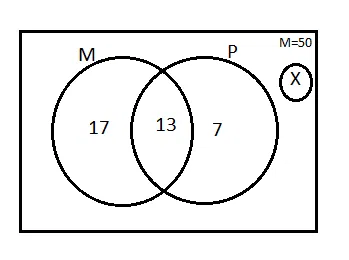
In a school of 50 students, 30 students took Mathematics course, 20 students took Physics course and 13 students took both the courses. What is the number of students who did not take either course?
Show Answer
Solution
17+13+7+X = 50
X = 13
So the answer is option A.
correct answer:-
1
Question 47
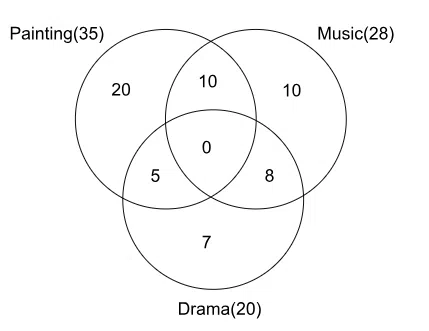
In a summer camp survey of children enrolled in at atleast one of the following: Painting, Music, and Drama, it was found that 35 children are enrolled in Painting, 28 in Music, and 20 in Drama. There are no children in all three fields. However, 10 children are enrolled in both Painting and Music, 8 in both Music and Drama, and 5 in both Painting and Drama. How many children are enrolled in only one of these fields?
Show Answer
Solution
Let P denote the set of children enrolled in painting, M in music, and D in dance.
We use the formula: $$n(P\cup M\cup D)=n(P)+n(M)+n(D)-n(P\cap M)-n(M\cap D)-n(P\cap D)+n(P\cap M\cap D)$$
Substituting the given values: $$n(P\cup M\cup D)=35+28+20-10-8-5+0=60$$
So, 60 children are enrolled in at least one field.
Those in exactly two fields = 10+8+5−3×0=23
Therefore, children in only one field = 60 - 23 = 37.
correct answer:-
3
Question 48
In a class 20% of students like only Pokemon, 150 students like Naruto, and 20% of students don't like both. What is the number of students in the class?
Show Answer
Solution
We are said that 20% of students like Pokemon and 20% of the students like none. So, the remaining 60% students are those who like only Naruto and who like both. We can also say that the remaining students like Naruto. We are given the value of the students who like Naruto i.e. 150
60% of students = 150.
From this, the number of students in the class is $$\frac{150}{0.6}$$ = 250.
correct answer:-
1
Instruction for set :
350 people are living in a particular village. There are three drinks Tea, Coffee and Hot chocolate available in the village. Each citizen has to vote for one or more of the three drinks which he/she like. It is known that:
1) In total 120 people like Tea and 160 people like Coffee.
2) 46 people like all the three drinks.
3) 62 people like both Tea and Hot chocolate.
4) 53 people like both Hot chocolate and Coffee.
5) 89 people like both Tea and Coffee.
Question 49
How many people like only Hot chocolate?
Show Answer
Solution
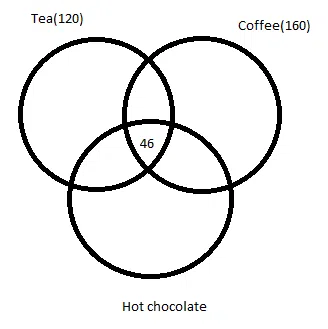
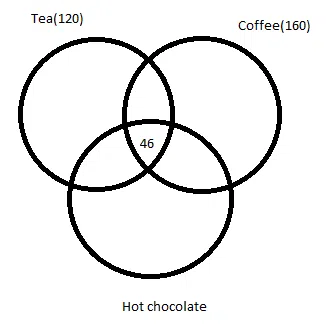
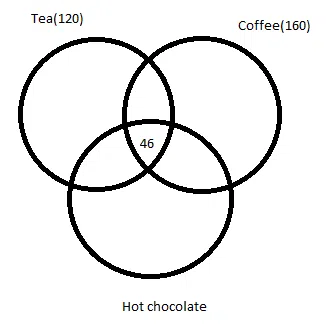
46 people like all the three drinks. We make following venn diagram -
Since 62 people like both Tea and Hot chocolate
62 - 46 = 16 people like only Tea and Hot chocolate
Since 53 people like both Hot chocolate and Coffee
53 - 46 = 7 people like only Hot chocolate and Coffee
Since 89 people like both Tea and Coffee
89 - 46 = 43 people like only Tea and Coffee.
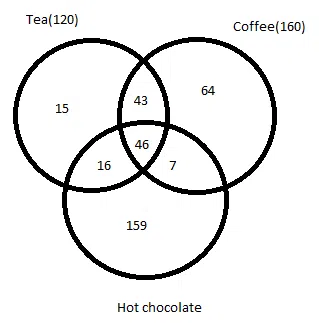
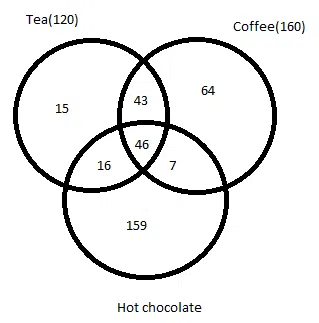
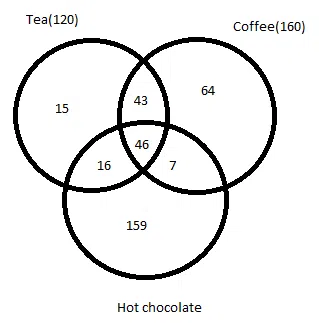
Thus, number of people who like only Tea = 120 - 46 - 16 - 43 = 15
Thus, number of people who like only Coffee= 160 - 43 - 46 - 7 = 64
Number of people who like only Hot chocolate = 350 - 160 - 16 - 15 = 159
We get following venn diagram -
Hence, option B is the correct choice.
correct answer:-
2
Instruction for set :
350 people are living in a particular village. There are three drinks Tea, Coffee and Hot chocolate available in the village. Each citizen has to vote for one or more of the three drinks which he/she like. It is known that:
1) In total 120 people like Tea and 160 people like Coffee.
2) 46 people like all the three drinks.
3) 62 people like both Tea and Hot chocolate.
4) 53 people like both Hot chocolate and Coffee.
5) 89 people like both Tea and Coffee.
Question 50
How many people like only Coffee?
Show Answer
Solution
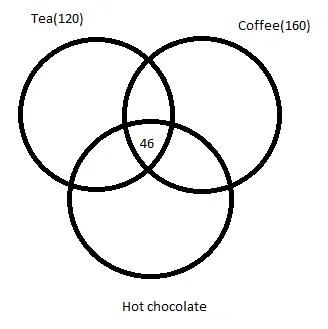
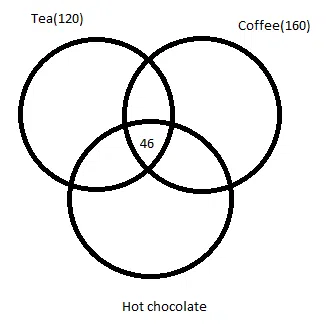
46 people like all the three drinks. We make following venn diagram -
Since 62 people like both Tea and Hot chocolate
62 - 46 = 16 people like only Tea and Hot chocolate
Since 53 people like both Hot chocolate and Coffee
53 - 46 = 7 people like only Hot chocolate and Coffee
Since 89 people like both Tea and Coffee
89 - 46 = 43 people like only Tea and Coffee.
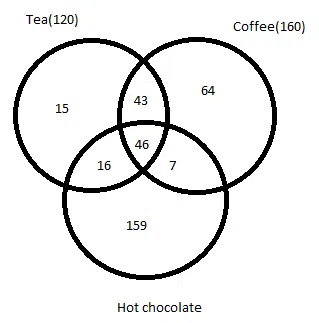
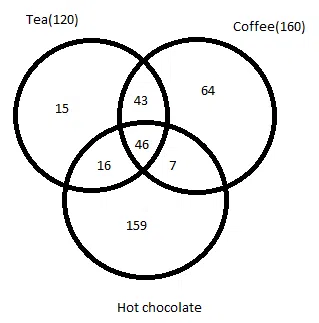
Thus, number of people who like only Tea = 120 - 46 - 16 - 43 = 15
Thus, number of people who like only Coffee= 160 - 43 - 46 - 7 = 64
Number of people who like only Hot chocolate = 350 - 160 - 16 - 15 = 159
We get following venn diagram -
Hence, option D is the correct option.
correct answer:-
4
Instruction for set :
350 people are living in a particular village. There are three drinks Tea, Coffee and Hot chocolate available in the village. Each citizen has to vote for one or more of the three drinks which he/she like. It is known that:
1) In total 120 people like Tea and 160 people like Coffee.
2) 46 people like all the three drinks.
3) 62 people like both Tea and Hot chocolate.
4) 53 people like both Hot chocolate and Coffee.
5) 89 people like both Tea and Coffee.
Question 51
How many people like only Coffee and Hot chocolate?
Show Answer
Solution
46 people like all the three drinks. We make following venn diagram -
Since 62 people like both Tea and Hot chocolate
62 - 46 = 16 people like only Tea and Hot chocolate
Since 53 people like both Hot chocolate and Coffee
53 - 46 = 7 people like only Hot chocolate and Coffee
Since 89 people like both Tea and Coffee
89 - 46 = 43 people like only Tea and Coffee.
Thus, number of people who like only Tea = 120 - 46 - 16 - 43 = 15
Thus, number of people who like only Coffee= 160 - 43 - 46 - 7 = 64
Number of people who like only Hot chocolate = 350 - 160 - 16 - 15 = 159
We get following venn diagram -
Hence, option C is the correct choice.
correct answer:-
3
Instruction for set :
350 people are living in a particular village. There are three drinks Tea, Coffee and Hot chocolate available in the village. Each citizen has to vote for one or more of the three drinks which he/she like. It is known that:
1) In total 120 people like Tea and 160 people like Coffee.
2) 46 people like all the three drinks.
3) 62 people like both Tea and Hot chocolate.
4) 53 people like both Hot chocolate and Coffee.
5) 89 people like both Tea and Coffee.
Question 52
How many people like only Tea and Coffee?
Show Answer
Solution
46 people like all the three drinks. We make following venn diagram -
Since 62 people like both Tea and Hot chocolate
62 - 46 = 16 people like only Tea and Hot chocolate
Since 53 people like both Hot chocolate and Coffee
53 - 46 = 7 people like only Hot chocolate and Coffee
Since 89 people like both Tea and Coffee
89 - 46 = 43 people like only Tea and Coffee.
Thus, number of people who like only Tea = 120 - 46 - 16 - 43 = 15
Thus, number of people who like only Coffee= 160 - 43 - 46 - 7 = 64
Number of people who like only Hot chocolate = 350 - 160 - 16 - 15 = 159
We get following venn diagram -
Hence, option A is the correct choice.
correct answer:-
1
Instruction for set :
350 people are living in a particular village. There are three drinks Tea, Coffee and Hot chocolate available in the village. Each citizen has to vote for one or more of the three drinks which he/she like. It is known that:
1) In total 120 people like Tea and 160 people like Coffee.
2) 46 people like all the three drinks.
3) 62 people like both Tea and Hot chocolate.
4) 53 people like both Hot chocolate and Coffee.
5) 89 people like both Tea and Coffee.
Question 53
How many people like only Tea?
Show Answer
Solution
46 people like all the three drinks. We make following venn diagram -
Since 62 people like both Tea and Hot chocolate
62 - 46 = 16 people like only Tea and Hot chocolate
Since 53 people like both Hot chocolate and Coffee
53 - 46 = 7 people like only Hot chocolate and Coffee
Since 89 people like both Tea and Coffee
89 - 46 = 43 people like only Tea and Coffee.
Thus, number of people who like only Tea = 120 - 46 - 16 - 43 = 15
Thus, number of people who like only Coffee= 160 - 43 - 46 - 7 = 64
Number of people who like only Hot chocolate = 350 - 160 - 16 - 15 = 159
We get following venn diagram -
Hence, option E is the correct choice.
correct answer:-
5
Question 54
A clock gains 5 minutes every 12 hours. The clock is set correctly at 6:00 AM on a Monday. What time will the clock show at 8:00 AM on the following Thursday?
Show Answer
Solution
From Monday 6:00 AM to Thursday 6:00 AM is exactly 3 days, or 3*24 = 72 hours.
From Thursday 6:00 AM to Thursday 8:00 AM is an additional 2 hours.
So, in total, 12 hours have elapsed.
The clock gains 5 minutes for every 12 seconds.
So, the rate of gain is 5/12 minutes per hour.
The total time gained over 74 hours is:
74*(5/12) = 185/6 minutes
185/6 minutes = 30 minutes + 5/6 minute
5/6 minute = 50 seconds.
Hence, total time gained: 30 minutes and 50 seconds.
So, Clock time: Thursday, 8:30:50 AM
correct answer:-
2
Question 55
An analog clock was set at 12:00 noon. After 12 hours, it showed 10 o'clock. After three and a half days, if the clock was observed at 12 AM, what time would it show?
Show Answer
Solution
After 12 hours, it was showing 10 PM. This means that the clock is losing 2 hours every 12 hours.
How many hours will it be after 3 and a half days?
$$3\times\ 24\ +\ 12=84\ hrs$$
So when it loses 2 hours every 12 hours, it will lose x hours in 84 hours. We can use cross multiplication.
So the clock should be 14 hrs before the actual time.
12 AM - 14 hours = 10 AM
Hence, the time it will be showing is 10:00 AM.
correct answer:-
1
Question 56
A clock shows 7 O'clock in the morning. By how much angle will the hours hand rotate when the clock shows 9 O’clock in the morning.
Show Answer
Solution
In 12 hours, the hand turns $$360^\circ$$.
Here, the difference between time = 2 hours
Then, Required angle $$= \dfrac{360}{12}\times2 = 60^\circ$$
correct answer:-
2
Question 57
An astronomer's clock is unique, with only 9 hours in one revolution and 30 minutes in each hour. What minor angle will be formed by the hour's hand and minute hand at 5:15?
Show Answer
Solution
The clock makes one revolution, covering nine hours. This means that it covers $$360^{\circ\ }$$ degrees or one revolution in nine hours.
Angle covered per hour = $$\frac{360^{\circ\ }}{9}=40^{\circ\ }$$
It means the hour hand will cover $$40^{\circ}$$ every hour.
Similarly, there are 30 minutes in an hour. It means the minute hand covers $$360^{\circ\ }$$ in 1 hour or 30 minutes.
Angle covered every minute = $$\frac{360}{30}=12^{\circ\ }$$
Now, we need to find the angle between 5:15.
To reach 5 hours, the hour hand would have covered an angle of $$5\times\ 40^{\circ\ }\ =\ 200^{\circ\ }$$
But here, the hour hand is also covering the 15 minutes or half an hour; it will move forward with the angle of half-hour more, i.e. $$\frac{40}{2}=20^{\circ\ }$$
Hence, the angle made by the hour hand at 5:15 = $$200+20=220^{\circ\ }$$
Similarly, for the minute hand to reach 15 minutes, it would have covered $$15\times\ 12^{\circ\ }=180^{\circ\ }$$.
Hence, the minor angle between them $$40^{\circ\ }$$.
correct answer:-
4
Question 58
A couple started watching a movie. Immediately after the movie was finished, the couple noticed that the hour hand in their watch had covered a distance of $$92.5^{\circ}$$ from the beginning of the movie till the end. If the movie had an interval of 15 minutes, what's the duration of the movie excluding interval?
Show Answer
Solution
1 hour has 60 minutes. An hour hand covers 12 hours to complete one revolution of $$360^{\circ}$$.
Converting in minutes, an hour hand covers 12*60 = 720 minutes to cover $$360^{\circ}$$.
It means the hour hand covers $$\frac{360}{720}=0.5^{\circ\ }$$ per minute.
The hour hand-covered $$92.5^{\circ}$$ during the movie.
It means the movie's duration was $$\frac{92.5}{0.5}=185$$ minutes or 3 hours 5 minutes.
This is the movie duration; however, the movie had an interval of 15 minutes.
Hence, excluding the interval duration, the movie will be of 2 hour and 50 minutes.
correct answer:-
4
Instruction for set :
Read the information given below carefully and answer the questions which follow.
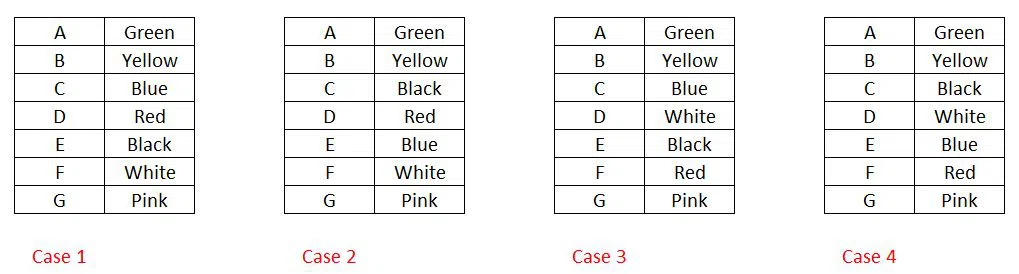
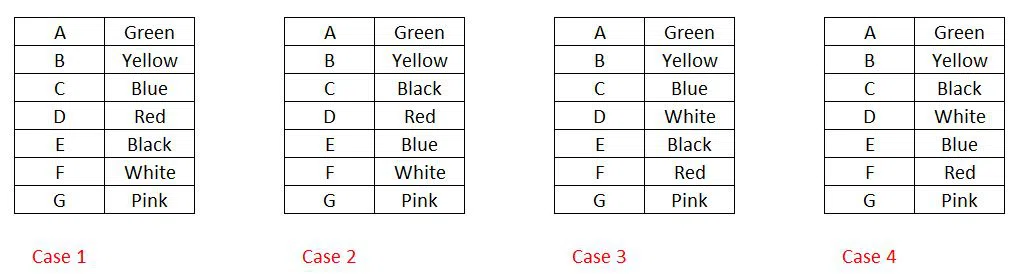
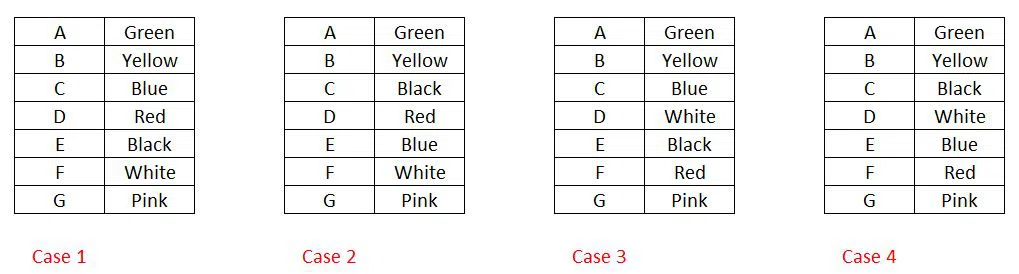
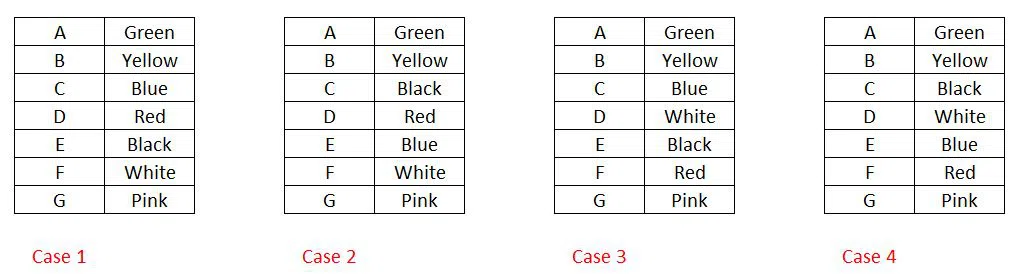
Seven friends A,B,C,D,E,F and G are present in a room. They are wearing different colored T-shirts – Red, Blue, Green, Yellow, White, Black, Pink(not necessarily in the same order). The following information is also known-
1. No person is wearing the T-shirt of the color starting with the same letter as that of their name.
2. C and E are wearing the T-shirt of the colors starting with the same letter.
3. B is wearing yellow colored T-shirt.
4. A and G are not wearing red or white.
Question 59
On a day, B has a choice to wear own T-shirt or the T-shirt worn by D or E, then number of possible color of B’s T-shirt would be?
Show Answer
Solution
From (3) => B is wearing Yellow.
From (2) => C and E are wearing either Blue or Black
From (4) and (1) => G cannot wear Green and G is not wear Red or White, therefore, G is wearing Pink
So, A has to wear Green.
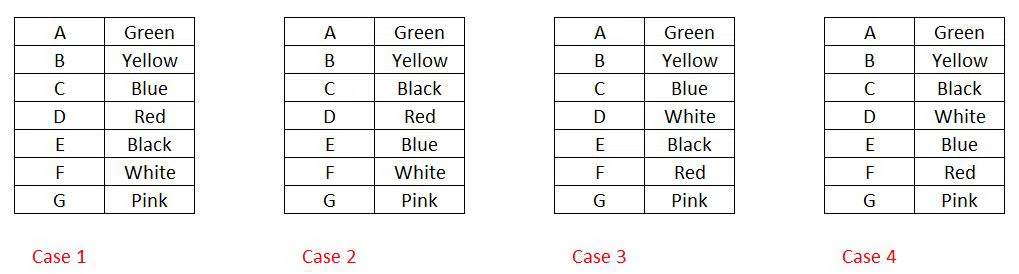
Therefore, D or F are wearing Red or White
Since, B can wear Yellow or the color of T-Shirt worn by D or E => Blue/Black/Red/White
=> B can wear five colors
But among these, B cannot wear Blue or Black as it contradicts the first condition. Hence, B can wear only 3 colours.
=> Option A is correct
correct answer:-
1
Instruction for set :
Read the information given below carefully and answer the questions which follow.
Seven friends A,B,C,D,E,F and G are present in a room. They are wearing different colored T-shirts – Red, Blue, Green, Yellow, White, Black, Pink(not necessarily in the same order). The following information is also known-
1. No person is wearing the T-shirt of the color starting with the same letter as that of their name.
2. C and E are wearing the T-shirt of the colors starting with the same letter.
3. B is wearing yellow colored T-shirt.
4. A and G are not wearing red or white.
Question 60
Who wore Green colored T-shirt?
Show Answer
Solution
From (3) => B is wearing Yellow.
From (2) => C and E are wearing either Blue or Black
From (4) and (1) => G cannot wear Green and G is not wear Red or White, therefore, G is wearing Pink
So, A has to wear Green.
Therefore, D or F are wearing Red or White
A is wearing Green Colored T-Shirt
=> Option E is correct
correct answer:-
5
Instruction for set :
Read the information given below carefully and answer the questions which follow.
Seven friends A,B,C,D,E,F and G are present in a room. They are wearing different colored T-shirts – Red, Blue, Green, Yellow, White, Black, Pink(not necessarily in the same order). The following information is also known-
1. No person is wearing the T-shirt of the color starting with the same letter as that of their name.
2. C and E are wearing the T-shirt of the colors starting with the same letter.
3. B is wearing yellow colored T-shirt.
4. A and G are not wearing red or white.
Question 61
How many different arrangements are possible?
Show Answer
Solution
From (3) => B is wearing Yellow.
From (2) => C and E are wearing either Blue or Black
From (4) and (1) => G cannot wear Green and G is not wear Red or White, therefore, G is wearing Pink
So, A has to wear Green.
Therefore, D or F are wearing Red or White
There are four different arrangements possible
=> Option D is correct
correct answer:-
4
Instruction for set :
Read the information given below carefully and answer the questions which follow.
Seven friends A,B,C,D,E,F and G are present in a room. They are wearing different colored T-shirts – Red, Blue, Green, Yellow, White, Black, Pink(not necessarily in the same order). The following information is also known-
1. No person is wearing the T-shirt of the color starting with the same letter as that of their name.
2. C and E are wearing the T-shirt of the colors starting with the same letter.
3. B is wearing yellow colored T-shirt.
4. A and G are not wearing red or white.
Question 62
For how many persons exact color of the T-shirt can be determined?
Show Answer
Solution
From (3) => B is wearing Yellow.
From (2) => C and E are wearing either Blue or Black
From (4) and (1) => G cannot wear Green and G is not wear Red or White, therefore, G is wearing Pink
So, A has to wear Green.
Therefore, D or F are wearing Red or White
T-Shirt color for A, B and G can be determined
=> Option A is correct
correct answer:-
1
Instruction for set :
Read the information given below carefully and answer the questions which follow.
Seven friends A,B,C,D,E,F and G are present in a room. They are wearing different colored T-shirts – Red, Blue, Green, Yellow, White, Black, Pink(not necessarily in the same order). The following information is also known-
1. No person is wearing the T-shirt of the color starting with the same letter as that of their name.
2. C and E are wearing the T-shirt of the colors starting with the same letter.
3. B is wearing yellow colored T-shirt.
4. A and G are not wearing red or white.
Question 63
If B and G interchange their T-shirt, what would the color of B’s T-shirt?
Show Answer
Solution
From (3) => B is wearing Yellow.
From (2) => C and E are wearing either Blue or Black
From (4) and (1) => G cannot wear Green and G is not wear Red or White, therefore, G is wearing Pink
So, A has to wear Green.
Therefore, D or F are wearing Red or White
If B and G interchange their T-Shirt , B will be wearing Pink colored T-shirt
=> Option C is correct
correct answer:-
3
Instruction for set :
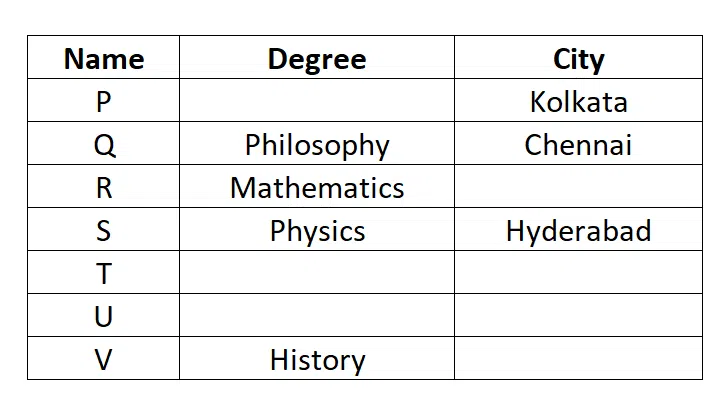
Seven friends – P, Q, R, S, T, U and V have a degree in one of the subjects among English, Philosophy, Psychology, History, Biology, Mathematics and Physics, not necessarily in the same order. The seven friends lived in a different city among Delhi, Mumbai, Bangalore, Chennai, Kolkata, Hyderabad and Pune.
Further, it is known that:
1. The person who had a degree in History did not live in Mumbai.
2. The person who has a degree in English lives in Delhi.
3. V had a degree in History and Q had a degree in Philosophy.
4. R had a degree in Mathematics.
5. S lived in Hyderabad and had a degree in Physics.
6. The person living in Bangalore neither had a Biology nor a Psychology degree.
7. Q lived in Chennai and P lived in Kolkata.
8. T did not live in Delhi and R did not live in Pune.
Question 64
Which city did T live in?
Show Answer
Solution
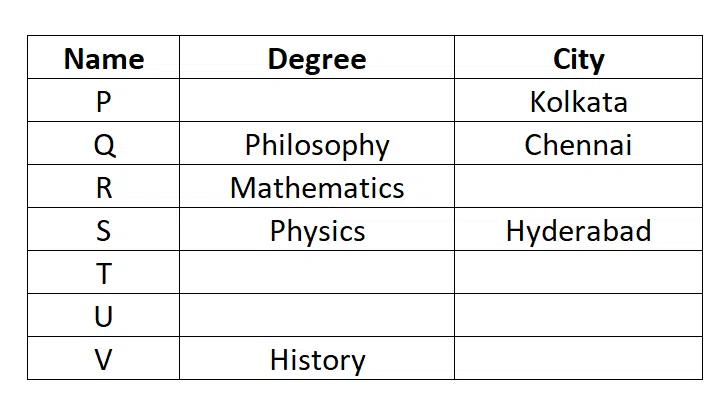
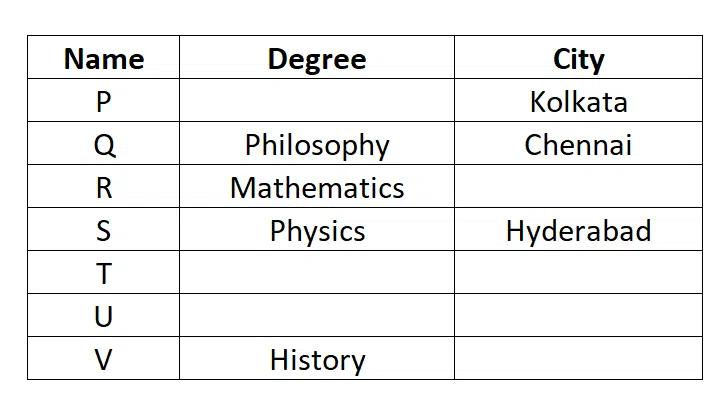
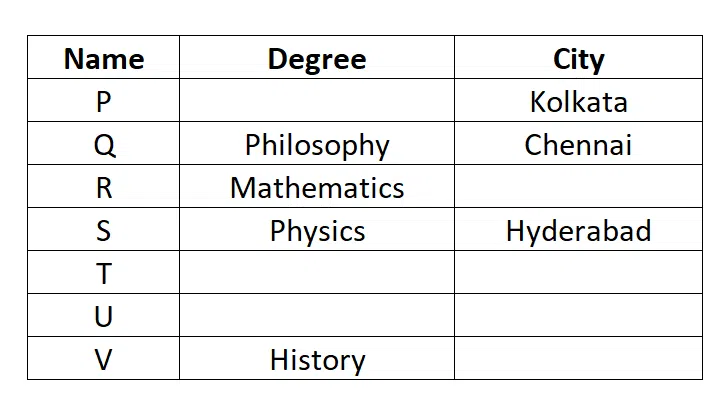
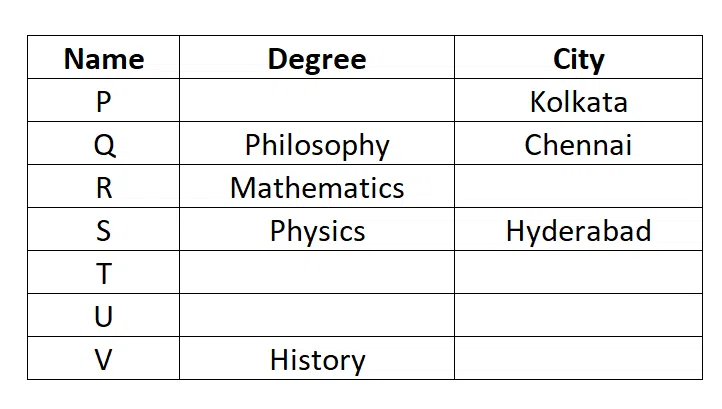
From 7, Q lived in Chennai and P lived in Kolkata. From 4, R had a degree in Mathematics. From 3, V had a degree in History and Q had a degree in Philosophy.
From 5, S lived in Hyderabad and had a degree in Physics.
From 2, the person who has a degree in English, lives in Delhi. Also, from 8, T did not live in Delhi. Hence, U lived in Delhi.
From 8, R did not live in Pune.
From 1, V did not live in Mumbai. From 6, T cannot live in Bangalore.
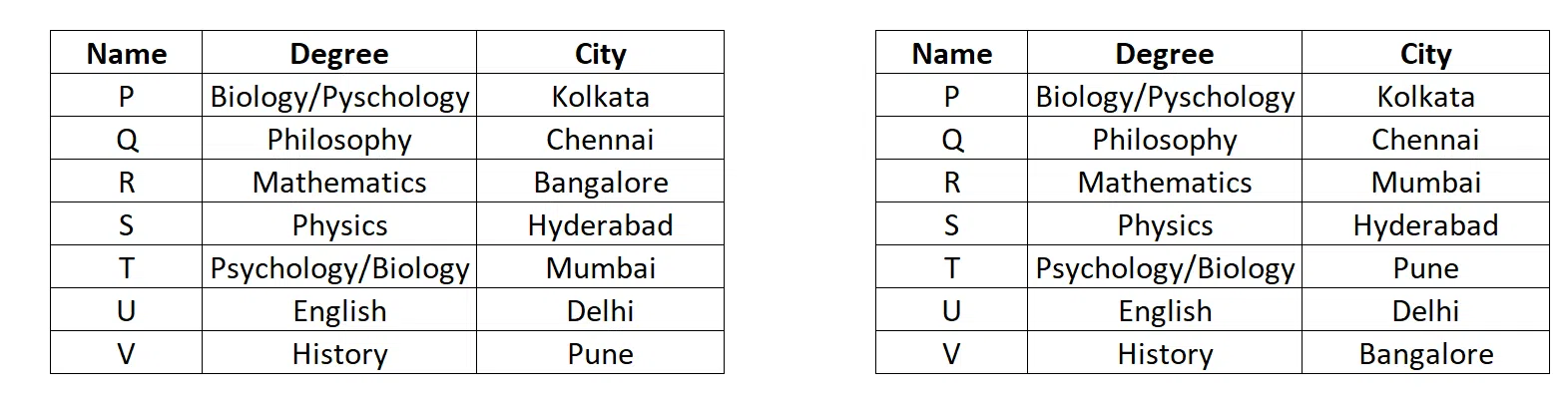
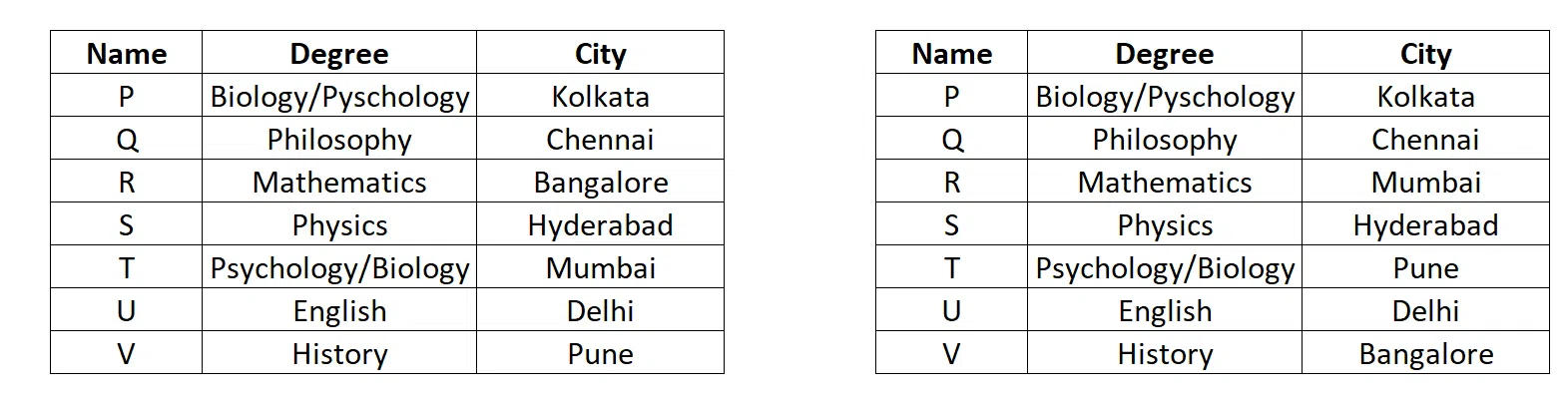
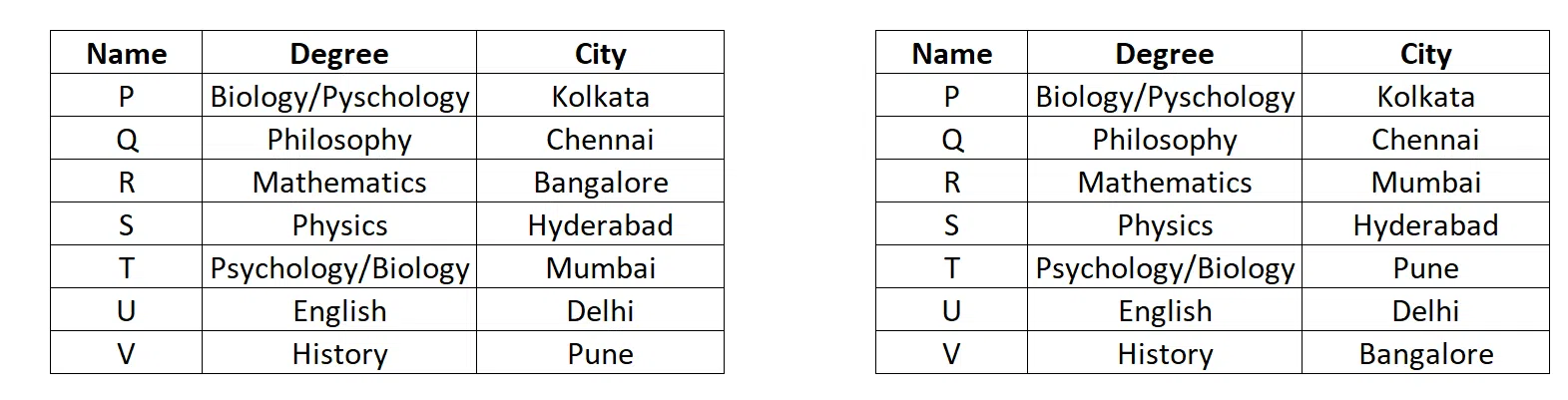
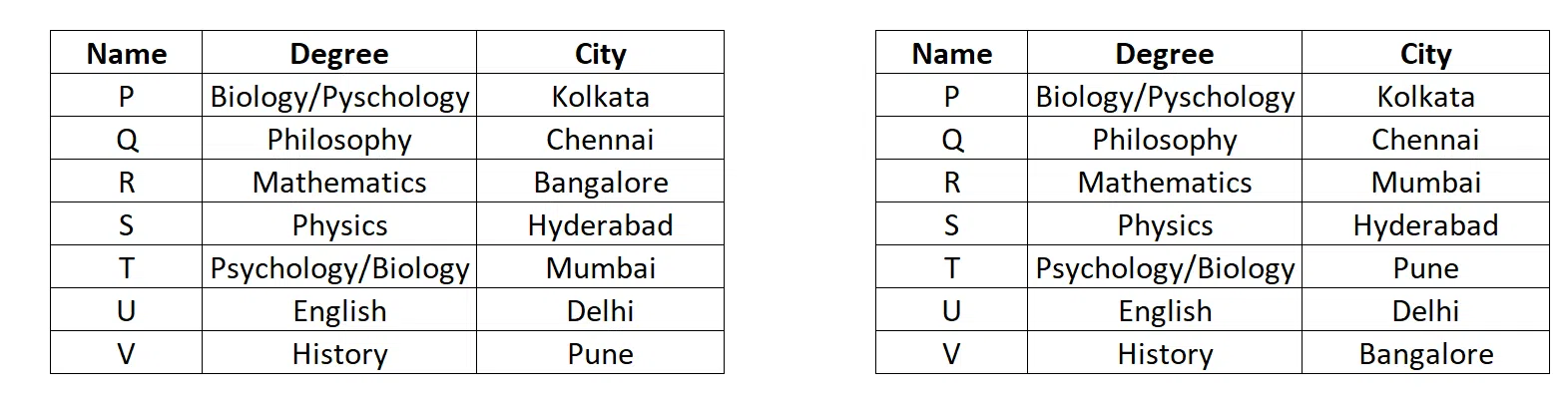
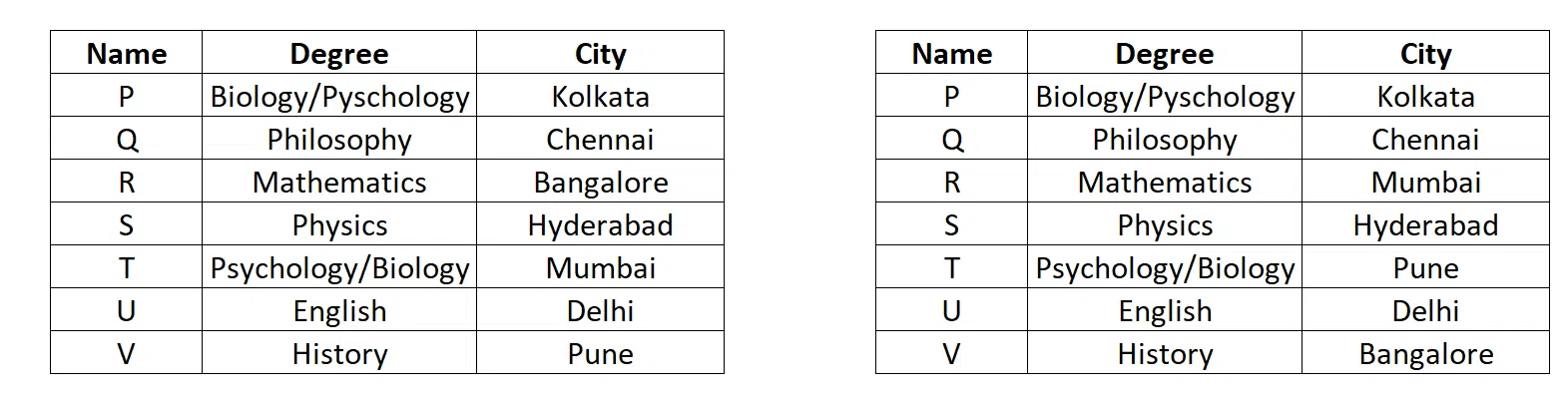
Hence the following 4 cases are possible:
Hence, option E is the correct choice.
correct answer:-
5
Instruction for set :
Seven friends – P, Q, R, S, T, U and V have a degree in one of the subjects among English, Philosophy, Psychology, History, Biology, Mathematics and Physics, not necessarily in the same order. The seven friends lived in a different city among Delhi, Mumbai, Bangalore, Chennai, Kolkata, Hyderabad and Pune.
Further, it is known that:
1. The person who had a degree in History did not live in Mumbai.
2. The person who has a degree in English lives in Delhi.
3. V had a degree in History and Q had a degree in Philosophy.
4. R had a degree in Mathematics.
5. S lived in Hyderabad and had a degree in Physics.
6. The person living in Bangalore neither had a Biology nor a Psychology degree.
7. Q lived in Chennai and P lived in Kolkata.
8. T did not live in Delhi and R did not live in Pune.
Question 65
How many arrangements are possible?
Show Answer
Solution
From 7, Q lived in Chennai and P lived in Kolkata. From 4, R had a degree in Mathematics. From 3, V had a degree in History and Q had a degree in Philosophy.
From 5, S lived in Hyderabad and had a degree in Physics.
From 2, the person who has a degree in English, lives in Delhi. Also, from 8, T did not live in Delhi. Hence, U lived in Delhi.
From 8, R did not live in Pune.
From 1, V did not live in Mumbai. From 6, T cannot live in Bangalore.
Hence the following 4 cases are possible:
Hence, option D is the correct choice.
correct answer:-
4
Instruction for set :
Seven friends – P, Q, R, S, T, U and V have a degree in one of the subjects among English, Philosophy, Psychology, History, Biology, Mathematics and Physics, not necessarily in the same order. The seven friends lived in a different city among Delhi, Mumbai, Bangalore, Chennai, Kolkata, Hyderabad and Pune.
Further, it is known that:
1. The person who had a degree in History did not live in Mumbai.
2. The person who has a degree in English lives in Delhi.
3. V had a degree in History and Q had a degree in Philosophy.
4. R had a degree in Mathematics.
5. S lived in Hyderabad and had a degree in Physics.
6. The person living in Bangalore neither had a Biology nor a Psychology degree.
7. Q lived in Chennai and P lived in Kolkata.
8. T did not live in Delhi and R did not live in Pune.
Question 66
For how many of the friends can the city in which they live be determined uniquely?
Show Answer
Solution
From 7, Q lived in Chennai and P lived in Kolkata. From 4, R had a degree in Mathematics. From 3, V had a degree in History and Q had a degree in Philosophy.
From 5, S lived in Hyderabad and had a degree in Physics.
From 2, the person who has a degree in English, lives in Delhi. Also, from 8, T did not live in Delhi. Hence, U lived in Delhi.
From 8, R did not live in Pune.
From 1, V did not live in Mumbai. From 6, T cannot live in Bangalore.
Hence the following 4 cases are possible:
Hence, option C is the correct choice.
correct answer:-
3
Instruction for set :
Seven friends – P, Q, R, S, T, U and V have a degree in one of the subjects among English, Philosophy, Psychology, History, Biology, Mathematics and Physics, not necessarily in the same order. The seven friends lived in a different city among Delhi, Mumbai, Bangalore, Chennai, Kolkata, Hyderabad and Pune.
Further, it is known that:
1. The person who had a degree in History did not live in Mumbai.
2. The person who has a degree in English lives in Delhi.
3. V had a degree in History and Q had a degree in Philosophy.
4. R had a degree in Mathematics.
5. S lived in Hyderabad and had a degree in Physics.
6. The person living in Bangalore neither had a Biology nor a Psychology degree.
7. Q lived in Chennai and P lived in Kolkata.
8. T did not live in Delhi and R did not live in Pune.
Question 67
If P had a degree in Biology, what degree does the person living in Mumbai have?
Show Answer
Solution
From 7, Q lived in Chennai and P lived in Kolkata. From 4, R had a degree in Mathematics. From 3, V had a degree in History and Q had a degree in Philosophy.
From 5, S lived in Hyderabad and had a degree in Physics.
From 2, the person who has a degree in English, lives in Delhi. Also, from 8, T did not live in Delhi. Hence, U lived in Delhi.
From 8, R did not live in Pune.
From 1, V did not live in Mumbai. From 6, T cannot live in Bangalore.
Hence the following 4 cases are possible:
Hence, option E is the correct choice.
correct answer:-
5
Instruction for set :
Seven friends – P, Q, R, S, T, U and V have a degree in one of the subjects among English, Philosophy, Psychology, History, Biology, Mathematics and Physics, not necessarily in the same order. The seven friends lived in a different city among Delhi, Mumbai, Bangalore, Chennai, Kolkata, Hyderabad and Pune.
Further, it is known that:
1. The person who had a degree in History did not live in Mumbai.
2. The person who has a degree in English lives in Delhi.
3. V had a degree in History and Q had a degree in Philosophy.
4. R had a degree in Mathematics.
5. S lived in Hyderabad and had a degree in Physics.
6. The person living in Bangalore neither had a Biology nor a Psychology degree.
7. Q lived in Chennai and P lived in Kolkata.
8. T did not live in Delhi and R did not live in Pune.
Question 68
Which city does U live in?
Show Answer
Solution
From 7, Q lived in Chennai and P lived in Kolkata. From 4, R had a degree in Mathematics. From 3, V had a degree in History and Q had a degree in Philosophy.
From 5, S lived in Hyderabad and had a degree in Physics.
From 2, the person who has a degree in English, lives in Delhi. Also, from 8, T did not live in Delhi. Hence, U lived in Delhi.
From 8, R did not live in Pune.
From 1, V did not live in Mumbai. From 6, T cannot live in Bangalore.
Hence the following 4 cases are possible:
Hence, option A is the correct choice.
correct answer:-
1
Instruction for set :
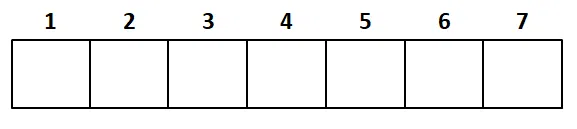
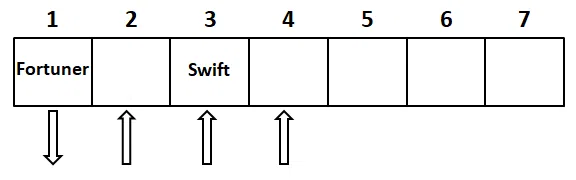
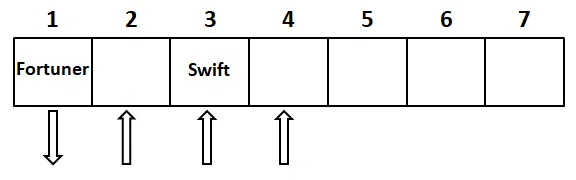
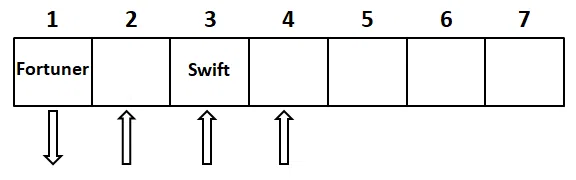
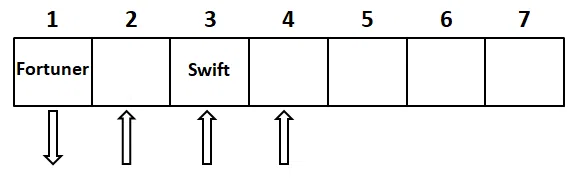
7 different cars namely- Vento, Polo, Duster, Fortuner, Swift, Wagon R and Baleno are parked in a row such that some of the cars are facing north direction while other cars are facing south direction. The distance between any two consecutive cars is the same. It is known that the number of cars which are facing north direction is 3 more than the number of cars which are facing south direction. Baleno is parked in the middle and it is equidistant from both Vento and Duster. The cars which are parked on extreme ends are facing opposite direction. Swift is parked second to left of Fortuner and both the cars are not facing the same direction. Duster is the only car parked between Wagon R and Polo. Both Duster and Polo are facing the same direction. Both the cars which are parked adjacent to Swift are facing the same direction as that of Swift. Fortuner is parked at one of the extremes.
Question 69
Which of the following cars is facing south direction?
Show Answer
Solution
(1) It is known that the number of cars which are facing north direction is 3 more than the number of cars which are facing south direction.
(2) Baleno is parked in the middle and it is equidistant from both Vento and Duster.
(3) The cars which are parked on extreme ends are facing opposite direction.
(4) Swift is parked second to left of Fortuner and both the cars are not facing the same direction.
(5) Duster is the only car parked between Wagon R and Polo. Both Duster and Polo are facing the same direction.
(6) Both the cars which are parked adjacent to Swift are facing the same direction as that of Swift.
(7) Fortuner is parked at one of the extremes.
We have a total of 7 cars and it is known that the number of cars which are facing north direction is 3 more than the number of cars which are facing south direction. Hence, we can say that 5 cars are facing in north direction whereas 2 cars are facing south direction.
Both the cars which are parked adjacent to Swift are facing the same direction as that of Swift. This is only possible when Swift and both the cars which are parked adjacent to swift are facing north direction as only 2 cars are facing south direction.
Swift is parked second to left of Fortuner and both the cars are not facing the same direction. Hence, we can say that Fortuner is facing south direction.
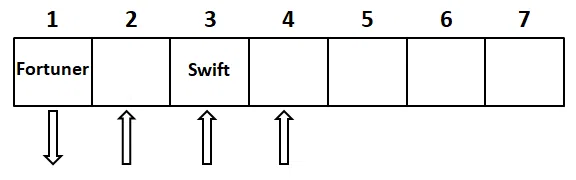
In the arrangement, we can see that Fortuner can’t occupy the 7th spot as Swift is parked in the left direction to Fortuner. Therefore, we can say that Fortuner is parked at the 1st spot. Consequently, we can say that Swift is parked on the 3rd spot.
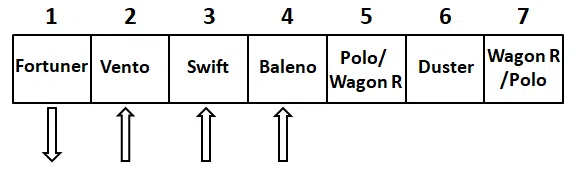
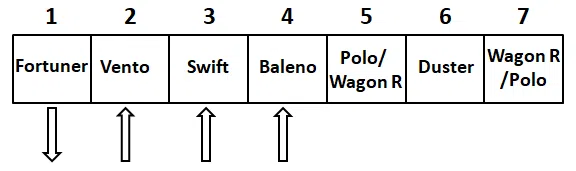
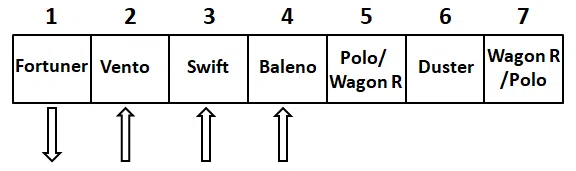
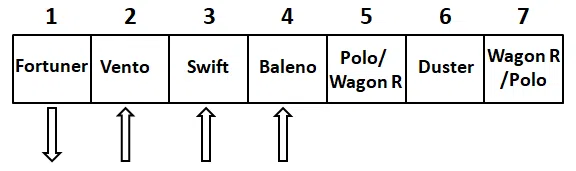
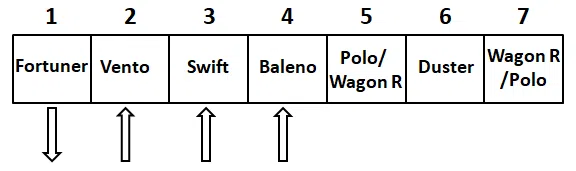
From the statement (2) we can see that Baleno is parked at 4th spot. Also we can say that Vento and Duster occupy 2nd and 6th spot in any order.
But from statement (5), we can say that Vento occupies 2nd spot and Duster occupies 6th spot. Also Polo and Wagon R occupies 5th and 7th spot in any order.
From the statement (3), we can say that the car parked at 7th spot and faces north direction.
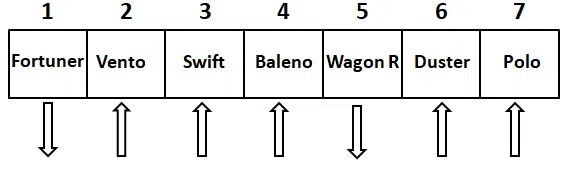
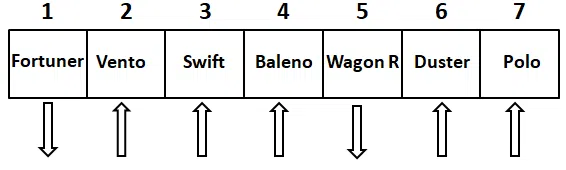
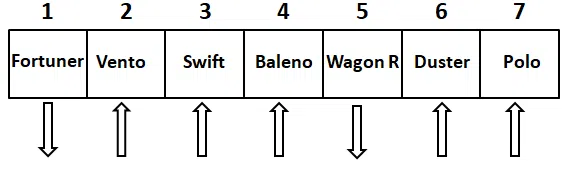
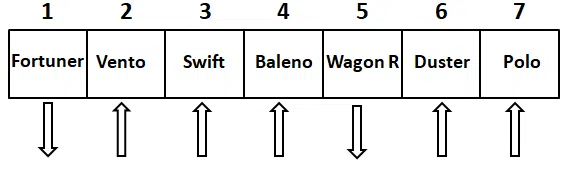
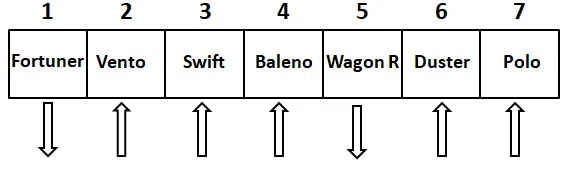
In statement (3) it is given that both Duster and Polo are facing the same direction. Hence, we can say that Wagon R occupies 5th spot and Polo occupies 7th spot. Also, both Duster and Polo are facing north direction.
From the arrangement, we can see that Wagon R faces south direction. Therefore, option C is the correct answer.
correct answer:-
3
Instruction for set :
7 different cars namely- Vento, Polo, Duster, Fortuner, Swift, Wagon R and Baleno are parked in a row such that some of the cars are facing north direction while other cars are facing south direction. The distance between any two consecutive cars is the same. It is known that the number of cars which are facing north direction is 3 more than the number of cars which are facing south direction. Baleno is parked in the middle and it is equidistant from both Vento and Duster. The cars which are parked on extreme ends are facing opposite direction. Swift is parked second to left of Fortuner and both the cars are not facing the same direction. Duster is the only car parked between Wagon R and Polo. Both Duster and Polo are facing the same direction. Both the cars which are parked adjacent to Swift are facing the same direction as that of Swift. Fortuner is parked at one of the extremes.
Question 70
Which of the following cars is parked third to the right of Baleno?
Show Answer
Solution
(1) It is known that the number of cars which are facing north direction is 3 more than the number of cars which are facing south direction.
(2) Baleno is parked in the middle and it is equidistant from both Vento and Duster.
(3) The cars which are parked on extreme ends are facing opposite direction.
(4) Swift is parked second to left of Fortuner and both the cars are not facing the same direction.
(5) Duster is the only car parked between Wagon R and Polo. Both Duster and Polo are facing the same direction.
(6) Both the cars which are parked adjacent to Swift are facing the same direction as that of Swift.
(7) Fortuner is parked at one of the extremes.
We have a total of 7 cars and it is known that the number of cars which are facing north direction is 3 more than the number of cars which are facing south direction. Hence, we can say that 5 cars are facing in north direction whereas 2 cars are facing south direction.
Both the cars which are parked adjacent to Swift are facing the same direction as that of Swift. This is only possible when Swift and both the cars which are parked adjacent to swift are facing north direction as only 2 cars are facing south direction.
Swift is parked second to left of Fortuner and both the cars are not facing the same direction. Hence, we can say that Fortuner is facing south direction.
In the arrangement, we can see that Fortuner can’t occupy the 7th spot as Swift is parked in the left direction to Fortuner. Therefore, we can say that Fortuner is parked at the 1st spot. Consequently, we can say that Swift is parked on the 3rd spot.
From the statement (2) we can see that Baleno is parked at 4th spot. Also we can say that Vento and Duster occupy 2nd and 6th spot in any order.
But from statement (5), we can say that Vento occupies 2nd spot and Duster occupies 6th spot. Also Polo and Wagon R occupies 5th and 7th spot in any order.
From the statement (3), we can say that the car parked at 7th spot and faces north direction.
In statement (3) it is given that both Duster and Polo are facing the same direction. Hence, we can say that Wagon R occupies 5th spot and Polo occupies 7th spot. Also, both Duster and Polo are facing north direction.
From the arrangement, we can see that Polo is parked third to the right of Baleno. Therefore, option D is the correct answer.
correct answer:-
4
Instruction for set :
7 different cars namely- Vento, Polo, Duster, Fortuner, Swift, Wagon R and Baleno are parked in a row such that some of the cars are facing north direction while other cars are facing south direction. The distance between any two consecutive cars is the same. It is known that the number of cars which are facing north direction is 3 more than the number of cars which are facing south direction. Baleno is parked in the middle and it is equidistant from both Vento and Duster. The cars which are parked on extreme ends are facing opposite direction. Swift is parked second to left of Fortuner and both the cars are not facing the same direction. Duster is the only car parked between Wagon R and Polo. Both Duster and Polo are facing the same direction. Both the cars which are parked adjacent to Swift are facing the same direction as that of Swift. Fortuner is parked at one of the extremes.
Question 71
How many cars are parked between Baleno and Vento?
Show Answer
Solution
(1) It is known that the number of cars which are facing north direction is 3 more than the number of cars which are facing south direction.
(2) Baleno is parked in the middle and it is equidistant from both Vento and Duster.
(3) The cars which are parked on extreme ends are facing opposite direction.
(4) Swift is parked second to left of Fortuner and both the cars are not facing the same direction.
(5) Duster is the only car parked between Wagon R and Polo. Both Duster and Polo are facing the same direction.
(6) Both the cars which are parked adjacent to Swift are facing the same direction as that of Swift.
(7) Fortuner is parked at one of the extremes.
We have a total of 7 cars and it is known that the number of cars which are facing north direction is 3 more than the number of cars which are facing south direction. Hence, we can say that 5 cars are facing in north direction whereas 2 cars are facing south direction. Both the cars which are parked adjacent to Swift are facing the same direction as that of Swift. This is only possible when Swift and both the cars which are parked adjacent to swift are facing north direction as only 2 cars are facing south direction.
Swift is parked second to left of Fortuner and both the cars are not facing the same direction. Hence, we can say that Fortuner is facing south direction.
In the arrangement, we can see that Fortuner can’t occupy the 7th spot as Swift is parked in the left direction to Fortuner. Therefore, we can say that Fortuner is parked at the 1st spot. Consequently, we can say that Swift is parked on the 3rd spot.
From the statement (2) we can see that Baleno is parked at 4th spot. Also we can say that Vento and Duster occupy 2nd and 6th spot in any order. But from statement (5), we can say that Vento occupies 2nd spot and Duster occupies 6th spot. Also Polo and Wagon R occupies 5th and 7th spot in any order.
From the statement (3), we can say that the car parked at 7th spot and faces north direction.
In statement (3) it is given that both Duster and Polo are facing the same direction. Hence, we can say that Wagon R occupies 5th spot and Polo occupies 7th spot. Also, both Duster and Polo are facing north direction.
From the arrangement, we can see that only 1 car is parked between Baleno and Vento. Therefore, option A is the correct answer.
correct answer:-
1
Instruction for set :
7 different cars namely- Vento, Polo, Duster, Fortuner, Swift, Wagon R and Baleno are parked in a row such that some of the cars are facing north direction while other cars are facing south direction. The distance between any two consecutive cars is the same. It is known that the number of cars which are facing north direction is 3 more than the number of cars which are facing south direction. Baleno is parked in the middle and it is equidistant from both Vento and Duster. The cars which are parked on extreme ends are facing opposite direction. Swift is parked second to left of Fortuner and both the cars are not facing the same direction. Duster is the only car parked between Wagon R and Polo. Both Duster and Polo are facing the same direction. Both the cars which are parked adjacent to Swift are facing the same direction as that of Swift. Fortuner is parked at one of the extremes.
Question 72
What is the position of Wagon R with respect to Baleno?
Show Answer
Solution
(1) It is known that the number of cars which are facing north direction is 3 more than the number of cars which are facing south direction.
(2) Baleno is parked in the middle and it is equidistant from both Vento and Duster.
(3) The cars which are parked on extreme ends are facing opposite direction.
(4) Swift is parked second to left of Fortuner and both the cars are not facing the same direction.
(5) Duster is the only car parked between Wagon R and Polo. Both Duster and Polo are facing the same direction.
(6) Both the cars which are parked adjacent to Swift are facing the same direction as that of Swift.
(7) Fortuner is parked at one of the extremes.
We have a total of 7 cars and it is known that the number of cars which are facing north direction is 3 more than the number of cars which are facing south direction. Hence, we can say that 5 cars are facing in north direction whereas 2 cars are facing south direction. Both the cars which are parked adjacent to Swift are facing the same direction as that of Swift. This is only possible when Swift and both the cars which are parked adjacent to swift are facing north direction as only 2 cars are facing south direction.
Swift is parked second to left of Fortuner and both the cars are not facing the same direction. Hence, we can say that Fortuner is facing south direction.
In the arrangement, we can see that Fortuner can’t occupy the 7th spot as Swift is parked in the left direction to Fortuner. Therefore, we can say that Fortuner is parked at the 1st spot. Consequently, we can say that Swift is parked on the 3rd spot.
From the statement (2) we can see that Baleno is parked at 4th spot. Also we can say that Vento and Duster occupy 2nd and 6th spot in any order. But from statement (5), we can say that Vento occupies 2nd spot and Duster occupies 6th spot. Also Polo and Wagon R occupies 5th and 7th spot in any order.
From the statement (3), we can say that the car parked at 7th spot and faces north direction.
In statement (3) it is given that both Duster and Polo are facing the same direction. Hence, we can say that Wagon R occupies 5th spot and Polo occupies 7th spot. Also, both Duster and Polo are facing north direction.
From the arrangement, we can see that Wagon R is parked to the immediate right of Baleno. Therefore, option E is the correct answer.
correct answer:-
5
Instruction for set :
7 different cars namely- Vento, Polo, Duster, Fortuner, Swift, Wagon R and Baleno are parked in a row such that some of the cars are facing north direction while other cars are facing south direction. The distance between any two consecutive cars is the same. It is known that the number of cars which are facing north direction is 3 more than the number of cars which are facing south direction. Baleno is parked in the middle and it is equidistant from both Vento and Duster. The cars which are parked on extreme ends are facing opposite direction. Swift is parked second to left of Fortuner and both the cars are not facing the same direction. Duster is the only car parked between Wagon R and Polo. Both Duster and Polo are facing the same direction. Both the cars which are parked adjacent to Swift are facing the same direction as that of Swift. Fortuner is parked at one of the extremes.
Question 73
How many cars are parked between Swift and Polo?
Show Answer
Solution
(1) It is known that the number of cars which are facing north direction is 3 more than the number of cars which are facing south direction.
(2) Baleno is parked in the middle and it is equidistant from both Vento and Duster.
(3) The cars which are parked on extreme ends are facing opposite direction.
(4) Swift is parked second to left of Fortuner and both the cars are not facing the same direction.
(5) Duster is the only car parked between Wagon R and Polo. Both Duster and Polo are facing the same direction.
(6) Both the cars which are parked adjacent to Swift are facing the same direction as that of Swift.
(7) Fortuner is parked at one of the extremes.
We have a total of 7 cars and it is known that the number of cars which are facing north direction is 3 more than the number of cars which are facing south direction. Hence, we can say that 5 cars are facing in north direction whereas 2 cars are facing south direction. Both the cars which are parked adjacent to Swift are facing the same direction as that of Swift. This is only possible when Swift and both the cars which are parked adjacent to swift are facing north direction as only 2 cars are facing south direction.
Swift is parked second to left of Fortuner and both the cars are not facing the same direction. Hence, we can say that Fortuner is facing south direction.
In the arrangement, we can see that Fortuner can’t occupy the 7th spot as Swift is parked in the left direction to Fortuner. Therefore, we can say that Fortuner is parked at the 1st spot. Consequently, we can say that Swift is parked on the 3rd spot.
From the statement (2) we can see that Baleno is parked at 4th spot. Also we can say that Vento and Duster occupy 2nd and 6th spot in any order. But from statement (5), we can say that Vento occupies 2nd spot and Duster occupies 6th spot. Also Polo and Wagon R occupies 5th and 7th spot in any order.
From the statement (3), we can say that the car parked at 7th spot and faces north direction.
In statement (3) it is given that both Duster and Polo are facing the same direction. Hence, we can say that Wagon R occupies 5th spot and Polo occupies 7th spot. Also, both Duster and Polo are facing north direction.
From the arrangement, we can see that only 3 cars are parked between Swift and Polo. Therefore, option C is the correct answer.
correct answer:-
3
Instruction for set :
A, B, and C play a game using 9 lotto balls numbered from 1 to 9. The game consists of 3 rounds, and in each round, each player picks one ball randomly without replacement. At the end of 3 rounds, all 9 balls have been picked. The player with the highest numbered ball in a round is declared the winner of that round. The following information is known about the outcome of the game:
1. B did not win any of the rounds.
2. A picked a perfect square in two of the rounds.
3. The sum of the numbers picked in round 1 is a single-digit prime number with C choosing a greater number than B
4. In round 2, the numbers picked by the players were prime numbers in arithmetic progression, with A having the smallest number and C having the largest.
Question 74
What is the maximum possible sum of numbers that B picked?
Show Answer
Solution
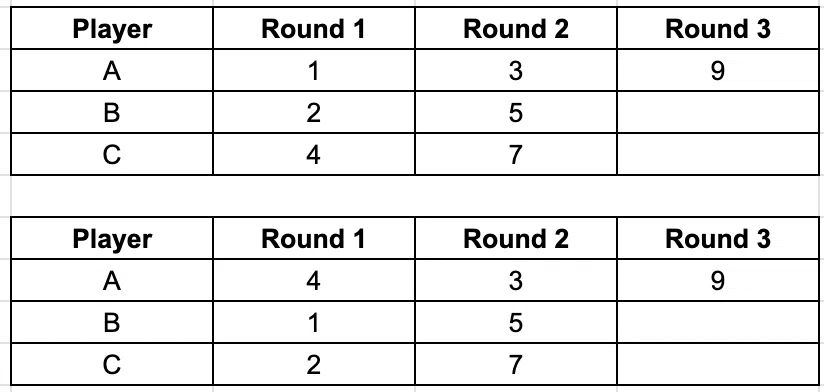
From condition 3, the single-digit prime number that can be expressed as the sum of 3 distinct numbers is 7. This can be written as 7=1+3+4. Therefore, the numbers picked in round 1 are 1, 2, and 4.
From condition 4, the only 3 prime numbers less than 10 that are in arithmetic progression are 3, 5, and 7.
Given that A picked the smallest and C picked the largest, A picked 3 in round 2, and C picked 7. Consequently, B picked 5 in round 2.
From condition 2, A must pick a perfect square in rounds 1 and 3 since he didn't pick a perfect square in round 2. Therefore, A can either pick 1 or 4 in round 1, and in round 3, A can only pick 9.
Here we are given the two possible scenarios given the clues, the numbers remaining in either situation is 6,8. Now given that B didn't win any rounds, the maximum possible sum of numbers that B can get is in the first scenario, 2+5+8=15
correct answer:-
5
Instruction for set :
A, B, and C play a game using 9 lotto balls numbered from 1 to 9. The game consists of 3 rounds, and in each round, each player picks one ball randomly without replacement. At the end of 3 rounds, all 9 balls have been picked. The player with the highest numbered ball in a round is declared the winner of that round. The following information is known about the outcome of the game:
1. B did not win any of the rounds.
2. A picked a perfect square in two of the rounds.
3. The sum of the numbers picked in round 1 is a single-digit prime number with C choosing a greater number than B
4. In round 2, the numbers picked by the players were prime numbers in arithmetic progression, with A having the smallest number and C having the largest.
Question 75
If after the three rounds, A had the highest total score, what number did C pick in the third round
Show Answer
Solution
From condition 3, the single-digit prime number that can be expressed as the sum of 3 distinct numbers is 7. This can be written as 7=1+3+4. Therefore, the numbers picked in round 1 are 1, 2, and 4.
From condition 4, the only 3 prime numbers less than 10 that are in arithmetic progression are 3, 5, and 7.
Given that A picked the smallest and C picked the largest, A picked 3 in round 2, and C picked 7. Consequently, B picked 5 in round 2.
From condition 2, A must pick a perfect square in rounds 1 and 3 since he didn't pick a perfect square in round 2. Therefore, A can either pick 1 or 4 in round 1, and in round 3, A can only pick 9.
The only situation where A could have the highest possible score is in scenario 2, and that also only when C picks number 6, bringing C's total points to 15 and A's total to 16.
correct answer:-
2
Question 76
Based on the statements given, select the conclusions that definitely follow:
Statements:
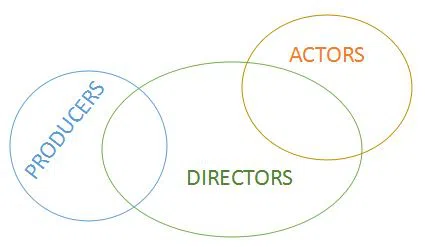
No actor is a producer.
Some directors are producers.
Conclusion I: Some directors are not actors.
Conclusion II: No director is an actor.
Show Answer
Solution
No actor is a producer. Some directors are producers.
The following diagram represents a possibility.
Directors, who are producers, cannot be actors. Therefore, some directors are not actors. Hence, conclusion I is definitely true.
Directors, who are not producers, can be actors. Therefore, we cannot say conclusion II to be definitely true. Therefore, only conclusion I follows. Hence, option A is the right answer.
correct answer:-
1
Question 77
In the question, three statements are given, followed by two conclusions, I and II. You have to consider the statements to be true even if it seems to be at variance from commonly known facts. You have to decide which of the given conclusions, if any, follows from the given statements.
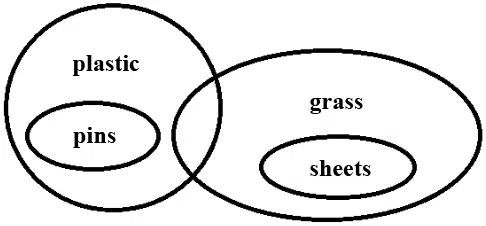
Statement I. All pins are plastic.
Statement II. Some grass are plastic.
Statement III. All sheets are grass.
Conclusion I. Some sheets are plastics
Conclusion II. Some pins are sheets
Show Answer
Solution
Consider the following possibility.
Both the conclusions are just possibilities. None of the conclusions can be definitely said to be true.
Hence, option D is the correct option.
correct answer:-
4
Question 78
Statements:
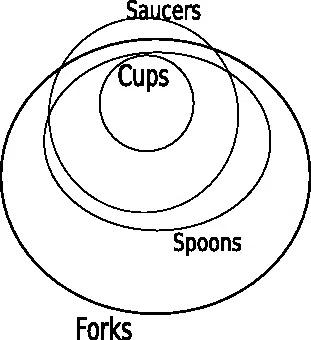
All cups are saucers.
All spoons are forks.
Conclusions:
1. All cups being spoons is a possibility
2. Some spoons are saucers.
Show Answer
Solution
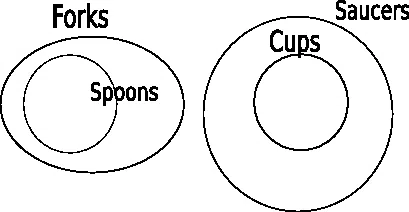
Consider the following case:
From this we can observe that all cups being spoons is a possibility.
Consider the following case:
From this we can observe that some spoons are saucers need not be true.
So, the correct answer is option a).
correct answer:-
1
Question 79
Based on the statements given below, which of the following conclusions follow?
Statements:
No rabbit is an animal
Some rabbits are mammals
Some animals are mammals
Ostrich is a mammal
Conclusion 1: Ostrich is a rabbit
Conclusion 2: Ostrich is an animal
Show Answer
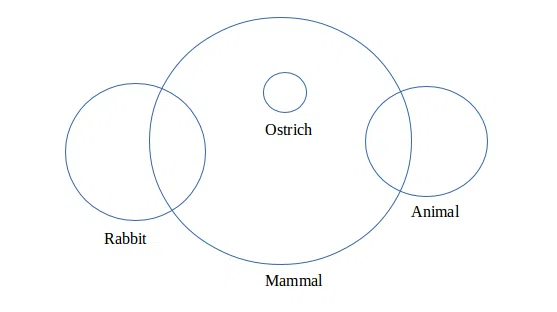
Solution
The arrangement as mentioned in the statements will be as follows.
Hence, we can't say for sure that either Conclusion 1 or Conclusion 2 will follow.
correct answer:-
4
Question 80
In the question given below, there are four statements followed by four conclusions. You have to take the given statements to be true even if they seem to be at variance from the commonly known facts. You have to decide which of the given conclusions, if any, follows from the given statements.
Statements: All cities are states, some cities are districts, all states are countries, no state is a street.
Conclusions:
I. Some cities being streets is a possibility
II. All districts are countries
III.Some streets may be countries
IV.Some countries are cities
Show Answer
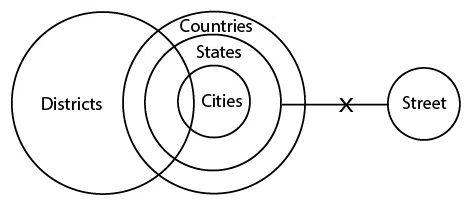
Solution
1) All cities are states and no state is a street. Hence, no city will be street. The Conclusion I does not follow
2) All districts are countries does not follow.
3) Some streets being countries is a possibility. Conclusion III follows.
4) All cities are states and all states are countries. Hence, some countries will be cities is true in all possibilities.
Hence, option C is the correct answer.
correct answer:-
3
Question 81
2A, 5C, 16E, 65H, 326L, _____
Show Answer
Solution
The numbers are following a particular series, where
2x2+1=5
5x3+1=16
16x4+1=65
65X5+1=326, so the next number in the series will be
326x6+1=1957
Letters are following a series where the number of letters skipped is changing,
There is one letter between A and C, There is again one letter between C and E, There are two letters between E and H, and there are three letters between H and L, this is clearly following a fibonacci series of skipping alphabets, so the next letter will be R.
Answer will be 1957R
correct answer:-
2
Question 82
The following relation is given between two numbers; find the value of X?
987 : 119 : : 676: X
Show Answer
Solution
We see that 987 and 119 are related as
(9+8)*7 = 17*7 = 119
Similarly, 676
(6+7)*6 = 13*6 = 78
Option C is the correct answer.
correct answer:-
3
Question 83
If $$625\ :\ 49\ ::\ 729\ :\ x$$, find 'x'.
Show Answer
Solution
625 : 49
We see the sqauare root of 625 is 25.
Now, 25 is related to 49 in sense i.e. $$\left(2+5\right)^2$$ = 49
Similarly, 729 is the squae of 27.
Therefore, the denominator should be $$\left(2+7\right)^2$$ = 81
correct answer:-
4
Question 84
Select the related word/letters/number from the given alternatives.
432 : 403 :: 718 : ?
Show Answer
Solution
The series follows the following pattern:
432 : 432 - ($$4^2 + 3^2 + 2^2$$)
Hence, the answer will be 718 - ( $$7^2 + 1^2 + 8^2$$)
correct answer:-
2
Question 85
In the following question, select the related number from the given alternatives.
18 : 83 : : 46 : ?
Show Answer
Solution
$$18 + 1^2 + 8^2 = 83$$
$$46 + 4^2 + 6^2 = 98$$
Hence, option B is the correct option.
correct answer:-
2
Question 86
In the following question, select the related number from the given alternatives.
49 : 85 : : 82 : ?
Show Answer
Solution
49 + (4*9) = 85
82 + (8*2) = 98
Hence, option B is the correct option.
correct answer:-
2
Question 87
Find the value of k if 5x + 4y =13 and 8x + ky = 14 have no solution.
Show Answer
Solution
The given two equations can be considered as straight lines of the form ax + by + c = 0.
Two equations have a solution if they meet at a point, no solution if they are parallel but not coinciding, and infinite solutions if both equations are the same.
The slope of a straight line = -a/b
=> For the two given equations, comparing slopes, we get
5x + 4y - 13 = 0 => Slope = -5/4
8x + ky - 14 = 0 => Slope = -8/k
Equating slope, we get => -5/4 = -8/k => k = (8 * 4)/5 = 32/5 = 6.4
Also, we can see that 5x + 4y - 13 = 0 and 8x + 6.4y - 14 = 0 are not the same equation, as the ratio of intercepts 13/14 is not in the same ratio of coefficients of x and y => They will have no solution for k = 6.4
correct answer:-
2
Question 88
For equation 2a + 5b = 108 find the number of pairs of positive integers a and b that satisfy this equation?
Show Answer
Solution
2a + 5b = 108
108 - 5b = 2a
We have to get an even number by subtracting a multiple of 5 from 108. So b must be an even number.
There are 21 multiple of 5 below 108. Out of those 11 are odd, and 10 are even.
For only 10 even multiples will get subtraction as an even number.
So b = 2, 4, 6, …, 20
Hence, option C is the right answer.
correct answer:-
3
Question 89
Ram buys 2 pants, 2 shirts and 1 towel for Rs. 300. He realizes that he could have bought thrice the number of towels had he paid Rs. 60 extra . If he could have bought 4 pants, 2 towels and 2 shirts for Rs. 500, find the price of a shirt.
Show Answer
Solution
Let the price of one pant be ‘p’, one shirt be ‘s’ and one towel be ‘t’.
2p + 2s + t = 300 ------(1)
It is given that for Rs. 60 more, he could have gotten thrice the number of towels I.e., 3 towels.
=> 2 towels cost Rs. 60 (1 towel out of the 3 towels is already included in the equation).
=> t = 30.
4p + 2s + 2t = 500 -------(2)
Subtracting (1) from (2), we get,
2p + t = 200
We know that t = 30
=> 2p = 170
p = 85
Substituting p and t, we get price of shirt, s as Rs. 50.
correct answer:-
1
Question 90
2 pens, 3 erasers and 5 pencils cost 32 rupees. 5 pens, 7 erasers and 4 pencils cost 46 rupees. How much do 14 pens, 19 erasers, and a pencil cost?
Show Answer
Solution
Based on the given information the following equations could be derived
2(pens) + 3(erasers) + 5(pencils) =32 ---- equation (1)
5(pens) + 7(erasers) + 4(pencils) = 46 ----- equation (2)
4* equation (2) - 3* equation (1) ==> 14(pens) + 19(erasers) +1*(pencil)=88
==>14 pens, 19 erasers, one pencil cost 88 rupees.
So the correct option to choose is B - Rs 88.
correct answer:-
2
Question 91
Which of the following is true about the given equations?
1) $$3x^2+9x+5=0$$
2) $$x^2-6x+9=0$$
Show Answer
Solution
For a quadratic equation to have real roots, its discriminant must be greater than or equal to 0.
Let’s consider both the equations.
Equation 1) Discriminant = $$9^2-4*3*5=81-60=21$$
Thus equation 1 has real roots.
Equation 2) Discriminant = $$6^2-4*1*9=36-36=0$$
Thus equation 2 also has real roots.
correct answer:-
3
Question 92
Find the value of a for which the sum of the squares of the roots of the equation $$x^2-\left(a-2\right)x-a-1$$ is minimum
Show Answer
Solution
$$x^2-\left(a-2\right)x-a-1=0$$
Sum of the squares of the roots can be written as $$\left(sum\ of\ roots\right)^2-2\left(product\ of\ roots\right)$$
$$\left(a-2\right)^2+2\left(a+1\right)$$
$$a^2+4-4a\ +2a+2$$
Minimum value of this quadratic equation occurs at -b/2a
$$-\frac{\left(-2\right)}{2}=1$$
Hence, for a=1, the sum of the squares of the roots will be minimum
correct answer:-
5
Question 93
Find the quadratic equation whose roots are squares of roots of the quadratic equation $$2x^2+\left(k-3\right)x+6k=0$$.
Show Answer
Solution
Let the quadratic equation whose roots are squares of the roots of the quadratic equation $$2x^2+\left(k-3\right)x+6k=0$$ be $$px^2+qx+r=0$$.
We know for a quadratic equation $$ax^2+bx+c=0$$ the sum of roots of the quadratic equation is $$-\dfrac{b}{a}$$ and the product of roots of the quadratic equation is $$\dfrac{c}{a}$$.
For $$2x^2+\left(k-3\right)x+6=0$$, let the roots be $$\alpha,\ \beta\ $$
So, $$\alpha+\beta=-\ \dfrac{\left(k-3\right)}{2}$$
and $$\alpha\beta=\dfrac{6k}{2}$$
We want the roots of $$px^2+qx+r=0$$ to be $$\alpha^2$$ and $$\beta^2$$
So the product of roots = $$\alpha^2\beta^2=\dfrac{r}{p}$$
putting the values of $$\alpha\beta$$ in the equation we get
$$p=4$$, $$q=-\left(k^2-30k+9\right)$$ and $$r=36k^2$$
So, the quadratic equation is $$4x^2-\left(k^2-30k+9\right)x+36k^2=0$$
correct answer:-
4
Question 94
If $$x^2 - x - 20$$ = 0 and $$x^2 + 7x + 12$$ = 0, what is the value of $$x$$?
Show Answer
Solution
$$x^2 - x - 20$$ = 0
=>$$(x + 4)(x - 5)$$ = 0
=> $$x$$ = -4 or $$x$$ = 5
Similarly, $$x^2 + 7x + 12$$ = 0
=> $$(x + 4)(x + 3)$$ = 0
=> $$x$$ = -4 or $$x$$ = -3
Since, $$x$$ = -4 is the value which satisfies both equations, option B is correct
correct answer:-
2
Question 95
The sum of the roots of the quadratic equation is 5 and the product of the roots -14. What is the absolute difference between the two roots?
Show Answer
Solution
Let the roots of the quadratic equation be a and b.
Then we know that a + b = 5
a*b = -14 => a*(5 - a) = -14
=> $$5a - a^2 = -14$$
=> $$a^2 - 5a - 14 = 0$$
=> (a - 7)(a + 2) = 0
=> a = 7 or a = -2
Hence the two roots are 7 and -2. Hence the difference between the two roots would be 7 - (-2) = 9.
correct answer:-
2
Question 96
What is the sum of all the 7 terms of an arithmetic progression if the first term is 11 and last term is 43?
What is the sum of the first 9 terms of an arithmetic progression if the 2nd term is 6 and the 4th term is 12?
Show Answer
Solution
$$T_{2} = 6 \Rightarrow a+d = 6$$-------(1)
$$T_{4} = 12 \Rightarrow a+3d = 12$$-------(2)
On solving (1) and (2)
a = 3, d = 3
$$S_{n} = \frac{n}{2} \times [2a+(n-1)d]$$
$$S_{9} = \frac{9}{2} \times [2(3)+(8)(3)]$$
$$S_{9} = \frac{9}{2} \times [30]$$
$$S_{9} =135$$
So the answer is option C.
correct answer:-
3
Question 98
$$n^{th}$$ term of a Infinite Geometric Progression equals one-third of the sum of all terms after it. The sum of the first four terms of the series is 350. Find the sum of all the terms of the series.
Show Answer
Solution
Let the first term of the GP be $$a$$ and the common ratio be $$r$$
So the GP is of form $$a,\ ar,\ ar^2,\ ar^3,\ ....$$
Given, $$n^{th}$$ term of the Geometric Progression equals one-third of the sum of all terms after it, i.e.
A
project is scheduled to be completed in 10 days, with the workforce
increasing each day: 2 people work on day 1, 4 people on day 2, 7 people
on day 3, and so on. If each person completes exactly one unit of work
per day, how many total units of work does the project require?
Show Answer
Solution
The series, 2,4,7... is a series with increasing difference. Such series can be represented in the form of a quadratic equation, $$ax^2+bx+c$$
$$2=a+b+c$$
$$4=4a+2b+c$$
$$7=9a+3b+c$$
Solving the above equations we get the expression for the nth term as $$T_n=\frac{n^2}{2}+\frac{n}{2}+1$$
We need to find the sum of the first 10 terms,
$$S_n=\Sigma\ \left(\frac{n^2}{2}+\frac{n}{2}+1\right)$$
$$\frac{\left(n\right)\left(n+1\right)\left(2n+1\right)}{12}+\frac{\left(n\right)\left(n+1\right)}{4}+n$$
n=10,
$$\frac{7\left(55\right)}{2}+\frac{55}{2}+10$$
$$230$$
correct answer:-
1
Question 100
If $$f(x)$$ = $$\frac{x+1}{x}$$ and $$g(x)$$ = $$\frac{x}{x+1}$$, then $$f(g(x))=x$$. How many integral values of x satisfy the equation?
What is the least value of the following expression
$$2 \log_{10} t - \log_t 0.01$$, where t > 1?
Show Answer
Solution
The expression can be written as follows:
$$2 \log_{10} t - \log_t 0.01$$ = $$2 \log_{10} t - \log_t 10^{-2}$$
= $$2 \log_{10} t + 2 * \log_t 10$$
= $$2 * (\log_{10} t + 1 / \log_{10} t)$$
Minimum value of $$(\log_{10} t + 1 / \log_{10} t)$$ = 2
So, the minimum value of the expression is 2*2 = 4
correct answer:-
4
Question 105
In 2010, the number of bears in the zoo was increased by 35% and next year these were decreased by 16.67%. Now the number of bears in the zoo is 405, then find out the 20% of the number of bears in the zoo two years ago.
Show Answer
Solution
Let’s assume the number of bears in the zoo two years ago is ‘y’.
y of (100+35)% of (100-16.67)% = 405
$$y\times1.35\times\frac{5}{6} = 405$$
6.75y = 2430
y = 360
20% of the number of bears in the zoo two years ago = 20% of 360
= 72
Hence, option e is the correct answer.
correct answer:-
5
Question 106
The population of a city increases by 10% at the beginning of every year. The population was 1,00,000 at the end of 2014. In the middle of 2016, an epidemic outbreak wiped out 20% of the population. What will be the population by the end of the year 2017?
Show Answer
Solution
In 2014, the population was 1,00,000.
It has been given that the population increases by 10% every year. Therefore, by the beginning of 2015, the population will be 1.1*1,00,000 = 1,10,000
Population by the beginning of 2016 = 1.1* 1,10,000 = 1,21,000.
The epidemic wiped off 20% of the population.
Therefore, population by the end of 2016 = 0.8*1,21,000 = 96,800.
By the beginning of 2017, the population would have again increased by 10%.
Therefore, population by the end of 2017 = 1.1*96,800 = 1,06,480.
Option D is the right answer.
correct answer:-
4
Question 107
Initially a number was 560. First it is increased by 14.28% and y% respectively. After that decreased by (y-5)% and got 624. Find out the value of ‘y’.
Show Answer
Solution
560 of (100+14.28)% of (100+y)% of (100-(y-5))% = 624
560 of 114.28% of (100+y)% of (100-y+5)% = 624
560 of 114.28% of (100+y)% of (105-y)% = 624
$$560\times\frac{8}{7}\times\frac{(100+y)}{100}\times\frac{(105-y)}{100} = 624$$
$$640\times\frac{(100+y)}{100}\times\frac{(105-y)}{100} = 624$$
$$\frac{(100+y)}{100}\times\frac{(105-y)}{100} = 0.975$$
(100+y) (105-y) = 9750
$$y^{2}-5y-750=0$$
$$y^{2}-(30-25)y-750=0$$
$$y^{2}-30y+25y-750=0$$
y(y-30)+25(y-30) = 0
(y-30) (y+25) = 0
y = 30, -25
value of ‘y’ = 30 (Negative value of y is not possible.)
Hence, option d is the correct answer.
correct answer:-
4
Question 108
Certain amount is divided among P, Q and R such that the amount obtained by Q is 11.11% less than the amount obtained by P. The amount obtained by P is 14.28% more than the amount obtained by R. If the total amount divided among them is ₹1194, then what is the amount obtained by R?
Show Answer
Solution
Let the amount obtained by P = 72p
The amount obtained by Q is 11.11% less than the amount obtained by P.
Amount obtained by Q = $$\frac{8}{9}$$ of the amount obtained by P
= $$\frac{8}{9}\times$$72p
= 64p
The amount obtained by P is 14.28% more than the amount obtained by R.
Amount obtained by P = $$\frac{8}{7}$$ of the amount obtained by R
72p = $$\frac{8}{7}\times$$Amount obtained by R
Amount obtained by R = 63p
Total amount divided among them is ₹1194
72p + 64p + 63p 1194
199p = 1194
p = 6
Amount obtained by R = 63p
= 63(6)
= ₹378
Hence, the correct answer is Option D
correct answer:-
4
Question 109
How much part of a day is 45 minutes?
Show Answer
Solution
total minutes in a day = (24 × 60) minutes
So 45 minutes will make = $$\frac{45}{24 \times 60}$$
= $$\frac{1}{32}$$ part of a day
correct answer:-
3
Question 110
Rs.73,689 are divided between A and B in the ratio of 4 : 7. What is the difference between thrice the share of A and twice of the share of B?
Show Answer
Solution
Share of $$A = \dfrac{4}{11} \times 73689 = 26796$$
Thrice share of $$A = 80388$$
Share of $$B = \dfrac{7}{11} \times 73689 = 46893$$
Twice the share of $$B = 93786$$
Difference = $$13398$$
correct answer:-
3
Question 111
In a map, the area of Tamil Nadu is measured to be 20 $$cm^2$$. The actual area of that state is 8000 $$km^2$$. What is the scale of the map?
Show Answer
Solution
The actual area is 8000 $$km^2$$
1 km = 1 lakh cms, so 1 $$km^2$$ = 1 $$lakh^2 cm^2$$
Since we are using the areas and the scale of a map is expressed in linear quantities, the required scale = $$\sqrt{20:8,000 * 1 lakh^2}$$
Also, we are scaling down the actual area to a small map. So, the ratio will have a smaller number on the left and a larger number on the right side.
So, the required scale is 1: $$\sqrt{400 * lakh^2}$$ = 1: 20 lakh
correct answer:-
2
Question 112
Ratio of the salaries of A to B is 4:7. If the salary of A increased by 50% and Salary of B decreased by 25%, what is the new ratio of their salaries?
Show Answer
Solution
Based on the given information, the following equations could be derived.
A:B = 4:7
1.5A:0.75B = 48:42 = 8:7
So, the correct answer is option (B).
correct answer:-
2
Question 113
Three samples of alcohol and water mixture have alcohol to water ratio as 2:3,5:3 and 4:5. A new sample consisting of 1 litre each of each sample is prepared. What is the alcohol to water ratio in the new sampel ?
Show Answer
Solution
By taking the amount of water in each sample we have $$\frac{2}{5},\frac{5}{8},\frac{4}{9}$$
and alcohol as $$\frac{3}{5},\frac{3}{8},\frac{5}{9}$$
Total water content in new sample is $$\left(\left(\frac{2}{5}\right)+\left(\frac{5}{8}\right)+\left(\frac{4}{9}\right)\right)$$ = $$\frac{551}{360}$$
Total alcohol content in new sample is $$\left(\left(\frac{3}{5}\right)+\left(\frac{3}{8}\right)+\left(\frac{5}{9}\right)\right)=\frac{529}{360}$$
Ratio = 529 : 551
correct answer:-
1
Question 114
A container contains milk and water in the ratio 2:3 respectively. A certain quantity from the container is taken out and an equal quantity of water is added into the container. If the remaining quantity of the solution in the container is 6 times the quantity removed from the container, then the quantity of water removed from the container is what percent of the quantity of milk initially.
Show Answer
Solution
Let the quantity of milk and water in the container be 2x litres and 3x litres respectively.
Let the quantity taken out from the container be ‘5a’ litres.
Out of ‘5a’ litres, 2a litres will be milk and 3a litres will be water.
In a mixture, the ratio of milk and water is 5:3 respectively. If 12.5% of mixture is taken out and 14 litres of milk is poured into the remaining mixture. Then the new ratio between milk and water is 9:5 respectively. Find out the initial quantity of mixture.
Show Answer
Solution
In a mixture, the ratio of milk and water is 5:3 respectively.
Let’s assume the initial quantity of milk and water is 40y and 24y respectively.
If 12.5% of mixture is taken out and 14 litres of milk is poured into the remaining mixture. Then the new ratio between milk and water is 9:5 respectively.
$$\dfrac{35y+14}{21y} = \dfrac{9}{5}$$
175y+70 = 189y
189y-175y = 70
14y = 70
y = 5
The initial quantity of mixture = (40y+24y) = 64y = $$64\times5$$ = 320 litres
Hence, option a is the correct answer.
correct answer:-
1
Question 116
In an oil tank, 14% of oil is taken out and replaced the same quantity with water. Again 14% of the mixture is taken out and replaced the same quantity with water. If a total of 651 litres of oil is taken out. Then find out the initial quantity of oil in the tank.
Show Answer
Solution
Let’s assume the initial quantity of oil in the tank is 100y litres.
In an oil tank, 14% of oil is taken out and replaced the same quantity with water. Again 14% of mixture is taken out and replaced the same quantity with water.
Remaining quantity of mixture = $$100y \times \left(1-\dfrac{14}{100}\right)^{2}$$
If the total 651 litres of oil is taken out.
100y-73.96y = 651
26.04y = 651
y = 25
Initial quantity of oil in the tank = 100y = $$100\times25$$ = 2500 litres
Hence, option b is the correct answer.
correct answer:-
2
Question 117
In a mixture, the ratio between the quantity of milk and water is 11:7 respectively. If ‘y’ and (y+20) litres of milk and water is poured into the mixture, then the quantity of milk will be 50% more than the quantity of water. Find out the value ‘y’, if the difference between the initial quantity of milk and water is 420 litres.
Show Answer
Solution
if the difference between the initial quantity of milk and water is 420 litres.
In a mixture, the ratio between the quantity of milk and water is 11:7 respectively.
Let's assume the initial quantity of milk and water is 11z and 7z respectively.
11z-7z = 420
4z = 420
z = 105
If ‘y’ and (y+20) litres of milk and water is poured into the mixture, then the quantity of milk will be 50% more than the quantity of water.
In a class, the number of girls is 14 less than the number of boys. The average weight of the class is 68 kg. The average weight of boys is 10.8 more than the average weight of girls in the class. Find out the total number of students in the class, if the average weight of girls is 6.8 less than the average weight of the whole class.
Show Answer
Solution
In a class, the number of girls is 14 less than the number of boys.
Let’s assume the number of girls in the class is y.
Number of boys = (14+y)
The average weight of the class is 68 kg.
The total weight of the whole class = $$68\times (14+y+y)$$
= 68(14+2y) Eq.(i)
If the average weight of girls is 6.8 less than the average weight of the whole class.
The average weight of girls in the class = 68-6.8 = 61.2
The total weight of girls in the class = 61.2y Eq.(ii)
The average weight of boys is 10.8 more than the average weight of girls in the class.
The average weight of boys = 61.2+10.8 = 72
The total weight of boys in the class = 72(14+y) Eq.(iii)
Eq.(i) = Eq.(ii) + Eq.(iii)
68(14+2y) = 61.2y + 72(14+y)
952+136y = 61.2y + 1008 + 72y
952+136y = 133.2y + 1008
136y-133.2y = 1008-952 = 56
2.8y = 56
y = 20
Total number of students in the class = (14+y)+y = (14+20)+20 = 54
Hence, option e is the correct answer.
correct answer:-
5
Question 119
The average weight of a certain number of men is ‘x’ kg. Four men of equal weight left the group and hence the average weight is now decreased by 1.5 kg. If the initial average weight of the group of men is 9 kg less than the weight of each person who left the group, then find the initial number of men in the group.
Show Answer
Solution
Let the initial number of men in the group be ‘n’.
Let the initial total weight of the group be ‘A’ kg.
Given, $$\dfrac{A}{n} = x$$
$$A = nx$$ → (1)
Let the weight of each person who left the group be ‘m’ kg.
$$\dfrac{A-4m}{n-4} = x-1.5$$
$$A-4m = (n-4)(x-1.5)$$
(1) ⇒ $$nx-4m = nx-1.5n-4x+6$$
$$-1.5n-4x+4m+6=0$$
$$-1.5n+4(m-x)+6=0$$
The initial average weight of the group of men is 9 kg less than the weight of each person who left the group.
⇒ m - x = 9
$$-1.5n+4\times9+6=0$$
$$-1.5n+36+6 = 0$$
$$1.5n = 42$$
$$n = 28$$
Hence, The initial number of men in the group = 28.
correct answer:-
4
Question 120
There are six numbers and the average of the first four numbers is equal to 35. The average of the last four numbers is 40. The average of the first and sixth number is 45 whereas the average of the second and fifth number is 55. What is the average of the first, third, fourth and sixth numbers?
Show Answer
Solution
Let the six numbers are a, b, c, d, e and f respectively.
The average of the first four numbers is equal to 35.
$$\Rightarrow$$ $$\frac{a+b+c+d}{4}$$ = 35
$$\Rightarrow$$ a + b + c + d = 140…………(1)
The average of the last four numbers is 40.
$$\Rightarrow$$ $$\frac{c+d+e+f}{4}$$ = 40
$$\Rightarrow$$ c + d + e + f = 160…………(2)
The average of the first and sixth number is 45.
$$\Rightarrow$$ $$\frac{a+f}{2}$$ = 45
$$\Rightarrow$$ a + f = 90…………(3)
The average of the second and fifth number is 55.
$$\Rightarrow$$ $$\frac{b+e}{2}$$ = 55
$$\Rightarrow$$ b + e = 110…………(4)
Adding (1) and (2),
a + b + c + d + c + d + e + f = 140 + 160
(a + f) + (b + e) + 2(c + d) = 300
90 + 110 + 2(c + d) = 300
2(c + d) = 100
c + d = 50…………..(5)
Average of the first, third, fourth and sixth numbers = $$\frac{a+c+d+f}{4}$$
= $$\frac{a+f+c+d}{4}$$
= $$\frac{90+50}{4}$$
= $$\frac{140}{4}$$
= 35
Hence, the correct answer is Option A
correct answer:-
1
Question 121
A certain number of students have attended an examination. There was an error in the key which affected the marks of 96 students whose average marks decreased from 84 to 72 and the average marks of the remaining students increased by 3.5. The average marks of the total students decreased by 4.5. What is the total number of students that attended the examination?
Show Answer
Solution
Let the total number of students = T
Without error
Average of 96 students = 84
Sum of 96 students = 84 x 96
Let average of remaining T-96 students = p
Sum of the T-96 students = p(T-96)
Total marks = (84 x 96) + p(T-96)
Let the average of total students = q
$$\Rightarrow$$ (84 x 96) + p(T-96) = Tq.........(1)
With error
Average of 96 students = 72
Sum of 96 students = 72 x 96
Average of T-96 students = (p+3.5)
Sum of T-96 students = (p+3.5)(T-96)
Total marks = (72 x 96)+(p+3.5)(T-96)
Average of total students = (q-4.5)
$$\Rightarrow$$ (72 x 96)+(p+3.5)(T-96) = T(q-4.5)
$$\Rightarrow$$ (72 x 96)+(p+3.5)(T-96) = Tq - 4.5T
$$\Rightarrow$$ (72 x 96)+(p+3.5)(T-96) = (84 x 96) + p(T-96) - 4.5T [From (1)]
$$\Rightarrow$$ (p+3.5)(T-96) - p(T-96) + 4.5T = (84 x 96) - (72 x 96)
Thank you for your response! We truly value your feedback.
Our Success Stories
shivam thakur
SNAP 2025
98.71%ile
Grateful and excited to share that I have scored 98.71 percentile in SNAP and have successfully converted SCMHRD (MBA 2026–28). Cracku played a very important role in my preparation journey. The SNAP…
Utkarsh Sharma
SNAP 2025
99.835%ile
Cracku mocks were very helpful in my SNAP preparation. The tests were well designed and closely aligned with the actual exam pattern. Their slightly higher difficulty level made the actual exam feel …
Ankit
SNAP 2025
96.01%ile
Cracku Snap mock test were really helpful to me. Questions were easy to moderate in the mocks which prepared me to get this score.
Ayush Kaushik
SNAP 2025
99.94%ile
Great structure of mocks that helped me shaped my preparation
Manas Joshi
SNAP 2025
98.8%ile
The mocks were super helpful, especially the sectional tests, which really improved my time management.
Aditya
SNAP 2025
99.1084%ile
The mocks were really helpful and they gave a clear idea about how the real exams going to be
Pratiswik Sanyal
SNAP 2025
99.346%ile
The mocks were on the harder side. Helped me prepare well for all kind of possible questions
Ananya Singh
SNAP 2025
99.49%ile
Really accurate mocks with apt pattern. Beneficial for time management and difficulty level recognition
Gurkirat Singh
SNAP 2025
99.963%ile
the mocks helped me strategise to the exam pattern . i could enhance my speed and accuracy with the same
devraj
SNAP 2025
98.5701%ile
It was the best. the course was so closely resembled the actual exam and I believe a lot of the credit goes to the team
Vinayak Pandey
SNAP 2025
99.346%ile
It helped me get better prepared for actual exam by making me familiar with medium-difficult level questions which helped me in exam as I was prepared for worst case scenario.
Adithyan M
SNAP 2025
94.83%ile
Cracku’s snap mocks were well designed matching snap difficulty exactly. The real snap exam felt so much at ease due to the familiarity i felt because of writting many cracku mocks
Prathamesh Bhanuse
SNAP 2025
98.57%ile
Snap mocks helped me to create a strategy and gave me confidence after scoring high in mocks. The pattern is very similar and questions are well designed.
Karun Golani
SNAP 2025
99.54%ile
Snap mocks helped me get used to with the pattern and interface, the questions were very similar to the exam and exam really felt like another cracku mock.
praven kumar
SNAP 2025
99.784%ile
It helped me in knowing the concept by taking mocks & the previous year papers helped me in understanding the pattern & device a strategy to attempt more with good accuracy .
P Saiharsha
SNAP 2025
99.9028%ile
The mocks have helped me in understanding the concept of time management which is very essential for SNAP. Both my speed and accuracy have been increased. Thank you Cracku
Dev Jindal
SNAP 2025
98.95%ile
The Cracku mocks were totally apt for the preparation. They made their mocks on a difficult note which is actually helpful as it is better to be prepared for a tough scenario than preparing for an ea…
Ashutosh Kumar
SNAP 2025
99.108%ile
The course was so well tailored as per the original exam’s difficulty and pattern, that it made me get comfortable and highly confident about scoring well in SNAP 2025. And that’s what happened! I sc…
Aryaman Choudhary
SNAP 2025
99.34%ile
SNAP mocks by Cracku were very close to real SNAP papers. I gave all the mocks before the D-day and that I think has helped me a lot to score a 99 percentile in SNAP.
Sahil Arora
SNAP 2025
99.346%ile
Cracku SNAP mocks prepared for the worst case scenario. I found the questions in real SNAP much easier than the mocks. Also, the quality of explanations provided really equipped me with concepts wher…
Ishaan Sinha
SNAP 2025
99.491%ile
Cracku Snap mocks and sectionals really helped me to know the wide variety of questions that one can expect in the main exam. The quality of questions were a level higher than the actual exam which r…
Tanmay Shrivastava
SNAP 2025
99.6591%ile
The mocks helped me a lot as they were very standardized and close to the pattern of snap exam. Giving 1 mock every day helped me to gain confidence and speed, which improved my performance consisten…
Bijoy Sakha Ghosh
SNAP 2025
99.7501%ile
I did enrol to Cracku CAT comprehensive course for 2025 and SNAP Mock test package (2025). While the recorded videos of CAT package helped me learn the concepts, the SNAP mocks being on moderate to d…
Somesh kharbal
SNAP 2025
99.75%ile
A huge thank you to Cracku for being instrumental in my success! Thanks to their exceptional SNAP mock series, I was able to score a 99.75 percentile this year. The mocks were perfectly aligned with …
Romit Banerjee
SNAP 2025
89.87%ile
A big thank you to the entire Cracku team for helping me in my SNAP preparation. The concept videos played a big role in helping me understand the basic concepts of various topics, particularly the L…
Harsh Mukund
SNAP 2025
99.78%ile
The abundance of quality and conceptual questions at cracku really helped me to minimise my mistakes in the actual exam. I had also taken the Cracku cat 2025 course which also helped me to cross the …
Esha Pasari
SNAP 2024
99.6990
I highly recommend Cracku for exam preparation. The course is well-structured, and sir and ma’am explain concepts with great clarity, building a strong foundation. The mocks were excellent and played…
Anupam Pandey
SNAP 2024
99.41%ile
I was a part of the SNAP Mock series and it was a great experience and I got to polish my skills. Plus, the video solutions and the variety of questions have helped me a lot totally! I would like to …
Kathan Gosar
SNAP 2024
99.18%ile
Thank you Cracku team. Mocks and sectionals have helped me manage time, especially for OMETS. SNAP mocks proved really useful as o scored 99.18%ile solely depending on mocks.
Aitihya Ghosh
SNAP 2024
99.75%ile
I have secured a 99.7570 percentile in the SNAP 2024 exam! Preparing for SNAP has been a challenging yet enriching experience, helping me grow in areas like logical reasoning, quantitative analysis, …
Vipul
SNAP 2023
99.14%ile
I just took mocks. They were really helpful and pretty detailed report is given after mock, thank you so much Cracku.
Ayush Maheshwari
SNAP 2023
97.53%ile
The level of mock really matched with snap exam. The interface was quite smooth and very much interactive. The price for the mock is quite reasonable.
Agniva Mitra
SNAP 2023
98.83%ile
The mocks were very helpful. The questions were on par with CAT. Some tests were a little more difficult while some were a little easier, giving us a true picture of the fluctuations in different slo…
Riddho Ghosh
SNAP 2023
98.94%ile
SNAP is a purely speed based exam. Thus, aggressive attempt strategy is required with effective time management and high accuracy. Cracku SNAP mock series, at par with the actual SNAP paper; helped m…
Animesh Agarwal
SNAP 2023
99.3417%ile
Cracku mocks were the best among all the mocks I took. I would deeply thank Cracku for helping me scoring this much in SNAP examination.
Aoushnik Upadhyay
SNAP 2023
99.39%ile
Those mock test were really upto the mark and closest to the actual exam.It really helped me to get a hold of things and build my strategy.
Ashwin Felix
SNAP 2023
99.393%ile
The mocks were truly helpful. Almost the same level of SNAP. The additional lectures in SNAP were also helpful to a great extent.
Abhishek Bose
SNAP 2023
99.393%ile
Cracku snap mocks are very relevant especially the LR and VA sections. QA is on a bit easier side but helps you covering all the aspects of the QA syllabus. Considering the price it's a no brainer to…
Hardik
SNAP 2023
99.44%ile
It helped me prepare for the paper pattern. Also I gave few mocks, the mocks were pretty similar to that of actual paper. After CAT, the video lectures gave me enough learning needed for me to crack …
Ashish Kunvar
SNAP 2023
99.4856%ile
SNAP mocks were very accurate and I got exactly similar score in main exam as I used to get during mocks.
Paluk Shukla
SNAP 2023
99.54%ile
The mocks were at par with the actual paper level. Also the analysis provided me with my accuracy rate section wise which help me improve.
Gursimar Singh
SNAP 2023
99.6008%ile
Amazing Snap mocks, perfectly according to exam pattern, helped me alot in my Snap prep. These were my go to mocks.
Sthitapragyan Pati
SNAP 2023
99.60%ile
Sayali Ma'am's explanation of the concepts in the SNAP crash course single handedly led me from sub 90%ile in CAT to 99.6%ile in SNAP.
Bhargav Patel
SNAP 2023
98.73%ile
The Cracku SNAP Mock Series is the reason that I'm here. This series gave me complete package of Tests, Analysis, Improvements, etc. I practiced and analysed every mock and it gave me much confidence…
Vidit Jain
SNAP 2023
99.01%ile
Mocks helped me to get an idea if the snap exam as it isn’t that easy to adjust to this exam after CAT.
Nainika Gulla
SNAP 2023
99.7797%ile
I have taken the mocks course. It was a really good practice before the exam, which was just a few days after CAT. After my CAT preparation, I practised only the mocks by Cracku and a few topics like…
Vivain Raj
SNAP 2023
90.57%ile
Well, it actually helped me a lot. The course is designed accordingly to snap pattern and the concept videos and just after that the concept test are available which helped me better to know whether …
Ankit Agrawalla
SNAP 2023
91.49%ile
I really thankful to Cracku team. Its SNAP Crash Course help me a lot in my preparation in my first mock i received 28 mark which i know that it is not good mark to land in good bschool, then i pract…
Kumaresh dey
SNAP 2023
96.5033%ile
Cracku has a very detailed course on SNAP. The little time I had to cover SNAP related concepts could be done very easily because of the well structed Cracku SNAP course. Also, the difficulty level o…
Silky negi
SNAP 2023
98.73%ile
It was very helpful because this course provided exam-specific tricks and methods, along with strategy videos that were very useful. Thanks!
Aryan Singla
SNAP 2023
99.85%ile
It was really helpful. The mocks were perfectly according to the pattern. I have recommended this website to various peers of mine. Thank you Cracku
Asad Hamid
SNAP 2023
99.85%ile
They were up to the mark (a little on the tougher side). But, it helped me to prepare for tougher circumstances. Overall I scored more than I scored in the mocks. Also, I found the price to be very r…
Shivam Singh
SNAP 2023
99.8849%ile
Mocks were like real exam. It has provided me the opportunity to know the exam better and finally I ended up getting 99.8849%ile .
Vivek Kurisetti
SNAP 2023
99.69%ile
The difficulty level of mocks was as accurate as the main exam! Would have been better if video solutions were given for every solution of the mock exams!!
Pavni Arora
SNAP 2023
93.50%ile
It was indeed helpful. It gave me a direction and assisted me throughout my preparation. I would recommend it to everyone. Thanks a lot!!!
Adithya Nandan M S
SNAP 2023
97.5%ile
Thanks for the support from Cracku Team, your mocks really helped me to ease pressure, anxiety of writing a competitive exam after a long time, to increase the speed and accuracy as well.
Ayush gupta
SNAP 2022
96.13%ile
Mocks were of really high quality and the analysis provided after every exam is up to the mark.
Sourav Datta
SNAP 2022
97.01%ile
Yes, it was massively helpful. Very precise.
Karthik Prakash
SNAP 2022
99.2%ile
Mocks and topic tests are very helpful
Swapnil Arun
SNAP 2022
99.46%ile
I enrolled in the Cracku program and started watching all those videos available to clear my concepts, especially in verbal and quantitative aptitude. Cracku provided me with five mocks, but when the…
Aastha Verma
SNAP 2022
98.85%ile
I got my concepts and examples from the videos. The mocks were on tougher end so it helped cushion the actual exam difficulty.
Ujjval Choudhary
SNAP 2022
99.24%ile
Loved the overall prep, the course content was the best in the market and most apt. The mocks were very close to the actual paper, it felt like giving another one of crackus mock while attempting the…
Ayush Das
SNAP 2022
SNAP 95.23%ile, NMAT 235, 95.89%ile
"The daily targets were very important in helping me solve questions in a given time. It helped me a lot for CAT. The full crash course for OMETs like SNAP and NMAT were highly comprehensive, and aid…
 91- 6303239042


 Group
Group


 Preferred Source

 Google Discover