JEE WhatsApp Group



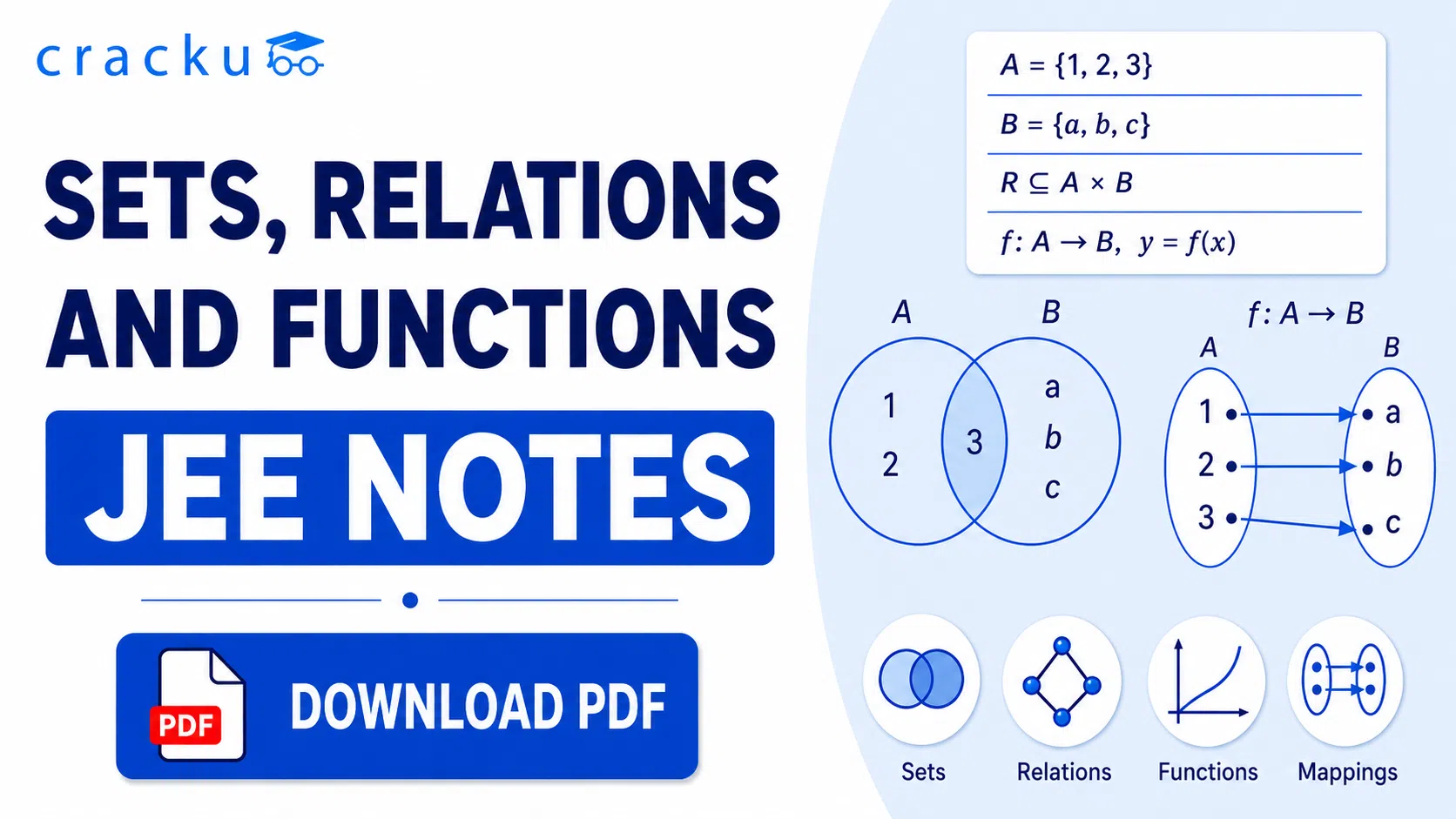
Sets, Relations and Functions is the opening chapter of JEE Mathematics and the vocabulary that almost every later chapter borrows from. Ideas such as domain, range, mapping and inverse functions appear again in limits, continuity, differentiability and inverse trigonometric functions. Practising JEE questions on Sets, Relations and Functions helps students apply concepts such as set operations, De Morgan's laws, relations, function types, composition and inverses in exam-level problems. These Sets, Relations and Functions JEE notes cover set notation and types, set operations, cardinality formulas, Cartesian products, properties of relations, function types, counting formulas, composition and inverse functions for quick revision.
Sets, Relations and Functions JEE Notes: Sets and Subsets
What Is a Set?
A set is a well-defined collection of distinct objects. These objects are called the elements or members of the set. Well-defined means that there should be no ambiguity about whether an object belongs to the set.
For example, the set of vowels in English is well-defined and can be written as:
$$\{a,e,i,o,u\}$$
However, "the set of all tall people" is not well-defined because the word tall has no fixed mathematical cut-off.
Sets are usually represented by capital letters such as A, B and C.
- If $$x$$ belongs to set A, we write $$x\in A$$.
- If $$x$$ does not belong to set A, we write $$x\notin A$$.
Ways to Represent a Set
| Method | Meaning | Example |
|---|---|---|
| Roster or listing form | List all elements inside braces | $$A=\{1,2,3,4,5\}$$ |
| Set-builder form | Describe the property satisfied by the elements | $$A=\{x:x\in\mathbb{N},x\leq5\}$$ |
The set-builder form above reads as "A is the set of all natural numbers x such that x is less than or equal to 5."
Standard Number Sets
| Symbol | Name | Contains |
|---|---|---|
| $$\mathbb{N}$$ | Natural numbers | $$\{1,2,3,4,\ldots\}$$ |
| $$\mathbb{W}$$ | Whole numbers | $$\{0,1,2,3,\ldots\}$$ |
| $$\mathbb{Z}$$ | Integers | $$\{\ldots,-2,-1,0,1,2,\ldots\}$$ |
| $$\mathbb{Q}$$ | Rational numbers | Numbers of the form $$p/q$$, where $$q\neq0$$ |
| $$\mathbb{R}$$ | Real numbers | All numbers on the number line |
These number sets are nested as:
$$\mathbb{N}\subset\mathbb{W}\subset\mathbb{Z}\subset\mathbb{Q}\subset\mathbb{R}$$
Types of Sets
| Type | Meaning | Example |
|---|---|---|
| Empty set | A set containing no elements | $$\varnothing$$ or $$\{\}$$ |
| Singleton set | A set containing exactly one element | $$\{5\}$$ |
| Finite set | A set containing a finite number of elements | $$\{2,4,6,8\}$$ |
| Infinite set | A set containing infinitely many elements | $$\mathbb{N}$$ |
| Equal sets | Two sets containing exactly the same elements | $$A=B$$ |
| Universal set | The set containing all elements under consideration | Usually denoted by $$U$$ |
Subsets and Proper Subsets
If every element of set A is also present in set B, then A is called a subset of B.
$$A\subseteq B$$
- $$A\subseteq B$$ means every element of A belongs to B.
- $$A\subset B$$ means A is a proper subset of B, so $$A\neq B$$.
- The empty set $$\varnothing$$ is a subset of every set.
- Every set is a subset of itself.
- A set containing $$n$$ elements has $$2^n$$ subsets.
- A set containing $$n$$ elements has $$2^n-1$$ proper subsets.
Worked example: find all subsets of $$A=\{1,2\}$$.
Here, $$n=2$$.
$$\text{Number of subsets}=2^2=4$$
The subsets are:
$$\varnothing,\{1\},\{2\},\{1,2\}$$
The number of proper subsets is:
$$2^2-1=3$$
Set Operations, Cardinality and De Morgan's Laws
Basic Set Operations
| Operation | Definition | Meaning |
|---|---|---|
| Union, $$A\cup B$$ | $$\{x:x\in A\text{ or }x\in B\}$$ | Elements in A or B or both |
| Intersection, $$A\cap B$$ | $$\{x:x\in A\text{ and }x\in B\}$$ | Elements common to both |
| Difference, $$A-B$$ | $$\{x:x\in A,x\notin B\}$$ | Elements in A but not B |
| Complement, $$A'$$ | $$U-A$$ | Elements in U that are outside A |
Worked example: let:
$$A=\{1,2,3,4\}$$
$$B=\{3,4,5,6\}$$
$$U=\{1,2,3,4,5,6,7\}$$
- $$A\cup B=\{1,2,3,4,5,6\}$$
- $$A\cap B=\{3,4\}$$
- $$A-B=\{1,2\}$$
- $$A'=\{5,6,7\}$$
Cardinality Formulas
For a finite set A, $$n(A)$$ represents the number of elements in A.
For two sets:
$$n(A\cup B)=n(A)+n(B)-n(A\cap B)$$
For three sets:
$$n(A\cup B\cup C)=n(A)+n(B)+n(C)-n(A\cap B)-n(B\cap C)-n(A\cap C)+n(A\cap B\cap C)$$
Worked example: in a class of 60 students, 35 play cricket, 25 play football and 10 play both. Find the number of students who play neither sport.
$$n(C\cup F)=35+25-10=50$$
Therefore:
$$\text{Neither}=60-50=10$$
De Morgan's Laws
De Morgan's laws describe how complements interact with union and intersection.
$$(A\cup B)'=A'\cap B'$$
$$(A\cap B)'=A'\cup B'$$
In simple terms, taking the complement flips the operation: union becomes intersection, and intersection becomes union.
JEE tip: Remember De Morgan's laws by thinking of the complement as a switch. Whenever the complement enters the brackets, $$\cup$$ changes to $$\cap$$ and $$\cap$$ changes to $$\cup$$.
Relations and Their Properties
Cartesian Product
The Cartesian product $$A\times B$$ is the set of all ordered pairs whose first element comes from A and second element comes from B.
$$A\times B=\{(a,b):a\in A,b\in B\}$$
The number of ordered pairs is:
$$n(A\times B)=n(A)\times n(B)$$
Worked example: if $$A=\{1,2\}$$ and $$B=\{a,b\}$$:
$$A\times B=\{(1,a),(1,b),(2,a),(2,b)\}$$
Therefore:
$$n(A\times B)=2\times2=4$$
What Is a Relation?
A relation from set A to set B is any subset of $$A\times B$$. If $$(a,b)$$ belongs to relation R, we can write $$aRb$$, meaning "a is related to b."
Types of Relations
| Property | Condition | Meaning |
|---|---|---|
| Reflexive | $$(a,a)\in R$$ for every $$a\in A$$ | Every element is related to itself |
| Symmetric | $$(a,b)\in R\Rightarrow(b,a)\in R$$ | Every relation pair has its reverse |
| Transitive | $$(a,b),(b,c)\in R\Rightarrow(a,c)\in R$$ | Relations can be chained |
| Equivalence | Reflexive, symmetric and transitive | All three properties are satisfied |
Worked example: on $$A=\{1,2,3\}$$, consider:
$$R=\{(1,1),(2,2),(3,3),(1,2),(2,1)\}$$
- Reflexive? Yes, because $$(1,1),(2,2),(3,3)$$ are present.
- Symmetric? Yes, because $$(1,2)$$ and $$(2,1)$$ both appear.
- Transitive? Yes, because the required chained pairs are present.
Therefore, R is an equivalence relation.
Functions: Types, Counting, Composition and Inverse
What Is a Function?
A function is a relation in which every element of the domain is mapped to exactly one element of the codomain.
If:
$$f:A\rightarrow B$$
then:
- Domain: set A, containing all possible inputs.
- Codomain: set B, containing all permitted outputs.
- Range: the set of outputs actually produced by the function.
An important relationship is:
$$\text{Range}\subseteq\text{Codomain}$$
The range equals the codomain only when the function is onto.
Types of Functions
| Type | Condition | Meaning |
|---|---|---|
| One-one or injective | $$f(a)=f(b)\Rightarrow a=b$$ | Different inputs produce different outputs |
| Onto or surjective | Range = Codomain | Every element of the codomain has a pre-image |
| Bijective | Both one-one and onto | Every input-output mapping is unique and complete |
For example, $$f(x)=2x$$ from $$\mathbb{R}\rightarrow\mathbb{R}$$ is both one-one and onto, whereas $$f(x)=x^2$$ from $$\mathbb{R}\rightarrow\mathbb{R}$$ is neither one-one nor onto.
Counting Functions
If $$n(A)=m$$ and $$n(B)=n$$:
| Type | Number | Condition |
|---|---|---|
| Total functions from A to B | $$n^m$$ | No restriction |
| One-one functions | $$\frac{n!}{(n-m)!}$$ | $$m\leq n$$ |
| Onto functions | Found using inclusion-exclusion | $$m\geq n$$ |
| Bijections | $$n!$$ | $$m=n$$ |
Worked example: how many functions can be formed from $$A=\{1,2,3\}$$ to $$B=\{a,b\}$$?
Here, $$m=3$$ and $$n=2$$.
$$\text{Total functions}=n^m=2^3=8$$
No one-one function is possible because the domain contains more elements than the codomain.
Composition of Functions
If:
$$f:A\rightarrow B$$
and:
$$g:B\rightarrow C$$
then the composition $$g\circ f$$ is defined as:
$$(g\circ f)(x)=g(f(x))$$
Important properties:
- $$g\circ f\neq f\circ g$$ in general, so composition is not commutative.
- $$(h\circ g)\circ f=h\circ(g\circ f)$$, so composition is associative.
- If f and g are both one-one, then $$g\circ f$$ is one-one.
- If f and g are both onto, then $$g\circ f$$ is onto.
JEE tip: Read $$g\circ f$$ from right to left. Apply f first, then apply g to the result.
Inverse Function
A function has an inverse only when it is bijective. If $$f:A\rightarrow B$$ is bijective, then:
$$f^{-1}:B\rightarrow A$$
and:
$$f^{-1}(f(x))=x$$
$$f(f^{-1}(y))=y$$
Worked example: find the inverse of:
$$f(x)=2x+3$$
Write:
$$y=2x+3$$
Solving for x:
$$x=\frac{y-3}{2}$$
Replace y by x:
$$f^{-1}(x)=\frac{x-3}{2}$$
JEE tip: To find an inverse, write $$y=f(x)$$, solve for x in terms of y and then replace y with x. Always check that the function is bijective before finding the inverse.
Sets, Relations and Functions Formula Sheet at a Glance
| Concept | Formula or Rule |
|---|---|
| Number of subsets | $$2^n$$ |
| Number of proper subsets | $$2^n-1$$ |
| Union of two sets | $$n(A\cup B)=n(A)+n(B)-n(A\cap B)$$ |
| Union of three sets | $$n(A)+n(B)+n(C)-n(A\cap B)-n(B\cap C)-n(A\cap C)+n(A\cap B\cap C)$$ |
| Complement | $$A'=U-A$$ |
| De Morgan's first law | $$(A\cup B)'=A'\cap B'$$ |
| De Morgan's second law | $$(A\cap B)'=A'\cup B'$$ |
| Cartesian product size | $$n(A\times B)=n(A)n(B)$$ |
| Relation | Any subset of $$A\times B$$ |
| Equivalence relation | Reflexive + symmetric + transitive |
| Total functions | $$n^m$$ |
| One-one functions | $$\frac{n!}{(n-m)!}$$ |
| Bijections | $$n!$$ when $$m=n$$ |
| Composition | $$(g\circ f)(x)=g(f(x))$$ |
| Inverse condition | $$f^{-1}$$ exists only when f is bijective |
JEE Important Points, Common Mistakes and Quick Revision
Points JEE Repeatedly Tests
- A set containing $$n$$ elements has $$2^n$$ subsets and $$2^n-1$$ proper subsets.
- The empty set counts as a subset of every set.
- De Morgan's laws convert unions into intersections and intersections into unions under complement.
- The range is always a subset of the codomain and equals it only for an onto function.
- An equivalence relation must be reflexive, symmetric and transitive at the same time.
- Only bijective functions have inverse functions.
- The number of total functions from an m-element set to an n-element set is $$n^m$$.
- The number of one-one functions is $$\frac{n!}{(n-m)!}$$ when $$m\leq n$$.
- Composition of functions is associative but generally not commutative.
Common Mistakes to Avoid
- Swapping m and n in the formula nᵐ. The exponent is the number of elements in the domain, while the base is the number of elements in the codomain.
- Confusing range with codomain. The codomain contains all permitted outputs, while the range contains only outputs actually produced.
- Forgetting the empty set when counting subsets. The empty set is always a subset.
- Assuming a relation is symmetric from one reversed pair. Every related ordered pair must have its reverse.
- Checking only two properties for an equivalence relation. Reflexive, symmetric and transitive must all hold.
- Applying composition in the wrong order. In $$g\circ f$$, f acts first and g acts second.
- Assuming composition is commutative. In general, $$g\circ f\neq f\circ g$$.
- Finding an inverse without checking bijectivity. A function has an inverse only if it is both one-one and onto.
- Forgetting overlap in cardinality questions. Add individual sets and subtract intersections carefully.
Quick Revision Notes for Sets, Relations and Functions
- Sets can be represented using roster form or set-builder form.
- Standard number sets follow $$\mathbb{N}\subset\mathbb{W}\subset\mathbb{Z}\subset\mathbb{Q}\subset\mathbb{R}$$.
- A set with $$n$$ elements contains $$2^n$$ subsets and $$2^n-1$$ proper subsets.
- Set operations are union, intersection, difference and complement.
- $$n(A\cup B)=n(A)+n(B)-n(A\cap B)$$.
- De Morgan's laws are $$(A\cup B)'=A'\cap B'$$ and $$(A\cap B)'=A'\cup B'$$.
- $$n(A\times B)=n(A)n(B)$$, and a relation from A to B is any subset of $$A\times B$$.
- Equivalence relation = reflexive + symmetric + transitive.
- Range is a subset of codomain and equals codomain only for onto functions.
- Total functions from m elements to n elements = $$n^m$$.
- One-one functions = $$\frac{n!}{(n-m)!}$$ when $$m\leq n$$.
- Bijections between equal-sized sets = $$n!$$.
- $$(g\circ f)(x)=g(f(x))$$ and composition is generally not commutative.
- An inverse exists only for a bijective function.
Problem-solving routine: First identify whether the question is based on set operations, cardinality, relations, function types, counting, composition or inverse functions. Translate the given information into set notation or mapping notation before applying formulas. Revise the important Sets, Relations and Functions Formulas regularly to quickly recall cardinality rules, function-counting results, De Morgan's laws, composition and inverse conditions. You can also use a JEE formula sheet during revision for faster recall of important formulas across chapters.