The number of labourers receiving at least 320 is:
PGDBA 2019 Question Paper
Answer the questions based on the following information.
The following bar diagram represents the number of daily wages (in rupees) of 100 labourers in different wage classes on a construction site. Here the class interval a-b includes all wages (in rupees) greater than or equal to a and less than b except for the interval 360-400, where both the end points are included.
No.of labourers

Wages in Rupees
Solution
Let's tabulate the information in the graph ,we get
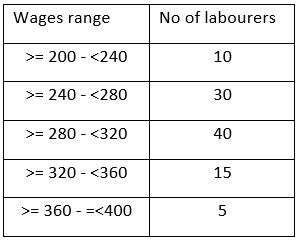
From the table, it is evident that there are 20 members who got at least 320
Hence C is the correct answer.
The number of labourers receiving less than Rs.250 is
Solution
Let's tabulate the information in the graph ,we get
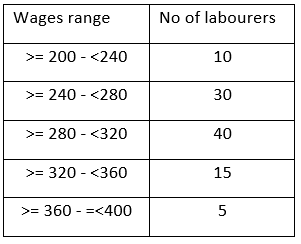
No. of labourers who receive a wage less than 250 will be at least 10 but not more than 40 in which case all the people in the range 200-240 will be receiving a wage less than 250.
So if all the people in the range >= 240 - <280 are included then to a maximum there will be 40 labourers to whom the wage will be less than 250.
Hence B is the correct answer.
The maximum wage (in Rupees), such that at least 50% of the labourers definitely earn more than that, is
Solution
Let's tabulate the information in the graph ,we get
The total number of labourer = 100
50% of the total labourers is 50 who will fall in the range >=280 - <320
$$\therefore$$ The maximum wage such that at least 50% of the labourers definitely earn more than that is 280
Hence B is the correct answer.
Answer the questions based on the following information.
The following table gives month-wise arrivals of foreign tourists in India in the years 2016 & 2017.
Table: Month-wise Arrivals of Foreign Tourists (in Thousands) in India (2016-2017)

In which month of 2017 is the percentage increase over the corresponding month of the previous year the minimum?
Solution

Let's solve the options one by one,
In 2017
Option A:The percentage increase of Foreign Tourists in FEB = 570-500/500 = 14%
Option B:The percentage increase of Foreign Tourists in JUL = 660-600/600 = 10%
Option C:The percentage increase of Foreign Tourists in SEP = 875-700/700 = 25%
Option D:The percentage increase of Foreign Tourists in DEC = 1090-1000/1000 = 9%
From the above values it is clear that the percentage increase of Foreign Tourists in DEC is minimum.
Hence D is the correct answer
In which month of 2017 is the percentage increase over the previous month the maximum?
Solution

Let's solve the options one by one,
In 2017
Option A:The percentage increase of Foreign Tourists in MAR= 720-570/570 = 26.32%
Option B:The percentage increase of Foreign Tourists in SEP= 875-696/696 = 25.72%
Option C:The percentage increase of Foreign Tourists in OCT= 984-875/875 = 12.46%
Option D:The percentage increase of Foreign Tourists in NOV= 1170-984/984 = 18.90%
It is clear that the percentage increase of Foreign Tourists in MAR is maximum
Hence A is the correct answer.
For the following questions answer them individually
If $$f(x) = \ln{\left(\dfrac{2 - x}{9 - x^2}\right)}$$, then the domain of the function $$f(x)$$ is
Solution
Logarithmic function is defined only for positive values
So $${\frac{2 - x}{9 - x^2}}$$ >0 and $$9-x^{2}$$ should not equal 0.
x $$\in$$ (-3,2)$$\cup$$ (3,$$\infty$$)
D is the correct answer.
If the system of linear equations
$$2x+ y+7z = a$$
$$6x-2y+11z = b$$
$$2x-y+3z = c$$
has infinite number of solutions, then $$a, b, c$$ must satisfy
Solution
 Share
Share
Let's represent the system of linear equations
$$2x+ y+7z = a$$
$$6x-2y+11z = b$$
$$2x-y+3z = c$$ in the Matrix Equation form
$$\begin{bmatrix}2 & 1 &7 & a \\6 & -2 & 11 & b &\\2 & -1 &3 & c \end{bmatrix}$$
Order of the matrix = 3
Now represent the matrix in echelon form
$$\begin{bmatrix}2 & 1 &7 & a \\0 & -5 & -10 & b-3a &\\0 & -2 &-4 & c-a \end{bmatrix}$$
$$\begin{bmatrix}2 & 1 &7 & a \\6 & -2 & 11 & b &\\0 & 0 &0 & 5c-5a-2b+6a \end{bmatrix}$$
Rank of the matrix = No of Non-zero rows after transforming the matrix into echelon form
The system of linear equations will have infinite solutions only if Rank of the matrix is not equal to Order of the Matrix
$$\therefore$$ 5c-5a-2b+6a=0
a-2b+5c=0
D is the correct answer.
If $$\alpha, \beta$$ are the roots of the equation $$x^2 + 3x - 3$$ , then the value of $$(\alpha + 1)^{-1} + (\beta +1)^{-1}$$ is equal to
Solution
$$\frac{1}{\alpha\ +1}+\frac{1}{\beta\ +1}=\frac{\left(\alpha\ +\beta\ +2\right)}{\alpha\ \beta\ +\alpha\ +\beta\ +1}$$
Since $$\alpha\ ,\beta\ $$ are roots of the given equation:
$$\alpha+\beta\ =-3$$
$$\alpha\times\beta\ =-3$$
Then we have: $$\frac{\left(\alpha\ +\beta\ +2\right)}{\alpha\ \beta\ +\alpha\ +\beta\ +1}=\frac{\left(-3+2\right)}{-3-3+1}=\frac{1}{5}$$
The number of real roots of the equation
$$(e^x + e^{-x})^3 + 3(e^x + e^{-x})^2 + 3(e^x + e^{-x}) = 7$$
Solution
Let $$e^x+e^{-x}=P$$
$$P^3+3P^2+3P-7 = 0$$
$$\left(P-1\right)(P^2+4P+7)=0$$
P = 1 and the other two roots are imaginary roots
$$e^x + e^{-x} = 1$$ but the minimum value of $$e^x + e^{-x} is 2$$, as $$e^x$$ is a positive number and sum of a positive number and its reciprocal is at least 2.
No. of real roots is 0.
Hence A is the correct answer.
Let $$x = -\frac{1}{1!}\cdot\frac{3}{4} + \frac{1}{2!}\cdot(\frac{3}{4})^2 -\frac{1}{3!}\cdot(\frac{3}{4})^3 +$$.... and $$y = x - \frac{x^2}{2} + \frac{x^3}{3} - $$..... then the value of y is
Solution
$$e^k = \sum_{n = 0}^\infty \frac{k^n}{n!} = 1 + k + \frac{k^2}{2!} + \frac{k^3}{3!}+ ....$$
We are given,
$$x = -\frac{1}{1!}\cdot\frac{3}{4} + \frac{1}{2!}\cdot(\frac{3}{4})^2 -\frac{1}{3!}\cdot(\frac{3}{4})^3 +....$$
This can be written as,
$$e^{-\frac{3}{4}}\ =\ 1\ -\ \frac{1}{1!}\left(\frac{3}{4}\right)\ +\ \frac{1}{2!}\left(\frac{3}{4}\right)^2-\frac{1}{3!}\left(\frac{3}{4}\right)^3....$$
$$x\ =\ -\ \frac{1}{1!}\left(\frac{3}{4}\right)\ +\ \frac{1}{2!}\left(\frac{3}{4}\right)^2-\frac{1}{3!}\left(\frac{3}{4}\right)^3....\ \ =\ e^{-\frac{3}{4}}\ -\ 1$$
We also know that,
$$\log\left(1\ +\ k\right)\ =\ k\ -\ \frac{k^2}{2}\ +\ \frac{k^3}{3}+\ ....$$
We can also write,
$$y=x-\frac{x^2}{2}+\frac{x^3}{3}-...\ =\ \log\left(1\ +\ x\right)$$
Substituting the value of x, we get,
$$y\ =\ \log\left(1\ +\ e^{-\frac{3}{4}}\ -\ 1\right)\ =\ \log\left(e^{-\frac{3}{4}}\right)\ =\ -\frac{3}{4}$$
Hence, A is the correct answer.
If $$P, Q, R$$ are subsets of some universal set, then the conditions $$P^c \cap Q \subseteq R^c \cap Q$$ and $$P^c \cap Q^c \subseteq R^c \cap Q^c$$ imply
Solution
$$P^c \cap Q \subseteq R^c \cap Q$$
$$P^c \cap Q^c \subseteq R^c \cap Q^c$$
=> $$\left(P^c\cap Q\right)U\ \left(P^c\cap Q^c\right)\subseteq\left(R^c\cap Q\right)U\ \left(R^c\cap Q^c\right)$$
=> $$P^c\cap\left(Q\ U\ Q^c\right)\subseteq R^c\cap\left(Q\ U\ Q^c\right)$$
=> $$P^c\subseteq R^c$$
=>$$R\subseteq P$$
The sides of triangle are 3 consecutive even integers with the largest side being less than 13. What is the total number of such triangles?
Solution
We have 4 cases
1: Largest side = 12 then Sides of the triangle are 8,10,12
2: Largest side = 10 then Sides of the triangle are 10,8,6
3: Largest side = 8 then Sides of the triangle are 8,6,4
4: Largest side = 6 then Sides of the triangle are 6,4,2
According to the properties of the triangle,
Sum of any two sides of a triangle is greater than the third side and difference of any two sides of a triangle is lesser than the third side
All the above cases satisfy the properties of the triangle except case 4
Hence C is the correct answer.
The circle $$x^2 + y^2 = 9$$ intersects with the parabola $$y^2 = 8x$$ at a point P in the first quadrant. The acute angle between the tangents to the circle and the parabola at the point P is
Solution
Let's find the point of intersection of the circle $$x^2 + y^2 = 9$$ and the parabola $$y^2 = 8x$$
$$x^2 + 8x= 9$$
On solving the equation we will get the values of x as 1,-9
Since the angle between the tangents has to be found in the first Quadrant, value of x is 1
$$\therefore value of y = 2\sqrt{2}$$
Let's find the slope of the tangent to the circle and the parabola
On differentiating the equation of the circle ,we get
$$2x+2y\frac{\text{d}y}{\text{d}x}=0$$
Slope of the tangent to the circle $$\ m_1= -1/ x$$
On differentiating the equation of the parabola ,we get
$$2y\frac{\text{d}y}{\text{d}x}=8$$
Slope of the tangent to the parabola $$m_2= 4/ y$$
Angle between the tangents $$\tan \theta$$= $$\frac{m_1-m_2}{1+m_1m_2}$$
=$$\frac{-1/2\sqrt{2}-4/2\sqrt{2}}{1+-1/2\sqrt{2}*4/2\sqrt{2}}$$
=$$\tan^{-1} (\frac{5}{\sqrt{2}})$$
Hence C is the correct answer.
The interior angles of a convex polygon are in arithmetic progression. The smallest angle is 120° and the common difference is 5°. Then the number of its sides is
Solution
Sum of the interior angles of a polygon is given by (2n-4)90
Smallest interior angle = 120
Let the number of sides of the convex-polygon be n
$$\frac{n}{2}\left(2(120)+\left(n-1\right)\times\ 5\right)=(2n-4)90$$
n(240+5n-5)=360n-720
$$5n^2+235n=360n-720$$
$$5n^2-125n+720=0$$
$$n^2-25n+144=0$$
n=9,16
for a polygon to be convex, each interior angle should be less than 180
The interior angle when n=16 is 120+15*5=195 So n is not equal to 16
Interior angle when n =9 is 120+8*5 =160
No of sides of the polygon =9
B is the correct answer.
Assuming that $$\sqrt{32\sqrt{32\sqrt{32.......}}}$$ is a real number, its value is
Solution
Let $$\sqrt{32\sqrt{32\sqrt{32.......}}}$$ = x
$$\sqrt{32x}$$ = x
Squaring on both sides , we get
32x=$$x^{2}$$
$$\therefore x$$ = 32
Hence B is the correct answer.
The total number of onto functions from {1,2,...10} to {1,2,.......9} is
Solution
The number of elements in set A = 10
The number of elements in set B = 9
for the mapping to be onto there will be a element in set B which has 2 pre-images from set A
Two elements can be selected in $$^{10}C_2 $$ ways and the elements in set B can be arranged in 9! ways
$$\therefore$$ No of onto functions = $$^{10}C_2 \times 9!$$
A is the correct answer
All words formed by permutations of the word `WARE' are arranged in a list according to the dictionary ordering. The position of the word 'WEAR' in this list is at number
Solution
All the words starting with the letter A =3!
All the words starting with the letter E =3!
All the words starting with the letter R =3!
All the words starting with the letter WA =2!
All the words starting with the letter WEAR =1
$$\therefore$$ position of the word 'WEAR' in this list is at number 3!*3 + 2+1
=21
Hence B is the correct answer.
The number of integers between 300 and 1100 which are divisible by either 7 or 13 but not both is
Solution
Multiples of 7 are {301,308 ................................1099}
Using the Ap formula, we can get that 301+ (n-1)7 = 1099
Giving n=115, that is there are 115 numbers that multiples of 7 in the given range.
Multiples of 13 are {312,323,.................................1092} n = 61
Multiples of 91 are {364,455.................................1092} n= 9
Number of integers which are divisible by either 7 or 13 but not both is 115+61-2*9
=158
Hence B is the correct answer.
The diameter of the circumcircle of the triangle formed by the line $$24x + 7y =168$$ and the coordinate axes is
Solution
Let's rewrite the equation $$24x + 7y =168$$ in intercept form
$$\frac{x}{7}+\frac{y}{24}$$ = 1
$$\therefore$$ The co-ordinates of the triangle are (7,0),(0,0),(0,24)
Diameter of the circumcircle formed by the vertices is given by the hypotenuse, which is between (7,0) and (0,24).
Distance between the co-ordinates (7,0) and (0,24) =$$\sqrt{7^{2} +24^{2}}$$ =25.
Hence C is the correct answer.
Let $$f: R \rightarrow R$$ be an even function that is differentiable every where except exactly at 10 distinct points. Then which of the following statements is TRUE?
Solution
An even function is symmetric about the y axis. Hence if there are 10 non-differential points, 5 of them lie towards the left side of the y-axis and 5 towards the right. Origin cannot be a non-differential point for an even function.
Hence $$f'\left(0\right)=0$$
Let the function $$f$$ be defined on the set of real numbers by
$$ f(x) = \begin{cases}x^2 - x, & if x < 1\\\frac{x^2 - 1}{3}, &if x \geq 1\end{cases}$$ then which of the following statement is TRUE ?
Solution
$$f'\left(x\right)=2x-1\ \ ,\ x<1$$
$$f'\left(x\right)=\frac{2x}{3}\ \ ,\ x\ge\ 1$$
$$f'\left(1^+\right)=\frac{2}{3}\ \ \ and\ f'\left(1^-\right)=1$$ => Right hand Derivative is not equal to LHD. Hence is is not differentiable at x=1
Left hand limit = 0 and RHL = 0. Hence it is continuos at x=1
If $$f'(x)$$ and $$g'(x)$$ exist for all $$x \in R$$, and if $$f'(x)>g'(x)$$ for all $$x \in R$$, then the curve $$y = f(x)$$ and $$y = g(x)$$ in the $$xy$$-plane
Solution
Let, $$h(x)=f(x)-g(x).$$
Then, $$h'(x)=f'(x)-g'(x)$$
Now according to question, $$f'(x)>g'\left(x\right)$$
So, $$f'(x)-g'\left(x\right)>0$$
So, $$h'(x)>0$$
So, h(x) is an increasing function.
Hence, there are two cases possible:-
Case 1:- The curve lies only in positive y axis. In this case it won't intersect x-axis. So, number of points of intersection is zero.
Case 2:- The curve is moving from negative y axis to positive y axis, since it is increasing. In this case it will intersect x-axis at 1 point. So, number of points of intersection is 1.
So option B.
The value of the integral $$\int_{-\frac{1}{\sqrt{3}}}^{\frac{1}{\sqrt{3}}} (\frac{x^2 - \tan x}{1 + x^2})dx$$ is equal to
Solution
$$\int_{-\frac{1}{\sqrt{3}}}^{\frac{1}{\sqrt{3}}} (\frac{x^2 - \tan x}{1 + x^2})dx$$
=$$\int_{-1/\sqrt{3}}^{1/\sqrt{3}} \frac{x^2+1-1 - \tan x}{1 + x^2}dx$$
=$$\int_{-1/\sqrt{3}}^{1/\sqrt{3}} \frac{x^2+1-1 - \tan x}{1 + x^2}dx$$
=$$\int_{-1/\sqrt{3}}^{1/\sqrt{3}}1-\int_{-1/\sqrt{3}}^{1/\sqrt{3}}\frac{1}{1+x^{2}}+\int_{-1/\sqrt{3}}^{1/\sqrt{3}}\frac{\tan x}{1+x^{2}}$$
=x-$$\tan^{-1}x$$+0 [$$\because$$
$$\frac{\tan x}{1+x^2}\ is\ an\ odd\ function,\ and\ will\ become\ zero$$
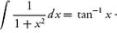

=$$\frac{1}{\sqrt{3}}-\frac{\pi}{6}$$ - $$\frac{-1}{\sqrt{3}}-\frac{\pi}{6}$$
=$$2(\frac{1}{\sqrt{3}} - \frac{\pi}{6})$$
Hence A is the correct answer.
The area enclosed between the parabolas $$y^2 = 16(1 + x )$$ and $$y^2 = 16(1 - x)$$ is
Solution
$$y^2 = 16(1 + x )$$ and $$y^2 = 16(1 - x)$$
Equating the parabolas ,we will get the point of intersection of both
16(1+x) = 16(1-x)
x=0
Substitute the value of x in the parabola $$y^2 = 16(1 + x )$$
y = $$\pm$$ 4
Point of intersection = (0,4),(0,-4)
=$$2(\int_{-4}^{4} (\frac{y^{2}-16}{16})-(\frac{16-y^{2}}{16}))$$ dy
= $$2(\int_{0}^{4} (\frac{y^{2}-16}{16})-(\frac{16-y^{2}}{16}))$$ dy [$$\because$$ $$\int_{0}^{2a} F(x)dx$$=2$$(\int_{0}^{a} F(x)dx)$$]
=$$2(\int_{0}^{4} (\frac{y^{2}}{16})-1-1+(\frac{y^{2}}{16}))$$
=$$2(\int_{0}^{4} (\frac{y^{2}}{8})-2))$$
=2$$(\frac{y^{3}}{3*8}-2y))$$ y varies from 0-4
=2(8/3 - 8)
=2(16/3) ($$\because$$ Area cant be negative)
=32/3
Hence C is the correct answer
Let $$[x]$$ denote the greatest integer less than or equal to $$x$$. The value of the integral $$\int_{0}^{\sqrt{2}} [x^2]e^x dx$$ is equal to
Solution
=$$\int_{0}^{1} 0 e^{x}dx+ \int_{1}^{\sqrt{2}} 1 e^{x} dx$$
=0 + $$e^{\sqrt{\ 2}}-e^1$$
=$$e^{\sqrt{2}} - e^{1}$$
Hence C is the correct answer.
A function $$f(x) = ax^2 + bx + c$$, where $$a, b, c \in R$$, satisfies the property $$f(x) < x$$ for all $$x \in R$$. Then which of the following statements must always be TRUE?
Solution
$$f(x) = ax^2 + bx + c$$ < x
$$ax^2+x\left(b-1\right)+c\ <0$$
Here, $$x^2$$ is the significant term that influences the value of the expression. So, if the coefficient of this term is positive, irrespective of the other terms, the expression will be greater than x when the value of x goes higher.
But if the value of a is negative, then this curve will be an inverted U-curve. So, $$a\le\ 0$$ is a correct condition.
The foot of the ladder RS in the following figure is slipping away from the wall RO.

Then the point P(a fixed point on the ladder) lies on
Solution
Let the point P be $$\left(\alpha\ ,B\right)$$
Let OS =a, OR=b and RS = c and $$\angle\ OSR=\theta\ $$ , PS = z
=> a=ccos$$\theta\ $$ and b = c sin$$\theta\ $$
$$\alpha\ =a\ -\ z\ \cos\theta\ $$ and $$\beta\ \ =z\ \sin\theta\ $$
$$\alpha\ \ =\ c\ \cos\theta\ \ -z\ \cos\theta\ $$
=> $$\cos\ \theta\ \ =\ \frac{\alpha}{c-z}$$ and $$\sin\theta\ \ \ =\ \frac{\beta\ }{z}$$
$$\ \frac{\alpha\ ^2}{\left(c-z\right)^2}+\ \frac{\beta\ ^2}{z^2}=1$$ which is an ellipse.
Given that
$$\lim_{x\rightarrow0}\frac{ae^x - be^{-x}}{x + \sin x} = 1$$
Then the value of ab is
Solution
Since the expression $$\lim_{x\rightarrow0}\frac{ae^x - be^{-x}}{x + \sin x}$$ is in 0/0 form, as RHS is a finite number, and denominator is zero, hence, the numerator must also be zero to get a finite number. Hence, a-b=0 when x tends to 0.
L'Hospitals rule can be applied
$$\lim_{x \rightarrow 0}\frac{ae^x + be^{-x}}{1 + \cos x}$$ = 1
$$\frac{a+b}{2}$$ = 1 which is valid only when a = b = 1
$$\therefore$$ ab=1
Hence D is the correct answer.
If $$\mid \frac{x + 1}{x - 1} \mid > \frac{x + 1}{x - 1}$$, then
Solution
|a|>a holds only if a is negative.
Similarly, $$\mid \frac{x + 1}{x - 1} \mid$$ will be greater than $$\frac{x + 1}{x - 1}$$ only if $$\frac{x + 1}{x - 1}$$ < 0
The above inequality is true if x lies in the range $$\in$$ (-1,1)
Hence, B is the correct answer.
How many $$6 \times 7$$ matrices are there with entries in {0,1} such that all the row totals and column totals are odd numbers?
Solution
If the row sums are all odd, then the total number of 1s is the sum of these 6 odd numbers, hence even. If the column sums are all odd, then the total number of 1s is the sum of these 7 odd numbers, hence odd. A contradiction; hence the number of such matrices is 0
Read the paragraph below and answer these questions.
Five analysts, P, Q, R, S and T each own at least one mobile phone handset. Among the five of them, they own 1 Nokia, 2 Samsung, 3 One Plus, 3 IPhone, and 1 Motorola brand handsets use the following information to answer Questions
• The analyst who owns the Nokia handset does not own any other handset.
• Q owns handsets of three different brands.
• The number of handsets owned by S is double of the number of handsets owned by T.
• There is at least one brand whose handset is owned by both R and T.
• No brand is owned by more than two analysts.
What the number of handsets owned by T?
Solution
Let's tabulate the conditions one by one.
Since we have ten handsets, we have two cases
1: T owns 2 handsets
2: T owns 1 handset
Case 1 :
If T owns 2 handsets, then S owns 4 handsets
But Q owns handsets of three different brands.
So we are left with only 1 handset to be given between P and R.
This case will not serve the purpose
Case 2: T owns 1 handset.
If T owns 1 handset, then S owns 2 handsets
Since the person who owns Nokia does not own any other handsets
It cannot be T as T and R have at least one handset brand in common
It cannot be Q as it owns three different brands.
It cannot be S as it has 2 handsets and the person who owns Nokia doesn't own any other handsets.
So it has to be P : P owns a Nokia handset.
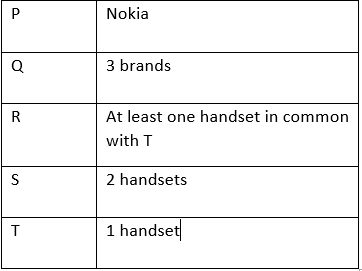
It is clear from the table that T owns 1 handset.
Hence option A is the correct answer.
Who owns the Nokia handset?
Solution
Let's tabulate the conditions one by one.
Since we have ten handsets, we have two cases
1: T owns 2 handsets
2: T owns 1 handset
Case 1 :
If T owns 2 handsets, then S owns 4 handsets
But Q owns handsets of three different brands.
So we are left with only 1 handset to be given between P and R.
This case will not serve the purpose
Case 2: T owns 1 handset.
If T owns 1 handset, then S owns 2 handsets
Since the person who owns Nokia does not own any other handsets
It cannot be T as T and R have at least one handset brand in common
It cannot be Q as it owns three different brands.
It cannot be S as it has 2 handsets and the person who owns Nokia doesn't own any other handsets.
So it has to be P : P owns a Nokia handset.
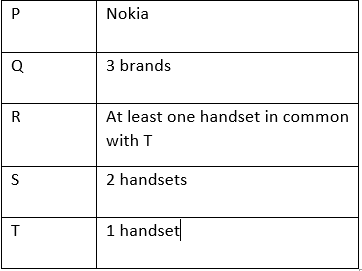
Hence option A is the correct answer.
If R owns only one handset, which brand it has to be?
Solution
Let's tabulate the conditions one by one.
Since we have ten handsets, we have two cases
1: T owns 2 headsets
2: T owns 1 headset
Case 1 :
If T owns 2 handsets, then S owns 4 handsets
But Q owns handsets of three different brands.
So we are left with only 1 handset to be given between P and R.
This case will not serve the purpose
Case 2: T owns 1 handset.
If T owns 1 handset, then S owns 2 handsets
Since the person who owns Nokia does not own any other handsets
It cannot be T as T and R have at least one headset brand in common
It cannot be Q as it owns three different brands.
It cannot be S as it has 2 handsets and the person who owns Nokia doesn't own any other handsets.
So it has to be P : P owns a Nokia handset.
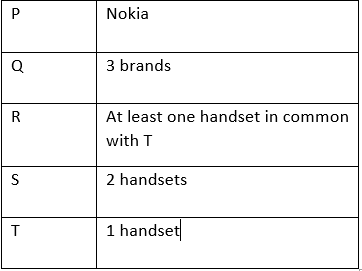
Since R must own a handset in common with T and it owns only a single handset and a handset brand can be owned by a maximum of 2 people .
R and T must own Samsung brand handset
Hence B is the correct answer.
If R owns two handsets, which of the following combinations cannot be owned by R?
Solution
Let's tabulate the conditions one by one.
Since we have ten handsets, we have two cases
1: T owns 2 headsets
2: T owns 1 headset
Case 1 :
If T owns 2 handsets, then S owns 4 handsets
But Q owns handsets of three different brands.
So we are left with only 1 handset to be given between P and R.
This case will not serve the purpose
Case 2: T owns 1 handset.
If T owns 1 handset, then S owns 2 handsets
Since the person who owns Nokia does not own any other handsets
It cannot be T as T and R have at least one headset brand in common
It cannot be Q as it owns three different brands.
It cannot be S as it has 2 handsets and the person who owns Nokia doesn't own any other handsets.
So it has to be P : P owns a Nokia handset.
Let's consider the options one by one,
Option A: If R owns handsets of Samsung and One Plus then T can own Samsung ,Q can own Motorola ,Iphone ,One Plus , S can own Iphone brand handsets. So this combination is possible.
Option B: If R owns handsets of Samsung and Iphone then T can own Samsung ,Q can own Motorola ,Iphone ,One Plus , S can own One Plus brand handsets. So this combination is possible.
Option C: If R owns handsets of One Plus and Motorola then T can own One Plus.We are left with only two brands but Q has handsets of 3 different brands. So this combination is not possible.
Hence C is the correct answer.
If Q and S have at least two brands in common, then what is the maximum number of handsets that Q and S together can own?
Solution
Let's tabulate the conditions one by one.
Since we have ten handsets, we have two cases
1: T owns 2 headsets
2: T owns 1 headset
Case 1 :
If T owns 2 handsets, then S owns 4 handsets
But Q owns handsets of three different brands.
So we are left with only 1 handset to be given between P and R.
This case will not serve the purpose
Case 2: T owns 1 handset.
If T owns 1 handset, then S owns 2 handsets
Since the person who owns Nokia does not own any other handsets
It cannot be T as T and R have at least one headset brand in common
It cannot be Q as it owns three different brands.
It cannot be S as it has 2 handsets and the person who owns Nokia doesn't own any other handsets.
So it has to be P : P owns a Nokia handset.
Since we have to maximise the number of handsets with Q and S together ,R and T owns 1 handset each i.e Samsung .
S owns 2 handsets of either Iphone or One plus ,Q owns 4 handsets
So maximum number of handsets that Q and S together can own is 7
Hence C is the correct answer
For the following questions answer them individually
Each of the following four sentences has two words within brackets. The word which has been highlighted has been used as the most appropriate word for the sentence. In one of the sentences, the wrong word has been highlighted. Identify that sentence and indicate that option as your answer.
Solution
Let's have a look at the meanings of each of the words
Peak : The pointed top of a mountain or the point of highest activity, quality, or achievement.
Peek: Look quickly or furtively.
Peak traffic hours means rush hours. Hence this is used correctly in the given context
Ensure : Make sure that (something) will occur or be the case
Insure: Arrange for compensation in the event of damage to or loss of (property)
Insure means arrange for compensation in the event of theft. Hence this is used correctly in the given context
Illicit: Forbidden by law, rules, or custom
Elicit: Evoke or draw out (a reaction, answer, or fact) from someone.
Elicit means draw out or to take opinion from someone. Hence this is used correctly in the given context
Principal: First in order of importance; main.
Principle: A rule or belief governing one's behaviour
Principal means main or important is misused in the given context.
Hence D is the correct answer.
Each of the following four sentences has two words within brackets. The word which has been highlighted has been used as the most appropriate word for the sentence. In one of the sentences, the wrong word has been highlighted. Identify that sentence and indicate that option
Solution
Let's have a look at the meanings of each of the words.
Complemented: A thing that contributes extra features to something else in such a way as to improve or emphasize its quality.
Complimented: A polite expression of praise or admiration
A compliment which means a polite expression of praise is used correctly in the sentence.
Beneficent:(of a person) generous or doing good.
Beneficial: Resulting in good; favourable or advantageous
A rule can be beneficent. Hence beneficial was misused in the sentence.
Oversight: An unintentional failure to notice or do something.
Oversite: A layer of concrete used to seal the earth under the ground floor of a house
An oversight which means failure to notice is used correctly in the sentence
Break: Fail to continue with
Brake: A device for slowing or stopping a moving vehicle
A break which means failure to continue is used correctly in the sentence.
Hence B is the correct answer.
Arrange the sentences in the most logical order to form a coherent paragraph. From the given options (A, B, C, D) choose the most appropriate option.
(i) But state efforts to build up the data sector in rural areas have resulted in a plethora of under-used sites.
(ii) At the same time, data centres in main cities are already running at capacity. In Beijing and Shanghai, demand outstrips supply by 20 and 25 per cent, respectively, according to the ministry.
(iii) There are twice as many data centres in north-eastern China than required, according to figures from China's Ministry of Industry and Information Technology.
(iv) Tech groups have been given incentives by Chinese regulators to set up their onshore data storage in poorer, more remote areas, with inducements such as free land and cheap power.
Solution
After going through the sentence, we can understand that the paragraph talks about setting up data centres in China.
Sentence 4 which talks about setting up data centres in poorer remote areas sets up the context Hence this can be the opening sentence.
Sentence 1 which refutes the sentence 4 can be its continuation.
Sentence 1 and 3 are pairs as they talk about the data centres in main cities.
Sentence 2 talks about the number of data centres in China concludes the paragraph.
Hence the correct sequence is 4132.
A is the correct answer.
Arrange the sentences in the most logical order to form a coherent paragraph. From the given options (A, B, C, D) choose the most appropriate sequence.
(i) For almost a billion years, while its core churned and produced a protective magnetic field, Mars may have been among the friendlier places for life as we know it to set up and flourish.
(ii) But that is what the $2.4-billion 2020 rover will attempt to do.
(iii) Though Mars is a parched, toxic desert today, the planet was once much warmer and covered in liquid seas.
(iv) The trouble is, finding evidence for past life on an alien world, especially if that extinct life is microscopic, is not exactly easy.
Solution
After going through the sentences, we can understand that the paragraph talks about life on the planet Mars.
Sentence 3 introduces the topic as it talks about Mars and its qualities.
3 and 1 are pairs as sentence 1 further talks about Mars and how it has been among friendlier places to live.
Sentence 4 which furthers the discussion by stating the difficulty in tracing the past evidence.
Sentence 2 concludes talking about how 2020 rover will attempt to do.
The sequence is 3142.
D is the correct answer.
Arrange the sentences in the most logical order to form a coherent paragraph. From the given options (A, B, C, D) choose the most appropriate sequence.
(i) Part of the rapid slowing reflected specific problems in the German car industry, where changes in emissions regulation have had a one-off impact on production.
(ii) But even without that, growth would barely have been positive.
(iii) Last week it was revealed that Germany, one of the few reliable engines of eurozone growth since the global financial crisis, had seen a 0.2 per cent fall in GDP in the third quarter.
(iv) Moreover, indicators of business sentiment show that underlying growth momentum has slowed across the eurozone.
Solution
After going through the sentences, we can understand that the paragraph talks about the financial crisis in Germany.
Sentence 3 introduces the topic by stating a 0.2 per cent fall in GDP.
Sentence 1 will follow it as it explains the reasons for the downfall.
Sentence 2 refutes the explanation in sentence 1.
Sentence 4 furthers the discussion by indicators of business sentiment which slowed the growth across the eurozone.
3124 is the correct sequence.
B is the correct answer.
Read the passage below and choose the most appropriate answer for the questions that follow.
Passage I
One pictured a woman holding an hourglass next to the words: "Beauty has no age limit. Fertility does." Another portrayed a pair of baby shoes wrapped in a ribbon of the Italian flag. Yet another showed a man holding a half-burned cigarette: "Don't let your sperm go up in smoke" it read.
Were they part of a government effort to promote "Fertility Day" on Sept. 22? A campaign intended to encourage Italians to have more babies. Instead, the ads set off a furore were denounced as being offensive, and within days were withdraw. What they did succeed in doing, however, was to ignite a deeper and lasting debate about why it is that Italy has one of the lowest birthrates in the world, and what can be done about it.
The problem is not a lack of desire to have children, critics of the campaign say, but rather the lack of meaningful support provided by the government and many employers in a country where the family remains the primary source of child care. Many working women, without an extended family to care for a child, face a dilemma, as private child care is expensive. Some also worry that their job security may be undermined by missing workdays because of child care issues. Many companies do not offer flexible hours for working mothers.
Not surprisingly, Italy's long slowdown in childbirth has coincided with its recent economic slump. But Italian families have been shrinking for decades. In 2015, 488,000 babies were born in Italy, the fewest since the country first unified in 1861. It has one of the lowest birthrates in Europe, with 1.37 children per woman, compared with a European average of 1.6, according to Eurostat figures. By contrast, in France, the economy has been flat, too, but a family-oriented system provides a far more generous social safety net that includes daycare and subsidies for families to have children. There, women have two children each on average.
The Ministry of Health began the fertility campaign on Aug. 31 with a group of online advertisements and a hashtag on Twitter. The goal was to publicize a series of public meetings on Fertility Day and encourage Italians to have more children. Even Prime Minister Matteo Renzi, whose own health minister started the campaign distanced himself from the ads in a radio interview. Under Mr Renzi, Italy's government has paid families with a so-called baby bonus of 80 to 160 euros, or about $90 to $180, for low- and middle-income households. And it has approved labour laws giving more flexibility on parental leave.
But Italy allocates only 1 per cent of its gross domestic product to social protection benefits — half the European average. One child out of three here is at risk of relative poverty.Italy's health minister, Beatrice Lorenzin, responding on Facebook, wrote that the Fertility Day, the campaign was not a "call to reproduction" but a day to discuss "the fertility issues that 15 per cent of Italians deal with." She promptly cancelled the campaign. "I am saddened that the launch of the advertising campaign misled many people," Ms.Lorenzine said. "I withdrew it to change it."
Which one of the following sentences is inaccurate based on all the facts detailed in the passage?
Solution
Option A can be inferred from the fifth paragraph, where the author has mentioned that Italy allocates only 1 per cent of its gross domestic product to social protection benefits — half the European average. One child out of three here is at risk of relative poverty
Option C can be inferred from the fourth paragraph, where the author mentions the birth rates of Italy and France as 1.37 and 2, respectively.
Option D can be inferred from the penultimate paragraph, where Prime Minister Matteo Renzi, whose own health minister started the campaign, distanced himself from the ads in a radio interview. Under Mr Renzi, Italy's government has paid families with a so-called baby bonus of 80 to 160 euros, or about $90 to $180, for low- and middle-income households. and it has approved labour laws giving more flexibility on parental leave
Option B cannot be inferred, as the ad campaign was launched with a series of online advertisements and a hashtag on Twitter. Therefore, B is the correct answer.
According to the passage, what is the key reason for Italy's low fertility rate?
Solution
In the fourth paragraph, the author emphasized a family-oriented system provides a far more generous social safety net that includes daycare and subsidies for families to have children which were existing in France where the fertility rate is 2 whereas it lacks in Italy's economy which has the lowest fertility rate of 1.37.Hence the absence of a support system for families with children is the key reason for Italy's low fertility rate.
C is the correct answer.
Which of the following words best captures Prime Minister Matteo Renzi's reaction to the fertility campaign?
Solution
Disassociation which means to separate or to detach. In the penultimate paragraph, the author has mentioned Prime Minister Matteo Renzi distanced himself from the ads in a radio interview. Hence, disassociation which means the state of being disconnected would be the Prime Minister Matteo Renzi's reaction to the fertility campaign.
Belligerence which means hostile and aggressive.Prime Minister Matteo Renzi was nowhere offensive to the fertility campaign.
Indifference which means lack of concern. We can infer that Prime Minister Matteo Renzi was not indifferent as during his rule Italy's government has paid families with a so-called baby bonus of 80 to 160 euros, or about $90 to $180, for low- and middle-income households. And it has approved labour laws giving more flexibility on parental leave.
Solidarity which means mutual support within a group.No wherein the passage the author has mentioned support among the group.
Hence A is the correct answer.
Based on the passage, which of the following measures will not have a meaningful impact on Italy's fertility rate even if the government worked hard to implement them?
Solution
Option A: In the third paragraph, the author has mentioned "Many companies do not offer flexible hours for working mothers" as one of the reasons why Italy has the lowest birthrate. So if all private companies allow flexible working hours to pregnant women and new moms, this will have a meaningful impact on Italy's fertility rate.
Option B: In the fourth paragraph, the author emphasised the role of a family-oriented system, which provides a far more generous social safety net that includes daycare and subsidies for families to have children. Hence, this will have a meaningful impact on Italy's fertility rate.
Option C: In the third paragraph, the author mentions, "Many working women, without an extended family to care for a child, face a dilemma, as private childcare is expensive. Some also worry that their job security may be undermined by missing workdays because of childcare issues. " Therefore, this will have a significant impact on Italy's fertility rate.
Option D: In the third paragraph, the author mentions, "It is not a lack of desire to have children , but the lack of significant support provided by the government and many employers in a country where the family remains the primary source of child care is the reasons why Italy has the lowest birthrate." Therefore, spending money on advertisements that encourage Italians to have more children will not have a meaningful impact on Italy's fertility rate, even if the government works hard to implement them. Thus, Option D is the correct answer.
The passage mentions that the idea of "Fertility Day" was "denounced as being offensive" According to the campaign. what exactly did the Italians find "offensive"?
Solution
In paragraph three, the author has mentioned that the problem is not a lack of desire to have children, critics of the campaign say, but rather the lack of meaningful support provided by the government and many employers in a country where the family remains the primary source of child care. Many working women, without an extended family to care for a child, face a dilemma, as private child care is expensive. Some also worry that their job security may be undermined by missing workdays because of child care issues. Many companies do not offer flexible hours for working mothers. These are some of the reasons why Italy's fertility is low which the government failed to address. This is aptly captured in option C.
The other options are not relevant from the passage's perspective.
Hence C is the correct answer.
Read the passage below and choose the most appropriate answer for the questions that follow.
Passage II
The 'trolley problem' used to be an obscure question in philosophical ethics. It runs as follows: a trolley, or a train, is speeding down a track towards a junction. Some moustache-twirling evildoer has tied five people to the track ahead and another person to the branch line. You are standing next to a lever that controls the junction. Do nothing, and the five people will be killed. Pull the lever, and only one person dies. What is the ethical course of action?
The excitement around self-driving cars, though, has made the problem famous. A truly self-driving car, after all, will have to be given ethical instructions of some sort by its human programmers. That has led to a miniature boom for the world's small band of professional ethicists, who suddenly find themselves in hot demand.
In a paper just published in Nature, a team of psychologists and computer scientists describe a different approach. Rather than asking said a small band of philosophers for their thoughts, this team, led by Edmond Awad of the Massachusetts Institute of Technology (MIT), decided instead to ask the general public. They created the "Moral Machine", a website which presents visitors with a series of choices about whom to save and whom to kill. In one, for instance, a self-driving car experiences brake an ahead of a pedestrian crossing. If it carries on in a straight line, a man, a woman and two homeless people of unspecified sex will be run down. If it serves, the death count will be the same, but the victims will be two women and two male business executives. What should the car do?
The strongest preferences, expressed by respondents from all over the world, were for saving human lives over animal ones, preferring to save many rather than few and prioritising children over the old. There were weaker preferences for saving women over men, pedestrians over passengers in the car and for taking action rather than doing nothing. Criminals were seen as literally sub-human ranking below dogs in the public's priority list, above cats.
Preferences differed between countries. The preference for saving women, for instance, was stronger in places with higher levels of gender equality. The researchers found that the world's countries clustered into three broad categories, which they dubbed "western" covering North America and the Christian cultural countries of Europe, "Eastern", including the Middle East, India and China and "Southern" Latin America and many of France's Former colonial possessions. Countries in the Eastern cluster, for instance, showed a weaker preference for sparing the young over the elderly, while the preference for humans over animals was less pronounced in southern nations. Self-driving cars, it seems, may need the ability to download new moralities when they cross national borders.
Among the following, who would be the equivalent of the person pulling the lever in the 'trolley problem'?
Solution
It is mentioned in the second paragraph, 'A truly self-driving car, after all, will have to be given ethical instructions of some sort by its human programmers ' Hence the equivalent of the person pulling the lever in the 'trolley problem' will be human programmers who give ethical instructions.
Though the excitement of self -driving cars led to the miniature boom of professional ethicists , It is because of the human programmers who gave ethical instructions of some sort to the self-driving cars which have led to the trolley problem.
CEOs of multinational car manufacturing firms and driverless-car owners who use their cars to travel abroad are nowhere mentioned in the passage.
Hence D is the correct answer.
The statement "self-driving cars...may need the ability to download new moralities when they cross national borders" implies that,
Solution
It is mentioned in the last paragraph that since the preferences to save differed among nations and the researchers found that the world's countries clustered into three broad categories, which they dubbed "western" covering North America and the Christian cultural countries of Europe, "Eastern", including the Middle East, India and China and "Southern" Latin America and many of France's Former colonial possessions.
Option A: It is not about being acceptable in different countries, but a comment on how different countries have different values.
Option B: This option is close, but is a literal interpretation of the text, with no implication in place. Furthermore, it is not that countries do not have regulations for self-driving cars, but rather thatthey would have those.
Option C: This is what the sentence implies. With the segregation of preferences for lives, different places have different ideas on who should be prioritized. And if we were to introduce self-driving cars, we would have to modify them according to the preferences of that culture.
Option D: Training local software programmers is beyond the scope of the argument and can be eliminated as an option.
Therefore, Option C is the correct answer.
Which of the following references in driverless-car navigation software is likely to get acceptance from the largest number of countries?
Solution
It is evident from the lines in the fourth paragraph that 'The strongest preferences, expressed by respondents from all over the world, were for saving human lives over animal ones, preferring to save many rather than few and prioritising children over the old. There were weaker preferences for saving women over men, pedestrians over passengers in the car and for taking action rather than doing nothing. Criminals were seen as literally sub-human ranking below dogs in the public's priority list, above cats.'
Option B is the clearest culmination of these, pitting babies and women with animals against an equal number of criminals (who traditionally were given a lower preference).
Making Option B the best choice.
Regulatory approval of which of the following preferences of car-navigation software is likely to face most uncertainty in a 'Southern' country with high levels of gender in-equality?
Solution
In the Southern countries, it is given that there is a weaker preference while choosing between humans and animals. Moreover, it is given that this particular nation has high levels of gender inequality, so there would hardly be any preference between either gender.
So for the software to face the most uncertainty in this region, the two potential victims should be a human and an animal respectively and both of opposite genders.
The option that best describes such a situation is Option B.
Which of the following, if achieved, might solve the ethical dilemmas faced by those designing navigation software for driverless cars?
Solution
Option A: An international agreement to develop a separate signalling system for driverless cars would not solve the dilemma because preferences differed among nations.Hence A is not the correct answer.
Option B: A solution to the 'trolley problem' and an international agreement that cars should run on rails instead of roads will not solve the dilemma because Trolley problem will have different preferences to save in different countries and whether cars should run on rail or roads is beyond the scope of the passage.
Option C: As explained in option B, formation of an international panel of professional ethicists to solve the 'trolley problem' will not solve the dilemma
Option D: An international agreement on guidelines for development of navigation software for self-driving cars will solve the dilemma because preference to save differed among Nations.Having an international agreement on guidelines will help the self-driving cars.
Hence D is the correct answer.

