For the following questions answer them individually
A quantity $$f$$ is given by $$f = \sqrt{\frac{hc^5}{G}}$$ where $$c$$ is speed of light, $$G$$ is universal gravitational constant and $$h$$ is the Planck's constant. Dimension of $$f$$ is that of:
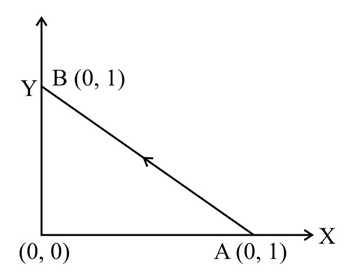
Consider a force $$\vec{F} = -x\hat{i} + y\hat{j}$$. The work done by this force in moving a particle from point $$A(1,0)$$ to $$B(0,1)$$ along the line segment is: (all quantities are in SI units)
Two particles of equal mass $$m$$ have respective initial velocities $$u\hat{i}$$ and $$u\left(\frac{\hat{i}+\hat{j}}{2}\right)$$. They collide completely inelastically. The energy lost in the process is:
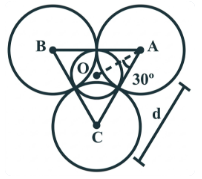
Three solid spheres each of mass $$m$$ and diameter $$d$$ are stuck together such that the lines connecting the centres form an equilateral triangle of side of length $$d$$. The ratio $$\frac{I_0}{I_A}$$ of moment of inertia $$I_0$$ of the system about an axis passing the centroid and about center of any of the spheres $$I_A$$ and perpendicular to the plane of the triangle is:
A body A of mass $$m$$ is moving in a circular orbit of radius $$R$$ about a planet. Another body B of mass $$\frac{m}{2}$$ collides with A with a velocity which is half $$\left(\frac{v}{2}\right)$$ the instantaneous velocity $$\vec{v}$$ of A. The collision is completely inelastic. Then, the combined body:
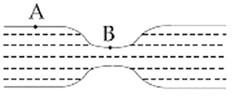
Water flows in a horizontal tube (see figure). The pressure of water changes by $$700 \; Nm^{-2}$$ between $$A$$ and $$B$$ where the area of cross section are $$40 \; cm^2$$ and $$20 \; cm^2$$, respectively. Find the rate of flow of water through the tube. (density of water $$= 1000 \; kgm^{-3}$$)
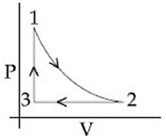
Which of the following is an equivalent cyclic process corresponding to the thermodynamic cyclic given in the figure? Where, $$1 \to 2$$ is adiabatic. (Graphs are schematic and are not to scale)
Consider two ideal diatomic gases $$A$$ and $$B$$ at some temperature $$T$$. Molecules of the gas $$A$$ are rigid, and have a mass $$m$$. Molecules of the gas $$B$$ have an additional vibrational mode and have a mass $$\frac{m}{4}$$. The ratio of the specific heats $$(C_V)_A$$ and $$(C_V)_B$$ of gas $$A$$ and $$B$$, respectively is:
Three harmonic waves having equal frequency $$\nu$$ and same intensity $$I_0$$, have phase angles $$0$$, $$\frac{\pi}{4}$$ and $$-\frac{\pi}{4}$$ respectively. When they are superimposed the intensity of the resultant wave is close to:
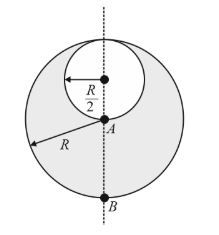
Consider a sphere of radius $$R$$ which carries a uniform charge density $$\rho$$. If a sphere of radius $$\frac{R}{2}$$ is carved out of it, as shown, the ratio $$\frac{|\vec{E_A}|}{|\vec{E_B}|}$$ of magnitude of electric field $$\vec{E_A}$$ and $$\vec{E_B}$$, respectively, at points $$A$$ and $$B$$ due to the remaining portion is:
An electric dipole of moment $$\vec{p} = (-\hat{i} - 3\hat{j} + 2\hat{k}) \times 10^{-29}$$ C m at the origin $$(0,0,0)$$. The electric field due to this dipole at $$\vec{r} = +\hat{i} + 3\hat{j} + 5\hat{k}$$ (note that $$\vec{r} \cdot \vec{p} = 0$$) is parallel to:
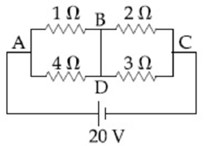
In the given circuit diagram, a wire is joining points B and D. The current in this wire is:
Radiation, with wavelength $$6561$$ Ã… falls on a metal surface to produce photoelectrons. The electrons are made to enter a uniform magnetic field of $$3 \times 10^{-4}$$ T. If the radius of the largest circular path followed by the electrons is $$10$$ mm, the work function of the metal is close to:
A long, straight wire of radius $$a$$ carries a current distributed uniformly over its cross-section. The ratio of the magnetic fields due to the wire at distance $$\frac{a}{3}$$ and $$2a$$, respectively from the axis of the wire is:
A charged particle of mass 'm' and charge 'q' moving under the influence of uniform electric field $$E\hat{i}$$ and a uniform magnetic field $$B\hat{k}$$ follows a trajectory from point P to Q as shown in figure. The velocities at P and Q are respectively, $$v\hat{i}$$ and $$-2v\hat{j}$$. Then which of the following statements (A, B, C, D) are the correct? (Trajectory shown is schematic and not to scale)
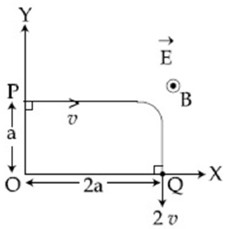
(A) $$E = \frac{3}{2}\left(\frac{mv^2}{qa}\right)$$
(B) Rate of work done by the electric field at P is $$\frac{3}{2}\left(\frac{mv^3}{a}\right)$$
(C) Rate of work done by both the fields at Q is zero
(D) The difference between the magnitude of angular momentum of the particle at P and Q is $$2mav$$.
The electric fields of two plane electromagnetic waves in vacuum are given by $$\vec{E_1} = E_0\hat{j}\cos(\omega t - kx)$$ and $$\vec{E_2} = E_0\hat{k}\cos(\omega t - ky)$$. At $$t = 0$$, a particle of charge $$q$$ is at origin with a velocity $$\vec{v} = 0.8c\hat{j}$$ ($$c$$ is the speed of light in vacuum). The instantaneous force experienced by the particle is:
A vessel of depth $$2h$$ is half filled with a liquid of refractive index $$2\sqrt{2}$$ and the upper half with another liquid of refractive index $$\sqrt{2}$$. The liquids are immiscible. The apparent depth of the inner surface of the bottom of the vessel will be:
The aperture diameter of a telescope is $$5$$ m. The separation between the moon and the earth is $$4 \times 10^5$$ km. With light of wavelength $$5500$$ Ã…, the minimum separation between objects on the surface of moon, so that they are just resolved, is close to:
A particle moving with kinetic energy $$E$$ has de Broglie wavelength $$\lambda$$. If energy $$\Delta E$$ is added to its energy, the wavelength become $$\frac{\lambda}{2}$$. Value of $$\Delta E$$, is:
If the screw on a screw-gauge is given six rotations, it moves by $$3 \; mm$$ on the main scale. If there are 50 divisions on the circular scale the least count of the screw gauge is:
The distance $$x$$ covered by a particle in one dimensional motion varies with time $$t$$ as $$x^2 = at^2 + 2bt + c$$. If the acceleration of the particle depends on $$x$$ as $$x^{-n}$$, where $$n$$ is an integer, the value of $$n$$ is ___________.
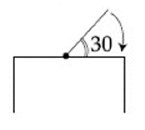
One end of a straight uniform $$1 \; m$$ long bar is pivoted on horizontal table. It is released from rest when it makes an angle $$30°$$ from the horizontal (see figure). Its angular speed when it hits the table is given as $$\sqrt{n}$$ rad $$s^{-1}$$, where $$n$$ is an integer. The value of $$n$$ is ___________.
A body of mass $$m = 10$$ kg is attached to one end of a wire of length $$0.3$$ m. What is the maximum angular speed (in rad $$s^{-1}$$) with which it can be rotated about its other end in a space station without breaking the wire?
[Breaking stress of wire $$(\sigma) = 4.8 \times 10^7$$ N $$m^{-2}$$ and area of cross-section of the wire $$= 10^{-2}$$ $$cm^2$$]
In a fluorescent lamp choke (a small transformer) $$100V$$ of reverse voltage is produced when the choke current changes uniformly from $$0.25A$$ to $$0$$ in a duration of $$0.025 \; ms$$. The self-inductance of the choke (in $$mH$$) is estimated to be ___________.
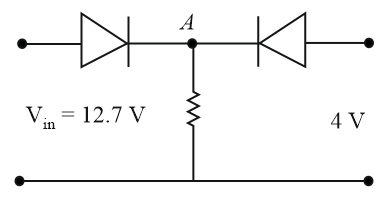
Both the diodes used in the circuit shown are assumed to be ideal and have negligible resistance when these are forward biased. Built in potential in each diode is $$0.7V$$. For the input voltages shown in the figure, the voltage (in Volts) at point A is ___________.