Join WhatsApp Icon JEE WhatsApp Group

NTA JEE Main 2nd April 2017 Offline - Chemistry

For the following questions answer them individually

The most abundant elements by mass in the body of a healthy human adult are: Oxygen (61.4%); Carbon (22.9%), Hydrogen (10.0%); and Nitrogen (2.6%). The weight which a 75 kg person would gain if all $$^{1}$$H atoms are replaced by $$^{2}$$H atoms is:

Among the following species which option contains all isoelectronic species?

The radius of the second Bohr orbit for hydrogen atom is
(Planck's constant, (h) = $$6.6262 \times 10^{-34}$$ Js; mass of electron = $$9.1091 \times 10^{-31}$$ kg; charge of electron = $$1.60210 \times 10^{-19}$$ C; permittivity of vacuum, ($$\epsilon_{0}$$) = $$8.854185 \times 10^{-12}$$ kg$$^{-1}$$ m$$^{-3}$$ A$$^{2}$$)

Given:
C(graphite) + O$$_{2}$$(g) → CO$$_{2}$$(g); $$\Delta_{r}$$H° = -393.5 kJ mol$$^{-1}$$
H$$_{2}$$(g) + $$\frac{1}{2}$$O$$_{2}$$(g) → H$$_{2}$$O(l); $$\Delta_{r}$$H° = -285.8 kJ mol$$^{-1}$$
CO$$_{2}$$(g) + 2H$$_{2}$$O(l) → CH$$_{4}$$(g) + 2O$$_{2}$$(g); $$\Delta_{r}$$H° = +890.3 kJ mol$$^{-1}$$
Based on the above thermochemical equations, the value of $$\Delta_{r}$$H° at 298 K for the reaction
C(graphite) + 2H$$_{2}$$(g) → CH$$_{4}$$(g) will be:

Both lithium and magnesium display several similar properties due to the diagonal relationship; however, the one which is incorrect is:

A water sample has ppm level concentration of following anions
F$$^{-}$$ = 10; SO$$_{4}^{2-}$$ = 100; NO$$_{3}^{-}$$ = 50
The anion/anions that make/makes the water sample unsuitable for drinking is/are

A metal crystallizes in a face centred cubic structure. If the edge length of its unit cell is 'a', the closest approach between two atoms in the metallic crystal will be

The freezing point of benzene decreases by 0.45°C on adding 0.2 g of acetic acid to 20 g of benzene. If acetic acid associates to form a dimer in benzene, then what is the percentage association of acetic acid in benzene?
K$$_{f}$$ for benzene = 5.12 K kg mol$$^{-1}$$

Given
E°$$_{Cl_{2}/Cl^{-}}$$ = 1.36 V, E°$$_{Cr^{3+}/Cr}$$ = -0.74 V
E°$$_{Cr_{2}O_{7}^{2-}/Cr^{3+}}$$ = 1.33 V, E°$$_{MnO_{4}^{-}/Mn^{2+}}$$ = 1.51 V
Among the following, the strongest reducing agent is:

Two reactions A$$_{1}$$ and A$$_{2}$$ have identical pre-exponential factors. The activation energy of A$$_{1}$$ is more than A$$_{2}$$ by 10 kJ mol$$^{-1}$$. If k$$_{1}$$ and k$$_{2}$$ are the rate constants for reactions A$$_{1}$$ and A$$_{2}$$, respectively at 300 K, then $$\ln\frac{k_{2}}{k_{1}}$$ is equal to
(R = 8.314 J mol$$^{-1}$$ K$$^{-1}$$)

The Tyndall effect is observed only when the following conditions are satisfied,
i. The diameter of the dispersed particles is much smaller than the wavelength of the light used.
ii. The diameter of the dispersed particle is not much smaller than the wavelength of the light used.
iii. The refractive indices of the dispersed phase and dispersion medium are almost similar in magnitude.
iv. The refractive indices of the dispersed phase and dispersion medium differ greatly in magnitude.

Which of the following reactions is an example of a redox reaction?

The sodium salt of an organic acid X produces effervescence with concentrated H$$_{2}$$SO$$_{4}$$. X reacts with the acidified aqueous CaCl$$_{2}$$ solution to give a white precipitate which decolourises acidic solution of KMnO$$_{4}$$. X is

On treatment of 100 mL of 0.1 M solution of CoCl$$_{3}$$.6H$$_{2}$$O with excess AgNO$$_{3}$$; $$1.2 \times 10^{22}$$ ions are precipitated. The complex is:

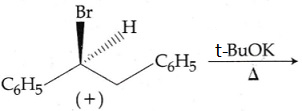
The major product obtained in the following reaction is,

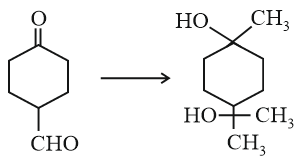
The correct sequence of reagents for the following conversion will be