
Join Our JEE Preparation Group
Prep with like-minded aspirants; Get access to free daily tests and study material.
Sign in
Please select an account to continue using cracku.in
↓ →
Join Our JEE Preparation Group
Prep with like-minded aspirants; Get access to free daily tests and study material.
We begin with the first law of thermodynamics, which is the fundamental energy balance for any thermodynamic process. It is written in chemistry sign-convention form as
$$\Delta U = q + w$$
where
$$\Delta U$$ is the change in internal energy of the system,
$$q$$ is the heat supplied to the system (positive when heat enters), and
$$w$$ is the work done on the system (positive when work is done on the system).
Now we analyse what happens in different kinds of processes mentioned in the options.
Isobaric process: In an isobaric process the pressure is constant, but heat can flow. Therefore the heat term $$q$$ is generally not zero, so from the first law we would still have $$\Delta U = q + w$$, not simply equal to work. Hence $$\Delta U$$ is not automatically equal to isobaric work.
Isothermal process: In an isothermal process the temperature remains constant. For an ideal gas, constant temperature implies $$\Delta U = 0$$, yet work can be non-zero because heat enters or leaves exactly to balance the work. So $$\Delta U$$ is not equal to isothermal work either, because in fact $$\Delta U = 0$$ for an ideal gas undergoing an isothermal change.
Isochoric process: In an isochoric process the volume is constant, which means no pressure-volume work is possible. Therefore $$w = 0$$. Substituting $$w = 0$$ in the first-law equation gives
$$\Delta U = q + 0 = q$$
So here the internal energy change equals the heat exchanged, not the work. Hence $$\Delta U$$ is equal to the heat, not to any work term. Thus iso-choric work is not the correct choice.
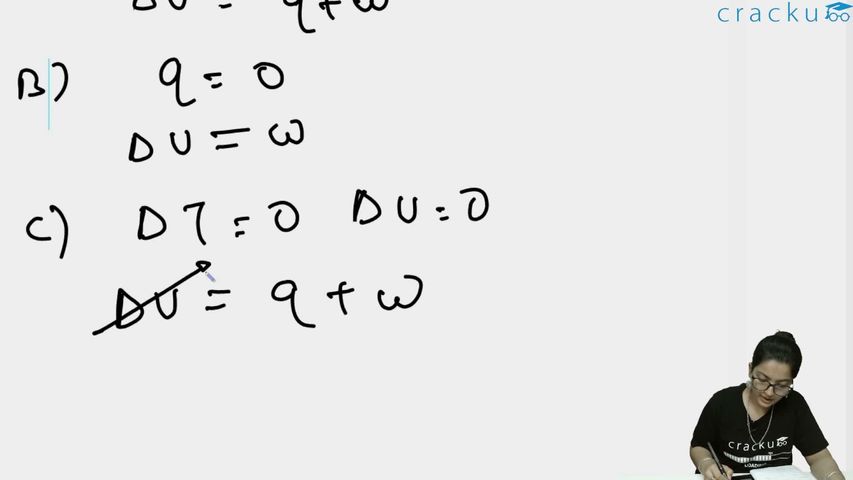
Adiabatic process: By definition, an adiabatic process is carried out with perfect thermal insulation, so that there is no heat exchange. Mathematically, for an adiabatic change we set
$$q = 0$$
Substituting $$q = 0$$ into the general first-law equation we get
$$\Delta U = 0 + w$$
$$\Rightarrow \;\; \Delta U = w$$
This result shows that under adiabatic conditions the entire change in internal energy is due solely to the work term. In other words, the work done in an adiabatic process is directly equal to the change in internal energy of the system.
Therefore, the condition under which $$\Delta U$$ equals the work done is precisely an adiabatic process. Among the given options, that corresponds to Option B.
Hence, the correct answer is Option B.
Was this solution helpful?
Click on the Email ☝️ to Watch the Video Solution
Create a FREE account and get:
_1.webp)

Educational materials for JEE preparation

Ask our AI anything

AI can make mistakes. Please verify important information.
AI can make mistakes. Please verify important information.
