91- 6303239042
If speed of light $$c$$, Planck's constant $$h$$ and gravitational constant $$G$$ are chosen as fundamental quantities, dimensions of time in this system of units is
Sign in
Please select an account to continue using cracku.in
↓ →
If speed of light $$c$$, Planck's constant $$h$$ and gravitational constant $$G$$ are chosen as fundamental quantities, dimensions of time in this system of units is
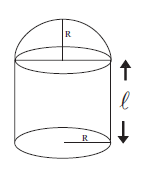
A solid hemisphere is cemented on the flat surface of a solid cylinder of same radius $$R$$ and same material. The composite body is rotating about the axis of the cylinder of length $$l$$ with angular speed $$\omega$$. The radius of gyration $$K$$ is
Loading solution...
The shortest period of rotation of a planet (considered to be a sphere of uniform density $$\rho$$) about its own axis, such that any mass $$m$$ kept on its equator is just about to fly off the surface, is
Loading solution...
.webp)
A body of mass 10 kg at rest explodes into two fragments of masses 3 kg and 7 kg. If the total kinetic energy of two pieces after explosion is 1680 J, the magnitude of their relative velocity in m/s after explosion is
Loading solution...
A shot is fired at an angle $$\alpha$$ to the horizontal up a hill (considered to be a long straight inclined plane) of inclination $$\beta$$ to the horizontal. It will strike the hill horizontally if
Loading solution...
A particle is executing Simple Harmonic Motion of time period $$T$$ in a straight line. Starting from rest, it travels a distance 'a' in the first second and distance 'b' in the next second travelling in the same direction. The amplitude of SHM is
Loading solution...

The kinetic energy of a particle moving along a circle of radius $$R$$ depends upon the distance covered 's' as $$KE = as^2$$ where $$a$$ is a constant. The magnitude of the force acting on the particle as a function of 's' is
Loading solution...
The flow of water in a horizontal pipe is stream line flow. Along the pipe, at a point where cross-sectional area is $$10 \text{ cm}^2$$, the velocity of water flow is $$1.00 \text{ ms}^{-1}$$ and the pressure is 2000 Pa. The pressure of water at another point where cross-sectional area is $$5 \text{ cm}^2$$ is
Loading solution...
Three containers A, B and C are filled with water at different temperature. When 1 litre of water from A is mixed with 2 litre of water from B, the resulting temperature of mixture is $$52^\circ\text{C}$$. When 1 litre of water from B is mixed with 2 litre of water from C, the resulting temperature of mixture is $$40^\circ\text{C}$$. Similarly when 1 litre of water from C is mixed with 2 litre of water from A, the resulting temperature of mixture is $$34^\circ\text{C}$$. Temperature of mixture when one litre of water from each container is mixed (neglect the water equivalent of container) is
Loading solution...

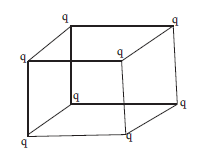
Point charge $$q$$ is kept at each corner of a cube of edge length $$l$$. The resultant force of repulsion on any one of the charges due to all others is expressed as
Loading solution...
In an experiment with potentiometer, the balancing length is 250 cm for a cell. When the cell is shunted by a resistance of $$7.5\ \Omega$$, balancing point is shifted by 25 cm. If the cell is shunted by a resistance of $$20\ \Omega$$, the balancing length will be nearly
Loading solution...
One mole of a gas with $$\gamma = \frac{5}{3}$$ is mixed with two moles of another non-interacting gas with $$\gamma = \frac{7}{5}$$. The ratio of specific heats $$\gamma = \frac{C_{P}}{C_{V}}$$ of mixture is approximately
Loading solution...
An ideal gas is expanding such that $$PT^3$$ is constant. The coefficient of volume expansion of the gas is
Loading solution...
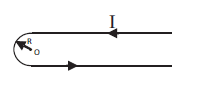
What is the magnetic induction B at the centre O of the semicircular arc if a current carrying wire has shape of a hair pin as shown in figure? The radius of the curved part of the wire is $$R$$, the linear parts are assumed to be very long.
Loading solution...
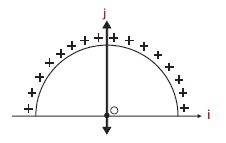
A thin semi-circular metal ring of radius $$R$$ has a positive charge $$q$$ distributed uniformly over its curved length. The resultant electric field E at the center O is
Loading solution...
An Alternating Current is expressed as $$i = i_1\cos\omega t + i_2\sin\omega t$$. The RMS value of current is
Loading solution...
A charge $$+q$$ is placed at each of the points $$x = x_0$$, $$x = 3x_0$$, $$x = 5x_0$$, $$x = 7x_0 \ldots \infty$$ on the x-axis and a charge $$-q$$ is placed at each of the points $$x = 2x_0$$, $$x = 4x_0$$, $$x = 6x_0$$, $$x = 8x_0 \ldots \infty$$ where $$x_0$$ is a positive constant. Take the electric potential at a point due to a charge $$q$$ at a distance $$r$$ from it to be $$\frac{1}{4\pi\epsilon_0}\frac{q}{r}$$. The electric potential at the origin due to the above system of charges is
Loading solution...
The Nucleus $$^{23}_{10}\text{Ne}$$ decays by $$\beta^-$$ emission through the reaction $$^{23}_{10}\text{Ne} \rightarrow\ ^{23}_{11}\text{Na} + ^{0}_{-1}\beta + \bar{\nu} + $$ energy. The atomic masses are $$^{23}_{10}\text{Ne} = 22.994466$$ u and $$^{23}_{11}\text{Na} = 22.989770$$ u, and $$^{0}_{-1}\beta = 0.000549$$ u. The maximum kinetic energy that the emitted electron can ever have is
Loading solution...
The distance between two slits in Young's double slit experiment is $$d = 2.5$$ mm and the distance of the screen from the plane of slits is $$D = 120$$ cm. The slits are illuminated with coherent beam of light of wavelength $$\lambda = 600$$ nm. The minimum distance (from the central maximum) of a point where the intensity reduces to 25 percent of maximum intensity is
Loading solution...
What amount of heat will be generated in a coil of resistance R (ohm) due to a total charge Q (coulomb) passing through it if the current in the coil decreases down to zero halving its value every $$\Delta t$$ second?
Loading solution...
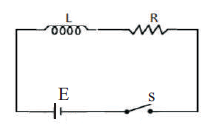
In the L R circuit shown in figure, switch S is closed at time $$t = 0$$, the charge that passes through the battery of emf E in one time constant is (e being the base of natural logarithm).
Loading solution...
Natural Uranium is a mixture of $$^{238}_{92}\text{U}$$ and $$^{235}_{92}\text{U}$$ with a relative mass abundance of $$140 \colon 1$$. The ratio of radioactivity contributed by the two isotopes of natural uranium, if their half-lives are $$4.5\times 10^{9}$$ years and $$7.0\times 10^{8}$$ years respectively, is
Loading solution...
A cylinder of length $$l > 1$$ m filled with water ($$\mu = \frac{4}{3}$$) up to the brim, kept on a horizontal table, is covered at its top by an equiconvex glass ($$\mu = 1.5$$) lens of focal length 25 cm when in air. At mid day, 12.00 noon, Sun is just overhead and light rays come parallel to the principal axis of the lens. The sun rays will be focused
Loading solution...
Even the radiation of highest wavelength in the ultraviolet region of hydrogen spectrum is just able to eject photoelectrons from a metal. The value of threshold frequency for the given metal is
Loading solution...
A parallel plate capacitor of plate area A and plate separation d is charged to potential V. Then the battery is disconnected. A slab of dielectric constant k is then inserted between the plates of the capacitor so as to fill the space between the plates completely. If Q, E and W denote respectively, the magnitude of charge on each plate, the electric field between the plates (after the slab is inserted) and work done on the system in the process of inserting the slab, then
Loading solution...
The magnitudes of the gravitational field at distances $$r_1$$ and $$r_2$$ from the centre of a uniform solid sphere of radius R and mass M are $$F(r_1)$$ and $$F(r_2)$$ respectively. Such that
Loading solution...
The intensity of sound at a point P is $$I_0$$ when the sounds reach this point directly and in same phase from two identical sources $$S_1$$ and $$S_2$$. The power of $$S_1$$ is now reduced by 64 percent and the phase difference $$\phi$$ between $$S_1$$ and $$S_2$$ is varied continuously. The maximum and minimum intensities recorded at P are now $$I_{max}$$ and $$I_{min}$$ such that
Loading solution...
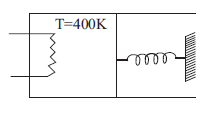
An ideal monatomic gas is confined within a cylinder by a spring loaded piston of cross-sectional area $$4\times 10^{-3}\ \text{m}^2$$. Initially the gas is at 400 K and occupies a volume $$2\times 10^{-3}\ \text{m}^3$$ and the spring is in its relaxed position. The gas is heated by an electric heater for some time. During this time the gas expands and the piston moves out by a distance 0.1 m. The spring connected to the rigid wall is massless and frictionless. The force constant of the spring is $$2000\ \text{Nm}^{-1}$$ and atmospheric pressure is $$10^{5}\ \text{Nm}^{-2}$$, then
Loading solution...
A particle of mass m is located in a one dimensional potential field $$U(x) = U_0(1 - \cos ax)$$ where $$U_0$$ and $$a$$ are constants. Which of the following statement or statements is or are correct?
Loading solution...
A ray of light is incident on an equilateral prism made of flint glass (refractive index 1.6) placed in air.
Loading solution...
In a p-n junction diode, the current (i) varies with applied biasing voltage (V) and can be expressed as $$i = i_0\left(e^{qV/kT} - 1\right)$$ where $$i_0 = 5\times 10^{-12}$$ A is reverse saturation current, k is Boltzmann constant and q is the charge on the electron. At absolute temperature $$T = 300$$ K
Loading solution...
A charged oil drop of density $$880\ \text{kg m}^{-3}$$ is held stationary between two parallel horizontal metal plates 6.0 mm apart when a potential difference of $$V = 103$$ volt is applied between the two plates. When the electric field is switched off, the drop falls. At a certain time the drop is seen to fall a distance of 2.0 mm in 35.7 s and next 1.2 mm in 21.4 s. The upper plate in the experiment is at higher potential. Given that the viscosity of air is $$1.80\times 10^{-5}\ \text{Nsm}^{-2}$$ and density of air is $$1.29\ \text{kg m}^{-3}$$
Loading solution...
Start your IIM journey with the right preparation and crack CAT 2026.

Educational materials for JEE preparation