91- 6303239042
Consider two point masses $$m_1$$ and $$m_2$$ connected by a light rigid rod of length $$r_0$$. The moment of inertia of the system about an axis passing through their centre of mass and perpendicular to the rigid rod is given by
Sign in
Please select an account to continue using cracku.in
↓ →
Consider two point masses $$m_1$$ and $$m_2$$ connected by a light rigid rod of length $$r_0$$. The moment of inertia of the system about an axis passing through their centre of mass and perpendicular to the rigid rod is given by
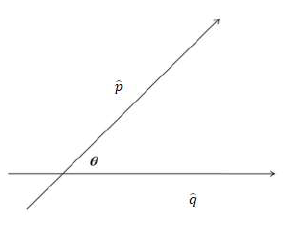
Motion of a particle in a plane is described by the non-orthogonal set of coordinates $$(p, q)$$ with unit vectors $$(\hat{p}, \hat{q})$$ inclined at an angle $$\theta$$ as shown in the diagram. If the mass of the particle is $$m$$, its kinetic energy is given by $$\left(\dot{x} = \frac{dx}{dt}\right)$$
Loading solution...
A man is going up in a lift (open at the top) moving with a constant velocity 3 m/s. He throws a ball up at 5 m/sec relative to the lift when the lift is 50 m above the ground. Height of the lift when the ball meets it during its downward journey is $$(g = 10\ \text{m/s}^2)$$
Loading solution...
.webp)
When a body is suspended from a fixed point by a spring, the angular frequency of its vertical oscillations is $$\omega_1$$. When a different spring is used, the angular frequency is $$\omega_2$$. The angular frequency of vertical oscillations when both the springs are used together in series is given by
Loading solution...
A small pond of depth 0.5 m deep is exposed to a cold winter with outside temperature of 263 K. Thermal conductivity of ice is $$K = 2.2\ \text{Wm}^{-1}\text{K}^{-1}$$, latent heat $$L = 3.4 \times 10^5\ \text{Jkg}^{-1}$$ and density $$\rho = 0.9 \times 10^3\ \text{kgm}^{-3}$$. Take the temperature of the pond to be 273 K. The time taken for the whole pond to freeze is about
Loading solution...
A body of mass 4 kg moves under the action of a force $$\vec{F} = (4\hat{i} + 12t^2\hat{j})$$ N, where $$t$$ is the time in second. The initial velocity of the particle is $$(2\hat{i} + \hat{j} + 2\hat{k})\ \text{ms}^{-1}$$. If the force is applied for 1 s, work done is
Loading solution...

A racing car moves along a circular track of radius $$b$$. The car starts from rest and its speed increases at a constant rate $$\alpha$$. Let the angle between the velocity and the acceleration be $$\theta$$ at time $$t$$. Then $$\cos\theta$$ is
Loading solution...
A small fish, 4 cm below the surface of a lake, is viewed through a thin converging lens of focal length 30 cm held 2 cm above the water surface. Refractive index of water is 1.33. The image of the fish from the lens is at a distance of
Loading solution...
A horizontal ray of light passes through a prism of refractive index 1.5 and apex angle $$4^\circ$$ and then strikes a vertical plane mirror placed to the right of the prism. If after reflection, the ray is to be horizontal, then the mirror must be rotated through an angle
Loading solution...

An isolated metallic object is charged in vacuum to a potential $$V_0$$ using a suitable source, its electrostatic energy being $$W_0$$. It is then disconnected from the source and immersed in a large volume of dielectric with dielectric constant $$K$$. The electrostatic energy of the sphere in the dielectric is
Loading solution...
Two identical coils each of self-inductance $$L$$, are connected in series and are placed so close to each other that all the flux from one coil links with the other. The total self-inductance of the system is
Loading solution...
A coil 2.0 cm in diameter has 300 turns. If the coil carries a current of 10 mA and lies in a magnetic field $$5 \times 10^{-2}$$ T, the maximum torque experienced by the coil is
Loading solution...
A particle performs simple harmonic motion at a frequency $$f$$. The frequency at which its kinetic energy varies is
Loading solution...
In case of real images formed by a thin convex lens, the linear magnification is (I) directly proportional to the image distance, (II) inversely proportional to the object distance, (III) directly proportional to the distance of image from the nearest principal focus, (IV) inversely proportional to the distance of the object from the nearest principal focus. From these the correct statements are
Loading solution...
An infinitely long straight non-magnetic conducting wire of radius $$a$$ carries a dc current $$I$$. The magnetic field $$B$$, at a distance $$r$$ $$(r < a)$$ from axis of the wire is
Loading solution...
A quantity $$\alpha$$ is defined as $$\alpha = \frac{e^2}{4\pi\varepsilon_0 c \hbar}$$, where $$e$$ is electric charge, $$\hbar = \frac{h}{2\pi}$$ is the reduced Planck's constant and $$c$$ is the speed of light. The dimensions of $$\alpha$$ are
Loading solution...
The earth's magnetic field at a certain point is $$7.0 \times 10^{-5}$$ T. This field is to be balanced by a magnetic field at the centre of a circular current carrying coil of radius 5.0 cm by suitably orienting it. If the coil has 100 turns then the required current is about
Loading solution...
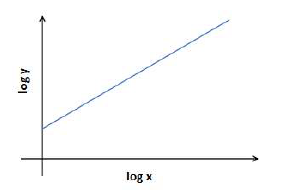
The equation correctly represented by the following graph is ($$a$$ and $$b$$ are constants)
Loading solution...
Which one of the following devices does not respond to the intensity of light incident on it?
Loading solution...
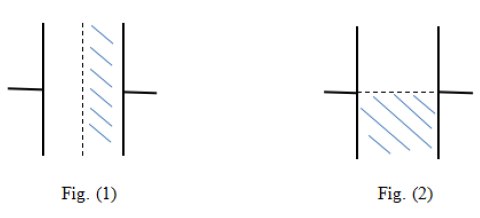
Consider a parallel plate capacitor. When half of the space between the plates is filled with some dielectric material of dielectric constant $$K$$ as shown in Fig. (1) below, the capacitance is $$C_1$$. However, if the same dielectric material fills half the space as shown in Fig. (2), the capacitance is $$C_2$$. Therefore, the ratio $$C_1 \colon C_2$$ is
Loading solution...
A point source of light is viewed through a plate of glass of thickness $$t$$ and of refractive index 1.5. The source appears
Loading solution...
The fraction of the original number of nuclei of a radioactive atom having a mean life of 10 days, that decays during the $$5^{th}$$ day is
Loading solution...
The photoelectric threshold wavelength of tungsten is 230 nm. The energy of electrons ejected from its surface by ultraviolet light of wavelength 180 nm is
Loading solution...
A slit of width $$a$$ is illuminated by parallel monochromatic light of wavelength $$\lambda$$. The value of $$a$$ at which the first minimum of the diffraction pattern will form at $$\theta = 30^\circ$$ is
Loading solution...
A whistle whose air column is open at both ends has a fundamental frequency 500 Hz. The whistle is dipped in water such that half of it remains out of water. What will be the fundamental frequency now? (speed of sound in air is $$340\ \text{ms}^{-1}$$).
Loading solution...
The physical quantity that has unit volt-second is
Loading solution...
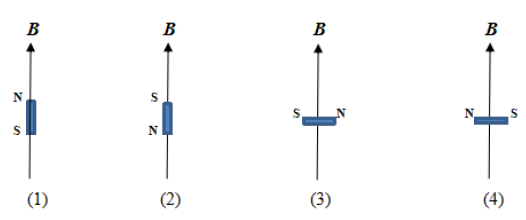
Consider different orientations of a bar magnet lying in a uniform magnetic field as shown below. The potential energy is maximum in orientation
Loading solution...
Two identical charged spheres suspended from a common point by two light strings of length $$l$$, are initially at a distance $$d$$ $$(d \ll l)$$ apart due to their mutual repulsion. The charges begin to leak from both the spheres at a constant rate. As a result, the spheres approach each other with a velocity $$v$$. If $$x$$ denotes the distance between the spheres, then $$v$$ varies as
Loading solution...
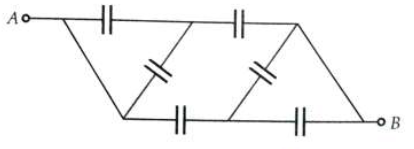
A network of six identical capacitors, each of capacitance $$C$$ is formed as shown below. The equivalent capacitance between the points A and B is
Loading solution...
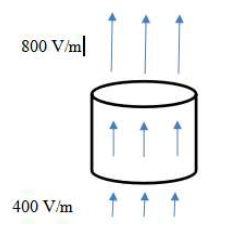
A cylinder on whose surfaces there is a vertical electric field of varying magnitude as shown. The electric field is uniform on the top surface as well as on the bottom surface. Therefore, this cylinder encloses
Loading solution...
Two identical solid blocks A and B are made of two different materials. Block A floats in a liquid with half of its volume submerged. When block B is pasted over A, the combination is found to just float in the liquid. The ratio of the densities of the liquid, material of A and material of B is given by
Loading solution...
In an X ray tube the electrons are expected to strike the target with a velocity that is 10% of the velocity of light. The applied voltage should be
Loading solution...
When observed from the earth the angular diameter of the sun is 0.5 degree. The diameter of the image of the sun when formed in a concave mirror of focal length 0.5 m will be about
Loading solution...
The decimal number that is represented by the binary number $$(100011.101)_2$$ is
Loading solution...
The excess pressure inside a soap bubble is equal to 2 mm of kerosene (density $$0.8\ \text{g cm}^{-3}$$). If the diameter of the bubble is 3.0 cm, the surface tension of soap solution is
Loading solution...
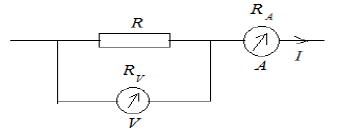
Let $$V$$ and $$I$$ be the readings of the voltmeter and the ammeter respectively as shown in the figure. Let $$R_V$$ and $$R_A$$ be their corresponding resistances. Therefore,
Loading solution...
A man stands at rest in front of a large wall. A sound source of frequency 400 Hz is placed between him and the wall. The source is now moved towards the wall at a speed of 1 m/s. The number of beats heard per second will be (speed of sound in air is 345 m/s)
Loading solution...
A hollow sphere of inner radius 9 cm and outer radius 10 cm floats half submerged in a liquid of specific gravity 0.8. The density of the material of the sphere is
Loading solution...
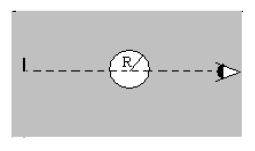
Rays from an object immersed in water ($$\mu = 1.33$$) traverse a spherical air bubble of radius $$R$$. If the object is located far away from the bubble, its image as seen by the observer located on the other side of the bubble will be
Loading solution...
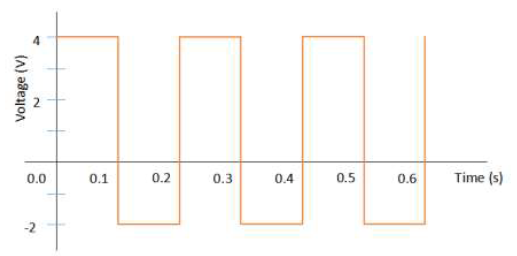
A 10 ohm resistor is connected to a supply voltage alternating between +4 V and $$-2$$ V as shown in the following graph. The average power dissipated in the resistor per cycle is
Loading solution...
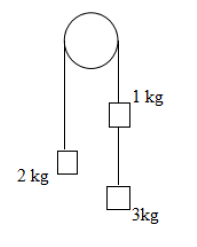
In the following arrangement the pulley is assumed to be light and the strings inextensible. The acceleration of the system can be determined by considering conservation of a certain physical quantity. The physical quantity conserved and the acceleration respectively, are
Loading solution...
Two cells each of emf $$E$$ and internal resistances $$r_1$$ and $$r_2$$ respectively are connected in series with an external resistance $$R$$. The potential difference between the terminals of the first cell will be zero when $$R$$ is equal to
Loading solution...
A student uses a convex lens to determine the width of a slit. For this he fixes the positions of the object and the screen and moves the lens to get a real image on the screen. The images of the slit width are found to be 2.1 cm and 0.48 cm wide respectively when the lens is moved through 15 cm. Therefore, the slit width and the focal length of the lens respectively, are
Loading solution...
A particle rests in equilibrium under two forces of repulsion whose centres are at distances of $$a$$ and $$b$$ from the particle. The forces vary as the cube of the distance. The forces per unit mass are $$k$$ and $$k'$$ respectively. If the particle be slightly displaced towards one of them the motion is simple harmonic with the time period equal to
Loading solution...
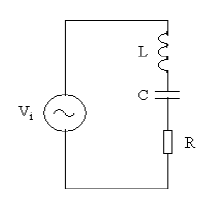
In the following circuit the current is in phase with the applied voltage. Therefore, the current in the circuit and the frequency of the source voltage respectively, are
Loading solution...
In an atom an electron excites to the fourth orbit. When it jumps back to the lower energy levels a spectrum is formed. Total number of spectral lines in this spectrum would be
Loading solution...
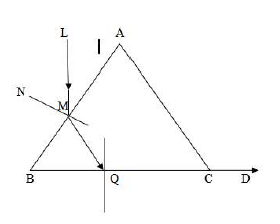
The following figure shows the section ABC of an equilateral triangular prism. A ray of light enters the prism along LM and emerges along QD. If the refractive index of the material of the prism is 1.6, angle LMN is
Loading solution...
A ball of mass $$m$$ hits directly another ball of mass $$M$$ at rest and is brought to rest by the impact. One third of the kinetic energy of the ball is lost due to the collision. The coefficient of restitution is
Loading solution...
An object 1 cm long lies along the principal axis of a convex lens of focal length 15 cm, the centre of the object being at a distance of 20 cm from the lens. Therefore, the size of the image is
Loading solution...
Acidified water from certain reservoir kept at a potential $$V$$ falls in the form of small droplets each of radius $$r$$ through a hole into a hollow conducting sphere of radius $$a$$. The sphere is insulated and is initially at zero potential. If the drops continue to fall until the sphere is half full, the potential acquired by the sphere is
Loading solution...
The following questions are concerned with experiments on the characterization and use of a moving coil galvanometer. The series combination of a variable resistance $$R$$, one $$100\ \Omega$$ resistor and a moving coil galvanometer is connected to a mobile phone charger having negligible internal resistance. The zero of the galvanometer lies at the centre and the pointer can move 30 divisions full scale on either side depending on the direction of current. The reading of the galvanometer is 10 divisions and the voltages across the galvanometer and $$100\ \Omega$$ resistor are respectively 12 mV and 16 mV.
The figure of merit of the galvanometer in microampere per division is
Loading solution...
The resistance of the galvanometer in ohm is,The series combination of the galvanometer with a resistance of R is connected across an ideal voltage supply of 12V and this time the galvanometer shows full scale deflection of 30 divisions.
Loading solution...
The value of R is nearly
Loading solution...
A $$24\ \Omega$$ resistance is connected to a 5 V battery with internal resistance of $$1\ \Omega$$. A $$25\ \text{k}\Omega$$ resistance is connected in series with the galvanometer and this combination is used to measure the voltage across the $$24\ \Omega$$ resistance. The number of divisions shown in the galvanometer is
Loading solution...
Now a $$1000\ \mu\text{F}$$ capacitor is charged using the 12 V supply and is discharged through the galvanometer-resistance combination used in the previous question. The current $$i$$ (in ampere) at different time $$t$$ (in second) are recorded. A graph of $$\ln i$$ against $$t$$ is plotted. The slope of the graph is
Loading solution...
If Newton's inverse square law of gravitation had some dependence on radial distance other than $$r^{-2}$$, which one of Kepler's three laws of planetary motion would remain unchanged?
Loading solution...
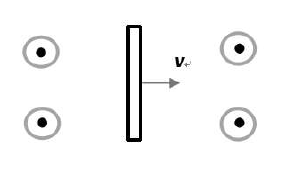
A neutral metal bar moves at a constant velocity $$v$$ to the right through a region of uniform magnetic field directed out of the page, as shown. Therefore,
Loading solution...
Two moles of hydrogen are mixed with $$n$$ moles of helium. The root mean square speed of gas molecules in the mixture is $$\sqrt{2}$$ times the speed of sound in the mixture. Then $$n$$ is
Loading solution...
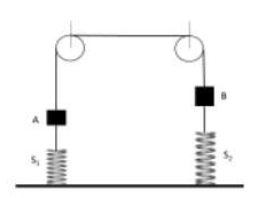
In the figure shown below masses of blocks A and B are 3 kg and 6 kg respectively. The force constants of springs $$S_1$$ and $$S_2$$ are 160 N/m and 40 N/m respectively. Length of the light string connecting the blocks is 8 m. The system is released from rest with the springs at their natural lengths. The maximum elongation of spring $$S_1$$ will be
Loading solution...
Two particles A and B of equal masses have velocities $$\vec{v_A} = 2\hat{i} + \hat{j}$$ and $$\vec{v_B} = -\hat{i} + 2\hat{j}$$. The particles move with accelerations $$\vec{a_A} = -4\hat{i} - \hat{j}$$ and $$\vec{a_B} = -2\hat{i} + 3\hat{j}$$ respectively. The centre of mass of the two particles moves along
Loading solution...
A ray is incident on a refracting surface of RI $$\mu$$ at an angle of incidence $$i$$ and the corresponding angle of refraction is $$r$$. The deviation of the ray after refraction is given by $$\delta = i - r$$. Then, one may conclude that
Loading solution...
In a series R-C circuit the supply voltage $$V_S$$ is kept constant at 2 V and the frequency $$f$$ of the sinusoidal voltage is varied from 500 Hz to 2000 Hz. The voltage across the resistance $$R = 1000$$ ohm is measured each time as $$V_R$$. For the determination of the $$C$$ a student wants to draw a linear graph and try to get $$C$$ from the slope. Then she may draw a graph of
Loading solution...
Two balls A and B moving in the same direction collide. The mass of B is $$p$$ times that of A. Before the collision the velocity of A was $$q$$ times that of B. After the collision A comes to rest. If $$e$$ be the coefficient of restitution then which of the following conclusion or conclusions is or are correct?
Loading solution...
A convex lens and a concave lens are kept in contact and the combination is used for the formation of image of a body by keeping it at different places on the principal axis. The image formed by this combination of lenses can be
Loading solution...
In a bipolar junction transistor
Loading solution...
A particle starting from rest at the highest point slides down the outside of a smooth vertical circular track of radius 0.3 m. When it leaves the track its vertical fall is $$h$$ and the linear velocity is $$v$$. The angle made by the radius at that position of the particle with the vertical is $$\theta$$. Now consider the following observations. $$(g = 10\ \text{m/s}^2)$$ (I) $$h = 0.1$$ m and $$\cos\theta = \frac{2}{3}$$. (II) $$h = 0.2$$ m and $$\cos\theta = \frac{1}{3}$$. (III) $$v = \sqrt{2}\ \text{ms}^{-1}$$. (IV) After leaving the circular track the particle will describe a parabolic path. Therefore,
Loading solution...
A small bar magnet is suspended by a thread. A torque is applied and the magnet is found to execute angular oscillations. The time period of oscillations
Loading solution...
Two identical rods made of two different metals A and B with thermal conductivities $$K_A$$ and $$K_B$$ respectively are joined end to end. The free end of A is kept at a temperature $$T_1$$ while the free end of B is kept at a temperature $$T_2$$ $$( < T_1)$$. Therefore, in the steady state
Loading solution...
If a system is made to undergo a change from an initial state to a final state by adiabatic process only, then
Loading solution...
A body of mass 1.0 kg moves in X-Y plane under the influence of a conservative force. Its potential energy is given by $$U = 2x + 3y$$ where $$(x, y)$$ denote the coordinates of the body. The body is at rest at $$(2, -4)$$ initially. All the quantities have SI units. Therefore, the body
Loading solution...
Start your IIM journey with the right preparation and crack CAT 2026.

Educational materials for JEE preparation