 91- 6303239042
Among Ca, V, Cr and Mn, the second Ionization Energy is the highest for
Sign in
Please select an account to continue using cracku.in
↓ →
Among Ca, V, Cr and Mn, the second Ionization Energy is the highest for
Among the given compounds, the permanent dipole moment is exhibited by
Loading solution...
Choose the correct statement
Loading solution...
.webp)
$$\text{HClO}_4$$ is used in etching of liquid crystal displays whereas $$\text{H}_2\text{C}_2\text{O}_4$$ is present in vegetables like spinach which causes itching to throat. Consider the following statements for these compounds.
(i) is that $$\text{HClO}_4$$ is a stronger acid than $$\text{H}_2\text{C}_2\text{O}_4$$.
(ii) is that $$\text{HClO}_4$$ is a weaker acid than $$\text{H}_2\text{C}_2\text{O}_4$$.
(iii) is that $$\text{H}_2\text{C}_2\text{O}_4$$ is a reducing agent and $$\text{HClO}_4$$ is an oxidizing agent.
(iv) is that the conjugate base of $$\text{HClO}_4$$ is stronger than the conjugate base of $$\text{H}_2\text{C}_2\text{O}_4$$.
The correct statements are
Loading solution...
Compounds A, B, C and D are solid trihalides, all containing the same central atom. Compounds A, B and C are pale lilac (pale purple) in colour but compound D is dark green. Compound A is insoluble in water and alcohol but the rest of the three are soluble in both the solvents. The correct statement indicating the central atom and halides present in each of the compounds is
Loading solution...
You are given a set of oxides, namely SrO, $$\text{MoO}_3$$ and $$\text{ZrO}_2$$. All the three show different reactions with water. Two of these oxides react with water whereas the third one is insoluble in water at room temperature. The statement that is correct about these oxides is
Loading solution...

The complex that shows maximum number of isomers, where gly denotes glycine and $$\text{PEt}_3$$ denotes triethylphosphine, is
Loading solution...
The spin-only magnetic moment for $$[\text{Ni(H}_2\text{O)}_6](\text{ClO}_4)_2$$ should be
Loading solution...
The correct order of $$\Delta_o$$ for the following given transition metal complexes is
Loading solution...

The correct rank of bond order for $$\text{O}_2^+$$, $$\text{O}_2^-$$, CO and $$\text{O}_2^{2-}$$ is
Loading solution...
The correct basicity order in water for the following is
Loading solution...
A 1.25 g Shelcal 500 tablet contains 1250 mg of $$\text{CaCO}_3$$. A student dissolved one tablet in water to make 1.0 L of solution X. 10.0 mL of solution X was titrated with 0.0198 M EDTA and MgEDTA mixture in the burette and found the $$\text{CaCO}_3$$ content matched the label claim, the molar mass of $$\text{CaCO}_3$$ being 100.0 g per mol. The correct option is
Loading solution...
When 10 mL of 0.01 M HCl was added to a mixture of 0.5 M $$\text{NH}_3$$ and 0.5 M $$\text{NH}_4\text{Cl}$$, the pH of the resultant solution will be, given that the $$pK_b$$ of $$\text{NH}_3$$ is 4.75
Loading solution...
The correct order of CO triple bond character in the given metal carbonyl complexes is
Loading solution...
Consider the following statements for the square planar complex $$[\text{Pt(en)(NCS)}_2]$$.
Statement I is that it is thermodynamically more stable than $$[\text{Pt(NH}_3)_2(\text{NCS})_2]$$.
Statement II is that it can exhibit stereoisomerism.
Statement III is that it can exhibit structural isomerism.
Statement IV is that it is not easily soluble in polar solvents.
The correct option is
Loading solution...
Which of the following molecules is odd one out in its bonding properties
Loading solution...
Which one of the following reactions will give a product that has zero net dipole moment
Loading solution...
Which of the following statements is not correct regarding the aromatic electrophilic substitution reactions of aniline or its derivatives under standard laboratory conditions
Loading solution...
The optically active mixture from the following is
Loading solution...
Alkenes can be converted to cis-diols using $$\text{OsO}_4$$ and $$\text{NaHCO}_3$$ and to trans-diols via the epoxide followed by acid hydrolysis.
Compound C given below is formed from :
i) alkene A by treatment with $$\text{OsO}_4$$ and $$\text{NaHCO}_3$$,
ii) the epoxide of alkene B followed by acid hydrolysis.
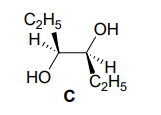
The structures of A and B are
Loading solution...
The disaccharide shown below undergoes enzymatic hydrolysis. The monosaccharide units formed upon complete hydrolysis of the disaccharide are
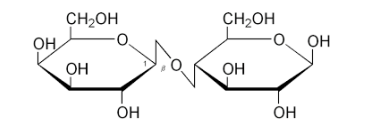
Loading solution...
The correct order of the isoelectric points(pl) of Alanine(Ala), Arginine(Arg) and Glutamic acid(Glu)is
Loading solution...
Which of the following most readily forms a cyclic hemiacetal in the presence of an acid catalyst
Loading solution...
A medicinal chemist is exploring halogenated aromatic compounds as potential precursors for drug molecules. In one experiment she attempts bromination of the substituted aromatic ring shown below in the presence of acetic acid, a typical aromatic electrophilic substitution condition.
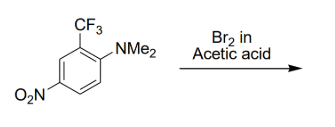
The chemist proposed an intermediate for the above reaction with the following resonance structures. Which of the following structures contributes the most to the stability of the intermediate
Loading solution...
Which sequence of reagents, when used in the correct order, will convert benzene to m-nitro-n-propylbenzene
Loading solution...
Which of the following compounds predominantly gives the para-nitro product as the major isomer upon nitration using a nitrating mixture of $$\text{HNO}_3$$ + $$\text{H}_2\text{SO}_4$$ ?
Loading solution...
Product E formed in the following chemical reaction, in which the carboxylic acid B reacts with ethanol under acid catalysis to give E and water, will
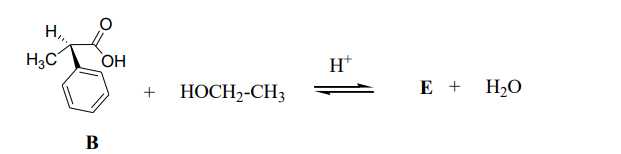
Loading solution...
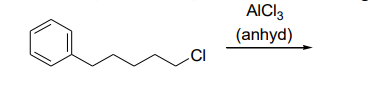
The most predominant product of the following reaction will be:
Loading solution...
Which of the following molecules will react with ozone and hydrogen peroxide to form 1,4-benzene dicarboxylic acid, formic acid, oxalic acid and acetone
Loading solution...
The correct numerical answers for the following are,
(i) is the number of NOT-aromatic compounds from the following is

(ii) is the number of alpha hydrogen atoms in the structure shown
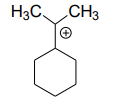
(iii)The number of geometrical isomers possible in $$\text{CH}_3\text{CH}=\text{CH}-\text{CH}=\text{CH}_2$$ and
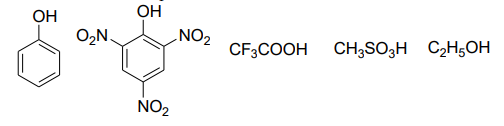
(iv) The number of compounds more acidic than $$\text{CH}_3\text{COOH}$$ from the compounds shown
Loading solution...
The following reaction is performed and multiple products are observed.
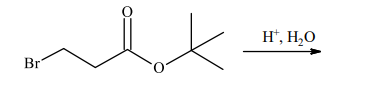
One of the products X can decolourize bromine water. The product X is
Loading solution...
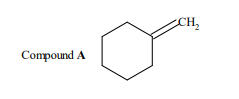
Compound A shown below can be prepared from a suitable alkyl halide and an appropriate reagent under suitable conditions. The most appropriate combination of the requirements to give the highest yield is
Loading solution...
Consider three cylinders of capacity 2.24 L each fitted with a piston, each containing 2.50 g of an ideal gas X, Y or Z as specified below at 273 K. The pressure is not specified. The molar masses (in g per mol^-1) are 40 = X, 80 = Y and 20 = Z.
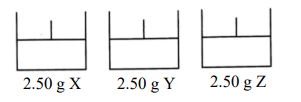
The correct set of statements,
(i) is that the number of molecules in each cylinder is the same,
(ii) is that the average velocity of the molecules in each cylinder is the same,
(iii) is that the pressure of gas Z is the highest and
(iv) is that if the pressure in each cylinder is adjusted to one atmosphere at constant temperature the volume of gas Z will increase and those of the other two will decrease, is
Loading solution...
A sample X of $$\text{MCl}_2$$ was found to contain a small quantity of $$\text{M(OH)}_2$$ as an impurity, both of the compounds being soluble in water. In an experiment 30 g of the above sample X was dissolved in 60 mL of 0.4 M HCl to give solution Y, and 20 mL of 0.4 M NaOH was required to neutralise the excess HCl in solution Y. The percentage of $$\text{M(OH)}_2$$ in sample X, given that the molar mass of $$\text{M(OH)}_2$$ is 65 g per mol, is
Loading solution...
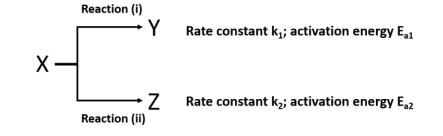
Consider the following two reactions occurring at 298 K, as shown in the scheme below, such that $$E_{a2} = 3E_{a1}$$ and the Arrhenius constant A has the same value for both the reactions. The relation between $$k_1$$ and $$k_2$$ is
Loading solution...
In the spacecrafts of NASA the oxygen required for the astronauts is obtained from the chemical reaction $$\text{KClO}_3(s) + \text{Fe}(s) \rightarrow \text{O}_2(g) + \text{KCl}(s) + \text{FeO}(s)$$. The requirement of $$\text{O}_2$$ per astronaut per day is 500 L as measured at 1 atm and 300 K. The minimum mass of $$\text{KClO}_3$$, whose molar mass is 122.5 g per $$mol^-1$$, needed for two astronauts to be in the spacecraft for ten days in a space mission is
Loading solution...
When 15.0 g of steam at 373 K is passed into 250.0 g of $$H_2O$$ (I) in a closed container at 298 K at a constant pressure of 1 bar, then the correct statement, if this is an isolated system and assuming that the final state is liquid water, will be
Loading solution...
Consider the given equilibrium reaction at 473 K, namely $$\text{Li}_3\text{N}(s) + 2\text{H}_2(g) \rightleftharpoons \text{LiNH}_2(s) + 2\text{LiH}(s)$$ with $$\Delta H_{rxn}^\circ = -200$$ kJ per mol. The number of moles of $$\text{H}_2(g)$$ present at equilibrium can be maximised by
Loading solution...
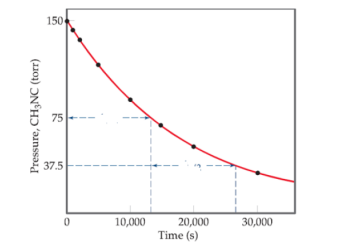
The following concentration versus time plot represents the conversion of $$\text{CH}_3\text{NC}(g)$$ to $$\text{CH}_3\text{CN}(g)$$. Which of the following statements is or are true, where
I is that the reaction is of zero order,
II is that the unit of the rate constant of this reaction is $$\text{s}^{-1}$$,
III is that the unit of the rate constant of the reaction is torr $$\text{s}^{-1}$$ and
IV is that the unit of the rate of the reaction is torr $$\text{s}^{-1}$$
Loading solution...
Consider the chemical reaction $$A \rightarrow C + D$$. The observations for the kinetic study of the above unimolecular elementary reaction at 298 K are
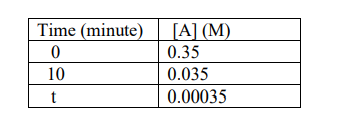
The value of time t (minute) is
Loading solution...
Propanoic acid is an organic acid. At 298 K the pH of a 50.0 mL sample of 0.20 M of it is 3.0. The pH of the solution formed by mixing 25.0 mL of 0.2 M sodium propanoate solution with 25.0 mL of 0.1 M propanoic acid will be
Loading solution...
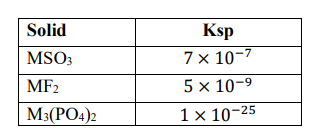
M is an alkaline earth metal. 1.0 M solution of $$\text{MCl}_2$$ is added dropwise to a solution that is 0.01 M each in fluoride, sulfite and phosphate ions. The order of precipitation of corresponding salts is
Loading solution...
$$\text{CrCl}_3 \cdot x\text{NH}_3$$ can exist as an octahedral complex (P). 0.1 molal aqueous solution of this complex P shows a depression in freezing point of $$0.558^\circ\text{C}$$. The molecular formula of the complex P, given that $$K_f$$ for water is 1.86 K kg per $$mol^-1$$ and assuming 100% ionization of the complex, is
Loading solution...
Aspirin, $$\text{C}_9\text{H}_8\text{O}_4$$, is produced by the reaction between salicylic acid, $$\text{C}_7\text{H}_6\text{O}_3$$, and acetic anhydride, $$\text{C}_4\text{H}_6\text{O}_3$$, as per the reaction $$\text{C}_7\text{H}_6\text{O}_3 + \text{C}_4\text{H}_6\text{O}_3 \rightarrow \text{C}_9\text{H}_8\text{O}_4 + \text{C}_2\text{H}_4\text{O}_2$$. In the reaction of 155 g salicylic acid and 105 g acetic anhydride, assuming 80% conversion of the limiting reactant, the mass of aspirin formed, given molar masses in g per mol of 138 for salicylic acid, 102 for acetic anhydride and 180 for aspirin, is
Loading solution...
A voltaic cell is constructed as
$$\text{Ni}(s) \mid \text{Ni}^{2+}(aq) \parallel \text{Ag}^+(aq) \mid \text{Ag}(s)$$
with $$E^\circ_{\text{Ni}^{2+}(aq)/\text{Ni}} = -0.236$$ V and $$E^\circ_{\text{Ag}^+(aq)/\text{Ag}} = 0.799$$ V. The initial concentration of $$\text{Ag}^+(aq)$$ in the silver half-cell is 0.005 M and the corresponding cell voltage is $$+0.95$$ V at 298 K. Identify the correct option from the following
Loading solution...
A certain quantity of a hydrocarbon fuel sample $$(C_x H_y)$$ is burnt in excess $$O_2$$(g) to ensure complete combustion. The combustion produced 11.93 g of $$\text{CO}_2$$, 2.19 g of $$\text{H}_2\text{O}$$ and 311 kJ of heat. Mass of the fuel burnt in this combustion is
Loading solution...
The photon with the longest wavelength required for the electronic transition in an atom of hydrogen is
Loading solution...
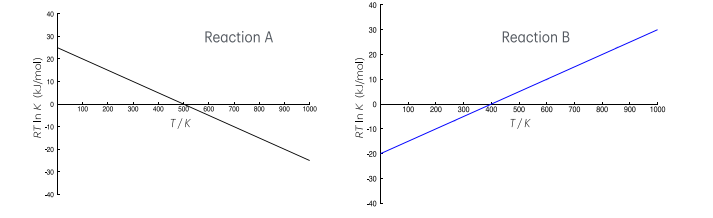
Consider two reactions A and B for which the variation of $$RT \ln K$$ with temperature is given in the plots below. If the enthalpy change for the reactions are $$-25$$ kJ per mol and 20 kJ per mol respectively for A and B, the correct statement is
Loading solution...
Alkyl lithium compounds are of interest in organic synthesis as efficient alkylating agents. Consider the following two reactions, where reaction (i) is $$\text{C}_4\text{H}_9\text{Li} + \text{C}_6\text{H}_6 \rightarrow \text{C}_6\text{H}_5\text{Li} + \text{C}_4\text{H}_{10}$$ and reaction (ii) is $$\text{C}_5\text{H}_5\text{Li} + \text{C}_6\text{H}_6 \rightarrow \text{C}_6\text{H}_5\text{Li} + \text{C}_5\text{H}_6$$. The correct statements for the above two reactions are
Loading solution...
A mixture gave a light yellow precipitate with silver nitrate which did not dissolve completely with ammonia solution. It gave a positive chromyl chloride test. When the organic layer test was performed with addition of excess of concentrated nitric acid, a violet coloured organic layer first formed which then changed to orange colour. The brown ring test was positive but the brown coloured gas was not intensified on heating the mixture with copper turnings and concentrated sulphuric acid. Which of the anions were present
Loading solution...
Consider the following half-cell reactions, namely
$$\text{H}^+(aq) + e^- \rightleftharpoons \frac{1}{2}\text{H}_2(g)$$ with $$E^\circ = 0.00$$ V,
$$\text{V}^{3+}(aq) + e^- \rightleftharpoons \text{V}^{2+}(aq)$$ with $$E^\circ = -0.255$$ V,
$$\text{VO}^{2+} + e^- + 2\text{H}^+ \rightleftharpoons \text{V}^{3+}(aq) + \text{H}_2\text{O}(l)$$ with $$E^\circ = +0.337$$ V, and
$$\frac{1}{2}\text{O}_2(g) + 2e^- + 2\text{H}^+ \rightleftharpoons \text{H}_2\text{O}(l)$$ with $$E^\circ = +1.23$$ V.
Using the above equations, the correct statements are
Loading solution...
The suitable combinations of physico-chemical methods that can be used to assign the correct formula to the compound $$\text{CoCl}_3 \cdot 4\text{NH}_3$$ are
Loading solution...
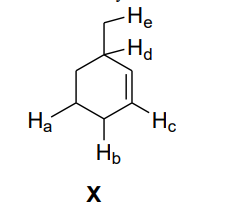
Given below is the structure of a compound X. Identify the correct statements from below.
Loading solution...
Which of the following statements is or are incorrect for sugars
Loading solution...
When the reaction shown below was performed, the product obtained gave a bright orange red precipitate with 2,4-dinitrophenylhydrazine and does not react with a saturated solution of $$\text{NaHCO}_3$$. This implies that
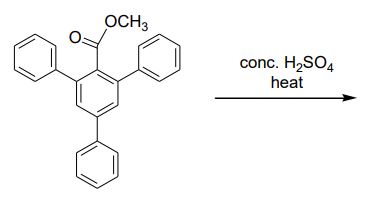
Loading solution...
The reaction shown below was performed.

However, on investigation it was discovered that there were additional products in the reaction mixture. The additional products are
[image]
Loading solution...
Two open beakers A and B are kept inside a sealed box. Initially, beaker A contains 30 mL of 0.050 M glucose solution and beaker B contains 30 mL of 0.035 M fructose solution. Enough time was given to ensure that the water vapour in the system is in equilibrium. Under the equilibrium conditions, assuming the density of solution to be 1 g per $$\text{cm}^3$$
Loading solution...
Three different gaseous mixtures (i), (ii) and (iii) of helium and nitrogen are placed in boxes of equal volume as shown below. The true statements from the following are
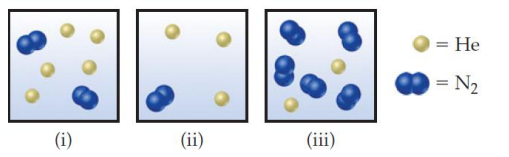
Loading solution...
Identify the isotonic solutions from the following mixtures of aqueous solutions at 298 K, assuming complete dissociation of the electrolytes in water
Loading solution...
Three cylinders connected with valves are shown in the diagram. All the cylinders are at the same temperature. Which of the following statements are true once the valves are opened and the system is allowed to reach equilibrium, given that the volume of connecting tubes may be neglected
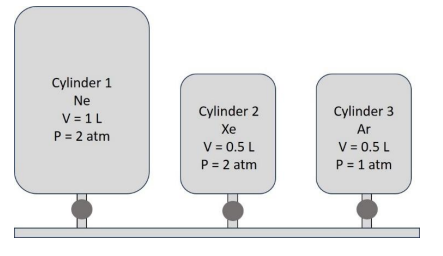
Loading solution...
Start your IIM journey with the right preparation and crack CAT 2026.

Educational materials for JEE preparation
