 91- 6303239042
Observe the following sequence. What is the 100th term? $$7, 8, 1, 0, 0, 1, 0, 1, 1, 0, 2, 1, 0, 3, \ldots$$
Sign in
Please select an account to continue using cracku.in
↓ →

Join Our JEE Preparation Group
Prep with like-minded aspirants; Get access to free daily tests and study material.
Observe the following sequence. What is the 100th term? $$7, 8, 1, 0, 0, 1, 0, 1, 1, 0, 2, 1, 0, 3, \ldots$$
Grouping the terms from the third term onward in blocks of three gives $$1, 0, 0$$ then $$1, 0, 1$$ then $$1, 0, 2$$ then $$1, 0, 3$$, so each block repeats the pair $$1, 0$$ followed by a number that increases by 1 in every block. Continuing this repeating structure out to the 100th position gives a value of 3.
A number is multiplied by 2 then by $$\frac{1}{3}$$, then by 4, then by $$\frac{1}{5}$$ then by 6 and finally by $$\frac{1}{7}$$. The answer is 16. Then the number is
Loading solution...
Samrud bought a t-shirt for Rs. 250. His friend Shlok wanted to buy it. Samrud wants to have a $$10\%$$ profit on that. The selling price is (in rupees)
Loading solution...
.webp)
The value of $$1 + 21 + 4161 + 81 - 11 - 31 - 51 - 71 - 91$$ is
Loading solution...
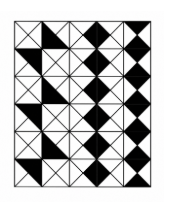
In the adjoining figure what portion of the figure is shaded?
Loading solution...
The sum of the numbers in the three brackets ( ) is $$\frac{( )}{24} = \frac{20}{( )} = \frac{24}{18} = \frac{4}{( )}$$
Loading solution...
.webp)
A is the smallest three digit number which leaves a remainder 2 when divided by 17. B is the smallest three digit number which leaves a remainder 7 when divided by 12. Then $$A + B$$ is
Loading solution...
A square of side 3 cm is cut into 9 equal squares. Another square of side 4 cm is cut into 16 equal squares. Saket made a bigger square using all the smaller square bits. The length of the side of the bigger square is (in cm)
Loading solution...
A contractor constructed a big hall, rectangular in shape, with length 32 meters and breadth 18 meters. He wanted to buy 1 meter by 1 meter tiles. But in the shop 3 meter by 2 meter tiles only were available. How many tiles he has to buy for tiling the floor?
Loading solution...
.webp)
The fraction to be added to $$2\frac{1}{3}$$ to get the fraction $$4\frac{4}{7}$$ is
Loading solution...
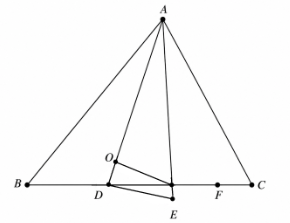
In the adjoining figure $$\angle BAD = \angle DAF = \angle FAC$$. GE is parallel to DF, and $$\angle EGA = 90^\circ$$. If $$\angle ACE = 70^\circ$$, the measure of $$\angle FDE$$ is
Loading solution...
$$ABC$$ is a triangle in which the angles are in the ratio $$3 \colon 4 \colon 5$$. PQR is a triangle in which the angles are in the ratio $$5 \colon 6 \colon 7$$. The difference between the least angle of $$ABC$$ and the least angle of PQR is $$a^\circ$$. Then $$a$$ =
Loading solution...
Samrud had to multiply a number by 35. By mistake he multiplied by 53 and got a result 720 more. The new product is
Loading solution...
Vishva plays football every 4th day. He played on a Tuesday. He plays football on a Tuesday again in is _____ days.
Loading solution...
In an elementary school $$26\%$$ of the students are girls. If there are 240 less girls than boys, then the strength of the school is
Loading solution...
There are three concentric circles as shown in the figure. The radii of them are $$2\text{ cm}$$, $$4\text{ cm}$$ and $$6\text{ cm}$$. The ratio of the area of the shaded region to the area of the dotted region is $$\frac{a}{b}$$ where $$a, b$$ are integers and have no common factor other than 1. Then $$a + b$$ =

Loading solution...
The value of $$\left(1+\frac{1}{9}\right)\left(1+\frac{1}{8}\right)\left(1+\frac{1}{7}\right)\left(1+\frac{1}{6}\right)\left(1+\frac{1}{5}\right)\left(1+\frac{1}{4}\right)\left(1+\frac{1}{3}\right)\left(1+\frac{1}{2}\right)$$ is
Loading solution...
When a two digit number divides 265, the remainder is 5. The number of such two digit numbers is
Loading solution...
If $$A \# B = \frac{A \times B}{A + B}$$, the value of $$\frac{12 \# 8}{8 \# 4} + \frac{10 \# 6}{6 \# 2}$$ is
Loading solution...
When water becomes ice, its volume increases by $$10\%$$. When ice melts into water its volume decreases by $$a\%$$. Then $$a$$ =
Loading solution...
Predict your JEE Main percentile, rank & performance in seconds

Educational materials for JEE preparation