The value of $$\frac{9999 + 7777 + 5555}{8888 + 6666 + 4444} $$ is
NMTC gauss ( primary level) 5th and 6th Aug 23 2025
For the following questions answer them individually
Solution
Every term in the numerator and in the denominator is a multiple of 1111. Taking 1111 common, the numerator is $$1111 \times (9 + 7 + 5) = 1111 \times 21$$ and the denominator is $$1111 \times (8 + 6 + 4) = 1111 \times 18$$. Cancelling 1111 from both gives $$\frac{21}{18} = \frac{7}{6}$$.
The sum of three prime numbers is 30. How many such sets of prime numbers are there?
Solution
The sum of three odd numbers is always odd, but 30 is even, so one of the three primes must be the only even prime 2. The other two primes must then add up to 28, and the only prime pairs with sum 28 are 5 and 23, and 11 and 17. So the sets are $$\{2, 5, 23\}$$ and $$\{2, 11, 17\}$$, which means there are 2 such sets.
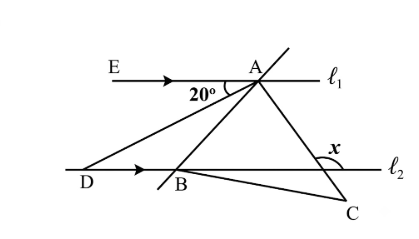
In the adjoining figure, lines $$\ell_1$$ and $$\ell_2$$ are parallel lines. $$ABC$$ is an equilateral triangle. $$AD$$ bisects $$\angle EAB$$. Then $$x$$ is
Solution
The figure marks $$\angle EAD = 20^\circ$$, and since $$AD$$ bisects $$\angle EAB$$, we get $$\angle EAB = 2 \times 20^\circ = 40^\circ$$. The triangle $$ABC$$ is equilateral, so $$\angle BAC = 60^\circ$$ and hence $$\angle EAC = 40^\circ + 60^\circ = 100^\circ$$. As $$\ell_1$$ and $$\ell_2$$ are parallel with $$AC$$ as the transversal, $$x$$ and $$\angle EAC$$ are alternate angles, so $$x = 100^\circ$$.
.webp)
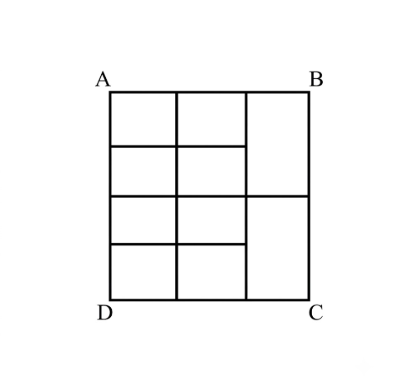
In the figure, $$ABCD$$ is a square. It consists of squares and rectangles of areas $$1\ \text{cm}^2$$ and $$2\ \text{cm}^2$$ as shown. The perimeter of the square $$ABCD$$ (in cm) is
Solution
Every piece of the square has an area of $$1\ \text{cm}^2$$ or $$2\ \text{cm}^2$$, so the area of the whole square must be a whole number. If the perimeter is $$P$$, the side is $$\frac{P}{4}$$ and the area is $$\frac{P^2}{16}$$. Now $$\frac{17^2}{16}$$, $$\frac{15^2}{16}$$ and $$\frac{14^2}{16}$$ are not whole numbers, while $$\frac{16^2}{16} = 16$$ is. So the side is 4 cm and the perimeter is 16 cm.
If $$a \ast b = \frac{a + b}{a - b}$$, then the value of $$\frac{13 \ast 6}{5 \ast 2}$$ is
Solution
Using the given rule, $$13 \ast 6 = \frac{13 + 6}{13 - 6} = \frac{19}{7}$$ and $$5 \ast 2 = \frac{5 + 2}{5 - 2} = \frac{7}{3}$$. Dividing one by the other, $$\frac{19}{7} \div \frac{7}{3} = \frac{19}{7} \times \frac{3}{7} = \frac{57}{49}$$.
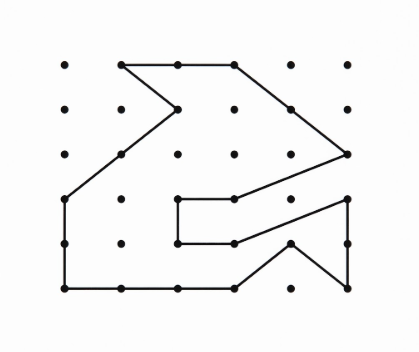
In the adjoining figure, the distance between any two adjacent dots is 1 cm. The area of the shaded region (in $$\text{cm}^2$$) is
Solution
Every corner of the shaded figure sits on a dot of the grid, so the dot rule for area can be used, which says the area equals the number of dots strictly inside, plus half the number of dots on the boundary, minus 1. This figure has 6 dots inside it and 21 dots on its boundary, so the area is $$6 + \frac{21}{2} - 1 = \frac{31}{2}$$ square cm.
.webp)
Three natural numbers $$n_1$$, $$n_2$$, $$n_3$$ are taken. Let $$ n_{1} < n_{2} < n_{3} $$ and $$n_1 + n_2 + n_3 = 6$$. The value of $$n_3$$ is
Solution
The three natural numbers are different and increasing, so the smallest they can possibly be is 1, 2 and 3, and these already add up to 6. Any other set of three different natural numbers has a sum bigger than 6. So $$n_1 = 1$$, $$n_2 = 2$$, $$n_3 = 3$$ and the value of $$n_3$$ is 3.
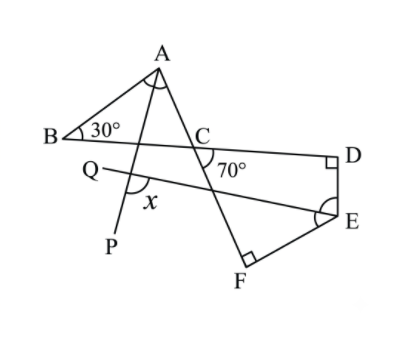
In the adjoining figure, AP and EQ are respectively the bisectors of $$\angle BAC$$ and $$\angle DEF$$. Then, the measure of angle $$x$$ is
Solution
In the triangle $$ABC$$, the angle $$\angle ACB$$ is vertically opposite the marked $$70^\circ$$, so $$\angle BAC = 180^\circ - 30^\circ - 70^\circ = 80^\circ$$ and the bisector $$AP$$ splits it into two angles of $$40^\circ$$. Where $$AP$$ crosses the line $$BD$$, the angle formed with $$BD$$ is $$180^\circ - 30^\circ - 40^\circ = 110^\circ$$, that is $$70^\circ$$ on the other side. In the four sided figure $$CDEF$$ the angles at $$D$$ and at $$F$$ are right angles and the angle at $$C$$ is $$70^\circ$$, so $$\angle DEF = 360^\circ - 70^\circ - 90^\circ - 90^\circ = 110^\circ$$, and its bisector $$EQ$$ makes $$55^\circ$$ with $$ED$$ and therefore $$35^\circ$$ with $$BD$$. The two bisectors together with $$BD$$ form a triangle, so the angle between the bisectors is $$180^\circ - 70^\circ - 35^\circ = 75^\circ$$, and $$x$$ is vertically opposite that angle.
The number of two-digit positive integers which have at least one 7 as a digit is
Solution
The numbers 70 to 79 have 7 in the tens place, and that is 10 numbers. The two-digit numbers ending in 7 are 17, 27, 37, 47, 57, 67, 87 and 97, which is 8 more, because 77 has already been counted. So the total is $$10 + 8 = 18$$.
.webp)
The fractions $$\frac{1}{5}$$ and $$\frac{1}{3}$$ are shown on the number line. In which position should $$\frac{1}{4}$$ be shown?

Solution
The gap between the two marked fractions is $$\frac{1}{3} - \frac{1}{5} = \frac{2}{15}$$, and the number line cuts this gap into 16 equal parts, so each small part is $$\frac{2}{15} \div 16 = \frac{1}{120}$$. Since $$\frac{1}{4} - \frac{1}{5} = \frac{1}{20} = \frac{6}{120}$$, the fraction $$\frac{1}{4}$$ lies 6 small parts to the right of $$\frac{1}{5}$$, which is the mark $$q$$.
Samrud reads $$\frac{1}{3}$$ of a story book on the first day, $$\frac{1}{2}$$ of the remaining book on the second day and $$\frac{1}{4}$$ of the remaining book as on the end of the first day, on the third day, and is left with 23 pages unread. The number of pages of the book is
Solution
Take the whole book as 1. After the first day $$\frac{2}{3}$$ is left. On the second day he reads half of that, which is $$\frac{1}{3}$$ of the book, so $$\frac{1}{3}$$ of the book is still left. On the third day he reads $$\frac{1}{4}$$ of $$\frac{2}{3}$$, which is $$\frac{1}{6}$$ of the book. The unread part is $$\frac{1}{3} - \frac{1}{6} = \frac{1}{6}$$ of the book, and this equals 23 pages, so the book has $$6 \times 23 = 138$$ pages.
The product of four different natural numbers is 100. What is the sum of the four numbers?
Solution
Since $$100 = 2^2 \times 5^2$$, the only way of writing 100 as a product of four different natural numbers is $$1 \times 2 \times 5 \times 10$$. Their sum is $$1 + 2 + 5 + 10 = 18$$.
Peter starts from a point A in a playground and walks $$100\ \text{m}$$ towards East. Then he walks 30 m towards North and then 70 m towards West and then finally 10 m North to reach the point B. The distance between A and B (in metres) is
Solution
Walking 100 m East and later 70 m West leaves him $$100 - 70 = 30$$ m East of A. Walking 30 m North and later 10 m North leaves him $$30 + 10 = 40$$ m North of A. So AB is the longest side of a right angled triangle with the other two sides 30 m and 40 m, giving $$AB = \sqrt{30^2 + 40^2} = \sqrt{2500} = 50$$ m.
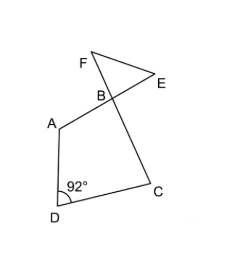
In the adjoining figure $$\angle DAB$$ is $$8^\circ$$ more than $$\angle ADC$$, and $$\angle BCD$$ is $$8^\circ$$ less than $$\angle ADC$$. $$\angle FEB$$ is half of $$\angle FBE$$. Then the measure of $$\angle BFE$$ is
Solution
The figure marks $$\angle ADC = 92^\circ$$, so $$\angle DAB = 92^\circ + 8^\circ = 100^\circ$$ and $$\angle BCD = 92^\circ - 8^\circ = 84^\circ$$. The four angles of $$ABCD$$ add up to $$360^\circ$$, so $$\angle ABC = 360^\circ - 92^\circ - 100^\circ - 84^\circ = 84^\circ$$. As $$E$$ lies on $$AB$$ produced and $$F$$ lies on $$CB$$ produced, $$\angle FBE$$ is vertically opposite $$\angle ABC$$ and so equals $$84^\circ$$. Then $$\angle FEB = \frac{84^\circ}{2} = 42^\circ$$ and $$\angle BFE = 180^\circ - 84^\circ - 42^\circ = 54^\circ$$.
The fraction to be added to the fraction $$\frac{1}{2 + \frac{1}{3 + \frac{1}{1 + \frac{1}{4}}}}$$ to get 1 is
Solution
Simplify from the bottom upwards. First $$1 + \frac{1}{4} = \frac{5}{4}$$, so the next step is $$3 + \frac{4}{5} = \frac{19}{5}$$, and then $$2 + \frac{5}{19} = \frac{43}{19}$$. The given fraction is therefore $$\frac{19}{43}$$, and the fraction to be added is $$1 - \frac{19}{43} = \frac{24}{43}$$.
Some amount of money is divided among A, B and C, so that for every Rs. ₹100 A has, B has Rs. ₹65 and C has Rs. ₹40. If the share of C is Rs. ₹4000, the total amount of money (in rupees) is
Backspace
789
456
123
0.-
Clear All
789
456
123
0.-
Clear All
Solution
The shares of A, B and C are in the ratio $$100 \colon 65 \colon 40$$, which is $$100 + 65 + 40 = 205$$ parts altogether. C has 40 parts and that is Rs. 4000, so one part is Rs. 100. The total amount is $$205 \times 100 = 20500$$ rupees.
ABCDE is a pentagon. The angles $$A$$, $$B$$, $$C$$, $$D$$, $$E$$ are in the ratio $$8 \colon 9 \colon 12 \colon 15 \colon 10$$. The external bisector of B and the internal bisector of C meet at P. Then the measure of $$\angle BPC$$ is
Backspace
789
456
123
0.-
Clear All
789
456
123
0.-
Clear All
Solution
The five angles of a pentagon add up to $$540^\circ$$ and the ratio has $$8 + 9 + 12 + 15 + 10 = 54$$ parts, so one part is $$10^\circ$$. This makes $$\angle B = 90^\circ$$ and $$\angle C = 120^\circ$$. The exterior angle at B is $$180^\circ - 90^\circ = 90^\circ$$, so its bisector makes $$45^\circ$$ with BC, and the internal bisector of $$\angle C$$ makes $$60^\circ$$ with CB. In the triangle BPC, $$\angle BPC = 180^\circ - 45^\circ - 60^\circ = 75^\circ$$.
The least number, when lessened (decreased) by 5, to be divisible by 36, 48, 21, and 28 is
Backspace
789
456
123
0.-
Clear All
789
456
123
0.-
Clear All
Solution
The number reduced by 5 must be a common multiple of 36, 48, 21 and 28, so the smallest such value is their LCM. Since $$36 = 2^2 \times 3^2$$, $$48 = 2^4 \times 3$$, $$21 = 3 \times 7$$ and $$28 = 2^2 \times 7$$, the LCM is $$2^4 \times 3^2 \times 7 = 1008$$. Adding back the 5 gives $$1008 + 5 = 1013$$.
When $$10\frac{5}{6}$$ is divided by 91, we get a fraction $$\frac{a}{b}$$, where $$a$$ and $$b$$ are natural numbers with no common factors other than 1. Then $$(b - a)$$ is equal to
Backspace
789
456
123
0.-
Clear All
789
456
123
0.-
Clear All
Solution
First $$10\frac{5}{6} = \frac{65}{6}$$, so dividing by 91 gives $$\frac{65}{6} \times \frac{1}{91} = \frac{65}{546}$$. Since $$65 = 5 \times 13$$ and $$546 = 2 \times 3 \times 7 \times 13$$, cancelling 13 leaves $$\frac{5}{42}$$ in lowest terms. So $$a = 5$$, $$b = 42$$ and $$b - a = 37$$.
Let $$p$$ be the smallest prime number such that the numbers $$(p + 6)$$, $$(p + 8)$$, $$(p + 12)$$ and $$(p + 14)$$ are also prime. Then the remainder when $$p^2$$ is divided by 4 is
Backspace
789
456
123
0.-
Clear All
789
456
123
0.-
Clear All
Solution
Trying the smallest primes, $$p = 2$$ fails because $$2 + 6 = 8$$ is not prime, and $$p = 3$$ fails because $$3 + 6 = 9$$ is not prime. For $$p = 5$$ the four numbers are 11, 13, 17 and 19, all of which are prime, so $$p = 5$$. Then $$p^2 = 25$$ and $$25 = 4 \times 6 + 1$$, so the remainder is 1.
A bag contains a certain number of black and white balls, of which 90% are black. When 9 white balls are added to the bag, the ratio of the black balls to the white balls is $$4 \colon 3$$. The number of white balls in the bag at the beginning is
Backspace
789
456
123
0.-
Clear All
789
456
123
0.-
Clear All
Solution
TO BE FILLED - the printed data gives no whole number answer, since taking the white balls as $$w$$ and the black balls as $$9w$$ leads to $$3 \times 9w = 4(w + 9)$$, that is $$23w = 36$$
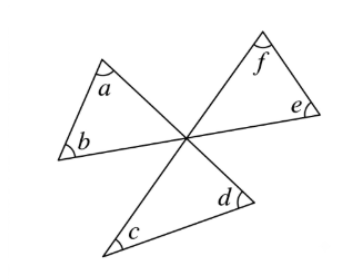
In the adjoining figure, the sum of the measures of the angles $$a$$, $$b$$, $$c$$, $$d$$, $$e$$, $$f$$ is
Backspace
789
456
123
0.-
Clear All
789
456
123
0.-
Clear All
Solution
Three straight lines pass through the middle point of the figure and cut out three triangles, one carrying the angles $$a$$ and $$b$$, one carrying $$e$$ and $$f$$, and one carrying $$c$$ and $$d$$. The three angles of these triangles at the middle point are vertically opposite the three remaining angles around that point, so the three of them add up to half of $$360^\circ$$, which is $$180^\circ$$. All nine angles of the three triangles add up to $$3 \times 180^\circ = 540^\circ$$, so the six marked angles add up to $$540^\circ - 180^\circ = 360^\circ$$.
A basket contains apples, bananas, and oranges. The total number of apples and bananas is 88. The total number of apples and oranges is 80. The total number of bananas and oranges is 64. Then the number of apples is
Backspace
789
456
123
0.-
Clear All
789
456
123
0.-
Clear All
Solution
Adding the three given totals counts every fruit exactly twice, so twice the number of fruits is $$88 + 80 + 64 = 232$$, and the basket holds 116 fruits in all. The bananas and oranges together are 64, so the number of apples is $$116 - 64 = 52$$.
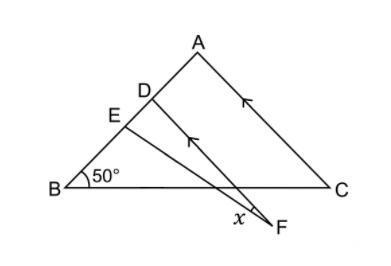
ABC is an isosceles triangle in which $$AB = AC$$. EDF is an isosceles triangle in which $$EF = DE$$. FD is parallel to AC. The degree measure of marked angle $$x$$ is
Backspace
789
456
123
0.-
Clear All
789
456
123
0.-
Clear All
Solution
Since $$AB = AC$$ and the figure marks $$\angle ABC = 50^\circ$$, we get $$\angle ACB = 50^\circ$$ and $$\angle BAC = 180^\circ - 50^\circ - 50^\circ = 80^\circ$$. As $$FD$$ is parallel to $$AC$$ with $$AB$$ as the transversal, the corresponding angles give $$\angle BDF = \angle BAC = 80^\circ$$, and since $$E$$ lies on $$DB$$, this is the angle $$\angle EDF$$ of the triangle $$EDF$$. In that triangle $$EF = DE$$, so the angles opposite these equal sides are equal, which gives $$x = \angle DFE = \angle EDF = 80^\circ$$.
The length and breadth of a rectangle are both prime numbers, and its perimeter is 40 cm. Then the maximum possible area of the rectangle (in $$\text{cm}^2$$) is
Backspace
789
456
123
0.-
Clear All
789
456
123
0.-
Clear All
Solution
Half the perimeter is $$\frac{40}{2} = 20$$ cm, so the length and the breadth are two primes adding up to 20. The possible prime pairs are 3 and 17, giving an area of $$3 \times 17 = 51$$, and 7 and 13, giving an area of $$7 \times 13 = 91$$. The greater of the two is $$91\ \text{cm}^2$$.