91- 6303239042


 Group


 Preferred Source

 Google Discover
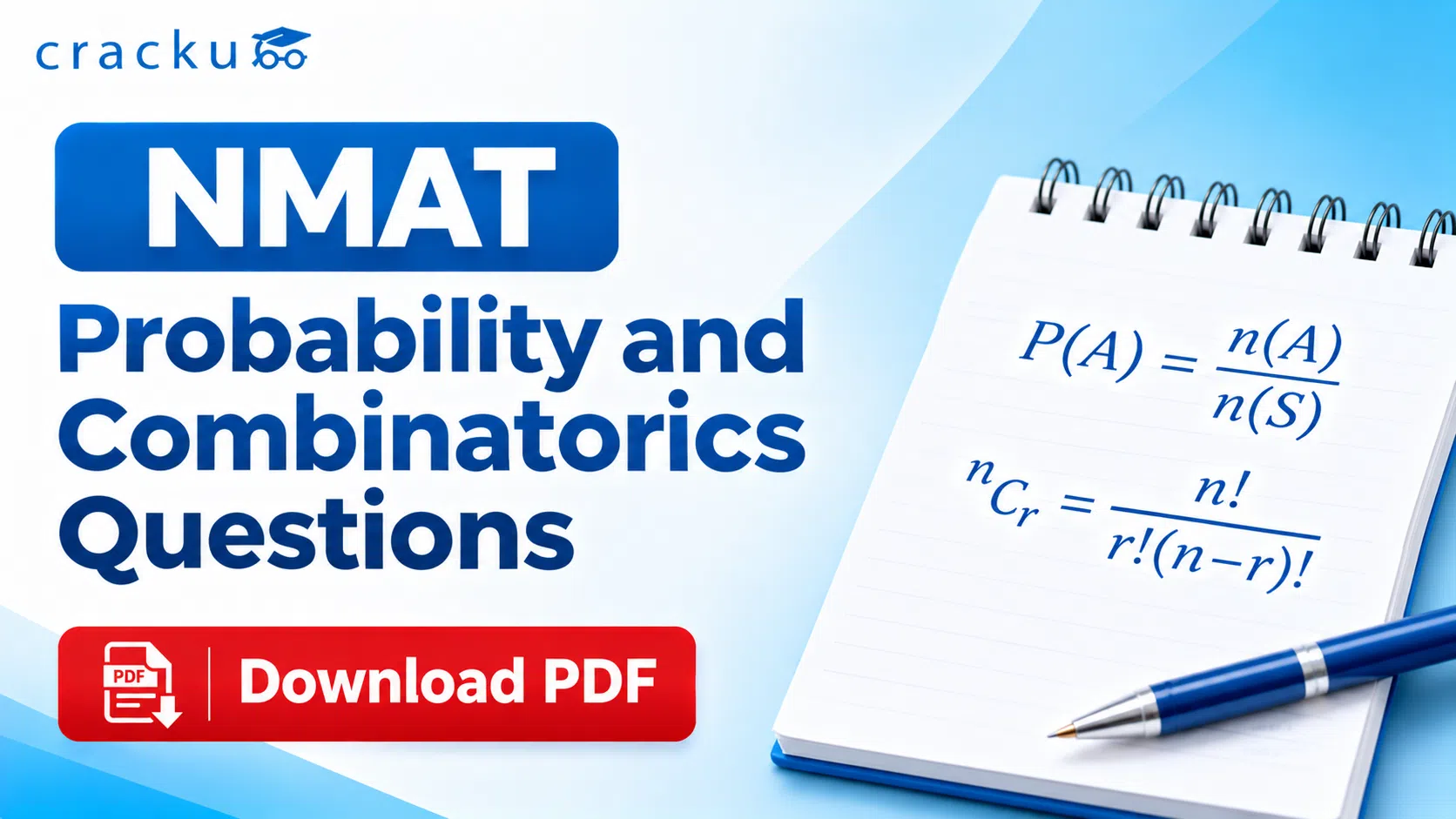
NMAT Probability and Combinatorics Questions 2026
Probability and Combinatorics (Permutations and Combinations) together form one of the most scoring yet most feared topics in the NMAT Quantitative Skills section. The section has 36 questions to be solved in 52 minutes, and this topic usually contributes 2 to 3 questions directly. Since NMAT has no negative marking, a clean counting method can turn these into quick, sure-shot marks.
Most NMAT Combinatorics questions rest on one decision: does order matter? If it does, you are arranging (permutations); if it does not, you are selecting (combinations). Probability then builds directly on counting, because every probability is simply favourable outcomes divided by total outcomes. Standard patterns include word arrangements, selecting committees with conditions, circular arrangements, digits and number formation, dice, coins and cards, drawing balls from a bag, independent events, "at least one" problems and distributing identical objects.
NMAT is a computer-adaptive test, so answering these questions correctly early on helps you move to higher-difficulty questions. Counting logic also shows up in Data Sufficiency and Logical Reasoning sets, so the effort you put in here pays off beyond a single topic.
Try to solve 8 to 12 Probability and Combinatorics questions daily. Mix pure arrangement questions, selection questions with conditions, dice and card probability, bag-and-ball problems and Data Sufficiency questions to build the pattern recognition you need to finish the Quant section on time.
NMAT Probability and Combinatorics Questions PDF
A single NMAT Probability and Combinatorics Questions PDF lets you practise every important pattern in one place instead of hunting through books and websites. It also makes last-minute revision quick, since the formulas, shortcut methods and solved examples sit together.
This PDF covers arrangements of letters with repeated letters, selection with "at least" conditions, circular arrangements, number formation, diagonals and triangles, distribution of identical objects, dice, coin and card probability, drawing balls and items without replacement, independent events, odds, derangements and an NMAT-style Data Sufficiency question. Every question comes with a step-by-step solution so you can check both your answer and your method.
Solve the questions in a timed setting, aiming for about 1.5 minutes per question. After each set, go through the solutions and note where the complement rule, the gap method or the glue method could have saved time. Revisit the questions you got wrong after a few days to make sure the concept has stuck.
Download NMAT Probability and Combinatorics Questions PDF
How to Solve NMAT Probability and Combinatorics Questions
Here are some methods that can help you solve NMAT Probability and Combinatorics questions quickly and accurately:
Decide whether order matters first: Before touching a formula, ask "does swapping two items create a new case?" Arranging people in seats, forming numbers or making passwords means order matters, so use permutations. Picking a team, a committee or a handful of balls means order does not matter, so use combinations.
AND means multiply, OR means add: If a task is done in stages (choose men AND choose women), multiply the counts. If the cases are separate alternatives (2 girls OR 3 girls OR 4 girls), add the counts.
Use the complement for "at least" questions: "At least one" is almost always faster as 1 − P(none), or Total − (cases with none). It turns a three-case calculation into a single subtraction.
Glue method for "together": If certain items must be together, tie them into one block, arrange the blocks, then arrange the items inside the block.
Gap method for "never together": Arrange the unrestricted items first, then place the restricted items in the gaps between them. With n items arranged in a row, there are n + 1 gaps.
Learn the key results by heart:
- nPr = n! ÷ (n − r)! and nCr = n! ÷ [r! × (n − r)!]
- nCr = nC(n − r), so 10C8 = 10C2 = 45
- Arrangements of n items where p are alike, q are alike, and so on = n! ÷ (p! × q! × …)
- n people around a circular table = (n − 1)!; beads on a necklace or flowers on a garland = (n − 1)! ÷ 2
- Distributing n identical items among r people, each getting at least one = (n − 1)C(r − 1); allowing zero = (n + r − 1)C(r − 1)
- Number of diagonals in an n-sided polygon = n(n − 3) ÷ 2
- Triangles from n points of which m are collinear = nC3 − mC3
- P(E) = favourable outcomes ÷ total outcomes, and P(not E) = 1 − P(E)
- P(A or B) = P(A) + P(B) − P(A and B)
- For independent events, P(A and B) = P(A) × P(B)
- Odds in favour of an event a : b means P(event) = a ÷ (a + b)
- Conditional probability: P(A given B) = P(A and B) ÷ P(B)
- Derangements (nothing in its correct place): D2 = 1, D3 = 2, D4 = 9, D5 = 44
Know the standard sample spaces: One die has 6 outcomes, two dice have 36, three coins have 8, and a deck has 52 cards (4 suits of 13; 12 face cards; 4 aces). For sums on two dice, the number of ways rises from 1 (sum 2) to 6 (sum 7) and falls back to 1 (sum 12).
Assign probabilities from odds before combining: Convert every odds statement into a plain probability first, then multiply or add. Mixing odds and probabilities is the most common error in these questions.
Sanity-check with the options: A probability must lie between 0 and 1, and an arrangement count with repeated letters must divide the count without repetition. Use this to strike out options before you calculate.
For Data Sufficiency, do not solve fully: A probability needs only a ratio of favourable to total, not the actual counts. Check whether a statement fixes that ratio uniquely.
Question 1
A fair coin is tossed repeatedly, If head appears on the first four tosses, then the probability of appearance of tail on the fifth toss is ..........
correct answer:- 1
Question 2
If all the vowels of the word COMPUTER are taken together, the letters of the word COMPUTER can be arranged in how many different ways ?
correct answer:- 1
Question 3
The Indian cricket team is to be selected out of fifteen players five of them are bowlers In how many ways the team can be selected so that the team contains at least three bowlers ?
correct answer:- 1
Question 4
From the letters of the word “STATISTICS”, how many distinct 10-letter words can be formed such that no two S’s appear consecutively?
correct answer:- 1
Question 5
Gajodhar throws two ordinary dice simultaneously. What is the probability that he shall get two numbers whose product will be an even number?
correct answer:- 5

Question 6
Two friends, Alka and Alkit appear for an interview for two vacancies for the same post in an Organisation. The probability of Alka's selection is 1/7 and Alkit is 1/ 5. What is the probability that only one of them will be selected?
correct answer:- 5
Question 7
There are 6 tasks and 6 persons. Task 1 cannot be assigned either to person 1 or person 2. Task 2 must be assigned to either person 3 or person 4. Every person is to be assigned one task. In how many ways can the assignment be done?
correct answer:- 4
Question 8
Four coins are tossed simultaneously. What is the probability that two consecutive heads never occur together?
correct answer:- 4
Question 9
The probabilities that A, B, and D can solve a problem independently are $$\dfrac{1}{3},\ \dfrac{1}{3}\ \&\ \dfrac{1}{4}$$ respectively. The probability that only two of them are able to solve the problem is:
correct answer:- 2
Question 10
Let A and B be two events such that P(A)=0.25, P(B)=0.50, and P(A∩B)=0.14. The probability that neither A nor B occurs is:
correct answer:- 3

Question 11
A speaks the truth in 75% cases and B in 80% of the cases. In what percentage of cases are they likely to contradict each other in narrating the same incident?
correct answer:- 3
Question 12
How many such pairs of digits are there in the number 8314629 each of which has as many digits between them in the number as after arranging the digits in descending order?
correct answer:- 3
Question 13
In how many ways can the following prizes be given away to a class of 30 students, first and second in Mathematics, first and second in Physics, first in Chemistry and first in English?
correct answer:- 4
Question 14
20 girls, among whom are A and B sit down at a round table. The probability that there are 4 girls between A and B is
correct answer:- 1
Question 15
A glass jar contains 6 white, 8 black, 4 red and 3 blue marbles. If a single marble is chosen at random from the jar, what is the probability that it is black or blue?
correct answer:- 2

Question 16
A word and number arrangement machine rearranges any given input, as shown below. All numbers are 2-digit numbers.
Input: 19 nike 21 just 45 do 90 it
Step 1: 90 19 21 just 45 do it nike
Step 2: 90 45 19 21 do it just nike
Step 3: 90 45 21 19 do it just nike
Step 4: 90 45 21 19 do it just nike
And step 4 is the final step of the input. Using the same machine, another input is fed.
Input: 41 39 you are 81 bald 99 man
What is the output after step 3?
correct answer:- 3
Question 17
Find the number of permutations that can be made from the letters of the word OMEGA, if the vowels occupy odd places.
correct answer:- 1
Question 18
DIRECTION for the question: Solve the following question and mark the best possible option.
The probability that a card drawn from a pack of 52 cards with be a diamond or a king, is
correct answer:- 2
Question 19
How many words of 4 letters beginning with 'A' or 'E' can be formed with the letters of the word 'EQUATION' ?
correct answer:- 4
Question 20
DIRECTION for the question: Solve the following question and mark the best possible option.
A basket contains 4 red , 5 blue and 3 green marbles. If 2 marbles are drawn at random from the basket, what is the probability that both are red?
correct answer:- 2