Group
Group
The NMAT 2026 marking scheme is important for candidates preparing for the exam. It explains the different types of questions, the sectional distribution of marks, and most importantly, the negative marking, which can affect the overall score. This understanding helps applicants to arrange their preparation material, focusing on important areas with high weightage, and matching their study technique with the exam's requirements can increase the overall score of the candidate.
NMAT Marking Scheme 2026
Understanding the NMAT marking scheme is important. It allows you to plan a better strategy for maximising your score. Because there is no negative marking, students are allowed to attempt all of the NMAT questions. The NMAT uses a scaled scoring model. Questions are randomly selected from a pool targeted at the candidate's ability level. The final score is derived using a probabilistic model and converted to a scaled score ranging from 12 to 120 per section. Here's an outline of the NMAT 2026 marking scheme, given below:
NMAT Marking Scheme 2026 | |
|---|---|
Criteria | Marking Scheme |
Correct Answer | +3 marks (scaled score) |
Incorrect Answer | No negative marking |
Unattempted Question | No penalty |
Score Per Section | 12–120 (scaled) |
Total Score Range | 36–360 |
Read Also, NMAT Score vs Percentile 2026, Check Previous Year Analysis
NMAT Negative Marking 2026
The NMAT does not give any negative marks for incorrect answers, encouraging students to attempt all questions without fear of losing marks. This element of the NMAT exam increases students' confidence and allows them to plan more flexible exam strategies. While the absence of negative marking may not have a major effect on overall rankings because all applicants have the same advantage, intelligent and careful guesses can still be useful.
Average students, in particular, generally find the exam easier, as they can attempt tough questions without fear of penalty for incorrect answers. However, depending purely on random or wild guessing is unlikely to give you a big advantage; therefore, strategic answering is important for maximising the NMAT score.
"Note: Since each correct answer contributes +3 marks to the raw score, and there are 108 questions total, the maximum raw score is 324, which GMAC then converts to a scaled score in the 36–360 range."
NMAT Exam Pattern 2026
NMAT Exam Pattern 2026 covers the structure, format, and marking scheme of GMAC's NMAT, one of the most popular MBA entrance exams in India and other countries. The exam serves to be candidate-friendly, with a computer-based method that evaluates a candidate's language skills, quantitative ability, and logical reasoning.
Understanding the NMAT 2026 exam pattern helps students in carefully planning their preparation and performing confidently on exam day. Below in the table, the detailed NMAT exam pattern for 2026 is given:
NMAT Exam Component | Details |
Exam Sections | Language Skills, Quantitative Skills, and Logical Reasoning |
Number of Questions | 36 questions in each section; 108 questions in total |
Overall Time Duration | 120 minutes (2 hours) |
Language Skills Time Limit | 28 minutes |
Quantitative Skills Time Limit | 52 minutes |
Logical Reasoning Time Limit | 40 minutes |
Score Per Section | 12–120 (scaled) |
Total Score Range | 36–360 |
Section Order | Candidates can choose the order of sections at the start of the exam |
Scorecard Availability | Within 48 hours of taking the exam |
Negative Marking | No negative marking for incorrect answers |
Exam Difficulty Level | Moderate compared to CAT, XAT, and SNAP |
Number of Attempts Allowed | Up to 3 attempts during the testing window |
Exam Mode | Computer-Based Test (CBT) |
Read Also, NMAT Syllabus 2026 PDF, Section Wise Important Topics
NMAT Preparation Strategy 2026
The first step in preparing for the NMAT is to make a preparation strategy for NMAT. Next, students should check their present level of preparation by reading NMAT previous-year papers or sample papers. Then, make a daily NMAT plan and stick to it. Check out the NMAT exam preparation strategies below.
1. Understand the syllabus & exam pattern: Read the NMAT exam pattern and syllabus before you start preparing for the 2026 exam. Understand about the topics you'll need to deal with and their weightages.
2. Decide your NMAT study mode: Choose whether you want to prepare for the NMAT on your own or through a coaching program.
3. Strengthen your fundamentals: Work on mastering the basic concepts of mathematics, reasoning, and English language. Having a basic comprehension of the topics is necessary for scoring well.
4. Solve the NMAT Previous Year Papers and Mocks: Previous years' papers can help students understand the types of questions they will see in the exam, and accordingly, they can prepare for such questions in advance.
5. Develop your NMAT Test Taking Approach: After you've identified your strengths and weaknesses, create your own NMAT question-solving technique and try it in a few NMAT mock tests.
Read Also, NMAT Cutoff 2026, Expected Cut off & Course Wise Analysis
Does NMAT Have Negative Marking?
No, there is no negative marking in NMAT 2026. So they can answer any question without fear of losing marks. This characteristic makes the NMAT less difficult than many other MBA entrance exams and allows students to use rational guessing when unsure of an answer. Because the exam uses a computer-based format, it is advised that candidates should attempt all questions because unanswered questions might affect the overall score.
Is there negative marking in NMAT 2026? | |
|---|---|
Particulars | Details |
Negative Marking | No |
Penalty for Wrong Answer | None |
Penalty for Unattempted Questions | No direct penalty |
NMAT Score vs Percentile 2026
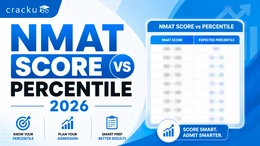
The NMAT percentile is calculated using the raw scores of all NMAT 2026 candidates. A relation between score and NMAT percentile can be calculated with sample data from the previous year's NMAT exam. This NMAT score vs percentile 2026 calculation can help applicants calculate their NMAT score and percentile.
Here's an expected table to help you to understand the percentile based on raw scores. However, students should be aware that the percentile and marks relation might vary from year to year because of multiple reasons.
NMAT Score vs Percentile 2026 | |
NMAT Score Range | Percentile |
236 - 244 | 99 |
232 - 235 | 98 |
230 - 231 | 97 |
226 - 228 | 95 |
220 - 222 | 90 |
209 - 211 | 80 |
207 - 208 | 75 |
200 - 205 | 70 |
NMAT Marking Scheme 2026: Conclusion
Understanding the NMAT Marking Scheme 2026 is essential for maximizing your performance in the exam. The absence of negative marking, combined with the adaptive scoring system and flexible section order, makes NMAT one of the most candidate-friendly MBA entrance exams. Knowing the score range, sectional structure, and percentile trends can help candidates build an effective test-taking strategy.
Since every attempt counts toward improving your final performance, candidates should focus on accuracy, speed, and smart question selection during preparation. By understanding the NMAT exam pattern, practicing regularly through mock tests, and leveraging the no-negative-marking advantage, aspirants can significantly improve their NMAT score and increase their chances of securing admission to top MBA colleges.