Group
Group
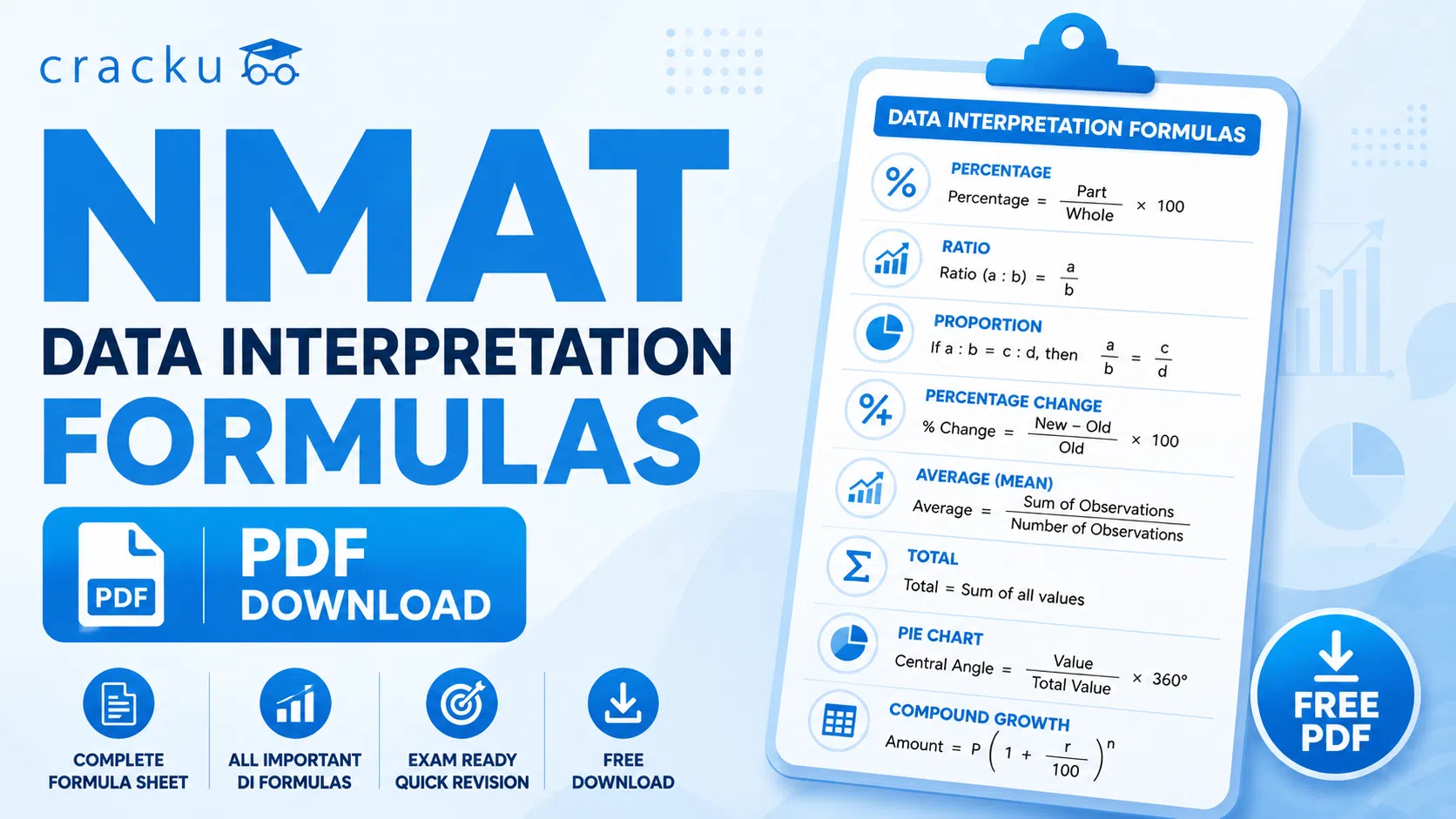
NMAT Data Interpretation Formulas PDF
NMAT Data Interpretation Formula PDF is part of the NMAT exam's Quantitative Skills section. Data Interpretation covers a good number of questions in the Quantitative Skills section of the NMAT exam, and with the correct technique, students can score well in this area.
Students aiming for an excellent overall score must have a good understanding of NMAT Data Interpretation formulas and related concepts. These formulas must be revised on a daily basis to perform well in the NMAT exam. This PDF can be used effectively for quick revision, mock test practice, and as a last-minute preparation for the NMAT exam.
Importance of NMAT Data Interpretation Formulas
Data Interpretation is an important topic in the NMAT Quantitative Skills section. A formula PDF has its own importance because it is a useful source for planning a strategy. Candidates having access to this PDF will automatically have a clear edge over others.
- Helps students solve data interpretation questions fast with accuracy during the NMAT exam.
- Reduces calculation time by giving straightforward solutions to difficult questions.
- It enables aspirants to confidently answer questions based on caselets, tables, line graphs, bar charts, and pie charts.
- The use of these formulas can reduce mistakes.
- Improves the conceptual clarity of reading and interpreting different chart types when aspirants try to solve formulas through derivations.
- Finally, it would improve overall Quantitative Skills performance and sectional score.
Complete NMAT Data Interpretation Formula List
NMAT Data Interpretation formulas at one single spot make preparation smooth and revision easy for aspirants. The list below contains topics and their formulas for the Data Interpretation part.
Caselets
Percentage of a Total
Percentage = (Part / Whole) × 100%
Converting a Ratio to Individual Values
Value of a part = (Given part of ratio / Sum of all ratio parts) × Overall total
Simple Average
Average = Sum of observations / Number of observations
Compound Annual Growth Rate (CAGR)
CAGR = (Final value / Initial value)^( / Number of years) − 1
Tables
Row or Column Percentage
Row % = (Cell value / Row total) × 100%
Year-on-Year Growth Rate
Growth % = ((Current year − Previous year) / Previous year) × 100%
Cumulative Total up to a Row
Running total after row k = Sum of values in rows 1 through k
Line Graphs
Slope = Rate of Change
Slope = Change in value / Change in time
Point-to-Point Growth %
Growth % from A to B = ((Value at B − Value at A) / Value at A) × 100%
Bar Charts
Value from Bar Height
Value = Scale per unit height × Observed height units
Segment Percentage in a Stacked Bar
Segment % = (Segment value / Total height of that bar) × 100%
Pie Charts
Central Angle from Percentage
Angle (°) = Percentage × 3.6
Value from Central Angle
Value = (Angle / 360°) × Total
Percentage from Angle
Percentage = (Angle / 360°) × 100%
Tabular Data Analysis (Percentages, Ratios, Averages)
Basic Percentage
Percentage = (Part / Whole) × 100%
Percentage Change
Change % = ((New − Old) / Old) × 100%
Turning a Ratio into Fractions/Percentages
Fraction of part = Ratio part / Sum of parts
Average (Arithmetic Mean)
Average = Total of all items / Number of items
Weighted Average
Weighted average = Sum of (value × weight) / Sum of weights
NMAT Data Interpretation Question Distribution Over the Years
Data Interpretation contributes a significant number of questions in the NMAT Quantitative Skills section every year. Caselets, tables, line graphs, bar charts, and pie charts are frequently asked question types in the exam and are important areas to prepare. The table below summarizes the approximate distribution of Data Interpretation questions asked in NMAT over the years, helping aspirants focus on the most important topics.
NMAT Exam Year | Data Interpretation Questions | Total Quant Questions |
NMAT 2024 | 10–12 | 36 |
NMAT 2023 | 10–12 | 36 |
NMAT 2022 | 9–11 | 36 |
Read Also, NMAT Number Properties Formulas PDF, Preparation Tips & Tricks
Tips to Master Important Data Interpretation Formulas for NMAT
After downloading the NMAT Formula PDFs, aspirants can follow these fundamental things to score good marks in the NMAT Data Interpretation part and improve performance in mock tests and in the NMAT exam.
- Clarity of Concept: Instead of just memorising formulas, start by understanding the basic concepts behind the derivation.
- Understand Formula Derivations: Instead of just memorizing formulas, understand how they are derived. This helps in revising them fast and using them correctly in different questions.
- Prepare a Formula List: By using the PDF, make a personal NMAT formula list with the formulas you struggle with the most.
- Analyse Mistakes After Practice: Analyse incorrect answers of mock tests to find weak areas and formulas that are used incorrectly, and avoid making the same mistakes.
Read Also, NMAT Syllabus 2026 PDF, Section Wise Important Topics
Download Cracku's Free NMAT Data Interpretation Formulas PDF
Cracku's Free NMAT Data Interpretation Formulas PDF is a complete source that covers major formulas for caselets, tables, line graphs, bar charts, pie charts, and tabular data analysis. Download it to accelerate your preparation and increase your accuracy in the NMAT exam. This formula PDF will help revise the complete topics in much lesser time, so that candidates can also focus on other topics and sections of the NMAT exam.
NMAT Data Interpretation Formulas PDF: Conclusion
NMAT Data Interpretation Formulas PDF is an essential revision resource for aspirants preparing for the Quantitative Skills section. Since Data Interpretation questions frequently appear in the exam, having all important formulas related to percentages, averages, ratios, growth rates, tables, pie charts, and graphs in one place helps candidates revise efficiently and solve questions with greater accuracy.
Regular practice combined with consistent revision of the NMAT Data Interpretation Formulas can significantly improve speed and confidence during the exam. By mastering these formulas and applying them through mock tests and practice questions, candidates can maximize their Quantitative Skills score and strengthen their overall NMAT performance.