JEE WhatsApp Group



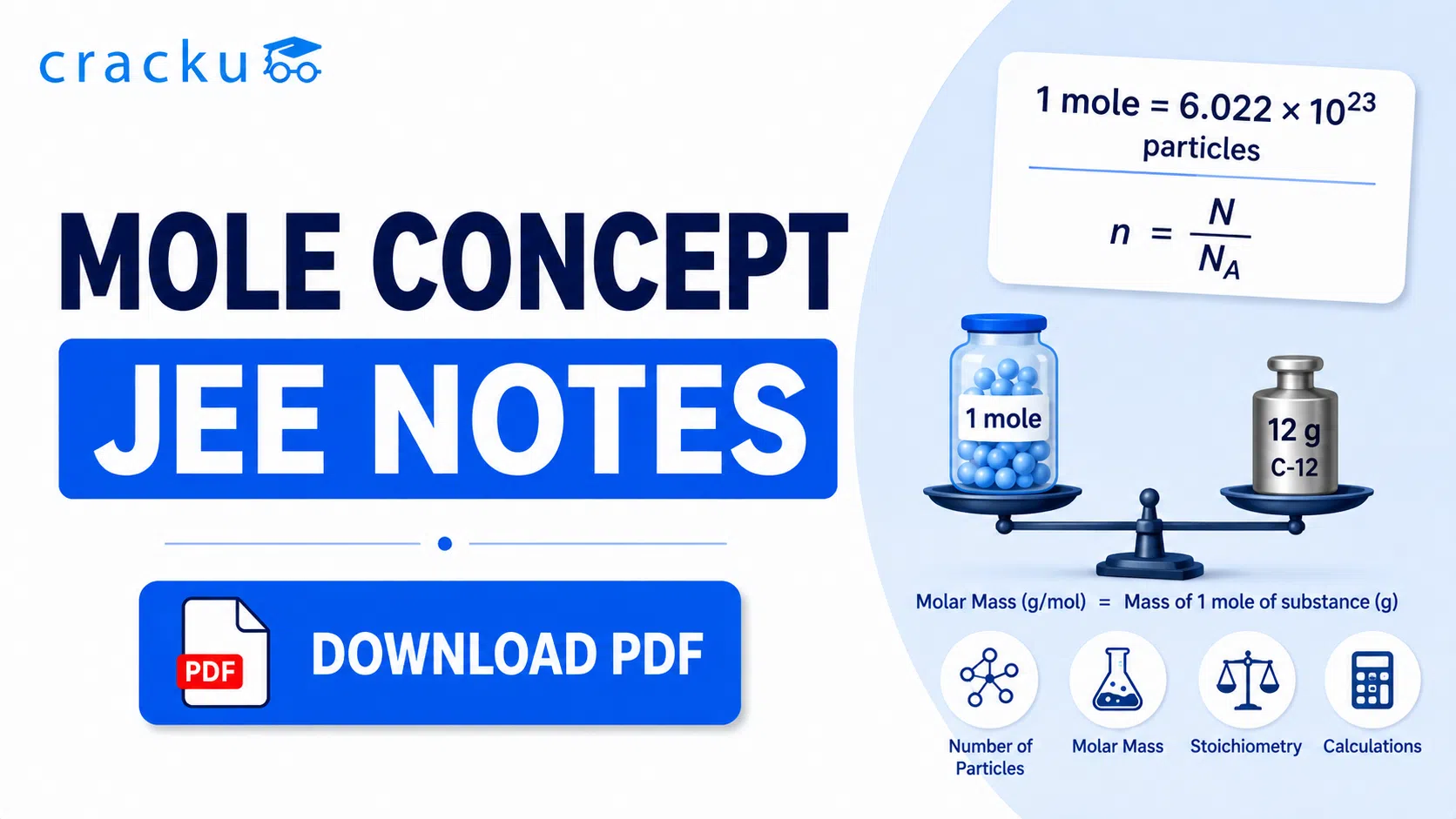
Mole Concept and Stoichiometry is the first chapter of JEE Chemistry and the one that every numerical in physical and inorganic chemistry runs through. Atoms and molecules are far too small to count individually, so chemists use the mole as a counting unit, much as we use "dozen" for 12. Practising JEE questions on the Mole Concept helps students understand how these ideas are applied in numerical problems. These Mole Concept JEE notes cover Avogadro's number, molar mass, the three mole relationships, percentage composition, empirical and molecular formulas, stoichiometry, limiting reagent and concentration terms in a format built for fast revision.
Mole Concept JEE Notes: Important Concepts
The Mole and Avogadro's Number
Mole: the amount of substance containing exactly $$6.022 \times 10^{23}$$ particles, whether those particles are atoms, molecules, ions or electrons. This count is Avogadro's number, $$N_A$$.
$$N_A = 6.022 \times 10^{23}\ \text{particles/mol}$$
- 1 mole of carbon atoms = $$6.022 \times 10^{23}$$ carbon atoms
- 1 mole of water molecules = $$6.022 \times 10^{23}$$ water molecules
- 1 mole of electrons = $$6.022 \times 10^{23}$$ electrons
Worked example: how many molecules are present in 3 moles of $$H_2O$$?
$$N = n \times N_A$$
$$N = 3 \times 6.022 \times 10^{23} = 1.807 \times 10^{24}\ \text{molecules}$$
Atomic and Molecular Mass
Atomic masses are measured relative to carbon-12.
| Term | Meaning |
|---|---|
| Atomic mass unit (amu or u) | Exactly $$\frac{1}{12}$$ the mass of a carbon-12 atom; $$1\,\text{amu} = 1.66 \times 10^{-24}\,\text{g}$$ |
| Atomic mass | Mass of one atom in amu, read from the periodic table, such as C = 12 u, O = 16 u and Fe = 56 u |
| Molecular mass | Sum of the atomic masses of all atoms present in a molecule |
Worked example: molecular mass of $$H_2SO_4$$:
$$2(1) + 1(32) + 4(16) = 2 + 32 + 64 = 98\,u$$
Molar Mass
Molar mass ($$M$$) is the mass of one mole of a substance and is expressed in g/mol.
- Molar mass of C = $$12\,\text{g/mol}$$, so one mole of carbon weighs 12 g.
- Molar mass of $$H_2O = 18\,\text{g/mol}$$.
- Molar mass of $$H_2SO_4 = 98\,\text{g/mol}$$.
JEE tip: Molar mass in g/mol is numerically identical to molecular mass in amu. Add the required atomic masses and write the resulting molar mass in g/mol.
Mole Relationships: Mass, Particles and Volume
The mole links three measurable quantities: number of particles, mass and volume for gases. These conversions are among the most frequently used formulas in Mole Concept questions.
| Relationship | Formula | Notes |
|---|---|---|
| Mole and mass | $$n = \frac{w}{M}$$ | $$w$$ = given mass in g, $$M$$ = molar mass in g/mol |
| Mole and particles | $$n = \frac{N}{N_A}$$ or $$N = nN_A$$ | $$N$$ = number of particles |
| Mole and volume of gas at STP | $$n = \frac{V}{22.4}$$ | $$V$$ in litres; applicable at STP |
Mole and Mass
Worked example: how many moles are present in 49 g of $$H_2SO_4$$?
$$n = \frac{w}{M} = \frac{49}{98} = 0.5\,\text{mol}$$
Mole and Number of Particles
Worked example: how many atoms are present in 4 g of helium?
- Molar mass of He = $$4\,\text{g/mol}$$
- $$n = \frac{4}{4} = 1\,\text{mol}$$
- $$N = 1 \times 6.022 \times 10^{23} = 6.022 \times 10^{23}\ \text{atoms}$$
Mole and Volume of a Gas
At STP, standard temperature and pressure of $$0^\circ C$$ and 1 atm, one mole of any gas occupies 22.4 litres.
Worked example: what volume do 2 moles of $$O_2$$ occupy at STP?
$$V = n \times 22.4 = 2 \times 22.4 = 44.8\,L$$
Important: The $$22.4\,L/mol$$ value applies only at STP. For other conditions, use the ideal gas equation:
$$PV = nRT$$
Percentage Composition, Empirical and Molecular Formula
Percentage Composition
Percentage composition gives the mass fraction contributed by each element in a compound and can help identify an unknown compound.
$$\%\text{ of element} = \frac{\text{Mass of element in 1 mole of compound}}{\text{Molar mass of compound}}\times100$$
Worked example: find the percentage of oxygen in $$H_2O$$.
- Molar mass of $$H_2O = 2(1) + 16 = 18\,\text{g/mol}$$
- Mass of oxygen in one mole = $$16\,g$$
- $$\%O = \frac{16}{18}\times100 = 88.9\%$$
Empirical Formula and Molecular Formula
The empirical formula gives the simplest whole-number ratio of atoms in a compound. The molecular formula gives the actual number of atoms and is a whole-number multiple of the empirical formula.
For example, glucose has molecular formula $$C_6H_{12}O_6$$ and empirical formula $$CH_2O$$.
Steps to find the empirical formula:
- Find the mass or percentage of each element.
- Divide each value by the corresponding atomic mass to calculate moles.
- Divide all mole values by the smallest value.
- If the resulting ratios are not whole numbers, multiply all of them by the smallest integer that converts them into whole numbers.
Converting empirical formula to molecular formula:
$$n = \frac{\text{Molecular mass}}{\text{Empirical formula mass}}$$
$$\text{Molecular formula} = n \times \text{Empirical formula}$$
Worked example: a compound contains 40% C, 6.7% H and 53.3% O. Its molecular mass is 60. Find its molecular formula.
- Assume a 100 g sample.
- $$C = \frac{40}{12} = 3.33$$
- $$H = \frac{6.7}{1} = 6.7$$
- $$O = \frac{53.3}{16} = 3.33$$
- Divide by 3.33: $$C:H:O = 1:2:1$$
- Empirical formula = $$CH_2O$$
- Empirical formula mass = $$12+2+16=30$$
- $$n = \frac{60}{30}=2$$
- Molecular formula = $$C_2H_4O_2$$
Stoichiometry, Limiting Reagent and Concentration Terms
Reading a Balanced Chemical Equation
Stoichiometry is the study of quantities involved in chemical reactions. A balanced chemical equation gives the exact mole ratios in which reactants combine and products form.
For:
$$N_2 + 3H_2 \rightarrow 2NH_3$$
- 1 mole of $$N_2$$ reacts with 3 moles of $$H_2$$.
- 2 moles of $$NH_3$$ are produced.
- Mole ratio $$N_2:H_2:NH_3 = 1:3:2$$.
- Mass is conserved, so total mass of reactants equals total mass of products.
Worked example: how many grams of $$NH_3$$ can be formed from 14 g of $$N_2$$?
- Moles of $$N_2 = \frac{14}{28} = 0.5\,\text{mol}$$
- 1 mol $$N_2$$ gives 2 mol $$NH_3$$.
- Therefore, 0.5 mol $$N_2$$ gives 1 mol $$NH_3$$.
- Mass of $$NH_3 = 1\times17 = 17\,g$$.
Limiting Reagent
When reactants are not mixed in exactly the ratio required by the balanced equation, the reactant that gets consumed first is called the limiting reagent. It determines the maximum quantity of product that can form. The other reactant remains in excess.
Steps to identify the limiting reagent:
- Calculate the moles of each reactant.
- Divide the number of moles of each reactant by its coefficient in the balanced equation.
- The smallest value corresponds to the limiting reagent.
- Use the limiting reagent to calculate the quantity of product formed.
Worked example: 5 g of $$H_2$$ reacts with 32 g of $$O_2$$ according to:
$$2H_2 + O_2 \rightarrow 2H_2O$$
- $$n(H_2)=\frac{5}{2}=2.5\,\text{mol}$$
- $$n(O_2)=\frac{32}{32}=1\,\text{mol}$$
- For $$H_2$$: $$\frac{2.5}{2}=1.25$$
- For $$O_2$$: $$\frac{1}{1}=1$$
- Since 1 is smaller, $$O_2$$ is the limiting reagent.
- 1 mol $$O_2$$ produces 2 mol $$H_2O$$.
- Mass of water formed = $$2\times18=36\,g$$.
JEE tip: In stoichiometry problems, balance the equation first, convert all given quantities into moles and check the limiting reagent whenever quantities of two or more reactants are provided.
Concentration Terms
A solute dissolved in a solvent forms a solution. The following concentration terms describe how much solute is present.
| Term | Formula | Unit |
|---|---|---|
| Molarity ($$M$$) | $$M = \frac{\text{Moles of solute}}{\text{Volume of solution in L}}$$ | mol/L |
| Molality ($$m$$) | $$m = \frac{\text{Moles of solute}}{\text{Mass of solvent in kg}}$$ | mol/kg |
| Mole fraction ($$\chi$$) | $$\chi_A = \frac{n_A}{n_A+n_B}$$ | No unit |
| Mass percent (w/w) | $$\frac{\text{Mass of solute}}{\text{Mass of solution}}\times100$$ | % |
Worked example: calculate the molarity when 4 g of NaOH is dissolved in water to prepare 500 mL of solution.
- Molar mass of NaOH = $$23+16+1=40\,\text{g/mol}$$
- Moles of NaOH = $$\frac{4}{40}=0.1\,\text{mol}$$
- Volume = $$500\,\text{mL}=0.5\,L$$
- $$M = \frac{0.1}{0.5}=0.2\,M$$
JEE tip: Molarity changes with temperature because it depends on volume. Molality does not change with temperature because it depends on mass. This is why molality is commonly used in colligative property problems.
Mole Concept Formula Sheet at a Glance
| Quantity or Situation | Formula |
|---|---|
| Avogadro's number | $$N_A = 6.022\times10^{23}\ \text{particles/mol}$$ |
| Atomic mass unit | $$1\,\text{amu}=1.66\times10^{-24}\,g$$ |
| Moles from mass | $$n=\frac{w}{M}$$ |
| Moles from particle count | $$n=\frac{N}{N_A},\qquad N=nN_A$$ |
| Moles of gas at STP | $$n=\frac{V}{22.4}$$ |
| Molar volume at STP | $$22.4\,L/mol$$ at $$0^\circ C$$ and 1 atm |
| Gas outside STP conditions | $$PV=nRT$$ |
| Percentage of an element | $$\frac{\text{Mass of element in 1 mol}}{\text{Molar mass}}\times100$$ |
| Empirical to molecular formula factor | $$n=\frac{\text{Molecular mass}}{\text{Empirical formula mass}}$$ |
| Molecular formula | $$n\times\text{Empirical formula}$$ |
| Molarity | $$M=\frac{\text{Moles of solute}}{\text{Volume of solution in L}}$$ |
| Molality | $$m=\frac{\text{Moles of solute}}{\text{Mass of solvent in kg}}$$ |
| Mole fraction | $$\chi_A=\frac{n_A}{n_A+n_B}$$ |
| Mass percent | $$\frac{\text{Mass of solute}}{\text{Mass of solution}}\times100$$ |
JEE Important Points, Common Mistakes and Quick Revision
Points JEE Repeatedly Tests
- Molar mass in g/mol is numerically the same as molecular mass in amu.
- The $$22.4\,L/mol$$ molar volume applies only at STP. At other temperatures and pressures, use $$PV=nRT$$.
- If quantities of two reactants are provided, check for the limiting reagent before calculating the product.
- Molality is temperature independent, whereas molarity varies with temperature.
- The molecular formula is always a whole-number multiple of the empirical formula.
Common Mistakes to Avoid
- Using mole ratio as a mass ratio. Coefficients in balanced equations represent mole ratios, not gram ratios. Convert the quantities into moles first.
- Skipping the limiting reagent check. When more than one reactant quantity is given, determine which reactant limits the product.
- Using 22.4 L/mol away from STP. This value applies only at $$0^\circ C$$ and 1 atm.
- Confusing molarity and molality. Molarity uses the volume of solution, while molality uses the mass of solvent.
- Dividing by molar mass instead of atomic mass when determining mole ratios for an empirical formula.
- Rounding mole ratios too early. A ratio such as $$1:2.5$$ should be converted to $$2:5$$ instead of being rounded to $$1:2$$.
- Forgetting to convert mL into L before calculating molarity.
- Counting molecules when the question asks for atoms. For example, one mole of $$H_2O$$ contains $$6.022\times10^{23}$$ molecules but three times as many total atoms.
Quick Revision Notes for Mole Concept
- One mole contains $$6.022\times10^{23}$$ particles.
- The three basic conversions are $$n=\frac{w}{M}$$, $$n=\frac{N}{N_A}$$ and $$n=\frac{V}{22.4}$$ for gases at STP.
- Molar mass in g/mol is numerically equal to molecular mass in amu.
- $$\%\text{ of element}=\frac{\text{Mass of element in one mole}}{\text{Molar mass}}\times100$$.
- Empirical formula method: take mass or percentage, divide by atomic masses, divide by the smallest value and scale the ratios to whole numbers.
- $$\text{Molecular formula}=\frac{\text{Molecular mass}}{\text{Empirical formula mass}}\times\text{Empirical formula}$$.
- Stoichiometry routine: balance the equation, convert quantities into moles, apply the mole ratio and check the limiting reagent.
- Limiting reagent corresponds to the smallest value of $$\frac{\text{moles}}{\text{coefficient}}$$.
- Molarity is mol/L of solution; molality is mol/kg of solvent; mole fraction has no unit.
Problem-solving routine: Convert whatever the question gives you, such as grams, litres or particle counts, into moles first. Most Mole Concept questions become much easier once every given quantity is expressed in moles. Use a JEE formula sheet during revision to quickly recall the key mole relationships and avoid calculation mistakes.
.webp)