What does the term “dehumanize” most closely mean in the context of the passage?
MAH MBA CET Sample Paper 2026
The passage below is accompanied by a set of questions. Choose the best answer to each question.
"Violence is a driver of much of human history," David C. Geary, a cognitive scientist and evolutionary psychologist at the University of Missouri in Columbia, stated in an email. "All of humanity's early empires were built through intimidation and violence." "There's also evidence of aggression before recorded history: bones with evidence of violent death, like embedded arrow points or skulls staved in," says Pat Barclay, an evolutionary psychologist at the University of Guelph in Ontario. That suggests violence predated complex societies and the rise of civilization.
But on the flip side, rates of violence vary (and have historically varied) wildly across cultures and communities, Barclay said. That suggests violence can be dialled up or down dramatically in our species. Nomadic peoples, for example, tend to have lower levels of lethal interpersonal human violence, while eras filled with societies bent on plunder and conquest, unsurprisingly, had higher levels. And modern-day American culture is more violent than most of those in Europe. "There's wide variation in violence rates — order of magnitude difference," Barclay noted. "In some specific recorded societies, up to half of all men die violently at the hands of other men. In other societies, physical violence is very rare, like in modern Japan."
Violence tends to breed violence, meaning that cultures where conflict is common are more likely to experience violence generation after generation, Geary said. In this way, violence is "transmitted" as a contagious disease would be, according to University of Illinois epidemiologist Gary Slutkin. However, Brad Evans, a professor of political violence at the University of Bath in the U.K., pointed out that even people in the most progressive and peaceful communities are capable of violence. "Ordinary, lawful persons can quickly turn into monsters once conditions change; equally, some who are most dislikeable can end up showing remarkable acts of kindness. There is no clear formula as to why a person acts in a violent way. And that is why it is such a complex problem," Evans said.
Additionally, according to both Barclay and Evans, it can be far easier to carry out violent acts if the individual committing the violence is distant from their victims; it is far easier to press a button launching a nuclear missile than it is to physically and directly strike a killing blow. For instance, in Stanley Milgram's classic studies of obedience, in which an experimenter told participants to deliver electric shocks of increasing intensity to other people, participants were more reluctant to shock victims if they were physically closer to them, Barclay noted. And historically, acts of genocide occur after perpetrators dehumanize, or create psychological distance, between themselves and those of a different race or ethnicity.
Solution
The passage states, “acts of genocide occur after perpetrators dehumanize, or create psychological distance, between themselves and those of a different race or ethnicity.” This suggests that to “dehumanize” means to perceive others as less than human. It is a process that involves stripping away the human qualities of another group to facilitate violence or mistreatment. Option A correctly presents this idea.
Which of the following conclusions can be drawn from the passage regarding violence?
I. Violence is an inherent part of human nature.
II. Some cultures are more violent due to historical and social factors.
III. Proximity to victims can affect the likelihood of committing violence.
IV. There are clear and universal predictors of violent behaviour.
Solution
The passage provides evidence for the following points:
II: Some cultures are more violent due to historical and social factors, as seen in the mention of "societies bent on plunder and conquest" and varying violence levels across cultures.
III: Proximity to victims can affect the likelihood of committing violence, which is supported by the reference to Stanley Milgram's experiments on obedience.
The other two points (I and IV) are not conclusively supported. The passage does not argue that violence is inherent in human nature (I) or that there are universal predictors of violent behaviour (IV), as violence varies greatly based on culture and context.
What is the main reason provided for why some societies historically had up to half of men die violently?
Solution
The passage explains that "societies bent on plunder and conquest" had higher levels of violence, which led to a high percentage of men dying violently. This emphasises the role of cultural factors, such as a focus on conquest, in increasing violent deaths. Option C aligns with this point.
Which of the following observations is consistent with the information in the passage?
Solution
Among the given statements, Option B best reflects the discussion. The passage highlights that even in peaceful communities, “ordinary, lawful persons can quickly turn into monsters once conditions change,” suggesting that individuals are influenced by external circumstances. This supports the idea that people may act violently when their environment or conditions shift.
The passage below is accompanied by a set of questions. Choose the best answer to each question.
One example of a multi-residence building from the ancient world was the Roman insula, or “apartment block.” While not as grand or luxurious as the domus (a private, single-family townhouse), multi-story insulae were important structures in crowded Roman cities. In a time before elevators, ground-floor and lower-level apartments were the most desirable. But while the idea that a Roman insula could rise as many as ten-to-twelve stories high may have taken hold in popular culture, anthropologist Glenn R. Storey points out that historical evidence doesn’t back up this assumption. He explains that this view “comes mostly from anecdotal written descriptions about Rome and other Roman cities” and that the “archaeological evidence for tall buildings in the Roman world is in reality very sparse.” Most material evidence places insulae at around four-to-five stories tall. The ruins of Case a Giardino in Ostia, Italy, supports this, as do the remains of other structures, such the Insula dell’Ara Coeli, within Rome itself.
Spinning the globe a bit, we arrive at the ancient city of Teotihuacan, outside present-day Mexico City. Teotihuacan was full of apartment compounds at its peak. The compounds were an essential part of Teotihuacan’s urban fabric, allowing a population of up to 200,000 people to live compactly within the city. While these may have looked a bit different than what we think of as apartments today, evidence shows that these structures “generally consist[ed] of several rooms at slightly different levels, arranged around open spaces (courtyards, refuse areas, and light wells) that serve[d] as places for ritual, rainwater collection, partial refuse disposal, and light provision,” explains archaeologist Linda R. Manzanilla. It’s believed that these apartments were shared by those either connected through kinship or through occupation.
In more recent times, apartments have been used as tools to clean-up and revitalize a city’s urban landscape. Georges-Eugène Haussmann’s urban plan for Paris, initiated in 1853, is a well-cited example of this. Hired by Napoléon III, Haussmann was granted wide authority to redesign Paris in his vision, as many—particularly those in power—found the city far too crowded and dirty. He widened the streets, making grand boulevards lined with the iconic “Haussmann buildings.” Standing as tall as six stories, these large structures with mansard roofs provided modern apartments while, along with the broad streets, gave Paris a visual unity—along with giving ample subject matter to the Impressionists for their paintings!
According to the passage, which of the following statements about Roman insulae is accurate?
I. In some places, they were usually taller than ten stories.
II. Lower-level apartments were more desirable due to accessibility.
III. Written descriptions of insulae likely exaggerate their height.
IV. Material evidence suggests insulae were typically four to five stories tall.
Solution
Statements II, III, and IV are supported by the passage. Statement I is incorrect, as the passage explicitly disputes the idea that insulae were taller than ten stories.
What can be inferred about the apartment compounds in Teotihuacan?
Solution
The passage describes the compounds as having multiple purposes, such as light provision, ritual use, and rainwater collection.
What does the word “anecdotal” most likely mean as used in the passage?
Solution
The passage contrasts “anecdotal written descriptions” with “archaeological evidence,” suggesting that “anecdotal” refers to accounts not firmly grounded in hard evidence.
The passage below is accompanied by a set of questions. Choose the best answer to each question.
“At critical junctures in American history, immigrants have been stigmatized as the etiology of a wide variety of physical and societal ills,” write scholars Howard Markel and Alexandra Minna Stern. “Anti-immigrant rhetoric and policy have often been framed by an explicitly medical language, one in which the line between perceived and actual threat is slippery and prone to hysteria and hyperbole.”
Markel and Stern explore the persistence of the notion that “immigrants threatened the health of the nation,” with “health” here being defined in both the public health sense and the ideological (political, moral) sense. So powerful is this persistence that some descendants of those who were once stigmatized now do the stigmatizing. Because most Americans are the descendants of immigrants, a division between “us” and “them” developed around the twentieth century, when a politically freighted distinction between the “old” immigrants who came from northern Europe and the “new” immigrants from eastern, central, and southern Europe seemed necessary. Between 1819 and 1880, 95 percent of immigrants came from England, Scotland, Ireland, Germany, France, the Low Countries, and the Nordic countries. By 1892, people from northern Europe made up less than 50 percent of immigrants, and that percentage steady dropped as arrivals from Russia, Poland, Austria-Hungary, the Balkans, Greece, Italy, Spain, Portugal, and Turkey increased.
These new immigrants ran afoul of hardening racial and eugenicist ideologies that defined them as not quite “white” and therefore biologically inferior and disease-ridden, a threat to both public health and a fantasy of racial purity. A diagnosis of a “loathsome or dangerous contagious disease” as the Immigration Act of 1891 put it, at the border “almost always meant deportation,” write Markel and Stern. At entrepôts such as Ellis Island, the US Public Health Service (USPHS) acted as the lookout for contagious diseases. But they also looked for cardiac problems, goiter, trachoma, sexually transmitted diseases, and parasitic infections, as well as “insanity, hernias, rheumatism, senility, malignancies, varicose veins, poor eyesight or blindness, and a range of other infirmities.” In 1898, some 2 percent of excluded immigrants were rejected entry for medical reasons. In 1915, 69 percent of all exclusions were based on medical criteria. This was because the list of medical reasons got longer and longer: the “creation and application of categories of medical exclusion outpaced the actual presence of diseases among the newly arrived.”
According to the passage, how did changes in the origins of immigrants influence perceptions of their fitness for entry?
Solution
The passage discusses how shifts in the demographic composition of immigrants entering the U.S. during the late 19th and early 20th centuries impacted how they were perceived by society and authorities. Initially, immigrants from northern Europe were seen as the "old" immigrants and deemed culturally and biologically superior. However, as immigration from southern and eastern Europe increased, these "new" immigrants faced heightened scrutiny, often being labelled as biologically inferior and a public health threat due to prevailing racial and eugenicist ideologies. Only Option E aligns with this idea.
The passage suggests that medical language was used to justify anti-immigrant sentiment likely because:
Solution
The passage emphasises that anti-immigrant rhetoric was framed in explicitly medical terms, apparently creating a veneer of neutrality while enabling discrimination. This approach allowed authorities to categorise immigrants as health risks based on both actual and exaggerated medical concerns, which aligned with the racial and eugenicist ideologies of the time. Option B correctly describes the phenomenon. The framing of anti-immigrant policies in medical language obscured underlying racial biases and allowed discrimination to be justified as a matter of public health.
Which of the following statements would most weaken the claim in the last paragraph?
Solution
The last paragraph highlights how the use of medical exclusions was often ideologically driven, with authorities expanding categories of exclusion beyond the actual presence of disease. Option C counters this the best: if exclusions were based solely on verifiable health risks, it would contradict the argument that medical rhetoric was being misused for discriminatory purposes.
Option A is not relevant since prioritising economic utility over public health concerns does not directly weaken the claim that medical language was used as a pretext for discrimination. Option B suffers from a similar issue and, thus, can be eliminated. Option D also fails to undermine the claim to the same extent as C since public consensus is tangential to the use of medical terminology towards discriminatory ends.
Option E does not definitively impact the argument in the last paragraph. Increased restrictions following public health outbreaks could align with the argument that health concerns were exploited, not necessarily contradict it.
In the world of true crime media, a good rule-of-thumb is that “runners” are rescuers and “joggers” get jabbed or jailed. But how did we become so obsessed with crime that the media now has patterns of language for describing this phenomenon? What about these stories compels us to need books, podcasts, television specials, and now social media campaigns about victims and suspects? As Dr. Pamela Burger notes, the true crime genre started with the dawn of print media and was as diverse then as it is now. Where sixteenth-century consumers couldn’t access printed materials, they turned to ballads and oral recitations of gruesome tales—even in church. As for modern consumers, Amanda Keeler explains that the availability of podcasts as a new form of true crime consumption has expanded both the quantity of stories available and the styles of account. Do you want to learn more about the victim—the investigation—the trial? There’s a podcast for that. But more importantly, she writes, "many of these podcasts effectively bridge the micro story of individuals with the macro investigations of larger circumstances surrounding criminal cases. The focus on these “small” stories helps to illuminate systemic issues, catapulting the audio-only exploration of an issue from the anonymous and vague notion that crime exists in the world to the personal stories of victims that can help create important connections for the audience."
Which of the following can be understood about the historical development of true crime media?
Solution
The passage provides a historical perspective on the development of true crime media, noting its diversity from its origins. It highlights how stories were consumed in different formats based on the availability of media, with a focus on oral traditions and ballads in the sixteenth century when print materials were scarce. Option C correctly highlights this information.
Option A is incorrect because the passage emphasises the diversity of true crime media throughout history, from oral recitations to modern podcasts, showing significant variation in format and style. On the other hand, Options B, D and E are difficult to substantiate since the passage presents no such claims.
What is the primary reason true crime podcasts have become popular, according to Amanda Keeler?
Solution
The passage discusses the appeal of modern true crime podcasts, emphasising their ability to blend individual stories with broader societal issues. This connection between “micro stories” (personal narratives) and “macro investigations” (systemic issues) is cited as a key reason for their popularity. Option D aptly points this out. None of the other reasons are presented in the passage.

For the following questions answer them individually
Rearrange the following sentences to get a meaningful paragraph :
A. Hydrogen fuel cells produce electricity by introducing oxygen to mix with contained hydrogen, producing water as a byproduct.
B. One way to obtain hydrogen is through the process of electrolysis, which uses electricity to split water into hydrogen and oxygen molecules.
C. The hydrogen is collected and contained for use or transport.
D. Hydrogen can play a big role in generating electricity.
Solution
Option D is the correct answer.
Sentence D introduces the topic by highlighting hydrogen's significant role in electricity generation, setting the stage for the discussion.
Sentence B logically follows by explaining how hydrogen can be obtained through the process of electrolysis, providing a foundation for understanding its sourcing.
Sentence C then describes the next step, where the collected hydrogen is contained for use or transport, creating a bridge between obtaining hydrogen and its practical application.
Finally, Sentence A concludes the flow by detailing how hydrogen fuel cells produce electricity, tying the explanation back to the topic introduced in Sentence D and completing the narrative cohesively.
Rearrange the following sentences to get a meaningful paragraph :
A. But in our modern society, the action bias is less necessary for survival than it once was.
B. Our tendency towards action is something hardwired into us from our history as hunter-gatherers.
C. Thousands of years ago, immediate action was required for our evolutionary ancestors to survive.
D. This automatic impulse was once incredibly adaptive.
Solution
Option D is the correct answer.
Sentence C introduces the topic by explaining how, thousands of years ago, immediate action was critical for the survival of our evolutionary ancestors, setting the historical context for the discussion.
Sentence B logically follows by connecting this historical necessity to human evolution, emphasizing that our tendency toward action is hardwired from our hunter-gatherer past.
Sentence D then elaborates on the adaptiveness of this automatic impulse in historical contexts, reinforcing its value in ensuring survival.
Finally, Sentence A concludes by transitioning to modern society, highlighting how the action bias, while once essential, is now less necessary for survival, providing a reflective and contemporary perspective to the discussion.
Rearrange the following sentences to get a meaningful paragraph :
A. They multiply and spread from one host to the other, feeding of their hosts, weakening them, and sometimes even killing them.
B. Organic parasites, such as viruses, live inside the body of their hosts.
C. As long as the hosts live long enough to pass along the parasite, it cares little about the condition of its host.
D. Ever more scholars see cultures as a kind of mental infection or parasite, with humans as its unwitting host.
Solution
Option E is the correct answer.
Sentence D introduces the topic by drawing a comparison between cultures and parasites, portraying humans as unwitting hosts to this mental infection, and setting the stage for the discussion.
Sentence B logically follows by providing an example of organic parasites, such as viruses, which live inside their hosts, helping to establish the basis for the analogy.
Sentence A then elaborates on the behavior of parasites, explaining how they multiply, spread, feed on their hosts, and sometimes even kill them, deepening the understanding of their impact.
Sentence C concludes the flow by reflecting on the parasite-host relationship, emphasizing that parasites prioritize their own survival and transmission over the condition of their host, tying the discussion back to the concept introduced in Sentence D.
Rearrange the following sentences to get a meaningful paragraph :
A. To Socrates, an individual’s actions were directly related to his intelligence and ignorance.
B. He believed people should develop their self, rather than concentrate on material objects, and he sought to understand the difference between acting good and being good.
C. A quote often attributed to Socrates is, “The unexamined life is not worth living."
D. Socrates believed that in order for a person to be wise, that individual must be able to understand himself.
Solution
Here, CDAB is the correct sequence of sentences.
Sentence C begins with Socrates' famous quote, introducing his central philosophy, "The unexamined life is not worth living," which sets the tone for the paragraph.
Sentence D elaborates on the idea introduced in C (the importance of self-examination) by stating that understanding oneself is essential for wisdom. This logically expands the central theme of self-awareness.
Sentence A connects actions to intelligence and ignorance, grounding Socrates' ideas in practical application.
Sentence B follows naturally by discussing how Socrates extended this idea to self-development and distinguishing between "acting good" and "being good."
Sentence D should precede B as it bridges the philosophical quote in sentence C and the practical application of Socrates' ideas in B, ensuring a logical progression.
Choose the correct synonym for the word : Abscond
Solution
 Share
Share
Option B is the correct answer.
The word "abscond" means to leave hurriedly and secretly, often to avoid detection or arrest. The closest synonym is "escape."
Choose the correct synonym for the word "Banal."
Solution
Option C is the correct answer.
The word "banal" refers to something lacking in originality, overused, or commonplace. The closest synonym is "trivial," which conveys a similar sense of being ordinary or unremarkable.
Choose the correct synonym for the word: Sycophant
Solution
Option D is the correct answer.
A "sycophant" is someone who flatters or ingratiates themselves with others, often to gain favor or advantage. The closest synonym is "flatterer."
Choose the correct synonym for the word: Quixotic
Solution
Option B is the correct answer.
The word "quixotic" describes someone who is exceedingly idealistic, often in a way that is impractical or unrealistic. The closest synonym is "idealistic."
Choose the correct synonym for the word: Enervate.
Solution
Option A is the correct answer.
The word "enervate" means to drain energy or vitality from someone, leaving them exhausted. The closest synonym is "exhaust."
Four words are given, out of which only one word is spelt correctly. Choose the correctly spelt word and click the button corresponding to it.
Solution
Option B is the correct answer.
The correct spelling is "acquaintance," which refers to a person one knows slightly but who is not a close friend.
"Acquaintence" is a common misspelling, often because people confuse it with the pronunciation.
"Aquaintance" and "Acquainteance" are incorrect because of extra or misplaced vowels.
Four words are given, out of which only one word is spelt correctly. Choose the correctly spelt word and click the button corresponding to it.
Solution
Option D is the correct answer.
The correct spelling is "exhilarate," which means to make someone feel very happy, animated, or elated.
"Exhilerate" is a common misspelling, as people often confuse the placement of the "i" and "l."
"Exhillerate" and "Exhilirate" are incorrect spellings due to extra or unnecessary letters.
Fill in the blank with the most appropriate option:
She completed the assignment ____ her friends were still brainstorming ideas.
Solution
Option A is the correct answer.
Option A: "While" indicates two actions happening simultaneously. This fits perfectly because her friends were brainstorming at the same time she completed the assignment.
Option B: "Whenever" implies repeated occurrences or any time something happens. This does not fit because the sentence describes a specific instance.
Option C: "Where" refers to a location, which is unrelated to the temporal connection between the two actions.
Option D: "As soon as" implies immediacy, meaning one action happens directly after the other. This does not work because the sentence describes two actions occurring concurrently, not consecutively.
Option E: "When" indicates a point in time. While it’s grammatically correct, it is less precise than "while," which emphasizes the simultaneity of the two actions.

Fill in the blank with the most appropriate word from the options given.
The teacher repeated the instructions twice _______ the students could understand clearly.
Solution
Option D is the correct answer.
Option A: "Since" explains the reason for an action but doesn’t indicate purpose. It doesn’t fit the sentence’s context of repeating instructions to achieve a specific goal.
Option B: "Because" explains a reason, but this sentence is about the purpose of repeating the instructions, not the cause of the action.
Option C: "While" implies simultaneous actions, which isn’t applicable here.
Option D: This is the best choice, as "so that" indicates the purpose of the teacher repeating the instructions: to ensure understanding.
Option E: "So as" can express purpose but is typically followed by an infinitive verb (e.g., "so as to make"). It’s grammatically incorrect in this sentence.
The sentence below has two blanks, each blank indicating that something has been omitted. Choose the set of words for each blank that best fits the meaning of the sentence as a whole.
She is travelling _______ train to get to the conference.
The report was completed _______ the manager's supervision.
Solution
Option D is the correct answer.
1) "She is travelling by train": The correct preposition to indicate the mode of transport is "by" when no article or specific detail is provided (e.g., not "the train" or "a train").
"The report was completed under the manager's supervision":
2) The preposition "under" is used to indicate the guidance or authority of someone, making it the correct choice here.
Option A: "In train" is incorrect; we use "by train" for travel.
Option B: While "by train" is correct, "with the manager's supervision" is less formal and doesn't convey authority as well as "under."
Option C: "In train" is incorrect, and "with the manager's supervision" is suboptimal.
Option E: "On train" is incorrect; we say "on the train" when referring to a specific train but "by train" for the general mode of transport.
Select the most appropriate option to fill in the blank:
The teacher emphasized the importance of discipline, stating that it is the _________ of success.
Solution
Option D is the correct answer. Cornerstone refers to something that is essential, fundamental, or the foundation of success. Discipline being emphasized as a key to success aligns perfectly with this metaphor.
Option A: Impediment means an obstacle or hindrance, which is the opposite of what discipline represents in this context.
Option B: Shadow does not convey the idea of a foundational element; it implies something secondary or unimportant.
Option C: While a blueprint represents a plan or guide, it doesn’t fit as well as "cornerstone," which emphasizes discipline as the foundation of success.
Option E: Drawback means a disadvantage, which is contradictory to the positive role of discipline in achieving success.

Select the most appropriate option to complete the sentence:
The scientist was awarded for his groundbreaking research, which has _____ our understanding of climate change.
Solution
Option B is the correct answer.
The sentence suggests the scientist's research has improved or added value to our understanding of climate change. "Enhanced" is the most appropriate choice because it means to increase or improve the quality of something.
Option A: Diminished means reduced, which contradicts the positive tone of the sentence.
Option C: Distracted implies diversion of attention, which is irrelevant to the idea of research improving understanding.
Option D: Complicated suggests making something more difficult, which doesn't fit the context of recognition for groundbreaking work.
Option E: Prevented would mean stopping or hindering, which does not align with the intent of improving understanding.
Which of the following phrases given below the sentence can replace the words /phrase given in bold in the sentence grammatically and meaningfully?
The team of researchers was preparing for the field study, which is scheduled to begin next month.
- were preparing for
- is preparing for
- has prepared for
Solution
Option B is the correct answer. Both phrases, 2 and 3, could replace the given phrase.
Phrase 1: "were preparing for" is incorrect, as "team" is a collective noun, treated as singular, so "was" is correct.
Phrase 2: "is preparing for" fits because it implies that the team is currently preparing, which aligns with the ongoing nature of the scheduled study. It uses the present continuous tense, which is appropriate for actions that are ongoing or happening in the near future. Since the field study is scheduled for next month, this tense fits if the preparation is currently taking place.
Phrase 3: "has prepared for" fits because it suggests the team has already completed its preparation, which is also valid in a different context. it uses the present perfect tense, which is suitable for actions completed in the past with relevance to the present situation. If the team has already completed its preparation for the study that begins next month, this phrase would be a valid choice.
Which of the following sentences is grammatically correct?
Solution
Option B is the correct answer. It uses the proper structure and grammar to convey the intended meaning. The verb "deems" is correctly followed by "it," which acts as a placeholder for the clause that explains what is deemed inappropriate. The phrase "for employees who arrive late" uses the relative pronoun "who," which is appropriate when referring to people, and "arrive" agrees with the plural subject "employees." Additionally, "to question company policies" correctly uses the infinitive form of the verb to indicate the action being criticized. This option is clear, concise, and adheres to standard grammar rules, making it the correct choice.
Option A: Uses "which" instead of "who," which is incorrect when referring to people.
Option C: Uses "that arrives," creating a subject-verb agreement error ("employees" is plural).
Option D: Omits "it," making the structure incomplete.
Option E: Here, "which" is used incorrectly for people, and "arrives" doesn't agree with the plural subject "employees."
Choose the grammatically correct version of the sentence given below:
He was neither interested in the project or willing to contribute to the team’s efforts.
Solution
Option A is the correct answer.
"Neither...nor" is the correct correlative conjunction pair to use for showing a negative choice between two alternatives. Using "neither...or" as in the original sentence is grammatically incorrect.
Option B: "Neither...and nor" is redundant and incorrect. The structure requires only "nor" after "neither."
Option C: The inclusion of "he was" after "nor" is unnecessary and disrupts the flow of the sentence.
Option D: "Nor was willing" is grammatically awkward; it should follow the same structure as the first clause for parallelism.
Option E: The original sentence is incorrect because "neither...or" is grammatically incorrect.
Five sentences are given below. Four of these when arranged in correct order, form a logical and meaningful paragraph. One of the sentences does not belong to this paragraph. Rearrange the 4 sentences that belong to the paragraph and choose the option that contains the order in which the 4 sentences should be put together:
A. The idea of equality is inextricably intertwined with the idea of creation.
B. The Americans got the idea of equality from Christianity, which argues that every person has a divinely created soul, and that all souls are equal before God.
C. According to the science of biology, people were not created’, they have evolved.
D. Christianity developed in a world with a well-articulated understanding of a multilayered and hierarchical universe that was, above all, animated.
E. And they certainly did not evolve to be ‘equal’.
Solution
Option D is the correct answer.
Sentence D is the odd one out. The sequence CEAB forms a coherent paragraph:
Sentence C introduces the biological perspective, stating that humans evolved rather than being created. It sets the stage for a discussion on the origins of equality by challenging the idea of divine creation.
Sentence E builds on C, emphasizing that evolution does not imply equality, creating a strong contrast to the idea of divinely ordained equality.
Sentence A transitions to the philosophical concept of equality being tied to creation, refuting the biological perspective introduced in C and E.
Sentence B, then, provides the historical and religious grounding of equality through Christianity, tying it to the idea of divine creation mentioned in A.
Thus, CEAB forms a logical paragraph that starts with a biological argument, moves to the philosophical and religious interpretation, and concludes by linking equality to Christianity.
Sentence D focuses on the historical context of Christianity which does not directly contribute to the discussion about equality or its connection to creation and evolution. The main theme of the paragraph is to contrast the biological perspective of evolution with the philosophical and Christian perspective of equality.
Five sentences are given below. Four of these when arranged in correct order, form a logical and meaningful paragraph. One of the sentences does not belong to this paragraph. Rearrange the 4 sentences that belong to the paragraph and choose the option that contains the order in which the 4 sentences should be put together:
A. By observing the accidental chain of events that led us here, we realise how our very thoughts and dreams took shape - and we can begin to think and dream differently.
B. It enables us to turn our head this way and that, and begin to notice possibilities that our ancestors could not imagine, or didn’t want us to imagine.
C. History and philosophy should reveal to us the baffling, strange and wondrous qualities of other lives and other times.
D. Studying history will not tell us what to choose, but at least it gives us more options.
E. Studying history aims to loosen the grip of the past.
Solution
Option E: EBAD is the correct answer.
Sentence C is the odd-one out. Sentence C focuses on history and philosophy, revealing the qualities of other lives and times, which is descriptive. This diverges from the main theme of history’s transformative role in loosening the past's grip and opening up possibilities for the future, making C unrelated to the paragraph's flow.
The sequence EBAD forms a coherent paragraph:
Sentence E introduces the theme of history loosening the grip of the past.
Sentence B elaborates by showing how history opens new possibilities.
Sentence A reflects on how understanding history reshapes our thoughts and dreams.
Sentence D concludes by explaining that history broadens our options without dictating choices.
This sequence focuses on the transformative power of studying history, excluding C, as it does not align with this theme.
Choose the word that is most opposite in meaning to: Misanthrope.
Solution
Option B is the correct answer. Misanthrope is a person who dislikes or distrusts humankind. A philanthropist is someone who loves and helps humanity, making it the direct opposite of a misanthrope.
Option A- Hermit: Someone who isolates themselves, unrelated to loving or hating humanity.
Option C- Cynic: A person who distrusts people's motives, somewhat similar to misanthrope but not opposite.
Option D- Skeptic: A person who questions or doubts, unrelated to misanthropy.
Option E- Naysayer: A person who criticizes, objects to, or opposes something.
Choose the word most opposite in meaning to: Finesse
Solution
Option A is the correct answer. Finesse refers to refined skill, elegance, or subtlety in handling a situation. Clumsiness is the opposite of finesse as it implies a lack of skill or grace.
Option B) Skill: Synonymous with finesse, not an opposite.
Option C) Precision: Often a characteristic of finesse, not opposite.
Option D) Dexterity: Similar to finesse in meaning, referring to skill or agility.
Choose the word most opposite in meaning to: Irascible
Solution
Option D is the correct answer. Irascible means easily angered or prone to temper outbursts. Option D directly opposes irascible, reflecting a composed and tranquil nature.
Option A) Amiable: Refers to being friendly and pleasant, which isn’t the direct opposite of irascible but could confuse some readers.
Option B) Jubilant: Unrelated, as it refers to extreme happiness, not anger or calmness.
Option C) Impulsive: Unrelated, indicating acting without thought, not anger or calmness.
Choose the word most opposite in meaning to: Somnolent
Solution
Option A is the correct answer. Somnolent means sleepy or drowsy. Option A says 'Energetic' which is the direct opposite of somnolent, reflecting vigor and alertness.
Option B) Sluggish: Similar to somnolent, indicating a lack of energy, not the opposite.
Option C) Cheerful: Unrelated, as it refers to a positive mood, not energy levels.
Option D) Restless: Implies unease or inability to relax, not directly opposing drowsiness.
What does the idiom "break the ice" mean?
Solution
Option C is the correct answer.
"Break the ice" is an idiom that refers to initiating a conversation or activity to reduce social awkwardness or tension between people, especially when they meet for the first time.
What does the idiom "hit the nail on the head" mean?
Solution
Option B is the correct answer.
"Hit the nail on the head" is an idiom used to describe when someone accurately identifies or addresses the main point or issue of something. It suggests that the person has perfectly understood or solved the problem, much like hitting a nail on the head with a hammer precisely.
What does the idiom "bite the bullet" mean?
Solution
Option C is the correct answer.
"Bite the bullet" is an idiom that means to face a difficult or unpleasant situation with courage and determination, often when there's no other option. The phrase originates from the practice during wartime when soldiers would literally bite down on a bullet to endure pain, especially before surgery or other painful procedures, as a way to avoid screaming or showing fear.
What does the idiom "burning the midnight oil" mean?
Solution
The idiom "burning the midnight oil" means working late into the night, usually on a task that requires focus or effort. This idiom originates from the old practice of using oil lamps to work after dark.
Find the part of the sentence that is erroneous.
(a) Neither of the two candidates /(b) are eligible for the role, /(c) as they do not meet the /(d) minimum qualifications required. /(e) No error.
Solution
"Neither" is singular, so the verb in part (b) should be “is” instead of “are.”
Find the part of the sentence that is erroneous:
(a) The committee has discussed /(b) the matter thoroughly, and /(c) it has recommended that /(d) the proposal is implemented at once. /(e) No error.
Solution
The sentence is in the present perfect tense. Therefore, in part (d), "is implemented" should be replaced with "be implemented" to maintain proper subjunctive usage.
Identify the word that best fits the following relation:
Gregarious : Sociable :: Taciturn : ?
Solution
'Sociable' is a synonym of 'Gregarious'. Similarly, 'Reserved' is a synonym of 'Taciturn'.
Identify the word that best fits the following relation:
Generous : Stingy :: Haughty: ?
Solution
'Stingy' is an antonym of 'Generous'. Similarly, 'Humble' is an antonym of 'Arrogant'.
Select the option that best replaces the part of the sentence in bold to ensure grammatical correctness.
The new rules implemented by the company has brought many positive changes to the workplace.
Solution
Option A is the correct answer. The subject of the sentence, "rules," is plural. Therefore, the verb must agree with it in number. The plural verb "have" is required instead of the singular "has."
"Many positive changes" is correct because "changes" is countable, and "many" is used with countable nouns.
Corrected Sentence: The new rules implemented by the company have brought many positive changes to the workplace.
Select the option that must replace the part of the sentence in bold, so that the sentence is grammatically correct.
The project is due by Friday, and we should finish it till tomorrow.
Solution
Option D is the correct answer.
The word "till" is incorrect in this context because it means "up to" a point in time but is not used to indicate a deadline or point of completion. The correct word would be "by" when referring to a specific deadline.
Which of the phrases given below should replace the portion in bold to make the sentence grammatically correct and meaningful? If the sentence is correct as it is, choose option E/5, which says "No correction required".
The teacher emphasized on the importance of punctuality during the meeting.
Solution
Option B is the correct answer.The verb "emphasized" does not require a preposition like "on" after it when directly followed by the object of emphasis. The phrase should be "emphasized the importance of punctuality", which is grammatically correct and concise.
Option A: "Emphasized" does not pair with "about." This construction is incorrect in standard English.
Option C: The preposition "at" is inappropriate in this context and does not fit grammatically.
Option D: The preposition "for" is not used with "emphasized" in this way. It would distort the meaning.
Select the option that must replace the part of the sentence in bold, so that the sentence is grammatically correct.
She did not knew the answer to the question asked by the teacher.
Solution
Option A is the correct answer. The phrase "did not knew" is incorrect because the auxiliary verb "did" already carries the past tense, so the main verb "knew" must be in its base form "know".
Option B: Incorrect because "did not" requires the base form "know," and adding "about" unnecessarily changes the meaning.
Option C: "Does" (present tense) cannot pair with "knew" (past tense). It should be "does not know."
Option D: "knows" (present tense) cannot follow "did not," which requires the base form "know."
The following sentence has an underlined part for which five alternatives are given. Choose the option that is grammatically correct.
The government has announced a new policy, hoping to boost the economy by attracting investments, but critics claim that it does not address issues like lack of infrastructure and the inadequate workforce.
Solution
Option C is the correct answer.
The phrase "such as" is the appropriate choice here because it is used to provide specific examples, which aligns with the context of the sentence. The inclusion of "the" before "lack of infrastructure" adds precision, referring to a specific issue, and "an" before "inadequate workforce" is correct as it modifies the singular noun "workforce."
Option A lacks the definite article "the" before "lack of infrastructure," making the phrase less precise.
Option B uses "like," which is less formal and not suitable for listing specific examples, and "or" changes the intended meaning.
Option D similarly uses "like," which is informal, and the structure "or inadequate workforce" is awkward and lacks parallelism.
An empty tank has three inlet and two outlet pipes connected to it. An inlet pipe can fill an empty tank in 12 hours, while an outlet pipe can drain a filled tank in 10 hours. All inlet pipes have the same efficiency and both outlet pipes have the same efficiency. If all inlet pipes and outlet pipes connected to the empty tank are opened together, find the time in which the tank is completely filled.
Solution
Assume that the capacity of the tank is $$x$$ litres, the efficiency of an inlet pipe is $$y$$ litres per hour, and that of an outlet pipe is $$z$$ litres per hour.
So, given that an inlet pipe can fill an empty tank in 12 hours or,
$$\dfrac{x}{y}=12$$
$$y=\dfrac{x}{12}$$ . . . (1)
Also, given that an outlet pipe can drain a filled tank in 10 hours or,
$$\dfrac{x}{z}=10$$
$$z=\dfrac{x}{10}$$ . . . (2)
Now, all the pipes are opened together to an empty tank,
so the time taken to fill the tank is $$\dfrac{x}{3y-2z}$$
Putting the values of $$y$$ and $$z$$ from equations (1) and (2) we get
Time taken = $$\dfrac{x}{3y-2z}=\dfrac{x}{\dfrac{3x}{12}-\dfrac{2x}{10}}=20$$ hours
Hence, the answer is 20 hours.
A task is completed in a unique manner: on the first day, one man works; on the second day, two men work; on the third day, three men work, and so on, until the task is finished in 15 days. The same task is then assigned to women, who are known to be 40% as efficient as men. Following the same pattern, calculate the number of days required for the women to complete the task. (Round up to the nearest integer.)
Solution
It is said that the task was finished in 15 days, so if we assume that one man does one unit of work each day, the amount of work done by the men after n days can be found by the formula, $$\frac{n\left(n+1\right)}{2}$$
It is given that it takes them 15 days, substituting 15 for n in that formula, we get 120 units of work.
Now these 120 units are work done by men, it is given that women are 40% less efficient, that means $$0.4\left(M\right)=W$$
The same 120 units of men's work are equivalent to $$\frac{120}{0.4}=300\ units$$ of Women's work.
From the options we see, 24 days, which will equal $$\frac{24\left(25\right)}{2}=300$$
Hence, the answer is 24.
P, Q, and R can complete a task in 10, 15, and 20 days, respectively. P and Q start working on the task together, and after 3 days, R joins, and P leaves. If they work together for 3 more days, what fraction of the task is left to be completed?
Solution
Let the total work to be done is 300 units.
So, P does = 300/10 = 30 units per day
Q does = 300/15 = 20 units per day,
R does = 300/20 = 15 units per day.
P and Q start working on the take and worked for 3 days. So the work done in 3 days = (30 + 20)*3 = 150 units.
Now, R joins and P left. So, the work done by R and Q in the next 3 days = (20 + 15)*3 = 105 units
Remaining work = 300 - 150 - 105 = 45 units
Fraction of the work remaining = 45/300 = 3/20
Ravi and Raju started from a same point on a circular track in opposite direction. They met at 11 distinct points. Had they travelled in same direction they would have met at 5 distinct points. If Raju who is fastest amoung two, can travel 1200m in 15 sec, then in what time can Ravi travell the same distance?
Solution
Let us assume the speeds of Raju and Ravi as kx, ky.
The ratio of their speeds are x:y.
x+y = 11
x-y = 5
x = 8, y=3
We are given that Raju travels 1200m in 15 sec. His speed will be 80 m/s.
kx = 80 => k = 10.
The speed of Ravi is 30m/s.
Time Ravi takes to travel 1200m will be 40s.
Anuj and Bharat start running towards each other simulatenously, starting from points P and Q, respectively. They meet somewhere in between and continue on their journeys to Q and P, respectively. Anuj reaches Q 4 hours after meeting Bharat. Given that it took Anuj 10 hours to reach Q from P, how much time did Bharat take to reach P from Q?
Solution
Anuj took 4 hours after meeting Bharat. Hence, Anuj met Bhrat after 6 hours.
The time before their meeting can be calculated as $$\sqrt{\ t_1t_2}$$, where $$t_1$$ and $$t_2$$ are time taken by the two people to cover the remaining distance after crossing each other.
We get the equation $$6=\sqrt{\ 4t_B}$$
$$36=4t_B$$
$$t_B=9$$
Hence, it took Bharat 9 more hours after meeting Anuj to complete his journey and reach P.
This, in addition to the 6 hours before meeting Anuj, gives the total time taken by Bharat to be 15 hours.
Therefore, Option D is the correct answer.
A train takes 20 seconds to cross a pole. It crosses a platform 1000 meters long in 100 seconds. What is the train's speed?
Solution
Let the speed of the train be ‘v’ m/s and it’s length be ‘l’
Then
l/v = 20
20v = l
Also,
(l + 1000)/v = 100
=> 100v = 1000 + l
=> Solving both the equations, we get
v = 12.5 m/s and l = 250 m
Hence the length of the train is 250 m and speed = 12.5 m/s
A train starts from Mumbai towards Bengaluru at a speed of 80 kmph. After half an hour, another train from Bengaluru starts running towards Mumbai at a speed of 100 kmph. Find the distance travelled by the slower train when both the trains meet if the distance between Mumbai and Bengaluru is 940 kms.
Solution
In the first half an hour, the slower train covers some distance, which is
$$80\times\dfrac{30}{60}=40\ $$ km
Hence, now the distance between the two trains is $$940-40\ =900$$ km.
The time after which both trains meet is $$\dfrac{900}{80+100}=\dfrac{900}{180}=5$$ hrs
Hence, the distance travelled in this time by the slower train will be $$5\times80=400$$ km
But it also covered 40 km before this, so the total distance travelled is 40+400 = 440 km.
Hence, the answer is 440 km.
A barrel is initially filled with pure single malt whiskey. A distiller follows a process to infuse another type of whiskey by removing 10% of the barrel's contents and replacing it with blended malt whiskey. The distiller plans to sell the whiskey once the percentage of single malt drops below 65%. Determine the minimum number of times this operation must be performed.
Solution
Let's say the contents of the barrel is X litres, and 10% is being taken out and being replaced every operation,
That means there's 90% of the barrel's contents intact after every operation.
So, if we start off with X litres of single malt whiskey, after the first operation we will have 0.9X of single malt whiskey,
And after n operations the contents of single malt whiskey will be $$0.9^nX$$
And we want this value to be lesser than 0.65X
After 4 operations the content will be 0.6561X
So, a minimum of 5 operations must be performed
The average age of a group of 6 sisters decreases by 12 years immediately when a pair of twins is born. What is the total age of all 8 siblings immediately after the birth of the twins?
Solution
Let the average of all the sisters before the birth of the pair of twins is X.
So, the sum of their ages = 6X
When the pair of twins born, the sum of their ages would remain the same.
Hence, the average of their ages when the pair of twins born = 6X/8 or 3X/4
So, the average decreased by 12 i.e. X - 3X/4 = 12
X/4 = 12
Or, X = 48
Therefore, the sum of their ages when the pair of twins born = 6*48 = 288
An alcohol brand BE contains alcohol and water in ratio 3:5, and brand RE contains alcohol and water in ratio 4:1. In what ratio these two should be mixed such that the mixture has equal quantity of water and alcohol?
Solution
Let the volume of BE be 8m and volume of RE be 5n.
The concentration of alcohol in the mixture is $$\frac{\left(3m+4n\right)}{\left(8m+5n\right)}=\frac{1}{2}$$
6m+8n = 8m+5n
3n = 2m
m:n = 3:2
We need 8m:5n = $$\frac{8}{5}\cdot\frac{3}{2}\ =\frac{12}{5}$$
Rice types A, B, and C cost 30, 40, and 45 rupees per kg. In what ratio should a shopkeeper mix A:B:C to get a profit of 2.5 rupees when selling one kg of mixture at the price of type B?
Solution
The selling price is the same as the price of type B, which is 40 rupees per kg.
The profit on 1 kg is given to be 2.5 rupees, giving the cost price of 1 kg of the mixture to be 37.5 rupees.
We need to mix 30, 40 and 45 in a ratio of 37.5 rupees per kg.
We can eliminate option A, as that would be simply $$\frac{30+40+45}{3}=\frac{115}{3}=38.33$$ rupees per kg.
We need to look for what option could lead to a price of 37.5 rupees per kg.
Option B, on mixing A and B, would give a mixture of 35 rupees per kg, which, when combined with 2 units of type C, gives a mixture worth 40 rupees per kg (2 units of 35 and 2 units of 45)
Option C gives the correct answer. Mixing two units of type A and 1 unit of type C would give three units of mixture worth 35 rupees per kg, using alligation. These 3 units, when mixed with 3 units of type B, would give an average of 35 and 40, which is 37.5 rupees per kg.
Option D on mixing B and C will give a mixture worth 42.5 rupees per kg, which, when combined with two units of type A, gives a final mixture worth 36.25 rupees per kg.
Option E on mixing A and B will give a mixture worth 35 rupees per kg, which, when mixed with 5 unit of type 45, this will be more than the mid-point of 40, and hence can be eliminated.
Therefore, Option C is the correct answer.
A bartender initially serves the customer 60% concentrated alcohol. Every time the customer finishes 50% of the drink, the bartender refills it with a 20% solution up to the brim. After how many refills, will the alcohol concentration of the drink be less than 22%?
Solution
Thinking about the problem, when the bartender refills the drink, 50% of the glass is with current concentration, and the other 50% (the one being filled) is 20%, since both are equal in quantities, the resulting concentration would be the mid-point between the two concentrations, or the average of the two values.
1st refill (20+60)/2 = 40%
2nd refuill (20+40)/2 = 30%
3rd refill (20+30)/2 = 25%
4th refill (20+25)/2 = 22.5%
5th refill (20+22.5)/2 = 21.25%
Hence, after the 5th refill, the concentration would be less than 22%
Therefore, Option D is the correct answer.
A milkman mixes 2 litres of water for every 6 litres of milk. The cost price of 1 litre of milk is Rs. 80. He marks up the price of the milk by 20% and gives a discount of 10% to the customers. Find the net profit percentage of the milkman.(Assume the cost of water to be negligible)
Solution
Given the milkman mixes 2 litres of water for every 6 litres of milk.
As the cost of water is negligible, the cost price of 8 litres of mixture is 6*80 = Rs. 480.
And the cost price of 1 litre of mixture is $$\frac{480}{8}=60$$.
Now he marks up the cost price of milk by 20% i.e.
So, the marked price of 1 litre of milk is $$80\times\left(1+\frac{20}{100}\right)=96$$
And he gives a discount of 10%,
So the selling price of 1 litre of milk is $$96\times\left(1-\dfrac{10}{100}\right)=86.4$$
Hence, the profit percentage is $$\frac{86.4-60}{60}=\frac{26.4}{60}=44\%$$
Hence, the answer is 44%.
A book was sold at a price of 450 rupees after giving a discount of 25%. Instead of giving a discount, if the book seller sold it at a premium of 12.5%, find the selling price of the book.
Solution
We have the original selling price as 450, and we are given that this was after a 25% discount, that means the original price would be,
$$\frac{450}{0.75}=600$$
We are now asked the new selling price if it is sold at a 12.5% profit,
0.125 is nothing but one eighth, $$\frac{600}{8}=75$$
So, the final selling price is 675 rupees.
A dishonest tailor uses an incorrect measuring tape to get 10% more fabric while buying. He uses a different measuring tape that gives 20% less fabric than promised when selling. If the stated selling price is the same as the cost price, what is his overall profit or loss percentage?
Solution
Suppose the tailor buys 100x meters of cloth.
In actuality, he gets 100x * 1.1 = 110x m of cloth.
Further, when selling he sells, 20% less fabric so if a person asks him 100x of cloth, he would sell him only 80x.
Hence, the total profit made by him = (110x/80x - 1) * 100 = 37.5%
While selling, a shopkeeper uses a weighing machine that shows 20% more than the actual weight and uses a normal machine while buying. He buys 50 gm of dal for Rs. 2 and a customer buys 24 gms for Rs. 1. If he professes to sell 24 gms, what is his profit percentage ?
Solution
He claimed to sell 24gms. But the actual amount he sold will be different.
According to the faulty weighing 24 gms is 120% of actual weight.
The actual weight he sold will be $$\frac{24}{1.2}=20$$
C.P of 20 gm = $$2\cdot\frac{20}{50}=\frac{4}{5}$$
We are told that S.P of 24 gms is Rs. 1.
Profit percent = $$\dfrac{\left(1-\dfrac{4}{5}\right)}{\dfrac{4}{5}}$$ = 25%
The selling price of 12 pens is equal to the cost price of 15 pens. If the selling price is increased by 10%, what would be the next profit percentage on selling one pen?
Solution
Let's take the selling price and cost price of 1 pen to be $$s$$ nd $$c$$ respectively.
We have the equation $$12s=15c$$, which would give te ratio of selling price to cost price as $$\frac{s}{c}=\frac{15}{12}=\frac{5}{4}$$
Essentially, if the cost price is 4, the selling price is 5
If we increase the selling price by 10%, it becomes 5.5
This would give us a profit of 1.5 per pen
Profit percentage would be $$\frac{1.5}{4}\times\ 100=1.5\times\ 25=37.5\%$$
Therefore, Option D is the correct answer.
Anul took a certain amount on a loan from the bank at 15% simple interest. He invests the amount in two halves at interest rates of 10% and 20% compounded annually. Anul takes his investments out after two years and pays back the bank's principal amount and interest. Investing the remaining amount at 20% compound interest rate (annually). What would be Anul's net profit percentage after 3 years since he first borrowed the amount from the bank?
Solution
Let's take the amount borrowed by Anul to be 100
The interest paid by Anul to the back would be $$\frac{100\times\ 15\times\ 2}{100}=30$$, hence net amount paid back to the bank: 130
His 50 invested at 10% compound interest would turn to $$50\left(1.1\right)^2$$, and the 50 invested at 12% compound interest would turn to $$50\left(1.2\right)^2$$
Giving the final amount with him to be $$50\left[\left(1.1\right)^2+\left(1.2\right)^2\right]=50\left[1.21+1.44\right]=50\left(2.65\right)$$
Giving the net amount with Anul at the end of two years to be 132.5
This gives a net profit of 2.5 after paying back the amount of 130 with interest to the bank.
Investing this money at 20% interest rate for one more year, Anuwl would have a total of $$2.5\times\ 1.2\ =\ 3$$
Hence 3% profit.
Aman lends Rs.1,00,000 to Raghu at a rate of 20% compounded annually. At the same time, Ram lends Rs. 1,00,000 to Aman at a rate of 15% simple interest. Find the net profit for Aman, if both Raghu and Aman pay back the entire amount after 3 years.
Solution
Total amount paid back by Raghu to Aman = $$100000\left(1.2\right)^3=172800$$
Total amount paid back by Aman to Ram = $$100000\left(1+3\times\frac{15}{100}\right)=100000\left(1.45\right)=145000$$
Hence, the net profit of Aman is 172800-145000 = Rs. 27800
Hence, the answer is Rs. 27800.
Kushal borrowed ₹82,000 from HSBC under a unique repayment scheme. He plans to repay the loan over two years, with the payment at the end of the second year being three times the amount paid at the end of the first year. Given that the interest rate is 10% compounded annually, calculate the total interest paid over the two years.
Solution
Using the installments formula, we get the equation,
$$82000=\frac{X}{1.1}+\frac{3X}{1.21}$$
$$82000=\frac{1.1X}{1.21}+\frac{3X}{1.21}$$
$$82000=\frac{4.1X}{1.21}$$
$$X=24200$$
Total amount paid is 4X=96800
Interest paid is 96800-82000=14800
A sum of money is invested at a compound interest rate of 20% per annum, compounded annually. After 3 years, the amount becomes Rs. 8,640. If the same amount had been invested at a rate of 40% per annum, what would the new amount have been after 2 years?
Solution
Let the principal be Rs. X.
We have: $$8640=X\left(1.2\right)^3$$
Or, $$8640=1.728X$$
We get X = Rs. 5000
If Rs. 5000 is invested for 2 years at the rate of 40%,
Amount = $$5,000\times\ \left(1.4\right)^2$$
Rs. 9800
Anisha shared 60% of her chocolate bars in the ratio 5:7 between her two cousins and kept the remaining bars for herself. Had she distributed the entire collection in the ratio 1:1:1 among her cousins and herself, she would have received 160 grams less chocolate. What was the total weight of the chocolate bars?
Solution
Let the total weight of her chocolate bar is 120X.
She distributed 60% of it among her cousins I.e. 60% of 120X = 72X
So, she received 120X - 72X = 48X
Now, if she distributed in equal ratio, then each one would have received 40X and Anisha would have received 150 grams less chocolate.
Or, 48X - 40X = 8X
8X = 160 grams
X = 20 grams
Hence, total weight = 120*20 = 2.4 Kg
A company's stock price decreased by 20% on Monday, 50% on Tuesday, 3% on Wednesday, and increased by 50% on Thursday and 20% on Friday. What can be concluded about the stock price at the end of Friday compared to the beginning of Monday?
Solution
Let's take the sock price on Monday start to be 100
Using the multiplication factor for all the increases and decreases through the week, we get:
$$100\times\ \frac{4}{5}\times\ \frac{1}{2}\times\ 0.97\times\ \frac{3}{2}\times\ \frac{6}{5}$$
$$97\times\ \frac{18}{25}$$
This would be less than 97.
Hence, Option A would be the correct answer.
Anmol states, "18% of the first number is equivalent to 45% of the second number. What percentage of the second number does 63% of the first number represent?
Solution
Let the two numbers be Y and Z, such that
18% of Y = 45% of Z
Then, 63% of Y = ? % of Z
18% of Y = 45% Z
63% of Y = ? % of Z
∴ 18 x ? = 45 x 63
∴ ? = 45 x 63 = 157.5%
So answer is 157.5% of Z
The value of $$x$$ for which the quadratic expression $$x^2-10x+21$$ attains its minimum value is the root of the quadratic equation $$x^2+kx-45=0$$. Find the value of $$k$$.
Solution
We know a quadratic $$ax^2+bx+c$$ attains its minimum value at $$x=-\dfrac{b}{2a}$$
For the given quadratic $$x^2-10x+21$$
$$-\dfrac{b}{2a}=-\left(\dfrac{-10}{2}\right)=5$$
So, $$x=5$$ is the root of the quadratic equation $$x^2+kx-45=0$$
Putting $$x=5$$ we get
$$5^2+5k-45=0$$
$$5k=20$$
$$k=4$$
Hence, the answer is 4.
What is the sum of the squares of the roots of the equation $$x^2-13x+9=0$$
Solution
We see that this equation does not have rational roots,
We will use the identity,
$$a^2+b^2=\left(a+b\right)^2-2ab$$
We know that the sum of the roots of the equation is 13
And the product of the roots of the equation is 9
So, substituting these values we get, $$13^2-2\left(9\right)=169-18=151$$
A rectangular swimming pool has a length of 12 m, a width of 6 m, and a depth of 2 m. The pool is to be painted (bottom floor and the four walls). If the cost of painting per square meter is Rs. 25, what would be the total cost incurred in painting the pool?
Solution
The bottom part of the pool has a length of 12 m and the width of 6 m . So the area of the bottom ground = 12*6 = 72 m square.
Now, the pool has 2 opposite rectangular walls with the length of 12 m and the depth/width = 2 m so the area = 2*12*2 = 48 m square.
Further, it has another 2 opposite rectangular walls with length of 6 m and depth/width of 2 m so the area = 2*6*2 = 24 m square.
So, the total area to be painted = 72 + 48 + 24 = 144 m square.
Cost of painting = 144*25 = Rs. 3600
Find the internal angle of a polygon with 35 diagonals.
Solution
Number of diagonals can be found by using: $$^nC_2-n$$
$$\frac{n\left(n-1\right)}{2}-n=35$$
$$n^2-3n-70=0$$
$$\left(n-10\right)\left(n+7\right)$$
N cannot be negative so n=10
Internal angle can be calculated using,
$$\frac{180\left(n-2\right)}{n}=\frac{180\left(8\right)}{10}=144$$
Hence the answer is 144.
What would be the area of a triangle formed by the medians of an equilateral triangle that has a side length of 12 cm?
Solution
The area of a triangle formed by the medians of an equilateral triangle would be (3/4) of the area of the original triangle.
The area of the original equilateral triangle can be calculated using the formula $$\frac{\sqrt{\ 3}}{4}a^2$$, where $$a$$ is the side length, giving the area of the original equilateral triangle to be $$\frac{\sqrt{\ 3}}{4}\times\ 12\times\ 12$$
This would give the area of the triangle formed by the medians to be $$\frac{\sqrt{\ 3}}{4}\times\ 12\times\ 12\times\ \frac{3}{4}=27\sqrt{\ 3}cm^2$$
Therefore, Option C is the correct answer.
The dimensions length, breadth and height of a wooden plank are in the ratio 4:5:7, and its surface area is 20086 square meters. Find the length of the plank.
Solution
Let the common factor be K
∴ Length = 4K ; Breadth = 5K and Height = 7K
Tip:
Total Surface area of cuboid = 2(LB + BH + LH)
L = Length; B = Breadth/width; H = Height
Whole surface area of the rectangular plank = 2(4K x 5K + 5K x 7K + 7K x 4K)
∴ 20086 = 83*2*K^2
∴ K = 11
∴ Length = 4K = 44 sq.m
Find the percentage change in the volume of a cylinder if the radius of the cylinder is decreased by 10%, while the height is increased by 33.33%.
Solution
We know that the volume of a cylinder with radius $$r$$ and height $$h$$ is $$\pi r^2h$$
Given that the radius of the cylinder is decreased by 10%, i.e. the new radius is $$r\left(1-\frac{10}{100}\right)=0.9r$$
Also, the height is increased by 33.33%, i.e. the new height is $$h\left(1+\frac{33.33}{100}\right)=\frac{4}{3}h$$
Hence, the new volume of the cylinder is $$\pi\left(0.9r\right)^2\frac{4}{3}h=1.08\pi r^2h$$
So, the percentage change is $$\frac{\left(1.08\pi r^2h-\pi r^2h\right)}{\pi r^2h}\times100=8\%$$
Hence, the answer is 8% increase.
What is the sum of the factors of the number 3240?
Solution
We see that the number 3240 can be factorised into: $$3240=2^3\times\ 3^4\times\ 5$$
We use the sum of factors formula:
$$\frac{\left(2^{3+1}-1\right)}{2-1}\times\ \frac{\left(3^{4+1}-1\right)}{3-1}\times\ \frac{\left(5^{1+1}-1\right)}{5-1}$$
$$15\times\ 121\times6$$
10890
What is the maximum power of 24 that can divide 124!?
Solution
24 = $$\ 2^3\times3$$
We need to see the maximum power of both.
Maximum power of 2 in 124! = $$\left[\dfrac{124}{2}\right]+\left[\dfrac{124}{4}\right]+\left[\dfrac{124}{8}\right]+\left[\dfrac{124}{16}\right]+\left[\dfrac{124}{32}\right]+\left[\dfrac{124}{64}\right]$$ = 119
So, the maximum power of $$2^3$$ in 124! is $$\left[\dfrac{119}{3}\right]=39$$
Now, let's check for 3: $$\left[\dfrac{124}{3}\right]+\left[\dfrac{124}{9}\right]+\left[\dfrac{124}{27}\right]+\left[\dfrac{124}{81}\right]=41+13+4+1=59$$
Since the maximum power that can be common for both $$2^3$$ and 3 is 39, the maximum power for 24 will also be 39.
What is the maximum possible sum of two numbers whose LCM is 1296?
Solution
The maximum sum is possible when two numbers equals to the LCM.
So, the maximum sum = 1296+1296 = 2592.
What is the minimum sum of two natural numbers whose lowest common multiple is 729?
Solution
We can see that 729 is 9 times 81, meaning that $$729=9^3=3^6$$
We want to find the minimum sum of the two numbers, in order to get the minimum sum, we would want the numbers to be as close to each other a possible, which would be when both are equal to $$3^3=27$$, giving the sum to be 54
But in that case, 729 would not be the lowest common multiple; it would be 27 itself.
We see that since the 729 is a prime number multiplied repeatedly, the only number that can have LCM as 729 are 1 and 729 itself.
Therefore, the minimum sum would be 730.
Hence, Option E is the correct answer.
What would be the last two digits of the value of $$217^{432}$$?
Solution
When finding the last two numbers, we would want to change the number so that it has 1 as its unit digit.
This can be done if we take $$217^{432}=\left(217^4\right)^{108}$$
Since the 7 raised to power 4 ends in 1, following the cycle of 7, 9, 3, 1,7....
To calculate the value of $$217^4$$, we would only have to consider the value of $$17^4$$, since the 200 would not impact the last two digits.
17 squared is 289. to find the last two digits of 17^4, we only have to find the last two digits of 89 times 89, which would be 21
So we essentially have a number of the form $$\left(....21\right)^{108}$$
When the number is of the form $$\left(...a1\right)^n$$, the last two digits of the value are $$\left(a\times\ n\right)1$$
Hence, the last two digits of $$\left(...21\right)^{108}$$ would be 61
Therefore, Option B is the correct answer.
Find the remainder when $$ 47^{121}$$ is divided by 31.
Solution
$$47^{121}$$ can be written as $$47^{30}\times\ 47^{30}\times\ 47^{30}\times\ 47^{30}\times\ 47^{1}\times\ 47$$
We know by Fermat's theorem that
when $$a^{p-1}$$ is divide by $$p$$ where $$p$$ is prime and both $$a$$ and $$p$$ are co-prime, the remainder is 1.
Using the theorem in our expression, we get
$$47^{30}mod31=1$$
So the remainder when $$47^{121}$$ is divided by 31 is
$$1\times\ 1\times\ 1\times\ 1\times\ 1\times\ 47mod31=16$$
Hence, the answer is 16.
When $$11^{121}$$ is divided by 13, what would be the remainder?
Solution
Seeing that 11, when divided by 13, leaves neither a remainder of 1 nor -1, we can look for a possible power of 11, which would leave a remainder of 1 or -1 when divided by 13.
This method might be lengthy and not feasible without a calculator.
Another property we can use here is Fermat little theorem, which states that $$\left[\frac{a^{p-1}}{p}\right]_R=1$$, where $$p$$ is a prime number.
Hence, $$\left[\frac{\left(11^{10}\right)^{12}}{13}\right]_R=1$$
This would give the expression $$\left[\frac{11^{121}}{13}\right]_R=\left[\frac{\left(11^{10}\right)^{12}}{13}\right]_R\times\ \left[\frac{11}{13}\right]_R=1\times\ 11$$
Therefore, Option C is the correct answer.
A rabbit covers a certain distance in such a way that he covers one-fifth of the distance covered on the previous day. If he covers 12000 meters on the first day, what is the maximum possible combined distance he can travel for all the days?
Solution
The Rabbit covers the distance in a geometric progression, with common ratio i.e 'r'= 1/5.
Since it travelled 12000 meters on the first day, the first term of the series is 12000
Now, we know that $$0<r<1$$ and in that case, the geometric progression is infinite.
Hence, maximum distance it can cover = Sum of infinite GP= $$\dfrac{\ a}{1-r}$$, where a = 12000 and r = 1/5
So, combined maximum distance the rabbit can travel on all the days = $$\dfrac{12000}{1-\dfrac{1}{5}}\ =\ \dfrac{12000}{\dfrac{4}{5}}=12000\times\dfrac{5}{4}=15000$$ meters
Series 1: 2, 5, 8, 11,...
Series 2: 20, 22, 24, 26, ...
What is the first common term in above two series?
Solution
The terms of series 1 is of the form 3n+2. The terms of series 2 is of the form 20+2m
3n+2 = 20+2m
when n = 6 and m = 1, the above equation satisfies. So, the first common term is 20.
Prakhar has six biased coins with him; whenever he tosses any four coins, the probability of him getting at least one head and at least one tail is equal to 1. How many coins with Prakhar have only either heads or tails on both sides?
Solution
Let's say Prakhar has only one coin with heads on both sides. If there is only one such coin, then there would be cases in which he chooses 4 out of those six coins, but he does not pick that coin
Then, his probability of getting at least one head can not be 1.
For this probability to be 1, he must have at least three coins with heads on both sides. So, no matter what four coins he picks, he picks one coin with heads on both sides, resulting in his probability of getting at least one head 1.
The same logic applies to tails; he must have three coils with tails on both sides.
Therefore, all six coins with prakhar have either heads or tails on both sides.
Hence, Option E is the correct answer.
The probability that it will rain on Monday is 0.3. The probability that Ramya brings an umbrella on monday is 0.6.
What is the probability that Ramya does not bring an umbrella, given that it rains on Monday?
Solution
The question uses the Bayes theorem., but it can also be solved by thinking logically
Essentially, we are given that it rains, and when it rains, Ramya brings the umbrella with a probability of 0.6. Hence the probability that she does not bring the umbrella on Monday is 0.4
These are two independent events and hence do not affect each other.
The question states that is rains; the probability of Ramy not having an umbrella is independent of this and can directly be answered to be 0.4
Using Bayes theorem too, we get the same answer:$$\frac{0.4\times\ 0.6}{0.4\times\ 0.6\ +\ 0.6\times\ 0.6}=0.4$$
Hence, Option A is the correct answer.
Find the number of ways of distributing five identical chocolates and six identical cookies among three children so that each child gets at least one cookie.
Solution
The number of ways of distributing $$n$$ items among $$r$$ persons is $$^{n+r-1}C_{r-1}$$
If at least one item is given to each person, then the number of ways is $$^{n-1}C_{r-1}$$
As there are five chocolates and three children, the number of ways is $$^{n+r-1}C_{r-1}=^{5+3-1}C_{3-1}=^7C_2=21$$
For cookies, there are six cookies and we need to give at least 1 to each child, the number of ways is $$^{n-1}C_{r-1}=^{6-1}C_{3-1}=^5C_2=10$$
So, the total number of ways is $$21\times10=210$$
Hence, the answer is 210.
The faces of a numbered die are to be painted by 6 distinct colours: Red, blue, green, black, indigo, and violet. In how many ways can the faces be painted such that the red, green and blue faces share a corner of the cube?
Solution
There are eight corners in the die; we can choose any of them in 8 ways.
Say we choose the corner with numbers (3,5,1); now we have to paint them in colours red, blue and green.
This again can be done in 3! ways.
The remaining three faces are to be painted with the remaining three colours, which again can be done in three ways!
Giving us a total of $$8\times\ 6\times\ 6=288$$
Therefore, Option E is the correct answer.
There are 10 people in a room, consisting of men and women. The total age of all the people in the room is 240 years. The ages of all the people are distinct integers, and the age of each man is greater than the age of any woman. What is the age of the youngest man in the room?
Statements:
Statement 1: The age of the oldest woman is 30 years.
Statement 2: The age of the youngest woman is 20 years.
Solution
Statement 1 gives us that the oldest woman is 30 years old. However, this doesn't provide enough information to find the age of the youngest man because we don't know how many men are or their ages.
Statement 2 tells us that the youngest woman is 20 years old, but this also doesn't give sufficient information about the men’s ages or their total.
Even combining both statements doesn’t give us enough to calculate the youngest man’s age because we still lack the distribution of ages among the men and women.
Thus, the correct answer is (E): Both statements together are not sufficient to answer the question.
Find the area of circumcircle of triangle ABC?
Statement 1: One of external angles of the triangle is $$90^o$$ and largest side is 10 cm.
Statement 2: The triangle has a perimeter of 24 cm, with its smallest angle measuring $$45^o$$.
Solution
We need to find the radius of circumcircle to find its area. Now lets look at the statements.
1) One of external angles of the triangle is $$90^o$$ and largest side is 10 cm.
It is given that one of the external angles is $$90^o$$. This says that the triangle ABC is a right-angled triangle. We are also told that the largest side is 10cms. So, this is the length of hypotenuse.
We know that for right angled triangle, half of hypotenuse is the circumradius. So, the radius is 5cm. Area = 25$$\pi$$
2) The triangle has a perimeter of 24 cm, with its smallest angle measuring $$45^o$$.
We need the lengths of all sides, to find the circumradius. But using only this statement, we only know one angle. So, we can't arrive at circumradius using this data.
So, option A is the correct answer.
The following bar chart represents the number of new automobiles purchased in the year 20XX in Panem in the different districts. Tesla sales are also considered in the new automobiles purchased. (The number of automobiles and teslas sold in any district were multiples of 10)
.png)
Answer the TWO questions that follow:
Which district had the largest sales of non-Tesla cars?
Solution
We can check for the options. To have the highest non-tesla sales, the number of tesla sales must be comparatively lower.
Comparing districts 43 and 1, we can eliminate 43; it has lesser overall sales and more Tesla sales.
Similarly we can eliminate 28 when comparing 1 and 28
Checking 1 and 3, 1 has 460 total sales and 100 Tesla sales, giving 360 non-t Tesla sales.
3 has 500 total sales and 200 non-tesla sales, giving 300 non-tesla sales.
Therefore, Option B is the correct answer.
What was the median of all the automobiles sold by all six districts?
Solution
The total number of automobiles sold by all the districts can be noted down as:
43: 400
46: 480
3: 500
12: 380
1:460
28: 400
Arranging them in ascending order we would get:
380, 400, 400, 460, 480, 500
Giving the median to be 430
Therefore, Option C is the correct answer.
The pie charts below illustrate the distribution of employees from Company A and Company B across the cities of Mumbai, Pune, Chennai, Ahmedabad, Jaipur, Delhi, and Hyderabad. Both companies operate exclusively in these cities, and the distributions represent the total number of employees. Company A has a total of 5,000 employees, while Company B has 8,000 employees. Based on this information, answer the following questions.
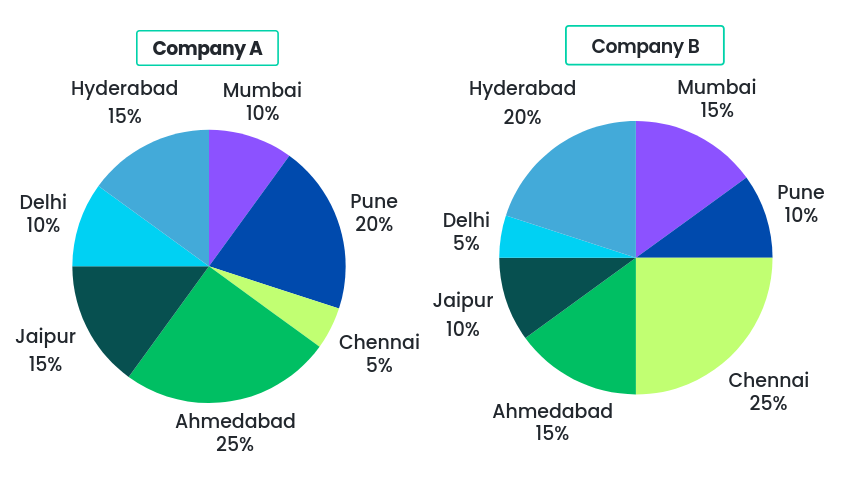
Calculate the total number of employees from both Company A and Company B combined in Mumbai and Ahmedabad.
Solution
Company A has employees = 5000
Company B has employees = 8000
% of company A employees in Mumbai and Ahmedabad = 10%+25% = 35%
35% of 5000 = 1750
% of company B employees in Mumbai and Ahmedabad = 15%+15% = 30%
30% of 8000 = 2400
Total number of employees from both Company A and Company B combined in Mumbai and Ahmedabad = 1750+2400 = 4150
Find the number of cities where the combined total number of employees from Company A and Company B is at least 1,850?
Solution
Based on the pie chart, total number of employees in each city for company A and Company B are as follows:-
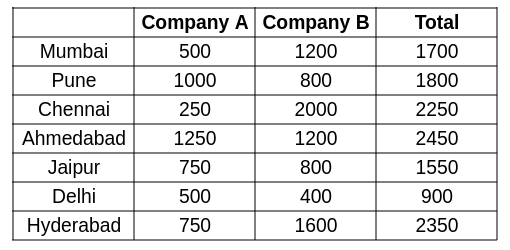
From the table, we can conclude that there are 3 cities where the combined total number of employees from Company A and Company B is at least 1,850.
Chennai, Ahmedabad and Hyderabad.
Seven friends, Abhay, Binny, Charu, Divya, Eshan, Fatima and Girish, are sitting on chairs in a straight line. All of them face the north direction. The chairs are numbered 1 to 7 from west to east. The following information is known about their relative positions :
1. Binny and Divya sit adjacent to each other with Divya's seat number being higher than Binny's.
2. Charu sits second to the left of Girish.
3. Fatima's seat number has the highest number of factors, and Binny's seat has the second highest.
4. Abhay does not sit at any end.
Based on the information provided, answer the following questions.
Who sits to the immediate left of Eshan?
Solution
Given that there are 7 chairs numbered 1 to 7 east to west

Statement 3 states Fatima's seat number has the highest number of factors
From seat number 1 to 7, the number with the highest number of factors is 6, with four factors, i.e. 1, 2, 3 and 6.
So Fatima sits at seat number 6.
Similarly, the number with the second highest number of factors is 4, with three factors, i.e. 1, 2 and 4.
Hence, Binny sits at seat number 4.

Given Binny and Divya sit adjacent to each other with Divya's seat number being higher than Binny's
So, Divya sits at seat number 5.
As Charu sits second to the left of Girish, there is only two seats where they can be i.e. Seat 1 and 3
Hence, Charu sits at Seat 1 and Girish sits at Seat 3.

There are only two seats left, and given Abhay does not sit at the end seats.
So, Abhay sits at Seat 2 and Eshan sits at Seat 7.
So, the final arrangement is

Hence, Fatima sits to the immediate left of Eshan.
Who sits on seat number 3?
Solution
Given that there are 7 chairs numbered 1 to 7 east to west
Statement 3 states Fatima's seat number has the highest number of factors
From seat number 1 to 7, the number with the highest number of factors is 6, with four factors, i.e. 1, 2, 3 and 6.
So Fatima sits at seat number 6.
Similarly, the number with the second highest number of factors is 4, with three factors, i.e. 1, 2 and 4.
Hence, Binny sits at seat number 4.
Given Binny and Divya sit adjacent to each other with Divya's seat number being higher than Binny's
So, Divya sits at seat number 5.
As Charu sits second to the left of Girish, there is only two seats where they can be i.e. Seat 1 and 3
Hence, Charu sits at Seat 1 and Girish sits at Seat 3.
There are only two seats left, and given Abhay does not sit at the end seats.
So, Abhay sits at Seat 2 and Eshan sits at Seat 7.
So, the final arrangement is
Hence, Girish sits on seat number 3.
What is the sum of the seat numbers of Binny and Fatima?
Solution
Given that there are 7 chairs numbered 1 to 7 east to west
Statement 3 states Fatima's seat number has the highest number of factors
From seat number 1 to 7, the number with the highest number of factors is 6, with four factors, i.e. 1, 2, 3 and 6.
So Fatima sits at seat number 6.
Similarly, the number with the second highest number of factors is 4, with three factors, i.e. 1, 2 and 4.
Hence, Binny sits at seat number 4.
Given Binny and Divya sit adjacent to each other with Divya's seat number being higher than Binny's
So, Divya sits at seat number 5.
As Charu sits second to the left of Girish, there is only two seats where they can be i.e. Seat 1 and 3
Hence, Charu sits at Seat 1 and Girish sits at Seat 3.
There are only two seats left, and given Abhay does not sit at the end seats.
So, Abhay sits at Seat 2 and Eshan sits at Seat 7.
So, the final arrangement is
The sum of the seat numbers of Binny and Fatima is 4+6 = 10.
How many people sit between Abhay and Eshan?
Solution
Given that there are 7 chairs numbered 1 to 7 east to west
Statement 3 states Fatima's seat number has the highest number of factors
From seat number 1 to 7, the number with the highest number of factors is 6, with four factors, i.e. 1, 2, 3 and 6.
So Fatima sits at seat number 6.
Similarly, the number with the second highest number of factors is 4, with three factors, i.e. 1, 2 and 4.
Hence, Binny sits at seat number 4.
Given Binny and Divya sit adjacent to each other with Divya's seat number being higher than Binny's
So, Divya sits at seat number 5.
As Charu sits second to the left of Girish, there is only two seats where they can be i.e. Seat 1 and 3
Hence, Charu sits at Seat 1 and Girish sits at Seat 3.
There are only two seats left, and given Abhay does not sit at the end seats.
So, Abhay sits at Seat 2 and Eshan sits at Seat 7.
So, the final arrangement is
So, 4 people sit between Abhay and Eshan.
In the upcoming Laver Cup, eight players—four from Europe and four from the rest of the world—are to be seated around a round table. Each player is either facing the table or facing away. A player who faces the table does not sit adjacent to another player who is also facing the table. No European player sits facing away from the table. Players seed 1 and 2 are seated directly opposite facing each other. Furthermore, for each pair of players sitting opposite one another, the sum of their seeds is a prime number. The players seeded 3 and 8 are positioned on either side of the first seed, while the player to the right of the second seed is not a top 4 seed, and to left of that player, who is not a top 4 seed is a player who is not a bottom two seed.
Which of the following statements is definitely FALSE?
Solution
From the clue given that a player who faces the table does not sit adjacent to someone who also faces the table, we understand that the directions alternate for the players around the round table. The configuration would look like,
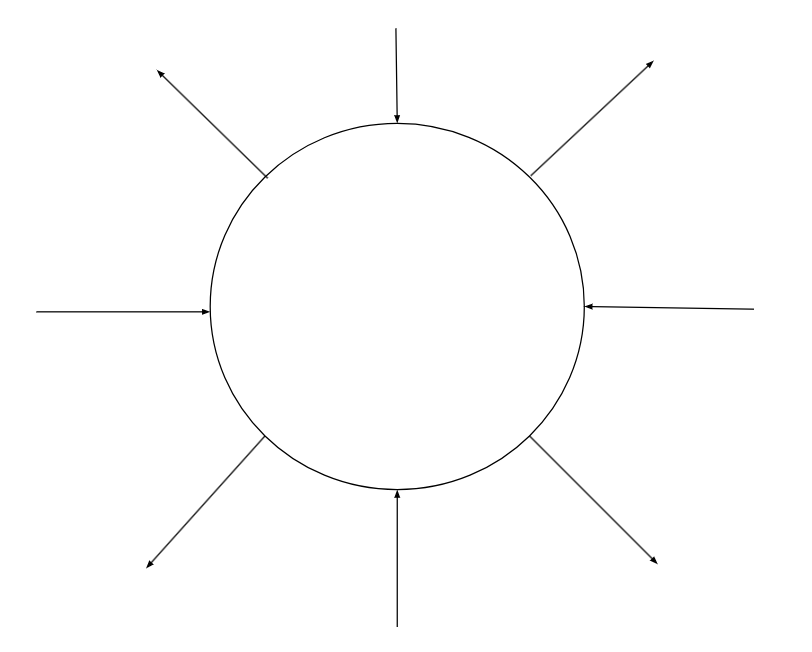
Now we are given that only European players face the table, and that seed 1 and 2 are facing each other. That means seed 1 and 2 are European. It is also given that pairs sitting opposite to each other, have their sum of seeds add up to a prime number.
Before doing trial and error, we look at the next clue that says that seeds 3 and 8 sit on either side of seed 1, so that means seed 3 and 8 are not Europeans and 3 and 8 are not sitting opposite to each other.
Now that 3 and 8 cannot be a prime number sum pair, we look at the only other possible option of pairs.
1 and 2 (given)
3 and 4
5 and 8
6 and 7
We have the following arrangement using the clues thus far,
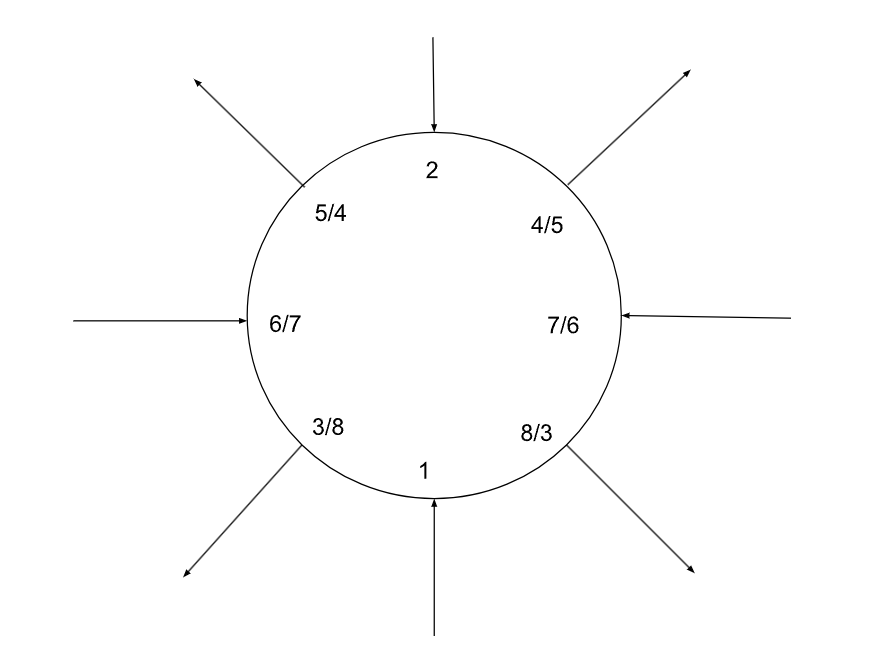
Now we look at the clue that says that the player to the right of the second seed is not a top 4 seed. So, we see the possible configurations, we observe that either 4 or 5 can be placed adjacent to seed 2, that means seed 5 is to the right of seed 2. And the second part of that clue says, the player to the left of that player is not bottom 2. To the left of the 5th seed (considering the fact the player is facing away from the table) is either 6 or 7, since it is said not bottom 2, it is 6th seed. And using the prime number configuration we can find the remaining two players as well.
The final configuration using all the clues is as follows.
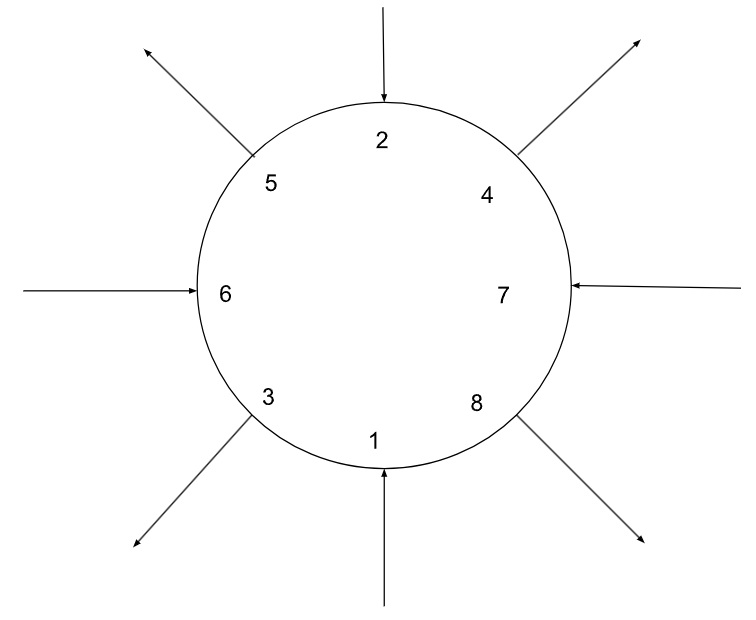
We see that 6 does not sit adjacent to 4.
Who out of the following players is NOT European?
Solution
From the clue given that a player who faces the table does not sit adjacent to someone who also faces the table, we understand that the directions alternate for the players around the round table. The configuration would look like,
Now we are given that only European players face the table, and that seed 1 and 2 are facing each other. That means seed 1 and 2 are European. It is also given that pairs sitting opposite to each other, have their sum of seeds add up to a prime number.
Before doing trial and error, we look at the next clue that says that seeds 3 and 8 sit on either side of seed 1, so that means seed 3 and 8 are not Europeans and 3 and 8 are not sitting opposite to each other.
Now that 3 and 8 cannot be a prime number sum pair, we look at the only other possible option of pairs.
1 and 2 (given)
3 and 4
5 and 8
6 and 7
We have the following arrangement using the clues thus far,
Now we look at the clue that says that the player to the right of the second seed is not a top 4 seed. So, we see the possible configurations, we observe that either 4 or 5 can be placed adjacent to seed 2, that means seed 5 is to the right of seed 2. And the second part of that clue says, the player to the left of that player is not bottom 2. To the left of the 5th seed (considering the fact the player is facing away from the table) is either 6 or 7, since it is said not bottom 2, it is 6th seed. And using the prime number configuration we can find the remaining two players as well.
The final configuration using all the clues is as follows.
We see that Seed 5 is not European.
Choose the Odd one out of the options
Solution
From the clue given that a player who faces the table does not sit adjacent to someone who also faces the table, we understand that the directions alternate for the players around the round table. The configuration would look like,
Now we are given that only European players face the table, and that seed 1 and 2 are facing each other. That means seed 1 and 2 are European. It is also given that pairs sitting opposite to each other, have their sum of seeds add up to a prime number.
Before doing trial and error, we look at the next clue that says that seeds 3 and 8 sit on either side of seed 1, so that means seed 3 and 8 are not Europeans and 3 and 8 are not sitting opposite to each other.
Now that 3 and 8 cannot be a prime number sum pair, we look at the only other possible option of pairs.
1 and 2 (given)
3 and 4
5 and 8
6 and 7
We have the following arrangement using the clues thus far,
Now we look at the clue that says that the player to the right of the second seed is not a top 4 seed. So, we see the possible configurations, we observe that either 4 or 5 can be placed adjacent to seed 2, that means seed 5 is to the right of seed 2. And the second part of that clue says, the player to the left of that player is not bottom 2. To the left of the 5th seed (considering the fact the player is facing away from the table) is either 6 or 7, since it is said not bottom 2, it is 6th seed. And using the prime number configuration we can find the remaining two players as well.
The final configuration using all the clues is as follows.
We see that Option E is not a pair that is sitting adjacent to each other.
Five friends, P, Q, R, S, and T, attended a series of five conferences in different cities: New York, London, Tokyo, Paris, and Sydney. Each friend attended a conference in a different city, and they attended the conferences on different days of the week: Monday, Tuesday, Wednesday, Thursday, and Friday. We have the following information about which person attended which conference and on which day:
1. P attended the conference in Sydney
2. T attended the conference on Friday and Q attended the conference in Paris.
3. The person who attended the Tokyo conference did so on Wednesday.
4. S and Q attended the conference on consecutive days and none went to Tokyo.
Who attended the conference in New York?
Solution
We have the following table to fill according to the arrangement:
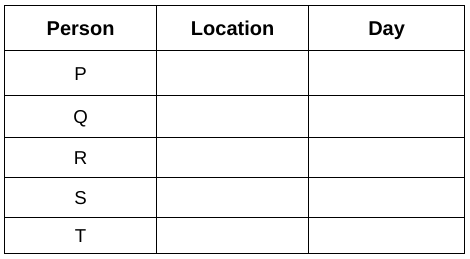
According to the statement 2, T attended the conference on Friday but not in New York and Q attended the conference in Paris
Further, statement 3 says that the person who attended the Tokyo conference did so on Wednesday.
Now, according to statement 4, S and Q attended the conference on consecutive days and none of them attended the conference on Tokyo. Therefore, none of them would have attended the conference on Wednesday. Hence, they attended the conference on Monday and Tuesday or they attended on Thursday and Friday.
However, T attended the conference on Thursday and Friday. Hence, S and Q must have attended the conference on Monday and Tuesday.
According to statement 1, P attended the conference in Sydney, he must have attended the conference on Thursday. Hence, R is left so he/she must have attended the conference on Wednesday in Tokyo.
Now, we are left with S and T to uniquely identify the locations. The remaining locations are London or New York so they must have attended at one of the location.
With this, we have the following table:
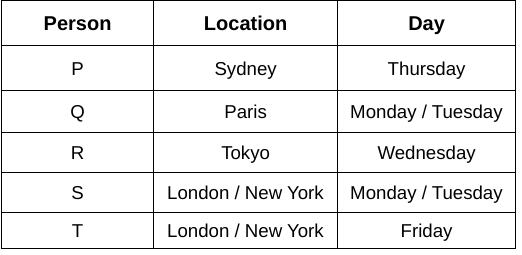
On which day R attended the conference?
Solution
We have the following table to fill according to the arrangement:
According to the statement 2, T attended the conference on Friday but not in New York and Q attended the conference in Paris
Further, statement 3 says that the person who attended the Tokyo conference did so on Wednesday.
Now, according to statement 4, S and Q attended the conference on consecutive days and none of them attended the conference on Tokyo. Therefore, none of them would have attended the conference on Wednesday. Hence, they attended the conference on Monday and Tuesday or they attended on Thursday and Friday.
However, T attended the conference on Thursday and Friday. Hence, S and Q must have attended the conference on Monday and Tuesday.
According to statement 1, P attended the conference in Sydney, he must have attended the conference on Thursday. Hence, R is left so he/she must have attended the conference on Wednesday in Tokyo.
Now, we are left with S and T to uniquely identify the locations. The remaining locations are London or New York so they must have attended at one of the location.
With this, we have the following table:
S attended the conference on which day?
Solution
We have the following table to fill according to the arrangement:
According to the statement 2, T attended the conference on Friday but not in New York and Q attended the conference in Paris
Further, statement 3 says that the person who attended the Tokyo conference did so on Wednesday.
Now, according to statement 4, S and Q attended the conference on consecutive days and none of them attended the conference on Tokyo. Therefore, none of them would have attended the conference on Wednesday. Hence, they attended the conference on Monday and Tuesday or they attended on Thursday and Friday.
However, T attended the conference on Thursday and Friday. Hence, S and Q must have attended the conference on Monday and Tuesday.
According to statement 1, P attended the conference in Sydney, he must have attended the conference on Thursday. Hence, R is left so he/she must have attended the conference on Wednesday in Tokyo.
Now, we are left with S and T to uniquely identify the locations. The remaining locations are London or New York so they must have attended at one of the location.
With this, we have the following table:
If S went to London on Tuesday, Q went to _____________ ?
Solution
We have the following table to fill according to the arrangement:
According to the statement 2, T attended the conference on Friday but not in New York and Q attended the conference in Paris
Further, statement 3 says that the person who attended the Tokyo conference did so on Wednesday.
Now, according to statement 4, S and Q attended the conference on consecutive days and none of them attended the conference on Tokyo. Therefore, none of them would have attended the conference on Wednesday. Hence, they attended the conference on Monday and Tuesday or they attended on Thursday and Friday.
However, T attended the conference on Thursday and Friday. Hence, S and Q must have attended the conference on Monday and Tuesday.
According to statement 1, P attended the conference in Sydney, he must have attended the conference on Thursday. Hence, R is left so he/she must have attended the conference on Wednesday in Tokyo.
Now, we are left with S and T to uniquely identify the locations. The remaining locations are London or New York so they must have attended at one of the location.
With this, we have the following table:
In XYZ company, six employees—A, B, C, D, E, and F—belong to different teams: Tech, Marketing, Design, Networking, Accounts, and Sales, not necessarily in the same order. Each employee visits the office on a different day from Monday to Saturday. The following details are known about the six employees.
1) A who belongs to Tech team doesn't visit on Thursday and C is not from marketing and did not visit on Friday.
2) E is from Accounts team and B visits on Saturday. While employee from Design did not visit on Saturday.
3) The employee from sales team visits on Monday and the employee from Network team visits on Friday.
4) Employee from Tech and sales visited on consecutive days while the employees from Tech and Design did not.
On which day did E visit the office?
Solution
We will write down the direct information given above.
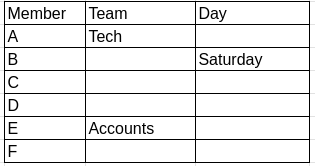
We are told that employee from sales team visits on Monday. And the employee from Network team visits on Friday.
We are also told that A didn't visit on Thursday. So, the only possible days that A would can visit Tuesday or Wednesday. Statement 4 says that Tech and sales Visited on consecutive days. So, the only possibitlity for Tech is Tuesday.
We are also told that tech and sales team visited on consecutive days. So, Tech team employee visited on Tuesday.
We are told that Teach and Design team didn't visit on consective days. So, Design team employee didn't visit on Wednesday.
The only possibility for Design team employee will be thursday. Hence Marketing employee will be on Saturday.
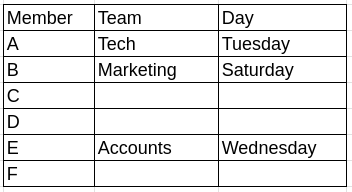
Wednesday is the correct answer.
How many different combinations of team and visiting day are possible for the six employees?
Solution
We will write down the direct information given above.
We are told that employee from sales team visits on Monday. And the employee from Network team visits on Friday.
We are also told that A didn't visit on Thursday. So, the only possible days that A would can visit Tuesday or Wednesday. Statement 4 says that Tech and sales Visited on consecutive days. So, the only possibitlity for Tech is Tuesday.
We are also told that tech and sales team visited on consecutive days. So, Tech team employee visited on Tuesday.
We are told that Teach and Design team didn't visit on consective days. So, Design team employee didn't visit on Wednesday.
The only possibility for Design team employee will be thursday. Hence Marketing employee will be on Saturday.
We know that C didn't visit on Friday. So, C can't be from Networking. C is either from Sales or from Design.
Not the remaining two can be given to D and F in two ways.
So, 2*2 = 4 ways.
If F is from sales team which team does D belong to?
Solution
We will write down the direct information given above.
We are told that employee from sales team visits on Monday. And the employee from Network team visits on Friday.
We are also told that A didn't visit on Thursday. So, the only possible days that A would can visit Tuesday or Wednesday. Statement 4 says that Tech and sales Visited on consecutive days. So, the only possibitlity for Tech is Tuesday.
We are also told that tech and sales team visited on consecutive days. So, Tech team employee visited on Tuesday.
We are told that Teach and Design team didn't visit on consective days. So, Design team employee didn't visit on Wednesday.
The only possibility for Design team employee will be thursday. Hence Marketing employee will be on Saturday.
We know that C didn't visit on Friday. So, C can't be from Networking. C is either from Sales or from Design.
We are told that F is from Sales. So, C will be from marketing. Hence, D will be from Networking.
The following table represents data about the number of families residing in buildings A and B of the pink apartment for different years. The table also represents the the number of families with less than 4 members and the number of families with more than 6 members as a percentage of a total number of families in both buildings combined.

Use the data provided in the table above to answer the FOUR questions that follow:
In which of the following years did the number of families with less than 4 members in pink apartments decrease compared to last year?
Solution
We need to check for three options
Option A: In 2021, there were 75+65=140 families in pink apartments, of which 15%, that is, 20 families, had less than 4 members.
Looking at 2020, there were 68+62 = 130 families in pink apartments, of which 10%, that is, 13, had less than 4 members. Hence, 2021 is not our answer.
Option B: In 2023, there were 175+175=150 families in pink apartments, of which 30%, that is, 45 families, had less than 4 members.
Looking at 2022, there were 85 + 70 = 155 members in the pink apartment, of which 20%, that is, 21 families had less than 4 members; hence, this, too, is not our answer.
Option C: In 2024, there were 78+62 = 140 families in pink apartments, 20 of which, that is 28 families, had less than 4 members.
This is a decrease from 45 families in 2023
Of the given options, only 2024 had a lesser number of families with less than 4 members.
Therefore, Option C is the correct answer.
If no family in a pink apartment had more than eight and less than two members, what is the lowest number of people that could have been living Pink apartment for the year 2021?
(Assume that only the families mentioned in the table are present in the apartment).
Solution
In 2021, there were a total of 140 families in pink apartments.
15% of these, that is, 21 families, had less than four members
10%, that is 14, had more than six members.
we want to find the minimum number of people possible in the apartment
We can assume that 21 families below the four-member mark have two members each, giving 42 people.
The 14 families above the six-member mark have 7-seven members each, giving 98 people.
And the remaining families: 140-21-14 = 105, had four members each, giving 420 people.
The total number of family members would hence be: 420+92+48 = 560
Therefore, Option C is the correct answer.
If no family in a pink apartment had more than eight and less than two members, what is the highest number of people that could have been living Pink apartment for the year 2018?
(Assume that only the families mentioned in the table are present in the apartment).
Solution
In 2018, there were a total of 65+55 = 120 members living in pink apartments in the year 2018
Of these, 12 families had less than four members. To maximize the number of people, we can take all these families and make them all have three members, giving 36 people.
36 had more than 6 people; to maximize the number of people, we can take them all and make them each have eight members, giving 288 members.
The remaining 72 families can have six members each, giving 432 members.
This would give the total number of members in the society to be 756
Therefore, Option A is the correct answer.
What is the difference (approximate) between the average number of families that stayed in buildings A and B over the given 7 years?
Solution
The average number of families in building A would be $$\frac{60+75+68+75+85+75+78}{7}=\frac{521}{7}$$
The average number of families sin building B would be $$\frac{55+65+62+65+70+75+62}{7}=\frac{454}{7}=$$
The difference would be $$\frac{521-454}{7}=\frac{67}{7}\approx\ 9.5$$
Therefore, Option B is the correct answer.
Five friends are playing a game consisting of several rounds. In each round, every friend is assigned a unique score ranging from 1 to 5, ensuring no two friends receive the same score in that round. It is also known that each friend obtained a different score in each round. The provided table presents partial details about the scores earned by each friend in different rounds, along with their total scores across all rounds. Using this information, answer the following questions.
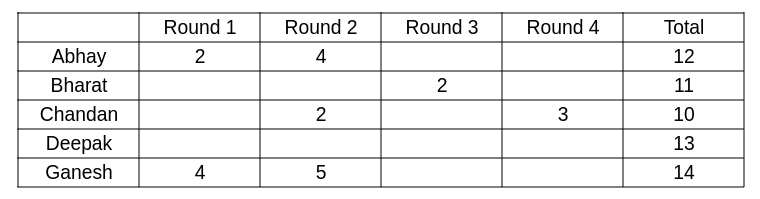
Who scored highest in round 3?
Solution
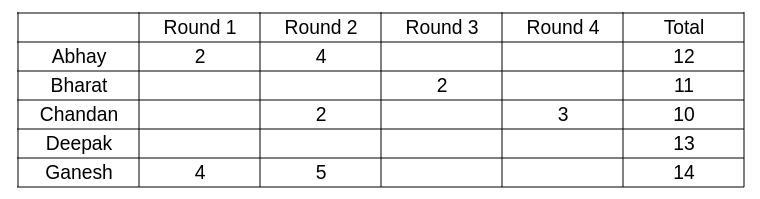
We know each friend obtained a different score in each round and each friend has a unique score in each round.
The scores are from 1 to 5.
Sum of 1 to 5 = 1+2+3+4+5 = 15
That means if we look at the total score of round 1 to round 4, the score not obtained in any round by any friend will be 15-total score.
For Abhay = 15-12 = 3 (Abhay didn't received a score of 3 in any round).
Similarly, for Bharat, Chandan, Deepak and Ganesh, the scores not obtained in any round are 4,5,2 and 1, respectively.
Now filling the table-
For Ganesh, total = 14
We know round 1+ round 2 = 9, so round 3+round 4 = 5 and scores will be 2 and 3.
Since Bharat has scored 2 in round 3, Ganesh will score 3 in round 3, thus he scores 2 in round 4.
Chandan has either received a score of 4 in round 1 or round 3. But, in round 1, Ganesh has scored 4, so Chandan scored 4 in round 3 and scored 1 in round 1.
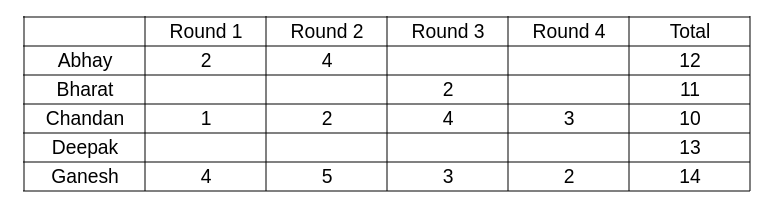
In round 3, either Abhay or Deepak has scored 5.
So, option D.
What is the score of Deepak in round 4?
Solution
We know each friend obtained a different score in each round and each friend has a unique score in each round.
The scores are from 1 to 5.
Sum of 1 to 5 = 1+2+3+4+5 = 15
That means if we look at the total score of round 1 to round 4, the score not obtained in any round by any friend will be 15-total score.
For Abhay = 15-12 = 3 (Abhay didn't received a score of 3 in any round).
Similarly, for Bharat, Chandan, Deepak and Ganesh, the scores not obtained in any round are 4,5,2 and 1, respectively.
Now filling the table-
For Ganesh, total = 14
We know round 1+ round 2 = 9, so round 3+round 4 = 5 and scores will be 2 and 3.
Since Bharat has scored 2 in round 3, Ganesh will score 3 in round 3, thus he scores 2 in round 4.
Chandan has either received a score of 4 in round 1 or round 3. But, in round 1, Ganesh has scored 4, so Chandan scored 4 in round 3 and scored 1 in round 1.
In round 4, someone has to score 4. Abhay, Chandan and Ganesh have already scored 4, and Bharat cannot score 4, so Deepak will score 4 in round 4.
How many arrangements of scores are possible?
Solution
We know each friend obtained a different score in each round and each friend has a unique score in each round.
The scores are from 1 to 5.
Sum of 1 to 5 = 1+2+3+4+5 = 15
That means if we look at the total score of round 1 to round 4, the score not obtained in any round by any friend will be 15-total score.
For Abhay = 15-12 = 3 (Abhay didn't received a score of 3 in any round).
Similarly, for Bharat, Chandan, Deepak and Ganesh, the scores not obtained in any round are 4,5,2 and 1, respectively.
Now filling the table-
For Ganesh, total = 14
We know round 1+ round 2 = 9, so round 3+round 4 = 5 and scores will be 2 and 3.
Since Bharat has scored 2 in round 3, Ganesh will score 3 in round 3, thus he scores 2 in round 4.
Chandan has either received a score of 4 in round 1 or round 3. But, in round 1, Ganesh has scored 4, so Chandan scored 4 in round 3 and scored 1 in round 1.
There are 2 cases possible.
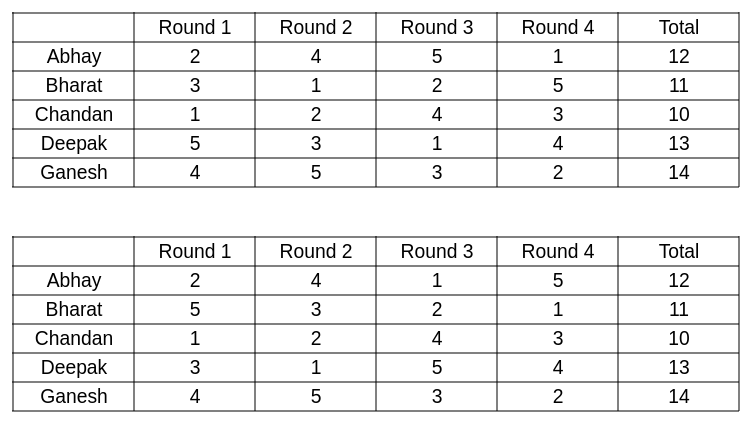
What is the score that is not obtained by Deepak in any round?
Solution
We know each friend obtained a different score in each round and each friend has a unique score in each round.
The scores are from 1 to 5.
Sum of 1 to 5 = 1+2+3+4+5 = 15
That means if we look at the total score of round 1 to round 4, the score not obtained in any round by any friend will be 15-total score.
For Abhay = 15-12 = 3 (Abhay didn't received a score of 3 in any round).
Similarly, for Bharat, Chandan, Deepak and Ganesh, the scores not obtained in any round are 4,5,2 and 1, respectively.
Now filling the table-
For Ganesh, total = 14
We know round 1+ round 2 = 9, so round 3+round 4 = 5 and scores will be 2 and 3.
Since Bharat has scored 2 in round 3, Ganesh will score 3 in round 3, thus he scores 2 in round 4.
Chandan has either received a score of 4 in round 1 or round 3. But, in round 1, Ganesh has scored 4, so Chandan scored 4 in round 3 and scored 1 in round 1.
There are 2 cases possible.
Deepak did not receive a score of 2 in any round.
Rushi is camping in the wilderness, he parks his car and walks 10 feet straight and then takes a right turn and walks 20 feet. He encounters some magic mushrooms which throws his sense of direction off and proceeds to take another right turn and walks 40 feet. Finally, he takes a left turn and walks 20 feet and sets up his camp for the night.
Find the distance (in feet) between the point where Rushi parked his car and the point where he set up camp for the night?
Solution
Rushi's actions can be traced into the following diagram,
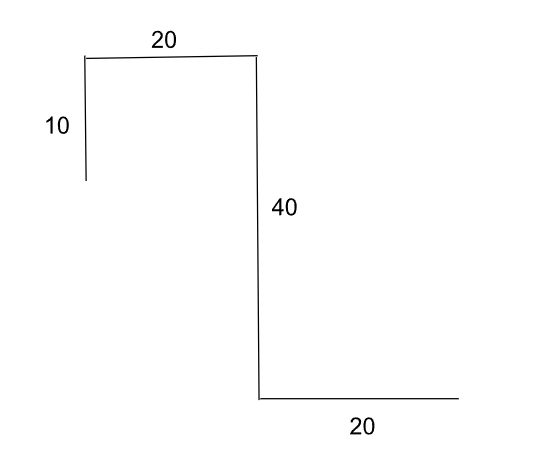
To find the distance between the starting and the final point we can basically sketch out the right-angle triangle involved.
We know that the ending point is 40 feet away horizontally and 30 feet away vertically.
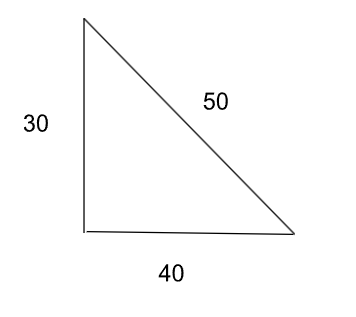
Hence the distance between the starting and the camping point is 50 feet.
From the camped spot, if Rushi wants to take the shortest route to the point where he encountered magic mushrooms, what is the distance (to the nearest integer) he would have to travel?
Solution
Rushi's actions can be traced into the following diagram,
From the camped spot to the point where he discovered magic mushrooms it is a right-angled triangle with sides 40 and 20.
Distance would be: $$\sqrt{1600+400}=20\sqrt{5}$$
Which approximately is: 44.72, nearest integer is 45.
For the following questions answer them individually
Ravi starts his walk from his house facing North. He walks 8 meters straight, then takes a left turn and walks 6 meters. He then takes another left turn and walks 10 meters. After that, he takes a right turn and walks 4 meters. Next, he takes a right turn again and walks 6 meters. Finally, he takes a left turn and walks 2 meters. In which direction is he facing now?
Solution
1. Starting Direction: Ravi begins facing North.
2. First Movement: He walks 8 meters straight (still facing North).
3. First Turn: He takes a left turn, so now he faces West. He walks 6 meters.
4. Second Turn: He takes another left turn, so now he faces South. He walks 10 meters.
5. Third Turn: He takes a right turn, so now he faces West. He walks 4 meters.
6. Fourth Turn: He takes another right turn, so now he faces North. He walks 6 meters.
7. Final Turn: He takes a left turn, so now he faces West. He walks 2 meters.
After the entire journey, Ravi is facing West.
Vishnu starts when he was facing North. He turns left, travels 39m, turns left again, and travels 17m to reach B. From B, he moves 20m east to C. From C, he turns right, walks 23m to D, turns left, and walks 10m to his final destination. What is the distance between his initial and final points, and in which direction is the final point from the initial point?
Solution
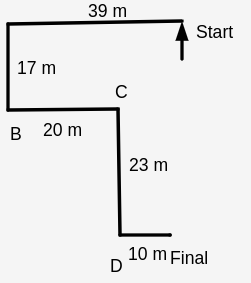
The final point is 40 m south and 9m west to the starting point.
So, the distance between the two points is $$\sqrt{9^2+40^2}=41m$$
Hence the answer is 41m, south-west.
Ram stands at a point facing north. He walks forward for one hour, then turns left and walks for half an hour. He then rotates $$90^{\circ\ }$$ clockwise and walks for another half-an-hour, after which he turns $$90^{\circ\ }$$ clockwise and walks for an hour, after which he walks in the south direction for an hour. What is the shortest time (approximately) it would take him to reach the starting point?
(Assume that the walks at constant speed throughout.)
Solution
Let's assume that he moves s meters every 30 minutes.
So he first travels 2s meters to the north, then turns left, facing west and walks s meters in that direction, after which he turns 90 degrees clockwise, now facing north again and walks s meter again.
Then turns 90 degree clockwise yet again, facing east and walks 2s meters, and then turns towards south and walks 2s meters in that direction.
So, he is essentially s meters north and s meters east of his original position.
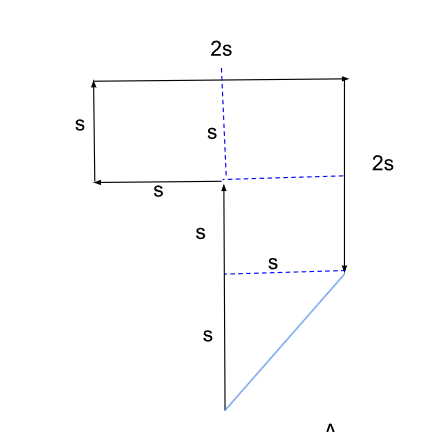
So he is $$s\sqrt{\ 2}$$ m away from the starting point.
This would take him approximately $$30\times\ \sqrt{\ 2}\approx\ 30\times\ 1.41\approx\ 42$$ minutes.
Therefore, Option B is the correct answer.
A recent study found that people who engage in at least 30 minutes of physical exercise daily tend to have lower stress levels compared to those who do not exercise. Based on this, a fitness trainer concluded that regular exercise directly reduces stress levels.
Which of the following assumptions underlies the fitness trainer's conclusion?
Solution
The correct assumption underlying the fitness trainer's conclusion is Option D, "The study's results are reliable and accurately represent the relationship between exercise and stress."
This is because the trainer's conclusion that regular exercise directly reduces stress levels depends on the assumption that the study's findings are valid and correctly reflect a cause-and-effect relationship between exercise and stress. Without trusting the reliability of the study, the conclusion cannot hold.
Option A suggests reverse causation (that people with lower stress levels are more likely to exercise), which goes against the trainer’s claim that exercise reduces stress.
Option B focuses on exercise being the primary factor for stress reduction, but it doesn’t address the underlying assumption that the study itself is valid.
Option C implies that no other factors contribute to stress reduction, which is unnecessary for the trainer’s conclusion. The trainer only needs to assume that exercise plays a significant role.
Option E adds a detail about the timeframe for stress reduction, but the trainer’s conclusion isn’t dependent on whether the effect is short- or long-term.
The trainer’s conclusion rests on the belief that the study is trustworthy and accurately captures the link between exercise and stress, which makes Option D the best choice.
Many cities have introduced bike-sharing programs to reduce traffic congestion and promote eco-friendly transportation. Studies show that in cities with proper infrastructure, such as bike lanes and safe parking, these programs reduce car usage and lower carbon emissions. However, in cities lacking such infrastructure, bike-sharing programs often struggle to succeed, resulting in minimal impact on traffic and pollution.
Which of the following most accurately describes the cause-and-effect relationship in the passage?
Solution
Option D accurately reflects the passage's main argument: the success of bike-sharing programs depends on supporting infrastructure like bike lanes and safe parking. This infrastructure enables these programs to effectively reduce traffic congestion and pollution, creating a clear cause-and-effect relationship. Without adequate infrastructure, the programs struggle to achieve their goals, as stated in the passage.
Option A: Incorrect. The passage does not claim that bike-sharing programs reduce traffic in all cities. It specifies that success depends on infrastructure.
Option B: Incorrect. While infrastructure is necessary, the passage does not claim it guarantees success in all cities.
Option C: Incorrect. The passage focuses on the effects of bike-sharing programs, not general preferences for alternative transportation.
Option E: Incorrect. The passage clearly states that reduced carbon emissions depend on the success of bike-sharing programs, not their mere presence.
Hence, the correct answer is Option D
As reported by the Financial Times, pension funds in Wisconsin and Michigan have become significant holders of U.S. stock market funds focused on cryptocurrency, signaling a growing trend of institutional investment in digital assets as Bitcoin's value surpasses $100,000.
Based on the information provided in the paragraph, which of the following is a possible conclusion?
Solution
Option B is correct: The paragraph indicates a correlation between Bitcoin's rising value and increased institutional interest. It is reasonable to conclude that Bitcoin's high value has contributed to its perception as a viable asset class for institutional investors like pension funds. This is a direct and logical inference from the text.
Option A: Is out of the context of the paragraph that is given, it does not talk about regulation at all.
Option C: The passage states that the pension fund have invested in cryptocurrency, does not talk about exclusivity at all
Optin D: Bitcoin passing 100k is mentioned along with the pension funds securing investments. It is not given that it is a direct result of it.
Option E: This option also is an overreach, there is no mention of complete replacement.
Y pointed at a boy and said: "He’s the son of my mother’s only son." How is Y related to the boy?
Solution
"Y said: 'He’s the son of my mother’s only son.'"
"My mother’s only son" refers to Y's brother or Y himself. If Y is a male, then Y is the father of the boy and if Y is female, that the Y will be the aunt of the boy.
Fill in the blank:
A man goes to meet his sister's son's only maternal aunt's father. The man is going to meet his _______.
Solution
The man’s sister’s son: This is the man's nephew.
The nephew's only maternal aunt: The only maternal aunt of the nephew is the nephew's mother's sister, who is also the man’s sister.
The sister's father: The father of the man’s sister is the man’s father.
Therefore, the man is the son and he is going to meet his father.
Raghav goes to meet his mother's daughter-in-law's son's only paternal cousin. What is Raghav's relation to the person?
Solution
Raghav is going to meet his mother's daughter in law's (who could be his wife or his brother's wife), only son's (who could be his son or his nephew), only paternal cousin (who could be his nephew or his son)
Hence, Raghav could either be the uncle or father to the person he will meet.
He will be the father if the daughter-in-law in question is his brother's wife.
He will be the uncle if the daughter-in-law in question is his wife.
He can be maternal or paternal uncle depending on the gender of his sibling.
Therefore, Option E is the correct answer.
Which of the following conclusions can be drawn from the given statements?
Statements:
All mangoes are apples.
Some apples are bananas.
No banana is an orange.
Conclusions:
I) Some mangoes are bananas.
II) No orange is an apple.
III) Some mangoes are not apples.
Solution
The following diagram is a possible diagram according to the statements given.
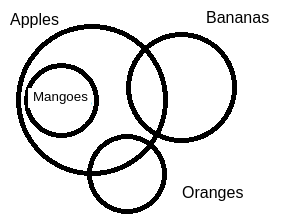
Based on the above Venn diagram-
I) Some mangoes are bananas - False
II) No orange is an apple - False
III) Some mangoes are not apples - False
Hence, none of the conclusions follows.
Which of the following conclusions can be made from the given statements.
Statements:
All cats are mammals.
Some dogs are mammals.
Some tigers are cats.
Conclusions:
I) Some dogs are tigers.
II) Some cats are dogs.
III) Some tigers are mammals.
Solution
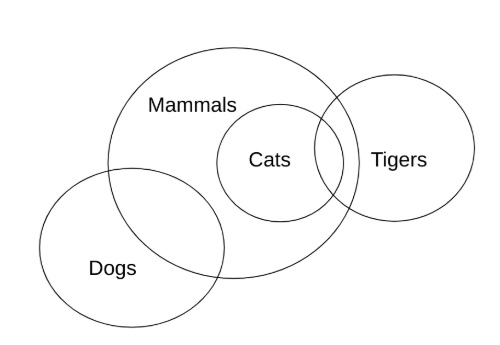
Only Conclusion 3, i.e. Some tigers are mammals, follows.
In certain code language “BFHMT” is written as “AEIOU”. Then what is the code for the word "HIDDEN"?
Solution
Let's check if there is some shift in position.
BFHMT = 2 6 8 13 20
AEIOU = 1 5 9 15 21
-1 -1 +1 +2 +1
There is no pattern visible. In the coded form of a given word, we only have vowels. B is given A, F is given E, and H is given I. This looks like some nearest vowel.
Let's check for the other two letters,
13 (M) is between two vowels, 9 (I) and 15(O). 13 is closer to 15.
20(T) is between two vowels, 15(O) and 21(U). 20 is closer to 21.
So, it is the closest vowel pattern.
HIDDEN = 8 9 4 4 5 14
So, H is close to I; I is itself a vowel; D is closer to E than A, E is itself a vowel, and lastly, N is close to O.
The closest vowels are IIEEEO.
In a certain code language, “CIRCLE” is written as “DHTAMD”. What is the code for the word “SQUARE”?
Solution
C → D: C is shifted by +1 to become D.
I → H: I is shifted by -1 to become H.
R → T: R is shifted by +2 to become T.
C → A: C is shifted by -2 to become A.
L → M: L is shifted by +1 to become M.
E → D: E is shifted by -1 to become D.
Using the same logic on SQUARE:
S → + 1 →T
Q → -1 → P
U → + 2 → W
A → - 2 → Y
R →+1 → S
E → - 1 → D
In certain code language “MOXCAB” is written as “BBEASR”. Then what is the code for the word “SUMMER”?
Solution
The logic is word is reversed and each letter is moved according to thier position value.
Reverse of MOXCAB is BACXOM
B+0 = B
A+1 = B
C+2 = E
X+3 = A
O+4 = S
M+5 = R
Using this logic, for SUMMER.
Reverse is REMMUS.
R+0 = R
E+1 = F
M+2 = O
M+3 = P
U+4 = Y
S+5 = X
RFOPYX is the code for SUMMER.
The words "HAIL HYDRA" change to "FYGJ FWBPY" in a certain code language. What would the words "MEIN KAMPF" change to?
Solution
Noticing the similarity, we can see that both the H change to F, and both the A change to Y.
We can see the pattern in which each letter is replaced by the second last letter before it.
H is replaced with F, I is replaced with G, L is replaced with J and so on.
In the case of A, the code follows a cycle where it goes to the end of the lexicon, going to Z and then Y, and replacing A with Y.
Hence, the word MEIN would translate to KCGL, and KAMPF would translate to IYKND
Giving the output as KCGL IYKND.
Therefore, Option C is the correct answer.
In certain code language “FORMATION” is written as “GQUQFZPWW”. Then what is the code for the word “GALAXY”?
Solution
Based on the given information, the logic behind the code could be as below.
Each alphabet is replaced by a new alphabet obtained by adding position to it.
F+1=G
O+2 = Q
R+3 = U
M+4 = Q
A+5 = F
T+6 = Z
I+7 = P
O+8 = W
N+9 = W
Similarly, the code for the word “GALAXY” will be
G+1 = H
A+2 = C
L+3 = O
A+4 = E
X+5 = C
Y+6 = E
“HCOECE”
So, the correct option to choose is A.
In a certain code language, the word "BALLOON" is written as "CAMNPQP". How will the word "MONSTER" be written in the same code language?
Solution
Let's examine how the word "BALLOON" is transformed into "CAMNPQP" to identify the pattern of the code:
- B → C: The letter "B" is shifted by +1 (B → C).
- A → A: The letter "A" remains unchanged (A → A).
- L → M: The letter "L" is shifted by +1 (L → M).
- L → N: The letter "L" is shifted by +2 (L → N).
- O → P: The letter "O" is shifted by +1 (O → P).
- O → Q: The letter "O" is shifted by +2 (O → Q).
- N → P: The letter "N" is shifted by +2 (N → P).
Now, we can observe that the pattern of shifting alternates between +1 and +2, with the second letter (A) remaining unchanged. This alternating shift pattern goes as follows: +1, 0, +1, +2, +1, +2, +2.
Let’s apply the same pattern to the word "MONSTER":
- M → N: Shifted by +1 (M → N).
- O → O: Remains unchanged (O → O).
- N → O: Shifted by +1 (N → O).
- S → U: Shifted by +2 (S → U).
- T → U: Shifted by +1 (T → U).
- E → G: Shifted by +2 (E → G).
- R → T: Shifted by +2 (R → T).
Therefore, the word "MONSTER" will be written as "NOOUUGT" in the same code language.
Choose the correct option which will complete the analogy
96:117::75:?
Solution
The logic followed here for the analogy is,
For a number XY, the corresponding term is $$X^2+Y^2$$
So, for 96 it is 117,
Using the same logic for 75, we get 49+25=74.
Choose the option which will have the same relationship with the second word as is displayed by the pair of given words.
45 : 82 : : 56 :
Solution
Here, we notice that $$82\ =2\times\ \ \left(4^2+5^2\right)$$
Hence, the second number should be $$\ \left(5^2+6^2\right)=2\times\ 61$$
26:40 : : 38:?
Solution
26:40
The pattern here is $$2^2$$+$$6^2$$ = 4+36 = 40
38 $$\Rightarrow$$ $$3^2+8^2$$ = 9+64 =73.
Which of the following would have the same relation with the second term, as the third has with first?
KO : PL :: GA : _ _
Solution
Looking at the position of the characters in the alphabetical sequence, we see that K is 11th from the start and P is 11 from the end.
Simialrly, O is 15th from the start, and L is 15th from the end.
The sum of their positions adds up to 27 each.
We want to find a parallel to GA.
A is 1st from the start, so the parallel should be Z, 1st from the end.
G is 7th from the start, so the parallel should be T, 7th from the end.
Therefore, the fourth term should be TZ.
Hence, Option A is the correct answer.
Choose the option which will have the same relationship with the second word as is displayed by the pair of given words.
58: 169 :: 62:?
Solution
58: 169 :: 62:?
The relationship between the given pair of numbers is
169 = $$(5+8)^2$$
Hence, using the same logic, the missing number will be
$$(6 + 2)^2 = 64$$
Hence, option C is the correct answer.
What comes next in the following number series?
5, 11, 23, 47, 95, 191, 383, ___?
Solution
Let's analyze the pattern:
- From 5 to 11, the difference is 6.
- From 11 to 23, the difference is 12.
- From 23 to 47, the difference is 24.
- From 47 to 95, the difference is 48.
- From 95 to 191, the difference is 96.
- From 191 to 383, the difference is 192.
So, the differences between the consecutive numbers are doubling:
- 6, 12, 24, 48, 96, 192 (each difference is multiplied by 2).
To continue the pattern, the next difference should be 384 (since 192 × 2 = 384).
Now, add 384 to the last number in the series (383):
383 + 384 = 767
Hence, the answer is 767
Choose the option which will come next in the series
A3, D6, H10, ?
Solution
D is 3 positions ahead of A, H is 4 positions ahead of D, using this sequence, the next letter should be 5 positions ahead of H, which is M
3 and then comes 6, so it increases by 3, 6 and then 10, so increases by 4, so the next number has to increase by 5
So, the answer is M15.
What should be the next 5 terms of the series?
2 B 5 D E 8 G H I 11 K L M N 14 P Q R S T
Solution
Here, the numbers in the sequence are: 2, 5, 8, 11, 14. These numbers are increasing by 3 each time:
2 → 5 → 8 → 11 → 14 The next number will logically be 17.
Further, we see the following patter,
After the number 2, we have the letter "B".
After the number 5, we have "D E".
After the number 8, we have "G H I".
After the number 11, we have "K L M N".
After the number 14, we have "P Q R S T".
Hence, the next 5 terms will be 17 and then V, W, X, Y (as we skip the alphabet at the place of the numeric value)
A1A, B2B, C3F, D4X,?
Solution
The first letter is moving by one letter. And the number is indicating the position in alphabetical order. The third letter is same as the first letter for the first terms.
Let's write the alphabetical positions.
1, 2, 6, 24 $$\Rightarrow$$ this is the factorial of the numbers. So, for the next term the third term will be 5! = 120.
120%26 = 16(P)
E5P will be the fifth term.
Statement:
The political party in Albasta won on the promise of introducing policies to help the region's farmers, who suffer from exploitation by individual landlords and an inability to repay loans due to poor weather conditions. A year after that party came into power, the state experienced one of its worst droughts in recent history, with pressure building from the farmer population. Which of the following actions should the government take to help the farmers in the short and long term?
Courses of Action:
I) Subsidise a portion of the loans owed to the individual landlords to help the farmers.
II) Provide the farmers micro-loans at a low rate of interest.
III) Promote agriculture education, promoting the farming of crops that take comparatively less water.
Solution
Action I is not a practical approach; giving money to pay the debts of individual landlords opens the policy to misuse by many and is prone to corruption.
Action II provides short-term relief by offering affordable credit, which can help farmers sustain themselves during the crisis.
Action III tackles the root cause by promoting sustainable farming practices and drought-resistant crops, ensuring long-term resilience.
Only II and III follow.
Therefore, Option D is the correct answer.
Statement:
The increasing number of road accidents in the city has raised concerns over public safety. Investigations reveal that accidents are primarily caused by reckless driving, poor road infrastructure, and inadequate public awareness of traffic rules.
Courses of Action:
I) The government should implement strict traffic rules and impose heavy penalties on offenders.
II) Awareness campaigns should be launched to educate citizens about road safety and the importance of following traffic rules.
III) The government should ban private vehicles during peak hours to reduce congestion and accident risks
Solution
I: Implementing strict traffic rules and imposing heavy penalties can act as a deterrent for careless driving and reduce accidents.
II: Educating citizens through awareness campaigns is essential to change attitudes and ensure long-term road safety.
III: Banning private vehicles during peak hours may reduce congestion but is impractical and overly restrictive, potentially causing backlash without addressing the root issues.
Hence, Option C is the correct answer. (Only I and II follow)
A recent study found that individuals who engage in 30 minutes of moderate physical activity five times a week report a 20% improvement in mental well-being compared to those who do not exercise. Critics argue the study may overstate exercise's benefits as it relies on subjective self-reported data and ignores other factors like diet, sleep, and social interactions. Despite these concerns, supporters claim the findings align with previous research linking physical activity to better mental health.
Which of the following, if true, would most weaken the conclusion that physical activity significantly improves mental well-being?
Solution
Option C : The follow-up study demonstrates that other factors, such as diet and sleep, can produce similar mental well-being improvements, suggesting exercise is not the primary determinant of better mental health. This directly challenges the study's conclusion.
Option A: Strengthens the argument by providing additional support from previous research.
Option B: Points to a sampling bias, which is a limitation but does not directly refute the study’s conclusion.
Option D: Highlights a methodological issue but doesn’t negate the link between exercise and mental well-being.
Option E: Suggests another factor, social activity, might influence mental well-being, but it does not directly undermine the conclusion that exercise plays a significant role.
Hence, the answer is Option C.
The FDA has banned the use of Red Dye No. 3, also known as erythrosine, in food and beverages due to concerns about cancer risks in lab animals and potential behavioral effects in children. While the dye was previously banned in cosmetics over 35 years ago, it remained in the food supply until this decision. Despite the FDA stating that the cancer-causing mechanism in lab animals may not apply to humans, the decision reflects a precautionary approach.
What is a possible conclusion that can be drawn?
Solution
The correct answer is B because the decision to ban Red Dye No. 3 indicates the FDA is adopting a more precautionary approach to food safety, even when the evidence of harm to humans is not definitive. This demonstrates a commitment to reducing potential risks in the food supply.
Option A is incorrect because the FDA has not conclusively stated that the dye is harmful to humans, only that the cancer risk in lab animals raises concerns.
Option C is incorrect because Red Dye No. 3 was already banned in cosmetics over 35 years ago, and this ban specifically targets food and beverages.
Option D is too broad and not fully supported by the statement, as it implies a general rule that any harm to lab animals leads to bans, which is not universally true.
Option E is incorrect because while behavioral issues in children are a noted concern, the primary reason cited in the ban is the link to cancer in lab animals.
If March 17th, 2021 is a Wednesday, what day of the week will it be on August 7th, 2026?
Solution
From March 17th, 2021, to March 17th, 2026, is exactly 5 years.
The total number of days in 5 years = 5 * 365 = 1825 days.
Add 1 for the leap year (2024) : 1825 + 1 = 1826 days.
Now, calculate the days from March 17th to August 7th, 2026:
March 17th to March 31st = 14 days
April has 30 days.
May has 31 days.
June has 30 days.
July has 31 days.
August 1st to August 7th = 7 days.
Total from March 17th to August 7th = 14 + 30 + 31 + 30 + 31 + 7 = 143 days.
1826 days (from the 5 years) + 143 days (from March 17th to August 7th) = 1969 days.
1969 ÷ 7 = 281 weeks with a remainder of 2.
Since March 17th, 2021, is a Wednesday, adding 2 days gives us Friday.
On January 1st at 12:00 AM, the clock, which is 5% faster than a usual clock, was set to the correct time. When will the clock show the correct time again?
Solution
Since the clock goes 5% faster, it has to gain 12 hrs to show the correct time.
When one hour of normal time is completed, incorrect clock completes 63 mins.
So, the clock gains 3 mins in one hour. The time taken for the clock to gain 12*60 = 720 mins will be 720/3 = 240 hrs.
This is 10 days.
This means the clock shows correct time on 11th Jan 12:00 AM.
If 30th December 2024 is a Wednesday, what day would it be on 20th December 2030?
Solution
Let's first find the day on 30th December 2030:
That would be 6 years, with only one leap year in between.
Each leap non-leap year increases the day count by 1 (365, leaving a remainder of 1 when divided by 7)and every leap year increases by 2
The day could increase by 5+2=7 days in total, coming back full circle, giving 30th December 2030 a Wednesday as well.
Going back 10 days, we would get 20th December 2030 as Sunday.
Therefore, Option D is the correct answer.
Four of the five options are alike in a certain way. Choose the one which does not belong to that group.
Solution
In each of the options, the third letter is the letter n placed away from the first letter where ‘n’ is the number which is given between the two letters.
A) C7J = C+7 = J
B) M4Q = M+4 = Q
C) P3S = P+3 = S
D) F7M = F+7 = M
E) J8S = J+8 = R
Thus, option E is the odd one out.
Which one of the following is the odd one out?
9B18, 7E35, 6G48, 5R90, 4P64, 8J80
Solution
Let's analyze the pattern
9B18 - $$9\times2\left(B\right)=18$$
7E35 - $$7\times5\left(E\right)=35$$
6G48 - $$6\times7\left(G\right)\ne48$$
5R90 - $$5\times18\left(R\right)=90$$
4P64 - $$4\times16\left(P\right)=64$$
8J80 - $$8\times10\left(J\right)=80$$
Hence, 6G48 is the Odd one out.
Choose the odd one out
Solution
Every option other than Option D have their digits adding up to 17.
Choose the odd one out.
Solution
All the numbers except 36 are thrice of a prime number.
i.e. 11*3, 2*3, 17*3, 29*3
However, 36 is a composite number multiplied with 3.
Find the odd one out?
Solution
CFLX = 3 6 12 24
ABDH = 1 2 4 8
EJTN = 5 10 20 40(40%26 = 14)
BDHP = 2 4 8 16
GNBE = 7 14 28(%26 = 2) 56(%26 = 4)
7 14 2 4 = GNBD
So, this is incorrect.
A class with less than 100 students was asked to choose one of three sports societies to apply to: Cricket, basketball, and football. Fifty applied for exactly two societies, and 15 applied for all three. Given that the number of students who applied for precisely one society is the same as those who applied for no society, what is the maximum number of students that could have used for precisely one society?
Solution
We will get the equation: 0+I+II+III<100
We know that II is 50, III is 15, and the 0 and I are equal, giving us the inequality:
2 I<35
I< 17.5
Therefore, a maximum of 17 students could have applied for exactly one sport.
Hence, Option B is the correct answer.
In a school, two-fifth of the students own a mobile phone, four-fifth own a laptop, and 20% own both. What percentage of students own only one of the two (either a mobile phone or a laptop)?
Solution
Let us assume total students in school = 100%
two-fifth of the students own a mobile phone = 2/5*100 = 40% have mobile phone
four-fifth own a laptop = 4/5*100 = 80% have laptops
20% own both.
So, students with only mobile = 40%-20% = 20%
Students with only laptop = 80%-20% = 60%
Hence, the percentage of students who own only one of the two (either a mobile phone or a laptop) = 20+60 = 80%
In a class of 350 students, 80 students drink both tea and coffee, while 170 students drink coffee. If 50 students don't drink either tea or coffee, find the number of students who drink tea.
Solution
Given that there are 350 students in the class and 50 students don't have either drink.
So, 300 students have either tea or coffee or both.
Given 80 students drink both tea and coffee, while 170 students drink coffee
So, the number of students who drink only coffee is 170-80 = 90.
Assuming that the number of students who drink only tea is $$x$$.
So, $$x+80+90=300$$
or, $$x=130$$
Hence, the number of students who drink tea = only tea + both tea and coffee = 130 + 80 = 210
Hence, the answer is 210.
In a class consisting of 100 students, students have the option of registering for three sports (cricket, football and hockey), and each student can register for one, two or all three sports. Number of students playing all three sports is equal to the number of students playing exactly two sports and both of them are equal to half the number of students playing only one sport. What was the total number of registrations?
Solution
Let:
x = number of students playing exactly one sport
y = number of students playing exactly two sports
z = number of students playing all three sports
We are given, z=y and x=2z
We know that, x+y+z=100
(2z)+(z)+(z)=100
z=25
Number of registrations will be,
x+2y+3z
2z+2z+3z=7z
7z=175
Which option represents the correct order of the given words as they would appear in an English dictionary?
1. Contradiction
2. Contradict
3. Contract
4. Contrive
5. Contribute
Solution
1. Contradiction
2. Contradict
3. Contract
4. Contrive
5. Contribute
Here, we need to look after "Contr" for each word as "Contr" is common to all.
So, we have: adiction, adict, act, ive, ibute
Arranging them in the order, we get: act, adict, adiction, ibute, ive
Hence, the correct order is 3, 2, 1, 5, 4
Which of the following words will come fourth when arranged in dictionary order?
Fashioned, Fastidious, Fascinate, Fascism, Fasten
Solution
Option 1: Fashioned
Option 2: Fastidious
Option 3: Fascinate
Option 4: Fascism
Option 5: Fasten
We have "Fas" common in all the words. So, the remaining part of the words are:
hioned, tidious, cinate, cism, ten
Arranging them alphabetically, we get:
cinate, cism, hioned, ten, tidious
Hence, the fourth word will be Fasten
What is the maximum possible area of an equilateral triangle inside a rectangle R that has a perimeter of 30 $$cm$$?
Statement 1: The area of the rectangle R is 54 $$cm^2$$.
Statement 2: The length of the diagonals of R is $$\sqrt{\ 117}\ cm$$.
Solution
The key in data sufficiency questions is to determine whether the answer is fixed; we need not find the answer itself, but eliminate if there are other possibilities.
Before considering the statements we know that $$2(l+b)$$ equals 30, hence $$l+b$$ equals 15 cm
The rectangle R could be of multiple forms, so we might not be able to find the exact triangle; hence, the maximum area can not be uniquely determined.
Let's consider statement 1:
It give us the information that $$lb$$ equals 54, along with $$l+b$$ equals 15, which would give us a quadratic equation, which can be used to find the values of both $$l$$ and $$b$$
Can we determine the triangle's maximum area once we know the exact side lengths of the triangle?
We can see that in order for the triangle to be of maximum length, we would want the side length to be maximum. Since that can be difficult to do, we can also try to maximize the base and height of the triangle. We can take the side length such that the base can be placed on the longer side, and the height would be equal to the smaller side of the rectangle. This would give us the maximum area possible.
Hence, Statement 1 alone is sufficient.
Let's consider statement 2:
This gives us $$l^2+b^2=117$$; this, along with the value of $$l+b$$ we have before considering the statements, which can also be used to uniquely determine the dimensions of the rectangle.
After this, the same process would follow as we did for statement 1
Hence, Statement 2 alone is also sufficient.
Therefore, Option B is the correct answer.
Find the year Kunal was born.
Statement 1: Kunal is 25 years younger than Manoj.
Statement 2: Raju, who was born in 1975, is 14 years older than Manoj.
Solution
Statement 1: It is given that Kunal is 25 years younger than Manoj, but we do not know the year in which Manoj was born. So, the year cannot be determined using Statement 1.
Statement 2: There is no information given in statement 2 about Kunal. So, we cannot determine the year Kunal was born.
Using statement 2, we can calculate the year in which Manoj was born as 1975 + 14 = 1989, and using statement 1, we can calculate the year in which Kunal was born. It can be calculated as 1989 + 25 = 2014.
So, using both statements, we can calculate the year in which Kunal was born.
Hence, the correct answer is option D.
Six friends—A, B, C, D, E, and F—are sitting in a circular arrangement facing towards the table. Who is sitting directly opposite A?
Statement I: B is sitting immediately to the left of C, and D is sitting immediately to the right of E.
Statement II: F is sitting to the immediate right of C, and F is sitting second to the right of B.
Solution
Using both statements together we can only confirm the relative positions of B, C and F
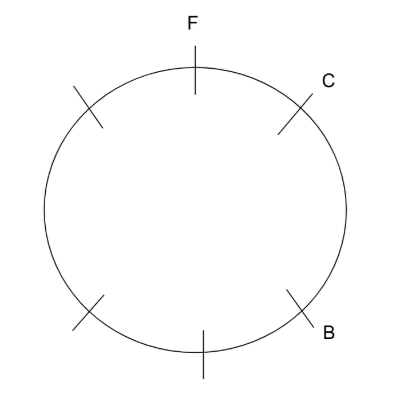
We know D and E are a pair that sit together.
Hence, A can be either opposite of F or opposite of B
So, The data in both statements together is not sufficient to answer the question
Input: TOWN, IDEA, CAGE
Step 1: TICNAE
Step 2: EANCIT
Step 3: IENCOT
Output: IENCOT
Find the output for the following input
Input: HAIR, OPEN, ULTRA
Solution
We see that the I/O uses the following logic,
Where the first letters of each work is taken and then last letters of each word is taken
Then the string is reversed,
And then each vowel is replaced with the next vowel
Following the same pattern for the input: HAIR, OPEN, ULTRA
Step 1: HOURNA
Step 2: ANRUOH
Step 3: ENRAUH
Output: ENRAUH
Input: MATH, LEAD, RUSH, COAT
Step 1: NMSDGCGS
Step 2: CDGGMNSS
Step 3: BCFFLMRR
Output: GOAT, SOFT, LAKH, RICE
Solution
In the first step, all the first alphabets of the four words are taken and their immediate next alphabet is written and in the second half, the last alphabet is taken and their immediate previous alphabet is written.
In step 2, the outcome of the step 1 is arranged in increasing order according to alphabet set.
In step 3, all the alphabets are changed with their respective and immediate previous alphabets.
Now, Input : GOAT, SOFT, LAKH, RICE
STEP 1: HTMSSSGD
STEP 2: DGHMSSST
STEP 3: CFGLRRRS
Hence, the output will be CFGLRRRS
In early 2025, Tesla announced its ambitious plan to develop a fully autonomous electric vehicle by 2028. CEO Elon Musk emphasized the need for innovation in artificial intelligence and battery technology to achieve this goal. The announcement sparked discussions about the feasibility of autonomous driving and its potential impact on the automotive industry, including concerns about safety, regulatory hurdles, and job displacement.
Assertion (A): The development of fully autonomous electric vehicles could significantly transform the automotive industry.
Reason (R): Elon Musk believes that advancements in artificial intelligence and battery technology are essential for creating fully autonomous vehicles.
Solution
While both the assertion that fully autonomous electric vehicles could transform the automotive industry and the reason that AI and battery technology advancements are essential are true, the reason provided does not directly explain why the transformation would occur. The transformation could be due to a variety of factors such as changes in consumer behavior, economic implications, or regulatory impacts, not solely because of technological advancements.
In the question given below, there are two statements marked as Assertion (A) and Reason (R).
Assertion (A): Disruptive innovations often end up displacing the existing products in the markets.
Reason (R): The main attribute of disruptive innovations is offering cheaper solutions to the existing products.
Solution
Assertion (A) is true because disruptive innovations often create new markets or significantly change existing ones, displacing existing products or technologies.
Reason (R), on the other hand, is false. While some disruptive innovations may be more affordable, their defining characteristic is not just being cheaper. Instead, they can create a new value proposition, often targeting a market niche that was previously underserved or ignored.
Therefore, Option C is the correct answer.
Choose the next figure in the pattern:
Solution
We see that the number of sides in the pattern is increasing from 3-4-6 so the next shape has to have 9 sides.
Identify the next term of the series among the following options:

Solution
We see two patterns:
First, the upper and lower arrows change their directions in every next box.
Second: Items in the first and second boxes exchange their positions, and then the item on the upper arrow in the second box is changed. Similarly, items in the third and fourth boxes exchange their positions. After that, the star at the upper arrow changes to a rhombus-shaped icon. Hence, in the sixth box, the icons of the fifth box should be exchanging their positions. Therefore, Option D is the correct option.
In the question below what will come in place of the question mark ‘?’ so that the figures are in series.
Solution
The inner most shape is becoming the outer most in the next figure. And the arrow is rotating by $$90^o$$.
In this pattern option A will be the answer.
In the question below what will come in place of the question mark ‘?’ so that the figures are in series.
Solution
We can see that the yellow square is going in a counter-clockwise direction inside the bigger area, with the arrow being diagonally opposite to it and pointing towards it.
Hence Option D is the correct answer.
In the question below what will come in place of the question mark ‘?’ so that the figures are in series.
Solution
From the given figures, we know the colours are interchanged on the circle, and the other part. The colours are moving in clockwise direction.
Hence, Option D is the correct answer.
Choose the figure from the options that comes next.
.jpg)
Solution
For each next figure, the number is multiplied by 2.
2, 4, 8, so next will be 16.
The moon crescent flips horizontally in the next figure and changes its position from Top left to Top Right to Bottom left, so next it would be Top Left.
The circle also moves in a similar fashion but also changes the angles of lines between.
So, in the last figure the circle will be in the top right.
The correct next figure will be
Hence, Option C is correct.
Choose the next figure in the series using logic of rotations:
Solution
From the first figure to the second, arrow is rotated twice anti clockwise. Second to third, its rotated thrice anti clock wise
So, the fourth image should be the arrow after rotating four times anti clockwise, which will be the same as the third figure.
Choose the pair of figures which best expresses the relationship similar to that given in the figures given initially?
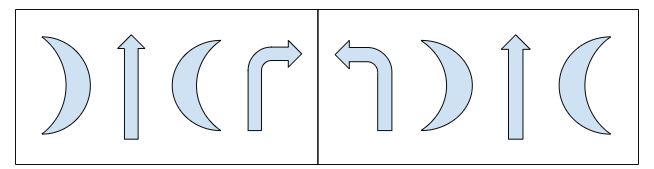
Solution
In the original question's figure, the order of the figures is reversed as well as the figures the changed from left to right facing.
In option 1, the sign of not equal to is not changed in terms of opposite side facing.
In option 2, the alphabet "L" is not changed in terms of opposite side facing.
Option 3 is correct.
In option 4, the alphabet "J" is not changed in terms of opposite side facing.
In option 5, the number "7 and 1" is not changed in terms of opposite side facing.
D 25 F : W 2 U : : M 8 T : ?
Solution
D 25 F $$\Rightarrow$$ 4 25 6
W 2 U $$\Rightarrow$$ 23 2 21
Adding the corresponding number is summing to 27.
With the same logic M 8 T (13 8 20) will be coded as (14 19 7) N 19 G.
If a mirror is placed on line AB, then which of the answer figures is the right mirror image of the given figure?
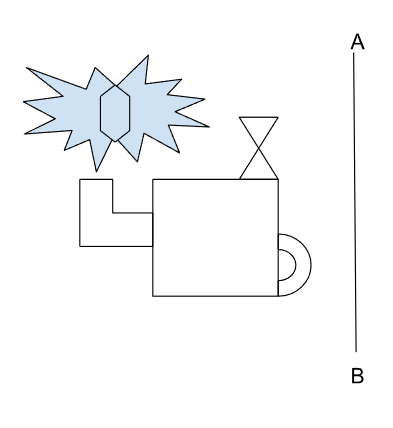
Solution
In a vertical mirror image, the hourglass-type triangle on top of the square should appear on the left top rather than the right top.
We can eliminate all options except D and E.
Option D's arch is on the same level as the L-shaped pipe, which would be incorrect.
This is not the case in E, which is a perfect image of the figure in question.
Therefore, Option E is the correct answer
Which of the following is the mirror image of superior?

Solution
Option A is the mirror image of “supreoir”
Option B is the mirror image of “superiro”
Option C is the mirror image of “superoir”
Option D is the mirror image of “supreior”
Thus, these options can be eliminated.
Option E is the mirror image of “superior”
Find the number of triangles in the figure
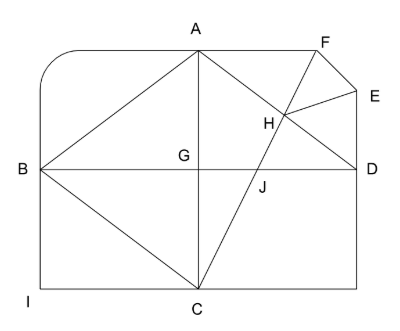
Solution
The following are the triangles
1. AGB
2. AGD
3. AHF
4. HFE
5. EHD
6. HDJ
7. ABD
8. ABC
9. BGC
10. BIC
11. GJC
12. BCJ
13. AHC
14. AFC
Hence, there are a total of 14 triangles.
Find the next term in the series: C2, E3, I5, O7, ??
Solution
C is the 3rd letter
E is the 5th letter
I is the 9th letter
O is the 15th letter
3, 3+2, 5+4, 9+6, 15+8 = 23
So, we are looking for the 23rd letter which is W.
The numbers are just prime numbers in order, so the next prime number is 11.
Identify the next step of the series:
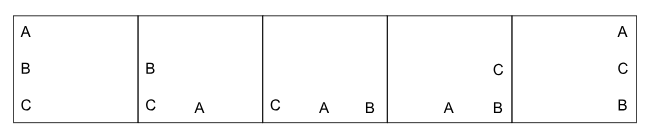
Solution
Here, we see the pattern that the three alphabets are moving anticlockwise and the alphabet last in the string takes the next spot in the anti clockwise direction.
Hence, in the 5th step, the B is last in the string so B will come in the middle spot of the top side and the position of A and C will remain the same as that in the step 5.
AZ, BX, CV, ET, HR, ??
Solution
The pattern in the second letter is clearly -2 from the respective second letter of the previous term.
And the first term is 1, 2, 3, 5, 8.
This is nothing but the sum of the two previous terms.
So, the first letter in the following term will be 13 - M.
And the second letter is R - 2 = P.
Hence, MP
Which of the following would logically be next in the sequence: A5I, D7J, G9K, ....?
Solution
Mapping the alphameric values, we can see that the numeric position of the alphabets give an average which is the same as the number between the two:
A+I= (1+9)/2 = 5
D+J = (4+10)/2 = 7
G+K = (7+11)/2 = 9
The next term in the series should also be following this pattern.
Also looking at the series we can see that the numbers ae increasing by 2 each turn, the next term should have 11 in the middle.
This narrows down options to C and E.
Of the two options, D would give an average of (11+13)/2 = 12
Hence E is the most logical next term of the series.
Which one of the following is the odd one out?
42, 74, 20, 30, 56, 90, 2, 6, 12
Solution
Let's analyze the pattern:
- 2 = 1 × 2
- 6 = 2 × 3
- 12 = 3 × 4
- 20 = 4 × 5
- 30 = 5 × 6
- 42 = 6 × 7
- 56 = 7 × 8
- 74 ≠ 8 × 9
- 90 = 9 × 10
The pattern here is that each number is the product of two consecutive integers.
However, 74 does not follow the same pattern.
Hence, 74 is the odd one out.
Choose the term that is the odd one out
Solution
The position of the letters in the alphabet corresponds to whether the numbers that follow are even or odd.
For letters in odd positions (A = 1, C = 3, E = 5, G = 7, I = 9), they are paired with odd numbers.
For letters in even positions (B = 2, D = 4, F = 6, H = 8, J = 10), they are paired with even numbers.
Option E: I (odd, 9) paired with 4 (even), J (even, 10) paired with 7 (odd) — Violates the pattern because the first letter (odd) is not paired with an odd number, the same goes for the second letter as well.
Which of the options have the following figure embedded in it? (Rotation not allowed)
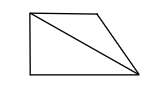
Solution
We notice that the figure is in the 5th option:
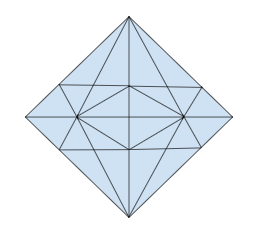
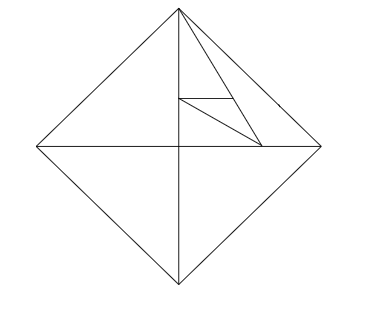
Read the following character sequence and adequately answer the question below.
9 % 5 m $ & f d 5 ) ! 8 # 7 p f 3 * d ? 1 m \ e 6 2 ! ? h
Which character is midway between the 15th from the left and the 27th from the right?
Solution
9 % 5 m $ & f d 5 ) ! 8 # 7 p f 3 * d ? 1 m \ e 6 2 ! ? h
The 15th character from the left = p
The 27th character from the right = 5
So, the characters between them are 5 m $ & f d 5 ) ! 8 # 7 p
The character which is in the middle is 5
The following words are modified such that all the letter are sorted in alphabetical order. Then all vowels are moved to first with out changing the order. If all these words are arranged in alphabetical order which word comes third. Ex: cracku $$\Rightarrow$$ ackru $$\Rightarrow$$ auckr
House, Tree, Water, Friend, Chair, Phone, Flower
Solution
Sorting each word alphabetically:
House → ehosu; Tree → eert; Water → aertw; Friend → definr; Chair → achir; Phone → ehnop; Flower → eflorw
Move all vowels to the front (without changing their order):
House → eouhs; Tree → eert; Water → aertw; Friend → eidfnr; Chair → aichr; Phone → eohnp; Flower → eoflrw
aertw, aichr are the first two as they are starting with 'a'.
Among the words that start with 'e', tree will be ranked third.
So, tree is the answer.
If the characters of each word below are flipped in order (for example, Mother would change to Rehtom) and the words are then arranged in alphabetic order, which of the following words would be placed fifth?
Easy, Broad, Handy, Eliminate, Fork, Ridiculous, Bottle, Cup, Pen, Mouse, Pad, Spoon
Solution
Since the words would be flipped, we need to look at their ending rather than their start
We see that pad and broad would be the first two, in some order (starting with d)
The next word would be ending with e: Bottle, Mouse, Eliminate; since we want to find the fifth one, we will have to check for them.
Bottle would be first, starting with l
Mouse would be second, starting with s
and finally, Eliminate would be third, starting with t
Therefore, Option D is the correct answer.
If all alphabets in the word " PROBABILITY "are replaced with their FOURTH next consecutive alphabet to form a new word. Which of the following alphabet is not a part of the new word?
Solution
If all the alphabets of the word " PROBABILITY " are replaced with the FOURTH next alphabet.
The new word formed is :
TVSFEFMPMXC.
Hence Q is not a part of the new word.
Option E is the correct answer.
The word "SERENDIPITY" is taken, and the letters are arranged alphabetically. Each vowel is replaced with the next vowel in the aplhabetical series, and the consonants are replaced by next consonants in the alphabetical series. Find the number of letters between "P" and "Z".
Solution
SERENDIPITY arranged alphabetically becomes DEEIINPRSTY.
Doing the operation that is described in the question we now get, F I I O O P Q S T V Z.
We see that there are exactly 4 letters between and P and Z.
Hence, the answer is 4.
If all the letters in the word "LOQUACIOUS" are arranged in reverse alphabetical order from left to right in such a way that vowels are arranged first followed by consonants, then how many letters are there in between L and I after the arrangement?
Solution
The word given is LOQUACIOUS
Reverse alphabetical but vowels first,
Vowels being: OUAIOU, in reverse order would be UUOOIA
Consonants being: LQCS in reverse order is SQLC
The needed string UUOOIASQLC
We see there are three letters between L and I
